
Submitted:
31 July 2026
Posted:
03 August 2026
You are already at the latest version
Abstract
Workplace language proficiency functions as career capital because it shapes whose expertise is heard, trusted, and converted into developmental assignments, networks, promotion, and mobility. Generative artificial intelligence (GenAI) separates an employee's underlying language proficiency from the communicative performance produced with technological assistance. This critical integrative review synthesises 37 substantive sources across language and careers, AI-mediated communication, multilingual model performance, workplace productivity, identity, and AI literacy. Sources were classified by evidentiary proximity to career outcomes, from model benchmarks and simulated tasks to workplace processes and direct mobility evidence. The evidence demonstrates task-level and workplace-process benefits alongside uneven cross-language performance and unresolved legitimacy concerns. However, no study in the reviewed set directly links GenAI-supported multilingual communication with promotion, pay growth, lateral mobility, or access to strategic assignments. The article therefore distinguishes empirical findings from theoretical inference and extends the Language Needs Analysis (LANA) framework through a five-stage conversion chain from practical access to career outcomes. Two conditional pathways explain how GenAI may flatten language ceilings through improved performance, participation, learning, and visibility, or re-stratify work through unequal access, verification burdens, cross-language error, and authenticity penalties. Five explicitly testable propositions and a multilevel research agenda are advanced. Inclusive career outcomes depend on how organisations distribute, legitimate, evaluate, and govern AI-mediated communication, not on tool availability alone.
Keywords:
AI-mediated communication
; career capital
; career mobility
; generative artificial intelligence
; language barriers
; language ceilings
; multilingual workplaces
; workplace inclusion
1. Introduction
Language proficiency is often treated as a communication skill, but in multilingual organisations it also functions as a mechanism of valuation. Employees who can communicate in the corporate language are more likely to participate visibly, build relationships across organisational boundaries, and be considered ready for roles with broader scope. Those who cannot may encounter barriers that are only partly related to their technical competence. Bhar and Chua (2025) describe these barriers as language ceilings and language walls. A ceiling restricts vertical advancement when the linguistic demands of a higher role exceed those recognised or supported in a lower role. A wall restricts horizontal movement by limiting access to teams, functions, locations, or networks. Through these mechanisms, language becomes career capital: a resource whose value depends on the organisational settings in which it can be mobilised and recognised.
Generative artificial intelligence (GenAI) challenges a basic assumption embedded in this literature. Before GenAI, the production of polished workplace language was usually attributed to the worker or to visible human assistance. Large language models can now draft emails, translate documents, summarise meetings, revise tone, suggest replies, and support rehearsal in near real time. AI-mediated communication therefore separates at least three elements that were previously bundled together: the worker's underlying language proficiency, the quality of the message received by others, and the organisational attribution of that quality. A worker may produce a highly effective message without independently possessing every linguistic capability manifested in the output. Conversely, a fluent worker may be evaluated negatively if AI assistance is suspected or disclosed.
Organisational adoption is no longer hypothetical. In a late-2024 survey of more than 5,000 small and medium-sized enterprises across seven countries, 31% reported using GenAI and 65% of users reported improved employee performance (Organisation for Economic Co-operation and Development [OECD], 2025). These figures establish organisational reach and perceived value, not causal effects or career returns. The report concerns selected economies and small and medium-sized enterprises and should not be generalised to all workplaces.
The distinction matters because the strongest evidence concerns tasks and proximal workplace processes rather than careers. Experiments show that GenAI can reduce the time required for professional writing and improve evaluated output quality (Noy & Zhang, 2023). Field evidence from customer support shows productivity gains, especially among less experienced and lower-performing workers (Brynjolfsson et al., 2025). A survey of 366 employees also associated cognitive and social GenAI use with innovative job performance through knowledge transfer, resource acquisition, and job satisfaction (Zhang et al., 2026). These studies make barrier reduction plausible, but they do not establish that multilingual employees subsequently receive stronger ratings, better assignments, larger wage increases, or more promotions.
Multilingual performance is also uneven. Language technologies perform systematically better for some languages than others (Blasi et al., 2022; Joshi et al., 2020), while experimental evidence across English, Arabic, and Chinese indicates that the work value of AI-generated content can differ by language and task domain (Koo, 2025). This evidence supports concern about unequal assistance, but not a conclusion that career inequality has already resulted. AI assistance can also alter social judgement. People may communicate more positively with AI support while being judged less favourably when AI use is suspected (Hohenstein et al., 2023), and automated detectors can disproportionately misclassify writing by non-native English speakers (Liang et al., 2023).
This article asks: Under what conditions might GenAI flatten language ceilings and walls, and under what conditions might it reconfigure them into new forms of linguistic and technological stratification? It answers this question through a critical integrative review and theory-development approach spanning international management, human resource management (HRM), communication, human-computer interaction, and multilingual natural language processing. The article makes three contributions. First, it separates assisted communication performance from career mobility and specifies the missing conversion mechanisms between them. Second, it develops flattening and re-stratification as conditional, testable pathways. Third, it extends the Language Needs Analysis (LANA) framework (Bhar & Chua, 2025) by treating GenAI as a mediation layer whose effects depend on individual capability, organisational governance, and operational task characteristics.
The argument is deliberately conditional. GenAI is neither inherently inclusive nor inherently stratifying. Its career consequences depend on practical access, language and task fit, verification capability, legitimacy, and whether improved communication changes opportunity allocation. The article therefore avoids treating productivity, confidence, or message quality as substitutes for observed career outcomes.
2. Review Design and Evidentiary Boundaries
This article uses a critical integrative review as the foundation for theory development. Integrative reviews are appropriate when evidence is dispersed across fields and the purpose is to connect empirical findings, examine conceptual assumptions, and generate a framework rather than estimate a pooled effect (Snyder, 2019; Torraco, 2005). The design is appropriate because research directly combining GenAI, multilingual workplace communication, and career mobility remains immature. The objective is transparent analytic integration and mechanism development, not an exhaustive census or pooled estimate.
Source discovery was iterative and was last updated on 20 July 2026. Targeted searches of scholarly discovery interfaces were combined with publisher and DOI records, the manuscript's existing reference set, backward reference checks, and forward citation trails visible from core sources. Search concepts combined ("generative AI" OR "large language model" OR ChatGPT) with terms from four domains: (a) workplace and organisation; (b) multilingual, non-native speaker, language barrier, translation, or communication; (c) trust, authenticity, identity, or AI literacy; and (d) career, promotion, mobility, pay, appraisal, assignment, or employability. A final direct-outcome check required at least one GenAI term, one multilingual or language-barrier term, and one career-outcome term.
Sources were eligible when they were peer-reviewed empirical, conceptual, or review publications that informed at least one link from technological capability to assisted communication, workplace recognition, opportunity allocation, or career outcome. The OECD report was retained only as adoption context. Sources were excluded when they addressed AI without a communication, language, work, identity, capability, or career mechanism; discussed traditional machine translation without relevance to GenAI-mediated work; duplicated an included publication; or provided claims that could not be checked against a primary publisher or DOI record. Academic writing, creativity, and detector studies were retained only when they clarified identity, attribution, or standardisation mechanisms and are explicitly treated as adjacent rather than workplace-career evidence.
The final reference set contains 39 works: 37 substantive sources and two review-method guides. The substantive sources were coded into seven roles: pre-GenAI language and career foundations (n = 18), multilingual model or benchmark evidence (n = 3), simulated work-task evidence (n = 2), direct workplace-process evidence (n = 4), adjacent recognition or identity evidence (n = 5), enabling-condition evidence on AI-mediated communication, literacy, or digital inequality (n = 4), and adoption context (n = 1). The author screened and coded the sources and checked bibliographic details against primary publisher or DOI records. Because the process did not begin with a reproducible database export and was not independently double-screened, the article is not presented as a systematic review. The bounded conclusion is therefore: no direct study was identified within this reviewed set that linked GenAI-supported multilingual communication to promotion, pay growth, lateral mobility, or access to strategic assignments. This is an evidentiary discontinuity, not proof that no such study exists.

Table 1.
Review audit trail and decision rules.
| Review element | Recorded decision |
| Purpose | Integrate dispersed evidence and develop mechanisms linking GenAI-mediated multilingual communication to career capital and mobility. |
| Search update | Iterative discovery completed through 20 July 2026, followed by publisher/DOI verification and citation chaining. |
| Core concept blocks | GenAI; workplace/organisation; multilingual communication; recognition/identity/AI literacy; career and opportunity outcomes. |
| Eligibility | Peer-reviewed empirical, conceptual, or review work informing at least one conversion-chain link; one OECD report used only for adoption context. |
| Exclusion | No relevant mechanism; traditional translation without GenAI-work relevance; duplicate publication; or bibliographic/claim details not verifiable from a primary record. |
| Evidence coding | Each source coded by evidence role and proximity to career outcomes. Adjacent evidence was not treated as direct workplace-career evidence. |
| Synthesis set | 39 works: 37 substantive sources plus two review-method guides. Screening and coding were completed by the author. |
| Inference boundary | No universal absence claim. The identified gap is restricted to the reviewed set and the search date. |
Table 2.
Evidence-chain map for GenAI, multilingual communication, and career mobility.
| Evidence link | Representative evidence | What the evidence can establish | What it cannot establish |
| 1. Model capability | Multilingual benchmarks and language-technology evaluations (Ahuja et al., 2023; Blasi et al., 2022; Joshi et al., 2020) | Relative performance across languages and tasks | Effective use in a particular workplace or any career benefit |
| 2. Simulated work tasks | Professional writing and multilingual email experiments (Koo, 2025; Noy & Zhang, 2023) | Changes in speed, evaluated quality, actionability, or creativity | Durable learning, opportunity allocation, promotion, or pay |
| 3. Workplace processes | Customer support, employee-performance, organisational-relationship, and professional-boundary studies (Brynjolfsson et al., 2025; Nguyen et al., 2026; Yinglei & Nik Hasan, 2026; Zhang et al., 2026) | Productivity, job performance, communication satisfaction, relationships, or boundary control | Multilingual career effects across occupations or organisations |
| 4. Recognition and identity | Attribution, authenticity, identity, detection, and output-diversity studies (Doshi & Hauser, 2024; Hohenstein et al., 2023; Hu et al., 2025; Jago, 2019; Liang et al., 2023) | Possible mechanisms affecting trust, authorship, legitimacy, and evaluation | Net effects on formal employment or mobility outcomes |
| 5. Multilingual career outcomes | No direct study identified within the reviewed evidence | Promotion, pay growth, lateral movement, strategic assignments, or mobility intentions, if directly studied | This missing link is the focal evidence gap |
3. Language Ceilings and Walls Before GenAI
Evidence-status convention. Throughout Section 3, Section 4, Section 5, Section 6, Section 7 and Section 8, claims are interpreted at four levels: direct evidence (observed career or opportunity outcomes), workplace-process evidence (observed workplace behaviour or employee reports), adjacent evidence (benchmarks, simulations, academic or social settings), and theoretical proposition (a relationship advanced for future testing). No direct GenAI-multilingual career evidence was identified in the reviewed set. Accordingly, the five propositions are predictions, not findings.
3.1. Language as Career Capital
Career capital refers to resources that individuals accumulate and convert across roles and organisations. Its value is not purely intrinsic. A competence becomes capital when it is legible, valued, and usable within a field of opportunity (Bourdieu, 1991; DeFillippi & Arthur, 1994; Inkson & Arthur, 2001). Language illustrates this relational quality. Fluency can increase access to information and networks, but its career return depends on the language regime of the organisation, the role under consideration, and the people authorised to evaluate readiness.
Empirical research supports a link between language competence and mobility. Itani et al. (2015) show that language skills shape both psychological and physical dimensions of career mobility. Peltokorpi (2023), using two time-lagged studies of local employees in foreign subsidiaries in Japan, links English-language competence to objective and subjective career outcomes through managerial encouragement and social capital. Latukha et al. (2016) similarly show that corporate language can influence career mobility in multinational corporations. These studies do more than associate language with task efficiency. They identify relational mechanisms through which competence is noticed and converted into opportunity.
Language competence also structures power. In multinational corporations, language can influence formal structure, informal networks, knowledge flows, and employees' access to headquarters (Marschan-Piekkari et al., 1999; Welch & Welch, 2008). The adoption of a common corporate language may improve coordination while redistributing status toward those already fluent in that language (Harzing & Pudelko, 2013; Neeley, 2013). In global teams, language barriers affect trust formation, emotion regulation, subgroup dynamics, and power contests (Hinds et al., 2014; Tenzer et al., 2014). Employees are therefore evaluated not only on what they know but also on the ease, confidence, and culturally recognisable form with which they make that knowledge available.
The language-sensitive turn in international management further shows that language is not a neutral channel layered over organisational processes. It helps constitute hierarchy, identity, coordination, and control, which makes its effects relevant to both theory and managerial practice (Brannen et al., 2014; Karhunen et al., 2018).
3.2. Ceilings, Walls, and Discontinuous Requirements
The concepts of language ceilings and walls consolidate these observations into a career framework (Bhar & Chua, 2025). A language ceiling arises when employees can perform successfully at one level but are treated as unready for roles requiring different communication repertoires. A language wall blocks movement across functions, projects, or geographies. Neither barrier needs to appear in a formal job description. It can be reproduced through staffing conversations, client-facing criteria, informal sponsorship, or assumptions about executive presence.
These barriers are reinforced by discontinuity. Suzuki et al. (2023) show that the oral and literacy demands associated with job roles do not necessarily rise in a simple linear sequence. Skills that are adequate for a current role may not prepare an employee for the communication ecology of a managerial role. A technically strong employee may therefore receive little opportunity to practise the persuasive, relational, or representational communication that is later used to deny advancement. This is one reason why generic language training can miss the problem. The relevant need is not merely a higher test score but access to the communicative practices of the next role.
Evaluation is also ideological. Non-native English-speaking staff can be judged through assumptions that conflate accent, style, confidence, and competence (Śliwa & Johansson, 2014). Barner-Rasmussen et al. (2024) show how language ideologies shape participation by prescribing whether employees should pursue perfection, rely on hybrid practices, or remain silent. Such norms define which forms of multilingual communication count as professional. Language barriers are therefore produced jointly by individual repertoires and organisational expectations.
3.3. The Original LANA Contribution
Bhar and Chua (2025) developed LANA to reconnect language development with career progression. LANA examines needs at three levels. The individual level concerns an employee's current repertoire, confidence, aspirations, and developmental gaps. The organisational level concerns language policies, access to learning, managerial support, and the ways that language is embedded in talent systems. The operational level concerns the actual linguistic demands of tasks, roles, and interactions. This multilevel structure avoids locating responsibility solely in the employee.
The pre-GenAI framework nevertheless assumes, understandably, that communicative capability resides primarily in the worker and develops through education, experience, and interaction. GenAI changes the site of production. A message may now be jointly produced by an employee, a model, organisational data, and an interface. The employee still supplies intent, context, judgement, and accountability, but not every word or translation. The theoretical question shifts from whether the employee possesses a linguistic resource to whether an AI-supported performance can be reliably produced, appropriately verified, and legitimately converted into career capital.
4. GenAI as a Communication-Barrier Technology
4.1. From Language Tool to Mediated Agency
AI-mediated communication occurs when an intelligent agent modifies, augments, or generates messages on behalf of a communicator (Hancock et al., 2020). GenAI expands the scope and visibility of that mediation. Spell-checking corrects bounded errors; a large language model can reorganise an argument, adjust politeness, translate a document, propose a response, or simulate a difficult conversation. The technology therefore acts as a communicative mediator, but the employee remains responsible for intent, context, verification, and consequences.
For multilingual employees, the affordances are substantial. Drafting support can reduce the cognitive load of encoding ideas in a second or additional language. Translation can widen access to documents and interactions. Tone revision can help workers navigate unfamiliar pragmatic conventions. Summarisation can support comprehension when meetings or documents contain dense, fast, or idiomatic language. Rehearsal tools can create low-risk opportunities to practise. These affordances plausibly reduce the immediate cost of crossing a language wall.
Voice-based translation, live captions, and meeting interpretation extend mediation into synchronous work. In principle, they can help employees follow rapid exchanges and contribute without waiting for a human translation cycle. In practice, the value of these tools depends on speech recognition across accents, speaker identification, latency, turn-taking, privacy, and the accurate rendering of specialised meaning. The review found no workplace study that connects use of these functions to multilingual career mobility. They are therefore treated as emerging affordances within AI-mediated communication (Hancock et al., 2020), not as evidence that synchronous language barriers have already been removed.
Experimental evidence provides an initial basis for barrier-reduction claims. Noy and Zhang (2023) found improved productivity and evaluated quality on mid-level professional writing tasks. Brynjolfsson et al. (2025) reported productivity gains in customer support, with larger gains among less experienced and lower-performing workers and improved communication fluency among international agents. At a broader organisational level, Zhang et al. (2026) associated cognitive and social GenAI use with knowledge transfer, resource acquisition, job satisfaction, and innovative job performance. These findings support plausible communication and resource mechanisms, but only the customer-support study directly observed work behaviour, and none tested multilingual career mobility.
The evidence is therefore useful but bounded. Customer support involves recurring, text-rich tasks with observable resolution outcomes and extensive historical data. Survey associations with innovative performance are not causal evidence. Leadership communication, negotiation, conflict, sponsorship, and client trust rely more heavily on contextual knowledge, embodied presence, spontaneity, and accountability. Results from bounded writing and service tasks should not be assumed to transfer to these higher-stakes interactions.
4.2. Uneven Multilingual Capability
The label multilingual GenAI can create a misleading impression of equivalent capability across languages. Reviews of natural language processing document systematic inequalities in data availability, research attention, and performance (Blasi et al., 2022; Joshi et al., 2020). Ahuja et al. (2023) likewise show that generative models vary across multilingual evaluation tasks. These benchmark studies identify capability asymmetry; they do not show how employees use the systems, how organisations evaluate outputs, or whether any career consequence follows.
Koo (2025) offers the most directly relevant experimental work-task evidence currently used in this review. In a preregistered experiment with 480 participants across English, Arabic, and Chinese, the value of AI assistance varied by language and task domain. Arabic- and Chinese-language participants received smaller gains on some dimensions of actionability and creativity, particularly in specialised tasks. The study demonstrates cross-language variation in one model, three languages, and simulated email tasks. It does not establish stable language rankings, effects in natural organisations, or career inequality.
These findings motivate, rather than confirm, the possibility of a second-order ceiling. If employees using less well-supported languages must spend more time detecting errors, reconstructing context, or translating through English, the cost of apparently equivalent assistance may be unevenly distributed. Whether that burden affects participation, assignment allocation, or mobility remains an empirical question. The manuscript therefore treats the second-order ceiling as a conditional theoretical mechanism, not an observed career outcome.
4.3. Identity, Trust, and Attribution
Communication transmits information while also signalling effort, identity, expertise, warmth, and membership. Hohenstein et al. (2023) found that AI assistance can improve the positivity and efficiency of communication while changing how recipients judge a communicator when assistance is suspected. This work supports an attribution mechanism, but it does not concern promotion or multilingual organisational careers.
Jago's (2019) research on algorithms and authenticity predates the current GenAI wave but helps explain why technologically improved performance may not receive full social credit. Workplace evidence also shows that professional groups actively negotiate the boundaries of acceptable AI use. Yinglei and Nik Hasan (2026), based on interviews with 16 journalists in Malaysia and China, reported selective AI incorporation alongside continued professional boundary control, particularly where accuracy and stakeholder obligations were salient. This supports legitimacy as an organisational mechanism, not a claim about career outcomes.
Identity tensions are also evident in adjacent professional settings. Hu et al. (2025) found that non-native English-speaking researchers used ChatGPT for linguistic support while negotiating authorship, legitimacy, confidence, dependence, and disclosure. In an organisational study in Vietnam, Nguyen et al. (2026) examined relationships among AI-mediated communication, social presence, communication satisfaction, and professional relationships. These studies show that assistance can affect voice, satisfaction, and relationships, but neither establishes multilingual promotion or mobility effects.
Detection technologies may intensify attribution problems. Liang et al. (2023) demonstrated that several GPT detectors disproportionately classified writing by non-native English speakers as AI-generated. This was not an employment study, so the manuscript does not infer that such penalties are already occurring in recruitment or appraisal. It identifies a governance risk: if unreliable detection scores are used as decisive employment evidence, linguistic bias may be reproduced.
Assistance may also narrow expression. In an adjacent creative-writing context, Doshi and Hauser (2024) found that GenAI increased individual creativity while reducing the collective diversity of outputs. The workplace implication remains hypothetical: standardisation may improve processing ease while weakening local rhetorical resources or distinctive professional voice. This possibility requires direct testing in multilingual organisations.
5. Two Competing Pathways
The reviewed evidence supports neither a simple inclusion thesis nor a simple displacement thesis. It supports component mechanisms at different evidentiary distances from career mobility. The pathways below are therefore theory-building integrations. They organise established findings into relationships that remain to be tested as complete career pathways.
5.1. Pathway A: Flattening Language Ceilings and Walls
The flattening pathway begins with compensation. Employees use GenAI to reduce the time, anxiety, or error associated with communication in a non-dominant language. Better messages then improve comprehension and interaction. If these gains enable employees to contribute more frequently, enter cross-border exchanges, and take on visible assignments, they can strengthen knowing-how, knowing-whom, and knowing-why forms of career capital. Assistance becomes consequential when it changes opportunity, not merely prose.
Three mechanisms deserve separation. First, substitution allows a model to perform part of a task that the employee could not yet perform independently. Second, augmentation allows the employee to express existing expertise more effectively. Third, scaffolding helps the employee learn through feedback, comparison, and rehearsal. Substitution can remove an immediate wall but leave the underlying ceiling intact. Augmentation can correct an evaluation distortion by allowing substantive competence to be seen. Scaffolding can produce a durable gain if the employee internalises new linguistic and pragmatic knowledge.
The compensatory pattern in Brynjolfsson et al. (2025) suggests that benefits may be larger among workers with less experience or lower initial performance. Translating that pattern into a language proposition requires care. Language confidence, unaided task-language proficiency, domain expertise, and verification accuracy are distinct constructs. Lower proficiency may create more room for improvement while also making fluent errors harder to detect.
Theoretical Proposition 1 (not yet directly tested). Assisted-performance compensation. For bounded, text-based, and verifiable tasks, GenAI assistance will produce larger communication-performance gains when unaided task-language proficiency is lower, provided that domain knowledge and verification accuracy are sufficient for the task's error consequences.
Career value emerges only if communication affects visibility and allocation. An improved email that remains peripheral to decision making may have no mobility effect. By contrast, assistance that enables an employee to speak in a cross-border meeting, lead a client exchange, or join a strategic project can alter network position and managerial expectations.
Theoretical Proposition 2 (not yet directly tested). Opportunity conversion. The effect of GenAI-assisted communication on career outcomes will be mediated sequentially by communication quality, participation and visibility, and access to developmental assignments or influential networks.
Substitution and scaffolding also imply different time horizons. Repeated substitution may preserve assisted performance while leaving unaided competence unchanged. Scaffolded use requires employees to compare revisions, explain choices, practise without assistance, and receive feedback, making transfer more plausible. Immediate output quality and durable capability should therefore be measured separately.
Theoretical Proposition 3 (not yet directly tested). Learning conversion. Over repeated use, scaffolded GenAI practice that includes comparison, explanation, feedback, and unassisted performance will produce greater transferable language gains than substitution-only use, even when both approaches generate similar immediate assisted performance.
5.2. Pathway B: Re-Stratifying Multilingual Work
The re-stratification pathway begins when access and effective use are uneven. Digital inequality includes not only whether a person has a device or account but also differences in skills, support, autonomy, and realised outcomes (Lythreatis et al., 2022). In workplaces, some employees receive secure enterprise tools, training, and permission to experiment. Others rely on restricted free versions, cannot input confidential context, or work in roles where AI use is prohibited. A nominally available technology may therefore distribute capability unevenly.
AI literacy creates another distinction. Effective use requires more than prompt formulation. Employees must understand tool limits, judge output quality, protect sensitive information, and decide when not to use the system. Measures of AI literacy increasingly distinguish technical use, critical evaluation, ethical awareness, self-efficacy, and self-management (Carolus et al., 2023; Liu et al., 2025). When language support becomes dependent on these capacities, the old language ceiling can become an AI-fluency ceiling.
Model inequality interacts with this skills gap. Employees communicating in less well-resourced languages may need greater expertise to verify outputs and may incur higher error costs. In high-stakes domains, a polished but incorrect translation can be more dangerous than visibly imperfect human language because fluency increases unwarranted trust.
Theoretical Proposition 4 (not yet directly tested). Resource and governance asymmetry. The barrier-reducing effect of GenAI will be weaker where model performance is poorer for the relevant language and task, verification costs are higher, or secure access and training are unequally distributed; these disadvantages will intensify as the consequences of error increase.
Re-stratification can also arise through social judgement. If evaluators interpret AI assistance as evidence that an employee lacks authentic ability, improved output may not convert into status. The penalty may be especially sharp when organisations have no shared disclosure norms. Employees are left to choose between concealing assistance and risking accusations of deception, or disclosing assistance and risking competence discounting.
Theoretical Proposition 5 (not yet directly tested). Attribution and legitimacy penalty. Disclosure or credible suspicion of GenAI assistance will reduce evaluator judgements of authorship, authenticity, and role readiness when legitimate-use norms are ambiguous, with stronger penalties in relational and leadership communication than in bounded administrative tasks.
Institutional arrangements determine whether these risks remain isolated or become systematic. Performance systems may continue to reward unaided linguistic polish after routine work becomes AI-mediated. Managers may also allocate stretch work to employees whose spontaneous fluency appears safer while allowing other employees to use AI only for low-visibility tasks. In that case, assisted performance improves without expanding access to the communicative practices required for advancement.
Proposition 4 treats access, training, model quality, and verification burden as cross-level boundary conditions. Proposition 2, by contrast, tests whether an observed communication gain is converted into opportunity and career outcomes. This distinction separates unequal inputs from unequal returns.
The pathways are not mutually exclusive. A worker may experience immediate task-level flattening and longer-term re-stratification. The propositions also require different evidence. Propositions 1 and 4 can first be examined in multilingual task experiments; Proposition 5 requires evaluator studies; Proposition 3 requires repeated assisted and unassisted assessment; and Proposition 2 ultimately requires longitudinal organisational data linking communication to assignments and mobility.
6. Extending LANA for GenAI-Mediated Work
6.1. GenAI as a Transversal Layer
LANA levels identify the sites at which language needs and responsibilities are located: the employee, the organisation, and the task or interaction. GenAI is different. It is not a stable diagnostic site because its operation is constituted through all three levels. Output depends simultaneously on the employee's repertoire and judgement, organisational access and governance, and the language, modality, genre, audience, and stakes of the task. Treating technology as an independent fourth level would risk obscuring these dependencies and reifying the tool as an autonomous cause. For the present explanatory purpose, GenAI is therefore modelled as a transversal mediation layer. A fourth-level formulation may still be useful for studies focused on external vendors or technological ecosystems, but it is less suitable for diagnosing how workplace communication is produced and evaluated.
This choice changes the diagnostic question. Traditional needs analysis asks what language an employee needs to perform a role. GenAI-LANA also asks which parts of performance may be mediated, what the employee must still understand and verify, what organisational data and permissions are required, and how evaluators will attribute the resulting performance. The unit of analysis becomes a sociotechnical communicative performance rather than an isolated worker deficit.
Table 3.
GenAI-LANA diagnostic matrix.
| LANA level | Traditional diagnostic focus | Potential flattening mechanism | Re-stratifying risk | Illustrative indicators |
| Individual | Repertoire, confidence, aspirations, development needs | Drafting, translation, rehearsal, feedback, reduced anxiety | Weak verification, miscalibrated confidence, dependence, identity conflict, unequal AI literacy | Language proficiency and confidence; AI literacy; verification accuracy; assisted and unassisted performance; perceived voice ownership |
| Organisational | Policy, learning access, managerial support, talent processes | Secure access, role-specific training, legitimate-use norms, fair evaluation of substantive expertise | Tiered access, surveillance, detector misuse, ambiguous legitimacy, unchanged promotion norms | Tool access by grade; training uptake; policy clarity; manager attitudes; rating, assignment, and promotion gaps |
| Operational | Actual language demands of tasks and roles | Role-specific templates, live support, multilingual knowledge access | Poor task fit, cross-language error, high verification cost, over-standardisation | Task genre; modality; language pair; model error rate; verification time; interaction stakes; audience response |
6.2. The Conversion Chain
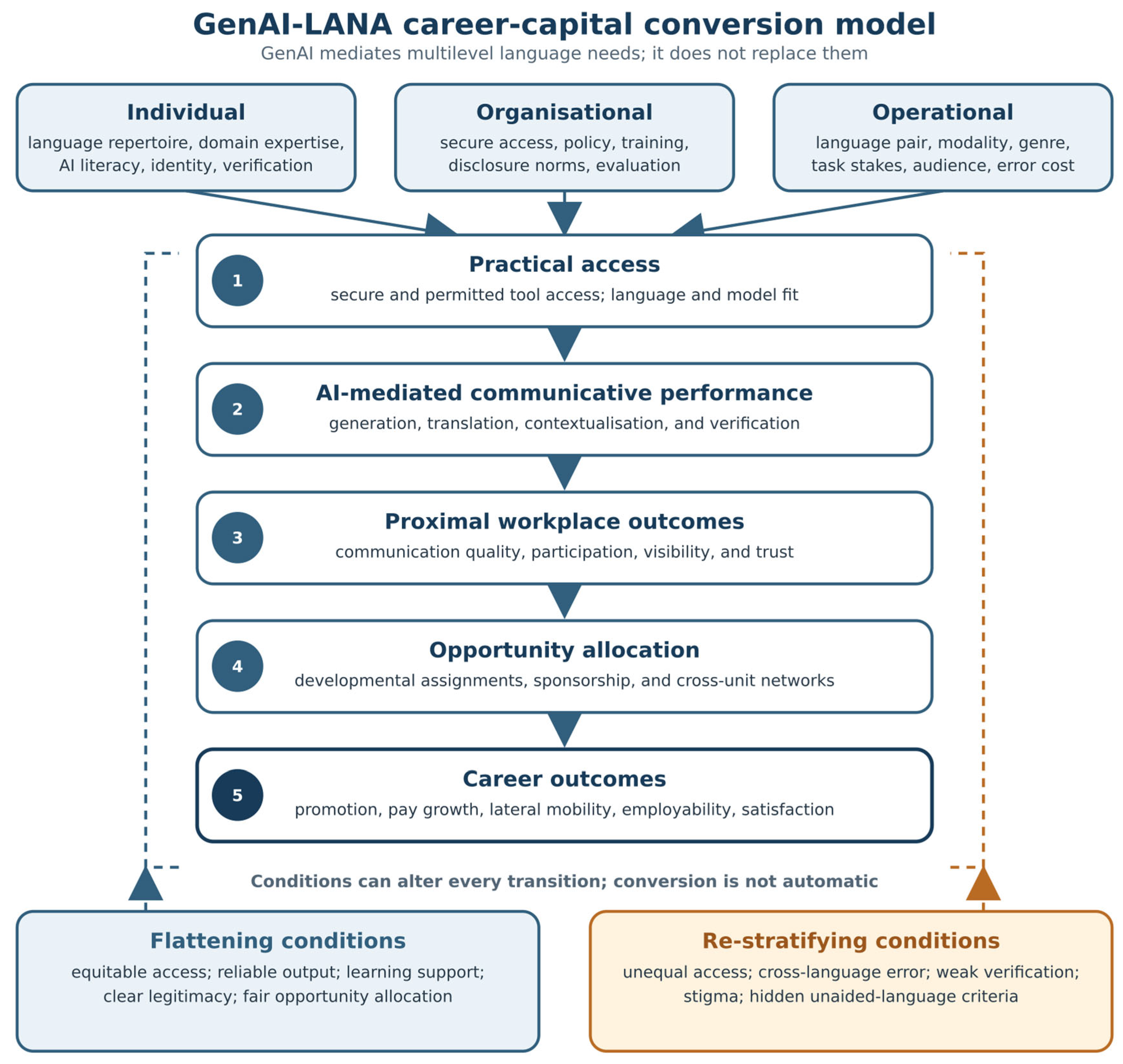
The extended framework proposes five distinct stages. First, employees obtain practical access to a secure and permitted tool that fits the relevant language and task. Second, access is converted into AI-mediated communicative performance through generation, translation, contextualisation, and verification. Third, that performance affects proximal workplace outcomes such as communication quality, participation, visibility, and trust. Fourth, those outcomes may change the allocation of developmental assignments, sponsorship, cross-unit networks, or higher-status interaction. Fifth, accumulated opportunities may affect promotion, pay growth, lateral mobility, employability, or career satisfaction.
The revised chain makes the evidentiary discontinuity explicit. Failure can occur at any transition. A tool may be licensed but unusable with confidential data. Output may be fluent but inaccurate. An accurate contribution may be discounted as inauthentic. A well-received contribution may still fail to change staffing decisions, and repeated opportunity may not be rewarded if promotion criteria remain tied to unaided performance. Flattening and re-stratifying conditions therefore operate across the full chain rather than only at the final career transition.
The framework also distinguishes proximal from distributive inclusion. Proximal inclusion occurs when employees communicate more easily, participate more, or feel more confident. Distributive inclusion occurs when valued assignments, sponsorship, ratings, pay, and mobility become more equitably allocated. The first is desirable but does not guarantee the second. A credible inclusion claim must trace conversion beyond user experience.
Figure 1.
GenAI-LANA career-capital conversion model.
6.3. Boundary Conditions
Four boundary conditions recur across the three LANA levels. The first is language-resource position. Performance in high-resource languages cannot be presumed for all languages or dialects. The second is task stakes. Low-stakes drafting permits experimentation; legal, clinical, safety, financial, and executive communication demands stronger verification. The third is governance maturity. Clear rules, secure systems, appeal processes, and manager training reduce uncertainty and arbitrary penalties. The fourth is legitimacy. Employees must know which uses are accepted and how their contribution will be attributed.
These conditions interact. A low-resource language used in a high-stakes task under weak governance presents a markedly different risk profile from English-language drafting in a well-supported administrative role. LANA offers a way to make that variation visible before an organisation labels a tool inclusive.
7. Discussion
7.1. Theoretical Implications
The first theoretical implication concerns the location of capability. Communicative performance in AI-mediated work is increasingly distributed across employee knowledge, model capability, interface design, organisational data, and permission to use the system. This does not mean that career capital itself is automatically distributed. System-enabled performance becomes an employee's portable career capital only when the employee can reliably supervise it, explain it, transfer it across settings, and receive recognised credit for it. The framework therefore distinguishes owned competence, temporarily accessed technological capability, and organisationally recognised performance.
The second implication is that recognition remains the missing mechanism. Language research shows that competence gains career value through social capital, managerial encouragement, and access to organisational arenas (Peltokorpi, 2023). GenAI may alter the signal received by evaluators, but managers and institutions still decide whether that signal warrants opportunity. Communication parity is therefore not equivalent to mobility parity.
Third, inclusion should be theorised as conversion rather than availability. Providing the same licence to every employee may satisfy a narrow access criterion while leaving differences in training, language support, task permission, verification cost, and managerial legitimacy untouched. Equal inputs do not ensure equal career returns. Differentiated support may be required where languages, tasks, and roles impose different verification burdens.
Fourth, compensation and development should be separated. Compensation can be legitimate and valuable even when it does not build unaided proficiency. The problem arises when organisations benefit from assisted performance while continuing to use unaided communication as a hidden advancement criterion. HR systems should state whether they are evaluating independent language production, effective AI-supervised communication, transferable learning, or a combination of these capabilities.
Finally, GenAI may move rather than remove the ceiling. The valued competence may shift from producing polished corporate language to supervising, verifying, and legitimising AI-generated language. Employees with strong domain knowledge and metalinguistic judgement may benefit, while those with weak digital access or little opportunity to learn fall behind. The resulting inequality lies at the intersection of language, technology, status, task, and organisational support.
7.2. Implications for HRM and Organisational Language Policy
Organisations can operationalise the framework through a GenAI-LANA audit. The audit begins with role and task analysis rather than a generic commitment to AI adoption. It identifies communication practices that constrain mobility, such as presenting to senior leaders, writing client proposals, joining cross-border meetings, negotiating, or managing conflict. For each practice, the organisation records the relevant language and modality, acceptable assistance, verification requirements, data restrictions, evaluator expectations, and access to developmental opportunities. This produces a repeatable diagnostic that can be compared across roles, languages, and employee groups.
Consider a multilingual engineer being prepared for a client-facing role. At the operational level, the audit may separate proposal drafting, technical explanation, and spontaneous client questioning. At the individual level, it may assess task-specific language proficiency, confidence, domain knowledge, and the ability to detect AI errors. At the organisational level, it may identify whether a secure tool is available, whether assisted drafting is legitimate, and whether managers discount AI-supported work. The audit may show that GenAI improves proposals but offers limited support during live questioning. The resulting intervention would combine secure drafting assistance, supervised rehearsal, client-meeting exposure, and explicit promotion criteria rather than treating tool access as sufficient development.
Access should include secure tools and role-specific learning. Training limited to prompt tips is insufficient. Employees need practice in checking meaning, detecting confident errors, protecting confidential information, preserving voice, and escalating uncertain outputs. Training should be differentiated by task stakes and language-resource position. Where model performance is weaker, additional human review or bilingual expertise may be necessary.
Organisations should also establish explicit legitimacy and disclosure norms. Policies need to distinguish prohibited delegation from accepted assistance. A worker should not face a hidden authenticity penalty for conduct the organisation encourages. Managers require guidance on evaluating AI-supported work, and employees need a safe route to question inconsistent judgements. Automated AI detectors should not be used as decisive evidence in employment decisions, particularly given documented bias against non-native English writing (Liang et al., 2023).
Performance management should reward substantive contribution, judgement, verification, and effective communication rather than treating unaided polish as a proxy for capability. This does not mean abandoning language development. Spontaneous interaction, listening, relationship building, and accountability remain essential in many roles. It means making the relevant standard explicit and ensuring that employees can practise the communication of the next role before being assessed against it.
Finally, organisations should measure opportunity distribution. Useful indicators include participation in multilingual meetings, speaking time, authorship of visible documents, access to client work, cross-unit assignments, sponsorship, performance ratings, lateral moves, and promotions. These should be examined by language background, language confidence, role, grade, and practical access to GenAI, with appropriate privacy safeguards. Monitoring only adoption or self-reported satisfaction will miss whether the ceiling has changed.
8. Research Agenda
The most urgent need is longitudinal evidence linking GenAI use to career outcomes. Cross-sectional perceptions of employability or confidence cannot establish whether employees actually move. Researchers should observe both proximal mechanisms and distal outcomes over sufficient time for staffing and promotion decisions to occur.
Table 4.
Research agenda for GenAI, language, and career capital.
| Research question | Suitable design | Key measures | Contribution |
| Does GenAI access alter promotion, pay growth, lateral mobility, or access to stretch work for multilingual employees? | Staggered organisational rollout with difference-in-differences or matched longitudinal comparison | Tool logs with consent; language background and confidence; assignments; ratings; pay; moves; promotions | Tests the full conversion chain rather than task performance alone |
| Does AI support increase participation and visibility in multilingual teams? | Field experiment across meetings, email, and collaborative documents | Speaking time; contribution uptake; response latency; network centrality; task allocation; manager ratings | Identifies proximal mechanisms linking assistance to opportunity |
| How do effects differ across language-resource positions and task types? | Multilingual, multi-country factorial experiment using equivalent high-stakes and low-stakes tasks | Accuracy; pragmatic fit; verification time; confidence; error severity; evaluator response | Tests resource asymmetry and limits English-centric inference |
| Does disclosure or suspicion of AI use change competence and authenticity judgements? | Paired-profile evaluator audit varying disclosure, language background, accent cues, and task genre | Trust; authenticity; competence; leadership potential; promotion recommendation | Estimates legitimacy penalties and their interaction with language status |
| Does repeated use scaffold learning or create dependence? | 12- to 24-month panel with assisted and unassisted assessments | Transfer, retention, error detection, self-efficacy, spontaneous interaction, usage pattern | Separates durable capability formation from substitution |
| Which policies prevent AI-fluency ceilings? | Comparative case study or natural experiment across access, training, and disclosure regimes | Access equality; policy clarity; training uptake; appeals; opportunity gaps; career outcomes | Connects governance choices to distributive inclusion |
Three design principles should guide this agenda. First, language should be measured as a multidimensional, situated resource rather than a native versus non-native binary. Relevant variables include proficiency by modality, confidence, language use at work, accent visibility, language pair, and the match between an employee's repertoire and a task. Second, AI exposure should not be reduced to self-reported use. Researchers should distinguish tool version, enterprise versus public access, frequency, function, task, autonomy, verification practices, and training. Third, outcomes should be traced across levels. A study that measures output quality, evaluator judgement, subsequent task allocation, and later mobility can identify where conversion succeeds or fails.
Mixed methods are especially valuable. Digital trace and HR records can identify patterns, but interviews and observation can reveal why employees conceal use, avoid high-visibility tasks, distrust translations, or perceive a loss of voice. Participatory approaches can also prevent researchers from treating English-centric performance criteria as neutral. Employees who work across languages should help define what effective and authentic communication means in their setting.
Sectoral comparison is necessary. GenAI may reduce barriers quickly in codified service work yet provide little assistance in embodied, safety-critical, or relationship-intensive roles. Regulated sectors introduce confidentiality and accountability constraints. Small and medium-sized enterprises may have less capacity for secure infrastructure and formal training. Public organisations may face additional obligations concerning accessibility, procedural fairness, and language rights. A robust research programme should treat these settings as theoretically meaningful boundary conditions, not merely sample variation.
9. Limitations
This review has four limitations. First, it is a critical integrative review and theory-development study rather than an exhaustive systematic review. Although the query concepts, eligibility rules, evidence categories, search date, and synthesis set are reported, discovery was iterative, screening was completed by one author, and no database export or independent duplicate screening was available. The evidence set therefore cannot support a universal claim that no relevant study exists; the conclusion is limited to the reviewed set. Second, much of the literature is English-centred or restricted to a small number of languages, occupations, and task types. Benchmark inequalities, simulated emails, academic identity, and detector bias cannot represent the full diversity of multilingual workplace regimes.
Third, models, interfaces, and organisational policies change quickly. A capability limitation observed in one model version may be reduced later, while new dependencies or governance risks emerge. The propositions therefore concern mechanisms and boundary conditions rather than fixed technology rankings. Fourth, direct multilingual career evidence was not identified. Several links in the framework connect adjacent evidence on productivity, communication, identity, professional boundaries, and digital inequality. Those links are theoretically reasoned but remain propositions until tested with assignment, appraisal, pay, and mobility data.
10. Conclusions
GenAI can reduce the cost of drafting, translation, revision, and rehearsal, allowing expertise that was previously obscured by linguistic form to become more visible. Yet improved output is not automatically recognised as competence, and recognised competence is not automatically converted into opportunity.
The revised GenAI-LANA framework identifies five transitions that must be examined: practical access, AI-mediated communicative performance, proximal workplace outcomes, opportunity allocation, and career outcomes. It also shows why task-level productivity evidence cannot establish that a language ceiling has been flattened. Cross-language model quality, verification capability, legitimate-use norms, and managerial attribution can alter every transition.
Flattening and re-stratification may occur simultaneously. GenAI may improve a worker's written contribution while reducing opportunities to develop spontaneous interaction, or it may increase participation while evaluators discount the contribution. The relevant question is therefore not whether GenAI is inclusive in the abstract, but which pathway dominates for a particular employee, language, task, and organisation.
Within the evidence reviewed here, no study directly connected GenAI-supported multilingual communication with promotion, pay growth, lateral mobility, or strategic assignments. Longitudinal and field-based research is now needed to test that conversion. Until such evidence is available, claims that GenAI democratises multilingual careers should remain provisional. For practitioners, inclusive outcomes must be designed through equitable access, task analysis, training, verification, legitimacy, opportunity allocation, and fair evaluation.
Data Availability Statement
No new data were generated or analysed for this conceptual review.
Conflicts of Interest
The authors declare no conflict of interest.
Appendix A. Evidence-Role Inventory
Pre-GenAI language and career foundations (n = 18). Barner-Rasmussen et al. (2024); Bhar and Chua (2025); Bourdieu (1991); Brannen et al. (2014); DeFillippi and Arthur (1994); Harzing and Pudelko (2013); Hinds et al. (2014); Inkson and Arthur (2001); Itani et al. (2015); Karhunen et al. (2018); Latukha et al. (2016); Marschan-Piekkari et al. (1999); Neeley (2013); Peltokorpi (2023); Śliwa and Johansson (2014); Suzuki et al. (2023); Tenzer et al. (2014); Welch and Welch (2008).
Multilingual model or benchmark evidence (n = 3). Ahuja et al. (2023); Blasi et al. (2022); Joshi et al. (2020).
Simulated work-task evidence (n = 2). Koo (2025); Noy and Zhang (2023).
Direct workplace-process evidence (n = 4). Brynjolfsson et al. (2025); Nguyen et al. (2026); Yinglei and Nik Hasan (2026); Zhang et al. (2026).
Adjacent recognition or identity evidence (n = 5). Doshi and Hauser (2024); Hohenstein et al. (2023); Hu et al. (2025); Jago (2019); Liang et al. (2023).
Enabling-condition evidence (n = 4). Carolus et al. (2023); Hancock et al. (2020); Liu et al. (2025); Lythreatis et al. (2022).
Adoption context (n = 1). Organisation for Economic Co-operation and Development (2025).
References
- Ahuja, K.; Diddee, H.; Hada, R.; Ochieng, M.; Ramesh, K.; Jain, P.; Nambi, A.; Ganu, T.; Segal, S.; Ahmed, M.; Bali, K.; Sitaram, S. MEGA: Multilingual evaluation of generative AI. In Proceedings of the 2023 Conference on Empirical Methods in Natural Language Processing, 2023; Association for Computational Linguistics; pp. 4232–4267. [Google Scholar] [CrossRef]
- Barner-Rasmussen, W.; Gaibrois, C.; Wilmot, N. V. Perfection, hybridity or shutting up? A cross-country study of how language ideologies shape participation in international business. Int. Bus. Rev. 2024, 33(1), 102189. [Google Scholar] [CrossRef]
- Bhar, S. K.; Chua, Y. E. Language as career capital: A scoping review of human capital development, employee mobility, and HR implications in multilingual organisations. Adm. Sci. 2025, 15(11), 421. [Google Scholar] [CrossRef]
- Blasi, D. E.; Anastasopoulos, A.; Neubig, G. Systematic inequalities in language technology performance across the world's languages. Proc. 60th Annu. Meet. Assoc. Comput. Linguist. 2022, Vol. 1, 5486–5505. [Google Scholar] [CrossRef]
- Bourdieu, P. Language and symbolic power; Polity Press, 1991. [Google Scholar]
- Brannen, M. Y.; Piekkari, R.; Tietze, S. The multifaceted role of language in international business: Unpacking the forms, functions and features of a critical challenge to MNC theory and performance. J. Int. Bus. Stud. 2014, 45(5), 495–507. [Google Scholar] [CrossRef]
- Brynjolfsson, E.; Li, D.; Raymond, L. R. Generative AI at work. Q. J. Econ. 2025, 140(2), 889–942. [Google Scholar] [CrossRef]
- Carolus, A.; Koch, M. J.; Straka, S.; Latoschik, M. E.; Wienrich, C. MAILS: Meta AI literacy scale: Development and testing of an AI literacy questionnaire based on well-founded competency models and psychological change- and meta-competencies. Comput. Hum. Behav. Artif. Hum. 2023, 1(2), 100014. [Google Scholar] [CrossRef]
- DeFillippi, R. J.; Arthur, M. B. The boundaryless career: A competency-based perspective. J. Organ. Behav. 1994, 15(4), 307–324. [Google Scholar] [CrossRef]
- Doshi, A. R.; Hauser, O. P. Generative AI enhances individual creativity but reduces the collective diversity of novel content. Sci. Adv. 2024, 10(28), eadn5290. [Google Scholar] [CrossRef] [PubMed]
- Hancock, J. T.; Naaman, M.; Levy, K. AI-mediated communication: Definition, research agenda, and ethical considerations. J. Comput.-Mediat. Commun. 2020, 25(1), 89–100. [Google Scholar] [CrossRef]
- Harzing, A.-W.; Pudelko, M. Language competencies, policies and practices in multinational corporations: A comprehensive review and comparison of Anglophone, Asian, Continental European and Nordic MNCs. J. World Bus. 2013, 48(1), 87–97. [Google Scholar] [CrossRef]
- Hinds, P. J.; Neeley, T. B.; Cramton, C. D. Language as a lightning rod: Power contests, emotion regulation, and subgroup dynamics in global teams. J. Int. Bus. Stud. 2014, 45(5), 536–561. [Google Scholar] [CrossRef]
- Hohenstein, J.; Kizilcec, R. F.; DiFranzo, D.; Aghajari, Z.; Mieczkowski, H.; Levy, K.; Naaman, M.; Hancock, J.; Jung, M. F. Artificial intelligence in communication impacts language and social relationships. Sci. Rep. 13 2023, 5487. [Google Scholar] [CrossRef] [PubMed]
- Hu, H.; Zhou, Q.; Hashim, H. Negotiating identity in the age of ChatGPT: Non-native English researchers' experiences with AI-assisted academic writing. Humanit. Soc. Sci. Commun. 12 2025, 965. [Google Scholar] [CrossRef]
- Inkson, K.; Arthur, M. B. How to be a successful career capitalist. Organ. Dyn. 2001, 30(1), 48–61. [Google Scholar] [CrossRef]
- Itani, S.; Järlström, M.; Piekkari, R. The meaning of language skills for career mobility in the new career landscape. J. World Bus. 2015, 50(2), 368–378. [Google Scholar] [CrossRef]
- Jago, A. S. Algorithms and authenticity. Acad. Manag. Discov. 2019, 5(1), 38–56. [Google Scholar] [CrossRef]
- Joshi, P.; Santy, S.; Budhiraja, A.; Bali, K.; Choudhury, M. The state and fate of linguistic diversity and inclusion in the NLP world. In Proceedings of the 58th Annual Meeting of the Association for Computational Linguistics, 2020; Association for Computational Linguistics; pp. 6282–6293. [Google Scholar] [CrossRef]
- Karhunen, P.; Kankaanranta, A.; Louhiala-Salminen, L.; Piekkari, R. Let's talk about language: A review of language-sensitive research in international management. J. Manag. Stud. 2018, 55(6), 980–1013. [Google Scholar] [CrossRef]
- Koo, W. W. Cross-lingual effects of AI-generated content on human work. Sci. Rep. 15 2025, 30949. [Google Scholar] [CrossRef] [PubMed]
- Latukha, M.; Doleeva, A.; Järlström, M.; Jokinen, T.; Piekkari, R. Does corporate language influence career mobility? Evidence from MNCs in Russia. Eur. Manag. J. 2016, 34(4), 363–373. [Google Scholar] [CrossRef]
- Liang, W.; Yuksekgonul, M.; Mao, Y.; Wu, E.; Zou, J. GPT detectors are biased against non-native English writers. Patterns 2023, 4(7), 100779. [Google Scholar] [CrossRef] [PubMed]
- Liu, X.; Zhang, L.; Wei, X. Generative artificial intelligence literacy: Scale development and its effect on job performance. Behav. Sci. 2025, 15(6), 811. [Google Scholar] [CrossRef] [PubMed]
- Lythreatis, S.; Singh, S. K.; El-Kassar, A.-N. The digital divide: A review and future research agenda. Technol. Forecast. Soc. Change 175 2022, 121359. [Google Scholar] [CrossRef]
- Marschan-Piekkari, R.; Welch, D.; Welch, L. In the shadow: The impact of language on structure, power and communication in the multinational. Int. Bus. Rev. 1999, 8(4), 421–440. [Google Scholar] [CrossRef]
- Neeley, T. B. Language matters: Status loss and achieved status distinctions in global organizations. Organ. Sci. 2013, 24(2), 476–497. [Google Scholar] [CrossRef]
- Nguyen, H. T. M.; Thang, P. C.; Trang, T. T. N.; Le, L. B. Understanding AI-mediated communication in organizational settings: A PLS-SEM study of social presence, satisfaction, and relationships in Vietnam. Telemat. Inform. Rep. 22 2026, 100331. [Google Scholar] [CrossRef]
- Noy, S.; Zhang, W. Experimental evidence on the productivity effects of generative artificial intelligence. Science 2023, 381(6654), 187–192. [Google Scholar] [CrossRef] [PubMed]
- Organisation for Economic Co-operation and Development. Generative AI and the SME workforce: New survey evidence; OECD Publishing, 2025. [Google Scholar] [CrossRef]
- Peltokorpi, V. The "language" of career success: The effects of English language competence on local employees' career outcomes in foreign subsidiaries. J. Int. Bus. Stud. 54 2023, 258–284. [Google Scholar] [CrossRef]
- Śliwa, M.; Johansson, M. How non-native English-speaking staff are evaluated in linguistically diverse organizations: A sociolinguistic perspective. J. Int. Bus. Stud. 2014, 45(9), 1133–1151. [Google Scholar] [CrossRef]
- Snyder, H. Literature review as a research methodology: An overview and guidelines. J. Bus. Res. 104 2019, 333–339. [Google Scholar] [CrossRef]
- Suzuki, H.; Ando, N.; Nishikawa, K. Discontinuity of required oral and literacy skills across job roles in achieving high work performance: An fsQCA approach. Int. Bus. Rev. 2023, 32(4), 102072. [Google Scholar] [CrossRef]
- Tenzer, H.; Pudelko, M.; Harzing, A.-W. The impact of language barriers on trust formation in multinational teams. J. Int. Bus. Stud. 2014, 45(5), 508–535. [Google Scholar] [CrossRef]
- Torraco, R. J. Writing integrative literature reviews: Guidelines and examples. Hum. Resour. Dev. Rev. 2005, 4(3), 356–367. [Google Scholar] [CrossRef]
- Welch, D. E.; Welch, L. S. The importance of language in international knowledge transfer. Manag. Int. Rev. 2008, 48(3), 339–360. [Google Scholar] [CrossRef]
- Yinglei, H.; Nik Hasan, N. N. Constructing the role of AI in news production: A cross-cultural analysis of journalists' perceptions in reporting higher education news in Malaysia and China. J. Commun. Lang. Cult. 2026, 6(1), 209–229. [Google Scholar] [CrossRef]
- Zhang, H.; Zhu, L.; Zhang, A.; Shohruh, K. The influence of generative artificial intelligence usage on employees' innovative job performance. PLoS ONE 2026, 21(1), e0327786. [Google Scholar] [CrossRef] [PubMed]
Disclaimer/Publisher’s Note: The statements, opinions and data contained in all publications are solely those of the individual author(s) and contributor(s) and not of MDPI and/or the editor(s). MDPI and/or the editor(s) disclaim responsibility for any injury to people or property resulting from any ideas, methods, instructions or products referred to in the content. |
© 2026 by the authors. Licensee MDPI, Basel, Switzerland. This article is an open access article distributed under the terms and conditions of the Creative Commons Attribution (CC BY) license (http://creativecommons.org/licenses/by/4.0/).
Copyright: This open access article is published under a Creative Commons CC BY 4.0 license, which permit the free download, distribution, and reuse, provided that the author and preprint are cited in any reuse.