

Submitted:
30 July 2026
Posted:
03 August 2026
You are already at the latest version
Abstract
The English /t/ is among the most phonetically variable consonants in contemporary English, exhibiting multiple realizations that are shaped by linguistic, historical, and sociocultural factors. Although individual variants such as alveolar flapping, T-glottaling, unreleased /t/, and aspirated /t/ have been extensively investigated, existing research has largely examined these phenomena in isolation. This conceptual review integrates ev-idence from phonetics, sociophonetics, variationist sociolinguistics, linguistic anthro-pology, and communication studies to provide a comprehensive interpretation of English /t/ as a socially meaningful linguistic resource. The review first summarizes the principal phonetic realizations and traces their historical evolution across British and American English. It then critically examines how variation in /t/ is associated with major social determinants, including socioeconomic status, education, gender, age, regional identity, and communicative context. Building upon this interdisciplinary synthesis, the article proposes the concept of Linguistic Social Biomarkers and introduces the Theory of Lin-guistic Social Biomarkers (TLSB) as a conceptual framework for interpreting socially meaningful phonetic variation at the population level. Rather than functioning as de-terministic markers of individual identity, linguistic social biomarkers are understood as probabilistic indicators of broader processes of social organization, identity construction, and cultural change. This framework extends the sociological interpretation of pronun-ciation and provides a foundation for future interdisciplinary research on language, so-ciety, and human behavior.
Keywords:
English /t/
; sociophonetics
; sociolinguistics
; phonetic variation
; linguistic social biomarkers
; social determinants of language
; theory of linguistic social biomarkers (TLSB)
; language and society
1. Introduction
Language is one of the most powerful expressions of human social behavior. Beyond its communicative function, it continuously reflects the complex interaction between biological capacities, cultural traditions, social environments, and individual identities (Ellis, 2019). Pronunciation represents one of the most dynamic components of language, as even subtle phonetic differences may convey information about a speaker's geographical origin, socioeconomic background, educational attainment, age, gender, ethnicity, professional identity, and degree of integration within a speech community. Consequently, phonetic variation should not be viewed merely as an articulatory phenomenon but rather as a socially meaningful behavior that evolves alongside changes within society (Sokyrska, 2023; Bent & Holt, 2017).
The relationship between speech and society has long occupied a central position in sociolinguistic research. Since the pioneering variationist studies of William Labov (Labov, 1964; Labov, 1966), numerous investigations have demonstrated that linguistic variation is systematic rather than random and that pronunciation frequently mirrors social stratification, prestige, identity construction, and language change (Costa & Serra, 2022). Similarly, the work of Peter Trudgill, Penelope Eckert, Michael Silverstein, Allan Bell, and many other scholars has established that phonetic variables function as powerful indexical resources through which speakers negotiate social identities and interpersonal relationships. Rather than representing deviations from a linguistic norm, phonetic variants constitute meaningful social practices embedded within specific cultural and historical contexts (Trudgill, 2014; Eckert & Labov, 2017; Silverstein, 2017; Bell & Gibson, 2011).
Among the consonants of English, the alveolar stop /t/ occupies a unique position. Few phonemes display such remarkable phonetic flexibility across varieties of English while simultaneously carrying substantial sociolinguistic significance. Depending on phonological context, speaking style, regional variety, and social setting, the English /t/ may be realized as a canonical alveolar plosive, an alveolar tap (or flap), a glottal stop, an unreleased stop, an aspirated consonant, or several intermediate articulations. These realizations are distributed unevenly across British and American English and are further influenced by numerous social variables, including education, socioeconomic status, gender, ethnicity, age, occupational setting, and communicative context.
Although individual realizations of /t/ have been extensively investigated within phonetics and sociophonetics, much of the existing literature remains fragmented. Studies have frequently focused on a single pronunciation variant, a specific dialect, or an isolated social variable, making it difficult to appreciate the broader sociological significance of /t/ variation. For example, research on American English has primarily examined alveolar flapping as a characteristic feature of General American pronunciation, whereas investigations conducted in the United Kingdom have concentrated largely on T-glottaling and its diffusion across different social classes and geographical regions. Other studies have explored unreleased or held /t/ in relation to speech rate, conversational style, or phonological environment. While these investigations have substantially advanced our understanding of English phonetics, they have generally approached the phenomenon from descriptive, articulatory, or dialectological perspectives (Hay & Drager, 2007); Ambalegin et al, 2024; Li & Gut, 2024; Cole & Strycharczuk, 2023). Comparatively little attention has been devoted to integrating these diverse findings within a broader sociological framework capable of explaining how different realizations of /t/ reflect population-level social dynamics
This need for integration is consistent with an emerging perspective that views language as an indicator of wider social processes. In a review on English rhoticity (Costa & Serra, 2022), it was argued that the pronunciation of /r/ extends beyond a purely phonetic phenomenon and constitutes a reflection of social stratification, prestige, mobility, and cultural identity. By examining the historical development and sociological implications of rhotic and non-rhotic varieties, we demonstrated that pronunciation patterns may provide valuable insights into the evolution of speech communities and the social meanings attached to linguistic variation. The present review builds upon that conceptual foundation by extending the analysis from rhoticity to the English alveolar stop /t/, arguably one of the richest and most socially informative phonetic variables in contemporary English. Rather than considering isolated pronunciation variants, we seek to examine the broader system through which /t/ realizations index social differentiation across British and American English.
To facilitate this interpretation, we introduce the concept of social biomarkers (also defined sociomarkers) as a theoretical framework for understanding sociophonetic variation. Borrowing the conceptual logic of biomedical research, in which biomarkers are understood as measurable indicators of biological processes that are themselves shaped by social determinants (Costa et al, 2025; Costa & Serra, 2026), we define social biomarkers as observable social features, including linguistic features, that serve as systematic indicators of underlying social structures, collective identities, and ongoing processes of social change. Within this framework, phonetic variants do not determine individual characteristics, nor should they be interpreted as deterministic markers of personal identity. Instead, they function as probabilistic indicators of broader population-level tendencies, revealing patterns of social organization, prestige, accommodation, mobility, and identity construction when interpreted within appropriate sociocultural contexts. The analogy is intended as a heuristic rather than a literal equivalence: just as biological biomarkers provide measurable evidence of physiological processes without establishing definitive diagnoses in isolation, phonetic variants offer measurable evidence of social processes without allowing deterministic inferences about individual speakers.
The English /t/ represents an especially suitable case study for this conceptual approach. Unlike many other consonants, its realization is highly sensitive to both linguistic and extralinguistic influences. Social class, educational attainment, gender, ethnicity, age, geographical origin, interactional setting, speech style, and even the communicative medium may all contribute to shaping the pronunciation selected by speakers (Faheem et al, 2024). Furthermore, the rapid diffusion of digital communication, increased geographical mobility, and global exposure to multiple English varieties through social media, streaming platforms, and online interactions have accelerated the circulation of pronunciation patterns across previously distinct speech communities. These developments raise important questions regarding the future evolution of English pronunciation and the persistence, or transformation, of traditional sociophonetic markers.
Accordingly, the objective of the present review is threefold. First, we provide a comprehensive overview of the principal realizations of the English /t/ in British and American English, summarizing their articulatory characteristics and historical development. Second, we critically examine the evidence linking these pronunciation variants to major social determinants, including socioeconomic status, educational attainment, gender, age, ethnicity, geographical distribution, and communicative context. Finally, we propose an integrative sociological interpretation in which the pronunciation of /t/ may be understood as a system of social biomarkers reflecting broader processes of identity formation, social stratification, and linguistic change.
By integrating evidence from phonetics, sociolinguistics, anthropology, and social theory, this review aims not only to synthesize the existing literature but also to offer a conceptual framework that may inform future interdisciplinary research. Understanding pronunciation as a measurable expression of social organization has implications extending beyond linguistics, contributing to broader discussions concerning identity, inequality, cultural evolution, and the reciprocal relationship between language and society.
2. Phonetic Background of English /t/
The English alveolar stop /t/ is one of the most phonetically variable consonants among the world's major languages. Although traditionally classified as a voiceless alveolar plosive, its actual realization is remarkably flexible, varying according to phonological environment, speech rate, dialect, communicative setting, and speaker characteristics. This variability has made /t/ one of the most extensively investigated consonants in sociophonetics, as its numerous surface realizations provide valuable insights into both linguistic processes and social behavior (Wells, 1982; Mojsin 2016). Unlike phonemes that exhibit relatively stable articulatory patterns, the English /t/ occupies a privileged position at the intersection of phonetics, phonology, and sociolinguistics. Speakers continuously adjust its realization according to both linguistic constraints and social expectations, often without conscious awareness. Consequently, the pronunciation of /t/ represents not only an articulatory choice but also a dynamic interaction between biological speech mechanisms and socially conditioned linguistic practices.
For clarity, the principal realizations discussed throughout this review are briefly summarized below and described in Table 1
2.1. Canonical Alveolar Stop
The canonical realization of /t/ consists of a voiceless alveolar plosive produced through complete closure of the tongue against the alveolar ridge, followed by an abrupt release of the oral airflow. This pronunciation is generally regarded as the citation form taught to second-language learners and remains characteristic of careful speech in both British and American English.
Examples include top, ten, attack, and retain, particularly when speakers adopt formal or highly monitored speech styles. Although frequently perceived as the "standard" pronunciation, the canonical alveolar stop represents only one realization within a much broader phonetic continuum.
Its social significance lies largely in its association with careful articulation, formal communicative settings, public speaking, and speech styles characterized by increased self-monitoring. Consequently, the canonical alveolar stop often serves as the reference point against which other realizations acquire their sociolinguistic meanings.
2.2. Aspirated /t/
In many phonological contexts, particularly at the beginning of stressed syllables, the English /t/ is accompanied by aspiration, producing a brief interval of voiceless airflow before the onset of the following vowel. This phenomenon is widespread across most varieties of English and represents a normal consequence of English phonological organization rather than a socially marked pronunciation.
Although aspiration itself generally carries limited sociolinguistic significance, its degree may vary according to speech style, dialect, and communicative emphasis. Hyperarticulated speech frequently exhibits stronger aspiration than spontaneous conversation, reflecting speakers' tendency to increase articulatory precision in formal contexts.
2.3. Alveolar Tap (Flap)
Perhaps the most recognizable characteristic of General American English is the realization of intervocalic /t/ as an alveolar tap (or flap). In this articulation, the tongue briefly contacts the alveolar ridge without producing the complete closure characteristic of a canonical stop.
This realization typically occurs when /t/ appears between vowels and the second vowel is unstressed, as in water, better, city, writer, and meeting. To many listeners, the resulting sound resembles a rapid voiced consonant, contributing to the widespread perception that American speakers "replace" /t/ with a sound similar to /d/.
From a linguistic perspective, however, the alveolar tap is neither a weakening nor an error but a highly systematic phonological process governed by well-established phonetic constraints. Its high frequency in North American English has made it one of the defining characteristics of General American pronunciation.
Importantly, although traditionally associated with American English, alveolar tapping is increasingly observed in younger speakers of several other English varieties, reflecting ongoing processes of accent convergence driven by globalization and digital communication.
2.4. Unreleased or Held /t/
Another frequent realization involves the production of a complete alveolar closure without an audible release burst. This so-called unreleased, held, or stopped /t/ commonly occurs before another consonant or at the end of an utterance.
Examples include cat, football, department, and great day, where speakers maintain articulatory closure but suppress the explosive release.
Historically regarded as a feature of casual American speech, unreleased /t/ is now recognized across numerous English varieties and appears particularly common in rapid spontaneous conversation. Rather than reflecting articulatory laziness, this realization increases speech efficiency while preserving lexical intelligibility.
2.5. Glottal Stop (T-Glottaling)
Among all realizations of English /t/, glottal replacement has received perhaps the greatest sociolinguistic attention. In this pronunciation, the alveolar closure is replaced wholly or partially by a glottal stop produced through complete closure of the vocal folds.
Typical examples include pronunciations such as bo'le for bottle, bu'on for button, or ge' off for get off.
Although once regarded primarily as a defining characteristic of Cockney English, T-glottaling has expanded dramatically during the past century and now occurs across much of southern England, Scotland, Northern Ireland, and, to varying degrees, numerous other English-speaking communities worldwide.
Unlike aspiration or flapping, glottal replacement has acquired exceptionally rich social meanings. Throughout its historical development, it has been associated with working-class identity, urban speech, youth culture, linguistic innovation, informality, regional pride, and, more recently, mainstream pronunciation in several British varieties. This remarkable evolution makes T-glottaling one of the clearest examples of how phonetic variation may undergo substantial changes in social meaning over time.
2.6. Affricated and Intermediate Realizations
Between the canonical alveolar stop and complete glottal replacement lies a continuum of intermediate articulations. Some speakers produce partially affricated realizations, glottal reinforcement, or combinations of oral and glottal closure. Rather than representing discrete pronunciation categories, these variants illustrate the continuous nature of phonetic variation.
Modern instrumental phonetics has demonstrated that many productions traditionally classified into simple categories actually occupy intermediate positions along articulatory continua. Consequently, contemporary sociophonetic research increasingly favours gradient descriptions over rigid phonetic classifications.
2.7. Style-Shifting and Contextual Variation
One of the most important characteristics of English /t/ is that speakers rarely employ a single realization consistently. Instead, pronunciation varies according to communicative context, audience, degree of formality, emotional state, and conversational goals.
A university lecturer, for example, may produce carefully released alveolar stops during a formal academic presentation while naturally adopting glottalized or unreleased variants during informal conversation with colleagues. Similarly, speakers frequently adjust their pronunciation when interacting with interlocutors from different linguistic backgrounds, illustrating the dynamic process of speech accommodation.
This intra-speaker variability highlights an essential principle of sociophonetics: pronunciation is not a fixed individual characteristic but a flexible social resource through which speakers continuously negotiate identity, solidarity, authority, and interpersonal relationships.
2.8. Towards a Sociological Interpretation
The considerable phonetic diversity displayed by the English /t/ provides the empirical foundation for the sociological analysis developed throughout this review. While the articulatory mechanisms underlying these realizations have been extensively described within phonetics, their broader social implications remain comparatively underexplored.
Importantly, none of these variants should be interpreted as inherently "correct," "incorrect," "prestigious," or "non-prestigious." Rather, their meanings emerge through historical evolution, cultural context, and social interaction. A pronunciation associated with low prestige in one historical period may subsequently become widely accepted or even acquire overt prestige in another, as demonstrated by the diffusion of T-glottaling from traditional Cockney speech into contemporary mainstream British English.
Accordingly, the following sections move beyond articulatory description to examine how these phonetic realizations function as socially meaningful resources. By integrating evidence from sociophonetics, variationist linguistics, anthropology, and social theory, we argue that the pronunciation of English /t/ may be understood as a system of social biomarkers, observable linguistic features that index broader processes of social organization, identity construction, and linguistic change.
3. Historical Evolution of English /t/: From Regional Variation to Social Identity
The pronunciation of the English alveolar stop /t/ has never been static. Rather than representing a fixed phonetic entity, its realization has continuously evolved alongside broader linguistic, social, and cultural transformations. Throughout the history of English, changes affecting /t/ have reflected patterns of urbanization, migration, class formation, educational expansion, and the emergence of new social identities. Consequently, understanding the contemporary sociophonetic diversity of /t/ requires an appreciation of the historical processes that have shaped its development (Wells, 1982; Mojsin 2016; Ibrokhimova, 2026; Faheem et al, 2024).
Unlike many sound changes that remain largely unnoticed outside specialist linguistic circles, several realizations of /t/ have become highly salient social markers. In particular, the rise of glottalization in Britain and alveolar flapping in North America illustrates how phonetic innovations may gradually evolve from localized dialectal features into widespread pronunciation norms carrying complex social meanings (Lincoln & Starr, 2025; Bakhsh & Magsi, 2024; Aldeteron, 2022).
3.1. Early English and the Stability of the Alveolar Stop
Old English and Early Middle English were characterized by a relatively stable realization of /t/ as a voiceless alveolar plosive. Historical evidence suggests that pronunciation varied primarily according to phonological environment rather than social identity. Although regional dialects certainly existed, there is little evidence that different realizations of /t/ functioned as strong markers of class or prestige comparable to those observed in contemporary English. The gradual standardization of English following the introduction of printing in the fifteenth century and the increasing political importance of London contributed to the emergence of more uniform pronunciation norms. Nevertheless, spoken English continued to display considerable regional diversity, laying the foundations for many of the sociophonetic developments that would emerge during the following centuries (Starčević, 2024).
3.2. Received Pronunciation and the Rise of Linguistic Prestige
During the eighteenth and nineteenth centuries, Received Pronunciation (RP) gradually became associated with education, social prestige, political authority, and institutional power. Although RP was never spoken by the majority of the British population, it acquired exceptional symbolic value through public schools, universities, the legal profession, government institutions, and, later, national broadcasting (Costa & Serra, 2022).
Within this prestige model, the realization of /t/ remained predominantly as a carefully articulated alveolar stop. Clear release, controlled aspiration, and the avoidance of strongly regional variants became implicit indicators of education and social status. Pronunciation was therefore transformed into a form of cultural capital, reflecting broader processes of social stratification within British society. Importantly, this prestige was socially constructed rather than linguistically inherent. The preference for canonical alveolar realizations reflected the authority of specific social groups rather than any intrinsic phonetic superiority. This observation remains central to contemporary sociolinguistics, which recognizes pronunciation norms as products of historical power relations rather than objective standards of linguistic quality (Holmes-Elliott & Levon, 2024).
3.3. Cockney English and the Emergence of T-Glottaling
No discussion of English /t/ would be complete without considering Cockney English, one of the most influential urban dialects in the history of British sociolinguistics. Traditionally associated with the working-class communities of London's East End, Cockney developed under conditions of intense urbanization, industrialization, and demographic growth during the nineteenth century (Ciancia, 2023).
Among its many distinctive phonetic characteristics, the replacement of alveolar /t/ with a glottal stop [ʔ] became one of its most recognizable features. Pronunciations such as [ˈbɒʔl̩] (bottle), [ˈbʌʔn̩] (button), or [ˌɡɛʔ ˈɒf] (get off) gradually became emblematic of Cockney speech and were widely perceived as signals of working-class identity (Gerwin, 2025).
For much of the twentieth century, T-glottaling was heavily stigmatized. Educational institutions, elocution manuals, and public broadcasting frequently presented it as evidence of careless speech, limited education, or low social status. These attitudes reflected broader social ideologies concerning language and class rather than any linguistic deficiency. In reality, glottal replacement constitutes a highly systematic phonological process governed by well-defined articulatory and phonological constraints. From a sociological perspective, Cockney illustrates how phonetic variation can acquire meanings extending far beyond pronunciation itself. The glottal stop became an index of neighbourhood identity, occupational background, solidarity, resistance to institutional norms, and local cultural belonging. In other words, the realization of /t/ evolved into a symbolic resource through which speakers expressed membership within a specific urban community (Ciancia, 2023).
3.4. From Cockney to Estuary English
One of the most remarkable developments in contemporary British English has been the diffusion of T-glottaling beyond its traditional Cockney origins. During the second half of the twentieth century, increasing geographical mobility, suburban expansion, mass media, and changing social attitudes facilitated the spread of many Cockney features into surrounding areas of southeastern England. This process contributed to the emergence of what has become known as Estuary English, a variety occupying an intermediate position between traditional Received Pronunciation and working-class London speech. Within Estuary English, glottal realization of /t/ became increasingly common, particularly in word-final and preconsonantal positions, while remaining compatible with speakers occupying a broad range of educational and professional backgrounds. The diffusion of T-glottaling represents an instructive example of changing social evaluation. A pronunciation once interpreted primarily as a marker of low socioeconomic status gradually became acceptable within large segments of the British middle class. This transformation demonstrates that the social meaning of phonetic variables is neither fixed nor universal but evolves alongside wider cultural and demographic changes. Rather than disappearing, the glottal stop underwent a process of social recontextualization. Its meaning shifted from signalling predominantly working-class identity to expressing urban belonging, informality, linguistic modernity, and, among younger generations, ordinary everyday speech (Bondarenko, et al, 2024).
3.5. American English and the Rise of Alveolar Flapping
Across the Atlantic, the historical trajectory of /t/ followed a different path. Instead of widespread glottalization, North American English increasingly favoured alveolar flapping in intervocalic position. Pronunciations such as water, city, butter, and better became defining characteristics of General American English and gradually spread across much of the United States and Canada. Unlike British T-glottaling, alveolar flapping has generally attracted relatively little social stigma. Instead, it became normalized as a regular feature of mainstream American pronunciation. This difference illustrates an important sociolinguistic principle: the social interpretation of a phonetic feature depends not on its articulatory properties but on the historical and cultural contexts in which it develops. Although regional differences certainly persist across North America, flapping is now widely perceived as a neutral pronunciation characteristic rather than a strong indicator of social class. Nevertheless, variation remains according to speech style, age, regional identity, and communicative setting, providing further evidence that phonetic realization continues to function as a flexible social resource (Androsova & Karavaeva, 2017); (Hannisdal, 2020).
3.6. Contemporary English: Globalization and Sociophonetic Convergence
The twenty-first century has introduced unprecedented conditions for the diffusion of pronunciation patterns. Digital communication, international mobility, streaming platforms, online gaming, social media, and global entertainment have dramatically increased speakers' exposure to multiple English varieties.
These developments have accelerated processes of accent levelling while simultaneously encouraging the emergence of new hybrid pronunciation patterns. Younger speakers are increasingly exposed to both British and American models, often incorporating phonetic features from multiple varieties within the same individual repertoire. Rather than producing complete linguistic homogenization, globalization appears to have expanded the range of pronunciation choices available to speakers. The realization of /t/ has therefore become an increasingly flexible resource for constructing identity across local, national, and global contexts (Joshi, 2023; Lubis et al, 2026).
3.7. Historical Change as Social Change
Viewed from a broader perspective, the historical evolution of English /t/ illustrates a fundamental sociolinguistic principle: phonetic change and social change are deeply interconnected. Every major transformation in the realization of /t/ has coincided with broader changes in patterns of social organization, including industrialization, urbanization, educational expansion, mass communication, and globalization.
This historical perspective also supports the conceptual framework proposed in the present review. The social meanings attached to individual realizations of /t/ have changed repeatedly over time, demonstrating that phonetic variants should not be interpreted as fixed indicators of particular social groups. Instead, they function as dynamic social biomarkers, whose interpretation depends upon the historical, geographical, and cultural contexts in which they are observed. Accordingly, understanding the pronunciation of English /t/ requires moving beyond purely articulatory descriptions to consider the broader social processes that shape linguistic behavior (Eckert & Labov, 2017).
The following section therefore examines how specific social determinants, including socioeconomic status, education, gender, ethnicity, age, and geographical mobility, influence the realization and social interpretation of this highly variable consonant.
4. Methodological and Conceptual Considerations
The present article is intentionally conceived as a conceptual review and its primary objective is not to estimate the frequency of specific phonetic variants or to quantify effect sizes across published studies. Instead, it seeks to integrate evidence from sociophonetics, variationist sociolinguistics, linguistic anthropology, communication studies, and related disciplines in order to develop a novel theoretical framework capable of explaining the broader social significance of phonetic variation.
Conceptual reviews occupy a distinct position within scientific literature. Whereas systematic reviews aim to synthesize empirical findings through predefined inclusion criteria and reproducible search strategies, conceptual reviews pursue a different objective: they identify common theoretical patterns across heterogeneous bodies of evidence, evaluate their explanatory potential, and propose new interpretative models capable of stimulating further empirical investigation. The value of a conceptual review therefore lies less in exhaustive literature retrieval than in theoretical integration.
The literature considered in this review spans several decades of research on English pronunciation, encompassing classical variationist studies, contemporary sociophonetic investigations, linguistic anthropology, research on language ideologies, communication sciences, and interdisciplinary scholarship examining the relationships between language and society. Particular attention has been given to studies demonstrating systematic associations between phonetic variation and social determinants, including socioeconomic status, education, gender, age, ethnicity, regional identity, occupational context, social networks, and historical language change.
Rather than treating these social dimensions as isolated variables, the present review adopts a synthetic perspective. Individual studies frequently investigate one or two determinants at a time, often within specific geographical or sociocultural contexts. Considered collectively, however, these investigations reveal a striking convergence: the pronunciation of English /t/ repeatedly functions as an observable manifestation of broader processes of social organization. It is precisely this convergence, emerging across otherwise independent lines of research, that motivates the theoretical proposal advanced in this article.
In this paper, the Theory of Linguistic Social Biomarkers (TLSB) is introduced and this does not arise from a single empirical observation or from one particular methodological tradition. Instead, it represents an attempt to integrate recurring patterns identified across multiple disciplines into a coherent explanatory framework. In this sense, the proposed theory should be understood as an abductive synthesis. Beginning with a diverse collection of empirical observations, the review seeks the most parsimonious conceptual explanation capable of accounting for their shared characteristics.
This interdisciplinary orientation inevitably introduces certain methodological challenges. Terminology, research designs, analytical traditions, and theoretical assumptions differ substantially across sociolinguistics, anthropology, communication studies, computational linguistics, and the biomedical sciences. The present review does not seek to eliminate these disciplinary differences. On the contrary, it argues that preserving their diversity enriches the explanatory capacity of the proposed framework. The concept of a linguistic social biomarker is therefore presented not as a replacement for existing disciplinary concepts but as a common conceptual language through which complementary perspectives may interact more effectively.
Finally, it is important to emphasize that the theory proposed here should be regarded as a heuristic framework rather than as a completed explanatory model. Its principal purpose is to generate empirically testable hypotheses, encourage interdisciplinary dialogue, and provide a coherent conceptual structure within which future studies may evaluate whether additional linguistic phenomena satisfy the defining characteristics of linguistic social biomarkers. As with any emerging theoretical model, its long-term validity will ultimately depend upon systematic empirical testing across different languages, communities, and communicative contexts.
5. English /t/ as a Social Biomarker: Evidence Across Social Determinants
The extraordinary variability of English /t/ extends far beyond its phonetic realization. Over the past five decades, sociolinguistic research has consistently demonstrated that the pronunciation of this consonant reflects multiple dimensions of social life, including socioeconomic inequality, educational attainment, gender, age, ethnicity, regional identity, and interpersonal interaction. Rather than acting independently, these determinants interact dynamically, producing complex patterns of variation that differ across speech communities and historical periods. (Jean, 2023).
From the perspective proposed in this review, these observations support the interpretation of /t/ realizations as social biomarkers. Importantly, the term should not be understood in a deterministic sense. Individual speakers cannot be categorized solely on the basis of a single pronunciation feature. Instead, recurrent phonetic patterns observed across populations provide measurable evidence of broader social processes, much as biological biomarkers reflect physiological processes without constituting diagnoses in themselves.
The following sections summarize the principal social determinants associated with variation in the pronunciation of English /t/.
5.1. Socioeconomic Status and Social Class
Since the emergence of modern sociolinguistics, social class has remained one of the strongest predictors of phonetic variation. Classic variationist studies demonstrated that pronunciation frequently mirrors patterns of social stratification, with speakers adjusting their linguistic behavior according to prestige norms, community expectations, and aspirations for upward social mobility (Serra & Costa, 2022); (Eckert & Labov, 2017).
The pronunciation of /t/ provides an especially informative example of this relationship. In Britain, the historical association between T-glottaling and working-class communities of East London is among the best-documented cases of socially stratified phonetic variation. Throughout much of the twentieth century, glottal replacement was frequently interpreted as a linguistic marker of lower socioeconomic status and limited educational opportunity. These interpretations reflected prevailing social ideologies regarding class and linguistic prestige rather than intrinsic properties of the pronunciation itself. Subsequent research has shown that the relationship between social class and T-glottaling is considerably more nuanced. The diffusion of glottal realizations into middle-class speech, particularly through the expansion of Estuary English, illustrates how linguistic features may lose their original class associations as broader patterns of social mobility and urbanization reshape speech communities. Consequently, the social meaning of the glottal stop has become increasingly context-dependent, varying according to geographical region, age, professional setting, and interactional style (Dahou & Hamlin, 2016); Ciancia, 2023).
In North America, socioeconomic differences are generally less closely associated with alveolar flapping, which has become a widespread characteristic of General American English regardless of class. Nevertheless, subtle variation persists in the frequency of unreleased stops, careful alveolar articulations, and hyperarticulated speech styles, particularly in formal professional environments (Eddington & Taylor, 2009).
Taken together, these findings demonstrate that the pronunciation of /t/ functions less as a fixed indicator of social class than as a dynamic reflection of changing patterns of prestige and social mobility. Within the proposed framework, class-related pronunciation differences should therefore be interpreted as dynamic social biomarkers, whose meanings evolve alongside broader socioeconomic transformations.
5.2. Education
Educational attainment influences pronunciation through multiple mechanisms. Formal schooling exposes speakers to standardized language norms, promotes awareness of prestige varieties, and increases opportunities for style-shifting across different communicative contexts. Consequently, educational level has frequently been associated with variation in the realization of English /t/. Historically, educational institutions in Britain strongly discouraged glottal replacement, favouring carefully articulated alveolar stops as part of standard pronunciation. For decades, pronunciation manuals and elocution courses explicitly associated canonical /t/ with linguistic correctness and social refinement. However, contemporary evidence suggests that these distinctions have become progressively weaker, particularly among younger generations of highly educated speakers who increasingly employ glottal variants in informal contexts without perceiving them as socially inappropriate (Edwards, 2011).
Education therefore appears to influence not only pronunciation itself but also speakers' ability to modulate pronunciation according to audience, setting, and communicative purpose. Highly educated individuals often display greater stylistic flexibility, alternating between conservative and innovative variants depending on interactional demands (Levis, 2005; Edwards, 2017).
From the perspective of social biomarkers, educational attainment is reflected less in the presence or absence of a specific pronunciation than in speakers' capacity for adaptive sociophonetic behavior. This observation reinforces the view that linguistic variation represents a dynamic communicative resource rather than a static social label.
5.3. Gender
Gender represents one of the most extensively investigated dimensions of sociolinguistic variation. However, contemporary sociophonetics increasingly recognizes that gender should not be interpreted as a simple biological variable but rather as a dynamic social practice through which speakers construct, negotiate, and perform identity. Consequently, differences in pronunciation cannot be attributed solely to biological sex but must be understood within broader processes of identity formation, social positioning, and interactional behavior (Wodak & Benke, 2017).
Early variationist studies frequently reported that women tended to favour pronunciation variants associated with overt prestige, whereas men more often retained vernacular forms carrying covert prestige within local communities. This pattern was interpreted as reflecting differences in access to social mobility, institutional power, and community norms. Although these general tendencies remain influential, subsequent research has demonstrated that gender interacts with numerous additional variables, including age, education, occupation, ethnicity, social networks, and communicative context. The realization of English /t/ provides an illuminating example of this complexity. In Britain, several investigations have shown that the use of T-glottaling cannot be explained solely by gender differences. Instead, its frequency depends upon the interaction between gender, geographical location, social class, and style. For instance, younger women in many urban communities increasingly employ glottal variants that previous generations would have avoided, reflecting changing attitudes towards prestige, local identity, and linguistic innovation. Rather than signalling reduced educational attainment, the glottal stop may instead index authenticity, urban affiliation, or membership within contemporary youth culture. Conversely, in formal professional environments both male and female speakers frequently reduce the use of highly localized variants in favour of more conservative realizations, illustrating the phenomenon of style-shifting. Such flexibility demonstrates that speakers do not possess a single "gendered pronunciation" but instead select among multiple phonetic resources according to communicative goals and audience expectations (James, 2014).
North American English presents a somewhat different sociophonetic landscape. Because alveolar flapping constitutes the unmarked realization of intervocalic /t/ in General American English, gender differences are generally less evident than those reported for British T-glottaling. Nevertheless, subtle variation has been documented in the frequency of hyperarticulated alveolar stops, unreleased stops, and conversational speech styles, again suggesting that gender operates primarily through interaction with other social variables rather than as an isolated determinant (Eddington & Taylor, 2009).
An additional consideration concerns the growing recognition that phonetic variation contributes to the construction of gender identities themselves. Contemporary sociophonetic research argues that speakers actively deploy phonetic features to project masculinity, femininity, professionalism, authority, informality, or other socially meaningful personae. From this perspective, pronunciation is not merely a consequence of gender but also one of the mechanisms through which gendered identities are performed and interpreted during social interaction (Podesva, & Kajino).
Recent scholarship has further challenged binary approaches to gender by emphasizing the diversity of gender identities and the importance of intersectionality (Costa, 2025). Research on transgender, non-binary, and gender-diverse speakers demonstrates that phonetic variation often reflects complex processes of identity negotiation that cannot be captured by traditional male-versus-female comparisons. These developments have encouraged sociophonetics to adopt increasingly inclusive theoretical models that recognize the multiplicity of gendered vocal performances (Merrit, 2023).
Within the Social Biomarker Framework proposed in this review, gender should therefore not be regarded as a direct determinant of a particular realization of /t/. Instead, gender influences the social meanings attached to different pronunciations and the communicative contexts in which they are selected. The same phonetic variant may index different social identities depending on the gender, age, occupation, or community of the speaker, illustrating the inherently dynamic nature of sociophonetic interpretation. Accordingly, the pronunciation of English /t/ functions as a context-dependent social biomarker, reflecting not only gender-related patterns of language use but also the broader social processes through which gender identities are continuously constructed, negotiated, and transformed within contemporary English-speaking communities.
5.4. Age and Generational Change
Age has long been recognized as one of the principal sources of sociolinguistic variation. Unlike many biological characteristics, however, age does not simply reflect chronological progression but also indexes membership in different linguistic generations, each shaped by distinct educational systems, cultural environments, technological developments, and social norms. Consequently, age-related variation often provides valuable insights into ongoing processes of language change. Variationist sociolinguistics has traditionally interpreted age differences through the apparent-time hypothesis, according to which systematic pronunciation differences between younger and older speakers may reflect linguistic change in progress rather than age-related physiological variation. Although longitudinal studies remain essential for confirming sound change, apparent-time analyses have repeatedly demonstrated that younger speakers frequently act as innovators in the diffusion of emerging pronunciation patterns (Eckert, 2017; Barbieri, 2008) .
The historical development of English /t/ offers one of the clearest illustrations of this phenomenon. In Britain, numerous studies have documented substantially higher frequencies of T-glottaling among adolescents and young adults than among older speakers. Initially confined to traditional Cockney communities, glottal replacement progressively expanded across southeastern England before becoming increasingly common throughout much of the United Kingdom. The greater adoption of glottal variants by younger speakers has often been interpreted as evidence of continuing linguistic diffusion rather than simple age grading. Importantly, younger speakers do not merely reproduce the pronunciation of previous generations. Instead, they actively reshape the sociolinguistic meanings associated with phonetic variants. Features that once carried strong negative social evaluations may gradually lose their stigma as younger generations reinterpret them within new cultural contexts. The trajectory of T-glottaling exemplifies this process. A pronunciation historically associated with working-class speech and educational disadvantage has increasingly become an ordinary feature of contemporary urban British English, particularly in informal interaction (Bondarenko, et al, 2024).
The relationship between age and pronunciation is similarly evident in North American English, although the underlying processes differ. Since alveolar flapping is already well established within General American English, generational differences tend to involve more subtle aspects of phonetic realization, including speech rate, reduction phenomena, conversational style, and the adoption of innovative pronunciation patterns influenced by digital communication and contact with other English varieties (Eddington & Elzinga, 2008).
Digital media have introduced an additional dimension to generational change. Previous generations acquired pronunciation primarily through local face-to-face interaction, family networks, and formal education. Contemporary adolescents, by contrast, are exposed daily to a wide range of accents through streaming services, social media platforms, podcasts, online gaming, and international audiovisual content. This unprecedented linguistic exposure has increased opportunities for accent mixing and the adoption of pronunciation features originating outside speakers' traditional regional communities (Panjaitan & Patria, 2024).
At the same time, younger speakers frequently employ pronunciation as a means of expressing generational identity. Sociophonetic variation contributes not only to communication but also to the symbolic construction of youth culture, peer-group solidarity, innovation, and resistance to traditional linguistic norms. Consequently, age should not be interpreted simply as a demographic variable but as a dynamic social dimension through which linguistic change is initiated, negotiated, and disseminated (Sadigzade, 2025).
From the perspective of the Social Biomarker Framework, age functions as one of the strongest modulators of the social interpretation of English /t/. The same phonetic realization may convey markedly different meanings depending on the speaker's generation. A glottal stop produced by an elderly speaker from East London may primarily index lifelong regional affiliation, whereas the identical realization produced by a university student from southern England may instead reflect contemporary urban identity or informal interactional style. The phonetic form remains unchanged, yet its social meaning evolves across generations (Llamas, 2007).
These observations reinforce a central principle of the present review: social biomarkers are inherently dynamic rather than static. Their interpretation requires consideration not only of the pronunciation itself but also of the historical period and generational context in which it occurs. Age therefore represents a critical dimension through which the social meanings of English /t/ are continuously redefined, illustrating how linguistic variation both reflects and contributes to ongoing processes of societal change.
5.5. Geography, Regional Identity and Dialect Contact
Geographical variation represents one of the most visible dimensions of sociophonetic diversity. However, contemporary sociolinguistics has increasingly demonstrated that regional pronunciation should not be interpreted merely as a consequence of geographical separation. Instead, regional varieties emerge from the interaction of historical migration, socioeconomic organization, urbanization, patterns of social contact, and the continuous negotiation of local identities. Consequently, geographical variation in the realization of English /t/ reflects not only spatial distribution but also the social histories of the communities in which these pronunciations have developed (Trudgill, 1974; Pereira et al, 2025).
The social interpretation of English /t/ therefore varies considerably across the English-speaking world. Identical phonetic realizations may convey distinct meanings depending upon the regional community in which they occur, illustrating that pronunciation acquires significance through local social experience rather than through articulation alone.
5.5.1. London: Cockney as the Archetype of Social Indexicality
No regional variety has influenced the sociolinguistic interpretation of English /t/ more profoundly than Cockney English. Originating within the working-class communities of London's East End, Cockney developed during the rapid urban expansion of the nineteenth century, becoming closely associated with industrial labour, dense social networks, and strong neighbourhood identities (Hughes et al, 2013; Ciancia, 2023).
Within this linguistic ecosystem, T-glottaling evolved into one of the defining phonetic characteristics of the dialect. Pronunciations such as bottle [ˈbəʊʔɫ̩], button [ˈbʌʔn̩], and get off [ɡeʔ ˈɒf] became immediately recognizable not simply because of their articulatory form but because they indexed a complex constellation of social meanings, including local identity, solidarity, resilience, and working-class belonging . The historical stigma attached to Cockney pronunciation reflected broader social hierarchies rather than linguistic considerations. During much of the twentieth century, the glottal stop was frequently portrayed as evidence of poor education or careless speech. Subsequent sociolinguistic research has shown that these evaluations primarily reflected the unequal distribution of social prestige between speech communities rather than objective differences in linguistic complexity (Gerwin, 2025; Ciancia, 2023).
From the perspective of the present review, Cockney provides perhaps the clearest demonstration of the Social Biomarker Framework. Here, the realization of /t/ functioned as a highly informative social biomarker, indexing not merely geographical origin but also class position, occupational background, community membership, and patterns of social interaction.
5.5.2. Estuary English: The Transformation of a Social Biomarker
The emergence of Estuary English represents one of the most important sociophonetic developments in contemporary Britain. As traditional distinctions between Received Pronunciation and London working-class speech became progressively less rigid, numerous phonetic features associated with Cockney, including T-glottaling, spread throughout southeastern England. This diffusion fundamentally altered the social meaning of glottal replacement. Once interpreted primarily as a marker of working-class identity, it gradually became compatible with speakers from diverse educational, occupational, and socioeconomic backgrounds (Bondarenko, et al, 2024).
Rather than losing its social significance, the glottal stop acquired new meanings. Contemporary speakers may employ glottal realizations to project informality, urban identity, authenticity, or regional affiliation without necessarily signalling socioeconomic disadvantage. This transformation illustrates that social biomarkers evolve continuously alongside changes in society itself.
5.5.3. Received Pronunciation: Pronunciation as Institutional Prestige
Received Pronunciation occupies a unique position within British sociolinguistics because its prestige derives largely from historical institutions rather than demographic prevalence. The careful realization of alveolar /t/, together with the avoidance of strongly localized variants, became associated with education, governmental authority, broadcasting, and professional status. Importantly, contemporary RP itself has evolved considerably. Younger speakers frequently incorporate limited glottalization, particularly in preconsonantal environments, without perceiving such realizations as incompatible with educated speech. This gradual relaxation of earlier pronunciation norms illustrates the increasing permeability of traditional prestige boundaries (Mugglestone, 2017; Fabricius, 2018) .
Consequently, modern RP should be understood not as a fixed pronunciation model but as a continuously evolving repertoire responding to broader processes of linguistic change.
5.5.4. Scotland, Wales and Ireland
Outside southeastern England, the realization of English /t/ reflects distinct historical trajectories. Scottish English generally preserves clearer alveolar articulations, although glottal replacement has become increasingly widespread, particularly among younger urban speakers. In many Scottish communities, glottalization no longer functions as a marker of low prestige but constitutes an ordinary feature of local pronunciation. Welsh English displays substantial regional diversity, with pronunciation patterns shaped by historical contact between English and Welsh. Similarly, varieties of Irish English exhibit multiple realizations of /t/, reflecting the interaction of English phonology with indigenous linguistic traditions and regional settlement histories (Marshall, 2003; Jaworski & Baran, 2023; Skarnitzl & Rálišová, 2023).
These examples demonstrate that identical phonetic realizations may acquire different social meanings according to regional histories. A glottal stop occurring in Glasgow, Cardiff, Belfast, or London cannot automatically be assigned identical sociological interpretations despite its similar articulatory form.
5.5.5. North America
Across North America, the sociophonetic landscape differs substantially from that observed in Britain. Alveolar flapping represents the dominant realization of intervocalic /t/ in General American English and has become sufficiently widespread to function as the unmarked pronunciation in most communicative contexts.
Unlike British T-glottaling, flapping rarely indexes strong class distinctions. Instead, regional identity is expressed through more subtle differences involving the frequency of flapping, the realization of word-final stops, speech rhythm, and interactions with neighbouring phonological features (Eddington & Taylor, 2009; Boberg, 2015).
Nevertheless, important regional variation remains. New York City, the American South, the Midwest, Western Canada, and Newfoundland each display distinctive patterns in the realization of /t/, reflecting their unique settlement histories and evolving sociolinguistic identities (Gordon, 2008; Boberg, 2008).
African American English likewise exhibits characteristic patterns of stop reduction and consonantal variation that interact with broader systems of phonological organization. These features should be understood within the historical development of African American communities rather than interpreted as isolated pronunciation phenomena (Farrington, 2018; Edwards & Schneider, 2008).
5.5.6. Globalization and the Emergence of Hybrid Pronunciation
Contemporary patterns of geographical variation are increasingly influenced by globalization. The unprecedented circulation of English through digital media, international education, migration, tourism, and global entertainment has intensified contact among previously distinct speech communities.
As a consequence, younger speakers frequently combine pronunciation features originating from multiple English varieties. British speakers may occasionally adopt American flapping, while American speakers increasingly recognize glottal variants through exposure to British television, online media, and international social networks (Ferrari et al, 2026; Aldeteron, 2022).
Rather than eliminating regional diversity, globalization appears to be creating increasingly complex sociophonetic repertoires in which speakers select pronunciation variants according to communicative context, audience, and desired identity.
5.5.7. Geography as a Dynamic Social Biomarker
Taken together, these observations demonstrate that geography influences English /t/ not because places possess intrinsic phonetic properties but because speech communities develop distinct systems of social meaning through their unique historical experiences.
Within the Social Biomarker Framework proposed in this review, geographical variation should therefore be interpreted as a dynamic interaction between place, history, identity, and social organization. The pronunciation of English /t/ does not simply reveal where speakers come from; rather, it reflects the historical evolution of the communities to which they belong and the identities they choose to construct through language.Accordingly, regional realizations of /t/ constitute dynamic social biomarkers whose interpretation requires simultaneous consideration of geographical context, historical development, social structure, and ongoing linguistic change. Table 2 resumes the content of this section.
6. The Social Biomarker Framework: Towards a New Conceptual Model for Sociophonetic Research
The preceding sections have demonstrated that the pronunciation of English /t/ systematically reflects multiple dimensions of social life. Evidence accumulated over several decades indicates that phonetic variation is associated with socioeconomic stratification, educational attainment, gender, age, geographical origin, regional identity, and processes of linguistic change. Collectively, these findings support the interpretation of phonetic variants as social biomarkers, observable linguistic features that index broader social processes within speech communities.
To transform this concept from a descriptive metaphor into an operational framework, it is necessary to define the characteristics that distinguish a robust social biomarker from an ordinary linguistic variable. Drawing inspiration from biomarker research in the biomedical sciences, while recognizing the fundamental differences between biological and social phenomena, we propose the Social Biomarker Evaluation Framework (SBEF).
Unlike biological biomarkers, social biomarkers are not intended to predict individual characteristics or classify speakers into discrete categories. Rather, they provide probabilistic evidence of population-level social processes. Their value therefore depends upon the extent to which they consistently reflect patterns of social organization across different communicative contexts.
We propose that every candidate social biomarker should be evaluated according to five complementary dimensions.
6.1. Historical Stability
The first criterion concerns the historical continuity of the relationship between a linguistic feature and its associated social meaning. Some pronunciation variants maintain relatively stable interpretations across extended periods, whereas others undergo substantial semantic shifts as societies evolve. Consequently, historical stability should not be interpreted as permanence but rather as the degree to which a phonetic feature preserves recognizable social associations over time (Nichols, 2017).
The evolution of T-glottaling illustrates both continuity and change. Although glottal replacement has remained associated with urban British speech for more than a century, its social evaluation has shifted dramatically from strong stigma to widespread acceptance within many communities.
6.2. Social Specificity
The second dimension concerns the degree to which a pronunciation feature is associated with particular social groups or communities. Highly specific social biomarkers are strongly linked to well-defined speech communities, whereas low-specificity biomarkers occur across multiple populations and therefore provide less information regarding social affiliation.
Importantly, specificity should always be interpreted probabilistically rather than deterministically. No pronunciation feature uniquely identifies an individual speaker or social category (Crystal, 2013).
6.3. Contextual Flexibility
Unlike biological biomarkers, linguistic behavior is inherently adaptive. Speakers continuously modify pronunciation according to audience, communicative purpose, emotional state, interactional setting, and stylistic preferences. (Schilling, 2013). Consequently, an effective social biomarker should be evaluated according to its sensitivity to contextual modulation. Features displaying extensive style-shifting may provide particularly rich information regarding speakers' sociolinguistic competence and communicative adaptation (Gnevsheva, 2020).
6.4. Population Consistency
A useful social biomarker should exhibit reproducible patterns across sufficiently large speech communities.
Individual variation remains inevitable, yet repeated observations across independent sociolinguistic investigations strengthen confidence that the observed relationships reflect genuine population-level tendencies rather than isolated individual behavior (Nguyen, 2016).
Population consistency therefore represents one of the principal criteria supporting the interpretation of English /t/ as a social biomarker.
6.5. Dynamic Social Meaning
Perhaps the most distinctive characteristic of social biomarkers is their capacity to change meaning over time.
Unlike many biological indicators, whose physiological interpretation remains relatively stable, linguistic variables continuously acquire new social meanings as communities evolve (Eckert, 2012).
The historical trajectory of English /t/ demonstrates this principle particularly clearly. Glottal replacement, once interpreted primarily as a marker of working-class speech, now frequently indexes urban identity, informality, authenticity, and contemporary British speech more generally.This semantic flexibility should not be regarded as a weakness of social biomarkers but rather as one of their defining characteristics.
6.6. A Conceptual Model
Taken together, these five dimensions provide a preliminary framework for evaluating candidate social biomarkers in sociophonetic research.
Rather than asking whether a pronunciation feature directly identifies a particular speaker, the framework encourages researchers to investigate how consistently that feature reflects broader social processes across populations and historical contexts.
Although developed here using English /t/ as a case study, the proposed framework is intentionally generalizable. Other sociophonetic variables, including English rhoticity (Costa & Serra, 2022), TH-fronting (Levon, 2014), H-dropping (Bell & Holmes, 1992), vowel shifts (Torgersen & Kerswill, 2004), creaky voice (Henton & Bladon, 2025), or rising terminal intonation (Cruttenden, 2012), may likewise be examined through the same conceptual lens.
Accordingly, the concept of social biomarkers should be viewed not as a replacement for existing sociolinguistic theory but as an integrative framework capable of connecting variationist sociolinguistics, sociophonetics, anthropology, social psychology, and communication studies within a common interdisciplinary perspective (Table 3).
7. Why /t/? The Ideal Sociophonetic Social Biomarker
The conceptual framework proposed in this review raises an important question: why should the English alveolar stop /t/ be considered an exemplary social biomarker rather than simply one sociophonetic variable among many?
English contains numerous pronunciation features that display socially meaningful variation, including rhoticity, TH-fronting, H-dropping, vowel shifts, consonant cluster reduction, creaky voice, and intonational patterns. Each has contributed substantially to the development of sociolinguistic theory. Nevertheless, the evidence reviewed throughout this article suggests that the English /t/ occupies a particularly distinctive position within this broader landscape (Costa & Serra, 2022; Levon, 2014; Bell & Holmes, 1992; Torgersen & Kerswill, 2004; Henton & Bladon, 2025; Cruttenden, 2012).
First, few phonemes exhibit the remarkable articulatory diversity observed in English /t/. Depending on phonological environment, dialect, speech style, and communicative context, the same underlying phoneme may be realized as a canonical alveolar stop, an aspirated consonant, an alveolar flap, an unreleased stop, a glottal stop, or a range of intermediate articulations. This exceptional phonetic flexibility provides researchers with multiple observable variants through which social processes may be investigated (Eckert & Labov, 2017)
Second, the realization of /t/ is influenced simultaneously by an unusually broad spectrum of social determinants. Existing evidence demonstrates associations with socioeconomic status, educational attainment, gender, age, ethnicity, regional identity, occupational setting, interactional style, and patterns of social mobility (Trudgill, 2011). Few sociophonetic variables display such extensive multidimensional sensitivity across both British and American English.
Third, the historical trajectory of /t/ illustrates particularly clearly that linguistic meaning is socially constructed rather than intrinsically determined. The evolution of T-glottaling from a heavily stigmatized working-class feature to a widespread characteristic of contemporary British English demonstrates how identical phonetic forms may acquire radically different social meanings over time (Ciancia, 2023). Such semantic plasticity makes English /t/ especially valuable for investigating the dynamic relationship between language and society.
A further advantage concerns methodological accessibility. Unlike certain sociophonetic variables requiring highly specialized acoustic analysis, many realizations of English /t/ can be reliably identified through auditory observation, broad phonetic transcription, or relatively straightforward instrumental techniques (De’Ath, 2013) . This methodological versatility facilitates comparative research across diverse populations and disciplinary traditions, encouraging collaboration between linguists, anthropologists, sociologists, psychologists, communication scientists, and speech-language researchers.
The pronunciation of /t/ also offers an exceptional opportunity to investigate interactions between local identity and globalization. Contemporary speakers are routinely exposed to multiple English varieties through digital communication, international mobility, streaming services, and online social networks. As a consequence, English /t/ has become an increasingly dynamic site of sociophonetic innovation, where local traditions coexist with global models of pronunciation. The resulting variation provides valuable evidence of how linguistic communities adapt to rapidly changing social environments (Malik et al, 2025).
Finally, English /t/ exemplifies an essential property of social biomarkers: the coexistence of stability and flexibility. Although the phonological environments conditioning many realizations remain remarkably consistent, their social interpretation changes continuously across generations, geographical regions, and communicative contexts. This combination of structural regularity and sociocultural adaptability distinguishes /t/ as an especially informative indicator of population-level social processes.
For these reasons, the English alveolar stop should not be regarded simply as one more variable within sociophonetic research. Rather, it represents an ideal model through which broader theoretical questions concerning language, identity, social stratification, and cultural change may be explored. While the present review focuses specifically on /t/, the conceptual framework developed here is intentionally broader. Future studies may determine whether comparable properties characterize other sociophonetic variables, ultimately contributing to a general theory of linguistic social biomarkers.
8. Discussion: Towards a Theory of Linguistic Social Biomarkers
The present review began with a straightforward observation: the English alveolar stop /t/ displays an extraordinary range of phonetic realizations across the English-speaking world. However, the evidence synthesized throughout this article demonstrates that these variants cannot be understood solely through the lenses of phonetics or phonology. Rather, they emerge from the continuous interaction between linguistic structure and social organization. Collectively, the literature reviewed here supports a broader theoretical proposition. The pronunciation of English /t/ should not be regarded merely as a variable phonetic feature but as an observable indicator of population-level social processes. In this sense, its realizations function as social biomarkers, reflecting the influence of education, socioeconomic status, regional identity, gender, age, occupational environment, interpersonal accommodation, and ongoing language change. Importantly, this proposal does not imply that pronunciation determines social identity, nor that individual speakers can be classified according to isolated phonetic characteristics. Human linguistic behavior remains highly dynamic, context-dependent, and influenced by numerous interacting factors. Instead, the concept of a social biomarker is inherently probabilistic. Just as biological biomarkers reveal physiological processes without constituting diagnoses in themselves, phonetic realizations reveal tendencies within speech communities without defining individual speakers (Boyd & Markowitz, 2025; Zhang et al, 2026).
This distinction is fundamental. The present framework is explicitly population-oriented rather than individually deterministic. Its purpose is not to infer personal characteristics from pronunciation but to understand how recurring linguistic patterns emerge from broader systems of social organization.
The analogy with biomedical science extends further. Modern medicine increasingly recognizes that biological biomarkers rarely operate in isolation. Their interpretation depends upon clinical history, environmental exposures, genetic background, and interactions with numerous physiological systems (Costa et al, 2025). Similarly, linguistic social biomarkers should never be interpreted independently of their historical, geographical, and communicative contexts. The same glottal realization of /t/, for example, may index very different social meanings in London, Glasgow, New York, or among internationally mobile young professionals. Context is therefore not an external modifier of the biomarker but an integral component of its interpretation. This contextual dependency represents one of the principal differences between biological and linguistic biomarkers. Whereas many biological biomarkers seek stability across populations, sociophonetic biomarkers derive much of their explanatory power from their capacity to evolve. Their meanings change because societies change. Urbanization, educational expansion, migration, technological innovation, globalization, and digital communication continuously reshape the symbolic value attached to linguistic forms. Consequently, variability should not be interpreted as methodological weakness but as evidence of the adaptive nature of human language (Zimmermann et al, 2025).
The English /t/ provides an especially informative case study because it simultaneously satisfies several characteristics desirable in a social biomarker. It is highly observable, exhibits extensive phonetic diversity, reflects multiple dimensions of social organization, has been investigated across numerous populations, and demonstrates well-documented historical changes in social meaning. Few sociophonetic variables combine these properties with comparable richness. Nevertheless, the conceptual framework proposed here is intentionally broader than the English /t/. The same principles may potentially be applied to numerous additional linguistic variables, including rhoticity, TH-fronting, H-dropping, vowel shifts, creaky voice, and intonational phenomena. Future research may therefore evaluate whether these variables satisfy the criteria proposed within the Social Biomarker Evaluation Framework, thereby contributing to a more general theory of linguistic social biomarkers.
Such a theory would offer several advantages for interdisciplinary research. First, it provides a shared conceptual vocabulary capable of connecting sociolinguistics with anthropology, sociology, communication studies, psychology, public health, and speech-language sciences. Second, it encourages researchers to investigate linguistic variation as an emergent property of social systems rather than merely as a collection of isolated phonetic phenomena. Finally, it promotes the integration of quantitative sociophonetic data with broader theories of identity, inequality, mobility, and cultural evolution.
The framework also has important methodological implications. Rather than analysing isolated pronunciation variables independently, future studies may benefit from examining clusters of social biomarkers simultaneously. Multiple phonetic features occurring together may provide a richer representation of community-level sociolinguistic organization than any single variable considered in isolation. Such an approach parallels developments in biomedical research, where panels of biomarkers often provide substantially greater explanatory value than individual indicators.
The growing availability of large spoken corpora, automatic speech recognition, acoustic analysis software, and machine-learning techniques further expands these possibilities. Contemporary computational methods now allow researchers to analyse millions of speech tokens across geographically dispersed populations, opening unprecedented opportunities to investigate how linguistic social biomarkers evolve over time and across communities. Importantly, these technologies should complement rather than replace sociolinguistic interpretation, ensuring that quantitative analyses remain grounded in the cultural and historical contexts from which linguistic behavior emerges (Cui et al., 2025).
Ultimately, the central contribution of this review extends beyond the pronunciation of a single consonant. We propose that observable phonetic variation may serve as a measurable manifestation of broader social organization. Language is therefore not simply a medium through which society communicates; it is also one of the mechanisms through which society becomes empirically observable. From this perspective, linguistic social biomarkers offer a novel conceptual bridge between the biological sciences, the social sciences, and linguistics, providing an interdisciplinary framework for understanding how human communities continuously inscribe their histories, identities, and social structures into everyday speech.
8.1. Positioning Linguistic Social Biomarkers Within Existing Sociolinguistic Theory
The concept of a linguistic social biomarker is not intended to replace established theories of sociolinguistic variation. Rather, it offers an integrative perspective capable of connecting insights from variationist sociolinguistics, sociophonetics, linguistic anthropology, communication studies, and the biomedical sciences.
Variationist sociolinguistics has long demonstrated that linguistic variables correlate systematically with social categories such as age, socioeconomic status, gender, ethnicity, and geographical origin. Likewise, linguistic anthropology has shown that phonetic variation acquires meaning through processes of indexicality, whereby linguistic forms come to signal identities, social relationships, and cultural values. Figure 1 shows the interpretation of these issues trough TLSB.
The present proposal builds upon these theoretical traditions but introduces a complementary perspective. Whereas indexicality primarily concerns how linguistic forms acquire and communicate social meaning during interaction, the concept of a linguistic social biomarker emphasizes the observable distribution of those forms across populations as indicators of broader social organization.
Accordingly, linguistic social biomarkers should be viewed as population-level manifestations of socially meaningful linguistic behavior. Their value lies not in identifying individual speakers but in revealing recurring patterns through which communities organize identity, prestige, solidarity, mobility, and cultural change.
This distinction is analogous to that found in biomedical research. Individual biological measurements become biomarkers not because they uniquely identify patients but because, when examined across populations, they consistently reflect underlying physiological processes (Costa et al, 2025). Similarly, linguistic social biomarkers derive their explanatory value from recurrent population-level regularities rather than deterministic predictions concerning individual speakers.
The proposed framework therefore complements existing sociolinguistic theory by introducing an interdisciplinary vocabulary capable of describing linguistic variation using concepts that are already familiar within epidemiology, public health, and biomedical research. In doing so, it facilitates dialogue between disciplines while preserving the theoretical foundations established by sociolinguistics and linguistic anthropology.
8.2. Evaluating the Theory of Linguistic Social Biomarkers
Like any emerging theoretical framework, TLSB should be evaluated not only according to its explanatory capacity but also according to the broader criteria commonly applied to scientific theories. The present framework is therefore proposed as an initial conceptual model whose value ultimately depends on its ability to generate meaningful research questions and withstand empirical scrutiny.
First, TLSB offers conceptual coherence by integrating observations that have traditionally been examined separately within sociophonetics, variationist sociolinguistics, linguistic anthropology, and communication studies. Rather than introducing entirely new empirical phenomena, the theory provides a common interpretative framework through which existing observations may be understood as manifestations of broader processes of social organization.
Second, the theory aims for parsimony. Despite the complexity of linguistic behavior, TLSB proposes that a limited number of underlying principles, observable linguistic variation, social interpretability, population-level distribution, and contextual dependency, can account for a wide range of sociophonetic phenomena across different speech communities.
Third, the framework is intentionally falsifiable. Not every linguistic variable should be expected to function as a linguistic social biomarker. Future empirical research may demonstrate that certain phonetic, lexical, or grammatical features lack sufficient social stability, interpretability, or population-level consistency to satisfy the criteria proposed here. Such findings would refine, rather than invalidate, the theoretical framework.
Fourth, TLSB is intended to be generative. Its principal contribution lies in encouraging new empirical investigations rather than providing definitive explanations. The theory predicts that socially meaningful linguistic features should display systematic relationships with underlying social organization across multiple languages, historical periods, and communicative contexts. These predictions can be examined using both qualitative and quantitative methodologies.
Finally, the framework explicitly recognizes its own boundaries. Linguistic social biomarkers are not diagnostic tools for identifying individual speakers, nor should they be interpreted as deterministic indicators of personal identity, social status, or psychological characteristics. Their explanatory value emerges only when linguistic behavior is examined collectively within historically and socially situated populations. This distinction preserves the probabilistic nature of sociolinguistic explanation while avoiding the risks of essentializing individual linguistic practices.
The long-term significance of TLSB will therefore depend not upon the present conceptual formulation alone but upon the accumulation of empirical studies capable of testing, refining, and, where necessary, revising its central assumptions. In this respect, the theory should be understood as an evolving research programme rather than as a closed explanatory system.
9. Future Directions: A Research Agenda for Linguistic Social Biomarkers
TLSB proposed in this review should be regarded as a conceptual starting point rather than a definitive theoretical framework. As with any emerging interdisciplinary model, its long-term value will depend upon empirical validation across diverse linguistic phenomena, speech communities, and methodological approaches. The pronunciation of English /t/ provides an ideal proof of concept because of its exceptional sociophonetic variability and extensive documentation. Nevertheless, the broader significance of lies in its potential applicability far beyond this single consonant.
One immediate research priority concerns the systematic evaluation of additional linguistic variables. English rhoticity represents a particularly suitable candidate, given its well-established associations with regional identity, social prestige, and historical language change. Likewise, phenomena such as TH-fronting, H-dropping, consonant cluster reduction, vowel shifts, creaky voice, and intonational variation may all be examined to determine whether they satisfy the defining characteristics of linguistic social biomarkers proposed in this review.
Extending the framework beyond English constitutes an equally important objective. Many languages exhibit socially meaningful phonetic variation comparable to that described here in order to provide potential opportunities to investigate whether linguistic social biomarkers represent a general property of human language rather than a phenomenon specific to English.
Future research should also explore linguistic social biomarkers operating beyond the phonetic level. Lexical selection, morphosyntactic constructions, discourse markers, pragmatic strategies, and prosodic organization frequently display systematic relationships with social identity and community membership. The present framework therefore encourages investigation across all levels of linguistic structure, recognizing that socially meaningful variation is not confined to pronunciation alone.
Methodologically, the development of TLSB requires increasingly interdisciplinary approaches. Traditional variationist sociolinguistics remains indispensable, but future investigations will benefit from integrating acoustic phonetics, corpus linguistics, linguistic anthropology, computational linguistics, social network analysis, and machine learning. The growing availability of large-scale spoken corpora and automatic speech-recognition technologies offers unprecedented opportunities to examine sociophonetic variation across geographically dispersed populations while maintaining rigorous quantitative standards.
The framework may also contribute to communication sciences and education. Understanding pronunciation as a linguistic social biomarker encourages a shift away from deficit-based perspectives that classify certain accents as intrinsically superior or inferior. Instead, pronunciation differences may be interpreted as observable manifestations of diverse social experiences and community histories. Such an approach may support more inclusive models of language education by recognizing linguistic diversity as an expected consequence of social variation rather than as evidence of communicative inadequacy.
Although the present framework draws conceptual inspiration from biomedical biomarker research, its relevance extends beyond medicine. The analogy primarily serves to emphasize the importance of observable indicators capable of reflecting broader population-level processes. This perspective may encourage productive dialogue between sociolinguistics, sociology, anthropology, psychology, communication studies, public health, and data science, disciplines that increasingly investigate how social environments shape human behavior.
Particularly promising is the potential integration of TLSB with research on the Social Determinants of Health (SDHs). Social conditions such as education, income, occupation, housing, ethnicity, and social exclusion influence not only health outcomes (Costa, 2023) but also linguistic behavior. While linguistic social biomarkers should never be interpreted as indicators of health status, they may provide complementary evidence of the same underlying social environments that contribute to health inequalities. Consequently, future interdisciplinary research may explore how linguistic variation and health outcomes represent parallel manifestations of shared social determinants, thereby enriching our understanding of both language and society.
Finally, the Theory of Linguistic Social Biomarkers should remain open to continuous refinement. New linguistic variables, new technologies, and new theoretical perspectives will inevitably modify the framework proposed here. This adaptability should be regarded as a strength rather than a limitation. Human societies evolve continuously, and the linguistic systems through which they express identity, negotiate social relationships, and construct cultural meaning evolve accordingly. A successful theory of linguistic social biomarkers must therefore remain sufficiently flexible to accommodate the dynamic nature of both language and society.
10. Conclusion
The pronunciation of English /t/ has traditionally been investigated as a phonetic and phonological phenomenon. The evidence reviewed throughout this article suggests a broader interpretation. Rather than representing merely an articulatory variable, the realization of /t/ constitutes a dynamic expression of the social environments in which speakers live, interact, and construct their identities.
Across British and American English, variation in the pronunciation of /t/ reflects the cumulative influence of education, socioeconomic status, regional affiliation, age, gender, ethnicity, occupational context, communicative setting, and historical language change. These factors do not determine individual pronunciation in a deterministic manner; rather, they shape probabilistic patterns that become observable at the population level. Such observations support the central argument advanced in this review: that certain linguistic features may be interpreted as linguistic social biomarkers.
Building upon established principles of variationist sociolinguistics, sociophonetics, and linguistic anthropology, we have proposed the Theory of Linguistic Social Biomarkers (TLSB) as an integrative conceptual framework for understanding how observable linguistic behavior reflects broader processes of social organization. The theory does not replace existing concepts such as linguistic variables, indexicality, or social meaning. Instead, it complements them by emphasizing the value of systematically observable linguistic features as population-level indicators of cultural evolution, social interaction, and identity construction.
The pronunciation of English /t/ provides an especially informative proof of concept because of its exceptional phonetic diversity, extensive documentation, and sensitivity to multiple social determinants. Nevertheless, the theoretical implications of TLSB extend beyond this single consonant. Similar approaches may be applied to other sociophonetic phenomena, to higher levels of linguistic structure, and ultimately to languages beyond English. The present review should therefore be understood not as the final formulation of a new theory but as the first step toward a broader research programme exploring the relationship between language and social organization.
Importantly, the concept of a linguistic social biomarker should not be interpreted as a deterministic classification of speakers. Human linguistic behavior remains fluid, adaptive, and deeply context dependent. Social biomarkers do not reveal immutable characteristics of individuals; rather, they provide observable traces of collective processes operating within speech communities. Their explanatory power emerges only when interpreted alongside historical context, geographical setting, communicative situation, and the social determinants that shape linguistic behavior.
This perspective also invites closer dialogue between disciplines that have rarely shared a common conceptual vocabulary. By adopting the notion of observable indicators from biomarker research while preserving the theoretical foundations of sociolinguistics, TLSB establishes a bridge between linguistics, anthropology, sociology, communication studies, computational linguistics, and the health sciences. Such interdisciplinary exchange may stimulate new methodologies for investigating how language and society continuously shape one another.
Ultimately, language should not be regarded solely as a medium through which societies communicate. It is also one of the principal mechanisms through which societies become empirically observable. Every pronunciation choice represents the outcome of countless interactions among history, culture, education, mobility, identity, and social experience. When examined collectively rather than individually, these observable linguistic patterns provide valuable evidence of how communities evolve over time.
The pronunciation of English /t/ therefore represents far more than a variable consonant. It offers a window into the dynamic relationship between language and society and serves as a compelling demonstration that linguistic variation can be interpreted not only as a consequence of social change but also as one of its most accessible and measurable expressions.
Author Contributions
Conceptualization, D.C., R.S.; methodology, D.C., R.S.; validation, D.C., N.I., R.S.; formal analysis, D.C., R.S.; investigation, R.S.; data curation, R.S.; writing, original draft preparation, D.C., N.I., R.S.; writing, review and editing, D.C., R.S.; visualization, D.C., N.I., R.S.; supervision, D.C., R.S.; The author has read and agreed to the published version of the manuscript.”
Funding
This research received no external funding
Institutional Review Board Statement
Not applicable.
Data Availability Statement
no new data were created.
Conflicts of Interest
The authors declare no conflicts of interest.
References
- Alderton, R. T-tapping in Standard Southern British English: An ‘elite’sociolinguistic variant? Journal of Sociolinguistics 2022, 26(2), 287–298. [Google Scholar]
- Ambalegin, A.; Afriana, A.; Handayani, N. D. The American English Accent: Phonological Analysis. IdeBahasa 2024, 6(1), 1–9. [Google Scholar] [CrossRef]
- Androsova, S. V.; Karavaeva, V. G. Intervocalic Alveolar-T-/-Tt-Realization Patterns: Based On American, British, Canadian* And Australian English. In Phonetics Without Borders; 2017; pp. 3–10. [Google Scholar]
- Bakhsh, N.; Magsi, F. Phonetic Variation In The/T/Glottalization Among London Adolescents. Journal of English Discourse and Research (JEDR) 2024, 2(1), 19–27. [Google Scholar]
- Barbieri, F. Patterns of age-based linguistic variation in American English 1. Journal of sociolinguistics 2008, 12(1), 58–88. [Google Scholar] [CrossRef]
- Bell, A.; Gibson, A. Staging language: An introduction to the sociolinguistics of performance. Journal of Sociolinguistics 2011, 15(5), 555–572. [Google Scholar] [CrossRef]
- Bell, A.; Holmes, J. H-droppin’: Two sociolinguistic variables in New Zealand English. Australian Journal of Linguistics 1992, 12(2), 223–248. [Google Scholar] [CrossRef]
- Bent, T.; Holt, R. F. Representation of speech variability. Wiley Interdisciplinary Reviews: Cognitive Science 2017, 8(4), e1434. [Google Scholar]
- Boberg, C. Regional phonetic differentiation in standard Canadian English. Journal of English Linguistics 2008, 36(2), 129–154. [Google Scholar] [CrossRef]
- Boberg, C. North American English; The handbook of English pronunciation, 2015; pp. 227–250. [Google Scholar]
- Bondarenko, V.; Kapranov, Y.; Humeniuk, I. Estuary English: Social background and linguistic status. Aktualni Pytannia Humanitarnykh Nauk 2024, 75(1), 170–176. [Google Scholar] [CrossRef]
- Boyd, R. L.; Markowitz, D. M. Verbal behavior and the future of social science. American Psychologist 2025, 80(3), 411. [Google Scholar] [CrossRef] [PubMed]
- Ciancia, C. Social Class and Phonological Variation: The Case of T-Glottaling in Cockney; Claudia, Ortu, Bachis, Francesco, Eds.; 2023; pp. 1–28. [Google Scholar]
- Cole, A.; Strycharczuk, P. The search for linguistically coherent accents: Unsupervised clustering of diphthong variation in Southeast England. English World-Wide: a journal of varieties of English 2023, 95(1), 129–129. [Google Scholar]
- Costa, D.; Serra, R. Rhoticity in English, a Journey Over Time Through Social Class: A Narrative Review. Frontiers in sociology 2022, 7, 902213. [Google Scholar] [CrossRef] [PubMed]
- Costa, D.; Serra, R. Vascular Sociology: Integrating Vascular Surgery and Medical Sociology for a Comprehensive Understanding of Vascular Health. Journal of Vascular Diseases 2026, 5(1), 5. [Google Scholar] [CrossRef]
- Costa, D.; Andreucci, M.; Ielapi, N.; Accarino, G.; Turchino, D.; Bracale, U. M.; Serra, R. Bridging Biology and Society: Molecular Insights into Social Determinants of Vascular Disease; Annals of Vascular Surgery, 2025. [Google Scholar]
- Costa, D. Diversity and health: two sides of the same coin. Italian Sociological Review 2023, 13(1), 69–90. [Google Scholar]
- Costa, D. Beyond the binary: Connecting Medical Humanities and Healthcare for Inclusive Transgender and Gender Diverse Experience; Tab Edizioni, 2025; pp. 1–412. [Google Scholar]
- Cruttenden, A. Rises in english. In Studies in general and English phonetics; Routledge, 2012; pp. 155–173. [Google Scholar]
- Crystal, D. Prosodic and paralinguistic correlates of social categories. In Social anthropology and language; Routledge, 2013; pp. 185–206. [Google Scholar]
- Cui, W.; Yu, D.; Jiao, X.; Meng, Z.; Zhang, G.; Wang, Q.; King, I. Recent advances in speech language models: A survey. In Proceedings of the 63rd Annual Meeting of the Association for Computational Linguistics; 2025; Volume 1, pp. 13943–13970. [Google Scholar]
- Dahou, S.; Hamlin, J. ‘Ow Cockney is Beckham Twenty Years On? An Investigation into H-dropping and T-glottaling. Lifespans and Styles 2016, 2(2), 20–27. [Google Scholar]
- De'Ath, L. Phonetic Transcription-What It Doesn't Tell Us. Journal of Singing 2013, 70(1), 59. [Google Scholar]
- Eckert, P.; Labov, W. Phonetics, phonology and social meaning. Journal of sociolinguistics 2017, 21(4), 467–496. [Google Scholar] [CrossRef]
- Eckert, P. Three waves of variation study: The emergence of meaning in the study of sociolinguistic variation. Annual review of Anthropology 2012, 41(1), 87–100. [Google Scholar] [CrossRef]
- Eckert, P. Age as a sociolinguistic variable; The handbook of sociolinguistics, 2017; pp. 151–167. [Google Scholar]
- Eddington, D.; Elzinga, D. The phonetic context of American English flapping: Quantitative evidence. Language and speech 2008, 51(3), 245–266. [Google Scholar] [CrossRef] [PubMed]
- Eddington, D.; Taylor, M. T-glottalization in American English. American speech 2009, 84(3), 298–314. [Google Scholar] [CrossRef]
- Edwards, W. F.; Schneider, E. W. African American Vernacular English: phonology. Varieties of English 2008, 2, 181–191. [Google Scholar] [CrossRef]
- Edwards, J. G. H. Deletion of/t, d/and the acquisition of linguistic variation by second language learners of English. Language Learning 2011, 61(4), 1256–1301. [Google Scholar] [CrossRef]
- Edwards, J. G. H. Pronunciation and individual differences. In The Routledge handbook of contemporary English pronunciation; Routledge, 2017; pp. 385–398. [Google Scholar]
- Ellis, N. C. Essentials of a theory of language cognition. The Modern Language Journal 2019, 103, 39–60. [Google Scholar] [CrossRef]
- Fabricius, A. H. Social change, linguistic change and sociolinguistic change in Received Pronunciation. In Sociolinguistics in England; Palgrave Macmillan UK, 2018; pp. 35–66. [Google Scholar]
- Faheem, M.; Danish, F.; Ali, J. Z.; Nawaz, S. Pronunciation perspectives: How location shapes English accents. ASSAJ 2024, 2(4), 443–453. [Google Scholar]
- Farrington, C. Incomplete neutralization in African American English: The case of final consonant voicing. Language Variation and Change 2018, 30(3), 361–383. [Google Scholar] [CrossRef]
- Ferrari, E.; Caillol, C.; Ferragne, E. Perception of flapped/t/in British English: a generational shift? International Conference on Phonetic Variation: Diversity within and across Languages (ICPhoV); 2026. [Google Scholar]
- Gerwin, J. The Persistence and Revival of Cockney: Language and Identity in Twenty-First-Century London. The London Journal 2025, 50(1), 17–33. [Google Scholar] [CrossRef]
- Gnevsheva, K. The role of style in the ethnolect: Style-shifting in the use of ethnolectal features in first-and second-generation speakers. International Journal of Bilingualism 2020, 24(4), 861–880. [Google Scholar] [CrossRef]
- Gordon, M. J. The west and midwest: phonology. Varieties of English 2008, 2, 129–143. [Google Scholar] [CrossRef]
- Hannisdal, B. A corpus-based study of/t/flapping in American English broadcast speech. Corpus Phonology of English: Multifocal Analyses of Variation 2020, 256. [Google Scholar] [CrossRef]
- Hay, J.; Drager, K. Sociophonetics. Annu. Rev. Anthropol. 2007, 36(1), 89–103. [Google Scholar] [CrossRef]
- Henton, C.; Bladon, A. Creak as a sociophonetic marker. In Language, speech and mind; Routledge, 2025; pp. 3–29. [Google Scholar]
- Holmes-Elliott, S.; Levon, E. The jet set: Modern RP and the (re) creation of social distinction. Language Variation and Change 2024, 36(2), 149–170. [Google Scholar] [CrossRef]
- Hughes, A.; Trudgill, P.; Watt, D. English accents and dialects: An introduction to social and regional varieties of English in the British Isles; Routledge, 2013. [Google Scholar]
- Ibrokhimova, M. M. How Urbanization Changes Local Dialects. European Review of Contemporary Arts and Humanities 2026, 2(2), 30–38. [Google Scholar]
- James, D. Women, men and prestige speech forms: a critical review; Rethinking language and gender research, 2014; pp. 98–125. [Google Scholar]
- Jaworski, S.; Baran, M. Affricated Allophones of North Welsh/t: An acoustic Analysis. GEMA Online Journal of Language Studies 2023, 23(3). [Google Scholar] [CrossRef]
- Jean, B. Sociolinguistics: Investigating Language Variation in Society. Journal of International Social Research 2023, 16(107). [Google Scholar]
- Joshi, A. Language variation and change in World Englishes: Case studies and analysis. Journal of International English Research Studies (JIERS) 2023, 1(2), 32–38. [Google Scholar]
- Labov, W. The social stratification of English in New York city; Columbia University, 1964. [Google Scholar]
- Labov, W. The effect of social mobility on linguistic behavior. Sociol Inq. 1966, 36, 186–203. [Google Scholar] [CrossRef]
- Levis, J. M. Changing contexts and shifting paradigms in pronunciation teaching. In Pronunciation; Routledge, 2005; pp. 265–272. [Google Scholar]
- Levon, E.; Fox, S. Social salience and the sociolinguistic monitor: A case study of ING and TH-fronting in Britain. Journal of English Linguistics 2014, 42(3), 185–217. [Google Scholar]
- Li, Z.; Gut, U. [bɪt] by [bɪʔ]: Variation in T-glottaling in Scottish Standard English. Language Variation and Change 2024, 36(1), 49–72. [Google Scholar] [CrossRef]
- Lincoln, W. M.; Starr, R. L. T-Flapping in Singapore English: Americanization, Innovation, or Both? Dialect Contact: From Speaker to Community-Based Perspectives 2025, 161. [Google Scholar]
- Llamas, C. “A place between places”: Language and identities in a border town. Language in Society 2007, 36(4), 579–604. [Google Scholar] [CrossRef]
- Lubis, Y.; Gemilang, M. S.; Azzahra, A.; Munthe, R. S. Z. Pronounciation Variations: A Study on Accents and Dialects. Journal of Literary and Linguistic Research 2026, 1(2), 51–61. [Google Scholar] [CrossRef]
- Malik, B.; Iftikhar, F.; Gurmani, T. Transformative impact of social media platforms on language evolution: Creation and adoption of emerging lexicon. Journal of Arts and Linguistics Studies 2025, 3(1), 249–268. [Google Scholar] [CrossRef]
- Marshall, J. The changing sociolinguistic status of the glottal stop in northeast Scottish English. English world-wide 2003, 24(1), 89–108. [Google Scholar] [CrossRef]
- Merritt, B. Speech beyond the binary: Some acoustic-phonetic and auditory-perceptual characteristics of non-binary speakers. JASA Express Letters 2023, 3(3). [Google Scholar] [CrossRef] [PubMed]
- Mojsin, L. Mastering the American Accent, 2nd edition; Barron’s, 2016. [Google Scholar]
- Mugglestone, L.; Brinton, L. J.; Bergs, A. Received Pronunciation; The History of English: Varieties of English, 2017; pp. 151–168. [Google Scholar]
- Nguyen, D.; Doğruöz, A. S.; Rosé, C.; De Jong, F. Computational sociolinguistics: A survey. Computational linguistics 2016, 42(3), 537–593. [Google Scholar] [CrossRef]
- Nichols, J. Diversity and stability in language; The handbook of historical linguistics, 2017; pp. 283–310. [Google Scholar]
- Panjaitan, L. L.; Patria, A. N. Social media and language evolution: The impact of digital communication on language change. International Journal of Linguistics, Literature and Translation 2024, 7(12), 53–57. [Google Scholar] [CrossRef]
- Pereira, M.; Siswandi, S.; Hadi, K. A. Phonological Variation in World Englishes: A Comparative Analysis. Journal of Humanities Research Sustainability 2025, 2(1), 12–22. [Google Scholar] [CrossRef]
- Podesva, R. J.; Kajino, S. Sociophonetics, gender, and sexuality; The handbook of language, gender, and sexuality, 2014; pp. 103–122. [Google Scholar]
- Sadigzade, Z. Dialect diversity and social change: New approaches in sociolinguistics. Journal of Azerbaijan Language and Education Studies 2025, 2(3), 91–107. [Google Scholar] [CrossRef]
- Schilling, N. Investigating stylistic variation; The handbook of language variation and change, 2013; pp. 325–349. [Google Scholar]
- Silverstein, M. Forty years of speaking (of) the same (object) language–sans le savoir. Langage et société 2017, 160161(2), 93–110. [Google Scholar] [CrossRef]
- Skarnitzl, R.; Rálišová, D. Phonetic variation of Irish English/t/in the syllabic coda. Journal of the International Phonetic Association 2023, 53(3), 728–747. [Google Scholar] [CrossRef]
- Sokyrska, O. Pronunciation as an important aspect of ELT: Modern Trends; European Science, 2023; Volume (sge18-02), pp. 118–140. [Google Scholar]
- Starčević, A. Another fortis-lenis language: A reanalysis of Old English obstruents. Acta Linguistica Academica 2024, 71(3), 259–308. [Google Scholar] [CrossRef]
- Torgersen, E.; Kerswill, P. Internal and external motivation in phonetic change: Dialect levelling outcomes for an English vowel shift. Journal of sociolinguistics 2004, 8(1), 23–53. [Google Scholar] [CrossRef]
- Trudgill, P. Linguistic change and diffusion: Description and explanation in sociolinguistic dialect geography. Language in society 1974, 3(2), 215–246. [Google Scholar] [CrossRef]
- Trudgill, P. Sociolinguistic typology: Social determinants of linguistic complexity; Oxford University Press, 2011. [Google Scholar]
- Trudgill, P. Norwich: endogenous and exogenous linguistic change. In Urban voices; Routledge, 2014; pp. 124–140. [Google Scholar]
- Wells, J. C. Accents of English; Cambridge University Press, 1982; 3 vols. [Google Scholar]
- Wodak, R.; Benke, G. Gender as a sociolinguistic variable: New perspectives on variation studies; The handbook of sociolinguistics, 2017; pp. 127–150. [Google Scholar]
- Zhang, F.; Chai, B.; Wu, Y.; Siok, W. T.; Wang, N. Linguistics and human brain: a perspective of computational neuroscience. Cognitive Neurodynamics 2026, 20(1), 127. [Google Scholar] [CrossRef] [PubMed]
- Zimmermann, M.; Wartenburger, I.; Georgi, D. Variability, Its Limits, and the Performance–Competence Debate: Implications of Linguistic Variability for a Theory of Grammar. Annual Review of Linguistics 2025, 12. [Google Scholar]
Figure 1.
From observable variation to social understanding.
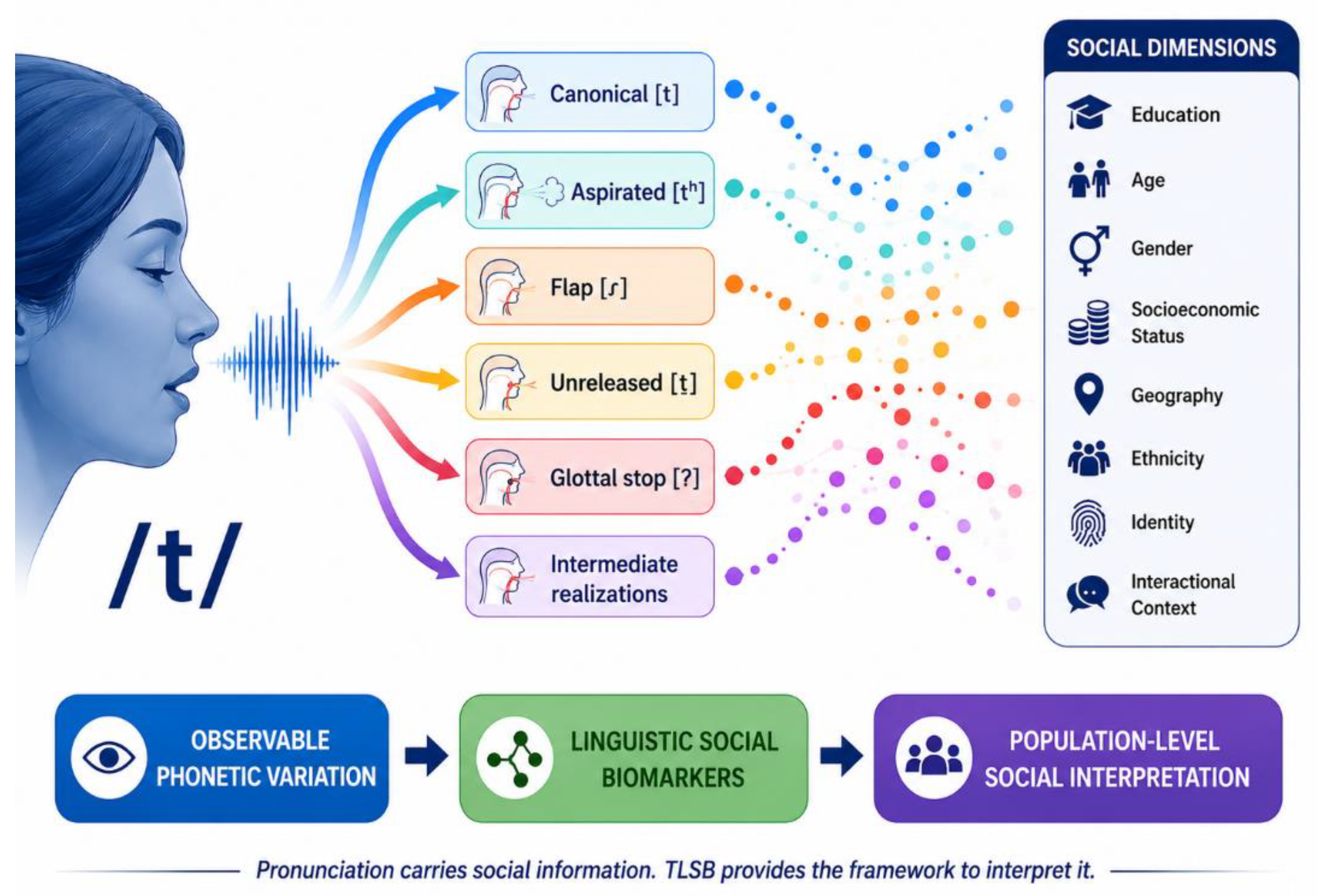

Table 1.
Principal Realizations of English /t/.
| Variant | Example | Typical variety | Linguistic context | Social salience |
|---|---|---|---|---|
| Canonical stop | top | UK/US | careful speech | low |
| Aspirated | ten | UK/US | stressed syllables | low |
| Flap | water | US | intervocalic | moderate |
| Unreleased | cat | UK/US | final/preconsonantal | low |
| Glottal stop | bottle | UK | informal | high |
Table 2.
Social Determinants Associated with English /t/.
| Social determinant | Evidence | Typical effect on /t/ | Interpretation |
|---|---|---|---|
| SES | strong | style shifting | prestige |
| Education | strong | careful articulation | institutional norms |
| Gender | moderate | contextual | identity performance |
| Age | strong | innovation | language change |
| Geography | very strong | dialect variation | regional identity |
| Interaction | strong | accommodation | social adaptation |
Table 3.
Social Biomarker Evaluation Framework (SBEF).
| Criterion | Definition | Example for English /t/ |
|---|---|---|
| Historical stability | persists through time | T-glottaling |
| Social specificity | linked to communities | Cockney |
| Contextual flexibility | varies by setting | style shifting |
| Population consistency | reproducible | British English |
| Dynamic meaning | changes socially | Estuary English |
Disclaimer/Publisher’s Note: The statements, opinions and data contained in all publications are solely those of the individual author(s) and contributor(s) and not of MDPI and/or the editor(s). MDPI and/or the editor(s) disclaim responsibility for any injury to people or property resulting from any ideas, methods, instructions or products referred to in the content. |
© 2026 by the authors. Licensee MDPI, Basel, Switzerland. This article is an open access article distributed under the terms and conditions of the Creative Commons Attribution (CC BY) license (http://creativecommons.org/licenses/by/4.0/).
Copyright: This open access article is published under a Creative Commons CC BY 4.0 license, which permit the free download, distribution, and reuse, provided that the author and preprint are cited in any reuse.