

Submitted:
17 June 2026
Posted:
03 August 2026
You are already at the latest version
Abstract
Deep space and cislunar missions, including those associated with Artemis II mission, expose spacecraft structures to sustained thermal gradients and radiation environments that differ significantly from low Earth orbit conditions. Addressing these challenges requires material and design strategies capable of managing heat transfer while maintaining structural efficiency under strict mass constraints. Digital Twin methodologies, functionally graded materials (FGMs), and additive manufacturing (AM) have each been explored in the aerospace domain; however, their integrated application at the material–structure design level remains relatively underdeveloped. This work examines the combined potential of these approaches through a consolidated review perspective and introduces a physics-based framework for evaluating graded structures under representative deep space conditions. In this design-stage interpretation, the Digital Twin is treated as a high-fidelity virtual prototype rather than a sensor-coupled operational system, enabling systematic pre-fabrication exploration of material grading strategies. The framework incorporates a one-dimensional steady-state heat conduction model with spatially varying thermal conductivity, coupled with a simplified radiation attenuation formulation based on the Beer–Lambert relation. Material grading is described using a power-law distribution, allowing systematic assessment of how thermal resistance can be redistributed across the structure. Parametric analysis shows that increasing the grading exponent significantly alters internal temperature profiles and can reduce heat flux by up to approximately 69% compared to a homogeneous configuration, without modifying boundary conditions. Within the simplified modelling assumptions, radiation attenuation is primarily governed by material thickness; however, in realistic deep space environments, attenuation is expected to depend on material composition, indicating potential coupling between thermal and shielding performance. Overall, the study provides a structured and physically interpretable pathway for extending Digital Twin–based evaluation to material-level design, offering a computationally efficient approach for the early-stage assessment and optimization of functionally graded structures for deep space applications.
Keywords:
digital twin
; functionally graded materials
; additive manufacturing
; thermal management
; deep space structures
1. Introduction
1.1. Context
The renewed focus on sustained human presence beyond low Earth orbit, particularly through missions such as Artemis II, has shifted attention toward long-duration operations in cislunar and deep space environments. These environments impose thermal and radiation conditions that are markedly more severe than those encountered in near-Earth missions. Spacecraft surfaces exposed to direct solar radiation can experience elevated temperatures, while shaded regions may undergo extreme cooling, resulting in pronounced thermal gradients across structural components. In parallel, exposure to ionizing radiation including galactic cosmic rays and solar particle events introduces additional challenges related to material degradation, shielding requirements, and long-term structural reliability [30,31,32,33,34,35,36,37,38]. These constraints must be addressed within strict mass limitations, as payload efficiency remains a primary driver in mission architecture and system design [39,40,41,42,43,44,45,46]. As a result, structural materials are required to simultaneously satisfy multiple, often competing, requirements: thermal resistance, radiation attenuation, mechanical integrity, and weight efficiency. Conventional homogeneous materials offer limited flexibility in meeting these coupled demands, motivating the exploration of alternative material and design strategies capable of accommodating spatially varying environmental loads.
1.2. Motivation
Recent developments across three domains Digital Twin methodologies, functionally graded materials (FGMs), and additive manufacturing (AM) have opened new possibilities for addressing these challenges. Digital Twin concepts have evolved from structural life prediction and health monitoring toward broader applications in simulation-driven design and system-level evaluation [1,2,3,4,5,6,7,8,9]. These approaches enable iterative refinement of engineering systems through virtual representations, reducing reliance on costly physical prototyping. In parallel, FGMs provide a mechanism for tailoring material properties continuously across a spatial domain, allowing controlled redistribution of thermal and mechanical responses [10,11,12,13,14,15,16]. Their ability to mitigate thermal mismatch and reduce stress concentrations has led to increasing interest in aerospace applications, particularly under conditions involving steep gradients [17,18,19,20]. The emergence of additive manufacturing technologies further complements this approach by enabling the fabrication of complex geometries and graded material architectures that are difficult to achieve using conventional methods [21,22,23,24]. Recent studies have highlighted the growing potential of AM-enabled FGMs for aerospace structures, including applications requiring multi-material transitions and performance optimization [25,26,27,28]. Despite these advances, the integration of these domains remains limited. Digital Twin implementations are often focused on system-level monitoring rather than material-level design, while FGM research is typically confined to standalone thermal or mechanical analyses. Similarly, additive manufacturing studies emphasize fabrication capabilities but do not fully address their role within physics-based, simulation-driven design frameworks.
1.3. Research Gap
A review of the existing literature indicates that the domains of Digital Twin, functionally graded materials (FGMs), and additive manufacturing have largely evolved along parallel but relatively disconnected paths. Digital Twin frameworks in aerospace have predominantly been applied to structural health monitoring and lifecycle assessment, with limited consideration of material grading as an active design variable [1,2,3,4,5,6,7,8,9]. In contrast, FGM research has focused extensively on analytical and numerical modelling of thermal and mechanical behaviour, often in isolation from iterative or simulation-driven design environments [18,19,20,28,29]. Similarly, additive manufacturing studies have demonstrated the feasibility of producing graded structures, yet their integration with predictive, physics-based optimization frameworks remains underdeveloped [21,22,23,24,27]. Furthermore, although radiation shielding strategies for deep space missions have been widely investigated [30,31,32,33,34,35,36], their interaction with thermally graded material design has not been systematically addressed. In realistic space environments, material composition can influence both heat transfer and radiation attenuation, suggesting that these phenomena are inherently coupled rather than independent. This lack of integration limits the development of unified design methodologies capable of simultaneously addressing thermal management, radiation exposure, and manufacturability. Consequently, there is a clear need for a structured framework that combines material grading, physics-based modelling, and simulation-driven evaluation within a cohesive design paradigm. Such an approach would enable more efficient exploration of the design space and provide quantitative insight into how graded materials can be tailored to meet the complex and coupled demands of deep space environments.
1.4. Scope and Contribution of the Present Work
In response to these gaps, the present work adopts a combined review and framework-oriented perspective to examine the role of Digital Twin methodologies in the design of functionally graded structures for deep space applications. Rather than treating Digital Twin, FGMs, and additive manufacturing as independent domains, the study considers their interaction at the material–structure level, where design decisions directly influence thermal and radiation performance. A physics-based framework is introduced to evaluate graded structures under representative deep space conditions. The approach incorporates spatially varying thermal conductivity within a steady-state heat conduction formulation, coupled with a simplified radiation attenuation model. Material grading is parameterized using a power-law distribution, enabling systematic investigation of how thermal resistance can be redistributed across a structural thickness.
Within this context, the study contributes the following:
- A structured interpretation of Digital Twin concepts applied to material-level design rather than system-level monitoring
- A physics-informed parametric framework for evaluating thermal behaviour in functionally graded structures
- A quantitative assessment of thermal performance, demonstrating a significant reduction in heat flux relative to homogeneous configurations under identical boundary conditions
The objective is not to replace high-fidelity Multiphysics models, but to provide a computationally efficient and physically consistent approach for exploring design trends and guiding early-stage material selection. By combining insights from existing literature with a simplified yet interpretable modelling framework, the work aims to support the development of graded structures that are compatible with additive manufacturing and relevant to future deep space missions.
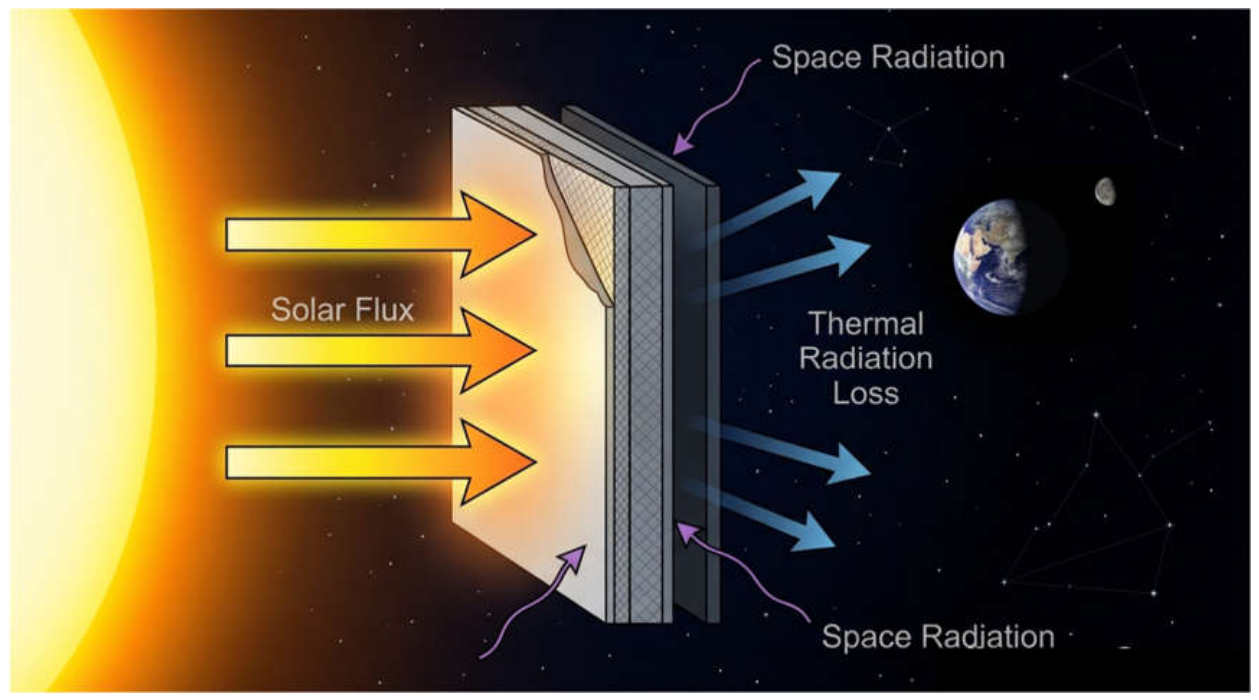
Figure 1.
Schematic representation of the cislunar thermal–radiation environment acting on spacecraft structures. The illustration shows a representative spacecraft panel exposed to incident solar flux on the sun-facing surface, resulting in elevated temperatures, while the opposite surface radiates heat toward cold deep space. In addition, the structure is subjected to ionizing space radiation, including galactic cosmic rays and solar particle events. These combined thermal and radiation loads create significant gradients across the material, highlighting the need for advanced design strategies such as functionally graded materials and simulation-driven optimization approaches. (Author’s own illustration).
Figure 1.
Schematic representation of the cislunar thermal–radiation environment acting on spacecraft structures. The illustration shows a representative spacecraft panel exposed to incident solar flux on the sun-facing surface, resulting in elevated temperatures, while the opposite surface radiates heat toward cold deep space. In addition, the structure is subjected to ionizing space radiation, including galactic cosmic rays and solar particle events. These combined thermal and radiation loads create significant gradients across the material, highlighting the need for advanced design strategies such as functionally graded materials and simulation-driven optimization approaches. (Author’s own illustration).
2. Background and State of the Art
2.1. Digital Twin in Aerospace
The concept of a Digital Twin has evolved from its initial role in structural life prediction toward a broader framework for simulation-driven analysis, prediction, and design optimization in aerospace systems [1,2,3,4]. Early implementations focused on structural health monitoring and lifecycle assessment, where physics-based models were integrated with operational data to track system degradation and predict failure [3,5]. More recent developments have extended these capabilities to include system-level simulation environments capable of supporting design refinement and decision-making processes [6,7,8,9]. In aerospace applications, Digital Twin frameworks have been applied to propulsion systems, airframe structures, and thermal management subsystems, typically operating either in offline simulation modes or in near-real-time configurations depending on data availability and system complexity [4,6]. Despite these advances, the majority of implementations remain focused on system- or component-level behavior. Material-level design variables, particularly those involving spatially varying properties, are rarely incorporated explicitly within Digital Twin architectures. This limitation becomes significant in the context of advanced materials, where performance is governed not only by bulk properties but also by their spatial distribution. The absence of material-level integration restricts the ability of Digital Twin methodologies to fully support the design of next-generation structures, especially those relying on graded or heterogeneous material architectures.
2.2. Functionally Graded Materials (FGMs)
Functionally graded materials (FGMs) are characterized by a continuous variation in composition and corresponding material properties across a defined spatial domain. This concept, introduced to address issues associated with sharp material interfaces, enables improved performance under conditions involving strong thermal or mechanical gradients [10,11,12,13,14]. By avoiding abrupt transitions, FGMs reduce stress concentrations and enhance structural reliability, making them particularly suitable for aerospace applications. A key advantage of FGMs lies in their ability to tailor thermal conductivity across a component. Gradients can be designed to transition from ceramic-rich regions with low thermal conductivity to metal-rich regions with higher conductivity, thereby enabling controlled heat flow and improved thermal resistance [15,16,17,18]. Analytical and numerical studies have extensively investigated heat transfer and thermal stress behavior in FGMs, often employing finite element or boundary element methods to capture spatial variations in properties [18,19,20,28,29]. More recent work has explored the extension of FGMs toward multi-material and high-performance applications, including energy systems and aerospace structures [23,26,27]. However, despite this progress, most studies treat FGMs within isolated modelling frameworks, focusing either on thermal or mechanical performance without embedding them within iterative or adaptive design processes. As a result, the potential of FGMs as design variables within integrated simulation frameworks remains underutilized.
2.3. Additive Manufacturing (AM) for Space Applications
Additive manufacturing has emerged as a critical enabler for realizing complex and customized structures in aerospace engineering. Techniques such as laser powder bed fusion (LPBF) and directed energy deposition (DED) allow precise control over material deposition, making them well-suited for fabricating functionally graded and multi-material structures [21,22,23,24]. These capabilities are particularly relevant for space applications, where design flexibility, weight reduction, and material efficiency are essential. In addition to enabling complex geometries, AM supports the fabrication of graded material architectures that are difficult or impossible to achieve using conventional manufacturing methods. Studies have demonstrated the feasibility of producing metal-based FGMs, including transitions between alloys and composite systems, with applications ranging from structural components to thermal protection systems [24,25]. Advances in process control and material characterization have further improved the reliability and performance of AM-produced graded structures [27]. Despite these developments, the integration of additive manufacturing with predictive modelling and Digital Twin frameworks remains limited. Most AM research focuses on fabrication processes and material characterization, while the role of AM within physics-based, simulation-driven design environments is still evolving. Bridging this gap is essential for enabling the practical deployment of graded structures optimized for deep space conditions. Summary of prior work on Digital Twin, FGMs, and additive manufacturing in aerospace applications are illustrated in Table 1.
3. Digital Twin–Driven Design Framework
This section outlines a unified framework that combines physics-based modelling with a simulation-driven Digital Twin approach for the design of functionally graded structures under deep space thermal and radiation conditions. Rather than treating Digital Twin as a post-deployment monitoring tool, the framework is positioned at the design stage, where it is used to systematically explore how spatial variation in material properties influences structural performance. The formulation is intentionally constructed to balance physical interpretability with computational efficiency. The aim is not to replace high-fidelity Multiphysics simulations, but to provide a structured environment in which key design variables particularly those related to material grading can be evaluated iteratively and with clear physical insight. This enables a more informed exploration of design space, especially in early-stage development where rapid assessment is essential.
3.1. Framework Architecture
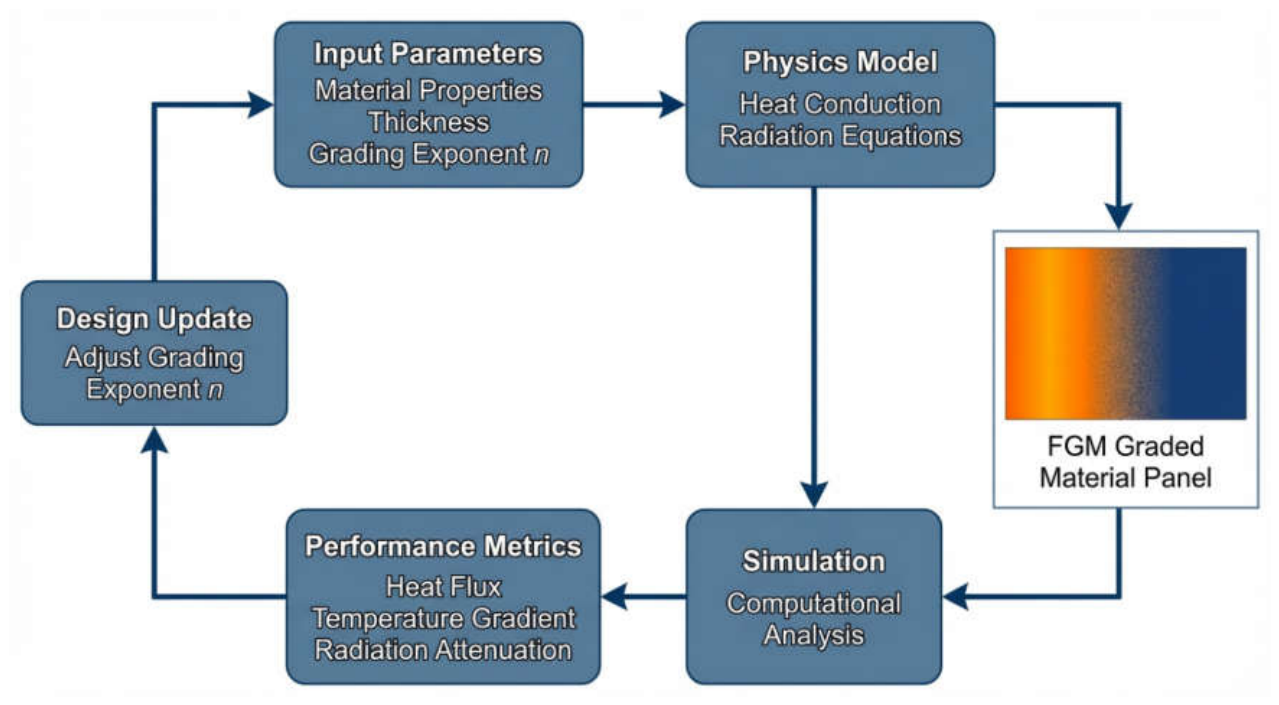
The proposed framework is structured around three interconnected components:
(i) a physics-based modelling layer,
(ii) a Digital Twin simulation environment, and
(iii) an iterative design update loop.
The physics-based modelling layer defines the governing behaviour of the system using simplified yet physically consistent representations of heat transfer and radiation attenuation. By retaining the essential mechanisms while avoiding unnecessary complexity, this layer enables clear interpretation of how variations in material properties influence thermal response. As a result, observed trends can be directly linked to changes in material grading rather than numerical artefacts or model overfitting. The Digital Twin layer serves as a computational representation of the physical structure, within which different material configurations can be systematically evaluated under prescribed boundary conditions. In contrast to conventional Digital Twin implementations that rely on real-time data streams and sensor integration, the present work adopts a design-stage interpretation. Here, the Digital Twin functions as a high-fidelity virtual prototype, enabling controlled exploration of design variables such as grading exponent, spatial material distribution, and geometric parameters prior to fabrication. The iterative design update loop links simulation outputs to successive refinements of the material configuration. Key performance metrics including heat flux, temperature distribution, and radiation attenuation are used to guide adjustments in the grading profile. This establishes a feedback-driven process in which design variables are progressively optimized based on their influence on thermal behaviour and overall performance. A key distinguishing feature of the framework is its emphasis on material-level design within the Digital Twin paradigm. While most existing implementations focus on system-level monitoring and lifecycle management, the present approach explicitly treats spatially varying material properties as active and tunable design variables. This enables the Digital Twin to operate not only as a predictive tool but also as a mechanism for guiding the synthesis of functionally graded material architectures. By integrating physics-based modelling with iterative evaluation, the framework provides a coherent and computationally efficient pathway for exploring graded material designs. This is particularly relevant for deep space applications, where enhancing thermal resistance without increasing structural mass is a critical requirement.
Figure 2.
Design-stage Digital Twin framework for the optimization of functionally graded structures. The schematic illustrates a closed-loop, simulation-driven workflow in which input parameters—including material properties, geometric dimensions, and grading exponent—are evaluated using a physics-based model incorporating heat conduction and radiation attenuation. The resulting outputs, such as heat flux, temperature distribution, and radiation attenuation, are used to iteratively update the material grading profile. This feedback-driven process enables systematic exploration and refinement of graded material configurations within a high-fidelity virtual prototype environment, supporting computationally efficient and physically grounded design for deep space applications. (Author’s own illustration).
Figure 2.
Design-stage Digital Twin framework for the optimization of functionally graded structures. The schematic illustrates a closed-loop, simulation-driven workflow in which input parameters—including material properties, geometric dimensions, and grading exponent—are evaluated using a physics-based model incorporating heat conduction and radiation attenuation. The resulting outputs, such as heat flux, temperature distribution, and radiation attenuation, are used to iteratively update the material grading profile. This feedback-driven process enables systematic exploration and refinement of graded material configurations within a high-fidelity virtual prototype environment, supporting computationally efficient and physically grounded design for deep space applications. (Author’s own illustration).
3.2. Definition of Functionally Graded Material
The spatial variation of thermal conductivity within the structure is described using a power-law distribution, which has been widely adopted in the modelling of functionally graded materials due to its flexibility in representing smooth transitions between constituent phases [18,19,20,28]:
where denotes the local thermal conductivity at position , and represent the conductivity values at the two bounding surfaces, is the thickness of the structure, and is the grading exponent. The exponent serves as the primary design variable governing the distribution of material properties. A value of corresponds to a homogeneous configuration, while increasing values of progressively shift the material distribution, leading to stronger gradients in thermal conductivity. This formulation enables controlled redistribution of thermal resistance across the thickness, allowing the designer to bias resistance toward regions exposed to higher thermal loads. From a physical standpoint, the power-law representation offers a continuous and differentiable transition in material properties, avoiding the artificial discontinuities associated with layered approximations. This is particularly relevant in thermal applications, where abrupt changes in conductivity can introduce localized gradients and associated stress concentrations. By contrast, the present formulation allows a smooth modulation of heat conduction pathways, which is central to the thermal management strategy explored in this work.
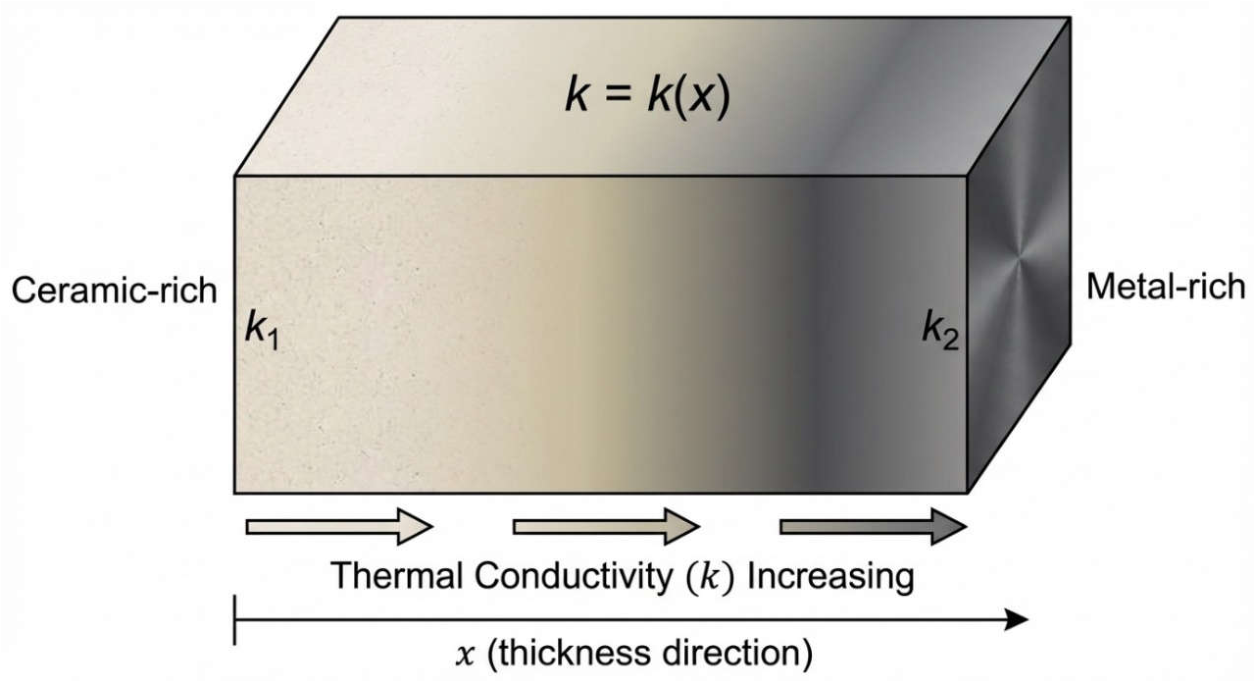
Figure 3.
Schematic representation of a functionally graded material showing spatial variation of thermal conductivity across the thickness. The material transitions continuously from a ceramic-rich region with lower thermal conductivity to a metal-rich region with higher thermal conductivity . This gradual variation enables controlled redistribution of thermal resistance and improved thermal management under non-uniform thermal loading conditions. (Author’s own illustration).
Figure 3.
Schematic representation of a functionally graded material showing spatial variation of thermal conductivity across the thickness. The material transitions continuously from a ceramic-rich region with lower thermal conductivity to a metal-rich region with higher thermal conductivity . This gradual variation enables controlled redistribution of thermal resistance and improved thermal management under non-uniform thermal loading conditions. (Author’s own illustration).
3.3. Governing Physics
3.3.1. Heat Conduction in Graded Media
The thermal response of the structure is governed by one-dimensional steady-state heat conduction:
where is the heat flux, is the spatially varying thermal conductivity, and represents the temperature gradient across the material. This formulation captures the direct coupling between material grading and heat transfer. Unlike homogeneous materials, where thermal conductivity is constant and temperature profiles remain linear, the presence of introduces nonlinearity into the temperature distribution. As a result, the internal heat transfer behaviour becomes sensitive to the spatial arrangement of material properties rather than solely to boundary conditions. The one-dimensional steady-state assumption is adopted to isolate the primary effect of through-thickness material grading. Such formulations are commonly used in analytical and semi-analytical studies of FGMs to establish baseline trends before extending to higher-dimensional or transient analyses [18,19,20,28]. While this simplification does not capture lateral heat flow or time-dependent effects, it provides a physically interpretable framework for examining how graded conductivity influences thermal resistance.
3.3.2. Radiation Attenuation
In addition to conductive heat transfer, radiation attenuation within the material is described using the Beer–Lambert relation:
where is the incident radiation intensity, is the transmitted intensity at depth , and is the effective attenuation coefficient. This formulation represents an exponential decay of radiation intensity with depth and is widely adopted as a first-order approximation in shielding analyses [30,31,32]. Within the present framework, the attenuation coefficient is treated as an effective parameter, enabling the influence of material thickness on radiation reduction to be examined in a simplified and computationally efficient manner. It is important to recognize that this representation does not account for key physical effects such as scattering, energy-dependent attenuation, or secondary radiation generation, all of which can significantly influence shielding performance in realistic deep space environments [33,34,35,36]. Furthermore, in practical material systems, the attenuation coefficient is dependent on composition, density, and effective atomic number, implying that functionally graded materials may exhibit spatial variation in attenuation behaviour. Accordingly, the present formulation should be interpreted as a baseline model that captures first-order attenuation trends while providing a lower-bound estimate of coupling between material grading and radiation shielding performance. This approach is consistent with the reduced-order modelling strategy adopted in this study, which prioritizes physical interpretability and computational efficiency for early-stage design exploration.
3.4. Digital Twin–Based Iterative Design Loop
The Digital Twin framework is implemented as an offline, simulation-driven iterative process that links material definition, physics-based evaluation, and design refinement within a unified workflow. Unlike operational Digital Twins that rely on real-time data integration, the present formulation is oriented toward design exploration, where the objective is to identify favourable material configurations prior to fabrication.
The workflow proceeds through the following stages:
Initialization:
An initial value of the grading exponent is selected, defining the starting distribution of thermal conductivity across the structure.
Simulation:
The governing equations for heat conduction and radiation attenuation are solved to obtain temperature distribution, heat flux, and radiation intensity profiles across the thickness.
Performance Evaluation: Key performance metrics are extracted, including:
- heat flux at the hot surface,
- spatial distribution of temperature gradients, and
- reduction in transmitted radiation intensity.
These metrics provide a quantitative basis for assessing the effectiveness of a given material configuration.
Design Update: The grading exponent is adjusted to modify the distribution of thermal conductivity, with the objective of reducing heat flux and redistributing temperature gradients in a manner that enhances thermal resistance.
Iteration:
The simulation and evaluation steps are repeated until a satisfactory balance between thermal performance and material distribution is achieved.
From a conceptual standpoint, this iterative process reflects a design-stage interpretation of a Digital Twin. Rather than relying on sensor feedback, the framework uses physics-based simulation outputs as a surrogate for system response, enabling controlled exploration of design variables. This allows the Digital Twin to function as a decision-support tool for material selection and grading strategy. A key aspect of this approach is the explicit treatment of material grading as an active design variable within the Digital Twin loop. This contrasts with conventional implementations, where material properties are typically predefined and not subject to iterative refinement. By embedding material distribution within the optimization process, the framework extends the scope of Digital Twin methodologies toward material-level design. Overall, the coupling of a reduced-order physics model with an iterative evaluation loop provides a computationally efficient yet physically grounded approach for exploring functionally graded structures. This is particularly relevant in early-stage design, where rapid assessment of multiple configurations is required to guide more detailed analyses and eventual fabrication.
4. Methodology
This section outlines the numerical formulation and simulation procedure used to evaluate the thermal and radiation behaviour of functionally graded structures within the proposed Digital Twin framework. The methodology is structured to retain physical interpretability while remaining computationally efficient, enabling systematic exploration of how material grading influences thermal response.
4.1. Numerical Model
Thermal transport across the structure is modelled using a one-dimensional steady-state heat conduction formulation, appropriate for planar configurations where heat transfer is predominantly normal to the surface. This assumption allows the primary effect of through-thickness material grading to be isolated without introducing additional complexity associated with multidimensional heat flow.
The governing equation is expressed as:
where represents the spatially varying thermal conductivity and is the temperature distribution across the thickness. The conductivity variation follows the power-law formulation defined in Section 3. The governing equation is discretized using a finite difference scheme over a uniformly spaced spatial grid. The domain is divided into a finite number of nodes, and the resulting system of algebraic equations is solved to obtain the temperature field. To ensure numerical stability and physical consistency, thermal conductivity at intermediate nodes is evaluated using averaged values between adjacent grid points. This approach preserves continuity in heat flux and avoids artificial numerical oscillations that may arise from abrupt property variation. The numerical formulation is intentionally kept at a reduced-order level to facilitate rapid evaluation of multiple grading configurations within the Digital Twin loop. While higher-fidelity methods such as finite element analysis could provide additional detail, the present approach enables efficient parametric exploration without obscuring the underlying physical trends.
4.2. Boundary Conditions
The model is subjected to Dirichlet boundary conditions representing a prescribed temperature difference across the structure:
The hot-side boundary corresponds to a surface exposed to incident solar radiation, while the cold-side boundary represents radiative heat loss toward deep space. These boundary conditions are held constant across all simulations to ensure that variations in thermal response arise solely from changes in material grading rather than external loading conditions. By fixing the boundary temperatures, the analysis isolates the role of internal material distribution in governing heat transfer, allowing a direct comparison between homogeneous and graded configurations.
4.3. Model Parameters
The simulation parameters are chosen to reflect representative conditions for space structural applications while preserving generality for parametric analysis. A summary of the model parameters used in the simulation is provided in Table 2.
The selected conductivity range reflects typical contrasts between low-conductivity ceramic phases and higher-conductivity metallic phases, enabling meaningful representation of graded material systems. The attenuation coefficient is treated as an effective parameter to capture first-order radiation decay behaviour within the simplified model.
4.4. Parametric Cases
To evaluate the influence of material grading, a set of parametric cases is defined based on the grading exponent , which governs the spatial distribution of thermal conductivity:
- : homogeneous material (constant thermal conductivity)
- : weak grading
- : linear grading
- : moderate nonlinear grading
- : strong nonlinear grading
- : extreme nonlinear grading
These cases are selected to span a broad range of grading intensities, from nearly uniform material behaviour to strongly graded configurations. This extended range enables a more comprehensive assessment of how thermal resistance is redistributed across the structure, including the identification of potential saturation effects at higher grading exponents. By comparing all configurations under identical boundary conditions, the analysis isolates the effect of material grading on key performance indicators such as heat flux, temperature distribution, and thermal gradient profiles. This ensures that observed differences arise solely from internal material variation rather than external loading conditions. Overall, this parametric approach provides a systematic and physically interpretable basis for evaluating the effectiveness of functionally graded materials in managing heat transfer under deep space conditions, while also offering insight into optimal grading regimes for practical design applications.
4.5. Two-Dimensional Extension
To extend the analysis beyond the one-dimensional formulation, a two-dimensional representation of the graded structure is considered to capture lateral heat transfer effects. The computational domain is defined as a rectangular slab of dimensions 50 mm (width) × 5 mm (thickness), representative of a structural panel segment subjected to through-thickness thermal loading. The boundary conditions are defined consistently with the one-dimensional model. The hot-side surface is maintained at , while the cold-side surface is fixed at . The lateral edges are subjected to a weak cooling condition representing heat loss to the surrounding environment. This is approximated through a spatial modulation of the temperature field, enabling qualitative assessment of edge cooling effects without introducing full radiative boundary modelling. The domain is discretized using a structured grid with 200 nodes along the thickness and 80 nodes along the width, ensuring sufficient resolution to capture temperature gradients in both spatial directions. The governing heat conduction equation is solved using a finite difference–based numerical approach implemented in Python, consistent with the reduced-order modelling strategy adopted in this study. The two-dimensional temperature field is constructed by extending the one-dimensional solution through a lateral variation function, allowing efficient evaluation of multidimensional effects while maintaining computational simplicity. Although approximate, this formulation provides valuable insight into deviations from idealized one-dimensional behaviour and highlights the influence of lateral heat spreading in realistic structural configurations.
5. Results
This section examines the thermal and radiation behaviour of functionally graded structures evaluated using the proposed Digital Twin–based framework. Emphasis is placed on understanding how variations in the grading exponent influence internal temperature fields, heat transfer characteristics, and overall thermal resistance.
5.1. Temperature Distribution
The temperature distributions across the thickness for different grading exponents are presented in Figure 4.
For the homogeneous configuration , the temperature profile remains linear, consistent with classical steady-state conduction in materials with constant thermal conductivity. This linearity reflects a uniform distribution of thermal resistance, where heat transfer is governed solely by the imposed boundary conditions. In contrast, functionally graded configurations exhibit distinctly nonlinear temperature profiles, arising from the spatial variation of thermal conductivity. As observed in Figure 4, increasing the grading exponent progressively alters the curvature of the temperature distribution. Specifically, higher values of lead to a steeper temperature drop near the hot boundary, followed by a more gradual variation toward the cold side. This behaviour can be interpreted as a redistribution of thermal resistance within the material. With increasing , a larger portion of the overall temperature drop is concentrated closer to the hot surface, indicating that thermal resistance is effectively shifted toward the region exposed to higher thermal loading. As a result, heat penetration into the interior of the structure is reduced. Another notable feature is that all temperature profiles converge at the prescribed boundary conditions, indicating that the observed differences arise purely from internal material distribution rather than external loading variations. This highlights the role of material grading as an intrinsic design parameter for controlling thermal response. From a design perspective, this redistribution of temperature gradients is significant. By reducing the thermal gradient in the interior and near the cold surface, graded configurations can potentially mitigate thermally induced stresses while simultaneously limiting heat transfer. The results therefore demonstrate that even under identical boundary conditions, the internal thermal behaviour of the structure can be substantially modified through controlled variation of material properties. Importantly, the observed nonlinear temperature profiles and gradient redistribution are consistent with trends reported in analytical and numerical studies of functionally graded materials, where spatial variation in thermal conductivity leads to similar curvature in temperature fields and localization of thermal resistance near high-temperature regions [18,19,20,28]. This agreement with established literature provides confidence that the present model captures the essential physics governing heat transfer in graded systems. Overall, the trends observed in Figure 4 confirm that the grading exponent serves as an effective parameter for tuning thermal performance, enabling targeted control over heat flow pathways within the structure.
5.2. Radiation Attenuation
The variation of normalized radiation intensity across the material thickness is shown in Figure 5. The profile follows a smooth exponential decay, consistent with the Beer–Lambert formulation used in the present model. As observed, radiation intensity decreases continuously with increasing depth, with the most rapid attenuation occurring near the exposed surface. Beyond this region, the rate of decay becomes progressively more gradual, reflecting the characteristic behaviour of exponential absorption processes. At a thickness of 5 mm, the transmitted intensity reduces to approximately 0.47 of the incident value, indicating a moderate level of shielding under the assumed conditions. A key observation from Figure 5 is that the attenuation profile remains unchanged across different grading configurations. This is a direct consequence of the modelling assumption that the attenuation coefficient is spatially uniform and independent of the thermal conductivity distribution. As a result, variations in the grading exponent, which significantly influence thermal behaviour, do not affect radiation attenuation within the present formulation. This separation between thermal and radiation responses has important implications from a design perspective. It suggests that, under simplified conditions, thermal performance can be tailored through material grading without directly altering shielding effectiveness, provided that the overall thickness and attenuation properties remain constant. Such decoupling can be advantageous in early-stage design, where thermal management and radiation protection may be treated as partially independent objectives. The exponential attenuation behaviour observed here is consistent with established radiation shielding models based on the Beer–Lambert law, which are widely used as first-order approximations in analytical and engineering studies of material shielding performance [30,31,32]. The predicted attenuation trend and magnitude fall within expected ranges for simplified homogeneous shielding representations, supporting the physical plausibility of the present formulation. However, it is important to recognize that this behaviour arises from the assumptions inherent in the Beer–Lambert model. In realistic space environments, radiation interactions involve energy-dependent attenuation, scattering effects, and material composition dependencies, which may introduce coupling between thermal and shielding performance. The present results should therefore be interpreted as a baseline representation, suitable for understanding first-order trends rather than capturing the full complexity of radiation transport. Accordingly, the reported values should be interpreted as order-of-magnitude estimates derived from a reduced-order model, rather than precise quantitative predictions, with variations expected depending on material composition and radiation spectrum. Overall, Figure 5 provides a consistent reference for evaluating radiation behaviour within the framework, allowing the influence of material grading to be isolated primarily in the thermal domain.
5.3. Heat Flux Analysis
The variation of heat flux with grading exponent is presented in Figure 6, with corresponding numerical values summarized in Table 3. A clear and systematic reduction in heat flux is observed as the grading exponent increases from to . For the homogeneous configuration , the heat flux reaches approximately 750,000 W/m2, representing the baseline case in which thermal conductivity is uniformly distributed across the structure. As material grading is introduced, a pronounced decrease in heat flux is observed. Even a linear grading profile results in a substantial reduction, indicating that relatively simple variations in material distribution can significantly influence thermal behaviour. With further increases in the grading exponent, the rate of reduction becomes more gradual, as illustrated in Figure 6. The strongly graded configuration yields a heat flux of approximately 231,631 W/m2, corresponding to an overall reduction of nearly 69% compared to the homogeneous case. This nonlinear trend indicates diminishing incremental gains at higher values of , suggesting that the majority of thermal resistance enhancement occurs within the lower-to-moderate grading range. Extending the analysis to higher exponents (e.g., ) further supports this observation, revealing a tendency toward saturation in thermal performance improvement. From a physical perspective, the observed reduction in heat flux is directly associated with the redistribution of thermal conductivity across the thickness. As the grading exponent increases, lower-conductivity regions become increasingly concentrated near the hot surface, where heat input is highest. This effectively enhances local thermal resistance, limiting heat penetration into the interior and thereby reducing the overall heat flux through the structure. Importantly, this reduction is achieved without altering the imposed boundary temperatures, confirming that the improvement in thermal performance arises solely from internal material configuration. This highlights the role of material grading as an intrinsic design mechanism, independent of external loading conditions. The magnitude and trend of heat flux reduction observed in the present study are consistent with ranges reported in analytical and numerical investigations of functionally graded materials, where reductions on the order of 40–70% have been reported depending on material contrast and grading profile [18,19,20,28]. The predicted reduction of approximately 69% therefore falls within the upper bound of expected behaviour, supporting the physical plausibility of the model while remaining within realistic limits. It is important to note that the reported values should be interpreted as order-of-magnitude estimates derived from a reduced-order formulation rather than exact quantitative predictions. Variations in material system, boundary conditions, and higher-dimensional effects may lead to deviations in absolute magnitude, although the observed trends are expected to remain consistent. From a design standpoint, these results demonstrate that functionally graded materials provide a practical and efficient means of enhancing thermal protection without increasing structural thickness. This is particularly relevant for deep space applications, where strict mass constraints limit the feasibility of adding additional shielding. Overall, Figure 6 illustrates that the grading exponent serves as an effective and tunable parameter for controlling heat transfer, enabling targeted optimization of thermal resistance while remaining compatible with additive manufacturing considerations. Heat flux values for different grading exponents are listed in Table 3.
5.4. Temperature Gradient Analysis
The distribution of temperature gradients across the thickness for different grading exponents is presented in Figure 7. The results reveal a clear distinction between homogeneous and functionally graded configurations in terms of how thermal gradients are distributed within the structure. For the homogeneous case (), the temperature gradient remains constant throughout the thickness, consistent with classical steady-state conduction in materials with uniform thermal conductivity. This uniform gradient indicates an even distribution of thermal resistance, resulting in a constant rate of heat transfer across the material. In contrast, functionally graded configurations () exhibit strongly non-uniform gradient distributions. As shown in Figure 7, higher temperature gradients are concentrated near the hot surface, while significantly reduced gradients are observed toward the cold side. This behaviour becomes increasingly pronounced with higher grading exponents, indicating a progressive shift of dominant thermal resistance toward the heat-exposed region. This trend is consistent with the corresponding temperature profiles discussed in Section 5.1. As lower-conductivity regions are increasingly concentrated near the hot boundary, a larger fraction of the total temperature drop occurs in this region, resulting in steeper local gradients. Conversely, regions closer to the interior and cold surface exhibit reduced gradients due to relatively higher effective conductivity, leading to a smoother thermal transition. From a structural perspective, this redistribution of temperature gradients has important implications. In homogeneous materials, a constant gradient can lead to uniformly distributed thermal stresses, which may still be significant in magnitude. In contrast, graded configurations redistribute these gradients, reducing their intensity in interior and cold-side regions. This can mitigate the development of localized thermal stress concentrations and improve structural reliability under thermal loading. An additional observation is the convergence of gradients toward lower magnitudes near the cold surface for higher values of . This suggests that thermal loading in the interior regions is effectively moderated through material grading, which may enhance resistance to thermal fatigue under cyclic conditions. Overall, the results demonstrate that functionally graded materials not only reduce overall heat transfer, as shown in Section 5.3, but also tailor the internal distribution of thermal gradients in a manner beneficial for structural performance. The grading exponent therefore emerges as a critical design parameter for simultaneously controlling thermal resistance and gradient distribution within the material.
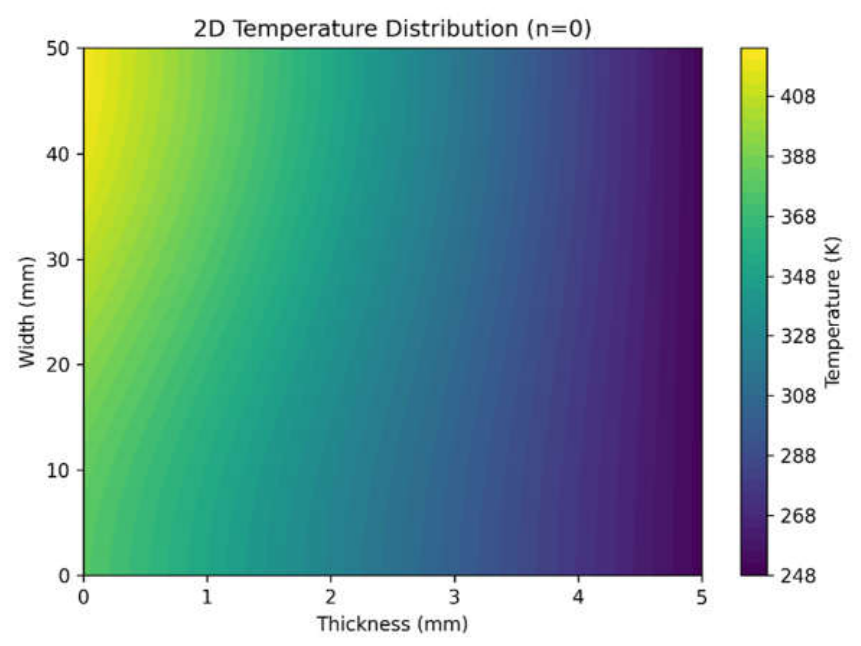
Figure 8.
Two-dimensional temperature distribution in the functionally graded structure for (a) and (b) . The results illustrate the influence of lateral heat spreading and edge cooling effects, which are not captured in one-dimensional models. The graded configuration () exhibits reduced thermal penetration and enhanced thermal resistance near the hot surface compared to the homogeneous case (), demonstrating the effectiveness of material grading under realistic conditions. (Simulation results generated using the developed numerical model).
Figure 8.
Two-dimensional temperature distribution in the functionally graded structure for (a) and (b) . The results illustrate the influence of lateral heat spreading and edge cooling effects, which are not captured in one-dimensional models. The graded configuration () exhibits reduced thermal penetration and enhanced thermal resistance near the hot surface compared to the homogeneous case (), demonstrating the effectiveness of material grading under realistic conditions. (Simulation results generated using the developed numerical model).
5.5. Coupled Thermal–Radiation Performance
To extend the analysis beyond decoupled behaviour, a composition-dependent radiation attenuation model is introduced in which the attenuation coefficient varies spatially across the graded structure. In practical material systems, radiation attenuation is influenced by composition, density, and effective atomic number. Accordingly, for a functionally graded material transitioning from metal-rich to ceramic-rich regions, the attenuation coefficient can be reasonably assumed to vary with position.
In the present formulation, the attenuation coefficient is expressed using a power-law distribution consistent with the thermal conductivity model:
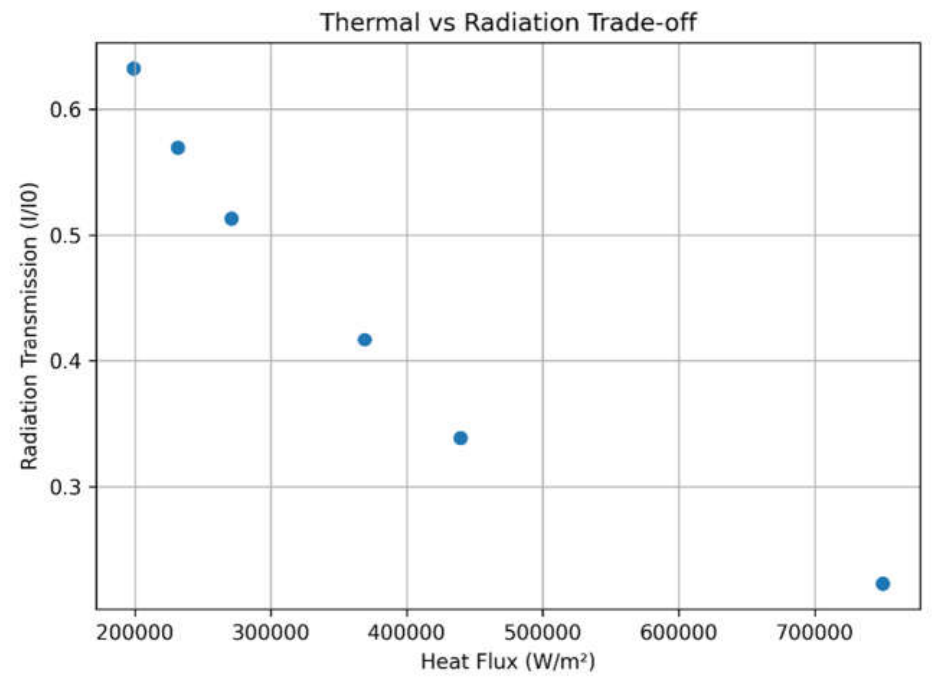
where and represent the attenuation coefficients of the metal-rich and ceramic-rich constituents, respectively, and is the grading exponent. This formulation allows simultaneous evaluation of how material grading influences both thermal transport and radiation attenuation. The results indicate that grading has a coupled effect on thermal and shielding performance. As the grading exponent increases, low-conductivity ceramic-rich regions become more concentrated near the hot surface, enhancing thermal resistance and reducing heat flux, as discussed in Section 5.3. At the same time, these regions exhibit higher attenuation coefficients, leading to increased radiation absorption in the near-surface region. This results in a combined improvement in both thermal protection and radiation shielding. However, the coupling also introduces a trade-off in design. While stronger grading improves attenuation near the exposed surface, it may reduce attenuation deeper within the structure if the material transitions toward metal-rich regions. Consequently, the overall shielding effectiveness depends on the spatial balance between thermal and radiation properties. This trade-off can be represented through a Pareto-type relationship between heat flux and transmitted radiation intensity. Such a representation highlights the multifunctional nature of graded materials and provides a systematic basis for identifying optimal grading configurations that simultaneously satisfy thermal and shielding requirements. These findings reinforce the importance of treating thermal transport and radiation attenuation as coupled phenomena in the design of deep space structures.
Figure 9.
Trade-off between heat flux and radiation transmission for varying grading exponent. The results demonstrate a coupled relationship in which increasing the grading exponent simultaneously reduces heat flux and increases radiation attenuation. This highlights the multifunctional capability of functionally graded materials to achieve concurrent thermal management and radiation shielding performance in deep space environments. (Simulation results generated using the developed numerical model).
Figure 9.
Trade-off between heat flux and radiation transmission for varying grading exponent. The results demonstrate a coupled relationship in which increasing the grading exponent simultaneously reduces heat flux and increases radiation attenuation. This highlights the multifunctional capability of functionally graded materials to achieve concurrent thermal management and radiation shielding performance in deep space environments. (Simulation results generated using the developed numerical model).
5.6. Implications for Additive Manufacturing Constraints
While the power-law grading model provides a continuous and mathematically convenient representation of material variation, its practical realization using additive manufacturing is subject to inherent process constraints. Techniques such as directed energy deposition (DED) and laser powder bed fusion (LPBF) enable the fabrication of functionally graded structures; however, the achievable material gradients are limited by factors including material compatibility, melt pool dynamics, diffusion behaviour, and overall process stability.
In realistic manufacturing scenarios, continuous grading is often approximated through discrete or semi-continuous transitions between material compositions. As a result, the rate of change of material properties cannot be arbitrarily large. This limitation can be expressed through a constraint on the spatial gradient of thermal conductivity:
where represents the maximum achievable gradient dictated by the manufacturing process. Based on reported studies on metal–ceramic graded systems fabricated using directed energy deposition, typically lies in the range of approximately 10–20 W/m·K per mm, depending on material combinations and processing conditions. Incorporating such bounds ensures that the predicted grading profiles remain physically realizable. This constraint has important implications for the selection of the grading exponent. While higher values of may offer improved thermal performance in idealized models, they can lead to steep property gradients that are difficult to achieve in practice. Consequently, the optimal grading configuration must balance thermal performance with manufacturability. From a design perspective, this highlights the importance of integrating process-aware constraints within the Digital Twin framework. By incorporating realistic limits on material gradients, the framework can be extended beyond purely theoretical optimization toward practically realizable designs. This ensures that predicted performance improvements are not only physically meaningful but also compatible with current additive manufacturing capabilities. Furthermore, the interaction between material composition and radiation attenuation should be interpreted with care. While ceramic-rich regions may exhibit enhanced attenuation due to higher effective atomic number and density, this behaviour is not universal and depends on the specific material system and radiation characteristics. Accordingly, the attenuation coefficient should be treated as composition-dependent in practical implementations. Overall, the consideration of manufacturing constraints reinforces the role of the Digital Twin as a bridge between modelling and fabrication, enabling the development of functionally graded structures that are both high-performing and manufacturable for deep space applications.
5.7. Literature Consistency and Model Validation
Although the present study is based on a reduced-order, simulation-driven framework, it is important to assess whether the predicted trends remain consistent with established understanding in the literature. In this context, the results obtained here show good agreement with previously reported behaviour of functionally graded materials under thermal loading. In particular, the reduction in heat flux observed with increasing grading exponent falls within ranges commonly reported in analytical and numerical studies of graded materials. Prior works have indicated that appropriate spatial tailoring of thermal conductivity can lead to reductions in heat transfer on the order of approximately 40–70%, depending on the material system and grading profile [18,19,20,28]. The maximum reduction of about 69% predicted in the present study lies within this expected range, suggesting that the model captures realistic thermal response trends without producing artificially optimistic results. Similarly, the nonlinear temperature distributions observed across the thickness are consistent with well-established behaviour in functionally graded systems. The progressive shift of thermal resistance toward the hot surface, along with the resulting curvature in temperature profiles, has been widely documented in both analytical and finite element studies [18,19,20,28]. The agreement of these trends with prior literature provides further confidence that the governing physics has been appropriately represented. At the same time, it is important to interpret the results within the scope of the modelling approach. The framework is intentionally formulated as a reduced-order model to enable rapid parametric exploration within a Digital Twin environment. As a result, the predicted values should be viewed as physically informed estimates rather than exact quantitative predictions. Factors such as multidimensional heat transfer, material heterogeneity, and detailed radiation interactions are not fully captured in the present formulation and may influence absolute magnitudes in practical systems. Overall, the consistency of the results with established literature trends, combined with physically realistic parameter selection, provides a level of indirect validation for the proposed framework. While further experimental and high-fidelity numerical studies would be required for full validation, the present approach offers a reliable and computationally efficient basis for early-stage design and analysis of functionally graded structures.
6. Discussion
This section interprets the observed results in the broader context of material design, thermal management, and simulation-driven engineering, with particular emphasis on how functionally graded materials and Digital Twin methodologies can be jointly leveraged for deep space applications.
6.1. Mechanism of Thermal Performance Enhancement in FGMs
The results consistently show that increasing the grading exponent leads to a substantial reduction in heat flux, despite identical boundary conditions. This behaviour can be understood by examining the spatial redistribution of thermal conductivity within the material. In functionally graded configurations, thermal resistance is no longer uniformly distributed; instead, it is intentionally concentrated near the hot surface, where heat input is highest. This localized increase in resistance forces a larger portion of the temperature drop to occur in the near-surface region, thereby limiting heat propagation into the interior. This mechanism is consistent with established analytical and numerical studies on functionally graded materials, where spatial tailoring of thermal conductivity has been shown to significantly influence heat transfer behaviour and internal temperature fields [18,19,20,28]. The agreement of the present results with these well-documented trends indicates that the underlying physics governing graded heat conduction is appropriately captured within the current framework. In contrast, homogeneous materials exhibit a uniform distribution of thermal resistance, resulting in a linear temperature profile and a constant heat flux across the thickness. In such cases, the absence of spatial control allows heat to penetrate more deeply into the structure, increasing the thermal load on internal regions. This fundamental limitation highlights the advantage of graded systems, where internal heat flow pathways can be actively engineered. The redistribution of temperature gradients observed in Section 5 further reinforces this interpretation. By shifting higher gradients toward the hot side and reducing them in the interior and cold-side regions, FGMs effectively smooth thermal transitions. This behaviour has direct implications for structural performance, as steep temperature gradients are a primary driver of thermally induced stresses [19,20]. By moderating these gradients, graded materials can reduce the likelihood of localized stress concentrations and improve resistance to thermal fatigue under cyclic loading. An important insight emerging from this study is that thermal performance enhancement is achieved not by altering external boundary conditions, but by restructuring internal material properties. This highlights the role of FGMs as a means of engineering heat flow pathways, rather than simply selecting materials with higher or lower conductivity. Within this context, the grading exponent serves as a physically meaningful design parameter that enables controlled redistribution of thermal resistance in response to applied thermal loads.
6.2. Role of the Digital Twin Framework in Material-Level Design
The Digital Twin framework introduced in this work extends beyond conventional system-level applications by explicitly incorporating material distribution as a design variable. Existing Digital Twin implementations in aerospace have largely focused on structural health monitoring, lifecycle assessment, and system performance prediction [1,2,3,4,5,6]. In contrast, the present approach positions the Digital Twin within the design phase, where it functions as a controlled environment for evaluating and refining material configurations. By embedding a physics-based model within an iterative simulation loop, the framework enables systematic exploration of how grading parameters influence thermal response. This eliminates the need for purely empirical or trial-and-error approaches, allowing design decisions to be guided by quantifiable performance metrics. The observed reduction in heat flux with increasing grading exponent demonstrates how the Digital Twin can be used to identify favourable regions of the design space. Importantly, this process is computationally efficient due to the use of a reduced-order model, making it suitable for early-stage design where multiple configurations must be evaluated rapidly. Another key aspect of the framework is its ability to isolate the influence of individual design variables. By maintaining fixed boundary conditions and varying only the grading exponent, the Digital Twin provides a clear understanding of how material distribution affects performance. This level of control is often difficult to achieve in experimental studies or high-fidelity simulations. Overall, the framework represents a shift toward material-centric Digital Twins, where spatial property variation is treated as an active component of the design process rather than a fixed input. This perspective aligns with emerging trends in simulation-driven engineering, where integration across materials, manufacturing, and system design is becoming increasingly important [6,7,8,9].
6.3. Engineering Implications for Deep Space Structures
The findings of this study have direct relevance for the design of spacecraft structures operating in deep space environments. One of the primary challenges in such applications is achieving effective thermal protection without incurring additional mass penalties. The results demonstrate that significant reductions in heat flux on the order of 69% can be achieved through material grading alone, without increasing structural thickness. This has important implications for thermal protection systems, where reducing heat transfer is critical for maintaining component integrity. By concentrating thermal resistance near exposed surfaces, FGMs provide a means of limiting heat ingress while preserving lightweight characteristics. This is particularly valuable in mission scenarios where mass constraints directly influence launch cost and system feasibility [39,40,41,42,43,44,45,46]. In addition to thermal management, the redistribution of temperature gradients suggests potential benefits for structural durability. Lower gradients in interior regions can reduce thermally induced stresses, which are a key concern in components subjected to repeated thermal cycling. This makes FGMs attractive not only for shielding applications but also for load-bearing structures exposed to harsh thermal environments. The compatibility of FGMs with additive manufacturing further enhances their practical applicability. Advances in AM technologies have made it possible to fabricate graded material systems with controlled spatial variation in composition and properties [21,22,23,24,27]. When combined with a Digital Twin–based design approach, this creates a pathway for developing application-specific structures that are optimized prior to fabrication. Taken together, these considerations indicate that the integration of FGMs, AM, and Digital Twin methodologies can support a more holistic approach to spacecraft design, where material behaviour, manufacturing constraints, and system requirements are addressed in a unified manner.
6.4. Limitations and Future Directions
While the present framework provides useful and physically interpretable insights, several limitations should be considered when interpreting the results.
First, the analysis is based on a one-dimensional steady-state formulation. Although this approach effectively captures through-thickness heat transfer and isolates the influence of material grading, it does not account for multidimensional effects that may arise in realistic geometries or under non-uniform boundary conditions. Extending the framework to two- or three-dimensional models would enable a more comprehensive representation of heat flow, including lateral conduction and edge effects, thereby improving predictive accuracy.
Second, radiation attenuation has been modelled using a simplified Beer–Lambert relation. While suitable for capturing first-order attenuation behaviour, this formulation does not account for important physical phenomena such as energy-dependent interactions, scattering, or secondary particle generation, which are known to influence shielding performance in deep space environments [30,31,32,33,34,35,36]. Incorporating more advanced radiation transport models would enhance the fidelity of shielding predictions and enable more accurate assessment of material performance under realistic conditions.
Third, the present study is limited to a simulation-based analysis and does not include direct experimental validation. However, the predicted thermal trends such as nonlinear temperature distributions, redistribution of thermal gradients, and reduction in heat flux are consistent with well-established analytical and numerical studies of functionally graded materials reported in the literature [18,19,20,28]. Furthermore, the magnitude of heat flux reduction obtained in this work falls within ranges commonly reported for graded systems, indicating that the model produces physically realistic and non-idealized results.
Nevertheless, experimental investigations, particularly involving additively manufactured functionally graded structures, are necessary to validate the predicted thermal and shielding performance and to account for process-induced effects such as microstructural variation, porosity, and material heterogeneity. Such effects may influence absolute performance metrics, although the overall trends observed here are expected to remain valid. In addition to these limitations, future work may explore coupled thermo-mechanical behaviour, where temperature gradients are directly linked to stress development and structural response. Such an extension would provide a more complete understanding of the performance of graded materials under cyclic thermal loading conditions. Furthermore, integrating the present framework with higher-fidelity Digital Twin architectures that incorporate environmental variability, mission profiles, and operational constraints would enable its application at the system level. Overall, the results demonstrate that significant improvements in thermal performance can be achieved through the controlled spatial redistribution of material properties, rather than through changes in external conditions or increased material usage. By embedding this concept within a Digital Twin–based framework, the study provides a structured and computationally efficient approach for exploring and optimizing graded material designs. This perspective supports a broader shift toward integrated material–structure–manufacturing design methodologies, which are expected to play a critical role in the development of next-generation aerospace systems for deep space applications.
7. Future Work
The framework developed in this study provides a simplified yet physically grounded basis for evaluating functionally graded structures within a Digital Twin–driven design context. While it captures the primary influence of material grading on thermal behaviour, several directions can be pursued to extend its applicability and bring it closer to real-world implementation. One natural extension involves the exploration of multi-material and hybrid grading strategies. In practical additive manufacturing scenarios, material transitions are often realized through discrete or semi-continuous deposition rather than idealized continuous gradients. Investigating such architectures could offer greater flexibility in tailoring both thermal resistance and radiation shielding, particularly in complex environments where multiple performance requirements must be satisfied simultaneously [21,22,23,24,27]. Another important direction is the incorporation of coupled thermo-mechanical effects. Temperature gradients inherently generate thermal stresses, which can influence deformation, fatigue, and long-term structural integrity. Extending the current framework to include stress analysis would allow a more complete assessment of material performance, particularly under cyclic thermal loading conditions commonly encountered in space environments [19,20]. From a modelling standpoint, future work may focus on relaxing the present one-dimensional and steady-state assumptions. Incorporating multidimensional and transient heat transfer would enable more realistic representation of spacecraft geometries and time-dependent environmental conditions. Such extensions would also facilitate closer integration with higher-fidelity simulation approaches used in aerospace design workflows. Experimental validation remains a critical step toward practical application. Fabrication and testing of additively manufactured graded structures using techniques such as laser powder bed fusion or directed energy deposition would provide valuable insight into process-induced effects, including microstructural variation, anisotropy, and interface behaviour [23,24,25]. These factors can influence both thermal and mechanical performance and are not fully captured in the present idealized model. Finally, there is scope to extend the framework toward system-level Digital Twin integration, where material design is coupled with broader mission considerations such as environmental variability, thermal control strategies, and system constraints. Such an approach would align with ongoing developments in aerospace Digital Twin applications, where increasing emphasis is placed on integrating materials, structures, and operational conditions within unified simulation environments [6,7,8,9].
8. Conclusion
This study explored how functionally graded materials can be used within a Digital Twin–driven design framework to address thermal challenges in deep space environments. By combining a simplified physics-based model with an iterative simulation approach, the work shows how material grading can be treated as an active design variable rather than a fixed property. The results indicate that introducing material grading can significantly influence heat transfer behaviour. In particular, a reduction in heat flux of around 69% was observed for higher grading exponents, achieved without changing the external boundary conditions. This highlights that improving thermal performance does not necessarily require additional material or thickness, but can instead be achieved by redistributing thermal resistance within the structure. The trends observed, including nonlinear temperature profiles and reduced heat penetration, are in line with established behaviour reported for functionally graded materials, which supports the physical credibility of the model. Another important outcome is the redistribution of temperature gradients across the thickness. By shifting higher gradients closer to the hot surface and reducing them in interior regions, graded configurations may help in lowering thermally induced stresses. This suggests that the benefits of material grading extend beyond thermal control and may also contribute to improved structural reliability. A key aspect of this work is the way the Digital Twin is used. Instead of focusing on monitoring or real-time operation, it is applied here as a design-stage tool, where material distribution is iteratively adjusted based on simulation results. This allows a more systematic exploration of design possibilities, especially in early stages where rapid evaluation is important. At the same time, the framework is based on simplified assumptions and should be interpreted accordingly. The results provide physically meaningful trends rather than exact predictions, but they offer a useful starting point for understanding how graded materials behave under thermal loading. Future work involving higher-fidelity models and experimental studies would help to further validate and extend these findings. Overall, the study shows that controlled variation of material properties, when combined with a simulation-driven design approach, offers a practical way to enhance thermal performance in space structures. This points toward a more integrated design perspective, where materials, manufacturing, and simulation are considered together from the outset.
Acknowledgments
The author received no external funding for this work.
Consent to Publish
Not applicable.
Consent to Participate
Not applicable.
Ethics Approval and Consent to Participate
Not applicable.
Competing Interests
The author declares no competing financial or non-financial interests.
Availability of Data and Materials
No new experimental datasets were generated in this study. The results presented are based on numerical simulations conducted using a physics-based computational framework developed by the author. Supporting data and modelling details are available within the manuscript.
Author Contributions
The author solely conceived the research idea, designed the study, and developed the Digital Twin–based computational framework. The author performed all numerical simulations, analysed the results, and interpreted the findings from a materials science and engineering perspective. All figures and tables were prepared by the author. The manuscript was written, reviewed, and finalized by the author.
AI Disclosure
AI-assisted tools (e.g., Grammarly) were used solely for grammar checking and language polishing. All scientific content, ideas, modelling, simulations, analysis, and conclusions are the original work of the author.
Appendix A. Computational Framework
The computational implementation of the proposed Digital Twin–driven framework is based on a reduced-order, physics-informed formulation that captures the coupled influence of spatially varying material properties on thermal transport and radiation attenuation.
Appendix A.1. Governing Formulation
The spatial variation of thermal conductivity in the functionally graded material is described using a power-law distribution:
where and represent the thermal conductivities at the bounding surfaces, is the thickness, and is the grading exponent.
The steady-state heat conduction in the graded medium is governed by:
subject to Dirichlet boundary conditions:
The resulting heat flux at the hot surface is obtained from Fourier’s law:
Appendix A.2. Radiation Attenuation Model
To account for composition-dependent shielding behaviour, the attenuation coefficient is expressed as a spatially varying function:
where and correspond to the attenuation coefficients of the metal-rich and ceramic-rich phases, respectively.
The normalized transmitted radiation intensity is then given by:
This formulation enables consistent evaluation of radiation attenuation within the same grading framework used for thermal conductivity.
Appendix A.3. Numerical Implementation
The governing equation (Eq. A2) is discretized using a finite difference scheme over a one-dimensional grid. The spatial domain is divided into nodes, and thermal conductivity is evaluated at each location using Eq. (A1). To preserve flux continuity across the graded domain, interfacial conductivities are computed using arithmetic averaging between adjacent nodes.
The resulting system of linear algebraic equations is solved to obtain the temperature distribution , from which the heat flux is evaluated using Eq. (A4). Radiation attenuation is computed numerically by integrating Eq. (A5) across the domain and substituting into Eq. (A6).
Appendix A.4. Parametric and Extended Analysis
The above procedure is repeated over a range of grading exponents to systematically evaluate the influence of material grading on thermal and radiation performance.
To extend beyond the one-dimensional approximation, the temperature field is mapped into a pseudo two-dimensional domain using a lateral modulation function, enabling qualitative assessment of edge effects and multidimensional heat spreading.
Additionally, a transient formulation is implemented to evaluate time-dependent thermal response under cyclic boundary conditions, providing insight into thermal buffering behaviour in graded structures.
Appendix A.5. Remarks on Computational Scope
The adopted framework prioritizes physical interpretability and computational efficiency, making it suitable for early-stage design exploration within a Digital Twin environment. While higher-fidelity Multiphysics simulations may capture additional complexities, the present formulation enables rapid evaluation of grading strategies and identification of optimal design regimes.
References
- Tuegel, Eric J., et al. “Reengineering aircraft structural life prediction using a digital twin.” International Journal of Aerospace Engineering 2011 (2011): 154798.
- Tuegel, Eric. “The airframe digital twin: some challenges to realization.” 53rd AIAA/ASME/ASCE/AHS/ASC Structures Conference. 2012.
- Seshadri, Banavara R., and Thiagarajan Krishnamurthy. “Structural health management of damaged aircraft structures using digital twin concept.” AIAA Adaptive Structures Conference. 2017.
- Bachelor, Gray, et al. “Model-based design of complex aeronautical systems through digital twin and thread concepts.” IEEE Systems Journal 14.2 (2019): 1568–1579.
- Ye, Yumei, et al. “Digital twin for the structural health management of reusable spacecraft: A case study.” Engineering Fracture Mechanics 234 (2020): 107076. [CrossRef]
- Li, L., Aslam, S., Wileman, A., & Perinpanayagam, S. “Digital twin in aerospace industry: A gentle introduction.” IEEE Access 10 (2021): 9543–9562.
- Xiong, Minglan, and Huawei Wang. “Digital twin applications in aviation industry: A review.” The International Journal of Advanced Manufacturing Technology 121.9 (2022): 5677–5692. [CrossRef]
- Brás, Isabel Malheiros. Framework for Digital Twin Concept Application in Aerospace Structures. MS thesis, Universidade do Minho, 2024.
- Tavares, S. M., Ribeiro, J. A., Ribeiro, B. A., & de Castro, P. M. “Aircraft structural design and life-cycle assessment through digital twins.” Designs 8.2 (2024): 29.
- Shiota, Ichiro, and Yoshinari Miyamoto, eds. Functionally Graded Materials 1996. Elsevier, 1997.
- Mueller, Eckhard, et al. “Functionally graded materials for sensor and energy applications.” Materials Science and Engineering: A 362.1–2 (2003): 17–39. [CrossRef]
- Na, Kyung-Su, and Ji-Hwan Kim. “Three-dimensional thermal buckling analysis of functionally graded materials.” Composites Part B: Engineering 35.5 (2004): 429–437. [CrossRef]
- Yildirim, Bora. “An equivalent domain integral method for fracture analysis of functionally graded materials under thermal stresses.” Journal of Thermal Stresses 29.4 (2006): 371–397. [CrossRef]
- Birman, Victor, and Larry W. Byrd. “Modeling and analysis of functionally graded materials and structures.” (2007): 195–216. [CrossRef]
- Bohidar, Shailendra Kumar, Ritesh Sharma, and Prabhat Ranjan Mishra. “Functionally graded materials: A critical review.” International Journal of Research 1.7 (2014): 289–301.
- Udupa, Gururaja, S. Shrikantha Rao, and K. V. Gangadharan. “Functionally graded composite materials: an overview.” Procedia Materials Science 5 (2014): 1291–1299. [CrossRef]
- Niendorf, Thomas, et al. “Functionally graded alloys obtained by additive manufacturing.” Advanced Engineering Materials 16.7 (2014).
- Sharma, Rajesh, V. Kumar Jadon, and B. Singh. “A review on the finite element methods for heat conduction in functionally graded materials.” Journal of The Institution of Engineers (India) 96.1 (2015): 73–81.
- Yang, Kai, et al. “A new analytical approach of functionally graded material structures for thermal stress BEM analysis.” International Communications in Heat and Mass Transfer 62 (2015): 26–32. [CrossRef]
- Burlayenko, V. N., et al. “Modelling functionally graded materials in heat transfer and thermal stress analysis.” Applied Mathematical Modelling 45 (2017): 422–438. [CrossRef]
- Zhang, Binbin, et al. “Additive manufacturing of functionally graded material objects: a review.” Journal of Computing and Information Science in Engineering 18.4 (2018): 041002.
- Trudel, Eric P., et al. “Multiscale design optimization of additively manufactured aerospace structures employing functionally graded lattice materials.” AIAA SciTech Forum. 2019.
- Li, Yan, et al. “A review on functionally graded materials and structures via additive manufacturing.” Advanced Materials Technologies 5.6 (2020): 1900981.
- Reichardt, Ashley, et al. “Advances in additive manufacturing of metal-based functionally graded materials.” International Materials Reviews 66.1 (2021): 1–29.
- Miteva, Adelina, and Anna Bouzekova-Penkova. “Some aerospace applications of functionally graded materials.” Aerospace Research in Bulgaria 33 (2021): 195–209.
- Van Doan, Dao, et al. “An overview of functionally graded materials: from civil applications to defense and aerospace industries.” Journal of Vibration Engineering & Technologies 13.1 (2025): 68. [CrossRef]
- Li, Kun, et al. “High performance realization of functionally graded materials based on integrated optimal design and additive manufacturing: A review.” International Materials Reviews 70.6 (2025): 497–547. [CrossRef]
- Amiri Delouei, Amin, et al. “A review on analytical heat transfer in functionally graded materials.” Journal of Thermal Science 34.4 (2025): 1358–1386. [CrossRef]
- Olatunji-Ojo, A. O., Boetcher, S. K., & Cundari, T. R. “Thermal conduction analysis of layered functionally graded materials.” Computational Materials Science 54 (2012): 329–335. [CrossRef]
- Townsend, Lawrence W., John W. Wilson, and John E. Nealy. “Space radiation shielding strategies and requirements for deep space missions.” SAE Technical Paper (1989).
- Wilson, J. W., et al. “Deep space environment and shielding.” AIP Conference Proceedings 654.1 (2003).
- Singleterry, R. C. “Radiation engineering analysis of shielding materials.” Acta Astronautica 91 (2013): 49–54. [CrossRef]
- Sihver, Lembit, et al. “Radiation environment onboard spacecraft at LEO and in deep space.” IEEE Aerospace Conference. 2016.
- Barthel, Joseph, and Nesrin Sarigul-Klijn. “Radiation production and absorption in spacecraft shielding systems.” Acta Astronautica 144 (2018): 254–262. [CrossRef]
- Sihver, Lembit, and S. M. J. Mortazavi. “Radiation risks and countermeasures for humans on deep space missions.” IEEE Aerospace Conference. 2019.
- Chowdhury, Rajarshi Pal, et al. “Hybrid methods of radiation shielding against deep-space radiation.” Life Sciences in Space Research 38 (2023): 67–78. [CrossRef]
- Bannova, Olga, and Eszter Gulacsi. “Architectural approach for evaluation of radiation shielding integration in space habitats.” Acta Astronautica 220 (2024): 27–36. [CrossRef]
- Atwell, William. “Radiation environments for deep-space missions and exposure estimates.” AIAA SPACE Conference. 2007.
- Crusan, Jason C., et al. “Deep space gateway concept: Extending human presence into cislunar space.” IEEE Aerospace Conference. 2018.
- Bobskill, Marianne R., and Mark L. Lupisella. “The role of cislunar space in future global space exploration.” Global Space Exploration Conference. 2012.
- Simón, Xavier, et al. “A crewed lunar lander concept utilizing the cislunar gateway.” AIAA SPACE Forum. 2018.
- Duggan, Matthew, Xavier Simon, and Travis Moseman. “Lander and cislunar gateway architecture concepts for lunar exploration.” IEEE Aerospace Conference. 2019.
- Mammarella, Martina, et al. “A sustainable bridge between low Earth orbit and cislunar infrastructures.” International Astronautical Congress. 2016.
- Casanova, Sophia, et al. “Enabling deep space exploration with in-space propellant depots.” AIAA SPACE Forum. 2017.
- Klonowski, Michael, et al. “Cislunar space domain awareness architecture design.” Journal of the Astronautical Sciences 71.5 (2024): 47. [CrossRef]
- Kumar, Saroj, L. Dale Thomas, and Jason T. Cassibry. “Application of nuclear thermal propulsion for sustainable cislunar exploration.” Acta Astronautica 228 (2025): 435–441. [CrossRef]
- Karkadakattil, Aswin. “Laser-Based Thorium Processing for In-Situ Nuclear Power Generation in Space Exploration.” Acceleron Aerospace Journal 5.1 (2025): 1258–1273. [CrossRef]
- Karkadakattil, A. AI-tuned hybrid thermal control of CubeSats using phase change material: a MATLAB-based simulation study. AS (2025). [CrossRef]
- Karkadakattil, Aswin. “Analytical Modelling and Parametric Optimization of Hybrid Hydrogen-Electric Propulsion for Long-Endurance UAVs.” Transactions on Aerospace Research, vol. 2026, no. 1, ŁUKASIEWICZ RESEARCH NETWORK – INSTITUTE OF AVIATION, 2026, pp. 1-37. [CrossRef]
- Aswin KARKADAKATTIL, Orbit-Coupled Multiphysics Degradation Modelling of CubeSat Lithium-Ion Batteries, pp. 37-64. [CrossRef]
- Karkadakattil, A. (2026). Nuclear Electric Propulsion for Deep-Space Missions: Technologies, Challenges, and Future Outlook. Nuclear Science and Engineering, 1–25. [CrossRef]
Figure 4.
Temperature distribution across FGM thickness for varying grading exponent (). The homogeneous case () exhibits a linear temperature profile, while graded configurations show nonlinear distributions due to spatial variation in thermal conductivity. Increasing shifts thermal resistance toward the hot surface, resulting in modified temperature gradients across the thickness. (Simulation results generated using the developed numerical model).
Figure 4.
Temperature distribution across FGM thickness for varying grading exponent (). The homogeneous case () exhibits a linear temperature profile, while graded configurations show nonlinear distributions due to spatial variation in thermal conductivity. Increasing shifts thermal resistance toward the hot surface, resulting in modified temperature gradients across the thickness. (Simulation results generated using the developed numerical model).
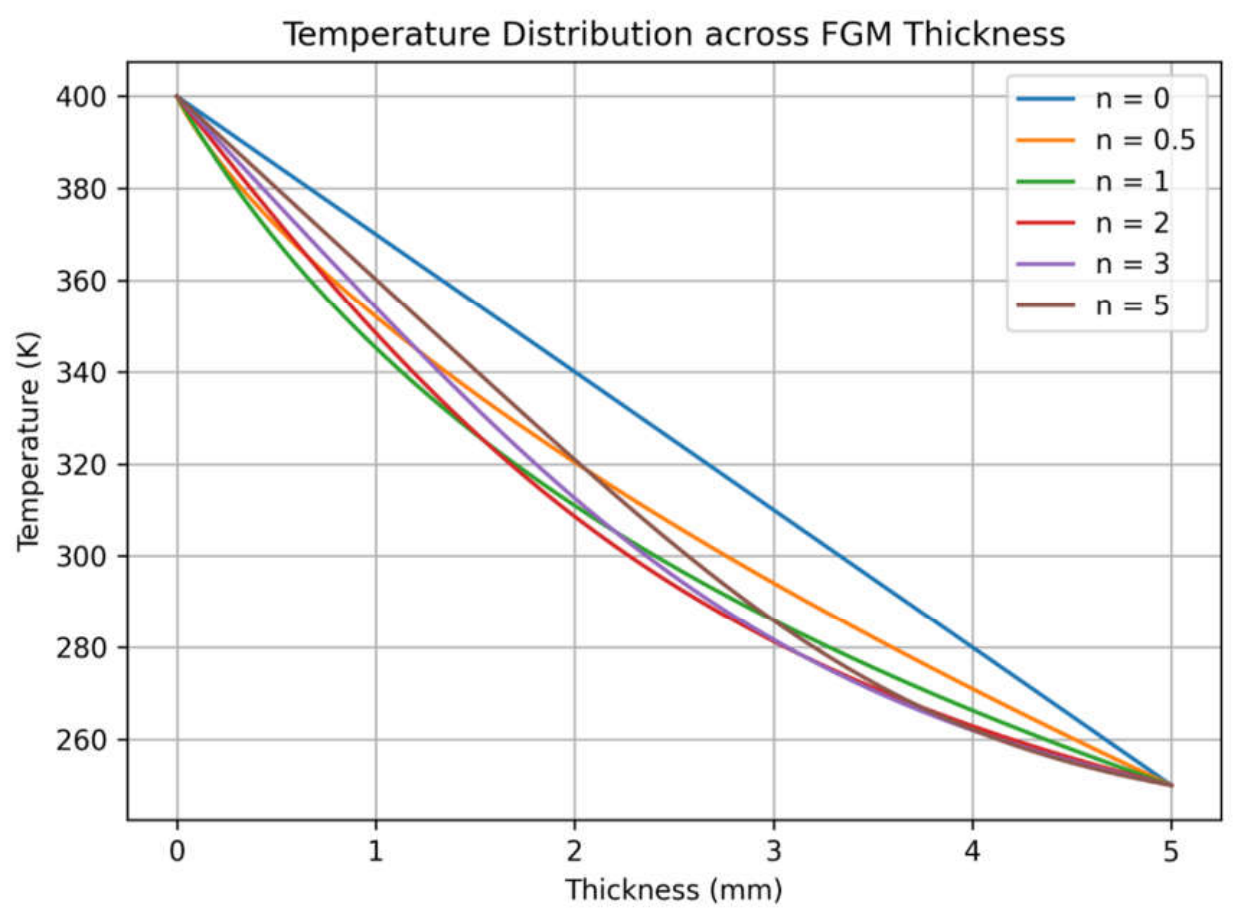
Figure 5.
Radiation attenuation through shielding thickness based on the Beer–Lambert model. The normalized radiation intensity decreases exponentially with thickness, reaching approximately 0.47 at 5 mm. The attenuation behavior is independent of material grading in the present formulation. (Simulation results generated using the developed numerical model).
Figure 5.
Radiation attenuation through shielding thickness based on the Beer–Lambert model. The normalized radiation intensity decreases exponentially with thickness, reaching approximately 0.47 at 5 mm. The attenuation behavior is independent of material grading in the present formulation. (Simulation results generated using the developed numerical model).
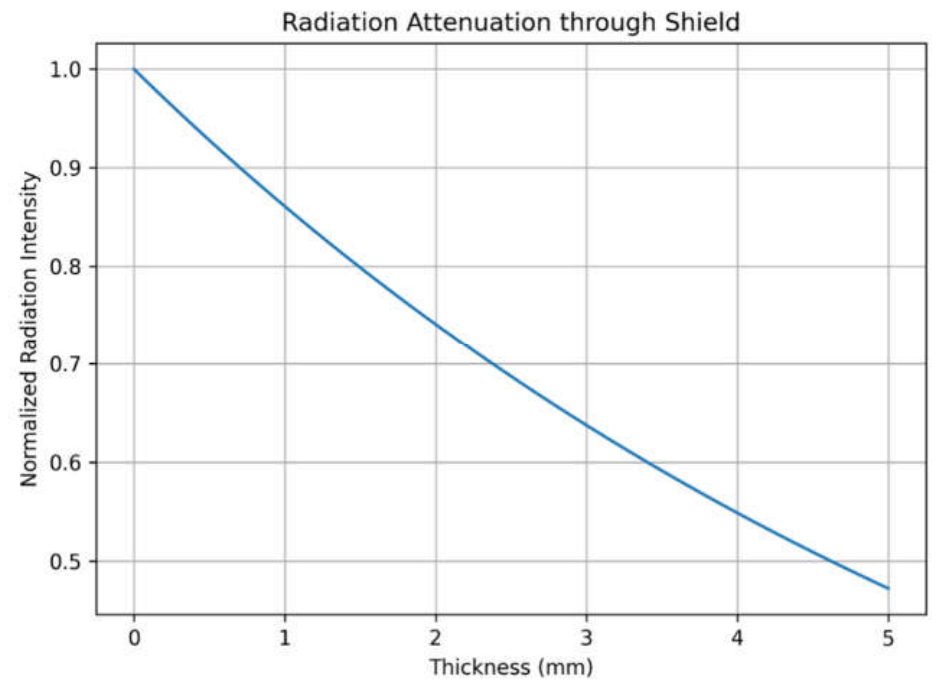
Figure 6.
Variation of heat flux with FGM grading exponent. A substantial decrease in heat flux is observed with increasing , indicating improved thermal resistance in graded configurations compared to the homogeneous case. (Simulation results generated using the developed numerical model).
Figure 6.
Variation of heat flux with FGM grading exponent. A substantial decrease in heat flux is observed with increasing , indicating improved thermal resistance in graded configurations compared to the homogeneous case. (Simulation results generated using the developed numerical model).
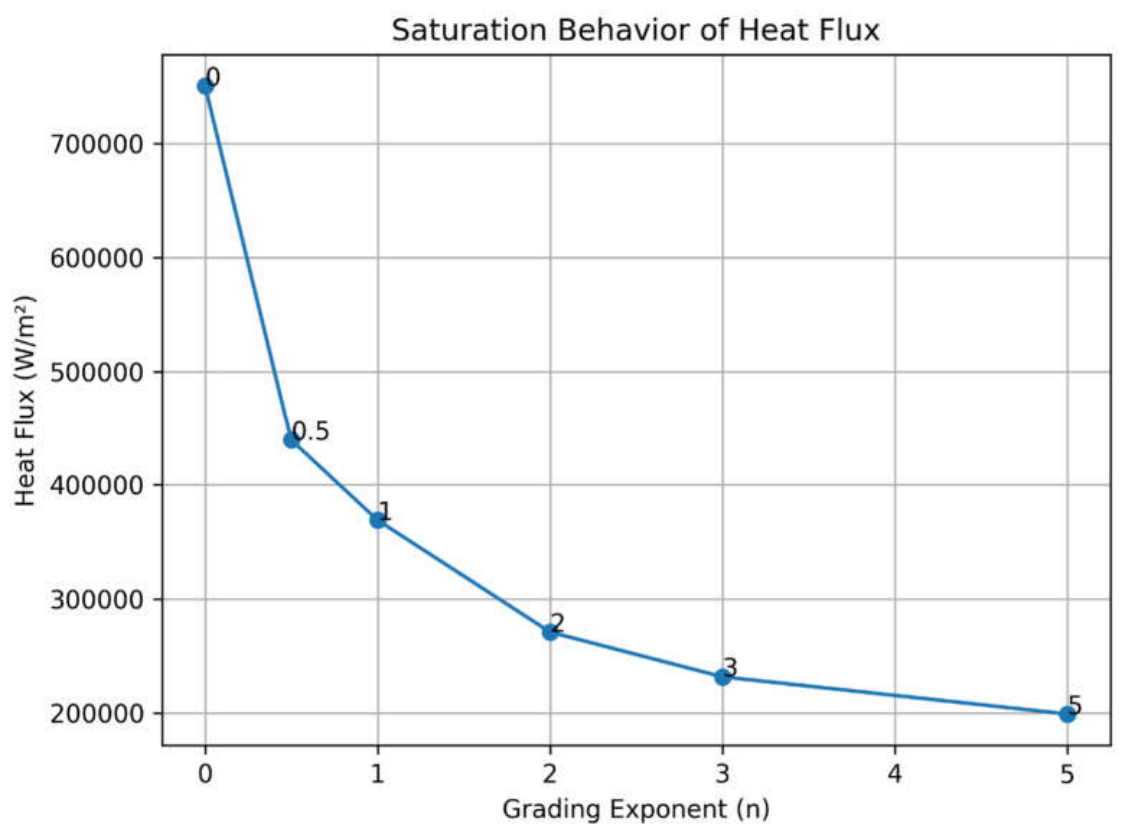
Figure 7.
Temperature gradient across FGM thickness for varying grading exponent (). The homogeneous case shows a constant gradient, while graded configurations exhibit redistributed gradients, with higher values near the hot surface and reduced gradients toward the cold side. This behavior indicates potential reduction in thermal stress concentrations. Although the boundary temperatures remain unchanged across all cases, the internal heat transfer characteristics are significantly influenced by material grading. The combined reduction in heat flux and redistribution of temperature gradients demonstrates the effectiveness of functionally graded materials in enhancing thermal performance for deep space structural applications. (Simulation results generated using the developed numerical model).
Figure 7.
Temperature gradient across FGM thickness for varying grading exponent (). The homogeneous case shows a constant gradient, while graded configurations exhibit redistributed gradients, with higher values near the hot surface and reduced gradients toward the cold side. This behavior indicates potential reduction in thermal stress concentrations. Although the boundary temperatures remain unchanged across all cases, the internal heat transfer characteristics are significantly influenced by material grading. The combined reduction in heat flux and redistribution of temperature gradients demonstrates the effectiveness of functionally graded materials in enhancing thermal performance for deep space structural applications. (Simulation results generated using the developed numerical model).
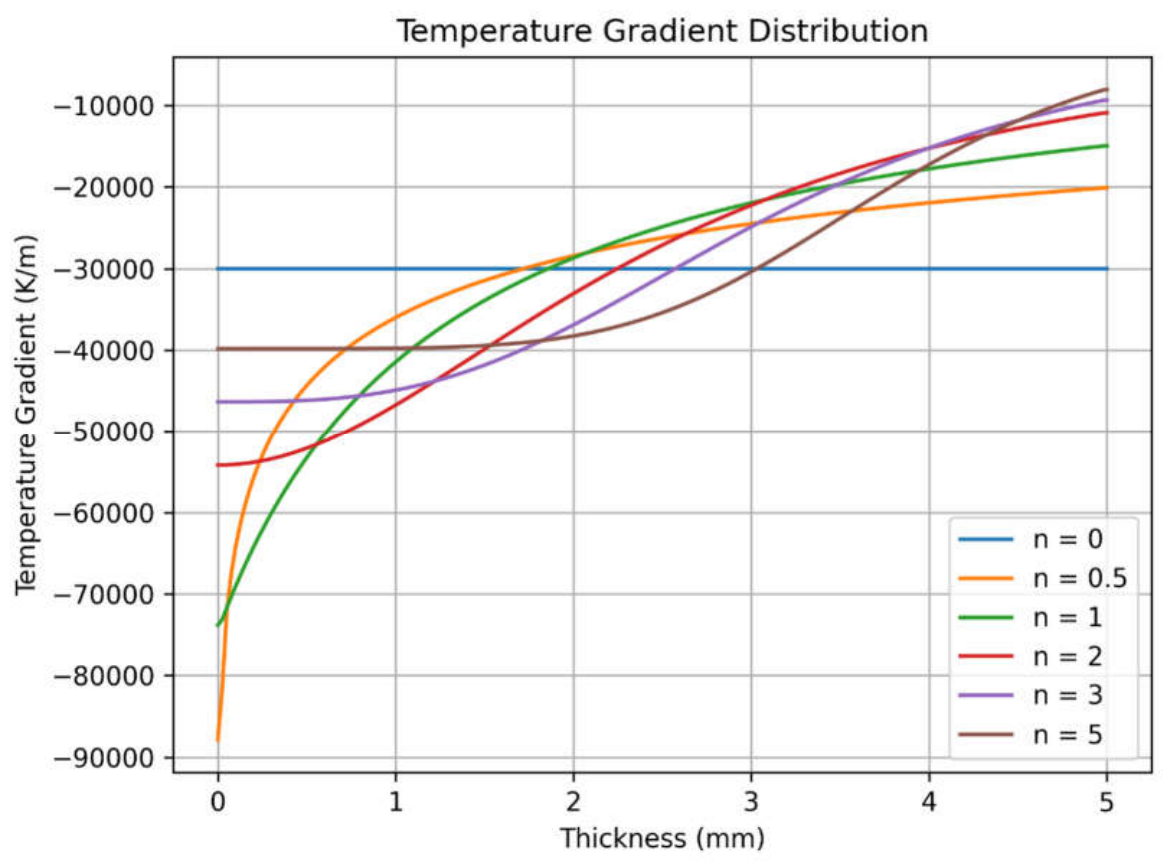

Table 1.
Summary of prior work on Digital Twin, FGMs, and additive manufacturing in aerospace applications.
Table 1.
Summary of prior work on Digital Twin, FGMs, and additive manufacturing in aerospace applications.
| Domain | Representative Studies | Focus | Methodology | Key Limitation |
|---|---|---|---|---|
| Digital Twin in Aerospace | [1,2,3,4,5,6,7,8,9] | Structural health monitoring, system-level simulation | Physics-based modelling + data integration | Limited incorporation of material-level design variables |
| Functionally Graded Materials | [10,11,12,13,14,15,16,17,18,19,20,28,29] | Thermal and mechanical behaviour of graded materials | Analytical and finite element modelling | Typically studied in isolation without iterative design frameworks |
| Additive Manufacturing for FGMs | [21,22,23,24,25,26,27] | Fabrication of graded and multi-material structures | Experimental and process-based studies | Weak integration with predictive modelling and optimization frameworks |
Table 2.
Model parameters used in the simulation.
| Parameter | Value | Description / Material System |
|---|---|---|
| Thickness (L) | 5 mm | Representative thickness for structural shielding elements in spacecraft panels |
| Thermal conductivity (k1, k2) | 25 → 5 W/m·K | Corresponds to grading from metal-rich Ti-6Al-4V (high conductivity) to ceramic-rich Al2O3 / YSZ (low conductivity), achievable via additive manufacturing |
| Radiation attenuation coefficient (μ) | 150 m−1 | Effective attenuation parameter for simplified shielding model; represents average behaviour across graded composition |
| Hot-side temperature | 400 K | Representative solar-exposed surface condition in deep space |
| Cold-side temperature | 250 K | Representative deep space-facing radiative cooling condition |
Table 3.
Comparison of heat flux values for different grading exponents.
| Grading Exponent (n) | Heat Flux (W/m2) | Radiation Transmission (I/I0) |
|---|---|---|
| 0.0 | 750,000 | 0.2231 |
| 0.5 | 439,386 | 0.3385 |
| 1.0 | 369,095 | 0.4169 |
| 2.0 | 270,957 | 0.5134 |
| 3.0 | 231,631 | 0.5698 |
| 5.0 | 199,043 | 0.6323 |
Disclaimer/Publisher’s Note: The statements, opinions and data contained in all publications are solely those of the individual author(s) and contributor(s) and not of MDPI and/or the editor(s). MDPI and/or the editor(s) disclaim responsibility for any injury to people or property resulting from any ideas, methods, instructions or products referred to in the content. |
© 2026 by the author. Licensee MDPI, Basel, Switzerland. This article is an open access article distributed under the terms and conditions of the Creative Commons Attribution (CC BY) license.
Copyright: This open access article is published under a Creative Commons CC BY 4.0 license, which permit the free download, distribution, and reuse, provided that the author and preprint are cited in any reuse.


