

Submitted:
25 July 2026
Posted:
31 July 2026
You are already at the latest version
Abstract
Tesserodoniellini new tribe, is established to accommodate the Neotropical genus Tesserodoniella Vaz-de-Mello & Halffter, based on phylogenomic evidence and morphological support. The tribal placement of this genus has been uncertain in previous classifications of Scarabaeinae, and it has been treated as incertae sedis at the tribal level. Recent analyses based on ultra-conserved elements (UCEs) recover Tesserodoniella as a highly supported lineage sister to a clade endemic to Australasia, and in a distinct lineage from Deltochilini and Ateuchini. Although until no single unequivocal synapomorphy was identified, the tribe can be diagnosed by a unique morphological combination of characters. The biogeographic implications related to Gondwanan fragmentation are discussed. An illustrated diagnosis, description with characters that define the tribe, natural history, distributional data with a map for the two known Chilean species are given. Also, photographs of the Tesserodoniella elguetai (type species of the genus) and live specimens in your respective natural habitats are provided.
Keywords:
Chile
; Neotropical region
; systematics
; taxonomy
; UCEs
Introduction
The subfamily Scarabaeinae represents one of the most diverse radiations of dung beetles, whose suprageneric classification has historically been hindered by extensive morphological convergence associated with similar ecological habits (Davis et al. 2002; Tarasov & Génier 2015). As a result, tribal delimitation has often relied on characters prone to homoplasy, leading to artificial or non-monophyletic groupings and to the persistence of genera treated as incertae sedis. One example of this is Tesserodoniella Vaz-de-Mello & Halffter, 2006 (Tarasov & Génier 2015; Tarasov & Dimitrov 2016; Gunter et al. 2026), a small and uncommon South American taxon endemic to Chile (Vaz-de-Mello & Halffter 2006). The genus has historically represented a phylogenetically problematic lineage, and no unequivocal morphological synapomorphies has yet been identified for it within Scarabaeinae phylogenetic studies.
In the morphological analysis of Tarasov & Génier (2015), Tesserodoniella was not placed within any traditional tribe of Scarabaeinae, instead appearing as an isolated lineage weakly associated with some austral taxa of Gondwanan affinities. That study also suggested that the classical tribal limits, particularly within Deltochilini (= Canthonini), were artificial or polyphyletic. Similarly, the molecular phylogenetic analysis of Tarasov & Dimitrov (2016) failed to recover Tesserodoniella within any recognized tribe, placing it in an isolated position, weakly associated in some analyses with a small Neotropical clade including Homocopris Burmeister, 1846 (Homocoprini) and Paracanthon Balthasar, 1938 (insertae sedis), but without sufficient support for formal tribal assignment. Consequently, the genus was effectively treated as tribal incertae sedis.
Recent advances in phylogenomics have enabled the reassessment of higher-level relationships within Scarabaeinae (Tarasov & Dimitrov 2016). In particular, analyses based on ultra-conserved elements (UCEs) have provided greater resolution and stronger support for deep phylogenetic nodes through the incorporation of large genomic datasets. A recent large-scale study recovered Tesserodoniella within a derived Neotropical clade related to the former “Ateuchini/Deltochilini” and associated with Australasian endemic genera (AEG), suggesting a complex biogeographic history linked to Gondwanan fragmentation (Gunter et al. 2026). These results are congruent with the earlier findings of Tarasov & Dimitrov (2016), reinforcing the interpretation of Tesserodoniella as an independent tribal lineage within Scarabaeinae and supporting the need for formal recognition of a new tribe based on robust phylogenomic evidence and morphological support.
In parallel, several recent studies have established new tribes to reconcile classification with phylogenetic evidence, emphasizing the importance of recognizing monophyletic units (Tarasov 2017; Davis et al. 2019; Rossini et al. 2022; Gunter et al. 2026; Scholtz et al. 2025; Montanaro et al. 2026). Within this framework, the consistently recovered isolated position of Tesserodoniella warrants formal taxonomic recognition.
This study proposes Tesserodoniellini new tribe, based on published phylogenomic evidence and supported by a distinctive combination of morphological characters, in order to improve the stability and phylogenetic consistency of Scarabaeinae classification.
This manuscript conforms to the requirements of the amended International Code of Zoological Nomenclature (ICZN). Please note that this work is not issued for the purpose of zoological nomenclature and it should be considered not published within the meaning of the code (ICZN code, Section 8.2). The nomenclatural acts and new taxon names described herein should therefore be considered as not available.
Materials and Methods
The present taxonomic proposal is based on reinterpretation of recently published phylogenomic evidence presented by Gunter et al. (2026) and morphological support.
The placement of Tesserodoniella was evaluated through examination of nodal support values and alternative topologies presented in that study. The genus is consistently recovered as a highly supported lineage, sister to the Deltochilini+Ateuchini+Mentophilini combinate clade, with no alternative placement receiving comparable support.
The taxonomic decision to erect a new tribe follows a phylogenetic species concept at the suprageneric level, recognizing only well-supported monophyletic clades and considering congruence with morphological and biogeographical evidence.
Morphological Examination
19 specimens of Tesserodoniella were studied and photographed for this work from the collection of the first author (JMEC), Museo Nacional de Historia Natural, Santiago, Chile (MNNC), and Finnish Museum of Natural History, Helsinki, Finland (LUOMUS).
The description and diagnosis are based on analyses of external morphological characters and male genitalia. The specimens were examined and dissected using an Olympus SZ61 stereomicroscope (10–60×). Male genitalia were extracted by relaxing the specimens in hot water, cleaned with KOH 10%, and later glued on cardboard for imaging. Adult specimens were photographed with a Canon EOS 250D connected to a stereomicroscope (details of disarticulated specimens) and a Canon EOS 5DS (habitus/lateral/head). The final images were obtained using focus stacking with Zerene Stacker software version 1.04 and edited with Adobe Photoshop CS5.
The geographic coordinates of the collecting sites were recorded using Google Earth Pro. The distribution map (Fig. 12) was generated by entering the geographical coordinates on the website www.simplemappr.net.
Results
Phylogenetic Position
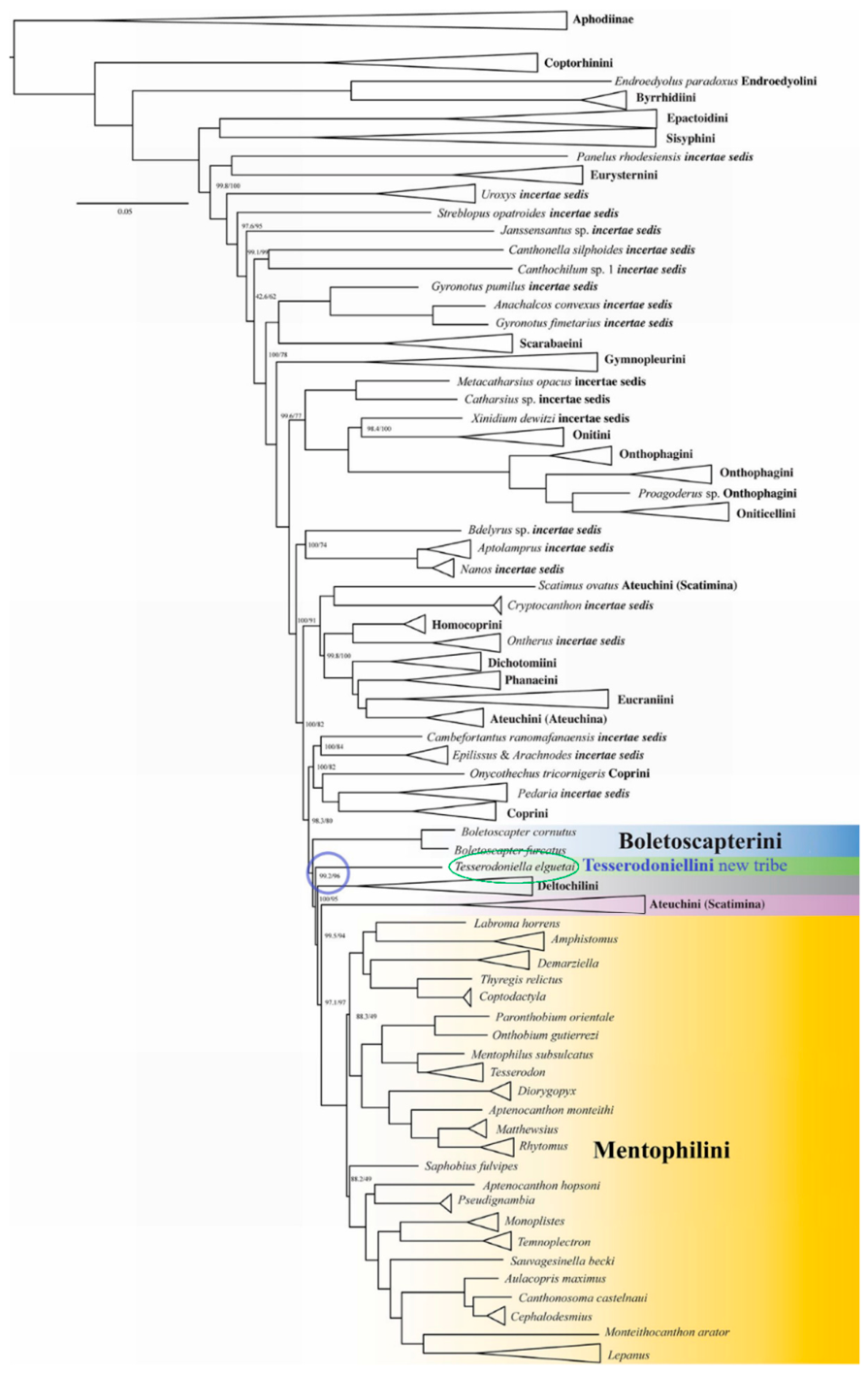
Tesserodoniella is recovered as a distinct and highly supported monophyletic lineage within Scarabaeinae (Gunter et al. 2026). It is placed as sister to the Deltochilini+Ateuchini(Scatimina)+Mentophilini clade, with strong nodal support (SH-aLRT ≈100; UFBoot >95) (Fig. 1). The genus is clearly separated from Deltochilini (=Canthonini) and does not cluster with Ateuchini. Its position has been unstable in previous morphology-based analyses (see Tarasov & Génier 2015), further supporting the need for taxonomic reassessment. These results indicate that Tesserodoniella represents an independent evolutionary lineage is not convincingly accommodated within currently recognized tribes, questioning previous tribal placements proposed by Vaz-de-Mello & Halffter (2006), Montreuil (2010), and Allsopp & Schoolmeesters (2025).
Figure 1.
Phylogenetic placement of Tesserodoniella (Tesserodoniellini) as a sister Deltochilini+Ateuchini(Scatimina)+Mentophilini combinate clade based on UCEs data with strong nodal support (SH-aLRT ≈100; UFBoot >95) (modified from Gunter et al. 2026).
Figure 1.
Phylogenetic placement of Tesserodoniella (Tesserodoniellini) as a sister Deltochilini+Ateuchini(Scatimina)+Mentophilini combinate clade based on UCEs data with strong nodal support (SH-aLRT ≈100; UFBoot >95) (modified from Gunter et al. 2026).
Taxonomy
Some morphological characters (possibly synapormorphics) have been identified that may be used to separate the membership of this new tribe from all other Scarabaeinae taxa. As there are few, unique, diagnostic characters, their separation at tribal level relies strongly on their phylogenomics relationships and biogeography together with a unique combinations of characters provided below.
Tesserodoniellini Mondaca & Tello, New Tribe
Type genus: Tesserodoniella Vaz-de-Mello & Halffter, 2006 (Figs. 2–11).
Etymology: The tribal name is derived from the type genus Tesserodoniella, with the tribal suffix -ini.
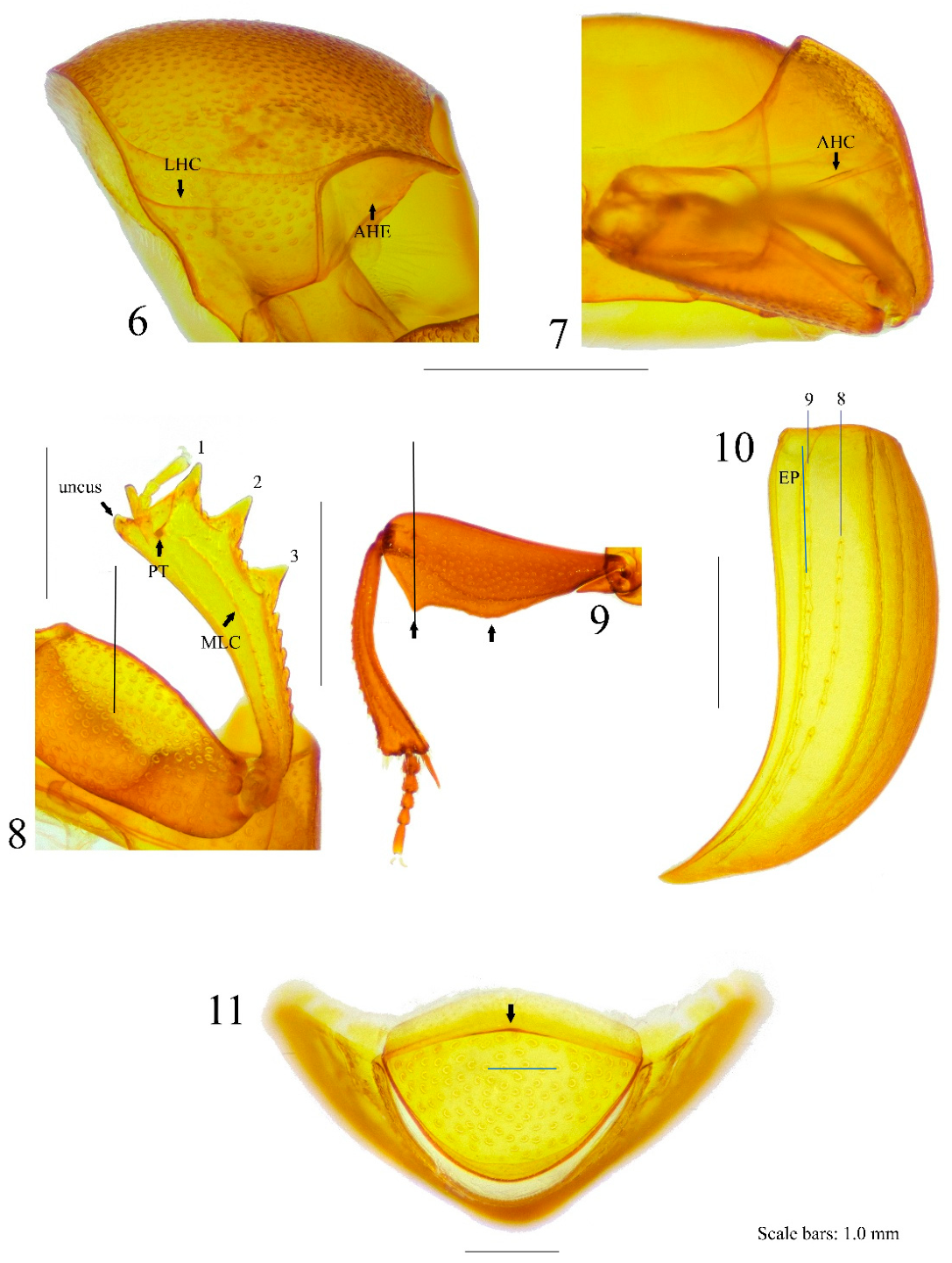
Diagnosis. Tesserodoniellini is distinguished from all related tribes of Scarabaeinae, including Deltochilini and Ateuchini, by the following unique combination of characters: head without occipital bead (Figs. 2, 4); clypeus quadridentate, with two bigger median teeth separated by a U-shaped emargination (Fig. 4); eye surface dorsally reduced (Fig. 4); prothorax lateroventrally with an incomplete posterior hypomeral carina that is parallel to the external margin (Fig. 6); hypomeron deeply excavated anteriorly (Fig. 6); protibia with a prominent tubercle at the level of the tarsal insertion (Fig. 8); metafemur strongly widened medially, with a prominent posteroventral lobe (Fig. 9); metatibia elongate, weakly widened apically, with external serration along apical two-thirds and apex obliquely truncate and strongly expanded externally; elytra with nine well-impressed striae, the lateralmost two placed on pseudoepipleuron, one complete and well impressed and the other incomplete and conspicuous (Fig. 10); pygidium with complete marginal border (Fig. 11).
Description. Length 5.1–6.1 mm. Body short oval (Fig. 2); dorsal surface microgranulose, glabrous or microsetose, opaque to slightly shiny. Color black, without metallic reflections (Fig. 2). Head as long as wide, without occipital bead (Fig. 4). Clypeus quadridentate, with two bigger medial teeth separated by U-shaped emargination (Fig. 4); clypeogenal sutures evident, frontoclypeal suture absent (Fig. 4). Eyes small, feebly visible dorsally; dorsal eye surface reduced, triangular, or elongated (Fig. 4). Prothorax subrectangular or rhomboidal, transverse, widest at middle (Figs. 2, 4). Hypomeron with transverse carina extending from external side of procoxal cavity to anterior third of lateral pronotal carina (Fig. 7). Hypomeral surface concave anterior to transverse carina, flat to feebly convex posterior to transverse carina, with longitudinal carina parallel to external margin (Fig. 6). Elytra with nine well-impressed striae, the lateralmost two placed on pseudoepipleuron (Fig. 10); humerus without tubercle (Figs. 2, 3). Hind wings: strongly reduced, non-functional. Mesosternum long, narrowed medially; surface covered by large, dense, ocellate punctures. Metasternum non gibbose, covered by large, dense ocellate punctures. Legs: protibia tridentate, curved internally; teeth located on apical half, basal half with 3 denticles (Fig. 8); Ventral median longitudinal carina with strong tubercle at tarsal insertion; spur conical, apex narrow; claws small, simple, falciform (Fig. 8). Mesofemur elongate. Mesotibia triangular with straight sides, evenly widened to apex. Larger mesotibial spur subconical. Mesotarsomeres 1–4 decreasing in size towards claw. Metafemur evenly and strongly widened at middle, with strong posterior ventral carina; posterior margin prolonged into conspicuous lobe in apical fourth (Fig. 9). Metatibia long, narrow, weakly widened apically; externally serrate in apical two thirds; apex strongly widened externally, obliquely truncate (Fig. 9). Metatibial spur subconical, as long as tarsomeres 1–2 combined. Metatarsi similar to that of mesothoracic legs. Pygidium almost twice as wide as long; disc strongly convex with ocellate punctures; bordered complete (Fig. 11). Male genitalia with asymmetric parameres, left paramere (in dorsal view) longer and wider at apex.
Sexual dimorphism: Weakly expressed. Male protibia with strong internal apical tooth directed foreward and downward, external teeth narrower than in females; male metatibiae with larger external serrations; and male abdominal ventrite 5 narrowed medially.
Composition: The tribe includes a single genus, Tesserodoniella, currently comprising two species endemic to Chile: T. elguetai Vaz-de-Mello & Halffter, 2006 (Fig. 2) and T. meridionalis Vaz-de-Mello & Halffter, 2006.
Figure 2–5.
Tesserodoniella elguetai Vaz-de-Mello & Halffter (female). 2–3. Habitus in dorsal and lateral views. 4. Details of head and prothorax. 5. Antenna detail.
Figure 2–5.
Tesserodoniella elguetai Vaz-de-Mello & Halffter (female). 2–3. Habitus in dorsal and lateral views. 4. Details of head and prothorax. 5. Antenna detail.
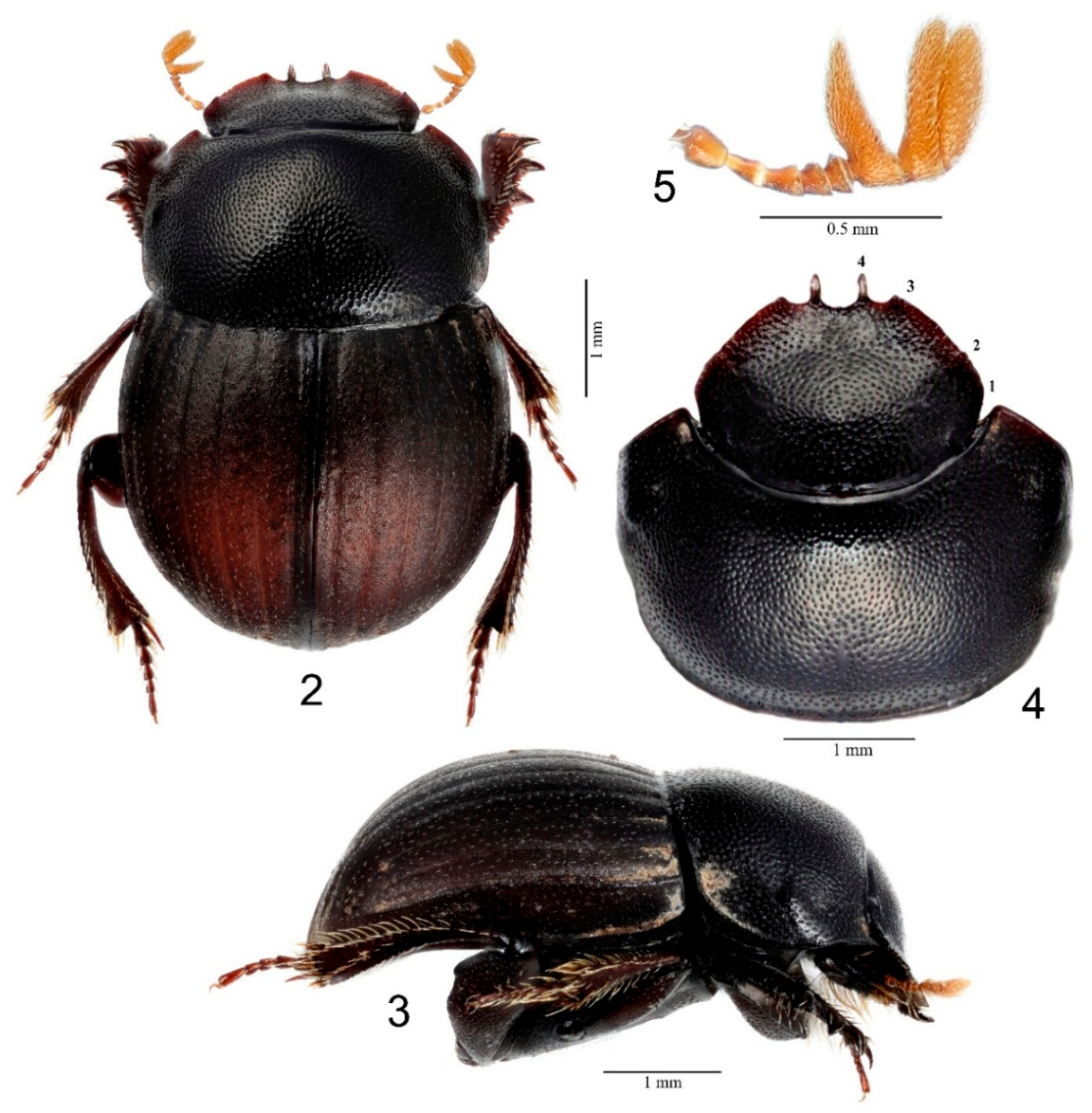
Figure 6–11.
Diagnostic morphological characters of Tesserodoniellini new tribe. Tesserodoniella elguetai: (6) prothorax with incomplete lateral hypomeral carina (LHC) and anterior hypomeral excavation (AHE). (7) hypomeron showing anterior hypomeral carina (AHC). (8) protibia (ventral view) showing uncus and small tubercle (PT) and median longitudinal carina (MLC). (9) metafemur with widening and posterior lobe and strongly curved metatibia. (10) elytra showing epipleuron (EP) and 8th and 9th lateral striae. (11) pygidium showing ocellate punctures and bordered complete..
Figure 6–11.
Diagnostic morphological characters of Tesserodoniellini new tribe. Tesserodoniella elguetai: (6) prothorax with incomplete lateral hypomeral carina (LHC) and anterior hypomeral excavation (AHE). (7) hypomeron showing anterior hypomeral carina (AHC). (8) protibia (ventral view) showing uncus and small tubercle (PT) and median longitudinal carina (MLC). (9) metafemur with widening and posterior lobe and strongly curved metatibia. (10) elytra showing epipleuron (EP) and 8th and 9th lateral striae. (11) pygidium showing ocellate punctures and bordered complete..
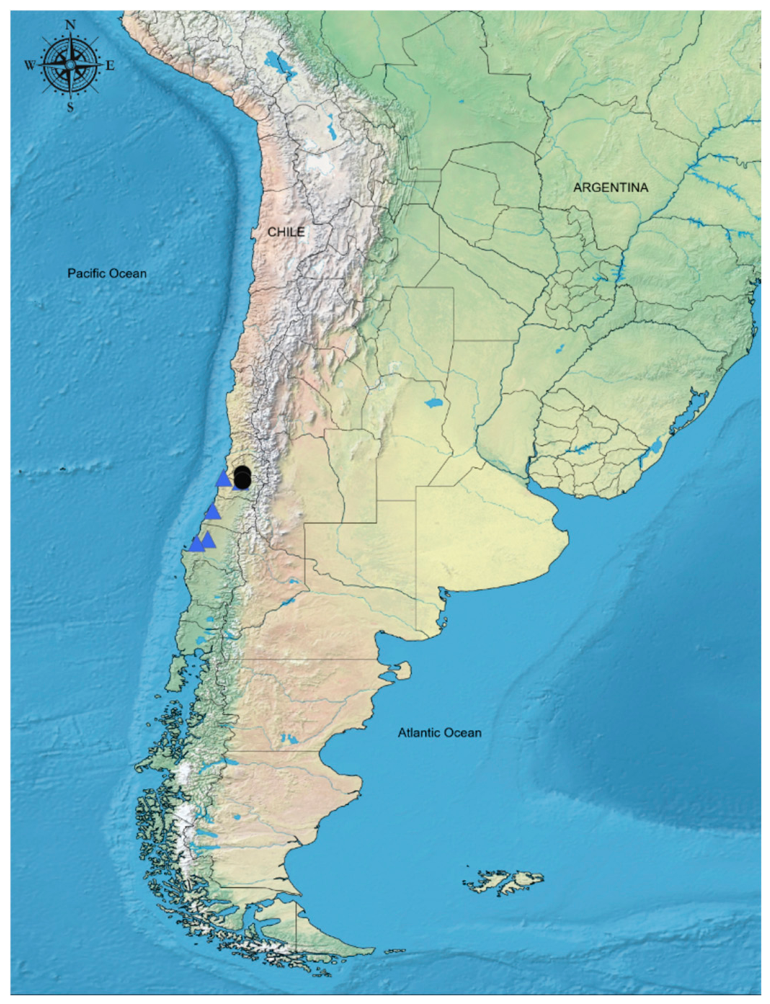
Distribution: Coastal mountains of south-central Chile (Fig. 12).
Material examined:Tesserodoniella elguetai (Figs. 2-5). CHILE, Región Metropolitana de Santiago. Provincia de Maipo, Rangue (Barber trap), 33°51'20.3''S, 70°59'03.4''W, 602 m, 21-vii-2006 (2 JMEC), 12-vi-2007 (5 JMEC), 6-ix-2008 (2 JMEC), col. J. Mondaca E. Región del Libertador General Bernardo O’Higgins. Cachapoal, R.N. Roblerías de Loncha, 20-xi-2004, col. J. Mondaca E. (1 JMEC). Tesserodoniella meridionalis. CHILE, Región del Libertador General Bernardo O’Higgins. Provincia de Cachapoal, Cerro Poqui, 27-ix-2013 (3 JMEC), 5-x-2013 (1 JMEC), col. J. Mondaca E.; B. O’Higgins, Cardenal Caro, El Maitén, Matanzas, 11-x-2012, col. J. Mondaca (3 JMEC); Biobío Region. Nonguén, 18/25-vii-2012, col. M. Pincheira (1 JMEC).
iNaturalist Records (1):Tesserodoniella meridionalis (Fig. 4B). CHILE, Región del Libertador General Bernardo O’Higgins. Provincia de Cachapoal, cerca de Quebrada El Infierno, San Vicente de Tagua-Tagua, 30-vii-2023, Christofer Olea. www.inaturalist.org/observations/186165673.
Remarks: The possible absence of morphological synapomorphies can be interpreted as a consequence of the high degree of homoplasy reported in Scarabaeinae. In a phylogenomic framework, the recognition of well-supported monophyletic lineages is prioritized over reliance on isolated morphological characters. The consistent recovery of Tesserodoniella as an isolated lineage supports its recognition as a distinct tribe.
Figure 12.
Known distribution of Tesserodoniella species in Chile. Tesserodoniella elguetai (black dots) and T. meridionalis (blue triangles).
Figure 12.
Known distribution of Tesserodoniella species in Chile. Tesserodoniella elguetai (black dots) and T. meridionalis (blue triangles).
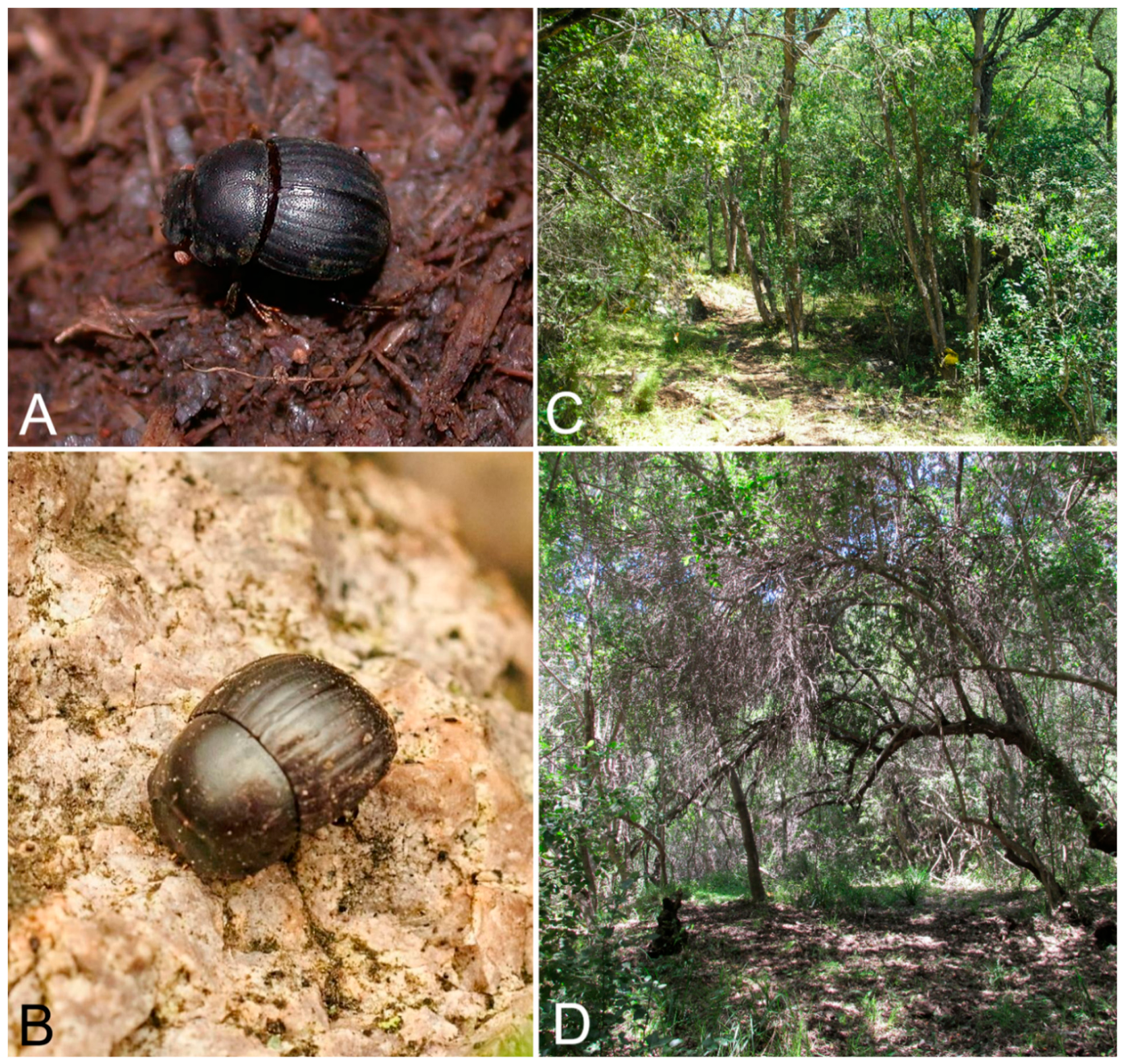
Natural history: Tesserodoniella is a small flightless dung beetle that inhabits the sclerophyllous-hydrophyllous and Nothofagus forests (Nothofagaceae) (Figs. 13c, d) located in central-south Chile (Fig. 12) (Vaz-de-Mello & Halffter 2006; Mondaca 2023). Tesserodoniella appears to feed primarily on detritus, as it inhabits under a thick layer of moist leaf litter that accumulates under the canopy of trees. Occasionally, it is found under horse and cow dung. The immature stages and brood-ball behavior remain unknown.
Figure 13.
Living specimens of Tesserodoniella species and collection environments in central Chile. A. Tesserodoniella elguetai. B. Tesserodoniella meridionalis. C. Rangue, Aculeo (Región Metropolitana de Santiago), locality for T. elguetai. D. El Maitén, Matanzas (Región del Libertador General Bernardo O’Higgins), locality for T. meridionalis.
Figure 13.
Living specimens of Tesserodoniella species and collection environments in central Chile. A. Tesserodoniella elguetai. B. Tesserodoniella meridionalis. C. Rangue, Aculeo (Región Metropolitana de Santiago), locality for T. elguetai. D. El Maitén, Matanzas (Región del Libertador General Bernardo O’Higgins), locality for T. meridionalis.
Discussion
The establishment of Tesserodoniellini reflects the increasing role of phylogenomic data in stabilizing higher-level classification in Scarabaeinae. The available phylogenomic evidence suggests that retaining Tesserodoniella within Deltochilini may compromise the monophyly of that tribe. Comparable cases in recent literature (Tarasov 2017; Davis et al. 2019, 2025; Génier and Darling 2024; Gunter et al. 2026; Lopes et al. 2024; Montanaro et al. 2026; Rossini et al. 2022; Scholtz et al. 2025), demonstrate that the recognition of new tribes is necessary to maintain monophyly and reflect evolutionary history of the subfamily. The phylogenetic placement of Tesserodoniella suggests an early divergence within a lineage associated with Australasian taxa, supporting a Gondwanan biogeographic scenario (Gunter et al. 2025).
The recognition of this tribe reduces to 21 the number of genera treated as incertae sedis (principally from the Americas), and contributes to a more stable and predictive classification.
Biogeographic Implications Related to Gondwanan Fragmentation
The disjunct distribution of the genus Tesserodoniella is consistent with a Gondwanan biogeographic origin, supported by both morphological evidence and phylogenetic patterns within the group. This genus, restricted to central-south Chile, exhibits closer affinities with Australasian and American taxa, suggesting its membership in an ancient and relatively isolated lineage within the subfamily (Vaz-de-Mello & Halffter 2006). In this context, the fragmentation of the supercontinent Gondwana during the Late Jurassic and Early Cretaceous would have led to the separation of ancestral populations previously distributed continuously across now-disintegrated landmasses (Sanmartín & Ronquist 2004). The subsequent continental drift between South America, Antarctica, and Australia would have promoted vicariance events, facilitating the evolutionary divergence of lineages that currently exhibit disjunct distributions but retain profound structural similarities.
A Gondwanan vicariance scenario is more parsimonious than alternative scenarios of transoceanic dispersal, especially considering the limited long-distance dispersal capacity relict lineage, whose current distribution reflects the persistence of components of an ancestral Gondwanan biota that has survived in refuges of the southern hemisphere, specifically in the coastal mountain range of south-central Chile which harbors ancient and geographically isolated lineages. One example is Tesserodoniella, whose distribution is closely associated with these mountainous environments and whose isolated phylogenetic position suggests a long evolutionary history. This type of relict lineage reinforces the hypothesis that the Chilean coastal mountain range has functioned not only as a refuge for biodiversity, but also as a setting for the diversification and persistence of ancestral insect groups.
Conclusion
Phylogenomic and morphological evidence supports the recognition of Tesserodoniellini as a distinct South American evolutionary lineage within Scarabaeinae. It is the closest known sister lineage to the Australasian tribe Mentophilini and represents a very ancient Neotropical lineage, that probably diverging before the radiation of Australasian dung beetle genera. This proposal aligns with current systematic practices and contributes to a more robust tribal classification.
Acknowledgments
We appreciate the collaboration of Mario Elgueta (MNNC) for by facilitating access to Tesserodoniella type specimens. Thanks to Giulio Montanaro and Marcelo Guerrero for the photographs that illustrate this work. We appreciate the valuable comments and suggestions made by A.B.T Smith (Canadian Museum of Nature, Canada) and Giulio Montanaro (Finnish Museum of Natural History, Finland). Christofer Olea from Chile collaborated with the photograph of an adult in situ and the report of T. meridionalis in San Vicente de Tagua-Tagua, Región del Libertador General Bernardo O’Higgins.
References
- Allsopp, P.; Schoolmeesters, P. All genera of the world: Subfamilies Lithoscarabaeinae, Chironinae, Aegialiinae, Eremazinae, Aphodiinae, Aulonocneminae, Termitotroginae, and Scarabaeinae (Animalia: Arthropoda: Insecta: Coleoptera: Scarabaeidae). Megataxa 2025, 17, 343–410. [Google Scholar] [CrossRef]
- Davis, A.L.V.; Deschodt, C.M.; Scholtz, C.H. Defining new dung beetle tribes to resolve discrepancies between phylogeny and tribal classification in the subfamily Scarabaeinae (Coleoptera: Scarabaeidae). Zootaxa 2019, 4608, 131–144. [Google Scholar] [CrossRef] [PubMed]
- Davis, A.L.; Deschodt, C.M.; Scholtz, C.H. Replacement names for the dung beetle genus Byrrhidium Harold, 1869 and the tribe Byrrhidiini Davis, Deschodt & Scholtz, 2019 (Coleoptera: Scarabaeidae: Scarabaeinae). Zootaxa 2025, 5604(1), 84–86. [Google Scholar] [CrossRef] [PubMed]
- Davis, A. L.V.; Scholtz, C.H.; Philips, T.K. Historical biogeography of Scarabaeinae dung beetles (Coleoptera: Scarabaeidae). J. Biogeogr. 2002, 29, 1217–1256. [Google Scholar] [CrossRef]
- Génier, F.; Darling, J.D. Revision of the South American genera Andinocopris new genus and Homocopris Burmeister, 1846 (Coleoptera: Scarabaeidae: Scarabaeinae: Homocoprini new tribe). Eur. J. Taxon. 2024, 925, 220–267. [Google Scholar] [CrossRef]
- Gunter, N.L.; Saxton, N.A.; Lopes, F.; Tarasov, S.; Cupello, M.; Vaz-de-Mello, F.Z.; Stone, R.L.; Losacco, F.; Montanaro, G.; Rossini, M.; Weir, T.A. Ultraconserved elements support a new tribal-level classification for Australasian endemic dung beetles (Coleoptera: Scarabaeidae: Scarabaeinae). Syst. Entomol. 2025, 51, 1–20. [Google Scholar] [CrossRef]
- Lopes, F.; Gunter, N.; Gillett, C.P.; Montanaro, G.; Rossini, M.; Losacco, F.; Daniel, G.M.; Straube, N.; Tarasov, S. From museum drawer to tree: Historical DNA phylogenomics clarifies the systematics of rare dung beetles (Coleoptera: Scarabaeinae) from museum collections. PLoS ONE 2024, 19(12), e0309596. [Google Scholar] [CrossRef] [PubMed]
- Mondaca, J. A checklist of the Scarabaeoidea (Coleoptera) of Chile with exemplar live photographed. Zootaxa 2023, 5285, 201–251. [Google Scholar] [CrossRef] [PubMed]
- Montanaro, G.; Lopes, F.; Gunter, N.L.; Scholtz, C.; Davis, A.L.; Losacco, F.; Rossini, M.; Gillett, P.D.T.C.; Saxton, N.A.; Stone, R.L.; Daniel, G.M.; Tarasov, S. Phylogenomics resolves a 200-year-old puzzle: a revised tribal classification of Afro-Eurasian dung beetles (Coleoptera: Scarabaeinae). bioRxiv 2026. [Google Scholar] [CrossRef]
- Montreuil, O. Première espèce du genre Haroldius Boucomont, 1914, à Madagascar, et redéfinition des Epilissini (Coleoptera, Scarabaeidae, Ateuchini). Bull. De La Société Entomol. De Fr. 2010, 115, 73–76. [Google Scholar] [CrossRef]
- Rossini, M.; Grebennikov, V.; Merrien, T.; Miraldo, A.; Viljanen, H.; Tarasov, S. Paleogene forest fragmentation and out-of-Africa dispersal explain radiation of the Paleotropical dung beetle tribe Epactoidini trib. nov (Coleoptera: Scarabaeinae). Syst. Entomol. 2022, 47, 655–667. [Google Scholar] [CrossRef]
- Sanmartín, I.; Ronquist, F. Southern hemisphere biogeography inferred by event-based models: Plant versus animal patterns. Syst. Biol. 2004, 53, 278–298. [Google Scholar] [CrossRef] [PubMed]
- Scholtz, C.H.; Davis, A.L.V.; De Klerk, H. New tribes (Paraphytini, Coptorhinini) proposed for five African or Afro-Oriental dung beetle genera formerly classified in the tribe Ateuchini Perty, 1830 (Coleoptera: Scarabaeidae: Scarabaeinae). Zootaxa 2025, 5711, 79–92. [Google Scholar] [CrossRef] [PubMed]
- Tarasov, S. A cybertaxonomic revision of the new dung beetle tribe Parachoriini (Coleoptera: Scarabaeidae: Scarabaeinae) and its phylogenetic assessment using molecular and morphological data. Zootaxa 2017, 4329, 101–149. [Google Scholar] [CrossRef] [PubMed]
- Tarasov, S.; Génier, F. Innovative Bayesian and Parsimony Phylogeny of Dung Beetles (Coleoptera, Scarabaeidae, Scarabaeinae) Enhanced by Ontology-Based Partitioning of Morphological Characters. PLoS ONE 2015, 10, e0116671. [Google Scholar] [CrossRef] [PubMed]
- Tarasov, S.; Dimitrov, D. Multigene phylogenetic analysis redefines dung beetles relationships and classification. BMC Evol. Biol. 2016, 16, 1–19. [Google Scholar] [CrossRef] [PubMed]
- Vaz-de-Mello, F.Z.; Halffter, G. A new dung beetle genus with two new species from Chile (Coleoptera: Scarabaeidae: Scarabaeinae). Zootaxa 2006, 1193, 59–68. [Google Scholar] [CrossRef]
Disclaimer/Publisher’s Note: The statements, opinions and data contained in all publications are solely those of the individual author(s) and contributor(s) and not of MDPI and/or the editor(s). MDPI and/or the editor(s) disclaim responsibility for any injury to people or property resulting from any ideas, methods, instructions or products referred to in the content. |
© 2026 by the authors. Licensee MDPI, Basel, Switzerland. This article is an open access article distributed under the terms and conditions of the Creative Commons Attribution (CC BY) license (http://creativecommons.org/licenses/by/4.0/).
Copyright: This open access article is published under a Creative Commons CC BY 4.0 license, which permit the free download, distribution, and reuse, provided that the author and preprint are cited in any reuse.