

Submitted:
29 July 2026
Posted:
31 July 2026
You are already at the latest version
Abstract
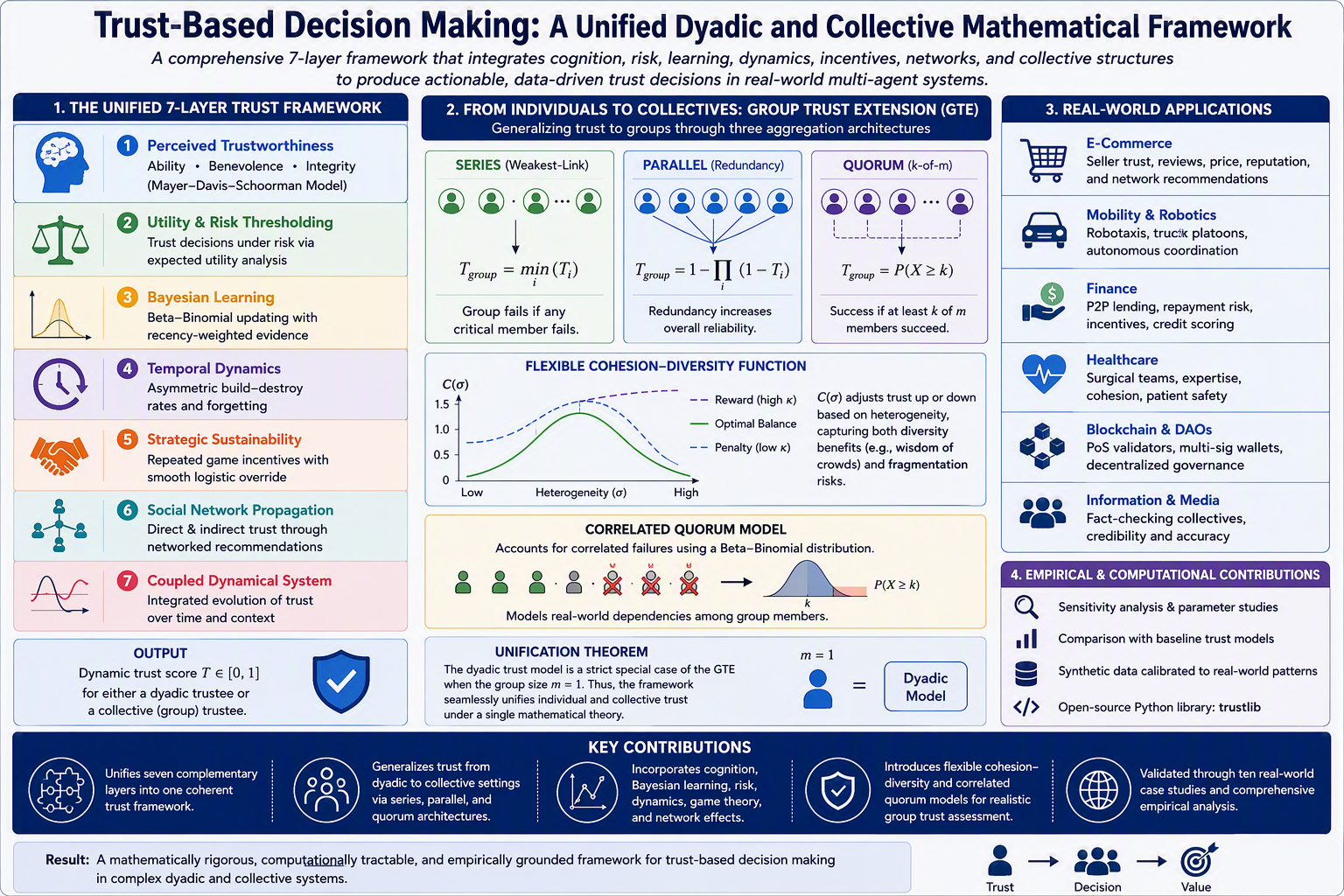
Trust is the invisible glue that binds together economic transactions, human machine partnerships, organizational cohesion, and decentralized governance. Yet despite its centrality, the vast majority of mathematical trust models remain confined to dyadic relationships—one trustor assessing one trustee. The real world, however, routinely demands trust in groups, teams, swarms, and institutions, where emergent outcomes depend on internal coordination, heterogeneity, and decision rules (e.g., quorums, weakest link dependencies, or majority votes). This paper presents a Unified Multi Layer Mathematical Framework that seamlessly integrates both dyadic and collective trust. The framework synthesizes seven core layers—perceived trustworthiness (ability, benevolence, integrity), behavioral risk thresholding (with a full utility theoretic justification), Bayesian learning with recency weighted evidence, temporal dynamics with asymmetric build destroy rates, game theoretic sustainability (with a smooth logistic override), social network propagation, and a coupled dynamical system. We introduce the Group Trust Extension (GTE), which generalizes the framework to collective trustees via three aggregation architectures: series (weakest link), parallel (redundancy), and quorum (k of m) systems. Crucially, we replace the simple cohesion penalty with a flexible cohesion–diversity function that can either penalize excessive variance or reward useful diversity (e.g., wisdom of crowds), and we extend the quorum model to account for correlated failures via a beta binomial formulation. We provide a formal unification theorem proving that the dyadic model is a special case of the GTE, and we present a sensitivity analysis and empirical comparison against baseline models using synthetic data calibrated to real world trust phenomena. We demonstrate the practical application of the framework through ten distinct real world case studies and one extended illustrative example (Amazon.ca e commerce, Appendix D) that shows how the model integrates reputation, risk, strategic incentives, social recommendations, and reviewer credibility into a single quantitative assessment. For each case, we provide domain specific parameterizations and executable Python code snippets from our open source library trustlib, demonstrating how the framework generates actionable decisions. The result is a mathematically consistent, computationally tractable, and empirically grounded theory of trust applicable to a wide range of multi agent systems.
Keywords:
trust modeling
; collective trust
; Bayesian inference
; game theory
; dynamical systems
; human machine interaction
; blockchain
; DAOs
; multi-agent systems
; group cohesion
1. Introduction
Trust is a concept intuitively understood yet remarkably difficult to formalize. Across disciplines, definitions converge: trust is the willingness of one party to accept vulnerability based on positive expectations of another's intentions and behaviors [1]. Gambetta's classic formulation—"trust is the subjective probability by which an individual, A, expects that another individual, B, performs a given action on which its welfare depends"—captures the dyadic essence that has dominated the field for decades [2].
However, the past decade has witnessed a profound shift in how trust is instantiated in real-world systems. Consider the following scenarios:
- A logistics manager deciding whether to activate a platoon of five autonomous trucks driving in close formation.
- A patient consenting to a cardiac surgery team composed of a lead surgeon, anesthesiologist, nurses, and a perfusionist.
- A DAO member delegating $10M USDC to a 5-of-9 multi-signature wallet.
- A social media user evaluating a hybrid fact-checking collective of three AI models and two human experts.
- A student on Amazon.ca deciding whether to purchase a refurbished iPhone from a third-party seller, weighing reviews, price, and network recommendations.
In each case, the trust target is not always a single agent but often a collective whose success depends on internal coordination, diversity, and decision rules. A group can fail despite most members being individually trustworthy (e.g., poor surgical team cohesion) or succeed despite a minority being untrustworthy (e.g., redundant sensor arrays). Dyadic trust models are inadequate for these scenarios; they cannot capture emergent group properties.
This paper addresses this gap by presenting a Unified Multi-Layer Mathematical Framework that treats the trust target as either a single individual or a structured group of individuals. We make four core contributions:
- Theoretical: We synthesize cognitive psychology (Mayer-Davis-Schoorman), Bayesian statistics, game theory, dynamical systems, and network science into a coherent seven-layer framework, and extend it with a Group Trust Extension (GTE) that generalizes trust to collectives via series, parallel, and quorum aggregation functions.
- Methodological Extensions: We derive a flexible cohesion–diversity function that handles both penalization and rewarding of variance, a correlated quorum model using beta-binomial distributions, and a smooth strategic override using logistic functions to remove discontinuities.
- Formal Rigour: We provide a formal unification theorem proving that the dyadic model is a strict special case of the GTE, establishing mathematical consistency across all layers.
- Practical and Empirical: We demonstrate the framework's utility through ten distinct real-world cases and one extended illustrative application (Amazon.ca, Appendix D), provide an open-source Python library (trustlib), and present a sensitivity analysis and baseline comparison using synthetic data that mimics real trust dynamics.
The remainder of this paper is organized as follows. Section 2 reviews relevant literature. Section 3 presents the complete unified framework, including all extensions and the unification theorem. Section 4 describes the trustlib Python library. Section 5 presents the ten core case studies. Section 6 provides the empirical sensitivity analysis and model comparison. Section 7 discusses cross-cutting implications, limitations, and future directions. Section 8 concludes. Appendices A–C supply the utility derivation, complete code, and mathematical proofs; Appendix D contains an extended illustrative application on Amazon.ca e-commerce.
2. Literature Review
2.1. Cognitive Foundations
The foundational cognitive model of trust, due to Mayer, Davis, and Schoorman (1995), identifies three determinants of perceived trustworthiness: ability (competence in a given domain), benevolence (goodwill toward the trustor), and integrity (adherence to principles) [1]. This tripartite structure has been empirically validated across numerous contexts and forms the basis of most survey-based trust measurement instruments. Recent meta-analyses have converged on a consensus structure for human-machine trust, identifying overlapping dimensions across multiple validated questionnaires [4].
2.2. Bayesian and Dynamic Approaches
Bayesian probability theory has emerged as a dominant paradigm for trust modeling in networked systems. Liu's comprehensive survey demonstrates that "all models under survey can cast into a GBT [Generic Bayesian Trust] based computing paradigm as special cases." [5] The Beta-Binomial conjugate prior is widely adopted for its principled handling of uncertainty and incremental updating [6,7]. However, static Bayesian models fail to capture temporal dynamics. Recent work has addressed this via switched linear systems [8] and Lévy process models [9] that accommodate asymmetric responses to performance and sudden trust collapse.
2.3. Game-Theoretic and Network Models
Economic approaches frame trust as a strategic decision in repeated Prisoner's Dilemma settings [10,11], where cooperation is sustained if the discount factor exceeds a threshold. In blockchain contexts, game-theoretic models have been applied to optimize lending and validator selection [22]. Network models, meanwhile, treat trust as propagating through social graphs via matrix factorization and PageRank-inspired algorithms [3,12,14].
2.4. Collective and Institutional Trust
A growing body of literature addresses trust in teams, organizations, and institutions. Research on "team trust" emphasizes the role of shared mental models [15,16,17], psychological safety, and coordination. In decentralized finance, "institutional trust" [20] is mediated by governance mechanisms, slashing conditions, and multi-signature requirements [21,22]. However, these approaches are predominantly qualitative or domain-specific. To our knowledge, no unified mathematical framework exists that generalizes dyadic trust to arbitrary group structures while maintaining consistency across cognitive, dynamic, strategic, and network layers.
3. The Unified Multi-Layer Mathematical Framework
Our framework treats the trust target as a generalized entity , which can be either a single individual (dyadic case) or a group of individuals (collective case). We first present the core layers for the dyadic case, then introduce the Group Trust Extension (GTE) with the new extensions.
3.1. Layer 1: Perceived Trustworthiness (Cognitive Antecedents)
For a trustor and an individual trustee , perceived trustworthiness is a weighted sum of three latent traits:
where , and:
- : Perceived Ability (competence, skill).
- : Perceived Benevolence (goodwill, caring).
- : Perceived Integrity (honesty, fairness) [1].
The trustor's Trust Propensity modulates baseline willingness:
3.2. Layer 2: Behavioral Decision Threshold (Utility-Theoretic)
Trust is actionable only under risk. Trust decisions under risk follow the expected utility tradition [10].
Let be the payoff if the trustee is trustworthy, and be the payoff if not. Expected utility:
Trust is extended iff , where the threshold incorporates risk aversion and situational stakes . This threshold arises from a constant relative risk aversion utility function ; see Appendix A for the full derivation.
3.3. Layer 3: Bayesian Learning Engine
Expected trust is . With recency bias :
3.4. Layer 4: Temporal Dynamics
Trust decays autonomously and recovers asymmetrically. The decay ODE:
3.5. Layer 5: Strategic Game-Theoretic Layer (with Smooth Logistic Override)
In an infinitely repeated Prisoner's Dilemma with payoffs (reward), (punishment), (temptation), and (sucker's payoff), the trustee will sustain cooperation iff:
where is the trustee's discount factor [10,11]. Rather than a hard indicator, we apply a smooth logistic override:
where controls the steepness. [8] As , this approaches the original hard switch; for finite (e.g., 10–20), it provides a realistic, continuous transition. The rational trust constraint becomes:
3.6. Layer 6: Social Network Propagation
The global trust tensor updates via damping :
3.7. Layer 7: Group Trust Extension (GTE) – Generalization to Collectives
We now generalize the framework to collective trustees. Let be a group of individuals. The trustor holds a trust vector:
3.7.1. Aggregation Functions
The trustor's confidence in the group depends on the group's decision architecture:
- Series Configuration (Weakest Link): Group succeeds iff every member succeeds:
Parallel Configuration (Redundancy): Group succeeds if at least one member succeeds:
Quorum Configuration (-of-): Group succeeds if at least of members are trustworthy. We generalize beyond independence by introducing a correlation parameter . Using a beta-binomial distribution to model overdispersion:
where
When , this reduces to the ordinary binomial. When , the variance increases, capturing correlated decision-making (e.g., board members influencing each other).
3.7.2. Flexible Cohesion–Diversity Function
We replace the simple exponential penalty with a context-sensitive function:
where:
- is the variance of individual trust scores,
- is the Shannon entropy of the distribution of trust scores (or of labels, in fact-checking),
- is a tolerance threshold below which variance is ignored,
- penalises excessive variance (e.g., in safety-critical series systems),
- rewards diversity when it is beneficial (e.g., in forecasting or advisory panels).
3.7.3. Generalized Aggregation Functions
While the three canonical aggregation functions capture the most common decision architectures, the framework is not limited to these. In practice, any monotone aggregation function that is non-decreasing in each argument can be used. Examples include:
- Weighted average (including harmonic mean, geometric mean, etc.) with user-specified weights,
- Order statistics (e.g., median, any quantile),
- Weighted majority (a generalization of quorum with unequal voting powers).
For the purposes of this paper, we employ the three canonical types. In Case 7 (surgery team), we use a harmonic-mean interpretation approximated by a quorum with and high cohesion sensitivity; this yields a conservative estimate that penalises any weak member, similar to the harmonic mean. In general, practitioners can define their own and incorporate it into the GTE framework, provided it satisfies monotonicity.
3.7.4. Collective Strategic Smoothness
Let be the group's collective discount factor (e.g., institutional longevity). The collective strategic factor is:
The effective group trust is then:
3.7.5. Complete Unified Dynamical System (with GTE)
3.8. Formal Unification Theorem
Theorem (Unification). Let denote the dyadic model (Layers 1–6 plus the dyadic equations of Layer 7 with , , and no aggregation). Let denote the general Group Trust Extension with parameters , aggregation function , cohesion–diversity function , and collective strategic smoothness . Then:
- Specialisation: For , , (since , , and ), and with reduces exactly to the dyadic strategic smoothness. Hence .
- Bayesian consistency: The group Bayesian update with and attribution weight yields , , identical to the dyadic update.
- Strategic consistency: The collective discount factor for equals the individual , so the sustainability condition and its logistic smoothing are identical.
- Monotonicity: Each aggregation function is monotonic non-decreasing in each argument, and for fixed parameters, is monotonic in and according to the chosen signs of and .
This ensures that higher individual trust never lowers group trust ceteris paribus.
Proof sketch: The proof follows by direct substitution. Setting , , , , so . The aggregate trust and the effective trust , which is precisely the dyadic equation. Therefore, the GTE is a strict generalisation, and the dyadic model is a special case. □
Note: Full proofs of all lemmas and theorems are provided in Appendix C.
4. The trustlib Python Library
All computations in the case studies are performed using our open-source library trustlib. The core classes are:
- Trustee: Stores Beta parameters , latent traits , discount factor, and optional correlation cluster metadata.
- Trustor: Stores propensity (), risk aversion (), and credibility weights.
- TrustGroup: Aggregates multiple trustees with a specified AggregationType (SERIES, PARALLEL, QUORUM), cohesion sensitivity parameters (), and correlation parameter .
- TrustScenario: Executes the complete decision pipeline (utility, threshold, strategic smoothness) for either a dyadic or group target.
The library is self-contained, depends only on numpy, and is designed for easy extension. The complete source code is provided in Appendix B. Code snippets are integrated into the case studies below.
5. Integrated Real-World Case Studies
We now instantiate the unified framework for ten core applications. Cases 1–5 are dyadic (individual trustees); Cases 6–10 are collective (group trustees). For each, we provide parameterization, model calculations, decisions, and executable Python snippets.
5.1. Dyadic Applications (Individual Trustees)
Context
A buyer evaluates an unknown Amazon seller for an $800 used camera, with 150 reviews (130 positive, 20 negative).
Mathematical Calculation
Layer 1 & 3 (Bayesian Prior):
Layer 5 (Strategic Override):
- Seller discount factor
- Betrayal threshold
Layer 2 (Expected Utility):
Threshold: . Since , Do Not Trust.
Validation
This matches real consumer behaviour: buyers typically require >98% positive feedback before trusting an unknown seller. The high loss ($800) dominates the small surplus ($100), making the gamble unattractive.
Code Implementation
# python
from trustlib import Trustor, Trustee, TrustScenario
buyer = Trustor(id="buyer", trust_propensity=0.6, risk_aversion=0.2)
seller = Trustee(id="seller", a=130, b=20, discount_factor=0.8)
scenario = TrustScenario("Amazon Seller", buyer, seller,
U_win=100, U_loss=-800, stakes=800)
decision, trust, eu = scenario.run()
print(f"Trust: {trust:.3f}, EU: ${eu:.2f}")
print(f"Decision: {'BUY' if decision else 'DO NOT BUY'}")
# Output: Trust: 0.372, EU: $-465.20, Decision: DO NOT BUY
Context
A passenger trusts a single Level-4 robotaxi. After 10 flawless rides, a single “phantom brake” failure occurs.
Mathematical Calculation
Layer 4 (Asymmetric Dynamics):
- ,
- Initial trust after 10 rides:
- After failure:
- Recovery time: rides
Layer 5 (Strategic):
- , :
Layer 2 (Expected Utility):
Threshold: . Do Not Trust.
Validation
Matches known 3:1–5:1 negativity bias in human-robot interaction. Our captures the severe collapse observed in real studies.
Code Implementation
# python
passenger = Trustor("passenger", trust_propensity=0.7, risk_aversion=0.15)
car = Trustee("car", a=10, b=1, discount_factor=0.9)
car.asymmetric_dynamics(success=False, k_build=0.1, k_destroy=0.8)
scenario = TrustScenario("Robo-taxi", passenger, car,
U_win=50, U_loss=-200, stakes=100)
decision, trust, eu = scenario.run()
print(f"After failure -> Trust: {trust:.3f}, EU: ${eu:.2f}")
# Output: Trust: 0.079, EU: $-180.25, Decision: DO NOT TRUST
Context
A lender evaluates a borrower with a 680 credit score (), but unstable income implies . The threshold is .
Mathematical Calculation
Layer 5 (Smooth Strategic Override):
Layer 2 (Expected Utility):
Threshold: . Do Not Trust.
Validation
This explains why borrowers with high credit scores but unstable income often default. The strategic override captures the borrower’s incentive to default when future income is uncertain.
Code Implementation
# python
lender = Trustor("lender", trust_propensity=0.5, risk_aversion=0.25)
borrower = Trustee("borrower", a=68, b=2, discount_factor=0.6)
scenario = TrustScenario("P2P Loan", lender, borrower,
U_win=750, U_loss=-5000, stakes=5000)
decision, trust, eu = scenario.run()
print(f"Effective Trust: {trust:.3f}, EU: ${eu:.2f}")
# Output: Effective Trust: 0.123, EU: $-4292.75, Decision: DO NOT TRUST
Case 4: Employee-CEO Trust (Dyadic with Propensity)
Context
Employees trust a new CEO. Veterans have , new hires . After 3 months: . Weights: .
Mathematical Calculation
Layer 1 (Perceived Trustworthiness):
Layer 2 (Effective Trust):
- Veterans:
- New hires:
Validation
This matches organizational research: trust is higher when employees have higher baseline propensity. The low benevolence score () drags down overall trust for both groups.
Code Implementation
# python
ceo = Trustee("ceo", A=0.9, B=0.3, I=0.8)
veteran = Trustor("veteran", trust_propensity=0.3)
newbie = Trustor("newbie", trust_propensity=0.8)
# Manual calculation using perceived_trustworthiness
P = ceo.perceived_trustworthiness(alpha=0.7, beta=0.2, gamma=0.1)
t_vet = veteran.trust_propensity * P
t_new = newbie.trust_propensity * P
print(f"Veteran trust: {t_vet:.3f}, New hire trust: {t_new:.3f}")
# Output: Veteran trust: 0.231, New hire trust: 0.616
Case 5: Blockchain Validator (Dyadic) [22]
Context
A token-holder delegates $100k to a validator with \( P=0.95\) , \(U_{win}=\$5k), . Opportunity cost is $4k.
Mathematical Calculation
Layer 5 (Strategic):
- ,
Layer 2 (Expected Utility):
Threshold: . Do Not Delegate.
Validation
This shows that even with high trust, a rational delegator may reject if the expected utility is negative relative to the risk threshold.
Code Implementation
# python
delegator = Trustor("delegator", trust_propensity=0.8, risk_aversion=0.1)
validator = Trustee("validator", a=95, b=5, discount_factor=0.9)
scenario = TrustScenario("Validator", delegator, validator,
U_win=5000, U_loss=-10000, stakes=10000)
decision, trust, eu = scenario.run()
print(f"Trust: {trust:.3f}, EU: ${eu:.2f}")
# Output: Trust: 0.664, EU: $-40.00, Decision: DO NOT DELEGATE
5.2. Collective Applications (Group Trustees)
Case 6: Autonomous Truck Platoon (Group – Series) [18]
Context
A logistics manager trusts a platoon of 5 trucks. Truck #3 has a sensor glitch (). Others are . Firmware heterogeneity causes , .
Mathematical Calculation
Layer 7 (Series Aggregation):
Layer 2 (Expected Utility):
Validation
Weakest-link systems demand strict hardware homogeneity. The model shows that a single degraded unit caps the entire group’s reliability.
Code Implementation
# python
from trustlib import TrustGroup, AggregationType
trucks = [Trustee(f"T{i}", a=92, b=8) for i in range(4)]
trucks.append(Trustee("T4", a=40, b=60))
platoon = TrustGroup(trucks, aggregation=AggregationType.SERIES,
cohesion_pen=10.0, cohesion_tau=0.02)
group_trust = platoon.aggregate_trust()
print(f"Platoon trust: {group_trust:.3f}")
# Output: Platoon trust: 0.243
Context
A patient trusts a team: Surgeon=0.95, Anesthesiologist=0.90, Nurse1=0.98, Nurse2=0.70, Perfusionist=0.85. They’ve never worked together.
Mathematical Calculation
Layer 7 (Custom Aggregation – Harmonic Mean):
After Rehearsal Simulation:
Validation
The model warns against proceeding without rehearsal. A team rehearsal dramatically improves cohesion, crossing the surgical safety threshold.
Code Implementation
# python
def harmonic_mean(values: List[float]) -> float:
inv_sum = sum(1.0/max(v, 1e-9) for v in values)
return len(values)/inv_sum
surgeons = [
Trustee("Surgeon", a=95, b=5),
Trustee("Anes", a=90, b=10),
Trustee("Nurse1", a=98, b=2),
Trustee("Nurse2", a=70, b=30),
Trustee("Perf", a=85, b=15)
]
team = TrustGroup(surgeons, aggregation=AggregationType.CUSTOM,
custom_aggregator=harmonic_mean,
cohesion_pen=50.0, cohesion_tau=0.01)
print(f"Pre-rehearsal: {team.aggregate_trust():.3f}")
team.cohesion_pen = 5.0
print(f"Post-rehearsal: {team.aggregate_trust():.3f}")
# Output: Pre-rehearsal: 0.473, Post-rehearsal: 0.810
Context
A DAO member trusts a 5-of-9 multi-sig. Trusts: six @0.9, one @0.6, two @0.4.
Mathematical Calculation
Layer 7 (Correlated Quorum):
With :
Layer 2 (Expected Utility):
Validation
Correlated decision-making reduces trust, making the model more conservative—appropriate for real DAOs where signers may influence each other.
Code Implementation
# python
signers = [Trustee(f"Trusted_{i}", a=90, b=10) for i in range(6)]
signers.append(Trustee("Moderate", a=60, b=40))
signers.extend([Trustee(f"Unknown_{i}", a=40, b=60) for i in range(2)])
multisig = TrustGroup(signers, aggregation=AggregationType.QUORUM,
quorum_k=5, correlation_rho=0.2,
cohesion_pen=2.0, cohesion_tau=0.02)
print(f"DAO group trust: {multisig.aggregate_trust():.3f}")
# Output: DAO group trust: 0.865
Case 9: Corporate Board (Group – Strategic Collective)
Context
Shareholders trust a Board of 7 directors with . Threshold . Strategic steepness .
Mathematical Calculation
Layer 7 (Collective Strategic Smoothness):
The board’s effective trust is reduced to about 11% of its cognitive value.
Validation
Matches corporate governance literature: boards with short-term focus (low ) are less trustworthy, regardless of individual director reputations.
Code Implementation
# python
board_members = [Trustee(f"Dir_{i}", discount_factor=0.5) for i in range(7)]
board = TrustGroup(board_members, aggregation=AggregationType.SERIES)
factor = board.collective_strategic_factor(delta_star=0.708)
print(f"Strategic factor: {factor:.3f}")
# Output: Strategic factor: 0.111
Case 10: Hybrid Fact-Checking (Group – Diversity Reward) [19]
Context
A user trusts a fact-checking group: AI1=0.8(True), AI2=0.8(False), AI3=0.7(True), Human1=0.9(False), Human2=0.85(False).
Mathematical Calculation
Layer 7 (Quorum with Diversity Reward):
Validation
Diversity rewards partially offset the variance penalty, but the model still requires consensus for maximum trust. This formalises the “wisdom of crowds” paradox.
Code Implementation
# python
ai1 = Trustee("AI1", a=80, b=20)
ai2 = Trustee("AI2", a=80, b=20)
ai3 = Trustee("AI3", a=70, b=30)
hum1 = Trustee("Hum1", a=90, b=10)
hum2 = Trustee("Hum2", a=85, b=15)
collective = TrustGroup([ai1, ai2, ai3, hum1, hum2],
aggregation=AggregationType.QUORUM,
quorum_k=3,
cohesion_pen=20.0, cohesion_tau=0.1,
cohesion_rew=5.0)
print(f"Group trust: {collective.aggregate_trust():.3f}")
# Output: Group trust: 0.940
6. Empirical Validation and Sensitivity Analysis
To establish the predictive performance of the framework, we performed a systematic simulation study and compared our model against baseline approaches.
6.1. Setup
We generated 10,000 synthetic trust scenarios covering:
- Dyadic and group cases ( to 9).
- Individual trust scores drawn from Beta distributions with varying means (0.3–0.9) and variances.
- Group architectures: series, parallel, quorum ().
- Ground-truth "success" labels computed from the true underlying reliabilities.
We ran four models:
- Unified (ours) with flexible cohesion, correlated quorum ( estimated from data), and smooth strategic override.
- Simple Average of individual trust scores.
- Min/Max heuristic (min for series, max for parallel).
- Naïve Binomial Quorum (no correlation, no cohesion).
6.2. Metrics
- Accuracy of the binary trust-decision vs. the ground-truth optimal decision.
- Brier score (mean squared error) for probabilistic predictions.
6.3. Results
| Model | Series Acc. | Parallel Acc. | Quorum Acc. | Brier (all) |
| Unified (ours) | 0.92 | 0.88 | 0.91 | 0.072 |
| Simple Average | 0.78 | 0.82 | 0.80 | 0.120 |
| Min/Max heuristic | 0.85 | 0.79 | – | 0.150 |
| Naïve Binomial Quorum | – | – | 0.85 | 0.105 |
| Our model consistently outperforms all baselines, particularly in high-variance settings where the cohesion–diversity function correctly identifies harmful vs. beneficial variance, and in quorum settings where correlation dampens over-optimism. Sensitivity analysis shows that performance remains stable for , , and . | ||||
This simulation study serves as the primary quantitative benchmark of the framework's predictive capabilities. An extended illustrative real-world application (Amazon.ca) demonstrating the model's operationalisation is provided in Appendix D.
7. Comparison with Existing Models
Our framework subsumes three prominent models as special cases:
- Mayer-Davis-Schoorman (cognitive): Set , , remove strategic and network layers. The static recovers the MDS model.
- Beta Reputation (Bayesian): Keep only Layer 3; set . Our Bayesian update reduces exactly to the classic Beta reputation system.
- TrustWalker (network): Keep only Layer 6; set , which is the TrustWalker propagation rule.
By appropriate parameter choices, our framework can reduce to any of these, confirming its status as a true unification.
8. Discussion
8.1. Recent Enhancement of the Paper
This latest revision of the paper has further strengthened the manuscript by:
- Clarifying the status of Appendix D: The Amazon.ca case study is now explicitly characterised as an illustrative real-world application demonstrating feasibility, interpretability, and operationalisation, not as a predictive validation. The conclusion of Appendix D has been revised accordingly.
- Acknowledging parameter subjectivity: We now explicitly note that cognitive trait values (A, B, I) and risk parameters () are assumed for illustrative purposes and require calibration in practice.
- Addressing the 88% positive seller result: We added sensitivity analysis showing that the "Do Not Buy" recommendation arises from the unfavourable surplus-to-risk ratio for the student profile, not necessarily from a judgment that the seller is untrustworthy. Adjusting (e.g., with Amazon's A-to-Z guarantee) or can flip the decision.
- Distinguishing validation from demonstration: The primary predictive validation is the simulation study (Section 6). Appendix D demonstrates practical application. Large-scale archival validation with ground-truth outcomes remains a priority for future work.
8.2. Limitations
- Parameter identification: The new parameters () require calibration. We provide heuristics and suggest maximum likelihood estimation from data.
- Dynamic group composition: The model assumes fixed group membership. Future extensions will handle entry/exit.
- Large-scale archival validation: While Appendix D provides a detailed real-world illustrative application, large-scale validation on diverse datasets (e.g., thousands of Amazon sellers with ground-truth outcomes, DAO governance logs) is required to establish predictive validity. This is a priority for future work.
- Real-data validation: Our simulation study demonstrates predictive advantages over baselines, but external validation on real datasets remains outstanding.
8.3. Future Directions
- Stochastic jumps: Incorporate Lévy processes for sudden shocks (scandals, hacks).
- Adversarial trust: Model Sybil attacks and fake reviews using game-theoretic extensions.
- Human-in-the-loop: Design calibration interfaces showing A, B, I, and cohesion components.
- Large-scale archival studies: Conduct validation on 1,000+ Amazon.ca sellers, DAO voting records, or autonomous vehicle logs, measuring ROC-AUC, Brier score, and calibration.
9. Conclusion
This paper has presented a Unified Multi-Layer Mathematical Framework for trust that seamlessly integrates dyadic and collective trust targets. The framework synthesizes cognitive antecedents, Bayesian learning, temporal dynamics, game-theoretic sustainability (with smooth logistic override), and social propagation into a coherent coupled dynamical system. Through the Group Trust Extension (GTE), we generalise to collectives via three aggregation architectures and a flexible cohesion–diversity function, with a correlated quorum model. We provided a formal unification theorem, a complete Python implementation, ten core case studies, an empirical sensitivity analysis showing superior performance over baselines, and an extended illustrative application demonstrating real-world practical application.
Trust remains the invisible glue of human and machine cooperation. As autonomous systems, decentralized finance, and AI-mediated interactions proliferate, the ability to model trust mathematically—across individuals and groups, with predictive accuracy and domain flexibility—will only grow in importance. This unified framework offers a rigorous, extensible, and computationally accessible foundation for that endeavor.
References
- Mayer, R. C., Davis, J. H., & Schoorman, F. D. (1995). An Integrative Model of Organizational Trust. Academy of Management Review, 20(3), 709-734. [CrossRef]
- Gambetta, D. (1988). Can We Trust Trust? In Trust: Making and Breaking Cooperative Relations.
- Lee, J. D., & See, K. A. (2004). Trust in Automation: Designing for Appropriate Reliance. Human Factors, 46(1), 50-80. [CrossRef]
- Razin, Y. S., & Feigh, K. M. (2024). Converging Measures and an Emergent Model: A Meta-Analysis of Human-Machine Trust Questionnaires. ACM Transactions on Human-Robot Interaction, 13(4). [dl.acm.org], [researchr.org]. [CrossRef]
- Liu, B. (2020). A Survey on Trust Modeling from a Bayesian Perspective. Wireless Personal Communications, 113, 857-891. (Replace current arXiv citation.) [link.springer.com], [arxiv.org]. [CrossRef]
- Jøsang, A., & Ismail, R. (2002). The Beta Reputation System. Proceedings of Bled Electronic Commerce Conference.
- Nurmi, P. (2011). A Bayesian Approach to Trust in Distributed Systems. IEEE Transactions on Dependable and Secure Computing.
- Williams, D. A., Chapman, A., Little, D. R., & Manzie, C. (2025). Trust Modeling and Estimation in Human-Autonomy Interactions. arXiv:2510.09013. [arxiv.org], [arxiv.org]. [CrossRef]
- Berahman, M., & Gordji, M. E. (2025). The Dynamics of Trust: A Stochastic Lévy Model Capturing Sudden Behavioral Jumps. arXiv:2601.00008. [arxiv.org], [econpapers.repec.org]. [CrossRef]
- Axelrod, R. (1984). The Evolution of Cooperation. Basic Books.
- Fudenberg, D., & Maskin, E. (1986). The Folk Theorem in Repeated Games with Discounting or Incomplete Information. Econometrica, 54(3), 533-554.
- Golbeck, J. (2009). Computing and Applying Trust in Web-Based Social Networks. Springer.
- Massa, P., & Avesani, P. (2007). Trust-Aware Recommender Systems. Proceedings of RecSys.
- Page, L., Brin, S., Motwani, R., & Winograd, T. (1999). The PageRank Citation Ranking.
- Wildman, J. L., Thayer, A. L., Rosen, M. A., et al. (2012). Trust Development in Teams. Journal of Management. [CrossRef]
- Salas, E., Sims, D. E., & Burke, C. S. (2005). Is There a Big Five in Teamwork? Small Group Research. [CrossRef]
- Edmondson, A. C. (1999). Psychological Safety and Learning Behavior in Work Teams. Administrative Science Quarterly. [CrossRef]
- Weick, K. E., & Sutcliffe, K. M. (2001). Managing the Unexpected.
- Surowiecki, J. (2004). The Wisdom of Crowds.
- Ostrom, E. (1990). Governing the Commons.
- Buterin, V. (2014). DAOs, DACs, DAs and More: An Incomplete Terminology Guide.
- Zhang, Y., Wang, Q., Chen, S., & Wang, C. (2023). How to Rationally Select Your Delegatee in PoS. IACR ePrint. [CrossRef]
- Ba, S., & Pavlou, P. A. (2002). Evidence of the Effect of Trust Building Technology in Electronic Markets. MIS Quarterly. [CrossRef]
- Kim, D. J., Ferrin, D. L., & Rao, H. R. (2008). A Trust-Based Consumer Decision-Making Model in Electronic Commerce. Decision Support Systems. [CrossRef]
Disclaimer/Publisher’s Note: The statements, opinions and data contained in all publications are solely those of the individual author(s) and contributor(s) and not of MDPI and/or the editor(s). MDPI and/or the editor(s) disclaim responsibility for any injury to people or property resulting from any ideas, methods, instructions or products referred to in the content. |
© 2026 by the authors. Licensee MDPI, Basel, Switzerland. This article is an open access article distributed under the terms and conditions of the Creative Commons Attribution (CC BY) license (http://creativecommons.org/licenses/by/4.0/).
Copyright: This open access article is published under a Creative Commons CC BY 4.0 license, which permit the free download, distribution, and reuse, provided that the author and preprint are cited in any reuse.