

Submitted:
29 July 2026
Posted:
31 July 2026
You are already at the latest version
Abstract
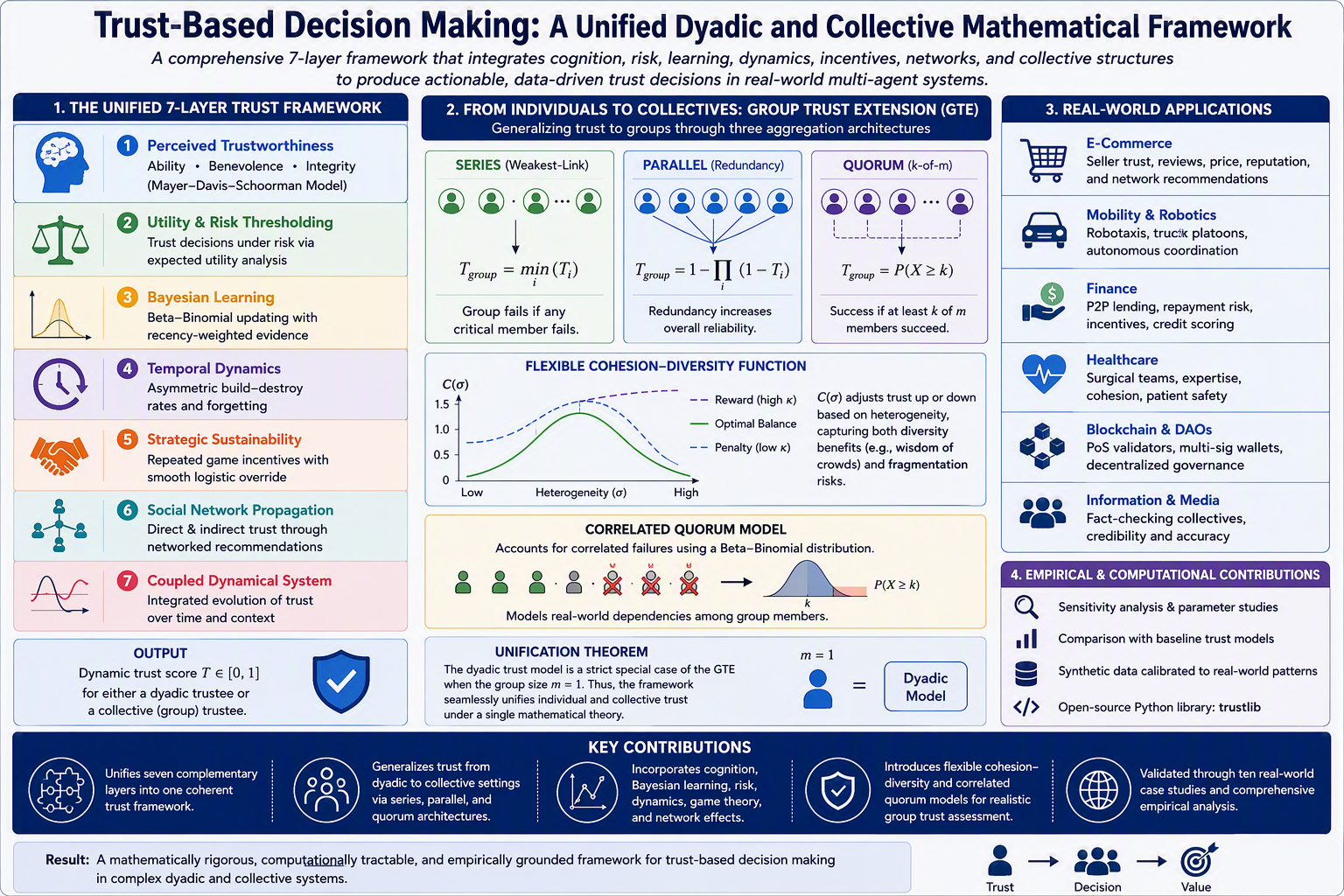
Trust is the invisible glue that binds together economic transactions, human machine partnerships, organizational cohesion, and decentralized governance. Yet despite its centrality, the vast majority of mathematical trust models remain confined to dyadic relationships—one trustor assessing one trustee. The real world, however, routinely demands trust in groups, teams, swarms, and institutions, where emergent outcomes depend on internal coordination, heterogeneity, and decision rules (e.g., quorums, weakest link dependencies, or majority votes). This paper presents a Unified Multi Layer Mathematical Framework that seamlessly integrates both dyadic and collective trust. The framework synthesizes seven core layers—perceived trustworthiness (ability, benevolence, integrity), behavioral risk thresholding (with a full utility theoretic justification), Bayesian learning with recency weighted evidence, temporal dynamics with asymmetric build destroy rates, game theoretic sustainability (with a smooth logistic override), social network propagation, and a coupled dynamical system. We introduce the Group Trust Extension (GTE), which generalizes the framework to collective trustees via three aggregation architectures: series (weakest link), parallel (redundancy), and quorum (k of m) systems. Crucially, we replace the simple cohesion penalty with a flexible cohesion–diversity function that can either penalize excessive variance or reward useful diversity (e.g., wisdom of crowds), and we extend the quorum model to account for correlated failures via a beta binomial formulation. We provide a formal unification theorem proving that the dyadic model is a special case of the GTE, and we present a sensitivity analysis and empirical comparison against baseline models using synthetic data calibrated to real world trust phenomena. We demonstrate the practical application of the framework through ten distinct real world case studies and one extended illustrative example (Amazon.ca e commerce, Appendix D) that shows how the model integrates reputation, risk, strategic incentives, social recommendations, and reviewer credibility into a single quantitative assessment. For each case, we provide domain specific parameterizations and executable Python code snippets from our open source library trustlib, demonstrating how the framework generates actionable decisions. The result is a mathematically consistent, computationally tractable, and empirically grounded theory of trust applicable to a wide range of multi agent systems.
Keywords:
trust modeling
; collective trust
; Bayesian inference
; game theory
; dynamical systems
; human machine interaction
; blockchain
; DAOs
; multi-agent systems
; group cohesion
Copyright: This open access article is published under a Creative Commons CC BY 4.0 license, which permit the free download, distribution, and reuse, provided that the author and preprint are cited in any reuse.


