

Submitted:
30 July 2026
Posted:
31 July 2026
You are already at the latest version
Abstract
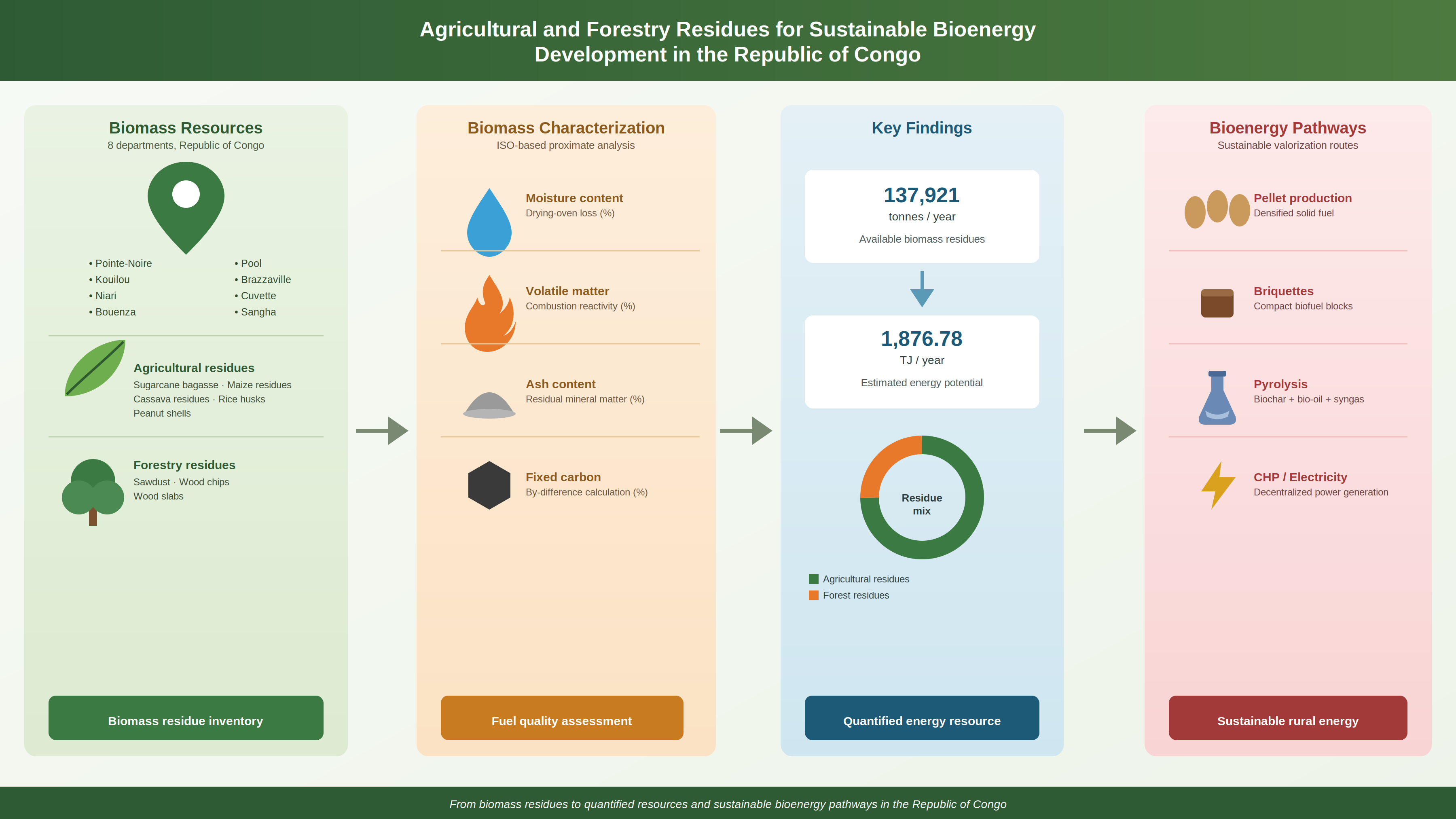
In the context of increasing energy demand and limited access to clean cooking and heating fuels in the Republic of Congo, agricultural and forestry residues represent a promising resource for energy production. The aim of this study is to identify, quantify and assess the energy potential of the residues generated across eight departments of the Country. Ten residues were characterized: sugarcane bagasse, peanut shells, corn stalks and cobs, rice husks, cassava stalks and peelings, sawdust, wood chips and wood slabs. Proximate analyses were carried out using a muffle furnace and an oven, while the calorific value was estimated using empirical formulas. Results of proximate analysis showed that moisture content ranged between 8.80 ± 0.14 % and 45.17 ± 1.57 %, ash content from 1.00 ± 0.23 to 15.07 ± 0.15 %, volatile matter content from 67.86 ± 0.02 to 82.14 ± 0.14 % and fixed carbon content from 12.13 ± 0.33 to 19.87 ± 0.37 %. The lower calorific value ranged between 14.98 and 18.04 MJ/kg. Approximately 137 921.16 tonnes of available residues were generated in 2025, representing an estimated energy potential of 1876.78 TJ/year. These residues constitute a significant resource for solid biofuel production and decentralized electricity generation.
Keywords:
quantification
; energy potential
; agricultural residues
; forest residues
1. Introduction
Access to reliable and affordable energy remains a major determinant of socio-economic development, particularly in developing countries where demand is rising rapidly under the combined pressure of population growth, urbanization, and industrial expansion [1]. In many of these countries, conventional energy distribution, whether through electricity grids, petroleum product supply chains, or cooking gas (LPG) pipelines and logistics networks, is capital-intensive and infrastructure-demanding, which slows the extension of centralized supply systems to remote and low-density areas [2]. Unlike electricity grids, fuel and LPG distribution further depends on continuous transport logistics (road, rail, or pipeline), making supply chains particularly vulnerable to distance, terrain, and infrastructure gaps. As a result, rural and peri-urban communities often remain disconnected from these centralized networks for extended periods, creating a persistent gap in energy access (for electricity, cooking fuel, and motive power alike) that centralized infrastructure alone cannot close in the short or medium term. Diversifying the energy resource base with decentralized, locally available sources therefore offers a practical pathway to bring energy closer to underserved populations without waiting for network expansion.
Biomass constitutes one of the most abundant and geographically accessible resources for this purpose [3]. The Republic of Congo holds substantial biomass reserves, with forests covering approximately 23.5 million hectares, or 69% of the national territory [4,5]. Wood and charcoal already dominate household energy use, supplying an estimated 81% of the population’s primary cooking fuel [6,7,8,9] a reliance driven in part by the limited reach of LPG distribution networks in rural areas, and one that illustrates the logistical feasibility of biomass-based solutions where other supply chains are absent or unreliable. In parallel, the country’s agricultural sector, spanning nearly 10 million hectares of arable land, generates substantial quantities of residues including peanut shells, corn cobs, cassava stalks, rice husks, cocoa pods, coffee stems, bean stalks, and sugarcane bagasse that are largely left unused or burned in the fields after harvest [9]. This open-field burning represents a direct loss of exploitable energy content and a source of particulate and NOx emissions [10], while the residues themselves could instead be densified into pellets or briquettes, or converted through pyrolysis, combustion, or gasification, to supply local energy demand as a substitute for both electricity and imported cooking fuels. Valorizing these residues would support resource efficiency and generate added value from agricultural and forestry by-products [10,11], while offering rural communities an alternative, locally produced energy source that does not depend on the extension of any of these distribution networks.
Despite this potential, few studies in developing countries have quantified residue availability with a view to energy recovery. Francis et al. [12] estimated Nigeria’s annual biomass residue generation from agriculture, forestry, municipal solid waste, and animal/human waste at approximately 200 billion kg using the residue/product ratio method with data from national agricultural authorities, the Food and Agricultural Organization of the United Nation (FAO) and the literature. Obed et al. [13] examined timber-industry residues in Ghana and found that most wood-processing operations lack equipment to quantify their waste, resulting in the incineration or decomposition of nearly 930,270 m³ of wood residue a gap the present study also addresses by proposing a simple, low-cost quantification method for sawdust and shavings generated in carpentry workshops, based on daily weighing of standard 50 kg storage bags to extrapolate weekly, monthly, and annual production.
Beyond quantification, the energy potential of these residues the amount of usable energy they contain remains rarely assessed in developing-country contexts. Several studies have applied the residue/product ratio method combined with crop calorific values to estimate this potential at national or regional scale : Robinson et al. [14] reported approximately 606 PJ/year from crop residues and municipal solid waste in Cameroon; Moonmoon et al. [15] estimated 686 million tonnes of annual crop residues in India, of which surplus residues contributed approximately 4.15 EJ against a national primary energy consumption of 24.91 EJ (2011); Ömer et al. [16] calculated an average annual bioenergy potential of 19.27 PJ (range 14.36–24.18 PJ) for South Central Texas; Collins et al. [17] estimated approximately 260 PJ/year for Uganda (2008–2009); and, following a comparable approach, Akpahou et al. [18] estimated Benin is total energy potential at approximately 142.63 PJ in 2021.
Regional-scale assessment is equally important for siting decentralized energy projects, yet remains uncommon. Angesom et al. [19] evaluated 27 residue types across Ethiopian regions (2014–2018), estimating a gross potential of 494.7 PJ, while Tolessa Amsalu [6] broadened the resource base to manure, agricultural residues, forestry residues, and municipal solid waste across 44 crop-derived residues from 30 crops, estimating a substantially higher national potential of 2,955 PJ/year (about 819.7 TWh electricity-equivalent) underscoring how the choice of resource scope strongly influences potential estimates. In the Republic of Congo specifically, Maryse et al. [20] characterized six commonly harvested woody biomass species using allometric estimation of above-ground biomass, finding that half a hectare of forest biomass yields 203.1 GJ (about56,417 kWh, enough to supply around 350 households), while the same area of savannah biomass yields 109.2 GJ ( about 30,333 kWh, enough for around 192 households).
These studies demonstrate the scale of biomass-based energy solutions achievable even at small spatial units, reinforcing their relevance for off-grid rural electrification. However, existing Congolese research has focused almost exclusively on woody biomass and forest resources [20], leaving the quantities, spatial distribution, and energy recovery potential of agricultural and agro-industrial residues largely undocumented. This gap limits the design of evidence-based decentralized energy strategies and constrains investment planning for local biomass valorization initiatives, particularly in rural areas where grid extension is not economically viable in the near term.
To address this gap, the present study identifies, quantifies, and assesses the energy potential of agricultural, agro-industrial, and forestry residues generated across eight departments of the Republic of Congo. Specifically, it aims to : (i) identify the major residue streams from agricultural and forestry activities; (ii) quantify their annual production; (iii) characterize their physicochemical and fuel properties through proximate and ultimate analyses; and (iv) evaluate their theoretical energy potential for local bioenergy applications. The findings are intended to provide a scientific basis for diversifying the national energy mix through decentralized biomass valorization, offering rural and underserved communities a locally produced alternative to electricity, fuel, and cooking gas that does not depend on the extension of costly distribution networks.
2. Materials and Methods
The Republic of Congo is subdivided into fifteen (15) departments (Figure 1). This study was conducted in eight (08) departments : Pointe-Noire, Kouilou, Niari, Bouenza, Pool, Brazzaville, Cuvette and Sangha during the months of June, September and October 2025. Lists of agricultural enterprises, agricultural cooperatives, sawmills and timber harvesting and processing companies were obtained from the Ministry of Agriculture and Livestock, as well as the Ministry of Forest Economy and Sustainable Development in order to identify the different companies working in each department. Field surveys were conducted to collect information on the quantities and types of agricultural, agro-industrial and forestry residues generated in each department. A structured technical questionnaire was used to gather data, including company name and location, manager profile, main activities, types of residues, annual production volumes, and seasonality. Collected data were processed and analyzed using Microsoft Excel.
Ten (10) types of agricultural, agro-industrial and forestry residues were collected, including: sugarcane bagasse, peanut shells, corn cobs and stalks, cassava stalks and peelings, rice husks, sawdust and wood chips. These residues were quantified in order to assess their potential in each department. The sawdust used in this study is a composite sample from several species. Congolese forests are dominated by several species such as: Okoumé (Aucoumea klaineana), Limba (Terminalia superba), Sipo (Entandrophragma utile), Sapelli (Entandrophragma cylindricum), Moabi (Baillonella toxisperma), Ayous (Triplochiton scleroxylon), Iroko (Milicia excelsa), Kossipo (Entandrophragma candollei), Padouk (Pterocarpus soyauxii), Wengé (Millettia laurentii) and Azobé (Lophira alata) [21]. In this study, two composite samples of sawdust were formed : one composite sample from sawdust collected in the department of Pointe-Noire, Kouilou, Niari and Brazzaville, constitued of Okoumé (Aucoumea klaineana), Limba (Terminalia superba), Moabi (Baillonella toxisperma) and a composite sample from sawdust (CODEXO) collected in the departments of Cuvette and Sangha, constitued of Sapelli (Entandrophragma cylindricum) and Sipo (Entandrophragma utile Sprague). Proximate analysis of these collected residues were conducted at Oyo Centre of Excellence for Renewable Energy and Energy Efficiency, located in Oyo, Republic of Congo.
2.1. Quantification of Biomass Residues
2.1.1. Forest Residues
Three (03) types of forest residues namely sawdust, wood chips, and wood slabs were quantified and collected through a sample survey based on technical data sheets in sawmills, carpentry workshops, logging and wood processing companies A specific field method was developed to estimate the quantities of sawdust and wood chips stored in bags within carpentry workshops. Fully filled and sealed bags were selected at random to ensure representativeness. Only fully filled and sealed bags were considered. To determine the net mass, three (3) empty bags with a nominal capacity of 50 kg, were first weighed to establish a reference tare (). These bags were then filled with sawdust or wood chips as stored in the carpentry workshops. The total mass was measured using a TOPMOVE portable balance, series no. HG12836 A (Figure 2.a). Equation (1) was used to determine the mass of sawdust or wood chips contained in each bag.
: mass of empty bag (kg) ;
: mass of empty bag + sawdust or wood chips (kg) ;
: mass of sawdust or wood chips contained in the bag (kg).
An average of three measurements was calculated to represent the mass of sawdust or wood chips per bag. This value was then multiplied by the average number of bags produced per weekly in each workshop. Finally, an annual estimate was derived, taking into account periods of high and low production.
The quantity of sawdust and wood chips generated in sawmills and wood processing companies was initially measured in cubic meters. Annual production in tonnes was determined using the bulk density of the residues. The collected samples consisted of mixtures of different wood species. Sawdust and wood chips samples were collected from each site and stored in hermetically sealed containers. A composite sample was prepared from samples collected each carpentry shop, sawmill, and wood processing facility.
2.1.2. Agricultural and Agro-Industrial Residues
Seven (07) types of agricultural residues (sugarcane bagasse, peanut shells, corn cobs and stalks, rice husks, cassava stems and peels) from five (05) agricultural crops were identified. The annual quantity of agricultural and agro-industrial residues was estimated using the residue/product ratio (RPR) method, as described by Miguel et al. [22] ; Mohamedeltayib et al. [23] ; Angesom et al. [19] using the equation (2).
RRP : Crop residue/product ratio ;
: Annual quantity of residues generated per crop ;
: Annual quantity of crops produced ;
2.2. Physico-Chemical Properties
2.2.1. Bulk Density
The bulk density (ρ) of the composite sample of wood chips or sawdust collected in sawmills was determined according to ISO 17828:2015, using Equation (3).
ρ : Bulk density of collected forest residues (kg/m³) ;
Mass of sawdust or wood chips (kg) ;
Volume of the container used (m³).
2.2.2. Proximate Analysis
The proximate analysis can give the amount of moisture, ash, volatile matter and fixed carbon of the biomass sample.
- Moisture content
The moisture content (MC) was determined according to ISO 18134-1:2021. The method consisted of preheating the empty crucible to 105 °C for 1 h. After cooling in the desiccator, it was weighed to determine its initial mass (). Approximately, 2 g of powdered samples were placed in the crucible () and heated in the oven at 105 °C for 4 h until a constant mass was achieved. After heating, the crucible containing the sample was placed in the desiccator for 10 minutes. After cooling in the desiccator, this crucible was then weighed to determine the dry mass (). The moisture content was calculated using the following Equation (4) :
: mass of the empty crucible after heating to 105 °C and cooling in the desiccator (g);
: mass of the crucible + wet sample before drying (g) ;
: mass of crucible + sample after drying in the oven at 105 °C for 4 hours and re-cooling in the desiccator (g) ;
Moisture content.
- Volatile matter content
The volatile matter content (VM) was determined according to ISO 18123:2015. The procedure involved preheating an empty, covered crucible in a muffle furnace at 900 °C ± 10 °C for 7 min ± 5 s, followed by cooling in a desiccator for 30 minutes prior to use. After cooling, the empty, covered crucible () was weighed to the nearest 0.01 mg using an analytical balance. Subsequently, approximately, 2 g of powdered dry sample was placed in the covered crucible (), weighed to the nearest 0.1 mg and placed in a muffle furnace at a temperature T = 900 °C ± 10 °C for 7 min ± 5 s. After heating, the crucible was removed using a crucible tong and placed in the desiccator, where it was allowed to cool for 30 minutes of cooling. After cooling, the resulting residue was weighed to the nearest 0.1 mg (), and the volatile matter content was calculated using the following Equation (5) :
M6 : Mass of empty crucible + lid after heating to 900 °C ± 10 °C for 7 min ± 5 s and cooling in the desiccator for 30 min (g) ;
M7 : Mass of crucible + dry sample + lid before heating in the muffle furnace (g) ;
M8 : Mass of crucible + lid + residue after heating at 900 °C ± 10 °C for 7 min ± 5 s and cooling in the desiccator for 30 min (g) ;
: Volatile matter content.
- Ash content
The ash content (Ash) was determined according to ASTM E1755. The procedure involved preheating an empty, lidless crucible was preheated in a muffle furnace at 575 °C ± 25 °C for 4 h. After heating, the crucible was removed with crucible tongs and placed in a desiccator for 30 minutes. After cooling, the crucible () was weighed to the nearest 0.01 mg using a balance. Approximately, 2 g of powdered dry pulverized sample was placed in the lidless crucible () weighed to the nearest 0.1 mg and placed in a muffle furnace at 575 °C ± 25 °C for 4 h. After heating, the crucible was removed with a crucible tong and placed in a desiccator for 30 minutes. After cooling, the ash obtained was weighed to the nearest 0.01 mg ) and the ash content was calculated using the following Equation (6) :
: mass of the crucible after pretreatment at 575 °C ± 25 °C for 4 h (g) ;
: mass of the crucible + sample before heating in the muffle furnace (g) ;
: Crucible mass + Ash after heating at 575 °C ± 25 °C for 4 h (g) ;
: ash content.
- Fixed carbon content
The fixed carbon content (FC) of the collected samples was determined on a dry basis by difference, according the Equation (7) :
Fixed carbon content.
2.2.3. Ultimate Analysis
The ultimate analysis can give the amount of carbon (C), hydrogen (H), oxygen (O), sulphur (S) and nitrogen (N) contents of the biomass sample.
However, carbon (C), hydrogen (H) and oxygen (O) contents were calculated using Equations 8, 9 and 10 presented below :
C (%) = 0.9671 FC (%) + 0.4097 VM (%) - 0.0348 Ash (%)
H (%) = 0.0215 FC (%) + 0.0708 VM (%) - 0.0063 Ash (%)
O (%) = 0.0061 FC (%) + 0.5147 VM (%) - 0.0097 Ash (%)
C (%) : Carbon content ;
H (%) : Hydrogen content ;
O (%) : Oxygen content.
In this study, sulphur and nitrogen content of the collected samples were not determined.
2.2.4. Heating Value
The higher heating value of the collected samples was determined using the empirical formula proposed by Jigisha et al. [24], as shown in Equation (11) :
HHV (MJ/kg) = 0.3536 FC (%) + 0.1559 VM (%) + 0.0078 Ash (%)
HHV : High heating value (MJ/kg).
The lower heating value was deduced using Equation (12) :
2.3. Energy Potential Assessment
2.3.1. Energy Potential of Forest Residues
The energy potential of forest residues was calculated according to the method proposed by Miguel et al. [22]; Giordano et al. [25] using Equation (13).
) : Energy potential of collected waste (TJ) ;
LHV : Lower heating value of each type of collected residue (MJ/kg) ;
: Annual quantity of sawdust and wood chips generated (Kg) ;
MC (%) : Moisture content ;
In this study, the mass of sawdust and wood chips generated per year corresponds to the annual quantity produced in the sawmills and the carpentry workshops.
2.3.2. Energy Potential of Agricultural and Agro-Industrial Residues
The energy potential of these residues was evaluated using the method proposed by Miguel et al. [22] and Bill Vanneck et al. [26], as described in Equation (14). This method proposes first estimating the quantity of residue potentially available for energy production. Thus, the residue/product ratio of certain crops was determined based on results published in the literature. Equation (14) was then used to determine the energy potential of the collected agricultural residues.
) : Energy potential of agricultural residues (TJ) ;
LHV : Lower Heating Value (MJ/kg) ;
MC (%) : Moisture Content.
3. Results
3.1. Assessment of the Potential of Agricultural, Agro-Industrial and Forestry Residues
The survey covered several departments of the Republic of Congo, including Pointe-Noire, Kouilou, Niari, Bouenza, Brazzaville, Cuvette and Sangha.
In the Pointe-Noire department, the study covered four boroughs (Lumumba, Mongo-Poukou, Loandjili and Ngoyo). Five neighborhoods were covered (Grand Marché, Makayabou, Mpaka, Siafoumou and Ngoyo). A total of twenty-seven (27) carpentry workshops, three (3) sawmills (Scierie de la Plage site 1, MIRAF Scierie, and MGP Service), one rice mill (PESA AGRI) and one wood processing company (SICOFOR) were surveyed. As shown in Figure 3.a, wood-related residues dominate this urban area, with approximately 767.48 tonnes of wood chips and 741.34 tonnes of sawdust produced in 2025. In contrast, the Kouilou department (Figure 3.b) has a more limited industrial activity, producing 88.52 tonnes of sawdust and 13.6 tonnes of wood shavings, mainly from small-scale carpentry workshops. The difference is mainly attributed to the higher concentration of industrial and artisanal wood processing activities in Pointe-Noire department.
In the Niari department, the survey focused on five (05) carpentry workshops, three (03) peanut shelling units, two (02) wood production and processing companies (SICOFOR Parc Matsende and XIANGTAO), located in Dolisie. A Protected Agricultural Zone (ZAP) was also identified in Malolo 2, in the Louvakou district.
However, in the Bouenza department, primarily dominated by agricultural crops, included three (03) agricultural enterprises (SARIS, SHENG SHENG, and TOLONA), a sugarcane wine production workshop, a Protected Agricultural Zone and an agricultural cooperative. The results of this survey showed that approximately 444.56 tonnes of sawdust, 202.2 tonnes of wood chips, 57.6 tonnes of peanut shells, 31.2 tonnes of cassava peelings and 23.4 tonnes of cassava stalks were assessed in the Niari department (Figure 4.a). However, sugarcane bagasse was the most dominant residue in Bouenza department, with approximately 11680 tonnes (Figure 4.b). Similarly, approximately 515.73 tonnes of maize stalks, 452.57 tonnes of maize cobs and 256 tonnes of cassava peelings were produced (Figure 4.b). The Bouenza department is primarily dominated by agricultural crops due to its very fertile soil. The forestry residues are less frequently generated.
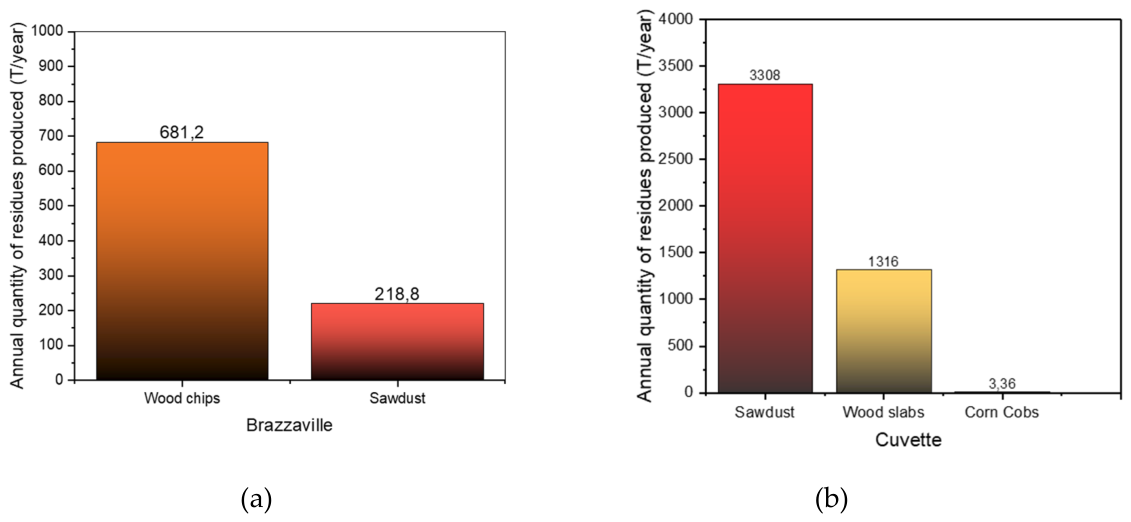
In Brazzaville department, the survey was conducted in three boroughs (Makélékélé, Bacongo and Madibou). The neighborhoods covered by the study were: Moukoundzi-Ngouaka, Centre Sportif, Cinq Chemins and Massissia. Approximately twenty (20) carpentry workshops were surveyed. In the Cuvette Department, two (2) wood processing and logging companies (CODEXO and WANG SAM), as well as one Protected Agricultural Zone, were surveyed in Makoua. The survey results revealed that approximately 681.12 tonnes of wood chips and 218.8 tonnes of sawdust, mainly generated by carpentry workshops, were produced in the Brazzaville department. In contrast, the Cuvette department was characterised by a predominance of sawdust, estimated at about 3308 tonnes, followed by 1316 tonnes of wood slabs and 3.36 tonnes of corn cobs.
Figure 5.
(a) Potential of agricultural and forestry residues generated in the department of Brazzaville ; (b) Potential of agricultural and forestry residues generated in the department of Cuvette.
Figure 5.
(a) Potential of agricultural and forestry residues generated in the department of Brazzaville ; (b) Potential of agricultural and forestry residues generated in the department of Cuvette.
The Sangha Department is largely covered by forest and traversed by the vast equatorial rainforest. Timber exploitation constitutes the main economic activity in this department. Three timber harvesting and processing companies were surveyed: Congolaise Industrielle de Bois (CIB), located in Pokola, Société d’Exploitation Forestière Yuang Dong (SEFYD) located in Souanke and Industrie Forestière de Ouesso (IFO) located in Ngombe. The results showed that approximately 80 124 tonnes of sawdust and 36 920 tonnes of wood slabs were produced in 2025 (Figure 6). This department is characterized by a strong predominance of forest residues.
3.2. Physico-Chemical Properties
3.2.1. Bulk Density
The bulk density of the composite sample of sawdust varied between (181.52 and 230.52 kg/m³). The bulk density of the composite sample of sawdust collected in the departments of Pointe-Noire, Kouilou, Niari and Brazzaville (ρ = 181.52 kg/m³) and the composite sample of sawdust collected in the departments of Cuvette and Sangha (ρ = 230.13 kg/m³). The wood chips had a very low density compared to the sawdust. The bulk density of the composite sample wood chips obtained (ρ = 81.12 kg/m³).
3.2.2. Proximate and Ultimate Analysis
The proximate and ultimate analysis of agricultural, agro-industrial and forestry residues are presented in the Table 1.
In this study, the moisture content of the agricultural, agro-industrial and forestry residues varied between (8.80 ± 0.14% and 45.17 ± 1.57%). The highest moisture content was obtained for sugarcane bagasse (45.17 ± 1.57%). Relatively high values were also recorded for the composite sample of sawdust collected in the departments of Cuvette and Sangha (27.58 ± 0.17%), followed by cassava peel (21.00 ± 0.47%), the composite sample of sawdust collected in the departments of Pointe-Noire, Kouilou, Niari, Brazzaville (18.08 ± 0.14%), wood chips (12.27 ± 0.14%), peanut shells (10.94 ± 0.22%), cassava stalks (10.58 ± 0.13%), rice husks (9.62 ± 0.14%) and corn cobs (9.46 ± 0.01%). The lowest moisture content was obtained for corn stalks (8.80 ± 0.14%).
Volatile matter content is a key parameter for assessing the energy behaviour of agricultural and forestry residues, as it directly influences ease of ignition and combustion rate. In general, higher volatile matter content indicates faster ignition and more reactive combustion behaviour, which is particularly favourable for thermochemical conversion processes such as combustion and pyrolysis. The results show high volatile matter contents, ranging from 67.86 ± 0.02% to 82.14 ± 0.14%, indicating a strong energetic potential for all the studied biomass types. The highest values were recorded for the composite sawdust sample collected in the departments of Pointe-Noire, Kouilou, Niari and Brazzaville (82.14 ± 0.14%), followed by sugarcane bagasse (82.07 ± 0.25%), corn cobs (81.77 ± 0.17%), wood chips (81.13 ± 0.10%), maize stalks (79.73 ± 0.09%), cassava stalks (79.58 ± 0.30%), composite sample of sawdust collected in the departments of Cuvette and Sangha (79.13 ± 0.29%), peanut shells (74.82 ± 0.11%). In contrast, the lowest volatile matter contents were observed in cassava peel (67.86 ± 0.02%) and rice husks (69.81 ± 0.01%) suggesting comparatively slower combustion reactivity.
Thus, the ash content of agricultural, agro-industrial and forestry residues varied between (1.00 ± 0.23% and 15.07 ± 0.15%). The highest ash content was obtained for rice husks (15.07 ± 0.15%), followed by cassava peel (13.51 ± 0.32%), cassava stems (8.29 ± 0.14%), sugarcane bagasse (5.64 ± 0.27%), peanut shells (5.15 ± 0.13%), corn stalks (4.82 ± 0.36%) and wood chips (3.31 ± 0.36%). In contrast, the lowest ash content were obtained for the composite sample of sawdust collected in the departments of Cuvette and Sangha (1.00 ± 0.23%), followed by the composite sample of sawdust collected in the departments of Pointe-Noire, Kouilou, Niari and Brazzaville (1.49 ± 0.01%), and corn cobs (1.99 ± 0.01%).
The fixed carbon content of the residues collected varied between (12.13 ± 0.33% and 20.03 ± 0.17%). The highest fixed carbon content was obtained for peanut shells (20.03 ± 0.17%), followed by sawdust (19.87 ± 0.37%), cassava peel (18.63 ± 0.32%), maize cobs (16.24 ± 0.17%), wood chips (15.56 ± 0.37%), maize stalks (15.45 ± 0.37%) and sugarcane bagasse (12.28 ± 0.37%). The lowest fixed carbon content was obtained for cassava stalks (12.13 ± 0.33%).
The carbon content varied between (41.44 ± 0.36% and 51.60 ± 0.26%). The level of carbon content was high for sawdust samples, followed by peanut shells (49.84 ± 0.17%), corn cobs (49.14 ± 0.17%), wood chips (48.17 ± 0.36%), cassava peel (45.35 ± 0.31%), sugarcane bagasse (45.31 ± 0.37%), cassava stalks (44.05 ± 0.34%) and rice husks (42.69 ± 0.14%). Maize stalks exhibited the lowest carbon content, with a value of (41.44 ± 0.36%).
The hydrogen content of the agricultural and forestry residues varied between (05.12 ± 0.01% and 06.16 ± 0.01%). The hydrogen content was high in sawdust (06.16 ± 0.01%) and low in cassava peelings (05.12 ± 0.01%).
Similarly, variations were also observed in the oxygen content of the studied residues. The highest oxygen content was obtained for sawdust (42.36 ± 0.07%) followed by sugarcane bagasse (42.26 ± 0.13%), corn cobs (42.16 ± 0.08%), wood chips (41.82 ± 0.05%), corn stalks (41.08 ± 0.04%), cassava stalks (40.95 ± 0.15%), peanut shells (38.58 ± 0.05%) and rice husks (35.87 ± 0.01%). The lowest oxygen content was obtained for cassava peel (34.91 ± 0.01%).
3.3. Heating Value
The Lower Heating Value (LHV) of agricultural, agro-industrial and forestry residues varied between (14.98 ± 0.05 MJ/kg and 18.04 ± 0.09 MJ/kg). The highest value was observed for the composite sample of sawdust (18.04 ± 0.09 MJ/kg) collected in the departments of Cuvette and Sangha, followed by rice husks (17.54 ± 0.09 MJ/kg), peanut shells (17.46 ± 0.06 MJ/kg), corn cobs (17.14 ± 0.06 MJ/kg), wood chips (16.80 ± 0.13 MJ/kg), corn stalks (16.56 ± 0.13 MJ/kg), cassava peel (15.94 ± 0.11 MJ/kg) and cassava stalks (15.35 ± 0.13 MJ/kg). The lowest lower heating value was obtained for rice husks, approximately 14.98 ± 0.05 MJ/kg.
3.4. Assessment of Energy Potential
Table 2, illustrates the quantity of residues generated by department, the lower and high heating values, as well as the energy potential of agricultural and forestry residues.
This study was conducted in eight (08) departments of the Republic of the Congo. The energy potential of the various types of waste collected per department ranged from 0.05 TJ/year to 1046.73 TJ/year. Consequently, the distribution of energy potential across the departments ranged from 1.45 TJ to 1644.9 TJ (Figure 7). The highest energy potential was estimated in the Sangha department, at approximately 1644.90 TJ/year. Furthermore, the energy potential of the waste collected is estimated at 119.06 TJ/year in the department of Bouenza, 64.59 TJ/year in the department of Cuvette, 22.8 TJ/year in the department of Pointe-Noire and 13.13 TJ/year in the department of Brazzaville and 10.85 TJ/year in the Niari department. However, the lowest energy potential was observed in the Kouilou department, with approximately 1.45 TJ/year.
4. Discussion
In this study, we identified, quantified, characterised and assessed the potential of biomass generated in eight (08) departments in the Republic of Congo. Ten (10) types of agricultural, agro-industrial, and forestry residues were identified (sugarcane bagasse, maize stalks and cobs, cassava stalks and peels, peanut shells, rice husks, wood chips, wood slabs and sawdust). The conversion of these residues into solid biofuels or bioenergy faces several constraints, including heterogeneous moisture content, seasonal availability, storage requirements, logistical difficulties related to collection and transportation competing uses of biomass resources. Approximately 137 921.16 tonnes of agricultural, agro-industrial and forestry residues were generated in the Republic of Congo in 2025. The largest quantity of agricultural and agro-industrial residues was estimated in the Bouenza department. This department has vast areas of arable land, particularly in the great Niari valley, which offer great potential for the development of agricultural activities. However, the departments of Pointe-Noire, Kouilou, Niari, Brazzaville, Cuvette and Sangha are mainly characterised by the predominance of forest residues. The amount of residues generated in the Pool department, specifically in Kinkala and the Louingui district, are very low. We have not identified any agricultural or forestry residues in this department.
The bulk density of the composite sample of sawdust collected in the departments of Pointe-Noire, Kouilou, Niari, Brazzaville (ρ= 181.52 kg/m³) is lower than that of the composite sample of sawdust collected in the departments of Cuvette and Sangha (ρ= 230.13 kg/m³). This difference is due to the species collected Sipo and Sapelli are the most dominant species in the departments of Cuvette and Sangha, whereas the departments of Pointe-Noire, Kouilou, Niari, Brazzaville are dominated by Okoumé, Moabi and Limba. The bulk density of the composite sample wood chips obtained was very low ρ= 81.12 kg/m³. These results of the sawdust are almost corroborate that reported by Kewir et al. [28] ρ= 184,64 kg/m³.
Regarding the characterization, the sugarcane bagasse has a very high moisture content obtained in this study (45.17 ± 1.57%) was higher than that obtained by Muhammad et al. [29] (8.77%). The rice husks have a low moisture content, but their ash content is very high. This increase of ash content may be due to the presence of silica Dinh et al. [21], which reduces their lower heating value. These results are almost identical to those obtained by Muhammad et al. [29]; Dinh et al. [21]. This high ash content is a disadvantage for the recovery of pellets as solid biofuels. In addition, the sawdust collected has very low ash content and a high lower heating value. These results are consistent with those obtained by Muhammad et al. [29]. The peanut shells, corn stalks and corn cobs collected had a very low ash content and very high heating value. These results are similar to those obtained by Ayşegül et al. [30]; Harmandeep et al. [31] confirmed that samples with higher ash content can cause combustion problems, requiring regular cleaning of equipment.
The residue/product ratio for peanut shells (0.35) obtained by Ezekiel et al. [8], is almost identical to that obtained in this study (0.37), but remains lower than the value of 0.447 obtained by Robinson et al. [13]. However, the residue/product ratio for maize stalks (1.15) obtained by Ezekiel et al. [8] is much lower than that obtained in this study (1.50). This value is almost identical to that of 1.59 obtained by Angesom et al. [19]. Furthermore, the residue/product ratio of corn cobs (0.57) reported by Angesom et al. [19] is significantly higher than that determined in this study (0.174). This difference could be explained by the variability of species, agronomic and climatic conditions. With regard to sugarcane bagasse, the residue/product ratio estimated in this study (0.304) is close to that obtained by Angesom et al. [19] (0.33), but remains lower than the value of 0.25 obtained by Collins et al. [17]; Maw et al. [32]. The energy potential of unused agricultural, agro-industrial and forestry residues generated in the Republic of Congo is approximately 1,876.78 TJ/year. These residues can be used to generate electricity, particularly in cogeneration plants. In the Republic of Congo, national electricity production relies mainly on thermal and hydroelectric power stations. However, the country faces significant load shedding problems in large cities, particularly Brazzaville and Pointe-Noire, due to growing demand for electricity caused by high population density. To better illustrate the significance of this resource, the estimated energy potential of 1,876.78 TJ/year corresponds to approximately 521 GWh/year of electricity equivalent. Although this figure represents a theoretical potential, it highlights the considerable contribution that agricultural, agro-industrial and forestry residues could make to the national energy sector. Such an amount of energy could support decentralized electricity generation systems, particularly in rural and peri-urban areas where access to reliable electricity remains limited [33].
The spatial distribution of biomass resources also reveals important regional opportunities. The Sangha department accounts for the largest share of the national biomass energy potential, mainly due to the concentration of forestry industries and timber processing activities. Furthermore, the contribution of biomass to electricity production in this department remains very limited. Approximately 4.1 MW are produced by Congolaise Industrielle de Bois from biomass residues. In contrast, the Bouenza department exhibits the highest agricultural biomass potential, particularly through sugarcane bagasse, maize stalks and maize cobs. These findings suggest that future biomass energy projects should adopt a regional approach that takes into account local resource availability and existing industrial infrastructure.
Beyond electricity generation, the valorization of agricultural and forestry residues can generate important environmental and socio-economic benefits. The utilization of residues that are currently burned, abandoned or underutilized would contribute to reducing greenhouse gas emissions, limiting open-field burning practices, promoting circular economy principles and creating new employment opportunities along biomass supply chains. Consequently, biomass energy development could support the Republic of the Congo efforts to achieve its Nationally Determined Contributions (NDCs), improve energy security and accelerate progress toward Sustainable Development Goals 7 (Affordable and Clean Energy) and 13 (Climate Action).
5. Conclusions
Ultimately, this study quantified and assessed the energy potential of selected agricultural, agro-industrial, and forestry residues in the Republic of Congo and assessment of their potential as a sustainable energy source. Ten (10) types of residues were identified, including rice husks, sugarcane bagasse, peanut shells, corn stalks and cobs, sawdust, wood slabs wood chips, cassava stalks and peelings. In 2025, approximately 137921.16 tonnes of residues were generated, corresponding to an estimated energy potential of 1,876.78 TJ/year. The results of the proximate analysis showed moisture contents ranging from 8.80 ± 0.14% to 45.17 ± 1.57%, ash contents from 1.00 ± 0.23% to 15.07 ± 0.15%, volatile matter contents from 67.86 ± 0.02% to 82.14 ± 0.14%, and fixed carbon contents from 12.13 ± 0.33% to 20.03 ± 0.17%. The highest ash content was found in rice husks (15.07 ± 0.15%) and the lowest ash content was found in sawdust (1.00 ± 0.23%). Thus, the highest lower heating value was obtained for sawdust (18.04 ± 0.09 MJ/kg), which facilitates its use as a bioenergy source. However, the distribution of residues varied according to the department. The Bouenza department stands out for its high production of agricultural and agro-industrial residues, linked to the importance of its agricultural activities, while the departments of Pointe-Noire, Kouilou, Niari, Brazzaville, Cuvette and Sangha are mainly characterised by the predominance of forest residues. The quantities of residues identified in the Pool department remain very low. These residues represent a strategic opportunity for the development of a local solid biofuel industry, particularly for the production of high-quality pellets and briquettes. Furthermore, their integration into combined heat and power plants could significantly boost decentralised electricity generation, particularly in rural areas. By utilising these untapped agricultural, agro-industrial and forestry residues, the Republic of the Congo can diversify its national energy mix, reduce its heavy reliance on traditional firewood and accelerate its transition towards a more sustainable and resilient energy future.
Author Contributions
Conceptualization : P.D.P.B and M.D.N.N; methodology : P.D.P.B; G.J.A.M and T.S.M; software : P.D.P.B; validation : P.D.P.B, M.D.N.N and G.J.A.M; formal analysis : P.D.P.B; investigation : P.D.P.B; G.J.A.M and T.S.M; resources : X.X.; data curation : X.X.; writing—original draft preparation : P.D.P.B; writing—review and editing : X.X.; visualization : X.X.; supervision : X.X.; project administration, X.X.; funding acquisition, Y.Y. All authors have read and agreed to the published version of the manuscript.” Please turn to the CRediT taxonomy for the term explanation. Authorship must be limited to those who have contributed substantially to the work reported.
Funding
This research was funded by the Oyo Centre of Excellence for Renewable Energy and Energy Efficiency (CEO) under the project “Operationalization of the Oyo Centre of Excellence for Renewable Energy and Energy Efficiency in the Republic of the Congo” (Project ID: 190379), implemented with the technical support of the United Nations Industrial Development Organization (UNIDO). The APC was funded by the Oyo Centre of Excellence for Renewable Energy and Energy Efficiency.
Data Availability Statement
The original contributions presented in the study are included in the article, further inquiries can be directed to the corresponding author.
Acknowledgments
The authors gratefully acknowledge the Oyo Centre of Excellence for Renewable Energy and Energy Efficiency for its financial support and logistical assistance during field surveys conducted across the Republic of the Congo. The authors also acknowledge the technical support provided by the United Nations Industrial Development Organization (UNIDO) through the project “Operationalization of the Oyo Centre of Excellence for Renewable Energy and Energy Efficiency in the Republic of the Congo” (Project ID: 190379). The authors further thank local authorities, agricultural producers, agro-industrial companies, and forestry stakeholders who facilitated data collection and provided valuable information during the biomass resource assessment.:
Conflicts of Interest
The authors declare no conflicts of interest.
Abbreviations
The following abbreviations are used in this manuscript:
| CIB | Congolaise Industrielle de Bois |
| SEFYD | Société d’Exploitation Forestière Yuang Dong |
| IFO | Industrie Forestière de Ouesso |
| SICOFOR | Sino- Congo Forêt |
References
- Akbar, Ali; Aslam, Umair; Asghar, Anam; Aslam, Zaheer. Effect of binding materials on physical and fuel characteristics of bagasse based pellets. Biomass Bioenergy 2021, 150, 106118. [Google Scholar] [CrossRef]
- Nhuchhen, Daya Ram. Prédiction des compositions en carbone, hydrogène et oxygène de la biomasse brute et torréfiée à l’aide de l’analyse immédiate. Fuel 2016, 180, 348–356. [Google Scholar]
- Flores, Roxana Isabel Bernaola; Barreda, Carmen Elena Flores; Quinayá, Diana Carolina Parada; Zúñiga, Ursula Fabiola Rodríguez. Energy Potential of Agricultural and Forestry By-Products in Peru. J. Renew. Energy Environ. 2022, 10, 1–8. [Google Scholar] [CrossRef]
- Mayala, Tania S.; Nkoua Ngavouka, Maryse D.; Douma, Dick H.; Hammerton, James M.; Ross, Andrew B.; Brown, Aaron E.; M’Passi-Mabiala, Bernard; Lovett, Jon C. Characterisation of Congolese Aquatic Biomass and Their Potential as a source of Bioenergy. Biomass 2022, 2, 1–13. [Google Scholar] [CrossRef]
- Ouissika, Brice Chérubins; Milandou, Carine Saturnine. mapping forest cover and changes in Republic of Congo. OSFACO Conference: Satellite images for management sustainable territories in Africa hal.science, 2019; pp. 1–22. [Google Scholar]
- Tolessa, Amsalu. Bioenergy Production Potential of Available Biomass Residue Resources in Ethiopia. J. Renew. Energy Vol. 2023, 1–12. [Google Scholar] [CrossRef]
- BOUNDZANGA, Georges Claver; KIBINZA, Arnaud KIESSE; TSOH-IKOUNGA, Henriette; NZIENDOLO, Holland Guenaël. study of the spatialization and weighting of the causes of deforestation and forest degradation and analysis of strategic options, proposed by the R-PP of the Republic of Congo, Republic of Congo; 2014; p. 17. [Google Scholar]
- Anabire Ayamga, Ezekiel; Kemausuor, Francis; Addo, Ahmad. Technical analysis of crop residue biomass energy in an agricultural region of Ghana. J. Resour. Conserv. Recycl. 2015, 96, 51–60. [Google Scholar] [CrossRef]
- TATY Constantin, SAMBA Quevin Claize Aymard, ZINGA Kevin Donald, OKEMBA Rodrigue Armel Patrick, YELA Jean-Claude, Stratégie énergétique du Congo 2015-2025, Diplôme d’Études Supérieures Spécialisées (DESS) en gestion de l’énergie, HEC Montréal, Montréal, http://fr.scrbd.com › DESS-CONGO-Strategie-Rapport (09/04/2026). 09 04.
- Louvel, Roland; de Gromard, Christian. From biomass to the bioeconomy an energy strategy for Africa. In De Boeck Supérieur, Contemporary Africa; 2017; Volume 261-262, pp. 223–240. [Google Scholar]
- Azizpanah, Amir; Taki, Morteza. Quantifying bioenergy potential and environmental impacts of agricultural residues; a Comparative analysis with global benchmarks. PLoS ONE 2025, 20(9), e0333492 1-19. [Google Scholar] [CrossRef] [PubMed]
- Olanrewaju, Francis O.; Andrews, Gordon E.; Li, Hu; Phylaktou, Herodotos N. Bioenergy Potential in Nigeria. Chem. Eng. Trans. 2019, 74, 61–66. [Google Scholar]
- Asamoah, Obed; Kuittinen, Suvi; Danquah, Jones Abrefa; Quartey, Ebo Tawiah; Bamwesigye, Dastan; Boateng, Charles Mario; Pappinen, Ari. Assessing Wood Waste by Timber Industry as a Contributing Factor to Deforestation in Ghana, J. Forests 2020, 11, 1–15. [Google Scholar] [CrossRef]
- Tanyi, Robinson J.; Adaramola, Muyiwa S. Bioenergy potential of agricultural crop residues and municipal solid waste in Cameroon. J. AIMS Energy 2023, 11(1), 31–46. [Google Scholar] [CrossRef]
- Hiloidhari, Moonmoon; Das, Dhiman; Baruah, D.C. Bioenergy potential from crop residue biomass in India. Renew. Sustain. Energy Rev. 2014, 32, 504–512. [Google Scholar] [CrossRef]
- Ertu˘grul, Ömer; Daher, Bassel; Özgünaltay, Gülden; Mohtar, Rabi. From Agricultural Waste to Energy: Assessing the Bioenergy Potential of South-Central Texas, J. Energies 2024, 17, 802. [Google Scholar] [CrossRef]
- Okello, Collins; Pindozzi, Stefania; Faugno, Salvatore; Boccia, Lorenzo. Bioenergy potential of agricultural and forest residues in Uganda. Biomass Bioenergy 2013, 56, 515–525. [Google Scholar] [CrossRef]
- Akpahou, Romain; Admas, Marshet M.; Adaramola, Muyiwa S. Evaluation of a bioenergy resource of agricultural residues and municipal solid wastes in Benin. AIMS Energy 2024, 12(1), 167–189. [Google Scholar] [CrossRef]
- Tesfay, Angesom Gebrezgabiher; Tesfay, Asfafaw Haileselassie; Adaramola, Muyiwa Samuel. Quantifying Agricultural Residues Biomass Resources and the Energy Potentials with Characterization of Their Nature and Ethiopian Case Consumption Inference. J. Energies 2024, 17, 1–24. [Google Scholar] [CrossRef]
- Nkoua Ngavouka, Maryse D.; Mayala, Tania S.; Douma, Dick H.; Brown, Aaron E.; Hammerton, James M.; Ross, Andrew B.; Nsongola, Gilbert; M’Passi-Mabiala, Bernard; Lovett, Jon C. Characterization of Congolese Woody Biomass and Its Potential as a Bioenergy Source. Appl. Sci. 2025, 15(371), 1–14. [Google Scholar] [CrossRef]
- Viet, Dinh Quoc; Van Vinh, Nguyen; Luong, Pham Hoang; Tho, Van Dinh Son. Thermogravimetric Study on Rice, Corn and Sugar Cane Crop Residue. J. Sustain. Energy Environ. 2015, 6, 87–91. [Google Scholar]
- Gonzalez-Salazar, Miguel Angel; Morini, Mirko; Pinelli, Michele; Spina, Pier Ruggero; Venturini, Mauro; Finkenrath, Matthias; Poganietz, Witold-Roger. Methodology for estimating biomass energy potential and its application to Colombia. Applied Energy 2014. [Google Scholar] [CrossRef]
- Salih EISSA, Mohamedeltayib Omer. Determining the biomass energy potential derived from agricultural wastes in Uganda. Int. J. Energy Stud. 2024, 9(4), 945–957. [Google Scholar] [CrossRef]
- Parikh, Jigisha; Channiwala, S.A.; Ghosal, G.K. A correlation for calculating HHV from proximate analysis of solid fuels. Fuel 2005, 84, 487–494. [Google Scholar] [CrossRef]
- Ruggeri, Giordano; Mazzocchi, Chiara; De Marchi, Elisa; Banterle, Alessandro; Sali, Guido. Provincial assessment of agricultural biomass residues for renewable energy in Italy. Energy Rep. 2025, 13, 2946–2957. [Google Scholar] [CrossRef]
- Bot, Bill Vaneck; Tamba, Jean Gaston; Sosso, Olivier Thierry. Assessment of biomass briquette energy potential from agricultural residues in Cameroon. Biomass Convers. Biorefinery 2022, 1–13. [Google Scholar]
- Awafo, Edward A.; Akolgo, Gilbert A.; Awaafo, Augustine. Assessment of agricultural residue potential for electrification of off-grid communities in the Sawla-Tuna-Kalba District of Ghana. 2024, 14, 50. [Google Scholar] [CrossRef]
- Veeyee, Kewir Fannyuy; Bup, Nde Divine; Boldor, Dorin; Elambo, Nkeng George. Potentials of sustainable electricity electricity production from sawdust by small-scale wood transformation units: a case study in Cameroon. Int. J. Energy Environ. Eng. 2020, 1–14. [Google Scholar] [CrossRef]
- Danisha, Muhammad; Naqvi, Muhammad; Farooq, Usman; Naqvi, Salman. Characterization of South Asian agricultural residues for potential utilization in future energy mix. Energy Procedia 2015, 75, 2974–2980. [Google Scholar] [CrossRef]
- BAHADIROĞLU, Ayşegül; ATAY, Buse Nur; BAŞAKÇILARDAN KABAKCI, Sibel. Agricultural8 residues in Turkey: Energy potential and evaluation of existing biomass power plants. J. Agric. Sci. 2022, vol.32, 119–131. [Google Scholar]
- Singh, Harmandeep; Sapra, Pawan Kumar; Sidhu, Balwinder Singh. Evaluation and characterization of different biomass residues through proximate and ultimate analysis and heating value. Asian J. Eng. Appl. Technol. 2013, 2, 6–10. [Google Scholar] [CrossRef]
- Tun, Maw Maw; Juchelková, Dagmar. Biomass Sources and Energy Potential for Energy Sector in Myanmar: An Outlook. Resources 2019, 8, 102. [Google Scholar] [CrossRef]
- Dasappa, S. Potential of biomass energy for electricity generation in sub-Saharan Africa. Energy Sustain. Dev. 2011, 15, 203–213. [Google Scholar] [CrossRef]
Figure 1.
Regional assessment map of the potential of agricultural and forestry residues generated in the Republic of Congo.
Figure 1.
Regional assessment map of the potential of agricultural and forestry residues generated in the Republic of Congo.
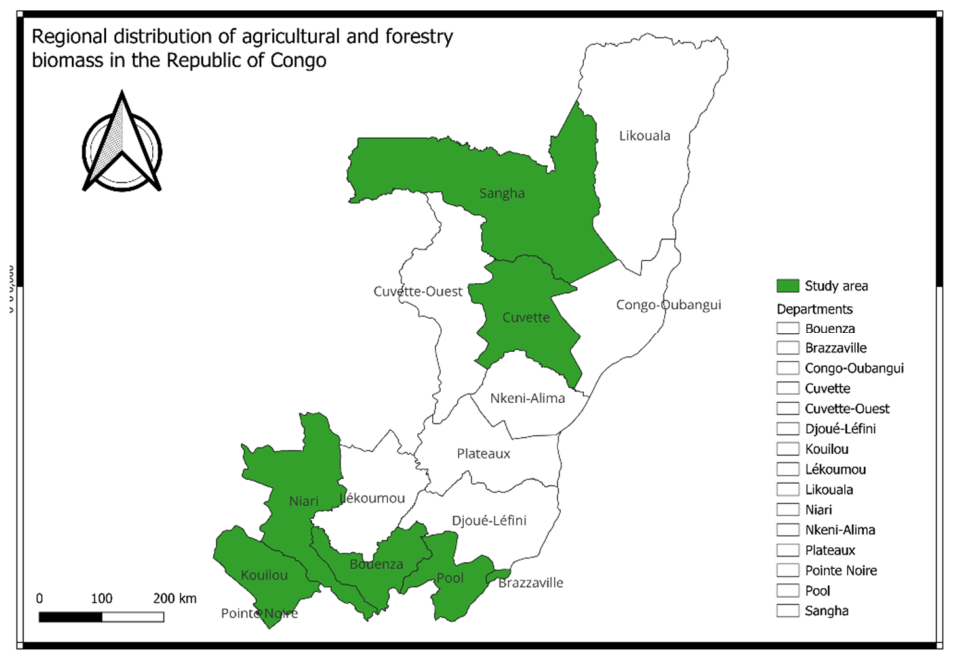
Figure 2.
(a) Collection of sawdust or wood chips from carpentry workshops ; (b) Storage of sawdust and wood chips in 50 kg bags in the carpentry workshops.
Figure 2.
(a) Collection of sawdust or wood chips from carpentry workshops ; (b) Storage of sawdust and wood chips in 50 kg bags in the carpentry workshops.
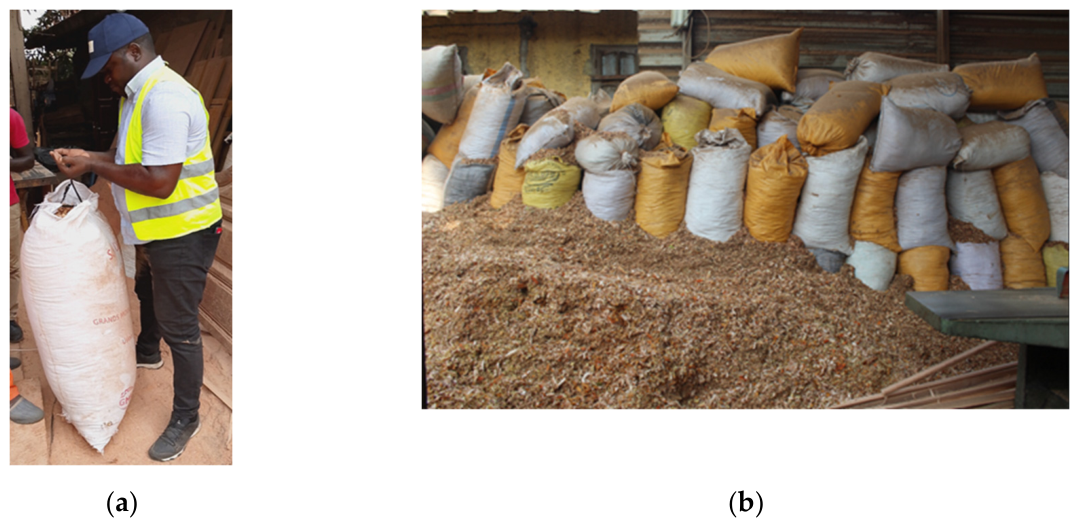
Figure 3.
(a) Potential of agricultural and forestry residues generated in the department of Pointe-Noire ; (b) Potential of agricultural and forestry residues generated in the department of Kouilou.
Figure 3.
(a) Potential of agricultural and forestry residues generated in the department of Pointe-Noire ; (b) Potential of agricultural and forestry residues generated in the department of Kouilou.
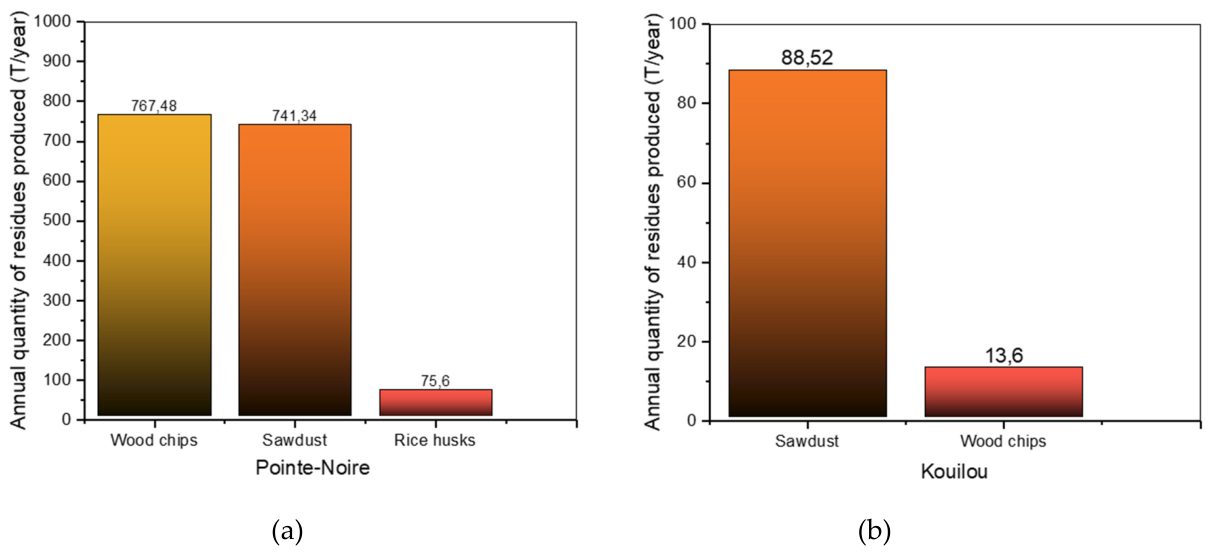
Figure 4.
(a) Potential of agricultural and forestry residues generated in the Niari department ; (b) Potential of agricultural and forestry residues generated in the Bouenza department.
Figure 4.
(a) Potential of agricultural and forestry residues generated in the Niari department ; (b) Potential of agricultural and forestry residues generated in the Bouenza department.
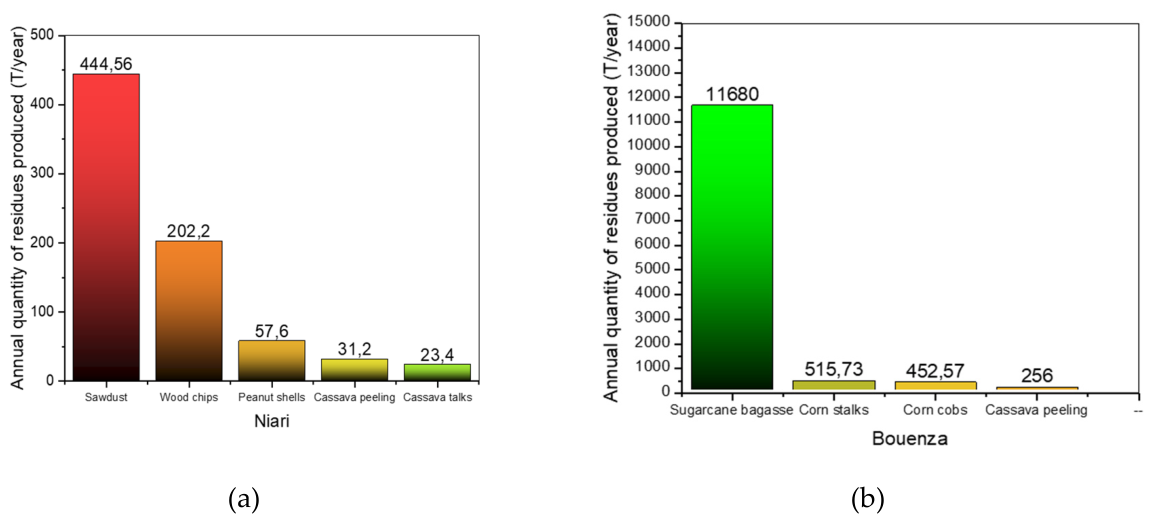
Figure 6.
Potential of agricultural and forestry residues generated in the Sangha department.
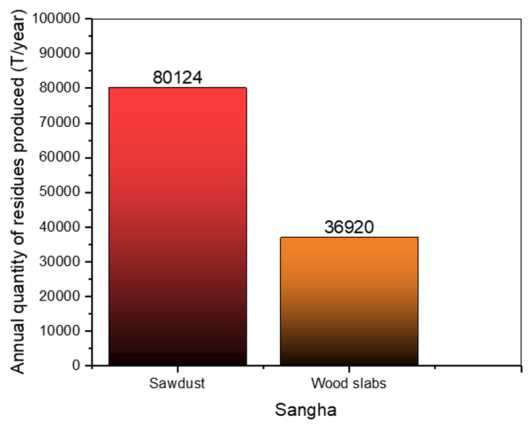
Figure 7.
Distribution of the energy potential of residues generated by department in the Republic of Congo.
Figure 7.
Distribution of the energy potential of residues generated by department in the Republic of Congo.
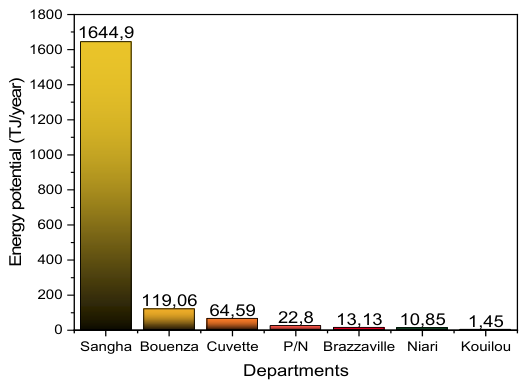

Table 1.
Proximate and ultimate analysis of agricultural, agro-industrial and forestry residues.
| Biomass residues | Proximate analysis (%) | Ultimate analysis (%) | |||||
|---|---|---|---|---|---|---|---|
| C | H | O | |||||
| Sugarcane bagasse | 45.17 ± 1.57 | 82.07 ± 0.25 | 5.64 ± 0.27 | 12.28 ± 0.37 | 45.31 ± 0.37 | 6.04 ± 0.02 | 42.26 ± 0.13 |
| Corn cobs | 9.47 ± 0.01 | 81.77 ± 0.17 | 1.99 ± 0.01 | 16.24 ± 0.17 | 49.14 ± 0.17 | 6.12 ± 0.01 | 42.16 ± 0.08 |
| Corn stalks | 8.80 ± 0.14 | 79.73 ± 0.09 | 4.82 ± 0.36 | 15.45 ± 0.37 | 41.44 ± 0.36 | 5.94 ± 0.01 | 41.08 ± 0.04 |
| Cassava peel | 21.00 ± 0.47 | 67.86 ± 0.02 | 13.51 ± 0.32 | 18.63 ± 0.32 | 45.35 ± 0.31 | 5.12 ± 0.01 | 34.91 ± 0.01 |
| Peanut shells | 10.94 ± 0.22 | 74.82 ± 0.11 | 5.15 ± 0.13 | 20.03 ± 0.17 | 49.84 ± 0.17 | 5.69 ± 0.01 | 38.58 ± 0.05 |
| Cassava stems | 10.58 ± 0.13 | 79.58 ± 0.30 | 8.29 ± 0.14 | 12.13 ± 0.33 | 44.05 ± 0.34 | 5.84 ± 0.02 | 40.95 ± 0.15 |
| Sawdust | 18.08 ± 0.14 | 82.14 ± 0.14 | 1.49 ± 0.01 | 16.37 ± 0.14 | 49.43 ± 0.15 | 6.16 ± 0.01 | 42.36 ± 0.07 |
| Sawdust (CODEXO) | 27.58 ± 0.17 | 79.13 ± 0.29 | 1.00 ± 0.23 | 19.87 ± 0.37 | 51.60 ± 0.26 | 6.02 ± 0.01 | 40.84 ± 0.01 |
| Wood chips | 12.27 ± 0.14 | 81.13 ± 0.10 | 3.31 ± 0.36 | 15.56 ± 0.37 | 48.17 ± 0.36 | 6.06 ± 0.01 | 41.82 ± 0.05 |
| Rice husks | 9.62 ± 0.14 | 69.81 ± 0.01 | 15.07± 0.15 | 15.12 ± 0.15 | 42.69 ± 0.14 | 5.17 ± 0.01 | 35.87 ± 0.01 |
1 Moisture content ; Ash content ; Fixed carbon content ; Volatile matter content ; Carbon content ; H (%) : Hydrogen content ; O (%) : Oxygen content.
Table 2.
Assessment of energy potential of agricultural, agro-industrial and forestry residues produced by department.
Table 2.
Assessment of energy potential of agricultural, agro-industrial and forestry residues produced by department.
| Departments | Biomass residues | Total annual quantity (T/year) |
RRP |
HHV (MJ/kg) |
LHV (MJ/kg) |
Energy potential (TJ/year) |
|---|---|---|---|---|---|---|
| Pointe-Noire | Sawdust | 741.34 | - | 18.58 ± 0,05 | 17.24 ± 0,05 | 10.47 |
| Wood chips | 767.48 | - | 18.12 ± 0,13 | 16.80 ± 0,13 | 11.31 | |
| Rice husks | 75.6 | 0.27 [19] | 16.11 ± 0,05 | 14.98 ± 0,05 | 1.02 | |
| Kouilou | Wood chips | 13.6 | - | 18.12 ± 0,13 | 16.80 ± 0,13 | 0.2 |
| Sawdust | 88.52 | - | 18.58 ± 0,05 | 17.24 ± 0,05 | 1.25 | |
| Niari | Wood chips | 202.2 | - | 18.12 ± 0.13 | 16.80 ± 0.13 | 2.98 |
| Sawdust | 444.56 | - | 18.58 ± 0.05 | 17.24 ± 0.05 | 6.27 | |
| Peanut shells | 57.6 | 0.37 | 18.71 ± 0.06 | 17.46 ± 0.06 | 0.89 | |
| Cassava peel | 31.2 | 0.2 [27] | 17.06 ± 0.11 | 15.94 ± 0.11 | 0.39 | |
| Cassava stems | 23.4 | 0.8 [27] | 16.63 ± 0.13 | 15.35 ± 0.13 | 0.32 | |
| Sugarcane bagasse | 11 680 | 0.304 | 17.09 ± 0.14 | 15.77 ± 0.14 | 101.04 | |
| Bouenza | Cassava peel | 256 | 0.2 [27] | 17.06 ± 0.11 | 15.94 ± 0.11 | 3.22 |
| Corn cobs | 452.57 | 0.174 | 18.47 ± 0.06 | 17.14 ± 0.06 | 7.02 | |
| Corn stalks | 515.73 | 1.5 | 17.85 ± 0.13 | 16.56 ± 0.13 | 7.78 | |
| Brazzaville | Sawdust | 218.8 | - | 18.58 ± 0.05 | 17.24 ± 0.05 | 3.09 |
| Wood chips | 681.2 | - | 18.12 ± 0.13 | 16.80 ± 0.13 | 10.04 | |
| Sawdust (CODEXO) | 3 308 | - | 19.37 ± 0.14 | 18.04 ± 0.09 | 43.22 | |
| Cuvette | Wood slabs | 1 316 | - | 18.87 ± 0.09 | 17.54 ± 0.09 | 21.32 |
| Corn cobs | 3.36 | 0.174 | 18.47 ± 0.06 | 17.14 ± 0.06 | 0.05 | |
| Wood slabs | 36 920 | - | 18.87 ± 0.09 | 17.54 ± 0.09 | 598.17 | |
| Sangha | Sawdust (CODEXO) | 80 124 | - | 19.37 ± 0.14 | 18.04 ± 0.09 | 1046.73 |
| Total | 137 921.16 | 1876.78 |
* HHV : High Heating Value; LHV : Low Heating Value; TJ : Terajoule; T : tonnes.
Disclaimer/Publisher’s Note: The statements, opinions and data contained in all publications are solely those of the individual author(s) and contributor(s) and not of MDPI and/or the editor(s). MDPI and/or the editor(s) disclaim responsibility for any injury to people or property resulting from any ideas, methods, instructions or products referred to in the content. |
© 2026 by the authors. Licensee MDPI, Basel, Switzerland. This article is an open access article distributed under the terms and conditions of the Creative Commons Attribution (CC BY) license (http://creativecommons.org/licenses/by/4.0/).
Copyright: This open access article is published under a Creative Commons CC BY 4.0 license, which permit the free download, distribution, and reuse, provided that the author and preprint are cited in any reuse.