

Submitted:
30 July 2026
Posted:
31 July 2026
You are already at the latest version
Abstract
Mitochondrial genomes (mitogenomes) are no longer considered as entities simply engaged in cellular bioenergetics, but rather as dynamic, multifaceted synchronized systems assimilating genome architecture, evolutionary processes and organismal physiology. In the present review, the contemporary understanding of mitogenome organization, its diversity, evolution and associated functions across the eukaryotic life have been summarized in connection with mitonuclear co-evolution and briefly to some connection with human health. The manuscript comprehensively discusses the conserved and lineage-specific characteristic features of mitogenome architecture, including its genetic content, topology and regulatory elements governing its precise replication and transcription. Additionally, the review also explores the role of evolutionary dynamics, with emphasis on mutation-rate heterogeneity, recombination dynamics, gene rearrangements and the interacting roles of mutation, natural selection and genetic drift in shaping mitochondrial genome diversity and evolutionary trajectories. The comparative approaches highlight extensive diversity in mitogenome structural organization and its composition closely associated with life-history strategies such as metabolic rate, longevity and reproductive peculiarity. Moreover, at the functional level, variability potential of a mitogenome significantly influences oxidative phosphorylation efficiency, reactive oxygen species generation and orchestration of cellular signalling cascades. Fundamental to these processes is the existence of coordinated mitonuclear interrelationships, wherein co-evolution between mitochondrial and nuclear-encoded genes safeguards bioenergetic functional integrity, and while its inconsistencies could lead to reduced cellular fitness and disease progression. In humans, mutations in mitochondrial DNA (mtDNA) and heteroplasmy are significantly contribute to the development of primary mitochondrial disorders; they are being progressively implicated in other complex disease etiologies, including neurodegeneration, metabolic syndromes and cancer. Furthermore, the paper summarizes the phylogenetic utility of mitogenomes in the genomic era, accentuating the need to employ integrative approaches that could combine mitochondrial and nuclear data. Lastly, the role of emerging technological platforms, including long-read sequencing and multi-omics, which are expected to transform the current scenario of mitogenome research are being discussed. Altogether, the manuscript positioning the mitogenomes as indispensable entities bridging the gaps between evolutionary histories, physiological function and personalized precision medicine.
Keywords:
bioenergetics
; mitogenomes
; mitogenome architecture
; mitochondrial evolution
; mitonuclear co-evolution
; heteroplasmy
; phylogenomics
; mitochondrial disease
; Dn/Ds
; substitution rates for non-synonymous and synonymous mutations (substitutions)
; nDNA
; nuclear DNA
; mtDNA
; mitochondrial DNA
; eDNA
; environmental DNA
; PCGs
; protein coding genes
1. Introduction
The mitochondrial DNA (mtDNA) has recently been recognized as a keystone hub in modern genetics that surpasses its classical role in modulating cellular energy metabolism. Formerly considered a highly compact and static remnant of an ancestral endosymbiont, mtDNA is now being recognized as an extremely vibrant genomic entity with notable implications for evolutionary biology, regulation of cellular physiology, including direct involvement in the maintenance of human health [1,2]. This reassessment has been made largely possible by recent advancements in long-read sequencing technology, single-cell analyses and integrative genomics approaches that have disclosed unexpected structural diversity, variable patterns of inheritance and ubiquitous mitonuclear communications across eukaryotes [3,4]. Although the canonical animal mitogenome is compact (circular and approximately 16–20 kbp in size), it encodes for 13 oxidative phosphorylation (OXPHOS) proteins, 22 tRNAs and 2 rRNAs, however the magnitude of structural variation across different taxa is remarkable [5,6]. Unusually, plants and protists do not follow the established paradigm of organellar streamlining by recurrently exhibiting intensely expanded mtDNAs with introns rather than reducing, with some plant mtDNAs exceeding 11Mb in size. Such gigantic, multifaceted genomes are driven by low substitution rates, higher recombining repeats, mobile genetic elements and frequent mitochondrion-to-mitochondrion horizontal gene transfer, thereby posing a challenge for operating traditional paradigm of organellar functioning [7]. Even among metazoans, genomic rearrangements, control region duplications and gene content shifts are common, which often drive adaptation by altering metabolic rates, thermal tolerance and lifespan [8].
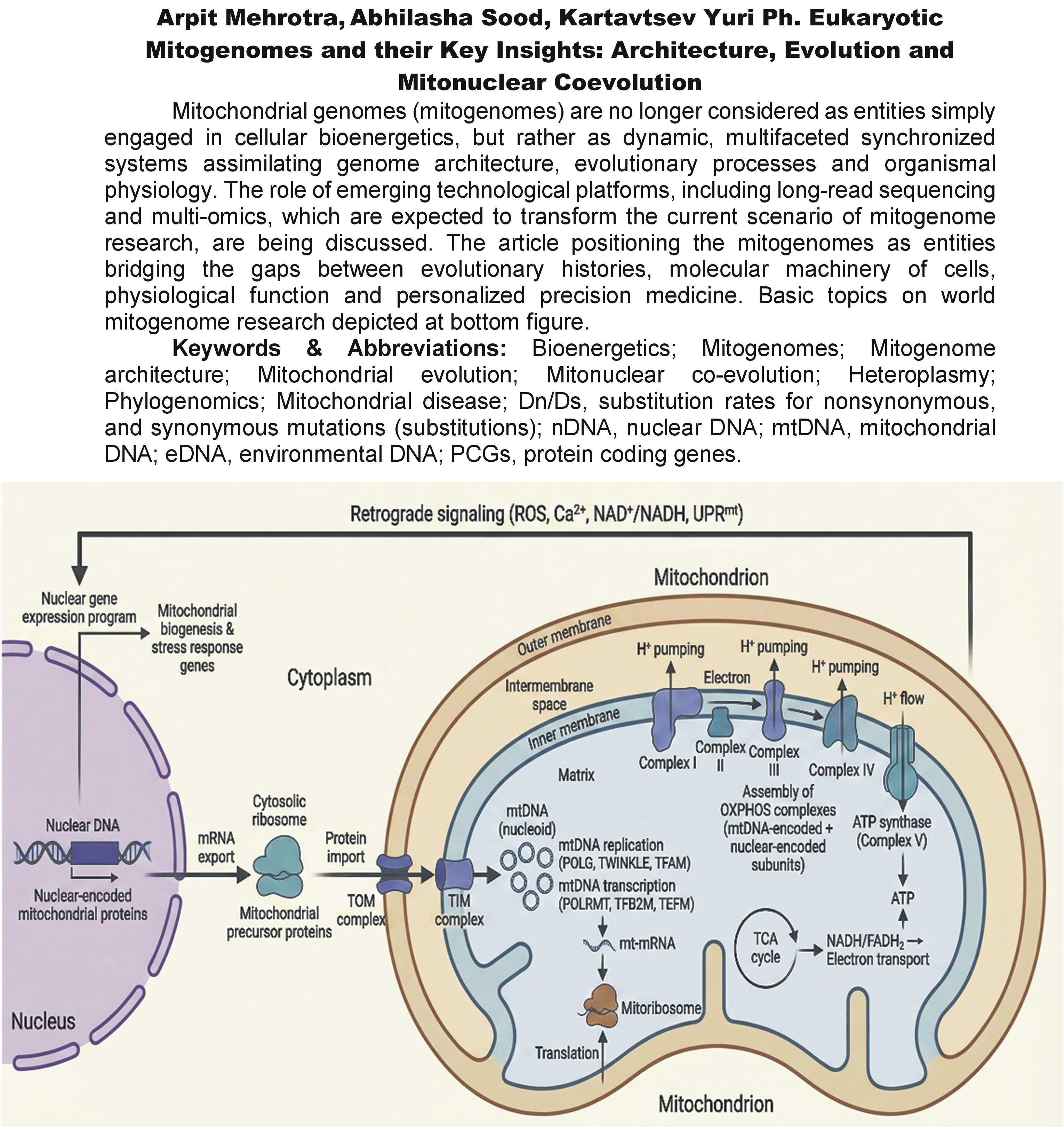
Moreover, mitogenome is a dynamic, multidimensional system integrating structural organization, replication and transcription within the cellular environment (Figure 1). The circular mitogenome encodes vital components for oxidative phosphorylation while its maintenance and expression depend significantly on nuclear-encoded proteins, such as: Polymerase Gamma (POLG), Mitochondrial Transcription Factor-A (TFAM), Mitochondrial RNA Polymerase (POLRMT), Mitochondrial Single-Stranded DNA-Binding Protein (mtSSB), Transcription Factors B1 and B2 (TFB1M/TFB2M), Twinkle DNA Helicase and Mitochondrial Ribosomal Proteins (MRPs). These nuclear imported proteins, along with others are involved in mtDNA repair and RNA processing (such as TEFM and RNaseP), are considered fundamental for the proper functioning of 13 polypeptides encoded by the mtDNA [9,10].
Additionally, the replication and transcription processes occur in close coordination, being regulated by transcription factors (TFAM, TFB1M/TFB2M) imported from the nucleus into mitochondria. The figure highlights the bidirectional exchange of signals and proteins between mitochondrial and nuclear compartments, thereby emphasizing on functional interdependence. Such mitonuclear coordination ensures mitochondrial integrity, bioenergetic efficiency and adaptive responses to metabolic demands, positioning the mitogenome as a central hub in maintaining cellular homeostasis and cross-compartmental communication/s.
The evolutionary dynamics of mtDNA have also driven by its unique replication and maternal inheritance [11,12]. Uniparental (typically maternal; but see some exceptions below) transmission and the absence of conventional recombination diminishes effective population size (Ne) by at least 1/4th [13,14], with concomitant increase in influence of genetic drift which altogether augments lineage sorting relative to nuclear loci [15]. Nevertheless, this diminished operational population size simultaneously exaggerates the stepwise accumulation of deleterious mutations (phenomenon theoretically referred as Muller’s ratchet [16], unless neutralized via mitochondrial genetic bottleneck or selection against dysfunctional variants during germline transmission process [17]. Recently, the role of mitonuclear co-evolution was highlighted by showing that prompt changes in mtDNA mutation rate augment compensatory evolution in nuclear-encoded mitochondrial (N-mt) proteins. E.g., since mtDNA and nuclear DNA evolve independently, co-adaptation is vital and compensatory changes in both genomes ensure that translated proteins match structurally, sustaining efficient energy production while alleviating proteotoxic stress and reactive oxygen species (ROS) leakage [18]. Such co-adaptation confirms that the protein subunits from both genomes, must fit together "like a lock and key", to function efficiently [19]. Any disruption of this co-adaptive equilibrium, whether through hybridization, introgression or somatic mutations, could jeopardize cellular bioenergetic machinery. All these actions significantly promotes oxidative stress and disrupts organismal fitness, with implications ranging from speciation dynamics to metabolic diseases [20,21].
The recent conceptual shift from viewing mtDNA merely as a static, maternally inherited marker of genetic disease in humans to recognizing it as an interactive genomic hub has reshaped investigators' understanding of mitochondrial diseases [22,23]. Moreover, high-depth sequencing approaches have revealed extensive heteroplasmy, wherein mixtures of wild-type and mutant mtDNA were shown to generate tissue-specific threshold effects which contributed to phenotypic variability, as evidenced by review data available from several organisms investigated [24,25]. Evidently, minute discordance in mitonuclear functioning has been increasingly implicated in age-related pathologies, neurodegenerative diseases and complex metabolic traits, thereby expanding the clinical relevance of human mitogenomes beyond just classical mitochondrial disorders [26]. In synthesizing structural diversity, evolutionary dynamics and functional integration, the present manuscript positions mtDNA as a multifaceted genomic entity. By emphasizing mitogenome architecture, evolution and mitonuclear co-evolution, the review aims to bridge evolutionary genetics with organismal biology and translational insight, thus summarizing a unified framework for understanding genetic diversity, evolution and disease.
2. Architecture of Mitogenomes
Mitochondrial genomes demonstrate architectural diversity that belies their relatively small size in several biological lineages, especially extraordinary in plants and ancient metazoans. Classical depictions of animal mtDNA feature a conserved compact, circular, double-stranded molecule (~14–20 kb) encoding a conserved set of 37 genes. However, comparative genomics and modern sequencing techniques depict a spectrum of organizational variants shaped by lineage-specific evolutionary pressures [5,27], as shown in Figure 2. This architectural variability highlights the differences in replication strategies, recombination dynamics, genomic stability and interactions with nuclear system or other cellular elements, thereby accentuating the need to consider mitogenomes as adaptable genomic architectures of cells and entire organism rather than mere static organellar entity [28]. In metazoans, the canonical animal mitogenome encodes 13 PCGs involved in OXPHOS functioning, two ribosomal RNAs, and usually 22–24 tRNAs that most variable in number and specific set. It includes a non-coding control region (D-loop in mammals or A+T-rich region in invertebrates) that coordinates replication, origin of heavy/light or +/– strand synthesis and transcription (promoters) mechanisms [29]. Despite of broad conservation of gene contents, the gene order (synteny) is surprisingly fluid. For instance, extensive rearrangements of tRNAs and even protein-coding genes have been demonstrated across Arthropods (insects and crustaceans), nematodes and bivalve mollusks, which are frequently found to be associated with lineage-specific life-history traits and metabolic demands [30,31,32,33]. Such rearrangements challenge classical hypothesis of mtDNA as a rigidly conserved marker for phylogenetics and necessitates careful investigation of gene synteny, whenever interpreting evolutionary histories to circumvent imprecise phylogenetic interpretations [34,35].
As discussed above, a contrasting pattern has been demonstrated to occur in plants and protists, wherein the size of the mitogenome and its architectural organization are far more heterogeneous in nature. Mitogenomes in plants, particularly in angiosperms, are well known for their enormous and variable size (often 200 kb and up to ~11 Mb, such as in Silene conica). This feature is achieved not through amplified gene number but via accretion of repeated elements, introns and sequences transferred from plastids or the nucleus [42,43]. These repeated elements encourage recombination, thus yielding multipartite genome structures and sub-stoichiometric forms that co-exist within a single cell [44,45]. RNA editing, predominantly universal in plant mitochondria, further complicates genotype-to-phenotype relationships by altering coding sequences post-transcriptionally. This process encompasses the conversion of cytidine to uridine at hundreds of specific sites within mitochondrial transcripts [46,47].
Among the protists, mitogenome configurations range from linear chromosomes with telomere-like ends to extremely fragmented mini-circles (as observed in kinetoplastids), wherein hundreds of circular molecules encode a mosaic of genes and guide RNAs. Such architectures are associated with specialized replication and segregation machineries, including mini-circle segregation systems that differ fundamentally from those in animal mitochondria [48,49]. Structural diversity in mitochondrial genomes is further exemplified by doubly uniparental inheritance (DUI), an unusual transmission system discovered in several bivalve lineages, including Mytilidae, Unionidae, Mactridae and Veneridae, in which distinct female (F-type) and male (M-type) mitochondrial genomes are inherited through maternal and paternal lineages, respectively [50,51,52,53]. Unlike the predominantly maternal inheritance observed in most animals, DUI generate sex-specific mitogenomes that often differ substantially in sequence composition, gene arrangement and evolutionary rate, thereby providing a unique framework for studying mitochondrial genome evolution, mitonuclear interactions and lineage diversification [54,55,56]. On the other hand, cnidarians and sponges possess linear mitogenomes with telomeric repeats, demonstrating adaptations to specific cellular microenvironments or life histories [57]. The CRs in mtDNA in vertebrates show structural plasticity within largely conserved genomic content. Any variation in the length of such control regions has been shown to be directly correlated with metabolic rate and lifespan across the vertebrates, thereby signifying that regulatory intricacy may adaptively scale with organismal bioenergetics [58,59].
Additionally, tandem repeat expansions within control regions also serve as hotspots for slipped-strand replication, which may encourage heteroplasmy dynamics in mitochondrial populations. Mechanistically, variations in mitogenome architecture arise from differential activity of recombination surveillance pathways (mediated by MSH1 and RECA3), error-prone DNA polymerases (such as Pol-theta and Pol-zeta) and the equilibrium between replication and repair. Nuclear-encoded factors such as TWINKLE helicase, DNA polymerase-gamma (POLγ) and mitochondrial single-stranded DNA-binding proteins (mtSSB) modulate replication fidelity and structural stability, linking mitogenome organization directly to nuclear genetic control. Altogether, the architectural diversity of mitogenomes reflects a balance between functional constraint and evolutionary flexibility [60,61,62]. By contextualizing these architectures across lineages, investigators are expected to decipher how architectural variation interfaces with metabolic demands, population genetic processes and ecological adaptation.
3. Evolutionary Dynamics of Mitochondrial Genomes
The mitogenome presents a distinctive complex system of forces and structural unites which indeed distinguish their dynamic functioning from those of nuclear machinery. The complex interplay of mutation pressure, selection, genetic drift and demographic history orchestrates variation in substitution rates, structural features and functional constraints, with concomitant consequences from viewpoints of basic biology and genetics, including organismal adaptation, evolution, phylogenetic inference, disease vulnerability, etc. [63,64]. Therefore, understanding for example peculiarities of evolutionary dynamics in an organism lineage, for example, necessitates incorporating classical population genetics knowledge with emerging insights from the approaches of modern comparative genomics, high-throughput sequencing technologies and experimental research on the evolution in peculiar species and organisms. One such significant characteristic feature of mitochondrial evolution is its uniparental inheritance, which is naturally maternal in animals and reduces the effective population size (Ne) of mitogenomes relative to nuclear genome [65,66,67]. This reduced Ne further strengthens the profound effects of genetic drift, thereby allowing slightly deleterious mutations to persist and occasionally fix [68,69,70]. Elevated fixation of mildly deleterious mitochondrial variants in metazoans, where reduced Ne and limited recombination may facilitate mutation accumulation with potential consequences for mitochondrial function and aging [71]. Comparable processes have also been documented in plants, although their evolutionary consequences are often manifested through cytonuclear interactions and fitness-related traits rather than senescence alone [72]. Nevertheless, strong purifying selection on core OXPHOS genes remains universal, as these proteins interface with nuclear-encoded subunits, which are essential for regular bioenergetic functioning. The critical nature of such "mitonuclear" interaction causes intense selective pressure that eliminates mutations causing dysfunction [73,74]. Such matters are very complicated and will be discussed in more details in later section of the manuscript.
Mitochondrial mutation rates demonstrate striking variability among different taxa. Such as, in vertebrates, mtDNA evolves rapidly, frequently with an order of magnitude faster than nuclear DNA, thus making it exceedingly useful for resolving recent divergences [75,76,77]. However, in plants and some protists, mitochondrial mutation rates are paradoxically lower at nucleotide level despite large and structurally dynamic genomes [78]. This decoupling of mutation rate and mitochondrial genome architecture shapes differences in DNA repair efficiency, including its replication fidelity across lineages. For example, plant mitochondria exhibit high rates of recombination and architectural rearrangements facilitated by the presence of repeated elements, nevertheless also preserve low substitution rate due to competent error correction mechanisms [79,80]. This existence of substitution rate heterogeneity within metazoans correlates well with life-history traits. For instance, short-lived species with high-metabolic demand tends to accrue substitutions more rapidly, which is consistent with the metabolic rate hypothesis [81,82,83]. This suggests that enhanced oxidative stress and replication turnover increases mutational input [84,85]. On the other hand, long-lived species with slower metabolic rates frequently demonstrate lower mtDNA substitution rates, possibly reflecting stronger purifying selection or reduced replication load [86]. These associations, while vigorous in broad patterns, are not universal and therefore may differ with ecology and Ne impact [84,87], thus emphasizing the requirement for lineage-specific analyses. Recombination in mitochondrial genomes has long been under intense debate, often considered rare or absent due to stringent uniparental inheritance and the resulting homoplasmic state (signifying identical mtDNA molecules within a cell). Animal mtDNA is conventionally considered non-recombining, however investigations from high-depth sequencing approaches (PacBio® HiFi or high-coverage Next-Generation Sequencing) discloses rare but detectable recombination events in humans and other vertebrates [88,89]. In contrast, recombination is an essential feature that exists universally in plant and fungal mitogenomes, contributing to multifaceted structures and sub-stoichiometric shifting of genomic forms [45,90]. Altogether, a multifaceted web of forces regulates mitochondrial evolutionary dynamics: mutation pressure moderated by repair and replication mechanisms, selection constrained by essential bioenergetic functions and drift augmented via uniparental inheritance and population history. These processes interact dynamically across lineages (Figure 2) and scales, further warranting integrative models that reconcile genomic architecture, life history and cellular physiology with evolutionary theory.
4. Mitogenome Diversity and Life-History Strategies
Mitogenome diversity is not an isolated phenomenon in organismal biology; rather it is deeply intertwined with life-history of each organism, heredity patterns and species evolution. Variation in metabolic rate (energy expenditure per unit body mass), lifespan, and reproductive strategy and Ne size largely influences the mutation rate, the severity of selective constraints and the cumulative structural organization of mitogenome [84,91]. Therefore, understanding such relationships could provide a holistic framework that might be useful for interpreting both macro-evolutionary patterns and lineage-specific differentiation peculiarities. Among these, one of the comprehensively examined associations is between mitochondrial mutation rate and metabolic rate. The metabolic rate hypothesis suggests that enhanced metabolic throughput augments reactive oxygen species (ROS) generation and replication frequency, which concomitantly heightens mutational input in mtDNA [84]. Comparative investigations across vertebrates and insects indicate the existence of a strong positive relationship between the taxa with high mass-specific metabolic rates (small mammals and flying insects), and often accompanied by accelerated substitution rates in mitochondrial gene products, in PCGs, etc. [92,93]. Recently, it was suggested that replication errors arise during mtDNA turnover and maintenance, rather than direct oxidative damage, and as such, may actually govern such mutation accretion [94,95]. Although, mitochondria harbour a highly reactive environment with reactive species, reports suggests that ROS-mediated mutations (such as, G:C to T:A transversions) does not increase with age as expected earlier, rather emphasizes the role of DNA polymerase (Polg) induced errors occurring during mtDNA replication [96,97]. These findings highlight the significance of replication dynamics and germline blockages in determining subsequent evolutionary rates.
Notably, long-lived species (having a longevity tends) are demonstrate reduced substitution rates in mitogenome and stronger signatures of purifying selection, hypothetically reflecting heightened mitochondrial quality control mechanisms and may have rigorous germline selection against deleterious variants judging on non-synonymous (Dn) to synonymous substitutions (Ds), Dn/Ds ratio [86]. In birds and bats, lineages prominent for extended lifespans relative to their body size, mitogenome evolution seems decoupled from metabolic intensity, signifying lineage-specific mitigation of typical accumulation of mtDNA mutational load linked with high metabolic activity [98,99,100]. Such findings suggest that mitochondrial metabolic rate alone cannot explain the heterogeneity rate in mitogenome; rather life-history trade-offs amongst factors, such as reproduction, maintenance and longevity must be incorporated into evolutionary models [101]. Moreover, the effect of Ne variation is well known to exercise a dominant influence on mitogenome diversity despite some complications [102,103]. Since the mitogenome is characteristically haploid and maternally inherited, its Ne is approximately 1/4–1/2th that of autosomal nuclear loci under equal sex ratios [103,104]. Reduced Ne augments genetic drift, thereby increasing the probability of fixation of slightly deleterious mutations and accelerating lineage sorting as obtained by simulation and literature data [105]. Comparative genomic findings strongly support the hypothesis that species with small Ne, often found with large-body, specialized or endangered taxa and exhibit greater Dn/Ds ratios of substitutions among mitochondrial genes, consistent with relaxed purifying selection [105,106]. Conversely, species with large Ne may preserve stronger selective constraints and lower non-synonymous divergence in comparison to species with small Ne, which are more susceptible to genetic drift [106]. Reproductive and biochemical adaptive strategy also may modulate mitogenomic dynamics [107,108]. Particularly, in taxa with skewed sex ratios or complex inheritance systems (as observed during DUI, in bivalves), selection may act differently on male- and female-transmitted mitogenomes, producing divergent evolutionary trajectories within a single species [6,9,10,11,43]. Similarly, species experiencing persistent population bottlenecks may display rapid shifts in haplotype frequencies due to drift rather than adaptive change [10].
Notably, the life-history association of mitochondrial evolution are not fully predictive. Ecological specialization, thermal adaptation and migratory behaviour can modulate metabolic demand and selective pressures on mtDNA, independently of body size or lifespan. While slow life histories (with long lifespan, large size) are conventionally linked to slower rates of mitochondrial evolution, these other factors can cause complicated variance and evolutionary outcomes [109,110]. These relationships therefore represent probabilistic associations rather than deterministic rules. Altogether, such findings place mitogenome as a sensitive mediator of life-history evolution. By integrating metabolic ecology, demography and molecular evolution, a unified framework emerges wherein mitochondrial diversity reflects both intrinsic genomic properties and extrinsic ecological pressures. Such integration is indispensable for understanding the evolutionary rate variation and the adaptive signals for distinguishing that from demographic artefacts in comparative analyses.
5. Functional Implications of Mitogenomic Variation
Variation within mitogenomes can have significant functional consequences on regulation of a cellular physiology and for cellular physiology and organismal fitness. Although mtDNA encodes a comparatively small set of genes, these genes play essential roles in regulating oxidative phosphorylation, which mediated the generation of ATP in eukaryotic cells (Table 1). Subsequently, even marginal variation in mitochondrial sequence or copy number can greatly influence metabolic performance, redox balance and the life-history traits in organisms [111,112].
Table 1 summarizes the relationships between key types of mitogenomic variations and their associated functional and some clinical consequences in humans. It highlights that characteristic features of mitogenomic variations (heteroplasmy, elevated mutation rates in the mitogenome, deletions and mitonuclear incompatibility), all converge to impair OXPHOS that subsequently disrupt cellular energy metabolism. Such molecular defects translate into different phenotypes, ranging from classical mitochondrial disorders to complex diseases, including neurodegeneration, cardiometabolic dysfunction and aging-related decline. Notably, the table also underscores the evidence-dependent nature of mitogenomic effects, wherein thresholds of the mutation load in mitogenome and it interaction with the nuclear genome critically determines disease manifestation. Data presented in Table 1 also highlight translational opportunities, including the usage of mtDNA variants as biomarkers and the development of targeted therapeutic approaches.
At the molecular organization level, mtDNA encodes core subunits of mitochondrial respiratory chain complexes-I, -III, -IV and -V, altogether which function in close structural association with nuclear-encoded proteins. Amino acid substitutions or changes in mitochondrial polypeptide sequences coded by mitogenomes can therefore alter electron transport chain efficiency, and thus subsequently affecting proton pumping and ATP synthesis. Investigations across different model organisms (such as Drosophila, bovine and other animals) demonstrate that naturally occurring mitochondrial haplotypes can significantly produce quantifiable differences in metabolic rate, thermogenesis and locomotor performance [122,123,124]. Cited reports suggest that mitochondrial genetic variation may be not selectively neutral, but frequently contributes directly to functional, physiological and behavioural phenotypes with reservations that will be discussed in the special section (Section 9) on selectivity-and-neutrality of molecular markers in general. One of the most extensively reported functional consequence of mitogenomic variation involves the regulation of the ROS, as mentioned earlier (Section 4). The electron leakage from mitochondrial respiratory chain complexes generates ROS, which functions both as a damaging agent (via enhancing lipid peroxidation, mtDNA damage etc.) and as an efficient signalling molecule involved in regulating several cellular cascades, including stress responses, apoptosis and metabolic adaptation [125,126]. Certain mtDNA variants and haplogroups appear to modulate ROS production rates, which directly influences oxidative stress tolerance and cellular signalling cascades. In some ecological conditions, such differences are not detrimental; rather offer adaptive advantages. For instance, they allow such population(s) to thrive during thermal stress, hypoxia tolerance or changes in nutrient availability [127,128].
Mitogenomic variation is also well known in contributing to differences in organismal aging. The mitochondrial theory of aging, often termed as mitochondrial free radical theory of aging, suggests that gradual accretion of mitochondrial mutations and oxidative damage significantly contributes to functional decline over time. This process may act due the fact that mitochondria are the chief entities involved in ROS production (at Complex-I and -III of the electron transport chain), which can cause notable damage to macromolecules over time [129,130,131]. A prominent role of mitochondrial ROS in aging, still, remains debated, however growing evidences highlights that mutations in mitogenome accumulating during the course of aging in multiple tissues could impair respiratory chain functions upon exceeding threshold levels [132]. Experimental models with elevated mtDNA mutation rates have shown to exhibit premature aging phenotypes (mtDNA-mutator mouse models), supporting a causal relationship between mitogenome integrity and lifespan regulation [133,134]. Additional critical aspect of mitogenome functional is the presence of heteroplasmy, due to the co-existence of numerous mitochondrial genotypes within a cell or an organism. Since mitochondria are present in hundreds to thousands of copies per cell, their mutant variants (with mutated mitogenomes) are reported to persist at low frequencies without producing observable phenotypic effects. However, occasionally they surpass a critical threshold level (usually ranging from ~60–80% or sometimes ~50–90% of the overall mtDNA within a cell), which may compromise overall mitochondrial respiratory chain functions [135,136]. Technological advancements in ultra-deep sequencing approaches have demonstrated that low-level heteroplasmy is nearly universally present in healthy individuals, suggesting that mitochondrial populations are dynamic and continuously shaped by mutation, selection and genetic drift [137,138]. Some peculiarities on the role of mitogenome and other genes in fitness could be discussed in ending Section 9. Mitochondrial signalling cascades interact extensively with nuclear transcriptional machinery to coordinate efficient modulation of metabolic networks, emphasizing the importance of combined genomic reprogramming [139]. Altogether, as mentioned earlier, these observations highlight mitochondrial genomes as not mere passive energy entities, rather as dynamic determinants of physiological variations as well. These functional consequences of mitogenomic diversity arise via complex interactions between metabolic efficiency, ROS signalling, heteroplasmy dynamics and cellular regulatory functioning. Such a diverse interactions set is the stage for co-evolutionary relationships between mitochondrial and nuclear genomes, to be further discussed in the following section.
6. Mitonuclear Interactions and Co-Evolution
The dynamic functioning of mitochondria depends explicitly on intricate genetic integration between the mitogenomes and nuclear genomes. While the former encodes for 13 PCGs and few others, the majority of proteins (~99%) are nuclear encoded, like in mammals and most Eukarya, and subsequently imported into the individual organelle after cytosolic translation [140]. This inter-genomic division of labour loads suits to generate an environment wherein mitochondrial and nuclear genes may evolve in a coordinated manner. As a result, this mechanism allows preserving efficient functioning of oxidative phosphorylation and metabolic homeostasis. Accordingly, mitonuclear co-evolution has emerged as a significant frontier in the field of mitochondrial biology, connecting molecular evolution with organismal fitness, speciation and disease severity [141]. The need for such intergenomic-and-organismal synchronized evolution arises predominantly from the structural composition of mitochondrial respiratory chain complexes and their integration in eukaryotic cellular organization. Key components of respiratory chain complexes (-I, -III, -IV and -V) contain both mtDNA and nDNA encoded subunits that assemble themselves as multi-subunit macromolecular structures embedded within inner mitochondrial membrane [28]. Comparative genomic analyses highlight signatures of such compensatory evolution across diverse taxa, particularly in genes encoding respiratory chain complexes [20,142]. Therefore, amino-acid substitutions in mitochondrial proteins have the propensity to alter binding interfaces or electron transfer efficiency, often requiring compensatory changes in interacting nuclear encoded proteins and might be a core point or property for natural selection action at this organismal (phenotype) level. Few other insights into these matters are discussed in the Section 9.
Evidence for mitonuclear co-adaptation has especially shown to be strong in case of hybridization studies. Crosses between populations or closely related species can produce hybrid offspring with mismatched mtDNA and nuclear genomes (a phenomenon classically recognized as mitonuclear or cytonuclear incompatibility), leading to reduced metabolic efficiency and diminished fitness. Summary of classical views on this subject are well known [72,143,144]. Investigations in copepods (Tigriopus californicus), insects (Nasonia wasps, Drosophila) and vertebrates (swordtail fish, birds) demonstrate that hybrid offspring repeatedly exhibit significantly impaired mitochondrial respiration, stunted growth and lower reproductive success when mitonuclear compatibility is interrupted [144,145,146]. Such findings demonstrate that mitonuclear incompatibilities can substantially contribute to reproductive isolation and speciation via creating intrinsic genetic barriers between diverging lineages, however there is limited data that supports such claims since 1980s [72,147,148,149,150,151]. Mitonuclear interactions are also known to influence adaptation during environmental challenges. For instance, changes in climatic conditions, availability of oxygen or bioenergetic demand may itself select for mitochondrial variants that optimize electron transport efficiency under new environmental stressors [152]. Since these mitochondrial variants interact with nuclear encoded proteins, adaptive evolution may therefore encompass coordinated substitutions in both mtDNA and nDNA genomes. For the case, investigations performed in high-altitude vertebrates have identified significant mitochondrial and nuclear changes related with heightened oxidative phosphorylation under hypoxic conditions. Such adaptations include a higher evolutionary rate in mitochondrial PCGs compared to low-altitude species, designed to optimize oxygen utilization [153]. Similar patterns have also been observed in insects and marine organisms adapting to thermal gradients [153,154,155,156]. A recent study showed higher nucleotide diversity and evolutionary rate in the alpine group as compared to the lowland group, wherein mtDNA PCGs (ATP6, ATP8, COX1, COX3 and CYTB) showed seven positive selection sites, whereas few genes (ATP6, ATP8, COX3 and ND1) were found to be significantly associated with temperature-related environmental factors. These findings offer deeper insights into adaptive mechanisms of parasitoids in response to the alpine environment and subsequently highlight how such species might react to future ambient temperature shifts [157,158].
Modulating evolutionary dynamics, mito-nuclear interactions also have imperative implications for human health and any disruption in such coordinated network could cause mitochondrial failure and commencement of disease. Classical mitochondrial disorders (such as MELAS and MERRF) are known to arise from pathogenic mutations in either mtDNA or nuclear genes encoding mitochondrial proteins. Recent reports suggest that subtle mitonuclear mismatches may also contribute significantly in developing complex disease and age-related pathologies via compromising metabolic efficiency, enhanced ROS production and redox homeostasis [158,159]. This concept has become particularly relevant in the context of mitochondrial replacement therapies, where nuclear genomes are paired with donor mitochondria to prevent transmission of pathogenic mtDNA variants [160]. Altogether, these investigations once again demonstrate that mitochondrial and nuclear genomes cannot be considered as independent evolutionary entities. Rather, they collectively form a tightly integrated genetic system whose components evolve in concert to sustain cellular bioenergetics. Hence, understanding the precise mechanisms orchestrating mitonuclear co-evolution is indispensable for interpreting patterns of mitochondrial diversity, evolutionary adaptation and disease susceptibility.
7. Phylogenetic Utility of Mitogenomes
Mitogenomes have long been among the most widely used sources of genetic markers in evolutionary biology. Due to their relatively small size, high copy number, maternal inheritance, a lack of recombination and a rapid evolutionary rate, all of which make field research particularly feasible. Such noteworthy characteristics have made mtDNA sequences particularly valuable for reconstructing species-level phylogenetic relationships, inferring population history, in identification of phylogeography, etc. [63,161,162]. Ever since the initial applications of mitochondrial markers in molecular systematics, mtDNA has played a significant role in shaping modern phylogeography and understanding evolutionary genetics [163]. One of the primary advantages of employing mtDNA markers for evolutionary inference is their basically uniparental inheritance and lack of recombination in most animals, facilitating the generation of genealogies that are easier to reconstruct than those of recombining nuclear loci (directly back in time without the confounding effects of genetic shuffling that occur with nDNA). This often permits rapid lineage sorting, thus expediting resolution of recent divergence events [1,12], with certain reservations mentioned above. Additionally, the relatively higher rate of mutation observed in animals mtDNA further augments its utility for investigating population-level variation and demographic history, thus facilitating in tracking migration patterns, population expansions and genetic bottlenecks across diverse taxa [164,165].
Comprehensive sequencing approaches have considerably expanded the phylogenetic information accessible from mitogenome. As such, mitogenomic datasets from higher Eukarya encompass not only 13 protein-coding genes but also 2 rRNAs, 22 tRNAs and CRs that jointly offer extensive phylogenetic signals that are capable of resolving relationships at diverse taxonomic levels, from population genetics to higher-order systematics [32,56,166]. Subsequently, mitogenomes have also been exclusively employed to reconstruct deep evolutionary relationships across vertebrates, invertebrates and some microbial eukaryotes, which were specifically observed recently, e.g. for Human microbiome [167]. In addition to mitogenome sequence information, gene order rearrangements themselves can also assist as phylogenetic characters, offering independent evidence for evolutionary relationships among lineages [168,169,170]. Despite above advantages, reliance on mitogenomes has also demonstrated several limitations. Since mtDNA embodies a single non-recombining locus, its genealogy may not precisely reflect the evolutionary history of entire nuclear genome or the species tree. This is because mtDNA is distinctively vulnerable to processes that deviate from the species branching history, such as incomplete lineage sorting, introgression and selective sweeps, thereby producing discordance amongst mitochondrial and nuclear phylogenies. In some cases, mitochondrial introgression between species can obscure true species boundaries or generate misleading signals of evolutionary relationships [163,171,172,173,174].
Selection acting on mitochondrial genes may also bias phylogenetic inference, as mitogenome does not always represent the neutral markers often assumed in molecular systematics, but frequently represents a complex entity [32,56,162]. Although mtDNA is widely used for investigating recent evolutionary history patterns, positive selection and purifying selection, whereas metabolic adaptations lead to divergent mitochondrial loci, which concomitantly yields conflicting phylogenetic trees, thus generating inaccuracies in identification of true species relationships [32,56,175,176,177]. Since mtDNA encodes for crucial components of the mitochondrial protein subunits of the OXPHOS complexes, it is strongly influenced by both adaptive evolution (driving the fixation of advantageous mutations in specific environments) or purifying selection (involved in removing deleterious mutations to maintain regular functions). This multifaceted selection pattern in combination with its distinctive features (high substitution rates, lack of recombination and maternal inheritance) results in lineage-specific rate variation in mitochondrial populations. Such deviations from neutral expectations can largely confound molecular clock estimates and phylogenetic reconstruction, if not appropriately accounted for [32,56,152,162,178].
The large-scale accessibility of nuclear genomic data, accelerated by next-generation sequencing strategies has encouraged a shift towards employing integrative phylogenomics approach, wherein mitochondrial and nuclear markers are analysed together to reconstruct evolutionary history framework, hence addressing the limitations inherent in using either marker type alone. In such technological approach, mitogenomic data remains a valuable tool-set due to its high resolution for recent divergences and its capability to offer autonomous and multiple set of evolutionary patterns. Whenever combined with genome-wide nuclear datasets, mitogenomes are able to provide robust phylogenetic hypotheses to identify complex processes such as introgression [179,180]. Recent technological advancements in sequencing methodology have also expanded the usage of mtDNA information in few other scientific domains, such as in environmental DNA (eDNA) analysis, ancient DNA studies and biodiversity monitoring. Since mitochondrial genes occur usually in high copy number and often persist in degraded samples, they are predominantly useful for identifying species presence in environmental samples or reconstructing evolutionary histories from the ancient remains [181]. Altogether, mitogenomes remain indispensable tools in the field of evolutionary genetics. Modern technological approaches progressively accentuate integrating mitogenomic information with nuclear genomic data and ecological findings. This holistic perspective allows researchers to exploit the strengths of mitochondrial markers while mitigating their limitations, offering deeper insight into the evolutionary processes shaping biodiversity (Figure 3).
8. Technological Advances and Future Directions
Recent technological advances are rapidly transforming the investigations of mitochondrial genomes, facilitating improved precision in characterizing its architecture, population dynamics, molecular-genetic detailing of metabolic chains and functional integration of mitogenome with entire cellular system. Such cutting-edge developments are reshaping the long-standing conventions about mitochondrial genetics and offers novel approaches in eight items for simplicity (Table 2), for promising translational investigations [5], and cell biology in general. Recently, the successful establishment of long-read sequencing platforms (developed by Pacific Biosciences and Oxford Nanopore Technologies) has significantly enhanced the resolution with which mitogenomes could be precisely assembled and holistically analysed. Unlike short-read sequencing approaches, the long-read platforms generate long contiguous reads (in several kbs), facilitating precise reconstruction of complex mitochondrial structures including repeat regions, detection of complex structural rearrangements and multipartite genome configurations [182,183]. These advance technological approaches have demonstrated their effectiveness in resolving mitogenomes of plants, protists and other metazoans, wherein repeated sequences and recombination-mediated rearrangements have previously hindered assembly via short-read methods. For example, long-read sequencing of genomic DNA from adult Schistosoma haematobium enabled the assembly of complete mitochondrial non-coding regions that had previously remained unresolved. The recovery of contiguous reads spanning approximately 18.5 kb provided improved resolution of mitogenome organization and structural complexity, highlighting the utility of long-read approaches for mitochondrial genome characterization [184].
In another study, using three species of sea chubs, it was demonstrated that perfect (complete and fully accurate) or quasi-perfect (complete but with a single or a very few errors) mitogenomes can be assembled at high (> 25×) and low (3–5×) but not at very low (1×, genome skimming) sequencing depths via using long-reads [183].
Such long-read sequencing approach has also heightened the detection of structural heteroplasmy, highlighting point that mitochondrial populations within cells may consist of multiple genome conformations rather than existing as a single canonical structure. Therefore, this challenges the classical recognition of mitochondria as genetically uniform entities and suggests that mitochondrial genome organization may be more vibrant than previously reported [200]. In addition, advances in targeted enrichment and single-molecule sequencing have further assisted in high-resolution mapping of mtDNA mutations, detections of copy-number variations in individual cells, offering unique insights into mitochondrial population genetics and somatic mosaicism at the cellular level [185,186]. Recently, an Individual Mitochondrial Genome sequencing (iMiGseq) approach for full-length mtDNA was developed for detecting ultra-sensitive variant, complete haplotyping and unbiased evaluation of heteroplasmy levels, at the individual mtDNA molecule level. This is not only beneficial in the elucidation of mitochondrial etiology of diseases, but also in investigating the safety usage of several mtDNA editing approaches [187]. An ultra-deep approach of the amplicon-based sequencing library preparation was designed that could cover the entire mitochondrial genome via high-depth mtDNA sequencing for detecting mutations in mtDNA linked to risk, progression and treatment response of head and neck squamous cell carcinoma (HNSCC). This approach rapidly sequenced mtDNA mutations in 28 HNSCCs, matched with lymph nodes metastasis, surgical margins and bodily fluids, including application of multiregional sequencing on 14 primary tumors. This offered a comprehensive overview of mitochondrial heterogeneity, which is suggested to be utilized for detecting low frequency tumor-associated mtDNA mutations in lymph nodes, sputum and serum specimens of cancer patients [188].
Besides structural genomics, the effectual integration of mitochondrial data into systems-level analyses has recently demonstrated how mitochondrial variation influences larger cellular signalling. Multi-omics approaches combining genomics, transcriptomics, proteomics and metabolomics have revealed extensive “cross-talk” between mitochondrial function and nuclear gene regulation [201,202]. For instance, compromised mitochondrial dynamics have been demonstrated for efficient activation of retrograde signalling cascades involved in altering nuclear transcriptional workflows, thus modulating metabolic responses across cellular compartments [203]. Recent studies employing single-cell transcriptomics and spatial omics technologies have further demonstrated that mitochondrial gene expression differs significantly across tissues and sometimes during the different developmental stages. Such observations reflect the dominant role of mitochondria in regulating energy metabolism, redox homeostasis and apoptosis. Therefore, integrating these datasets with quantitative measurements of mitochondrial respiration and metabolite flux could assist in establishing predictive models linking mitochondrial genetic variation with physiological outcomes [190,191].
Despite rapid progress, several fundamental questions about mitochondrial biology still remaining unresolved. One key challenge is in the understanding how mitonuclear co-evolution operates across evolutionary timescales and ecological contexts. Evidence for mitonuclear incompatibilities is accumulating due to observed high mutation rate of mtDNA and the tight, co-evolved requirement for interaction with nuclear-encoded proteins. Hence, the molecular mechanisms via nuclear genomes compensate for mitochondrial mutations remain incompletely characterized. Determining these mechanisms will require integrative approaches combining structural biology, evolutionary genomics and functional assays [72,197]. Another unresolved issue concerns the role of mitochondrial heteroplasmy in complex disease and aging. While advances in sequencing have revealed widespread low-level heteroplasmy, the extent to which these variants influence cellular function and disease susceptibility remains an active area of investigation [204,205]. Longitudinal studies tracking mitochondrial mutation dynamics across tissues and lifespans will be essential for clarifying these relationships. Translational opportunities are also expanding. Emerging therapeutic strategies, including mitochondrial gene editing approaches (mitoTALENs, DddA-derived base editors), targeted nucleases (mtZFNs) and mitochondrial replacement techniques (e.g., spindle transfer, pronuclear transfer), aims to prevent transmission of pathogenic mtDNA mutations or restore mitochondrial function in affected tissues [206,207].
Advances in machine learning approaches were applied to predict genetic relatedness using human mtDNA hypervariable region-I sequences and the overall results (WEKA and Python) of different machine learning models showed the highest accuracy for the Caucasian population, followed by African and the lowest accuracy was obtained for the Asian race [198]. This suggests that the African population is more genetically diverse making them more complex to classify and recommend a higher degree of similarity in the Caucasian race than the African and Asian race [198,199]. The clinical translational success of such technological platforms will depend on a deeper understanding of mitonuclear compatibility and mitochondrial population dynamics. Altogether, advances in sequencing technologies, systems biology and translational medicine are still redefining the frontiers of mitochondrial research. By integrating structural genomics with functional and evolutionary perspectives, future investigations are believed to further uncover how mitogenomes shape biological diversity, promote environmental adaptation and sustaining human health.
9. Selectivity-and-Neutrality of Variability at Molecular Markers
Earlier it was briefly discussed how mitogenome properties could contribute to local adaptation [109,208], and on availability of great differences between Dn and Ds substitution rates in many PCGs or other elements of mitogenomes in variable lineages of Eukaryotic organisms. Claims on local adaptation in the research such as in above cited reports [109,208], are experimental investigations on cell culture (murine) and on laboratory organism (Drosophila). Both findings cited above are thorough investigations, but offers limited valuable evidence in terms of selection in natural populations at the molecular markers level, including mitogenome. They only demonstrate that selective neutrality is not the case in these investigations and a variety of factors including selective force play their roles in the development and in the population dynamics of organisms [32,56,209]. Recently, findings on one of the most abundant bivalves, the mussel family Mytilidae that provides, and discuss mitogenome structure, evolution, and the effect of natural selection on its molecular polymorphisms in nature [32,56,210,211]. Data available stressed the complexity of the phenomenon and lack in many cases precise solutions in Nature on selective effects in several published findings at molecular markers in many papers on the subject [32,56,212,213]. Nevertheless, mitogenomic variations are also known for direct influence on organismal traits such as fertility, stress tolerance and immune responses, as noted above and referred to in the end of this paragraph. For instance, in insects and vertebrates mtDNA haplotypes are not neutral but are rather non-neutral components of local adaptation which have been linked to differences in their reproductive success (via mechanisms of mitonuclear interactions) and thermal performance, demonstrating how mtDNA can contribute to local adaptation [109,208,214,215].
The interpretation of mitogenome variation has long been influenced by the debate between neutrality and selection in molecular evolution. Traditionally, mitogenome markers were assumed to evolve largely under the principles of the Neutral Theory [216,217,218], whereby most polymorphisms arise via mutations and subsequently shaped by genetic drift rather than adaptive processes itself [63,219]. This assumption underpins the widespread use of mitochondrial markers in phylogeography, population genetics and species identification. However, growing evidence suggests that many mitochondrial variants are subject to varying degrees of purifying, positive and balancing selection, challenging the view of strict neutrality [63,220]. Purifying selection remains the predominant force acting on mitochondrial protein-coding genes because of their essential roles in OXPHOS. Consequently, deleterious mutations are frequently removed from populations, contributing to the high conservation of core mitochondrial functions [221,222]. Conversely, adaptive evolution has been documented in diverse taxa inhabiting extreme environments, including high-altitude vertebrates, polar fishes and migratory birds, where mitochondrial variants influence metabolic efficiency and environmental fitness [153]. At the same time, demographic processes, reduced Ne and uniparental inheritance can facilitate the fixation of mildly deleterious mutations through genetic drift, particularly in small or bottlenecked populations [106,223].
These observations indicate that mitochondrial markers exist along a continuum between neutrality and selection rather than representing purely neutral genetic systems. Importantly, selective pressures may vary among mitochondrial genes, taxa and ecological contexts, influencing rates of sequence evolution and patterns of genetic diversity [224,225]. Recognizing the interplay between selection and neutrality is therefore essential for accurate interpretation of mitogenomic data, particularly in studies of adaptation, phylogenetic inference, structure of populations and mitonuclear co-evolution [226,227,228]. Such considerations provide a more nuanced framework for understanding the evolutionary significance of mitochondrial genome variability across biological systems.
10. Conclusion
Mitogenomes are uniquely repositioned at the intersection of evolutionary genetics, cellular physiology and human well-being. Though, traditionally considered as compact remnants of an ancestral endosymbiont that were principally responsible for ATP generation, present-day findings reveal them as dynamic genetic systems whose morphological architecture, inheritance patterns and diverse interactions with nuclear genes modulates biological processes across multiple levels of organization. The emergent recognition of mitochondrial functional complexity has necessarily reshaped how mitogenomes are investigated and interpreted. Across eukaryotes, mitogenomes demonstrate remarkable diversity in its size, structure and evolutionary patterns. Comparative analyses validate that mitogenome architecture reflects an equilibrium between functional constraints imposed by OXPHOS functioning and lineage-specific evolutionary pressures, including its mutation rate, recombination, population size and life-history traits. Concurrently, such factors promote the generation of a spectrum of genomic configurations, ranging from the streamlined circular genomes (which are typically observed in most animals) to highly expanded and recombination-prone mitogenomes (in plants and certain protists). Such genetic diversity challenges classically established assumptions of mitochondrial uniformity and accentuates the significance of employing comparative genomics for understanding mitochondrial evolution.
Moreover, equally imperative is the observation that mitogenomes cannot be studied in isolation from the nuclear genome. The indispensable functions of mitochondria are predominantly dependent on highly synchronized network of genes distributed across both the genomes. Such inter-dependence facilitates generation of mitonuclear co-evolution phenomenon, involved in maintaining compatibility between mitochondrial and nuclear-encoded components of the respiratory chain. Any disruption of this synchronized phenomenon, whether via hybridization, higher mutation rates or due to environmental stress factors, could significantly impair cellular bioenergetics and concomitantly influence organismal fitness. Consequently, mitonuclear cross talk offers a platform for linking molecular evolution with physiological functioning, ecological adaptation and speciation. Presently, technological advancements in high-throughput sequencing approaches have transformed our understanding of mitochondrial disease progression and their subsequent variation. The widespread existence of mitochondrial heteroplasmy, accretion of somatic mtDNA mutations (with age) and compromised mitochondrial dynamics in numerous complex disorders highlights the fundamental role of mitogenomes in sustaining human health. Subsequently, recently developed therapeutic approaches such as mitochondrial replacement technologies and targeted editing of mitogenomes, offer promising results in addressing inherited mitochondrial disorders. Such technological developments demonstrate how data insights from evolutionary genetics findings could be transformed into clinical innovation/s. From the futuristic point of view, numerous key challenges and technological advancements are highly expected to reshape the next phase of mitochondrial research. Such as, incorporating mitochondrial genomics with systems-level approaches will be indispensible for deciphering how variation in mitogenome would orchestrate cellular signalling network and organismal phenotypes. Importantly, progress in long-read sequencing procedures, single-cell genomics and multi-omics integration is highly expected for further strengthening the concept of dynamic existence of mitochondrial populations within cells and across the tissues. Simultaneously, resolving unanswered queries concerning mitonuclear compatibility, heteroplasmy dynamics and the evolutionary drivers of mitochondrial diversity are suggested to consider assimilating interdisciplinary methodological approaches that could bridge molecular biology, evolutionary theory and clinical research.
In summary, mitogenomes characterize far more than just bioenergetic entities. Rather, they should be considered as dynamic evolutionary structures whose synchronized cross talk with nuclear genomes and cellular microenvironments influence the diversity, adaptability and health of living organisms. This warrants the sustained integration of evolutionary, functional and translational approaches in uncovering the complete biological significance of mitogenomes in the near future.
Author Contributions
The authors are solely responsible for the content and writing of this manuscript. Conceptualization: Y.P.K. made an impact on all sections of the research: planning, funding, analysis, MS writing and proofreading, etc. A.M. took part in all sections, and work with database analysis, submission, and MS proofreading. A.S. took part in all sections, and work with database analysis and MS proofreading. Methodology: Y.P.K. made an impact on it. Validation: Y.P.K., A.M. and A.S. made a nearly equal impact on it. Formal analysis: Y.P.K. made the most impact on it. Investigation: A.M. and A.S. took part in work with database and the mitogenomes’ research. Resources: Y.P.K. made the most impact on it. Data curation: All three authors made same impact on it. Writing: original draft preparation, Y.P.K. and A.M., who made a sufficient impact on it. Writing-review and editing: Y.P.K. made the most impact on it. Supervision: Y.P.K. made the most impact on it. Project administration and funding acquisition: Y.P.K. made the most impact on it. All authors have read and agreed to the published version of the manuscript.
Funding
This research was supported by the Ministry of Science and Higher Education of the Russian Federation as a part of the state theme 124021900011-9 for research in 2024–2026.
Institutional Review Board Statement
Not applicable.
Data Availability Statement
Not applicable.
Conflicts of Interest
The authors have no conflicts of interest to declare.
Acknowledgments
Our sincere thanks to Dr. Tatarenkov Andrey N. from UKI USA for proofreading the manuscript and providing valuable suggestions.
References
- Hernández, C.L. Mitochondrial DNA in Human Diversity and Health: From the Golden Age to the Omics Era. Genes 2023, 14. [Google Scholar] [CrossRef]
- Yapa, N.M.B.; Lisnyak, V.; Reljic, B.; Ryan, M.T. Mitochondrial Dynamics in Health and Disease. FEBS Lett. 2021, 595, 1184–1204. [Google Scholar] [CrossRef] [PubMed]
- Reynolds, J.C.; Bwiza, C.P.; Lee, C. Mitonuclear Genomics and Aging. Hum. Genet. 2020, 139, 381–399. [Google Scholar] [CrossRef] [PubMed]
- Serrano, I.M.; Hirose, M.; Valentine, C.C.; Roesner, S.; Schmidt, E.; Pratt, G.; Williams, L.; Salk, J.; Ibrahim, S.; Sudmant, P.H. Mitochondrial Haplotype and Mito-Nuclear Matching Drive Somatic Mutation and Selection throughout Ageing. Nat. Ecol. Evol. 2024, 8, 1021–1034. [Google Scholar] [CrossRef] [PubMed]
- Zardoya, R. Recent Advances in Understanding Mitochondrial Genome Diversity. F1000Research 2020, 9. [Google Scholar] [CrossRef] [PubMed]
- Feng, S.; Pozzi, A.; Stejskal, V.; Opit, G.; Yang, Q.; Shao, R.; Dowling, D.K.; Li, Z. Fragmentation in Mitochondrial Genomes in Relation to Elevated Sequence Divergence and Extreme Rearrangements. BMC Biol. 2022, 20, 7. [Google Scholar] [CrossRef] [PubMed]
- Gandini, C.L.; Sanchez-Puerta, M. V Foreign Plastid Sequences in Plant Mitochondria Are Frequently Acquired Via Mitochondrion-to-Mitochondrion Horizontal Transfer. Sci. Rep. 2017, 7, 43402. [Google Scholar] [CrossRef] [PubMed]
- Jiang, M.; Li, X.; Dong, X.; Zu, Y.; Zhan, Z.; Piao, Z.; Lang, H. Research Advances and Prospects of Orphan Genes in Plants. Front. Plant Sci. 2022, 13, 947129. [Google Scholar] [CrossRef] [PubMed]
- Vasileiou, P.V.S.; Mourouzis, I.; Pantos, C. Principal Aspects Regarding the Maintenance of Mammalian Mitochondrial Genome Integrity. Int. J. Mol. Sci. 2017, 18. [Google Scholar] [CrossRef] [PubMed]
- Park, J.; Baruch-Torres, N.; Yin, Y.W. Structural and Molecular Basis for Mitochondrial DNA Replication and Transcription in Health and Antiviral Drug Toxicity. Molecules 2023, 28. [Google Scholar] [CrossRef] [PubMed]
- Zhang, C.; Chen, Z.; Ma, H.; Xu, H. Replication Competition Drives the Selective MtDNA Inheritance in Drosophila Ovary. Cell Rep. 2025, 44, 116221. [Google Scholar] [CrossRef] [PubMed]
- Ladoukakis, E.D.; Zouros, E. Evolution and Inheritance of Animal Mitochondrial DNA: Rules and Exceptions. J. Biol. Res. 2017, 24, 2. [Google Scholar] [CrossRef] [PubMed]
- Chesser, R.K.; Baker, R.J. Effective Sizes and Dynamics of Uniparentally and Diparentally Inherited Genes. Genetics 1996, 144, 1225–1235. [Google Scholar] [CrossRef] [PubMed]
- Wang, J.; Santiago, E.; Caballero, A. Prediction and Estimation of Effective Population Size. Heredity (Edinb) 2016, 117, 193–206. [Google Scholar] [CrossRef] [PubMed]
- Gitschlag, B.L.; Pereira, C. V.; Held, J.P.; McCandlish, D.M.; Patel, M.R. Multiple Distinct Evolutionary Mechanisms Govern the Dynamics of Selfish Mitochondrial Genomes in Caenorhabditis Elegans. Nat. Commun. 2024, 15, 8237. [Google Scholar] [CrossRef] [PubMed]
- Freund, F.; Wirtz, J.; Zheng, Y.; Schäfer, Y.; Wiehe, T. Muller’s Ratchet and Gene Duplication. Theor. Popul. Biol. 2025, 164, 12–22. [Google Scholar] [CrossRef] [PubMed]
- Sakamoto, T.; Innan, H. Muller’s Ratchet of the Y Chromosome with Gene Conversion. Genetics 2022, 220. [Google Scholar] [CrossRef] [PubMed]
- Kremer, L.S.; Rehling, P. Coordinating Mitochondrial Translation with Assembly of the OXPHOS Complexes. Hum. Mol. Genet. 2024, 33, R47–R52. [Google Scholar] [CrossRef] [PubMed]
- Tang, J.X.; Thompson, K.; Taylor, R.W.; Oláhová, M. Mitochondrial OXPHOS Biogenesis: Co-Regulation of Protein Synthesis, Import, and Assembly Pathways. Int. J. Mol. Sci. 2020, 21. [Google Scholar] [CrossRef] [PubMed]
- Weaver, R.J.; Rabinowitz, S.; Thueson, K.; Havird, J.C. Genomic Signatures of Mitonuclear Coevolution in Mammals. Mol. Biol. Evol. 2022, 39. [Google Scholar] [CrossRef] [PubMed]
- Hill, G.E. Mitonuclear Ecology. Mol. Biol. Evol. 2015, 32, 1917–1927. [Google Scholar] [CrossRef] [PubMed]
- Zong, Y.; Li, H.; Liao, P.; Chen, L.; Pan, Y.; Zheng, Y.; Zhang, C.; Liu, D.; Zheng, M.; Gao, J. Mitochondrial Dysfunction: Mechanisms and Advances in Therapy. Signal Transduct. Target. Ther. 2024, 9, 124. [Google Scholar] [CrossRef] [PubMed]
- Wu, Z.; Sainz, A.G.; Shadel, G.S. Mitochondrial DNA: Cellular Genotoxic Stress Sentinel. Trends Biochem. Sci. 2021, 46, 812–821. [Google Scholar] [CrossRef] [PubMed]
- Pereira, C. V.; Gitschlag, B.L.; Patel, M.R. Cellular Mechanisms of MtDNA Heteroplasmy Dynamics. Crit. Rev. Biochem. Mol. Biol. 2021, 56, 510–525. [Google Scholar] [CrossRef] [PubMed]
- Huang, T. Next Generation Sequencing to Characterize Mitochondrial Genomic DNA Heteroplasmy. Curr. Protoc. Hum. Genet. 2011, Chapter 19, 19.8.1–19.8.12. [Google Scholar] [CrossRef] [PubMed]
- Li, H.; Slone, J.; Huang, T. The Role of Mitochondrial-Related Nuclear Genes in Age-Related Common Disease. Mitochondrion 2020, 53, 38–47. [Google Scholar] [CrossRef] [PubMed]
- Lavrov, D. V.; Pett, W. Animal Mitochondrial DNA as We Do Not Know It: Mt-Genome Organization and Evolution in Nonbilaterian Lineages. Genome Biol. Evol. 2016, 8, 2896–2913. [Google Scholar] [CrossRef] [PubMed]
- Quintana-Cabrera, R.; Mehrotra, A.; Rigoni, G.; Soriano, M.E. Who and How in the Regulation of Mitochondrial Cristae Shape and Function. Biochem. Biophys. Res. Commun. 2018, 500, 94–101. [Google Scholar] [CrossRef] [PubMed]
- Bronstein, O.; Kroh, A.; Haring, E. Mind the Gap! The Mitochondrial Control Region and Its Power as a Phylogenetic Marker in Echinoids. BMC Evol. Biol. 2018, 18, 80. [Google Scholar] [CrossRef] [PubMed]
- Chen, L.; Chen, P.-Y.; Xue, X.-F.; Hua, H.-Q.; Li, Y.-X.; Zhang, F.; Wei, S.-J. Extensive Gene Rearrangements in the Mitochondrial Genomes of Two Egg Parasitoids, Trichogramma Japonicum and Trichogramma Ostriniae (Hymenoptera: Chalcidoidea: Trichogrammatidae). Sci. Rep. 2018, 8, 7034. [Google Scholar] [CrossRef] [PubMed]
- Xiong, Z.; He, D.; Guang, X.; Li, Q. Novel TRNA Gene Rearrangements in the Mitochondrial Genomes of Poneroid Ants and Phylogenetic Implication of Paraponerinae (Hymenoptera: Formicidae). Life 2023, 13. [Google Scholar] [CrossRef] [PubMed]
- Bramwell, G.; Schultz, A.G.; Jennings, G.; Nini, U.N.; Vanbeek, C.; Biro, P.A.; Beckmann, C.; Dujon, A.M.; Thomas, F.; Sherman, C.D.H.; et al. The Effect of Mitochondrial Recombination on Fertilization Success in Blue Mussels. Sci. Total Environ. 2024, 913, 169491. [Google Scholar] [CrossRef] [PubMed]
- Li, F.; Zhang, Y.; Zhong, T.; Heng, X.; Ao, T.; Gu, Z.; Wang, A.; Liu, C.; Yang, Y. The Complete Mitochondrial Genomes of Two Rock Scallops (Bivalvia: Spondylidae) Indicate Extensive Gene Rearrangements and Adaptive Evolution Compared with Pectinidae. Int. J. Mol. Sci. 2023, 24, 13844. [Google Scholar] [CrossRef] [PubMed]
- Shtolz, N.; Mishmar, D. The Metazoan Landscape of Mitochondrial DNA Gene Order and Content Is Shaped by Selection and Affects Mitochondrial Transcription. Commun. Biol. 2023, 6, 93. [Google Scholar] [CrossRef] [PubMed]
- Lopriore, P.; Legati, A.; Neuhofer, C.M.; Lo Gerfo, A.; Kopajtich, R.; Barresi, M.; Cecchi, G.; Pavlov, M.; Izzo, R.; Montano, V.; et al. An Inherited MtDNA Rearrangement, Mimicking a Single Large-Scale Deletion, Associated with MIDD and a Primary Cardiological Phenotype. Mitochondrion 2025, 83, 102037. [Google Scholar] [CrossRef] [PubMed]
- Sloan, D.B.; Warren, J.M.; Williams, A.M.; Wu, Z.; Abdel-Ghany, S.E.; Chicco, A.J.; Havird, J.C. Cytonuclear Integration and Co-Evolution. Nat. Rev. Genet. 2018, 19, 635–648. [Google Scholar] [CrossRef] [PubMed]
- Smith, D.R.; Keeling, P.J. Mitochondrial and Plastid Genome Architecture: Reoccurring Themes, but Significant Differences at the Extremes. Proc. Natl. Acad. Sci. U. S. A. 2015, 112, 10177–10184. [Google Scholar] [CrossRef] [PubMed]
- Cameron, S.L. Insect Mitochondrial Genomics: Implications for Evolution and Phylogeny. Annu. Rev. Entomol. 2014, 59, 95–117. [Google Scholar] [CrossRef] [PubMed]
- Gissi, C.; Iannelli, F.; Pesole, G. Evolution of the Mitochondrial Genome of Metazoa as Exemplified by Comparison of Congeneric Species. Heredity (Edinb) 2008, 101, 301–320. [Google Scholar] [CrossRef] [PubMed]
- Klucnika, A.; Ma, H. Mapping and Editing Animal Mitochondrial Genomes: Can We Overcome the Challenges? Philos. Trans. R. Soc. Lond. B. Biol. Sci. 2020, 375, 20190187. [Google Scholar] [CrossRef] [PubMed]
- Boore, J.L. Animal Mitochondrial Genomes. Nucleic Acids Res. 1999, 27, 1767–1780. [Google Scholar] [CrossRef] [PubMed]
- Wang, J.; Kan, S.; Liao, X.; Zhou, J.; Tembrock, L.R.; Daniell, H.; Jin, S.; Wu, Z. Plant Organellar Genomes: Much Done, Much More to Do. Trends Plant Sci. 2024, 29, 754–769. [Google Scholar] [CrossRef] [PubMed]
- Zhou, S.; Zhi, X.; Yu, R.; Liu, Y.; Zhou, R. Factors Contributing to Mitogenome Size Variation and a Recurrent Intracellular DNA Transfer in Melastoma. BMC Genom. 2023, 24, 370. [Google Scholar] [CrossRef] [PubMed]
- Wang, H.; Wu, Z.; Li, T.; Zhao, J. Highly Active Repeat-Mediated Recombination in the Mitogenome of the Aquatic Grass Hygroryza Aristata. BMC Plant Biol. 2024, 24, 644. [Google Scholar] [CrossRef] [PubMed]
- Abdelnoor, R. V.; Yule, R.; Elo, A.; Christensen, A.C.; Meyer-Gauen, G.; Mackenzie, S.A. Substoichiometric Shifting in the Plant Mitochondrial Genome Is Influenced by a Gene Homologous to MutS. Proc. Natl. Acad. Sci. U. S. A. 2003, 100, 5968–5973. [Google Scholar] [CrossRef] [PubMed]
- Tang, W.; Luo, C. Molecular and Functional Diversity of RNA Editing in Plant Mitochondria. Mol. Biotechnol. 2018, 60, 935–945. [Google Scholar] [CrossRef] [PubMed]
- Ichinose, M.; Sugita, M. RNA Editing and Its Molecular Mechanism in Plant Organelles. In Genes (Basel); 2016. [Google Scholar] [CrossRef] [PubMed]
- Formaggioni, A.; Luchetti, A.; Plazzi, F. Mitochondrial Genomic Landscape: A Portrait of the Mitochondrial Genome 40 Years after the First Complete Sequence. Life 2021, 11. [Google Scholar] [CrossRef] [PubMed]
- Burger, G.; Forget, L.; Zhu, Y.; Gray, M.W.; Lang, B.F. Unique Mitochondrial Genome Architecture in Unicellular Relatives of Animals. Proc. Natl. Acad. Sci. U. S. A. 2003, 100, 892–897. [Google Scholar] [CrossRef] [PubMed]
- Rawson, P.D.; Hilbish, T.J. Evolutionary Relationships among the Male and Female Mitochondrial DNA Lineages in the Mytilus Edulis Species Complex. Mol. Biol. Evol. 1995, 12, 893–901. [Google Scholar] [CrossRef] [PubMed]
- Zouros, E.; Ball, A.O.; Saavedra, C.; Freeman, K.R. Mitochondrial DNA Inheritance. Nature 1994, 368, 818. [Google Scholar] [CrossRef] [PubMed]
- Skibinski, D.O.; Gallagher, C.; Beynon, C.M. Mitochondrial DNA Inheritance. Nature 1994, 368, 817–818. [Google Scholar] [CrossRef] [PubMed]
- Zouros, E.; Freeman, K.R.; Ball, A.O.; Pogson, G.H. Direct Evidence for Extensive Paternal Mitochondrial DNA Inheritance in the Marine Mussel Mytilus. Nature 1992, 359, 412–414. [Google Scholar] [CrossRef] [PubMed]
- Zouros, E.; Rodakis, G.C. Doubly Uniparental Inheritance of MtDNA: An Unappreciated Defiance of a General Rule. Adv. Anat. Embryol. Cell Biol. 2019, 231, 25–49. [Google Scholar] [CrossRef] [PubMed]
- Nie, H.; Kartavtsev, Y.P. The Complete Mitochondrial Genome of Mactra Chinensis (Bivalvia: Macridae). Mitochondrial DNA. Part B Resour. 2021, 6, 2812–2815. [Google Scholar] [CrossRef] [PubMed]
- Kartavtsev, Y.P.; Masalkova, N.A. Structure, Evolution, and Mitochondrial Genome Analysis of Mussel Species (Bivalvia, Mytilidae). Int. J. Mol. Sci. 2024, 25. [Google Scholar] [CrossRef] [PubMed]
- Kayal, E.; Lavrov, D. V One Ring Does Not Rule Them All: Linear MtDNA in Metazoa. Gene 2025, 933, 148999. [Google Scholar] [CrossRef] [PubMed]
- Auer, S.K.; Dick, C.A.; Metcalfe, N.B.; Reznick, D.N. Metabolic Rate Evolves Rapidly and in Parallel with the Pace of Life History. Nat. Commun. 2018, 9, 14. [Google Scholar] [CrossRef] [PubMed]
- Hoelzel, A.R. Evolution by DNA Turnover in the Control Region of Vertebrate Mitochondrial DNA. Curr. Opin. Genet. Dev. 1993, 3, 891–895. [Google Scholar] [CrossRef] [PubMed]
- Copeland, W.C.; Longley, M.J. Mitochondrial Genome Maintenance in Health and Disease. DNA Repair (Amst) 2014, 19, 190–198. [Google Scholar] [CrossRef] [PubMed]
- Hao, W. From Genome Variation to Molecular Mechanisms: What We Have Learned From Yeast Mitochondrial Genomes? Front. Microbiol. 2022, 13, 806575. [Google Scholar] [CrossRef] [PubMed]
- Singh, A.; Johnson, L.C.; Baruch-Torres, N.; Yin, Y.W.; Patel, S.S. Human Mitochondrial Helicase Twinkle Has RNA Binding, Annealing, and Strand-Exchange Activities. Nucleic Acids Res. 2026, 54. [Google Scholar] [CrossRef] [PubMed]
- Dowling, D.K.; Wolff, J.N. Evolutionary Genetics of the Mitochondrial Genome: Insights from Drosophila. Genetics 2023, 224. [Google Scholar] [CrossRef] [PubMed]
- Ludwig-Słomczyńska, A.H.; Rehm, M. Mitochondrial Genome Variations, Mitochondrial-Nuclear Compatibility, and Their Association with Metabolic Diseases. Obesity 2022, 30, 1156–1169. [Google Scholar] [CrossRef] [PubMed]
- Munasinghe, M.; Ågren, J.A. When and Why Are Mitochondria Paternally Inherited? Curr. Opin. Genet. Dev. 2023, 80, 102053. [Google Scholar] [CrossRef] [PubMed]
- Wang, Y.-W.; Elmore, H.; Pringle, A. Uniparental Inheritance and Recombination as Strategies to Avoid Competition and Combat Muller’s Ratchet among Mitochondria in Natural Populations of the Fungus Amanita Phalloides. J. Fungi 2023, 9. [Google Scholar] [CrossRef] [PubMed]
- Beekman, M.; Dowling, D.K.; Aanen, D.K. The Costs of Being Male: Are There Sex-Specific Effects of Uniparental Mitochondrial Inheritance? Philos. Trans. R. Soc. Lond. B. Biol. Sci. 2014, 369, 20130440. [Google Scholar] [CrossRef] [PubMed]
- Müller, R.; Kaj, I.; Mugal, C.F. A Nearly Neutral Model of Molecular Signatures of Natural Selection after Change in Population Size. Genome Biol. Evol. 2022, 14. [Google Scholar] [CrossRef] [PubMed]
- Freeman, M.; Ramasamy, U.; Subramanian, S. Deleterious Mutations in the Mitogenomes of Cetacean Populations. In Biology (Basel); 2026. [Google Scholar] [CrossRef] [PubMed]
- Gupta, R.; Kanai, M.; Durham, T.J.; Tsuo, K.; McCoy, J.G.; Kotrys, A. V.; Zhou, W.; Chinnery, P.F.; Karczewski, K.J.; Calvo, S.E.; et al. Nuclear Genetic Control of MtDNA Copy Number and Heteroplasmy in Humans. Nature 2023, 620, 839–848. [Google Scholar] [CrossRef] [PubMed]
- Kashko, N.D.; Muravyov, G.; Karavaeva, I.; Glagoleva, E.S.; Logacheva, M.D.; Garushyants, S.K.; Knorre, D.A. Inheritance Bias of Deletion-Harbouring MtDNA in Yeast: The Role of Copy Number and Intracellular Selection. PLoS Genet. 2025, 21, e1011737. [Google Scholar] [CrossRef] [PubMed]
- Burton, R.S. The Role of Mitonuclear Incompatibilities in Allopatric Speciation. Cell. Mol. Life Sci. 2022, 79, 103. [Google Scholar] [CrossRef] [PubMed]
- Gaertner, K.; Tapanainen, R.; Saari, S.; Fekete, Z.; Goffart, S.; Pohjoismäki, J.L.O.; Dufour, E. Exploring Mitonuclear Interactions in the Regulation of Cell Physiology: Insights from Interspecies Cybrids. Exp. Cell Res. 2025, 446, 114466. [Google Scholar] [CrossRef] [PubMed]
- Pappalardo, A.M.; Calogero, G.S.; Šanda, R.; Giuga, M.; Ferrito, V. Evidence for Selection on Mitochondrial OXPHOS Genes in the Mediterranean Killifish Aphanius Fasciatus Valenciennes, 1821. Biology 2024, 13. [Google Scholar] [CrossRef] [PubMed]
- Ferreira, T.; Rodriguez, S. Mitochondrial DNA: Inherent Complexities Relevant to Genetic Analyses. Genes 2024, 15. [Google Scholar] [CrossRef] [PubMed]
- Allio, R.; Donega, S.; Galtier, N.; Nabholz, B. Large Variation in the Ratio of Mitochondrial to Nuclear Mutation Rate across Animals: Implications for Genetic Diversity and the Use of Mitochondrial DNA as a Molecular Marker. Mol. Biol. Evol. 2017, 34, 2762–2772. [Google Scholar] [CrossRef] [PubMed]
- Zwonitzer, K.D.; Tressel, L.G.; Wu, Z.; Kan, S.; Broz, A.K.; Mower, J.P.; Ruhlman, T.A.; Jansen, R.K.; Sloan, D.B.; Havird, J.C. Genome Copy Number Predicts Extreme Evolutionary Rate Variation in Plant Mitochondrial DNA. Proc. Natl. Acad. Sci. U. S. A. 2024, 121, e2317240121. [Google Scholar] [CrossRef] [PubMed]
- Rose, R.J. Contribution of Massive Mitochondrial Fusion and Subsequent Fission in the Plant Life Cycle to the Integrity of the Mitochondrion and Its Genome. Int. J. Mol. Sci. 2021, 22. [Google Scholar] [CrossRef] [PubMed]
- Broz, A.K.; Hodous, M.M.; Zou, Y.; Vail, P.C.; Wu, Z.; Sloan, D.B. Flipping the Switch on Some of the Slowest Mutating Genomes: Direct Measurements of Plant Mitochondrial and Plastid Mutation Rates in Msh1 Mutants. bioRxiv Prepr. Serv. Biol. 2025. [Google Scholar] [CrossRef] [PubMed]
- Christensen, A.C. Plant Mitochondrial Genome Evolution Can Be Explained by DNA Repair Mechanisms. Genome Biol. Evol. 2013, 5, 1079–1086. [Google Scholar] [CrossRef] [PubMed]
- Olshansky, S.J.; Rattan, S.I.S. What Determines Longevity: Metabolic Rate or Stability? Discov. Med. 2005, 5, 359–362. [Google Scholar] [CrossRef]
- Lanfear, R.; Thomas, J.A.; Welch, J.J.; Brey, T.; Bromham, L. Metabolic Rate Does Not Calibrate the Molecular Clock. Proc. Natl. Acad. Sci. U. S. A. 2007, 104, 15388–15393. [Google Scholar] [CrossRef] [PubMed]
- Zhao, C.; Liu, G.; Yang, X.; Wang, X.; Zhou, S.; Liu, Z.; Liu, K.; Zhang, H. Mutation Pressure Mediates a Pattern of Substitution Rates with Latitude and Climate in Carnivores. Ecol. Evol. 2024, 14, e70159. [Google Scholar] [CrossRef] [PubMed]
- Jing, Y.; Long, R.; Meng, J.; Yang, Y.; Li, X.; Du, B.; Naeem, A.; Luo, Y. Influence of Life-History Traits on Mitochondrial DNA Substitution Rates Exceeds That of Metabolic Rates in Teleost Fishes. Curr. Zool. 2025, 71, 284–294. [Google Scholar] [CrossRef] [PubMed]
- Speakman, J.R.; Blount, J.D.; Bronikowski, A.M.; Buffenstein, R.; Isaksson, C.; Kirkwood, T.B.L.; Monaghan, P.; Ozanne, S.E.; Beaulieu, M.; Briga, M.; et al. Oxidative Stress and Life Histories: Unresolved Issues and Current Needs. Ecol. Evol. 2015, 5, 5745–5757. [Google Scholar] [CrossRef] [PubMed]
- Mortz, M.; Levivier, A.; Lartillot, N.; Dufresne, F.; Blier, P.U. Long-Lived Species of Bivalves Exhibit Low MT-DNA Substitution Rates. Front. Mol. Biosci. 2021, 8, 626042. [Google Scholar] [CrossRef] [PubMed]
- Sterling, J.E.; Zwonitzer, K.D.; Havird, J.C. Lifespan Predicts Mitochondrial Substitution Rates across Vertebrates, but Methodology Matters. Genome Biol. Evol. 2026, 18. [Google Scholar] [CrossRef] [PubMed]
- Fragkoulis, G.; Hangas, A.; Fekete, Z.; Michell, C.; Moraes, C.T.; Willcox, S.; Griffith, J.D.; Goffart, S.; Pohjoismäki, J.L.O. Linear DNA-Driven Recombination in Mammalian Mitochondria. Nucleic Acids Res. 2024, 52, 3088–3105. [Google Scholar] [CrossRef] [PubMed]
- Pyle, A.; Hudson, G.; Wilson, I.J.; Coxhead, J.; Smertenko, T.; Herbert, M.; Santibanez-Koref, M.; Chinnery, P.F. Extreme-Depth Re-Sequencing of Mitochondrial DNA Finds No Evidence of Paternal Transmission in Humans. PLoS Genet. 2015, 11, e1005040. [Google Scholar] [CrossRef] [PubMed]
- Gualberto, J.M.; Newton, K.J. Plant Mitochondrial Genomes: Dynamics and Mechanisms of Mutation. Annu. Rev. Plant Biol. 2017, 68, 225–252. [Google Scholar] [CrossRef] [PubMed]
- Moreno-Carmona, M.; Montaña-Lozano, P.; Prada Quiroga, C.F.; Baeza, J.A. Comparative Analysis of Mitochondrial Genomes Reveals Family-Specific Architectures and Molecular Features in Scorpions (Arthropoda: Arachnida: Scorpiones). Gene 2023, 859, 147189. [Google Scholar] [CrossRef] [PubMed]
- Yang, Y.; Xu, S.; Xu, J.; Guo, Y.; Yang, G. Adaptive Evolution of Mitochondrial Energy Metabolism Genes Associated with Increased Energy Demand in Flying Insects. PLoS ONE 2014, 9, e99120. [Google Scholar] [CrossRef] [PubMed]
- Régimbeau, A.; Budinich, M.; Larhlimi, A.; Pierella Karlusich, J.J.; Aumont, O.; Memery, L.; Bowler, C.; Eveillard, D. Contribution of Genome-Scale Metabolic Modelling to Niche Theory. Ecol. Lett. 2022, 25, 1352–1364. [Google Scholar] [CrossRef] [PubMed]
- Kobayashi, H.; Imanaka, S. Mitochondrial DNA Damage and Its Repair Mechanisms in Aging Oocytes. Int. J. Mol. Sci. 2024, 25. [Google Scholar] [CrossRef] [PubMed]
- Lagouge, M.; Larsson, N.-G. The Role of Mitochondrial DNA Mutations and Free Radicals in Disease and Ageing. J. Intern. Med. 2013, 273, 529–543. [Google Scholar] [CrossRef] [PubMed]
- Anderson, A.P.; Luo, X.; Russell, W.; Yin, Y.W. Oxidative Damage Diminishes Mitochondrial DNA Polymerase Replication Fidelity. Nucleic Acids Res. 2020, 48, 817–829. [Google Scholar] [CrossRef] [PubMed]
- Hahn, A.; Zuryn, S. Mitochondrial Genome (MtDNA) Mutations That Generate Reactive Oxygen Species. Antioxidants 2019, 8. [Google Scholar] [CrossRef] [PubMed]
- Munshi-South, J.; Wilkinson, G.S. Bats and Birds: Exceptional Longevity despite High Metabolic Rates. Ageing Res. Rev. 2010, 9, 12–19. [Google Scholar] [CrossRef] [PubMed]
- Nabholz, B.; Glémin, S.; Galtier, N. The Erratic Mitochondrial Clock: Variations of Mutation Rate, Not Population Size, Affect MtDNA Diversity across Birds and Mammals. BMC Evol. Biol. 2009, 9, 54. [Google Scholar] [CrossRef] [PubMed]
- Lagunas-Rangel, F.A. Why Do Bats Live so Long?-Possible Molecular Mechanisms. Biogerontology 2020, 21, 1–11. [Google Scholar] [CrossRef] [PubMed]
- Breton, S.; Ghiselli, F.; Milani, L. Mitochondrial Short-Term Plastic Responses and Long-Term Evolutionary Dynamics in Animal Species. Genome Biol. Evol. 2021, 13. [Google Scholar] [CrossRef] [PubMed]
- Piganeau, G.; Eyre-Walker, A. Evidence for Variation in the Effective Population Size of Animal Mitochondrial DNA. PLoS ONE 2009, 4, e4396. [Google Scholar] [CrossRef] [PubMed]
- Nei, M.; Tajima, F. Genetic Drift and Estimation of Effective Population Size. Genetics 1981, 98, 625–640. [Google Scholar] [CrossRef] [PubMed]
- Kimura, M. Model of Effectively Neutral Mutations in Which Selective Constraint Is Incorporated. Proc. Natl. Acad. Sci. U. S. A. 1979, 76, 3440–3444. [Google Scholar] [CrossRef] [PubMed]
- Charlesworth, J.; Eyre-Walker, A. The Other Side of the Nearly Neutral Theory, Evidence of Slightly Advantageous Back-Mutations. Proc. Natl. Acad. Sci. U. S. A. 2007, 104, 16992–16997. [Google Scholar] [CrossRef] [PubMed]
- Robinson, J.; Kyriazis, C.C.; Yuan, S.C.; Lohmueller, K.E. Deleterious Variation in Natural Populations and Implications for Conservation Genetics. Annu. Rev. Anim. Biosci. 2023, 11, 93–114. [Google Scholar] [CrossRef] [PubMed]
- Goldstein, R.A. Population Size Dependence of Fitness Effect Distribution and Substitution Rate Probed by Biophysical Model of Protein Thermostability. Genome Biol. Evol. 2013, 5, 1584–1593. [Google Scholar] [CrossRef] [PubMed]
- Muller, T.; Gautier, M.; Lombaert, É.; Leblois, R.; Sauné, L.; Branco, M.; Kerdelhué, C.; Perrier, C. Population Genomics of Incipient Allochronic Divergence in the Pine Processionary Moth. Mol. Ecol. 2025, 34, e70189. [Google Scholar] [CrossRef] [PubMed]
- Lajbner, Z.; Pnini, R.; Camus, M.F.; Miller, J.; Dowling, D.K. Experimental Evidence That Thermal Selection Shapes Mitochondrial Genome Evolution. Sci. Rep. 2018, 8, 9500. [Google Scholar] [CrossRef] [PubMed]
- Camus, M.F.; Wolff, J.N.; Sgrò, C.M.; Dowling, D.K. Experimental Support That Natural Selection Has Shaped the Latitudinal Distribution of Mitochondrial Haplotypes in Australian Drosophila Melanogaster. Mol. Biol. Evol. 2017, 34, 2600–2612. [Google Scholar] [CrossRef] [PubMed]
- Hood, W.R.; Austad, S.N.; Bize, P.; Jimenez, A.G.; Montooth, K.L.; Schulte, P.M.; Scott, G.R.; Sokolova, I.; Treberg, J.R.; Salin, K. The Mitochondrial Contribution to Animal Performance, Adaptation, and Life-History Variation. Integr. Comp. Biol. 2018, 58, 480–485. [Google Scholar] [CrossRef] [PubMed]
- Mironova, E.; Kvetnoy, I.; Balazovskaia, S.; Antonov, V.; Poyarkov, S.; Mazzoccoli, G. Mitochondria and Aging: Redox Balance Modulation as a New Approach to the Development of Innovative Geroprotectors (Fundamental and Applied Aspects). Int. J. Mol. Sci. 2026, 27. [Google Scholar] [CrossRef] [PubMed]
- Wallace, D.C.; Singh, G.; Lott, M.T.; Hodge, J.A.; Schurr, T.G.; Lezza, A.M.; Elsas, L.J.; Nikoskelainen, E.K. Mitochondrial DNA Mutation Associated with Leber’s Hereditary Optic Neuropathy. Science 1988, 242, 1427–1430. [Google Scholar] [CrossRef] [PubMed]
- Stewart, J.B.; Chinnery, P.F. The Dynamics of Mitochondrial DNA Heteroplasmy: Implications for Human Health and Disease. Nat. Rev. Genet. 2015, 16, 530–542. [Google Scholar] [CrossRef] [PubMed]
- Wallace, D.C. Mitochondrial DNA Mutations in Disease and Aging. Environ. Mol. Mutagen. 2010, 51, 440–450. [Google Scholar] [CrossRef] [PubMed]
- Sun, N.; Youle, R.J.; Finkel, T. The Mitochondrial Basis of Aging. Mol. Cell 2016, 61, 654–666. [Google Scholar] [CrossRef] [PubMed]
- Healy, T.M.; Burton, R.S. Differential Gene Expression and Mitonuclear Incompatibilities in Fast- and Slow-Developing Interpopulation Tigriopus Californicus Hybrids. Mol. Ecol. 2023, 32, 3102–3117. [Google Scholar] [CrossRef] [PubMed]
- Schon, E.A.; DiMauro, S.; Hirano, M. Human Mitochondrial DNA: Roles of Inherited and Somatic Mutations. Nat. Rev. Genet. 2012, 13, 878–890. [Google Scholar] [CrossRef] [PubMed]
- Gorman, G.S.; Chinnery, P.F.; DiMauro, S.; Hirano, M.; Koga, Y.; McFarland, R.; Suomalainen, A.; Thorburn, D.R.; Zeviani, M.; Turnbull, D.M. Mitochondrial Diseases. Nat. Rev. Dis. Prim. 2016, 2, 16080. [Google Scholar] [CrossRef] [PubMed]
- Mishmar, D.; Ruiz-Pesini, E.; Golik, P.; Macaulay, V.; Clark, A.G.; Hosseini, S.; Brandon, M.; Easley, K.; Chen, E.; Brown, M.D.; et al. Natural Selection Shaped Regional MtDNA Variation in Humans. Proc. Natl. Acad. Sci. U. S. A. 2003, 100, 171–176. [Google Scholar] [CrossRef] [PubMed]
- Wallace, D.C. Genetics: Mitochondrial DNA in Evolution and Disease. Nature 2016, 535, 498–500. [Google Scholar] [CrossRef] [PubMed]
- Wang, J.; Xiang, H.; Liu, L.; Kong, M.; Yin, T.; Zhao, X. Mitochondrial Haplotypes Influence Metabolic Traits across Bovine Inter- and Intra-Species Cybrids. Sci. Rep. 2017, 7, 4179. [Google Scholar] [CrossRef] [PubMed]
- Anderson, L.; Camus, M.F.; Monteith, K.M.; Salminen, T.S.; Vale, P.F. Variation in Mitochondrial DNA Affects Locomotor Activity and Sleep in Drosophila Melanogaster. Heredity (Edinb) 2022, 129, 225–232. [Google Scholar] [CrossRef] [PubMed]
- Brand, J.A.; Garcia-Gonzalez, F.; Dowling, D.K.; Wong, B.B.M. Mitochondrial Genetic Variation as a Potential Mediator of Intraspecific Behavioural Diversity. Trends Ecol. Evol. 2024, 39, 199–212. [Google Scholar] [CrossRef] [PubMed]
- Brillo, V.; Chieregato, L.; Leanza, L.; Muccioli, S.; Costa, R. Mitochondrial Dynamics, ROS, and Cell Signaling: A Blended Overview. Life 2021, 11. [Google Scholar] [CrossRef] [PubMed]
- Sood, A.; Mehrotra, A. Pharmaceutical Roots to Mitochondrial Routes: Targeting Neurodegeneration. Pharm. Res. 2026, 43, 19–39. [Google Scholar] [CrossRef] [PubMed]
- Huang, S.; Van Aken, O.; Schwarzländer, M.; Belt, K.; Millar, A.H. The Roles of Mitochondrial Reactive Oxygen Species in Cellular Signaling and Stress Response in Plants. Plant Physiol. 2016, 171, 1551–1559. [Google Scholar] [CrossRef] [PubMed]
- Hong, Y.; Boiti, A.; Vallone, D.; Foulkes, N.S. Reactive Oxygen Species Signaling and Oxidative Stress: Transcriptional Regulation and Evolution. Antioxidants 2024, 13. [Google Scholar] [CrossRef] [PubMed]
- Lapointe, J.; Hekimi, S. When a Theory of Aging Ages Badly. Cell. Mol. Life Sci. 2010, 67, 1–8. [Google Scholar] [CrossRef] [PubMed]
- Napolitano, G.; Fasciolo, G.; Muscari Tomajoli, M.T.; Venditti, P. Changes in the Mitochondria in the Aging Process-Can α-Tocopherol Affect Them? Int. J. Mol. Sci. 2023, 24. [Google Scholar] [CrossRef] [PubMed]
- Giorgi, C.; Marchi, S.; Simoes, I.C.M.; Ren, Z.; Morciano, G.; Perrone, M.; Patalas-Krawczyk, P.; Borchard, S.; Jędrak, P.; Pierzynowska, K.; et al. Mitochondria and Reactive Oxygen Species in Aging and Age-Related Diseases. Int. Rev. Cell Mol. Biol. 2018, 340, 209–344. [Google Scholar] [CrossRef] [PubMed]
- Salmonowicz, H.; Szczepanowska, K. The Fate of Mitochondrial Respiratory Complexes in Aging. Trends Cell Biol. 2025, 35, 955–970. [Google Scholar] [CrossRef] [PubMed]
- Joseph, A.-M.; Adhihetty, P.J.; Wawrzyniak, N.R.; Wohlgemuth, S.E.; Picca, A.; Kujoth, G.C.; Prolla, T.A.; Leeuwenburgh, C. Dysregulation of Mitochondrial Quality Control Processes Contribute to Sarcopenia in a Mouse Model of Premature Aging. PLoS ONE 2013, 8, e69327. [Google Scholar] [CrossRef] [PubMed]
- Chocron, E.S.; Munkácsy, E.; Pickering, A.M. Cause or Casualty: The Role of Mitochondrial DNA in Aging and Age-Associated Disease. Biochim. Biophys. Acta. Mol. Basis Dis. 2019, 1865, 285–297. [Google Scholar] [CrossRef] [PubMed]
- Knorre, D.A. Mitochondrial Heteroplasmy as a Cause of Cell-to-Cell Phenotypic Heterogeneity in Clonal Populations. Front. Cell Dev. Biol. 2023, 11, 1276629. [Google Scholar] [CrossRef] [PubMed]
- Pérez-Amado, C.J.; Bazan-Cordoba, A.; Hidalgo-Miranda, A.; Jiménez-Morales, S. Mitochondrial Heteroplasmy Shifting as a Potential Biomarker of Cancer Progression. Int. J. Mol. Sci. 2021, 22. [Google Scholar] [CrossRef] [PubMed]
- Kuiper, L.M.; Shi, W.; Verlouw, J.A.M.; Hong, Y.S.; Arp, P.; Puiu, D.; Broer, L.; Xie, J.; Newcomb, C.; Rich, S.S.; et al. Deleterious Mitochondrial Heteroplasmies Exhibit Increased Longitudinal Change in Variant Allele Fraction. iScience 2025, 28, 112590. [Google Scholar] [CrossRef] [PubMed]
- Chiaratti, M.R.; Chinnery, P.F. Modulating Mitochondrial DNA Mutations: Factors Shaping Heteroplasmy in the Germ Line and Somatic Cells. Pharmacol. Res. 2022, 185, 106466. [Google Scholar] [CrossRef] [PubMed]
- Darfarin, G.; Pluth, J. Mitochondria-Nuclear Crosstalk: Orchestrating MtDNA Maintenance. Environ. Mol. Mutagen. 2025, 66, 222–242. [Google Scholar] [CrossRef] [PubMed]
- Wiese, M.; Bannister, A.J. Two Genomes, One Cell: Mitochondrial-Nuclear Coordination via Epigenetic Pathways. Mol. Metab. 2020, 38, 100942. [Google Scholar] [CrossRef] [PubMed]
- Hill, G.E. Mitonuclear Coevolution as the Genesis of Speciation and the Mitochondrial DNA Barcode Gap. Ecol. Evol. 2016, 6, 5831–5842. [Google Scholar] [CrossRef] [PubMed]
- Hill, G.E. Mitonuclear Compensatory Coevolution. Trends Genet. 2020, 36, 403–414. [Google Scholar] [CrossRef] [PubMed]
- Sloan, D.B.; Havird, J.C.; Sharbrough, J. The On-Again, off-Again Relationship between Mitochondrial Genomes and Species Boundaries. Mol. Ecol. 2017, 26, 2212–2236. [Google Scholar] [CrossRef] [PubMed]
- Rand, D.M.; Mossman, J.A. Mitonuclear Conflict and Cooperation Govern the Integration of Genotypes, Phenotypes and Environments. Philos. Trans. R. Soc. Lond. B. Biol. Sci. 2020, 375, 20190188. [Google Scholar] [CrossRef] [PubMed]
- Ellison, C.K.; Niehuis, O.; Gadau, J. Hybrid Breakdown and Mitochondrial Dysfunction in Hybrids of Nasonia Parasitoid Wasps. J. Evol. Biol. 2008, 21, 1844–1851. [Google Scholar] [CrossRef] [PubMed]
- Moran, B.M.; Payne, C.Y.; Powell, D.L.; Iverson, E.N.K.; Donny, A.E.; Banerjee, S.M.; Langdon, Q.K.; Gunn, T.R.; Rodriguez-Soto, R.A.; Madero, A.; et al. A Lethal Mitonuclear Incompatibility in Complex I of Natural Hybrids. Nature 2024, 626, 119–127. [Google Scholar] [CrossRef] [PubMed]
- Veeraragavan, S.; Johansen, M.; Johnston, I.G. Evolution and Maintenance of MtDNA Gene Content across Eukaryotes. Biochem. J. 2024, 481, 1015–1042. [Google Scholar] [CrossRef] [PubMed]
- Marta, A.; Tichopád, T.; Bartoš, O.; Klíma, J.; Shah, M.A.; Bohlen, V.Š.; Bohlen, J.; Halačka, K.; Choleva, L.; Stöck, M.; et al. Genetic and Karyotype Divergence between Parents Affect Clonality and Sterility in Hybrids. Elife 2023, 12. [Google Scholar] [CrossRef] [PubMed]
- Burton, R.S.; Barreto, F.S. A Disproportionate Role for MtDNA in Dobzhansky-Muller Incompatibilities? Mol. Ecol. 2012, 21, 4942–4957. [Google Scholar] [CrossRef] [PubMed]
- Takahata, N.; Slatkin, M. Mitochondrial Gene Flow. Proc. Natl. Acad. Sci. U. S. A. 1984, 81, 1764–1767. [Google Scholar] [CrossRef] [PubMed]
- Powell, J.R. Interspecific Cytoplasmic Gene Flow in the Absence of Nuclear Gene Flow: Evidence from Drosophila. Proc. Natl. Acad. Sci. U. S. A. 1983, 80, 492–495. [Google Scholar] [CrossRef] [PubMed]
- Noll, D.; Leon, F.; Brandt, D.; Pistorius, P.; Le Bohec, C.; Bonadonna, F.; Trathan, P.N.; Barbosa, A.; Rey, A.R.; Dantas, G.P.M.; et al. Positive Selection over the Mitochondrial Genome and Its Role in the Diversification of Gentoo Penguins in Response to Adaptation in Isolation. Sci. Rep. 2022, 12, 3767. [Google Scholar] [CrossRef] [PubMed]
- Wang, X.; Zhou, S.; Wu, X.; Wei, Q.; Shang, Y.; Sun, G.; Mei, X.; Dong, Y.; Sha, W.; Zhang, H. High-Altitude Adaptation in Vertebrates as Revealed by Mitochondrial Genome Analyses. Ecol. Evol. 2021, 11, 15077–15084. [Google Scholar] [CrossRef] [PubMed]
- Tian, R.; Yin, D.; Liu, Y.; Seim, I.; Xu, S.; Yang, G. Adaptive Evolution of Energy Metabolism-Related Genes in Hypoxia-Tolerant Mammals. Front. Genet. 2017, 8, 205. [Google Scholar] [CrossRef] [PubMed]
- Graham, A.M.; Lavretsky, P.; Wilson, R.E.; McCracken, K.G. High-Altitude Adaptation Is Accompanied by Strong Signatures of Purifying Selection in the Mitochondrial Genomes of Three Andean Waterfowl. PLoS ONE 2024, 19, e0294842. [Google Scholar] [CrossRef] [PubMed]
- Morla, J.; Richard, M.; Lassus, R.; Pichaud, N.; Daufresne, M.; Sentis, A. Multigenerational Effects of Temperature Exposure on Upper Thermal Limit and Mitochondrial Functioning in Medaka (Oryzias Latipes) Brain. J. Therm. Biol. 2025, 130, 104161. [Google Scholar] [CrossRef] [PubMed]
- Kang, N.; Hu, H. Adaptive Evidence of Mitochondrial Genes in Pteromalidae and Eulophidae (Hymenoptera: Chalcidoidea). PLoS ONE 2023, 18, e0294687. [Google Scholar] [CrossRef] [PubMed]
- Li, X.-D.; Jiang, G.-F.; Yan, L.-Y.; Li, R.; Mu, Y.; Deng, W.-A. Positive Selection Drove the Adaptation of Mitochondrial Genes to the Demands of Flight and High-Altitude Environments in Grasshoppers. Front. Genet. 2018, 9, 605. [Google Scholar] [CrossRef] [PubMed]
- Ruiz, M.; Böhme, D.; Repetto, G.M.; Rebolledo-Jaramillo, B. Exploring the Impact of Mitonuclear Discordance on Disease in Latin American Admixed Populations. Genes 2025, 16. [Google Scholar] [CrossRef] [PubMed]
- Yamada, M.; Sato, S.; Ooka, R.; Akashi, K.; Nakamura, A.; Miyado, K.; Akutsu, H.; Tanaka, M. Mitochondrial Replacement by Genome Transfer in Human Oocytes: Efficacy, Concerns, and Legality. Reprod. Med. Biol. 2021, 20, 53–61. [Google Scholar] [CrossRef] [PubMed]
- Pakendorf, B.; Stoneking, M. Mitochondrial DNA and Human Evolution. Annu. Rev. Genom. Hum. Genet. 2005, 6, 165–183. [Google Scholar] [CrossRef] [PubMed]
- Kartavtsev, Y.P. Some Examples of the Use of Molecular Markers for Needs of Basic Biology and Modern Society. Anim. An. Open Access J. From MDPI 2021, 11. [Google Scholar] [CrossRef] [PubMed]
- AVISE, J.C. Phylogeography; Harvard University Press, 2000; ISBN 9780674268708. [Google Scholar]
- Avise, J.C.; Ball, R.M.; Arnold, J. Current versus Historical Population Sizes in Vertebrate Species with High Gene Flow: A Comparison Based on Mitochondrial DNA Lineages and Inbreeding Theory for Neutral Mutations. Mol. Biol. Evol. 1988, 5, 331–344. [Google Scholar] [CrossRef] [PubMed]
- Nabholz, B.; Mauffrey, J.-F.; Bazin, E.; Galtier, N.; Glemin, S. Determination of Mitochondrial Genetic Diversity in Mammals. Genetics 2008, 178, 351–361. [Google Scholar] [CrossRef] [PubMed]
- Kundu, S.; Kang, H.-E.; Kim, A.R.; Lee, S.R.; Kim, E.-B.; Amin, M.H.F.; Andriyono, S.; Kim, H.-W.; Kang, K. Mitogenomic Characterization and Phylogenetic Placement of African Hind, Cephalopholis Taeniops: Shedding Light on the Evolution of Groupers (Serranidae: Epinephelinae). Int. J. Mol. Sci. 2024, 25. [Google Scholar] [CrossRef] [PubMed]
- Parfrey, L.W.; Walters, W.A.; Knight, R. Microbial Eukaryotes in the Human Microbiome: Ecology, Evolution, and Future Directions. Front. Microbiol. 2011, 2, 153. [Google Scholar] [CrossRef] [PubMed]
- Tan, M.H.; Gan, H.M.; Lee, Y.P.; Bracken-Grissom, H.; Chan, T.-Y.; Miller, A.D.; Austin, C.M. Comparative Mitogenomics of the Decapoda Reveals Evolutionary Heterogeneity in Architecture and Composition. Sci. Rep. 2019, 9, 10756. [Google Scholar] [CrossRef] [PubMed]
- Sun, C.-H.; Lu, C.-H. Comparative Analysis and Phylogenetic Study of Dawkinsia Filamentosa and Pethia Nigrofasciata Mitochondrial Genomes. Int. J. Mol. Sci. 2024, 25. [Google Scholar] [CrossRef] [PubMed]
- Zolotova, A.O.; Kartavtsev, Y.P. Analysis of Sequence Divergence in Redfin (Cypriniformes, Cyprinidae, Tribolodon) Based on MtDNA and NDNA Markers with Inferences in Systematics and Genetics of Speciation. Mitochondrial DNA. Part A DNA Mapp. Seq. Anal. 2018, 29, 975–992. [Google Scholar] [CrossRef] [PubMed]
- Toews, D.P.L.; Brelsford, A. The Biogeography of Mitochondrial and Nuclear Discordance in Animals. Mol. Ecol. 2012, 21, 3907–3930. [Google Scholar] [CrossRef] [PubMed]
- Hurst, G.D.D.; Jiggins, F.M. Problems with Mitochondrial DNA as a Marker in Population, Phylogeographic and Phylogenetic Studies: The Effects of Inherited Symbionts. Proceedings. Biol. Sci. 2005, 272, 1525–1534. [Google Scholar] [CrossRef] [PubMed]
- Salles, M.M.A.; Carvalho, A.L.G.; Leaché, A.D.; Martinez, N.; Bauer, F.; Motte, M.; Espínola, V.; Rodrigues, M.T.; Piantoni, C.; Pie, M.R.; et al. Ancient Introgression Explains Mitochondrial Genome Capture and Mitonuclear Discordance Among South American Collared Tropidurus Lizards. Mol. Ecol. 2025, 34, e70130. [Google Scholar] [CrossRef] [PubMed]
- Zink, R.M. Natural Selection on Mitochondrial DNA in Parus and Its Relevance for Phylogeographic Studies. Proceedings. Biol. Sci. 2005, 272, 71–78. [Google Scholar] [CrossRef] [PubMed]
- Redin, A.D.; Kartavtsev, Y.P. The Mitogenome Structure of Righteye Flounders (Pleuronectidae): Molecular Phylogeny and Systematics of the Family in East Asia. Diversity 2022, 14, 805. [Google Scholar] [CrossRef]
- Haney, R.A.; Silliman, B.R.; Rand, D.M. Effects of Selection and Mutation on Mitochondrial Variation and Inferences of Historical Population Expansion in a Caribbean Reef Fish. Mol. Phylogenet. Evol. 2010, 57, 821–828. [Google Scholar] [CrossRef] [PubMed]
- DeSalle, R.; Tessler, M. Mitochondrial Gene Phylogenetic Incongruencies Are Linked to Chromosomal Position and Function. Genome Biol. Evol. 2025, 17. [Google Scholar] [CrossRef] [PubMed]
- Thoma, F.; Hagen, J.; Rathberger, R.; Padovani, F.; Hörl, D.; Schmoller, K.M.; Osman, C. Local Mitochondrial Physiology Defined by MtDNA Quality Guides Purifying Selection. PLoS Genet. 2026, 22, e1011836. [Google Scholar] [CrossRef] [PubMed]
- Kitano, T.; Tabata, M.; Takahashi, N.; Hirasawa, K.; Igarashi, S.; Hatanaka, Y.; Ooyagi, A.; Igarashi, K.; Umetsu, K. Integrating Mitochondrial and Nuclear Genomic Data to Decipher the Evolutionary History of Eubranchipus Species in Japan. Mol. Phylogenet. Evol. 2024, 194, 108041. [Google Scholar] [CrossRef] [PubMed]
- Fisher-Reid, M.C.; Wiens, J.J. What Are the Consequences of Combining Nuclear and Mitochondrial Data for Phylogenetic Analysis? Lessons from Plethodon Salamanders and 13 Other Vertebrate Clades. BMC Evol. Biol. 2011, 11, 300. [Google Scholar] [CrossRef] [PubMed]
- Zupanič Pajnič, I. Analysis of Human Degraded DNA in Forensic Genetics. Genes 2025, 16. [Google Scholar] [CrossRef] [PubMed]
- Frascarelli, C.; Zanetti, N.; Nasca, A.; Izzo, R.; Lamperti, C.; Lamantea, E.; Legati, A.; Ghezzi, D. Nanopore Long-Read next-Generation Sequencing for Detection of Mitochondrial DNA Large-Scale Deletions. Front. Genet. 2023, 14, 1089956. [Google Scholar] [CrossRef] [PubMed]
- Baeza, J.A.; Minish, J.J.; Michael, T.P. Assembly of Mitochondrial Genomes Using Nanopore Long-Read Technology in Three Sea Chubs (Teleostei: Kyphosidae). Mol. Ecol. Resour. 2025, 25, e14034. [Google Scholar] [CrossRef] [PubMed]
- Kinkar, L.; Gasser, R.B.; Webster, B.L.; Rollinson, D.; Littlewood, D.T.J.; Chang, B.C.H.; Stroehlein, A.J.; Korhonen, P.K.; Young, N.D. Nanopore Sequencing Resolves Elusive Long Tandem-Repeat Regions in Mitochondrial Genomes. Int. J. Mol. Sci. 2021, 22. [Google Scholar] [CrossRef] [PubMed]
- Macken, W.L.; Falabella, M.; Pizzamiglio, C.; Woodward, C.E.; Scotchman, E.; Chitty, L.S.; Polke, J.M.; Bugiardini, E.; Hanna, M.G.; Vandrovcova, J.; et al. Enhanced Mitochondrial Genome Analysis: Bioinformatic and Long-Read Sequencing Advances and Their Diagnostic Implications. Expert Rev. Mol. Diagn. 2023, 23, 797–814. [Google Scholar] [CrossRef] [PubMed]
- Citrigno, L.; Qualtieri, A.; Cerantonio, A.; De Benedittis, S.; Gallo, O.; Di Palma, G.; Spadafora, P.; Cavalcanti, F. Genomics Landscape of Mitochondrial DNA Variations in Patients from South Italy Affected by Mitochondriopathies. J. Neurol. Sci. 2024, 457, 122869. [Google Scholar] [CrossRef] [PubMed]
- Bi, C.; Wang, L.; Fan, Y.; Yuan, B.; Ramos-Mandujano, G.; Zhang, Y.; Alsolami, S.; Zhou, X.; Wang, J.; Shao, Y.; et al. Single-Cell Individual Full-Length MtDNA Sequencing by IMiGseq Uncovers Unexpected Heteroplasmy Shifts in MtDNA Editing. Nucleic Acids Res. 2023, 51, e48. [Google Scholar] [CrossRef] [PubMed]
- Schubert, A.D.; Channah Broner, E.; Agrawal, N.; London, N.; Pearson, A.; Gupta, A.; Wali, N.; Seiwert, T.Y.; Wheelan, S.; Lingen, M.; et al. Somatic Mitochondrial Mutation Discovery Using Ultra-Deep Sequencing of the Mitochondrial Genome Reveals Spatial Tumor Heterogeneity in Head and Neck Squamous Cell Carcinoma. Cancer Lett. 2020, 471, 49–60. [Google Scholar] [CrossRef] [PubMed]
- Li, Z.E.S.; Dunn, R.; Caloren, L.C.; Ziada, A.S.; Chapman, H.; Gadawska, I.; Côté, H.C.F. URMD-Seq: A High-Throughput Method for Scalable Detection of Ultra-Rare Mutations in the Human Mitochondrial Genome. Mitochondrion 2026, 88, 102134. [Google Scholar] [CrossRef] [PubMed]
- Li, W.; Chen, C.; Zhu, X.; Zhang, C. Single-Cell and Spatial Multiomics: Applications for Diseases. MedComm 2025, 6, e70553. [Google Scholar] [CrossRef] [PubMed]
- Chen, L.; Zhou, M.; Li, H.; Liu, D.; Liao, P.; Zong, Y.; Zhang, C.; Zou, W.; Gao, J. Mitochondrial Heterogeneity in Diseases. Signal Transduct. Target. Ther. 2023, 8, 311. [Google Scholar] [CrossRef] [PubMed]
- Picard, M.; Monzel, A.; Devine, J.; Kapri, D.; Enriquez, J.; Trumpff, C. A Quantitative Approach to Mapping Mitochondrial Specialization and Plasticity. Res. Sq. 2025. [Google Scholar] [CrossRef] [PubMed]
- Herbers, E.; Kekäläinen, N.J.; Hangas, A.; Pohjoismäki, J.L.; Goffart, S. Tissue Specific Differences in Mitochondrial DNA Maintenance and Expression. Mitochondrion 2019, 44, 85–92. [Google Scholar] [CrossRef] [PubMed]
- McCauley, M.; Koda, S.A.; Loesgen, S.; Duffy, D.J. Multicellular Species Environmental DNA (EDNA) Research Constrained by Overfocus on Mitochondrial DNA. Sci. Total Environ. 2024, 912, 169550. [Google Scholar] [CrossRef] [PubMed]
- Zhang, Y.; Zhang, C.; Yang, R.; Luo, C.; Deng, Y.; Liu, Y.; Zhang, Y.; Zhou, H.; Zhang, D. Molecular Phylogeny of Anopheles Nivipes Based on MtDNA-COII and Mosquito Diversity in Cambodia-Laos Border. Malar. J. 2022, 21, 91. [Google Scholar] [CrossRef] [PubMed]
- Waso, M.; Khan, S.; Khan, W. Development and Small-Scale Validation of a Novel Pigeon-Associated Mitochondrial DNA Source Tracking Marker for the Detection of Fecal Contamination in Harvested Rainwater. Sci. Total Environ. 2018, 615, 99–106. [Google Scholar] [CrossRef] [PubMed]
- Princepe, D.; de Aguiar, M.A.M. Nuclear Compensatory Evolution Driven by Mito-Nuclear Incompatibilities. Proc. Natl. Acad. Sci. U. S. A. 2024, 121, e2411672121. [Google Scholar] [CrossRef] [PubMed]
- Govender, P.; Fashoto, S.G.; Maharaj, L.; Adeleke, M.A.; Mbunge, E.; Olamijuwon, J.; Akinnuwesi, B.; Okpeku, M. The Application of Machine Learning to Predict Genetic Relatedness Using Human MtDNA Hypervariable Region I Sequences. PLoS ONE 2022, 17, e0263790. [Google Scholar] [CrossRef] [PubMed]
- Hallee, L.; Khomtchouk, B.B. Machine Learning Classifiers Predict Key Genomic and Evolutionary Traits across the Kingdoms of Life. Sci. Rep. 2023, 13, 2088. [Google Scholar] [CrossRef] [PubMed]
- Slapnik, B.; Šket, R.; Črepinšek, K.; Tesovnik, T.; Bizjan, B.J.; Kovač, J. The Quality and Detection Limits of Mitochondrial Heteroplasmy by Long Read Nanopore Sequencing. Sci. Rep. 2024, 14, 26778. [Google Scholar] [CrossRef] [PubMed]
- Khan, S.; Ince-Dunn, G.; Suomalainen, A.; Elo, L.L. Integrative Omics Approaches Provide Biological and Clinical Insights: Examples from Mitochondrial Diseases. J. Clin. Invest. 2020, 130, 20–28. [Google Scholar] [CrossRef] [PubMed]
- Wu, X.; Chen, D.; Feng, J.; Bu, X.; Wu, S.; Qiao, J. MitoCommun: A Database for Decoding Mitochondrial Communication Networks. BMC Genom. 2026, 27, 182. [Google Scholar] [CrossRef] [PubMed]
- Meichsner, A.; Bader, V.; Winklhofer, K.F. Mitochondria as Sources and Targets of Cellular Signaling. Mol. Cell 2026, 86, 503–521. [Google Scholar] [CrossRef] [PubMed]
- Guo, Y.; Li, C.-I.; Sheng, Q.; Winther, J.F.; Cai, Q.; Boice, J.D.; Shyr, Y. Very Low-Level Heteroplasmy MtDNA Variations Are Inherited in Humans. J. Genet. Genom. 2013, 40, 607–615. [Google Scholar] [CrossRef] [PubMed]
- Fernandes, P.; Pinho, B.; Miguéis, B.; Almeida, J.B.; Rito, T.; Soares, P. Analysis of Selective Pressure on Ancient Human Mitochondrial Genomes Reveals the Presence of Widespread Sequencing Artefacts. Int. J. Mol. Sci. 2025, 26. [Google Scholar] [CrossRef] [PubMed]
- Lim, K. Mitochondrial Genome Editing: Strategies, Challenges, and Applications. BMB Rep. 2024, 57, 19–29. [Google Scholar] [CrossRef] [PubMed]
- Song, M.; Ye, L.; Yan, Y.; Li, X.; Han, X.; Hu, S.; Yu, M. Mitochondrial Diseases and MtDNA Editing. Genes Dis. 2024, 11, 101057. [Google Scholar] [CrossRef] [PubMed]
- Lee, W.T.; Sun, X.; Tsai, T.-S.; Johnson, J.L.; Gould, J.A.; Garama, D.J.; Gough, D.J.; McKenzie, M.; Trounce, I.A.; St John, J.C. Mitochondrial DNA Haplotypes Induce Differential Patterns of DNA Methylation That Result in Differential Chromosomal Gene Expression Patterns. Cell Death Discov. 2017, 3, 17062. [Google Scholar] [CrossRef] [PubMed]
- Kartavtsev, Y.P. An Introduction to the Special Issue “Mitochondrial Genome of Aquatic Animals: Analysis of Structure, Evolution and Diversity”. Int. J. Mol. Sci. 2025, 26. [Google Scholar] [CrossRef] [PubMed]
- Kartavtsev, Y.P. An Introduction to the Special Issue “Mitochondrial Genome of Aquatic Animals: Analysis of Structure, Evolution and Diversity.”. Int. J. Mol. Sci. 2025, 26, 7871. [Google Scholar] [CrossRef] [PubMed]
- Kartavtsev, Y.P.; Masalkova, N.A. Structure, Evolution, and Mitochondrial Genome Analysis of Mussel Species (Bivalvia, Mytilidae). Int. J. Mol. Sci. 2024, 25, 6902. [Google Scholar] [CrossRef] [PubMed]
- Lewontin, R.C. The Genetic Basis of Evolutionary Change; Columbia University Press: New York, 1974; ISSN ISBN 0231033923. [Google Scholar]
- Kojima, K.; Gillespie, J.; Toari, Y.N. A Profile of Drosophila Species’ Enzymes Assayed by Electrophoresis. I. Number of Alleles, Heterozygosities, and Linkage Disequilibrium in Glucose-Metabolizing Systems and Some Other Enzymes. Biochem. Genet. 1970, 4, 627–637. [Google Scholar] [CrossRef] [PubMed]
- Hong, Y.-H.; Yuan, Y.-N.; Li, K.; Storey, K.B.; Zhang, J.-Y.; Zhang, S.-S.; Yu, D.-N. Differential Mitochondrial Genome Expression of Four Hylid Frog Species under Low-Temperature Stress and Its Relationship with Amphibian Temperature Adaptation. Int. J. Mol. Sci. 2024, 25, 5967. [Google Scholar] [CrossRef] [PubMed]
- Hong, Y.-H.; Yuan, Y.-N.; Li, K.; Storey, K.B.; Zhang, J.-Y.; Zhang, S.-S.; Yu, D.-N. Differential Mitochondrial Genome Expression of Four Hylid Frog Species under Low-Temperature Stress and Its Relationship with Amphibian Temperature Adaptation. Int. J. Mol. Sci. 2024, 25. [Google Scholar] [CrossRef] [PubMed]
- Kimura, M. Genetic Variability Maintained in a Finite Population Due to Mutational Production of Neutral and Nearly Neutral Isoalleles. Genet. Res. 1968, 11, 247–269. [Google Scholar] [CrossRef] [PubMed]
- King, J.L.; Jukes, T.H. Non-Darwinian Evolution. Science 1969, 164, 788–798. [Google Scholar] [CrossRef] [PubMed]
- Kimura, M. The Neutral Theory of Molecular Evolution: A Review of Recent Evidence. Jpn. J. Genet. 1991, 66, 367–386. [Google Scholar] [CrossRef] [PubMed]
- Nei, M. Molecular Evolutionary Genetics; Columbia University Press: New York, 1987; ISSN ISBN 0231063210. [Google Scholar]
- Korotkevich, E.; Conrad, D.N.; Gartner, Z.J.; O’Farrell, P.H. Selection Promotes Age-Dependent Degeneration of the Mitochondrial Genome. bioRxiv Prepr. Serv. Biol. 2024. [Google Scholar] [CrossRef] [PubMed]
- Dhillon, V.S.; Fenech, M. Mutations That Affect Mitochondrial Functions and Their Association with Neurodegenerative Diseases. Mutat. Res. Rev. Mutat. Res. 2014, 759, 1–13. [Google Scholar] [CrossRef] [PubMed]
- Hebert, S.L.; Lanza, I.R.; Nair, K.S. Mitochondrial DNA Alterations and Reduced Mitochondrial Function in Aging. Mech. Ageing Dev. 2010, 131, 451–462. [Google Scholar] [CrossRef] [PubMed]
- Lucena-Perez, M.; Kleinman-Ruiz, D.; Marmesat, E.; Saveljev, A.P.; Schmidt, K.; Godoy, J.A. Bottleneck-Associated Changes in the Genomic Landscape of Genetic Diversity in Wild Lynx Populations. Evol. Appl. 2021, 14, 2664–2679. [Google Scholar] [CrossRef] [PubMed]
- Burgess, D.J. Fine-Tuning Mitochondria to the Nuclear Genome. Nat. Rev. Genet. 2019, 20, 434–435. [Google Scholar] [CrossRef] [PubMed]
- Brand, J.A.; Bertram, M.G.; Bolstad, G.H.; Brodin, T.; Florencia Camus, M.; Hagen, I.J.; Havird, J.C.; Hill, G.E.; Hindar, K.; Iverson, E.N.K.; et al. The Importance of Mitochondrial DNA Introgression for Conservation. Trends Ecol. Evol. 2026. [Google Scholar] [CrossRef] [PubMed]
- Nikelski, E.; Weir, J.T. Genomic Analysis Suggests That Mitonuclear Coevolution Proceeds Over Rapid Timescales in the Amazonian Pipra Manakin Complex. Mol. Ecol. 2025, 34, e17802. [Google Scholar] [CrossRef] [PubMed]
- Zhao, D.; Guo, Y.; Gao, Y. Natural Selection Drives the Evolution of Mitogenomes in Acrossocheilus. PLoS ONE 2022, 17, e0276056. [Google Scholar] [CrossRef] [PubMed]
- Wu, L.-W.; Lin, L.-H.; Lees, D.C.; Hsu, Y.-F. Mitogenomic Sequences Effectively Recover Relationships within Brush-Footed Butterflies (Lepidoptera: Nymphalidae). BMC Genom. 2014, 15, 468. [Google Scholar] [CrossRef] [PubMed]
Figure 1.
The mitogenome as a multidimensional system. Schematic representation of mitochondrial genome architecture, including protein-coding genes (PCGs), rRNAs, tRNAs and regulatory elements controlling replication and transcription. UPRmt at top line is the mitochondrial unfolded protein response is a cellular stress response related to the mitochondria. The TIM/TOM, denotes a protein complex in cellular biochemistry. Mitochondrial PCGs encode core subunits of oxidative phosphorylation (OXPHOS) complexes, whereas the majority of mitochondrial proteins are encoded by the nuclear genome and imported into the organelle. Coordinated expression of mitochondrial and nuclear genes enables assembly of respiratory-chain complexes, ATP synthesis and cellular metabolic regulation. The figure highlights the interconnected processes of replication, transcription, translation and mitonuclear communication that collectively underpin mitochondrial function, evolutionary dynamics and organismal physiology. The Figure 1 image is an original that has been made by A. Mehrotra using the Biorender software.
Figure 1.
The mitogenome as a multidimensional system. Schematic representation of mitochondrial genome architecture, including protein-coding genes (PCGs), rRNAs, tRNAs and regulatory elements controlling replication and transcription. UPRmt at top line is the mitochondrial unfolded protein response is a cellular stress response related to the mitochondria. The TIM/TOM, denotes a protein complex in cellular biochemistry. Mitochondrial PCGs encode core subunits of oxidative phosphorylation (OXPHOS) complexes, whereas the majority of mitochondrial proteins are encoded by the nuclear genome and imported into the organelle. Coordinated expression of mitochondrial and nuclear genes enables assembly of respiratory-chain complexes, ATP synthesis and cellular metabolic regulation. The figure highlights the interconnected processes of replication, transcription, translation and mitonuclear communication that collectively underpin mitochondrial function, evolutionary dynamics and organismal physiology. The Figure 1 image is an original that has been made by A. Mehrotra using the Biorender software.
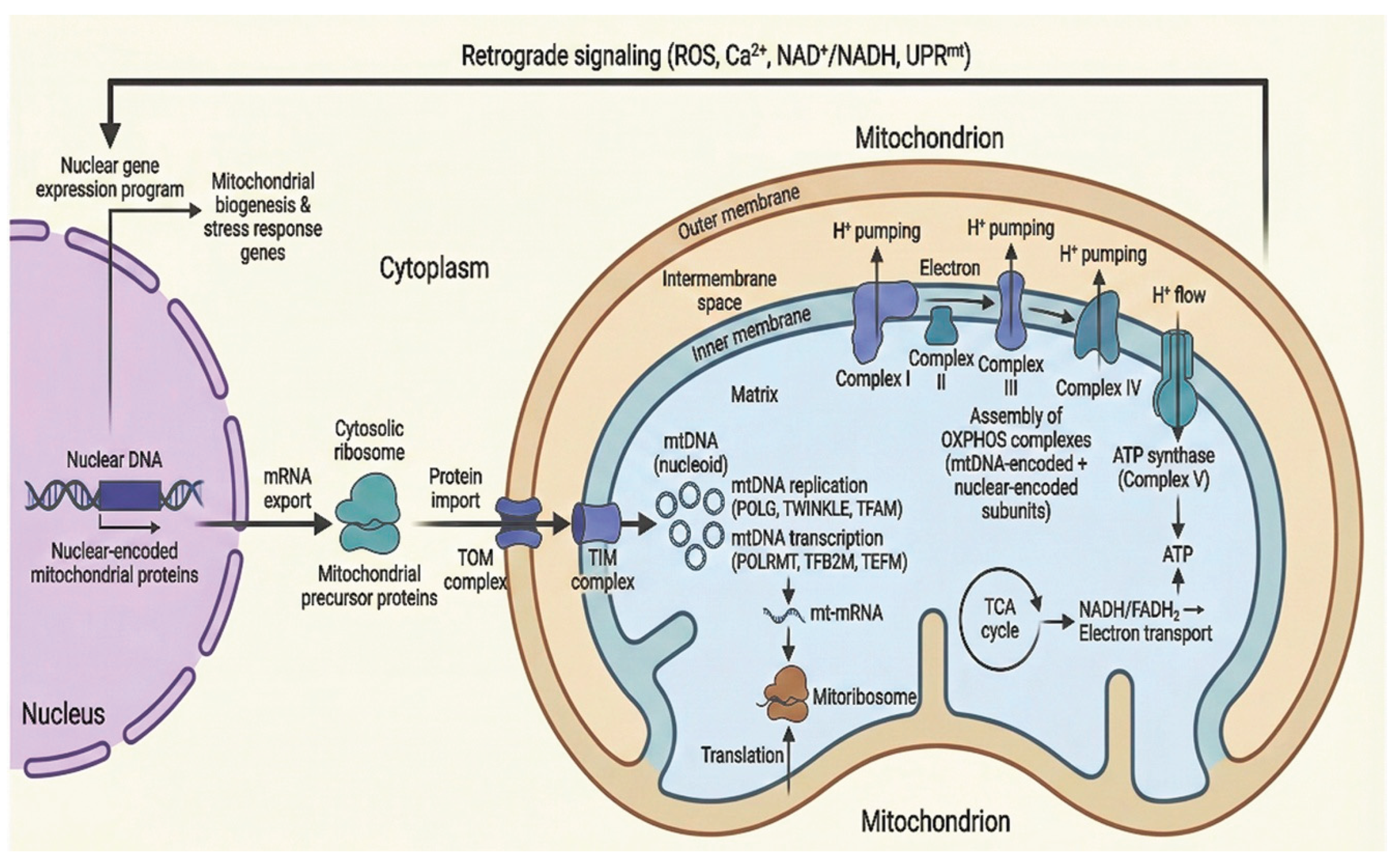
Figure 2.
Comparative structural features of mitochondrial genomes across major eukaryotic lineages. (A) Heatmap summarizing mitochondrial genome size (in kb) across taxonomic groups, including mammals, birds, reptiles, amphibians, fishes, insects, molluscs and crustaceans. Values represent minimum, median, maximum and mean genome sizes, highlighting lineage-specific variation and relative compactness of metazoan mitogenomes. (B) Heatmap depicting the presence (%) of key mitochondrial gene categories across taxa. Conserved gene sets include protein-coding genes (PCGs), rRNAs and tRNAs, whereas variability is observed in ATP synthase subunits, NADH dehydrogenase genes, control regions and origins of replication, D-loops or control regions, CRs. The panel also shows lineage-specific features such as RNA-processing genes and variation in stop codon usage. (C) Heatmap showing AT content (%) across different mitochondrial genome regions (whole genome, protein-coding regions, rRNA genes, tRNA genes and CRs). The facts reveal compositional biases among taxa, with generally higher AT content in invertebrates and in regulatory regions such as the control region. Heatmaps represent a synthesis of general patterns reported across comparative mitochondrial genomics studies and are intended to provide a conceptual overview of lineage-specific variation rather than a comprehensive quantitative meta-analysis. Data were compiled from representative comparative studies of mitochondrial genome architecture across eukaryotes [36,37,38,39,40,41].
Figure 2.
Comparative structural features of mitochondrial genomes across major eukaryotic lineages. (A) Heatmap summarizing mitochondrial genome size (in kb) across taxonomic groups, including mammals, birds, reptiles, amphibians, fishes, insects, molluscs and crustaceans. Values represent minimum, median, maximum and mean genome sizes, highlighting lineage-specific variation and relative compactness of metazoan mitogenomes. (B) Heatmap depicting the presence (%) of key mitochondrial gene categories across taxa. Conserved gene sets include protein-coding genes (PCGs), rRNAs and tRNAs, whereas variability is observed in ATP synthase subunits, NADH dehydrogenase genes, control regions and origins of replication, D-loops or control regions, CRs. The panel also shows lineage-specific features such as RNA-processing genes and variation in stop codon usage. (C) Heatmap showing AT content (%) across different mitochondrial genome regions (whole genome, protein-coding regions, rRNA genes, tRNA genes and CRs). The facts reveal compositional biases among taxa, with generally higher AT content in invertebrates and in regulatory regions such as the control region. Heatmaps represent a synthesis of general patterns reported across comparative mitochondrial genomics studies and are intended to provide a conceptual overview of lineage-specific variation rather than a comprehensive quantitative meta-analysis. Data were compiled from representative comparative studies of mitochondrial genome architecture across eukaryotes [36,37,38,39,40,41].
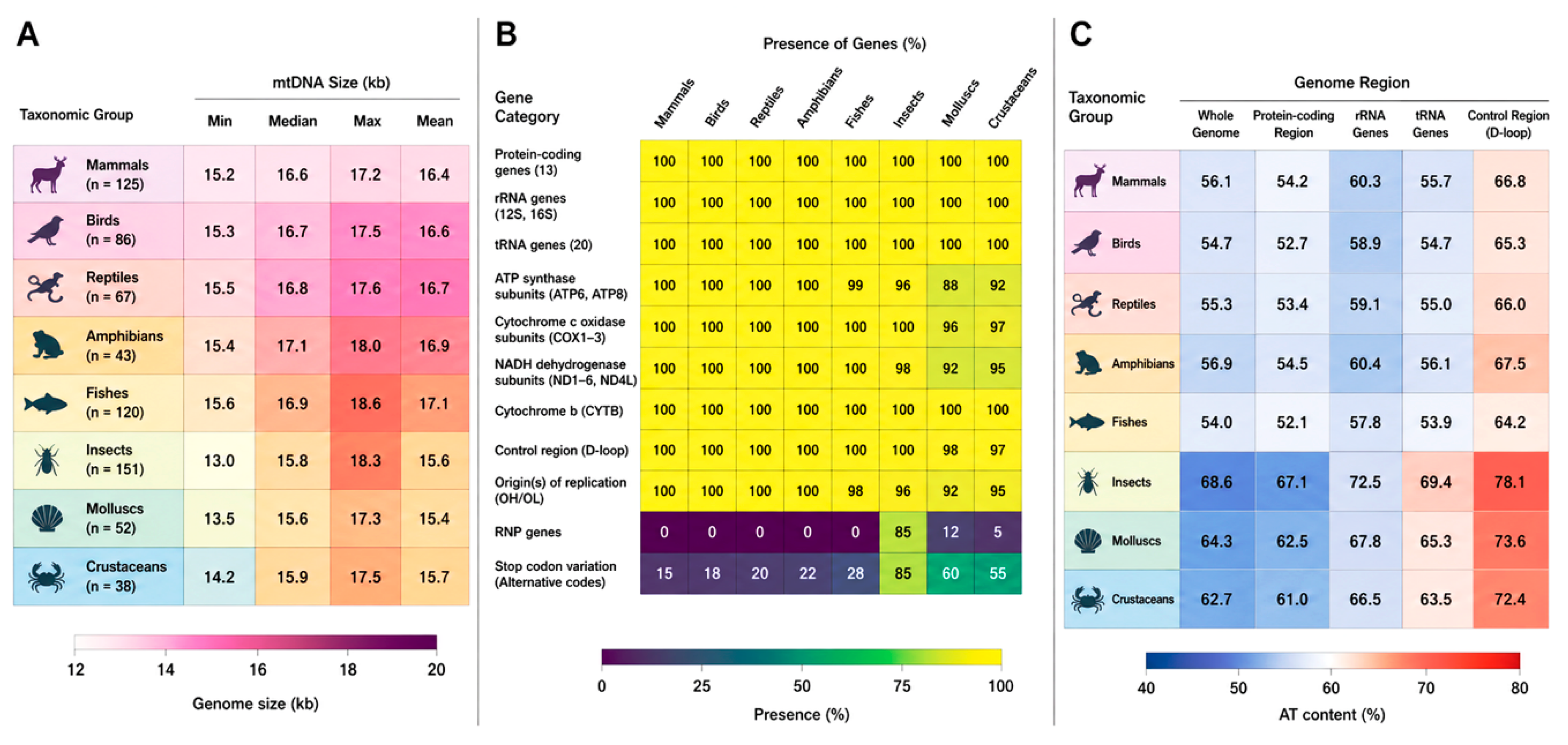
Figure 3.
Mitochondrial genomics in species identification and evolutionary research. Author’s overview of the conceptual and analytical framework of mtDNA applications, wherein the endosymbiotic origin of mitochondria, highlights the evolutionary transition from ancestral eukaryotic cells to mitochondria-bearing cells (Panel A). The central panel depicts the circular mtDNA, emphasizing key features such as compact size (~16.5 kb), maternal inheritance, elevated mutation rate and absence of recombination. The right Panel B summarizes major applications, including DNA barcoding for species identification, phylogenetic reconstruction and biodiversity assessment. Panel C depicts key limitations, such as nuclear mitochondrial insertions, heteroplasmy, PCR bias and analytical challenges arising from sequence similarity between mtDNA and nuclear genomes. Future directions (Panel D) focus on integrative multi-genome approaches, high-throughput sequencing with advanced bioinformatics, and expanding studies across understudied taxa and ecosystems for better understanding of evolutionary dynamics and ecological adaptation.
Figure 3.
Mitochondrial genomics in species identification and evolutionary research. Author’s overview of the conceptual and analytical framework of mtDNA applications, wherein the endosymbiotic origin of mitochondria, highlights the evolutionary transition from ancestral eukaryotic cells to mitochondria-bearing cells (Panel A). The central panel depicts the circular mtDNA, emphasizing key features such as compact size (~16.5 kb), maternal inheritance, elevated mutation rate and absence of recombination. The right Panel B summarizes major applications, including DNA barcoding for species identification, phylogenetic reconstruction and biodiversity assessment. Panel C depicts key limitations, such as nuclear mitochondrial insertions, heteroplasmy, PCR bias and analytical challenges arising from sequence similarity between mtDNA and nuclear genomes. Future directions (Panel D) focus on integrative multi-genome approaches, high-throughput sequencing with advanced bioinformatics, and expanding studies across understudied taxa and ecosystems for better understanding of evolutionary dynamics and ecological adaptation.
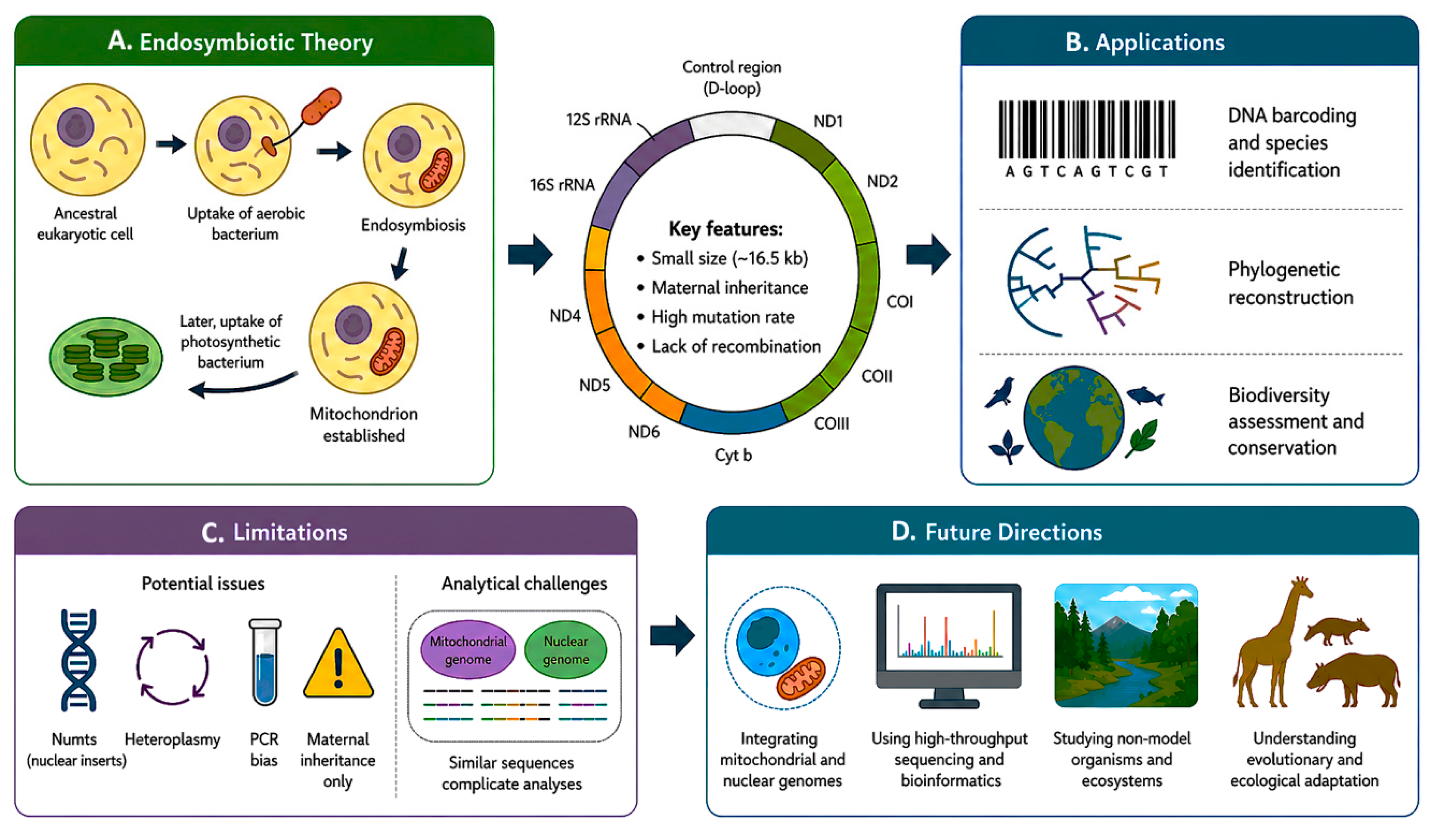

Table 1.
Mitogenomic variations and their functional consequences in physiology and disease.
| Mitogenomic characteristic feature | Molecular mechanism | Physiological consequences | Associated diseases / phenotypes | Translational implications | References |
| Heteroplasmy | Coexistence of mutant and wild-type mtDNA | Threshold-dependent impairment of oxidative phosphorylation | MELAS, LHON, MERRF |
Target for mitochondrial replacement therapies | [113,114] |
| Mitogenome mutation rate | Accumulation of substitutions in mitochondrial genes | Altered respiratory chain efficiency | Aging-related decline, neurodegeneration | Biomarker for disease progression | [115,116] |
| Mitonuclear incompatibility | Mismatch between mitochondrial and nuclear gene products | Impaired OXPHOS complex assembly | Metabolic disorders, hybrid individuals’ incompatibilities | Personalized mitochondrial medicine | [21,117] |
|
Mitogenome deletions |
Excision of mitochondrial genomic segments | Reduced ATP production | Human Kearns–Sayre syndrome, mitochondrial myopathies | Gene editing and therapeutic targeting | [118,119] |
| Adaptive mitogenome variation | Purifying and positive selection on mitochondrial proteins | Environmental metabolic adaptation | High-altitude adaptation, thermogenesis | Evolution-informed therapeutic insights | [120,121] |
Note. Data in the table are compiled by authors from the references cited in right column.
Table 2.
Emergent technological and analytical advancements in mitogenome research.
| S. No | Technology / Approach | Working principle | Key applications in mitogenome research | Major advantages |
Present limitations |
References |
| 1 | Long-read sequencing (e.g., Pacific Biosciences, Oxford Nanopore Technologies) | Single-molecule sequencing generating long contiguous reads | Assembly of complete mitochondrial genomes; detection of structural rearrangements, resolution of repetitive regions | Enables accurate assembly of complex mitogenomes, reveals structural heteroplasmy and genome isoforms | Higher error rates relative to short-read platforms, computational correction often required | [182,183,184] |
| 2 | Single-cell mitochondrial genomics | Sequencing mitochondrial DNA from individual cells | Mapping heteroplasmy dynamics, studying mitochondrial mutation accumulation across tissues | Resolves cell-to-cell variation in mtDNA, reveals clonal expansion of mitochondrial mutations | Limited DNA input, amplification bias can affect variant detection | [185,186,187] |
| 3 | High-depth mtDNA sequencing | Ultra-deep sequencing of mitochondrial genomes | Detection of low-frequency heteroplasmic variants; somatic mutation profiling | High sensitivity for rare mtDNA variants, useful for clinical diagnostics | Requires high sequencing coverage and careful error filtering | [188,189] |
| 4 | Multi-omics integration | Integration of genomics, transcriptomics, proteomics, and metabolomics datasets | Systems-level analysis of mitochondrial function and regulation | Enables understanding of mitochondrial signalling networks and metabolic integration | Complex data integration, requires advanced computational methods | [190,191] |
| 5 | Spatial transcriptomics | Mapping gene expression within tissue architecture | Investigating tissue-specific mitochondrial gene expression and metabolic specialization | Preserves spatial context of mitochondrial activity | Limited resolution for mitochondrial transcripts in some platforms | [192,193] |
| 6 | Environmental DNA (eDNA) metabarcoding |
Sequencing mitochondrial markers from environmental samples | Biodiversity monitoring, detection of rare or cryptic species | Sensitive species detection without direct sampling | PCR biases, incomplete reference databases | [194,195,196] |
| 7 | Ancient DNA sequencing | Recovery of degraded DNA from archaeological samples | Reconstruction of evolutionary history and population dynamics | Enables study of extinct or ancient populations | DNA fragmentation and contamination risks | [72,197] |
| 8 | Machine learning in evolutionary genomics | Computational models detecting patterns in large genomic datasets | Phylogenetic inference, mutation prediction, and evolutionary modelling | Handles large genomic datasets, identifies hidden evolutionary patterns | Requires extensive training datasets and validation | [198,199] |
Disclaimer/Publisher’s Note: The statements, opinions and data contained in all publications are solely those of the individual author(s) and contributor(s) and not of MDPI and/or the editor(s). MDPI and/or the editor(s) disclaim responsibility for any injury to people or property resulting from any ideas, methods, instructions or products referred to in the content. |
© 2026 by the authors. Licensee MDPI, Basel, Switzerland. This article is an open access article distributed under the terms and conditions of the Creative Commons Attribution (CC BY) license (http://creativecommons.org/licenses/by/4.0/).
Copyright: This open access article is published under a Creative Commons CC BY 4.0 license, which permit the free download, distribution, and reuse, provided that the author and preprint are cited in any reuse.


