
Submitted:
29 July 2026
Posted:
30 July 2026
You are already at the latest version
Abstract
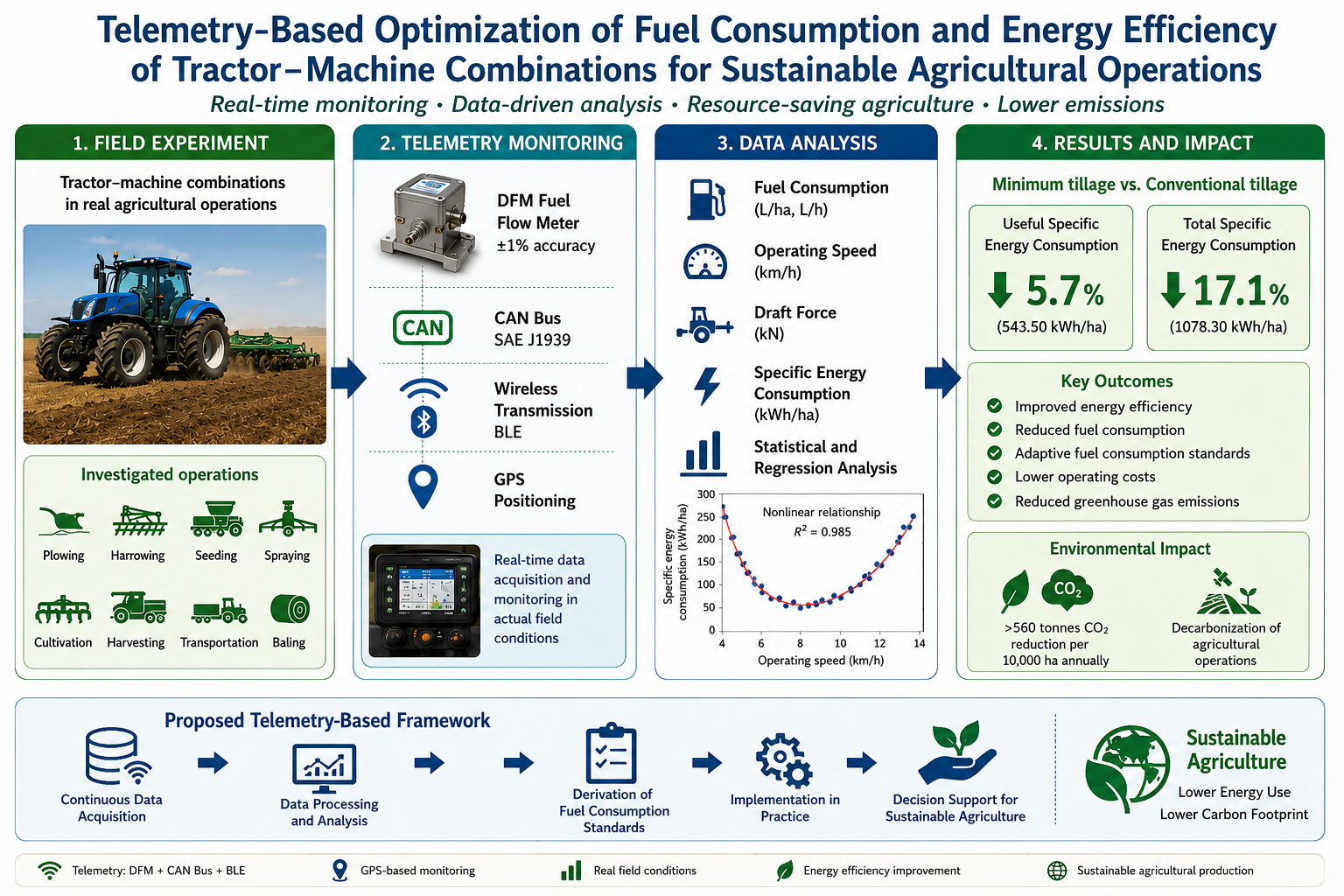
The use of outdated fuel consumption standards reduces the economic efficiency and environmental sustainability of modern agricultural production. This study aimed to refine fuel consumption standards and evaluate the energy performance of tractor–machine combinations during major agricultural operations using telemetry-based monitoring. Field experiments were conducted under real production conditions using DFM electronic fuel flow meters integrated with the CAN bus and BLE wireless data transmission. Comparative analyses of conventional and minimum tillage systems were performed using real-time telemetry data collected during plowing, harrowing, seeding, spraying, cultivation, harvesting, and transportation operations. Statistical and regression analyses revealed significant relationships between operating speed, fuel consumption, and specific energy consumption. Minimum tillage reduced useful specific energy consumption by 5.7% (543.5 kWh/ha) and total specific energy consumption by 17.1% (1078.3 kWh/ha) compared with conventional tillage. A strong non-linear relationship R2 = 0.985 was identified between operating speed and process energy consumption. The proposed telemetry-based methodology improves the accuracy of fuel consumption assessment and provides a practical basis for developing adaptive fuel consumption standards under actual operating conditions. Furthermore, the transition to minimum tillage and telemetry-based monitoring enables significant carbon footprint reduction, mitigating CO2 emissions by over 560 tonnes per 10,000 ha annually, thereby supporting the decarbonization of mechanized agricultural operations.
Keywords:
CAN bus
; carbon footprint reduction
; decarbonization
; digital agriculture
; fuel consumption standards
; precision agriculture
; resource-saving technologies
; specific energy consumption
; sustainable machinery management
; telemetry monitoring
; tractor–machine combinations
; tractive efficiency
Copyright: This open access article is published under a Creative Commons CC BY 4.0 license, which permit the free download, distribution, and reuse, provided that the author and preprint are cited in any reuse.


