
Submitted:
29 July 2026
Posted:
30 July 2026
You are already at the latest version
Abstract
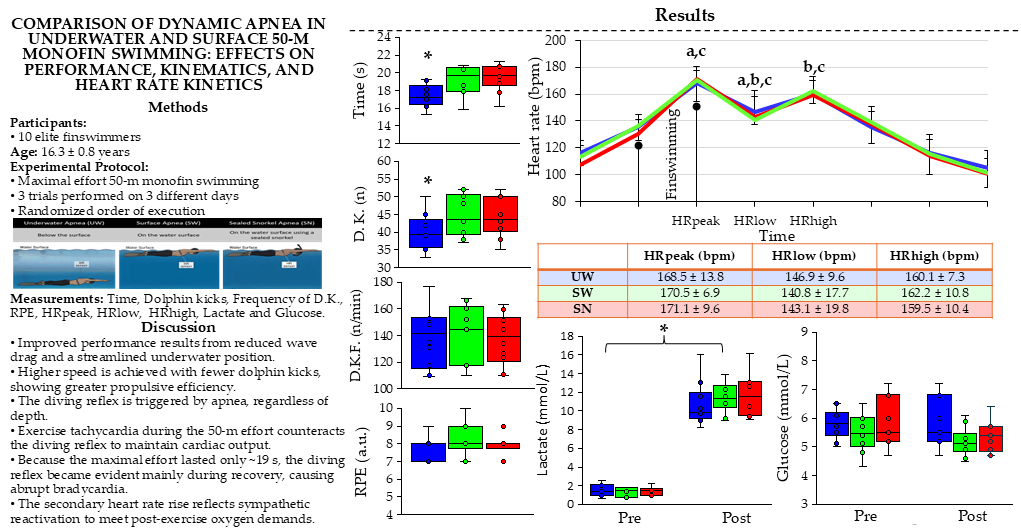
Finswimming is a high-intensity aquatic sport in which performance is determined by the interaction between biomechanical efficiency and physiological constraints, par-ticularly during underwater apnea sprint events. This study compared performance, kinematic characteristics, cardiovascular responses, metabolic stress, and perceived exertion during a maximal 50-m monofin sprint performed under three conditions: underwater apnea swimming (UW), surface swimming without snorkel (SN), and sur-face swimming with a closed snorkel (SC). Ten male elite national-level finswimmers completed a randomized repeated-measures protocol. Performance time, dolphin kick number and frequency, heart rate (HR), blood lactate, blood glucose, and rating of perceived exertion (RPE) were assessed. UW swimming resulted in significantly faster performance (17.38 ± 1.32 s) compared with both SN (19.20 ± 1.64 s) and SC (19.39 ± 1.53 s; p < 0.001), accompanied by a reduced number of dolphin kicks (40 ± 5 vs. 44 ± 6 and 44 ± 5 kicks, respectively), while kick frequency remained unchanged (~137–140 kicks·min⁻¹). Heart rate responses demonstrated a reproducible biphasic recovery pat-tern across all conditions, with HR declining rapidly from peak exercise values (HRpeak: ~169–171 bpm) to HRlow (~141–147 bpm), before increasing again to HRhigh (~160–162 bpm) during the first minute of recovery (p < 0.05). Post-exercise blood lactate increased significantly in all conditions from ~1.3–1.5 to ~10.7–11.9 mmol·L⁻¹ (p < 0.001), with no between-condition differences. Blood glucose (~5.2–5.8 mmol·L⁻¹) and RPE (7–8 AU) remained unchanged across conditions. In conclusion, underwater apnea swimming enhances sprint performance in elite male finswimmers primarily through biomechanical and hydrodynamic advantages without increasing acute metabolic or perceptual stress. The novel identification of a biphasic heart rate recovery response highlights complex autonomic regulation following maximal apnea exercise and may provide a relevant physiological marker for recovery dynamics in high-performance aquatic athletes.
Keywords:
finswimming
; mammalian diving reflex
; lactate
; glucose
; heart rate
Copyright: This open access article is published under a Creative Commons CC BY 4.0 license, which permit the free download, distribution, and reuse, provided that the author and preprint are cited in any reuse.


