

Submitted:
24 July 2026
Posted:
30 July 2026
You are already at the latest version
Abstract
Inflammatory cytokines are well-established drivers of organ-specific pathology, yet the seasonal patterning of their activity and its clinical implications remain poorly understood. IL-1, IL-6, and NF-B have traditionally been studied in isolation from seasonal biological rhythms, and current biomedical frameworks lack a unifying model integrating cytokine dominance, seasonal rhythmicity, and organ-specific disease progression. Recent advances in mapping Yellow Emperor’s Inner Canon (YEIC) conceptual constructs onto these molecular signaling pathways have created a translational foundation that makes such a cross-framework analysis feasible. This analysis proposes a unified inflammatory framework linking cytokine dominance to predictable seasonal cycles of tissue involvement and disease progression. This study is a systematic analysis. Classical descriptions of Bi syndrome from YEIC were translated into contemporary biomedical terminology using an established molecular mapping framework (Cold/IL-1, Dampness/IL-6, Wind/NF-B, Evil/LPS). For each season-tissue pair and organ progression pathway described in the YEIC, supporting evidence was systematically identified from peer-reviewed literature retrieved from PubMed, covering seasonal disease epidemiology, cytokine mechanisms, and clinical disease progression. Cytokine predominance mapped systematically onto distinct seasonal cycles of tissue involvement: bone (winter), tendons (spring), vasculature (summer), muscle (late summer), and skin (autumn). Unresolved inflammation progressed predictably to paired visceral injuries, including acute kidney injury, hepatitis, heart failure, splenomegaly, and asthma, respectively. The relative dominance of each mediator determined distinct joint manifestations: NF-B predominance corresponded to migratory arthritis, IL-1 predominance to gout, and IL-6 predominance to localized pain. This seasonal and organ-specific pattern was found to be precisely anticipated by the YEIC. These findings challenge the prevailing view that seasonal inflammatory conditions are etiologically unrelated, proposing instead a unified framework that accurately predicts their seasonal distribution and organ-specific progression. The YEIC, reinterpreted through a molecular lens, demonstrates a sophisticated physiological model with implications extending well beyond traditional Chinese medicine, offering clinically actionable insights into the seasonal epidemiology and unified pathophysiology of inflammatory disease.
Keywords:
cytokine-mediated pathophysiology
; inflammatory joint disease
; LPS-mediated inflammation
; seasonal disease progression
; Yellow Emperor’s Inner Canon
1. Background
Interleukin-1 (IL-1), Interleukin-6 (IL-6), and NF-κB are among the most extensively studied inflammatory mediators in modern medicine, implicated in a remarkably wide range of conditions — including skeletal disorders, acute kidney injury (AKI), tendinopathy, viral hepatitis, vascular disease, heart disease, myalgia, splenomegaly, eczema, and asthma. Despite their shared molecular origins, these conditions are conventionally treated as independent diseases with distinct etiologies, and the deeper inflammatory connections among them have yet to be systematically recognized or emphasized in clinical practice.
Notably, the Yellow Emperor's Inner Canon (YEIC) --- a foundational Chinese medical text compiled over two thousand years ago --- describes with remarkable specificity what appears to be the same cluster of inflammatory diseases, their seasonal onset patterns, and their pathological progression from one organ system to another. That a pre-modern text could anticipate relationships that contemporary biomedicine has only partially recognized raises a question worth taking seriously: what did its authors observe, and what can modern medicine learn from it?
The YEIC stands as one of the most systematic and enduring medical texts in human history. Compiled during the Axial Age (approximately 800–200 BCE) — a period Karl Jaspers [1] identified as one of the most consequential intellectual epochs in human history, whose insights "mankind is still living by" — it represents one of the most systematic attempts in the ancient world to describe human physiology and disease. Structured as dialogues between the legendary Yellow Emperor and a series of Wise Men, its two books — the Su Wen ("Plain Questions") and the Ling Shu ("Spiritual Pivot") — encompass 162 chapters covering vital substances, the meridian-collateral system, disease etiology, and therapeutic principles. For millennia it served as the theoretical foundation of East Asian medicine, and it remains a canonical reference in Traditional Chinese Medicine (TCM) today.
Modern medicine has viewed the YEIC with understandable skepticism on two grounds. First, its core physiological concepts — Qi, Cold, Dampness, Wind, Evil — are formulated in abstract terms with no obvious correspondence to concrete biochemical entities. Second, while the YEIC explicitly identifies meridians with the vascular system, the meridian pathways it describes differ substantially from modern cardiovascular anatomy. Some scholars have sought to rescue the text through metaphysical interpretation, but this has tended to deepen rather than resolve doubts about its scientific basis.
Recent research has begun to reframe this problem. Rather than treating the YEIC's terminology as inherently non-scientific, Liu [2] demonstrated that its Vital Substances can be systematically mapped onto specific modern signaling molecules: Qi corresponds to sodium ions, Cold to IL-1, Dampness to IL-6, Wind to NF-κB, and Evil to lipopolysaccharide (LPS), as shown in Table 1. This molecular reinterpretation has since been applied to specific diseases. In a study of TCM's understanding of diabetes ("Consumptive Thirsty" syndrome), Liu et al. [3] identified FoxO1 as the key molecular target underlying the TCM's three-stage disease model, and showed that classical herbal formulas modulate FoxO1 activity in ways consistent with contemporary diabetes management. The meridian system, understood through this framework as describing sodium ion dynamics rather than blood circulation — a scale difference of roughly 80,000-fold — will be addressed in detail in a separate publication [4].
This molecular framework opens a new avenue for evaluating the YEIC's clinical observations. The text describes Bi syndrome — caused by Cold, Dampness, and Wind — in terms that, translated into modern language, correspond to diseases mediated by IL-1, IL-6, and NF-κB. Crucially, the YEIC does not treat these as isolated conditions. It specifies their seasonal onset: skeletal disorders and kidney disease in winter, fascial and liver disorders in spring, vascular and heart disease in summer, skin and lung disease in autumn, and spleen disorders in late summer (July). It further describes predictable progression pathways: untreated skeletal disease advances to kidney injury, fascial disease to hepatitis, vascular disease to heart failure, muscle disease to spleen disorders, and skin disease to pulmonary involvement.
In this article, we systematically compare these YEIC descriptions with the findings of modern epidemiological and molecular research. The consistency we find is substantial — and some of the seasonal and mechanistic patterns the YEIC identifies have not yet been fully recognized or explained by contemporary medicine.
2. Method
This study is a systematic analysis aimed at systematically evaluating whether the seasonal and organ-specific disease patterns described in the Yellow Emperor's Inner Canon (YEIC) correspond to contemporary biomedical evidence on cytokine-mediated inflammatory pathophysiology.
No human participants or experimental materials were involved. The primary source material comprised Chapter 43 and Chapter 55 of the Su Wen Book, drawn from the YEIC. Contemporary biomedical evidence was drawn from peer-reviewed literature retrieved from PubMed, covering epidemiological studies on seasonal disease incidence, molecular studies on cytokine mechanisms, and clinical reports on disease progression and manifestation.
The analytical framework proceeded in three steps. First, the YEIC's descriptions of Bi syndrome — including its seasonal classifications, their cytokine equivalents (Cold/IL-1, Dampness/IL-6, Wind/NF-κB, Evil/LPS), and organ progression pathways — were extracted and translated into contemporary biomedical terminology based on the established molecular mapping previously described by Liu [2]. Second, for each season-tissue pair and organ progression pathway described in the YEIC, a targeted literature search was conducted to identify supporting biomedical evidence. Third, the correspondence between YEIC descriptions and contemporary findings was assessed qualitatively across five seasonal domains: winter/bone-kidney, spring/tendon-liver, summer/vessel-heart, late summer/muscle-spleen, and autumn/skin-lung.
As this is a systematic analysis based on existing published literature, no original data were collected, no statistical analysis was performed, and no power calculation was applicable.
2.1. Original Descriptions of Bi syndrome in YEIC
Below, we present the description of Bi syndrome from Chapter 43 of Su Wen in the YEIC, with additional symptom descriptions from Chapter 55 incorporated in parentheses:
The Yellow Emperor asked: How does Bi syndrome arise?
QiBo answered: When the three pathogenic factors—Cold, Dampness and Wind —invade the body simultaneously, they form Bi syndrome. When Wind predominates, it is called "Migratory Bi"; when Cold predominates, it is called "Painful Bi"; when Dampness predominates, it is called "Fixed Bi".
The Yellow Emperor further asked: What about the five types of Bi syndrome? QiBo said: When these pathogenic factors are contracted in winter, it causes "Bone Bi," (characterized by heaviness of the bones, difficulty lifting the limbs, severe aching pain deep in the bone marrow, and a sensation of cold invasion); in spring, it causes "Tendon Bi," (characterized by tendon spasms, joint pain, and difficulty walking); in summer, it causes "Vessel Bi"; in late summer (the transition between summer and autumn), it causes "Muscle Bi," (characterized by pain throughout the body's musculature); and in autumn, it causes "Skin Bi."
The Yellow Emperor asked: What causes the pathogenic factors to invade the five Zang organs and six Fu organs? QiBo said: Each of the five Zang organs corresponds to specific external tissues. If Bi syndrome persists without resolution, the pathogenic factors will penetrate deeper to invade the corresponding internal organs. Therefore, if Bone Bi does not resolve and the body is also exposed to Evil, they will invade the Kidneys; if Tendon Bi persists and the body is also exposed to Evil, they will invade the Liver; if Vessel Bi persists and the body is also exposed to Evil, they will invade the Heart; if Muscle Bi persists and the body is also exposed to Evil, they will invade the Spleen; if Skin Bi persists and the body is also exposed to Evil, they will invade the Lungs. All Bi syndromes result from repeated exposure to Wind, Cold, and Dampness during their respective seasons.
When Bi syndrome invades the five Zang organs: In Lung Bi, patients experience anxiety and chest tightness, short of breath, and experience vomiting; in Heart Bi, poor blood circulation, irritability accompanied by palpitations, dyspnea, dry throat, frequent belching, and feeling of fear; in Liver Bi, patients startle easily during sleep at night, experience excessive thirst with frequent drinking and urination, and abdominal distention similar to pregnancy; in Kidney Bi, patients experience abdominal distension, severe kyphosis (using the buttocks in place of the heels when standing), and inability to lift the head (using the spine in place of the head); in Spleen Bi, patients experience weakened limbs, coughing, vomiting liquid, and difficulty breathing.
2.2. Summary in Modern Languages
In this passage from the YEIC, "Cold" corresponds to IL-1, "Dampness" corresponds to IL-6, "Wind" corresponds to NF-κB, and “Evil” corresponds to LPS, depicting the effects of IL-1, IL-6, and NF-κB on the human body across different seasons, as well as the developmental pathways of diseases they trigger. Below, we summarize this passage in modern medical terminology, arranged by season.
- When IL-1, IL-6, and NF-κB simultaneously invade the body, they form Bi syndrome. The predominant factor determines the presentation: NF-κB predominance produces "Migratory Bi" (migratory arthritis pain), IL-1 predominance produces "Painful Bi" (gout), and IL-6 predominance produces "Fixed Bi" (localized pain).
- In winter, invasion causes "Bone Bi," characterized by heaviness in the bones, difficulty lifting the limbs, severe aching pain deep within the bone marrow, and sensations of cold penetration. If Bone Bi persists and the body is additionally exposed to LPS, the pathogenic factors invade the Kidneys, resulting in Kidney Bi. Patients with Kidney Bi experience abdominal distension and severe kyphosis.
- In spring, invasion causes "Tendon Bi," characterized by tendon spasms, joint pain, and difficulty walking. If Tendon Bi persists with concurrent LPS exposure, the pathogenic factors invade the Liver, resulting in Liver Bi. Patients with Liver Bi startle easily during sleep, experience excessive thirst with frequent drinking and urination, and develop abdominal distention resembling pregnancy.
- In summer, invasion causes "Vessel Bi." If Vessel Bi persists with concurrent LPS exposure, the pathogenic factors invade the Heart, resulting in Heart Bi. Patients with Heart Bi experience poor circulation, irritability with palpitations, dyspnea, dry throat, frequent belching, and feelings of fear.
- In late summer (July), invasion causes "Muscle Bi," characterized by pain throughout the body's musculature. If Muscle Bi persists with concurrent LPS exposure, the pathogenic factors invade the Spleen, resulting in Spleen Bi. Patients with Spleen Bi experience weakened limbs, coughing, vomiting of liquid, and difficulty breathing.
- In autumn, invasion causes "Skin Bi." If Skin Bi persists with concurrent LPS exposure, the pathogenic factors invade the Lungs, resulting in Lung Bi. Patients with Lung Bi experience anxiety, chest tightness, shortness of breath, and vomiting.
Below, we will compare the above content with modern medicine point by point.
3. Results: Comparative Analysis of YEIC Descriptions and Contemporary Biomedical Findings
3.1. Bi Patterns by Cytokine: Migratory (NF-κB), Painful (IL-1), Fixed (IL-6)
Figure 1 shows the relationship between inflammatory pathways and Bi syndromes: NF-κB produces "Migratory Bi," IL-1 produces "Painful Bi" (gout), and IL-6 produces "Fixed Bi," along with corresponding treatment strategies.
3.2. NF-κB Induces Migratory Arthritis Pain
NF-κB plays a central role in rheumatoid arthritis by regulating inflammation, immune responses, synovial cell dysfunction, and osteoclast activation, with pathway blockade reducing disease severity in animal models [5]. In fibroblast-like synoviocytes (FLS), NF-κB activation drives proliferation, inhibits apoptosis, promotes inflammatory cytokine and matrix metalloproteinase production causing joint erosion, and enhances migration [6]. Importantly, FLS contribute to pain in osteoarthritis and rheumatoid arthritis by secreting inflammatory and pain mediators that interact with nerve and vascular endings, independent of structural damage [7]. NF-κB's role in promoting the migratory behavior of synoviocytes is thus consistent with the migratory pattern of joint pain described in the YEIC, even if direct clinical evidence linking NF-κB to pain migration specifically remains to be established.
TCM offers comprehensive treatments for migratory arthritis, detailed in Chapter 8 of our monograph [2]. In modern medical terms, as shown in Figure 1, the TCM strategy targets IL-1, IL-6, and NF-κB inhibition while increasing iron and erythropoietin (EPO) and suppressing glutathione (GSH). This multi-targeted approach works synergistically: iron [8] and EPO [9] inhibit NF-κB, while GSH promotes it [10]; therefore, GSH suppression enhances anti-inflammatory effects [2].
3.3. IL-1 Is Associated with Gout
IL-1 drives the inflammatory process in acute gout, making IL-1 inhibitors a promising treatment for refractory cases and patients intolerant to conventional therapies [11]. TCM offers a comprehensive framework for treating gout [2]. In modern medical terms, as shown in Figure 1, the TCM strategy targets IL-1, IL-6, and NF-κB inhibition while tonifying Kidney Yang (corresponding to calcitonin regulation), as calcitonin suppresses IL-1 expression and activity [12].
3.4. IL-6 Is Associated with Fixed Arthritis Pain
IL-6 promotes synovitis, joint destruction, and systemic inflammation in rheumatoid arthritis, with serum levels correlating directly with disease activity and severity [13]. TCM offers a comprehensive framework for treating fixed arthritis pain [2]. In modern medical terms, as shown in Figure 1, the TCM strategy targets IL-1, IL-6, and NF-κB inhibition while elevating atrial natriuretic peptide (ANP) [14], ghrelin [15], and retinoic acid [16], which suppress IL-6 expression and activity. TCM also emphasizes tonifying Qi (corresponding to sodium ions), aligning with findings that IL-6 levels inversely correlate with plasma sodium levels [17].
3.5. Winter Bone Bi and Kidney Bi: YEIC Descriptions and Modern Medical Evidence
Figure 2 illustrates how IL-1, IL-6, and NF-κB drive distinct Bi syndromes in different seasons and shows disease evolution.
According to YEIC, IL-1, IL-6, and NF-κB cause "Bone Bi" in winter, characterized by bone heaviness, difficulty lifting limbs, severe marrow pain, and cold sensations. YEIC describes a pathological progression where persistent Bone Bi with concurrent LPS exposure allows pathogenic factors to invade the Kidneys, causing Kidney Bi with abdominal distension and severe kyphosis.
Modern evidence supports this framework. Winter is the peak season for bone disorders, with fragility fractures (hip, forearm, humerus, ankle) occurring most frequently in winter and least in summer [18]. Bone metabolism follows a circannual pattern with lower vitamin D, higher parathyroid hormone, and elevated bone turnover markers in winter, contributing to bone loss and osteoporosis over time [19,20].
The inflammatory cascade mirrors the described pathology. Osteoporotic patients exhibit elevated monocyte IL-1 production correlating with bone turnover [21]. IL-1β and IL-6 promote bone loss and osteoporosis by stimulating osteoclast differentiation through RANKL upregulation, favoring bone resorption over formation [22]. NF-κB activation in osteoblasts inhibits bone formation, and its specific inhibition significantly prevents ovariectomy-induced bone loss [23].
Clinical manifestations align with YEIC descriptions. Low muscle mass associates with osteoporosis in both sexes [24], consistent with difficulty lifting limbs. Osteoporosis causes bone pain through increased sensory nerve fiber density, nociceptor sensitization from osteoclastic activity, and pathological nerve modifications [25]. Osteoporosis associates with poor lower extremity circulation [26], correlating with cold sensations [27].
The progression to renal involvement aligns with seasonal patterns. Acute kidney injury (AKI) incidence peaks in winter across England, Japan, and China [28,29,30], and AKI associates with increased fracture risk [31]. Supporting YEIC's bone-kidney progression, ischemic AKI involves tubular epithelial cells generating proinflammatory cytokines including IL-6, IL-1β, and TNF-α that drive kidney injury [32]. NF-κB activation promotes renal inflammation, oxidative stress, and tissue injury in AKI pathogenesis [33]. LPS directly induces AKI through microcirculatory dysfunction, NLRP3 inflammasome activation, and mitochondrial damage [34].
3.6. Spring Tendon Bi and Liver Bi: YEIC Descriptions and Modern Medical Evidence
As shown in Figure 2, IL-1, IL-6, and NF-κB cause "Tendon Bi" in spring, characterized by tendon spasms, joint pain, and difficulty walking. YEIC describes a pathological progression where persistent Tendon Bi with concurrent LPS exposure allows pathogenic factors to invade the Liver, causing Liver Bi with sleep disturbances, excessive thirst, frequent urination, and abdominal distention resembling pregnancy.
Modern evidence supports this framework. Tendinitis is a common injury during spring and summer [37]. The inflammatory cascade also mirrors the described pathology. IL-6 is elevated in human tendon tears, while IL-1β, IL-6, and TNF-α are increased in animal models of tendon injury (38). IL-1β has been identified as a key mediator in tendinopathy pathogenesis, stimulating inflammation, apoptosis, and extracellular matrix degradation [39,40]. Transcriptional profiling of early rotator cuff tendinopathy reveals increased NF-κB signaling, which may drive degenerative changes prior to complete tears and impair healing following surgical repair [41].
Clinical manifestations align with YEIC descriptions. Tendon disease causes local pain, stiffness, and restricted movement [42], accompanied by protective muscle spasm around affected tendons [43], consistent with tendon spasms and difficulty walking.
The progression to hepatic involvement aligns with seasonal patterns. Hepatitis shows seasonal variation with spring and summer peaks for hepatitis A, B, C, and E [44], including acute hepatitis E in the UK [45]. Supporting YEIC's tendon-liver progression, tendinitis may be the initial manifestation of autoimmune hepatitis [46], and chronic liver disease increases tendon disorder risk [47].
The cytokine-liver connection is well-established. IL-1 family cytokines, especially IL-1β, are central drivers of liver injury across viral, alcoholic, and metabolic hepatitis via inflammasome-dependent activation in hepatic macrophages [48,49]. Serum and intrahepatic IL-6 levels are elevated in chronic hepatitis B (50). The NF-κB pathway in hepatocytes and immune cells orchestrates liver inflammatory responses in viral and autoimmune hepatitis by regulating cytokine expression [51,52]. LPS plays a central role in inflammatory liver disease pathogenesis [53].
Liver Bi manifestations match precisely: depression and anxiety are highly prevalent in hepatitis C patients [54], and 60–80% of chronic liver disease patients report poor sleep, including insomnia, reduced rapid eye movement (REM) sleep, and restless leg syndrome [55]. Persistent excessive thirst may signal serious liver disease [56], liver disease can damage kidneys causing frequent urination [57], and liver disease frequently causes abdominal distention due to ascites [58].
3.7. Summer Vessel Bi and Heart Bi: YEIC Descriptions and Modern Medical Evidence
As shown in Figure 2, IL-1, IL-6, and NF-κB cause "Vessel Bi" in summer. Persistent Vessel Bi with concurrent LPS exposure progresses to Heart Bi, manifesting as poor circulation, palpitations with irritability, dyspnea, dry throat, belching, and anxiety.
Modern evidence supports this framework. Each 1°C rise above local temperature thresholds increases cardiovascular mortality by several percent, particularly for stroke and coronary heart disease [59,60]. Summer heat and humidity force the heart to nearly double blood circulation for thermoregulation [61].
The inflammatory cascade mirrors the described pathology. Elevated IL-1β predicts worse outcomes in coronary artery disease and heart failure [62], while higher IL-6 increases risk for coronary disease, stroke, atrial fibrillation, and cardiovascular mortality [63,64]. NF-κB activation drives atherosclerotic plaque formation, endothelial dysfunction, myocardial hypertrophy, and heart failure progression [65,66,67]. Elevated circulating LPS correlates with carotid atherosclerosis progression [68].
The clinical presentation aligns precisely: cardiovascular disease causes poor circulation [27], irritability increases cardiovascular disease (CVD) risk [69], anxiety triggers palpitations [70], dyspnea links to asthma as a CVD risk factor [71], xerostomia commonly occurs in CVD patients [72,73], belching may indicate angina [74], and bidirectional fear-anxiety associations exist with heart disease [75,76]. Vascular disease and heart failure form a pathological cycle (77).
3.7. Late Summer (July) Muscle Bi and Spleen Bi: YEIC Descriptions and Modern Medical Evidence
As shown in Figure 2, IL-1, IL-6, and NF-κB trigger "Muscle Bi" in late summer (July), causing widespread muscular pain. Persistent Muscle Bi with concurrent LPS exposure progresses to Spleen Bi, manifesting as weakened limbs, coughing, vomiting, and dyspnea.
Modern evidence supports this framework. Muscle pain worsens in summer due to heat and dehydration [78]. The inflammatory cascade mirrors the described pathology: IL-1β from ischemia-reperfusion injury sensitizes muscle afferents and induces myalgia-like pain, which IL-1 receptor antagonists can block [79]. Intramuscular IL-6 produces dose-dependent mechanical hyperalgesia through gp130 signaling, inflammatory cell recruitment, cytokine production (TNF-α, IL-1β, KC/IL-8), and MAPK pathway activation [80]. NF-κB activation initiates transcription of inflammatory genes including TNF-α, IL-1β, COX-2, and IL-6 [81], with NF-κB-dependent mechanisms mediating inflammatory pain that pharmacological inhibition can block [82].
The progression to splenic involvement aligns with seasonal patterns. Juvenile birds exhibit significantly enlarged spleens in July [83], while human immune markers reach their lowest point in July: C-reactive protein and neutrophil counts reach their lowest levels, suggesting compromised splenic immune response [84,85]. Supporting YEIC's muscle-spleen progression, splenomegaly causes left upper abdominal pain radiating to the left shoulder [86,87].
3.8. Autumn Skin Bi and Lung Bi: YEIC Descriptions and Modern Medical Evidence
As shown in Figure 2, IL-1, IL-6 and NF-κB cause "Skin Bi" in autumn. YEIC describes a pathological progression where persistent Skin Bi with concurrent LPS exposure allows pathogenic factors to invade the Lungs, resulting in Lung Bi, manifesting as anxiety, chest tightness, dyspnea, and vomiting.
Modern evidence supports this framework. Eczema worsens in autumn [95]. Atopic dermatitis shows upregulated IL-1β and IL-18, promoting cutaneous inflammation [96], with elevated IL-1β and IL-6 in lesions [97]. NF-κB-DNA binding activity is significantly higher in eczema patients and correlates with clinical severity [98].
The skin-lung progression aligns with seasonal patterns. The "September asthma peak" shows 2–3-fold increases in emergency visits versus summer [99]. Atopic dermatitis patients have increased asthma risk through shared Th2-mediated inflammatory pathways [100].
The cytokine-lung connection is well-established. Asthma shows elevated IL-1β and IL-6 mediating airway inflammation [101], with NF-κB playing a central role [102]. LPS exposure increases asthma severity: elevated airway LPS correlates with neutrophil recruitment and airway remodeling [103], while potentiating allergen-induced inflammation even in corticosteroid-treated patients [104].
4. Discussion
In the YEIC, the symptoms arising from the combined actions of IL-1, IL-6, and NF-κB are collectively termed "Bi" syndrome. This condition is further designated by the affected anatomical region. When each of the three molecules exerts a predominant influence, the condition is classified according to its distinct pathological characteristics as Painful Bi, Fixed Bi, or Migratory Bi, respectively.
Within the theoretical framework of the YEIC, "Wind" corresponds to NF-κB (2). Since wind is by nature unpredictable and wandering, NF-κB predominance manifests clinically as migratory pain. Accordingly, NF-κB is identified as the principal driver of migratory joint pain. Notably, ancient Chinese physicians treating this condition did not merely suppress IL-1, IL-6, and NF-κB; they also augmented iron levels and erythropoietin (EPO) while inhibiting glutathione (GSH)—interventions that have since been shown to exert downstream suppressive effects on NF-κB (2).
Likewise, the YEIC maps "Cold" onto IL-1. When IL-1 predominates, clinical presentation is one of severe pain, implicating IL-1 as the primary pathological basis of gout. In treating this condition, ancient physicians not only inhibited IL-1, IL-6, and NF-κB, but also elevated calcitonin levels as a targeted strategy to further suppress IL-1 activity (2).
The YEIC associates "Dampness" with IL-6. Dampness is adhesive in nature, tending to accumulate and stagnate in a fixed location. When IL-6 predominates, this manifests as localized, fixed pain—the hallmark of Fixed Bi. Ancient physicians addressed this by not only suppressing IL-1, IL-6, and NF-κB, but also by increasing levels of ghrelin, atrial natriuretic peptide (ANP), all-trans retinoic acid (ATRA), and sodium, all employed as targeted modulators to inhibit IL-6 activity (2).
The YEIC precisely delineates the season-dependent, tissue-specific effects of IL-1, IL-6, and NF-κB on the human body.
In winter, these three molecules preferentially target bone tissue, manifesting in conditions such as osteoporosis. If left untreated, the concurrent influence of LPS drives further pathological progression to the kidneys, potentially culminating in acute kidney injury (AKI).
In spring, the primary targets shift to the tendons and sinews, where dysregulation of these molecules can give rise to tendinitis. Without timely intervention, LPS potentiates the spread of pathology to the liver, precipitating hepatitis.
In summer, the three molecules predominantly affect the vascular system, contributing to a spectrum of vascular diseases. Should the condition remain unaddressed, LPS-mediated amplification can extend the damage to the heart, ultimately resulting in heart failure.
In July—referred to in the YEIC as the "Late Summer"—the molecular targets migrate to skeletal muscle, manifesting as myalgia and related muscular disorders. In the absence of effective treatment, LPS-driven progression can lead to splenic involvement, causing splenomegaly.
In autumn, these molecules act principally upon the skin, where their dysregulation underlies conditions such as eczema. If inadequately managed, LPS further propagates the inflammatory cascade to the lungs, predisposing individuals to asthma.
These seasonal pathological patterns align well with observations documented in contemporary medical literature, yet modern medicine tends to treat each condition as an isolated entity, overlooking the unified pathophysiological framework that the YEIC had already articulated millennia ago.
Although modern medicine has observed and documented these seasonal phenomena, it has yet to recognize the season-dependent differential roles played by IL-1, IL-6, and NF-κB in driving them. Instead, it has consistently attributed the seasonal patterns of these conditions to non-medical factors, dismissing them with behavioral or environmental explanations. Tendon injuries serve as a representative example: spring marks the peak season for tendon injuries, with the incidence of Achilles tendon ruptures rising in a statistically significant manner compared to autumn and winter—a trend especially pronounced in sport-related cases. The explanation conventionally offered by modern medicine is that individuals who have experienced physical deconditioning over the winter months return in large numbers to outdoor activities as temperatures rise, resulting in a sudden increase in mechanical load on the tendons (108, 109). This account, however, is confined to behavioral causation and entirely overlooks the underlying season-dependent molecular biological mechanisms—which may, in fact, represent the more fundamental basis for understanding this pattern.
A clarification is warranted here. Taking winter as an example, the concept of "Bone Bi" described in the YEIC does not exclusively correspond to osteoporosis as defined in modern medicine. Rather, it serves as a broad designation encompassing the full spectrum of skeletal disorders arising from the aberrant activation of IL-1, IL-6, and NF-κB; osteoporosis represents merely one of its many clinical manifestations. This interpretive principle applies equally to the prevalent conditions associated with other seasons—the specific diseases cited for each season should be understood as representative examples of that season's characteristic pathological tendencies, not as a complete list.
One limitation of the present analysis warrants acknowledgment. The evidence linking cytokine activity to seasonal patterns is largely correlational. While the seasonal epidemiology of each condition cited is well-documented in the literature, the mechanisms underlying these seasonal rhythms — and the specific contributions of IL-1, IL-6, and NF-κB to their timing — have not been established by prospective studies designed for this purpose. The seasonal associations described here are therefore hypothesis-generating rather than mechanistically conclusive, pointing toward a testable question: whether the inflammatory mechanisms now characterized in modern biomedicine are the biological basis of seasonal patterns that physicians documented two thousand years ago. These limitations notwithstanding, the degree of concordance between the YEIC framework and contemporary biomedical observations is sufficient to warrant further systematic investigation.
5. Conclusion
Since its compilation over two thousand years ago, the YEIC has remained a subject of enduring controversy. Over the past two centuries, the rise of modern medicine and advances in cardiovascular research led Western medicine to adopt a largely dismissive stance toward the text, while skepticism persisted even within TCM circles. In recent years, however, progress in molecular biomedicine — together with the identification of correspondences between Vital TCM Substances such as Qi, Cold, and Dampness and specific molecular mechanisms — has afforded us the opportunity to revisit this classical work. What emerges is a remarkable finding: the YEIC describes human physiological and pathological processes at the level of molecular biomedicine, or beyond, and much of its knowledge remains ahead of current medical understanding. Further rigorous study of the YEIC will undoubtedly carry significant implications for the advancement of biomedical science.
With respect to Bi syndrome, the central argument of the YEIC may be summarized as follows: when NF-κB predominates, migratory joint pain ensues; when IL-1 predominates, gout develops; and when IL-6 predominates, joint pain tends to be fixed in location.
The YEIC further delineates a seasonal pattern governing which organ systems serve as the primary targets of pathological activity. In winter, the three mediators act preferentially on bone, giving rise to conditions such as osteoporosis; if left untreated, LPS-mediated progression extends the injury to the kidneys, culminating in acute kidney injury (AKI). In spring, the target shifts to tendons and sinews, manifesting as tendinitis; disease progression then involves the liver, leading to hepatitis. In summer, the vascular system becomes the primary target, producing a range of vascular disorders that can ultimately damage the heart and result in heart failure. During late summer (approximately July), the target moves to muscle, causing myalgia; without timely intervention, the spleen becomes involved, resulting in splenomegaly. In autumn, the skin bears the brunt of pathological activity, giving rise to eczema; further progression impairs pulmonary function and precipitates asthma.
Modern medicine tends to regard skeletal disease, AKI, tendinopathy, hepatitis, vascular disease, heart disease, myalgia, splenomegaly, eczema, and asthma as distinct conditions with unrelated etiologies. The YEIC, by contrast, attributes all of these to the concerted action of IL-1, IL-6, and NF-κB, and systematically maps the influence of seasonal variation on their onset and progression. The striking concordance between these ancient descriptions and contemporary clinical observations attests to the extraordinary, timeless insight embedded in this classical work. The present article has offered only a brief introduction to Bi syndrome; subsequent work will provide a systematic account of the pathological mechanisms and therapeutic strategies described in the YEIC for a broader range of conditions.
Ethics Declarations
Ethics approval and consent to participate Not applicable.
Consent for Publication
Not applicable.
Author Contributions
Yang Liu retired from the Hong Kong Polytechnic University and now lives in Brisbane, Australia. Y.L., Y. Z., and B.M.F. conceived and designed research, analyzed data, interpreted results of comparisons, prepared figures, drafted manuscript, edited and revised manuscript, approved final version of manuscript.
Conflicts of Interest
The authors declare no competing interests.
References
- Mandelbaum, M.; Jaspers, K. The Origin and Goal of History. Philos. Rev. 1954, 63, 623. [Google Scholar] [CrossRef]
- Liu, Y. The Mapping between Traditional Chinese Medicine and Signaling Molecules; Cambridge Scholars Publishing: Newcastle upon Tyne, UK, 2022; p. 625 p. [Google Scholar]
- Liu, Y.; Fu, B.M.; Zeng, Y. Targeting FoxO1 in traditional Chinese medicine for the treatment of diabetes. Cell. Mol. Biol. 2023, 69, 44–51. [Google Scholar] [CrossRef]
- Liu, Y. The Convergence of Ancient Medical Wisdom and Modern Physiology: Sodium Ion Wave Propagation in Endothelial Cells, IL-1 Vascular Pathways, and the Six-Day Progression Pattern of Clinical Symptoms. In Molecular, Cellular and Tissue Engineering of the Vascular System, 2nd ed; Fu, B.M., Wright, N.T., Eds.; Springer, 2026. [Google Scholar]
- Makarov, S.S. NF-κB in rheumatoid arthritis: a pivotal regulator of inflammation, hyperplasia, and tissue destruction. Arthritis Res. Ther. 2001, 3, 200–206. [Google Scholar] [CrossRef] [PubMed]
- Samimi, L.N.; Farhadi, E.; Tahmasebi, M.N.; Jamshidi, A.; Vaziri, A.S.; Mahmoudi, M. NF-κB signaling in rheumatoid arthritis with focus on fibroblast-like synoviocytes. Autoimmun. Highlights 2020, 11, 1–10. [Google Scholar] [CrossRef]
- Gautam, S.; Ramirez-Perez, S.; Vekariya, R.; Drissi, H.; Bhattaram, P. Investigation Of The Molecular Mechanisms Regulating Early OA Pain Induced By Synovial Lining Fibroblasts. ORS 2025 Annual Meeting, Feb7–11, 2025; Orthopaedic Research Society: Phoenix, Arizona, 2025. [Google Scholar]
- Agoro, R.; Taleb, M.; Quesniaux, V.F.J.; Mura, C. Cell iron status influences macrophage polarization. PLoS ONE 2018, 13, e0196921. [Google Scholar] [CrossRef] [PubMed]
- Nairz, M.; Schroll, A.; Moschen, A.R.; Sonnweber, T.; Theurl, M.; Theurl, I.; Taub, N.; Jamnig, C.; Neurauter, D.; Huber, L.A.; et al. Erythropoietin Contrastingly Affects Bacterial Infection and Experimental Colitis by Inhibiting Nuclear Factor-κB-Inducible Immune Pathways. Immunity 2011, 34, 61–74. [Google Scholar] [CrossRef] [PubMed]
- Hammond, C.L.; Lee, T.K.; Ballatori, N. Novel roles for glutathione in gene expression, cell death, and membrane transport of organic solutes. J. Hepatol. 2001, 34, 946–954. [Google Scholar] [CrossRef] [PubMed]
- Tran, T.H.; Pham, J.T.; Shafeeq, H.; Manigault, K.R.; Arya, V. Role of Interleukin-1 Inhibitors in the Management of Gout. Pharmacother. J. Hum. Pharmacol. Drug Ther. 2013, 33, 744–753. [Google Scholar] [CrossRef] [PubMed]
- Aida, S.; Okawa-Takatsuji, M.; Aotsuka, S.; Shimoji, K.; Yokohari, R. Calcitonin inhibits production of immunoglobulins, rheumatoid factor and interleukin-1 by mononuclear cells from patients with rheumatoid arthritis. Ann. Rheum. Dis. 1994, 53, 247–249. [Google Scholar] [CrossRef] [PubMed]
- Srirangan, S.; Choy, E.H. The role of Interleukin 6 in the pathophysiology of rheumatoid arthritis. Ther. Adv. Musculoskelet. Dis. 2010, 2, 247–256. [Google Scholar] [CrossRef] [PubMed]
- Moro, C.; Klimcakova, E.; Lolmède, K.; Berlan, M.; Lafontan, M.; Stich, V.; Bouloumié, A.; Galitzky, J.; Arner, P.; Langin, D. Atrial natriuretic peptide inhibits the production of adipokines and cytokines linked to inflammation and insulin resistance in human subcutaneous adipose tissue. Diabetologia 2007, 50, 1038–1047. [Google Scholar] [CrossRef] [PubMed]
- Beynon, A.L.; Brown, M.R.; Wright, R.; I Rees, M.; Sheldon, I.M.; Davies, J.S. Ghrelin inhibits LPS-induced release of IL-6 from mouse dopaminergic neurones. J. Neuroinflammation 2013, 10, 40–40. [Google Scholar] [CrossRef] [PubMed]
- Lu, K.; Bao, Q.; Wang, D.; Ning, Y.; Xie, X.; Zhou, M.; Zhou, L.; Zeng, X.; Shan, J.; Li, Y. Effects of All-Trans Retinoic Acid on Lipopolysaccharide-Induced Synovial Explant. J. Nutr. Sci. Vitaminol. 2019, 65, 8–18. [Google Scholar] [CrossRef] [PubMed]
- Atila, C.; Monnerat, S.; Bingisser, R.; Siegemund, M.; Lampart, M.; Rueegg, M.; Zellweger, N.; Osswald, S.; Rentsch, K.; Christ-Crain, M.; et al. Inverse relationship between IL-6 and sodium levels in patients with COVID-19 and other respiratory tract infections: data from the COVIVA study. Endocr. Connect. 2022, 11. [Google Scholar] [CrossRef] [PubMed]
- Dahl, C.; Madsen, C.; Omsland, T.K.; Søgaard, A.-J.; Tunheim, K.; Stigum, H.; Holvik, K.; Meyer, H.E. The Association of Cold Ambient Temperature With Fracture Risk and Mortality: National Data From Norway—A Norwegian Epidemiologic Osteoporosis Studies (NOREPOS) Study. J. Bone Miner. Res. 2022, 37, 1527–1536. [Google Scholar] [CrossRef] [PubMed]
- McCarthy, D.; Duggan, P.; O'Brien, M.; Kiely, M.; McCarthy, J.; Shanahan, F.; Cashman, K.D. Seasonality of vitamin D status and bone turnover in patients with Crohn's disease. Aliment. Pharmacol. Ther. 2005, 21, 1073–1083. [Google Scholar] [CrossRef] [PubMed]
- Meier, C.; Woitge, H.W.; Witte, K.; Lemmer, B.; Seibel, M.J. Supplementation With Oral Vitamin D3 and Calcium During Winter Prevents Seasonal Bone Loss: A Randomized Controlled Open-Label Prospective Trial. J. Bone Miner. Res. 2004, 19, 1221–1230. [Google Scholar] [CrossRef] [PubMed]
- Pacifici, R.; Rifas, L.; McCracken, R.; Avioli, L.V. The role of interleukin-1 in postmenopausal bone loss. Exp. Gerontol. 1990, 25, 309–316. [Google Scholar] [CrossRef] [PubMed]
- Ruscitti, P.; Cipriani, P.; Carubbi, F.; Liakouli, V.; Zazzeroni, F.; Di Benedetto, P.; Berardicurti, O.; Alesse, E.; Giacomelli, R. The Role of IL-1β in the Bone Loss during Rheumatic Diseases. Mediat. Inflamm. 2015, 2015, 782382–782382. [Google Scholar] [CrossRef] [PubMed]
- Chang, J.; Wang, Z.; Tang, E.; Fan, Z.; McCauley, L.; Franceschi, R.; et al. Inhibition of osteoblast functions by IKK/NF-κB in osteoporosis. Nat. Med. 2009, 15(6), 682. [Google Scholar] [PubMed]
- Jang, S.-Y.; Park, J.; Ryu, S.-Y.; Choi, S.-W. Low muscle mass is associated with osteoporosis: A nationwide population-based study. Maturitas 2020, 133, 54–59. [Google Scholar] [CrossRef] [PubMed]
- Mattia, C.; Coluzzi, F.; Celidonio, L.; Vellucci, R. Bone pain mechanism in osteoporosis: a narrative review. Clin. Cases Mineral. Bone Metab. 2016, 13(2), 97. [Google Scholar]
- Vogt, M.T.; Cauley, J.A.; Kuller, L.H.; Nevitt, M.C. Bone Mineral Density and Blood Flow to the Lower Extremities: The Study of Osteoporotic Fractures. J. Bone Miner. Res. 1997, 12, 283–289. [Google Scholar] [CrossRef] [PubMed]
- Barhum, L. What to know about poor circulation: Medical News Today. 2024. Available online: https://www.medicalnewstoday.com/articles/322371.
- Li, J.; Zhou, Q.; Zhang, D.; Wang, J.; Yang, L. Seasonal variation in the detection rate and all-cause in-hospital mortality of AKI in China: A nationwide cohort study. Front. Public Heal. 2022, 10, 947185. [Google Scholar] [CrossRef] [PubMed]
- Lombardi, G.; Gambaro, G.; Pertica, N.; Naticchia, A.; Bargagli, M.; Ferraro, P.M. Seasonality of acute kidney injury in a tertiary hospital academic center: an observational cohort study. Environ. Heal. 2021, 20, 1–8. [Google Scholar] [CrossRef] [PubMed]
- Wong, E.; Peracha, J.; Pitcher, D.; Casula, A.; Steenkamp, R.; Medcalf, J.F.; Nitsch, D. Seasonal mortality trends for hospitalised patients with acute kidney injury across England. BMC Nephrol. 2023, 24, 1–10. [Google Scholar] [CrossRef] [PubMed]
- Hassan, H.I.C.; Mulholland, B.S.; McAlister, B.; Lambert, K.; Murali, K.M.; Moules, S.; Mullan, J. Associations between acute kidney injury and bone fractures: a retrospective cohort study. Clin. Kidney J. 2024, 17, sfae282. [Google Scholar] [CrossRef] [PubMed]
- Bonventre, J.V.; Yang, L. Cellular pathophysiology of ischemic acute kidney injury. J. Clin. Investig. 2011, 121, 4210–4221. [Google Scholar] [CrossRef] [PubMed]
- Song, N.; Thaiss, F.; Guo, L. NFκB and kidney injury. Front. Immunol. 2019, 10, 815. [Google Scholar] [CrossRef] [PubMed]
- Kuwabara, S.; Goggins, E.; Okusa, M.D. The Pathophysiology of Sepsis-Associated AKI. Clin. J. Am. Soc. Nephrol. 2022, 17, 1050–1069. [Google Scholar] [CrossRef] [PubMed]
- Lee, J.W.; Cho, S.; Kim, K.-M.; Park, J.H. Cervical Fusion-Requiring Mineral and Bone Disorder Disguised as Osteoporosis in a Chronic Kidney Disease Patient on Hemodialysis: A Case Report. J. Bone Metab. 2022, 29, 59–62. [Google Scholar] [CrossRef] [PubMed]
- Ruszkowski, J.; Majkutewicz, K.; Heleniak, Z.; Witkowski, J.M.; Dębska-Ślizień, A. Prevalence and Severity of Lower Gastrointestinal Symptoms amongst Non-Dialysis Chronic Kidney Disease Patients: A Systematic Review and Meta-Analysis. J. Clin. Med. 2022, 11, 6363. [Google Scholar] [CrossRef] [PubMed]
- Musser, B. Tendinitis: A Common Spring & Summer Injury by Dr. Bret Musser: Northern Illinois Foot & Ankle Specialists 2025. Available online: https://www.illinoisfoot.com/blog/tendinitis-a-common-spring-summer-injury-by-dr-bret-musser.
- Morita, W.; Dakin, S.; Snelling, S.; Carr, A. Cytokines in tendon disease: a systematic review. Bone Jt. Res. 2017, 6(12), 656–64. [Google Scholar] [CrossRef] [PubMed]
- Mobasheri, A.; Shakibaei, M. Is tendinitis an inflammatory disease initiated and driven by pro-inflammatory cytokines such as interleukin 1ß? Histol. Histopathol. 2013, 28, 955–964. [Google Scholar] [PubMed]
- Zhang, Y.; Wang, J.; Tang, F.; Xian, R.; Zhang, H.; Yuan, Y.; Chen, G.; Yang, G. Mechanistic insights into IL-1β-mediated progression of tendinopathy. Front. Immunol. 2025, 16, 1657285. [Google Scholar] [CrossRef] [PubMed]
- Abraham, A.C.; Shah, S.A.; Golman, M.; Song, L.; Li, X.; Kurtaliaj, I.; Akbar, M.; Millar, N.L.; Abu-Amer, Y.; Galatz, L.M.; et al. Targeting the NF-κB signaling pathway in chronic tendon disease. Sci. Transl. Med. 2019, 11. [Google Scholar] [CrossRef] [PubMed]
- Staff, M.C. Tendinopathy: Mayo Clinic. 2025. Available online: https://www.mayoclinic.org/diseases-conditions/tendinopathy/symptoms-causes/syc-20580660.
- Sureja, R.N. What is Muscle Guarding? What Purpose Does It Serve?: Orthopaedic and Spine Center of Newport News. 2025. Available online: https://www.osc-ortho.com/blog/what-is-muscle-guarding-what-purpose-does-it-serve/.
- Fares, A. Seasonality of hepatitis: A review update. J. Fam. Med. Prim. Care 2015, 4, 96–100. [Google Scholar] [CrossRef] [PubMed]
- Dalton, H.R.; Stableforth, W.; Thurairajah, P.; Hazeldine, S.; Remnarace, R.; Usama, W.; Farrington, L.; Hamad, N.; Sieberhagen, C.; Ellis, V.; et al. Autochthonous hepatitis E in Southwest England: natural history, complications and seasonal variation, and hepatitis E virus IgG seroprevalence in blood donors, the elderly and patients with chronic liver disease. Eur. J. Gastroenterol. Hepatol. 2008, 20, 784–790. [Google Scholar] [CrossRef] [PubMed]
- Ling, H.W. Shoulder and Elbow Tendinitis as Initial Manifestation of Autoimmune Hepatitis. ARC J. Orthop. 2019, 4(2), 19–26. [Google Scholar] [CrossRef]
- Lin, C.-Y.; Huang, S.-C.; Tzou, S.-J.; Yin, C.-H.; Chen, J.-S.; Chen, Y.-S.; Chang, S.-T. Tendon Disorders in Chronic Liver Disease: A Retrospective Cohort Study in Taiwan. Int. J. Environ. Res. Public Heal. 2023, 20, 4983. [Google Scholar] [CrossRef] [PubMed]
- Barbier, L.; Ferhat, M.; Salamé, E.; Robin, A.; Herbelin, A.; Gombert, J.-M.; Silvain, C.; Barbarin, A. Interleukin-1 Family Cytokines: Keystones in Liver Inflammatory Diseases. Front. Immunol. 2019, 10, 2014. [Google Scholar] [CrossRef] [PubMed]
- Dadmanesh, M.; Ranjbar, M.M.; Ghorban, K. Inflammasomes and their roles in the pathogenesis of viral hepatitis and their related complications: An updated systematic review. Immunol. Lett. 2019, 208, 11–18. [Google Scholar] [CrossRef] [PubMed]
- Lan, T.; Chang, L.; Wu, L.; Yuan, Y.-F. IL-6 Plays a Crucial Role in HBV Infection. J. Clin. Transl. Hepatol. 2015, 3, 271–276. [Google Scholar] [CrossRef]
- Wullaert, A.; van Loo, G.; Heyninck, K.; Beyaert, R. Hepatic Tumor Necrosis Factor Signaling and Nuclear Factor-κB: Effects on Liver Homeostasis and Beyond. Endocr. Rev. 2007, 28, 365–386. [Google Scholar] [CrossRef] [PubMed]
- Zakeri, M.; Javaherdehi, A.P.; Torkashvand, A.; Zafarani, A.; Razizadeh, M.H. The role of NF-κB signaling pathway in viral hepatitis and gastroenteritis: pathogenesis and therapeutic applications. Futur. Virol. 2024, 19, 435–452. [Google Scholar] [CrossRef]
- Nakadate, K.; Saitoh, H.; Sakaguchi, M.; Miruno, F.; Muramatsu, N.; Ito, N.; Tadokoro, K.; Kawakami, K. Advances in Understanding Lipopolysaccharide-Mediated Hepatitis: Mechanisms and Pathological Features. Curr. Issues Mol. Biol. 2025, 47, 79. [Google Scholar] [CrossRef] [PubMed]
- Golden, J.; O'Dwyer, A.M.; Conroy, R.M. Depression and anxiety in patients with hepatitis C: prevalence, detection rates and risk factors. Gen. Hosp. Psychiatry 2005, 27, 431–438. [Google Scholar] [CrossRef] [PubMed]
- Shah, N.M.; Malhotra, A.M.; Kaltsakas, G. Sleep disorder in patients with chronic liver disease: a narrative review. J. Thorac. Dis. 2020, 12, S248–S260. [Google Scholar] [CrossRef] [PubMed]
- Pietrangelo, A. What Causes Excessive Thirst? Healthline. 2019. Available online: https://www.healthline.com/health/thirst-excessive.
- Roberts, A. Frequent urination: Spire Healthcare. 2023. Available online: https://www.spirehealthcare.com/symptoms/frequent-urination/.
- Affairs USDoV. Ascites (fluid in the belly): U.S. Department of Veterans Affairs. 2019. Available online: https://www.hepatitis.va.gov/cirrhosis/patient/ascites.asp.
- Desai, Y.; Khraishah, H.; Alahmad, B. Heat and the Heart. Yale J. Biol. Med. 2023, 96, 197–203. [Google Scholar] [CrossRef]
- Liu, J.; Varghese, B.M.; Hansen, A.; Zhang, Y.; Driscoll, T.; Morgan, G.; Dear, K.; Gourley, M.; Capon, A.; Bi, P. Heat exposure and cardiovascular health outcomes: a systematic review and meta-analysis. Lancet Planet. Heal. 2022, 6, e484–e495. [Google Scholar] [CrossRef] [PubMed]
- Paulino, M. Effects of hot weather, humidity on blood pressure, heart: Mayo Clinic Health System. 2023. Available online: https://www.mayoclinichealthsystem.org/hometown-health/speaking-of-health/effects-of-high-temperatures-on-blood-pressure-heart.
- Libby, P. Targeting Inflammatory Pathways in Cardiovascular Disease: The Inflammasome, Interleukin-1, Interleukin-6 and Beyond. Cells 2021, 10, 951. [Google Scholar] [CrossRef] [PubMed]
- Mehta, N.N.; Degoma, E.; Shapiro, M.D. IL-6 and Cardiovascular Risk: A Narrative Review. Curr. Atheroscler. Rep. 2024, 27, 1–16. [Google Scholar] [CrossRef]
- Katkenov, N.; Mukhatayev, Z.; Kozhakhmetov, S.; Sailybayeva, A.; Bekbossynova, M.; Kushugulova, A. Systematic Review on the Role of IL-6 and IL-1β in Cardiovascular Diseases. J. Cardiovasc. Dev. Dis. 2024, 11, 206. [Google Scholar] [CrossRef]
- Matsumori, A. Nuclear Factor-κB is a Prime Candidate for the Diagnosis and Control of Inflammatory Cardiovascular Disease. Eur. Cardiol. Rev. 2023, 18, e40. [Google Scholar] [CrossRef]
- Brasier, A.R. The nuclear factor- B-interleukin-6 signalling pathway mediating vascular inflammation. Cardiovasc. Res. 2010, 86, 211–218. [Google Scholar] [CrossRef] [PubMed]
- Valen, G.; Yan, Z.-Q.; Hansson, G.K. Nuclear factor kappa-B and the heart. JACC 2001, 38, 307–314. [Google Scholar] [CrossRef] [PubMed]
- Shimada, K.; Daida, H.; Ma-Krupa, W.; Goronzy, J.J.; Weyand, C.M. Lipopolysaccharide, CD14 and Toll-like Receptors: an Emerging Link Between Innate Immunity and Atherosclerotic Disease. Futur. Cardiol. 2005, 1, 657–674. [Google Scholar] [CrossRef] [PubMed]
- Cai, D.; Fu, Y.; Song, Y.; Lin, H.; Ba, Y.; Lian, J. A causal relationship between irritability and cardiovascular diseases: a Mendelian randomization study. Front. Cardiovasc. Med. 2023, 10, 1174329. [Google Scholar] [CrossRef] [PubMed]
- Roland, J. Can Anxiety Cause Heart Palpitations? Healthline. 2025. Available online: https://www.healthline.com/health/anxiety/can-anxiety-cause-heart-palpitations.
- Pollevick, M.; Xu, K.; Mhango, G.; Goodman, E.; Vedanthan, R.; Busse, P.; Holguin, F.; Federman, A.; Wisnivesky, J. The Relationship Between Asthma and Cardiovascular Disease: An Examination of the Framingham Offspring Study. American Thoracic Society 2020 International Conference, Philadelphia, PA, May 15-20, 2020; LOCATION OF CONFERENCE, COUNTRYDATE OF CONFERENCE; pp. A2739–A2739. [Google Scholar]
- Bida, F.C.; Curca, F.R.; Lupusoru, R.-V.; Virvescu, D.I.; Scurtu, M.; Rotundu, G.; Butnaru, O.M.; Tudorici, T.; Luchian, I.; Budala, D.G. The Systemic Link Between Oral Health and Cardiovascular Disease: Contemporary Evidence, Mechanisms, and Risk Factor Implications. Diseases 2025, 13, 354. [Google Scholar] [CrossRef] [PubMed]
- Wefer, F.; Koeberich, S. Xerostomia in patients with heart failure - prevalence, intensity and reported strategies of symptom reduction. Eur. J. Cardiovasc. Nurs. 2024, 23, I34–I34. [Google Scholar] [CrossRef]
- El-Shafie, K. Belching as a Presenting Symptom of Angina Pectoris. Sultan Qaboos Univ. Med. J. [SQUMJ] 2007, 7, 257–260. [Google Scholar] [CrossRef]
- Holt, R.I.; Phillips, D.I.; Jameson, K.A.; Cooper, C.; Dennison, E.M.; Peveler, R.C. The relationship between depression, anxiety and cardiovascular disease: Findings from the Hertfordshire Cohort Study. J. Affect. Disord. 2013, 150, 84–90. [Google Scholar] [CrossRef] [PubMed]
- Nakada, S.; Ward, J.; Strawbridge, R.J.; Welsh, P.; Celis-Morales, C.; Ho, F.K.; Pell, J.P. Anxiety disorder, depression and coronary artery disease: associations and modification by genetic susceptibility. BMC Med. 2025, 23, 1–9. [Google Scholar] [CrossRef] [PubMed]
- AIHW. Heart, stroke & vascular diseases: Australian Institute of Health and Welfare. 2025. Available online: https://www.aihw.gov.au/reports-data/health-conditions-disability-deaths/heart-stroke-vascular-diseases/overview.
- clinics, P.U. Heat and chronic pain: why do your symptoms get worse in summer? Physiothérapie Universelle clinics. 2025. Available online: https://physiotherapieuniverselle.com/en/blogue/heat-and-chronic-pain-why-do-your-symptoms-get-worse-in-summer.
- Ross, J.L.; Queme, L.F.; Lamb, J.E.; Green, K.J.; Ford, Z.K.; Jankowski, M.P. Interleukin 1β inhibition contributes to the antinociceptive effects of voluntary exercise on ischemia/reperfusion-induced hypersensitivity. Pain 2017, 159, 380–392. [Google Scholar] [CrossRef] [PubMed]
- Manjavachi, M.N.; Motta, E.M.; Marotta, D.M.; Leite, D.F.P.; Calixto, J.B. Mechanisms involved in IL-6-induced muscular mechanical hyperalgesia in mice. Pain 2010, 151, 345–355. [Google Scholar] [CrossRef] [PubMed]
- Guo, Q.; Jin, Y.; Chen, X.; Ye, X.; Shen, X.; Lin, M.; Zeng, C.; Zhou, T.; Zhang, J. NF-κB in biology and targeted therapy: new insights and translational implications. Signal Transduct. Target. Ther. 2024, 9, 1–37. [Google Scholar] [CrossRef] [PubMed]
- Hartung, J.E.; Eskew, O.; Wong, T.; Tchivileva, I.E.; Oladosu, F.A.; O’bUckley, S.C.; Nackley, A.G. Nuclear factor-kappa B regulates pain and COMT expression in a rodent model of inflammation. Brain Behav. Immun. 2015, 50, 196–202. [Google Scholar] [CrossRef] [PubMed]
- Silverin, B.; Fange, R.; Viebke, P.-A.; Westin, J. Seasonal Changes in Mass and Histology of the Spleen in Willow Tits Parus montanus. J. Avian Biol. 1999, 30, 255. [Google Scholar] [CrossRef]
- NAKAYAMA, S.; GEWURZ, H.; HOLZER, T.; CLOS, T.; MOLD, C. THE ROLE OF THE SPLEEN IN THE PROTECTIVE EFFECT OF C-REACTIVE PROTEIN IN STREPTOCOCCUS-PNEUMONIAE INFECTION. 1983, 54, 319–326. [Google Scholar] [PubMed]
- Wyse, C.; O'MAlley, G.; Coogan, A.N.; McConkey, S.; Smith, D.J. Seasonal and daytime variation in multiple immune parameters in humans: Evidence from 329,261 participants of the UK Biobank cohort. iScience 2021, 24, 102255. [Google Scholar] [CrossRef]
- professional CCm. Enlarged Spleen: Cleveland Clinic. 2022. Available online: https://my.clevelandclinic.org/health/diseases/17829-enlarged-spleen.
- Staff, M.C. Enlarged spleen (splenomegaly): Mayo Clinic. 2022. Available online: https://www.mayoclinic.org/diseases-conditions/enlarged-spleen/symptoms-causes/syc-20354326.
- Bairachnaya, M.; Agranyoni, O.; Antoch, M.; Michaelevski, I.; Pinhasov, A. Innate sensitivity to stress facilitates inflammation, alters metabolism and shortens lifespan in a mouse model of social hierarchy. Aging 2019, 11, 9901–9911. [Google Scholar] [CrossRef] [PubMed]
- Wang, J.; Kannan, S.; Li, H.; Khan, M.F. Cytokine gene expression and activation of NF-κB in aniline-induced splenic toxicity. Toxicol. Appl. Pharmacol. 2004, 203, 36–44. [Google Scholar] [CrossRef] [PubMed]
- Ma, L.; Wang, L.; Qu, Y.; Wan, X.; Hashimoto, K. A role of splenic heme biosynthesis pathway in the persistent prophylactic actions of arketamine in lipopolysaccharide-treated mice. Transl. Psychiatry 2023, 13, 1–10. [Google Scholar] [CrossRef] [PubMed]
- Liverani, E.; Rico, M.C.; Yaratha, L.; Tsygankov, A.Y.; E Kilpatrick, L.; Kunapuli, S.P. LPS-induced systemic inflammation is more severe in P2Y12 null mice. J. Leukoc. Biol. 2013, 95, 313–323. [Google Scholar] [CrossRef] [PubMed]
- Stuart, A. Enlarged Spleen: Causes, Symptoms, and Treatments: WebMD. 2024. Available online: https://www.webmd.com/digestive-disorders/enlarged-spleen-causes-symptoms-and-treatments.
- Nall, R. Hepatosplenomegaly: Everything you need to know: Medical News Today. 2023. Available online: https://www.medicalnewstoday.com/articles/321862.
- Associates, C.G. What is Enlarged Spleen: Causes, Symptoms, and Treatments: Cary Gastroenterology Associates. 2025. Available online: https://www.carygastro.com/blog/enlarged-spleen-causes-symptoms-and-treatments.
- Group SD. Why is My Eczema Worse in the Fall? Schweiger Dermatology Group, 2025; Available online: https://www.schweigerderm.com/skin-care-articles/eczema/eczema-fall-season/.
- Fania, L.; Moretta, G.; Antonelli, F.; Scala, E.; Abeni, D.; Albanesi, C.; Madonna, S. Multiple Roles for Cytokines in Atopic Dermatitis: From Pathogenic Mediators to Endotype-Specific Biomarkers to Therapeutic Targets. Int. J. Mol. Sci. 2022, 23, 2684. [Google Scholar] [CrossRef] [PubMed]
- Toda, M.; Leung, D.Y.; Molet, S.; Boguniewicz, M.; Taha, R.; Christodoulopoulos, P.; Fukuda, T.; Elias, J.A.; Hamid, Q.A. Polarized in vivo expression of IL-11 and IL-17 between acute and chronic skin lesions. J. Allergy Clin. Immunol. 2003, 111, 875–881. [Google Scholar] [CrossRef] [PubMed]
- Angelini, F.; Di Matteo, G.; Balestrero, S.; Brunetti, E.; Mancino, G.; Rossi, P.; Galli, E. Nuclear Factor κB Activity is Increased in Peripheral Blood Mononuclear Cells of Children Affected by Atopic and Non-Atopic Eczema. Int. J. Immunopathol. Pharmacol. 2007, 20, 59–67. [Google Scholar] [CrossRef] [PubMed]
- Weiss, K.B. Seasonal trends in US asthma hospitalizations and mortality. 1990, 263, 2323–8. [Google Scholar] [CrossRef]
- Yaneva, M.; Darlenski, R. The link between atopic dermatitis and asthma- immunological imbalance and beyond. Asthma Res. Pr. 2021, 7, 1–8. [Google Scholar] [CrossRef] [PubMed]
- Elkoshi, Z. TGF-β, IL-1β, IL-6 levels and TGF-β/Smad pathway reactivity regulate the link between allergic diseases, cancer risk, and metabolic dysregulations. Front. Immunol. 2024, 15, 1371753. [Google Scholar] [CrossRef] [PubMed]
- Edwards, M.R.; Bartlett, N.W.; Clarke, D.; Birrell, M.; Belvisi, M.; Johnston, S.L. Targeting the NF-κB pathway in asthma and chronic obstructive pulmonary disease. Pharmacol. Ther. 2009, 121, 1–13. [Google Scholar] [CrossRef] [PubMed]
- Hauk, P.; Krawiec, M.; Boguniewicz, J.; Schiltz, A.; Goleva, E.; Liu, A.; Leung, D. Poorly Controlled Childhood Asthma Is Associated With Increased Bacterial Lipopolysaccharide (LPS) And Expression of Markers of Airway Remodeling In Bronchoalveolar Lavage (BAL). J. Allergy Clin. Immunol. 2008, 121, S274. [Google Scholar] [CrossRef]
- Berger, M.; de Boer, J.D.; Bresser, P.; van der Poll, T.; Lutter, R.; Sterk, P.J.; van der Zee, J.S. Lipopolysaccharide amplifies eosinophilic inflammation after segmental challenge with house dust mite in asthmatics. Allergy 2014, 70, 257–264. [Google Scholar] [CrossRef]
- AaAFo, America. Emotions, Stress, and Depression: Asthma and Allergy Foundation of America. 2018. Available online: https://aafa.org/asthma/asthma-triggers-causes/emotions-stress-depression/.
- Organization WH. World Health Organization; Asthma, 2024; Available online: https://www.who.int/news-room/fact-sheets/detail/asthma.
- Osundwa, V.M.; Dawod, S.T. Vomiting as the Main Presenting Symptom of Acute Asthma. Acta Paediatr. 1989, 78, 968–970. [Google Scholar] [CrossRef] [PubMed]
- Scott, A.; Grewal, N.; Guy, P. The seasonal variation of Achilles tendon ruptures in Vancouver, Canada: a retrospective study. BMJ Open 2014, 4, e004320. [Google Scholar] [CrossRef] [PubMed]
- Caldwell, J.-M.E.; Lightsey, H.M.; Trofa, D.P.; Swindell, H.W.; Greisberg, J.K.; Vosseller, J.T. Seasonal Variation of Achilles Tendon Injury. JAAOS Glob. Res. Rev. 2018, 2, e043. [Google Scholar] [CrossRef] [PubMed]
Figure 1.
Different inflammatory pathways produce distinct Bi syndromes and their corresponding treatments. Three inflammatory mediators — IL-1, IL-6, and NF-κB — drive three distinct Bi syndromes: Migratory Bi (migratory arthritis pain), Painful Bi (gout), and Fixed Bi (localized pain), each with a dominant mediator. Treatment strategies target the shared pathways by inhibiting IL-1, IL-6, and NF-κB, while selectively increasing specific mediators: iron and EPO for Migratory Bi, calcitonin for Painful Bi, and ghrelin, ANP, ATRA, and sodium for Fixed Bi. ANP, atrial natriuretic peptide; ATRA, all-trans retinoic acid; EPO, erythropoietin; GSH, glutathione.
Figure 1.
Different inflammatory pathways produce distinct Bi syndromes and their corresponding treatments. Three inflammatory mediators — IL-1, IL-6, and NF-κB — drive three distinct Bi syndromes: Migratory Bi (migratory arthritis pain), Painful Bi (gout), and Fixed Bi (localized pain), each with a dominant mediator. Treatment strategies target the shared pathways by inhibiting IL-1, IL-6, and NF-κB, while selectively increasing specific mediators: iron and EPO for Migratory Bi, calcitonin for Painful Bi, and ghrelin, ANP, ATRA, and sodium for Fixed Bi. ANP, atrial natriuretic peptide; ATRA, all-trans retinoic acid; EPO, erythropoietin; GSH, glutathione.
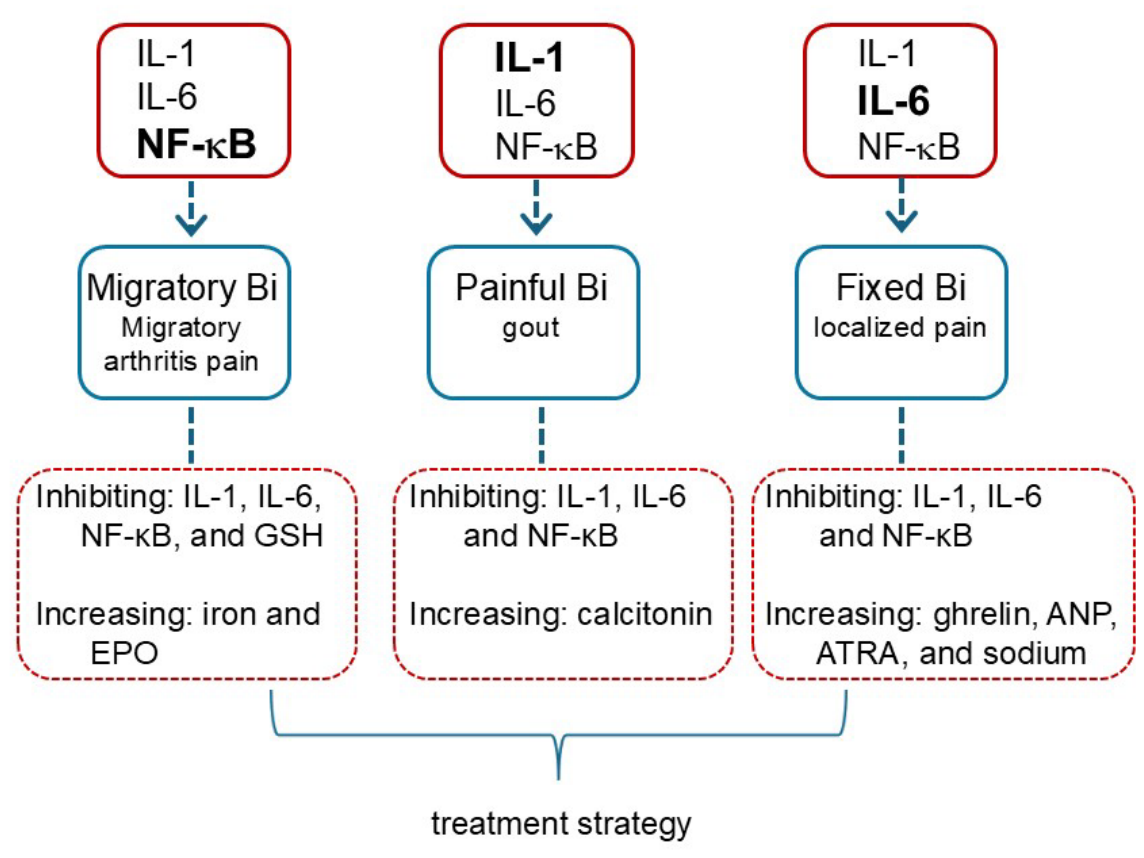
Figure 2.
Seasonal patterns of Bi syndromes driven by IL-1, IL-6, and NF-κB and their progression to organ injury. The pro-inflammatory mediators IL-1, IL-6, and NF-κB drive five season-associated Bi syndromes: Bone Bi (osteoporosis) in Winter, Tendon Bi (tendinitis) in Spring, Vessel Bi (vascular disease) in Summer, Muscle Bi (muscle pain) in July, and Skin Bi (eczema) in Autumn. LPS-mediated signaling further propagates injury to the corresponding internal organs, leading to Kidney Bi (AKI), Liver Bi (hepatitis), Heart Bi (heart failure), Spleen Bi (splenomegaly), and Lung Bi (asthma), respectively. AKI, acute kidney injury; LPS, lipopolysaccharide.
Figure 2.
Seasonal patterns of Bi syndromes driven by IL-1, IL-6, and NF-κB and their progression to organ injury. The pro-inflammatory mediators IL-1, IL-6, and NF-κB drive five season-associated Bi syndromes: Bone Bi (osteoporosis) in Winter, Tendon Bi (tendinitis) in Spring, Vessel Bi (vascular disease) in Summer, Muscle Bi (muscle pain) in July, and Skin Bi (eczema) in Autumn. LPS-mediated signaling further propagates injury to the corresponding internal organs, leading to Kidney Bi (AKI), Liver Bi (hepatitis), Heart Bi (heart failure), Spleen Bi (splenomegaly), and Lung Bi (asthma), respectively. AKI, acute kidney injury; LPS, lipopolysaccharide.
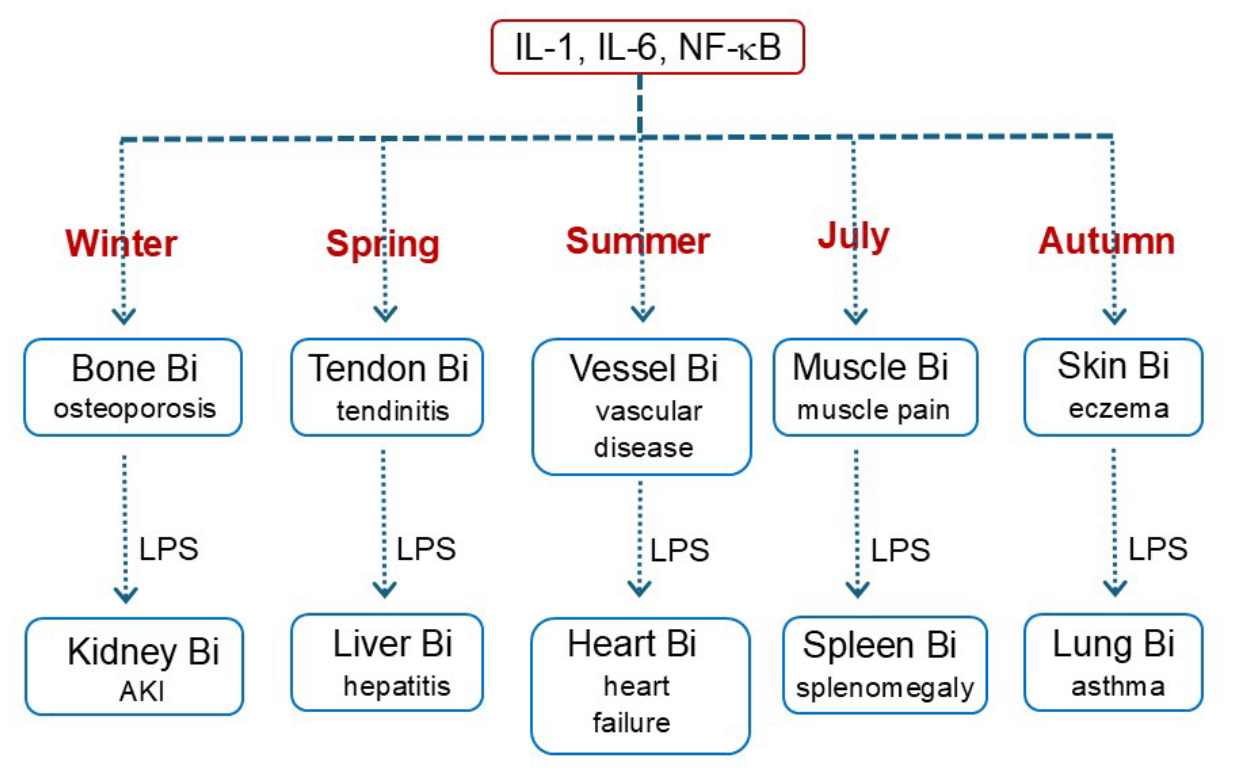

Table 1.
The mapping between TCM vital substances and signaling molecules.
| TCM Vital Substance | Signaling Molecules | TCM Vital Substance | Signaling Molecules |
| Essence | Tyrosine | Liver Qi | Glutathione (GSH) |
| Mind | Melatonin | Liver Yin | Superoxide dismutase (SOD) Renin |
| Ethereal Soul | Serotonin | Liver Yang | Hepatocyte growth factor (HGF) Erythropoietin (EPO) |
| Corporeal Soul | Cysteine | Heart Qi | Magnesium (Mg) |
| Ideation | Tryptophan | Heart Yin | Angiotensin |
| Will | Arginine | Heart Yang | IGF |
| Thin Fluid | Proteins | Spleen | Ghrelin |
| Thick Fluid | Lipids | Spleen Yin | Aldosterone Retinoic Acid |
| Qi | Sodium | Spleen Yang | Atrial Natriuretic Peptide (ANP) |
| Zong Qi | Dopamine | Lung Qi | Hypoxia Inducible Factor (HIF) |
| Nutrient Qi | Cyclic adenosine monophosphate (cAMP) | Lung Yin | Ascorbic Acid |
| Glory Qi | Adenosine triphosphate (ATP) | Lung Yang | Vascular endothelial growth factor (VEGF) Fibroblast Growth Factor 7 (FGF7) |
| Defending Qi | Chloride | Kidney Qi | Nitric Oxide (NO) |
| Yin Qi | Potassium | Kidney Yin | Wnt |
| Yang Qi | Calcium | Kidney Yang | Calcitonin Parathyroid hormone-related protein (PTHrP) |
| Clear Qi | Toll-like receptor 4 (TLR4) | Cold | Interleukin-1 (IL-1) |
| Turbid Qi | Leptin | Damp | Interleukin-6 (IL-6) |
| Righteous Qi | Immunoglobulin G (IgG) | Wind | NF-κB |
| Evil Qi | Lipopolysaccharide (LPS) | Heat | TNF-α |
| Stomach Qi | Amylase | Dry | Interleukin-8 (IL-8) |
| Genuine Qi | Phosphorus | Summerheat | Cyclooxygenase-2 (COX-2) |
| Blood Qi | Iron | Consumption | Forkhead Box O1 (FoxO1) |
| Essence Qi | Zinc | Central | Aldosterone |
| Indulged Qi | Gonadotropin-releasing hormone (GnRH) | Mind Qi | Thyroid Hormone |
Disclaimer/Publisher’s Note: The statements, opinions and data contained in all publications are solely those of the individual author(s) and contributor(s) and not of MDPI and/or the editor(s). MDPI and/or the editor(s) disclaim responsibility for any injury to people or property resulting from any ideas, methods, instructions or products referred to in the content. |
© 2026 by the authors. Licensee MDPI, Basel, Switzerland. This article is an open access article distributed under the terms and conditions of the Creative Commons Attribution (CC BY) license.
Copyright: This open access article is published under a Creative Commons CC BY 4.0 license, which permit the free download, distribution, and reuse, provided that the author and preprint are cited in any reuse.


