

Submitted:
29 July 2026
Posted:
30 July 2026
You are already at the latest version
Abstract
Gravity changes clock rates, and the free point-particle action converts proper-duration differences into relative phase. Coherence lost to an unresolved duration difference can be recovered only through a correlated physical record and a conditional correction. I derive an exact ceiling on that recovery. For a uniform phase window of width \( 0<\Theta\leq2\pi \) and a record retaining M classical values, \( \mathcal V\leq sinc(\Theta/(2M)) \), attained by equal phase bins. The physical question is what fixes M. I take it to be set by the record interface. With n readable binary lines of which at most \( S_\star \) can be asserted together, the reachable codebook has at most \( \sum_{j=0}^{S_\star}\binom nj \) words, so \( \mathcal V\leq sinc\!\left(\frac{\Theta}{2\sum_{j=0}^{S_\star}\binom nj}\right), \) and the coherence deficit falls as \( n^{-2S_\star} \) rather than \( 4^{−n} \). Two cases fix \( S_\star \) by physics rather than by design. A single-quantum position probe of the apparatus coordinate is weight-one by particle number, giving \( \mathcal V\leq sinc(\pi/n) \) at one full cycle and 0.9745 for eight detectors. A peak-assertion budget of \( S_\star \) lines sets the exponent rather than the prefactor. For held or guided branches with matched velocity histories in a weak uniform field, \( \Theta=mgT\Delta z/\hbar \), and a calibrated layer-time count in a static spacetime has rate \( r=\nu N \), so gravity, the count, quantum phase, record interface, and recovered coherence occur in one operational chain. I state a complete record channel and a protocol that leaves the interfering particle undisturbed.
Keywords:
quantum coherence
; quantum erasure
; proper time
; quantum records
; atom interferometry
; gravitational phase
1. Proper Time and Embodied Counts
Proper time appears in three established laws. Stationary clocks at different gravitational potentials accumulate different durations. In a path-integral or WKB description, a free massive branch carries phase . A timelike geodesic locally maximises the same duration between fixed endpoints [1,2]. Optical clocks resolve gravitational redshift across laboratory height differences [3,4]. I ask how a finite embodied record constrains the phase correction inferred from such a duration.
I use the Stack Theory definitions needed for that question [5,6]. Let be a nonempty set of mutually exclusive states. A program is a set . A finite vocabulary encodes by
For a finite timeline fragment , define
Layer space and encoding capacity are
Layer space counts programs true together at one state. Encoding capacity counts the distinct encodings reached across states. The two come apart, and the distinction carries the result below. Capacity is blind to whether a layer can hold many distinctions at once or only a few, and it is that simultaneity which physical constraints act on.
For the record result, let be the nonempty set of states reachable when the correction is selected. Fix an operational record vocabulary
and its correction-state codebook
Program means that binary input line i of the correction interface is asserted at the correction event. A low line is represented by absence from the encoding, rather than by an added complementary program. Under this convention, is the Hamming weight of the interface word. The codebook size is the number of interface words reachable when correction is selected. The theorem is relative to this fixed interface. A different vocabulary describes a different interface.
Lemma 1
(Bounded-weight record count). Let and let . If for every , then
Equality requires every binary word of weight at most to be reachable.
Proof.
Every member of is a subset of with cardinality at most . There are such subsets. □
Interpretation. If at most of n interface lines can be asserted together, the record cannot use arbitrary n-bit words. It can use only words inside the corresponding Hamming ball [7]. The counting is standard. The physical content arises when the record layer fixes . Section 4 gives two such cases.
Fix a physical map from each timelike path segment in a family to a timeline fragment .
Definition 1
(Calibrated clock). A clock vocabulary has frequency and error on Γ when
for every .
Interpretation. The count tracks proper duration at rate , with at most B ticks of error. Stack Theory defines the count of changes visible to the clock vocabulary, which means the number of transitions between distinct clock-layer encodings along the fragment. Physical calibration determines whether the chosen vocabulary functions as a clock.
2. Gravity Changes the Count Rate
Consider a connected static region with zero cosmological constant and
where and t is normalised to a reference clock. A stationary path obeys . If stationary segments of arbitrary coordinate duration T lie in the calibrated family, Eq. (9) gives
Let be the future unit normal. Define and . The standard static lapse equation becomes
where is the covariant derivative of [8]. For a perfect fluid at rest relative to , .
A Newtonian monotonicity statement for added density under common boundary data follows from Eq. (12) and is given in the Supplemental Material. It is not used below.
Scope of this section. Equations (11) and (12) establish that the calibrated count is an operational stand-in for proper duration and that gravity acts on its rate. The visibility bound uses the gravitational phase-window width of Eq. (28). The dynamic dictionary, the count-maximiser theorem, and the jointly resolved stationary-phase result are likewise placed in the Supplemental Material, because they fix the shared variable rather than the ceiling.
For two calibrated branches, write and . Equation (9) gives
A relative phase is therefore a calibrated layer-time difference with a bounded error. The record theorem concerns the finite interface used to infer and correct that phase.
3. Finite Outcomes Limit Quantum Erasure
Proper-duration differences can correlate an interferometer path with internal clock or environmental degrees of freedom and reduce visibility [9,10,11]. Here quantum erasure means measuring a separate correlated record and applying an outcome-conditioned phase correction to the path system. This conditions on side information without retaining the quantum record coherently [12,13,14]. Finite reference frames and restricted environmental access impose related coherence limits [15,16]. Miatto and colleagues restrict the accessible Hilbert-space dimension and obtain full recovery for some finite-dimensional conditional states [17,18]. Here the unresolved phase has an absolutely continuous distribution and only M classical values are retained. A finite value set cannot resolve almost every phase exactly.
Let . Let u be uniformly distributed on an interval J of width . Conditional on u, take
The uniform law is the maximum-entropy density on a fixed bounded interval. The Supplemental Material treats arbitrary densities and a Gaussian example.
Let R be a separate record with conditional state ,
A measurement of R is followed by storage of one classical encoding in . Let be the retained encodings and let . An arbitrary measurement induces . After outcome y, an optimal y-dependent phase shift aligns the conditional coherence. The average recovered visibility is
This includes a classical side record and any positive-operator-valued measurement on a separate quantum record when only the classical outcome remains available for path correction.
I use the unnormalised convention and .
Theorem 1
The function F is strictly increasing in M. Equality is attained when the record channel perfectly distinguishes M equal contiguous phase bins and the correction interface retains their labels.
Proof.
Set . Choose so that , with arbitrary when . Assign each u to the smallest index that maximises . Let be the visibility of the resulting measurable deterministic partition, so . Under the change of variable , let be its phase cells and let be their arc lengths. Then
Circular rearrangement gives
with equality for a contiguous arc. The cell lengths obey . Jensen’s inequality for the concave function gives Eq. (17). Strict monotonicity follows because decreases on and decreases with M. The Supplemental Material gives each step. □
Interpretation. Each retained value groups a range of unresolved phases and applies one correction to the whole group. Equal phase bins lose the least coherence, but every finite partition leaves some phase spread inside each bin. No finite record can therefore recover full coherence for this absolutely continuous phase law.
4. Layer Space Fixes the Codebook
At the correction event, one of M distinguishable record encodings is retained. Across possible runs, the interface must admit each encoding that triggers a distinct correction. Therefore
The first inequality is the immediate capacity requirement. The second is the layer-space constraint for the fixed interface vocabulary.
Theorem 2
(Record codebook ceiling). Let the operational record vocabulary contain n binary programs, let , and assume for every . Then
Equality requires every bounded-weight encoding to be reachable, perfect discrimination of the corresponding equal phase bins, and a distinct correction for each retained label.
Equation (21) is only as interesting as the reason for . Read as a comparison between codebooks it says little, since a designer who wants more correction labels will simply choose a denser code, and standard capacity accounting tracks that choice perfectly well. The physical content appears where is not available to the designer. Two such cases follow.
4.1. A Complete Record Channel
The record must correlate with u without disturbing the interfering particle, and it must be read and fed forward before recombination. Position detection of the interfering particle itself would destroy the superposition and does not realise Eqs. (15)–(16).
The residual arm-height difference z is a property of the guiding potential rather than of the interfering particle. Let a probe system R couple to the apparatus coordinate that sets z, for example by scattering from the guide or mirror element whose displacement fixes the arm offset, and let its outcome be resolved by n position-sensitive detectors. Writing y for the detector index gives a channel directly, since . The protocol then retains y, applies the phase to one arm, and recombines.
Three conditions are required and are experimentally separable. The probe must couple to the apparatus coordinate and not to the branch index, so that it carries no which-path information. Probe backaction on z during the dwell must stay below the bin width, or the effective channel is broadened. The feed-forward must complete inside the coherence window.
4.2. Particle Number Fixes the Weight
Condition on one detected probe quantum under ideal number-resolving detection. Exactly one detector then fires. The reachable codebook is the set of n singletons, so and
For this gives , and reaching at one full cycle requires detectors. This is a design constraint on the readout rather than a correction to a naive estimate: a correct capacity accounting also assigns an ideal one-hot array , hence bits. What Eq. (22) adds is the conversion of that count into an attainable interferometric ceiling, and the observation that the weight is set by particle number and is therefore not available to the designer.
4.3. Peak Assertion and One Energy Realisation
More generally, suppose the interface presents n readable lines but the layer can assert at most of them together at the correction event. One realisation is a budget E for simultaneous assertion at cost per asserted line, giving and
This is a peak-weight constraint, not a thermodynamic law. Equation (23) assigns zero cost to unasserted lines and omits the decoder, wiring, reset, discrimination, and correction-actuator budgets, each of which is a separate and possibly dominant cost. The substantive content is that peak simultaneity, not total capacity, is what the constraint acts on, and that it changes an exponent. For fixed and large n,
against for an unrestricted n-line codebook. Figure 1 shows the resulting slopes. Equation (24) is asymptotic in n and should not replace the exact entries of Table 1 and Table 2; at and it sits about a third above the exact ceiling.
Table 1 fixes eight readable binary lines and one full phase cycle. The exact one-hot row is the physically forced case of Eq. (22); the remaining rows are Hamming balls, which include the all-zero word. Table 2 fixes sixteen lines and varies the energy budget alone.
Doubling the budget from one line to two improves the ceiling by nearly two orders of magnitude in deficit at fixed interface size. Read the other way, fix a target and let be the unique solution of . Any protocol reaching the target must obey
This condition is necessary. It becomes sufficient only when the corresponding codewords and equal-bin record channel are physically available. For fixed and large , inversion of the Hamming-ball asymptotic gives . At the target requires , which a budget of one line meets only at , a budget of two lines meets at , and a budget of three or more meets at . Energy and interface size trade against each other at fixed coherence target.
5. Gravitational Phase Window
Let bound both and on the branches. In a weak static field,
Consider held or guided branches with the same velocity history in . Let their height difference be , where is the nominal arm separation and z is the residual arm-height difference after the known mean phase has been removed. A common vertical displacement of both arms does not contribute. For coordinate dwell time T,
If z spans a window of width , then
The first expression is the proper-time contribution from the point-particle action [1]. It does not treat one internal energy eigenstate as an operational Compton clock. The second is the internal-clock scale [9,11]. A closed freely falling light-pulse interferometer can cancel the uniform-field redshift term. Equation (28) therefore concerns held or guided branches, or an equivalent clock-initialisation scheme [11,19]. Differential trapping, guide, laser, separation, and endpoint phases must be common-mode, calibrated, or independently measured.
For 87Rb, , and , one full rest-mass phase cycle corresponds to
Mass, field, dwell time, residual arm-height width, record architecture, and target visibility now occur in one relation. With a single-particle position record, Eq. (22) replaces the left side by the detector count n.
For Gaussian residual separation , let . With no retained record,
A one-bit sign record attains
For 87Rb, , , and , these values are and . The sign partition is an attainable benchmark rather than a global optimum.
A direct protocol prepares a balanced path superposition, varies the residual arm-height difference according to a known law, retains only a chosen codeword, removes access to the finer controller setting, applies the codeword-dependent phase shift, and recombines the paths. Shot-to-shot randomisation tests the resource bound on the retained protocol record. It does not assert irreversible decoherence. The decisive comparison holds the interface size n fixed and varies through the record physics, either by detecting a single-quantum probe of the apparatus coordinate or by restricting the peak assertion weight of Eq. (23). Optical clocks establish laboratory access to gravitational frequency gradients [3,4]. The coherent two-branch protocol and its phase controls remain additional experimental requirements.
6. Discussion
The quantum theorem depends directly on M, the number of retained correction values. The Stack variables constrain the observable through
The first arrow is the bounded-weight record count over correction states. The final arrow is the finite-outcome theorem.
Equation (8) is Hamming-ball enumeration and agrees with standard coding theory. Capacity accounting determines once the reachable codebook is known. The physical record determines that codebook. Particle number fixes the one-hot codebook of Eq. (22), while a peak-assertion budget fixes the bounded-weight codebook of Eq. (23). Combining those embodied constraints with Eq. (17) yields exact coherence ceilings and their attainability conditions.
Layer space defines peak weight as a property of the encoding layer and places it in the same vocabulary as the layer-time count of Eq. () and the calibrated clock of Eq. (9). The chain from through to then becomes one accounting of clock rate, phase, record architecture, and recovered coherence.
The result is vocabulary-relative. I fix the vocabulary by the correction interface, where each program is one directly readable asserted line. A different interface changes n, , and the reachable encoding image. The theorem does not identify a vocabulary-independent property of the substrate.
The static gravity equation is the standard lapse equation after . The dynamic dictionary, count-to-phase error bound, count-maximiser theorem, and jointly resolved stationary-phase result are given in the Supplemental Material. Those results establish a shared operational variable. They do not derive Einstein’s equation, Hilbert space, the Born rule, the point-particle action, or clock calibration.
The visibility ceiling assumes a uniform phase window with , an absolutely continuous mixture, a retained classical record, correction conditioned only on that record, and no postselection. Coherent retention of the quantum record, joint path-record operations, filtering, extra side information, wrapped windows, and other phase laws define different protocols. The Gaussian benchmark illustrates one such law without claiming the uniform closed form. Equation (23) assumes a fixed per-line assertion cost with none for unasserted lines, and neglects decoder, wiring, reset, discrimination, and actuator budgets.
Acknowledgments
A large language model assisted with literature search, simulated reviews, LaTeX preparation, and project organisation.
References
- Stodolsky, L. Matter and Light Wave Interferometry in Gravitational Fields. General. Relativ. Gravit. 1979, 11, 391–405. [Google Scholar] [CrossRef]
- O’Neill, B. Semi-Riemannian Geometry with Applications to Relativity; Vol. 103, Pure and Applied Mathematics; Academic Press: New York, 1983. [Google Scholar]
- Chou, C.W.; Hume, D.B.; Rosenband, T.; Wineland, D.J. Optical Clocks and Relativity. Science 2010, 329, 1630–1633. [Google Scholar] [CrossRef] [PubMed]
- Bothwell, T.; Kennedy, C.J.; Aeppli, A.; Kedar, D.; Robinson, J.M.; Oelker, E.; Staron, A.; Ye, J. Resolving the Gravitational Redshift across a Millimetre-Scale Atomic Sample. Nature 2022, 602, 420–424. [Google Scholar] [CrossRef] [PubMed]
- Bennett, M.T. How to Build Conscious Machines: Deriving Intelligence, Life and Mind from Time; Palgrave Macmillan, 2027. [Google Scholar]
- Bennett, M.T. Time Is Space, 2026. [CrossRef] [PubMed]
- Hamming, R.W. Error Detecting and Error Correcting Codes. Bell Syst. Tech. J. 1950, 29, 147–160. [Google Scholar] [CrossRef]
- Gourgoulhon, É. 3+1 Formalism in General Relativity: Bases of Numerical Relativity; Lecture Notes in Physics; Springer: Berlin and Heidelberg, 2012; Vol. 846. [Google Scholar] [CrossRef]
- Zych, M.; Costa, F.; Pikovski, I.; Brukner, Č. Quantum Interferometric Visibility as a Witness of General Relativistic Proper Time. Nat. Commun. 2011, 2, 505. [Google Scholar] [CrossRef] [PubMed]
- Pikovski, I.; Zych, M.; Costa, F.; Brukner, Č. Universal Decoherence Due to Gravitational Time Dilation. Nat. Phys. 2015, 11, 668–672. [Google Scholar] [CrossRef]
- Roura, A. Gravitational Redshift in Quantum-Clock Interferometry. Phys. Rev. X 2020, 10, 021014. [Google Scholar] [CrossRef]
- Scully, M.O.; Drühl, K. Quantum Eraser: A Proposed Photon Correlation Experiment Concerning Observation and Delayed Choice in Quantum Mechanics. Phys. Rev. A 1982, 25, 2208–2213. [Google Scholar] [CrossRef]
- Englert, B.G. Fringe Visibility and Which-Way Information: An Inequality. Phys. Rev. Lett. 1996, 77, 2154–2157. [Google Scholar] [CrossRef] [PubMed]
- Englert, B.G.; Bergou, J.A. Quantitative Quantum Erasure. Opt. Commun. 2000, 179, 337–355. [Google Scholar] [CrossRef]
- Bartlett, S.D.; Rudolph, T.; Spekkens, R.W. Reference Frames, Superselection Rules, and Quantum Information. Rev. Mod. Phys. 2007, 79, 555–609. [Google Scholar] [CrossRef]
- Bartlett, S.D.; Rudolph, T.; Spekkens, R.W.; Turner, P.S. Quantum Communication Using a Bounded-Size Quantum Reference Frame. New J. Phys. 2009, 11, 063013. [Google Scholar] [CrossRef]
- Miatto, F.M.; Piché, K.; Brougham, T.; Boyd, R.W. The Optimal Bound of Quantum Erasure with Limited Means. arXiv 2014, arXiv:quant. [Google Scholar] [CrossRef]
- Miatto, F.M.; Piché, K.; Brougham, T.; Boyd, R.W. Recovering Full Coherence in a Qubit by Measuring Half of Its Environment. Phys. Rev. A 2015, 92, 062331. [Google Scholar] [CrossRef]
- Loriani, S.; Friedrich, A.; Ufrecht, C.; Di Pumpo, F.; Kleinert, S.; Abend, S.; Gaaloul, N.; Meiners, C.; Schubert, C.; Tell, D.; et al. Interference of Clocks: A Quantum Twin Paradox. Sci. Adv. 2019, 5, eaax8966. [Google Scholar] [CrossRef] [PubMed]
Figure 1.
Coherence deficit against interface size n, from Eq. (21). At fixed peak weight the deficit falls polynomially with slope , so the peak-assertion budget sets the exponent. An unrestricted n-line codebook falls as and leaves the frame. The marked point is the exact one-hot readout of Eq. (22) at .
Figure 1.
Coherence deficit against interface size n, from Eq. (21). At fixed peak weight the deficit falls polynomially with slope , so the peak-assertion budget sets the exponent. An unrestricted n-line codebook falls as and leaves the frame. The marked point is the exact one-hot readout of Eq. (22) at .
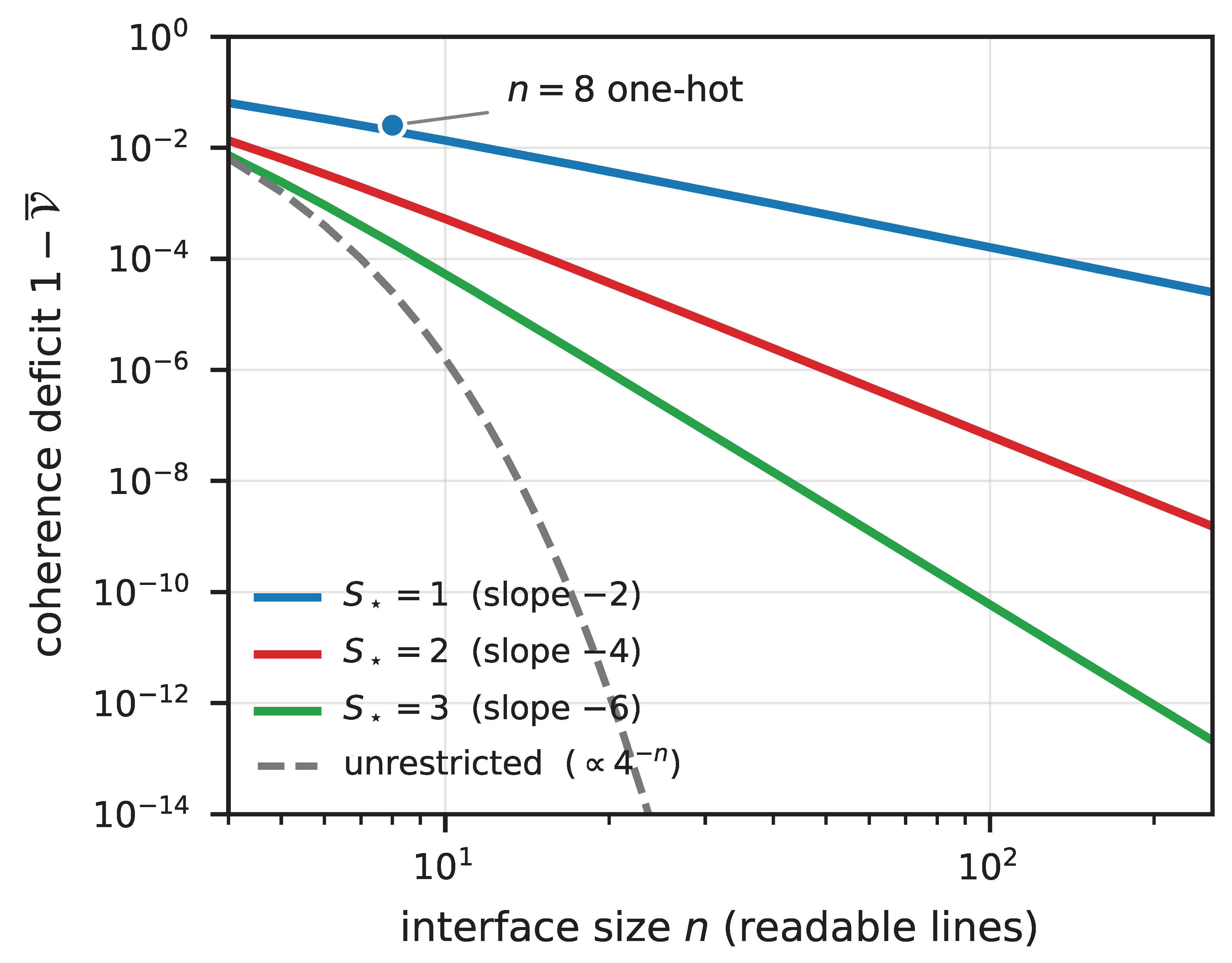

Table 1.
Best-case finite-outcome ceilings at for four codebooks over eight readable binary lines.
| codebook | M | ||
|---|---|---|---|
| exact one-hot | 1 | 8 | |
| weight at most two | 2 | 37 | |
| weight at most three | 3 | 93 | |
| unrestricted binary | 8 | 256 |
Table 2.
Ceiling at for a sixteen-line interface as a function of the energy budget for simultaneous assertion, with . Line count is identical in every row.
Table 2.
Ceiling at for a sixteen-line interface as a function of the energy budget for simultaneous assertion, with . Line count is identical in every row.
| 1 | 1 | 17 | |
| 2 | 2 | 137 | |
| 3 | 3 | 697 | |
| 4 | 4 | 2517 | |
| 16 | 65536 |
Disclaimer/Publisher’s Note: The statements, opinions and data contained in all publications are solely those of the individual author(s) and contributor(s) and not of MDPI and/or the editor(s). MDPI and/or the editor(s) disclaim responsibility for any injury to people or property resulting from any ideas, methods, instructions or products referred to in the content. |
© 2026 by the author. Licensee MDPI, Basel, Switzerland. This article is an open access article distributed under the terms and conditions of the Creative Commons Attribution (CC BY) license (http://creativecommons.org/licenses/by/4.0/).
Copyright: This open access article is published under a Creative Commons CC BY 4.0 license, which permit the free download, distribution, and reuse, provided that the author and preprint are cited in any reuse.