

Submitted:
29 July 2026
Posted:
29 July 2026
You are already at the latest version
Abstract
Collaborative robots have left the safety cage. In factories, operating theatres and care homes they now share physical and decision space with people. Physical safety is only one part of the ethical problem raised by that proximity. A second part concerns whether the person working beside the robot can still experience themselves as capable, recognised and in control of what they do. The question gains weight as robots become stronger and more precise, and as the AI systems directing them match or exceed human performance in narrow tasks and, plausibly, in broader ones. Technical standards such as ISO 10218:2025, which absorbs the former ISO/TS 15066, regulate force, speed and separation. The EU AI Act (Regulation 2024/1689) imposes human oversight obligations on high-risk systems. Neither instrument treats human dignity as a design property that can be specified, observed and audited, and neither addresses the risk that a more competent AI system diminishes human standing through cognitive rather than physical superiority. This paper proposes Dignity-by-Design (DbD), a framework that translates dignity-related concerns in robot ethics, drawing on Riek and Howard, on Sharkey and Sharkey, and on Nussbaum’s capabilities approach, into four operational principles: Informed Engagement, Override and Recovery, Affective Transparency, and Contextual Autonomy. Each principle carries auditable indicators, is anchored in Value Sensitive Design and is aligned with Article 14 of the AI Act. We work the framework through three deployment scenarios: an industrial cobot bench, an assistive robot for older adults, and an AI-supported professional decision environment. A research and certification roadmap follows, organised around a Dignity Impact Assessment. The contribution is conceptual rather than empirical. It offers a vocabulary and a measurement scaffold for moving dignity, as safety once moved, from ethical aspiration into engineering practice.
Keywords:
human-robot collaboration
; dignity-by-design
; value sensitive design
; ISO 10218
; EU AI Act
; affective transparency
; collaborative robots
; robot ethics
1. Introduction
Collaborative robots, usually called cobots, have left the fenced-off areas of classical automation and entered shared human workspaces. In automotive assembly, surgical theatres, warehouses and elder-care facilities, robots move within centimetres of human bodies and sometimes touch them deliberately. The practical gain is clear enough: productivity, precision, ergonomics and continuity of service. The moral difficulty is less clear. A machine that adapts to a worker’s pace, prompts a patient to take medication, or interrupts a task it judges unsafe does more than execute a trajectory. It shapes how the human partner understands their own competence, freedom and place in the interaction.
The frameworks that govern these interactions begin from physical safety and acceptance. ISO 10218:2025, which now integrates the earlier ISO/TS 15066 specification, defines collaborative operating modes, biomechanical thresholds for power and force limiting, and separation distances for speed and separation monitoring. The EU AI Act (Regulation 2024/1689) classifies AI systems used in robots, drones and medical devices as high-risk where third-party conformity assessment applies, and Article 14 requires providers to make effective human oversight possible. Both instruments are necessary and neither is sufficient. They say little about the worker who feels reduced to an accessory of a faster and more accurate machine, about the hospital patient who cannot tell whether an assistive robot is recording distress, or about the older adult who forms an attachment to a system that simulates concern without feeling any.
The value that goes missing is human dignity. Dignity overlaps with safety, comfort, usability and trust without reducing to any of them. Following Nussbaum, we treat dignity as the standing of a person whose life is lived from the inside, under conditions worthy of a human being [1]. In human-robot collaboration this carries a concrete implication: the human must not become the slower, weaker, less precise component of a technical system. A dignity-respecting robot leaves the person a real capacity to refuse, override, reinterpret and be heard; it does not deceive them about its own nature or affective state, and it does not treat them as a predictable input variable.
A further problem arises as AI systems take on work traditionally associated with highly qualified professionals. In scientific research, financial analysis, medical decision support, legal reasoning and strategic management, such systems already match or exceed human performance in specific analytical activities. Efficiency and decision quality may improve. At the same time, a dignity-related concern appears. People draw part of their identity, social recognition and sense of purpose from exercising competence and judgement. Where the machine is seen as consistently more capable, workers, professionals and organisational leaders risk being relegated to supervisory or symbolic roles. The ethical question then extends beyond physical safety and operational control, towards the preservation of meaningful human contribution in settings where machine competence exceeds human expertise.
This paper asks a practical question: can dignity be engineered without emptying it of its moral force? We call the proposed answer Dignity-by-Design (DbD). The framework builds on Value Sensitive Design [2], on dignity-aware robot design in HRI [3] and care robotics [4,5], and on recent empirical and regulatory work on people-centric HRC and the EU AI Act [6,7]. It also draws on earlier work on modelling sensorial and emotional information in networked systems, which anticipated some of the affective-inference problems now appearing in collaborative robotics [8]. We do not claim that dignity reduces to a metric. The aim is to make visible, early enough in design, the points at which physical, operational or cognitive superiority becomes human diminishment. Figure 1 sets out these three layers of asymmetry and the standards and legal instruments that currently cover each.
The paper proceeds as follows. Section 2 reviews the state of the art in HRC ethics and identifies the gap that DbD addresses. Section 3 sets out the conceptual foundations, drawing on Kant, on Nussbaum and on the value-sensitive tradition. Section 4 presents the four principles and their indicators. Section 5 tests the framework against three deployment scenarios: an industrial cobot bench, an assistive robot in the home of an older adult, and an AI-supported professional decision environment. Section 6 proposes a governance and research roadmap built around a Dignity Impact Assessment, and states the limitations of the proposal. Section 7 concludes.
2. State of the Art
2.1. Safety Standards and the Limits of Biomechanics
The technical baseline for human-robot collaboration is set by ISO 10218 in its 2025 revision, which incorporates the content of ISO/TS 15066. The standard recognises four collaborative modes: safety-rated monitored stop, hand guiding, speed and separation monitoring, and power and force limiting. Together these define the conditions under which a robot may share a workspace with a human [9]. Within power and force limiting, biomechanical thresholds derived from pain studies on different body regions cap the forces and pressures that a moving robot may transfer on contact [10]. Later empirical work has validated and refined those limits. It has shown that pain thresholds differ by sex and body region, and that the standard contact-force formula understates how much impact forces vary across the workspace [10,11].
Standards of this type answer a narrow question: when is unintended contact unlikely to injure the body? A second question arises in the same workspace: when does the interaction continue to respect the worker as a person? A cobot may comply fully with ISO 10218 and still erode agency, misrepresent its capabilities, or reduce the worker to a sensor and residual problem-solver inside its own optimisation loop. That risk grows when the machine is not only physically stronger but also faster in perception, more consistent in execution, and supported by AI that justifies its recommendations in terms that sound more authoritative than the worker’s own judgement.
2.2. Trust, Acceptance and the Missing Moral Layer
Trust and acceptance dominate the social side of the HRC literature [12]. Trust calibration matters: under-trust produces refusal, over-trust produces complacency and over-reliance, and both create safety problems [13]. Trust is nevertheless a different thing from respect. A system may be trusted and still humiliate or marginalise the person using it. A worker’s distrust may equally be morally informative rather than irrational, for instance when the cobot monitors them in ways they did not consent to, or when its superior speed quietly redefines the worker as the bottleneck.
The Stanford Encyclopedia entry on the ethics of AI and robotics states the deeper concern: robotic systems can violate the Kantian requirement of respect for humanity when their appearance, behaviour or internal processes deceive, manipulate or instrumentalise the human partner [14]. Riek and Howard’s 2014 proposal for a code of ethics in HRI was an early attempt to make this concrete. It sets out principles for human-dignity considerations covering privacy, predictability, emotional needs, and the alignment of robot appearance with actual capability [3].
2.3. Cognitive Superiority and Professional Displacement
Discussion of human-robot collaboration has concentrated on physical safety, trust calibration and workplace acceptance. Work in human factors and automation research points to a second source of asymmetry, cognitive rather than physical. AI systems now analyse large datasets, identify patterns, generate recommendations and support decisions in domains once reserved for highly trained professionals. Parasuraman and Riley showed that operators defer to automated recommendations in ways that shift responsibility, reduce active scrutiny and produce over-reliance when system outputs appear authoritative [15]. Bainbridge’s account of the ironies of automation applies directly: as automation becomes more capable, the operator is left with residual supervision and rare intervention, and practical expertise decays precisely where intervention matters most [16].
Earlier generations of machines replaced physical effort or routine procedure. Contemporary AI systems reach further, into judgement itself. In financial institutions, healthcare organisations, legal services, research environments and executive decision-making, professionals work alongside systems that are faster, more consistent and often perceived as more objective. Autor’s analysis of automation stresses that technologies both substitute for and complement human labour [17]. The dignity problem appears when the complementary role becomes so thin that human judgement amounts to procedural approval. Read from an AI ethics perspective, what is at stake is recognition, agency and the future standing of human expertise, alongside the more familiar questions of safety, bias and accountability [18].
2.4. Dignity in Care Robotics
The most developed dignity-centred critique has come from social and care robotics. Sharkey and Sharkey identify six recurring ethical concerns in robot care for older adults: reduction in human contact, objectification and loss of control, loss of privacy, loss of personal liberty, deception and infantilisation, and the question of who controls the robot [4]. Sharkey’s later treatment situates these concerns explicitly under the heading of dignity and links them to the United Nations human-rights framework [5]. A parallel literature on social robotic deception, drawing on Wallach and Allen [19] and Danaher [20], formalises the ways in which simulated emotional states can mislead users about the moral and cognitive standing of the machine.
The technological landscape to which these concerns apply is by now documented in detail. A systematic review of multimodal solutions for people with dementia catalogues thirty supportive technologies and fifteen support services, and finds that the largest single share is devoted to locating, tracking and monitoring activity, followed by environmental control and cognitive enhancement [29]. Loss of privacy and loss of personal liberty, two of the six concerns identified by Sharkey and Sharkey, therefore attach to the dominant technology class in the field rather than to a marginal one.
2.5. Ethical Frameworks for HRC in Manufacturing
In manufacturing, a European Delphi study with thirty subject-matter experts produced an ethical framework for people-centric human-robot collaboration [6]. The framework names human dignity, alongside safety, equity, data protection and accountability, as a principle that organisations must implement through procedures and labour-design choices rather than declare. That distinction matters because dignity failures in factories rarely appear as dramatic abuse. They emerge as small shifts in authority: the worker stops correcting the system, stops interrupting it, or comes to accept the machine’s timing and judgement as the real measure of competent work.
2.6. Regulatory Context: The EU AI Act
The EU AI Act adds a binding layer to this picture. AI systems that operate robots and medical devices are typically high-risk under the Act where third-party conformity assessment applies [21]. Article 14 requires that high-risk systems be designed and developed so that natural persons can effectively oversee them while in use, with the stated aim of preventing or minimising risks to health, safety and fundamental rights [7]. The Act also prohibits emotion-recognition systems in the workplace and in education, subject to limited medical and safety exceptions, on the grounds that such systems can manipulate behaviour and produce discriminatory outcomes [22]. Writing on the convergence of AI, robotics and quantum computing, Luís-Ferreira and Loureiro-Rodrigues argue that, beyond what the Act prescribes, affective and biometric data flows require explicit ethical red lines: informed and revocable consent, prohibition of sensitive inferences outside supervised clinical settings, and strict data minimisation [23]. Taken together with that red-line argument, the two regulatory provisions create both an obligation and an opening. Collaborative systems must be overseeable, and they must not weaponise affective inference against the workforce. Dignity-by-Design articulates how this can be done in practice.
2.7. The Gap
Dignity is not absent from the literature. It is usually invoked at the level of principle and then lost at the level of design. The conceptual material is available in capabilities theory, care-robot ethics and Value Sensitive Design, and the regulatory environment now expects more than physical safety from collaborative systems. What is missing is a shared engineering vocabulary for the dignity risks created by asymmetry: the encounter between a vulnerable human body and a machine that may be stronger, more precise, more tireless and cognitively more assertive. DbD is an attempt to make that asymmetry designable and auditable.
3. Conceptual Foundations
3.1. Two Traditions of Dignity
Two philosophical traditions inform the use of dignity adopted here. The Kantian tradition treats dignity as the unconditional worth of every rational being, expressed in the formula of humanity: persons are never to be treated merely as means [14]. Applied to robotics, this rules out designs whose practical effect is to instrumentalise the human partner. A worker should not become a convenient source of behavioural data; a patient should not become a compliance target; an older adult should not be steered by simulated affection that the system cannot reciprocate.
The capabilities tradition, developed by Sen and Nussbaum, treats dignity as the foundation of a list of central capabilities that a just society must secure for each person [1,24]. Nussbaum’s list includes practical reason, affiliation, control over one’s environment, and being treated as a being with dignity in one’s workspace [24]. The capabilities approach has been used to ground design ethics for health and well-being technologies [25]. It suits HRC because it focuses on what people are actually able to do and to be within a given socio-technical arrangement, rather than on abstract status.
The two traditions do different work in the present argument. Kant provides a floor: some treatments of the human partner are ruled out even where they improve efficiency. Nussbaum provides a positive horizon, in which a dignity-respecting system leaves people with real capabilities and not only formal rights. In HRC, this means asking whether the person can still understand, refuse, correct and shape the interaction when the machine is visibly more capable along many dimensions.
The point acquires further weight in AI-assisted decision-making. Dignity depends on retaining control over physical actions, and equally on preserving genuine opportunities to exercise competence, interpretation and judgement. A person whose role is reduced to approving machine-generated recommendations may formally retain authority while losing much of their agency. Dignity-preserving systems must therefore support operational control together with meaningful cognitive participation.
3.2. From Values to ENGINEERING: Value Sensitive Design
Value Sensitive Design (VSD), developed by Friedman and colleagues since the late 1990s, provides the methodological bridge between these philosophical traditions and engineering practice [2,26]. VSD couples conceptual investigations of the relevant values, empirical investigations of how stakeholders experience them, and technical investigations of how design choices express or undermine them. This tripartite methodology has been applied to informed-consent mechanisms in browsers, to implantable medical devices, and, more recently, to robotics [2]. Later extensions couple VSD with Nussbaum’s capabilities theory to produce a Capability Sensitive Design approach for health and well-being technologies [25].
DbD inherits the VSD assumption that values are built into a system through design choices, organisational policies and modes of evaluation, rather than added once the system is finished. The four principles set out in Section 4 are accordingly commitments that must be visible in logs, interfaces, override mechanisms, consent flows, workforce policies, and empirical instruments such as perception scales and override-ratio measurements.
3.3. Why Affect Matters
One feature of contemporary HRC separates it from earlier industrial automation: the role of affect. Cobots and assistive robots read user states such as gaze, posture, voice prosody or physiology, and they produce affective signals of their own through lighting, voice, motion or facial expression. Earlier work on modelling things in ways that mirror how the human brain stores sensorial and emotional content anticipated the technical possibility of representing objects and events beyond simple keyword retrieval [8]. Complementary work proposed architectures for capturing emotional information from users in IoT environments [27]. In assisted-living settings those capabilities have already left the laboratory: the review of dementia support technologies cited above records deployed systems that capture physical behaviour and emotional patterns through galvanic skin response sensors, eye tracking, wearable stress detection and video-based behavioural analysis [29]. The open question is no longer whether affective inference can be done, but whether it should be done, who benefits from it, and whether the human partner can remain more than a behavioural object to be read and optimised.
Two problems follow. The first is regulatory: under the AI Act, workplace emotion recognition is prohibited by default, with narrow medical and safety exceptions [22]. The second is ethical. Even where the robot only expresses affect, without inferring it, those expressions can mislead users about the system’s inner life. Sharkey and Sharkey [4,5], Wallach and Allen [19], and Danaher [20] have analysed this problem as robotic deception. Work on the convergence of AI, robotics and quantum computing argues that affective and biometric data flows require explicit ethical red lines, including informed and revocable consent, prohibition of sensitive inferences outside supervised clinical settings, and strict data minimisation [23]. Affective Transparency, the third DbD principle, responds to the asymmetry between what the machine can simulate and what the human may feel.
4. The Dignity-by-Design Framework
DbD treats dignity as a designable property expressed through four principles. Each principle has a working definition, a normative anchor and at least one auditable indicator. The principles should be read together. A robot that is transparent but difficult to override, or adjustable but emotionally manipulative, has not implemented dignity by design. The framework makes a limited claim: it does not measure dignity itself, but identifies design conditions under which dignity is more likely to be protected or undermined. Figure 2 maps the four principles onto their normative anchors and onto ISO 10218 and the EU AI Act; Table 1, at the end of this section, summarises the principles together with their working definitions and indicators.
4.1. Principle 1: Informed Engagement
Definition. The human partner can form, during the interaction and not only in training, a reasonably accurate understanding of what the robot is doing, what it is likely to do next, and why.
Anchor. Article 14 of the AI Act requires that high-risk systems be designed so that operators can interpret outputs, detect anomalies and intervene [7]. Riek and Howard frame the same requirement under predictability and transparency [3].
Indicators. Time-to-comprehension on first exposure; correct user prediction of the next robot action under standardised probes; intelligible explanations for robot-initiated interruptions; explicit consent flows for any affective or biometric capture, with documented opt-out paths.
4.2. Principle 2: Override and Recovery
Definition. The human partner retains a real, low-friction capacity to halt, reverse, refuse or question robot action, and the system recovers without penalising the person for doing so.
Anchor. ISO 10218 already mandates emergency-stop functionality, though as a safety device. DbD treats override more broadly, as the operationalisation of Nussbaum’s capability of control over one’s environment [24] and as the practical correlate of the Article 14 oversight obligations [7].
Indicators. Override ratio (worker-initiated halts as a fraction of robot-initiated actions); time-to-override; proportion of overridden actions that lead to system improvement; absence of productivity or evaluation penalties associated with override use, verified through workforce policies and logs.
4.3. Principle 3: Affective Transparency
Definition. Where the robot expresses or simulates affective states, those expressions are framed as simulations, bounded in scope, and never used to push the human partner into compliance, attachment or unwarranted trust.
Anchor. This principle responds to the deception literature in social and care robotics [4,5,19,20], to the AI Act’s prohibition on workplace emotion recognition [22], and to work on ethical red lines for affective and biometric data in convergent digital systems [23]. It permits affective signalling by the robot. What it forbids is signalling that misrepresents the system’s nature or exploits the user’s tendency to anthropomorphise.
Indicators. Disclosure rate of simulated affect at first interaction and at meaningful state changes; absence of affective inference about the worker in workplace deployments, except where covered by the AI Act’s narrow safety and medical exceptions; user-reported clarity that the robot’s expressions are simulated.
4.4. Principle 4: Contextual Autonomy
Definition. The robot’s autonomy and social register are adjustable to the setting, task and person, and they default to the least diminishing option compatible with safe and effective operation.
Anchor. Capabilities theory recognises that the same functioning, mobility assistance for instance, can support or undermine dignity depending on context [24]. Care-robotics scholarship documents the harm of one-size-fits-all autonomy, particularly the slide into infantilisation [4,5].
Indicators. Adaptive-mode switches per session; user-initiated adjustments to robot social register; documented per-context defaults reviewed by an ethics function.
5. Applications and Scenarios
We apply DbD to three ordinary deployments: an industrial cobot bench, an assistive robot in eldercare, and an AI-supported professional decision environment. Futuristic edge cases are unnecessary for the argument. Dignity risks already arise in routine environments, particularly where the machine appears stronger, more competent or more certain than the human beside it. Figure 3 traces a common five-stage mechanism across the three deployments, from a compliant starting point to a dignity outcome.
Each row traces one scenario from a compliant starting point through to a dignity outcome, along a shared five-stage spine. In every case the system remains conformant with the applicable standard or regulation throughout: what changes is a configuration choice made under external pressure, after which the human partner ceases to exercise a capacity the design nominally preserves. The indicator column, shown in outline, is where that change first becomes observable. The override ratio falls before the worker's loss of practical authority is legible to management; the disclosure rate and the frequency of adaptive-mode switches fall before attachment and infantilisation are recognised in the home; the rate of meaningful disagreement falls before the professional role has visibly narrowed to confirmation. Because the indicator moves at the fourth stage and the outcome only at the sixth, the indicators function as leading rather than lagging measures, which is the basis for proposing them as reporting categories in Section 6.2. Markers attached to the third and fourth stages name the DbD principle that applies at the point of intervention and the corresponding design or organisational commitment.
5.1. Scenario A: Cobot at the Assembly Bench
Consider a power-and-force-limiting cobot sharing a bench with a worker who performs screw-driving and inspection tasks. The robot is ISO 10218 compliant and biomechanical thresholds are respected. On paper the cell is safe. In practice, productivity pressure pushes the integrator towards a configuration in which the cobot leads the rhythm and the worker fills the gaps. The worker’s body is protected while their practical authority weakens. Three dignity risks follow.
Informed Engagement is at risk if the cobot’s motion planner reroutes around the worker without signalling why. The worker may then experience the change as correction by a superior system rather than as cooperation. A short visual or motion cue, paired with a one-time briefing on the planner’s logic, reduces the asymmetry without slowing the line.
Override and Recovery is at risk if the worker believes that pausing the cobot will count against their performance. In such settings the override ratio may fall because intervention has become socially expensive, not because nothing is wrong. The DbD response is partly technical and partly organisational: management commits in writing that override events will not be used as performance indicators against individuals, and override logs are aggregated for system improvement rather than individual evaluation.
Affective Transparency is at risk if the cell incorporates worker-facing affective inference such as fatigue detection or attention monitoring. Under the AI Act, emotion recognition in the workplace is prohibited except for narrow safety and medical exceptions [22]. A DbD-compliant configuration therefore removes affective inference about the worker unless one of those exceptions is genuinely engaged, documented and limited. Fatigue clearly matters; the objective is to stop a system from turning the worker’s inner state into another production variable.
5.2. Scenario B: Assistive Robot for an Older Adult
Consider a mobile assistive robot deployed in the home of an older adult living alone, performing reminders, light fetching tasks and remote-presence calls with family or care staff. The scenario is not hypothetical: reviews of the assisted-living market identify a substantial installed base of location trackers, activity monitors, telecare platforms and behaviour-tracking devices aimed at exactly this user [29]. The dignity risks are different from those of the factory and in some ways sharper. The user may anthropomorphise the system more readily, may have less technical literacy, and may have no institutional advocate comparable to a workplace representative.
Informed Engagement requires that the user understands when the robot is recording, who can see what it records, and what it will and will not do on its own initiative. This maps onto a long-standing concern in care robotics about loss of privacy [4].
Override and Recovery takes a specific shape in this setting. The user must be able to refuse the robot, including refusing reminders, without triggering escalation to family or care staff, except where a documented safety threshold is crossed. Otherwise the override becomes punitive and dignity is lost.
Affective Transparency is the most exposed principle in this scenario. Care robots routinely use expressive faces, soft voices and gestures that read as concern. A DbD-compliant design can retain warmth while avoiding false intimacy. At first contact, and at appropriate intervals afterwards, the system should make clear that it does not feel and that its expressions are simulated [4,20]. A cold disclaimer at every turn is unnecessary. What is required is interaction design in which the simulation remains legible without effort.
Contextual Autonomy requires that the same robot may need to behave differently when deployed with two different users. A user who values independence should not have to struggle against the robot to assert it, and a user who welcomes proactive support should be able to enable it. The default setting is a dignity choice rather than a neutral technical one.
5.3. Scenario C: AI-Supported Professional Decision-Making
Consider a financial analyst, CFO or research director working with an AI system that can scan market data, scientific literature, contracts or operational indicators at a scale no human team can match. The system produces ranked recommendations, risk explanations and alternative scenarios. Formally the human remains in charge. In practice, the machine’s analytical superiority may make disagreement feel irrational, risky or professionally indefensible. Better evidence from the AI is not the problem. The problem is that the human role may shrink into confirmation, liability absorption or symbolic oversight.
A DbD-compliant design makes the human contribution visible and consequential. The interface should expose uncertainty, assumptions and alternative interpretations rather than present a single authoritative answer. Override and Recovery should include a right to challenge or delay machine-generated recommendations without reputational penalty. Contextual Autonomy should allow different levels of AI proactivity according to the decision domain, the user’s expertise and the consequences of error. The objective is not to protect professional dignity by pretending that humans are always more competent, but to ensure that superior machine analysis does not erase human judgement, responsibility and recognition. Table 2 summarises the primary tension, the most-engaged principles and the expected effect across the three scenarios.
6. A Roadmap for Governance and Research
6.1. A Dignity Impact Assessment
The AI Act already requires Fundamental Rights Impact Assessments for certain deployers of high-risk systems. We propose a Dignity Impact Assessment (DIA), structured around the four DbD principles, as a complementary instrument for collaborative robotic systems. For each deployment, the DIA would document the concrete physical, affective and cognitive asymmetries between human and robot, the risks created under each principle, the mitigations in place, and the indicators to be monitored. It would sit alongside conformity assessment under ISO 10218 and the AI Act, and would not replace it. Figure 4 sets out the proposed DIA workflow against the existing conformity assessment cycle.
6.2. Standards Work
The natural home for DbD indicators is in the supporting technical reports that accompany ISO 10218 and in the emerging IEEE work on robot ethics. Override ratio, disclosure rate of simulated affect, and adaptive-mode switching frequency are all measurable, and all could be standardised as reporting categories without prescribing universal values. Minimum thresholds should be set later, by domain, once empirical baselines exist. The immediate task is simpler: make dignity-relevant information visible enough that designers, auditors and workers can argue about it with evidence rather than intuition.
6.3. A Research Agenda
Four empirical questions follow from the framework. How do override ratios change when workers are explicitly protected from penalties for intervention? Which disclosure formats for simulated affect produce real understanding without breaking interaction flow, particularly for users with cognitive impairments? How should defaults for Contextual Autonomy be set across cultures, given that the same level of robot proactivity may read as helpful in one setting and patronising in another? How do professionals experience dignity, agency and accountability when AI systems are demonstrably superior in narrow analytical tasks? These questions are tractable with established HRC methods, including controlled studies, longitudinal field trials and mixed-method ethnography, and they produce evidence that standards bodies can use.
6.4. Limitations
The proposal has limits. It is conceptual and has not been validated empirically; we offer a vocabulary and a measurement scaffold rather than a tested intervention. Some indicators, the override ratio among them, are proxies and can be gamed. Their value lies in being read together and in context, which is an instance of Vallor’s broader point that virtue and good judgement cannot be reduced to single metrics [28]. Dignity is also culturally inflected. The defaults proposed here reflect a European regulatory and ethical context, and other jurisdictions would need to revisit which principles are foregrounded and how the indicators are weighted.
7. Conclusion
Safety in human-robot collaboration moved from aspiration to engineering practice because researchers, standards bodies and integrators eventually agreed on measurable quantities and built tools around them. Dignity sits at an earlier and less comfortable point. It is invoked often and measured rarely. It is discussed at length in philosophy and care ethics, and remains underrepresented in the engineering literature that shapes actual deployments.
The Dignity-by-Design framework is offered as a step towards closing that gap. Its starting point is straightforward: the more capable the robot or AI system becomes, the more carefully the human place in the interaction must be designed. A system that is stronger, faster, more precise or more competent in analytical and decision-support tasks can assist the person, and it can also leave that person feeling residual, corrected or managed. DbD treats this as an engineering problem with ethical content. It anchors dignity in established philosophical traditions, takes its method from Value Sensitive Design, and aligns its principles with ISO 10218 and the EU AI Act.
The next frontier of dignity in human-robot and human-AI collaboration may therefore be cognitive rather than physical. Engineering systems that preserve meaningful human contribution in the presence of machine superiority will matter more as AI systems assume larger roles in analysis, planning and decision support. The challenge extends beyond ensuring that robots do not injure humans. It reaches the question of whether people continue to experience themselves as competent, recognised and genuinely involved participants in socio-technical systems where machines may outperform them in many specialised tasks.
Funding
This research received no external funding.
Conflicts of Interest
The authors declare no conflict of interest.
References
- Nussbaum, M. C. Creating Capabilities: The Human Development Approach; Harvard University Press: Cambridge, MA, 2011. [Google Scholar]
- Friedman, B.; Hendry, D. G. Value Sensitive Design: Shaping Technology with Moral Imagination; MIT Press: Cambridge, MA, 2019. [Google Scholar]
- Riek, L. D.; Howard, D. A Code of Ethics for the Human-Robot Interaction Profession. in Proc. We Robot 2014. 2014. [Google Scholar]
- Sharkey; Sharkey, N. Granny and the Robots: Ethical Issues in Robot Care for the Elderly. Ethics Inf. Technol. 2012, vol. 14(no. 1), 27–40. [Google Scholar]
- Sharkey. Robots and Human Dignity: A Consideration of the Effects of Robot Care on the Dignity of Older People. Ethics Inf. Technol. 2014, vol. 16(no. 1), 63–75. [Google Scholar] [CrossRef]
- Pizzagalli, L.; Ferro, S. An Ethical Framework for Human-Robot Collaboration for the Future People-Centric Manufacturing: A Collaborative Endeavour with European Subject-Matter Experts in Ethics. Technol. Soc. 2024, vol. 78, 102726. [Google Scholar]
- European Parliament and Council, Regulation (EU) 2024/1689 (Artificial Intelligence Act), Article 14. Official Journal of the European Union 2024. [CrossRef]
- Luís-Ferreira, F.; Jardim-Goncalves, R. “Modelling of Things on the Internet for the Search by the Human Brain,” in Technological Innovation for the Internet of Things (DoCEIS 2013). In IFIP Advances in Information and Communication Technology; Camarinha-Matos, L. M., Tomic, S., Graca, P., Eds.; Springer: Berlin/Heidelberg, 2013; vol. 394, pp. 71–79. [Google Scholar] [CrossRef]
- International Organization for Standardization. ISO 10218-1:2025 and ISO 10218-2:2025, Robotics - Safety Requirements (incorporating former ISO/TS 15066). Geneva, 2025.
- Behrens, R.; Pliske, M.; et al. A Statistical Model to Determine Biomechanical Limits for Physically Safe Interactions With Collaborative Robots. Frontiers in Robotics and AI 2022. [Google Scholar] [CrossRef] [PubMed]
- Svarny, P.; Rozlivek, J.; Rustler, L.; Hoffmann, M. 3D Collision-Force-Map for Safe Human-Robot Collaboration. Proc. IEEE ICRA, 2021. [Google Scholar]
- Sheridan, T. B. Human-Robot Interaction: Status and Challenges. Hum. Factors 2016, vol. 58(no. 4), 525–532. [Google Scholar] [CrossRef] [PubMed]
- Lee, J. D.; See, K. A. Trust in Automation: Designing for Appropriate Reliance. Hum. Factors 2004, vol. 46(no. 1), 50–80. [Google Scholar] [CrossRef] [PubMed]
- Muller, V. C. Ethics of Artificial Intelligence and Robotics. In Stanford Encyclopedia of Philosophy; Zalta, E. N., Ed.; 2020. [Google Scholar]
- Parasuraman, R.; Riley, V. Humans and Automation: Use, Misuse, Disuse, Abuse. Hum. Factors 1997, vol. 39(no. 2), 230–253. [Google Scholar] [CrossRef]
- Bainbridge, L. Ironies of Automation. Automatica 1983, vol. 19(no. 6), 775–779. [Google Scholar] [CrossRef]
- Autor, D. H. Why Are There Still So Many Jobs? The History and Future of Workplace Automation. J. Econ. Perspect. 2015, vol. 29(no. 3), 3–30. [Google Scholar] [CrossRef]
- Coeckelbergh, M. AI Ethics; MIT Press: Cambridge, MA, 2020. [Google Scholar]
- Wallach, W.; Allen, C. Moral Machines: Teaching Robots Right from Wrong; Oxford University Press: Oxford, 2009. [Google Scholar]
- Danaher, J. Robot Betrayal: A Guide to the Ethics of Robotic Deception. Ethics Inf. Technol. 2020, vol. 22(no. 2), 117–128. [Google Scholar] [CrossRef]
- European Commission. “Navigating the AI Act,” Shaping Europe’s Digital Future, 2024-2025.
- European Parliament and Council, Regulation (EU) 2024/1689 (Artificial Intelligence Act), Article 5 (prohibited practices, including emotion recognition in the workplace and educational institutions). Off. J. Eur. Union 2024.
- Luís-Ferreira, F.; Loureiro-Rodrigues, C. “Ethical Challenges in the Current Digital Landscape: AI, Robotics and Quantum Computing,” Preprints.org. 2025. [Google Scholar] [CrossRef]
- Nussbaum, M. C. Frontiers of Justice: Disability, Nationality, Species Membership; Belknap Press: Cambridge, MA, 2006. [Google Scholar]
- Jacobs, N. Capability Sensitive Design for Health and Wellbeing Technologies. Sci. Eng. Ethics 2020, vol. 26(no. 6), 3363–3391. [Google Scholar] [CrossRef] [PubMed]
- Friedman; Kahn, P. H., Jr.; Borning, A. “Value Sensitive Design and Information Systems,” in Human-Computer Interaction in Management Information Systems: Foundations; Zhang, P., Galletta, D., Eds.; M.E. Sharpe: Armonk, NY, 2006; pp. 348–372. [Google Scholar]
- Luís-Ferreira, F.; Jardim-Goncalves, R. A Behavioral Framework for Capturing Emotional Information in an Internet of Things Environment. AIP Conf. Proc. 2013, vol. 1558(no. 1), 1368–1371. [Google Scholar] [CrossRef]
- Vallor, S. Technology and the Virtues: A Philosophical Guide to a Future Worth Wanting; Oxford University Press: Oxford, 2016. [Google Scholar]
- Zamiri, M.; Sarraipa, J.; Luís-Ferreira, F.; Mc Manus, G.; O’Brien, P.; Camarinha-Matos, L. M.; Jardim-Goncalves, R. Review of Technology-Supported Multimodal Solutions for People with Dementia. Sensors 2021, vol. 21(no. 14), 4806. [Google Scholar] [CrossRef] [PubMed]
Figure 1.
The three layers of asymmetry between human and machine addressed by the framework (physical, operational, cognitive), with the standards and legal instruments that currently cover each layer.
Figure 1.
The three layers of asymmetry between human and machine addressed by the framework (physical, operational, cognitive), with the standards and legal instruments that currently cover each layer.
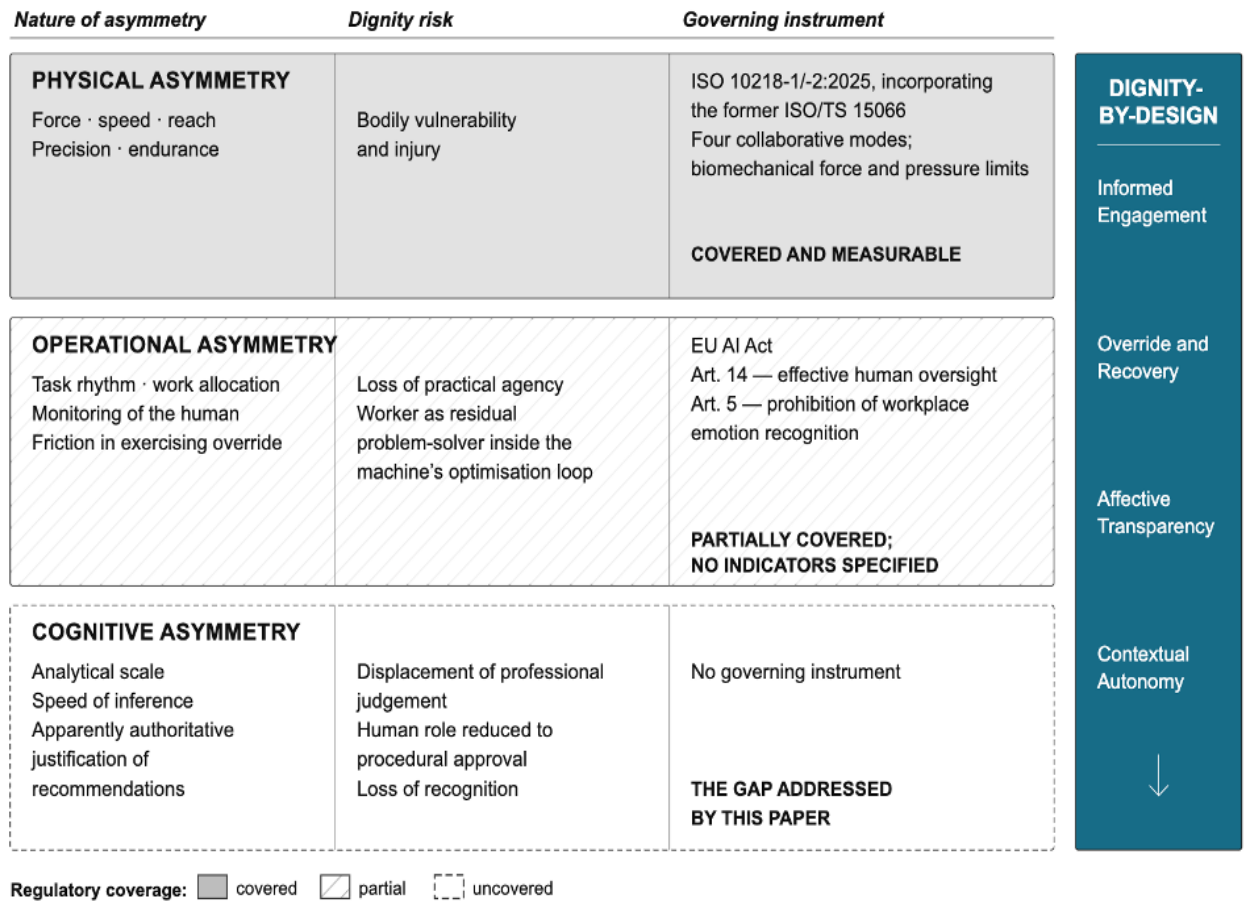
Figure 2.
The four DbD principles mapped onto their normative anchors and onto the corresponding clauses of ISO 10218 and the EU AI Act.
Figure 2.
The four DbD principles mapped onto their normative anchors and onto the corresponding clauses of ISO 10218 and the EU AI Act.
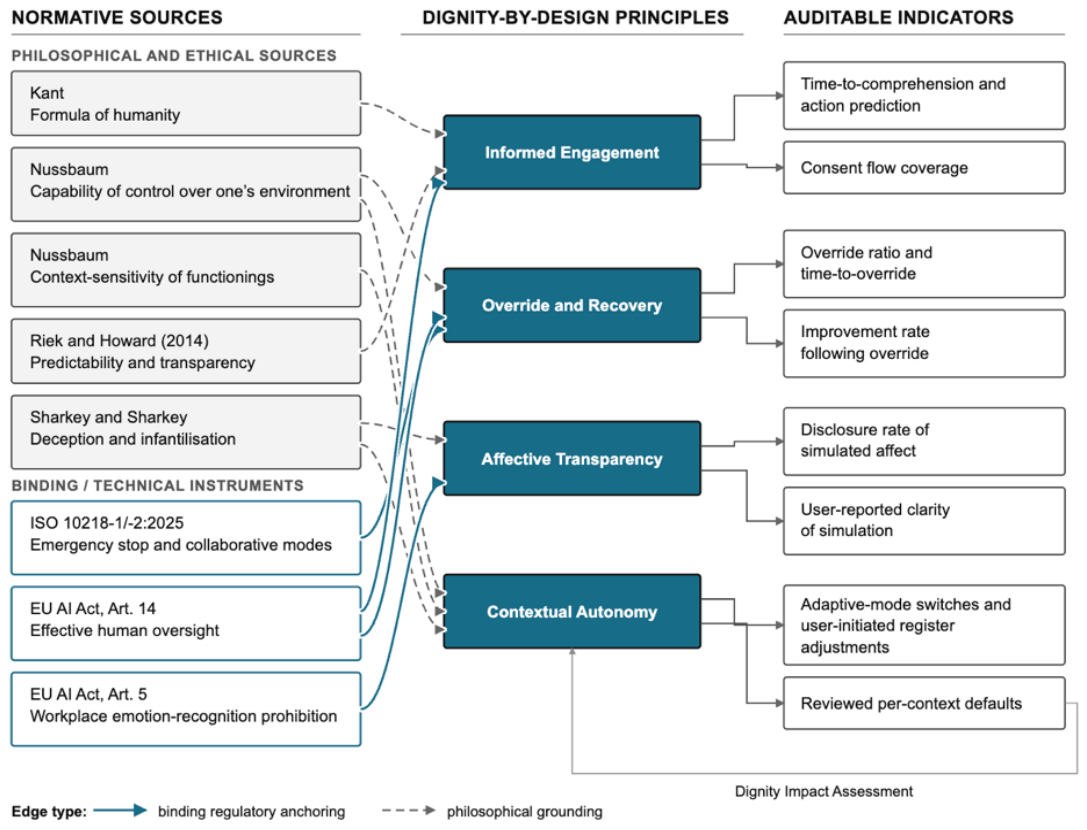
Figure 3.
A common mechanism across three deployments: in each, the indicator moves before the dignity outcome becomes visible.
Figure 3.
A common mechanism across three deployments: in each, the indicator moves before the dignity outcome becomes visible.
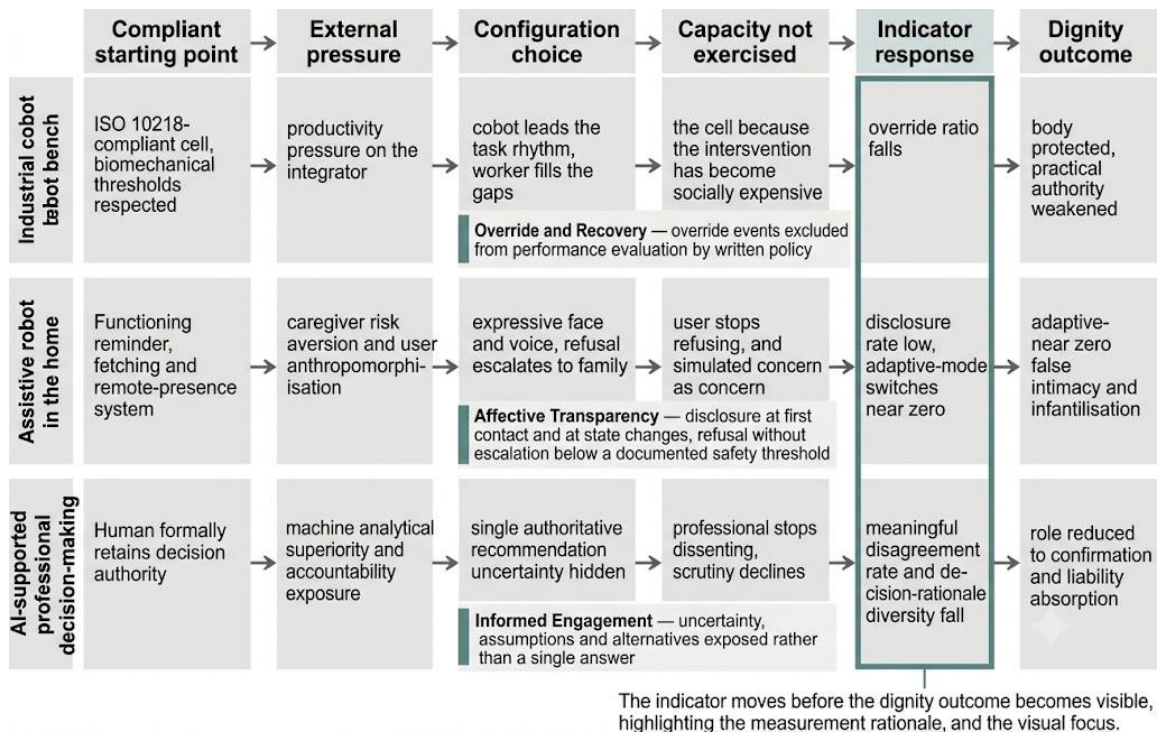
Figure 4.
The Dignity Impact Assessment workflow, from asymmetry mapping through risk identification and mitigation to indicator monitoring, shown against the existing conformity assessment cycle.
Figure 4.
The Dignity Impact Assessment workflow, from asymmetry mapping through risk identification and mitigation to indicator monitoring, shown against the existing conformity assessment cycle.
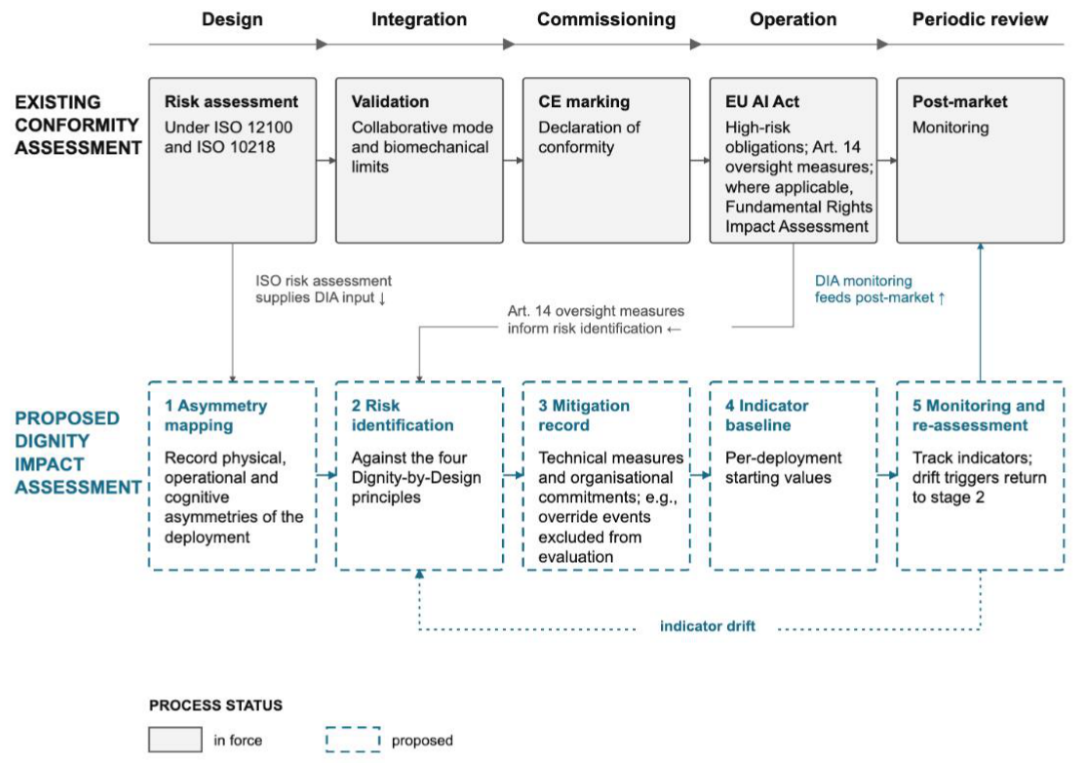

Table 1.
The four DbD principles and their indicators.
| Principle | Working definition | Primary anchor | Indicator |
|---|---|---|---|
| Informed Engagement | Real-time understanding of robot intent, basis and asymmetry | AI Act Art. 14; Riek and Howard 2014 | Time-to-comprehension; action prediction; consent flows |
| Override and Recovery | Penalty-free capacity to halt, question or reverse robot action | ISO 10218; Nussbaum capability of control | Override ratio; time-to-override; improvement after override |
| Affective Transparency | Simulated affect is disclosed, bounded and non-manipulative | Sharkey and Sharkey; AI Act Art. 5 | Disclosure rate; clarity of simulation |
| Contextual Autonomy | Autonomy and social register adapt to context and person | Nussbaum; Sharkey and Sharkey | Adaptive-mode switches; user adjustments; reviewed defaults |
Table 2.
DbD applied to three contrasting deployments.
| Setting | Primary tension | Most-engaged principles | Key indicator | Expected effect |
|---|---|---|---|---|
| Industrial cobot bench | Machine rhythm and competence against worker agency | Informed Engagement; Override and Recovery | Override ratio; consent on affective capture | Agency preserved without hiding asymmetry |
| Assistive robot in the home | Support against infantilisation, dependency and deception | Affective Transparency; Contextual Autonomy | Disclosure rate; adaptive-mode switches | Warmth without false intimacy |
| AI-supported professional decision-making | Machine analytical competence against professional judgement and recognition | Informed Engagement; Override and Recovery; Contextual Autonomy | Meaningful disagreement rate; decision rationale diversity; expert override review | Expertise preserved without denying machine superiority |
Disclaimer/Publisher’s Note: The statements, opinions and data contained in all publications are solely those of the individual author(s) and contributor(s) and not of MDPI and/or the editor(s). MDPI and/or the editor(s) disclaim responsibility for any injury to people or property resulting from any ideas, methods, instructions or products referred to in the content. |
© 2026 by the authors. Licensee MDPI, Basel, Switzerland. This article is an open access article distributed under the terms and conditions of the Creative Commons Attribution (CC BY) license (http://creativecommons.org/licenses/by/4.0/).
Copyright: This open access article is published under a Creative Commons CC BY 4.0 license, which permit the free download, distribution, and reuse, provided that the author and preprint are cited in any reuse.