
Submitted:
28 July 2026
Posted:
29 July 2026
You are already at the latest version
Abstract
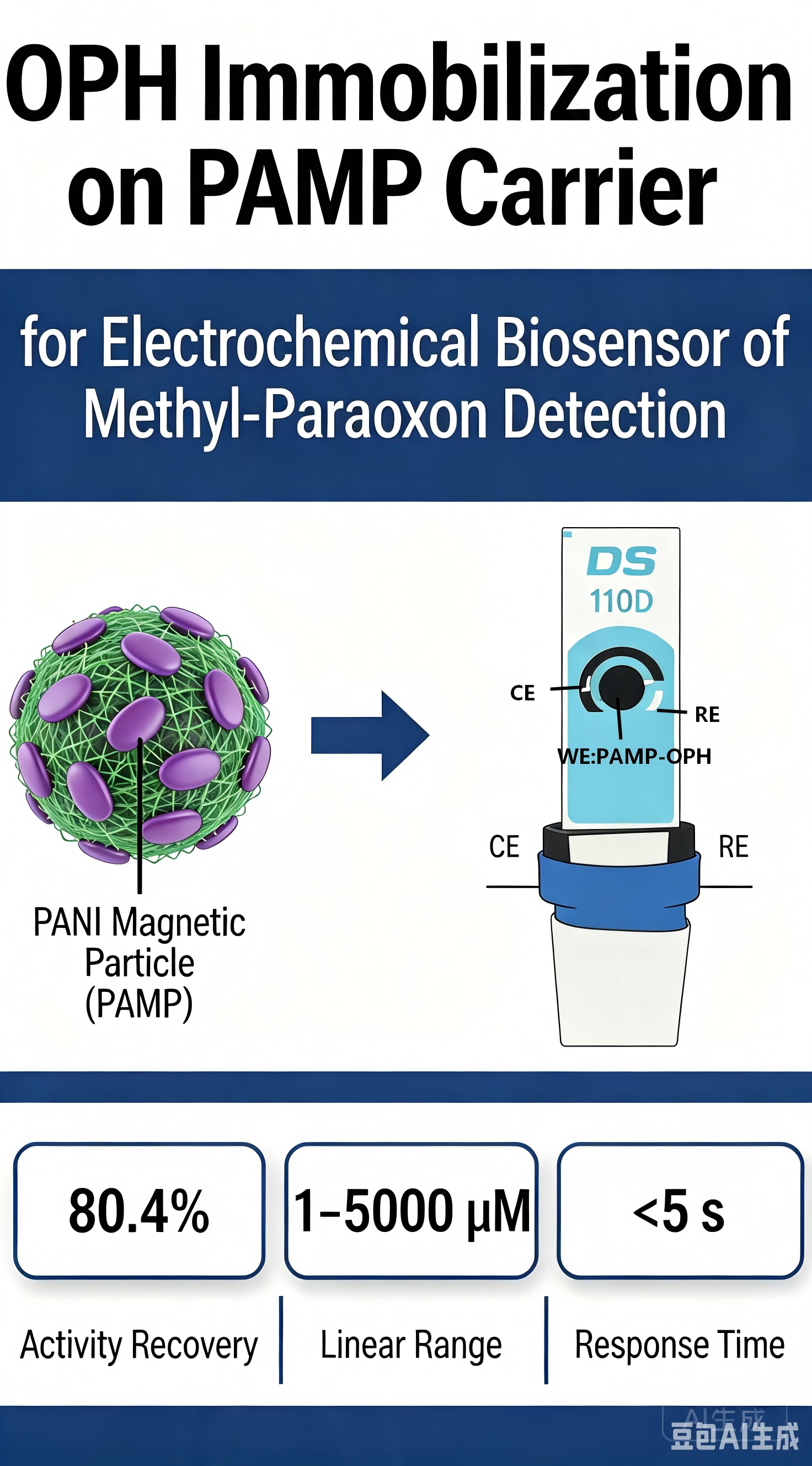
Rapid detection of organophosphorus pesticides (OPs) is urgently needed. A recombinant organophosphorus hydrolase (OPH) was expressed in E. coli and immobilized onto polyaniline nanofibers (PANF) and magnetic particles (PAMP) via adsorption–crosslinking (EAC) or adsorption–precipitation–crosslinking (EAPC). The immobilized OPH was characterized and integrated into an electrochemical biosensor for methyl-paraoxon detection. The EAPC method on PAMP gave the highest activity recovery (80.4%). Immobilized OPH showed optimal activity at pH 11 and 55 °C, with improved thermal stability (50% activity retained after 2 h at 60 °C) and storage stability (>80% after 30 days). The biosensor exhibited a linear response to methyl-paraoxon from 1 to 5000 μmol·L⁻¹ (R² > 0.99), with optimal detection at pH 12 and a scan rate of 150 mV·s⁻¹. The EAPC-PAMP immobilization strategy effectively stabilizes OPH, and the resulting biosensor offers a fast, sensitive, and stable platform for OP residue analysis.
Keywords:
organophosphorus hydrolase
; polyaniline
; enzyme immobilization
; electrochemical biosensor
; methyl-paraoxon
Copyright: This open access article is published under a Creative Commons CC BY 4.0 license, which permit the free download, distribution, and reuse, provided that the author and preprint are cited in any reuse.


