

Submitted:
27 July 2026
Posted:
29 July 2026
You are already at the latest version
Abstract
Radar emitter recognition based on pulse description words (PDWs) serves as a fundamental prerequisite for target identification and tracking in electronic support measures (ESM). Although self-supervised learning (SSL) has been widely applied to text and image tasks, few effective SSL paradigms are available for feature representation of radar PDWs. In this paper, a novel masked representation alignment-based self-supervised learning (SSL-MRA) method is proposed for radar emitter feature learning and recognition. Firstly, a dual-branch Transformer encoder is designed to extract contextual representations from both masked and unmasked tokens. Secondly, a cross-attention Transformer-based predictor is constructed to recover the masked representations from unmasked features. Furthermore, a codebook-based tokenizer is developed to learn discrete representations of masked inputs. Based on the masked prediction mechanism, two pretext tasks are established for the pre-training of SSL-MRA. Specifically, a masked discrete representation alignment task is adopted to replace traditional reconstruction-based pre-training, which implements codebook classification for semantic discretization. Meanwhile, a masked prediction contrastive alignment task is constructed to constrain the high-dimensional semantic consistency of feature embeddings. Experimental results on both simulated and real measured datasets demonstrate that the proposed method achieves superior feature representation capability. It yields an average recognition accuracy of 95.04% on source-domain data, outperforming all baseline methods. Moreover, the proposed SSL-MRA also achieves better cross-domain transfer performance than the mainstream masked autoencoder (MAE) method.
Keywords:
self-supervised learning
; radar emitter recognition
; PDW
; masked representation alignment
1. Introduction
Radar emitter recognition is a core intelligent perception technology in modern electronic support measure (ESM) systems, undertaking key tasks such as electromagnetic signal parsing, emitter attribute identification, and battlefield electromagnetic situation reconstruction [1,2,3]. As standardized quantitative description of radar pulse signals, radar pulse description words (PDWs) record critical pulse parameters, including Radio Frequency (RF), Pulse Width (PW), and Pulse Repetition Interval (PRI), as shown in Figure 1. These multidimensional time-series parameters effectively characterize the operating mechanisms, functional attributes and working states of radar emitters, serving as the dominant data source for radar signal sorting and intelligent recognition [4].
In complex practical electromagnetic battlefield environments, modern multifunctional radars exhibit agile parameter variations, overlapping parameter intervals, and diverse working modes [5]. Meanwhile, complex electromagnetic interference inevitably causes pulse loss, spurious pulse disturbances, and measurement noise in acquired PDW data. These non-ideal factors severely degrade the effective feature distribution of pulse sequences, resulting in low feature discriminability among homogeneous radars and poor robustness of recognition algorithms, which poses substantial challenges for accurate and reliable radar emitter recognition.
With the rapid advancement of deep learning, data-driven radar emitter recognition methods have gradually replaced traditional manual feature extraction and statistical classification algorithms and become the mainstream technical paradigm in this field. Existing intelligent recognition methods [6,7,8] are predominantly built upon supervised learning frameworks, which rely on large-scale labeled PDW datasets to establish end-to-end feature mapping and classification models. Typical supervised networks, including CNN, LSTM, and Transformer have been widely applied to radar signal feature mining and classification, achieving promising performance under ideal experimental conditions. Nevertheless, practical engineering applications reveal two critical limitations of supervised radar recognition methods. On the one hand, most models are trained and validated based on artificially simulated PDW data. Ideal simulation environments cannot fully reproduce the noise distortion, pulse missing, and complex interference characteristics of real measured data, leading to severe domain mismatch between experimental models and practical scenarios [9]. On the other hand, supervised learning models are task-driven and label-dependent with fixed feature learning paradigms. Such models lack adaptive generalization capability for unknown radar types and time-varying electromagnetic environments, inevitably suffering severe performance degradation across different datasets and application scenarios [10].
Self-supervised learning (SSL) enables the learning of generalizable feature representations by constructing effective pretext tasks from inherent data characteristics without relying on task-specific annotations. Therefore, SSL trained on massive unlabeled data has been widely deployed in natural language processing (NLP) and computer vision (CV). In particular, the Masked Autoencoder (MAE) proposed by He et al. [11], built upon the ViT architecture [12] architecture, achieves outstanding fine-tuning and transfer learning performance on the ImageNet dataset. Accordingly, masked modeling techniques [13,14,15] have been gradually introduced into time-series signal analysis tasks, including industrial condition monitoring and physiological signal processing [16]. Recently, researchers have migrated SSL methods from physiological signal analysis to radar signal processing for radar modulation recognition [17,18] and working mode recognition [10]. Most existing studies focus on original I/Q signals, which contain long-duration waveforms, explicit modulation patterns, and periodic characteristics. In contrast, research on SSL-based PDW sequence recognition remains insufficient. Different from conventional I/Q time-series data, radar PDW sequences exhibit shorter temporal lengths, structured parameter distributions, multi-parameter coupling characteristics, and high noise sensitivity. Directly adopting general time-series SSL models for PDW feature learning leads to insufficient feature pertinence, poor robustness, and limited performance improvement in downstream recognition tasks [19].
In view of the above research gaps, this paper proposes a masked representation alignment-based self-supervised learning (SSL-MRA) method for radar emitter recognition. Unlike existing supervised radar recognition schemes and general time-series SSL frameworks, the proposed method designs a dual-branch Transformer encoder to synchronously extract contextual features from both masked and unmasked PDW sequences. Combined with cross-attention Transformer-based masked prediction contrastive alignment and masked discrete representation alignment pretext tasks, the SSL-MRA method enables fine-grained and robust feature learning for radar pulse sequences. Extensive experiments on both simulated and real measured datasets verify that the proposed method achieves superior feature representation capability, better fine-tuning accuracy, and stronger cross-scene generalization than state-of-the-art baseline methods. The main contributions of this paper are summarized as follows:
- (1)
- A dual-branch Transformer encoder architecture is designed for PDW sequence feature extraction, which compensates for incomplete feature mining defects existing in conventional single-branch time-series modeling.
- (2)
- A multidimensional self-supervised pretext task integrating cross-attention prediction and discrete representation alignment is proposed to enhance the discriminability and robustness of PDW feature representations.
- (3)
- The effectiveness and practical superiority of the proposed method are comprehensively validated on both simulated and real measured data, providing a new feasible solution for robust and generalized radar emitter recognition in complex electromagnetic environments.
1.1. Supervised Learning for Radar Emitter Recognition
Supervised deep learning has long served as the dominant technical paradigm for radar emitter recognition. Benefiting from the powerful end-to-end feature learning capacity of deep neural networks, classic supervised architectures including Convolutional Neural Network (CNN), Long Short-Term Memory (LSTM), and Transformer have been extensively deployed for PDW sequence feature extraction and radar recognition tasks [4]. Traditional radar recognition approaches rely on manual feature engineering, which demands specialized domain expertise to extract statistical and transform-domain pulse features, suffering from low feature utilization efficiency and weak environmental adaptability. By contrast, data-driven supervised learning frameworks [6,7,8] can automatically mine latent feature patterns from PDW time-series data, effectively circumventing the drawbacks of handcrafted feature design. In terms of spatial feature extraction, CNN-based models are widely adopted to capture local correlation characteristics of radar pulse data. Researchers convert one-dimensional PDW sequences or raw radar I/Q signals into two-dimensional feature maps, then employ convolution kernels to excavate local spatial distributions of pulse parameters, yielding stable recognition accuracy under conventional single-scene conditions [6]. For time-dependent pulse sequences, LSTM and Gated Recurrent Unit (GRU) networks are leveraged to model temporal dependencies embedded in PDW data, which accurately capture time-varying patterns of RF, PW and PRI parameters and compensate for the limited temporal perception of convolutional models [7]. With advances in sequence modeling, Transformer architectures equipped with multi-head self-attention have been introduced into radar recognition tasks. Such models are capable of capturing global long-range dependencies across pulse sequences and further strengthen the feature representation capacity of long-duration PDW data [8].
Currently, abundant research has greatly advanced the development of supervised radar emitter recognition. Fan [5] constructed a novel feature extraction and clustering framework oriented to multifunctional radar working mode identification, enabling adaptive mining of multi-scale features corresponding to radar working states. Yang [9] integrated deep metric autoencoders into radar open-set recognition, mitigating the challenge of unknown emitter classification to a certain degree. Liu [10] further introduced incremental learning to radar recognition pipelines, supporting continuous learning of unseen radar categories while alleviating catastrophic forgetting. Wang [4] generated 2D feature maps from the distribution properties of pulse sequences and fused local and global segmentation information for classification, achieving state-of-the-art performance on a dataset covering eight types of radar emitters. Despite outstanding classification accuracy achieved on fixed experimental datasets, supervised learning methods suffer from inherent, hard-to-mitigate limitations in practical engineering deployments. First, nearly all supervised models require labeled samples for training. Annotating radar PDW data consumes substantial professional labor and time, leading to a severe shortage of labeled samples in real-world electromagnetic scenarios [20]. Second, supervised models exhibit strong dataset bias; the feature patterns learned within a specific dataset cannot be readily transferred to unseen electromagnetic environments or novel radar types, resulting in poor generalization performance. Third, most training datasets adopted in existing literature consist of idealized simulated data, which fail to replicate complex noise interference and pulse distortion encountered in field measurements, ultimately degrading the practical robustness of deployed models.
1.2. General Time-Series Self-Supervised Pre-Training Methods
Driven by the remarkable feature representation performance of Transformer [21], BERT [22,23], ViT [12], and MoCo [24], a spectrum of classic self-supervised learning (SSL) paradigms have been proposed for natural language processing (NLP) and computer vision (CV), including masked modeling [11,13,14,15], contrastive learning (CL) [25,26,27,28,29], and autoregressive prediction [30,31,32].
Masked modeling, represented by the masked autoencoder (MAE) [11], implements unsupervised learning by randomly masking partial data tokens and reconstructing the missing information. This mechanism effectively excavates local and global structural correlations within time-series data and yields robust feature embeddings. For example, Cheng et al. [13] devised a decoupled masked autoencoder for time-series representation based on MAE, and validated its superior feature learning and transfer capabilities on multiple public benchmarks in 2022. In 2024, Wang [15] presented a lightweight SSL framework customized for multi-lead ECG signals. The framework optimizes segment-wise masked pre-training via fluctuated reconstruction targets and layered regularization strategies, effectively alleviating data redundancy and overfitting risks for ECG recordings. Contrastive learning [28] generates positive and negative sample pairs through data augmentation, and learns discriminative embeddings by minimizing feature distances between positive pairs while maximizing distances between negative pairs. This paradigm demonstrates prominent advantages in small-sample and cross-domain learning tasks. Hu [14] combined MAE and contrastive learning to build a spatio-temporal representation alignment framework for EEG sequence classification. Autoregressive SSL models adopt sequential prediction as the pretext task to simulate temporal evolution patterns of time-series signals, making them well-suited for modeling sequences with long-range dependencies [32]. Wang et al. [30] proposed TimeDART, a unified self-supervised pre-training framework for time series. It integrates autoregressive Transformer modeling and patch-level denoising to capture both long-term temporal trends and subtle local variations. Extensive forecasting and classification experiments on multiple public datasets verify that TimeDART outperforms mainstream SSL baselines. Liu et al. [31] put forward a decoder-only large time-series foundation model, which unifies forecasting, missing value imputation and anomaly detection into autoregressive generative tasks and achieves competitive cross-domain generalization performance. Although representative works such as TimeMAE, EEGPT, TimeDART and Timer attain promising results on general sequential datasets, few of them introduce targeted optimizations to accommodate the unique properties of radar PDW time series, including multi-parameter coupling and severe noise contamination.
1.3. Self-Supervised Pre-Training Methods for Radar Signal
As self-supervised learning has achieved extraordinary success in generic time-series modeling, researchers have begun to explore SSL applications in radar signal processing, covering I/Q signal representation learning, modulation recognition, and radar emitter classification. Such methods leverage massive unlabeled radar data for model pre-training, aiming to address the scarcity of annotated samples and weak generalization plaguing traditional supervised algorithms.
For instance, Wang [18] proposed a diffusion-based self-supervised pre-training scheme for raw radar I/Q signals, which enables unsupervised feature learning for microwave waveforms and improves model adaptability to signal amplitude and phase fluctuations. Liu [17] adopted contrastive SSL to tackle radar modulation recognition tasks, significantly boosting the anti-interference capacity of models under complex electromagnetic clutter. Zhou [33] pioneered the application of autoregressive SSL to radar modulation identification, realizing effective representation learning for I/Q data and opening a new research direction for SSL-driven intelligent radar signal processing. Zhang et al. [19] further developed feature-aligned self-supervised learning for radar open-set recognition, enhancing the model’s ability to distinguish unseen radar emitters. Ren et al. [34] proposed GAE, an improved MAE pre-training architecture tailored to PDW data. The method converts PDW sequences into two-dimensional images for training, and experimental results confirm that GAE delivers stronger radar emitter recognition performance than vanilla MAE. Nevertheless, most existing SSL solutions for radar signals have two obvious limitations. First, the majority of studies focus on low-level I/Q waveforms or simply convert PDW sequences into static images. Second, these works rely on a single pretext task for optimization. Such designs fail to extract robust discriminative features from noisy, multi-parameter coupled PDW sequences collected in complex electromagnetic environments.
2. Materials and Methods
We propose a masked representation alignment-based self-supervised learning method for radar emitter recognition, whose overall architecture is depicted in Figure 2. First, a preprocessing and embedding module converts the input multi-parameter PDW sequences into masked and visible high-dimensional embeddings. Next, a dual-branch contextual feature representation module learns feature representations for the two groups of embeddings. Finally, the masked prediction representation module and masked discrete representation module jointly act as dual pretext tasks to optimize the self-supervised model.
2.1. Data Preprocessing and Embedding
Restricted by inconsistent receiving hardware, complex electromagnetic environments and diverse pulse sorting algorithms, raw measured radar PDW sequences suffer from uneven sequence lengths and inconsistent feature dimensions. Hence, all PDW samples require unified standardization and normalization before network input. In this work, cyclic padding and cropping operations are adopted to unify variable-length PDW sequences into a fixed dimension of , where 64 denotes the sequence length and 3 stands for the number of pulse parameters. The three dimensions correspond to Pulse Repetition Interval (PRI), Radio Frequency (RF), and Pulse Width (PW), respectively. PRI and PW are uniformly converted to microseconds (s), while RF is scaled to megahertz (MHz). Afterwards, a hybrid normalization strategy combining Min-Max scaling and independent dimension normalization is utilized to map all three parameter dimensions into the range .
In the embedding stage, sliding window segmentation is applied to split each 64-length standardized sequence into non-overlapping patches. A one-dimensional convolutional layer is then used to extract cross-channel local embeddings for each patch. Afterwards, a random masking strategy with a masking ratio of 50% is implemented to generate visible unmasked embeddings and masked embeddings . Under sufficient training iterations, this design guarantees that each patch shares an equal probability of being masked.
2.2. Feature Representation Learning
2.2.1. Masked Prediction Feature Alignment
Typically, self-supervised learning based on masked model will introduce additional masked information into the embedding computation during pre-training stage. However, the training data used in the fine-tuning stage lacks a masking strategy, and the optimization objectives differ between the two stages, leading to inconsistent learning goals at different stages. Thus, we employ a dual-branch vanilla Transformer encoder module to separately learn masked feature representations and unmasked feature representations .
where and denote masked embeddings and ummasked embeddings, stands for positional encoding, and refers to the momentum encoder.
The core insight of representation learning lies in the fact that latent spaces capturing intrinsic data distributions possess far lower dimensionality than raw input spaces. Latent embeddings can highlight meaningful temporal patterns embedded in time-series inputs while suppressing irrelevant measurement noise. To realize this property, leveraging the consistency of deep feature space representations to construct pretext tasks for self-supervised learning is a significant approach. Thus, we predict new feature representation of masked masked region based on the feature representation from visible parts learned by the encoder, while ensuring that the predicted masked features remain consistent with the original masked feature representations learned by the momentum encoder.
Specifically, a cross-attention Transformer module takes unmasked features and mask position information as inputs to reconstruct masked representations. We reinitialize a masked feature vector based on the masked position as the prediction target, and then use it as the query of the cross-attention transformer. In addition, we construct the value and key from the feature representation of the visible input part. Then, we can obtain the masked prediction feature representation through the cross-attention transformer module. Through the above operations, we obtained mask feature representations from two different views, thus enabling feature representation alignment using contrastive learning. The core principle of contrastive learning is to narrow the embedding distance between positive sample pairs and enlarge the gap between negative pairs. Differently, we only align positive sample pairs constructed by the masked prediction feature representation and its raw masked feature representation learned by momentum encoder without considering negative sample pairs. Since the masked feature representations from momentum encoder and predictor are both continuous latent vectors, we use mean squared error (MSE) loss to form the feature prediction alignment optimization objective shown in Equation (4).
where the denotes the stacked cross-attention and feed-forward layers. is the predicted masked feature from the predictor, and is the original masked feature extracted by the momentum encoder.
We implement a gradient-stop strategy on the momentum encoder, whose weights are updated via a moving average (MA) rule throughout pre-training. The detailed update rules for the momentum encoder and encoder are formulated as follows:
where is a momentum coefficient for the momentum-based moving average. With a large value of , the momentum encoder slowly approximates the encoder. For proposed method, we find performs effectively. Further, ∇ is the gradient and denotes the learning rate for stochastic optimization. As shown in Equation 8, the direction of updating completely differs from that of updating the . Finally, converges to equilibrium by the slow-moving average. At each training iteration, only the encoder and the predictor receive gradient updates derived from alignment loss. This asymmetric update mechanism effectively prevents model collapse..
During fine-tuning, only the vanilla Transformer encoder is retained to extract feature representations from complete PDW sub-sequences, whose outputs are fed into the classification head for downstream emitter recognition. The momentum encoder is discarded at this stage, ensuring masked representations are decoupled from unmasked information for stable inference.
2.2.2. Masked Discrete Feature Alignment
Conventional masked self-supervised learning (SSL) paradigms solely rely on reconstruction loss as their core optimization objective. Under this training target, the encoder is forced to prioritize pixel-level or token-level recovery of raw input PDW sequences, and the learned feature representations tend to overfit trivial noise and measurement interference unique to the training dataset rather than extracting discriminative semantic patterns related to radar emitter categories. When transferred to downstream radar recognition tasks, such noise-biased embeddings often converge to suboptimal solutions and degrade the model’s classification accuracy, especially on real measured PDW data contaminated by pulse loss and complex electromagnetic clutter.
To address this inherent limitation of single reconstruction loss, we draw inspiration from vector quantization (VQ) theory proposed in [35] and designed an end-to-end learnable tokenizer module. This module bridges continuous latent feature space and discrete semantic space, converting dense feature representations extracted from masked PDW sub-sequences into sparse, interpretable discrete codewords without introducing extra offline clustering steps. The core of the tokenizer is a learnable codebook embedding matrix , which stores K trainable latent prototype vectors with dimension d identical to the embedding size of PDW sub-sequences.
During the pre-training forward propagation, two groups of masked feature vectors are simultaneously fed into the tokenizer: the original masked embedding generated from the preprocessing module, and the predicted masked representation output by the cross-attention predictor branch. For each input sub-sequence vector, we calculate its similarity to every prototype vector in the codebook via cosine similarity, a metric insensitive to vector magnitude and suitable for measuring the matching degree of temporal feature distribution of multi-parameter PDW data. Each masked vector is then mapped to the codeword with the highest similarity score, and the corresponding serial number of this optimal codeword is recorded as the token index . Each discrete codeword corresponds to a typical temporal pattern of PDW sub-sequences formed by the coupling of PRI, RF and PW multi-dimensional pulse parameters. Therefore, the matched token indices naturally serve as intrinsic self-supervised supervision signals that reflect the inherent structural characteristics of masked PDW segments.
On this basis, we construct the masked discrete representation alignment optimization objective , as formulated in Equation (10). This loss adopts cross entropy to constrain the token indices assigned to the predicted representation and the original masked embedding to be consistent. By minimizing the cross entropy loss between two sets of token labels, the model is guided to learn discrete embeddings with strong category discrimination, which complements the continuous feature alignment loss of the prediction branch and further improves the robustness of PDW feature representation under noisy real measurement environments.
where the operator represents the cosine distance, and is the vector of codebook embedding. The non-differentiable argmax mapping is resolved via the straight-through estimator (STE) [36].
During training, the update of the prototypes is carried out using the exponential moving average (EMA) algorithm as formulated in the Equations (11a–11c). At training step t, each prototype is updated by weighting the closest input vectors at the current step and its historical value from step . counts the total number of patches assigned to prototype i, accumulates weighted feature sums, and is the EMA discount factor.
2.3. Model Optimization Objectives
In the pre-training phase, the model is jointly optimized with mask prediction feature alignment loss and masked discrete feature alignment loss. The overall pre-training loss is defined as:
where is a hyperparameter to balance the two loss terms.
In the fine-tuning stage, we directly input the embedding vectors of all the radar PDW sub-sequences into the vanilla Transformer encoder, and then followed a prediction head to achieve the recognition of radar emitter. As shown in Equation 13 and Equation 14, we utilize the cross-entropy loss between the radar type labels and predict results to optimize the parameters from encoder and prediction layer.
where is the ground-truth emitter category label of the sample, and represents the classification prediction head.
2.4. Dataset Description and Implementation Details
To evaluate the cross-domain transferability of the proposed SSL-MRA, this paper conducts comprehensive experiments on four benchmark datasets for pre-training and downstream recognition task fine-tuning. These include one simulated dataset SD5 and three real measurement dataset RD13, RD14 and RD11.
- (1)
- Simulated Data (SD5): A simulated radar PDW dataset synthesized with measured noise, pulse lost, and spurious pulse. It contains 5 radar types, with each radar type containing 20,000 PDWs of a fixed length of 64.
- (2)
- Real Data (RD13): A real measured radar PDW dataset acquired via a single-satellite localization system. It contains 13 shipborne radar types, totaling 23,644 samples, with lengths ranging from 33 to 200.
- (3)
- Real Data (RD14): A real measured radar PDW dataset acquired via a single-satellite localization system. It contains 14 land-based radar types, totaling 19799 samples, with lengths ranging from 33 to 200.
- (4)
- Real Data (RD11): A real measured radar PDW dataset acquired via a multi-satellite time difference of arrival localization system. It contains 11 shipborne radar types, totaling 12,569 samples, with lengths ranging from 15 to 1,094.
Four distinct datasets are utilized for pre-training and fine-tuning. The input length of radar PDW is 64, the patch size is 4, and the masking ratio is set to 50%. The dual-path transformer encoder contains 8 attention heads and 16 layers with total 64 embedding dimensions. The predictor is consisted of 8 cross attention layers, and the codebook’s size is set to 256. The hyperparameters for the masked prediction alignment loss and masked discrete alignment loss are set to 1 and 0.2, respectively. Both pre-training and fine-tuning employ the Adam optimizer with an initial learning rate of 1e-3, and a step decay of learning rate is applied with a step size of 100 during fine-tuning. All experiments are built and trained in the Pycharm compiler and pytorch deep learning environment on an Inspur server equipped with a single H100 80GB GPU and an i9-13900K CPU.
3. Results
We compare the proposed SSL-MRA method with mainstream contrastive self-supervised frameworks (MoCo [24]), two state-of-the-art time-series self-supervised models (1D-MAE [14], TimeDART [30]), as well as two classic supervised baselines (vanilla Transformer [21], ResNet-50 [37]). In addition, ablation experiments are conducted to evaluate the effectiveness of the two core components in our framework, namely the masked prediction alignment module and masked discrete alignment module.
- Resnet 50: A standard 50-layer convolutional neural network designed to extract spatial feature maps from transformed PDW sequences.
- Transformer: Basic self-attention architecture adopted as the supervised baseline, without customized time-series pretext tasks.
- TimeDART: Autoregressive generative self-supervised framework dedicated to time-series pre-training.
- MoCo: Momentum-based contrastive learning paradigm for unsupervised discriminative feature learning.
- 1D-MAE: One-dimensional masked autoencoder specially optimized for sequential signal representation learning.
3.1. Comparison Experiments
3.1.1. Comparison of Source-Domain Classification Performance
To quantitatively evaluate the performance of the proposed self-supervised learning framework for radar emitter recognition, we first report the recognition accuracy on the source domain of all datasets and conduct comprehensive comparisons with multiple mainstream deep learning baselines. The recognition accuracy of our SSL-MRA and all competing methods on the downstream radar identification task is summarized in Table 1.
Overall, the proposed SSL-MRA achieves an average accuracy of 95.17% across the four datasets, surpassing all comparative approaches. For the simulated dataset SD5, the best-performing supervised baseline (Transformer) only attains 91.50%, whereas our SSL-MRA reaches 99.20%. This remarkable gain outperforms both self-supervised competitors (TimeDART, MoCo, 1D-MAE) and supervised models (Transformer, ResNet-50). For the three real measured datasets RD13, RD14 and RD11, the recognition accuracy of ResNet-50 and Transformer drops below 85%. TimeDART yields accuracy lower than 80% on all real datasets. MoCo achieves 90% accuracy on RD13, while 1D-MAE obtains 97.23%, 92.45% and 83.25% on RD13, RD14 and RD11 respectively. Notably, our SSL-MRA hits 87.15% on RD11, nearly 4 percentage points higher than 1D-MAE. Furthermore, SSL-MRA attains state-of-the-art accuracy on both RD13 and RD14 among all evaluated methods.
3.1.2. Comparison of Cross-Domain Generalization Performance
To evaluate the cross-domain generalization capability of the proposed SSL-MRA, we perform pre-training on each of the four datasets individually and test the recognition performance on unseen target domains under different transfer settings. We further benchmark our approach against 1D-MAE as the primary comparison baseline.
As illustrated in Figure 3(a), when pre-trained on SD5, RD14 and RD11 and fine-tuned on RD13, our method achieves transfer recognition accuracy above 95% across all three source domains, consistently exceeding the performance of 1D-MAE. Particularly, pre-training on RD11 yields an accuracy of 96.77% for our model, which outperforms 1D-MAE by a substantial margin of 13%. Figure 3(b) reports the cross-domain results with RD14 as the target dataset. Although both methods attain accuracy higher than 90%, SSL-MRA surpasses 1D-MAE by roughly 2% to 5% under all source-domain configurations. For RD11 as the target domain (Figure 3(c)), transfer accuracy stays below 80% for 1D-MAE when pre-trained on RD13 and RD14. In contrast, our SSL-MRA reaches 86.21% and 83.22% respectively, delivering clear performance improvements over the baseline. Furthermore, we construct a mixed training set combining RD13, RD14 and RD11 for supplementary pre-training, followed by fine-tuning on each individual real-measured dataset. This multi-source pre-training scheme further boosts radar emitter classification accuracy, with the highest transfer accuracy of 89.52% obtained on RD11.
3.2. Ablation Study
We conduct ablation experiments to investigate the individual contributions of the two proposed self-supervised pretext losses to downstream radar emitter recognition accuracy. Four experimental setups are designed for comparison:
- (1)
- Scratch: The model is trained from scratch without pre-trained weights or any self-supervised pretext tasks.
- (2)
- w/o MPA: Pre-training is performed while removing the Masked Prediction Alignment (MPA) loss.
- (3)
- w/o MDA: Pre-training is performed while removing the Masked Discrete Alignment (MDA) loss.
- (4)
- with all: Full pre-training equipped with both MPA and MDA losses.
Detailed quantitative results are summarized in Table 2. When trained from scratch, the model achieves less than 95% accuracy on the simulated dataset SD5, and merely 76.88% on the real measured dataset RD11. By contrast, pre-training with either MPA or MDA alone yields consistent accuracy gains across all datasets. When only MDA is activated, the model obtains 95.85% on RD13 and 93.57% on RD14, with RD11 accuracy rising to 83.00%. When only MPA is adopted, clear performance improvements are also observed on RD13 and RD14; especially on RD11, the accuracy reaches 86.36%, nearly 10 percentage points higher than the scratch training baseline. When MPA and MDA are jointly optimized as dual pretext objectives, the model achieves further accuracy improvements, hitting 99.20% on SD5 and the peak value of 87.15% on RD11. These ablation results verify that the two proposed masked representation alignment losses based on deep latent features are critical for boosting the classification performance of downstream radar emitter recognition tasks.
3.3. Analysis of Mask Ratio and Patch Size
We perform supplementary ablation experiments on three real measured datasets to investigate how mask ratio and patch size affect the final recognition performance, with quantitative results visualized in Figure 4.
Figure 4 (a) reports the classification accuracy under five different mask ratios: 20%, 30%, 40%, 50% and 60%. For RD13 and RD14, the model maintains accuracy above 98% and 95% respectively when the mask ratio ranges from 40% to 60%, and the peak performance is consistently attained at a mask ratio of 50%. For RD11, the highest accuracy of 87.15% is also achieved with a 50% mask ratio. By comparison, lower mask ratios (20% and 30%) lead to obvious accuracy degradation across all three datasets. Accordingly, we fix the mask ratio to 50% in all subsequent experiments.
With the mask ratio fixed at 50%, we further test patch sizes of 1,2,4,8,16 to analyze their influence on recognition capability. As presented in Figure 4 (b), patch sizes of 2 and 4 enable RD13 to exceed 98% accuracy, where size 4 delivers the optimal performance. For RD14, the maximum accuracy also appears at patch size 4. In contrast, RD11 achieves its best recognition result when the patch size is set to 2. Overall, patch sizes 2 and 4 yield competitive classification accuracy on all datasets. To strike a balance between recognition accuracy and computational overhead, we adopt 4 as the final patch size throughout our model.
3.4. Feature Representation Visualization at Different Training Stages
We adopt a mixed pre-training strategy combining all three real measured datasets and utilize t-SNE [38] to visualize deep feature embeddings output by the Transformer encoder at three training stages: randomly initialized state (without pre-training), post-pre-training, and post-fine-tuning optimized for radar emitter recognition. Each row of subplots in Figure 5 sequentially presents embedding results of the initial stage, pre-trained stage, and fully fine-tuned stage.
The visualization reveals that features of distinct radar emitter types are heavily overlapped and indistinguishable under random initialization. After self-supervised pre-training, the encoder yields embeddings with preliminary inter-class separability in the latent space. After downstream fine-tuning, the feature discrimination is further enhanced: inter-cluster distances between different radar categories are enlarged, while intra-class feature distributions become tighter and more compact. Overall, the t-SNE results verify that the proposed self-supervised pre-training effectively excavates intrinsic structural patterns of PDW data. Subsequent task-specific fine-tuning further refines discriminative latent representations, laying a solid foundation for accurate radar emitter classification.
4. Discussion
Comprehensive experiments verify the effectiveness of the proposed masked representation alignment-based SSL-MRA for radar emitter recognition. Our core hypothesis is that joint Masked Prediction Alignment (MPA) and vector-quantized Masked Discrete Alignment (MDA) extract more robust PDW semantic features than single masked reconstruction used in conventional time-series SSL models like 1D-MAE and TimeMAE. Source-domain results strongly support this claim: SSL-MRA achieves state-of-the-art average accuracy on simulated and real measured datasets against mainstream supervised and self-supervised baselines. Most existing radar SSL methods rely on a single pretext task such as autoregressive prediction or simple reconstruction, which easily overfits dataset-specific noise and fails to separate radar category features from interference. By contrast, our dual losses jointly regularize temporal consistency and discrete semantic clustering, bringing consistent accuracy gains across all four datasets. This aligns with prior research showing multi-objective SSL improves discriminability for multi-parameter time series. Cross-domain transfer experiments confirm the dual-branch momentum update and learnable discrete codebooks learn domain-invariant features to mitigate simulation-real distribution shifts. Traditional single-encoder MAE variants suffer severe generalization degradation on unseen measured data. Our slow EMA-updated momentum encoder stabilizes latent prototypes, while discrete token mapping suppresses domain-specific noise. SSL-MRA consistently outperforms 1D-MAE by a large margin across all transfer settings, consistent with contrastive learning findings that momentum branches boost cross-domain generalization.
Notably, performance degrades on RD11, as fixed-length cropping removes its unique long-range pulse patterns. Most prior PDW recognition works ignore this information loss when unifying sequence lengths. Ablation results prove MPA and MDA are mutually complementary; removing either loss weakens inter-class feature separation, while their joint optimization fills the gap of missing multi-dimensional alignment constraints in existing PDW SSL methods. Models trained from scratch perform far worse, confirming SSL pre-training unlocks valuable information from unlabeled radar pulses. Hyperparameter ablation justifies our 50% mask ratio and patch size 4, balancing sufficient masked supervision and complete local multi-parameter coupling, consistent with optimal settings reported in masked time-series modeling literature.
Beyond radar emitter recognition, our work delivers practical value for ESM systems. Battlefield environments produce abundant unlabeled PDW data yet lack high-quality annotations. Unlike label-dependent supervised models, SSL-MRA pre-trains solely on unlabeled pulses with strong cross-domain robustness, drastically reducing manual labeling costs for field-deployed ESM devices. Moreover, the dual masked alignment pipeline generalizes to other multivariate pulse sequence tasks, including communication signal sorting and multi-sensor pulse identification.
However, our work has several limitations to address in future work. First, fixed-length preprocessing truncates long-range temporal dependencies; we will design adaptive variable-length patch segmentation to retain full pulse context. Second, static EMA codebook updates cannot handle imbalanced radar categories, so dynamic clustering strategies will be explored as alternatives. Long-term follow-up research will integrate continual learning to realize open-set recognition of novel unknown radar emitters without full retraining, adapting to dynamically changing complex electromagnetic battlefields.
5. Conclusions
This paper proposes a masked representation alignment-based self-supervised learning framework (SSL-MRA) to extract discriminative feature representations and realize accurate radar emitter recognition based on multi-parameter PDW sequences. The proposed SSL-MRA architecture is constructed with a dual-branch Transformer encoder, cross-attention masked predictor and learnable discrete tokenizer, which jointly realizes two mutually complementary self-supervised pretext tasks, namely masked prediction alignment (MPA) and masked discrete alignment (MDA). The MPA task enforces continuous feature consistency between masked tokens and predicted latent embeddings, while the MDA task leverages vector quantization to build discrete semantic supervision signals, which jointly drive the model to capture robust multi-parameter coupling patterns hidden in noisy PDW time series. Extensive experiments conducted on one simulated dataset and three real measured radar datasets comprehensively verify the superiority of SSL-MRA. Compared with classic supervised models (ResNet-50, vanilla Transformer) and mainstream self-supervised time-series baselines (MoCo, 1D-MAE, TimeDART), our method achieves state-of-the-art average recognition accuracy on source-domain tasks. Meanwhile, cross-domain transfer experiments demonstrate that SSL-MRA possesses stronger domain generalization capability than conventional MAE-based pre-training methods, effectively alleviating the severe distribution mismatch between simulated training samples and real measured radar data.
Nevertheless, the current preprocessing pipeline relies on fixed-length cropping to unify the length of input PDW sequences, which inevitably truncates long-range temporal pulse correlation information and causes irreversible feature loss. Therefore, designing flexible adaptive encoding and segmentation strategies to preserve the complete temporal context of raw variable-length PDW sequences is expected to further improve the feature extraction and generalization performance of the pre-trained model.
Funding
This research was funded by Outstanding Member of Youth Innovation Promotion Association of Chinese Academy of Sciences grant number Y2022052.
Abbreviations
The following abbreviations are used in this manuscript:
| SSL | Self-supervised learning |
| PDW | Pulse description word |
| ESM | Electronic Support Measures |
| MRA | Masked representation alignment |
| PRI | Pulse repetition interval |
| RF | Radio frequency |
| PW | Pulse width |
| NLP | Natural language processing |
| CV | Computer vision |
| CL | Contrastive learning |
| STE | Straight through estimator |
| MAE | Masked autoencoder |
| VQ | Vector quantization |
| EMA | Exponential moving average |
| MPA | Masked prediction alignment |
| MDA | Masked discrete alignment |
References
- Zhou, Z.; Fu, X.; Dong, J.; Gao, M.; Lang, P. Divergence-based pulse group extracting and inter-pulse modulation parameter estimation of multifunction radar pulse sequences. Signal Process. 2025, 110388. [Google Scholar]
- Chen, T.; Tian, H.; Liu, Y.; Xiao, Y.; Yang, B. Radar signal intra-pulse modulation recognition based on point cloud network. IEEE Signal Process. Lett. 2024, 32, 596–600. [Google Scholar]
- Chen, T.; Yang, B.; Guo, L. Radar pulse stream clustering based on MaskRCNN instance segmentation network. IEEE Signal Process. Lett. 2023, 30, 1022–1026. [Google Scholar] [CrossRef]
- Wang, J.; Wang, H.; Xu, K.; Mao, Y.; Xuan, Z.; Tang, B.; Wang, X.; Mu, X. Visualization and classification of Radar Emitter Pulse Sequences based on 2D feature map. Phys. Commun. 2023, 61, 102168. [Google Scholar] [CrossRef]
- Fan, R.; Zhu, M.; Zhang, X. Multivariate time series feature extraction and clustering framework for multi-function radar work mode recognition. Electronics 2024, 13, 1412. [Google Scholar] [CrossRef]
- Xiao, Y.; Wang, B.; Yu, X.; Jiang, Y. Radar emitter individual recognition based on dual-path CNN and feature fusion. J. Electron. Inf. Technol. 2024, 46, 3238–3245. [Google Scholar] [CrossRef]
- Zhou, D.; Lu, Y.; Ruan, H.; Sha, M.; Fu, Y. Radar signal pulse train recognition with dual-branch LSTM-transformer networks. IEEE Access 2025, 13, 112456–112465. [Google Scholar] [CrossRef]
- Wang, G.; Huang, Y.; Wang, X.; Tang, Y. A Novel Representing Method of Radar Emitter PDWs Based on Non-Uniform Encoding. In Proceedings of the 2024 6th International Conference on Electronic Engineering and Informatics (EEI); IEEE, 2024; pp. 1766–1770. [Google Scholar]
- Yang, C.; Liu, H.; Yang, S.; Feng, Z.; Tang, X.; Zhang, F. Open-set radar emitter recognition via deep metric autoencoder. IEEE Internet Things J. 2024, 11, 18281–18291. [Google Scholar] [CrossRef]
- Liu, L.; Tian, T.; Chen, B.; Zhou, F. Continual Learning Method for Multi-Functional Radar Working Modes Recognition via CILCER-PDW. In Proceedings of the 2025 IEEE 15th International Conference on Signal Processing, Communications and Computing (ICSPCC); IEEE, 2025; pp. 1–5. [Google Scholar]
- He, K.; Chen, X.; Xie, S.; Li, Y.; Dollár, P.; Girshick, R. Masked autoencoders are scalable vision learners. In Proceedings of the Proceedings of the IEEE/CVF conference on computer vision and pattern recognition, 2022; pp. 16000–16009. [Google Scholar]
- Chen, X.; Xie, S.; He, K. An empirical study of training self-supervised vision transformers. In Proceedings of the Proceedings of the IEEE/CVF international conference on computer vision, 2021; pp. 9640–9649. [Google Scholar]
- Cheng, M.; Tao, X.; Liu, Z.; Liu, Q.; Zhang, H.; Zhang, R.; Chen, E. Timemae: Self-supervised representations of time series with decoupled masked autoencoders. In Proceedings of the Proceedings of the Nineteenth ACM International Conference on Web Search and Data Mining, 2026; pp. 498–508. [Google Scholar]
- Hu, R.; Chen, J.; Zhou, L. Spatiotemporal self-supervised representation learning from multi-lead ECG signals. Biomed. Signal Process. Control 2023, 84, 104772. [Google Scholar] [CrossRef]
- Wang, G.; Liu, W.; He, Y.; Xu, C.; Ma, L.; Li, H. Eegpt: Pretrained transformer for universal and reliable representation of eeg signals. Adv. Neural Inf. Process. Syst. 2024, 37, 39249–39280. [Google Scholar] [CrossRef]
- Jiang, Y.; Zhang, H.; Wang, Y. Self-supervised representation learning for industrial sensor time series. IEEE Internet Things J. 2023, 10, 13245–13254. [Google Scholar]
- Li, S.; Du, X.; Cui, G.; Chen, X.; Zheng, J.; Wan, X. Radar signal modulation recognition with self-supervised contrastive learning. IEEE Geosci. Remote Sens. Lett. 2024, 21, 1–5. [Google Scholar] [CrossRef]
- Wang, H.; Zhao, J.; Sun, B. Diffusion-based self-supervised pre-training for radar I/Q signal representation. IEEE Signal Process. Lett. 2025, 32, 456–460. [Google Scholar]
- Zhang, L.; Liu, S.; Wu, Y. Self-supervised feature alignment learning for radar emitter open-set recognition. Remote Sens. 2024, 16, 2158. [Google Scholar]
- Su, D.; Cao, G.; Wang, Y.; Wang, H.; Ren, H. Deep learning methods for radar emitter recognition with limited samples: A review. Comput. Sci. 2022, 49, 226–234. [Google Scholar]
- Vaswani, A.; Shazeer, N.; Parmar, N.; Uszkoreit, J.; Jones, L.; Gomez, A.N.; Kaiser; Polosukhin, I. Attention is all you need. Adv. Neural Inf. Process. Syst. 2017, 30. [Google Scholar]
- Alaparthi, S.; Mishra, M. Bidirectional Encoder Representations from Transformers (BERT): A sentiment analysis odyssey. arXiv 2020, arXiv:2007.01127. [Google Scholar]
- Devlin, J.; Chang, M.W.; Lee, K.; Toutanova, K. Bert: Pre-training of deep bidirectional transformers for language understanding. Proceedings of the Proceedings of the 2019 conference of the North American chapter of the association for computational linguistics: human language technologies 2019, volume 1 (long and short papers), 4171–4186. [Google Scholar] [CrossRef]
- He, K.; Fan, H.; Wu, Y.; Xie, S.; Girshick, R. Momentum contrast for unsupervised visual representation learning. In Proceedings of the Proceedings of the IEEE/CVF conference on computer vision and pattern recognition, 2020; pp. 9729–9738. [Google Scholar]
- Chen, T.; Kornblith, S.; Norouzi, M.; Hinton, G. A simple framework for contrastive learning of visual representations. In Proceedings of the International conference on machine learning. PmLR, 2020; pp. 1597–1607. [Google Scholar]
- Chen, X.; He, K. Exploring simple siamese representation learning. In Proceedings of the Proceedings of the IEEE/CVF conference on computer vision and pattern recognition, 2021; pp. 15750–15758. [Google Scholar]
- Goswami, M.; Szafer, K.; Choudhry, A.; Cai, Y.; Li, S.; Dubrawski, A. Moment: A family of open time-series foundation models, 2024. 3, 8. Available online: https://arxiv.
- Chen, S.; Ma, K.; Zheng, J.; Liu, Y. Contrastive learning for time series: A survey. IEEE Trans. Artif. Intell. 2023, 4, 521–538. [Google Scholar]
- Jeon, E.; Ko, W.; Yoon, J.S.; Suk, H.I. Mutual information-driven subject-invariant and class-relevant deep representation learning in BCI. IEEE Trans. Neural Netw. Learn. Syst. 2021, 34, 739–749. [Google Scholar] [CrossRef] [PubMed]
- Wang, D.; Cheng, M.; Liu, Z.; Liu, Q. Timedart: A diffusion autoregressive transformer for self-supervised time series representation. arXiv 2024, arXiv:2410.05711. [Google Scholar]
- Liu, Y.; Zhang, H.; Li, C.; Huang, X.; Wang, J.; Long, M. Timer: Generative pre-trained transformers are large time series models. arXiv 2024, arXiv:2402.02368. [Google Scholar]
- Wu, Z.; Liu, X.; Shi, Y.; Wang, J. Autoregressive self-supervised learning for long-term time series forecasting. IEEE Trans. Knowl. Data Eng. 2024, 36, 789–802. [Google Scholar]
- Zhou, H.; Hao, X.; Liu, X.; Sun, X.; Li, L.; Liu, F.; Jiao, L. Diffusion SigFormer for interference time-series signal recognition. IEEE Transactions on Instrumentation and Measurement, 2025. [Google Scholar]
- Ren, W.; Yang, Z.; Li, G. Radar Recognition Method Based on Signal Pre-Trained Model of Satellite Borne Passive Detection Data. IET Radar Sonar Navig. 2026, 20, e70160. [Google Scholar] [CrossRef]
- Van Den Oord, A.; Vinyals, O.; et al. Neural discrete representation learning. Adv. Neural Inf. Process. Syst. 2017, 30. [Google Scholar]
- Bengio, Y.; Léonard, N.; Courville, A. Estimating or propagating gradients through stochastic neurons for conditional computation. arXiv 2013, arXiv:1308.3432. [Google Scholar]
- He, K.; Zhang, X.; Ren, S.; Sun, J. Deep residual learning for image recognition. arXiv;arXiv 2015, arXiv:1512.03385. [Google Scholar]
- Van der Maaten, L.; Hinton, G. Visualizing data using t-SNE. J. Mach. Learn. Res. 2008, 9. [Google Scholar]
Figure 1.
The diagrame of radar PDWs. A PDW is a multi-parameter sequence, it contains Radio Frequency (RF), Pulse Repetition Interval (PRI), Pulse Width (PW), Pulse Amplitude (PA) and Direction of Arrival (DOA).
Figure 1.
The diagrame of radar PDWs. A PDW is a multi-parameter sequence, it contains Radio Frequency (RF), Pulse Repetition Interval (PRI), Pulse Width (PW), Pulse Amplitude (PA) and Direction of Arrival (DOA).
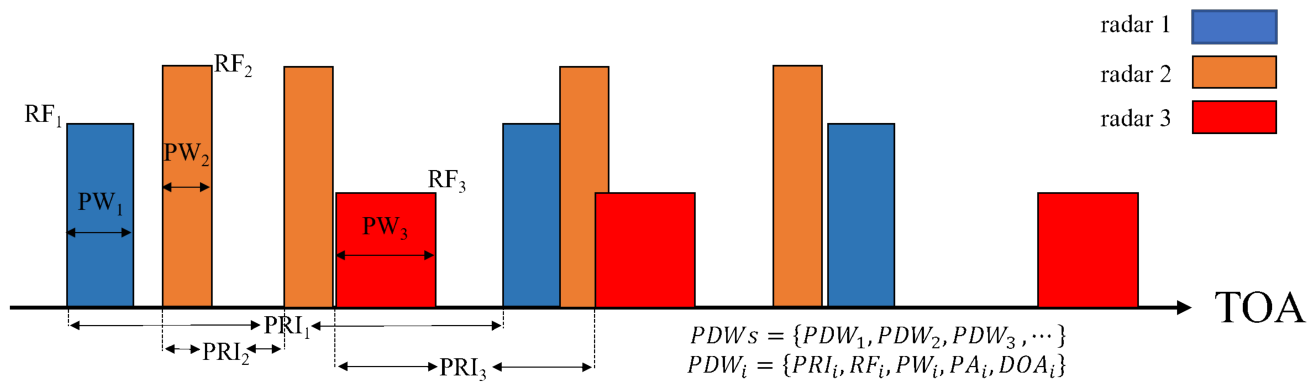
Figure 2.
Overall architecture of the proposed masked representation alignment-based self-supervised learning method for radar PDW sequences. The framework consists of four core modules: preprocessing and embedding module, dual-branch contextual feature representation module, masked prediction representation module, and masked discrete representation module.
Figure 2.
Overall architecture of the proposed masked representation alignment-based self-supervised learning method for radar PDW sequences. The framework consists of four core modules: preprocessing and embedding module, dual-branch contextual feature representation module, masked prediction representation module, and masked discrete representation module.
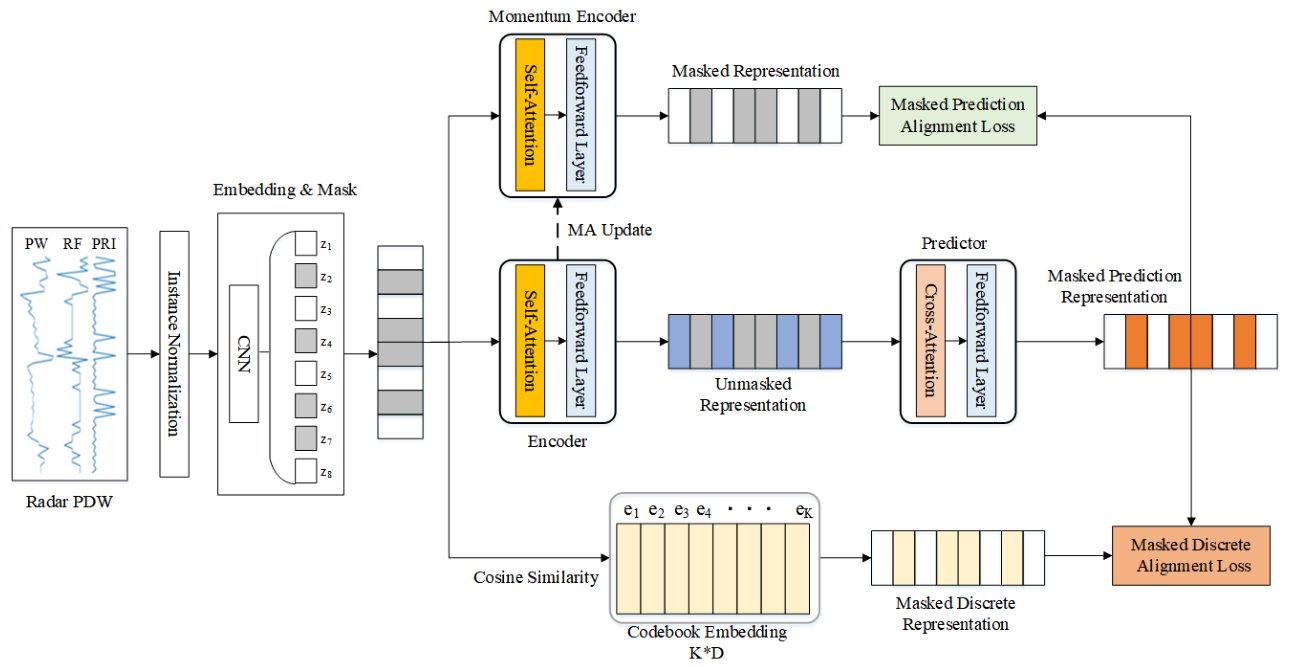
Figure 3.
Cross-domain generalization accuracy of compared models (%). (a) Recognition accuracy with RD13 as the target domain; (b) Recognition accuracy with RD14 as the target domain; (c) Recognition accuracy with RD11 as the target domain.
Figure 3.
Cross-domain generalization accuracy of compared models (%). (a) Recognition accuracy with RD13 as the target domain; (b) Recognition accuracy with RD14 as the target domain; (c) Recognition accuracy with RD11 as the target domain.
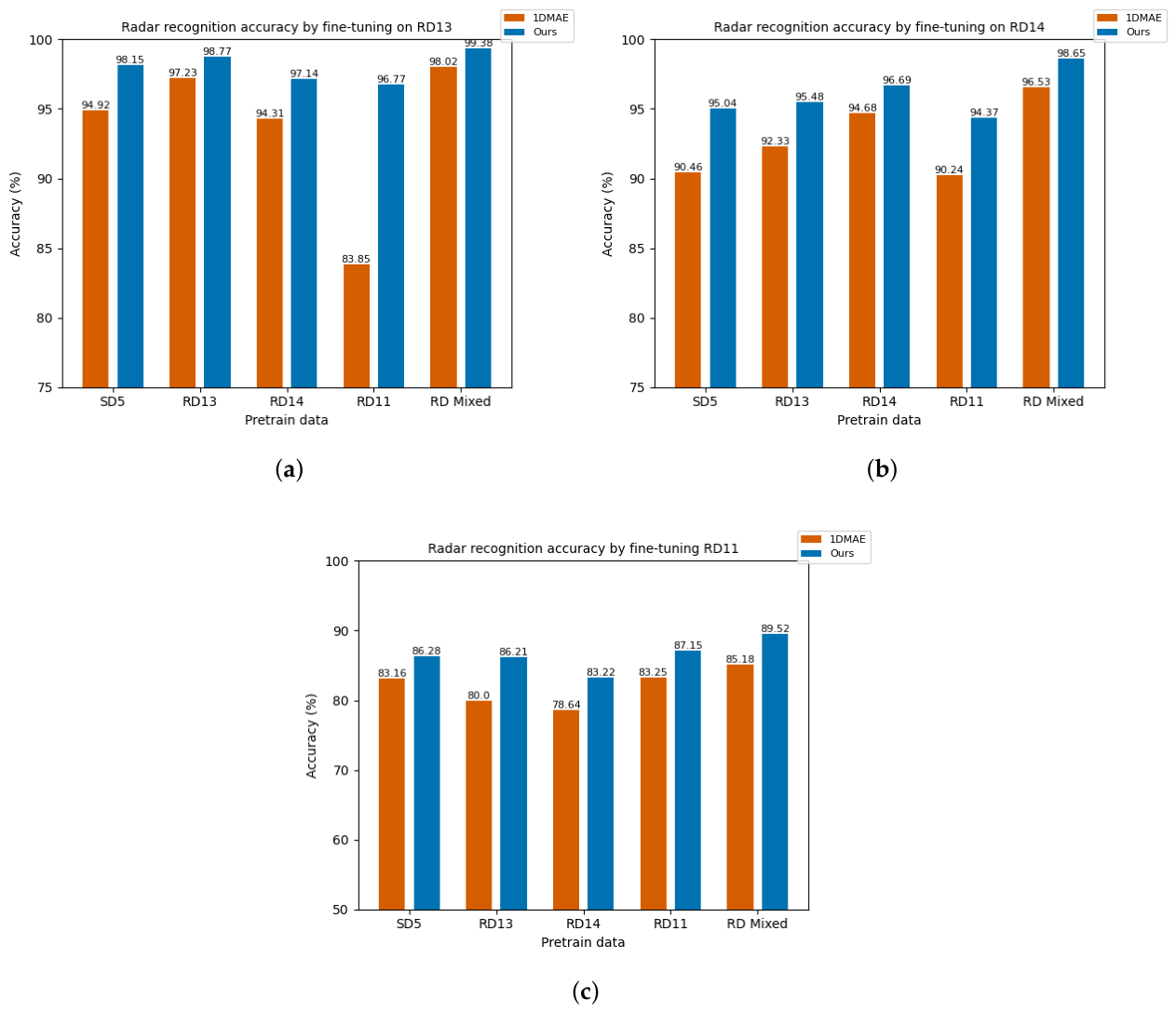
Figure 4.
Recognition accuracy under different mask ratios and patch sizes (%).
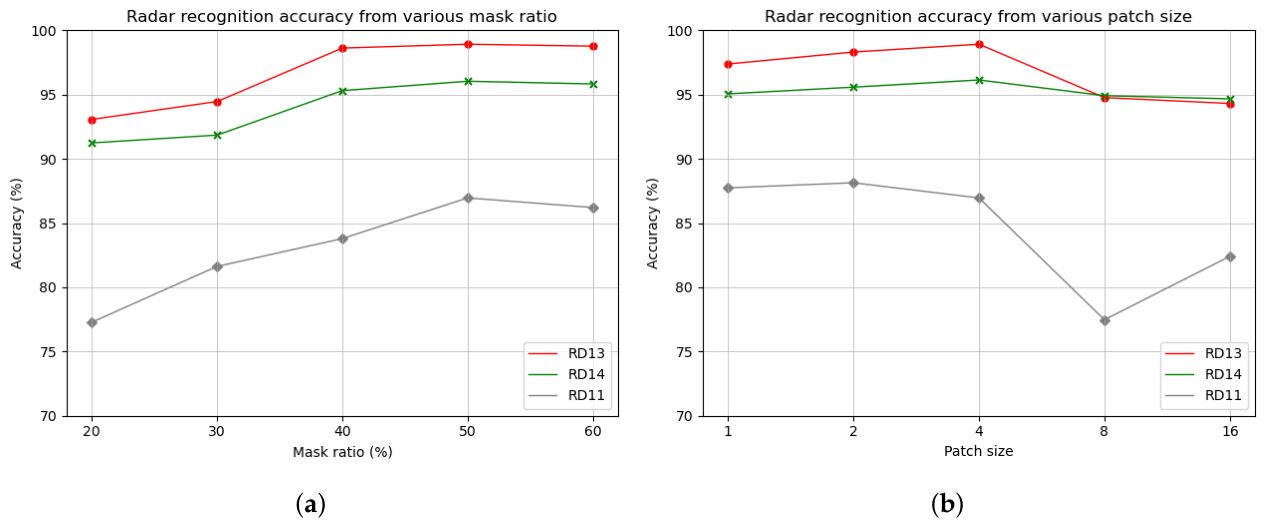
Figure 5.
t-SNE visualization of deep feature embeddings extracted from PDW sequences on three real measured datasets. (a),(b),(c) correspond to RD13 features at three training stages: initialization, post-pre-training and post-fine-tuning, (d),(e),(f) illustrate RD14 feature distributions, (g),(h),(i) display RD11 feature distributions.
Figure 5.
t-SNE visualization of deep feature embeddings extracted from PDW sequences on three real measured datasets. (a),(b),(c) correspond to RD13 features at three training stages: initialization, post-pre-training and post-fine-tuning, (d),(e),(f) illustrate RD14 feature distributions, (g),(h),(i) display RD11 feature distributions.
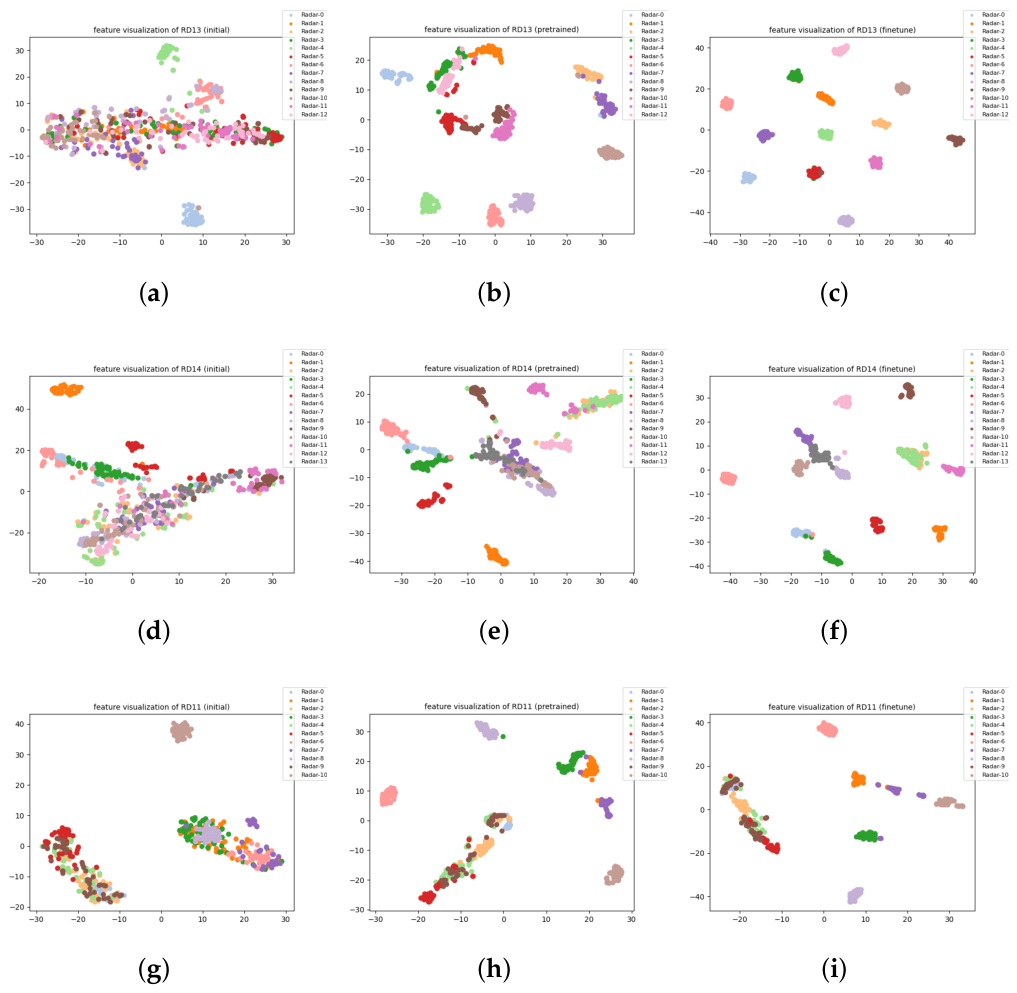

Table 1.
Comparison of recognition accuracy with baseline methods on source-domain datasets (%).
| Method | SD5 | RD13 | RD14 | RD11 | Average |
|---|---|---|---|---|---|
| Resnet 50 | 82.72 | 80.99 | 80.15 | 83.79 | 81.91 |
| Transformer | 91.50 | 82.57 | 81.42 | 84.52 | 85.00 |
| TimeDART | 90.20 | 78.54 | 76.32 | 75.40 | 80.11 |
| MoCo | 93.50 | 90.14 | 87.66 | 82.34 | 88.41 |
| 1D-MAE | 98.50 | 97.23 | 92.45 | 83.25 | 92.86 |
| SSL-MRA (Ours) | 99.20 | 98.77 | 95.57 | 87.15 | 95.17 |
1 Bold values denote the best performance per column.
Table 2.
Radar emitter recognition accuracy under different pretext task combination (%).
| Dataset | Scratch | w/o MPA | w/o MDA | with all |
|---|---|---|---|---|
| SD5 | 94.75 | 96.24 | 96.43 | 99.20 |
| RD13 | 92.84 | 95.85 | 93.07 | 98.77 |
| RD14 | 91.20 | 93.57 | 92.96 | 95.57 |
| RD11 | 76.88 | 83.00 | 86.36 | 87.15 |
Disclaimer/Publisher’s Note: The statements, opinions and data contained in all publications are solely those of the individual author(s) and contributor(s) and not of MDPI and/or the editor(s). MDPI and/or the editor(s) disclaim responsibility for any injury to people or property resulting from any ideas, methods, instructions or products referred to in the content. |
© 2026 by the authors. Licensee MDPI, Basel, Switzerland. This article is an open access article distributed under the terms and conditions of the Creative Commons Attribution (CC BY) license (http://creativecommons.org/licenses/by/4.0/).
Copyright: This open access article is published under a Creative Commons CC BY 4.0 license, which permit the free download, distribution, and reuse, provided that the author and preprint are cited in any reuse.