
Submitted:
27 July 2026
Posted:
29 July 2026
You are already at the latest version
Abstract
The traditional truck-based urban logistics drives the highest unit costs and externalities in urban logistics, including elevated CO₂ emissions, air pollution, road accidents, traffic congestion, road damage, and adverse social effects on delivery workers and communities. In Italy, the unique urban morphology of historic city centers, coupled with stringent Limited Traffic Zones (ZTL), make the impacts particularly severe. This paper proposes a hybrid system that exploits the existing electric regional rail network to transport freight to urban areas with fewer externalities. The system utilizes autonomous, electric wagons, such as the type built by Parallel Systems, a start-up in Los Angeles, that couple with passenger trains for suburban-to-urban transit and decouple to travel independently over dedicated short-distance connectors to urban cross-docking terminals. The study aims to improve delivery efficiency while reducing the environmental impact. A preliminary analysis for the city of Rome shows the possibility of implementing the system, and the findings indicate that Autonomous Electric Wagons (AEW) have the potential to provide a scalable and environmentally sustainable alternative for urban logistics.
Keywords:
urban logistics
; road transport impacts
; rail innovations
; multimodal distribution center
Introduction
The freight delivery segment of urban road transport is a greater source of negative impacts—including congestion, greenhouse gas emissions, noise, and accidents—than its share of the total would seem to warrant.
Urban logistics is the process of optimizing the movement, storage, and delivery of freight in urban areas. It operates under fundamentally different spatial, temporal, and operational constraints than private or public passenger transport [1]. In most European cities, freight vehicles represent only 10% to 15% of total vehicle kilometers traveled (VKT) yet contribute disproportionately to congestion, particulate matter (PM), nitrogen oxides (NOₓ), road damage, and curbside conflict [2]. This asymmetry between share of traffic and share of impacts makes urban logistics a priority area for targeted policy intervention.
This paper (1) systematically defines the impacts of urban logistics and distinguishes them from those of general urban road transport and analyzes them not as environmental, social, or economic, but as a cascade of multidimensional effects with feedback loops; (2) compares established and emerging mitigation and innovative strategies, focusing on the use of rail for the first tier of urban distribution; (3) proposes a hybrid system that exploits the existing electric regional passenger rail network and innovative autonomous electric wagons (AEW) to transport freight to urban areas; (4) applies the hybrid system to the city of Rome and shows how it could serve the main B2C operator, Amazon.
Impacts of Urban Logistics
Urban economies depend on continuous freight flows—retail stock, food, construction materials, and e-commerce parcels.
Commuters follow predictable routes between fixed origins and destinations, but urban freight, with its sequential structure, moving through a chain of nodes (regional consolidation centers, urban distribution centers, neighborhood micro-fulfilment hubs, doorstep delivery points), is inherently fragmented and resource-intensive relative to its volume.
With sharply growing demand, e-commerce now prefers high-frequency, low-weight consignments that prioritize speed over consolidation. A weekly truck has given way to several vans per day.
Freight Vehicle Characteristics
The problems begin with the inherent properties of freight vehicles:
- Engine and emissions: Most freight vehicles still use diesel engines. Light commercial vehicles (LCVs) and articulated heavy goods vehicles (HGVs) have high NOₓ and PM emission factors. Even with Euro VI standards, diesel vans emit far more NOₓ per km than gasoline cars. In urban stop-start driving, fuel consumption (hence CO₂ and pollutants) rises sharply. For example, London’s atmospheric inventory shows that vans/HGVs (~20% of vehicles) produce 31%–39% of road transport NOₓ and 25%–30% of CO₂.
- Visibility and maneuverability: Trucks have large blind spots and require more turning space. Safety research finds that heavy vehicles are overrepresented in serious urban crashes.
Large freight vehicles are high-polluting, high-impact units. But the disproportionate impacts depend on the operational differences in comparison with passenger cars.
Operational Characteristics of Urban Freight
Urban deliveries have distinct operational patterns that exacerbate externalities:
- A typical delivery van route includes numerous stops, often dozens per shift [5]. Each stop requires deceleration, parking, and re-acceleration, reducing speed and increasing emissions.
- Every delivery involves loading/unloading on the street. In dense cities, dedicated loading bays are limited, obliging drivers to cruise for parking and often double-park or use bicycle and bus lanes. This contributes to significant downtown traffic congestion. A study in New York estimated double-parked delivery vans cause significant delays [6]. Urban Freight Lab data from Seattle, like many cities, found couriers spent ~28% of their trip time cruising for parking. This extra driving adds both emissions and congestion.
- Time windows and peak deliveries: Retailers often require deliveries during narrow time windows (morning), and consumers have come to expect next-day delivery. Consequently, many freight movements are clustered in peak periods, contributing to already-high peak congestion.
- Vehicle mix: In cities, deliveries are often made by a mix of large trucks (for wholesale or construction) and small vans (retail, e-commerce). The proliferation of LCVs) in particular is striking; London statistics show LCVs have grown 50% since 2000, faster than cars [7].
Trends in Urban Logistics
Beyond individual operations, broader logistics trends amplify freight impacts:
- Over the past 20–30 years, warehouses and distribution centers have moved from city centers to peripheral “logistics parks” [8,9], feeding the logistics sprawl. High urban land prices push large DCs to suburbs, near highways. Economies of scale are gained (bigger facilities, truck access), but the average distance from hub to customer has increased.
- Some retail chains centralize distribution in large regional warehouses; this reduces the number of suppliers and freight vehicles on intercity roads, but concentrates them on the final urban leg with greater travel distances.
- E-commerce alters distribution. Instead of one truck delivering many items to a store, one parcel delivered at a time per address makes many more delivery trips.
- Urban freight involves many small firms, increasing supply-chain fragmentation. A single order may involve an e-commerce fulfilment center, a parcel carrier, a local courier, and an autonomous delivery robot.
The Efficiency and Consumer Paradoxes
Logistics operators act to minimize their cost and meet delivery commitments. For example, an operator may use multiple small vans to ensure speed and reliability or choose route optimization software or better loading techniques to reduce operating cost. While these are rational choices, replacing trucks with more frequent van deliveries can externalize more costs (road use, emissions, congestion). The cost reduction increases demand for deliveries (the rebound effect with latent demand) and overall traffic. On the consumer side, free shipping or next-day delivery can drive up freight demand. Yet the same consumers value livable streets and may oppose trucks idling by the curb or a new warehouse in their neighborhood. This creates a paradox: the aggregate effect of individual shopping convenience choices is degradation of urban quality.
Innovative Sustainable Solutions
Urban road logistics is a socio-technical system that facilitates the modern city economy, but it imposes externalities on public health, safety, and equity that are neither priced nor equitably distributed. A sustainable transition requires proactive public governance that internalizes these social costs to ensure that the benefits are not outweighed by the degradation of the urban environment [10].
Addressing this transfer requires more than incremental regulation; it demands a multiscalar, socio-technical reframing of how cities govern, price, and design their freight systems [11,12,13].
The framework proposed in the literature is on normative sustainability of regulatory and access solutions (reducing ecological footprint), equity (distributing burdens and benefits fairly), and logistics performance (preserving economic efficiency and service quality), on the use of rail as the most sustainable transport mode, and on a multi-echelon urban logistics structure.
Regulatory & Access Solutions
Urban freight regulation relies on four main interventions: vehicle eligibility, adjusting costs to change behavior, limiting access times, and assigning curb space. Together, these tools tackle the biggest negative impacts of city deliveries.
- Zero-Emission Zones for Freight (ZEZ-F): These zones legally ban vehicles with tailpipe emissions. Because they set the baseline rules for who can enter a city, they form the foundation of any regulatory plan. At present, ZEZ-F is the most popular and direct way to decarbonize urban freight. However, success depends on giving small businesses extra time and financial help to upgrade their fleets. London, Utrecht, Amsterdam, and Oslo lead the way, with zero-emission delivery zones already active or near launch.
- Road and Access Pricing: This intervention uses variable fees based on time, weight, or emissions. While a ZEZ-F acts as a simple yes-or-no gatekeeper, pricing gently nudges companies to change their daily habits, such as consolidating deliveries or changing routes. London’s Congestion Charge and Milan’s Area C are the best-studied examples.
- Temporal Access Regulation: Instead of targeting vehicle types or costs, this method controls when deliveries happen. It complements the first two rules perfectly. New York City’s Off-Hour Delivery program is still the gold standard.
- Curbside and Curb Space Governance: This emerging fourth intervention tackles an issue the first three ignore: how to share limited street-level loading space among competing drivers, vehicle types, and pedestrians. When left unmanaged, curb space quickly descends into chaos. Drivers park illegally, block pedestrians, and slow down the entire last-kilometer delivery network-no matter how clean the vehicle is or what time it arrives. To fix this at the street level, cities are introducing dedicated loading zones with strict time limits, digital spot reservations, and shared curb rules. London and Barcelona have successfully built these strategies into their broader urban distribution frameworks. Furthermore, digital booking apps now allow drivers to reserve loading bays in advance, which completely eliminates the need to circle the block searching for a spot (e.g., Los Angeles, Portland, and Singapore).
Urban Rail Freight
Urban rail freight represents one of the most structurally underexploited opportunities in sustainable urban logistics. Rail offers unrivaled capacity, energy efficiency, and emissions performance per metric ton-kilometer (tkm) relative to road freight. Rail freight generates approximately 80% less CO2 per tkm than road freight and produces negligible local pollutant emissions when electric traction is used. The environmental case for deploying rail in urban freight is compelling. Yet the modal share of rail in urban last-mile operations remains near zero in most cities, with the exception of a small number of pioneering schemes.
This paradox—strong environmental logic, negligible deployment—reflects a structural incompatibility between the geographic and operational logic of conventional rail systems and the requirements of urban last-mile freight. Rail infrastructure is capital-intensive, spatially fixed, and organized around high-volume trunk corridors that terminate at peripheral intermodal facilities. Urban last-mile freight is spatially diffuse, time-sensitive, and requires access to the dense street-level environments from which rail networks have been progressively excluded as cities have grown and land values have risen. Resolving this incompatibility requires a change in how rail penetrates the urban environment.
Cities have explored several rail-based logistics models [14]. Broad categories include:
- Urban freight on passenger rail, with commuter or metro trains to carry goods during off-peak hours.
- Freight trams/light-rail freight: Small electric trams carry goods on city tram networks.
- Last-kilometer rail terminals (urban consolidation) with freight delivered by train to a peripheral city rail terminal or “urban consolidation center,” then transferred to e-vans or bikes for final delivery.
- Nighttime rail freight: Running freight trains through cities at night, when passenger traffic is low.
- Rail-truck intermodal hubs bulk rail for longer haul, trucks only for final short haul.
Several challenges have limited the adoption of rail:
- Infrastructure constraints and city rail networks prioritize passenger service, so capacity for freight is scarce.
- Station platforms are short (limiting car length) and have no loading docks. Adding sidings or longer platforms in dense city cores is often infeasible or costly.
- Rail freight involves multiple actors—rail infrastructure managers, city authorities, freight companies, and end-consignees. Coordinating them is difficult.
- Up-front costs (new rolling stock, track work) are high.
There have been several initiatives to make rail freight a more competitive, profitable and attractive option for shippers, consignees, and operators in comparison with the use of traditional railway freight systems. The core concept was the deployment of small, self- propelled, bi-directional train formations such as CargoSprinter [15,16] and TruckTrain [17].
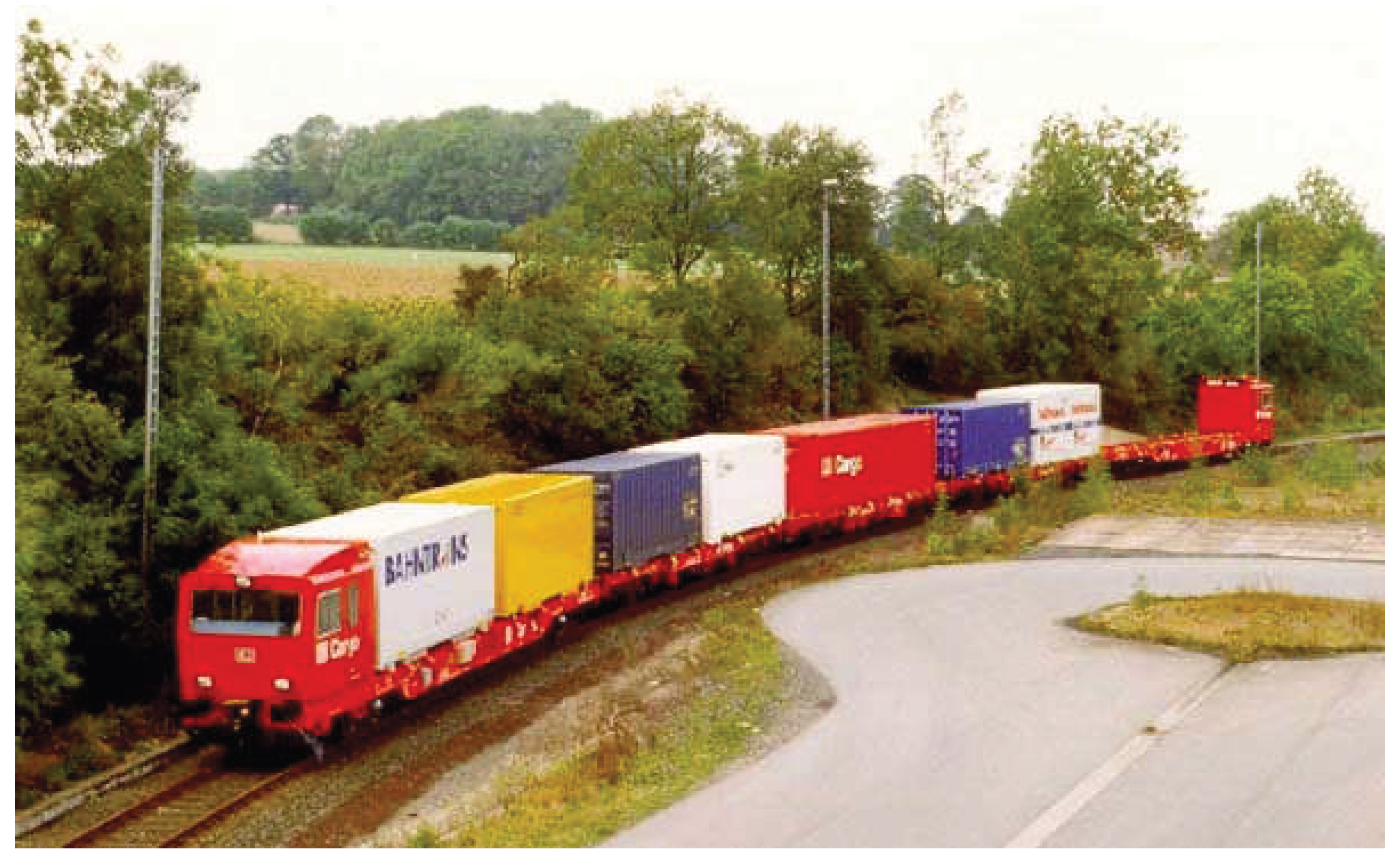
CargoSprinter began to operate in Germany at the end of the 1990s. It was a five-wagon train, equipped with a motorized wagon at each end, arranged in double symmetrical traction, powered by truck-diesel engines, and equipped with a driving cabin. The CargoSprinter was well suited for short distances: no locomotive shunting; automatic coupling system and efficient brake system.
Figure 1.
CargoSprinter. Source DB.
TruckTrain was UK rail-freight technology. It was designed to be: cost effective in complex and demanding logistic chains; cost competitive; attractive to a wider range of asset owners, operators, and cargo interests; unfailingly reliable, secure, and flexible; and environmentally superior to road-based competition. Rail needs a more agile train model facilitating smaller and intermediate volumes and distances. Rail freight should operate at passenger train speeds to minimize the impact on other rail network users. A considerable body of technical, commercial and economic evaluation of short, fast, fixed formation like TruckTrain (Figure 2), self-propelled bidirectional trains, has been undertaken to make rail a more attractive option for shippers.
The Multi-Echelon Urban Logistics Structure
Urban freight infrastructure operates at multiple spatial scales simultaneously, from street-level consolidation nodes to metropolitan freight arteries. The four instruments presented here address each of these scales in sequence and together constitute a coherent spatial hierarchy for reducing freight vehicle penetration into dense urban environments—one that mirrors the tiered network logic increasingly adopted in the urban logistics literature.
Modern urban logistics operates through a layered, multi-echelon distribution network designed to bridge the gap between long-haul freight and last-mile delivery [18]. This hierarchy exists out of necessity—cities are dense, access is restricted, and the cost and emissions of moving large vehicles deep into urban cores are unsustainable.
The multi-echelon structure manages the complexity, high density, and space constraints of city environments, typically dividing operations of consolidation and distribution. The aim of this multi-tier, multi-modal system is to consolidate freight from long-haul transport into smaller, more efficient vehicles for the final delivery.
Figure 3 shows an example of a schematic logistics network from the global inbound to the urban outbound, a hierarchical structure of operational nodes, from external suppliers and regional logistics (such as ports, factories, and multiple regional hubs) and progressing through four operational tiers to the final delivery.
The Urban Consolidation Centre (UCC) is a peripheral city warehouse where inbound freight is received from global, national, or regional suppliers and cross-docked and consolidated before outbound distribution. It has several roles:
- Replace larger vehicles with smaller, cleaner vehicles in dense urban cores.
- Reduce the number of vehicles entering the city by batching and sorting deliveries destined for the same urban area, combining shipments from one or more suppliers.
- Support returns, reverse logistics, and waste collection in some schemes.
- Provide such added services as labeling, storage, inventory holding, and assembling to order (ATO).
The Urban Distribution Centre (UDC) is a facility typically located near the city edge or within the outer ring, where mixed shipments are sorted and broken down for local delivery.
The Micro-Hub (M-H) represents a qualitatively new form of logistics facility in the urban core [21], a micro-consolidation center located closer to the delivery area with a limited spatial range, where goods are bundled inside the urban area boundaries. It allows a modal shift to low-emission vehicles or soft transportation modes for last-kilometer deliveries. They are small local depots (often automated) in or near neighborhoods, serving short-range last-kilometer deliveries (e.g. building entrance, locker or collection point) where goods reach the end customer.
The figure highlights how the spatial layers of the supply chain shift from diverse high-capacity transportation modes in broad geographic zones to specialized urban delivery with consignees as local retails and consumers. Large-scale global and continental logistics utilize mainly sea, rail, and air to move goods into regions. As the process transitions toward national and regional levels, the transport eventually relies on road-based distribution to reach urban and metropolitan areas.
Urban logistics increasingly use a multi-echelon hub model to improve sustainability and efficiency. Figure 4 illustrates the echelons for urban logistics
Figure 4 shows the three facility types (UCC, UDC, M-H), the viable operational range of five transport modes—four road-based and a railway—from peri-urban to dense core. For road modes, the figure distinguishes between distance-based range limits and access-based regulatory limits. The railway line serves the inbound flow of UCC and a B2B facility.
Figure 5 shows a typical e-commerce urban logistics distribution with only two echelons, UCC and UDC, with inbound and outbound modes of transport.
The network model draws on the broader literature on hierarchical freight systems, a concept defined by urban logistics experts [19,20]. In its most schematic form, goods entering a city travel from high-volume, long-distance trunk routes through progressively smaller-scale, higher-frequency, and spatially denser distribution layers until they reach their final destination. Each echelon serves to break down load units, match freight flows to the spatial and temporal demands of the receiving market and enable efficient routing within the constraints imposed by urban infrastructure.
This hierarchical structure offers several advantages. Consolidation at higher tiers reduces the number of vehicle movements required in dense urban areas. Cross-docking and sorting at intermediate facilities allows carriers to aggregate flows from multiple origins and disaggregate them by delivery zone. Proximity hubs at the lowest echelon reduce the distance, time, and cost of the final delivery leg, which consistently accounts for the highest unit cost per parcel in the supply chain.
The proposed model organizes urban freight into a hierarchical sequence of three echelons, each operating at a different spatial scale, serving a distinct function and using different transport modes inbound and outbound. The rationale is that no single facility can efficiently reconcile long-haul trunk movements with fine-grained last-meter delivery; instead, freight is progressively disaggregated as it moves from the urban periphery toward the final recipient.
Each echelon has distinct scale, functions, and stakeholders, yet they all interoperate: for example, UCCs feed UDCs or M-H, which in turn hand off loads for final delivery.
The three echelons and the Last-Meter Delivery Point to the consignees describe where goods move. They do not explain how, why, or for whom. That depends on two variables: who owns the assets and who controls the data.
Both determine whether a network is integrated or fragmented, who absorbs losses when a delivery fails, and who captures the margin when it succeeds. A supermarket running its own dark stores and vans operates the same physical tiers as a third-party platform coordinating independent couriers, but the incentives, risks, and efficiencies are entirely different. The physical tiers constitute the structure of the logistics system; the ownership and the organizational models constitute the coordinating system, the data shapes movement patterns, decision-making, and service delivery.
The management of these hierarchical facilities fall into five main business models:
- The Proprietary integrated Model (Amazon, DHL), whereby a single giant company owns or leases the entire chain and therefore controls every data stream. Amazon is a vertically integrated retailer; DHL is a classic Third-Party Logistics (3PL) provider.
- The Third-Party Logistics model (3PL) separates asset ownership from the freight-generating commercial relationship. The 3PL operator—exemplified by XPO Logistics, DB Schenker, Kuehne + Nagel, or Geodis—owns, leases, and operates the physical network infrastructure across tiers 1 and 2 and achieves asset utilization by sharing infrastructure across multiple shipper-clients, but it creates a structural data gap that neither the 3PL nor the client can close unilaterally.
- The Platform Operator model (4PL) owns no physical infrastructure at any tier, employs no drivers, and holds no vehicles. What it owns is the matching algorithm, the data layer, and the customer relationship. Lalamove, Uber Freight, and the delivery marketplace layer of Just Eat, Glovo, or Deliveroo represent this model in different market segments. In the platform model, data is the primary asset, which the platform controls entirely; they are not shared with couriers or with shippers.
- The Retail Captive model (RC) owns or controls the physical infrastructure across most or all tiers and increasingly internalized home delivery network, such as Ocado in the UK, Zara’s parent Inditex in fashion, and IKEA’s.
- The rapid commerce operator model (RCO) represents a distinct configuration in which the third tier is the core strategic asset and all other tiers are either absent or subordinated to it. Inventory is replenished directly from suppliers or from a single regional warehouse into dark stores, bypassing the UCC and UDC layers.
Rail-Based City Logistics System Design and Architecture with Autonomous Electric Wagons (AEWs)
This paper proposes a urban logistics in which a share of urban freight flows is handled through Urban Distribution Centers (UDCs) located inside the metropolitan rail corridor and supplied by Autonomous Electric Wagons (AEWs) operating on the existing rail network. In this configuration, AEWs perform the intermediate trunk movement between a peri-urban Urban Consolidation Centre (UCC) and strategically positioned UDC rail terminals in the inner city. From these UDCs, last-mile distribution is carried out using zero-emission vehicles such as electric light commercial vehicles (eLCVs) and cargo bikes with micro-hubs, lockers, and pick-up/drop-off points (PUDO).
AEWs, without a locomotive or onboard engineer, the type built by Parallel Systems, a start-up in Los Angeles, are each equipped with its own motors, sensors, and computers. The sensors on board monitor position and check speed and the environment with six cameras, lidar, and multiple layers of redundancy, including four independent braking systems powered by hydraulics.
The main features of AEWs are:
- Propulsion. The architecture’s battery-electric propulsion system is by PMSMs (permanent magnet synchronous motors) for a payload capacity of up to 58,000 kg with double-stack containers, or 2.8 times more capacity than a semi-truck. The range between charges is up to 800 km, with charging time less than 1 hour. Its fully autonomous system is based on bidirectional camera-based perception.
- Advanced Braking. Parallel vehicles can stop shorter than traditional trains because of adaptive braking forces, which adjust for the weight of the payload and friction of the rail. Each vehicle’s braking system is self-contained with very little latency. Parking brakes engage automatically at zero velocity.
- Continuous Sensing. Each vehicle continuously monitors thousands of sensor readings to ensure the vehicle is operating safely and efficiently. Vehicle status and location are uploaded to servers in real-time, and these data are made available to existing railroad train control. Onboard vehicle software can automatically take action, including remote disposition or stopping the vehicle. Utilizing technologies such as Ultra-Wideband (UWB) radio modules, these wagons maintain precise distance measurements and communication between units, ensuring coordinated movement sand safety. Parallel’s advanced software can be integrated with railroad business and train control systems to increase flexibility and speed within the rail environment.
- Long Range. Parallel vehicles combine truck-like flexibility with the energy efficiency of rail. Parallel’s patented platooning technology with aerodynamic performance allows up to 500 miles of range on as little as one hour of charging.
- Virtual coupling. This eliminates the need for a mechanical locking device (no drawbar, no coupler hook) that requires manual servicing and that can be and time-consuming. The wagons are held together by control logic and contact at the bumpers of each wagon maintained by the following wagon continuously pushing forward by regulating tractive effort. The follower actively drives its motors to maintain a small positive compression force at the contact point.. The control system must keep the intervehicle force in a narrow positive window: enough compression to maintain contact, not so much as to damage the buffers or destabilize the lead vehicle. Reaction time collapses to zero. When the leader brakes, the deceleration force is transmitted mechanically and instantaneously through the contact point to the follower—before any sensor reads it or any signal within the platoon carries it. This eliminates the communication latency problem entirely.
- Fully automated platooning. Parallel Systems AEWs connect with one another through bumper-to-bumper contact. Individual wagons do not connect with mechanical train couplers. They couple virtually, make contact at the bumpers, and continuously push against each other by regulating their tractive effort. With virtual coupling, they can form platoons of up to 50 wagons, improving aerodynamic energy efficiency and using railroad network capacity more effectively. The fully automated platooning process eliminates the requirement for railcars to couple to each other and connect air brake lines. Upon contact, each vehicle maintains bumper contact with the one in front by controlling tractive effort. The small air gap between containers and the pushing action through railcar bumpers reduces the average aerodynamic drag of the platoon, ultimately improving energy efficiency. Rather than acting as one rigid 50-car block, these platoons can split apart or merge without stopping for manual train assembly; software instantly routes freight to the intended destination without human intervention. Individual wagons separate from one another, enabling them to proceed independently to their separate destinations.
Micro terminal. Today, traditional rail terminals, built on hundreds of hectares of land, have to be large enough to service long trains. These large terminals are expensive, remote, and result in slower delivery times. The possibility of serving a terminal with just one AEW allows for smaller, cleaner, and less expensive terminals that can be built closer to shippers and customers, effectively opening up new markets for rail transport and reducing last-mile delivery costs. The micro terminals, low-capital expenditure, zero-emissions terminals built closer to shippers and customers, require less than 5% of the land needed by a traditional terminal. The main benefits are reduced yard switching and train-building time and higher line capacity. Vehicles can dynamically form separate trains running at very short headways under automated control; these behave almost like a single train while remaining physically independent.
By enabling railroads to serve new markets, decongest highways and urban areas, and reduce shipping costs and pollution, the technology provides a safer, more efficient, and sustainable alternative to short-haul trucking. Parallel’s small footprint allows for direct container service to warehouse docks or small terminals developed in distribution centers or industrial parks, giving customers direct access to rail. AEWs are designed to interface seamlessly with automated terminals and digital signaling systems, facilitating efficient loading, unloading, and routing.
AEW Sharing Tracks with Traditional Train
One of the central challenges in deploying AEWs on European rail networks is the apparent complexity of the regulatory and technical landscape surrounding shared passenger corridors. European commuter lines operate under demanding conditions—high-frequency services, mixed rolling stock fleets, strict safety certification rules, and signaling architectures that were not designed with self-propelled autonomous freight units in mind. Against this backdrop, the prospect of full integration of AEWs into mixed-traffic commuter services can appear prohibitively demanding.
To be introduced gradually, the new system can be deployed in two operationally distinct phases that differ in their degree of rail-network integration. In the first phase, AEW platoons leverage existing commuter rail infrastructure as passive trunk-haul capacity by attaching to scheduled passenger services, thereby avoiding the need for additional rail network capacity. In the second phase, full integration with the European Rail Traffic Management System (ERTMS) enables autonomous AEW movements across the rail network during residual capacity windows, unlocking higher operational flexibility and throughput.
The first phase is a specific and commercially realistic operating model. AEWs travel as part of a platoon or in the wake of a commuter service and then diverge at a designated switch station onto a dedicated track. This substantially narrows the set of changes required, concentrating the technological investment at a small number of well-defined interfaces rather than requiring a comprehensive overhaul of the shared corridor’s signaling infrastructure.
This dedicated track for AEW introduces autonomous rail operations without trying to automate an existing mixed-traffic railway. The AEWs branches off from the conventional railway network and operates independently for part or all of its route. For the shared section of the journey, the AEW behaves as a cooperative follower: it moves in a platoon of similar vehicles or trails behind a commuter service, exploiting the existing path already allocated to that service in the timetable. It requires no independent path allocation and imposes no additional capacity burden on the line. At a pre-designated switch station, it peels off onto dedicated freight infrastructure—track used exclusively by freight vehicles, without competing passenger services, without complex headway management requirements, and without the crowded platform environments that represent the hardest obstacle-detection challenge in railway automation. From that point, it proceeds autonomously to an urban freight terminal.
This spatial separation of the journey into a shared cooperative phase and a dedicated autonomous phase is what makes the model tractable. Rather than asking the technology to solve every aspect of mixed-traffic autonomy simultaneously, it asks for solutions to a smaller and more precisely bounded set of problems.
Figure 6 shows an AEWs platoon living a peripheral UCC toward the UDCs in the urban area.
The Switch Station: Where the Complexity Concentrates
The single most demanding moment in the operating model is the divergence event itself—the point at which the AEW separates from its platoon or the commuter train and is routed onto the freight track. Several things must happen simultaneously, correctly, and without human intervention. Figure 7 shows the urban logistics system with three echelons (UCC, UDC, M-H), the switch stations, the rail network used by the AEWs, and the different transport modes.
The AEW must request and receive a route through the junction. Under current European practice, route requests are initiated by human dispatchers or drivers. Enabling the AEW’s onboard computer to autonomously negotiate a diverging route requires a defined machine-to-machine communication interface, which does not yet exist in the European regulatory framework. Encouragingly, Europe’s Rail Joint Undertaking is actively developing “autonomous route setting” as a core capability in its Rail to Digital Automated up to Autonomous Train Operation (FP2-R2DATO) research program, which demonstrated autonomous remote switching operations on a live line in the Netherlands in September 2025.
Simultaneously, when the AEW departs from its platoon, the remaining vehicles must confirm that the platoon is now shorter and re-establish their collective identity to the railway control system. This is a specific gap in the current European Train Control System (ETCS) specification: the standard assumes trains have a fixed composition for an entire journey and does not yet define a protocol for a vehicle splitting off mid-route.
The Dedicated Track: A Much Simpler Environment
Once the AEW has completed the divergence maneuver and is operating on the dedicated track, things become much simpler. With no passenger services, no competing traffic, and no need to manage headways between multiple trains, standard ETCS Level 2—the widely deployed, well-understood baseline of European train control—is sufficient to issue the AEW a movement authority to the terminal and track its position along the route. None of the advanced signaling infrastructure required for high-frequency mixed-traffic operation is needed on the dedicated section.
The schematic Figure 8 shows an AEW platoon coupled virtually with a commuter train and an AEW platoon with switch stations connected to UDC. The switch stations can coincide with commuter stations.
Figure 9 shows the first phase of deployment, where an AEW platoon virtually coupled with a commuter train in a station is ready to send or receive an AEW from a UDC through a short-distance dedicated connector. The switch station can coincide with a commuter station.
Figure 10 shows the second phase of deployment where an AEW platoon in a switch station ready to send or receiving an AEW from an UDC through a short distance dedicated connector. The switch station can coincide with a commuter station.
The AEW system must maintain a continuous data link with the railway control system throughout its journey, both on the shared line and at switches and on the dedicated track, for position reporting and movement authorization.
One additional requirement is the creation of a new rolling stock category in European homologation regulations covering self-propelled autonomous freight units. AEWs are neither freight wagons in the conventional sense nor powered traction vehicles as currently defined; they fall between the existing categories of the Wagons TSI and the Locomotives and Passenger Rolling Stock TSI, and neither regulation currently contains the requirements applicable to their traction, control, and safety systems. Establishing this category is a precondition for any European AEW authorization, irrespective of the specific operating model, and should be initiated in parallel with the technical development program.
The Positive Effects of AEW on Land Use
For much of the twentieth century, the logistics land use change was one of suburbanization: warehouses, distribution centers, and freight terminals migrated progressively outward from the urban core to the periphery, following highway infrastructure, cheap land, and permissive planning regimes. From the early 2010s onwards, however, a counter-dynamic has emerged. The explosive growth of e-commerce, the compression of delivery time expectations to same-day and sub-two-hour windows, and the proliferation of rapid commerce platforms have created structural demand for logistics facilities located close to—or inside—dense urban areas.
The expansion of urban logistics has significantly reshaped all the spatial layers over the past four decades, setting in motion two mainly interconnected dynamics that now define the spatial evolution of contemporary logistics systems. These include:
- a dominant trend of UCCs and UDCs outward, related to logistics sprawl;
- a counter-trend of logistical reurbanization driven by e-commerce, rapid-delivery models, and the need for proximity from curb side space to infill parcels and dense-core urban center micro-hub locations.
Logistics sprawl is the progressive relocation of freight facilities—warehouses, UCC, UDC —to urban peripheries, driven by land cost, road congestion, and zoning pressure. The result is longer last-kilometer distances, more vehicle-kilometers traveled, and deeper penetration of medium/heavy vehicles into dense urban areas.
How AEWs counter it is making intermediate urban locations viable again. The core problem with inner-urban logistics nodes is that trunk delivery by road is expensive and congested at that scale. AEWs running on existing rail infrastructure can serve intermediate nodes—UDC with mini terminal at low marginal cost. A UDC in the city center frequently replenished by an AEW becomes competitive with a large UDC 20 km out.
They decouple trunk cost from urban land cost. Logistics sprawl happens partly because operators optimize the trunk leg (cheap land + motorway access) at the expense of the last mile. AEWs invert this: the trunk leg follows rail geometry regardless of land value
With AEWs as the trunk mode, you can justify more UDCs at smaller scale, also MH, closer to demand. This shortens last-kilometer distances, reduces the number of delivery vehicles in circulation, and concentrates the final segment into cargo bikes, walkers, or small EVs—modes that are genuinely compatible with dense urban fabric.
Much of the logic for large peripheral UCCs is that consolidation must happen before the congested urban area, because re-handling inside is too costly. AEWs lower rehandling cost by making internode transfers fast and cheap, so consolidation can happen inside the urban area, closer to the delivery point.
AEWs do not eliminate logistics sprawl; the outer UCC still exists and may still be peripheral. But they break the link between trunk efficiency and peripheral location. Sprawl has been partly a rational response to road-based trunk logistics; AEWs change the underlying cost structure that makes sprawl rational in the first place. Logistics sprawl is a way to externalizes last-mile costs onto the city (congestion, emissions, road wear, public space occupation). AEWs partially internalize those costs by making the denser, shorter-haul network economically self-sustaining.
AEWs increase the value of infill logistics sites—underused urban land parcels near rail corridors or stations, abandoned rail freight terminal—by making them trunk-accessible. This creates a new category of competition: logistics operators, residential developers, and mixed-use planners will contest these sites, and without active zoning protection, market pressure may price logistics out even as AEWs make those locations operationally attractive. The infrastructure investment risks generating land value that logistics cannot capture. An example of how to avoid these reactions is the use of so-called ‘logistics hotels’ in high-density areas of Paris. Parcels from suburban logistics centers are pooled at the logistics hotels via freight train services or a limited number of larger delivery shuttle-trucks. A logistics hotel is an innovative urban planning concept where multi-story, mixed-use buildings integrate e-commerce distribution centers, offices, and green spaces directly into dense residential neighborhoods The city rents out the space in these logistics hotels at a favorable rate, in exchange for delivery firms using low-emission transport modes.
AEWs can directly serve deep-urban micro-hubs along the railways network— the final node before cargo bike or pedestrian delivery. But by making the UDC tier more viable and more urban, they shorten the distance between UDC and micro-hub, which strengthens the micro-hub business case.
A Case Study of Rome
Rome (population approximately 2.8 million within the municipal boundary, 4.3 million in the metropolitan area) presents one of Europe’s most acute urban freight challenges. A polycentric commercial structure, a dense historic urban fabric subject to access restrictions, and an almost entirely road-based freight system combine to produce chronic congestion, elevated emissions, and severe pedestrian–vehicle conflicts in the central city [22]. At the same time, Rome possesses one of the largest urban rail networks in Italy, circa 430 km, a legacy of its role as national capital and railway hub. This infrastructure remains substantially underutilized for freight purposes.
This underutilization reflects a long-run structural decline in urban rail freight across Italian and European metropolitan areas, driven by modal shift to road haulage, passenger-priority corridor management, and the progressive spatial mismatch between large rail freight terminals and the fine-grained spatial demand of urban distribution [8,23]. The question this paper addresses is whether emerging autonomous rail vehicle technology, specifically the AEW platform developed by Parallel Systems Inc., can provide the operational characteristics needed to overcome these structural barriers and reintegrate rail into Rome’s urban freight system.
Rome’s rail freight infrastructure reached its operational apex in the early-to-mid 20th century. The national railway’s principal marshaling yard, Roma Smistamento, which opened in 1905 in the Pigneto district of Rome, was, at its peak, one of the largest rail freight sorting facilities in Europe, capable of processing several thousand wagons per day. Complementary freight functions were distributed across yards at Ostiense, Tiburtina, Roma S. Pietro, and several smaller urban sidings. These facilities collectively served as the backbone of the capital’s goods supply system, handling coal, building materials, food staples, and military logistics well into the postwar period [24,25].
The structural decline of this system unfolded in three overlapping phases. The first, from roughly 1960 to 1980, was driven by motorway construction: a large ring around Rome in 1972 as well as the radial motorway connections to Milan (A1) in the North and Naples in the South transformed the economics of road haulage to and from Rome. Rail became increasingly uncompetitive for consignments of less than a full wagon load (LWL) and for time-sensitive goods. The second phase, from the 1980s to 2000s, involved the active repurposing of urban freight rail infrastructure. The Ostiense freight yard was converted to passenger and museum functions; inner-urban sidings were progressively abandoned or absorbed into road surfaces; and network investment was concentrated on high-speed passenger corridors rather than urban freight capacity [26]. The third phase, at the beginning of this century, was the creation of Omnia Logistica, a new Italian logistics and freight transportation company headquartered in Rome. It specialized in integrated logistics services, freight transportation, warehousing, distribution, and intermodal rail-road logistics. It was historically part of the logistics activities of the Ferrovie dello Stato Italiane (FS Group), the Italian state railway, and played an important role in developing combined rail and road freight solutions in Italy. Omnia Logistica represented one of the major efforts by Italy’s national railway sector to expand beyond traditional rail freight and develop modern integrated logistics services. Its emphasis on intermodal transportation anticipated many of the sustainability and efficiency trends that now drive European freight logistics. The service in Rome was organized in the centrally located S. Lorenzo rail terminal. Rail transport with freight block trains handling groupage shipments from the North and door-to-door service with capillary distribution and reverse logistics to supermarkets in the urban area of Rome. Figure 11 shows the supply chain of Omnia Logistica and Figure 12 the delivery points in Rome. The experience was terminated in 2008 and the S. Lorenzo warehouse was used for only road transport, inbound and outbound.
Several attempts to revive urban rail freight in Rome and other EU cities have not progressed beyond the feasibility study stage. When there was a development, as in Paris with the Hôtel Logistique de La Chapelle, it demonstrated how difficult it is to make urban rail freight commercially viable, despite strong public support and significant infrastructure investment [27].
The principal barriers documented in the literature are: (i) the minimum lot size constraint—conventional wagon-load rail freight requires batches far larger than the consignment volumes typical of urban distribution [28]; (ii) the terminal access problem—inner-urban freight rail terminals require dedicated shunting infrastructure and platform space that conflicts with passenger operations and urban land values; (iii) the scheduling rigidity problem—rail freight must compete for train paths with higher-priority passenger services and lacks the on-demand flexibility of road haulage; and (iv) the last-mile gap—rail delivers to fixed nodes, not to street addresses, requiring an additional transshipment stage that erodes the cost advantage of rail [23,29].
The AEW architecture proposed in this paper addresses each of these barriers directly. The small-platoon operating logic of AEW eliminates the minimum lot size constraint; the autonomous connector capability enables terminal access at low infrastructure cost; the Phase 1 coupling strategy avoids scheduling conflicts with passenger services; and the three-tier hierarchy with eLCV and cargo bike last-mile deployment closes the terminal-to-curb gap.
Rise of E-Commerce B2C
Rome has evolved in recent years from a city dominated by traditional retail into a major e-commerce market. Strong consumer adoption, digitalization of local businesses, and continued growth in online spending are reshaping how Romans shop.
Amazon today is one of the primary forces reshaping the e-commerce and urban-logistics landscape of Rome, acting simultaneously as a demand generator, a network orchestrator, and a technological accelerator. Its influence is visible in infrastructure location choices, delivery-network design, and service-level expectations across the metropolitan area. Amazon has fundamentally restructured the urban logistics landscape of Rome by introducing a tiered, highly integrated distribution network. This infrastructure transitions seamlessly from massive suburban fulfillment hubs to hyper-local, zero-emission last-mile delivery networks designed to navigate the strict regulatory and geographic constraints of the capital’s historic core. Amazon has built in Rome’s metropolitan a logistics system that includes fulfillment centers, sortation hubs, and delivery stations, supported by robotics, AI, and advanced routing.
Amazon’s metropolitan logistics system in Rome operates through a multiechelon road-based distribution structure, with all flows from the Passo Corese fulfillment center (located in Rieti province, 28 km from the GRA, Rome’s ring road) to the city’s delivery nodes handled exclusively by truck (Figure 13):
Passo Corese: Rome’s primary logistics gateway, a 180,000-m² fulfillment center spread across three levels, with 1,900 employees and 24/7 operations supported by Amazon Robotics technology. Situated strategically near the A1 motorway, it manages rapid inventory turnover and acts as the central intake hub for fulfilment by Amazon shipments destined mainly for Rome.
Urban delivery centers in Rome are located at Settecamini with 9,000 m² and 35 permanent employees working in warehouse operations, and 80 permanent drivers for delivery service providers, and at Magliana, with 8,000 m2 and 70 permanent employees. Both consolidate incoming packages from Passo Corese and dispatch them rapidly to local courier fleets. The last is the 6000-m2 Amazon Fresh, in Portonaccio, for daily delivery within Rome’s historic center Limited Traffic Zones (ZTL) with mainly zero-emission electric vehicles.
Although Passo Corese is located within a few hundred meters of the Roma–Orte (FL1) railway corridor, no rail-integrated feeder services are employed. This spatial configuration illustrates the dynamics of logistics sprawl in the sense of Dablanc, driven by peripheral siting motivated by land-cost advantages and motorway accessibility. The location of Passo Corese—approximately 40 km from central Rome—generates systematic HGV flows along the A1 corridor toward urban distribution centers situated outside or at the margins of the GRA (e.g., Settecamini, Magliana), with Portonaccio representing the only semicentral exception.
The last mile of delivery is historically the most expensive segment of the supply chain, often absorbing between 40% and 53% of total shipment costs due to urban traffic, fuel consumption, and failed delivery attempts. In Rome, this challenge is magnified by narrow medieval street layouts and strict ZTL boundaries that ban highly polluting commercial vehicles. To overcome these physical and regulatory barriers, Amazon has shifted from traditional delivery vans to same-day zero-emission electric-vehicle deliveries. The logistics structure is powered by micro-hubs and PUDO points located near or within the ZTL boundaries. The hubs act as micro-warehouses where cargo mopeds can be quickly reloaded, reducing total travel distance and easing street-level congestion.
To mitigate the high costs associated with failed home delivery attempts and constant urban stop-and-go driving, Amazon has heavily expanded its local out-of-home delivery infrastructure in the inner urban area through automated self-service parcel lockers and third-party pickup points. The company consolidates single-family shipments into dense, centralized delivery nodes. By redirecting a significant portion of Roman deliveries to self-service lockers, Amazon optimizes local routing, lowers the cost-per-drop for its delivery partners, and reduces the number of delivery vehicles required on Rome’s public streets.
The AEW Deployment Architecture for Rome
The AEW architecture with a UCC at Roma Smistamento and intra-urban UDCs reverses the traditional road-based logic by bringing the UDCs inside the city and using rail for the trunk-haul. This reduces the last-mile distance enough to make eLCVs and cargo bikes economically viable, while also lowering both the number of vehicles required and the total kilometers needed to deliver the same volume.
The proposed architecture for Rome confirms the general multi-echelon urban logistics model with Rome-specific node locations derived from the existing rail network topology and land-use context. The three echelons are:
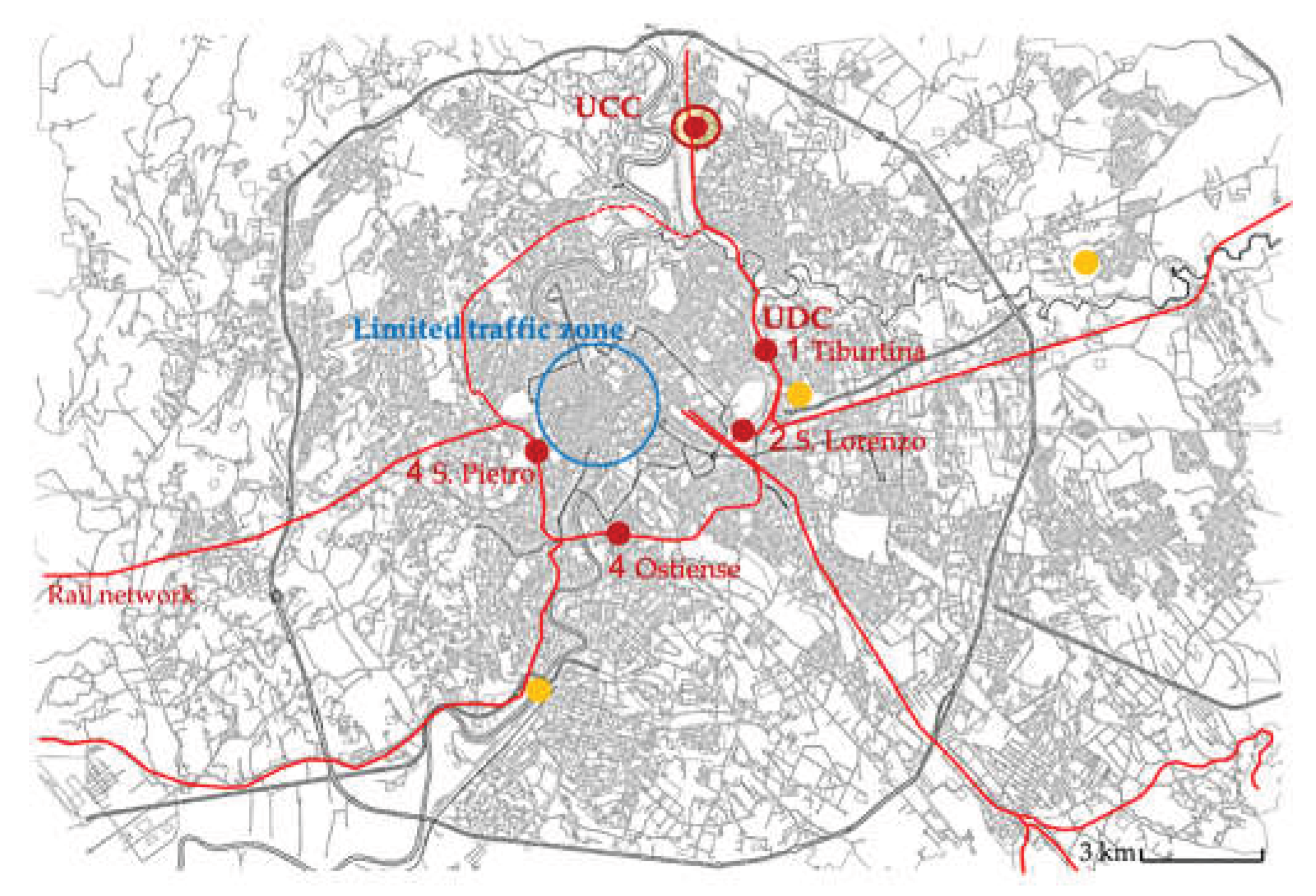
Echelon 1—UCC at Roma Smistamento (Pigneto). Located at Roma Smistamento, historically Italy’s largest marshaling yard, situated in the Pigneto district approximately 3 km east of Roma Termini, the UCC occupies the first rail node within the GRA ring. Smistamento retains residual track infrastructure, extensive yard area, and connections to all four proposed UDC nodes, Roma S. Pietro, Roma Ostiense, Roma S. Lorenzo, and Roma Tiburtina (Figure 14).
It receives interurban freight flows from the national rail network and from truck-based feeders, performs break-bulk consolidation, loads AEW units, and manages platoon formation and departure scheduling through the station of Nuovo Salario to each of the four UDC nodes. Roma Smistamento retains residual shunting and limited intermodal activity, but no regular urban freight train services operate within the metropolitan area. In the proposed framework, Smistamento is repositioned as the UCC, a function consistent with its historical role and its central position within the Roman rail network.
Echelon 2—UDC with AEW rail terminals. The four UDC nodes are proposed, each co-located with an existing or former freight rail facility and providing cross-docking capacity for onward last-mile distribution. Together they form a rail-served logistics ring encircling the ZTL.
Echelon 3—Micro-hub and last-kilometer delivery. A network of street-level or underground micro-hubs within or immediately adjacent to the ZTL boundary, served by eLCVs and cargo bikes dispatched from the UDCs. Micro-hubs may occupy existing parking facilities, loading bays, or repurposed commercial ground floors [30]. The acceptable distance between UDC and micro-hubs depend on the mode used for supply: cargo bike range ceiling 3–5 km; eLCV within range of 5–10 km.
The current rail network in Rome, operated by Rete Ferroviaria Italiana (RFI) and FSI, consists of eight regional rail lines (FL1–FL8) converging on Roma Termini and Roma Tiburtina, supplemented by two metropolitan lines (MA and MB) and a light rail line (Roma–Giardinetti). For the purposes of freight reintegration, the most important lines are FL1 (Roma Fiumicino–Orte), FL3 (Roma Ostiense–Viterbo), FL4 (Roma Termini–Ciampino–Albano), and FL8 (Roma Termini–Nettuno), all of which pass through or close to the proposed UDC nodes.
Importantly, while these corridors are used heavily during commuter peak hours, they exhibit substantial residual capacity during inter-peak windows (10:00–16:00 and after 20:00). RFI’s network utilization data indicates that several urban rail corridors operate at below 50% of theoretical capacity outside peak hours [31]. This residual capacity constitutes the operational resource base for the Phase 2 AEW deployment framework described above, “Rail-based Urban Logistics.”
The institutional framing for reintegration is also relevant. Rome’s Urban Plan for Sustainable Mobility (PUMS) [32] explicitly identifies rail-based freight as a strategic priority, calling for the development of an “urban logistic ring” connecting existing rail nodes for goods distribution. The UCC and the four UDC nodes proposed in this paper—S. Pietro, Ostiense, S. Lorenzo, and Tiburtina—collectively operationalize precisely this ring concept, encircling the ZTL at the cardinal and intermediate compass points. The PUMS targets a 30% reduction in trailer-truck movements within the GRA by 2030 and a 50% increase in clean urban freight vehicle penetration. AEW deployment is directly consistent with these policy targets.
Phase 1: Passive Coupling on Commuter Rail
In Phase 1, AEW platoons depart the UCC and traverse a short dedicated rail connector to the nearest commuter station on the relevant FL line. At the station, the platoon couples autonomously with the rear of a scheduled commuter service during the passenger dwell. On arrival, the platoon decouples and proceeds autonomously along a short connector to the UDC terminal. The return movement is operationally symmetrical. Phase 1 requires no additional rail network capacity and no modification to commuter timetables, as it exploits structural capacity within existing train formations.
The coupling and decoupling operations are designed to fall within the scheduled passenger dwell time at the relevant stations, which on Rome’s FL network averages between 45 and 90 seconds depending on station category. At Roma S. Pietro and Roma S. Lorenzo, the two nodes with the shortest connector distances from the UCC, the coupling window is the most constrained, requiring particular attention to platoon positioning protocol [30]. This constrains both the maximum platoon length (which determines coupling time) and the terminal connector design (which must be short enough to allow the platoon to reach the coupling position within the available window).
The four proposed UDC nodes collectively provide rail access to all principal quadrants inside the railway ring of the Rome and its immediately adjacent commercial districts. All four sites retain residual rail infrastructure—sidings, platform faces, and yard area—that can accommodate AEW terminal functions with comparatively modest investment, reducing the need for greenfield construction. The UCC at Roma Smistamento, positioned at the beginning of the UDC ring, maintains direct rail connections to all four nodes via existing track alignments, minimizing connector length and trunk-haul cycle time. The exact siting of cross-docking facilities, electric vehicle charging infrastructure, and cargo-bike staging areas within each node is subject to detailed site-specific planning, which falls outside the scope of this paper.
Phase 2: ERTMS-Integrated Autonomous Operation
Phase 2 is contingent on the certification of AEW units as independent railway vehicles within the ERTMS framework and on the progressive deployment of ERTMS Level 2 or Level 3 on Rome’s commuter rail corridors. Under Phase 2, AEW platoons are granted independent movement authorities by RFI’s Traffic Management System during inter-peak capacity windows, eliminating the dependency on specific commuter train formations. This substantially increases operational flexibility: the UCC terminal management system can dispatch platoons on demand rather than according to fixed commuter timetable intervals, enabling more responsive freight throughput and better alignment with shipper demand patterns.
Modelling a Modal Shift to AEW for Rome Distribution Network
In this section, we analyze the case of Amazon Rome’s modal shift to AEW. First we estimate the quantity of Amazon traffic in Rome and second, we dimension the AEW service to accommodate the estimated traffic.
According to the Italian Communications Regulatory Authority (AGCOM) [https://www.agcom.it/comunicazione/comunicati-stampa/osservatorio-sulle-comunicazioni-n1-2026], the Italian parcel delivery market handled approximately 1.2 billion parcels per year in 2025, 85.7% with domestic senders and recipients exhibiting a year-on-year increase of 4.9%. AGCOM also identifies Amazon as the leading operator in the Italian parcel market, with a market share of ≈20% of the overall parcel market. The total parcels per day number ≈3.2 million, of which Amazon Italy accounts for 3.2x20 ≈640,000.
Rome contains 4.75% of Italy’s population (some 2.8 million out of 59 million). Rome is, however, the second Italian e-commerce market after Milan, with penetration above the national average. Conservatively, with a factor of overrepresentation of 1.3 on the basis of income urban area/periphery, we obtain the weight of Rome equal to 4.75% x 1.3 ≈6.2%. Amazon parcels/day in Rome number 643,000 x 6.2% ≈40,000 parcels/day.
The first question is whether an Amazon rail service based on platoons of AEWs can serve the urban area of Rome when the Passo Corese fulfillment center has been connected with the station of Fara Sabina–Montelibretti about 1 km away. Not all the four stations are available in this first phase. S. Lorenzo is not served by any commuter train, and S. Pietro is not served directly by the same trains as Tiburtina and Ostiense. In this first phase, Tiburtina and Ostiense are the only stations served by commuter trains with a frequency of ~12 minutes during the hours 06:00–22:00. AEWs leave the fulfillment center and first reach the three stations to be coupled with commuter trains and then, on dedicated tracks, reach the two UDC.
Each AEW carries a FEU loaded with mixed e-commerce parcels (the Amazon/courier profile). A typical configuration is roll cages used in retail logistics with a footprint of around 0.8–0.9 m × 0.7–0.8 m. In a FEU there are 45 cages with a height of 1.8 m with an estimate, based on about 30 interviews with B2C drivers in Rome, of ~75 parcels per m3. The FEU is essentially full by volume (45 cages occupy ~45 m³ of the 67.7 m³ internal volume with aisle space and dunnage) with 45 x 75 = 3375 parcels. Twelve AEWs per day with one FEU each, a total of 40,500 parcels reaching the two UDC are sufficient to serve the urban area of Rome with 40,000 Amazon parcels on an average day.
A second question is the size of a rail service with AEWs coupled to commuter train based on the UCC in Roma Smistamento. The UCC is linked along the ring rail to the switch stations of Tiburtina and Ostiense served by commuter trains with a frequency of ~12 min during the period 06–22 to reach with dedicated connector the same two UDC.
The two UDC can accommodate two berths each. In the first phase, the AEWs on the railway network of Rome are assumed to leave the UCC of Rome Smistamento with a platoon of four AEW units. This choice reflects the available tail-track length at Rome’s commuter stations and the coupling window available within scheduled passenger dwell times. At each of the two-switch stations the four-wagon platoons leave two wagons. The cycle time breakdown is:
- FEU loading the platoon of 4 AEWs at UCC 45 min
- Dedicated link Smistamento-Nuovo Salario + coupling the platoon to commuter train 15 min
- Run on ring rail to Tiburtina and decoupling 2 AEWs 11 min
- Run on ring rail to Ostiense and decoupling 2 AEWs 13 min
- FEU unloading to Ostiense 30 min
- Dedicated link UDC to coupling 2 AEWs to return commuter train in Ostiense 10 min
- Dedicated link UDC to coupling 2 AEWs to return commuter train in Tiburtina 0 min
- Return to Nuovo Salario from Ostiense 24 min
- Decoupling in Nuovo Salario the platoon + dedicated link to UCC 10 min
The daily operating window is assumed to be 16 hours (06:00–22:00), aligned with the commuter service window on commuter lines. Within this window, the platoon completes six round-trip rotations between the UCC and a UDC node. The total time for a cycle is 158 min. On these assumptions, a platoon during the 16 hours can complete six cycles and ship 4 × 3,375 × 6 rotations = 81,000 parcels/day.
If all these parcels currently moved by diesel LCV and HGV were transferred to the AEW system, the implied vehicle-km reduction would be substantial. At an average road delivery tour of approximately 80 km/vehicle/day for LCVs and 120 km for HGVs, the current road fleet serving this demand generates some 180,000–250,000 vehicle-km/day within the metropolitan area. Substituting AEW for the trunk-haul segment and eLCV/cargo bikes for the final leg of the delivery chain, possible for the reduced distance between the UDC and the urban area to be served, would reduce diesel vehicle-km by an estimated 60%–70%, with corresponding reductions in NOₓ, PM₂.₅, and CO₂ emissions. Full quantification requires an origin–destination matrix for current freight movements and a route-level assignment model, which constitute directions for future research.
Successful AEW deployment in Rome requires engagement across three institutional domains. First, the RFI the rail infrastructure manager must be party to agreements governing AEW access to the network, coupling protocols at commuter stations, and (in Phase 2) slot allocation procedures and technology innovation. Second, the urban planning domain: the siting of UDC terminals at S. Pietro, Ostiense, S. Lorenzo, and Tiburtina, and the UCC at Smistamento, requires coordination with the Comune di Roma and the Città Metropolitana di Roma Capitale, as well as with the RFI and private landowners to use residual rail freight assets at these locations. Integration with Rome’s PUMS and the Sustainable Urban Logistics Plan (PULS) provides a planning framework for this coordination. Third, the regulatory domain: AEW vehicle certification under European Union Agency for Railways (ERA) and Italian national agency for railway safety and for highway (ANSFISA) is a prerequisite for Phase 1 deployment (passive coupling) and an even more demanding requirement for Phase 2. The timeline for certification will be a critical determinant of deployment pace and should be initiated in parallel with infrastructure and operational planning.
Conclusions
This paper has described the impacts of the urban road logistics and the systematic decline of rail freight for urban logistics.
Thanks to its operational flexibility, the new technology based on AEWs can bring the railways back to play an important role in urban logistics with positive effects on the environmental impacts.
An urban rail freight system for Rome has been proposed based on AEWs, structured within UCC–UDC hierarchy and phased for progressive ERTMS integration.
The case study has demonstrated that the approach is operationally feasible given Rome’s existing rail network topology and the residual freight infrastructure at Roma Smistamento (UCC), Roma S. Pietro, Roma Ostiense, Roma S. Lorenzo, and Roma Tiburtina (UDC nodes), and that it is directionally consistent with the modal-shift and emissions-reduction objectives of the city’s.
Factors such as the built environment and transportation policies are critical variables influencing travel decision-making. However, the cities that will realize the full potential of AEW-on-commuter-rail are those that treat the spatial planning work as equal in importance to the technological development: that protect logistics land before development pressure eliminates it, that apply hub location optimization methodologies before preferred sites are lost, and that build the governance institutions before the need for coordination becomes acute.
Funding
no funding.
Informed Consent Statement
Informed consent was obtained from all subjects involved in the study.
Data Availability Statement
The data presented in this study are available on request from the author.
Conflicts of Interest
The author declares no conflicts of interest.
References
- Taniguchi, E.; Thompson, R.G.; Yamada, T.; van Duin, J.H.R. (Ron). City Logistics: Network modelling and intelligent transport systems. Elsevier Science Publishing Company, 2001. ISBN: 0080439039.
- ITF. The Final Frontier of Urban Logistics: Tackling the Last Metres, No. 131. OECD Publishing, Paris, 2024.
- Forman, J.; Östling, M.; Mroz, K.; Lubbe, N. Potential Injury Criteria for Collisions with Heavy Goods Vehicles. The 27th International Technical Conference on the Enhanced Safety of Vehicles Conference (ESV), Yokohama, Japan 2023. Paper Number 23-0334.
- Edwards, M.; Leonard, D. Effects of large vehicles on pedestrian and pedal cyclist injury severity. Journal of Safety Research 2022, 82, 275–282. (https://www.sciencedirect.com/science/article/pii/S0022437522000810). [CrossRef]
- Allen , J., et al. Understanding the impact of e-commerce on last-mile light goods vehicle activity in urban areas: The case of London. Transportation Research Part D: Transport and Environment 2018, 61, 325–338. [CrossRef]
- Goldstein, J.; Racette, Z.; Adam, Y.; Huang, C.; Durrenberger, O. Estimating the Environmental Impact of the Shift to E-Commerce. Columbia University School of Professional Studies: New York, 2024.
- ALICE/ERTRAC Urban Freight research roadmap, November 2014. https://www.ertrac.org/wp-content/uploads/2022/07/ERTRAC_Alice_Urban_Freight.pdf.
- Dablanc, L.; Rakotonarivo, D. The impacts of logistics sprawl: How does the location of parcel transport terminals affect the energy efficiency of goods’ movements in Paris and what can we do about it? Procedia—Social and Behavioral Sciences, 2010, 2(3), 6087–6096.
- El Yadari, M.; Jawab, F.; Moufad, I. Logistics Sprawl: A Systematic Literature Review. IEEE Eng. Manag. Rev. 2025, 53, 82–99. [CrossRef]
- ITF. The Freight Space Race: Curbing the Impact of Freight Deliveries in Cities. International Transport Forum Policy Papers, No. 109, OECD Publishing: Paris, 2022.
- Taniguchi, E., Thompson, R.G., Eds. City Logistics 1: New Opportunities and Challenges 2018. Print ISBN: 9781786302052 |Online ISBN: 9781119425519 . [CrossRef]
- Taniguchi, E., Thompson, R.G., Eds.City Logistics 2: Modeling and Planning Initiatives 2018. Print ISBN: 9781786302069 |Online ISBN: 9781119425526. [CrossRef]
- Taniguchi, E., Thompson, R.G., Eds.City Logistics 3: Towards Sustainable and Liveable Cities 2018. Print ISBN: 9781786302076 |Online ISBN: 9781119425472. [CrossRef]
- Alessandrini, A.; Delle Site, P.; Filippi, F.; Salucci, M.V. Using rail to make urban freight distribution more sustainable. European Transport, 2012, Issue 50, paper n. 5. ISSN 1825-3997.
- Pietrzak, O.; Pietrzak, K. The role of railway in handling transport services of cities and agglomerations. Transportation Research Procedia 2019.
- Pietrzak, K.; Pietrzak, O.; Montwill, A. Light Freight Railway (LFR) as an innovative solution for Sustainable Urban Freight Transport. Sustainable Cities and Society 2021, 66. [CrossRef]
- Mortimer, P.N., Kling-David, R. (2018). Innovation in Rail Freight and Interchanges (or How to Stop Rail Freight Hitting the Buffers). In Marinov, M., Ed. Sustainable Rail Transport. Lecture Notes in Mobility. Springer, Cham. [CrossRef]
- Mancini, S. Multi-Echelon Distribution Systems in City Logistics. European Transport\Trasporti Europei 2013, Issue 54, Paper n° 2, ISSN 1825-3997.
- Thompson, R.G.; Taniguchi, E. 2001 City logistics and transportation. Handbook of Logistics and Supply-Chain Management, Elsevier, Amsterdam, pp. 393–405.
- Allen, J.; Browne, M.; Woodburn, A.; Leonardi, J. The Role of Urban Consolidation Centres in Sustainable Freight Transport, Transport Reviews: A Transnational Transdisciplinary Journal 2012. https://www.researchgate.net/publication/254324483_The_Role_of_Urban_Consolidation_Centres_in_Sustainable_Freight_Transport [accessed Jul 02 2026]. [CrossRef]
- Katsela, K.; Güneş, S.; Fried, T.; Goodchild, A.; Browne, M. Defining Urban Freight Microhubs: A Case Study Analysis. Sustainability 2022, 14, 532. [CrossRef]
- Comune di Roma. Piano Urbano della Mobilità Sostenibile (PUMS) 2020–2030. Roma: Dipartimento Mobilità e Trasporti, 2020.
- Pimentel, C.; Alvelos, F.; Falcão e Cunha, J. Urban rail cargo: A decision framework for sustainable urban freight. Transport Policy 2020, 92, 48–57.
- Rete Ferroviaria Italiana (RFI). Piano industriale RFI 2017–2026. Ferrovie dello Stato Italiane, 2018.
- Giuntini, A. Le ferrovie italiane: storia, politica e cultura. Soveria Mannelli, CZ, Italy: Rubbettino Editore, 2001.
- Bertolini, L.; le Clercq, F.; Kapoen, L. Sustainable accessibility: A conceptual framework to integrate transport and land use plan-making. Two test-applications in the Netherlands and a reflection on the way forward. Transport Policy 2012, 15(6), 368–377.
- Kin, B.; Buldeo Rai, H.; Dablanc L.; Quak, H. Integrating logistics into urban planning: best practices from Paris and Rotterdam. European Planning Studies, 2024. [CrossRef]
- Bolis, S.; Maggi, R. Logistics Strategy and Transport Service Choices: An Adaptive Stated Preference Experiment. Growth and Change 2003, 34, 490–504. [CrossRef]
- Crainic, T.G.; Ricciardi, N.; Storchi, G. Models for evaluating and planning city logistics systems. Transportation Science 2009, 43(4), 432–454. [CrossRef]
- van Duin, J.H.R.; Wiegmans, B.; van Arem, B.; van Amstel, Y. From home delivery to parcel lockers: A case study in Amsterdam. Transportation Research Procedia 2016, 12, 119–131. [CrossRef]
- Rete Ferroviaria Italiana (RFI). Prospetto Informativo della Rete (PIR) 2024. Ferrovie dello Stato Italiane, 2024.
- Roma – PUMS 2020 https://romamobilita.it/wp-content/uploads/2025/09/PUMS-ROMA-vol-2.pdf.
Figure 2.
TruckTrain. Source: trucktrain.co.uk.
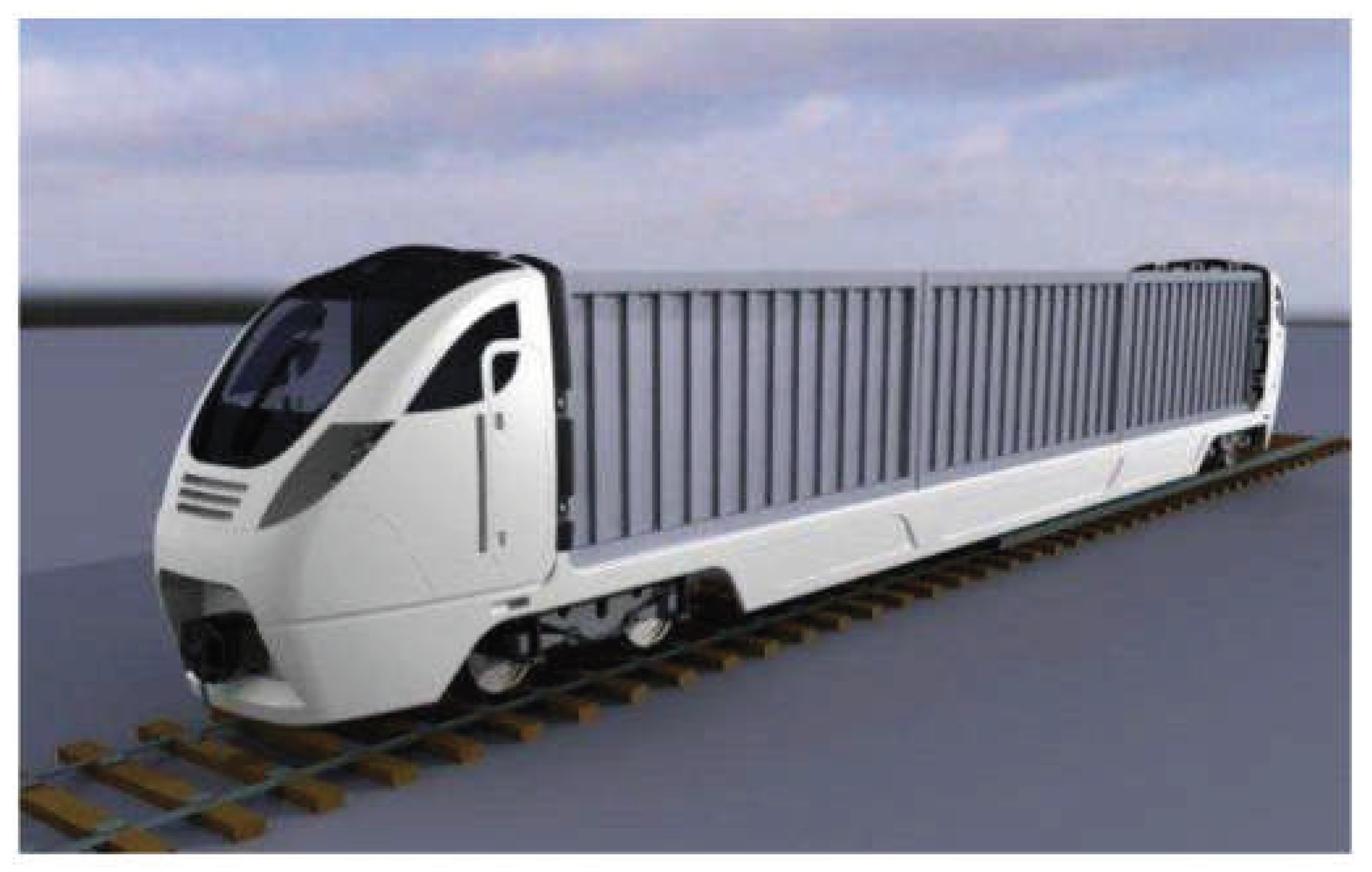
Figure 3.
The hierarchical logistics network.
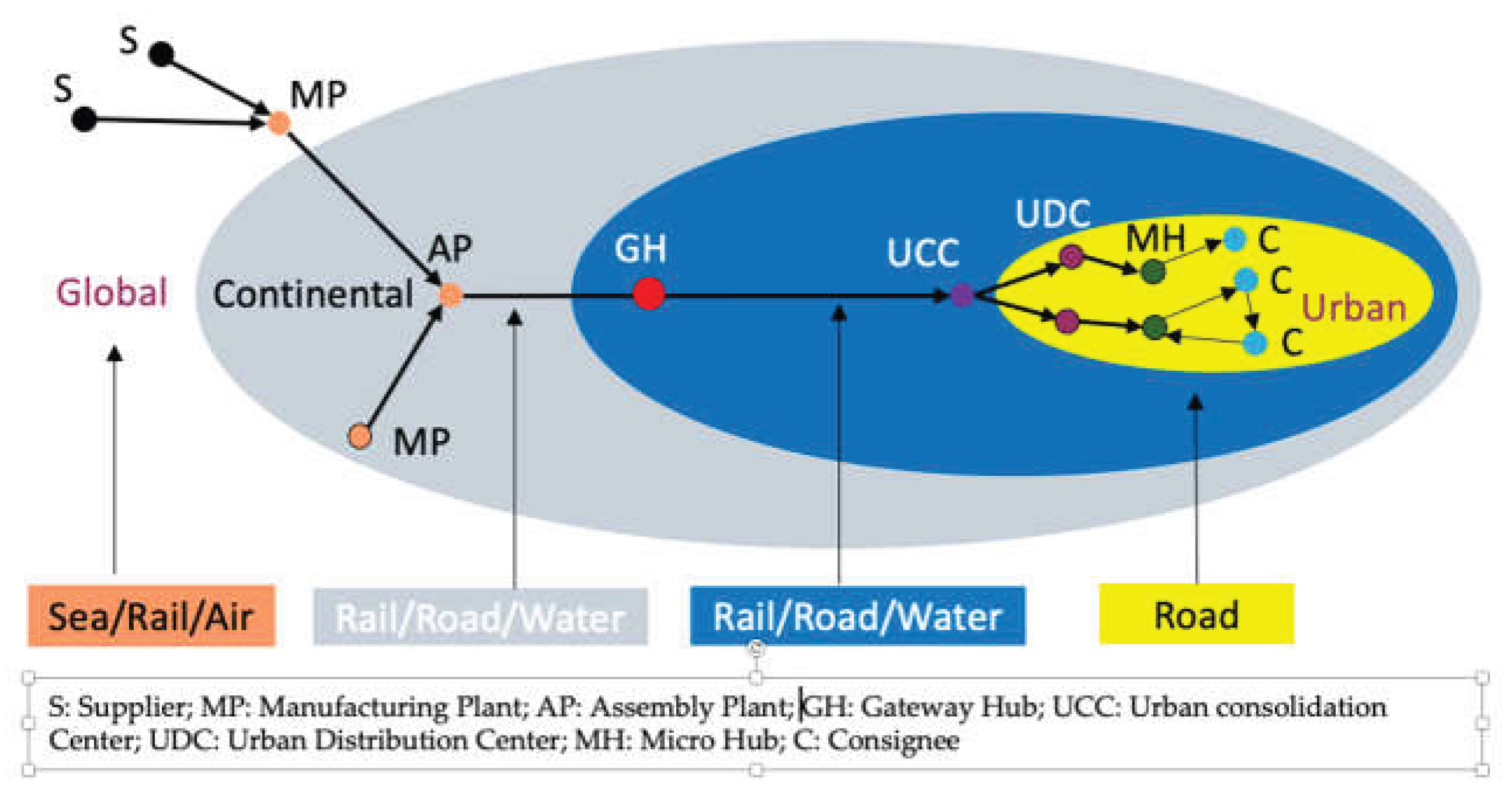
Figure 4.
Multi-echelon urban logistics mode penetration from UCC to city center.
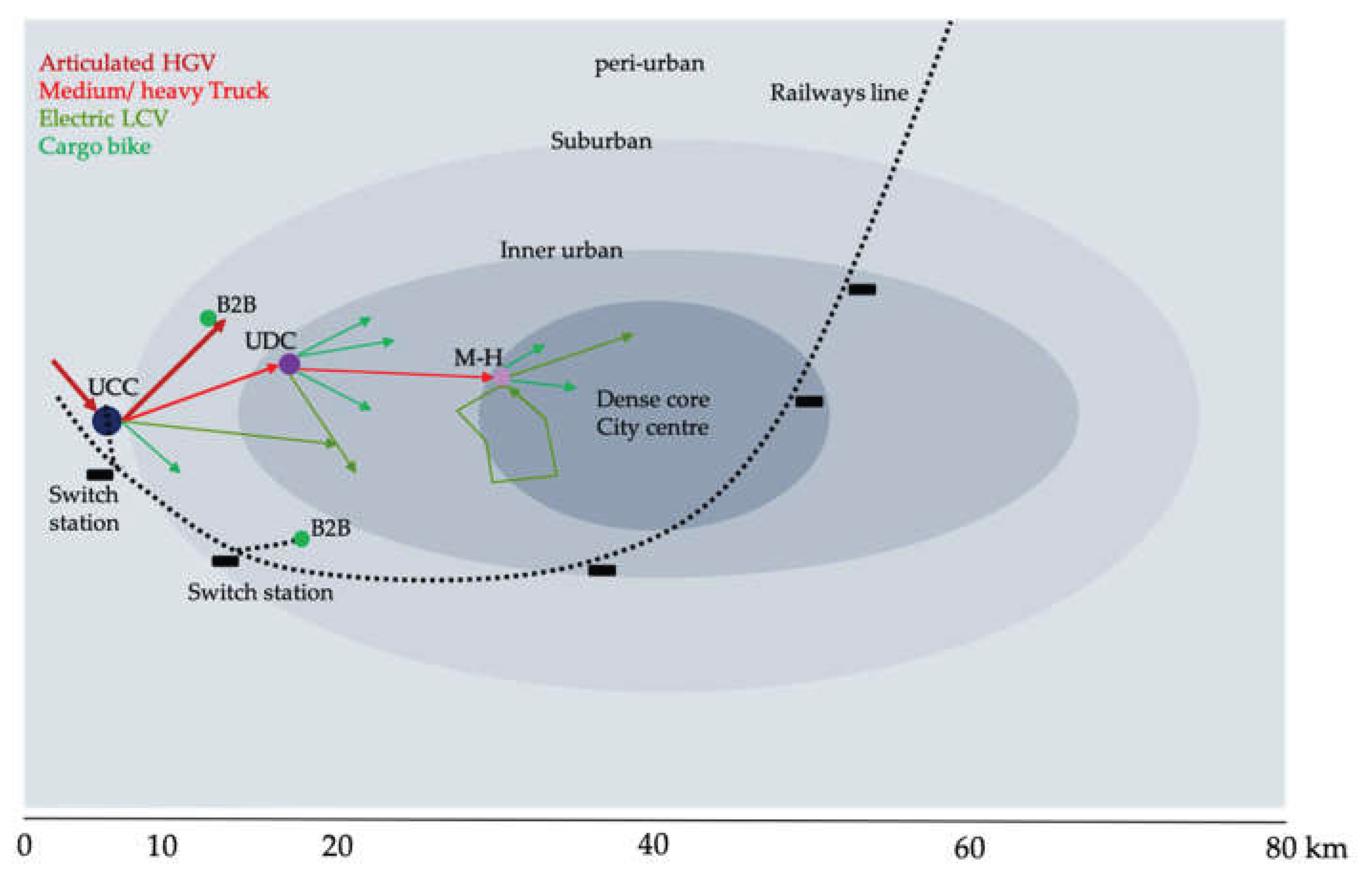
Figure 5.
Urban logistics with two echelons, UCC and UDC, and modes of transport.
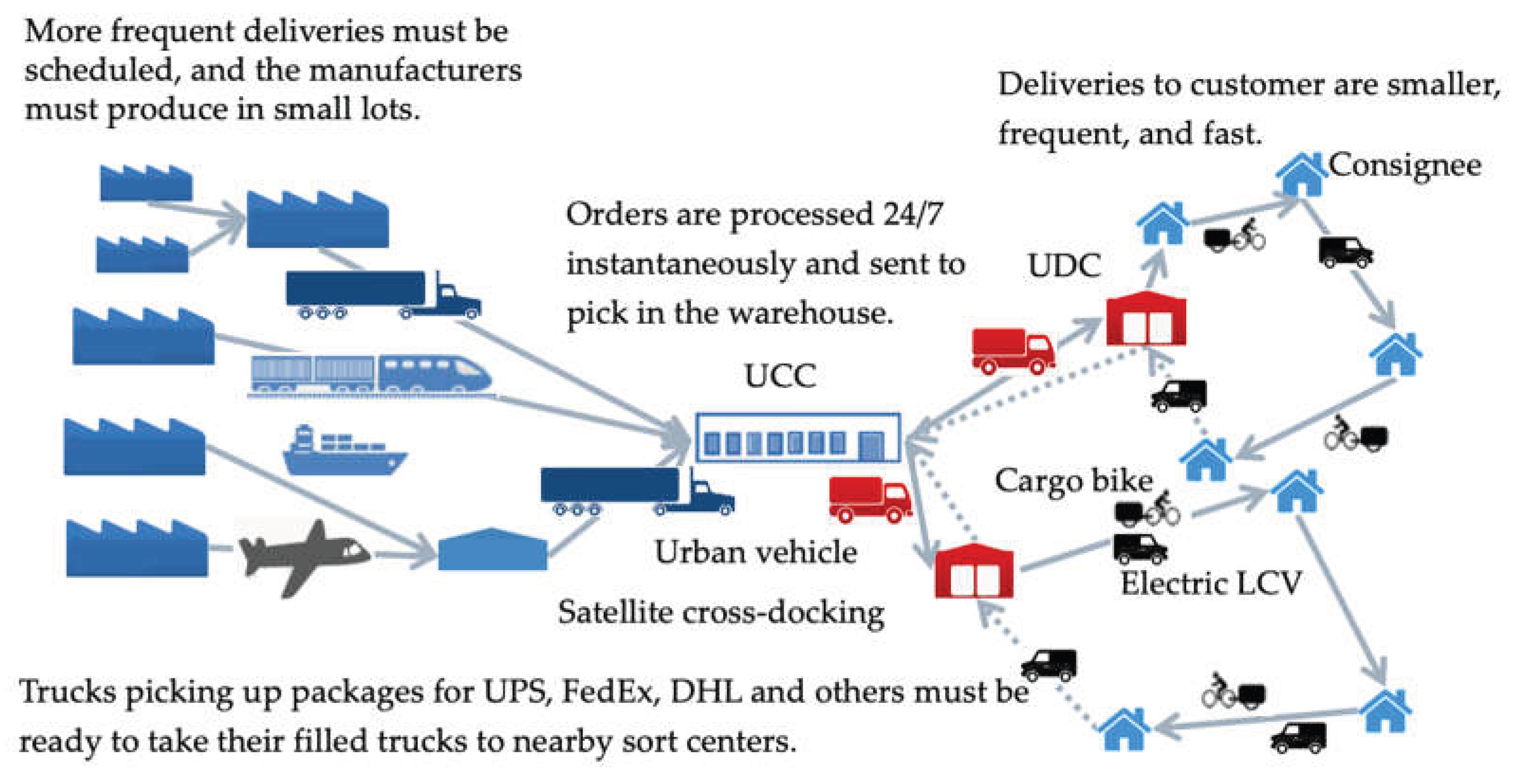
Figure 6.
AEWs platoon leaves a peripheral UCC toward UDCs in urban area Source: Gemini Image Creator.
Figure 6.
AEWs platoon leaves a peripheral UCC toward UDCs in urban area Source: Gemini Image Creator.
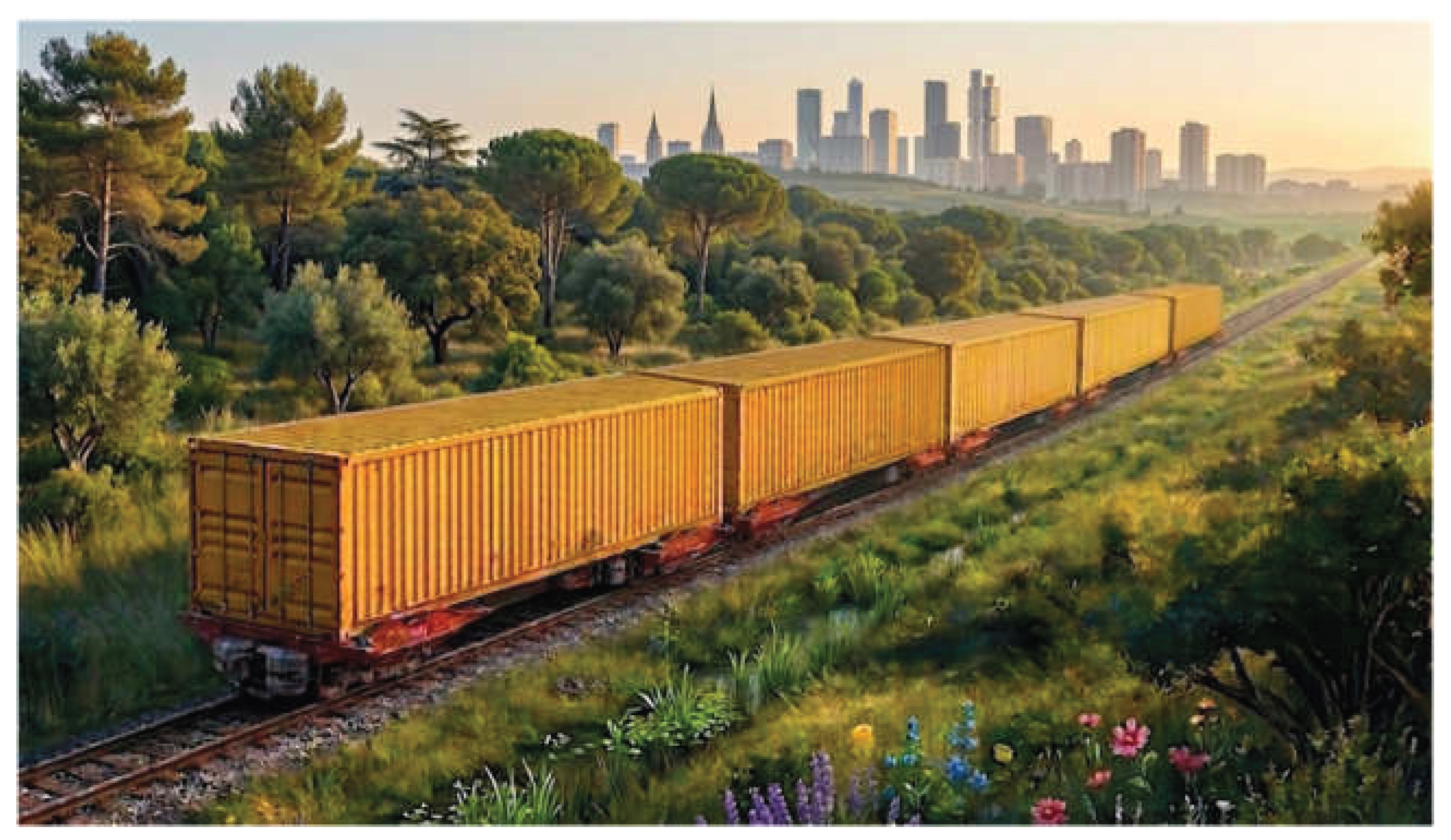
Figure 7.
Urban area echelon with different road vehicles and rail AEWs.
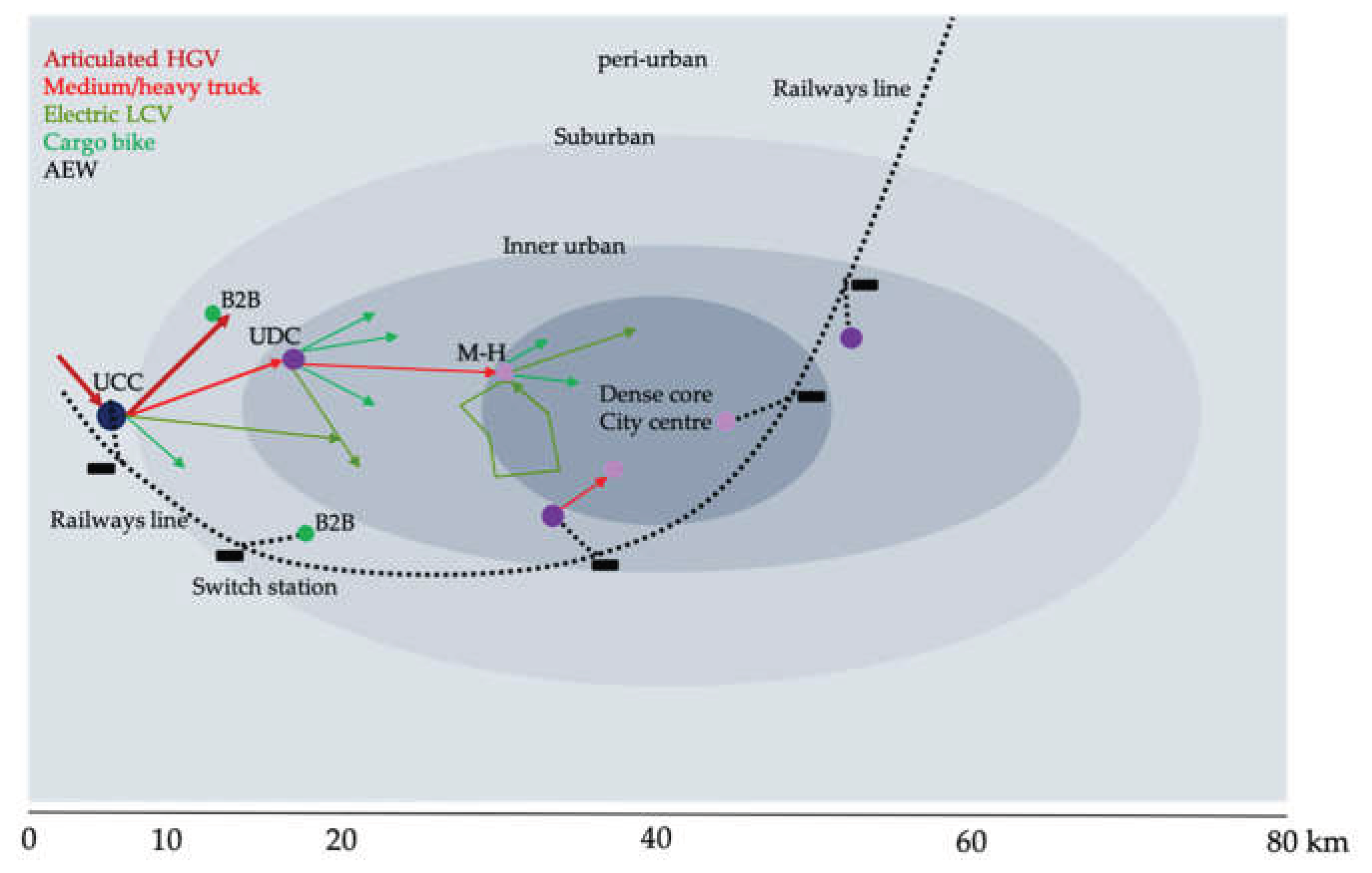
Figure 8.
The complexity of AEWs travelling in a rail network.
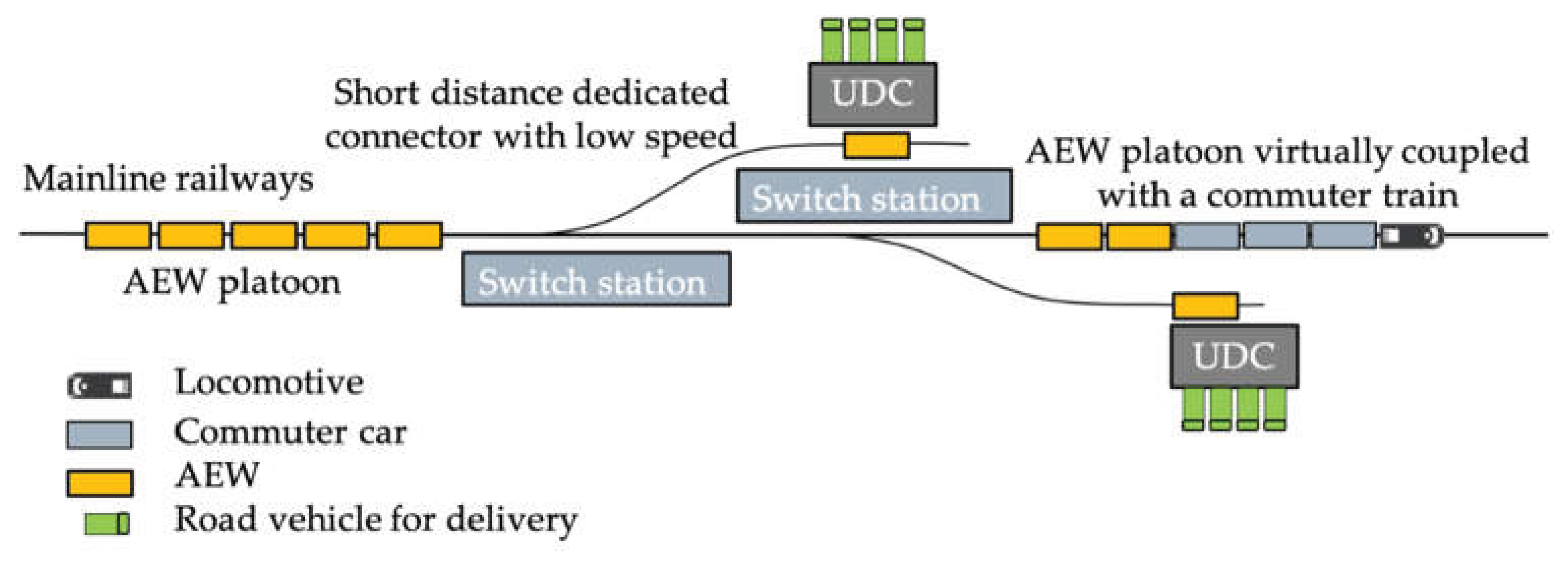
Figure 9.
AEWs coupled with a commuter train and the connector to the UDC.
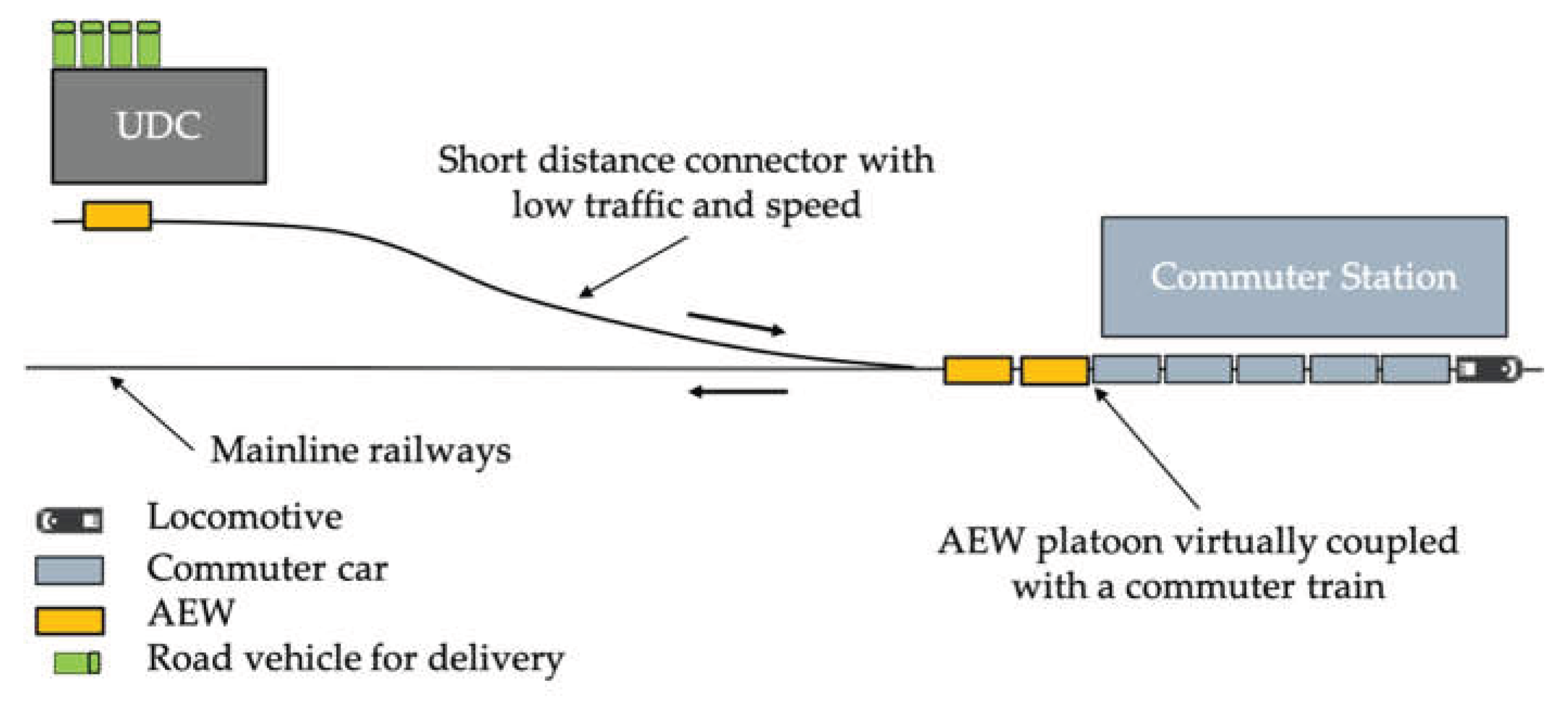
Figure 10.
An independent AEWs platoon live or retrieve a wagon from an UDC.
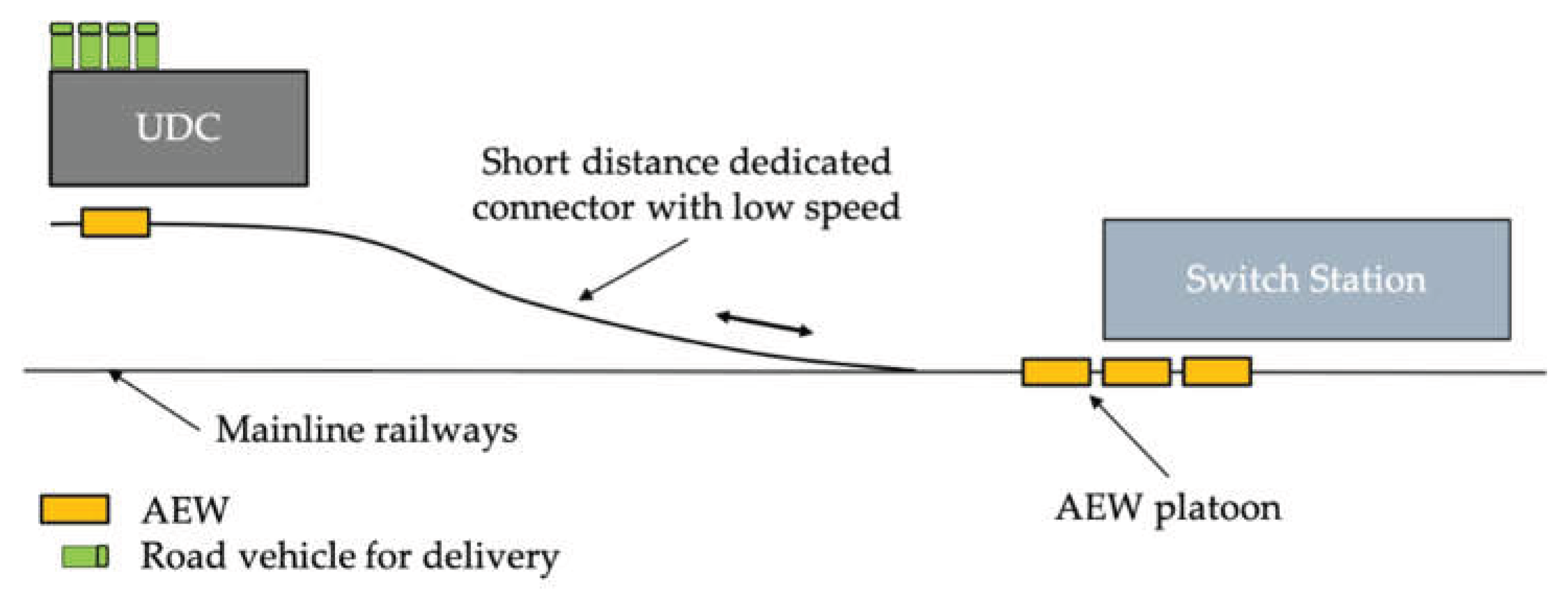
Figure 11.
An example of the Omnia Logistica supply chain.
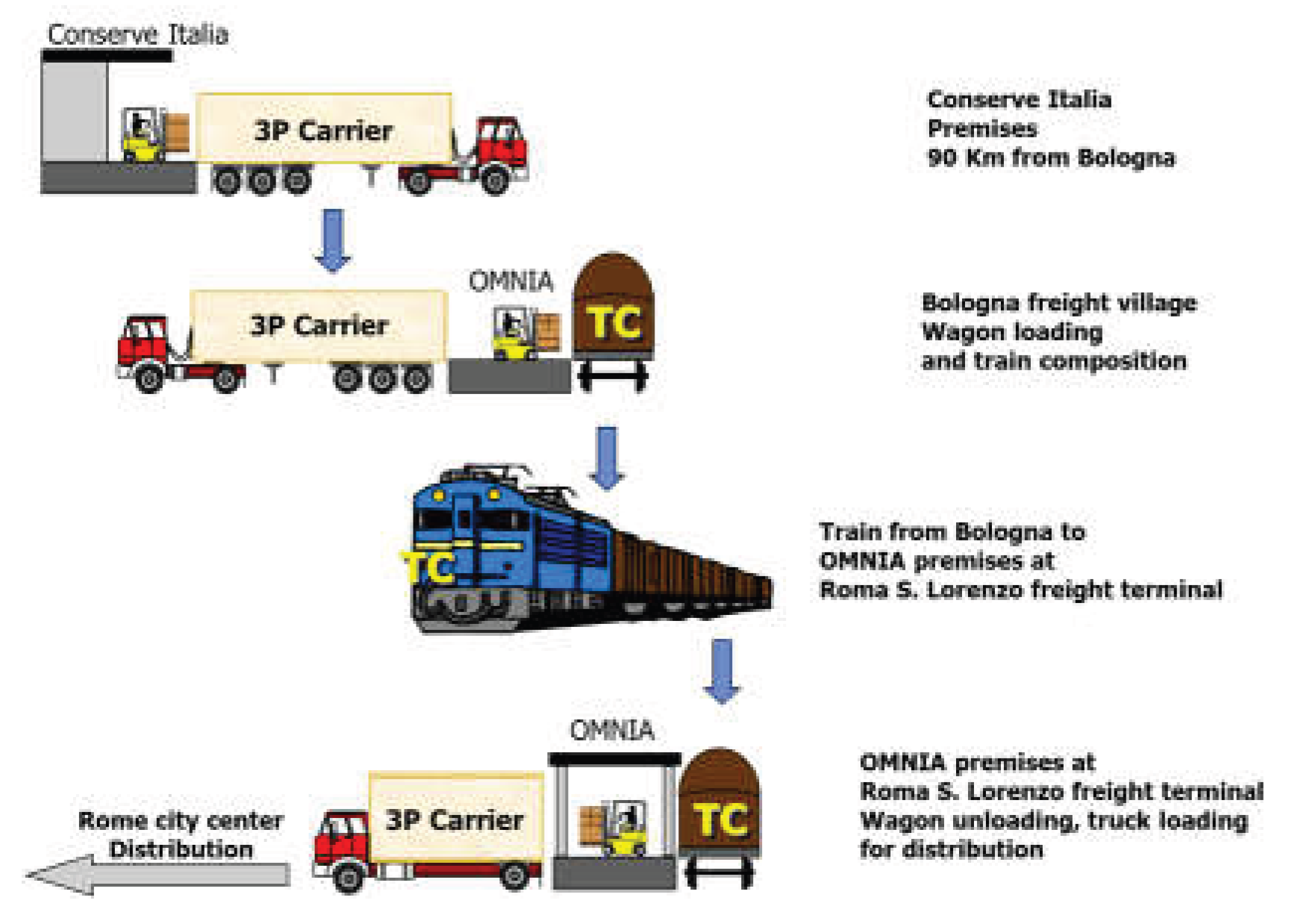
Figure 12.
The delivery points in Rome.
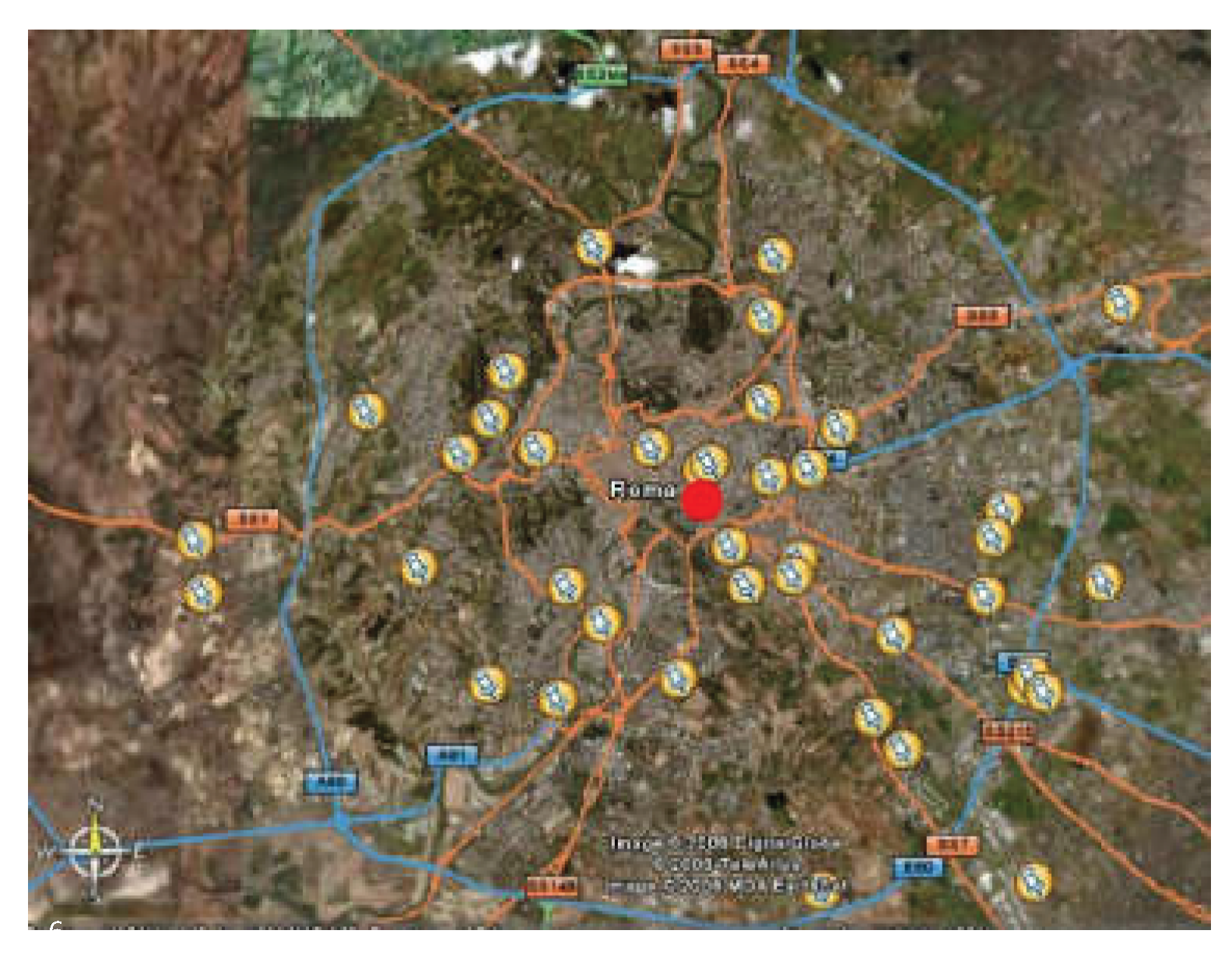
Figure 13.
The Amazon logistics network in Rome.
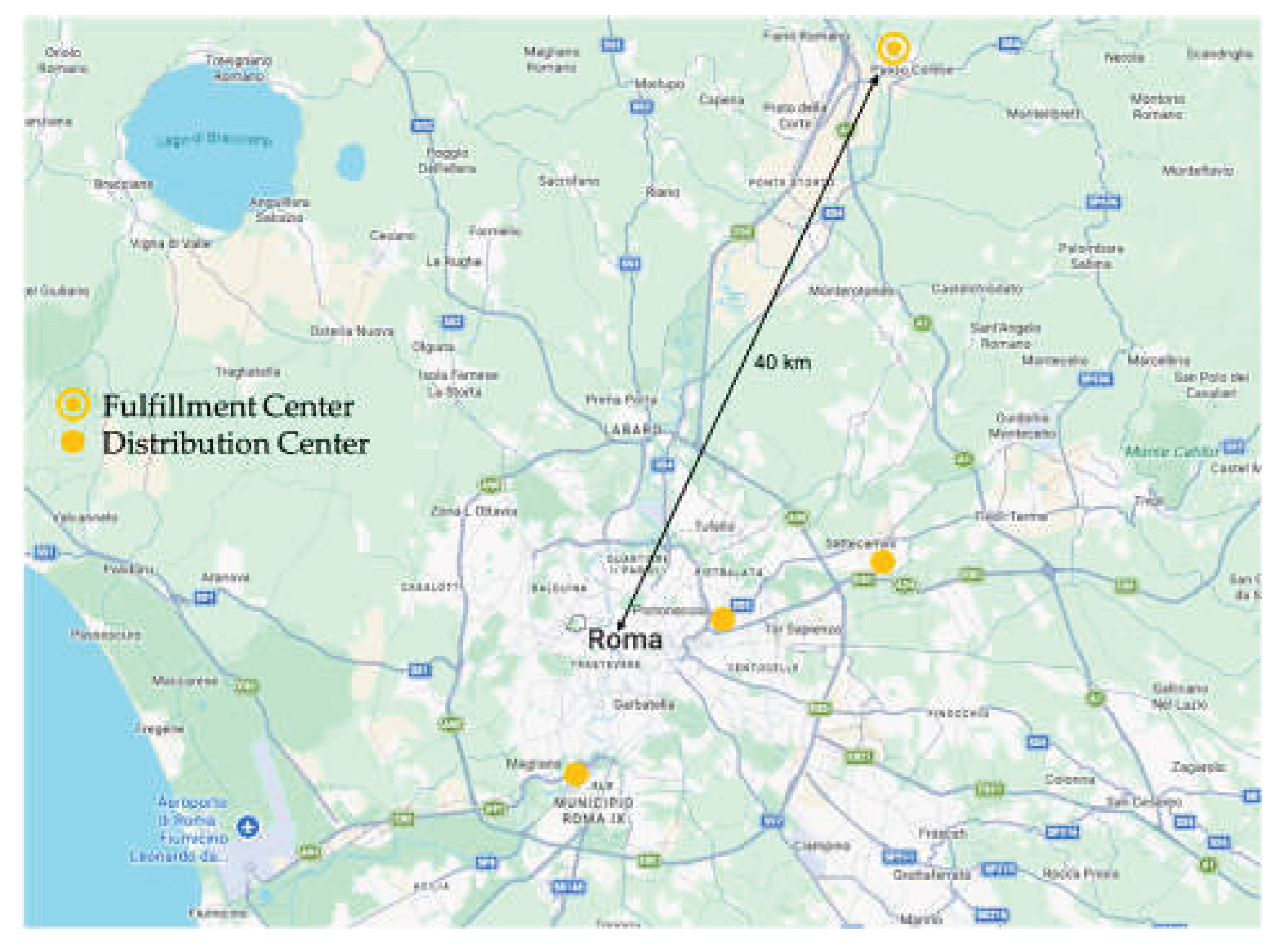
Figure 14.
AEWs logistics network.
Disclaimer/Publisher’s Note: The statements, opinions and data contained in all publications are solely those of the individual author(s) and contributor(s) and not of MDPI and/or the editor(s). MDPI and/or the editor(s) disclaim responsibility for any injury to people or property resulting from any ideas, methods, instructions or products referred to in the content. |
© 2026 by the authors. Licensee MDPI, Basel, Switzerland. This article is an open access article distributed under the terms and conditions of the Creative Commons Attribution (CC BY) license (http://creativecommons.org/licenses/by/4.0/).
Copyright: This open access article is published under a Creative Commons CC BY 4.0 license, which permit the free download, distribution, and reuse, provided that the author and preprint are cited in any reuse.