
Submitted:
27 July 2026
Posted:
29 July 2026
You are already at the latest version
Abstract
Introduction: Co-administration is a safe and effective vaccination practice and is considered an important strategy for increasing vaccination coverage across populations. However, the real world uptake for respiratory co-administration is not well quantified. Objective: To better characterize rates of co-administration and potential missed opportunities. Methods: This retrospective study leveraged data from a large vaccine ecosystem that provides end-to-end vaccine management for more than 5,000 clinics located in 43 US states. Data were gathered from the vaccine ecosystem database for active patients, defined as those who were eligible for vaccination with at least one of three respiratory vaccines (COVID-19, influenza, and Respiratory syncytial virus [RSV]), had a clinic visit between July 1, 2022 and June 1, 2023, and received one or more of those vaccine(s) during the study period. Active patients were categorized according to the number and types of those vaccines received. Those receiving co-administration of vaccines were compared to those who did not receive co-administration. Results: Of the 1,233,349 patients who received at least one respiratory vaccine during the study period, 50,582 active patients (4.1%) received 2 or more co-administered vaccines. Middle-aged adults (51-64 years), women, commercially insured patients, and those vaccinated in primary care clinics and health departments were more likely to receive co-administered vaccines. The most commonly co-administered respiratory vaccines were influenza and COVID-19 (91.3%), followed by influenza and RSV (5.4%) and RSV and COVID-19 (2.5%). Only 0.7% of patients in the co-administration cohort received all 3 respiratory vaccines simultaneously. Conclusions: This study highlights substantial missed opportunities for co-administration of respiratory vaccines and identifies population- and clinic-level factors associated with higher uptake.
Keywords:
adult vaccination
; pediatric vaccination
; vaccination clinics
; multiple vaccines
1. Introduction
Simultaneous vaccine administration, or co-administration, is the delivery of more than one vaccine using different syringes and anatomic sites at the same clinic visit. [1] Co-administration is considered an important strategy for increasing vaccination coverage across populations. [2,3] With only rare exceptions, co-administered vaccines have similar immunogenicity and adverse event rates compared with vaccines administered alone. [4,5,6] Recommendations from the Centers for Disease Control and Prevention (CDC) Advisory Committee on Immunization Practices (ACIP) support co-administration of most indicated vaccines and explicitly endorse co-administration of vaccines intended to protect against respiratory viruses (e.g., influenza, respiratory syncytial virus [RSV], and COVID-19) in people of all ages. [7,8]
Despite the extensive data supporting the safety and efficacy of co-administered vaccines and the recommendations from the CDC, missed opportunities for co-administration are prevalent in routine clinical practice. [9,10,11] Studies show that caregiver, patient, and provider concerns about co-administration are common. [12,13] However, more data are needed to identify motivators of co-administration acceptance and hesitance in order to guide interventions that may increase vaccine uptake across the lifespan. These interventions are particularly crucial for vulnerable populations who have lower vaccine coverage rates despite being at higher risk for complications from vaccine-preventable illnesses. [14,15,16,17,18] The importance of understanding vaccine uptake in this context is underscored by the 2023-2024 respiratory virus season marking a critical juncture in vaccine delivery, representing the first season when vaccines against influenza, COVID-19, and RSV were simultaneously available for adults aged 60 years and older. This unique opportunity for comprehensive respiratory virus protection through co-administration occurred against the backdrop of ongoing concerns about concurrent circulation of multiple respiratory pathogens (i.e. the ‘tripledemic’).
To better characterize rates of co-administration and potential missed opportunities, this study leveraged data from a large vaccine ecosystem that provides end-to-end vaccine management for more than 5000 clinics located in 43 states across the United States. The objectives of this study were to (1) describe the frequency of co-administration of COVID-19, influenza, or RSV vaccines within the large vaccine ecosystem during the 2022-2023 respiratory virus season and (2) determine whether sociodemographic factors and clinic attributes contribute to co-administration of these vaccines within that same vaccine ecosystem.
2. Methods
2.1. Study Design
This retrospective, observational study analyzed data from a large, end-to-end vaccine ecosystem (VaxCare LLC, Orlando, Florida). This vaccination network has been previously described and includes more than 5000 active clinic sites across more than 40 US states. In 2023, the more than 17,000 providers in this network administered approximately 4 million vaccines. [19] Through the ecosystem’s automated technology platform, which is integrated with clinic electronic health records (EHR) systems, vaccine encounters are documented, billed to insurance, and reimbursed, resulting in a robust repository of vaccination information. Providers and clinics within this ecosystem can select the vaccines they would like to offer to their patient populations. Vaccine inventory is continuously monitored and replenished, making vaccines available for immediate access at the time of the patient visit.
This study included data from active patients, defined as those who were eligible for vaccination with at least one of three respiratory vaccines (COVID-19, influenza, and RSV), had a clinic visit between July 1, 2022 and June 1, 2023, and received one or more of those vaccine(s) during the study period. Active patients were categorized according to the number and types of those vaccines received.
The study was approved by the University of Louisville Institutional Review Board [23.0719]. Data were provided by the VaxCare data science team and all identifiers removed. The IRB waived the requirement for informed consent due to the retrospective review of de-identified data.
2.2. Statistical Analysis
Demographic and clinic data for the overall population and age-group subpopulations are presented as percentages of their respective totals. Statistical analyses were performed to compare characteristics among active patients who received 1 respiratory vaccine with those who received at least 2 respiratory vaccines at a single visit (co-administration). Additionally, characteristics for patients who received co-administered vaccines were compared for those who received 2 vaccines and those who received at least 3 vaccines at a single visit. Frequencies and percentages were used to summarize categorical variables. Characteristics were statistically compared between the two groups using Chi-squared tests. P values of <.05 were considered statistically significant. Analyses were performed using SAS 9.4 software (SAS Institute Inc., Cary, North Carolina).
3. Results
3.1. Study Population
The vaccine ecosystem had a total of 1,850,269 patients who were vaccinated with any vaccine, and of them, 1,233,349 (67%) received one or more respiratory vaccines during the study period (Figure 1). Of the study population, 40.5% were 65 years or older, and 56.4% were women. Most patients were covered by commercial insurance (53%) or Medicare (39.9%), with a smaller proportion covered by Medicaid or the Vaccines for Children (VFC) program. The most common clinic sites for care were internal medicine (33.9%), pediatric (33.1%), and family medicine (25.1%).
Within the vaccination ecosystem, clinics are categorized based on their annual vaccination volume: highest (>10,000 vaccines annually), extra high (between 2001 and 10,000 vaccines annually), high (9999 to 2000 vaccines annually), medium (401 to 2001 vaccines annually), and low (≤400 vaccines annually). Clinics in the highest volume bracket are typically health system clinics and provided vaccines to nearly one-quarter of the study population.
3.2. Co-Administration of Respiratory Vaccines
Of those with a respiratory vaccine, most active patients in the study population (n=1,182,767; 95.9%) received a single vaccine only (no co-administration). Only 50,582 active patients (4.1%) received 2 or more co-administered respiratory vaccines.
3.3. Differences in Characteristics Between Cohorts
Across all subgroups studied, co-administration rates were substantially lower than single-vaccination rates. The subgroup with the highest co-administration rate was the population of active patients vaccinated at health department sites (13.4%), followed by those with VFC coverage (5.9%), with Medicaid coverage (5.5%), receiving vaccines at the highest-volume clinics (5.2%), and aged 51 to 64 years (5.0%).
The differences in subgroup distribution were compared between the co-administration and no co-administration cohorts are shown in Table 1. The distribution of patient ages, patient genders, insurance types, clinic types, and clinic vaccine volumes were significantly different between the cohorts receiving co-administration vs no co-administration (all P<0.0001). The largest differences between the co-administration and no co-administration cohorts were by clinic specialty, with higher proportions of patients vaccinated at health departments receiving co-administered vaccines (between-group difference, +18.1 percentage points) and lower proportions of patients vaccinated in pediatric clinics receiving co-administered vaccines (−9.0 percentage points). When the distribution of active patients by clinic vaccine volume was compared between cohorts, the differences between the co-administration and no co-administration cohort became increasingly disparate with decreasing vaccine volume, from +7.0 percentage points in the highest-volume clinics to −5.2 percentage points in low-volume clinics. Additionally, compared with the no co-administration cohort, the co-administration cohort had higher proportions of patients aged 51-64 years (between-group difference, +4.3 percentage points) and lower proportions of patients 65 years or older (−5.2 percentage points).
3.4. Co-Administration by Vaccine Types
In the co-administration cohort, the most commonly co-administered respiratory vaccines were influenza and COVID-19 (91.3%). In addition, 5.4% of co-administration events included influenza and RSV, and 2.5% of co-administration events included RSV and COVID-19 vaccines. Only 0.7% of patients in the co-administration cohort received all 3 respiratory vaccines simultaneously.
The co-administered vaccine combinations were evaluated by age group, gender, insurance type, specialty type, and clinic vaccination volume. In general, adults 51 years and older received more co-administered influenza and RSV vaccines than patients in other age groups. Co-administered influenza and COVID-19 were the only combination used in those aged 6 months to 2 years and predominated in people aged 3 to 50 years.
3.5. Co-Administration by Number of Co-Administered Vaccines
Significantly more patients received 2 co-administered vaccines (99.3%) than >2 co-administered vaccines (0.7%). Most individuals receiving 3 co-administered vaccines were aged 51-64 years (67.5%) or 65 years and older (31.2%) and were vaccinated in clinics administering at least 2001 vaccines annually (extra-high or highest volume; 73.2%) (Table 2). The distribution of patients receiving two versus more than two co-administered vaccines differed significantly by age group, insurance type, specialty type, and clinic vaccination volume (all P <0.001). There was no statistically significant difference between the gender of those who received two or more than two co-administered vaccines (P = 0.299).
4. Discussion
In this study of a large, nationwide vaccine ecosystem, we found low rates of co-administration of respiratory vaccines. Despite the CDC recommendations for respiratory vaccines co-administration, fewer than 5% of vaccine visits included multiple vaccines, potentially indicating persistent missed opportunities for optimizing vaccination delivery in real-world clinical settings. To our knowledge, this is the first large study to examine vaccine co-administration in health clinics across multiple states and a wide range of clinic types and sizes.
The underutilization of co-administration represents a critical gap in adult immunization delivery, particularly given evidence supporting the safety, immunogenicity, and operational benefits of administering multiple vaccines simultaneously. Studies of influenza, COVID-19, and RSV vaccines have consistently shown that co-administration does not compromise immune responses or increase serious adverse events, supporting broader implementation in routine practice. [4,5,6] Co-administering vaccines reduces the number of healthcare visits required and addresses barriers such as limited patient access and clinic capacity constraints. [3]
Our findings indicate that respiratory vaccine co-administration is more common and feasible among certain demographic groups and care settings. Middle-aged adults (51-64 years), women, commercially insured patients, and those vaccinated in primary care clinics and health departments were more likely to receive co-administered vaccines. These patterns are unlikely to be due to chance and likely reflect systematic differences in vaccination practices or patient preferences across different population segments. For example, differences in co-administration rates may be related to employee immunization or preventive health initiatives in the workplace among commercially insured and middle-aged adults, differences in health care–seeking behaviors between genders, and stronger vaccination infrastructure in high-volume clinics. [20,21]
The higher rates of co-administration observed in specific settings—such as high-volume clinics, health departments, and among Medicare recipients —underscore the critical role that infrastructure and system supports play in optimizing vaccine delivery. Studies have consistently shown that implementing standing orders, integrated vaccination records, clinician reminders, and care coordinator support can substantially increase vaccine uptake relative to routine care. [22] Clinics with standing orders streamline workflows by authorizing non-provider staff to assess vaccine eligibility and administer vaccines without direct clinician involvement, a practice endorsed by the CDC and ACIP. [23] Similarly, centralized immunization registries and care coordinators facilitate the timely identification of vaccination needs and enable delivery of multiple vaccines during a single encounter. [24] These systems-level interventions may reduce missed opportunities for co-administration and promote efficient use of healthcare resources. In the analysis of Medicare claims data examining the extent of COVID-19 and influenza vaccine administration among older adults, Harris and colleagues observed that racial and ethnic differences in coadministration rates may be more related to access and awareness than to vaccine acceptance itself. Their findings further support attention to structural barriers and operational attention in order to impact vaccine acceptance and resultant co-administration. [25]
Conversely, lower co-administration rates among pediatric clinics, Medicaid and VFC beneficiaries, and low-volume sites suggest potential systemic barriers to vaccine co-administration. For example, vaccine coverage among Medicaid recipients is often hindered by low reimbursement rates and administrative burdens—state Medicaid typically pays less than Medicare or private insurance, potentially discouraging providers from stocking and administering vaccines. [26] Similarly, data show that VFC-eligible children receive vaccines at lower rates than their privately insured peers, reflecting potential structural and organizational challenges. [15] The disparities in co-administration by clinical setting and insurance type highlight areas where targeted interventions—such as improved provider training and streamlined clinic workflows—may help close the co-administration gap. In addition, policy changes that address low vaccine reimbursement rates in Medicaid and other public programs may be necessary to ensure providers are adequately supported to stock and provide commonly co-administered respiratory vaccines. Finally, differences in provider training and knowledge regarding contraindications could also explain the observed patterns. Vaccine co-administration may be enhanced through provider training, with a focus on vaccine safety, co-administration reassurance, and strategies for patient and caregiver counseling on co-administration to reduce vaccine hesitancy. [27]
Further research into the causes of low co-administration rates and disparities in co-administration are needed. Future research should explore patient and provider perceptions of co-administration through qualitative studies. Additionally, the feasibility and acceptability of workflow redesign to incorporate co-administration protocols should be evaluated. Cost-effectiveness analyses examining the impact of improved co-administration on healthcare utilization and disease prevention are also warranted.
This study has limitations that are inherent to its retrospective design, which limits inferential analyses. Additionally, reliance on patient EHR data may incompletely capture patient demographics or vaccinations received outside the ecosystem (e.g., at pharmacies, workplaces, or community events). Lack of race and ethnicity data prevents analysis of disparities across these different groups, but the large sample size helps inform overall co-administration trends, which are likely robust across various ethnic and racial groups. Finally, the dataset did not include information about contraindications, prior vaccinations, and provider-level decision making, so true eligibility for co-administration was not calculated. VaxCare clinics provide vaccines on-site in clinics thereby facilitating access. Although patients can access vaccines through other routes (e.g., other clinics, pharmacies), the ability to seamlessly access co-administered vaccines increase co-administration opportunities and likely influence co-administration rates. The purpose of this study, however, is to report what has occurred in these clinics and serve as a baseline for improvement opportunities. The results also provide the chance to see co-administration rates under what could be considered as a best access opportunity. The exceptionally large sample size of over 1.2 million individuals allowed us to capture real-world vaccination practices across various demographics and settings, enhancing the external validity of the findings. Strengths of this study include the large sample size, geographic diversity, and real world settings which capture actual clinical practice patterns.
In conclusion, this study highlights the possibility of missed opportunities for co-administration of respiratory vaccines in the United States and identifies population- and clinic-level factors associated with higher uptake. Notable disparities across age groups, gender, insurance types, specialty types, and vaccination volume demonstrate that both patient- and systems-level influences, such as access to care, provider practices, and clinic guidelines, shape co-administration patterns. Enhancing co-administration practices could improve vaccine coverage, reduce preventable illnesses, and streamline healthcare delivery.
Future efforts should focus on targeted interventions, including policy changes to address insurance-related disparities, expanding co-administration coverage across payer types, and implementing provider training programs to build confidence in co-administration practices across specialties. Additional research is needed to explore disparities by socioeconomic status, geographic regions, and race and ethnicity. Studies investigating short-term sequalae (e.g., adverse events) and long-term metrics (e.g., vaccine effectiveness, seroconversion, and the need for booster doses) could support efforts to increase co-administration rates by reassuring both patients and providers. Pilot studies on clinic workflow redesign such as standing orders and integration of co-administration, coupled with cost-effectiveness analyses, could provide critical insights for improving vaccine coverage and optimizing resource use in diverse health care settings.
Author Contributions
RC was responsible for study conceptualization, design, and primary writing. SR contributed to manuscript construction for study design as well as manuscript revision and editing. SR and CK were responsible for statistical analysis. All authors have reviewed and approved the final version of the manuscript.
Role of The Funding Source: No funding was provided for this study.
Conflicts of Interest
RC has provided consulting services for VaxCare and CK is an employee of VaxCare. .
Acknowledgments
The authors express thanks to the healthcare personnel within the VaxCare system who continue to maintain emphasis on provision of vaccination to patients across the lifespan. .
References
- Centers for Disease Control and Prevention. Timing and Spacing of Immunobiologics. 1 August 2023. Available online: https://www.cdc.gov/vaccines/hcp/acip-recs/general-recs/timing.html (accessed on 4 September 2024).
- Zhao, Z.; Smith, P.J.; Hill, H.A. Evaluation of potentially achievable vaccination coverage with simultaneous administration of vaccines among children in the United States. Vaccine 2016, 34(27), 3030–3036. [Google Scholar] [CrossRef]
- Bonanni, P.; Steffen, R.; Schelling, J.; et al. Vaccine co-administration in adults: An effective way to improve vaccination coverage. Hum. Vaccin Immunother. 2023, 19(1), 2195786. [Google Scholar] [CrossRef] [PubMed]
- Gonen, T.; Barda, N.; Asraf, K.; et al. Immunogenicity and Reactogenicity of Coadministration of COVID-19 and Influenza Vaccines. JAMA Netw. Open 2023, 6(9), e2332813. [Google Scholar] [CrossRef] [PubMed]
- Chandler, R.; Montenegro, N.; Llorach, C.; et al. Immunogenicity, Reactogenicity, and Safety of AS01E-adjuvanted RSV Prefusion F Protein-based Candidate Vaccine (RSVPreF3 OA) When Co-administered With a Seasonal Quadrivalent Influenza Vaccine in Older Adults: Results of a Phase 3, Open-Label, Randomized Controlled Trial. Clin. Infect. Dis. 2024. [Google Scholar] [CrossRef] [PubMed]
- Toback, S.; Galiza, E.; Cosgrove, C.; et al. Safety, immunogenicity, and efficacy of a COVID-19 vaccine (NVX-CoV2373) co-administered with seasonal influenza vaccines: an exploratory substudy of a randomised, observer-blinded, placebo-controlled, phase 3 trial. Lancet Respir. Med. 2022, 10(2), 167–179. [Google Scholar] [CrossRef] [PubMed]
- Grohskopf, L.A.; Ferdinands, J.M.; Blanton, L.H.; Broder, K.R.; Loehr, J. Prevention and Control of Seasonal Influenza with Vaccines: Recommendations of the Advisory Committee on Immunization Practices - United States, 2024-25 Influenza Season. MMWR Recomm. Rep. 2024, 73(5), 1–25. [Google Scholar] [CrossRef] [PubMed]
- Fleming-Dutra, K.E.; Jones, J.M.; Roper, L.E.; et al. Use of the Pfizer Respiratory Syncytial Virus Vaccine During Pregnancy for the Prevention of Respiratory Syncytial Virus-Associated Lower Respiratory Tract Disease in Infants: Recommendations of the Advisory Committee on Immunization Practices - United States, 2023. MMWR Morb. Mortal. Wkly. Rep. 2023, 72(41), 1115–1122. [Google Scholar] [CrossRef] [PubMed]
- Kelly, M.K.; Grundmeier, R.W.; Stephens-Shields, A.J.; et al. Missed opportunities for human papillomavirus vaccination at office visits during which influenza vaccine was administered: An AAP pediatric research in office settings (PROS) national primary care research network study. Vaccine 2020, 38(33), 5105–5108. [Google Scholar] [CrossRef] [PubMed]
- Butler, A.M.; Newland, J.G.; Sahrmann, J.M.; O’Neil, C.A.; McGrath, L.J. Characterizing timeliness of recommended vaccinations among privately-insured children in the United States, 2009-2019. Vaccine 2024, 42(21), 126179. [Google Scholar] [CrossRef] [PubMed]
- Harris, D.A.; Chachlani, P.; Hayes, K.N.; et al. COVID-19 and Influenza Vaccine Coadministration Among Older U.S. Adults. Am. J. Prev. Med. 2024, 67(1), 67–78. [Google Scholar] [CrossRef] [PubMed]
- Wallace, A.S.; Mantel, C.; Mayers, G.; Mansoor, O.; Gindler, J.S.; Hyde, T.B. Experiences with provider and parental attitudes and practices regarding the administration of multiple injections during infant vaccination visits: lessons for vaccine introduction. Vaccine 2014, 32(41), 5301–5310. [Google Scholar] [CrossRef] [PubMed]
- Domnich, A.; Grassi, R.; Fallani, E.; et al. Acceptance of COVID-19 and Influenza Vaccine Co-Administration: Insights from a Representative Italian Survey. J. Pers. Med. 2022, 12(2). [Google Scholar] [CrossRef] [PubMed]
- Jain, B.; Paguio, J.A.; Yao, J.S.; et al. Rural-Urban Differences in Influenza Vaccination Among Adults in the United States, 2018-2019. Am. J. Public Health 2022, 112(2), 304–307. [Google Scholar] [CrossRef] [PubMed]
- Valier, M.R.; Yankey, D.; Elam-Evans, L.D.; et al. Vital Signs: Trends and Disparities in Childhood Vaccination Coverage by Vaccines for Children Program Eligibility - National Immunization Survey-Child, United States, 2012-2022. MMWR Morb. Mortal. Wkly. Rep. 2024, 73(33), 722–730. [Google Scholar] [CrossRef] [PubMed]
- Pingali, C.; Yankey, D.; Chen, M.; et al. National Vaccination Coverage Among Adolescents Aged 13-17 Years - National Immunization Survey-Teen, United States, 2023. MMWR Morb. Mortal. Wkly. Rep. 2024, 73(33), 708–714. [Google Scholar] [CrossRef] [PubMed]
- Black, C.L.; O’Halloran, A.; Hung, M.C.; et al. Vital Signs: Influenza Hospitalizations and Vaccination Coverage by Race and Ethnicity-United States, 2009-10 Through 2021-22 Influenza Seasons. MMWR Morb. Mortal. Wkly. Rep. 2022, 71(43), 1366–1373. [Google Scholar] [CrossRef] [PubMed]
- Mackey, K.; Ayers, C.K.; Kondo, K.K.; et al. Racial and Ethnic Disparities in COVID-19-Related Infections, Hospitalizations, and Deaths: A Systematic Review. Ann. Intern Med. 2021, 174(3), 362–373. [Google Scholar] [CrossRef] [PubMed]
- BMC journal.
- Gualano, M.R.; Santoro, P.E.; Borrelli, I.; et al. Employee Participation in Workplace Vaccination Campaigns: A Systematic Review and Meta-Analysis. Vaccines 2022, 10(11). [Google Scholar] [CrossRef] [PubMed]
- Thompson, A.E.; Anisimowicz, Y.; Miedema, B.; Hogg, W.; Wodchis, W.P.; Aubrey-Bassler, K. The influence of gender and other patient characteristics on health care-seeking behaviour: a QUALICOPC study. BMC Fam. Pract. 2016, 17(1), 38. [Google Scholar] [CrossRef] [PubMed]
- Wheeler, S.G.; Beste, L.A.; Overland, M.K.; Wander, P.L. Interventions in primary care to increase uptake of adult vaccines: a systematic review. J. Public Health (Oxf) 2025, 47(2), 222–231. [Google Scholar] [CrossRef] [PubMed]
- McKibben, L.J.; Stange, P.V.; Sneller, V.-P.; Strikas, R.A.; Rodewald, L.E. Use of standing orders programs to increase adult vaccination rates: recommendations of the Advisory Committee on Immunization Practices. Morb. Mortal. Wkly. Rep. Recomm. Rep. 2000, 15–26. [Google Scholar]
- Groom, H.; Hopkins, D.P.; Pabst, L.J.; Murphy Morgan, J.; Patel, M.; Calonge, N.; Coyle, R.; Dombkowski, K.; Groom, A.V.; Kurilo, M.B.; Rasulnia, B.; Shefer, A.; Town, C.; Wortley, P.M.; Zucker, J. Community Preventive Services Task Force. Immunization information systems to increase vaccination rates: a community guide systematic review. J. Public Health Manag Pract. 2015, 21(3), 227–48. [Google Scholar] [CrossRef] [PubMed]
- Harris, D.A.; Chachlani, P.; Hayes, K.N.; McCarthy, E.P.; Wen, K.J.; Deng, Y.; Zullo, A.R.; Djibo, D.A.; McMahill-Walraven, C.N.; Smith-Ray, R.L.; Gravenstein, S.; Mor, V. COVID-19 and Influenza Vaccine Coadministration Among Older U.S. Adults. Am. J. Prev. Med. 2024, 67(1), 67–78. [Google Scholar] [CrossRef] [PubMed]
- Polaris, J.J.Z.; Eiden, A.L.; DiFranzo, A.P.; Pfister, H.R.; Itzkowitz, M.C.; Bhatti, A.A. State Medicaid Coverage and Reimbursement of Adult Vaccines Administered by Physicians and Pharmacists. AJPM Focus. 2024, 3(4), 100252. [Google Scholar] [CrossRef] [PubMed]
- Holford, D.; Anderson, E.C.; Biswas, A.; et al. Healthcare professionals’ perceptions of challenges in vaccine communication and training needs: a qualitative study. BMC Prim. Care 2024, 25(1), 264. [Google Scholar] [CrossRef] [PubMed]
Figure 1.
Flow diagram of study population identification and cohorting.
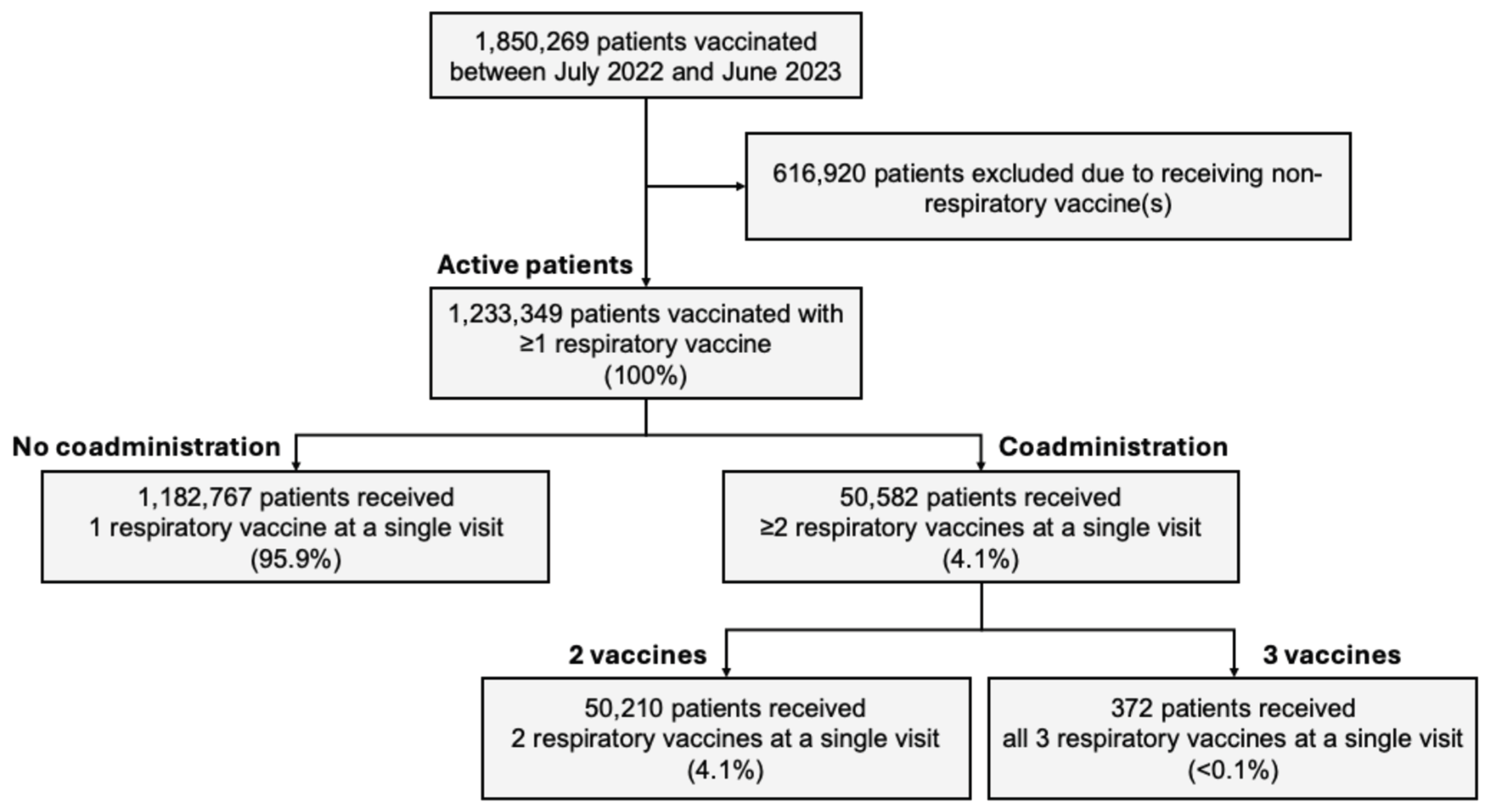

Table 1.
Comparison Between Patients Who Received 1 Respiratory Vaccine (No Co-administration) or 2 or More Respiratory Vaccines (Co-administration) in a Nationwide Vaccine Ecosystem During the 2022-2023 Season.
Table 1.
Comparison Between Patients Who Received 1 Respiratory Vaccine (No Co-administration) or 2 or More Respiratory Vaccines (Co-administration) in a Nationwide Vaccine Ecosystem During the 2022-2023 Season.
| Characteristic | All active patients N=1,233,349 |
No co-administration (1 respiratory vaccine) n=1,182,767 |
Co-administration (≥2 respiratory vaccines) n=50,582 |
Between-group difference (co-administration – no co-administration), percentage points | P value | |||
|---|---|---|---|---|---|---|---|---|
| n | % | n | % | n | % | |||
| Age group | <0.0001 | |||||||
| 6 months to 2 years | 66,168 | 5.4 | 64,227 | 5.4 | 1941 | 3.8 | -1.6 | |
| 3-18 years | 199,014 | 16.1 | 191,017 | 16.2 | 7997 | 15.8 | -0.4 | |
| 19-50 years | 240,087 | 19.5 | 228,835 | 19.4 | 11,252 | 22.3 | 2.9 | |
| 51-64 years | 229,222 | 18.6 | 217,759 | 18.4 | 11,463 | 22.7 | 4.3 | |
| ≥65 years | 498,858 | 40.5 | 480,929 | 40.7 | 17,929 | 35.5 | -5.2 | |
| Gender | <0.0001 | |||||||
| Woman | 695,299 | 56.4 | 669,075 | 56.6 | 26,224 | 51.8 | -4.8 | |
| Man | 537,739 | 43.6 | 513,383 | 43.4 | 24,356 | 48.2 | 4.8 | |
| Other | 311 | 0.0 | 309 | 0.0 | 2 | 0.0 | 0 | |
| Insurance type | <0.0001 | |||||||
| Commercial | 657,394 | 53.3 | 628,537 | 53.1 | 28,857 | 57.1 | 4 | |
| Medicaid | 44,552 | 3.6 | 42,109 | 3.6 | 2443 | 4.8 | 1.2 | |
| Medicare | 491,439 | 39.9 | 474,522 | 40.1 | 16,917 | 33.4 | -6.7 | |
| VFC | 39,964 | 3.2 | 37,599 | 3.2 | 2365 | 4.7 | 1.5 | |
| Specialty | <0.0001 | |||||||
| Family medicine | 308,931 | 25.1 | 297,669 | 25.2 | 11,262 | 22.3 | -2.9 | |
| Health department | 93,515 | 7.6 | 80,939 | 6.8 | 12,576 | 24.9 | 18.1 | |
| Internal medicine | 417,876 | 33.9 | 403,570 | 34.1 | 14,306 | 28.3 | -5.8 | |
| OB/GYN | 5110 | 0.4 | 5018 | 0.4 | 92 | 0.2 | -0.2 | |
| Pediatric | 407,917 | 33.1 | 395,571 | 33.4 | 12,346 | 24.4 | -9.0 | |
| Annual vaccine volume | <0.0001 | |||||||
| Highest (>10,000) | 294,823 | 23.9 | 279,349 | 23.6 | 15,474 | 30.6 | 7.0 | |
| Extra high (2001- 10,000) | 402,524 | 32.6 | 384,770 | 32.5 | 17,754 | 35.1 | 2.6 | |
| High (999-2000) | 217,457 | 17.6 | 208,832 | 17.7 | 8625 | 17.1 | -0.6 | |
| Medium (401-2001) | 178,349 | 14.5 | 172,840 | 14.6 | 5509 | 10.9 | -3.7 | |
| Low (≤400) | 140,196 | 11.4 | 136,976 | 11.6 | 3220 | 6.4 | -5.2 |
Table 2.
Comparison Between Patients Who Received 2 or More Than 2 Respiratory Vaccines in a Nationwide Vaccine Ecosystem During the 2022-2023 Season.
Table 2.
Comparison Between Patients Who Received 2 or More Than 2 Respiratory Vaccines in a Nationwide Vaccine Ecosystem During the 2022-2023 Season.
| Characteristic | 2 respiratory vaccines n=50,210 |
>2 respiratory vaccines n=372 |
Between-group difference (>2 vaccines – 2 vaccines), percentage points |
P value | ||
|---|---|---|---|---|---|---|
| n | % | n | % | |||
| Age group | <0.0001 | |||||
| 6 months to 2 years | 1941 | 3.9 | 0 | 0.0 | -3.9 | |
| 3-18 years | 7996 | 15.9 | 1 | 0.3 | -15.6 | |
| 19-50 years | 11248 | 22.4 | 4 | 1.1 | -21.3 | |
| 51-64 years | 11212 | 22.3 | 251 | 67.5 | 45.2 | |
| ≥65 years | 17813 | 35.5 | 116 | 31.2 | -4.3 | |
| Gender | .299 | |||||
| Woman | 26046 | 51.9 | 178 | 47.9 | -4.0 | |
| Man | 24162 | 48.1 | 194 | 52.2 | 4.1 | |
| Other | 2 | 0.0 | 0 | 0.0 | 0 | |
| Insurance type | <0.0001 | |||||
| Commercial | 28561 | 56.9 | 296 | 79.6 | 22.7 | |
| Medicaid | 2400 | 4.8 | 43 | 11.6 | 6.8 | |
| Medicare | 16885 | 33.6 | 32 | 8.6 | -25.0 | |
| VFC | 2364 | 4.7 | 1 | 0.3 | -4.4 | |
| Specialty | <0.0001 | |||||
| Family medicine | 11136 | 22.2 | 126 | 33.9 | 11.7 | |
| Health department | 12520 | 24.9 | 56 | 15.1 | -9.8 | |
| Internal medicine | 14189 | 28.3 | 117 | 31.5 | 3.2 | |
| OB/GYN | 92 | 0.2 | 0 | 0.0 | -0.2 | |
| Pediatric | 12273 | 24.4 | 73 | 19.6 | -4.8 | |
| Annual vaccine volume | <0.0001 | |||||
| Highest (>10,000) | 15332 | 30.5 | 142 | 38.2 | 7.7 | |
| Extra high (2001-10,000) | 17624 | 35.1 | 130 | 35.0 | -0.1 | |
| High (9999-2000) | 8559 | 17.1 | 66 | 17.7 | 0.6 | |
| Medium (401-2001) | 5488 | 10.9 | 21 | 5.7 | -5.2 | |
| Low (≤400) | 3207 | 6.4 | 13 | 3.5 | -2.9 |
Disclaimer/Publisher’s Note: The statements, opinions and data contained in all publications are solely those of the individual author(s) and contributor(s) and not of MDPI and/or the editor(s). MDPI and/or the editor(s) disclaim responsibility for any injury to people or property resulting from any ideas, methods, instructions or products referred to in the content. |
© 2026 by the authors. Licensee MDPI, Basel, Switzerland. This article is an open access article distributed under the terms and conditions of the Creative Commons Attribution (CC BY) license (http://creativecommons.org/licenses/by/4.0/).
Copyright: This open access article is published under a Creative Commons CC BY 4.0 license, which permit the free download, distribution, and reuse, provided that the author and preprint are cited in any reuse.


