

Submitted:
27 July 2026
Posted:
28 July 2026
You are already at the latest version
Abstract
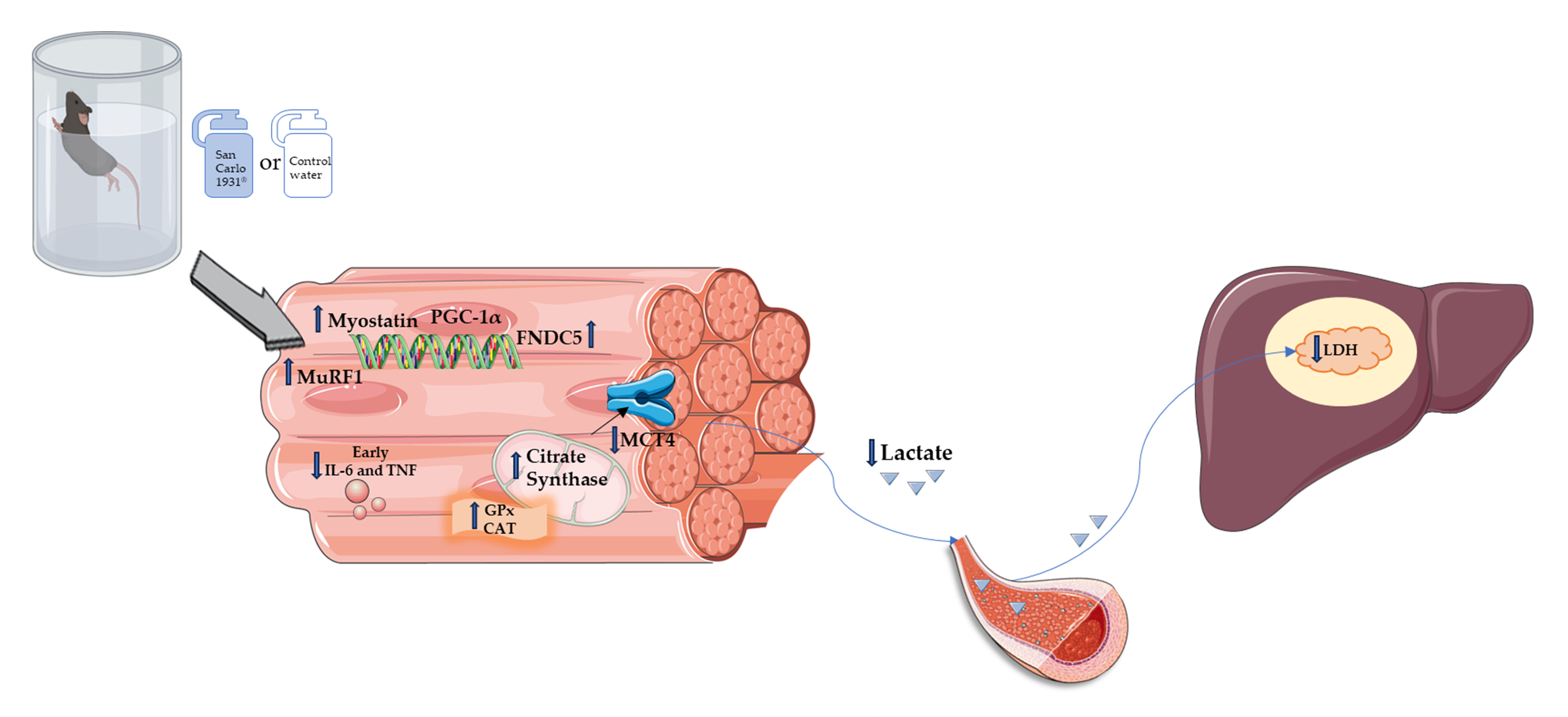
Background: Repeated endurance exercise induces transient inflammatory, oxidative and metabolic responses that drive skeletal muscle adaptation. This study investigated whether the consumption of San Carlo 1931® water, a mineral water with a human-like electrolyte profile, modulates these responses in a murine model of repeated swimming exercise. Methods: Male C57BL/6 mice underwent swimming exercise (10 min/day) for 2, 3 or 4 weeks while receiving either San Carlo 1931® water or control water. Grip strength, inflammatory cytokines (IL-6 and TNF), oxidative stress markers (MDA, GPx, and CAT), lactate metabolism (lactate, LDH, and monocarboxylate transporters), citrate synthase activity and the expression of PGC-1α, FNDC5, MuRF1 and myostatin were evaluated. Results: San Carlo 1931® water prevented the early decline in grip strength, attenuated the early exercise-induced inflammatory response, reduced circulating lactate and hepatic LDH activity, enhanced citrate synthase activity and progressively decreased MCT4 expression, indicating improved oxidative metabolism. No significant changes were observed in MCT1 protein expression. These adaptations were accompanied with unchanged PGC-1α expression, early FNDC5 induction and a time-dependent regulation of muscle remodeling markers, with transient progressive MuRF1 upregulation and myostatin induction. Conclusions: The consumption of San Carlo 1931® water modulate inflammatory and metabolic responses to repeated endurance exercise, suggesting a potential role in supporting physiological adaptation to exercise-induced stress.
Keywords:
endurance exercise
; mineral water
; oxidative metabolism
; inflammation
Copyright: This open access article is published under a Creative Commons CC BY 4.0 license, which permit the free download, distribution, and reuse, provided that the author and preprint are cited in any reuse.


