
Submitted:
27 July 2026
Posted:
28 July 2026
You are already at the latest version
Abstract
This study investigated the quality characteristics of tea plant germplasm from different geographic origins under the ecological conditions of Guizhou. Quality components and volatile aroma compounds were analyzed in four introduced cultivars (CC4H, SLX, SMCY, HJC1) and two local cultivars (QM601, GZSC). The results showed that the phenol-to-amine ratios of all six cultivars were below 8, indicating their suitability for green tea production. GC-MS identified a total of 147 volatile compounds, among which alcohols were present in the highest concentrations (1090.69–1499.18 μg/kg). SMCY had the highest total alcohol content. ROAV analysis confirmed that benzaldehyde, (E)-β-damascone, β-ionone, and 1-octene-3-one are the key contributors to the aroma profile. Among the introduced cultivars, SMCY stands out for its floral and aromatic compounds; SLX is notably rich in floral and fruity aldehydes and esters; CC4H has a distinct roasted sweetness, and HJC1 offers the best freshness. The local variety QM601 exhibits synergistic accumulation of tea polyphenols and fruity terpenes, while GZSC maintains its traditional advantage in the balance of phenolic and amino compounds. These findings provide a theoretical basis for the differentiated deployment of tea cultivars in Guizhou’s tea-growing regions.
Keywords:
tea cultivars
; quality components
; volatile aromatic compounds
; ROAV
1. Introduction
The tea plant (Camellia sinensis L.O. Kuntze) is a perennial specialty cash crop whose quality characteristics results from the synergistic interplay between genetic background and cultivation environment [1]. Among these, the germplasm genotype underpins the baseline abundance and compositional architecture of secondary metabolites, thereby directly governing the biosynthetic capacity for critical flavor precursors, including amino acids, tea polyphenols, and catechins.[2]. Meanwhile, regional ecological factors—including altitude, light intensity, temperature, and humidity, and soil physicochemical characteristics—modulate the metabolic rhythms within tea plants, reshape the proportional accumulation of metabolites, and ultimately give rise to diverse sensory flavor profiles among cultivars and production areas. [3,4,5,6,7]. This genotype–environment interaction implies that, upon introduction of geographically distinct cultivars to a common ecological region, the extent of quality-component divergence is governed both by the cultivars’ intrinsic metabolic capacity and by the remodeling of their pre-existing metabolic pathways imposed by the novel environment.
As a prime example of high-altitude, premium tea-growing regions in southwest China, Guizhou’s unique natural environment—characterized by “high altitude, limited sunlight, frequent fog, and a pristine ecosystem”—endows its tea with quality advantages such as high amino acid content, a balanced phenolic-to-amino acid ratio, and a delicate yet rich aroma [8]. The abundant local tea plant genetic resources within the province serve as the core genetic foundation supporting the high-quality development and differentiated competitiveness of Guizhou’s tea industry. In order to broaden the genetic diversity of tea plant resources, optimize product flavor profiles, and meet diverse market demands, a large number of high-quality tea plant germplasms from outside the province have been introduced to Guizhou in recent years for local cultivation and domestication. However, after any plant cultivar is introduced into a new environment, its physiological metabolism and quality traits must undergo a long-term adaptive remodeling in response to specific ecological factors [9,10]. To date, there has been a lack of systematic comparative research on the quality domestication characteristics exhibited by tea plant germplasm from different geographical origins under typical ecological conditions in Guizhou, as well as on the mechanisms underlying the formation of quality differences between these germplasm sources and Guizhou’s native superior germplasm.
This study examined four tea cultivars sourced from different provinces outside Guizhou, using two major tea cultivars grown locally in Guizhou as controls. Under strictly standardized cultivation management and field conditions, the study systematically measured key quality indicators—including free amino acids, tea polyphenols, water-soluble extracts, and volatile aromatic compounds—in each tea cultivar. By further integrating multivariate statistical and variance analysis methods, we will conduct an in-depth analysis of the quality phenotypic differences among different germplasm accessions, with the aim of revealing the quality reshaping characteristics of exogenous tea cultivars following their domestication and adaptation to Guizhou’s unique ecological conditions, identify the key points of quality advantages and flavor differences between exogenous and local germplasm, and provide a solid theoretical basis and practical guidance for the innovative utilization of tea germplasm resources in Guizhou’s tea-growing regions, the optimization and enhancement of high-quality and efficient cultivation techniques, and the targeted development of distinctive flavored tea products.
2. Materials and Methods
2.1. Main Chemicals
The main chemicals used in this study included ninhydrin (AR, Shanghai Haohong Biomedical Technology Co., Ltd.); Folin-Ciocalteu (biotechnology grade, Shanghai Eanchen Chemical Technology Co., Ltd.); L-theanine (standard products, Shanghai Eanchen Chemical Technology Co., Ltd.); Tea polyphenol (standard products, Shanghai Eanchen Chemical Technology Co., Ltd.).
The 20 mL headspace vials, which come with 18 mm magnetic PTFE/silicone caps, were acquired from Agilent Technologies Inc. (Palo Alto, CA, USA). For headspace solid-phase microextraction (HS-SPME), the manual holder and divinylbenzene/carbon wide range/polydimethylsiloxane (DVB/CWR/PDMS) fiber assembly were sourced from Supelco (Belle fonte, PA, USA).
2.2. Plant Materials
In this study, the six tea cultivars (HJC 1, CC4H, JZSC, QM601, SLX and SMCY) tested were planted at the Egongba Tea Germplasm Repository in Xinglong Town, Meitan County, Zunyi City, Guizhou Province, and all the tea trees were 4 years old.
2.3. Characterization of Tea Samples
Fresh tender tea shoots (one bud and one leaf) were collected in the early spring before the Qingming Festival. All samples were dried to constant weight in an oven at 103 °C, pulverized, and sieved through a 60-mesh screen for subsequent determination.
The contents of tea polyphenols were determined via the spectrophotometric method specified in GB/T 8313-2018 (Determination of tea polyphenols and catechins in tea) [11]. The total free amino acid content was measured using the spectrophotometric method described in GB/T 8314-2013 (Tea - Determination of total free amino acids) [12]. The water extract content was determined in accordance with the standard method of GB/T 8305-2013 (Tea- Determination of water extracts) [13].
The ratio of tea polyphenols to free amino acids (phenol-amino ratio) was calculated as follows: phenol-amino ratio = tea polyphenol content / total free amino acid content. All the above experiments were repeated 3 times.
2.4. Analysis of Volatile Metabolites in Tea Samples Based on HS-SPME-GC/MS
2.4.1. Headspace Solid-Phase Microextraction Conditions
Exactly 1.0 g of tea powder was accurately weighed into a 20 mL headspace vial, followed by the addition of 2.5 µL of internal standard (n-pentadecane-d32, 50 µg/mL) and 4 mL of saturated sodium chloride aqueous solution. The sample was equilibrated at 80 °C and 500 rpm for 20 min. Extraction was then carried out using a 120 µm DVB/CWR/PDMS solid-phase microextraction fiber at 80 °C and 500 rpm for 10 min. After extraction, the fiber was desorbed at 250 °C for 5 min.
2.4.2. Chromatographic and Mass Spectrometry Conditions
A VF-WAXms column (25 m × 0.25 mm × 0.2 µm, Agilent CP9204) was employed. The injector temperature was 240 °C. The carrier gas was high-purity helium at 1.0 mL/min, with a septum purge flow of 3 mL/min. The oven temperature was programmed from 40 °C to 120 °C at 8 °C/min, then to 230 °C at 20 °C/min, and held for 4.5 min, for a total run time of 20 min. Mass spectrometry was carried out in full-scan mode (m/z 35–500) using an EI ionization source. The ion source temperature was maintained at 250 ◦C, and the electron energy was 70 eV.
2.4.3. Qualitative and Quantitative Methods for Volatile Compounds
Volatile compounds were identified by comparing the calculated retention indices (RI, determined from n-alkanes C8-C30) with those in the standard mass spectra database (NIST-2023, GC-Orbitrap flavor and fragrances v1.0). Quantification was carried out based on the peak area of internal standard compounds.
2.4.4. Relative Odor Activity Value
The relative odor activity value (ROAV) was employed to evaluate the contribution of each volatile compound to the overall tea aroma of the tea. Based on quantitative analysis of volatile compounds, the flavor thresholds of volatile components in references were consulted, and ROAV of volatile components were calculated according to formula [14]:
ROAV = RCi / OTi
where RCi is the relative content of volatile compounds, μg/kg; OTi is the aroma threshold of volatile compounds, μg/kg.
2.5. Statistical Analysis
Volatile compound data were analyzed using Excel 2024 software, with results presented as ‘mean ± standard deviation’. Origin 2026SR1 software was used to draw the bar chart and perform Pearson correlation analysis; TBtools software was used to draw the heatmap analysis; OPLS-DA was performed using SIMCA-P 14.1 software.
3. Results and Discussion
3.1. Analysis of Major Quality Components in Different Tea Cultivars
The physicochemical factors that determine the quality grade of tea primarily include key components such as tea polyphenols, free amino acids, and water-soluble extracts [15]. Figure 1 illustrates the distribution characteristics of the major biochemical components in tea samples prepared from the six test cultivars. As a key component of total soluble solids, tea polyphenols are not only the primary substances responsible for the astringent and bitter flavors of tea but also play a significant role in enhancing the richness and body of the tea infusion [16]. In this study, the tea polyphenol content of the six tea cultivars showed significant inter-cultivar differences, with the content ranked from highest to lowest as follows: QM601 > CC4H > GZSC > SLX > SMCY > HJC1 (Figure 1A). The differences between any two groups were statistically significant, indicating that QM601 possesses a distinct cultivar advantage in polyphenol accumulation. Free amino acids are the key flavor components that determine the fresh and crisp taste of tea liquor [17]. Experimental data show that the amino acid content of HJC1 is significantly higher than that of the other test cultivars (Figure 1B), suggesting that it has superior potential for a fresh and crisp taste. Previous studies have shown that the concentration of aqueous extract directly affects the richness and fullness of the tea’s flavor, and is significantly correlated with the intensity of the aroma and the depth of the brewed tea’s color [18]. In this experiment, the water-soluble extract content of QM601, SMCY, and CC4H was higher than that of the other three cultivars (Figure 1C), indicating that these three cultivars have a better chemical basis for shaping the overall taste of the tea infusion. In addition, the ratio of polyphenols to amino acids (the phenol-to-amino acid ratio) is widely recognized as a key quantitative indicator for evaluating the freshness and balance between bitterness and astringency in green tea; it is generally believed that cultivars with a phenol-to-amino acid ratio below 8 are suitable for producing high-quality green tea [19,20]. As shown in Figure 1D, the phenol-to-amine ratios of all six test cultivars were below 8, meeting the basic threshold for green tea production. Among them, GZSC (5.50) has a relatively high phenol-to-amine ratio, this variety is typically processed into black tea in the Yunnan region.
3.2. Analysis of Volatile Aromatic Compounds in Different Tea Cultivars
To further investigate the differences in the composition of volatile compounds among different tea cultivars, this study employed headspace microextraction-gas chromatography-mass spectrometry (HS-SPME/GC-MS) to perform qualitative and quantitative analyses of volatile metabolites in six tea cultivars.
A total of 147 volatile compounds were identified and quantified, including 32 ketones, 24 aldehydes, 21 alcohols, 14 esters, 12 alkenes, 13 pyrazines, 7 acids, 5 furans, 2 pyrroles, and 17 other compounds (Figure 2A, Table 1).
Alcohols with floral and sweet notes were the most prevalent substances in teas, which occur not only in free forms but also in the form of glycosides [21]. Among the 147 volatile compounds, alcohols accounted for a relatively high proportion of the total, primarily including phenethyl alcohol, benzyl alcohol, geraniol, linalool, and α-pinene, which is consistent with the findings of previous studies on the composition of tea aroma compounds [22,23]. The total content of the six types of alcohol compounds showed a clear variety-dependent pattern, ranging from highest to lowest as follows: SMCY (1499.18 μg/kg) > QM601 (1209.36 μg/kg) > HJC (1203.54 μg/kg) > SLX (1130.01 μg/kg) > CC4H (1093.54 μg/kg) > GZSC (1090.69 μg/kg). It is worth noting that the extremely high alcohol content in SMCY is a key factor contributing to its excellent aromatic quality. As shown in Table 1, phenethyl alcohol, benzyl alcohol and linalool were present at high levels in SMCY, QM601, SLX and CC4H, whereas HJC and GZSC are characterized by phenethyl alcohol, geraniol, and linalool as their primary aromatic components. Alcohols are the primary contributors to the delicate floral and fruity aromas of green tea. Existing research has confirmed that linalool works synergistically to create floral, fruity, and woody notes [24,25]. Geraniol combines fruity, floral, and sweet aromas with a fresh, green leafy note, and is a key component of green tea’s floral notes, fresh, crisp aroma, and chestnut-like fragrance [26,27]. Phenethyl alcohol primarily contributes sweet and rose-like notes [28,29,30]. Differences in the composition of alcohol groups among different tea cultivars account for the distinct aromatic profiles observed in tea quality.
Among the 24 aldehydes detected, benzaldehyde, nonanal, tetradecanal, and β-cyclocitral were present in relatively high concentrations (Table 1). These components are commonly identified in green tea [31,32], and they jointly participate in the construction of tea aroma. A comparison of aldehyde content revealed that the total aldehyde content in both SLX and QM601 was higher than that in the other four cultivars, particularly the benzaldehyde content. The tetradecanal content in SLX was significantly higher than that in the other five cultivars. Relevant studies have verified that benzaldehyde features a distinct almond odor, while nonanal delivers rose-like notes at low concentrations [33]. Tetradecanal contributes floral and citrus aromas, and β-cyclocitral imparts a minty scent [34]. Collectively, these compounds serve as vital contributors to the formation of tea aroma.
Among the 32 ketone compounds identified, jasmone, β-ionone, 2,3-octanedione, and 6-methylhept-5-en-2-one were present in relatively high concentrations. Among them, the content of jasmone in SMCY was significantly higher than that in other cultivars. Previous studies have indicated that jasmone possesses floral and creamy-sweet aromas and may be related to the formation of the sweet, mellow floral aroma in green tea [35]. The content of 2,3-octanedione (with notes of grass and fennel) in SLX was significantly higher than in other cultivars, while the content of 6-methyl-5-hepten-2-one (with notes of apple and mushrooms) in CC4H was significantly higher than in other cultivars [36,37], indicating differentiated flux distribution in the lipoxygenase metabolic pathway among specific cultivars.
A total of 14 ester compounds were detected, among which methyl salicylate had the highest concentration, and its concentration in SLX was significantly higher than in other cultivars. Methyl salicylate has a characteristic minty aroma and is a common ester compound found in green tea [38]. In addition, the content of methyl palmitate in SMCY was significantly higher than in the other four cultivars. This compound primarily imparts waxy, oily, and iris-like aromas [39].
It is known that the Maillard reaction occurs very readily during the high-temperature processing of green tea, yellow tea, oolong tea, and black tea, and can produce various aromatic compounds such as pyrazines, furans, pyrroles, and their derivatives [40,41,42]. A total of 13 pyrazines, 5 furans, and 2 pyrroles were identified in this experiment, and the pyrazine and pyrrole contents in CC4H were significantly higher than those in other cultivars (Figure 2). Among these, 2,3-dimethylpyrazine and 2-methylpyrazine are important volatile compounds responsible for the “sweet” and “chestnut-like” characteristics [43].
In terms of olefin compounds, the total content of QM601, CC4H, and SLX was significantly higher than that of the other three cultivars. Among these, the QM601 variety contained significantly higher levels of limonene, isopinoene, γ-terpinene, (3E)-β-basilene, α-terpinene, β-pinene, and cubene than the other cultivars. Studies have confirmed that limonene, isopinoene, γ-terpinene, and cubene all exhibit lemon and citrus fruit aromas [44,45,46], while (3E)-β-ocimene possesses woody and sweet characteristics [47]. The synergistic accumulation of these compounds in QM601 may significantly enhance the release of its floral and fruity notes. In addition, the levels of caramene, α-bisabolene, and α-corene in SLX are significantly higher than in other cultivars, giving it a unique, aromatic undertone.
To visually illustrate the inter-varietal differences in volatile aroma compounds among the six tea cultivars under study (HJC1, CC4H, GZSC, QM601, SLX, and SMCY), this study established an orthogonal partial least squares discriminant analysis (OPLS-DA) model. As shown in Figure 2C, the first principal component (Comp 1) and the second principal component (Comp 2) in the OPLS-DA score plot explain 56.0% and 22.8% of the variance, respectively, with a cumulative variance explained of 78.8%, indicating that the first two principal components effectively capture the main variability in the original data. Based on the sample distribution, the six cultivars exhibit a distinct variety-specific clustering pattern on the scoring plot. Specifically, HJC1 and CC4H are concentrated on the positive end of Comp 1, while GZSC and QM601 show a high degree of spatial overlap on the negative end of Comp 1, suggesting a certain degree of similarity in their comprehensive metabolic profiles. SMCY and SLX exhibited relatively broad distributions at the positive and negative ends of Comp 2, respectively, reflecting their distinct flavor profiles. Overall, although there is some overlap among the different cultivars on the OPLS-DA score plot, each variety exhibits a relatively distinct cluster, indicating that the comprehensive spectral characteristics of their volatile aromas and biochemical components are variety-specific.
To further validate the effectiveness and reliability of the OPLS-DA model, this study conducted 200 permutation tests (Figure 2D). The results show that in the replacement test, both the original values of R² (the model’s explanatory power for the X variable) and Q² (the model’s predictive ability) were higher than the corresponding values for all replacement random models. Furthermore, the intercept of the Q² regression line was negative, indicating that the model does not exhibit overfitting and possesses good predictive ability and statistical reliability. The above results confirm that the OPLS-DA model based on volatile aroma compounds can effectively distinguish tea plant cultivars from different sources.
In summary, these six tea cultivars exhibit significant differences in their aromatic characteristics, which are primarily attributable to variations in the content of aromatic compounds among the different cultivars, as well as differences in the proportions of key aromatic compounds.
3.3. Confirmation of Odor-Active Compounds in Six Tea Cultivars
The final aroma profile of tea is determined by a combination of numerous volatile compounds, but not all identified volatile substances make a substantial contribution to the final aroma quality. Odor researchers note that odor compounds with an ROAV (Relative Odor Activity Value) greater than 1 are generally considered to contribute to the overall aroma profile of the sample being analyzed. In addition, odor compounds with a ROAV greater than 100 are considered to play a significant role in shaping the overall aroma of the sample being analyzed [48]. Based on this, this experiment calculated the ROAV (Relative Odor Activity Value) of each volatile compound to further identify the key flavor-forming compounds in six different tea cultivars.
As shown in Figure 3 and Table 2, a total of 36 key aroma-active compounds with ROAV values greater than 1 were identified, including aldehydes (11), ketones (7), esters (3), alcohols (4), alkenes (2), pyrazines (5), furans (1), and other classes (3), most of which present floral, fruity, and woody sensory notes. Among these, compounds with higher ROAV values include benzaldehyde (2804.17–6986.11), (E)-β-damascenone (616.33–5253.33), (3E)-β-ocimene (417.17–2018.33), β-ionone (836.51–1315.87), and 1-octene-3-one (531.11–998.89). These compounds were detected in all tea samples tested, and their ROAV values were all well above 100, indicating that these compounds form the core framework of the overall aromatic matrix in all samples. On the other hand, heterocyclic compounds with roasted or nutty aromas, such as 3-ethyl-2,5-dimethylpyrazine and 2,3-diethyl-5-methylpyrazine, were also identified as key contributors (all with ROAV values greater than 1), suggesting that heterocyclic compounds formed during thermal processes such as fixation and drying are crucial for the rich roasted and nutty aromas of green tea [49]. Furthermore, linalool, as a key aroma marker for many tea cultivars, had a ROAV greater than 1 in all six test cultivars in this study. Moreover, the ROAV for all cultivars except GZSC exceeded 10, further confirming the important role of linalool in shaping the floral aroma quality of tea [39].
3.4. Analysis of the Potential Regulatory Relationship Between Amino Acids and Tea Polyphenols on the Accumulation of Key Volatile Aromatic Compounds
To investigate whether the two major non-volatile flavor compounds in tea (amino acids and tea polyphenols) exhibit a statistically significant synergistic or antagonistic relationship with regard to the metabolic accumulation of volatile aroma compounds, this study conducted Pearson correlation analyses between each of these two compounds and key aroma compounds with ROAV values greater than 1 (Figure 4). It is important to emphasize that, given the complex substrate competition and enzymatic cascade reactions within the aroma metabolism network, statistical correlations merely suggest potential metabolic associations rather than direct causal relationships.
Amino acid content showed a significant negative correlation with β-cyclocitral, damascone, (E)-β-damascone, and methyl salicylate. It is hypothesized that the underlying mechanism involves high concentrations of amino acids competing with the carotenoid degradation pathway and the phenylpropanoid pathway for shared metabolic precursors or energy carriers, thereby inhibiting the enzymatic production efficiency of these floral-fruity and fresh-scented compounds [50]. In contrast, amino acids showed a significant positive correlation with 2-methylbutanal, heptanal, tetradecanal, isovaleraldehyde, β-violetone, and phenethyl alcohol. This is primarily because most of the aforementioned aldehydes and alcohols are either direct products of the Strecker degradation of amino acids (such as leucine, isoleucine, and phenylalanine) during thermal processing or secondary derivatives catalyzed and promoted by amino acid metabolic intermediates. The higher the abundance of the precursor substrates, the greater the accumulation of the corresponding products [51].
The tea polyphenol content showed a significant negative correlation with nonanal, hexanal, octanal, heptanal, safranal, 1-octen-3-one, jasmone, geraniol, 1-octen-3-ol, 2-pentylfuran, indole, and coumarin. Which may be attributed to the non-competitive inhibitory effect of tea polyphenols on lipoxygenase (LOX) and the activity of its downstream cleavage enzymes, combined with the physical adsorption and acid-mediated degradation effects of polyphenolic compounds on aldehydes and ketones, thereby reducing the content of the aforementioned aroma compounds, which are primarily derived from lipid oxidation [52]. Tea polyphenols showed a significant positive correlation with 2-methylbutanal, isovaleraldehyde, linalyl acetate, linalool, (3E)-β-ocimene, α-phellandrene, and p-cymene. On the one hand, quinone intermediates formed by the oxidation of polyphenols may mediate the oxidative decarboxylation of branched-chain aldehydes [53]. On the other hand, the strong reducing properties and antioxidant protection provided by tea polyphenols can effectively maintain the stability of the unsaturated double bonds in terpenes and terpenoids, preventing their premature oxidative degradation during processing, thereby exhibiting a phenotypic association with the co-accumulation of terpenoid aroma compounds.
4. Conclusions
In summary, the six tea cultivars originating from different regions exhibited significant quality when cultivated under the same ecological conditions in Meitan, Guizhou. Among the introduced cultivars, SMCY showed the richest floral and aromatic profiles, SLX stood out for its high concentration of floral and fruity aldehydes and esters, CC4H displayed a notable roasted sweetness, and HJC1 offered the best amino acid-derived freshness. The local variety QM601 exhibits a distinct advantage in the synergistic accumulation of tea polyphenols and fruity terpenes, whereas GZSC with its relatively high phenol-to-amine ratio, may be more suitable for black tea processing. On this basis, we recommended that tea-growing regions in Guizhou adopt a flavor-oriented, differentiated deployment of introduced cultivars to develop diverse, and distinctive tea products, while also conducting genetic improvement focused on flavor harmony and ecological adaptability using local cultivars as core parental lines.
Supplementary Materials
The following supporting information can be downloaded at the website of this paper posted on Preprints.org, Table S1: Sources of aroma descriptions and thresholds for key volatile compounds.
Author Contributions
M.G. (Manman Gao): Investigation, methodology, formal analysis, data curation, writing-original draft and funding acquisition; K.Z. (Kai Zhang): experimental sample processing, investigation, methodology, data curation; M.G. and K.Z.: Sample, tea processing, resources; H.W. (Huan Wang): methodology and validation, data curation; H.S.: funding acquisition and project administration, writing—review and editing. All authors have read and agreed to the published version of the manuscript.
Funding
This research was funded by Zunyi Municipal Bureau of Industry, Science and Technology (Zunyi Kehe HZ Zi (2024) No. 335), Zunyi Municipal Bureau of Industry, Science and Technology (Zunyi Kehe HZ Zi (2022) No. 410), Guizhou Provincial Department of Science and Technology (Qian Ke He Platform Talents [2021] 1350-070), Zunyi Medical University (Doctoral Research Fund, No. ZMUDRF2025-19), and Guizhou Provincial Department of Science and Technology (Qian Ke He Ji Chu [2026] 002-55).
Conflicts of Interest
The authors declare no conflicts of interest.
Acknowledgments
While writing this manuscript, the author used DeepL for English translation. The author has reviewed and revised the generated results and assumes full responsibility for the content of this publication.
Abbreviations
| CC4H | Chuancha 4 |
| SLX | Shilixiang |
| SMCY | Siming Cuiya |
| HJC1 | Huangjincha 1 |
| QM601 | Qianmei 601 |
| GZSC | Guizhou Zise Tea |
| HS-SPME | headspace solid-phase microextraction |
| GC/MS | gas chromatography-mass spectrometry |
| DVB/CWR/PDMS | divinylbenzene/carbon wide range/polydimethylsiloxane |
| ROAV | the relative odor activity value |
| OPLS-DA | Orthogonal partial least squares discriminant analysis |
Appendix A
Appendix A.1

Table A1.
Sources of aroma descriptions and thresholds for key volatile compounds.
| Metabolite | Odour | CAS ID | Threshold (μg/L or μg/kg) | References |
| Nonanal | waxy; fatty; citrus; rose; fat; orange peel; grapefruit; green; fish; fresh; orris; aldehydic; lime | 124-19-6 | 1.1 | Chen, H. Y., Ying, J. Q., An, H. M., Chen, Y., Huang, Y. W., Jiang, Y. C., Wang, S. R., Bai, S. L., Li, S., Huang, J. A., & Liu, Z. H. (2025). Chinese Jasmine Tea: The Harmonious Intertwining of Tea and Jasmine Fragrance. Comprehensive reviews in food science and food safety, 24(4), e70210. https://doi.org/10.1111/1541-4337.70210. |
| Hexanal | fatty; leafy; fat; sweaty; green; tallow; fresh; grass; aldehydic; fruity | 66-25-1 | 4.5 | Xu, J., Zhang, Y., Yan, F., Tang, Y., Yu, B., Chen, B., Lu, L., Yuan, L., Wu, Z., & Chen, H. (2022). Monitoring Changes in the Volatile Compounds of Tea Made from Summer Tea Leaves by GC-IMS and HS-SPME-GC-MS. Foods (Basel, Switzerland), 12(1), 146. https://doi.org/10.3390/foods12010146. |
| β-Cyclocitral | rose oxide; tobacco; sweet; saffron; tropical; minty; clean; herbal; damascone; mint; fruity | 432-25-7 | 3 | Chen, H., Jiang, R., An, H., Xu, H., Ou, X., Wang, K., Chen, Y., Jiang, Y., Li, S., Huang, J., & Liu, Z. (2026). Characterization of key odor-active volatiles in jasmine green tea by sensomics and chemometrics. Food chemistry: X, 34, 103695. https://doi.org/10.1016/j.fochx.2026.103695. |
| Benzaldehyde | cherry; vanilla; almond; fruity; sweet; caramel; sharp; strong; bitter; bitter almond | 100-52-7 | 0.024 | Guo, X., Schwab, W., Ho, C. T., Song, C., & Wan, X. (2022). Characterization of the aroma profiles475 of oolong tea made from three tea cultivars by both GC-MS and GC-IMS. Food Chemistry, 376:476 131933. http://doi.org/10.1016/j.foodchem.2021.131933. |
| 2-Methylbutyraldehyde | coffee; malty; almond; musty; cocoa; nutty | 96-17-3 | 1.5 | Cui, L., Wang, X., He, C., Liu, Z., & Liang, J. (2024). Effect of puffing treatment on volatile components of green tea explored by gas chromatography-mass spectrometry and gas chromatography-olfactometry. Food chemistry: X, 23, 101746. https://doi.org/10.1016/j.fochx.2024.101746. |
| Octanal | waxy; lemon; fatty; citrus; fat; orange peel; green; aldehydic; soapy | 124-13-0 | 0.8 | Chen, H., Jiang, R., An, H., Xu, H., Ou, X., Wang, K., Chen, Y., Jiang, Y., Li, S., Huang, J., & Liu, Z. (2026). Characterization of key odor-active volatiles in jasmine green tea by sensomics and chemometrics. Food chemistry: X, 34, 103695. https://doi.org/10.1016/j.fochx.2026.103695. |
| Heptanal | fatty; citrus; wine-lee; fat; rancid; ozone; green; herbal; fresh; aldehydic | 111-71-7 | 2.8 | Chen, H., Jiang, R., An, H., Xu, H., Ou, X., Wang, K., Chen, Y., Jiang, Y., Li, S., Huang, J., & Liu, Z. (2026). Characterization of key odor-active volatiles in jasmine green tea by sensomics and chemometrics. Food chemistry: X, 34, 103695. https://doi.org/10.1016/j.fochx.2026.103695. |
| Tetradecanal | dry; musky; flower; fatty; waxy; incense; wax; citrus peel | 124-25-4 | 67 | Li, H., Chen, J., Zhang, Y., Jiang, Y., Sun, D., Piao, C., Li, T., Wang, J., Li, H., Mu, B., & Li, G. (2024). Evaluation of the flavor profiles of Yanbian-style sauced beef from differently treated raw beef samples. Food chemistry: X, 22, 101505. https://doi.org/10.1016/j.fochx.2024.101505. |
| Safranal | phenolic; spicy; tobacco; sweet; metallic; herbal; fresh; rosemary | 116-26-7 | 3 | Xu, J., Zhang, Y., Yan, F., Tang, Y., Yu, B., Chen, B., Lu, L., Yuan, L., Wu, Z., & Chen, H. (2022). Monitoring Changes in the Volatile Compounds of Tea Made from Summer Tea Leaves by GC-IMS and HS-SPME-GC-MS. Foods (Basel, Switzerland), 12(1), 146. https://doi.org/10.3390/foods12010146. |
| Isovaleraldehyde | fatty; peach; malty; chocolate; sour; aldehydic | 590-86-3 | 0.5 | Cui, L., Wang, X., He, C., Liu, Z., & Liang, J. (2024). Effect of puffing treatment on volatile components of green tea explored by gas chromatography-mass spectrometry and gas chromatography-olfactometry. Food chemistry: X, 23, 101746. https://doi.org/10.1016/j.fochx.2024.101746. |
| Decanal | waxy; citrus; sweet; orange peel; tallow; aldehydic; soapy | 112-31-2 | 3 | Chen, H., Jiang, R., An, H., Xu, H., Ou, X., Wang, K., Chen, Y., Jiang, Y., Li, S., Huang, J., & Liu, Z. (2026). Characterization of key odor-active volatiles in jasmine green tea by sensomics and chemometrics. Food chemistry: X, 34, 103695. https://doi.org/10.1016/j.fochx.2026.103695. |
| 1-Octen-3-One | mushroom; earthy; metallic; musty; dirty; herbal | 4312-99-6 | 0.003 | Sacks, D., Baxter, B., Campbell, B. C. V., Carpenter, J. S., Cognard, C., Dippel, D., Eesa, M., Fischer, U., Hausegger, K., Hirsch, J. A., Shazam Hussain, M., Jansen, O., Jayaraman, M. V., Khalessi, A. A., Kluck, B. W., Lavine, S., Meyers, P. M., Ramee, S., Rüfenacht, D. A., … Vorwerk, D. (2018). Multisociety Consensus Quality Improvement Revised Consensus Statement for Endovascular Therapy of Acute Ischemic Stroke. International journal of stroke: official journal of the International Stroke Society, 13(6), 612–632. https://doi.org/10.1177/1747493018778713. |
| Jasmone | spicy; jasmine; celery; herbal; woody; jasmin | 488-10-8 | 1.9 | Chen, H., Jiang, R., An, H., Xu, H., Ou, X., Wang, K., Chen, Y., Jiang, Y., Li, S., Huang, J., & Liu, Z. (2026). Characterization of key odor-active volatiles in jasmine green tea by sensomics and chemometrics. Food chemistry: X, 34, 103695. https://doi.org/10.1016/j.fochx.2026.103695. |
| β-Ionone | dry; flower; powdery; jam; seaweed; violet; orange; woody; orris; raspberry | 79-77-6 | 0.021 | Cui, L., Wang, X., He, C., Liu, Z., & Liang, J. (2024). Effect of puffing treatment on volatile components of green tea explored by gas chromatography-mass spectrometry and gas chromatography-olfactometry. Food chemistry: X, 23, 101746. https://doi.org/10.1016/j.fochx.2024.101746. |
| 2,3-Octanedione | cooked; buttery; broccoli; dill | 585-25-1 | 12 | Li, H., Chen, J., Zhang, Y., Jiang, Y., Sun, D., Piao, C., Li, T., Wang, J., Li, H., Mu, B., & Li, G. (2024). Evaluation of the flavor profiles of Yanbian-style sauced beef from differently treated raw beef samples. Food chemistry: X, 22, 101505. https://doi.org/10.1016/j.fochx.2024.101505. |
| Damascenone | apple; tobacco; rose; smoke; honey; sweet; apple. rose | 23726-93-4 | 0.006 | Cui, L., Wang, X., He, C., Liu, Z., & Liang, J. (2024). Effect of puffing treatment on volatile components of green tea explored by gas chromatography-mass spectrometry and gas chromatography-olfactometry. Food chemistry: X, 23, 101746. https://doi.org/10.1016/j.fochx.2024.101746. |
| (E)- β-Damascone | apple; tobacco; rose; plum; honey; blackcurrant; berry; fruity | 23726-91-2 | 0.001 | Xue, Y., Chen, G., Zhang, J., Zhu, G., Zheng, X., Xie, H., Wang, Z., Li, D., Huang, J., Liu, Z., & Wang, C. (2026). Cultivar-specific aroma divergence in multi-type teas: Comparative study of five cultivars processed into green, white, and black teas. Food chemistry: X, 34, 103498. https://doi.org/10.1016/j.fochx.2026.103498. |
| (E, E)-3,5-Octadien-2-One | grassy; mushroom; fatty; fruity; green | 38284-27-4 | 0.1 | Wang, D., Wang, C., Su, W., Lin, C. C., Liu, W., Liu, Y., Ni, L., & Liu, Z. (2023). Characterization of the Key Aroma Compounds in Dong Ding Oolong Tea by Application of the Sensomics Approach. Foods (Basel, Switzerland), 12(17), 3158. https://doi.org/10.3390/foods12173158. |
| Methyl Salicylate | wintergreen; minty; peppermint | 119-36-8 | 40 | Chen, H., Jiang, R., An, H., Xu, H., Ou, X., Wang, K., Chen, Y., Jiang, Y., Li, S., Huang, J., & Liu, Z. (2026). Characterization of key odor-active volatiles in jasmine green tea by sensomics and chemometrics. Food chemistry: X, 34, 103695. https://doi.org/10.1016/j.fochx.2026.103695. |
| Linalyl Acetate | citrus; sweet; lavender; fruity; green; bergamot; woody | 115-95-7 | 0.1109 | Elsharif, S. A., Banerjee, A., & Buettner, A. (2015). Structure-odor relationships of linalool, linalyl acetate and their corresponding oxygenated derivatives. Frontiers in chemistry, 3, 57. https://doi.org/10.3389/fchem.2015.00057. |
| Methyl Nonanoate | waxy; coconut; sweet; pear; tropical; fruity; wine | 1731-84-6 | 0.04 | Chen, H., Jiang, R., An, H., Xu, H., Ou, X., Wang, K., Chen, Y., Jiang, Y., Li, S., Huang, J., & Liu, Z. (2026). Characterization of key odor-active volatiles in jasmine green tea by sensomics and chemometrics. Food chemistry: X, 34, 103695. https://doi.org/10.1016/j.fochx.2026.103695. |
| Phenylethyl Alcohol | lilac; rose flower; rose water; honey; rose; rose dried; bitter; spice | 20-12-8 | 564.23 | Chen, H., Jiang, R., An, H., Xu, H., Ou, X., Wang, K., Chen, Y., Jiang, Y., Li, S., Huang, J., & Liu, Z. (2026). Characterization of key odor-active volatiles in jasmine green tea by sensomics and chemometrics. Food chemistry: X, 34, 103695. https://doi.org/10.1016/j.fochx.2026.103695. |
| Geraniol | waxy; citrus; rose; geranium; sweet; fruity | 106-24-1 | 6.6 | Chen, H., Jiang, R., An, H., Xu, H., Ou, X., Wang, K., Chen, Y., Jiang, Y., Li, S., Huang, J., & Liu, Z. (2026). Characterization of key odor-active volatiles in jasmine green tea by sensomics and chemometrics. Food chemistry: X, 34, 103695. https://doi.org/10.1016/j.fochx.2026.103695. |
| Linalool | flower; lemon; citrus; sweet; lavender; green; orange; woody; blueberry | 78-70-6 | 6 | Chen, H., Jiang, R., An, H., Xu, H., Ou, X., Wang, K., Chen, Y., Jiang, Y., Li, S., Huang, J., & Liu, Z. (2026). Characterization of key odor-active volatiles in jasmine green tea by sensomics and chemometrics. Food chemistry: X, 34, 103695. https://doi.org/10.1016/j.fochx.2026.103695. |
| 1-Octen-3-Ol | fungal; mushroom; earthy; raw; green; fish; chicken; oily | 3391-86-4 | 1.5 | Chen, H., Jiang, R., An, H., Xu, H., Ou, X., Wang, K., Chen, Y., Jiang, Y., Li, S., Huang, J., & Liu, Z. (2026). Characterization of key odor-active volatiles in jasmine green tea by sensomics and chemometrics. Food chemistry: X, 34, 103695. https://doi.org/10.1016/j.fochx.2026.103695. |
| (3E)-β-Ocimene | woody; citrus; herbal; tropical; green; sweet; terpene | 13877-91-3 | 0.02 | Ye, F., Gui, A., Qiao, X., Liu, P., Wang, X., Wang, S., Feng, L., Teng, J., Xue, J., Chen, X., Mei, Y., Zhang, B., Han, H., Liao, A., Zheng, P., & Gao, S. (2025). Effects of Roasting Process on Sensory Qualities, Color, Physicochemical Components, and Identification of Key Aroma Compounds in Hubei Strip-Shaped Green Tea. Metabolites, 15(3), 155. https://doi.org/10.3390/metabo15030155. |
| α-Phellandrene | citrus; peppery; green; turpentine; woody; herbal; terpene; minty; spice | 99-83-2 | 0.04 | Zhao, Z., Hao, Y., Liu, Y., Shi, Y., Lin, X., Wang, L., Wen, P., Hu, X., & Li, J. (2023). Comprehensive evaluation of aroma and taste properties of different parts from the wampee fruit. Food chemistry: X, 19, 100835. https://doi.org/10.1016/j.fochx.2023.100835. |
| 3-Ethyl-2,5-Dimethylpyrazine | cocoa; nutty; potato; roast; roasted | 13360-65-1 | 25 | Cui, L., Wang, X., He, C., Liu, Z., & Liang, J. (2024). Effect of puffing treatment on volatile components of green tea explored by gas chromatography-mass spectrometry and gas chromatography-olfactometry. Food chemistry: X, 23, 101746. https://doi.org/10.1016/j.fochx.2024.101746. |
| 2-Ethyl-5-Methylpyrazine | sweet; bean; fruity; coffee | 13360-64-0 | 16 | Cui, L., Wang, X., He, C., Liu, Z., & Liang, J. (2024). Effect of puffing treatment on volatile components of green tea explored by gas chromatography-mass spectrometry and gas chromatography-olfactometry. Food chemistry: X, 23, 101746. https://doi.org/10.1016/j.fochx.2024.101746. |
| 2,5-Diethylpyrazine | - | 13238-84-1 | 0.02 | Cui, L., Wang, X., He, C., Liu, Z., & Liang, J. (2024). Effect of puffing treatment on volatile components of green tea explored by gas chromatography-mass spectrometry and gas chromatography-olfactometry. Food chemistry: X, 23, 101746. https://doi.org/10.1016/j.fochx.2024.101746. |
| 2,3-Diethyl-5-Methylpyrazine | vegetable; wine; earthy; meat; potato; citrus; fatty; roast; musty; herbal; nutty; spicy; green; hazelnut; woody; fruity; meaty | 18138-04-0 | 0.031 | Cui, L., Wang, X., He, C., Liu, Z., & Liang, J. (2024). Effect of puffing treatment on volatile components of green tea explored by gas chromatography-mass spectrometry and gas chromatography-olfactometry. Food chemistry: X, 23, 101746. https://doi.org/10.1016/j.fochx.2024.101746. |
| 3,5-Diethyl-2-Methylpyrazine | vegetable; nutty; roast; meaty | 18138-05-1 | 0.26 | Cui, L., Wang, X., He, C., Liu, Z., & Liang, J. (2024). Effect of puffing treatment on volatile components of green tea explored by gas chromatography-mass spectrometry and gas chromatography-olfactometry. Food chemistry: X, 23, 101746. https://doi.org/10.1016/j.fochx.2024.101746. |
| 2-Pentylfuran | buttery; earthy; metallic; green bean; green; vegetable; fruity; beany | 3777-69-3 | 5.8 | Cui, L., Wang, X., He, C., Liu, Z., & Liang, J. (2024). Effect of puffing treatment on volatile components of green tea explored by gas chromatography-mass spectrometry and gas chromatography-olfactometry. Food chemistry: X, 23, 101746. https://doi.org/10.1016/j.fochx.2024.101746. |
| P-Cymene | solvent; citrus; gasoline; terpene; woody; fresh; spice | 99-87-6 | 11.4 | Xu, J., Zhang, Y., Yan, F., Tang, Y., Yu, B., Chen, B., Lu, L., Yuan, L., Wu, Z., & Chen, H. (2022). Monitoring Changes in the Volatile Compounds of Tea Made from Summer Tea Leaves by GC-IMS and HS-SPME-GC-MS. Foods (Basel, Switzerland), 12(1), 146. https://doi.org/10.3390/foods12010146. |
| Indole | fecal; moth ball; fish; jasmine; honey; animal; naphthelene; mothball; burnt | 120-72-9 | 11 | Chen, H., Jiang, R., An, H., Xu, H., Ou, X., Wang, K., Chen, Y., Jiang, Y., Li, S., Huang, J., & Liu, Z. (2026). Characterization of key odor-active volatiles in jasmine green tea by sensomics and chemometrics. Food chemistry: X, 34, 103695. https://doi.org/10.1016/j.fochx.2026.103695. |
| Coumarin | bitter; sweet; green; new mown hay | 91-64-5 | 11 | Cui, L., Wang, X., He, C., Liu, Z., & Liang, J. (2024). Effect of puffing treatment on volatile components of green tea explored by gas chromatography-mass spectrometry and gas chromatography-olfactometry. Food chemistry: X, 23, 101746. https://doi.org/10.1016/j.fochx.2024.101746. |
References
- Wu, T.; He, J.; Deng, X.; Wang, X.; Yuan, W.; Wang, Q.; Chen, X.; Zou, M.; An, H.; Wang, B.; et al. Influencing factors and regulatory mechanisms of fresh tea leaf quality: A review. Foods 2025, 14, 3268. [Google Scholar] [CrossRef] [PubMed]
- Ahmed, S.; Griffin, T.S.; Kraner, D.; Schaffner, M.K.; Sharma, D.; Hazel, M.; Leitch, A.R.; Orians, C.M.; Han, W.; Stepp, J.R.; et al. Environmental factors variably impact tea secondary metabolites in the context of climate change. Front. Plant Sci. 2019, 10, 939. [Google Scholar] [CrossRef] [PubMed]
- Bassiony, A.; Peng, Q.; Baldermann, S.; Feng, S.; Yang, K.; Zhang, Y.; Fu, J.; Lv, H.; Lin, Z.; Shi, J. Differential accumulation patterns of flavor compounds in longjing 43 and qunti fresh leaves and during processing responding to altitude changes. Food Res. Int. 2024, 187, 114392. [Google Scholar] [CrossRef] [PubMed]
- Wang, M.; Yang, J.; Li, J.; Zhou, X.; Xiao, Y.; Liao, Y.; Tang, J.; Dong, F.; Zeng, L. Effects of temperature and light on quality-related metabolites in tea [Camellia sinensis (L.) Kuntze] leaves. Food Res. Int. Epub. 2022, 161, 111882. [Google Scholar] [CrossRef] [PubMed]
- Wang, M.; Yang, J.; Li, J.; Zhou, X.; Xiao, Y.; Liao, Y.; Tang, J.; Dong, F.; Zeng, L. Effects of temperature and light on quality-related metabolites in tea [Camellia sinensis (L.) Kuntze] leaves. Food Res. Int. 2022, 161, 111882. [Google Scholar] [CrossRef] [PubMed]
- Stilo, F.; Tredici, G.; Bicchi, C.; Robbat, A.J.; Morimoto, J.; Cordero, C. Climate and processing effects on tea (Camellia sinensis L. Kuntze) metabolome: Accurate profiling and fingerprinting by comprehensive two-dimensional gas chromatography/time-of-flight mass spectrometry. Molecules 2020, 25, 2447. [Google Scholar] [CrossRef] [PubMed]
- Xie, L.; Li, W.; Pang, X.; Liu, Q.; Yin, C. Soil properties and root traits are important factors driving rhizosphere soil bacterial and fungal community variations in alpine rhododendron nitidulum shrub ecosystems along an altitudinal gradient. Sci. Total Environ. 2023, 864, 161048. [Google Scholar] [CrossRef] [PubMed]
- Wang, Y.; Niu, S.; Deng, X.; Bai, D.; Chen, Z.; Deng, X.; Huang, D. Genome-wide association study, population structure, and genetic diversity of the tea plant in Guizhou Plateau. BMC Plant Biol. 2024, 24(1), 79. [Google Scholar] [CrossRef] [PubMed]
- Zeng, L.; Zhou, X.; Liao, Y.; Yang, Z. Roles of specialized metabolites in biological function and environmental adaptability of tea plant (Camellia sinensis) as a metabolite studying model. J. Adv. Res. 2020, 34, 159–171. [Google Scholar] [CrossRef] [PubMed]
- Wang, Y.; Zhang, Y.; Wang, L.; He, M.; Wu, L.; Liu, G.; Wang, Y.; Wang, L.; Wei, K. Analysis of the synergistic effects of tea cultivars and regional environments on metabolic phenotypes. Food Res. Int. 2026, 231, 118790. [Google Scholar] [CrossRef] [PubMed]
- GB/T 8313-2018; Determination of Total Polyphenols and Catechins Content in Tea. Standards Press of China: Beijing, China, 2018.
- GB/T 8314-2013; Tea—Determination of Free Amino Acids Content. Standards Press of China: Beijing, China, 2013.
- GB/T 8305-2013; Tea—Determination of Water Extracts Content. Standards Press of China: Beijing, China, 2013.
- Xue, Y.J.; Chen, G.H.; Zhang, J.; Zhu, G.M.; Zheng, X.X.; Xie, H.; Wang, Z.X.; Li, D.F.; Huang, J.N.; Liu, Z.H.; et al. Cultivar-Specific Aroma Divergence in Multi-Type Teas: Comparative Study of Five Cultivars Processed into Green, White, and Black Teas. Food Chem. X 2026, 34, 103498. [Google Scholar] [CrossRef] [PubMed]
- Li, Y.; He, C.; Yu, X.; Zhou, J.; Ran, W.; Chen, Y.; Ni, D. Effects of red-light withering on the taste of black tea as revealed by non-targeted metabolomics and transcriptomics analysis. LWT-Food Sci. Technol. 2021, 147, 111620. [Google Scholar] [CrossRef]
- Deng, S.; Zhang, G.; Aluko, O.O.; Mo, Z.; Mao, J.; Zhang, H.; Liu, X.; Ma, M.; Wang, Q.; Liu, H. Bitter and astringent substances in green tea: Composition, human perception mechanisms, evaluation methods and factors influencing their formation. Food Res. Int. 2022, 157, 111262. [Google Scholar] [CrossRef] [PubMed]
- Yu, X.; Li, Y.; He, C.; Zhou, J.; Chen, Y.; Yu, Z.; Ni, D. Nonvolatile metabolism in postharvest tea (Camellia sinensis L.) leaves: Effects of different withering treatments on nonvolatile metabolites, gene expression levels, and enzyme activity. Food Chem. 2020, 327, 126998. [Google Scholar] [CrossRef] [PubMed]
- Hu, S.; He, C.; Li, Y.; Yu, Z.; Chen, Y.; Wang, Y.; Ni, D. Changes of fungal community and non-volatile metabolites during pile-fermentation of dark green tea. Food Res. Int. 2021, 147, 110472. [Google Scholar] [CrossRef] [PubMed]
- Chen, D.; Sun, Z.; Gao, J.; Peng, J.; Wang, P.; Zhao, Y.; Dai, W. Metabolomics combined with proteomics provides a novel interpretation of the compound differences among Chinese tea cultivars (Camellia sinensis var. sinensis) with different manufacturing suitabilities. Food Chem. 2021, 348, 131976. [Google Scholar] [CrossRef] [PubMed]
- Xu, Y.Q.; Zhang, Y.N.; Chen, J.X.; Wang, F.; Du, Q.Z.; Yin, J.F. Quantitative analyses of the bitterness and astringency of catechins from green tea. Food Chem. 2018, 258, 16–24. [Google Scholar] [CrossRef] [PubMed]
- Ma, L.J.; Gao, M.M.; Zhang, L.Q.; Qiao, Y.; Li, J.X.; Du, L.P.; Zhang, H.L.; Wang, H. Characterization of the Key Aroma-Active Compounds in High-Grade Dianhong Tea Using GC-MS and GC-O Combined with Sensory-Directed Flavor Analysis. Food Chem. 2022, 378, 132058. [Google Scholar] [CrossRef] [PubMed]
- Wang, Y.; Fang, M.; Zheng, S.; Cho, J.; Yi, T. Identification of Chinese Green Tea (Camellia sinensis) Marker Metabolites Using GC/MS and UPLC-QTOF/MS. Food Sci. Biotechnol. 2021, 30, 1063–1071. [Google Scholar] [CrossRef] [PubMed]
- Li, Y.C.; Ran, W.; He, C.; Zhou, J.T.; Chen, Y.Q.; Yu, Z.; Ni, D.J. Effects of Different Tea Tree Cultivars on the Color, Aroma, and Taste of Chinese Enshi Green Tea. Food Chem. X 2022, 14, 100289. [Google Scholar] [CrossRef] [PubMed]
- Zou, Y.; Tang, C.; Yang, X.Y.; Guo, T.Y.; Song, H.L. Discovery and Flavor Characterization of High-Grade Markers in Baked Green Tea. Molecules 2023, 28, 2462. [Google Scholar] [CrossRef] [PubMed]
- Hou, Z.W.; Chen, Z.Y.; Li, L.; Chen, H.P.; Zhang, H.Y.; Liu, S.T.; Zhang, R.; Song, Q.Y.; Chen, Y.X.; Su, Z.C.; et al. Comparison of Volatile Compounds in Jingshan Green Tea Scented with Different Flowers Using GC-IMS and GC-MS Analyses. Foods 2024, 13, 2653. [Google Scholar] [CrossRef] [PubMed]
- Shi, Y.L.; Zhu, Y.; Ma, W.J.; Lin, Z.; Lv, H.P. Characterisation of the Volatile Compounds Profile of Chinese Pan-Fried Green Tea in Comparison with Baked Green Tea, Steamed Green Tea, and Sun-Dried Green Tea Using Approaches of Molecular Sensory Science. Curr. Res. Food Sci. 2022, 5, 1098–1107. [Google Scholar] [CrossRef] [PubMed]
- Yang, H.; Shen, L.; Li, Y.R.; Wu, S.Q.; Zhang, X.Y.; Yang, X.P. Non-Targeted Metabolomic Analysis Reveals the Mechanism of Quality Formation of Citrus Flower-Green Tea. J. Sci. Food Agric. 2024, 104, 5807–5815. [Google Scholar] [CrossRef] [PubMed]
- Tang, J.H.; Hu, J.J.; Zhou, X.X.; Wang, Q.W.; Jiang, Y.W.; Yuan, H.B.; Wang, Y.J.; Yang, Y.Q. Influence of Different Shaping Techniques on the Aroma Quality and Volatile Metabolites of Green Tea Revealed by Gas Chromatography Electronic Nose and Gas Chromatography-Tandem Mass Spectrometry. Foods 2025, 14, 816. [Google Scholar] [CrossRef] [PubMed]
- Jiang, R.G.; Chen, H.Y.; Ouyang, J.; Xu, H.; Wang, K.F.; Ou, X.C.; Peng, Y.; Chen, J.H.; Liu, Z.H.; Huang, J.N. Characterization of the Key Aroma Compounds in Baojing Huangjincha 1 Green Tea through Molecular Docking and Molecular Sensory Science. Food Res. Int. 2026, 235, 119258. [Google Scholar] [CrossRef] [PubMed]
- Niu, X.J.; Ao, C.; Yu, J.Z.; Zhao, Y.; Huang, H.T. GC-MS Combined with Proteomic Analysis of Volatile Compounds and Formation Mechanisms in Green Teas with Different Aroma Types. Foods 2024, 13, 1848. [Google Scholar] [CrossRef] [PubMed]
- Wang, Q.W.; Xie, J.L.; Wang, L.L.; Jiang, Y.W.; Deng, Y.L.; Zhu, J.Y.; Yuan, H.B.; Yang, Y.Q. Comprehensive Investigation on the Dynamic Changes of Volatile Metabolites in Fresh Scent Green Tea during Processing by GC-E-Nose, GC-MS, and GC × GC-TOFMS. Food Res. Int. 2024, 187, 114330. [Google Scholar] [CrossRef] [PubMed]
- Wang, C.M.; Tan, X.Q.; Du, X.; Hu, J.J.; Li, X.Y.; Yan, L.S.; Zhang, X.; Nie, C.N.; Chen, L.Y.; Du, F.; et al. Dynamic Changes and Interaction between Different Aroma Types during Low-Temperature Roasting of Bud Green Tea. Food Sci. Nutr. 2024, 12, 6367–6378. [Google Scholar] [CrossRef] [PubMed]
- Wen, S.; Sun, L.L.; Zhang, S.W.; Chen, Z.Z.; Chen, R.H.; Li, Z.G.; Lai, X.F.; Zhang, Z.B.; Cao, J.X.; Li, Q.; et al. The Formation Mechanism of Aroma Quality of Green and Yellow Teas Based on GC-MS/MS Metabolomics. Food Res. Int. 2023, 172, 113137. [Google Scholar] [CrossRef] [PubMed]
- Wang, J.Q.; Gao, Y.; Chen, J.X.; Wang, F.; Ma, Y.Y.; Feng, Z.H.; Yin, J.F.; Zeng, L.; Zhou, W.; Xu, Y.Q. Roasting Pretreatment Reduces Retort Odor Formation in Green Tea Beverages: Evidence from Chemometrics and Sensory Evaluation. Food Chem. X 2025, 30, 102950. [Google Scholar] [CrossRef] [PubMed]
- Chen, J.; Li, Z.Q.; Zhang, S.Y.; Cheng, Z.L.; Wu, L.; Dai, X.Q.; Yang, J.G.; Yao, X.Z.; Lu, L.T. The Key Quality Components in Fenggang Green Tea with Different Zinc Content and Their Correlations with Zinc. Food Res. Int. 2025, 208, 116195. [Google Scholar] [CrossRef] [PubMed]
- Wu, X.Q.; Zhou, S.; Huang, X.R.; He, L.; Wang, D.; Wu, F.; Luo, L.L.; Liu, Y.; Zeng, L. Characterization of the Key Odorants in Milky Aroma Small-Leaf Yellow Tea and Their Dynamic Changes during Processing Based on SAFE-GC-MS/O, OAV, Aroma Recombination and Omission. Food Chem. 2026, 517, 149482. [Google Scholar] [CrossRef] [PubMed]
- Deng, Y.Z.; Li, C.; Chen, Y.N.; Zou, Z.Y.; Gong, J.Y.; Shen, C.W.; Fang, K. Chemical Profile and Aroma Effects of Major Volatile Compounds in New Mulberry Leaf Fu Brick Tea and Traditional Fu Brick Tea. Foods 2024, 13, 1808. [Google Scholar] [CrossRef] [PubMed]
- Xu, S.; Song, L.Y.; Zhao, Y.C.; Zhao, D.G. Effects of Solid-State Fermentation with Eurotium cristatum on the Physicochemical, Sensory, and Volatile Profiles of Summer–Autumn Green Tea. Foods 2025, 14, 3681. [Google Scholar] [CrossRef] [PubMed]
- Huo, H.Z.; Cai, A.H.; Xie, Y.C.; Guo, C.Y. Changes in Flavor Quality of Raw Liupao Tea during the Piling Process. Heliyon 2024, 10, e40175. [Google Scholar] [CrossRef] [PubMed]
- Li, Y.F.; Han, Z.; Wang, M.; Yan, Y.X.; Ma, R.H.; Wang, H.P.; Deng, W.W. Metabolomics and Sensory Evaluation Reveal the Influence of Four Albino Tea Cultivars on the Quality of Processed Green Tea. Food Res. Int. 2025, 209, 116180. [Google Scholar] [CrossRef] [PubMed]
- Huang, W.J.; Liu, Q.Y.; Ning, J.M. Effect of Tea Stems on the Quality Formation of Large-Leaf Yellow Tea: Sensomics and Flavoromics Approaches. Food Chem. X 2024, 24, 101794. [Google Scholar] [CrossRef] [PubMed]
- Li, D.F.; Huang, J.N.; Liu, Z.H.; Wang, C. Cultivar-Specific Aroma Divergence in Multi-Type Teas: Comparative Study of Five Cultivars Processed into Green, White, and Black Teas. Food Chem. X 2026, 34, 103498. [Google Scholar] [CrossRef] [PubMed]
- Wang, J.Q.; Tang, B.M.; Gao, Y.; Chen, J.X.; Wang, F.; Yin, J.F.; Zeng, L.; Zhou, W.B.; Xu, Y.Q. Impact of Heat Treatment on the Flavor Stability of Longjing Green Tea Beverages: Metabolomic Insights and Sensory Correlations. Food Res. Int. 2024, 193, 114867. [Google Scholar] [CrossRef] [PubMed]
- Zhou, M.; Deng, X.J.; Wang, Q.M.; Wei, Z.Z.; Wang, X.H.; Yuan, W.X.; Li, L.M.; Zou, M.; Liu, W.H.; Lu, S.J.; et al. Flavor Characteristics of Sun-Dried Green Tea in Different Regions of Yunnan: Metabolite Basis and Soil Influencing Factors. Foods 2025, 14, 1280. [Google Scholar] [CrossRef] [PubMed]
- Zou, L.; Sheng, C.Y.; Xia, D.Z.; Zhang, J.X.; Wei, Y.M.; Ning, J.M. Mechanism of Aroma Formation in White Tea Treated with Solar Withering. Food Res. Int. 2024, 194, 114917. [Google Scholar] [CrossRef] [PubMed]
- Yang, Y.Q.; Xie, J.L.; Wang, Q.W.; Wang, L.L.; Shang, Y.; Jiang, Y.W.; Yuan, H.B. Volatolomics-Assisted Characterization of the Key Odorants in Green Off-Flavor Black Tea and Their Dynamic Changes during Processing. Food Chem. X 2024, 22, 101432. [Google Scholar] [CrossRef] [PubMed]
- He, C.; Li, Y.C.; Zhou, J.T.; Yu, X.L.; Zhang, D.; Chen, Y.Q.; Ni, D.J.; Yu, Z. Study on the Suitability of Tea Cultivars for Processing Oolong Tea from the Perspective of Aroma Based on Olfactory Sensory, Electronic Nose, and GC-MS Data Correlation Analysis. Foods 2022, 11, 2880. [Google Scholar] [CrossRef] [PubMed]
- Yang, Y.Q.; Zhu, H.K.; Chen, J.Y.; Xie, J.L.; Shen, S.; Deng, Y.L.; et al. Characterization of the Key Aroma Compounds in Black Teas with Different Aroma Types by Using Gas Chromatography Electronic Nose, Gas Chromatography-Ion Mobility Spectrometry, and Odor Activity Value Analysis. LWT—Food Sci. Technol. 2022, 163, 113492. [Google Scholar] [CrossRef]
- Guo, X.; Ho, C.; Wan, X.; Zhu, H.; Liu, Q.; Wen, Z. Changes of Volatile Compounds and Odor Profiles in Wuyi Rock Tea during Processing. Food Chem. 2021, 341, 128230. [Google Scholar] [CrossRef] [PubMed]
- Maoz, I.; Lewinsohn, E.; Gonda, I. Amino acids metabolism as a source for aroma volatiles biosynthesis. Curr. Opin. Plant Biol. 2022, 67, 102221. [Google Scholar] [CrossRef] [PubMed]
- Wang, Y.; Li, X.; Kong, Y.; et al. Effects of baking and steaming on volatile and non-volatile metabolites in Yanshu 25 juice before and after fermentation. Food Res. Int. 2026, 223, 117917. [Google Scholar] [CrossRef] [PubMed]
- Habza-Kowalska, E.; Gawlik-Dziki, U.; Dziki, D. Mechanism of Action and Interactions between Thyroid Peroxidase and Lipoxygenase Inhibitors Derived from Plant Sources. Biomolecules 2019, 9(11), 663. [Google Scholar] [CrossRef] [PubMed]
- Zha, M.; Lian, L.; Wen, M.; et al. The Oxidation Mechanism of Flavan-3-ols by an Enzymatic Reaction Using Liquid Chromatography–Mass Spectrometry-Based Metabolomics Combined with Captured o-Quinone Intermediates of Flavan-3-ols by o-Phenylenediamine. J. Agric. Food Chem. 2022, 70(18), 5715–5727. [Google Scholar] [CrossRef] [PubMed]
Figure 1.
Content of major quality components in different tea cultivars (A: Tea polyphenols; B: Amino acids; C: Aqueous extract; D: Ratio of polyphenols to amino).
Figure 1.
Content of major quality components in different tea cultivars (A: Tea polyphenols; B: Amino acids; C: Aqueous extract; D: Ratio of polyphenols to amino).
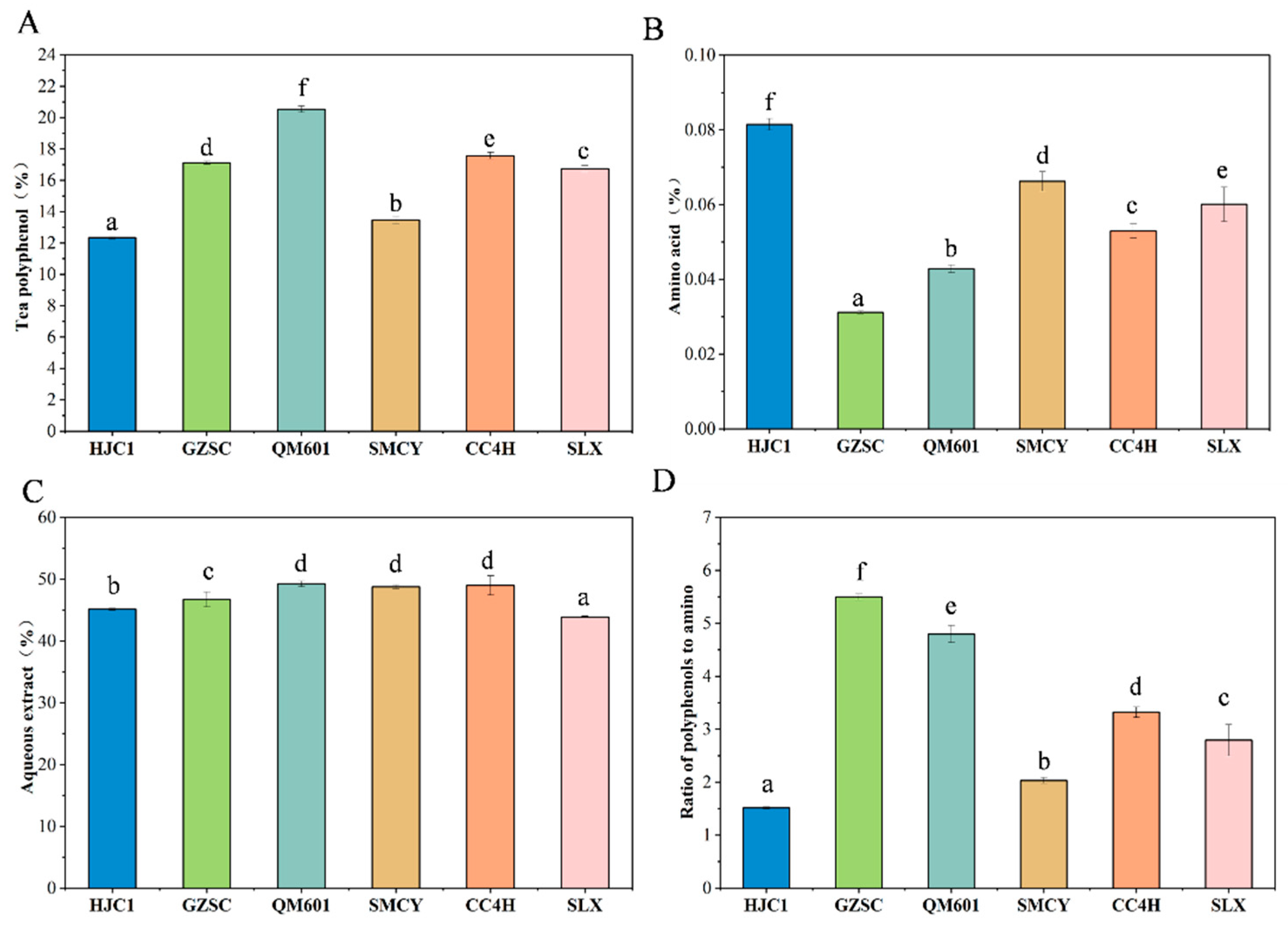
Figure 2.
Analysis of volatile compounds in different tea cultivars (A: Pie chart of volatile compound types; B: Stacked histogram of volatile compounds; C: OPLS-DA plot of volatile compounds; D: Permutation test).
Figure 2.
Analysis of volatile compounds in different tea cultivars (A: Pie chart of volatile compound types; B: Stacked histogram of volatile compounds; C: OPLS-DA plot of volatile compounds; D: Permutation test).
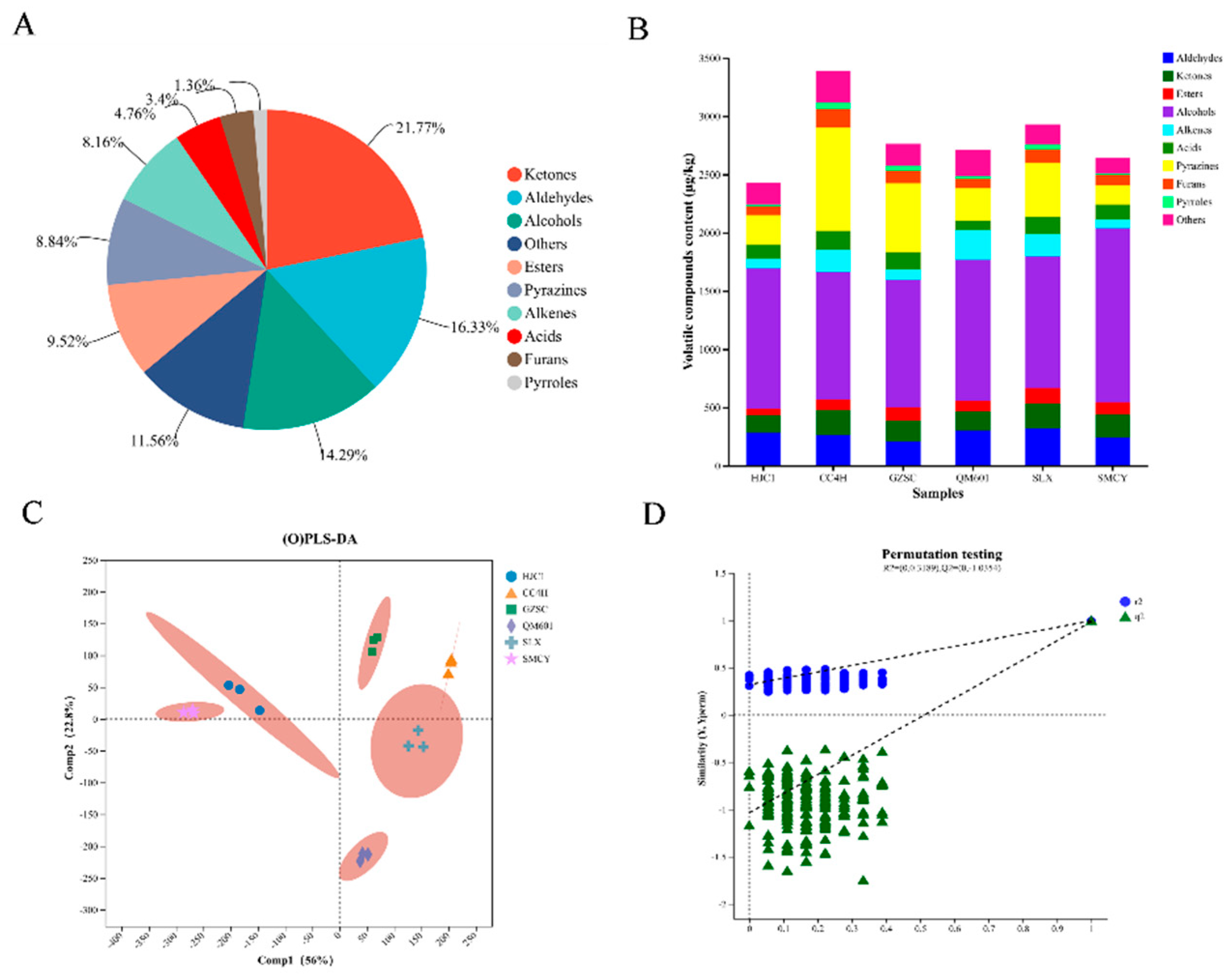
Figure 3.
Heat map of potential key aroma compounds in processed teas from 6 different tea cultivars.
Figure 3.
Heat map of potential key aroma compounds in processed teas from 6 different tea cultivars.
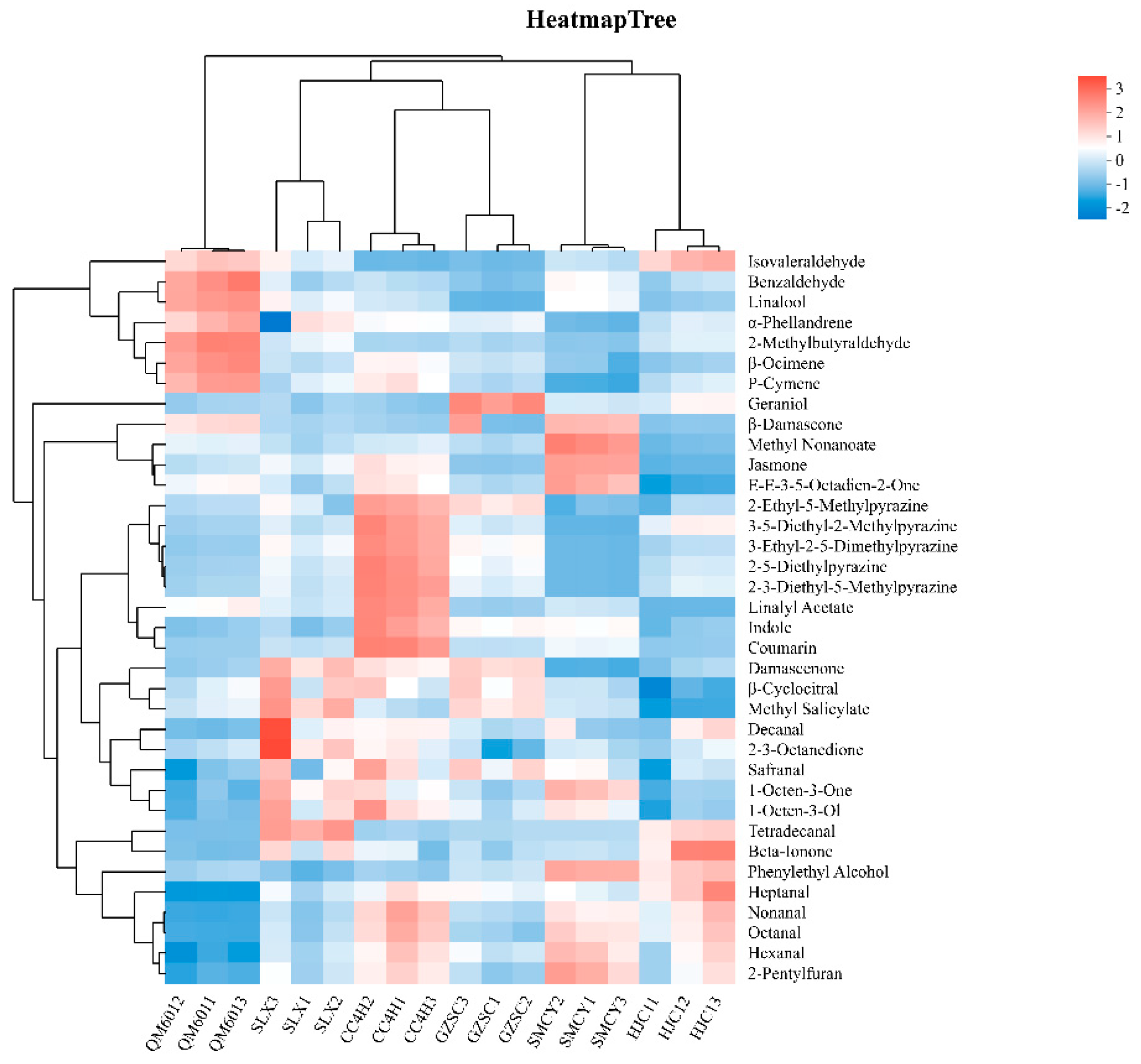
Figure 4.
(A) Pearson correlation analysis between amino acids and key aroma compounds. (B) Pearson correlation analysis between tea polyphenols and key aroma compounds.
Figure 4.
(A) Pearson correlation analysis between amino acids and key aroma compounds. (B) Pearson correlation analysis between tea polyphenols and key aroma compounds.
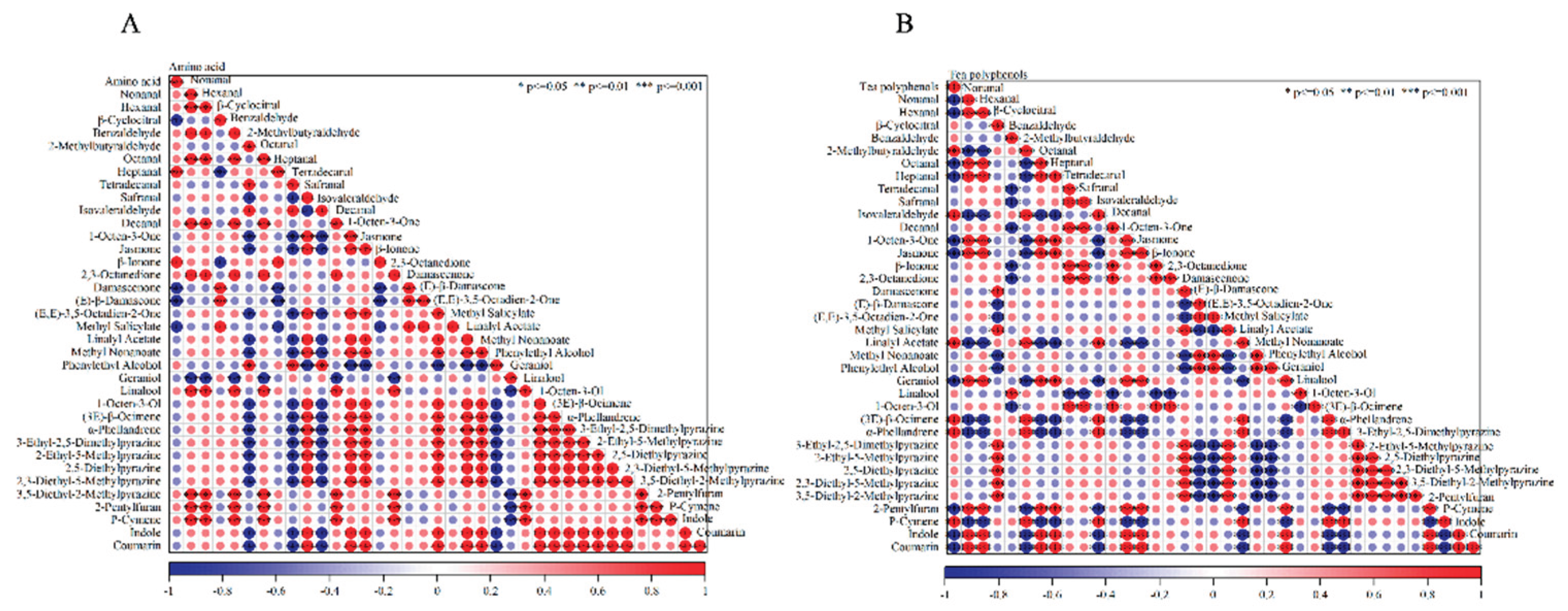
Table 1.
The relative content of aroma components in six different tea cultivars (μg/kg).
| Compounds | Retention time | RI | CAS | HJC1 | CC4H | GZSC | QM601 | SLX | SMCY |
| Aldehydes | |||||||||
| Nonanal | 7.532 | 1391 | 124-19-6 | 28.23±4.86ab | 32.53±2.84a | 20.33±0.80cd | 13.27±0.15e | 19.93±2.30d | 27.67±0.91b |
| 4-Methylbenzaldehyde | 10.82 | 1623 | 104-87-0 | 2.50±0.29b | 2.20±0.17b | 3.76±0.22a | 2.10±0.14b | 2.42±0.33b | 3.21±0.13ab |
| Hexanal | 3.194 | 1083 | 66-25-1 | 5.44±0.79bc | 5.98±0.38ab | 5.10±0.29c | 3.58±0.22d | 4.93±0.29c | 6.21±0.38a |
| Valeraldehyde | 2.319 | 979 | 110-62-3 | 3.58±0.32ab | 4.08±0.15a | 2.76±0.21cd | 2.54±0.09d | 3.83±0.64ac | 3.51±0.26bc |
| β-Cyclocitral | 10.783 | 1611 | 432-25-7 | 7.48±0.91d | 11.20±1.31b | 11.77±0.81ab | 10.25±0.64c | 12.06±1.99a | 9.77±0.35c |
| Furfural | 8.607 | 1461 | 98-01-1 | 1.47±0.15c | 8.49±0.69a | 3.15±0.35b | 2.47±0.09b | 4.11±1.73b | 1.69±0.23c |
| Salicylaldehyde | 11.418 | 1670 | 90-02-8 | 1.83±0.25b | 2.29±0.12a | 2.05±0.14ab | 1.75±0.12c | 2.60±0.29a | 1.93±0.14bc |
| Benzaldehyde | 9.458 | 1520 | 100-52-7 | 83.40±10.11b | 85.87±4.50b | 67.30±3.55c | 167.67±11.50a | 85.57±11.95b | 108.30±7.43b |
| 2,6-Dimethyl-5-Heptenal | 6.313 | 1357 | 106-72-9 | 4.41±0.40c | 6.30±0.60a | 5.61±0.42ab | 5.30±0.35b | 6.52±1.06a | 4.53±0.26c |
| 2-Methylbutyraldehyde | 1.933 | 914 | 96-17-3 | 17.13±1.67b | 10.13±0.41d | 10.92±1.02d | 46.87±3.02a | 18.23±3.06b | 6.31±0.50e |
| 5-Methylfurfural | 10.216 | 1570 | 620-02-0 | 4.55±0.57d | 28.20±1.97a | 11.77±0.81b | 8.13±0.42c | 12.00±2.13b | 4.32±0.29d |
| Octanal | 5.933 | 1289 | 124-13-0 | 4.71±0.78bc | 5.48±0.48b | 3.02±0.22d | 2.08±0.03e | 3.38±0.50cd | 5.03±0.27bc |
| Methylglyoxal | 2.313 | 970 | 78-98-8 | 0.30±0.03ab | 0.31±0.03a | 0.23±0.02c | 0.18±0.01d | 0.30±0.04ab | 0.25±0.03bc |
| Heptanal | 4.439 | 1185 | 111-71-7 | 11.75±2.00a | 9.75±0.90ab | 9.12±0.51b | 4.24±0.05c | 8.13±1.02b | 8.72±0.63b |
| Pyrrole-2-Carboxaldehyde | 13.935 | 2030 | 1003-29-8 | 6.24±0.77c | 11.73±0.90a | 5.42±0.21c | 4.36±0.29d | 5.40±0.85c | 3.07±0.06e |
| 2-Heptenal | 6.447 | 1323 | 18829-55-5 | 0.43±0.07d | 0.93±0.19a | 0.57±0.08c | 0.53±0.11c | 1.03±0.17a | 0.92±0.03ab |
| Tetradecanal | 13.325 | 1930 | 124-25-4 | 77.97±9.08b | 23.30±2.16d | 27.73±1.19d | 10.26±0.26e | 109.67±7.77a | 29.57±0.21c |
| Safranal | 11.062 | 1648 | 116-26-7 | 9.85±1.13b | 11.80±1.20a | 11.70±0.70a | 9.28±0.71b | 11.02±1.53a | 10.93±0.55a |
| Isovaleraldehyde | 1.951 | 918 | 590-86-3 | 5.56±0.63a | 1.11±0.04d | 1.25±0.10d | 5.11±0.31a | 3.41±0.58c | 2.59±0.20c |
| 2-Hexenal | 4.894 | 1216 | 6728-26-3 | 0.55±0.05c | 0.23±0.02d | 0.76±0.05a | 0.37±0.02d | 0.45±0.05c | 1.34±0.07a |
| Cis-Cinnamaldehyde | 12.942 | 1884 | 57194-69-1 | 0.13±0.01b | 0.17±0.01a | 0.16±0.02a | 0.13±0.01b | 0.18±0.04a | 0.14±0.02b |
| Decanal | 9.137 | 1498 | 112-31-2 | 2.43±0.62b | 2.61±0.03ab | 2.10±0.13bc | 1.67±0.05c | 3.02±0.99a | 2.09±0.51bc |
| Citral | 11.906 | 1732 | 141-27-5 | 0.74±0.10b | 0.38±0.04d | 1.31±0.06a | 0.47±0.04cd | 0.42±0.04d | 0.69±0.02bc |
| α-Cyclocitral | 8.169 | 1425 | 432-24-6 | 0.42±0.05c | 0.63±0.05a | 0.60±0.04a | 0.47±0.02bc | 0.63±0.05a | 0.48±0.04b |
| Ketones | |||||||||
| 2,3-Pentanedione | 2.968 | 1054 | 600-14-6 | 1.27±0.12c | 2.51±0.23a | 1.76±0.19b | 1.07±0.03c | 2.02±0.39ab | 1.01±0.02c |
| 1-Octen-3-One | 6.116 | 1301 | 4312-99-6 | 1.75±0.25c | 2.52±0.26b | 1.96±0.17c | 1.59±0.18c | 2.84±0.33a | 3.00±0.17a |
| 3-Penten-2-One | 3.697 | 1122 | 3102-33-8 | 3.79±0.64a | 2.23±0.80bc | 1.99±0.27c | 2.93±0.52ab | 2.33±0.02bc | 2.21±0.18bc |
| Methyl Ethyl Ketone | 1.87 | 945 | 78-93-3 | 0.57±0.08ab | 0.41±0.03c | 0.37±0.04c | 0.69±0.06a | 0.56±0.18ab | 0.50±0.05bc |
| Jasmone | 13.435 | 1961 | 488-10-8 | 3.46±0.51d | 20.20±1.74a | 6.79±0.21c | 11.67±0.97b | 15.03±1.85a | 30.83±0.40a |
| Mesityl Oxide | 3.767 | 1127 | 141-79-7 | 6.56±0.34d | 13.57±0.75b | 15.03±0.40a | 14.60±1.23ab | 23.03±2.19a | 6.87±0.47d |
| 3-Octen-2-One | 7.715 | 1396 | 1669-44-9 | 1.17±0.17c | 2.51±0.17a | 2.11±0.22b | 1.30±0.05c | 1.99±0.17b | 1.93±0.14b |
| Benzophenone | 16.254 | 2508 | 119-61-9 | 1.76±0.27b | 2.22±0.33a | 2.05±0.05ab | 1.60±0.06b | 2.05±0.16ab | 1.29±0.03c |
| 3-Octanone | 5.409 | 1253 | 106-68-3 | 1.08±0.14ab | 1.12±0.05a | 1.00±0.10b | 0.71±0.05c | 1.05±0.18ab | 1.21±0.05a |
| 2-Octanone | 5.862 | 1285 | 111-13-7 | 2.62±0.38c | 3.24±0.14a | 2.46±0.19c | 1.55±0.08d | 2.89±0.47bc | 2.84±0.22bc |
| 2’-Aminoacetophenone | 14.968 | 2223 | 551-93-9 | 0.74±0.12a | 0.56±0.03bc | 0.48±0.00c | 0.25±0.01d | 0.52±0.06c | 0.44±0.02c |
| Isophorone | 10.399 | 1591 | 78-59-1 | 1.51±0.21b | 1.69±0.11a | 1.39±0.09c | 0.88±0.06d | 1.60±0.19ab | 1.13±0.04c |
| β-Ionone | 13.411 | 1941 | 79-77-6 | 27.63±3.67a | 20.23±2.45b | 19.57±1.02b | 17.57±0.21b | 23.30±2.69ab | 20.23±0.21b |
| 2-Methyl-1-Penten-3-One | 3.034 | 1069 | 25044-01-3 | 6.66±0.83c | 8.39±0.58a | 5.49±0.51d | 7.92±0.36ab | 6.73±1.26c | 5.09±0.24d |
| 2-Heptanone | 4.393 | 1182 | 110-43-0 | 8.88±1.23ab | 9.22±0.47a | 7.83±0.60c | 5.01±0.31d | 8.07±1.27bc | 8.75±0.80ab |
| 2,3-Octanedione | 6.489 | 1335 | 585-25-1 | 27.50±2.72bc | 31.27±2.05ab | 22.73±4.21c | 27.00±1.30bc | 39.00±7.66a | 27.50±1.65bc |
| 2(5H)-Furanone | 12.1 | 1743 | 497-23-4 | 0.17±0.02c | 0.35±0.03a | 0.17±0.03c | 0.08±0.01d | 0.31±0.14ab | 0.26±0.03b |
| 6-Methyl-5-Hepten-2-One | 6.662 | 1336 | 110-93-0 | 35.00±3.38c | 49.90±4.83a | 46.53±3.07ab | 38.30±1.99c | 44.60±7.25b | 44.93±2.27b |
| Nerylacetone | 12.855 | 1838 | 3879-26-3 | 9.85±1.31c | 15.47±2.04a | 17.07±1.11a | 10.59±0.72c | 14.40±1.90ab | 12.27±0.32b |
| 1-Hepten-3-One | 5.159 | 1221 | 2918-13-0 | 0.29±0.10b | 0.32±0.09b | 0.32±0.04b | 0.38±0.27b | 0.51±0.35a | 0.20±0.01c |
| 2,4-Dimethyl-3-Hexanone | 4.18 | 1178 | 18641-70-8 | 2.44±0.30c | 3.84±0.61a | 3.52±0.21ab | 2.21±0.11c | 4.54±1.54a | 2.16±0.10c |
| Damascenone | 12.609 | 1813 | 23726-93-4 | 0.32±0.05d | 0.56±0.03b | 0.62±0.02a | 0.31±0.02d | 0.67±0.08a | 0.19±0.01e |
| (E)-β-Damascone | 12.909 | 1830 | 23726-91-2 | 0.62±0.11c | 1.00±0.13b | 2.25±3.40ab | 4.17±0.26a | 1.27±0.13bc | 5.25±0.12a |
| Furaneol | 13.947 | 2031 | 3658-77-3 | 2.70±0.36c | 8.67±1.17a | 5.54±0.30b | 2.01±0.53c | 4.73±0.67b | 1.89±0.05c |
| (E, E)-3,5-Octadien-2-One | 9.424 | 1522 | 38284-27-4 | 3.38±0.36d | 8.61±0.62a | 6.04±0.21c | 7.97±0.43b | 6.14±0.80c | 11.03±0.70a |
| 1-(3,5-Dimethylpyrazinyl)-Ethanone | 11.347 | 1629 | 54300-08-2 | 0.28±0.03b | 0.55±0.04a | 0.34±0.03b | 0.14±0.01d | 0.30±0.03bc | 0.10±0.01e |
| 2-Pentanone | 2.308 | 983 | 107-87-9 | 0.07±0.01b | 0.10±0.00a | 0.08±0.01b | 0.07±0.00b | 0.10±0.02a | 0.09±0.01ab |
| 2,6-Dimethyl-4-Hepten-3-One | 12.19 | 1754 | 56259-14-4 | 0.26±0.03c | 0.30±0.02b | 0.25±0.02c | 0.21±0.01d | 0.40±0.05a | 0.34±0.00b |
| 2,5-Dimethyl-3-Hexanone | 4.234 | 1145 | 1888-57-9 | 0.05±0.02b | 0.13±0.04a | 0.09±0.04ab | 0.05±0.00b | 0.11±0.11ab | 0.04±0.01b |
| 2-Nonanone | 7.443 | 1388 | 821-55-6 | 0.52±0.09c | 0.68±0.05b | 0.54±0.06c | 0.30±0.01d | 0.54±0.10c | 2.22±0.19a |
| 2-Pentadecanone | 13.883 | 2019 | 2345-28-0 | 0.27±0.05c | 0.42±0.03a | 0.34±0.03b | 0.24±0.03c | 0.34±0.04b | 0.26±0.00c |
| Ethyl Vinyl Ketone | 2.629 | 1019 | 1629-58-9 | 0.21±0.03b | 0.11±0.01c | 0.15±0.02c | 0.19±0.02bc | 0.24±0.04b | 0.43±0.03a |
| Esters | |||||||||
| Methyl Palmitate | 14.911 | 2209 | 112-39-0 | 4.21±0.48d | 5.13±0.27c | 6.57±0.31a | 5.75±0.06b | 5.29±0.74c | 10.10±0.30a |
| Methyl Hexanoate | 4.469 | 1184 | 106-70-7 | 6.33±0.69a | 3.19±0.20c | 5.23±0.41b | 2.21±0.09d | 3.78±0.52c | 6.15±0.58a |
| (Z)-Acetate 3-Hexen-1-Ol | 6.905 | 1327 | 3681-71-8 | 2.83±0.29a | 0.23±0.01e | 1.56±0.07c | 2.42±0.14b | 0.71±0.10d | 0.18±0.01e |
| Phenethyl Acetate | 12.364 | 1813 | 103-45-7 | 2.05±0.31b | 0.82±0.07d | 0.77±0.03d | 1.05±0.08c | 0.73±0.12d | 3.47±0.23a |
| Pentyl Hexanoate | 9.331 | 1510 | 540-07-8 | 0.19±0.04c | 0.23±0.02b | 0.16±0.01d | 0.09±0.00e | 0.22±0.02b | 0.14±0.01d |
| Methyl Octanoate | 7.48 | 1389 | 111-11-5 | 1.10±0.20c | 1.22±0.13bc | 1.04±0.06c | 1.27±0.08b | 1.14±0.16c | 3.00±0.26a |
| Methyl Salicylate | 12.271 | 1766 | 119-36-8 | 29.87±4.14d | 61.93±6.83c | 93.47±5.03a | 69.93±4.82c | 112.17±14.46a | 65.43±2.06c |
| Methyl Anthranilate | 15.062 | 2260 | 134-20-3 | 3.03±0.51c | 4.47±0.38a | 1.92±0.04d | 2.63±0.28c | 1.83±0.22d | 2.02±0.09d |
| Methyl Linoleate | 16.233 | 2482 | 112-63-0 | 1.97±0.21b | 1.94±0.10b | 3.17±0.10a | 1.93±0.15b | 2.29±0.27b | 5.57±0.16a |
| Linalyl Acetate | 9.445 | 1555 | 115-95-7 | 0.45±0.04d | 6.92±0.59a | 1.41±0.10c | 3.72±0.30b | 2.58±0.29b | 2.40±0.11b |
| (Z)-Benzoate 3-Hexen-1-Ol | 14.475 | 2126 | 25152-85-6 | 0.05±0.01a | 0.05±0.00a | 0.04±0.00ab | 0.03±0.00b | 0.06±0.01a | 0.05±0.01a |
| γ-Caprolactone | 11.627 | 1694 | 695-06-7 | 1.44±0.16c | 1.91±0.08a | 1.48±0.07c | 1.18±0.07d | 1.82±0.21ab | 1.89±0.11ab |
| γ-Decalactone | 14.589 | 2163 | 706-14-9 | 0.33±0.05c | 0.56±0.04a | 0.41±0.02b | 0.23±0.01d | 0.42±0.05b | 0.32±0.02c |
| Methyl Nonanoate | 9.046 | 1493 | 1731-84-6 | 0.08±0.01d | 0.17±0.01b | 0.14±0.01c | 0.18±0.00a | 0.14±0.02c | 0.39±0.02a |
| Alcohols | |||||||||
| Phenylethyl Alcohol | 13.236 | 1907 | 60-12-8 | 681.67±51.48a | 424.67±15.28c | 491.00±8.72b | 444.33±15.53c | 378.67±31.72d | 766.33±10.21a |
| Geraniol | 12.787 | 1847 | 106-24-1 | 105.20±14.38a | 60.97±5.25c | 179.33±8.08a | 66.57±4.68c | 67.23±8.47c | 88.10±2.51b |
| Linalool | 9.851 | 1547 | 78-70-6 | 72.63±8.33c | 113.00±6.24b | 42.23±1.99d | 261.33±11.24a | 144.00±19.52b | 147.33±7.23b |
| 1-Octanol | 9.996 | 1557 | 111-87-5 | 32.03±4.73b | 37.47±1.45a | 25.83±1.27c | 20.03±0.93d | 31.43±4.34b | 29.50±1.32b |
| 1-Undecanol | 11.707 | 1719 | 112-42-5 | 2.94±0.47c | 4.48±0.41a | 4.32±0.15a | 3.20±0.25c | 4.73±0.48a | 2.80±0.13c |
| 1-Octen-3-Ol | 8.375 | 1450 | 3391-86-4 | 19.70±2.44c | 29.10±3.46a | 23.33±1.55b | 19.30±0.98c | 27.93±4.35a | 26.30±1.51ab |
| Benzyl Alcohol | 13.005 | 1870 | 100-51-6 | 195.00±20.95d | 276.00±9.54c | 249.67±6.81c | 204.33±8.96d | 304.00±29.05b | 348.33±10.69a |
| 1-Penten-3-Ol | 4.073 | 1157 | 616-25-1 | 0.51±0.05d | 0.48±0.04d | 0.54±0.03cd | 0.66±0.04c | 0.71±0.13b | 0.94±0.06a |
| α-Terpineol | 11.576 | 1688 | 98-55-5 | 31.73±4.18d | 57.77±3.84b | 11.77±0.45e | 117.33±8.08a | 56.07±7.23b | 23.40±0.53c |
| Epi-Cubenol | 14.124 | 2067 | 19912-67-5 | 1.00±0.12d | 4.31±0.48b | 0.92±0.02d | 0.78±0.07d | 7.27±0.73a | 0.87±0.02d |
| Hotrienol | 10.683 | 1603 | 29957-43-5 | 1.39±0.16d | 18.13±1.42b | 4.82±0.11c | 22.93±1.74a | 15.77±1.86b | 2.96±0.09c |
| Nerol | 12.451 | 1797 | 106-25-2 | 5.45±0.89b | 1.66±0.17d | 4.01±0.19c | 4.15±0.34c | 1.88±0.31d | 2.02±0.10d |
| 1-Pentanol | 5.307 | 1250 | 71-41-0 | 32.23±2.06c | 41.67±4.66b | 30.77±2.54c | 28.13±1.67c | 56.70±8.41a | 27.33±2.39c |
| 1-Phenylethanol | 12.552 | 1821 | 98-85-1 | 0.89±0.12d | 1.47±0.09b | 2.49±0.09a | 0.94±0.05d | 2.73±0.38a | 5.39±0.61a |
| Cis-Nerolidol | 13.967 | 2044 | 142-50-7 | 1.56±0.22d | 4.89±0.47a | 2.97±0.23c | 1.41±0.13d | 3.18±0.33c | 2.75±0.09c |
| Isogeraniol | 12.534 | 1820 | 5944-20-7 | 0.88±0.14c | 1.27±0.10b | 1.32±0.07b | 0.91±0.08c | 1.29±0.14b | 1.90±0.06a |
| 4-Hexen-1-Ol | 7.346 | 1391 | 928-92-7 | 0.49±0.05d | 0.70±0.07c | 1.77±0.11a | 2.02±0.10a | 1.63±0.37a | 1.87±0.15a |
| 1-Decanol | 12.111 | 1760 | 112-30-1 | 0.40±0.09b | 0.35±0.01b | 0.32±0.02b | 1.20±0.11a | 0.52±0.08b | 0.31±0.01b |
| Nonan-1-Ol | 11.233 | 1660 | 143-08-8 | 3.70±0.52b | 2.70±0.21c | 2.13±0.09cd | 1.56±0.11d | 2.79±0.37c | 4.42±0.26a |
| 1-Heptanol | 8.438 | 1453 | 111-70-6 | 7.00±0.93b | 5.07±0.14c | 4.92±0.30c | 3.88±0.17d | 6.77±0.83b | 9.79±0.36a |
| Menthol | 14.445 | 1644 | 2216-51-5 | 7.14±1.58bc | 7.39±0.80b | 6.23±0.30c | 4.34±0.35d | 14.70±2.07a | 6.52±0.19c |
| Alkenes | |||||||||
| (+/-)-Limonene | 4.609 | 1199 | 138-86-3 | 10.74±1.68d | 33.87±3.93b | 9.68±0.63d | 53.97±2.66a | 25.97±7.33c | 8.50±0.47d |
| Terpinolene | 5.836 | 1281 | 586-62-9 | 7.98±0.99c | 20.63±1.33a | 4.53±0.21d | 47.53±2.50a | 16.27±2.37b | 6.75±0.25c |
| γ-Terpinene | 5.152 | 1238 | 99-85-4 | 11.61±1.48a | 9.55±0.77b | 7.28±0.34c | 13.97±1.12a | 8.72±1.66b | 3.30±0.17d |
| Calamenene | 12.714 | 1839 | 72937-55-4 | 11.37±1.18c | 45.77±4.25a | 7.72±0.37d | 6.89±0.51d | 62.70±5.98a | 7.45±0.48d |
| Longicyclene | 9.095 | 1519 | 1137-12-8 | 3.77±0.25d | 8.39±0.79b | 10.31±0.60a | 7.53±0.89bc | 7.49±1.23bc | 3.91±0.41d |
| α-Cubebene | 8.516 | 1463 | 31141-66-9 | 5.54±0.68c | 14.77±1.37a | 1.79±0.09d | 1.45±0.11d | 20.97±2.16a | 1.75±0.04d |
| (3E)-β-Ocimene | 5.392 | 1250 | 13877-91-3 | 11.05±1.39c | 23.43±1.59b | 16.37±0.67b | 40.37±2.36a | 15.33±1.17b | 8.34±3.56c |
| α-Terpinene | 4.348 | 1178 | 99-86-5 | 7.83±0.97b | 8.87±0.94a | 5.61±0.45d | 12.73±0.50a | 8.35±2.42b | 2.88±0.04e |
| β-Pinene | 4.155 | 1116 | 127-91-3 | 16.10±4.69c | 26.40±7.63b | 25.37±0.45b | 36.87±1.75a | 22.13±7.76b | 12.41±4.39d |
| Copaene | 9.714 | 1492 | 3856-25-5 | 0.42±0.06c | 1.04±0.09a | 0.42±0.02c | 30.13±1.76a | 1.29±0.13a | 14.93±0.91b |
| α-Corocalene | 14.15 | 2060 | 20129-39-9 | 0.25±0.04c | 1.31±0.13a | 0.15±0.01d | 0.15±0.02d | 2.09±0.19a | 0.14±0.01d |
| α-Phellandrene | 4.767 | 1167 | 99-83-2 | 0.42±0.03b | 0.49±0.01a | 0.45±0.01b | 0.66±0.06a | 0.40±0.28b | 0.27±0.01c |
| Acids | |||||||||
| Nonanoic Acid | 14.655 | 2171 | 112-05-0 | 18.17±3.49b | 24.47±1.94a | 15.93±1.65c | 8.79±0.81d | 15.43±2.67c | 19.87±0.90b |
| Caproic Acid | 12.797 | 1846 | 142-62-1 | 24.13±3.23c | 38.57±1.82a | 24.87±2.05c | 16.37±0.93d | 29.90±4.97b | 35.70±1.90a |
| Geranic Acid | 15.478 | 2347 | 459-80-3 | 8.00±1.39b | 7.06±0.48c | 43.50±2.42a | 8.28±0.54b | 6.86±1.35c | 5.42±0.08d |
| Heptanoic Acid | 13.488 | 1950 | 111-14-8 | 16.47±3.30a | 14.83±0.80b | 13.60±0.72c | 5.37±0.31e | 11.72±2.02d | 15.63±0.68b |
| Octanoic Acid | 14.101 | 2060 | 124-07-2 | 7.67±1.29c | 10.36±1.23a | 5.62±0.30d | 5.14±0.59d | 10.03±1.77a | 9.03±0.52b |
| Benzoic Acid | 16.048 | 2414 | 65-85-0 | 2.32±0.33d | 5.25±0.53a | 3.78±0.43b | 3.08±0.99c | 6.27±1.46a | 3.64±0.31bc |
| 2-Ethylbutyric Acid | 11.673 | 1711 | 32391 | 39.30±3.95c | 59.40±4.45b | 43.27±4.64c | 33.77±1.46d | 70.43±9.90a | 41.60±1.44c |
| Pyrazines | |||||||||
| 2,3-Dimethylpyrazine | 6.729 | 1344 | 5910-89-4 | 3.46±0.36c | 11.43±0.72a | 5.32±0.45b | 4.08±0.19c | 5.30±1.00b | 1.88±0.15d |
| 2-Ethylpyrazine | 6.56 | 1337 | 13925-00-3 | 3.55±0.32d | 17.83±1.27a | 11.53±0.90b | 5.53±0.30d | 9.66±1.52c | 3.14±0.37d |
| 2,5-Dimethylpyrazine | 6.364 | 1320 | 123-32-0 | 69.60±6.05d | 236.33±12.50a | 184.33±11.93b | 85.10±4.51d | 143.33±19.86c | 56.63±3.55e |
| 2,6-Dimethylpyrazine | 6.454 | 1328 | 108-50-9 | 18.83±1.82c | 99.27±5.62a | 62.00±4.73b | 27.53±1.33c | 53.27±7.05b | 18.33±1.39c |
| 2,6-Diethylpyrazine | 8.088 | 1445 | 13067-27-1 | 0.83±0.11b | 2.99±0.21a | 1.31±0.12b | 0.70±0.03c | 1.14±0.18b | 0.30±0.03d |
| 2,3,5-Trimethylpyrazine | 7.597 | 1395 | 14667-55-1 | 18.33±2.29c | 39.00±2.96a | 20.40±1.35c | 10.97±0.59d | 16.93±2.66c | 6.35±0.33e |
| 3-Ethyl-2,5-Dimethylpyrazine | 8.238 | 1435 | 13360-65-1 | 76.70±9.44d | 223.67±15.04a | 128.33±8.33b | 58.00±2.86e | 116.67±16.50b | 34.40±1.65f |
| 2-Methylpyrazine | 5.542 | 1266 | 109-08-0 | 9.44±0.67d | 58.87±3.61a | 37.90±3.29b | 19.83±1.27c | 34.50±6.24b | 13.17±1.02c |
| 2-Ethyl-5-Methylpyrazine | 7.424 | 1383 | 13360-64-0 | 48.73±28.26c | 178.00±10.82a | 130.67±8.74b | 63.00±3.20c | 76.90±37.10c | 26.77±12.55d |
| 2,5-Diethylpyrazine | 8.989 | 1456 | 13238-84-1 | 2.41±0.34c | 6.69±0.57a | 3.21±0.24b | 1.55±0.09d | 2.71±0.43bc | 0.63±0.03e |
| 2,3-Diethyl-5-Methylpyrazine | 9.319 | 1486 | 18138-04-0 | 1.14±0.18c | 2.93±0.17a | 1.22±0.08c | 0.75±0.06d | 1.11±0.18c | 0.27±0.02e |
| Acetylpyrazine | 10.848 | 1631 | 22047-25-2 | 0.41±0.05c | 1.37±0.10a | 0.81±0.04b | 0.37±0.02c | 0.79±0.10b | 0.47±0.02c |
| 3,5-Diethyl-2-Methylpyrazine | 9.273 | 1508 | 18138-05-1 | 3.65±0.55b | 6.57±0.56a | 2.71±0.21c | 1.74±0.09d | 2.52±0.39c | 0.62±0.02e |
| Furans | |||||||||
| 2-Ethylfuran | 2.152 | 951 | 3208-16-0 | 2.03±0.23c | 2.52±0.17b | 2.22±0.21c | 1.87±0.11c | 2.56±0.42b | 3.26±0.22a |
| 2-Acetylfuran | 9.205 | 1499 | 1192-62-7 | 18.27±1.67d | 98.30±5.57a | 60.03±4.20b | 40.27±2.57c | 60.10±8.15b | 20.37±1.47d |
| 2-Pentylfuran | 5.098 | 1232 | 3777-69-3 | 51.87±8.04c | 58.57±2.91b | 43.63±2.77d | 35.07±1.69e | 48.33±5.25c | 66.10±5.21a |
| 2-(2-Pentenyl) Furan | 6.142 | 1282 | 70424-14-5 | 1.00±0.12d | 1.83±0.13a | 1.18±0.10c | 1.62±0.10b | 1.55±0.23b | 2.07±0.15a |
| 2-Methylfuran | 1.848 | 870 | 534-22-5 | 0.74±0.06c | 1.16±0.08b | 1.64±0.14a | 0.77±0.03c | 1.30±0.23b | 1.34±0.08b |
| Pyrroles | |||||||||
| 1-Furfurylpyrrole | 12.684 | 1824 | 1438-94-4 | 0.37±0.04c | 2.63±0.21a | 1.35±0.14b | 0.58±0.05c | 0.64±0.12c | 0.04±0.03d |
| 2-Acetylpyrrole | 13.606 | 1973 | 1072-83-9 | 16.03±2.18d | 56.20±3.26a | 39.67±1.38b | 22.17±1.38c | 43.43±5.17b | 9.23±0.32e |
| Miscellaneous | |||||||||
| Vanillin | 16.716 | 2569 | 121-33-5 | 5.89±1.08c | 18.77±0.72a | 9.84±0.73b | 11.90±0.36ab | 11.43±1.01b | 12.80±0.30a |
| 1,1,6-Trimethyl-1,2-Dihydronaphthalene | 12.016 | 1737 | 30364-38-6 | 6.97±0.94b | 11.03±0.83a | 6.25±0.47c | 7.13±0.49b | 6.23±0.90c | 1.32±0.07d |
| Toluene | 2.8 | 1042 | 108-88-3 | 7.39±0.53c | 16.60±1.51a | 9.25±0.65b | 9.80±0.52b | 10.57±2.06b | 4.46±0.42d |
| Naphthalene | 11.971 | 1745 | 91-20-3 | 11.33±1.25bc | 13.60±2.25ab | 12.67±1.00b | 15.40±1.40a | 13.73±1.55ab | 8.51±0.68c |
| Ethylbenzene | 3.693 | 1129 | 100-41-4 | 0.95±0.07b | 1.31±0.24a | 1.23±0.03a | 0.99±0.02b | 1.38±0.22a | 0.77±0.07c |
| 2,4-Di-Tert-Butylphenol | 15.327 | 2321 | 96-76-4 | 119.87±19.69a | 108.67±8.33b | 102.30±4.10b | 139.67±15.18a | 81.97±5.66c | 59.70±1.44d |
| Tridecane | 6.613 | 1300 | 629-50-5 | 0.60±0.07c | 0.85±0.06a | 0.75±0.04b | 0.64±0.05c | 1.20±0.35a | 0.58±0.03c |
| Tetradecane | 8.255 | 1400 | 629-59-4 | 2.91±0.33c | 5.11±0.39a | 4.73±0.37a | 4.95±0.24a | 4.38±0.51b | 2.94±0.09c |
| P-Cymene | 5.665 | 1272 | 99-87-6 | 8.26±0.89c | 11.23±0.96b | 7.27±0.36d | 15.47±1.01a | 8.39±1.42c | 3.61±0.25e |
| Fluorene | 15.568 | 2337 | 86-73-7 | 0.76±0.14c | 1.37±0.15a | 0.89±0.05b | 0.62±0.04c | 1.24±0.13a | 0.81±0.03b |
| Hexadecane | 10.574 | 1600 | 544-76-3 | 1.61±0.21c | 2.65±0.23a | 2.52±0.16a | 1.95±0.16b | 3.14±0.31a | 1.76±0.09c |
| O-Xylene | 4.416 | 1183 | 95-47-6 | 3.04±0.29c | 4.51±0.66a | 3.61±0.13b | 2.49±0.12d | 4.06±0.39ab | 2.27±0.23d |
| Indole | 16.054 | 2469 | 120-72-9 | 9.96±1.46c | 26.23±2.05a | 17.77±0.59b | 10.32±0.73c | 10.97±1.65c | 17.47±0.42b |
| Pentadecane | 9.203 | 1500 | 629-62-9 | 1.47±0.27c | 1.88±0.21b | 1.93±0.22b | 1.64±0.06bc | 2.19±0.16a | 1.15±0.04d |
| Skatole | 16.3 | 2515 | 83-34-1 | 0.90±0.15c | 1.34±0.11a | 0.87±0.05c | 1.27±0.08ab | 0.71±0.09d | 0.43±0.01e |
| Eugenol | 14.683 | 2169 | 97-53-0 | 0.26±0.05d | 0.94±0.07a | 0.32±0.01cd | 0.32±0.02cd | 0.63±0.08b | 1.40±0.02a |
| Coumarin | 16.131 | 2465 | 91-64-5 | 2.53±0.33d | 38.13±2.56a | 7.90±0.22c | 3.50±0.17d | 8.50±0.69c | 13.90±0.44b |
Table 2.
Aroma compounds with an ROAV >1 in 6 different tea cultivars.
| Metabolite | CAS ID | Threshold (μg/L or μg/kg) | HJC1 | CC4H | GZSC | QM601 | SLX | SMCY |
| Nonanal | 124-19-6 | 1.1 | 25.67±4.42 | 29.58±2.58 | 18.48±0.73 | 12.06±0.14 | 18.12±2.09 | 25.15±0.82 |
| Hexanal | 66-25-1 | 4.5 | 1.21±0.18 | 1.33±0.09 | 1.13±0.06 | 0.80±0.05 | 1.10±0.06 | 1.38±0.08 |
| β-Cyclocitral | 432-25-7 | 3 | 2.49±0.30 | 3.73±0.44 | 3.92±0.27 | 3.42±0.21 | 4.02±0.66 | 3.26±0.12 |
| Benzaldehyde | 100-52-7 | 0.024 | 3475.00±421.33 | 3577.78±187.33 | 2804.17±147.96 | 6986.11±479.32 | 3565.28±497.94 | 4512.50±309.49 |
| 2-Methylbutyraldehyde | 96-17-3 | 1.5 | 11.42±1.12 | 6.75±0.27 | 7.28±0.68 | 31.24±2.01 | 12.16±2.04 | 4.20±0.33 |
| Octanal | 124-13-0 | 0.8 | 5.89±0.97 | 6.85±0.60 | 3.78±0.27 | 2.60±0.04 | 4.22±0.62 | 6.29±0.33 |
| Heptanal | 111-71-7 | 2.8 | 4.20±0.71 | 3.48±0.32 | 3.26±0.18 | 1.51±0.02 | 2.90±0.36 | 3.11±0.23 |
| Tetradecanal | 124-25-4 | 67 | 1.16±0.14 | 0.35±0.03 | 0.41±0.02 | 0.15±0.00 | 1.64±0.12 | 0.44±0.00 |
| Safranal | 116-26-7 | 3 | 3.28±0.38 | 3.93±0.40 | 3.90±0.23 | 3.09±0.24 | 3.67±0.51 | 3.64±0.18 |
| Isovaleraldehyde | 590-86-3 | 0.5 | 11.12±1.26 | 2.22±0.08 | 2.51±0.20 | 10.22±0.62 | 6.81±1.15 | 5.17±0.39 |
| Decanal | 112-31-2 | 3 | 0.81±0.21 | 0.87±0.01 | 0.70±0.04 | 0.56±0.02 | 1.01±0.33 | 0.70±0.17 |
| 1-Octen-3-One | 4312-99-6 | 0.003 | 584.44±84.74 | 840.00±87.43 | 654.44±55.21 | 531.11±59.66 | 947.78±110.02 | 998.89±57.48 |
| Jasmone | 488-10-8 | 1.9 | 1.82±0.27 | 10.63±0.92 | 3.57±0.11 | 6.14±0.51 | 7.91±0.97 | 16.23±0.21 |
| β-Ionone | 79-77-6 | 0.021 | 1315.87±174.60 | 963.49±116.87 | 931.75±48.64 | 836.51±9.91 | 1109.52±127.86 | 963.49±9.91 |
| 2,3-Octanedione | 585-25-1 | 12 | 2.29±0.23 | 2.61±0.17 | 1.89±0.35 | 2.25±0.11 | 3.25±0.64 | 2.29±0.14 |
| Damascenone | 23726-93-4 | 0.006 | 53.17±8.49 | 92.72±5.59 | 103.06±4.10 | 51.67±3.18 | 111.56±13.68 | 31.67±1.17 |
| (E)- β-Damascone | 23726-91-2 | 0.001 | 616.33±113.46 | 995.33±133.81 | 2245.00±3399.39 | 4166.67±259.29 | 1266.67±127.02 | 5253.33±122.20 |
| (E, E)-3,5-Octadien-2-One | 38284-27-4 | 0.1 | 33.83±3.60 | 86.10±6.20 | 60.37±2.06 | 79.67±4.26 | 61.37±8.02 | 110.33±7.02 |
| Methyl Salicylate | 119-36-8 | 40 | 0.75±0.10 | 1.55±0.17 | 2.34±0.13 | 1.75±0.12 | 2.80±0.36 | 1.64±0.05 |
| Linalyl Acetate | 115-95-7 | 0.1109 | 4.02±0.32 | 62.43±5.32 | 12.71±0.87 | 33.54±2.72 | 23.29±2.59 | 21.67±1.01 |
| Methyl Nonanoate | 1731-84-6 | 0.04 | 1.97±0.22 | 4.27±0.23 | 3.46±0.22 | 4.63±0.08 | 3.44±0.41 | 9.64±0.49 |
| Phenylethyl Alcohol | 20-12-8 | 564.23 | 1.21±0.09 | 0.75±0.03 | 0.87±0.02 | 0.79±0.03 | 0.67±0.06 | 1.36±0.02 |
| Geraniol | 106-24-1 | 6.6 | 15.94±2.18 | 9.24±0.80 | 27.17±1.22 | 10.09±0.71 | 10.19±1.28 | 13.35±0.38 |
| Linalool | 78-70-6 | 6 | 12.11±1.39 | 18.83±1.04 | 7.04±0.33 | 43.56±1.87 | 24.00±3.25 | 24.56±1.21 |
| 1-Octen-3-Ol | 3391-86-4 | 1.5 | 13.13±1.63 | 19.40±2.31 | 15.56±1.04 | 12.87±0.66 | 18.62±2.90 | 17.53±1.01 |
| (3E)-β-Ocimene | 13877-91-3 | 0.02 | 552.50±69.60 | 1171.67±79.43 | 818.33±33.29 | 2018.33±118.15 | 766.67±58.59 | 417.17±178.18 |
| α-Phellandrene | 99-83-2 | 0.04 | 10.61±0.73 | 12.28±0.28 | 11.23±0.37 | 16.57±1.61 | 9.95±7.11 | 6.72±0.32 |
| 3-Ethyl-2,5-Dimethylpyrazine | 13360-65-1 | 25 | 3.07±0.38 | 8.95±0.60 | 5.13±0.33 | 2.32±0.11 | 4.67±0.66 | 1.38±0.07 |
| 2-Ethyl-5-Methylpyrazine | 13360-64-0 | 16 | 3.05±1.77 | 11.13±0.68 | 8.17±0.55 | 3.94±0.20 | 4.81±2.32 | 1.67±0.78 |
| 2,5-Diethylpyrazine | 13238-84-1 | 0.02 | 120.33±17.22 | 334.67±28.25 | 160.50±12.13 | 77.67±4.54 | 135.50±21.50 | 31.28±1.42 |
| 2,3-Diethyl-5-Methylpyrazine | 18138-04-0 | 0.031 | 36.76±5.91 | 94.62±5.49 | 39.35±2.64 | 24.13±1.87 | 35.86±5.90 | 8.68±0.50 |
| 3,5-Diethyl-2-Methylpyrazine | 18138-05-1 | 0.26 | 14.03±2.13 | 25.27±2.15 | 10.44±0.81 | 6.68±0.36 | 9.71±1.49 | 2.38±0.09 |
| 2-Pentylfuran | 3777-69-3 | 5.8 | 8.94±1.39 | 10.10±0.50 | 7.52±0.48 | 6.05±0.29 | 8.33±0.91 | 11.40±0.90 |
| P-Cymene | 99-87-6 | 11.4 | 0.72±0.08 | 0.99±0.08 | 0.64±0.03 | 1.36±0.09 | 0.74±0.12 | 0.32±0.02 |
| Indole | 120-72-9 | 11 | 0.91±0.13 | 2.38±0.19 | 1.62±0.05 | 0.94±0.07 | 1.00±0.15 | 1.59±0.04 |
| Coumarin | 91-64-5 | 11 | 0.23±0.03 | 3.47±0.23 | 0.72±0.02 | 0.32±0.02 | 0.77±0.06 | 1.26±0.04 |
Disclaimer/Publisher’s Note: The statements, opinions and data contained in all publications are solely those of the individual author(s) and contributor(s) and not of MDPI and/or the editor(s). MDPI and/or the editor(s) disclaim responsibility for any injury to people or property resulting from any ideas, methods, instructions or products referred to in the content. |
© 2026 by the authors. Licensee MDPI, Basel, Switzerland. This article is an open access article distributed under the terms and conditions of the Creative Commons Attribution (CC BY) license.
Copyright: This open access article is published under a Creative Commons CC BY 4.0 license, which permit the free download, distribution, and reuse, provided that the author and preprint are cited in any reuse.


