

Submitted:
27 July 2026
Posted:
28 July 2026
You are already at the latest version
Abstract
Background/Objectives: Digital technologies are increasingly embedded in children’s everyday lives, yet problematic Internet use (PIU) remains conceptually heterogeneous and has been studied mainly in adolescents. This narrative review aimed to synthesize evidence on the conceptualization and manifestations of PIU among primary school children and identify associated risk and protective factors from a socioecological perspective. Methods: This narrative review used a structured literature search informed by an adapted PECOS framework. APA PsycInfo, Web of Science Core Collection, and PubMed were searched for quantitative empirical studies published between 2021 and 2026 involving primary school populations. Of the 232 records identified, 18 studies were included and narratively synthesized. Results: The studies used heterogeneous terminology, ranging from general or risky Internet use to problematic smartphone and video game use, Internet addiction, and Internet gaming disorder. Most employed observational, predominantly cross-sectional, designs. Higher levels or a greater likelihood of problematic use was associated with family conflict, insecure attachment, maladaptive parenting practices, parental technology dependence, socioemotional difficulties, externalizing problems, peer victimization, deviant peer affiliation, and intensive recreational digital use. Positive parent–child relationships, parental supervision, authoritative parenting, parental digital competence, positive peer communication, resilience, traditional games, and a positive school climate were associated with lower levels or a lower likelihood of problematic use. Evidence concerning school and community factors was limited. Conclusions: PIU is best understood as an umbrella construct shaped by interacting individual and contextual factors. Prevention should adopt a socioecological and developmentally appropriate approach, while future research should employ longitudinal designs and more standardized terminology and validated assessment instruments.
Keywords:
1. Introduction
2. Materials and Methods
2.1. Review Design and Research Questions
- -
- P (Population): Children enrolled in primary or elementary education.
- -
- E (Exposure): Individual, family, socioemotional, peer, school, and digital factors potentially associated with Internet use and its problematic manifestations.
- -
- C (Comparator): Where applicable, children with lower versus higher levels of the factors examined or with lower versus higher levels of problematic Internet use. A formal comparison group was not required for inclusion.
- -
- O (Outcomes): Measures of Internet use and its problematic manifestations, together with the reported associations between these outcomes and the factors examined.
- -
- S (Study design): Quantitative empirical studies employing observational or quasi-experimental designs, including cross-sectional, case-control, cohort, and longitudinal studies.
2.2. Literature Search
2.3. Eligibility Criteria
2.4. Study Selection and Narrative Synthesis
3. Results
3.1. Study Characteristics
3.2. Classification and Conceptualization of PIU in Childhood
3.3. Risk Factors Associated with Problematic Internet Use
3.3.1. Family and Digital Factors
3.3.2. Individual and Peer Factors
3.4. Protective Factors Associated with Problematic Internet Use
3.4.1. Family and School Factors
3.4.2. Individual, Behavioral, and Peer Factors
4. Discussion
4.1. Classification and Conceptualization of PIU in Childhood
4.2. Risk Factors Associated with Problematic Internet Use
4.2.1. Family and Digital Factors
4.2.2. Individual and Peer Factors
4.3. Protective Factors Associated with Problematic Internet Use
4.3.1. Family and School Factors
4.3.2. Individual, Behavioral, and Peer Factors
4.4. Limitations and Future Research
4.5. Clinical and Practical Implications
5. Conclusions
Author Contributions
Funding
Institutional Review Board Statement
Informed Consent Statement
Data Availability Statement
Conflicts of Interest
References
- Brand, M.; Potenza, M.N.; Stark, R. Theoretical Models of Types of Problematic Usage of the Internet: When Theorists Meet Therapists. Curr. Opin. Behav. Sci. 2022, 45, 101119. [Google Scholar] [CrossRef]
- Fineberg, N.A.; Menchón, J.M.; Hall, N.; Dell’Osso, B.; Brand, M.; Potenza, M.N.; Chamberlain, S.R.; Cirnigliaro, G.; Lochner, C.; Billieux, J.; et al. Advances in Problematic Usage of the Internet Research – A Narrative Review by Experts from the European Network for Problematic Usage of the Internet. Compr. Psychiatry 2022, 118, 152346. [Google Scholar] [CrossRef]
- Zare-Bidoky, M.; Baldacchino, A.M.; Demetrovics, Z.; Fineberg, N.A.; Kamali, M.; Khazaal, Y.; Potenza, M.N.; Stein, D.J.; Ekhtiari, H. Problematic Usage of the Internet: Converging and Diverging Terminologies and Constructs. J. Behav. Addict. 2025, 1. [Google Scholar] [CrossRef] [PubMed]
- Dell’Osso, B.; Di Bernardo, I.; Vismara, M.; Piccoli, E.; Giorgetti, F.; Molteni, L.; Fineberg, N.A.; Virzì, C.; Bowden-Jones, H.; Truzoli, R.; et al. Managing Problematic Usage of the Internet and Related Disorders in an Era of Diagnostic Transition: An Updated Review. Clin. Pract. Epidemiol. Ment. Health CP EMH 2021, 17, 61–74. [Google Scholar] [CrossRef] [PubMed]
- Tokunaga, R.S.; Rains, S.A. A Review and Meta-Analysis Examining Conceptual and Operational Definitions of Problematic Internet Use. Hum. Commun. Res. 2016, 42, 165–199. [Google Scholar] [CrossRef]
- American Psychiatric Association. Diagnostic and Statistical Manual of Mental Disorders, text rev., 5th ed.; American Psychiatric Association Publishing: Washington, DC, USA, 2022; ISBN 978-0-89042-577-0. [Google Scholar]
- World Health Organization. International Classification of Diseases 11th Revision (ICD-11); World Health Organization: Geneva, Switzerland, 2022. [Google Scholar]
- Ferrante, L.; Venuleo, C. Problematic Internet Use among Adolescents and Young Adults: A Systematic Review of Scholars’ Conceptualisations after the Publication of DSM5. Mediterr. J. Clin. Psychol. 2021, 9. [Google Scholar] [CrossRef]
- Kuss, D.J.; Lopez-Fernandez, O. Internet Addiction and Problematic Internet Use: A Systematic Review of Clinical Research. World J. Psychiatry 2016, 6, 143–176. [Google Scholar] [CrossRef] [PubMed]
- Bronfenbrenner, U. The Ecology of Human Development: Experiments by Nature and Design; Harvard University Press, 1979; ISBN 978-0-674-22456-8. [Google Scholar]
- O’Neill, B. Ecological Perspectives and Children’s Use of the Internet: Exploring Micro to Macro Level Analysis. Eest. Haridusteaduste Ajak. Est. J. Educ. 2015, 3, 32–53. [Google Scholar] [CrossRef]
- Swearer, S.M.; Espelage, D.L. Introduction: A Social-Ecological Framework of Bullying Among Youth. In Bullying in American schools: A social-ecological perspective on prevention and intervention; Espelage, D.L., Swearer, S.M., Eds.; Lawrence Erlbaum Associates Publishers: Mahwah, NJ, 2004; pp. 1–12. [Google Scholar]
- Liu, W.; Huang, J.; Li, Y.-L.; Gao, X.; Xu, Z.-Y.; Li, Y.-H. The Impact of Emotional Abuse on Internet Addiction in Chinese Children: The Sequential Mediation Roles of Emotional Dysregulation and Regulatory Emotional Self-Efficacy. Front. Psychol. 2025, 16. [Google Scholar] [CrossRef] [PubMed]
- Liu, W.; Huang, J.; Mo, Y.-K.; Guo, J.-X.; Yang, X.; Wu, Q. Parenting Styles and Internet Addiction in Chinese Primary School Students: A Moderated Sequential Mediation Model of Self-Control, Rejection Sensitivity, and Achievement Motivation. Front. Psychol. 2026, 17. [Google Scholar] [CrossRef] [PubMed]
- Long, C.; Liu, J.; Wu, Y.; Liu, S. The Relationship between Parental Smartphone Dependence and Elementary Students’ Internet Addiction during the COVID-19 Lockdown in China: The Mediating Role of Parent–Child Conflict and the Moderating Role of Parental Roles. Front. Psychol. 2024, 15. [Google Scholar] [CrossRef] [PubMed]
- Wei, C.; Xu, Q. The Longitudinal Relationship between School Climate and Internet Gaming Addiction among Chinese Children: A Moderated Mediation Model. Front. Psychiatry 2025, 16. [Google Scholar] [CrossRef] [PubMed]
- Zhou, P.; Cai, J.; Cui, J.; Liu, J.; He, W.; Zhang, C.; Chen, F.; Wang, Z. Peer Victimization and Children’s Internet Addiction in China: A Moderated Mediation Model. Front. Psychol. 2023, 14. [Google Scholar] [CrossRef] [PubMed]
- Zhou, P.; Dong, J.; Zhang, C.; Liu, J. Peer Relationship and Internet Addiction among Chinese Children: The Roles of Peer Victimization and Resilience. J. Fam. Trauma Child Custody Child Dev. 2025, 22, 551–570. [Google Scholar] [CrossRef]
- Ayaz-Alkaya, S.; Akca, A. The Impact of Traditional Children’s Games on Internet Use, Social Skills, and Stress Level: A Cross-Sectional Design. J. Transcult. Nurs. 2025, 36, 84–91. [Google Scholar] [CrossRef] [PubMed]
- Derin, S.; Celik, S.; Selman, S.B. ADHD, Social Skills and Risky Internet Use among Elementary School Children. Child Adolesc. Psychiatry Ment. Health 2025, 19, 74. [Google Scholar] [CrossRef] [PubMed]
- Derin, S.; Selman, S.B.; Ergun, A.F.; Ecer-Ergun, T. Indirect and Conditional Associations Between ADHD and Risky Internet Use in Elementary School Children With Parent-Child Conflict and Maternal Childhood Trauma. Res. Child Adolesc. Psychopathol. 2026, 54, 17. [Google Scholar] [CrossRef] [PubMed]
- Kacar, D.; Ayaz-Alkaya, S. The Effect of Traditional Children’s Games on Internet Addiction, Social Skills and Stress Level. Arch. Psychiatr. Nurs. 2022, 40, 50–55. [Google Scholar] [CrossRef] [PubMed]
- Bautista-Alcaine, P.; Piazuelo-Rodríguez, I.; Cebollero-Salinas, A. Problematic Internet Use in Primary School: Time of Use, Family Supervision and Video Problematic Game Use as Predictors Differentiating by Gender. Psychol. Soc. Educ. 2023, 15, 31–38. [Google Scholar] [CrossRef]
- Olmeda-Muelas, N.; Cuesta-Zamora, C.; Joiner, R.; Ricarte, J. Parental Attachment Security and Problematic Internet Use in Children: The Mediating Role of Maladaptive Cognitive Emotion Regulation Strategies. Clin. Child Psychol. Psychiatry 2024, 29, 746–763. [Google Scholar] [CrossRef] [PubMed]
- Pons-Salvador, G.; Zubieta-Méndez, X.; Frias-Navarro, D. Parents’ Digital Competence in Guiding and Supervising Young Children’s Use of the Internet. Eur. J. Commun. 2022, 37, 443–459. [Google Scholar] [CrossRef]
- Miltuze, A.; Sebre, S.B.; Martinsone, B. Consistent and Appropriate Parental Restrictions Mitigating Against Children’s Compulsive Internet Use: A One-Year Longitudinal Study. Technol. Knowl. Learn. 2021, 26, 883–895. [Google Scholar] [CrossRef]
- Tannous, N.; Aouad, M.; Chahine, A.; Hallit, R.; Malaeb, D.; El Khatib, S.; Sakr, F.; Dabbous, M.; Hallit, S.; Fekih-Romdhane, F.; et al. The Relationship Between Parental Smartphone Addiction and Child Problematic Media Use: Mediating Roles of Child–Parent Conflict and Parental Psychological Distress and Validation of the Child–Parent Relationship Scale-Short Form in Arabic. Public Health Chall. 2026, 5, 1–13. [Google Scholar] [CrossRef] [PubMed]
- Yun, J.; Han, G.; Son, H. Protective and Risk Factors of Problematic Smartphone Use in Preteens Using Panel Study on Korean Children. Front. Psychiatry 2022, 13. [Google Scholar] [CrossRef] [PubMed]
- Theopilus, Y.; Al Mahmud, A.; Davis, H.; Octavia, J.R. The Role of Parental Mediation Strategies and Online Behaviour on Internet Addiction in Young Indonesian Children: A Parent Survey Study. Behav. Inf. Technol. 2025, 1–24. [Google Scholar] [CrossRef]
- Przepiorka, A.; Błachnio, A.; Cudo, A.; Kot, P. Social Anxiety and Social Skills via Problematic Smartphone Use for Predicting Somatic Symptoms and Academic Performance at Primary School. Comput. Educ. 2021, 173, 104286. [Google Scholar] [CrossRef]
- Bronfenbrenner, U.; Morris, P.A. The Bioecological Model of Human Development. In Handbook of child psychology: Theoretical models of human development, 6th ed; John Wiley & Sons, Inc.: Hoboken, NJ, US, 2006; Vol. 1, pp. 793–828. ISBN 978-0-471-27288-5. [Google Scholar]
- Anderson, E.L.; Steen, E.; Stavropoulos, V. Internet Use and Problematic Internet Use: A Systematic Review of Longitudinal Research Trends in Adolescence and Emergent Adulthood. Int. J. Adolesc. Youth 2017, 22, 430–454. [Google Scholar] [CrossRef]
- Kaess, M.; Klar, J.; Kindler, J.; Parzer, P.; Brunner, R.; Carli, V.; Sarchiapone, M.; Hoven, C.W.; Apter, A.; Balazs, J.; et al. Excessive and Pathological Internet Use – Risk-Behavior or Psychopathology? Addict. Behav. 2021, 123, 107045. [Google Scholar] [CrossRef] [PubMed]
- Tokunaga, R.S.; Rains, S.A. An Evaluation of Two Characterizations of the Relationships Between Problematic Internet Use, Time Spent Using the Internet, and Psychosocial Problems. Hum. Commun. Res. 2010, 36, 512–545. [Google Scholar] [CrossRef]
- Fernández Montalvo, J.; Peñalva, A.; Irazabal, I. Internet Use Habits and Risk Behaviours in Preadolescence. Sci. J. Media Educ. 2015, 44, 113–120. [Google Scholar] [CrossRef]
- Brand, M.; Wegmann, E.; Stark, R.; Müller, A.; Wölfling, K.; Robbins, T.W.; Potenza, M.N. The Interaction of Person-Affect-Cognition-Execution (I-PACE) Model for Addictive Behaviors: Update, Generalization to Addictive Behaviors beyond Internet-Use Disorders, and Specification of the Process Character of Addictive Behaviors. Neurosci. Biobehav. Rev. 2019, 104, 1–10. [Google Scholar] [CrossRef] [PubMed]
- Petrescu, T.-C.; Błachnio, A.; Enea, V. Internet Gaming Disorder in Children and Adolescents: A Systematic Review of Familial Protective and Risk Factors. Addict. Behav. 2025, 167, 108345. [Google Scholar] [CrossRef] [PubMed]
- Kim, B.; Lee, S.; Doh, Y.Y.; Gweon, G. Classification of Problematic Internet Usage Types by Motives and Contexts with Elementary and Secondary School-Aged Counseling Clients. J. Behav. Addict. 2018, 7, 644–653. [Google Scholar] [CrossRef] [PubMed]
- Hsieh, Y.-P.; Hwa, H.-L.; Shen, A.C.-T.; Wei, H.-S.; Feng, J.-Y.; Huang, C.-Y. Ecological Predictors and Trajectory of Internet Addiction from Childhood through Adolescence: A Nationally Representative Longitudinal Study. Int. J. Environ. Res. Public. Health 2021, 18, 6253. [Google Scholar] [CrossRef] [PubMed]
- Nannatt, A.; Tariang, N.M.; Gowda, M.; Devassy, S.M. Family Factors Associated with Problematic Use of the Internet in Children: A Scoping Review. Indian J. Psychol. Med. 2022, 44, 341–348. [Google Scholar] [CrossRef] [PubMed]
- Schneider, L.A.; King, D.L.; Delfabbro, P.H. Family Factors in Adolescent Problematic Internet Gaming: A Systematic Review. J. Behav. Addict. 2017, 6, 321–333. [Google Scholar] [CrossRef] [PubMed]
- Vossen, H.G.M.; van den Eijnden, R.J.J.M.; Visser, I.; Koning, I.M. Parenting and Problematic Social Media Use: A Systematic Review. Curr. Addict. Rep. 2024, 11, 511–527. [Google Scholar] [CrossRef]
- Zhu, Y.; Deng, L.; Wan, K. The Association between Parent-Child Relationship and Problematic Internet Use among English- and Chinese-Language Studies: A Meta-Analysis. Front. Psychol. 2022, 13. [Google Scholar] [CrossRef] [PubMed]
- Nielsen, P.; Favez, N.; Rigter, H. Parental and Family Factors Associated with Problematic Gaming and Problematic Internet Use in Adolescents: A Systematic Literature Review. Curr. Addict. Rep. 2020, 7, 365–386. [Google Scholar] [CrossRef]
- Kardefelt-Winther, D. A Conceptual and Methodological Critique of Internet Addiction Research: Towards a Model of Compensatory Internet Use. Comput. Hum. Behav. 2014, 31, 351–354. [Google Scholar] [CrossRef]
- Vaala, S.E.; Bleakley, A. Monitoring, Mediating, and Modeling: Parental Influence on Adolescent Computer and Internet Use in the United States. J. Child. Media 2015, 9, 40–57. [Google Scholar] [CrossRef]
- Liu, S.; Wu, P.; Han, X.; Wang, M.; Kan, Y.; Qin, K.; Lan, J. Mom, Dad, Put down Your Phone and Talk to Me: How Parental Phubbing Influences Problematic Internet Use among Adolescents. BMC Psychol. 2024, 12, 125. [Google Scholar] [CrossRef] [PubMed]
- Özalp Gerçeker, G.; Göçer, İ.; Dorum, B.; Baran, Ö. The Problematic Media Use in Children and Their Parents: Predictors of Children’s Screen Time and Problematic Media Use. J. Pediatr. Nurs. 2026, 87, 236–242. [Google Scholar] [CrossRef] [PubMed]
- Valcke, M.; Bonte, S.; De Wever, B.; Rots, I. Internet Parenting Styles and the Impact on Internet Use of Primary School Children. Comput. Educ. 2010, 55, 454–464. [Google Scholar] [CrossRef]
- Odgers, C.L.; Jensen, M.R. Annual Research Review: Adolescent Mental Health in the Digital Age: Facts, Fears, and Future Directions. J. Child Psychol. Psychiatry 2020, 61, 336–348. [Google Scholar] [CrossRef] [PubMed]
- Paulus, F.W.; Ohmann, S.; von Gontard, A.; Popow, C. Internet Gaming Disorder in Children and Adolescents: A Systematic Review. Dev. Med. Child Neurol. 2018, 60, 645–659. [Google Scholar] [CrossRef] [PubMed]
- Caplan, S. A Social Skill Account of Problematic Internet Use. J. Commun. 2005, 55, 721–736. [Google Scholar] [CrossRef]
- Ding, H.; Cao, B.; Sun, Q. The Association between Problematic Internet Use and Social Anxiety within Adolescents and Young Adults: A Systematic Review and Meta-Analysis. Front. Public Health 2023, 11. [Google Scholar] [CrossRef] [PubMed]
- Fumero, A.; Marrero, R.J.; Voltes, D.; Peñate, W. Personal and Social Factors Involved in Internet Addiction among Adolescents: A Meta-Analysis. Comput. Hum. Behav. 2018, 86, 387–400. [Google Scholar] [CrossRef]
- Villanueva-Blasco, V.J.; García-Guerra, M.; Rial-Boubeta, A. Relationship between Problematic Internet Use and Emotional Variables in Childhood and Adolescence: Systematic Review of Longitudinal Evidence. Addict. Behav. 2026, 173, 108561. [Google Scholar] [CrossRef] [PubMed]
- Menéndez-García, A.; Jiménez-Arroyo, A.; Rodrigo-Yanguas, M.; Marin-Vila, M.; Sánchez-Sánchez, F.; Roman-Riechmann, E.; Blasco-Fontecilla, H. Internet, Video Game and Mobile Phone Addiction in Children and Adolescents Diagnosed with ADHD: A Case-Control Study. Adicciones 2022, 34, 208–217. [Google Scholar] [CrossRef] [PubMed]
- Thorell, L.B.; Burén, J.; Ström Wiman, J.; Sandberg, D.; Nutley, S.B. Longitudinal Associations between Digital Media Use and ADHD Symptoms in Children and Adolescents: A Systematic Literature Review. Eur. Child Adolesc. Psychiatry 2024, 33, 2503–2526. [Google Scholar] [CrossRef] [PubMed]
- Mehroof, M.; Griffiths, M.D. Online Gaming Addiction: The Role of Sensation Seeking, Self-Control, Neuroticism, Aggression, State Anxiety, and Trait Anxiety. Cyberpsychology Behav. Soc. Netw. 2010, 13, 313–316. [Google Scholar] [CrossRef] [PubMed]
- Coyne, S.M.; Radesky, J.; Collier, K.M.; Gentile, D.A.; Linder, J.R.; Nathanson, A.I.; Rasmussen, E.E.; Reich, S.M.; Rogers, J. Parenting and Digital Media. Pediatrics 2017, 140, S112–S116. [Google Scholar] [CrossRef] [PubMed]
- Symons, K.; Ponnet, K.; Emmery, K.; Walrave, M.; Heirman, W. A Factorial Validation of Parental Mediation Strategies with Regard to Internet Use. Psychol. Belg. 2017, 57, 93–111. [Google Scholar] [CrossRef] [PubMed]
- Nielsen, P.; Favez, N.; Liddle, H.; Rigter, H. Linking Parental Mediation Practices to Adolescents’ Problematic Online Screen Use: A Systematic Literature Review. J. Behav. Addict. 2019, 8, 649. [Google Scholar] [CrossRef] [PubMed]
- Chen, V.H.H.; Chng, G.S. Active and Restrictive Parental Mediation over Time: Effects on Youths’ Self-Regulatory Competencies and Impulsivity. Comput. Educ. 2016, 98, 206–212. [Google Scholar] [CrossRef]
- Livingstone, S.; Ólafsson, K.; Helsper, E.J.; Lupiáñez-Villanueva, F.; Veltri, G.A.; Folkvord, F. Maximizing Opportunities and Minimizing Risks for Children Online: The Role of Digital Skills in Emerging Strategies of Parental Mediation: Maximizing Opportunities and Minimizing Risks. J. Commun. 2017, 67, 82–105. [Google Scholar] [CrossRef]
- Elsaesser, C.; Russell, B.; Ohannessian, C.M.; Patton, D. Parenting in a Digital Age: A Review of Parents’ Role in Preventing Adolescent Cyberbullying. Aggress. Violent Behav. 2017, 35, 62–72. [Google Scholar] [CrossRef]
- Yudes-Gómez, C.; Baridon-Chauvie, D.; González-Cabrera, J.-M. Cyberbullying and Problematic Internet Use in Colombia, Uruguay and Spain: Cross-Cultural Study. Comunicar 2018, 26, 49–58. [Google Scholar] [CrossRef]
- Hayixibayi, A.; Strodl, E.; Chen, W.-Q.; Kelly, A.B. School-Based Relationships and Problematic Internet Use amongst Chinese Students. PLoS ONE 2021, 16, e0248600. [Google Scholar] [CrossRef] [PubMed]
- Jia, J.; Li, D.; Liu, Y.; Zhou, Y.; Sun, W.; Wang, Y.; Tong, W. Longitudinal Contributions of Parent-Child and Teacher-Student Relationships to Adolescent Problematic Internet Use: The Mediating Role of Self-Esteem. Child. Youth Serv. Rev. 2024, 163, 107748. [Google Scholar] [CrossRef]
- Liu, Y.; Li, D.; Jia, J.; Zhou, Y.; Zhao, L.; Wang, Y.; Sun, W. Perceived School Climate and Problematic Internet Use among Chinese Adolescents: Psychological Insecurity and Negative Peer Affiliation as Mediators. Psychol. Addict. Behav. 2021, 35, 113–123. [Google Scholar] [CrossRef] [PubMed]
- Zhai, B.; Li, D.; Li, X.; Liu, Y.; Zhang, J.; Sun, W.; Wang, Y. Perceived School Climate and Problematic Internet Use among Adolescents: Mediating Roles of School Belonging and Depressive Symptoms. Addict. Behav. 2020, 110, 106501. [Google Scholar] [CrossRef] [PubMed]
- Bozzato, P.; Longobardi, C. School Climate and Connectedness Predict Problematic Smartphone and Social Media Use in Italian Adolescents. Int. J. Sch. Educ. Psychol. 2024, 12, 83–95. [Google Scholar] [CrossRef]
- Andrianie, P.S. The Role of Peer Relationships in Problematic Internet Use among Adolescents: A Scoping Review and Meta-Analysis. Open Psychol. J. 2024, 17. [Google Scholar] [CrossRef]
- Sinulingga, N.N.; Lubis, S.H.; Suyani, E.; Dalimunthe, A.Q. The Role of Traditional Games and Physical Activities in Mitigating Screen Time Effects among Children: A Systematic Review. Retos Nuevas Tend. En. Educ. Física Deporte Recreación 2026, 24–33. [Google Scholar] [CrossRef]
- Hidalgo-Fuentes, S.; Martí-Vilar, M.; Ruiz-Ordoñez, Y. Problematic Internet Use and Resilience: A Systematic Review and Meta-Analysis. Nurs. Rep. 2023, 13, 337–350. [Google Scholar] [CrossRef] [PubMed]
- Visser, K.; van Aalst, I. Neighbourhood Factors in Children’s Outdoor Play: A Systematic Literature Review. Tijdschr. Voor Econ. En. Soc. Geogr. 2022, 113, 80–95. [Google Scholar] [CrossRef]
- Yin, S.; Kasraian, D.; van Wesemael, P. Children and Urban Green Infrastructure in the Digital Age: A Systematic Literature Review. Int. J. Environ. Res. Public. Health 2022, 19, 5906. [Google Scholar] [CrossRef] [PubMed]
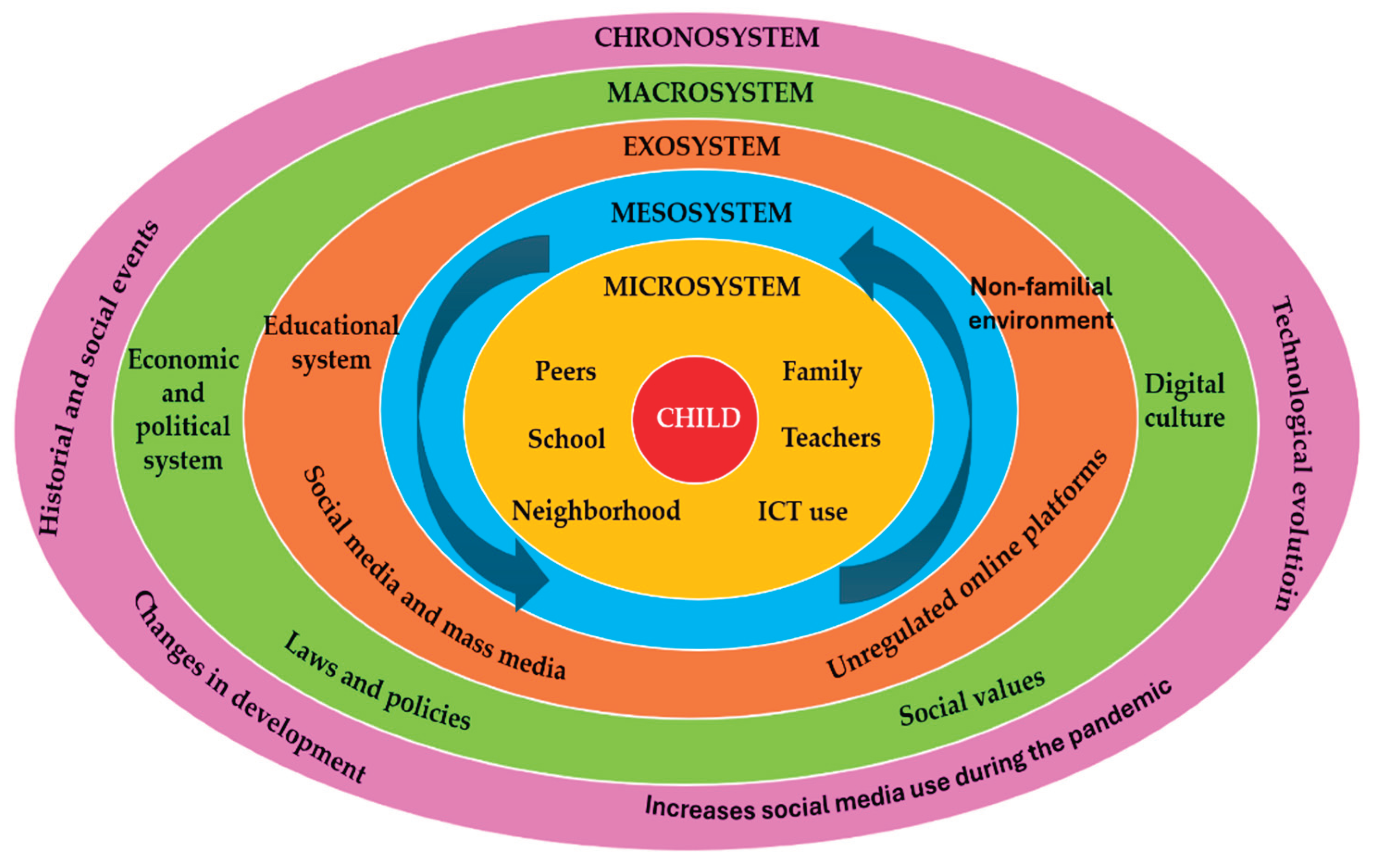
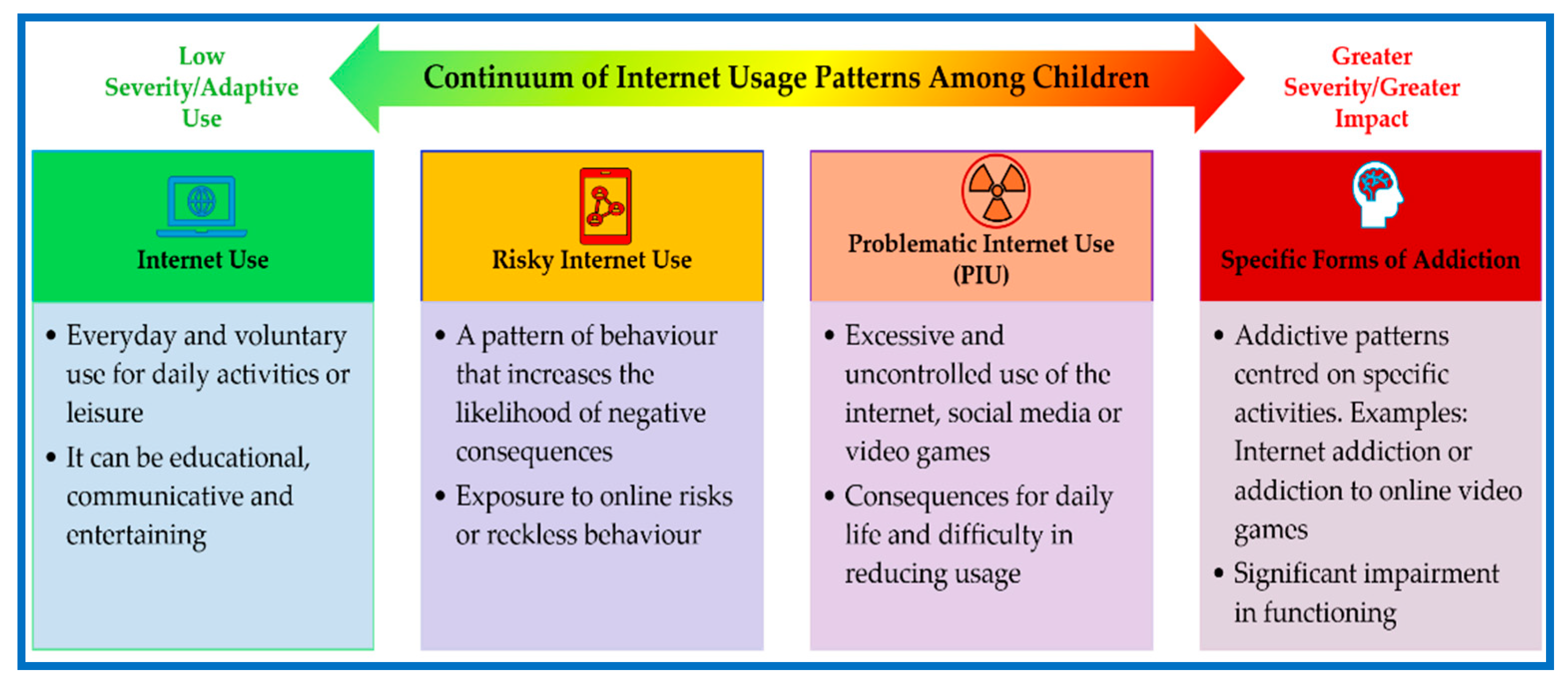
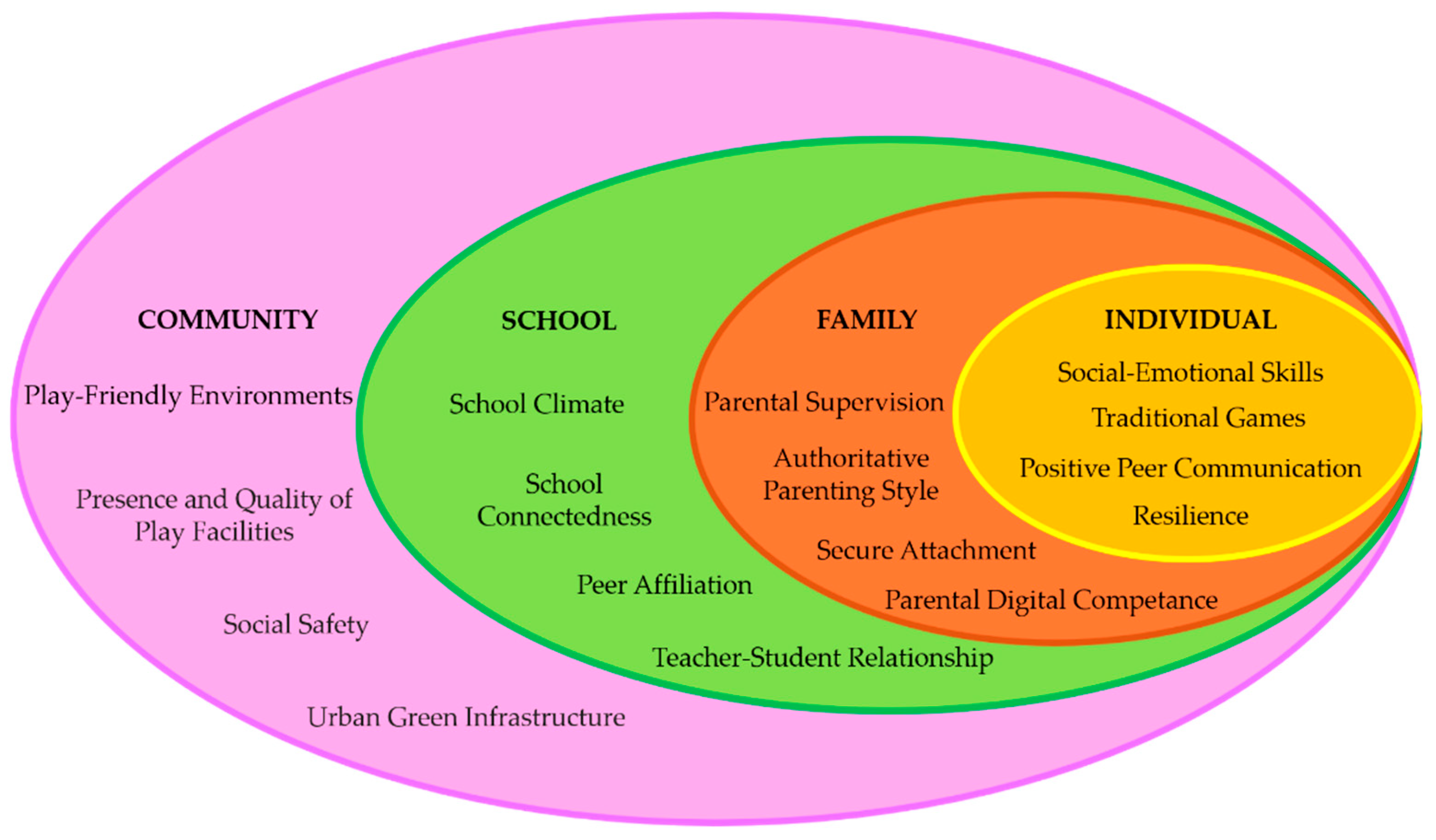

| Concept | Definition | Diagnostic Status |
| Problematic Internet Use (PIU) | An umbrella term describing excessive, compulsive, or maladaptive Internet use associated with negative consequences or functional difficulties across one or more online activities. | Not recognized as a distinct diagnosis in the DSM-5-TR or ICD-11 and does not necessarily imply the presence of a clinical disorder. |
| Problematic Social Media Use (PSMU) | An activity-specific manifestation of problematic digital use involving impaired control over social media use and associated negative consequences. | Not recognized as a distinct diagnosis in the DSM-5-TR or ICD-11. |
| Problematic Smartphone Use (PSU) | A maladaptive pattern of smartphone use characterized by impaired control and negative consequences. It may reflect problematic engagement with activities accessed through the device. | Not recognized as a distinct diagnosis in the DSM-5-TR or ICD-11. |
| Problematic Video Game Use (PVGU) | A maladaptive pattern of video game use is associated with negative consequences that do not necessarily meet the diagnostic criteria for a gaming disorder. | Not recognized as a distinct diagnosis in the DSM-5-TR or ICD-11. |
| Internet Addiction | A research term used to describe persistent addiction-like patterns of generalized Internet use involving loss of control and significant negative consequences. | Not recognized as a distinct diagnosis in the DSM-5-TR or ICD-11. |
| Internet Gaming Disorder (IGD) | Persistent and recurrent Internet gaming is associated with clinically significant impairment or distress. | Included in the DSM-5-TR as a condition for further study rather than as a formally recognized diagnosis. |
| Gaming Disorder (GD) | A pattern of online or offline gaming characterized by impaired control, increasing priority given to gaming, and continuation or escalation despite negative consequences, resulting in significant functional impairment. | Recognized as a clinical diagnosis in the ICD-11. |
Disclaimer/Publisher’s Note: The statements, opinions and data contained in all publications are solely those of the individual author(s) and contributor(s) and not of MDPI and/or the editor(s). MDPI and/or the editor(s) disclaim responsibility for any injury to people or property resulting from any ideas, methods, instructions or products referred to in the content. |
© 2026 by the authors. Licensee MDPI, Basel, Switzerland. This article is an open access article distributed under the terms and conditions of the Creative Commons Attribution (CC BY) license (http://creativecommons.org/licenses/by/4.0/).