

Submitted:
27 July 2026
Posted:
28 July 2026
You are already at the latest version
Abstract
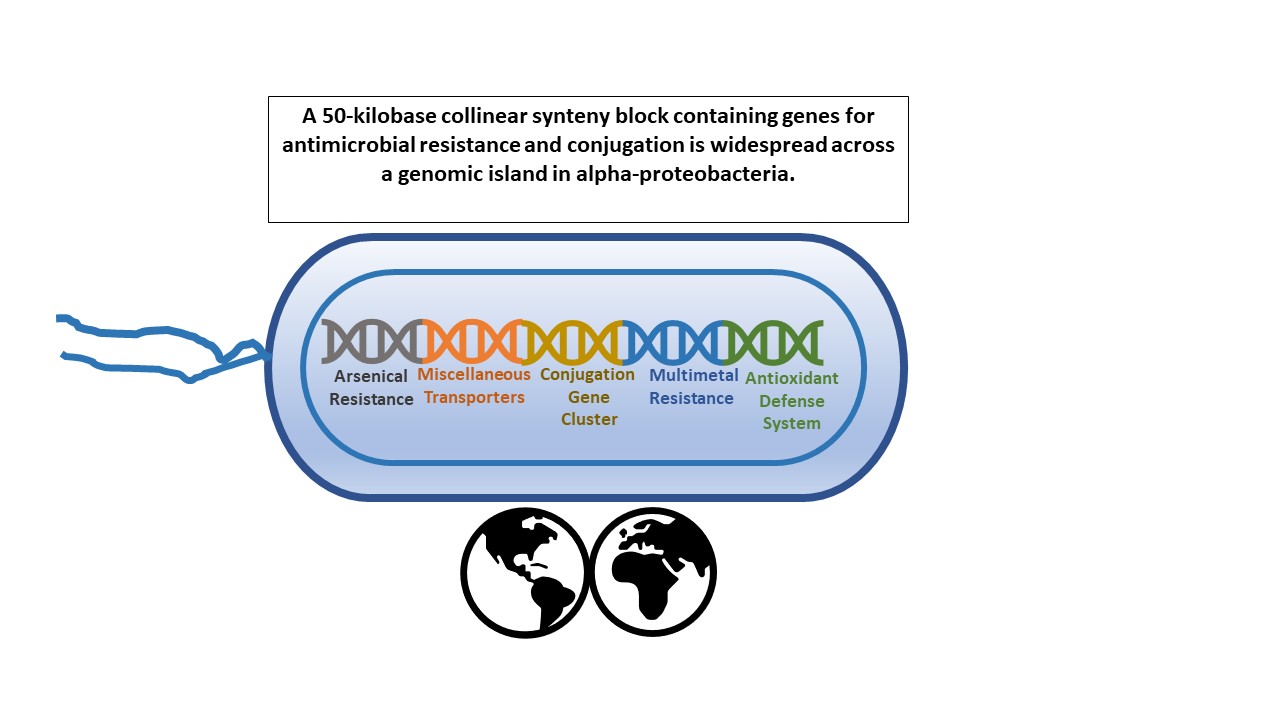
Antibiotic-, biocide-, and metal-resistance genes co-occur in the genomes of multidrug-resistant bacteria. This relationship is more complex than mere physical co-localization. Instead, it arises from co-selection pressures that favor co-regulation and co-resistance. The genomic basis of this co-occurrence remains unclear. Our studies on the co-occurrence of Cu(I)-ATPases with other metal-extrusion systems in the Methylobacterium extorquens AM1 genome revealed 3 Multimetal Homeostasis Gene Clusters (MHGCs) presumed to confer resistance to Cu/Ni/Co/Zn/Cd/Pb. In this study, we identified a more complex co-occurrence of Cu(I)-ATPases in the pathogen Brucella anthropi ATCC 49188. It comprises five collinear gene clusters (CGCs) spanning 48.5 kb and involved in multimetal and redox homeostasis, conjugation, and the transport of miscellaneous molecules. Highly homologous clusters were found in 43 strains across 3 alpha-proteobacterial orders, isolated from diverse habitats in different countries. Despite these geographical differences and phylogenetic distances, most orthologous genes remain syntenic. This arrangement of genes was named a Collinear Synteny Block (CSB). In some species, these CSBs reside within a ~110-kb genomic island, which explains their widespread occurrence. The CSB co-occurs with potential antibiotic-resistant genes scattered across the same replicon. This study will advance our understanding of the organization, evolution, and dispersal of resistance genes in bacteria.
Keywords:
co-occurrence
; Cu-P-type ATPases
; gene clusters
; copper transporters
; antimicrobial resistance
; collinear operon
; genomic islands
Copyright: This open access article is published under a Creative Commons CC BY 4.0 license, which permit the free download, distribution, and reuse, provided that the author and preprint are cited in any reuse.


