
Submitted:
01 September 2026
Posted:
02 September 2026
You are already at the latest version
Abstract
Three-flavor oscillation theory describes neutrino propagation but takes the PMNS orientation and mass spectrum as empirical inputs. This paper asks whether both can be reconstructed from one neutral-parent carrier architecture. A central feature is cross-sector inheritance: the charged-root ratios and neutral closure seam used here were fixed in a previously published charged-lepton calculation and are imported without adjustment to neutrino data. At the premetric level, the Indefinite Reconstruction Stability Principle (IRSP) requires persistent structure to survive admissible continuation and to descend independently of its representative. Combined with metric–carrier co-selection, codimension-two support yields a two-dimensional normal quotient. Under an explicit exact one-particle mass-readability premise, every local scalar-mass exposure factors through this quotient as a complex-linear map. For a nonzero exposure covariant under an irreducible real transverse rotation action, IRSP saturation fills both independent transverse directions, so a map from three active neutral continuation modes has rank exactly two. A source-protected mass-silent line is transported by exact invariant descent to the first propagation mode, giving m1=0 throughout the minimal protected reconstruction class. Equal-weight neutral geometry and inherited charged-root data determine a deformed tribimaximal PMNS frame, while a minimal two-seam incidence complex fixes the two nonzero masses. The resulting spectrum is m1=0, m2=8.686 meV, and m3=50.092 meV, with ∑imi=58.778 meV. No measured neutrino angle, phase, splitting, or absolute mass is inserted into the formulas; the measured electron mass only sets the final unit. The construction is conditional: exact transverse mass readability, source-level protection, overlap transfer, and post-read-out matching are stated explicitly. Within those premises, completeness of an anchored Z5 orbit, real transverse descent, and a unit-normalized linear endpoint read-out prove the finite seam weight x=5(1+ηe); it is not inferred from the symbol Z5 or from a fit. Exact physical-pole masslessness further requires a Lorentz- and electroweak-gauge-invariant effective theory whose renormalized matching preserves the protected quotient. Present numerical agreement is retrospective, whereas the frozen correlations and protected-zero condition provide prospective tests.
Keywords:
neutrino mixing
; PMNS matrix
; neutrino mass
; massless neutrino
; normal ordering
; neutral parent
; codimension-two defect
; transverse factorization
; protected kernel
; reconstruction
1. Introduction
Neutrino oscillations establish that charged-flavor states are coherent superpositions of propagation eigenstates with unequal squared masses [1,2,3,4,5,6,7,8,9,10]. In standard notation,
and the vacuum oscillation phases depend on the mass-squared differences
The effective three-flavor formalism describes the data successfully, but it leaves two conceptually distinct structures as inputs: the orientation of the PMNS matrix and the spectrum of the neutrino mass operator. Oscillation measurements determine two independent mass-squared differences but not the common absolute scale or whether the lightest mass is exactly zero.
Conventional approaches address these questions through Yukawa textures, effective operators, seesaw mechanisms, and continuous or discrete flavor symmetries [11,12,13]. Tribimaximal mixing is excluded as an exact low-energy matrix by the measured nonzero reactor angle, but it remains a useful leading frame for controlled TM-type deformations [13,14]. Rank-two mass matrices and one massless light neutrino also occur in minimal two-singlet seesaw models [15]. These precedents establish that neither a deformed tribimaximal frame nor rank two is novel by itself. The question addressed here is whether both can arise as linked read-outs of one declared closure architecture.
The purpose of this paper is to propose a common structural origin for these two inputs. The central organizing object is the dimensionless neutrino mass-squared operator in the charged-lepton flavor frame,
The mixing calculation determines the eigenvectors of the neutrino operator, while the mass calculation determines its rank and eigenvalues. Together, they reconstruct the complete neutrino operator in the flavor basis.
The proposal uses two descriptive layers that must be kept distinct. The post-read-out layer is ordinary neutrino phenomenology: a Lorentzian spacetime, quantum fields, weak interactions, propagation eigenstates, and the PMNS matrix. The reconstruction layer is a hypothesized premetric selection problem that asks which finite closure relations can persist before distance, duration, energy, and local field variables have been defined. The word “before” denotes logical dependence, not an earlier moment of ordinary cosmological time. The reconstruction layer is intended to supply structural boundary data to the standard dynamical layer, not to replace it.
The calculation has an important feature that can be stated without using the new terminology. Its charged-root ratios and its leading neutral closure seam are not selected inside the neutrino calculation. They were fixed in the published charged-lepton analysis of Ref. [20], where the same neutral seam closes a small residue in the electron–muon hierarchy. The present paper imports those values unchanged and asks whether they also organize neutrino mixing and mass. This is the paper’s principal cross-sector test. It is stronger than a fresh fit within one sector, although it is not by itself a prospective statistical validation because the broader framework was developed with neutrino data already known.
The basic reconstruction object is a neutral parent: an unresolved, zero-net-charge closure source whose admissible resolution produces complementary charged-transverse and neutral-continuation channels. A read-out is the map from this invariant closure information to a quantity defined in the effective spacetime theory. The PMNS matrix is then interpreted as the overlap between the charged-lepton and neutrino read-out frames,
Because no metric, action, or energetic weighting is yet available at the premetric layer, the primitive counting rule assigns equal weight to inequivalent admissible alternatives. Unequal observable weights arise from their multiplicities and from orientation or phase information, not from fitted primitive probabilities. This rule selects a tribimaximal leading continuation frame. Previously derived charged-lepton root ratios then determine a dominant continuation tilt and a smaller endpoint relaxation, producing definite values for the mixing angles and a near-quadrature phase.
For clarity, a continuation direction is an internal neutral mode that specifies how an excitation persists under successive admissible reconstruction. It is neither an additional spatial direction nor the coordinate-time axis. After Lorentzian read-out, its physical image is causal propagation along the particle’s worldline. Scalar rest mass is proposed to measure a different aspect of the same structure: the locally exposed transverse closure residue. The two-dimensional target is therefore not simply postulated from the phrase “codimension two.” It is derived below from a specific chain: IRSP, formulated as an existence condition in the published laws-side framework of Ref. [21], selects persistent loop-readable support; metric–carrier co-selection supplies its normal quotient and transverse inner product; exact one-particle mass readability and representative-independent observable descent force the positive mass-squared form to factor through that quotient; and an irreducible transverse action together with IRSP saturation fills its two independent directions. A map from three active continuation modes then has one and only one kernel direction. Source-level mass silence identifies which line is protected, while exact read-out transports that line without altering it.
This premetric use of counting rather than an action principle requires a scope qualification. A continuum Lagrangian presupposes a manifold, local fields, derivatives, a measure, and usually a metric or causal structure. Those are outputs rather than inputs of the proposed selection layer, so a Lagrangian cannot serve there as the fundamental weighting rule without assuming part of what is to be reconstructed. After read-out, however, Lagrangian quantum field theory remains applicable and must reproduce the rank-two spectrum and PMNS orientation obtained here. The open matching to a gauge-invariant effective theory is discussed explicitly below.
The paper builds on the topological classification of admissible reconstruction operations in Ref. [18], its local-to-global meridian-obstruction development in Ref. [22], the carrier-closure particle framework in Ref. [19], the charged-lepton hierarchy analysis in Ref. [20], and the published IRSP-based selection of the common Lorentzian and gauge-law platform in Ref. [21]. Importantly, the framework was not introduced specifically to reproduce neutrino data. Its previously published nucleon magnetic-moment, charged-lepton mass-ratio, and fine-structure-constant applications are summarized in Table 2. The fine-structure calculation in Ref. [23] is an independent constant-side application of the same neutral codimension-two, equal-weight, and finite-interface architecture; neither nor any electromagnetic datum enters the neutrino formulas. The present paper is nevertheless written to be self-contained at the level required to follow every equation used in the neutrino construction.
Here and throughout, the statement refers to the lightest propagation eigenstate in vacuum under normal mass ordering, not to the electron-flavor state . Section 2.2 explains why oscillation, beta-decay, and cosmological observables remain nonzero.
The main results are:
- 1.
- a frozen cross-sector input ledger showing exactly which coefficients were inherited, where they first appeared, and that they were not refitted;
- 2.
- a reader-verifiable equal-weight construction of the leading neutral frame and its charged-root deformations;
- 3.
- an IRSP and metric–carrier derivation of the two-dimensional mass-readable quotient;
- 4.
- an exact one-particle factorization theorem selecting a saturated rank-two mass exposure under an irreducible transverse action;
- 5.
- a protected-kernel preservation theorem transporting a source-level mass-silent line to , followed by a minimal two-seam spectrum for and ;
- 6.
- a complete anchored-orbit incidence theorem and a unit-normalized endpoint-descent theorem proving the anisotropy ; and
- 7.
- an explicit post-read-out matching condition required for the structural zero to remain an exact physical pole zero in the full renormalized theory.
The logical status of these claims is kept explicit. Standard oscillation phenomenology is retained after read-out. The structural rank and kernel statements are exact consequences of the declared IRSP, co-selection, one-particle mass-readability, irreducible saturation, and source-protection premises. Exactness of the physical pole zero additionally requires the EFT matching condition; it is not inferred from a tree-level rank-two matrix. The detailed seam transfer and the finite-interface construction remain more model-dependent than the rank theorem. Once the selected refinement, its complete persistent endpoint orbit, and the unit-normalized read-out maps are fixed, however, the factor 5 and its endpoint deformation are consequences rather than additional numerical hypotheses. Present numerical agreement is therefore a cross-sector consistency test, while the protected-zero condition, normal ordering, absolute scale, mass sum, and frozen correlations are prospective tests.
The paper is organized as follows. Section 2 and Section 3 separate established phenomenology from the new assumptions and define the reconstruction terminology, equal-weight measure, and post-read-out role of Lagrangian dynamics. Section 4, Section 5, Section 6, Section 7, Section 8, Section 9, Section 10, Section 11, Section 12 and Section 13 construct the PMNS frame. Section 14, Section 15, Section 16 and Section 17 derive the rank-two mass operator and its nonzero eigenvalues. Section 18, Section 19, Section 20, Section 21, Section 22 and Section 23 give numerical comparisons, observable consequences, limitations, and falsification criteria. Table A1 provides a compact notation guide.
2. Claim Hierarchy and Relation to Established Physics
The framework supplies structural boundary data to the standard post-read-out neutrino formalism; it does not replace quantum field theory, the standard oscillation equations, or established weak-interaction phenomenology. Table 1 separates the logical layers.
The calculation has four steps. First, it takes a set of charged–neutral numbers already fixed in another lepton observable. Second, it uses them to tilt a simple symmetric neutrino basis. Third, it argues that three neutral modes can produce only two independent local mass loads, leaving one protected combination massless. Fourth, it fixes the sizes of the two remaining loads with a minimal weighted comparison graph. The specialized terms introduced below name these four operations; they do not add extra numerical freedom.
2.1. Standard Three-Flavor Quantities Retained
The reconstruction rules enter only through the numerical orientation and spectrum assigned to the standard three-flavor Hilbert space. For any unitary mixing matrix U, the mixing angles are extracted in the Particle Data Group convention as
The oscillation-sensitive CP invariant is
Possible Majorana phases do not affect oscillations and are not fixed by the present construction. Likewise, the dimensionless operator in Equation (3) is the positive mass-squared operator acting on the left-handed neutrino flavor space, divided by . In this paper is defined as a map from that flavor space to its mass partner, so this operator is . With the opposite matrix-map convention the same left-handed operator is written ; its spectrum and PMNS diagonalizing frame are unchanged. Standard propagation and weak-interaction formulas are unchanged.
2.2. Physical Interpretation and Observable Compatibility of
Important distinction. The exact structural zero selected here belongs to the lightest propagation eigenstate in vacuum, , under normal mass ordering; its exact pole interpretation is conditional on Section 21. It is not the electron-flavor state . A flavor state is a coherent superposition of mass eigenstates:
Consequently, does not possess a single definite rest mass. Even when , the effective electron-neutrino mass measured in beta decay remains nonzero:
The cosmological mass sum likewise remains nonzero,
and oscillations remain governed by the nonzero mass-squared differences
The prediction therefore does not imply a massless flavor state, a vanishing beta-decay signal, a vanishing cosmological mass sum, or the absence of neutrino oscillations.
3. Framework, Assumptions, and Counting Method
3.1. Reconstruction and Read-Out
In this framework, reconstruction does not mean reconstructing a previously existing spacetime from incomplete information. It denotes the admissible formation and continued stabilization of relational structure at a level prior to the differentiation of spacetime, fields, particles, and dynamical variables. The framework therefore explores a premetric support layer: a domain in which there is not yet a distance function, physical clock, local inertial frame, energy functional, continuum field, or Lagrangian density. The word “prior” denotes logical dependence, not an earlier moment of ordinary cosmological time, because physical time is itself part of the subsequent read-out.
Reconstruction proceeds by admissible extension and refinement. A local relation is retained only if it can be completed consistently, remains stable under further admissible continuation, and descends independently of the representative used to describe it. A structure that closes at one finite stage but becomes inconsistent under continued reconstruction does not define a persistent physical identity. Reconstruction is therefore simultaneously a formation rule and a stability filter: it selects the relational structures that can support repeatable physical read-out.
The Indefinite Reconstruction Stability Principle (IRSP) summarizes this requirement. It states that a persistent identity must remain well-defined under indefinite admissible continuation and must descend consistently to the observable quotient. The continuation involved here is primarily logical or structural continuation, not motion through an already available time coordinate. The principle, including the qualification that IRSP is an existence condition rather than a claim of physical immortality, is developed in Ref. [21]. Under the assumptions stated in Refs. [18,22], persistent obstructions that remain readable by local linking loops are naturally supported on codimension-two subsets.
A read-out is the map by which an invariant premetric structure becomes represented as effective physical data. Different read-out maps can expose different aspects of the same underlying closure complex. In particular, the framework distinguishes metric, particle, mass, electromagnetic, weak, and flavor read-outs. The reconstruction layer is intended to select persistent particle identities, invariant constants and dimensionless ratios, and the admissible structural forms of the effective laws. Metric read-out supplies a Lorentzian spacetime and its causal organization; field and gauge read-outs supply the variables in terms of which the effective laws are written; and particle and mass read-outs supply the identities and spectral data on which those laws act.
The proposed division of labor is therefore
This construction is not proposed as a replacement for the Standard Model. Once spacetime, fields, particle species, and couplings have been read out, the Standard Model—together with its appropriate gauge-invariant neutrino mass completion—is the correct and indispensable effective description. It governs propagation, oscillation amplitudes, weak interactions, scattering cross sections, decay rates, radiative corrections, and renormalization-group evolution. The reconstruction framework instead addresses a logically earlier question that the effective theory normally leaves as empirical input: why these particle identities, constants, mass ratios, mixing structures, and law forms are selected in the first place. Its output must therefore match onto, and remain consistent with, ordinary post-read-out quantum field theory. This selection-before-dynamics division is developed at theorem level in Ref. [21].
The distinction does not mean that reconstruction ends after a single emergence event. Persistent physical structure is continually maintained by compatible reconstruction. After metric and temporal read-out, neighboring complete read-outs can be ordered by an effective time coordinate. In the limit in which the separation between such read-outs becomes small, their coarse-grained relation is represented by smooth differential evolution:
Thus, the familiar dynamical evolution of fields through partial differential equations is the small-step continuum limit of repeated reconstruction. The PDE description is fully valid at the effective level, but it does not replace the underlying admissibility conditions that continually secure the identities, constants, and law structure on which that evolution depends [21].
Because read-out is sector-specific, absence from one observable map does not imply absence from the underlying structure. A component can be essential to global closure while lying in the kernel of a particular read-out. This point is central to the neutrino construction below: one continuation mode remains necessary for neutral-parent closure but lies in the kernel of the scalar-mass exposure map, whereas the other two continuation modes acquire nonzero mass through their transverse closure residues.
3.2. IRSP, Saturation, and Metric–Carrier Co-Selection
The preceding discussion can be condensed into two requirements that will do explicit work in the mass proof. Let denote the class of admissible reconstruction refinements and let denote the observable quotient for read-out sector r. Two representatives are equivalent in that sector when they have the same image in .
Axiom 1
(Indefinite Reconstruction Stability Principle). A structure represents a persistent physical identity only if, under every admissible refinement in , it remains consistently completable and its read-out descends to independently of the representative used to describe it. In particular, if , then every physical read-out must satisfy
For readers familiar with gauge theory, Equation (9) plays a role analogous to requiring an observable to be independent of a redundant description. The equivalence relation here is more primitive: it is defined before a continuum gauge field has been selected.
Proposition 1
(Natural descent of an admissible refinement). Let preserve the equivalence relation defining a read-out quotient . Then there is an induced map satisfying
If one primitive refinement is read in two sectors, the two induced maps may have different representations and normalizations, but they have the same primitive antecedent T. Equality of their numerical coordinates requires an additional cross-sector normalization; it does not follow from naturality alone.
Proof.
Define . Because T preserves the read-out equivalence relation, implies , so this definition is independent of the representative. Equation (10) then follows directly. The final statement records that the refinement belongs to the primitive morphism T, whereas both its matrix form and its coordinate scale belong to the chosen read-out representation. □
This qualification will matter twice below. Exact descent preserves the antecedent of a protected line, but it does not by itself identify an angle with a mass-incidence coefficient. The latter identification will be made only after a unit normalization of both endpoint read-outs is stated explicitly. More generally, an exact read-out cannot turn a source direction that is invisible to an observable into an exposed one when the corresponding diagram commutes. Proposition 6 gives the specialized neutrino statement. This is the kernel-preservation principle of representative-independent observable descent developed in Ref. [21].
Axiom 2
(IRSP saturation). Once a persistent read-out type has been selected, every independent, mutually compatible and symmetry-related channel required for its complete closure is represented. A proper subset is inadmissible when an allowed reconstruction automorphism carries an occupied channel into an omitted one.
Saturation is a completeness condition, not a rule that every imaginable degree of freedom must occur. It applies only after admissibility, representation equivalence, and the relevant read-out type have been fixed. In the neutrino mass problem it will be applied to the two symmetry-related directions of the real transverse normal plane.
The geometry used by the observable theory must also be compatible with the carrier identity that it makes readable. We express this compatibility as follows.
Axiom 3
(Metric–carrier co-selection). The Lorentzian metric read-out and a persistent carrier defect are admissible jointly only when the metric preserves the defect’s linking class and supplies a nondegenerate normal quotient on which its local holonomy can be read. For a codimension-two carrier support D, the selected local geometry therefore contains the exact sequence
For the particle-facing branch considered here, the induced transverse metric is positive definite.
Carrier topology and metric read-out therefore have different jobs. The carrier supplies the persistent codimension-two linking obstruction; the metric supplies the tangent/normal decomposition and the positive transverse inner product. Their co-selection is what makes the two-dimensional quotient both structurally meaningful and usable in a positive mass-squared operator. The broader derivation of the Lorentzian platform and its co-selection with persistent carrier structure is given in Ref. [21]; the present axiom states the specialized normal-quotient premise needed for neutrino mass.
3.3. Previous Cross-Sector Applications and the Frozen-Input Protocol
Before the present neutrino construction, the same neutral-parent, codimension-two closure architecture was applied to particle structure, the charged-lepton hierarchy, and the fine-structure constant. Table 2 collects the most directly comparable numerical results. These calculations use the same distinction between protected identity structure and exposed carrier residue that is used below; they do not use neutrino mixing angles, neutrino mass splittings, or an absolute neutrino mass as inputs.

Table 2.
Previously published cross-sector applications of the reconstruction framework. The quoted agreements are those reported in the cited works.
Table 2.
Previously published cross-sector applications of the reconstruction framework. The quoted agreements are those reported in the cited works.
| Application | Principal result and reported agreement |
|---|---|
| Nucleon magnetic moments [19] | , differing from the CODATA ratio by |
| Charged-lepton hierarchy [20] | , , and , with reported deviations of , approximately , and approximately , respectively |
| Fine-structure constant [23] | , reported as below the 2022 CODATA value |
The decisive comparison is not only that both sectors give accurate numbers. It is that several quantities used below were publicly fixed in the charged-lepton calculation before the present neutrino submission and are not changed here. Define the inherited ledger
where and . Table 3 records the provenance and the distinct role of each entry.
The values and used in the PMNS calculation are algebraic read-outs of the first two rows, not additional fitted inputs. By contrast, the finite endpoint displacement , the anchored incidence multiplicity 5 in the two-seam anisotropy, and overlap-covariant transfer are neutrino-specific constructions whose status is examined separately. The first two are derived below from the declared finite carrier and read-out structure; overlap transfer remains a separate matching premise. This separation is important: inherited data cannot be used to shield new prescriptions from scrutiny.
Neither the nucleon result nor the fine-structure-constant result is used anywhere in the neutrino calculation. The charged-lepton ratios enter only where explicitly identified as previously derived transverse reference data in Section 8; the published neutral seam enters in Section 16. Measured charged-lepton ratios are not substituted for them. Thus Table 2 is evidence of continuity and cross-observable consistency, not an additional fit or a proof of the framework. The comparisons were made with experimental values already known when the models were developed and should therefore be regarded as retrospective tests. Nevertheless, successful reuse of a publicly fixed seam in a distinct observable sector is a nontrivial transportability test. The structural zero mode, frozen mass spectrum, and PMNS correlations derived here provide the prospective neutrino-sector tests.
3.4. Premetric Equal Weighting
An ordinary statistical or path-integral weight uses information such as an action, energy, length, or coupling. None is available at the primitive premetric stage. The minimal non-arbitrary measure is therefore equal weighting of admissible alternatives after representational redundancies have been removed.
Axiom 4
(Premetric equal weighting). Let be a finite set of admissible primitive alternatives after quotienting relabelings and other representation-only equivalences. Each physical equivalence class receives the same primitive weight,
For a read-out channel , its normalized structural weight is consequently
Equal primitive weight does not mean that all observable channels have equal probability. A channel represented by more inequivalent admissible alternatives has greater total weight. Nor does the axiom erase signs or complex phases: orientation, spinorial parity, and holonomy can attach signs or phases to equally weighted amplitudes before they interfere. If a calculation is performed with labeled representatives rather than quotient classes, automorphism multiplicities must be divided out so that a mere relabeling does not create physical weight.
This rule is used in two transparent places below. Three equivalent neutral channels give the democratic vector , whereas finite admissible chamber counts give ratios such as , , and . After metric and field read-out, ordinary dynamics may of course generate unequal effective weights through couplings, propagation, and interaction amplitudes. Premetric equality is a selection rule for primitive closure alternatives, not a claim of equal late-time event frequencies.
3.5. Why a Lagrangian Is Not the Primitive Selection Rule
A continuum action normally has the schematic form
Writing this expression already presupposes a manifold M, local fields , derivatives, an integration measure, causal or metric information g, and coupling parameters . The premetric reconstruction problem is intended to precede the selection of precisely these structures. Using Equation (15) to assign primitive weights would therefore import part of the desired output into the starting point.
The statement is deliberately limited: a Lagrangian approach is not applicable as the fundamental selection rule at the premetric stage. It remains applicable, and is ultimately required, after Lorentzian and gauge read-out. At that stage the reconstructed data must be expressible through a Lorentz-covariant and electroweak-gauge-invariant effective theory, with the usual quantum corrections and interaction phenomenology. In the present paper the PMNS matrix and rank-two spectrum are proposed as spectral boundary data for that effective theory. The absence of a completed Lagrangian matching is therefore a limitation and an open task, not a claim that Lagrangian quantum field theory is unnecessary.
3.6. Carrier, Neutral Parent, and Codimension Two
The carrier is the structured nonempty support from which local spacetime and field descriptions are read out. It is not a mechanical ether, a preferred-frame substance, or an additional experimentally asserted field. The term names the premetric support required by the reconstruction hypothesis. A neutral parent is an unresolved closure source with zero net charge before branch resolution. It is an archetype rather than a composite object containing ordinary particles. Persistent particle-like identities arise only after its admissible branches are resolved and mapped to the effective spacetime theory [19].
For the mathematics used in this paper, this statement is made operational as follows. Consider the category whose objects are finite oriented closure complexes , with , and whose morphisms are admissible refinements preserving closure and orientation data. The symbol
denotes an isomorphism class containing a connected closure complex and its admissible refinement system , subject to vanishing total charge under the unresolved charge read-out. Thus is not a numerical parameter, a spacetime point, or an additional quantum field. The present paper uses only its equivalence class, its resolved branch roles, and the codimension-two support selected after carrier/metric read-out. A complete microscopic theory would specify and explicitly; that stronger construction is not assumed here.
For a codimension-two defect, the punctured local normal fiber retracts to a circle,
so loops can link the defect and carry nontrivial holonomy. This is the local topological reason codimension two supports loop-readable identity [18,22,24,25]. Its use in an independent neutral-holonomy capacity calculation is developed in Ref. [23]. The phrase codimension-two particle structure refers to the carrier-level support of the read-out, not to a claim that a detected lepton is an extended classical string in measured spacetime. The observed particle remains a pointlike excitation within the tested effective theory. The codimension statement belongs to the underlying reconstruction and normal-linking description.
3.7. Discrete Interfaces, Chambers, and Refinement
The notation denotes a finite cyclic return interface with n distinguishable slots before equivalences are imposed. It is used as closure bookkeeping and should not be confused with an additional Standard Model gauge group. A chamber is an admissible slot or overlap class at such an interface. A chamber is exposed in read-out sector r when it contributes a nonzero signed residue under the corresponding map ; it is protected when it remains closure-essential but lies in .
An arrow denotes refinement of one already selected return structure by a finer interface. Higher interfaces do not replace the lower-level particle identity. They resolve conditional carrier-facing structure and therefore enter with progressively smaller weights. The superscripts + and − label oppositely oriented charge-polarization branches after read-out; they are not arithmetic signs attached to the abstract cyclic set. Equal weighting is applied to admissible inequivalent chambers at a fixed comparison level. Signed contributions appear only after their orientations and read-out roles have been resolved.
For the finite-interface argument below, a cyclic return must be distinguished from a representation-only relabeling. An anchored return interface is the flagged object
where a is the attachment to the already persistent lower-level carrier structure and o is its selected orientation. IRSP persistence requires both data to survive refinement. Consequently, a representation automorphism of must fix a and o. By contrast, a return step changes the position of a newly exposed seam relative to that fixed flag. Return-related placements can therefore be distinct admissible incidences even though the unanchored cyclic set would admit a rotation that merely relabels its slots. This distinction prevents a cyclic orbit from being counted as physical multiplicity unless a persistent relational anchor is actually present. An analogous anchored-interface and automorphism-quotient discipline is used in the published fine-structure calculation of Ref. [23]; no electromagnetic normalization or numerical output from that work is imported here.
3.8. Transverse Charged Read-Out and Neutral Continuation
The lepton-facing branch resolves schematically as
The charged lepton is a transverse, -visible endpoint. The neutrino is a neutral continuation-compensation read-out. The latter carries residual fermionic parity, while its actual spinor and chirality require the carrier read-out described in Section 5; its embedding is selected by closure compensation rather than by direct charged exposure [19].
3.9. Protected Identity and Exposed Residue
Let T denote a closure complex and a read-out-specific exposure map. A protected component in sector r belongs to
where denotes closure-essential structure. Such a component is required for identity but does not produce a local exposed residue in that sector. This distinction is central below: the electron is a small surviving charged exposure, whereas the lightest neutrino is proposed to be a protected kernel of the neutral mass exposure.
Figure 1 illustrates this division of labor: the three-dimensional continuation space is mapped to a two-dimensional transverse mass-exposure space, leaving one protected continuation mode in the structural mass kernel.
The arrows in Figure 1 denote logical dependence between structural and read-out levels, not a microscopic trajectory in ordinary time. The two-dimensional target is the effective mass-exposure quotient selected conditionally by metric–carrier co-selection and made mass-readable by the exact one-particle bridge in Section 14; it is not a claim that the observed neutrino propagates in only two spatial dimensions.
4. Neutral-Parent Origin of the Neutrino Sector
With the preceding terminology in place, this section states the model-specific resolution hypothesis used for the lepton sector. Let denote the unresolved neutral parent. It is not assumed to contain ordinary particles as pre-existing constituents. Rather, it is a carrier-supported closure archetype whose physical outcomes appear only after branch resolution, carrier embedding, and Lorentz read-out. The following branch pattern is an assumption of the reconstruction framework; it does not modify the standard charged-current interaction used after read-out.
The adopted minimal matter-resolution pattern is
The two branches are opposite charge-polarization ends of the same neutral parent. The negative branch is the lepton-facing side; the positive branch continues into the hadron-supporting closure side.
The lepton-facing branch has two read-out roles:
Here denotes a charged transverse read-out, while denotes a neutral continuation-direction read-out. The symbols ⊥ and ‖ do not denote ordinary spatial directions inside a particle. They denote two carrier-readable roles of the same residual fermion-parity branch.
This gives the basic interpretation:
The neutrino is therefore not a neutral afterthought added to weak decay. Its pre-spinorial origin is a residual compensating continuation class required by neutral-parent closure; the Lorentz carrier and chirality selector complete its particle-facing spinor read-out below.
5. Compensation Class and Spinorial Read-Out
The charged lepton and the positive closure branch are not symmetric copies. At the pre-spinorial level the charged lepton carries a transverse residual-parity branch,
whereas the positive side is closure-embedded,
Their mismatch is not a simple numerical charge difference. It is a relative closure obstruction:
The symbol “minus” denotes a relative mismatch class, not ordinary subtraction of two particles.
Neutral-parent closure requires this mismatch to be cancelled by a continuation-dual compensating class :
Equivalently,
Here denotes a continuation-sector duality map. It is analogous in spirit to Poincaré duality, relative obstruction duality, or an exact-sequence boundary map, but it is adapted to the carrier-continuation sector.
The residual class is necessary for fermionic parity, but a bare label is not yet a spinor. In the present paper, spinorial read-out is therefore introduced as an explicit post-read-out compatibility premise: the selected oriented and time-oriented Lorentzian frame bundle is assumed to admit a compatible lift carrying the residual class. Schematically,
The associated four-complex-component Dirac bundle then splits as . Identifying the active neutrino with a two-component section of requires a further protected handedness selector. The Lorentzian platform and its causal and gauge support are derived conditionally in Ref. [21], but that result does not derive either the lift from primitive carrier data or the electroweak chirality selector. Equation (21) is therefore not counted here as a completed reconstruction theorem; it states the post-read-out structure to which a future matching derivation must descend. Deriving both the compatible lift and the protected left-handed selector remains an explicit open obligation of the present framework. Thus the origin and particle identity of the neutrino are distinct:
Higher interface layers may shape the compensational geometry:
However, these higher layers do not make the emitted neutrino a - or -type particle. They provide internal compensation data whose final free-particle read-out remains fermionic after the carrier and chirality selections in Equation (21).
6. PMNS as a Compensation-Overlap Matrix
The PMNS matrix is usually described as the mismatch between weak flavor states and neutrino propagation states. In the present framework, this mismatch is reinterpreted as the overlap between two structural frames:
and
Thus
At the level of squared amplitudes, equal weighting permits the representation
The quantities in Equation (22) must be defined rather than left as symbolic “counts.” For the leading frame used here, their minimal integer representatives are
The second column follows from three equivalent neutral channels; the third is electron-silent and gives equal weight; normalization and orthogonality fix the first. The integer matrix is therefore a compact equal-weight ledger for the leading rational moduli. It is not claimed to be an enumeration of six fully specified microscopic carrier states. A future finite carrier complex must supply such a microscopic enumeration. Relative signs and phases, which squared multiplicities cannot determine, are supplied separately by orientation and continuation conjugacy.
Equation (22) is used quantitatively only for the leading matrix in Equation (23). The endpoint deformations are amplitude-level structural rules, not additional integer counts. This distinction prevents a conceptual counting interpretation from being mistaken for a computation that the paper does not perform.
The rest of the paper gives a compact quantitative realization. The neutral compensation frame has a symmetric leading basis, corrected by a charged-root-induced continuation tilt and a small electron-endpoint relaxation:
The three factors have distinct meanings:
The geometric logic of this construction–from the leading neutral-compensation basis, through the continuation tilt and the endpoint relaxation, to the associated predictions for , , , and –is summarized schematically in Figure 2.
7. Leading Neutral Compensation and the TBM Basis
The leading neutral compensation basis is obtained by applying premetric equal weighting to the three active neutral channels and then resolving the two orientation-distinguished heavy-channel combinations. The resulting orthonormal frame is the tribimaximal basis
In the present interpretation, this matrix is not introduced as an empirical flavor-symmetry ansatz. The equal-weight axiom selects the democratic direction but does not, by itself, determine a complete basis. The remaining two columns follow only after adding continuation conjugacy and orthonormal completion with a protected neutral closure direction. These three requirements, rather than equal weighting alone, select the leading frame.
The three column vectors are
Their structural meanings are as follows. The vector
is the democratic neutral-parent exposure mode. It assigns equal primitive weight to the three charged-lepton labels before any continuation-direction splitting is resolved. The vector
is the antisymmetric continuation mode. It expresses the leading conjugacy of the two heavy continuation channels while leaving the electron endpoint unexcited. The remaining vector
is then fixed, up to an overall sign, by orthogonality to both and . At this stage it is the unique candidate protected direction completing the neutral three-channel basis while preserving democratic neutrality and antisymmetry. Orthogonality alone does not prove mass protection. The additional source-level statement that this line is closure-essential and mass-silent is isolated in Axiom 7, and its preservation under read-out is proved in Proposition 6.
Equivalently, the TBM basis is the unique orthonormal basis, up to column signs and ordering, satisfying the leading neutral-compensation conditions
Solving these conditions gives
which are precisely the columns of . Thus the TBM structure is not assumed because it is historically familiar. It is the leading neutral-compensation frame selected by equal-weight three-channel exposure together with continuation conjugacy.
At this leading level one obtains
This captures the large neutral mixing pattern, but it cannot be the final physical PMNS matrix because the observed reactor angle is nonzero. The nonzero reactor angle is therefore interpreted below as the leading deformation of the neutral-compensation basis by the previously derived charged-lepton root hierarchy. The solar angle is then further refined by a small endpoint-induced rotation of the protected closure line away from its leading orientation , while the atmospheric angle is maximal in the exact quadrature limit and may receive an endpoint-phase relaxation.
8. Charged-Lepton Root Geometry as a Derived Input
The charged-lepton analysis of Ref. [20] derives the charged-lepton root geometry from endpoint leakage, nested chamber counting, neutral compensation, and Koide sector-power balance. The present PMNS derivation uses those results as already-derived structural quantities:
and
It follows that
and
These quantities are not fitted to PMNS data. They are the charged-root outputs of the neutral-parent hierarchy theory. In the PMNS derivation they play the role of a previously derived transverse reference geometry. This is natural because neutrino flavor labels are defined relative to charged leptons:
Thus PMNS mixing should depend on the relative orientation between charged-lepton root geometry and neutrino compensation geometry.
9. Dominant Continuation Tilt and Reactor Angle
The dominant deformation of the neutral compensation basis is a rotation in the 2-3 neutral subspace:
The leading factor is inherited from the charged-root geometry. The correction is fixed by the following explicitly stated endpoint rule.
Proposition 2
(Conjugate-pair endpoint correction). Assume that the electron-boundary displacement is read by the two oriented members of the transverse continuation-conjugacy pair, that IRSP covariance exchanges these members, and that neither is distinguished before read-out. Premetric equal weighting then assigns the same primitive displacement to each member. In the minimal one-step endpoint ledger their orientation-even contribution to the reactor-tilt norm is therefore exactly .
Proof.
Let the two conjugate contributions be and . Covariance under the exchange automorphism and equal primitive weighting give . The reactor-tilt norm is even under conjugation, so the two primitive contributions add rather than cancel: . □
Under this conjugate-pair premise, the structural relation is
Equivalently,
The leading factor is the charged-root hierarchy projected into the neutral continuation sector. The endpoint factor is the exact orientation-even boundary contribution of the minimal one-step ledger. It is not a truncated Taylor expansion: any further endpoint layer would be an additional structural refinement and would change the model. The coefficient 2 is thus not inferred from the measured reactor angle; it is conditional on the declared conjugate-pair action. If a future carrier complex does not contain this exchange pair, Proposition 2 and the resulting reactor prediction fail together.
Numerically,
Since the TBM first row has equal one-third overlap with the rotated third neutral mode, the reactor angle is
Therefore
10. Quadrature Phase and Atmospheric Mixing
Metric–carrier co-selection equips the oriented transverse plane with the compatible quarter-turn operator , satisfying and . The charged-transverse and neutral-continuation members of the leading conjugacy pair are assumed to be related by this operator. After complexification, is multiplication by . The leading relative phase is therefore quadrature,
This makes clear what is derived and what is assumed: quadrature follows from the compatible complex structure once the two read-outs are identified as its conjugate pair. The identification itself is a carrier-level premise, not a fit of a free CP phase.
With , the - and -side contributions remain equal in modulus. Consequently,
Thus the leading atmospheric prediction is
This is not introduced as a fit. It is the leading statement that the neutral continuation read-out preserves conjugacy at the compensation level. Deviations from maximal atmospheric mixing therefore require a controlled higher-order closure-asymmetry correction rather than a free angle inserted into the leading construction. The minimal endpoint-phase correction used here is examined in Section 12.
11. Endpoint Relaxation and the Solar Angle
The leading neutral-compensation structure contains a candidate protected neutral closure line, represented in the TBM limit by the first column . Its source-level protection is stated and transported exactly in Section 14. Its leading TBM orientation, however, need not remain fixed. If the protected line remained aligned with , the usual TM1 solar relation would follow after the reactor deformation. The nonzero electron endpoint instead transports this protected line through a small rotation. This changes its flavor components without lifting the protected zero mode.
Since the electron endpoint is a root-level displacement from the electron-zero boundary, the natural small parameter is
Proposition 3
(Shared electron-endpoint displacement). Let the charged-root endpoint displacement be . Suppose the directed endpoint read-out selects one member of the continuation-conjugacy pair of Proposition 2, and suppose the selected displacement descends through the democratic projector on the three equivalent neutral continuation channels. Then the signed primitive displacement carried by the endpoint-facing neutral line is
Proof.
Before a direction is selected, the two endpoint orientations form an equal-weight orbit. The normalized projector onto one directed member therefore contributes . The three neutral continuation channels form a second equal-weight orbit, so projection of that directed displacement onto one channel contributes . These choices concern independent factors of the finite endpoint ledger, and their product is . The sign is negative because the selected endpoint displacement relaxes the protected neutral line toward the electron boundary, opposite to the positive orientation assigned to the undeformed second seam. Hence . □
Axiom 5
(Unit-normalized endpoint read-out). Let be the oriented primitive endpoint-displacement line. Its PMNS and mass-incidence read-outs are normalized by their primitive generators,
where is the unit generator of the selected rotation and is the unit response of one occupied anchored incidence. Thus a unit primitive displacement has coordinate one in either read-out. This common unit is an explicit cross-sector normalization and is not implied by Proposition 1.
This normalized directed projection should not be confused with the orientation-even multiplicity in Proposition 2. The reactor-tilt norm sums both conjugate contributions and therefore carries ; the present construction asks for the signed displacement in one selected endpoint direction and therefore uses the normalized factor .
By the first normalization in Axiom 5, the PMNS orientation read-out represents the primitive displacement as an angle. We therefore define
The mass-incidence read-out of the same is derived independently in Section 16; it is not obtained by replacing a trigonometric function with its first-order Taylor expansion.
Thus
The corresponding endpoint relaxation is
The full endpoint-relaxed PMNS matrix is therefore
Using
one obtains
The endpoint rotation refines the primitive TBM value . Separately, the finite protected-chamber count used by the inherited neutral seam defines the compensational overlap
The notation follows the charged-lepton precursor, but is not a second exact prediction for the final PMNS angle. It is the primitive neutral-seam overlap entering the closure-scale calculation, whereas is the endpoint-relaxed physical PMNS solar value. The latter lies between the democratic TBM value and the finite seam-overlap value.
This separates necessity from numerical orientation. The partial closure defect left by the charged-lepton branch requires a neutral compensating projection, but the charged residual alone does not determine the solar angle. The neutral equal-weight count supplies the leading partition, and the charged-root endpoint displacement supplies its controlled relaxation. In this precise sense, the solar angle is the neutral-sector resolution angle through which the charged-branch closure defect is absorbed, not a mixing angle dynamically generated by the charged-lepton mass matrix.
12. Endpoint-Phase Relaxation and the Atmospheric Octant
At leading order the continuation tilt is taken to be in exact quadrature,
In this limit the interference term between the - and -side continuation amplitudes vanishes, and the atmospheric angle is forced to be maximal:
This is the leading neutral-conjugacy prediction of the model. Current global fits do not exclude maximal mixing, but their normal-ordering best fits mildly prefer the lower octant. It is therefore useful to ask whether exact quadrature is only the leading compensation limit, and whether the same endpoint effect that relaxes the solar angle can also relax the atmospheric phase.
The relevant small parameter has already appeared in the charged-lepton root geometry:
For the solar angle, the endpoint correction is one-sided and projected through the three-channel neutral closure share,
The atmospheric correction has a different structural role. It does not rotate the protected neutral line. It relaxes the quadrature relation between the two conjugate heavy continuation channels. Applying the same orientation-even conjugate-pair rule proved in Proposition 2 gives the two-sided correction
Thus the endpoint-relaxed quadrature phase is taken to be
No new continuous parameter is introduced. The coefficient 2 has the same declared origin as in the reactor sector: it expresses the two members of the continuation-conjugacy pair, in contrast to the one-sided and three-channel-projected solar endpoint correction. This shared origin creates a correlation between and the atmospheric-octant shift; the two coefficients may not be retuned independently.
For general , the atmospheric angle obtained from
is
Exact quadrature gives and therefore recovers . With endpoint-phase relaxation,
so the lower-octant branch is selected. Using the derived charged-lepton endpoint value gives
Thus the atmospheric sector has a two-level interpretation. The value
is the leading neutral-conjugacy limit, while
is the minimal endpoint-phase-relaxed refinement. The same endpoint parameter that relaxes the solar angle therefore also shifts the atmospheric angle toward the current lower-octant best-fit region, while leaving the reactor and solar predictions unchanged. Since the present experimental determination of remains non-Gaussian and octant-sensitive, both values should be reported: as the symmetry-limit prediction and as the endpoint-relaxed physical estimate.
13. From the PMNS Frame to the Unified Neutrino Operator
The preceding construction determines the physical neutral frame
with
and
The columns are the neutral propagation directions expressed in the charged-lepton flavor frame. Both mixing and mass are read from the same continuation space; they are not first constructed on unrelated vector spaces:
The PMNS matrix records the orientation supplied by the flavor read-out , while the singular values of supply the masses.
The candidate protected line is identified before those singular values are calculated. At leading order it is ; the source-protection axiom and exact descent transport it through the same endpoint deformation that defines the physical neutral frame:
Consequently, the label is fixed by the PMNS construction rather than assigned after the mass operator is found to have a kernel.
Let the dimensionless mass-squared operator in its spectral frame be
Then the corresponding operator in the charged-lepton flavor frame is
The two read-outs therefore solve complementary parts of one spectral problem:
A unitary frame rotation can transport a protected kernel but cannot lift a zero singular value. The endpoint rotation therefore changes the physical components of the protected state from to without changing its protected status. The remaining task is to prove that the mass map has a one-dimensional kernel; that proof now follows from IRSP descent, co-selection, and saturation rather than from a stipulated rank-two matrix.
14. Transverse Factorization and the Exact Zero
The domain dimension in this section is the established three-active-neutrino dimension of the low-energy flavor problem. Codimension two is not used to derive three generations. It is used to determine how many independent local mass exposures those three continuation modes can have.
It is helpful to perform the structural argument over the real numbers before introducing quantum amplitudes. Let be the real three-dimensional continuation space underlying , and let be the real normal quotient in Equation (11). Complexification gives
with complex dimensions three and two, respectively.
Three different dimensions occur in the construction and should not be identified. Table 4 makes their roles explicit.
Axiom 6
(Exact one-particle transverse mass readability). At the admitted one-particle read-out level, local scalar rest mass is exactly the norm of the link-changing transverse closure exposure. There is a real linear map
and its complexification
such that the one-particle quadratic response is exactly
Carrier-tangent continuation and changes of representative that preserve the local linking class lie in the kernel of this read-out. No third independent local mass-readable channel is retained in the minimal theory.
This is the model-specific bridge between carrier topology and scalar mass. It is stronger than a first-order approximation: linearity is part of the exact one-particle read-out premise. A nonlinear one-particle mass exposure, or a third independent carrier invariant, would invalidate the minimal bridge and hence the rank theorem below.
Proposition 4
(Exact IRSP transverse factorization). Under IRSP observable descent, metric–carrier co-selection, and Axiom 6, the mass read-out factors through the normal quotient, and in Equation (37) contains every local scalar-mass exposure admitted by the minimal one-particle theory.
Proof.
Two continuation representatives that differ only by carrier-tangent or link-preserving data have the same local mass read-out. IRSP therefore makes the read-out constant on those equivalence classes. By the universal property of the quotient, the exact linear map of Axiom 6 descends through the carrier normal quotient. Metric–carrier co-selection identifies that quotient with the two-dimensional and supplies its positive inner product. No linearization is invoked. □
The dimensionless mass-squared operator and its scalar response are consequently
where the adjoint uses the transverse inner product supplied by the metric read-out. The two-component object is an auxiliary transverse exposure; the observable response is the scalar quadratic form. It is not a claim that physical mass itself has two components.
Theorem 1
(IRSP transverse-rank theorem). Under the hypotheses of Proposition 4,
Hence at least one neutrino mass eigenvalue vanishes.
Proof.
The target has complex dimension two, so . For every ,
Therefore
A positive semidefinite operator of rank at most two has zero determinant and at least one zero eigenvalue. □
Rank at most two is not yet rank exactly two. That conclusion uses IRSP saturation rather than being hidden in the definition of .
Proposition 5
(Irreducible saturation of the transverse pair). Assume that the mass exposure is nonzero and covariant under an admissible subgroup containing a rotation through an angle . Equivalently, acts irreducibly on the real normal plane. IRSP saturation then gives
Proof.
IRSP covariance makes invariant under . A rotation with preserves no real one-dimensional subspace: it carries any nonzero vector to an independent vector. Because the exposure is nonzero, its image cannot be ; because an occupied direction cannot be retained while its symmetry-related partner is omitted, Axiom 2 requires the full normal plane. Complexification preserves the rank. □
Axiom 7
(Source-level protected neutral line). Let be the premetric neutral closure complex and let denote its mass-readable boundary. It contains a one-dimensional line that is required for closure but is mass-silent:
The admissible endpoint refinement transports this line without changing its mass-readable boundary, and the continuation read-out maps it to the first physical neutral direction,
This axiom locates the irreducible premise at the premetric level: the first line is closure-essential but absent from the source mass boundary. The following result proves, rather than separately assumes, its survival under an exact faithful read-out.
Proposition 6
(Protected-kernel preservation under exact read-out). Suppose the source mass boundary and the one-particle transverse read-out form the exact descent square
where is the source-to-normal exposure map. Then the endpoint-transported line of Axiom 7 satisfies
Proof.
Thus an exact commuting read-out can transport or hide a protected source direction, but it cannot expose that direction to scalar mass. □
Theorem 2
(Protected zero-mode theorem). Under exact transverse factorization, irreducible transverse saturation, source-level protection, and the exact descent square (46),
When the two exposed modes are ordered by their singular values, the minimal spectrum is
Proof.
Proposition 5 and rank–nullity give . Proposition 6 supplies the nonzero vector , so the kernel is exactly . Equation (42) gives the same kernel for , and the other two eigenvalues are strictly positive. Rank alone does not prove that those positive eigenvalues are distinct; the finite two-seam theorem below will do so. The protected line was identified as the transported first PMNS direction before the eigenvalues were evaluated; it is therefore not relabelled as after a zero is found. □
Corollary 1
(Protected zero within the admissible refinement class). Suppose an admissible refinement tower produces maps such that, for every level k,
Then any convergent effective sum or limit of the corresponding nonnegative structural mass-squared contributions preserves in its kernel. Consequently, throughout that protected refinement class.
Proof.
Each positive contribution annihilates . Any convergent nonnegative linear combination therefore annihilates . A nonzero requires a new map whose target or kernel violates Equation (50). □
This corollary states the precise difference between the electron and the lightest neutrino. The electron is a smallest surviving charged exposure. The proposed is an exact protected kernel within the reconstruction class. The corollary concerns convergent nonnegative structural refinements; it is not, by itself, an all-orders theorem about a renormalized quantum field theory. The additional EFT matching requirement is isolated in Section 21.
15. The Minimal Two-Seam Mass Complex
The rank theorem fixes one zero but not the ratio of the two nonzero masses. We now represent the two saturated transverse exposures by a minimal incidence complex. The graph is not introduced merely because its Laplacian has a zero eigenvalue. Its elements have a declared carrier meaning: vertices represent the three neutral continuation modes, oriented edges represent independent transverse closure comparisons, and the incidence map records the exposed seam differences.
15.1. Uniqueness of the Minimal Graph
Neutral-parent closure requires the comparison complex to be connected; otherwise at least one continuation mode would remain outside the common closure relation. Proposition 5 supplies exactly two independent transverse exposures. The minimal incidence realization therefore uses two independent edges and contains no redundant cycle. A connected graph on three vertices with exactly two edges is a tree, and the only such tree is a path up to relabeling. A triangle would add a third edge whose row is linearly dependent in a two-dimensional target; it is excluded here by minimality, not claimed to be topologically impossible in a nonminimal extension.
Let the two oriented seam weights be . After absorbing the common scale into , only their ratio matters. Set
Choosing an orientation only fixes signs and does not affect the spectrum. A canonical weighted incidence map is
Each row compares the endpoints of one exposed seam. The common mode
lies in because a common displacement changes neither seam. This is a coordinate statement in the canonical seam basis, not an a posteriori identification of with the physical PMNS vector .
Figure 3 displays the unique three-vertex, two-edge path and the subsequent basis transport from its canonical common mode to the protected physical direction.
15.2. Exact Spectrum of the Incidence Operator
The Gram matrix is
The same nonzero eigenvalues are obtained from
Proposition 7
(Two-seam eigenvalues). The eigenvalues of are , where
and
Proof.
The trace and determinant of Equation (55) are
To separate the overall neutrino scale from the dimensionless transverse shape, define
Then
Thus will be the geometric-mean mass ratio, while encode only anisotropy.
15.3. Transport to the Physical Neutral Frame
The mere existence of a unitary map between two orthonormal bases would carry no physical content. The model therefore requires more than existence: the incidence frame and PMNS frame must be two coordinate read-outs of the same ordered continuation structure.
Axiom 8
(Ordered frame co-selection). The canonical common seam mode represents the already selected protected line, the smaller exposed seam represents the second continuation direction, and the larger exposed seam represents the third. Carrier orientation and the PMNS phase convention fix the remaining column phases.
Let be the ordered orthonormal eigenbasis of . Axiom 8 requires
These three ordered images determine uniquely once the stated phase convention is fixed. This is the precise coupling between the mixing and mass constructions. It is conditional on ordered frame co-selection; the paper does not claim that the abstract existence of a unitary basis change establishes a common physical origin.
Define the physical dimensionless mass-squared operator by
Its spectral form is
The protected projector is absent exactly.
16. Structural Selection of the Scale and Anisotropy
The preceding section is pure linear algebra once x and are supplied. This section states the structural prescriptions used to select them.
16.1. The Inherited Neutral Seam
The charged endpoint tower in Ref. [20] uses conditional refinements
At the first two relevant levels,
The leading neutral closure overlap is obtained from three democratic continuation directions and the first protected two-slot correction at . There are two-slot choices, one protected by closure. Projecting the protected displacement through one of the three neutral directions gives
As emphasized in Section 11, this is a primitive seam-overlap count, not the endpoint-relaxed observable and not a measured oscillation input. The closure-aligned complement is
The inherited two-level neutral seam is therefore
No neutrino mass or oscillation splitting enters Equation (68).
16.2. Overlap-Covariant Transfer to the Physical Mass Frame
The leading seam Equation (68) is expressed in the compensation frame with overlap . The physical neutral frame is endpoint-relaxed and has
Using Equation (29),
Axiom 9
(Overlap-covariant seam transfer). The overlap-weighted neutral seam is invariant when transported from the leading compensation frame to the physical endpoint-relaxed mass frame:
Therefore
The physical intuition is analogous to expressing one fixed projected load in two normalized frames: a smaller overlap coefficient requires a correspondingly larger underlying amplitude so that the overlap-weighted seam remains unchanged. Axiom 9 is a new sector-specific matching rule. It is not implied by linear algebra alone and remains a target for derivation from a precise read-out functor.
16.3. Selection of the Two-Seam Anisotropy
The first seam in Equation (52) is the normalized primitive comparison. The second seam is assigned to the first interface at which neutral continuation becomes visibly resolved, namely . This level is not chosen from the observed neutrino splitting: it is the first endpoint refinement in the frozen cross-sector ledger, as shown by Equations (64) and (65). The remaining question is whether the phrase five-slot interface actually forces a seam coefficient 5. It does not do so by itself. The persistent anchor, the quotient, and the orientation must all be included.
16.3.1. The Anchored Orbit
Let r generate the cyclic return action,
on the anchored interface of Equation (18). The flag a is the inherited attachment of the already selected lower-level endpoint, and o is the carrier orientation. Let be one lift of the endpoint-facing second seam and define
Proposition 8
(Five inequivalent anchored placements). The return orbit has five members after representation-only equivalences have been removed.
Proof.
The cyclic return action on the five slots is regular, so no nonidentity power , , fixes the placement of relative to the flag a. An automorphism that could be divided out as a mere relabeling must preserve both a and the orientation o. An orientation-preserving automorphism of a cyclic five-slot interface that fixes an anchored slot is the identity: every other slot is fixed successively by its oriented distance from the anchor. Hence the stabilizer of in the admissible representation automorphism group is trivial. The orbit–stabilizer theorem therefore gives
The five objects are return-related physical placements relative to a persistent anchor, not five labels for one unanchored object. □
Let be the integral seam-chain group and let be the pushforward to the mass-readable incidence quotient. The mass read-out forgets the internal slot address but preserves the ordered endpoints and the multiplicity of inequivalent primitive chains. Thus
Proposition 9
(Real coherence of the five placements). All five pushforward incidences in Equation (76) have the same real orientation. No independent phase character appears when the mass map is subsequently complexified.
Proof.
The common second-seam channel is the real line inside the real transverse exposure space. Metric–carrier co-selection supplies its positive norm. The induced return action on this line is therefore an orthogonal character
If r acted by , then , contradicting . Hence , and every return-related placement has the same orientation. Proposition 4 constructs the mass exposure over the real numbers before complexification. Complexifying this equal-sign real incidence does not introduce an additional fifth-root phase. A nontrivial complex character would instead give ; it is excluded here precisely by the real carrier descent, not by numerical preference. □
Proposition 10
(Closure-complete anchored-orbit aggregation). If one anchored placement is occupied in the persistent second-seam closure, IRSP saturation requires all five members of to occur in the same closure object with equal primitive coefficient. The saturated seam chain is therefore
This is a simultaneous incidence chain, not a statistical mixture of five exclusive alternatives.
Proof.
The allowed return automorphism sends every occupied placement successively to all members of the regular orbit. Omitting any member would therefore violate Axiom 2. IRSP covariance gives the same primitive coefficient to return-related members, and Proposition 9 fixes their common sign. Normalizing one primitive incidence to coefficient one gives the integral chain . Because its five summands are compatible incidences in one closure complex, probability normalization is inapplicable. □
Theorem 3
(Anchored incidence theorem). For the selected anchored refinement, complete orbit aggregation, IRSP descent, and real metric–carrier co-selection force the undeformed second-seam incidence coefficient, relative to one unit first seam, to be
Proof.
Use the complete integral orbit chain of Proposition 10. Proposition 8 shows that none of these five unit coefficients is a representation multiplicity to be divided out. Proposition 9 shows that their orientations agree. Linearity of the chain pushforward and boundary therefore gives
Relative to the unit first seam, whose row is , the second row is . Hence its weight in Equation (52) is . □
Remark 1
(Incidence multiplicity, not normalized amplitude). The coefficient in Theorem 3 is an integer coefficient of a pushed-forward chain. It is not the norm of a normalized quantum superposition. Five normalized orthogonal alternatives could produce a enhancement, while five unanchored gauge copies would produce no multiplicity at all. Neither situation applies: the five primitive chains are inequivalent relative to the persistent flag and have the same mass-readable boundary.
16.3.2. Exact Endpoint Descent of the Seam
The primitive electron-endpoint displacement has already been derived in Proposition 3. Its PMNS read-out is the rotation . That rotation alone cannot alter the mass-incidence singular values: for every unitary R,
which is unitarily similar to . The endpoint correction to x must therefore be obtained from the incidence read-out of the same primitive carrier refinement, not by treating the PMNS rotation as a mass deformation.
For the endpoint step we extend the integral orbit chains to real coefficients,
so the already counted integer multiplicity and the fractional charged-root displacement remain logically distinct.
Proposition 11
(Unit-normalized linear endpoint descent). Let denote the projector onto the endpoint-facing orbit chain, so that and annihilates the normalized first seam. The single endpoint refinement with primitive displacement , read with the unit normalization of Axiom 5, descends to the mass incidence complex as
Consequently, for all five placements.
Proof.
Ordered frame co-selection identifies the orbit with the endpoint-facing second seam. In the minimal two-seam complex an endpoint correction that preserves the graph, the protected common mode, and the primitive first comparison cannot create a third edge or alter the first row. It must therefore be collinear with each . IRSP covariance under the return action forces the same coefficient on all five placements; otherwise the read-out would depend on which return representative was used.
The correction is a single additive refinement of a real chain coefficient. At the primitive chain level, was determined in Equation (24) as the coefficient of the signed endpoint displacement itself. Applying that chain displacement once therefore gives the identity contribution plus times the endpoint-facing projector, . This is addition of a selected chain element, not iteration of a one-parameter evolution and not an unspecified response function of . Proposition 1 supplies the common primitive antecedent, while Axiom 5—not naturality alone—sets its numerical coordinate to in both representations. The induced maps are respectively rotational and additive. □
Theorem 4
(Endpoint-covariant seam theorem). Under Theorem 3, complete anchored-orbit aggregation, ordered frame co-selection, and unit-normalized linear endpoint descent, the physical two-seam anisotropy is exactly
Proof.
Apply to the equal-weight orbit chain . Using Equation (76) and Proposition 11,
The second row of the incidence matrix is consequently , proving .
There is no omitted term. Equation (83) is the exact linear read-out of one additive endpoint refinement, not a first-order replacement for , , or . The trigonometric PMNS representation and the additive incidence representation are different descended images of the same primitive displacement. □
Corollary 2
(Strict normal ordering). The value in Equation (84) is positive and unequal to one. Hence , and the nonzero masses in Theorem 2 are distinct:
Proof.
For , Equation (56) gives ; the radicand cannot vanish for real x. The ordered-frame co-selection then assigns and to and , respectively. □
The refinement is not inserted again into x, because already appears in the common scale in Equation (68); doing so would double count the same refinement.
The resulting normalized eigenvalues are
with
Remark 2
(Scope of the finite proof). Theorems 3 and 4 do not claim that every object called carries coefficient 5. They prove the coefficient for the selected anchored, oriented, real mass-readable refinement. A future microscopic model must embed this explicitly constructed local incidence fragment into a complete neutral-parent complex . That global realization is a remaining construction problem, but the local multiplicity, orientation coherence, and endpoint factor are no longer independent numerical hypotheses within the declared framework.
17. Mass-Spectrum Theorem
Theorem 5
(Structural neutrino spectrum). Assume:
- 1.
- IRSP descent, metric–carrier co-selection, exact one-particle transverse mass readability, and irreducible transverse saturation;
- 2.
- the source-level protected line and the exact descent square (46);
- 3.
- the minimal two-seam incidence complex Equation (52);
- 4.
- ordered frame co-selection in Axiom 8;
- 5.
- the overlap-covariant scale Equation (72); and
- 6.
- the anchored incidence and endpoint-descent results of Theorems 3 and 4.
Then the neutrino-to-electron mass ratios are
The product and ratio satisfy
Proof.
The theorem makes the division of labor transparent. Codimension two supplies the rank of the normal quotient, exact one-particle readability makes that quotient mass-readable, irreducible saturation makes the exposure rank exactly two, and exact descent transports the source-protected line into the unique kernel. The determinant-normalized seam scale fixes the geometric mean, while the weighted path fixes the anisotropy.
The dependency structure is summarized in Figure 4. In particular, the structural-zero statement is logically independent of the prescriptions used to calculate the two nonzero masses.
18. Unified Numerical Predictions
All calculations in this section are evaluated from the defining formulas and the full frozen charged-lepton ratios before rounding. Displayed decimal places are reproducibility digits of the formula evaluation, not an estimate of theoretical uncertainty. Phenomenological precision should therefore be judged from the structural assumptions and ablations, not from the number of digits printed.
The charged-lepton structural inputs are
They imply
For the endpoint-relaxed negative-quadrature branch,
where is the structural phase of the rotation. Because the final rotation changes the physical column geometry, is not exactly the PDG Dirac phase. The standard angle-extraction formulas give
with Jarlskog invariant
The physical phase is fixed without a row- or column-rephasing ambiguity by using for its sine and for its cosine. Writing and ,
For the numerical matrix below, these invariants give
The exact-quadrature symmetry limit instead gives and .
Equivalently,
The mass-squared splittings are
18.1. Experimental-Input Audit and Predictive Status
A numerical agreement is scientifically meaningful only if prediction and comparison are kept separate. The present construction therefore requires an explicit audit of what enters the right-hand sides of the structural formulas.
No measured neutrino observable is inserted.
The derivations of the PMNS frame and the dimensionless mass spectrum do not substitute measured values of
or any direct absolute-neutrino-mass result. The NuFIT quantities quoted below enter only after the calculation, as comparison data. In particular, the structural-zero result follows from exact transverse factorization, irreducible saturation, source protection, and faithful descent, while the two nonzero dimensionless ratios also use , , , the inherited charged-root quantities, the overlap-transfer rule, and the weighted two-seam complex.
One measured quantity supplies dimensional calibration.
The primary mass outputs of the theory are the ratios
The CODATA value in Equation (101) is used only to express these ratios in electronvolts. Accordingly, the absolute numbers in Equation (102) should be described as structurally predicted neutrino-to-electron ratios with an experimental electron-mass calibration, not as an independent derivation of the electronvolt scale.
Previously derived charged-lepton quantities are structural inputs.
The ratios in Equation (92) are imported from the charged-lepton construction [20]; measured charged-lepton ratios are not substituted in their place. Within the reconstruction program they are prior theoretical outputs that provide the common charged–neutral boundary data. For external readers, however, they remain imported assumptions unless the companion derivation is accepted. The distinction is therefore:
The construction is not historically data-blind.
Although no measured neutrino number is algebraically fitted, the closure rules were developed while the oscillation data were known. Choices such as the endpoint-sharing rule, the phase relaxation, the overlap-transfer prescription, and the identification were evaluated in a data-aware setting. Present agreement is therefore a no-neutrino-fit structural postdiction conditional on the declared axioms, not a blind prediction made before the measurements existed. Its prospective content begins once the complete formula package is frozen and confronted with future precision data without retuning.
Table 5 records this separation between structural inputs, dimensional calibration, and quantities used only for post-calculation comparison.
The appropriate compact characterization is therefore
No measured neutrino parameter is substituted, but the outputs remain conditional on explicit structural axioms, imported charged-lepton results, and electron-mass calibration.
The structural-zero theorem has the least numerical dependence: it does not rely on a measured splitting, angle, , , or the anisotropy. It remains conditional on exact one-particle transverse readability, irreducible saturation, source protection, and faithful descent. Exactness at the physical pole additionally requires the EFT condition in Section 21.
18.2. Ablation and Dependency Checks
The inherited and neutrino-specific ingredients should affect different parts of the result. Table 6 verifies this separation by switching off one structural element at a time without refitting anything. The exercise is diagnostic rather than statistical: it shows that the inherited seam and finite deformation rules are operational inputs rather than decorative interpretations added after the calculation.
Three conclusions are immediate. First, controls the nonzero mass scale but not the PMNS orientation. Second, couples the solar deformation to both the overlap transfer and seam anisotropy. Third, the factor 5 is responsible for most of the hierarchy between and . None of these changes lifts the structural , because that zero depends on the earlier rank-and-protection theorem rather than on the numerical seam rules.
Table 7 compares the structural outputs with representative NuFIT 6.1 normal-ordering values including the tabulated atmospheric information [10,27]. The fit profiles, especially for and , are correlated and non-Gaussian; the table is descriptive rather than a formal model-selection test.
The endpoint-relaxed PMNS matrix for the negative-quadrature branch is numerically
Together with the spectral values in Equation (102), this matrix fixes the complete charged-flavor mass-squared operator through Equation (33). Its determinant vanishes exactly, and its two nonzero eigenvalues reproduce Equation (106). Conditional on ordered frame co-selection, the PMNS and seam calculations are therefore the orientation and eigenvalue read-outs of one operator rather than an unrestricted unitary joining performed after the fact.
The numerical agreement must be interpreted with discipline. The compact formulas were developed in the context of known oscillation data, so the comparison is not a blind discovery claim. The prospective content is the fixed joint package: normal ordering, an exact structural zero (and a pole zero if matching preserves it), the absolute spectrum, the mass sum, the lower-octant/quadrature correlation, and future precision convergence without retuning.
19. Absolute-Mass Observables
19.1. Mass Sum
The predicted sum is
This value lies near the minimal normal-ordering sum implied by oscillation splittings. Cosmological inference of the mass sum is sensitive to the assumed cosmological model and data combination, so the clean falsification criterion is not one present cosmological bound but a future robust lower determination substantially above Equation (111). For example, under CDM with three degenerate neutrino states, the DESI DR2 neutrino analysis reports a 95% upper bound of eV, while the bound becomes eV when an evolving dark-energy sector is allowed; the analysis also emphasizes tension with the oscillation-implied physical boundary [28]. This model dependence is why the value in Equation (111) is presented as a prospective target rather than claimed to be selected by one current cosmological likelihood.
19.2. Effective Beta-Decay Mass
The kinematic electron-neutrino mass is
Using the structural PMNS values
and , one obtains
This is far below the present KATRIN sensitivity; the latest reported direct bound is eV at 90% confidence [29].
19.3. Neutrinoless Double-Beta Decay
If neutrinos are Majorana particles, the effective mass is
The rank-two construction does not determine whether neutrinos are Dirac or Majorana and does not derive the Majorana phase difference. Varying the unknown relative Majorana phase with gives
This is a conditional consequence, not an unconditional prediction of a decay rate.
Table 8 collects the resulting absolute-mass targets and states the additional condition attached to each read-out.
20. Physical Intuition: Continuation, Projection, and Rank
Three intuitions summarize the construction.
Continuation is not itself mass exposure.
The neutrino propagates as a continuation-direction read-out. A perfectly protected continuation mode can carry identity and phase while producing no scalar transverse closure load. Its structural rest-mass read-out is therefore zero even though the state is physically present and can mix with the other propagation directions; exact pole masslessness additionally requires the matching of Section 21.
Codimension two limits local mass readability.
Metric–carrier co-selection gives the codimension-two support a real normal quotient with two independent directions. IRSP descent makes local scalar mass depend only on that quotient, and saturation activates both directions. Three neutral continuation amplitudes therefore produce exactly two independent local transverse loads. The third combination lies in the protected kernel. This is a rank statement, not an averaging statement.
Mixing rotates states but does not lift a protected singular value.
The PMNS matrix describes the relative orientation of charged-flavor and neutral-propagation frames. A unitary frame rotation changes the components of the protected state but not the singular values of the mass map. Flavor oscillation over time therefore does not average a mass to zero; the zero is an invariant eigenvalue of the vacuum mass operator.
21. Required Post-Read-Out EFT Matching and Radiative Protection
The Standard Model with only its minimal field content has massless neutrinos. Majorana masses can be represented at low energy by the dimension-five Weinberg operator [11], while ultraviolet completions include seesaw and radiative mechanisms [12]. Dirac masses instead require right-handed neutrinos and a correspondingly small Yukawa matrix. These are post-read-out field-theory realizations: they assume Lorentzian spacetime, Standard Model representations, local fields, and an action.
As explained in Section 3.5, such a Lagrangian cannot serve as the primitive measure of the proposed premetric selection problem, because its manifold, fields, derivatives, measure, and couplings are not yet defined there. This restriction does not extend to the observable theory. After read-out, the reconstruction must admit a conventional field-theory matching. The reconstructed masses are target physical pole data, conditional on that matching; they are not bare coefficients declared immune to ordinary renormalization. Running couplings and matrix representatives may change with the scale. To promote the structural zero to an exact pole zero, a faithful matching must preserve the selected rank and protected equivalence class.
With the matrix-map convention stated in Section 2, the target pole data are
and the diagonalizing frame must be .
For a Majorana realization, one may write schematically
in a conventional normalization. The renormalized coefficient must have the protected rank-two pole spectrum. For a Dirac realization,
and the same condition applies to the left-handed operator . The reconstruction fixes the common left-handed spectral data but does not decide whether the completion is Majorana or Dirac.
A minimal seesaw with two heavy singlets also yields rank two and one massless light neutrino [15]. The distinction is explanatory direction. In a minimal seesaw, rank two follows from the number of heavy singlets. Here it follows conditionally from IRSP descent to the saturated two-dimensional mass quotient. A future matching program should determine whether the carrier-level constraint is realized by a two-singlet seesaw, a radiative model, a constrained Dirac matrix, or another effective mechanism.
21.1. Why Tree-Level Rank Two Is Not Radiatively Sufficient
A rank-two coefficient at one scale is not automatically protected by ordinary Standard Model running. In particular, the complete two-loop renormalization-group equation for the Weinberg operator contains terms that can increase the rank of its Wilson coefficient [16,17]. Starting from one massless neutrino at a high scale, the Standard Model two-loop evolution can generate a very small nonzero lightest mass, of order in a representative minimal-seesaw calculation [16]. The numerical size is phenomenologically negligible for the present predictions, but its logical significance is decisive: exact pole masslessness requires an exact selection rule, Ward identity, or quotient-preserving matching beyond the statement “rank two at tree level.”
21.2. Required Condition for Exact Protection in the Full Renormalized Theory
A tree-level rank-two matrix is not by itself an all-orders protection mechanism. Let denote the renormalized chirality-changing two-point operator, including self-energy corrections. The post-read-out expression of protection covariance is
The representative may run or rotate with the renormalization scale; the invariant statement is that the protected line and the dimension of the kernel are preserved.
A sufficient matching condition is that the full positive pole operator continue to factor through the same protected exposure class,
Equation (121) permits running transverse responses and wave-function factors while forbidding a new independent map that exposes the protected line. In categorical language, reconstruction read-out and effective renormalization must commute on the protected equivalence class:
This formulation clarifies the role of radiative corrections. They can modify running parameters, transverse response functions, and the components of the protected vector. They cannot generate a physical pole mass for while remaining within the minimal protected reconstruction class. If a proposed effective completion produces , it is not a harmless deeper correction to the exact-pole claim: either the completion fails the required matching condition, or the minimal protected reconstruction class is not the physical one. At present the paper proves the structural kernel and states a sufficient EFT condition; it does not yet derive the protecting Ward identity.
Accordingly, the structural construction is not offered as an alternative set of low-energy equations of motion. It supplies a proposed origin for the rank, eigenvalue ratios, and mixing orientation that ordinarily enter those equations as mass-matrix data. Equations (118)– (121) state what a Lorentz- and electroweak-gauge-covariant realization must reproduce. Selecting and deriving a unique ultraviolet completion remains outside the present paper.
22. Conditional Propagation and Metric Response of the Massless State
Conditional on the protection-compatible EFT matching of Section 21, the structural zero is an exact pole zero. It applies to the scalar rest-mass read-out, not to every physical read-out. In vacuum, the massless eigenstate then satisfies
It has no rest frame. A flavor state is nevertheless a coherent superposition of all three propagation eigenstates, so a produced flavor neutrino is not itself a single exactly luminal mass eigenstate.
Masslessness also does not imply gravitational invisibility. The kernel condition is sector-specific:
The state carries energy and momentum and can therefore contribute to the post-read-out stress-energy tensor. What is absent is a static scalar rest-mass residue, not propagation energy or metric response. This distinction is consistent with the framework’s general separation of mass, flavor, and metric read-outs.
Ratios such as and are not appropriate invariants when . The finite structural data are instead the rank, the pseudodeterminant, and the anisotropy of the nonzero spectrum:
The mass sum is a particularly important derived observable, but the primitive invariant content is the complete rank-two spectrum.
23. Falsifiability, Limitations, and Open Theorem Targets
The unified construction is intentionally sharp. Its correlated predictions can fail in distinguishable ways.
Structural zero, pole matching, and ordering.
The minimal reconstruction class predicts the structural eigenvalue
exactly and identifies the protected state with . Its promotion to an exact physical pole mass requires the matching condition in Section 21. A robust positive lower bound on the lightest mass would reject the conjunction of the protected reconstruction and exact EFT matching; a definitive inverted ordering would reject the protected-frame identification. No finite experiment can prove a mathematical zero; empirical support would consist of convergence toward the minimal normal-ordering spectrum together with increasingly restrictive upper bounds on .
Mixing pattern.
The structural precision anchors are
The endpoint-relaxed branch further predicts a correlated lower atmospheric octant and near-quadrature phase. Convergence to a securely upper-octant solution, or to a CP-conserving phase without a new structural sign mechanism, would challenge the endpoint-phase prescription. Exact maximal mixing would instead favor the unrelaxed quadrature limit.
Absolute scale and splitting ratio.
The model predicts
and
A shifted common scale with a correct splitting ratio would challenge the overlap-transfer rule; a correct scale with a different ratio would challenge the seam weight.
The principal limitations are equally explicit.
The mass-readability bridge remains conditional.
The proof states exact complex-linear one-particle transverse readability as a model-specific axiom; it is not obtained merely by differentiating a nonlinear response. IRSP descent then proves factorization through the normal quotient. A complete carrier theory must derive exact linearity and exclude nonlinear or third-channel one-particle mass exposures.
Saturation depends on the admissible transverse action.
The rank-exactly-two result assumes a nonzero exposure covariant under an admissible transverse subgroup containing a rotation other than 0 or . A more microscopic theory must derive that automorphism action and verify that no additional label splits the two directions into separately admissible sectors.
Spinorial read-out and chirality are separate from mass rank.
The residual class does not by itself produce a spinor. The Lorentz carrier supplies a four-complex-component Dirac bundle, and an additional handedness selector is needed to isolate the active two-component Weyl sector. The present mass-rank proof uses the normal quotient, not the dimension of the Weyl fiber, and does not yet derive the full electroweak chirality bridge.
Protection must be realized by the full effective theory.
Equation (120) states the necessary all-orders condition, and Equation (121) gives a sufficient factorized realization. Known two-loop Weinberg-operator running can raise the rank in the absence of further protection [16,17]. The paper does not yet derive a unique Ward identity, selection rule, or ultraviolet mechanism enforcing its stronger condition.
The PMNS finite ledger requires completion.
The leading TBM frame is now separated into equal weighting, conjugacy, and orthonormal completion; the factor 2 is tied to a declared conjugate-pair action; and is decomposed into one-sided selection and three-channel sharing. A complete finite complex should still enumerate the underlying representatives rather than relying on the minimal rational ledger in Equation (23).
Overlap transfer and global finite-complex embedding remain open.
The overlap-covariant scale relation remains a precise matching premise rather than a theorem of the present carrier calculus. By contrast, the local anchored fragment now explicitly enumerates the five placements, removes representation-only automorphisms, proves real orientation coherence, uses IRSP saturation to prove their simultaneous aggregation, and derives the endpoint factor after an explicit unit normalization. What remains is to embed that local fragment, together with the PMNS finite ledger, into one complete microscopic neutral-parent complex without changing its induced quotient boundary map.
A unique microscopic EFT completion remains open.
Section 21 supplies gauge-invariant Majorana and Dirac matching forms and an exact radiative-protection condition. It does not select which ultraviolet realization nature uses. The carrier-level language supplies target pole data and protection constraints, not a substitute for post-read-out quantum field theory.
Retrospective development must be acknowledged.
As audited in Section 18.1, no measured neutrino observable is inserted into the formulas, but the construction was developed with existing neutrino data known. Present numerical proximity therefore has no discovery significance by itself. High-impact status depends on successful prospective tests after the formulas are frozen, with no retuning of structural coefficients in response to updated global fits.
The immediate theorem-building target is an explicit finite neutral complex with a quotient boundary map
whose matrix is forced, after admissible frame transport, to be equivalent to , whose automorphism action proves transverse saturation, and whose invariant pairing forces the overlap-transfer relation. The same complex should realize the already proved local incidence fragment and derive the PMNS rotations and mass singular values as coordinated read-outs of one closure object.
24. Conclusion
This paper has combined neutrino mixing and neutrino mass into one conditional structural spectral problem. The calculation begins with a cross-sector constraint: charged-root ratios and the neutral seam are inherited unchanged from the published charged-lepton analysis. Equal-weight neutral compensation supplies the tribimaximal leading frame; the inherited charged-root geometry supplies a dominant continuation tilt and a smaller endpoint relaxation. The resulting construction predicts the reactor and solar angles, a leading maximal atmospheric angle, and an endpoint-relaxed lower-octant branch with a near-quadrature phase.
The mass proof now explains why the relevant mass-exposure target is two-dimensional without confusing it with a Weyl spinor. IRSP selects persistent, representative-independent structure; metric–carrier co-selection supplies the normal quotient of the codimension-two carrier; exact one-particle mass readability factors scalar mass through that quotient; and irreducible IRSP saturation fills its two independent directions. A three-dimensional continuation space consequently has a unique kernel. Source-level protection and the exact descent square identify that kernel with the first PMNS direction. The minimal reconstruction therefore makes the structural claim
with normal ordering. This is an exact kernel statement within the declared reconstruction class, not a finite-time average or a tiny electron-like residue. Exactness of the corresponding physical pole additionally requires the quotient-preserving EFT matching condition.
The minimal two-seam complex and inherited neutral seam then give
and
Together with the PMNS frame, these values determine the complete rank-two mass-squared operator in the charged-lepton flavor basis.
The conceptual contribution is therefore not merely another rank-two matrix or another modified-TBM ansatz. It is the following auditable explanatory chain:
The status of the numerical prediction is equally explicit. No measured neutrino angle, phase, mass-squared splitting, or absolute mass is inserted into the structural formulas, while the measured electron mass enters only as the dimensional calibration of predicted neutrino-to-electron ratios. Nevertheless, the construction was developed with existing oscillation data known. Its present agreement is therefore a retrospective structural postdiction; its scientific force now lies in the frozen correlated predictions and their prospective tests without coefficient retuning.
The framework is useful precisely because its components can fail separately. A positive lightest pole mass would reject the conjunction of structural protection and exact EFT matching; inverted ordering would reject the protected-frame identification; a stable upper atmospheric octant would reject the endpoint phase rule; a changed common scale would test overlap transfer; and a changed splitting ratio would test the anchored incidence or endpoint-descent construction. Until such evidence forces a modification, the minimal reconstruction retains an exact structural zero and the fixed normal-ordering spectrum stated above; the exact pole-zero claim remains conditional on a protection-compatible field-theory realization.
Author Contributions
Bin Li is the only author.
Funding
This research received no external funding.
Data Availability Statement
No new experimental data were generated. All structural calculations can be reproduced from the equations and numerical ledger provided in the manuscript.
Conflicts of Interest
The author is employed by Silicon Minds Inc. The company had no role in the design of the study; in the collection, analysis, or interpretation of data; in the writing of the manuscript; or in the decision to publish the results. The views expressed are the author’s own. The author declares no other conflicts of interest.
Appendix A. Algebraic Details of the Two-Seam Spectrum
Thus
The normalized pseudo-determinant is
This is why equals the geometric mean of the two nonzero mass ratios:
Appendix B. Reproducibility Ledger
The full numerical chain is
With eV,
No oscillation mass splitting appears on the right-hand side of these equations.
Appendix C. Notation Summary
Table A1.
Principal reconstruction and neutrino-sector notation used in the manuscript.
| Symbol | Meaning |
| isomorphism class of the unresolved neutral-parent closure complex and its admissible refinements | |
| cyclic return interface with a persistent attachment anchor and carrier orientation | |
| codimension-two carrier support after metric/carrier read-out | |
| real two-dimensional normal quotient | |
| frozen ledger inherited from the published charged-lepton calculation | |
| Indefinite Reconstruction Stability Principle | |
| three-dimensional neutral continuation space | |
| complexification of the real two-dimensional transverse mass-exposure quotient | |
| exact real-linear one-particle transverse mass-exposure map | |
| complexification of on the three-mode continuation space | |
| dimensionless positive mass-squared operator | |
| read-out of the source-protected line and exact structural kernel | |
| structural phase parameter of the continuation rotation | |
| PDG Dirac phase extracted from the final PMNS matrix | |
| primitive signed electron-endpoint displacement; rotational in the PMNS read-out and additive in the seam read-out | |
| canonical two-seam weighted incidence matrix | |
| derived seam-weight ratio after complete anchored-orbit aggregation and unit-normalized endpoint descent | |
| determinant-normalized nonzero eigenvalues of the seam Gram operator | |
| conditional refinement factor at interface | |
| leading neutral closure overlap | |
| inherited leading neutral seam | |
| endpoint-relaxed physical solar overlap | |
| structural geometric-mean neutrino-to-electron mass ratio; a pole-mass target after EFT matching |
References
- Pontecorvo, B. Mesonium and antimesonium. Sov. Phys. JETP 1958, 6, 429–431. [Google Scholar]
- Pontecorvo, B. Neutrino experiments and the problem of conservation of leptonic charge. Sov. Phys. JETP 1968, 26, 984–988. [Google Scholar]
- Maki, Z.; Nakagawa, M.; Sakata, S. Remarks on the unified model of elementary particles. Prog. Theor. Phys. 1962, 28, 870–880. [Google Scholar] [CrossRef]
- Fukuda, Y.; et al. [Super-Kamiokande Collaboration]. Evidence for oscillation of atmospheric neutrinos. Phys. Rev. Lett. 1998, 81, 1562–1567. [Google Scholar]
- Ahmad; Q.R. et al. [SNO Collaboration; et al. Direct evidence for neutrino flavor transformation from neutral-current interactions in the Sudbury Neutrino Observatory. Phys. Rev. Lett. 2002, 89, 011301. [Google Scholar] [CrossRef] [PubMed]
- An; F.P. et al. [Daya Bay Collaboration; et al. Observation of electron-antineutrino disappearance at Daya Bay. Phys. Rev. Lett. 2012, 108, 171803. [Google Scholar] [CrossRef] [PubMed]
- Ahn; J.K. et al. [RENO Collaboration; et al. Observation of reactor electron antineutrinos disappearance in the RENO experiment. Phys. Rev. Lett. 2012, 108, 191802. [Google Scholar] [CrossRef] [PubMed]
- Abe, Y.; et al. [Double Chooz Collaboration]. Indication of reactor ν¯e disappearance in the Double Chooz experiment. Phys. Rev. Lett. 2012, 108, 131801. [Google Scholar] [CrossRef] [PubMed]
- Particle Data Group. Review of Particle Physics. Phys. Rev. D 2024, 110, 030001. [Google Scholar] [CrossRef]
- Esteban, I.; Gonzalez-Garcia, M.C.; Maltoni, M.; Martinez-Soler, I.; Pinheiro, J.P.; Schwetz, T. NuFit-6.0: Updated global analysis of three-flavor neutrino oscillations. JHEP 2024, 12, 216, arXiv:2410.05380. [Google Scholar] [CrossRef]
- Weinberg, S. Baryon- and lepton-nonconserving processes. Phys. Rev. Lett. 1979, 43, 1566–1570. [Google Scholar] [CrossRef]
- Minkowski, P. μ→eγ at a rate of one out of 109 muon decays? Phys. Lett. B 1977, 67, 421–428. [Google Scholar] [CrossRef]
- King, S.F.; Luhn, C. Neutrino mass and mixing with discrete symmetry. Rep. Prog. Phys. 2013, 76, 056201. [Google Scholar] [CrossRef] [PubMed]
- Harrison, P.F.; Perkins, D.H.; Scott, W.G. Tri-bimaximal mixing and the neutrino oscillation data. Phys. Lett. B 2002, 530, 167–173. [Google Scholar] [CrossRef]
- Frampton, P.H.; Glashow, S.L.; Yanagida, T. Cosmological sign of neutrino CP violation. Phys. Lett. B 2002, 548, 119–121. [Google Scholar] [CrossRef]
- Xing, Z.-z.; Zhang, D. On the two-loop radiative origin of the smallest neutrino mass and the associated Majorana CP phase. Phys. Lett. B 2020, 807, 135598, arXiv:2005.05171. [Google Scholar] [CrossRef]
- Ibarra, A.; Leister, N.; Zhang, D. Complete two-loop renormalization group equation of the Weinberg operator. JHEP 2025, 03, 214, arXiv:2411.08011. [Google Scholar] [CrossRef]
- Li, B. Topological Classification of Admissible Reconstruction Operations. Int. J. Topol. 2026, 3, 8. [Google Scholar] [CrossRef]
- Li, B. Particle Structure from Codimension-Two Carrier Closure. Symmetry 2026, 18, 1154. [Google Scholar] [CrossRef]
- Li, B. A Structural Origin of the Charged-Lepton Hierarchy. Symmetry 2026, 18, 1232. [Google Scholar] [CrossRef]
- Li, B. Reconstruction Before Dynamics: A Premetric Framework for Selecting Physical Laws. Symmetry 2026, 18, 1420. [Google Scholar] [CrossRef]
- Li, B. Primary Meridian Obstructions Under Admissible Reconstruction: A Local-to-Global Topological Framework for Codimension, Holonomy, and Persistence. Int. J. Topol. 2026, 3, 19. [Google Scholar] [CrossRef]
- Li, B. A Conditional Structural Derivation of the Fine-Structure Constant from Neutral Codimension-Two Holonomy Capacity. Symmetry 2026, 18, 1418. [Google Scholar] [CrossRef]
- Hatcher, A. Algebraic Topology; Cambridge University Press: Cambridge, UK, 2002. [Google Scholar]
- Nakahara, M. Geometry, Topology and Physics, 2nd ed.; Institute of Physics Publishing: Bristol, UK, 2003. [Google Scholar]
- Mohr, P.J.; Newell, D.B.; Taylor, B.N.; Tiesinga, E. CODATA recommended values of the fundamental physical constants: 2022. Rev. Mod. Phys. 2025, 97, 025002. [Google Scholar] [CrossRef]
- NuFIT. NuFIT 6.1 global analysis of three-flavor neutrino oscillations; parameter table, November 2025. Available online: https://www.nu-fit.org/ (accessed on 23 July 2026).
- Elbers; W.; et al. [DESI Collaboration; et al. Constraints on neutrino physics from DESI DR2 BAO and DR1 full shape. Phys. Rev. D. 2025, 112, 083513, arXiv:2503.14744. [Google Scholar] [CrossRef]
- KATRIN Collaboration. Direct neutrino-mass measurement based on 259 days of KATRIN data. Science 2025, 388, 180–185. [Google Scholar] [CrossRef] [PubMed]
Figure 1.
Division of labor in the proposed neutrino mass read-out. The neutrino is a continuation-direction excitation, but its local scalar rest mass is registered through the transverse quotient of the codimension-two support. Three continuation directions map to two transverse exposure directions, leaving one protected kernel.
Figure 1.
Division of labor in the proposed neutrino mass read-out. The neutrino is a continuation-direction excitation, but its local scalar rest mass is registered through the transverse quotient of the codimension-two support. Three continuation directions map to two transverse exposure directions, leaving one protected kernel.
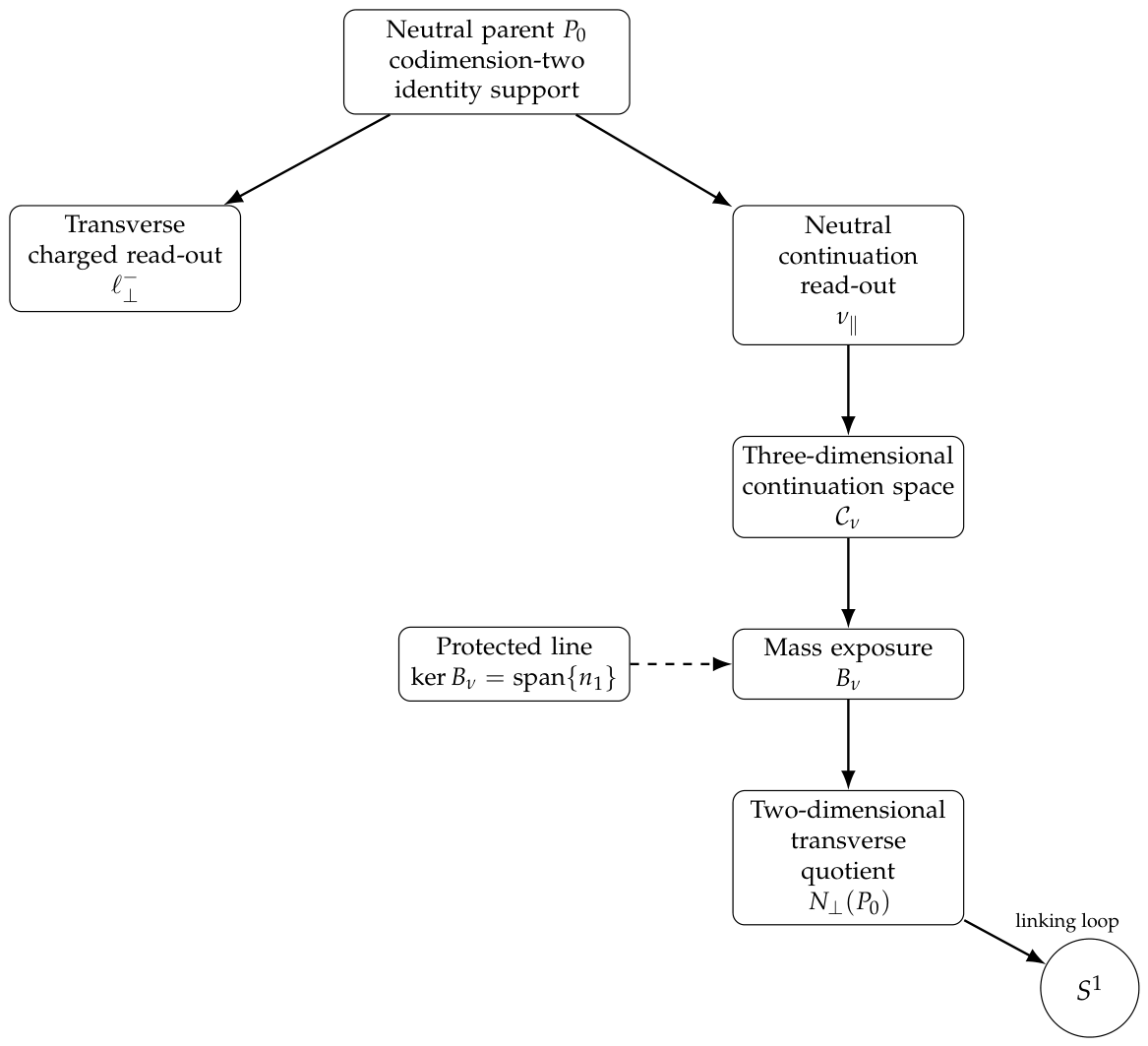
Figure 2.
Geometric schematic of the structural PMNS construction. The leading neutral-compensation frame is the tribimaximal basis , selected by democratic neutral exposure, antisymmetry, and a protected closure direction. A dominant deformation generates the nonzero reactor angle and controls the atmospheric sector, while a smaller relaxation shifts the solar angle away from its tribimaximal value. In exact quadrature , one obtains the leading prediction ; an endpoint-phase relaxation or yields the refined atmospheric estimate .
Figure 2.
Geometric schematic of the structural PMNS construction. The leading neutral-compensation frame is the tribimaximal basis , selected by democratic neutral exposure, antisymmetry, and a protected closure direction. A dominant deformation generates the nonzero reactor angle and controls the atmospheric sector, while a smaller relaxation shifts the solar angle away from its tribimaximal value. In exact quadrature , one obtains the leading prediction ; an endpoint-phase relaxation or yields the refined atmospheric estimate .
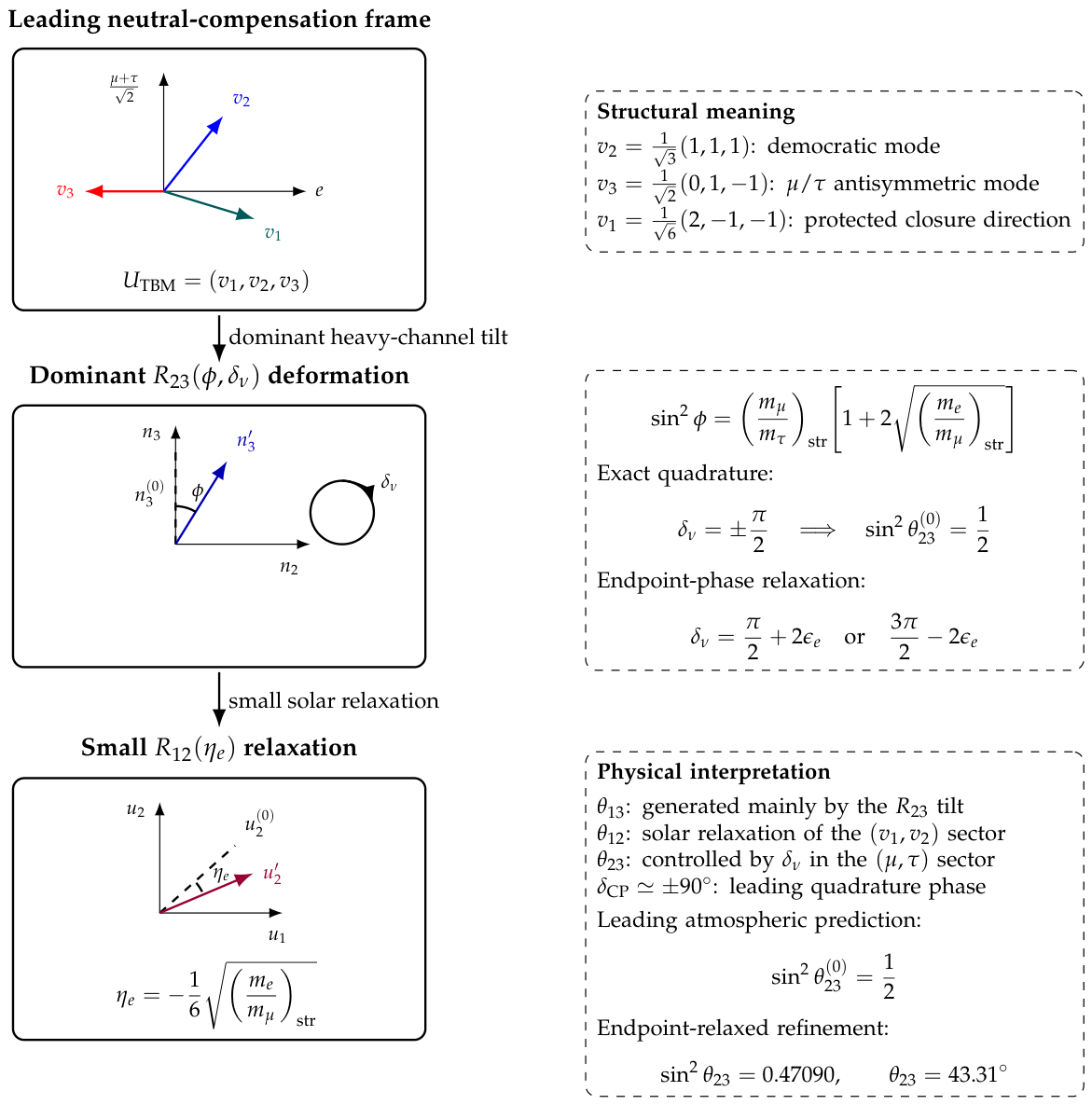
Figure 3.
Minimal connected two-seam comparison complex. Three continuation modes require a connected comparison graph, while transverse saturation supplies two independent seams. Minimality therefore selects the path up to relabeling. Its common mode is annihilated and two independent differences survive. The physical identification must additionally preserve the already selected protected line and the ordered exposed modes.
Figure 3.
Minimal connected two-seam comparison complex. Three continuation modes require a connected comparison graph, while transverse saturation supplies two independent seams. Minimality therefore selects the path up to relabeling. Its common mode is annihilated and two independent differences survive. The physical identification must additionally preserve the already selected protected line and the ordered exposed modes.
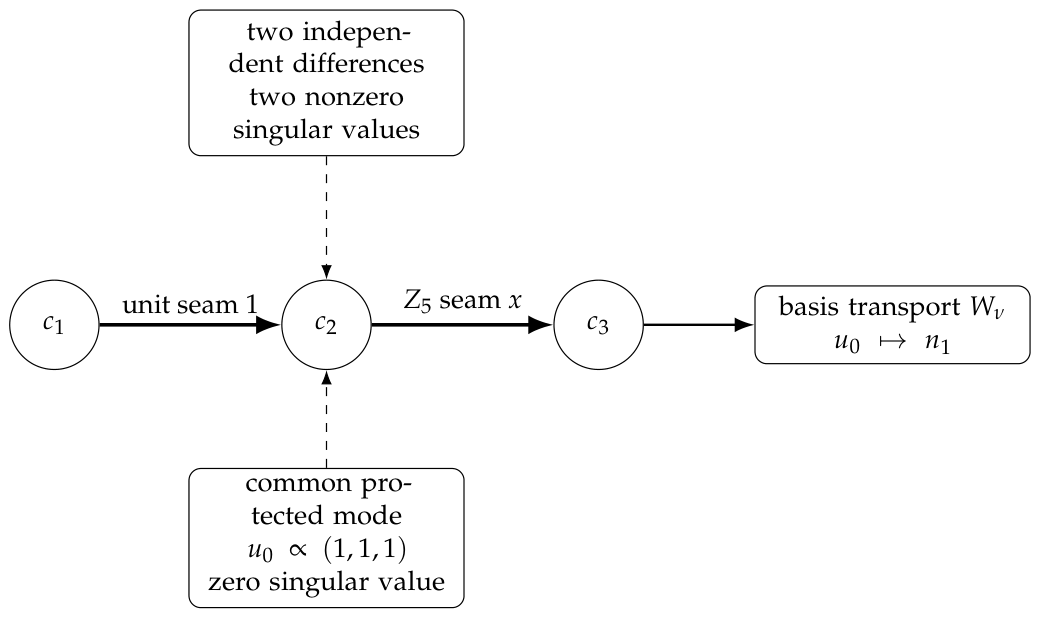
Figure 4.
Dependency graph. The structural zero follows from exact transverse factorization, irreducible saturation, source protection, and faithful descent. The nonzero numerical masses additionally use the overlap-transfer premise and the anchored incidence and unit-normalized endpoint-descent theorems. Exactness of the physical pole zero additionally requires the EFT condition in Equation (121).
Figure 4.
Dependency graph. The structural zero follows from exact transverse factorization, irreducible saturation, source protection, and faithful descent. The nonzero numerical masses additionally use the overlap-transfer premise and the anchored incidence and unit-normalized endpoint-descent theorems. Exactness of the physical pole zero additionally requires the EFT condition in Equation (121).
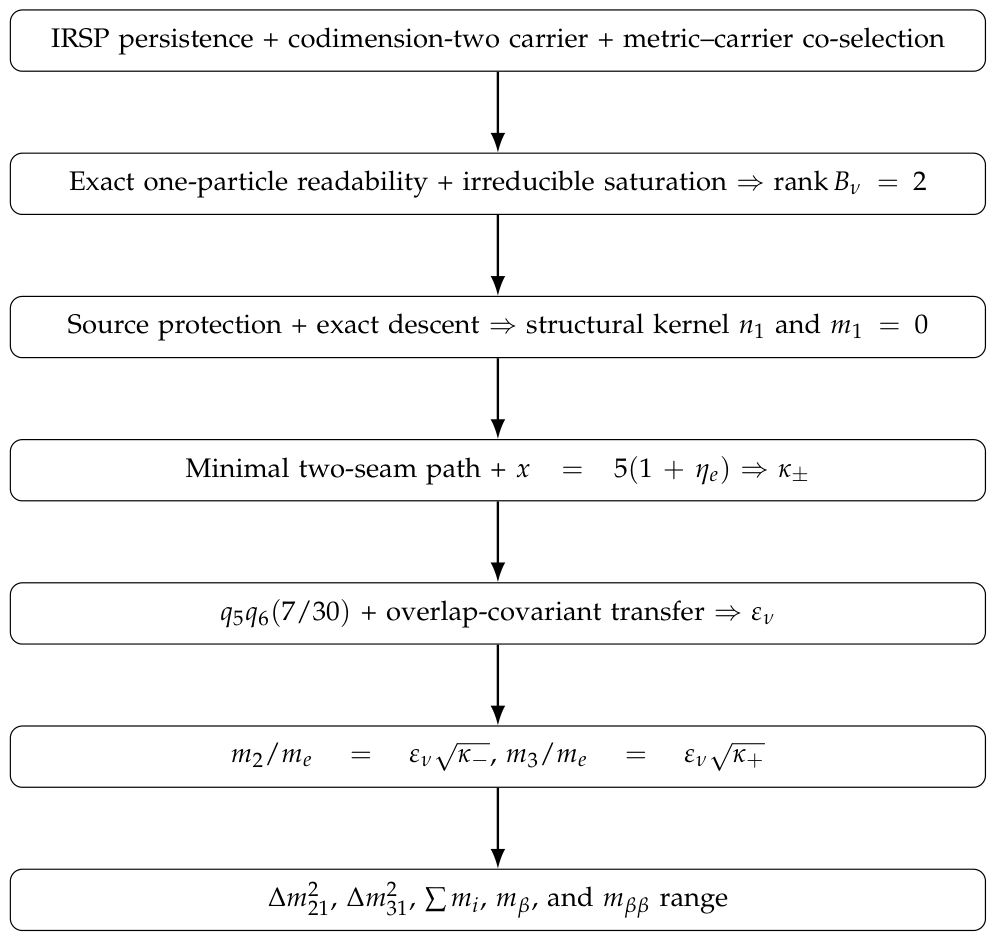
Table 1.
Logical status of the statements used in the unified construction. The table is also a reading guide: later theorem statements cite the precise rows on which they depend.
Table 1.
Logical status of the statements used in the unified construction. The table is also a reading guide: later theorem statements cite the precise rows on which they depend.
| Layer | Statement | Status |
| Established phenomenology | Three-flavor mixing, two independent mass-squared splittings, and standard effective observables. | Empirical and standard theoretical input. |
| Premetric selection | Metric, time, energy, and continuum fields are not primitive variables; inequivalent admissible closure alternatives receive equal primitive weight. | Foundational assumptions of the reconstruction framework. |
| IRSP and saturation | Persistent identities survive indefinite admissible continuation, descend to observable quotients, and use every independent channel required by a complete stable read-out. | Published foundational selection and completeness principles [21], restated precisely for the neutrino construction in Section 3.2. |
| Topological support | Persistent loop-readable reconstruction obstructions are supported on codimension-two subsets and admit local-to-global meridian analysis. | Prior conditional results [18,22]. |
| Frozen cross-sector ledger | The charged-root ratios, , , , and are inherited unchanged from the published charged-lepton calculation. | Previously published outputs, not neutrino-sector fit parameters [20]. |
| PMNS rules | Equal-weight neutral geometry, charged-root continuation tilt, endpoint relaxation, and near-quadrature phase. | A mixture of derived leading geometry and explicitly labelled finite closure hypotheses. |
| Mass bridge premises | Metric–carrier co-selection and exact complex-linear one-particle transverse mass readability. | Model-specific premises connecting the carrier theorem to a positive scalar mass-squared form. |
| Source protection | A closure-essential line is silent under the primitive mass boundary map. | Source-level structural premise; exact read-out preservation, rather than representation alone, transports it to . |
| Exact structural consequences | A two-dimensional mass quotient, saturated rank two, one protected structural zero, and a closed-form two-seam spectrum. | Conditional propositions and theorems derived from the stated premises. |
| Finite seam construction | Overlap-covariant scale transfer, complete aggregation of the anchored orbit, and unit-normalized linear electron-endpoint descent. | The scale transfer remains a declared matching premise; follows after orbit completeness and read-out normalization are fixed. |
| Numerical outputs | PMNS angles, phase branches, , , , splittings, mass sum, , and a Majorana-phase interval. | Reproducible structural predictions; present comparisons are retrospective, future tests prospective. |
| Post-read-out dynamics | A Lorentz- and electroweak-gauge-covariant effective theory must realize the reconstructed spectrum and preserve the protected line against rank-raising corrections. | Required, presently unproved matching condition developed in Section 21; a unique Ward identity or ultraviolet completion is not selected. |
Table 3.
Frozen cross-sector ledger. “Inherited” means that the displayed quantity is taken unchanged from Ref. [20]; “derived here” means an algebraic consequence of inherited ratios; and “new rule” denotes a neutrino-specific structural hypothesis rather than a hidden fit parameter.
Table 3.
Frozen cross-sector ledger. “Inherited” means that the displayed quantity is taken unchanged from Ref. [20]; “derived here” means an algebraic consequence of inherited ratios; and “new rule” denotes a neutrino-specific structural hypothesis rather than a hidden fit parameter.
| Quantity | Fixed value | Role in the charged-lepton paper | Role in this paper |
| Final electron–muon hierarchy | Defines the charged-root displacement | ||
| Large- Koide branch | Gives | ||
| First nested endpoint refinement | First factor in the inherited neutral seam | ||
| Second nested endpoint refinement | Second factor in the inherited neutral seam | ||
| Neutral compensational overlap | Defines the leading closure complement, not the final PMNS solar angle | ||
| Closure-aligned neutral projection | Reference overlap in seam transport | ||
| Neutral correction closing the charged endpoint residue | Frozen neutral scale transferred to the mass read-out |
Table 4.
The three spaces whose dimensions enter the neutrino construction. Only the normal quotient controls the rank of the local mass exposure.
Table 4.
The three spaces whose dimensions enter the neutrino construction. Only the normal quotient controls the rank of the local mass exposure.
| Space | Dimension | Role |
| Selected Weyl fiber | two complex components | Lorentz-spinorial and chirality read-out of one active fermion |
| Normal quotient | two real dimensions, then complexified | independent transverse scalar-mass exposures |
| Continuation/flavor space | three complex dimensions | three active neutral propagation directions |
Table 5.
Audit of numerical and structural inputs used in the unified construction.
| Quantity or information | Used in formulas? | Status in this paper |
| Measured PMNS angles and | No | Comparison only; no measured angle or phase is substituted. |
| Measured and | No | Comparison only; the two splittings are calculated from the predicted spectrum. |
| Direct absolute-neutrino-mass limits | No | Phenomenological tests only. |
| Measured electron mass | Yes | Dimensional calibration from predicted ratios to eV; it does not affect dimensionless ratios or mixing angles. |
| Structural and | Yes | Algebraic read-outs of the published charged-lepton ratios in Table 3. |
| , , , , and | Yes | Frozen quantities inherited unchanged from the published charged-lepton calculation. |
| IRSP, irreducible saturation, and metric–carrier co-selection | Yes | Foundational premises used to select the two-dimensional saturated exposure. |
| Exact transverse readability, source protection, and faithful descent | Yes | Model-specific premises and kernel-preservation theorem used to obtain the unique structural zero. |
| Overlap transfer | Yes | Declared neutrino-sector scale-matching premise still requiring derivation from a complete read-out functor. |
| Yes | Consequence of complete anchored-orbit aggregation, real incidence coherence, and unit-normalized linear endpoint descent proved in Theorems 3 and 4. | |
| NuFIT global-fit values | No | Post-calculation comparison set only. |
Table 6.
Ablation checks. Masses are in meV. “Pair off” removes the orientation-even corrections from both the reactor tilt and quadrature relaxation; all other rows change only the item named.
Table 6.
Ablation checks. Masses are in meV. “Pair off” removes the orientation-even corrections from both the reactor tilt and quadrature relaxation; all other rows change only the item named.
| Case | |||||
| Full frozen construction | 0.022577 | 0.307190 | 0.470898 | 8.686 | 50.092 |
| No inherited seam, | 0.022577 | 0.307190 | 0.470898 | 0 | 0 |
| No solar relaxation, | 0.022577 | 0.317935 | 0.470898 | 8.773 | 51.172 |
| Conjugate endpoint pair off | 0.019820 | 0.309090 | 0.500000 | 8.710 | 50.230 |
| Unweighted path, | 0.022577 | 0.307190 | 0.470898 | 15.850 | 27.452 |
Table 7.
Unified PMNS and mass-spectrum predictions compared with representative NuFIT 6.1 normal-ordering values.
Table 7.
Unified PMNS and mass-spectrum predictions compared with representative NuFIT 6.1 normal-ordering values.
| Quantity | Structural prediction | NuFIT 6.1 comparison | Comment |
| approximately above the best fit | |||
| approximately below the best fit | |||
| endpoint-relaxed lower-octant branch near the best fit | |||
| representative best fit near | NuFIT likelihood remains broad and non-Gaussian | ||
| approximately | |||
| approximately |
Table 8.
Absolute-mass predictions and their logical status.
| Observable | Prediction | Interpretation |
| 0 structurally | Exact protected kernel in the reconstruction class; exact pole zero requires protection-compatible EFT matching. | |
| meV | Target lower pole mass under the same field-theory matching. | |
| meV | Target upper pole mass under the same field-theory matching. | |
| meV | Prospective absolute-spectrum test. | |
| meV | Direct beta-decay kinematic target. | |
| – meV | Conditional on Majorana neutrinos and unknown phase. |
Disclaimer/Publisher’s Note: The statements, opinions and data contained in all publications are solely those of the individual author(s) and contributor(s) and not of MDPI and/or the editor(s). MDPI and/or the editor(s) disclaim responsibility for any injury to people or property resulting from any ideas, methods, instructions or products referred to in the content. |
© 2026 by the authors. Licensee MDPI, Basel, Switzerland. This article is an open access article distributed under the terms and conditions of the Creative Commons Attribution (CC BY) license (http://creativecommons.org/licenses/by/4.0/).
Copyright: This open access article is published under a Creative Commons CC BY 4.0 license, which permit the free download, distribution, and reuse, provided that the author and preprint are cited in any reuse.