

Submitted:
01 August 2026
Posted:
06 August 2026
You are already at the latest version
Abstract
Behavioral control requires translation between different representations. Drives translate physiological state into motivational intensity. Values translate competing drives and context into an ordered ranking. Goals translate current values into temporally extended plans. Each translation is a protocol that transforms the representation of one domain into the representation of another domain. I argue that drives, values, and goals form a protocol stack of the kind found in many robust layered systems in engineering and biology. Each protocol occurs at a translation interface between domains. At the interface, heterogeneous upstream inputs compress into compact signals that downstream systems use to guide action. Interfaces tend to be evolutionarily conserved because change breaks communication between the two sides. Fragility concentrates at the interface. The framework predicts a gradient of model-dependence in the architecture of translation interfaces. Drives translate physiology into motivation through concentrated, identifiable interface circuits. Values combine concentrated components for direct translations and distributed components for model-based predictions. Goals primarily output model-based plans about extended futures, implemented in distributed circuits. Many observations match the framework’s combination of translation, compression, conservation, and fragility.
Keywords:
evolutionary conservation
; fragility
; dimensional reduction
; neurobiology
; developmental hourglass
; protocol stack
; robust complex systems
Introduction
Three steps organize behavioral control. Physiological state generates motivational drives. Competing drives and context integrate into value rankings. Current values and future targets produce goals extended across time. This triad of drives, values, and goals has been widely discussed.
Homeostatic theories of motivation identified the drive layer (Hull, 1943; Keramati & Gutkin, 2014). Neuroeconomics developed the value layer as a common currency for comparing incommensurable options (Levy & Glimcher, 2012; Padoa-Schioppa, 2011). Executive function and prefrontal systems neuroscience developed the goal layer as the maintenance of temporally extended commitments (Miller & Cohen, 2001). This three-step structure recurs across vertebrates. In the goal layer of birds and mammals, independently evolved pallial structures support comparable executive functions (Güntürkün, 2005).
Each layer has been analyzed deeply within its own tradition. But why behavior organizes into these three steps has received less attention. The recurring architecture calls for an explanation beyond the properties of each layer taken separately.
This article proposes that necessary translations between different representational domains of behavior shape the overall control architecture. Specifically, drives translate physiological state into motivational intensity for action. Values translate incommensurable drives into rankings for action choice. Goals translate current values into temporally extended plans.
Each translation bridges representations that cannot directly communicate. Physiological state differs from motivation. Motivation differs from ranked choice. Current ranking differs from temporally extended commitment. The triad traces three necessary translations.
This translation framework gains support from its common form with many complex hierarchical control systems. In behavior, translations happen at interfaces between domains in the same way that protocol interfaces organize many robust layered systems in engineering and biology (Csete & Doyle, 2002; Doyle et al., 2005; Frank, 2023, 2026; Matni et al., 2024). At each interface, heterogeneous upstream inputs compress into compact signals that downstream systems can act on. A sequence of such translations forms a protocol stack. Drives, values, and goals form a protocol stack of domain translations (Figure 1).
Compression occurs wherever high-dimensional input narrows to a lower-dimensional code, which happens throughout neural and physiological systems. Translation occurs only where it is necessary to bridge two representational domains whose sides cannot directly communicate.
Here, the causal flow from the need for translation to the need for compression constrains behavioral architecture in two specific ways. Evolutionary conservation localizes to the interface change breaks the agreed protocol. Fragility concentrates at the interface because failed translation breaks behavioral control.
The domain translation sequence follows a gradient of increasing model dependence. Drives are mostly a direct mapping of physiological state to motivational level. Values depend more on internal models that predict the outcomes needed to translate motivations and context to rankings. Goals produce mostly model-based plans derived from current value rankings and state inputs.
The increasing model dependence from drives to values to goals explains the observed tendency of interfaces to grade from concentrated identifiable circuits to distributed diffuse circuits. Domain translation plus the model-based gradient together form the framework’s two explanatory foundations.
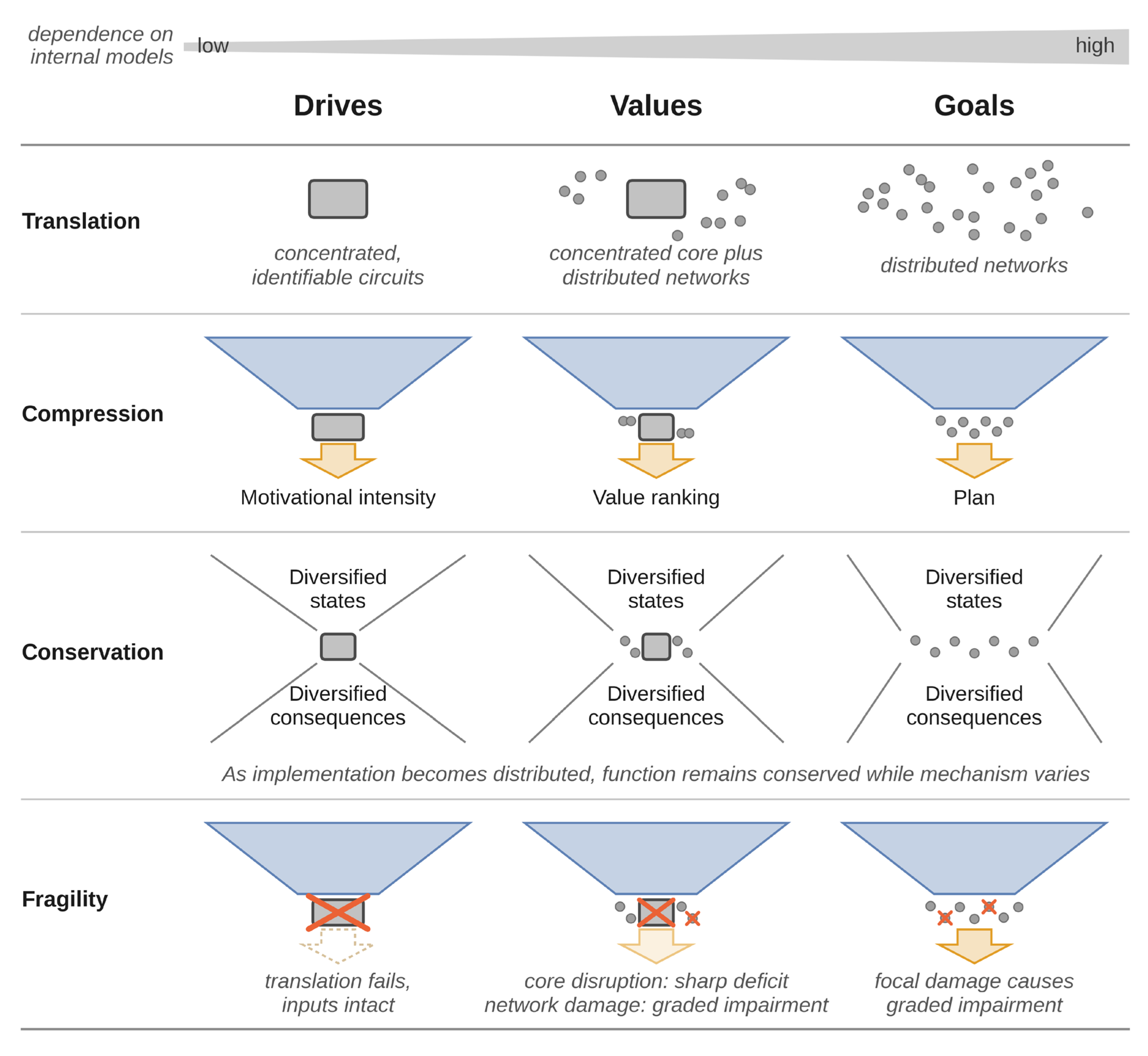
Each following section covers one layer through the four properties of translation, compression, conservation, and fragility. The sequence shows how these properties change with the layer’s position on the model-dependence gradient (Figure 2).
Drives
The drive translator converts physiological state into motivational intensity. In vertebrates, hypothalamic and brainstem circuits read metabolic, osmotic, hormonal, and visceral signals and write compact outputs that downstream systems treat as need signals. Hunger, thirst, thermal discomfort, and sexual motivation each follow the pattern, with different upstream states, compressed interface signals, and downstream behaviors (Sternson, 2013; Tan & Knight, 2018).
Architecturally, drives sit at the concrete-content end of the model-dependence gradient, with relatively little model-based content compared with values and goals. Drive inputs are directly measurable physiological signals, such as glucose, osmolality, hormone levels, and visceral feedback. Their outputs are motivational signals that downstream behavior reads as need.
The four interface properties take their sharpest form for drives. Translation between domains concentrates in identifiable circuits. Compression strongly reduces inputs to low-dimensional motivational signals. Conservation preserves homology across long evolutionary distances. Fragility appears as sharply circumscribed deficits when the interface is disrupted.
Translation
An interface bridges different representations that cannot directly communicate. For example, osmotic state is a thermodynamic property of body fluids, and thirst is a neural signal that downstream behavioral circuits interpret as need for water. The downstream action circuits cannot directly read the thermodynamics of fluids.
The lamina terminalis circuitry performs this translation. The subfornical organ, the organum vasculosum of the lamina terminalis, and the median preoptic nucleus read osmolality, sodium concentration, and blood volume through specialized sensors and write activity signals that downstream circuits treat as thirst (Allen et al., 2017; Oka et al., 2015).
The same logic applies to hunger. The AgRP/NPY and POMC/CART neurons of the arcuate hypothalamus read nutrient and adiposity signals and write motivational outputs read by downstream feeding circuits (Aponte et al., 2011; Cowley et al., 2001; Luquet et al., 2005).
Compression
An interface compresses heterogeneous high-dimensional inputs into a lower-dimensional signal that drives downstream behavior. Thirst integrates plasma osmolality, sodium concentration, blood volume, and oral-gut feedback into signals that stimulate or suppress drinking (Grove & Knight, 2024). Hunger integrates leptin, insulin, ghrelin, glucose, nutrient-related visceral feedback, and longer-term adiposity into signals that stimulate or suppress feeding (Morton et al., 2006).
In each case, the interface compresses the heterogeneous combination of upstream inputs into a small set of motivational channels. Separate channels may correspond to different aspects of need (Pool et al., 2020). For example, downstream systems may act differently in response to osmotic versus volume deficits.
The interface can also integrate predictive aspects of future physiological state. For example, the AgRP neurons that signal hunger are inhibited by food-predictive sensory cues before any nutrient has reached the bloodstream (Chen et al., 2015). Subfornical organ thirst neurons are updated by oral signals during drinking before blood chemistry normalizes (Zimmerman et al., 2016).
The interface integrates current and near-future need, with multiple input streams converging on a compact motivational signal. Here, the interface uses the limited model-based predictions required for simple translations.
Downstream circuits respond to the interface signal without direct access to the upstream inputs. Experimental activation of the interface drives downstream behavior even when the normal upstream triggers are absent. Optogenetic activation of AgRP neurons induces feeding in sated mice (Aponte et al., 2011). Activation of excitatory subfornical organ neurons drives drinking in hydrated animals (Oka et al., 2015). The interface signal by itself drives downstream action.
Evolutionary Conservation
An interface is evolutionarily conserved relative to its inputs and outputs. A change in the interface breaks communication unless both sides change simultaneously. That kind of simultaneous change is difficult to achieve in evolution. Thus, a working interface is often conserved over relatively long evolutionary periods.
The hypothalamic appetite system, including AgRP and POMC circuits, is broadly conserved from teleost fish through mammals, although details such as anatomical location and endocrine coupling vary (Cerdá-Reverter et al., 2003; Song et al., 2003). Angiotensin-sensitive thirst mechanisms are broadly conserved across tetrapods, with forebrain circumventricular organs central in mammals and birds (Fitzsimons, 1998; Katayama et al., 2018; Kobayashi et al., 1979; McKinley & Johnson, 2004).
Upstream sensors and downstream effectors diversify more than the interface. On the output side, feeding ecology varies widely across species. On the input side, the peripheral machinery that delivers nutrient signals to the interface varies with feeding behavior. Closer to the interface, change can occur but at a slower pace than the distant upstream and downstream peripheries.
The conservation claim is primarily about function and position, with some potential drift in specific neurons and molecules. The interface occupies the same architectural and functional location between body state and motivational signal across vertebrates, with the same kind of translation occurring in mostly homologous circuits. Individual components can drift. For example, gene duplication in teleosts created AgRP and POMC paralogs. Some paralogs retain the canonical hunger-signaling role, while others have taken on different jobs in different cell populations (de Souza et al., 2005; Shainer et al., 2019).
This pattern of central conservation and peripheral diversification matches the widely observed developmental hourglass (Duboule, 1994; Irie & Kuratani, 2014), in which conserved mid-development translators connect diversifying early and late processes (Frank, 2026). The shared evolutionary pattern between drives and development suggests that domain translation generates the same architectural signatures across systems.
Fragility
An interface concentrates fragility. Disruption of the interface produces a characteristic failure pattern in which upstream state may remain, downstream machinery still functions when properly triggered, but the normal coupling between domains is lost. Dehydration no longer becomes thirst. Energy deficit no longer becomes hunger, even though physiological inputs and downstream action systems remain available.
Lesions or targeted inhibition of lamina terminalis thirst circuits blunt osmotically induced drinking and can dissociate dehydration sensing from drinking behavior (Augustine et al., 2018; Cunningham et al., 1992; McKinley et al., 1999). Adipsic hypernatremia in humans shows a related pattern (Hiyama et al., 2010). Drinking remains behaviorally available, but dehydration no longer reliably generates thirst.
Classic adult AgRP-ablation paradigms can produce failure to eat and starvation despite intact gut, sensory systems, and preserved motor capacity (Luquet et al., 2005). On the satiety side, loss of POMC function produces hyperphagia and obesity (Krude et al., 1998).
Values
Value interfaces typically combine concentrated and distributed circuits. Like drives, some aspects of valuation operate directly on measurable signals that are translated through well-defined and concentrated pathways. The midbrain dopamine system is an example. Other aspects of valuation depend on model-based predictions that are implemented in distributed circuits. The mixture of concentrated and distributed processing puts values between the simpler direct translators for drives and the more complex and distributed model-dominated circuits for goals.
Translation
The value translator converts competing drives into a ranked set. On the input side, drives quantify individual needs, each need on its own incommensurable scale. Fluid imbalance and threat avoidance measure different things. The value translator orders incommensurable drives into a comparable ranking that resolves choice for action.
The input includes context beyond the basic drive signals. The value of hunger depends on physiological need and also on what food is available, the cost of obtaining it, and the predicted outcome of attempted feeding. The value of fear depends on perceived danger and also on the available escape routes and their predicted likelihood of success. The translation requires that drives and context on the upstream side become rankings on the downstream side.
Compression
A value interface compresses many inputs into a low dimensional ranking. Drives, context, predicted reward, delay, and required effort reduce to the output ranking. Each input contributes but typically does not pass through to the downstream decision and action circuits without compression.
Value interfaces typically combine concentrated and distributed components. Concentration occurs through the midbrain dopamine circuit, in which prediction errors provide a low-dimensional teaching signal measurable in identifiable cell populations (Bayer & Glimcher, 2005; Schultz, 1998). Basal ganglia concentrate core action selection across vertebrates through identifiable circuit structure (Grillner & Robertson, 2016; Stephenson-Jones et al., 2011). Both involve compact signals carried by identifiable neurons derived from heterogeneous inputs.
Distributed networks occur through cortical components. Orbitofrontal and ventromedial prefrontal cortex contain neural populations that carry collective value-related information (Chib et al., 2009; Levy & Glimcher, 2012; Padoa-Schioppa, 2011; Padoa-Schioppa & Assad, 2006). These neural population interfaces compress inputs to lower dimensional signals (Pastor-Bernier et al., 2019). Compression happens through network computation rather than through specialized bottleneck cells.
The framework requires only that drives and context become rankings. The particular form of the rankings is a matter of implementation. Questions about the form of rankings are interesting (Hayden & Niv, 2021) but do not affect this article’s predictions about the broad architecture of behavioral control.
Here, the important aspects concern the degree of input compression and the pathways of flow from the inputs to the ranked outputs. With regard to flow, the identity of the options in the rankings may flow through parallel channels rather than directly through the value translation itself.
Primate orbitofrontal cortex illustrates this separation of information flow through neuronal populations that encode chosen value and transmit chosen identity (Padoa-Schioppa, 2011). The value translation produces the rankings that downstream selection uses. The identities associated with values pass through separate cortical and subcortical pathways that can be read by motor systems. Both ranking and identity are needed, but only the ranking is the product of compression and translation.
The value interface sits above drives in the protocol stack and reads from them. But the drives do not necessarily disappear from the flow of information. For example, water-predictive cues evoke phasic dopamine responses whose magnitude depends on thirst state, showing that motivational context directly shapes valuation (Hsu et al., 2020).
Evolutionary Conservation
The degree of model-dependence in translation increases from drives to values to goals. Greater model-dependence alters the predicted pattern of evolutionary conservation.
For drives, translation maps directly measurable body state and environment to a motivational signal that can be read by clearly defined downstream action targets. The limited role of internal models in translation suggests that the translator can typically be implemented by a specialized and identifiable circuit with a tendency for deeply conserved cells and projections. Osmolality and thirst in one species mean the same thing in another species.
For values, translations depend more on model-based interpretations, such as predicted outcomes, action consequences, and opportunity costs. These model-based aspects are more likely to vary between species than primitive drives such as thirst. Thus, value interfaces are likely to have a mixture of concentrated, conserved circuits that do similar things between species and distributed, evolving circuits that do different things between species.
The conservation prediction takes three forms. Concentrated interface components with relatively concrete content should show homologous conservation within clades. Distributed interface components should show partial conservation of function with variation in implementation. Across distant clades, similar functions may be realized by convergent rather than homologous structures.
Within mammals, the concentrated subcortical components of the value interface are deeply conserved. Basal ganglia pathways carry homologous organization across mammalian lineages from rodents through primates (Grillner & Robertson, 2016; Stephenson-Jones et al., 2011). The midbrain dopamine system shows broadly similar conservation, with the specific reward-prediction-error interpretation best established in mammals. These components operate on relatively concrete content. Consequently, they specialize into identifiable circuits that can be conserved.
The distributed side of the mammalian valuation interface shows a different signature. Components of higher cortical processing handle interpretations of flexible cross-good valuation, and these model-based circuits show partial rather than uniform conservation. Orbitofrontal and ventromedial prefrontal cortex implement valuation through partially overlapping but not identical circuits across mammalian species (Heilbronner et al., 2016). Exact parcellations vary across taxa even where the function is preserved.
Within birds, comparable valuation functions sit in the nidopallium caudolaterale, including reward, effort, and prediction-related signals (Dykes et al., 2018; Dykes et al., 2019). The nidopallium caudolaterale shows conservation across avian lineages.
Birds and mammals inherit the pallium from a common ancestor, but the avian nidopallium caudolaterale and mammalian prefrontal cortex are not homologous as structures (Güntürkün, 2005; Gunturkun et al., 2021). The distributed component of flexible valuation is therefore realized through independently evolved structures in the two clades, a convergent realization rather than conservation of a homologous structure.
Fragility
The framework predicts that fragility concentrates at translation interfaces. Disruption of a concentrated interface produces a sharp failure. Disruption of a distributed model-based interface produces a graded failure. For values, fragility takes both forms because the value interface combines concentrated and distributed components.
Perturbation to concentrated subcortical components produces clear directional shifts in valuation. Dopamine antagonism reduces willingness to expend effort for reward; dopamine replacement in Parkinson’s disease can restore it (Chong et al., 2015; Salamone & Correa, 2012). The deficit perturbs translation of a drive’s costs and benefits to its value ranking. The motor system can execute the action, but the existing preference for the high-effort option is no longer assigned the appropriate rank.
Damage to the distributed model-based components of the value interface disrupts choice updating but preserves simpler computations. Orbitofrontal damage impairs choice but leaves stimulus-response habits intact (Murray & Rudebeck, 2018). Ventromedial prefrontal lesions in humans produce a similar pattern of impaired valuation and preserved routine (Camille et al., 2011; Reber et al., 2017). The individual can still recognize options, execute responses, and consume rewards. What fails is updating choice when the benefits of alternatives change, for example, inappropriately continued preference for food after it has been devalued by satiety.
For drives, failures are sharply circumscribed because the translator is implemented in concentrated cell populations whose loss removes the function. For values, failures show similar sharp signatures where the disruption occurs at concentrated components, such as the dopamine system. But for distributed model-based components of the interface, failures tend to be graded shifts in performance rather than sharp failures. The pattern matches the framework’s prediction that fragility happens at translator interfaces, with failures taking different forms depending on implementation.
Goals
Domain translation follows a continuum. For drives, body state translates directly into motivational intensity, typically through a concentrated interface circuit. Values mix direct translation at concentrated interfaces with model-based translations.
This section turns to goals, the ultimate emphasis on distributed model-based circuits. Goals translate current valuations and broad context into temporally extended plans. Future planning depends on models, as has been widely recognized. The new aspect here is placing model-based goals into a continuum framework of domain translation for drives, values, goals, and their relations in behavioral control.
For goals, compression occurs through distributed networks. Conservation happens within clades, and broad functional convergence occurs between clades such as mammals and birds. Fragility appears as graded disruption of temporal coherence rather than as sharply circumscribed deficits.
Translation
Goals translate current values and context into temporally extended plans. Current values rank options now. Plans hold commitments across time. The two are different representational kinds, and the translation between them is the third domain translation in the protocol stack.
Forward-looking goals may favor current actions that contradict instantaneous values. A plan selects current action based on instantaneous values and the predicted state of the world during execution, the potential alternative states over the planning horizon, and the cost of maintaining commitment under those potential alternatives. These planning aspects require estimates that depend on the system’s internal model of its environment and its potential action repertoire.
The way the system calculates its temporal sequence of behaviors is a problem of implementation rather than translation. The domain translation framework focuses on the fact that goals translate current values and context into temporally extended plans. That translation sets important constraints on system architecture that explain the overall structure of behavioral control. How action sequences in plans are actually calculated is a separate issue.
Compression
Goals compress current values and broad high-dimensional context into compact plans. Downstream action systems interpret the compressed plan signals created by the goals interface. The plan provides a low-dimensional representation of what the system will do over time.
Compression typically happens through distributed networks. Mammalian goal representations spread across prefrontal cortex and recurrent loops with mediodorsal thalamus. Behavioral rules emerge from the dynamics of neural populations rather than from individual neurons that carry the full plan (Bolkan et al., 2017; Schmitt et al., 2017). Avian goal representations distribute across the nidopallium caudolaterale through similar population dynamics (Veit & Nieder, 2013).
Goal translators compress planning content (Lai & Gershman, 2024). Execution runs in parallel or downstream circuits, including many parietal, basal ganglia, cerebellar, and motor circuits that interact with prefrontal goal circuits.
Drives and values directly influence actions and also feed into goals. The goal layer transforms the prior layers’ signals without necessarily ending their independent influence.
Goals sometimes dominate by screening off the lower layers for behaviors, such as extended foraging that overrides immediate alternatives or deferred-reward tasks where the goal must be held against contrary current value. By contrast, the lower layers may directly influence actions without engaging the goal interface for behaviors such as reflexive responses to threat or stimulus-response habits in stable environments.
Evolutionary Conservation
The heavy model-dependence of goals causes the translation interface to be relatively more distributed than for drives and values. The function of the interface remains conserved but the circuit implementation varies more within clades because models are more integrative and species specific. Across distantly related clades, the same architectural role is realized through independently evolved structures.
In mammals, goal architecture is evolutionarily conserved in prefrontal cortex and its reciprocal loops with mediodorsal thalamus. The reciprocal prefrontal-thalamic connectivity supports working memory, rule maintenance, and flexible action selection (Bolkan et al., 2017; Schmitt et al., 2017).
The specific cortical subregions that make up these goal circuits vary across species. Much of primate prefrontal cortex has no clear homolog in other mammals (Wise, 2008), and frontal-striatal connectivity differs in important ways between rodents and primates while subcortical value circuits are more conserved (Heilbronner et al., 2016).
The within-mammal variation in goal circuit details matches the fact that different mammalian species inhabit different ecological niches and develop different internal models of their environments. Thus, model-based goal translation varies across species in its particular details.
Birds have evolutionarily conserved goal architecture in the nidopallium caudolaterale, with multimodal connectivity supporting working memory, rule use, and flexible choice (Güntürkün, 2005; Veit & Nieder, 2013). The nidopallium caudolaterale shows conservation across avian lineages in supporting goal-level functions, with variation in circuit details across species (von Eugen et al., 2020). Pigeon and chicken organization differs substantially from the more elaborated multi-subarea organization seen in songbirds and corvids, paralleling the within-mammal pattern of conserved function with species-specific implementation.
As with values, the avian and mammalian executive structures evolved independently (Güntürkün, 2005). That convergence supports the framework’s argument that a complex goal translation layer naturally sits above drives and values when behavior advances to extended planning. Once a goal-planning architecture evolves within a clade, its broad organization tends to remain conserved even as circuit details vary.
Fragility
The strongest evidence that goals function as a translator comes from disruption of goal circuits. Patients with dorsolateral and anterior prefrontal damage show impaired plan formation. They can describe end-states, recognize situations, execute action components, or hold rules when given them, but cannot construct a sequence of actions that gets from current state to goal (Carlin et al., 2000; Goel & Grafman, 1995; Shallice, 1982; Shallice & Burgess, 1991). The failure is at the conversion of current values and context into temporally extended commitment.
The framework predicts graded rather than sharply circumscribed fragility because focal damage to a distributed model-based interface degrades the translation function rather than removing it. In the cases above with dorsolateral and anterior prefrontal lesions, severity is graded across patients and across the extent of damage. Gradations arise in laboratory tasks requiring multi-step problem-solving, in clinical descriptions of frontal-lobe lesion patients, and in progressive frontal degenerative disorders such as frontotemporal dementia.
Overall, the fragilities across drives, values, and goals follow the translation implementation gradient. Drive failures produce sharply circumscribed phenotypes such as adipsia and aphagia because the translator is concentrated in identifiable cell populations. Value failures show sharp signatures where the disruption hits concentrated components and graded shifts with the extent of disruption to distributed components. Goal failures show graded plan-formation deficits that scale with the extent of distributed damage. The framework explains this gradient as a consequence of the implementation form that follows from the relative model-dependence of each translation.
Discussion
The framework derives from two foundations. First, the need to translate between different representations determines the triadic layers of drives, values, and goals. Second, the increasing need for model-based translations across the different layers creates an explanatory gradient for the architecture of the translation interfaces.
No other theory accounts for the specific triadic translations in representation and the gradient from concentrated to distributed interfaces that match the degree of model-based transformations.
Drives show sharply defined interface circuits because the translation from body state to motivation operates on directly measurable attributes that can localize into concentrated cell populations. Values show mixed interface architectures because their translation combines concrete components with model-based components. Goals show diffuse circuits because their translation operates primarily through model-based transformations that are encoded through distributed networks.
In addition to predicting particular domain translations and interface architectures, the framework emphasizes three common attributes for each layer.
Compression occurs because translation typically reduces multiple inputs into low dimensional signals that can be read by output circuits that operate in the new domain. Here, compression is a consequence of domain translation, and occurs specifically at those control points that need translation.
Evolutionary conservation localizes to the translation interface because disrupted signals break the link between domains. Simultaneous coordinated evolutionary changes between signal writing on the input side and signal reading on the output require special conditions. By contrast, evolutionary divergence among inputs happens readily because changing environmental demands favor altered sensory and physiological inputs. Similarly, evolutionary divergence among outputs arises to match behavior to ecological niche.
Fragility concentrates at domain translation interfaces because broken signaling prevents the necessary flow of behavioral control. Concentrated interfaces break sharply, whereas distributed interfaces fail in a more graded manner.
The framework connects behavioral control to a broader architectural pattern in biology and engineering. In embryogenesis, domain translation explains the observed patterns of compression, conservation, and fragility (Frank, 2026). In engineering, layered protocols of control systems define fragile points of domain translation, for example, the TCP/IP internet protocol (Doyle et al., 2005). Convergence of independent control systems on the same architectural pattern suggests that the domain translation logic has real explanatory power. Behavioral control is one instance of a general architectural principle.
The domain translation framework for behavior focuses on broad control architecture and evolutionary patterns. It operates at a different level of analysis from accounts of how individual layers compute, how prediction and motivation integrate, or how action selection unfolds. Those accounts are generally compatible with the domain translation framework because the explanations at the different analytical levels do not interfere with each other.
In summary, the framework identifies drives, values, and goals as necessary domain translations. The signatures of compression, conservation, and fragility follow. The increasing model-dependence for translation along the triad explains the gradient from sharply defined interfaces to diffusely distributed circuits.
The same domain translation logic unifies understanding of development and engineered control systems. Behavioral architecture fits within the general theory for the design of robust complex control.
Acknowledgments
The Donald Bren Foundation and US National Science Foundation grant DEB-2325755 support my research.
Data and code availability
This work generated no new data or code.
Generative AI
The author used Claude, ChatGPT and Elicit (https://elicit.com) to search the literature for references, check the accuracy of particular statements, and suggest alternative phrasing for particular sentences. All content was critically reviewed and edited by the author. The author take full responsibility for the content.
References
- Allen, W. E.; DeNardo, L. A.; Chen, M. Z.; Liu, C. D.; Loh, K. M.; Fenno, L. E.; Ramakrishnan, C.; Deisseroth, K.; Luo, L. Thirst-associated preoptic neurons encode an aversive motivational drive. Science 2017, 357(6356), 1149–1155. [Google Scholar] [CrossRef] [PubMed]
- Aponte, Y.; Atasoy, D.; Sternson, S. M. AGRP neurons are sufficient to orchestrate feeding behavior rapidly and without training. Nature Neuroscience 2011, 14(3), 351–355. [Google Scholar] [CrossRef] [PubMed]
- Augustine, V.; Gokce, S. K.; Lee, S.; Wang, B.; Davidson, T. J.; Reimann, F.; Gribble, F.; Deisseroth, K.; Lois, C.; Oka, Y. Hierarchical neural architecture underlying thirst regulation. Nature 2018, 555(7695), 204–209. [Google Scholar] [CrossRef] [PubMed]
- Bayer, H. M.; Glimcher, P. W. Midbrain dopamine neurons encode a quantitative reward prediction error signal. Neuron 2005, 47(1), 129–141. [Google Scholar] [CrossRef] [PubMed]
- Bolkan, S. S.; Stujenske, J. M.; Parnaudeau, S.; Spellman, T. J.; Rauffenbart, C.; Abbas, A. I.; Harris, A. Z.; Gordon, J. A.; Kellendonk, C. Thalamic projections sustain prefrontal activity during working memory maintenance. Nature Neuroscience 2017, 20(7), 987–996. [Google Scholar] [CrossRef] [PubMed]
- Camille, N.; Griffiths, C. A.; Vo, K.; Fellows, L. K.; Kable, J. W. Ventromedial frontal lobe damage disrupts value maximization in humans. Journal of Neuroscience 2011, 31(20), 7527–7532. [Google Scholar] [CrossRef] [PubMed]
- Carlin, D.; Bonerba, J.; Phipps, M.; Alexander, G.; Shapiro, M.; Grafman, J. Planning impairments in frontal lobe dementia and frontal lobe lesion patients. Neuropsychologia 2000, 38(5), 655–665. [Google Scholar] [CrossRef] [PubMed]
- Cerdá-Reverter, J. M.; Ringholm, A.; Schiöth, H. B.; Peter, R. E. Molecular cloning, pharmacological characterization, and brain mapping of the melanocortin 4 receptor in the goldfish: involvement in the control of food intake. Endocrinology 2003, 144(6), 2336–2349. [Google Scholar] [CrossRef] [PubMed]
- Chen, Y.; Lin, Y. C.; Kuo, T. W.; Knight, Z. A. Sensory detection of food rapidly modulates arcuate feeding circuits. Cell 2015, 160(5), 829–841. [Google Scholar] [CrossRef] [PubMed]
- Chib, V. S.; Rangel, A.; Shimojo, S.; O’Doherty, J. P. Evidence for a common representation of decision values for dissimilar goods in human ventromedial prefrontal cortex. Journal of Neuroscience 2009, 29(39), 12315–12320. [Google Scholar] [CrossRef] [PubMed]
- Chong, T. T. J.; Bonnelle, V.; Manohar, S.; Veromann, K. R.; Muhammed, K.; Tofaris, G. K.; Hu, M.; Husain, M. Dopamine enhances willingness to exert effort for reward in Parkinson’s disease. Cortex 2015, 69, 40–46. [Google Scholar] [CrossRef] [PubMed]
- Cowley, M. A.; Smart, J. L.; Rubinstein, M.; Cerdán, M. G.; Diano, S.; Horvath, T. L.; Cone, R. D.; Low, M. J. Leptin activates anorexigenic POMC neurons through a neural network in the arcuate nucleus. Nature 2001, 411(6836), 480–484. [Google Scholar] [CrossRef] [PubMed]
- Csete, M. E.; Doyle, J. C. Reverse engineering of biological complexity. Science 2002, 295(5560), 1664–1669. [Google Scholar] [CrossRef] [PubMed]
- Cunningham, J. T.; Beltz, T.; Johnson, R. F.; Johnson, A. K. The effects of ibotenate lesions of the median preoptic nucleus on experimentally-induced and circadian drinking behavior in rats. Brain Research 1992, 580(1-2), 325–330. [Google Scholar] [CrossRef] [PubMed]
- de Souza, F. S. J.; Bumaschny, V. F.; Low, M. J.; Rubinstein, M. Subfunctionalization of expression and peptide domains following the ancient duplication of the proopiomelanocortin gene in teleost fishes. Molecular Biology and Evolution 2005, 22(12), 2417–2427. [Google Scholar] [CrossRef] [PubMed]
- Doyle, J. C.; Alderson, D. L.; Li, L.; Low, S.; Roughan, M.; Shalunov, S.; Tanaka, R.; Willinger, W. The “robust yet fragile” nature of the Internet. Proceedings of the National Academy of Sciences 2005, 102(41), 14497–14502. [Google Scholar] [CrossRef] [PubMed]
- Duboule, D. Temporal colinearity and the phylotypic progression: a basis for the stability of a vertebrate Bauplan and the evolution of morphologies through heterochrony; Development, 1994; pp. 135–142. [Google Scholar] [CrossRef]
- Dykes, M.; Klarer, A.; Porter, B.; Rose, J.; Colombo, M. Neurons in the pigeon nidopallium caudolaterale display value-related activity. Scientific Reports 2018, 8, 5377. [Google Scholar] [CrossRef] [PubMed]
- Dykes, M.; Porter, B. S.; Colombo, M. Neurons in the pigeon nidopallium caudolaterale, but not the corticoidea dorsolateralis, display value and effort discounting activity. Scientific Reports 2019, 9, 15677. [Google Scholar] [CrossRef] [PubMed]
- Fitzsimons, J. T. Angiotensin, thirst, and sodium appetite. Physiological Reviews 1998, 78(3), 583–686. [Google Scholar] [CrossRef] [PubMed]
- Frank, S. A. Robustness and complexity. Cell Syst 2023, 14(12), 1015–1020. [Google Scholar] [CrossRef] [PubMed]
- Frank, S. A. Protocol waists and the developmental hourglass. Proc Biol Sci 2026, 293(2075), 20260426. [Google Scholar] [CrossRef] [PubMed]
- Goel, V.; Grafman, J. Are the frontal lobes implicated in “planning” functions? Interpreting data from the Tower of Hanoi. Neuropsychologia 1995, 33(5), 623–642. [Google Scholar] [CrossRef] [PubMed]
- Grillner, S.; Robertson, B. The basal ganglia over 500 million years. Current Biology 2016, 26(20), R1088–R1100. [Google Scholar] [CrossRef] [PubMed]
- Grove, J. C. R.; Knight, Z. A. The neurobiology of thirst and salt appetite. Neuron 2024, 112(24), 3999–4016. [Google Scholar] [CrossRef] [PubMed]
- Güntürkün, O. The avian ‘prefrontal cortex’ and cognition. Current Opinion in Neurobiology 2005, 15(6), 686–693. [Google Scholar] [CrossRef] [PubMed]
- Gunturkun, O.; von Eugen, K.; Packheiser, J.; Pusch, R. Avian pallial circuits and cognition: A comparison to mammals. Curr Opin Neurobiol 2021, 71, 29–36. [Google Scholar] [CrossRef] [PubMed]
- Hayden, B. Y.; Niv, Y. The case against economic values in the orbitofrontal cortex (or anywhere else in the brain). Behavioral Neuroscience 2021, 135(2), 192–201. [Google Scholar] [CrossRef] [PubMed]
- Heilbronner, S. R.; Rodriguez-Romaguera, J.; Quirk, G. J.; Groenewegen, H. J.; Haber, S. N. Circuit-based corticostriatal homologies between rat and primate. Biological Psychiatry 2016, 80(7), 509–521. [Google Scholar] [CrossRef] [PubMed]
- Hiyama, T. Y.; Matsuda, S.; Fujikawa, A.; Matsumoto, M.; Watanabe, E.; Kajiwara, H.; Niimura, F.; Noda, M. Autoimmunity to the sodium-level sensor in the brain causes essential hypernatremia. Neuron 2010, 66(4), 508–522. [Google Scholar] [CrossRef] [PubMed]
- Hsu, T. M.; Bazzino, P.; Hurh, S. J.; Konanur, V. R.; Roitman, J. D.; Roitman, M. F. Thirst recruits phasic dopamine signaling through subfornical organ neurons. Proceedings of the National Academy of Sciences 2020, 117(48), 30744–30754. [Google Scholar] [CrossRef] [PubMed]
- Hull, C. L. Principles of Behavior: An Introduction to Behavior Theory; Appleton-Century-Crofts, 1943. [Google Scholar]
- Irie, N.; Kuratani, S. The developmental hourglass model: a predictor of the basic body plan? Development 2014, 141(24), 4649–4655. [Google Scholar] [CrossRef] [PubMed]
- Katayama, Y.; Sakamoto, T.; Saito, K.; Tsuchimochi, H.; Kaiya, H.; Watanabe, T.; Pearson, J. T.; Takei, Y. Drinking by amphibious fish: convergent evolution of thirst mechanisms during vertebrate terrestrialization. Scientific Reports 2018, 8, 625. [Google Scholar] [CrossRef] [PubMed]
- Keramati, M.; Gutkin, B. Homeostatic reinforcement learning for integrating reward collection and physiological stability. eLife 2014, 3, e04811. [Google Scholar] [CrossRef] [PubMed]
- Kobayashi, H.; Uemura, H.; Wada, M.; Takei, Y. Ecological adaptation of angiotensin-induced thirst mechanism in tetrapods. General and Comparative Endocrinology 1979, 38(1), 93–104. [Google Scholar] [CrossRef] [PubMed]
- Krude, H.; Biebermann, H.; Luck, W.; Horn, R.; Brabant, G.; Grüters, A. Severe early-onset obesity, adrenal insufficiency and red hair pigmentation caused by POMC mutations in humans. Nature Genetics 1998, 19(2), 155–157. [Google Scholar] [CrossRef] [PubMed]
- Lai, L.; Gershman, S. J. Human decision making balances reward maximization and policy compression. PLOS Computational Biology 2024, 20(4), e1012057. [Google Scholar] [CrossRef] [PubMed]
- Levy, D. J.; Glimcher, P. W. The root of all value: a neural common currency for choice. Current Opinion in Neurobiology 2012, 22(6), 1027–1038. [Google Scholar] [CrossRef] [PubMed]
- Luquet, S.; Perez, F. A.; Hnasko, T. S.; Palmiter, R. D. NPY/AgRP neurons are essential for feeding in adult mice but can be ablated in neonates. Science 2005, 310(5748), 683–685. [Google Scholar] [CrossRef] [PubMed]
- Matni, N.; Ames, A. D.; Doyle, J. C. A quantitative framework for layered multirate control: Toward a theory of control architecture. IEEE Control Systems 2024, 44(3), 52–94. [Google Scholar] [CrossRef]
- McKinley, M. J.; Johnson, A. K. The physiological regulation of thirst and fluid intake. News in Physiological Sciences 2004, 19(1), 1–6. [Google Scholar] [CrossRef] [PubMed]
- McKinley, M. J.; Mathai, M. L.; Pennington, G.; Rundgren, M.; Vivas, L. Effect of individual or combined ablation of the nuclear groups of the lamina terminalis on water drinking in sheep. American Journal of Physiology. Regulatory, Integrative and Comparative Physiology 1999, 276(3), R673–R683. [Google Scholar] [CrossRef] [PubMed]
- Miller, E. K.; Cohen, J. D. An integrative theory of prefrontal cortex function. Annual Review of Neuroscience 2001, 24, 167–202. [Google Scholar] [CrossRef] [PubMed]
- Morton, G. J.; Cummings, D. E.; Baskin, D. G.; Barsh, G. S.; Schwartz, M. W. Central nervous system control of food intake and body weight. Nature 2006, 443(7109), 289–295. [Google Scholar] [CrossRef] [PubMed]
- Murray, E. A.; Rudebeck, P. H. Specializations for reward-guided decision-making in the primate ventral prefrontal cortex. Nature Reviews Neuroscience 2018, 19(7), 404–417. [Google Scholar] [CrossRef] [PubMed]
- Oka, Y.; Ye, M.; Zuker, C. S. Thirst driving and suppressing signals encoded by distinct neural populations in the brain. Nature 2015, 520(7547), 349–352. [Google Scholar] [CrossRef] [PubMed]
- Padoa-Schioppa, C. Neurobiology of economic choice: a good-based model. Annual Review of Neuroscience 2011, 34, 333–359. [Google Scholar] [CrossRef] [PubMed]
- Padoa-Schioppa, C.; Assad, J. A. Neurons in the orbitofrontal cortex encode economic value. Nature 2006, 441(7090), 223–226. [Google Scholar] [CrossRef] [PubMed]
- Pastor-Bernier, A.; Stasiak, A.; Schultz, W. Orbitofrontal signals for two-component choice options comply with indifference curves of Revealed Preference Theory. Nature Communications 2019, 10, 4885. [Google Scholar] [CrossRef] [PubMed]
- Pool, A.-H.; Wang, T.; Stafford, D. A.; Chance, R. K.; Lee, S.; Ngai, J.; Oka, Y. The cellular basis of distinct thirst modalities. Nature 2020, 588(7836), 112–117. [Google Scholar] [CrossRef] [PubMed]
- Reber, J.; Feinstein, J. S.; O’Doherty, J. P.; Liljeholm, M.; Adolphs, R.; Tranel, D. Selective impairment of goal-directed decision-making following lesions to the human ventromedial prefrontal cortex. Brain 2017, 140(6), 1743–1756. [Google Scholar] [CrossRef] [PubMed]
- Salamone, J. D.; Correa, M. The mysterious motivational functions of mesolimbic dopamine. Neuron 2012, 76(3), 470–485. [Google Scholar] [CrossRef] [PubMed]
- Schmitt, L. I.; Wimmer, R. D.; Nakajima, M.; Happ, M.; Mofakham, S.; Halassa, M. M. Thalamic amplification of cortical connectivity sustains attentional control. Nature 2017, 545(7653), 219–223. [Google Scholar] [CrossRef] [PubMed]
- Schultz, W. Predictive reward signal of dopamine neurons. Journal of Neurophysiology 1998, 80(1), 1–27. [Google Scholar] [CrossRef] [PubMed]
- Shainer, I.; Michel, M.; Marquart, G. D.; Bhandiwad, A. A.; Zmora, N.; Ben-Moshe Livne, Z.; Zohar, Y.; Hazak, A.; Mazon, Y.; Förster, D.; Hollander-Cohen, L.; Cone, R. D.; Burgess, H. A.; Gothilf, Y. Agouti-related protein 2 is a new player in the teleost stress response system. Current Biology 2019, 29(12), 2009–2019.e2007. [Google Scholar] [CrossRef] [PubMed]
- Shallice, T. Specific impairments of planning. Philosophical Transactions of the Royal Society B 1982, 298(1089), 199–209. [Google Scholar] [CrossRef] [PubMed]
- Shallice, T.; Burgess, P. W. Deficits in strategy application following frontal lobe damage in man. Brain 1991, 114(2), 727–741. [Google Scholar] [CrossRef] [PubMed]
- Song, Y. J.; Golling, G.; Thacker, T. L.; Cone, R. D. Agouti-related protein (AGRP) is conserved and regulated by metabolic state in the zebrafish. Danio rerio. Endocrine 2003, 22(3), 257–265. [Google Scholar] [CrossRef] [PubMed]
- Stephenson-Jones, M.; Samuelsson, E.; Ericsson, J.; Robertson, B.; Grillner, S. Evolutionary conservation of the basal ganglia as a common vertebrate mechanism for action selection. Current Biology 2011, 21(13), 1081–1091. [Google Scholar] [CrossRef] [PubMed]
- Sternson, S. M. Hypothalamic survival circuits: blueprints for purposive behaviors. Neuron 2013, 77(5), 810–824. [Google Scholar] [CrossRef] [PubMed]
- Tan, C. L.; Knight, Z. A. Regulation of body temperature by the nervous system. Neuron 2018, 98(1), 31–48. [Google Scholar] [CrossRef] [PubMed]
- Veit, L.; Nieder, A. Abstract rule neurons in the endbrain support intelligent behaviour in corvid songbirds. Nature Communications 2013, 4, 2878. [Google Scholar] [CrossRef] [PubMed]
- von Eugen, K.; Tabrik, S.; Güntürkün, O.; Ströckens, F. A comparative analysis of the dopaminergic innervation of the executive caudal nidopallium in pigeon, chicken, zebra finch, and carrion crow. Journal of Comparative Neurology 2020, 528(17), 2929–2955. [Google Scholar] [CrossRef] [PubMed]
- Wise, S. P. Forward frontal fields: phylogeny and fundamental function. Trends in Neurosciences 2008, 31(12), 599–608. [Google Scholar] [CrossRef] [PubMed]
- Zimmerman, C. A.; Lin, Y. C.; Leib, D. E.; Guo, L.; Huey, E. L.; Daly, G. E.; Chen, Y.; Knight, Z. A. Thirst neurons anticipate the homeostatic consequences of eating and drinking. Nature 2016, 537(7622), 680–684. [Google Scholar] [CrossRef] [PubMed]
Figure 1.
Drives, values, and goals as a stack of domain translations. At each layer, a translator (gray) reads one kind of representation (blue) and writes another (orange). The output of one layer becomes an input to the next, so the three translations form a protocol stack. Drive and value outputs can directly trigger action without traversing the full stack, as when a threat provokes a reflexive response.
Figure 1.
Drives, values, and goals as a stack of domain translations. At each layer, a translator (gray) reads one kind of representation (blue) and writes another (orange). The output of one layer becomes an input to the next, so the three translations form a protocol stack. Drive and value outputs can directly trigger action without traversing the full stack, as when a threat provokes a reflexive response.
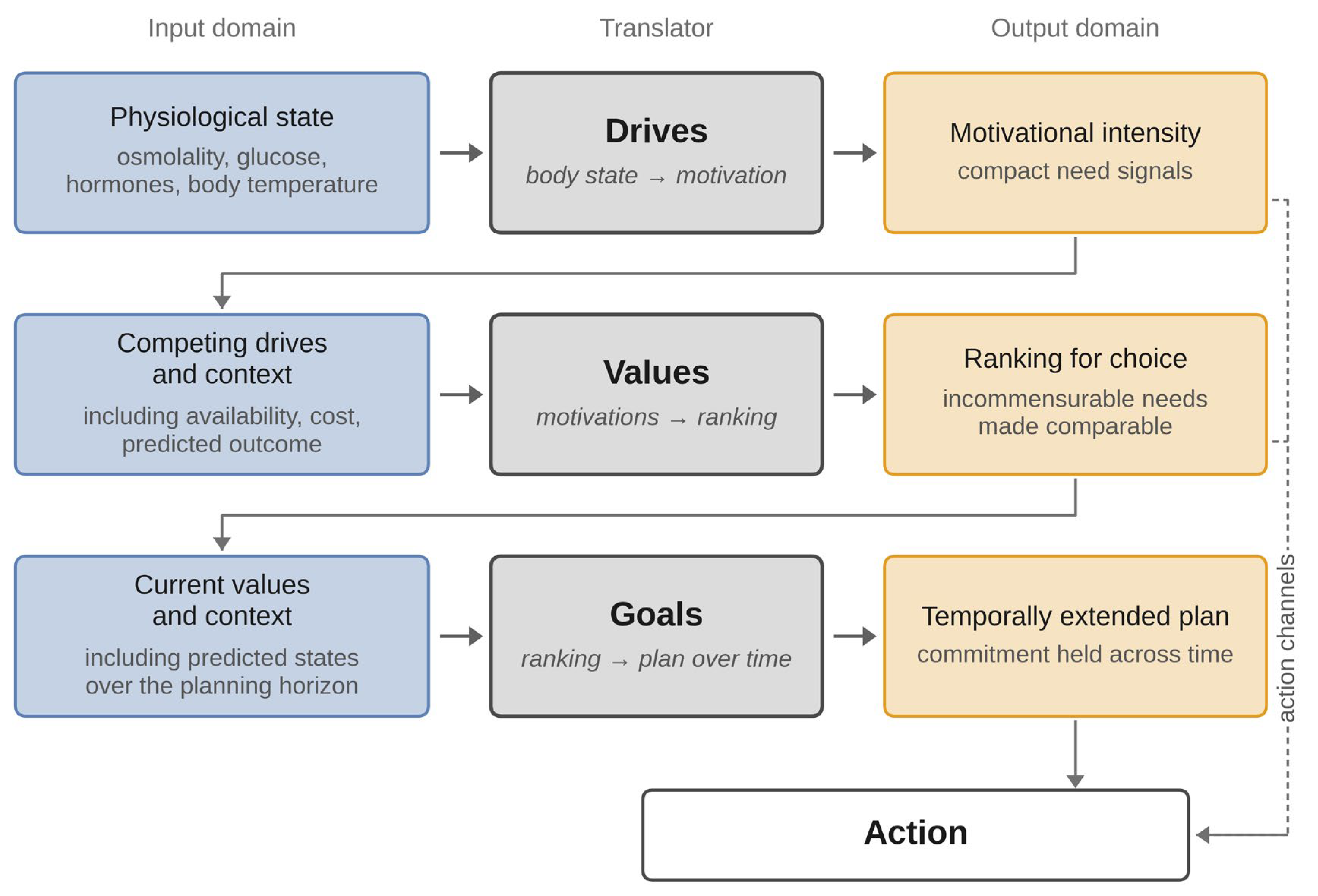
Figure 2.
Predicted architecture along the model-dependence gradient. The compression row focuses on mechanistic pathways within individuals. The conservation illustrates evolutionary diversification of states and consequences on either side of the translation interface. As implementation of the translation interface becomes more distributed, the functional role is retained, but the particular mechanism varies more within between species. Across distant clades, the mechanism may be reinvented and similar only by convergence.
Figure 2.
Predicted architecture along the model-dependence gradient. The compression row focuses on mechanistic pathways within individuals. The conservation illustrates evolutionary diversification of states and consequences on either side of the translation interface. As implementation of the translation interface becomes more distributed, the functional role is retained, but the particular mechanism varies more within between species. Across distant clades, the mechanism may be reinvented and similar only by convergence.
Disclaimer/Publisher’s Note: The statements, opinions and data contained in all publications are solely those of the individual author(s) and contributor(s) and not of MDPI and/or the editor(s). MDPI and/or the editor(s) disclaim responsibility for any injury to people or property resulting from any ideas, methods, instructions or products referred to in the content. |
© 2026 by the authors. Licensee MDPI, Basel, Switzerland. This article is an open access article distributed under the terms and conditions of the Creative Commons Attribution (CC BY) license (http://creativecommons.org/licenses/by/4.0/).
Copyright: This open access article is published under a Creative Commons CC BY 4.0 license, which permit the free download, distribution, and reuse, provided that the author and preprint are cited in any reuse.