

Submitted:
24 July 2026
Posted:
28 July 2026
You are already at the latest version
Abstract
The recently proposed two-component Tsallis-Hagedorn Model with Transverse Flow (THMTF) function, which is the sum of thermodynamically consistent Tsallis function with embedded transverse flow and inverse power-law function (which is asymptotic of Hagedorn function at high pT values), has described quite well simultaneously the experimental midrapidity pT spectra of the charged pions and kaons, protons and antiprotons in the whole measured pT range up to 20 GeV/c at all ten multiplicity classes in proton-proton collisions at sqrt(s)=7 and 13 TeV at the LHC. Dependencies of non-extensivity parameter, q, kinetic freeze-out temperature parameter, T0, momentum scale parameter, P0, and power-index n of the two-component THMTF function on <dNch/dη> in proton-proton collisions at sqrt(s)=7 and 13 TeV have been analyzed and interpreted. Analyzing <dNch/dη> dependencies of parameters T0 and <βT>, the border <dNch/dη> values of transition towards plateau region of kinetic freeze-out temperature (T0) (and simultaneous emergence of transverse flow) and probable onset of deconfinement phase transition (towards QGP-like state) have been estimated to be <dNch/dη>≈ 7.6±0.9 and <dNch/dη>≈ 9.0±1.0 in proton-proton collisions at sqrt(s)= 7 and 13 TeV, respectively. These estimates made using THMTF function in present work have been above but close to the corresponding <dNch/dη> ≈6.1±0.3 and <dNch/dη> ≈7.1±0.2 estimates of possible onset of deconfinement phase transition in proton-proton collisions at sqrt(s)= 7 and 13 TeV, respectively, made in our earlier works using Hagedorn function with embedded transverse flow. Our estimates are consistent with and complement the corresponding early result ((dNch/dη) ≈ 6±1) of Campanini and Ferri for probable onset of deconfinement phase transition, obtained from analyses of the experimental <pT> versus <dNch/dη> curves and extracted experimental EOSs, and squared speed of sound in proton-proton and proton-antiproton collisions in wide energy, sqrt(s)= 31-7000 GeV, interval. The mean number of partons participating in a scattering, nα=5, has been estimated from extracted average value of power-index n in the analyzed proton-proton collisions. This suggests that g+q→meson+q and g+g→meson+g gluon fragmentation reactions are the main mechanisms for high pT meson production in proton-proton collisions at the LHC. The obtained significant differences in <dNch/dη> dependencies of parameters q and n for pions and kaons, on the one hand, and for (anti)protons, on the other hand, can imply that pions and kaons demonstrate features of local thermalization in proton-proton collisions at the LHC with high enough multiplicity, whereas (anti)protons show significant deviations due to non-thermal production mechanisms. The Pearson coefficients of linear correlation have been calculated between various parameters of the two-component THMTF function in proton-proton collisions at sqrt(s)= 7 and 13 TeV and compared with those obtained recently in Xe+Xe and Pb+Pb collisions at the LHC.
Keywords:
high-energy proton-proton collisions at the LHC
; transverse momentum spectra of identified charged particles
; Hagedorn function
; Tsallis distribution with embedded transverse flow
; two-component model function
; power-index n
; non-extensivity parameter q
; transverse flow velocity
; kinetic freeze-out temperature
; mechanisms of hadron production at the LHC
; deconfinement phase transition in proton-proton collisions
; (crossover) phase transition from the dense hadronic matter to QGP-like state in proton-proton collisions
; correlations among kinetic freeze-out parameters
1. Introduction
In early works, analysis of high-energy proton-proton collisions was used as a baseline to extract the collective parameters of high-energy heavy-ion collisions, in which production of Quark-gluon plasma (QGP) was firmly established [1,2,3,4,5,6,7,8,9]. Nevertheless, most of the known signatures of QGP creation were observed [10,11,12,13,14,15,16,17,18,19,20,21,22,23,24,25,26,27,28,29,30,31,32] also in high-energy proton-proton collisions with large multiplicities at the LHC (Large Hadron Collider). One of the important signatures of QGP formation is significant enhancement of yield of multi-strange particles with respect to non-strange hadrons, which was observed [10] in high-multiplicity proton-proton collisions at high energies. Production of light flavor hadrons in proton-proton collisions at = 7 TeV at midrapidity at the LHC was investigated as a function of charged-particle multiplicity density in Ref. [13]. The ratio of a proton to pion yields did not change with multiplicity, while the ratios of a strange-hadron to pion yields increased considerably with increasing multiplicity, and a larger enhancement was found for hadrons with a higher strangeness content [13]. The emergence and development of a collective radial flow was observed [18,19,20,27,28] in proton-proton collisions at high energies. The thermal abundances in the hadron yields in high-energy proton-proton collisions together with exponential component observed in their pT spectra was considered as an evidence of thermalization [21,25]. The thermal feature observed in high-energy proton-proton collisions was a surprise, since only few interactions at the final state in proton-proton collisions could not lead to thermalization [21,25]. The possible reason of a thermalization in proton-proton collisions was investigated in Refs. [21,22,23,24]. The emergence of a thermalization in high-energy proton-proton collisions was interpreted [21,22,23,24] as being due to a rapid quench, caused by collisions, resulting from very intense quantum entanglement of the partonic wave functions, which belong to interacting protons. On the whole, the collective properties of high-multiplicity proton-proton collision events were found to be very similar to the corresponding properties observed in high-energy heavy-ion collisions. Hence, it is equally important to investigate high-energy heavy-ion as well as proton-proton collisions.
The present work is an important extension of our recent works [27,28,29], devoted to investigation of evolution of the freeze-out parameters in proton-proton collisions at = 7 and 13 TeV at the LHC with changing of the average charged-particle multiplicity density, , through simultaneous minimum χ2 fits of the midrapidity pT spectra of the charged pions and kaons, protons and antiprotons, measured by ALICE Collaboration [13,33], using separately the thermodynamically consistent Tsallis distribution function as well as Hagedorn function with embedded transverse flow. In Refs. [27,28,29], the dependencies of the extracted parameters of the Tsallis distribution as well as Hagedorn function with incorporated transverse flow were studied and interesting results on possible onset of deconfinement phase transition in proton-proton collisions at = 7 and 13 TeV obtained. The border values for possible onset of deconfinement phase transition and corresponding energy densities were estimated, and the dependencies of the effective temperature, T, freeze-out temperature, T0, average transverse flow velocity, ⟩, and non-extensivity parameter q established in these proton-proton collisions [27,28,29]. It was obtained in Refs. [27,28] that the dependence of the effective temperature, T, on in both proton-proton collisions at =7 and 13 TeV could be reproduced very well by simple power function with the same exponent parameter ≈1/3, obeying relation, in both collisions. Assuming approximate proportionality between energy density, , and , one obtains relation [27,28]. It is an interesting finding [27,28] that ≈ 1/3 exponent proved to be independent from the center-of-mass energy, , of proton-proton collisions. This indicates that the local thermodynamic properties at freeze-out are governed entirely by the local density of deposited energy, rather than the global collision energy of the incoming proton beams. Analyzing dependencies of parameters and T0 of Hagedorn function with embedded transverse flow in Refs. [27,28] it was estimated that the onset of deconfinement phase transition could probably occur at ≈ 6.1±0.3 [27] and ≈ 7.1±0.2 [28] in proton-proton collisions at =7 and 13 TeV, respectively. These estimates proved to be consistent with the corresponding estimate, (dNch/dη) ≈ 6±1, for possible onset of deconfinement phase transition in high-energy proton-proton collisions, which were made by Campanini and Ferri [34,35,36] from analysis of the experimental versus curves and extracted experimental EOSs, and squared speed of sound in proton-proton and proton-antiproton collisions in wide energy, = 31−7000 GeV, interval. The corresponding energy densities for possible onset of deconfinement phase transitions were estimated [27] to be 0.67±0.03 GeV/fm3 and 0.76±0.02 GeV/fm3 in proton-proton collisions at =7 and 13 TeV, respectively. Totally different trends of the dependencies of parameter q (n) in regions < 6−7 and > 6−7 were observed for all studied particle species in both proton-proton collisions at =7 and 13 TeV in Ref. [29]. The totally opposite correlations obtained between parameter n (q) for pions and kaons and in regions < 6 ( < 7) and > 6 ( > 7) supported [29] further the estimates of Refs. [27,28] indicating a possible onset of deconfinement phase transition at ≈ 6.1±0.3 ( ≈ 7.1±0.2) in proton-proton collisions at =7 TeV ( =13 TeV).
Transverse momentum distributions of hadrons in high-energy collisions demonstrate exponential behavior in the low-pT part and power-like distribution, typical for pQCD (perturbative Quantum-Chromo-Dynamics), in the high-pT part. The low-pT part (pT < 2 GeV/c) of hadron spectra reflects the collective radial expansion and thermal properties of the system at kinetic freeze-out. This region represents a thermalized medium and mass-ordered velocity field, exhibiting collective flow and resonance decays [9]. The processes of quark recombination, resulting in enhancement of proton-to-pion yield ratio in high-energy nuclear collisions compared to proton-proton collisions, contribute mostly to intermediate pT range of transverse momentum spectra of hadrons. QCD hard scatterings, quark and gluon fragmentation, production of quark-gluon jets and their energy loss in the QGP medium, contribute to and determine mostly the high-pT part (pT > 5 GeV/c) of hadron spectra [9]. While parton (quark or gluon) fragmentation dominates high-pT hadron production, the dense QGP matter produced in heavy-ion collisions allows for partons to recombine, which favors baryon (proton) production over meson (pion) production mostly in intermediate pT range [9]. There are no exact pT borders between various processes and mechanisms, which contribute to the measured pT spectra of hadrons and overlap significantly in different pT regions. Therefore, these various processes and mechanisms, contributing differently to the final pT spectra of hadrons, still lack unambiguous theoretical description of the whole measured pT range, and can be reproduced by various phenomenological models only.
To describe accurately the measured long ranges of the midrapidity transverse momentum distributions of charged particles at various centralities of high-energy heavy-ion collisions at the LHC, the two-component model function, which is the sum of thermodynamically consistent Tsallis function with embedded transverse flow and inverse power-law function (which is asymptotic of Hagedorn function at high pT values), was proposed in our recent work [37]. The first and second terms of this two-component model function are supposed to describe the “soft” (along with intermediate region) and “hard” components, respectively, of midrapidity transverse momentum distributions of hadrons in high-energy collisions. This new two-component model function, called Tsallis-Hagedorn model with transverse flow (THMTF), reproduced [37] very well the experimental midrapidity transverse momentum spectra of primary charged particles in the whole range up to 50 GeV/c, measured by ALICE Collaboration in minimum bias p+p collisions at =2.76 and 5.02 TeV [38], minimum bias p+Pb collisions at = 5.02 TeV [38], and nine collision centrality intervals of Xe+Xe collisions at =5.44 TeV [39] and Pb+Pb collisions at =2.76 and 5.02 TeV [38]. The dependencies of the extracted parameters of THMTF function on Xe+Xe and Pb+Pb collision centrality at the LHC, expressed by as well as , and c.m. collision energy (per nucleon pair) were established and interpreted [37].
The aim of the present work is to analyze the multiplicity dependencies of midrapidity pT spectra of the charged pions and kaons, protons and antiprotons at ten groups of the average charged-particle (pseudorapidity) multiplicity density () in proton-proton collisions at =7 and 13 TeV at the LHC, measured by the ALICE collaboration and presented in Refs. [13] and [40], respectively, using the new two-component THMTF model function, introduced and applied successfully in Ref. [37].
2. The Experimental Data and Two-Component Model
In Refs. [13] and [40], inelastic proton-proton collision events at = 7 and 13 TeV with at least one charged particle produced in pseudorapidity range
<1, corresponding to approximately 75% of the total inelastic scattering cross-section, were selected by ALICE Collaboration. To avoid the auto-correlation biases, the collision events were classified using the total charge accumulated in V0 detector (V0M amplitude). The total charge scaled linearly with the number of the charged particles in the pseudorapidity window corresponding to acceptance of V0 scintillators [13,40]. The corresponding were measured at mid-pseudorapidity (
<0.5) for each class of events. To take advantage of the full statistics of proton-proton collisions, the low and middle pT part (up to 6 GeV/c) of the particle spectra were reconstructed in the rapidity region <0.5, while the high pT part was extracted in the pseudorapidity range
<0.8 [13,40]. The average charged-particle multiplicity densities in the measured ten event multiplicity classes are shown in Table 1. The pT ranges [13,40] of transverse momentum spectra, measured by ALICE Collaboration in inelastic proton-proton collision events at =7 and 13 TeV, were as follows: [0.1-20.0] GeV/c for +, [0.2-20.0] GeV/c for +, and [0.3-20.0] GeV/c for p+.
The following version [41,42,43,44] of non-extensive Tsallis distribution [45,46,47] function, obtained at a zero chemical potential (μ ≈ 0 at the TeV energy range) at midrapidity (<y>=0), satisfies the thermodynamic expressions for pressure, temperature, particle number, energy, and entropy densities [41]:
where Cq is the fitting constant, Nev denotes the total number of inelastic collision events,—the transverse energy (mass), and m0 is the hadron’s rest mass. Parameter T represents the effective temperature, while q is the so-called non-extensivity parameter. The parameter, q, being fundamental for Tsallis distribution, is supposed to describe the fluctuations in system’s temperature through the relationship . The deviation, q−1, from unity of this parameter is thought to quantify the degree of non-thermalization and non-equilibrium within the system. As q approaches one (1), the Tsallis distribution reduces to the exponential Boltzmann-Gibbs distribution, applicable to systems in equilibrium. The closer the q parameter is to one (1), the higher the degree of thermalization (equilibrium) of the system. The function in Eq. (1) is called the thermodynamically consistent Tsallis function. The proof of thermodynamic consistency of the function in Eq. (1) was presented in Ref. [41]. The normalization constant is supposed to have a linear relationship with the system’s freeze-out volume (V) [41,42] through expression Cq=gV/(2π)3, where g is the degeneracy factor of particle species.
The effective temperature T in Eq. (1) contains contributions from both chaotic thermal motion and transverse radial flow. To disentangle these two factors, the velocity of transverse flow should be embedded into the Tsallis distribution function. The transverse flow can be embedded into thermodynamically consistent Tsallis distribution in Eq. (1) by simple substitution , as done for the first time in Ref. [48], to obtain the function:
The substitution denotes [48] simply the Lorentz transformation to a system co-moving with an average transverse flow velocity, , of the system of particles in the transverse plane assuming that such a flow of particles exists in this system. The thermodynamically consistent Tsallis function with incorporated transverse flow in Eq. (2) described [48,49,50,51] very well the midrapidity pT spectra of identified charged hadrons in the low and intermediate pT ranges up to 5 GeV/c in high-energy p+Pb, Xe+Xe, and Pb+Pb collisions at the LHC, enabling the physically meaningful interpretation of the extracted freeze-out parameters and their dependencies on collision centrality () and size of a system.
The high transverse momentum part of pT spectra of hadrons in high-energy nucleon-nucleon collisions were reproduced well by the inverse power law − QCD inspired Hagedorn function [52,53,54]:
where is the fitting constant, proportional to the system’s volume at freeze-out, n and P0 are free parameters, which have distinct physical meanings related to underlying production mechanisms of hadrons. Parameter , being characteristic momentum scale, is assumed to represent the typical momentum scale where the production mechanism transitions from soft (thermal/exponential) to hard (power-law/perturbative) processes. In modified versions of Hagedorn function, was also related to the temperature of the system (T) and the power-index n through expression . This parameter can also characterize the average transverse momentum contributed by partons (quarks or gluons) before they fragment into hadrons. The power-index parameter n describes the hardness of the interaction. A small value of n reflects a hard spectrum dominated by perturbative QCD (pQCD) scattering and jet production. The QCD cross sections at high energies are known [52,55] to scale as , in which the power-index n can be modelled as , where shows the number of active flavors or the number of partons participating in a scattering. For the simple scattering (leading twist), the main process is a simple point-like scattering between two quarks, , with the number of participant quarks, =4. This results in the power-index parameter . For the multiple scattering (higher twist), multiple quark-quark or quark-hadron scatterings take place, leading to an increase in n value. This demonstrates involvement of more constituent participants in the processes of particle production. Obviously, the value of parameter varies significantly depending on whether the produced particle is a meson (two constituent quarks) or a baryon (three constituent quarks). These significant differences in n value are due to the different quark structure and distinct production mechanisms of mesons and baryons − specifically, how many constituent quarks (partons) should coalesce to form the final hadron. In a statistical framework, Hagedorn parameter is inversely related to the Tsallis non-extensivity parameter q via the relation .
For very large values of , the Hagedorn function in Eq. (3) reduces to the following asymptotic, called (simple) inverse power-law function:
To reproduce well the measured long ranges of midrapidity transverse momentum distributions of charged particles at different centralities of high-energy heavy-ion as well as proton-proton collisions, the following two-component model function, which is the sum of the thermodynamically consistent Tsallis function with embedded transverse flow, given in Eq. (2), and (simple) inverse power-law function, shown in Eq. (4), was proposed in Ref. [37]:
where is the Heaviside function with the following properties: if and if . This two-component model function in Eq. (5) is called Tsallis-Hagedorn model with transverse flow (THMTF) in present work. Parameter represents the optimal value of border between the corresponding fit ranges of the first and second term in Eq. (5). The first term in Eq. (5) is assumed to describe the low (soft) and intermediate range, while the second term should describe the high (hard) region. It is well known that at the LHC (TeV range) collision energies, soft bulk particle production dominates below ≈ 2 GeV/c, while above ≈ 3 GeV/c hard fragmentation takes over. In our work, we use fixed GeV/c to make sure that > 4 GeV/c region is practically entirely governed by the hard scattering perturbative QCD processes, reproduced by the second power-law term in Eq. (5). Moreover, the first term in Eq. (5), represented by thermodynamically consistent Tsallis function with embedded transverse flow, given in Eq. (2), could reproduce very well the midrapidity transverse momentum distributions of identified charged particles at different centralities of high-energy heavy-ion collisions in the low and intermediate range up to = 4−5 GeV/c [48,49,50,51]. Using GeV/c in Eq. (5) means that the hadron spectrum is described by thermodynamically consistent Tsallis function with transverse flow (Eq. (2)) in ≤ 4 GeV/c range and by inverse power-law function (Eq. (4)) in > 4 GeV/c region. For the measured midrapidity spectra, , of particles in inelastic proton-proton collisions at =7 and 13 TeV the THMTF function in Eq. (5) becomes:
In present work, we analyze the midrapidity pT spectra of the charged pions and kaons, protons and antiprotons at ten multiplicity groups (see Table 1) in proton-proton collisions at =7 and 13 TeV at the LHC, measured by the ALICE collaboration and presented in Refs. [13] and [40], respectively, using the THMTF function given in Eq. (6). As stated in Refs. [56,57], it is not possible to give meaningful physical interpretation to collective properties, such as kinetic freeze-out temperature or radial transverse flow velocity, extracted from model fits to a single particle species. On the other hand, the simultaneous fits to the spectra of different particle species, produced in a given collision, can yield the physically meaningful collective parameters, such as global freeze-out temperature and average transverse (radial) flow velocity [56,57]. The simultaneous fits of the spectra of pions and kaons, protons and antiprotons are very useful for comparison of various collision systems using only few parameters [27,28,48,49,50,51,56,57]. In present analysis, the simultaneous minimum χ2 fits with the THMTF function (Eq. (6)) of transverse momentum spectra of the charged pions and kaons, protons and antiprotons in each class of event multiplicity in proton-proton collisions at =7 and 13 TeV have been performed using the Nonlinear Curve Fitting of the Origin 9.1 Data Analysis and Graphing Software. The T0, <βT>, and P0 parameters have been global (shared) parameters for all analyzed particle species during the simultaneous fit procedures. The error bars for the experimental data points in the figures of present work represent the combined (added) statistical and systematic errors. These combined errors are mostly due to the systematic uncertainties, which are much larger than the statistical ones. Minimum χ2 fit procedures have been conducted taking into account the weights (1/(combined error)2) of the experimental data points. The region pT < 0.5 GeV/c in spectra of charged pions is excluded from fitting procedures, as done previously in Refs. [48,49,50,51,56,57]. This is a standard commonly accepted procedure [56,57], because the region pT < 0.5 GeV/c contains significant fraction of pions coming from decays of baryon resonances. The simultaneously fitted pT ranges have been as follows: [0.5-20.0] GeV/c for +, [0.2-20.0] GeV/c for +, and [0.3-20.0] GeV/c for p+.
3. Analysis and Results
The parameters extracted from simultaneous fits with Tsallis-Hagedorn model with transverse flow (THMTF) (Eq. (6)) of experimental midrapidity spectra of the charged pions and kaons, protons and antiprotons in ten multiplicity classes in p+p collisions at =7 and 13 TeV are shown in Table 2 and Table 3, respectively. The corresponding minimum simultaneous fit curves of experimental midrapidity spectra of the studied particle species in four different classes of charged-particle multiplicity density in p+p collisions at =7 and 13 TeV are demonstrated in Figure 1 and Figure 2, respectively. As seen from Figure 1 and Figure 2 and /n.d.f. values in Table 2 and Table 3, the THMTF function in Eq. (6) reproduces quite well the experimental midrapidity spectra of the charged pions and kaons, protons and antiprotons in the whole measured range up to 20 GeV/c at all ten multiplicity classes in p+p collisions at =7 and 13 TeV.
The dependencies of the obtained parameters T0, ⟩, and q of two-component model (THMTF) function (Eq. (6)), given in Table 2 and Table 3, on the average charged-particle multiplicity density () in proton-proton collisions at = 7 and 13 TeV are illustrated in Figure 3. Figure 4 demonstrates the corresponding dependencies of the extracted parameters P0 and n of two-component model (THMTF) function (Eq. (6)), given in Table 2 and Table 3, on . As seen from Figure 3 (a), the kinetic freeze-out temperature parameter increases on the whole in the low region, and then starting from estimated value, shown as the vertical line, parameter T0 transitions towards plateau region extending up to the highest value in both proton-proton collisions at = 7 and 13 TeV. At the same time, as seen from Figure 3 (b), the average transverse flow velocity is absent in the low region, and then beginning from estimated border value, shown as the vertical line, parameter ⟩ starts emerging appreciably, and then ⟩ shows a steady growth with up to the highest value in both proton-proton collisions at =7 and 13 TeV. The border values of transition towards constant T0 region and possible onset of deconfinement phase transition towards QGP-like state have been estimated to be ≈ 7.6±0.9 and ≈ 9.0±1.0 in proton-proton collisions at = 7 and 13 TeV, respectively. These estimates made using THMTF function (Eq. (6)) in present work have proved to be above but close to the corresponding ≈ 6.1±0.3 and ≈ 7.1±0.2 estimates of possible onset of deconfinement phase transition in proton-proton collisions at = 7 and 13 TeV, respectively, made in Refs. [27,28] using Hagedorn function with embedded transverse flow. It is important to emphasize again that estimates of our present work and Refs. [27,28] have proved to be consistent and compatible with the corresponding estimate, (dNch/dη) ≈ 6±1, for possible onset of phase transition to QGP-like state in high-energy proton-proton collisions, which were made by Campanini and Ferri using different approaches in Refs. [34,35,36].
Here it is important to comment in more detail on the results obtained by Campanini and Ferri [34,35,36] and others, regarding probable onset of crossover transition from gas of hadrons to QGP-like state in high-energy proton-proton collisions. It was suggested by Van Hove [58] back in 1982 that an anomalous behavior of average transverse momentum, , versus multiplicity could indicate a phase transition in hadronic matter. This was based on the idea that distribution of particles reflects the system’s temperature, while provides a measure of entropy. In Ref. [35] it was shown a slope change at dNch/dη ≈ 5.5±1.2 in experimental versus curves in proton-proton and proton-antiproton collisions in wide collision energy () range from 22 to 7000 GeV. Signals related to this slope change could indicate transition to a new mechanism of particles production [35]. In early work [34] it was pointed out that proton-proton data at ISR and proton-antiproton data at CERN collider showed a jump at dNch/dη ≈ 6, which had to be investigated as a possible signal for phase transition [59]. In 2002, Alexopoulos et al. provided an evidence of a probable deconfined phase transition in proton-antiproton interactions at = 1800 GeV in Ref. [60], analyzing the experimental data from the Fermilab Tevatron Collider. They found [60] a distinct plateau behavior when mapping thermodynamic variables against charged particle pseudorapidity density (dNch/dη), which is a classical indicator of a phase transition. To explain the experimental results it was concluded [60] that the system produced in proton-antiproton collisions at = 1800 GeV at dNch/dη > 6.75 was above the probable deconfinement phase transition. The signatures of phase transition or crossover can also be found from analysis of Equation of State (EOS) of hadronic matter [36]. These signatures can be identified through analysis of modifications in the temperature (T) dependence of energy density, , pressure, P, and entropy density, σ. One can search for a rapid rise in the effective number of degrees of freedom, as expressed by the ratio or over a small range of temperature [36]. The experimental EOSs of hadronic matter were deduced from experimental measurements in proton-proton and proton-antiproton collisions in wide energy, , range from 31 to 7000 GeV in Ref. [36]. Combining the experimental measurements of versus and measurements of radii with Bose Einstein correlation or from a model relating impact parameter and multiplicity in proton-proton and proton-antiproton collisions in = 31−7000 GeV energy interval, Campanini and Ferri obtained that versus and reproduce the EOSs of hadronic matter and squared sound velocity, respectively, in presence of crossover or phase transition [36]. A neat change around (dNch/dη) ≈ 6 was observed, indicating the beginning of the crossover or phase transition [36]. Hence, our estimates for threshold values for onset of probable deconfinement phase transition in proton-proton collisions at = 7 and 13 TeV, obtained from analysis of dependencies of parameters and T0 of Hagedorn function with embedded transverse flow in Refs. [27,28], and obtained from corresponding analyses using the two-component THMTF function (Eq. (6)) in present work, are consistent with and complement the corresponding results of Campanini and others [34,35,36,60] obtained from analysis of proton-proton and proton-antiproton collisions in wide energy, = 31−7000 GeV, interval.
As seen from Figure 3 (b), non-extensivity parameter q values are systematically larger for all particle species in the whole region in proton-proton collisions at = 13 TeV as compared to the corresponding q values in proton-proton collisions at = 7 TeV. This is in agreement with the general increase of q parameter with an increase in collision energy () of high-energy proton-proton collisions observed earlier in Refs. [27,28,43,61]. With an increase in energy of proton-proton collision, the parameter q generally increases due to system’s moving further away from equilibrium [27,28,43,61]. At higher collision energies, production of particles is increasingly caused by perturbative QCD (pQCD) processes rather than soft thermal-like interactions. These hard scattering events create power-law tails in the transverse momentum spectra, which are mathematically described by a higher q value. The parameter q is also interpreted as a measure of temperature fluctuations in the system. Higher collision energies result in more violent initial conditions, leading to larger fluctuations of the local temperature, which drives q parameter further away from unity.
As observed from Figure 3 (b), parameter q for mesons is systematically larger than q for baryons. This is in agreement with q (baryons) < q (mesons) relation found in earlier works [27,28,43,61,62]. As can be seen from Figure 3 (b), the trends of dependencies of q parameter for all studied particle species are significantly different in < 6−7 and > 6−7 regions. While q values for charged pions and kaons are not stable and on the whole increase with in region < 6−7, parameter q does not change within uncertainties demonstrating a plateau for both pions and kaons in region > 6−7. Whereas for protons and antiprotons nonextensivity parameter q shows a high rate of increase with in region < 6−7 and its (q) increase rate slows down significantly in region > 6−7. Drastical changes in dependencies of parameter q for all particle species observed at ≈ 6−7, especially a plateau with practically constant values of q found for pions and kaons in region > 6−7, support further and are compatible with our estimates for threshold values for probable onset of deconfinement phase transition in proton-proton collisions at = 7 and 13 TeV obtained in present work using the two-component THMTF function, obtained earlier using Hagedorn function with embedded transverse flow in Refs. [27,28], and obtained using different approaches from analysis of proton-proton and proton-antiproton collisions in wide energy = 31−7000 GeV interval by Campanini and Ferri in Refs. [34,35,36].
As seen from Figure 4 (a) momentum scale parameter, P0, of the inverse power-law component of THMTF function in Eq. (6) increases consistently with an increase in in both proton-proton collisions at = 7 and 13 TeV. The increase in parameter with an increase in is due to higher energy-momentum transfer and more multiple parton scatterings during the initial collision at more head-on proton-proton collisions, leading to a higher average transverse momentum at higher . As observed from Figure 4 (a), except for the first data point for most grazing proton-proton collisions, values coincide at the same values in proton-proton collisions at = 7 and 13 TeV, indicating that P0 parameter is determined by the deposited local energy density, which is approximately proportional to , rather than the global collision energy of incoming proton beams. As seen from comparison of Figure 3 (b) and 4 (a), consistent increase of P0 with matches well with the emergence of ⟩ and its corresponding consistent increase starting from ≈7−9 and continuing up to the maximal measured values in proton-proton collisions at = 7 and 13 TeV. Indeed, more head-on (more central) proton-proton collisions create larger pressure gradient in the overlap zone of colliding protons resulting in the stronger transverse flow, which pushes particles to the higher pT values, and therefore increases the momentum scale parameter, P0.
As seen from Figure 4 (b), the parameter n values are systematically and significantly larger for each particles species in proton-proton collisions at = 7 TeV as compared to those at = 13 TeV. As proton-proton collision energy increases from 7 to 13 TeV, the parameter n generally decreases, signifying a power-law exponent that produces harder spectra, consistent with higher effective temperatures, due to the harder initial parton scatterings, which produce larger number of high pT hadrons making high pT spectrum flatter at higher ( = 13 TeV) collision energy as compared to the lower ( = 7 TeV) one. The power-index n, describing the hardness of pT spectrum and reflecting high pT hadron production, demonstrates clear dependence for both charged pions and kaons in proton-proton collisions at = 7 and 13 TeV in Figure 4 (b). The parameter n for pions and kaons generally decreases with an increase in in both proton-proton collisions at = 7 and 13 TeV. This is because collision events with larger occur at more central collisions with harder initial parton scatterings, producing larger number of high pT hadrons and making high pT spectrum flatter, represented mathematically by the lower values of power-index n. As observed from Figure 4 (b), power-index n demonstrates a high rate of decrease with in region < 6−7 and its (n) decrease rate slows down significantly in region > 6−7.
In contrast to clear decreasing trend with of parameter n for pions and kaons, power-index n for protons+antiprotons in Figure 4 (b) demonstrates largely fluctuating behavior with changing and it (n) roughly stays practically the same on the average. These different trends can be explained by that the pions and kaons are all the newly produced particles, and, hence, they can characterize and reflect the properties of the hot and dense overlap medium of two colliding protons, whereas the transverse momentum spectra of protons+antiprotons contain contribution from large fraction of protons emerging from initial protons. Besides it, threshold energies for production of pions and kaons are much smaller as compared to that of p+. Therefore, the observed significant differences in dependencies of the parameters q and n for pions and kaons, on the one hand, and for p+, on the other hand, suggest that pions and kaons demonstrate features of local thermalization in proton-proton collisions with high enough multiplicity, whereas protons and antiprotons show significant deviations due to non-thermal production mechanisms.
From model expression [52,55] for power-index n in high-energy collisions, where is the number of partons participating in a scattering, one can estimate in the analyzed collisions. As seen from Table 2 and Table 3, the average value of is roughly 6 in the analyzed proton-proton collisions. This average, ≈ 6, value corresponds to the average number of participant partons, ≈ 5. Taking into account that most of the charged hadrons in the studied collisions are charged pions (~ 85%) and kaons (~ 10%), ≈ 5 matches well with and gluon fragmentation reactions as the dominant mechanisms for high pT meson production in the studied proton-proton collisions at the LHC. This result agrees with the earlier finding [63] stating that gluon fragmentation should be the dominant mechanism for production of high pT mesons, especially in the central rapidity region, in high-energy collisions at the LHC. This is also explained by that the gluons carry a bigger color charge (3) as compared to that of quarks (4/3), making gluons more likely to radiate and fragment into a larger shower of particles. Moreover, the cross-sections of quark-gluon () and gluon-gluon () scatterings are significantly larger than that of quark-quark () scattering at TeV collision energy range at the LHC.
To analyze the correlation between two sets of parameters x and y, we evaluate the Pearson coefficient of linear correlation in present work as follows:
where and are the average values of the parameters x and y. The Pearson correlation coefficient, , varies from −1 to +1, being a statistical measure of a linear correlation between two sets of data. The values = ±1 imply a perfect linear dependence between parameters x and y with all data points (xi, yi) lying on a line in XY plane. The value = 0 denotes an absence of a linear correlation between x and y. The positive and negative values of imply the positive and negative (linear) correlation, respectively, between x and y.
To estimate the uncertainty in the values, we calculate the standard error of Pearson correlation coefficient as follows:
The formula in Eq. (8) is derived assuming that the data are normally distributed and with the null hypothesis that there is a zero correlation between x and y. Pearson correlation coefficient, , and its corresponding standard error between various parameters of the THMTF function (Eq. (6)) in Table 2 and Table 3 obtained in proton-proton collisions at = 7 and 13 TeV in present work are shown in Table 4. Pearson correlation coefficient, , and its corresponding standard error between various parameters of the THMTF function (Eq. (6)), obtained in Ref. [37] from minimum χ2 fits of experimental midrapidity transverse momentum spectra of primary charged particles in Xe+Xe collisions at =5.44 TeV and Pb+Pb collisions at =2.76 and 5.02 TeV, are shown in Table 5 for comparison with the corresponding results of present work given in Table 4.
As seen from Table 4, the Pearson linear correlation coefficient, R(<βT>, T0), between parameters <βT> and kinetic freeze-out temperature parameter, T0, is moderately positive in both proton-proton collisions at = 7 and 13 TeV. On the other hand, R(<βT>, T0) between parameters <βT> and T0 is strongly negative in Xe+Xe collisions at =5.44 TeV and Pb+Pb collisions at =2.76 and 5.02 TeV, as seen from Table 5. This is obviously due to a difference in dependencies of the parameter T0 in proton-proton and heavy-ion collisions at the LHC. As observed from Figure 3 (a), parameter T0 increases on the whole with in the region of low , and then it (T0) demonstrates a plateau behavior starting from the estimated border value, shown by the vertical line in both proton-proton collisions at = 7 and 13 TeV. In contrast to that, as shown in Ref. [37], parameter T0 firstly decreases with in the region of low , and then it (T0) transitions to region of constant T0 beginning from the estimated border values in Xe+Xe and Pb+Pb collisions at the LHC. Whereas parameter <βT> increases on the whole with an increase in in both proton-proton and heavy-ion collisions at the LHC, as seen in Figure 3 (b) in present work and corresponding figure of Ref. [37]. Parameters <βT> and P0 demonstrate a large positive correlation in both proton-proton collisions at = 7 and 13 TeV, as seen from R(<βT>, P0) values in Table 4. This correlation between <βT> and P0 is also positive and even stronger in Xe+Xe and Pb+Pb collisions at the LHC, as seen from R(<βT>, P0) ≈ +1 values in Table 5. This is obviously due to the fact that more head-on (more central) proton-proton as well as more central heavy-ion collisions create larger pressure gradient in the overlap zone of initial collisions, which pushes particles to the higher pT values, and therefore increases the momentum scale parameter, P0. Correlations between parameters P0 and T0 are of opposite signs in proton-proton and heavy-ion collisions at the LHC, as seen from R(P0, T0) values in Table 4 and Table 5. This difference is due to above mentioned difference in dependencies of the parameter T0 in proton-proton and heavy-ion collisions at the LHC. As seen from Table 4 and Table 5, R(P0,) is strongly positive in both proton-proton and heavy-ion collisions at the LHC. This is because momentum scale parameter, P0, increases consistently with an increase in in both proton-proton (see Figure 4 (a)) and heavy-ion collisions [37]. Parameters <βT> and n for pions and kaons show a large negative correlation in both proton-proton collisions at = 7 and 13 TeV, as seen from R(<βT>, n) values in Table 4. This is consistent with the large negative correlation observed between parameters <βT> and n for primary charged particles in Xe+Xe and Pb+Pb collisions at the LHC in Table 5. This is because parameter n for pions and kaons shows a decreasing trend with in Figure 4 (b) similarly with a decreasing trend of n for primary charged particles observed in Ref. [37], and because charged pions and kaons constitute together the largest fraction (~ 95%) among the primary charged particles at the LHC energies. As seen from Table 4, the correlation between parameters q and is moderately positive for pions and kaons and strongly positive for p+. On the other hand, as seen from R(q, ) values in Table 5, the correlation between parameters q and is strongly negative for primary charged particles in Xe+Xe and Pb+Pb collisions at the LHC. This is due to drastic differences observed in dependencies of parameter q for charged pions and kaons and protons+antiprotons in both proton-proton collisions at = 7 and 13 TeV in Figure 3 (c) and those observed for primary charged particles in Xe+Xe and Pb+Pb collisions at the LHC in Ref. [37]. In contrast to Figure 3 (c), a consistent decrease of parameter q with an increase in was obtained for primary charged particles in Xe+Xe collisions at =5.44 TeV and Pb+Pb collisions at =2.76 and 5.02 TeV in Ref. [37]. The differences observed in values of other parameters in proton-proton collisions in present work and in Xe+Xe and Pb+Pb collisions in Ref. [37] in Table 4 and Table 5 can be explained in a similar way by the corresponding differences obtained either in dependencies of kinetic freeze-out temperature parameter, T0, or those of non-extensivity parameter q or power-index n.
3. Summary and Conclusions
The two-component THMTF function, which is the sum of thermodynamically consistent Tsallis function with embedded transverse flow and inverse power-law function (which is asymptotic of Hagedorn function at high pT values), has reproduced quite well simultaneously the experimental midrapidity spectra of the charged pions and kaons, protons and antiprotons in the whole measured range up to 20 GeV/c at all ten multiplicity classes in proton-proton collisions at =7 and 13 TeV. The multiplicity density, , dependencies of the extracted parameters of THMTF function have been analyzed and interpreted.
The border values of transition towards plateau region of kinetic freeze-out temperature (T0) (and simultaneous emergence of transverse flow) and probable onset of deconfinement phase transition (towards QGP-like state) have been estimated to be ≈ 7.6±0.9 and ≈ 9.0±1.0 in proton-proton collisions at = 7 and 13 TeV, respectively, from analysis of dependencies of parameters T0 and ⟩. These estimates made using THMTF function in present work have proved to be above but close to the corresponding ≈ 6.1±0.3 and ≈ 7.1±0.2 estimates of possible onset of deconfinement phase transition in proton-proton collisions at = 7 and 13 TeV, respectively, made in Refs. [27] and [28] using Hagedorn function with embedded transverse flow. Our estimates of the threshold values obtained in proton-proton collisions at = 7 and 13 TeV are consistent with and complement the corresponding result ((dNch/dη) ≈ 6±1) of Campanini and Ferri [34,35,36] for onset of deconfinement phase transition, obtained from analyses of the experimental versus curves and extracted experimental EOSs, and squared speed of sound in proton-proton and proton-antiproton collisions in wide energy, = 31−7000 GeV, interval. Our results are also consistent with that of Alexopoulos et al., who concluded [60] that the system produced in proton-antiproton collisions at = 1800 GeV at dNch/dη > 6.75 at Fermilab Tevatron Collider was above the probable deconfinement phase transition, observing a distinct plateau behavior when mapping thermodynamic variables against dNch/dη.
Non-extensivity parameter q for charged pions and kaons are not stable and on the whole increase with in region < 6−7, while it (q) does not change within uncertainties demonstrating a plateau for both pions and kaons in region > 6−7. On the other hand, nonextensivity parameter q for protons and antiprotons shows a high rate of increase with in region < 6−7, and its (q) increase rate slows down significantly in region > 6−7.
Momentum scale parameter, P0, of the inverse power-law component of THMTF function increases consistently with an increase in in both proton-proton collisions at = 7 and 13 TeV. The increase in parameter with an increase in can be explained by the higher energy-momentum transfer and more multiple parton scatterings during the initial collision at more head-on proton-proton collisions, leading to a higher average transverse momentum at higher . Parameter values have coincided at the same values in proton-proton collisions at = 7 and 13 TeV, which indicates that P0 parameter is determined by the deposited local energy density (approximately proportional to ), rather than the global collision energy of incoming proton beams.
Power-index parameter n for pions and kaons generally decreases with an increase in in both proton-proton collisions at = 7 and 13 TeV. This is because collision events with larger occur at more central collisions with harder initial parton scatterings, producing larger number of high pT hadrons and making high pT spectrum flatter, represented mathematically by the lower values of power-index n. Parameter n for pions and kaons demonstrates a high rate of decrease with in region < 6−7, and its (n) decrease slows down significantly in region > 6−7. In contrast to that, power-index n for protons+antiprotons demonstrates largely fluctuating behavior with changing , and it (n) roughly stays practically the same on the average. These different trends can be explained by that the pions and kaons are all the newly produced particles, and, hence, they can characterize and reflect the properties of the hot and dense overlap medium of two colliding protons, whereas the transverse momentum spectra of p+ contain large fraction of protons emerging from initial protons.
The observed significant differences in dependencies of parameters q as well as n for pions and kaons, on the one hand, and for protons+antiprotons, on the other hand, can suggest that pions and kaons demonstrate features of local thermalization in proton-proton collisions with high enough multiplicity, whereas protons and antiprotons show significant deviations due to non-thermal production mechanisms.
From the obtained approximate average value n ≈ 6 and model expression for power-index n in high-energy collisions, the average number of participant partons, ≈ 5, in proton-proton collisions at = 7 and 13 TeV has been estimated in present work. Considering that most of the charged hadrons in the studied collisions are charged pions and kaons (~ 95%), ≈ 5 matches well with and gluon fragmentation reactions as being the dominant mechanisms for high pT meson production in the studied proton-proton collisions at the LHC.
The Pearson coefficients of linear correlation, , have been calculated between various parameters of the two-component THMTF function in proton-proton collisions at = 7 and 13 TeV and compared with those obtained in Xe+Xe collisions at =5.44 TeV and Pb+Pb collisions at =2.76 and 5.02 TeV in Ref. [37]. The differences observed in values of some parameters in proton-proton collisions in present work and in Xe+Xe and Pb+Pb collisions in Ref. [37] have been explained by the corresponding differences obtained either in dependencies of kinetic freeze-out temperature parameter, T0, or those of non-extensivity parameter q or power-index n.
Data availability statement
The experimental data on transverse momentum distributions of identified charged particles measured by ALICE Collaboration in proton-proton collisions at √S = 7 [13] and 13 TeV [40] at the LHC, analyzed in the present work, are available open-access at www.hepdata.net.
Acknowledgments
The research work was supported by the Science Committee of the Ministry of Education and Science of the Republic of Kazakhstan (Grant No. AP23487706). The work of PTI authors was supported by the Agency of Innovative Development of the Ministry of Higher Education, Science and Innovations of Uzbekistan, within the fundamental research Grant No. F3-20200929146 on analysis of open data on heavyion collisions at the LHC. The work of F.-H.L. was supported by the National Natural Science Foundation of China (Grant No. 12147215) and the Shanxi Provincial Basic Research Program (Natural Science Foundation) under Grant No. 202103021224036.
References
- Heinz, U. W.; Jacob, M. Evidence for a New State of Matter: An Assessment of the Results from the CERN Lead Beam Programme. arXiv [nucl-th]. arXiv:0002042.
- BRAHMS Collab., Quark–gluon plasma and color glass condensate at RHIC? The perspective from the BRAHMS experiment. Nucl. Phys. A 757 2005, 1.
- PHENIX Collab., Formation of dense partonic matter in relativistic nucleus–nucleus collisions at RHIC: Experimental evaluation by the PHENIX Collaboration. Nucl. Phys. A 2005, 757, 184. [CrossRef]
- Back, B.; Baker, M.; Ballintijn, M.; et al. The PHOBOS perspective on discoveries at RHIC. Nucl. Phys. A 757 2005, 28. [Google Scholar]
- STAR Collab., Experimental and theoretical challenges in the search for the quark–gluon plasma: The STAR Collaboration’s critical assessment of the evidence from RHIC collisions. Nucl. Phys. A 757 2005, 102. [CrossRef]
- Shuryak, E. V. What RHIC experiments and theory tell us about properties of quark–gluon plasma? Nucl. Phys. A 750 2005, 64. [Google Scholar] [CrossRef]
- CMS Collab., Observation and studies of jet quenching in PbPb collisions at √snn = 2.76 TeV. Phys. Rev. C 2011, 84, 024906.
- Song, H.; et al. 200 A GeV Au+Au Collisions Serve a Nearly Perfect Quark-Gluon Liquid. Phys. Rev. Lett. 2011, 106, 192301. [Google Scholar] [CrossRef] [PubMed]
- Heinz, U.; Snellings, R. Collective Flow and Viscosity in Relativistic Heavy-Ion Collisions. Ann. Rev. Part. Sci. 2013, 63, 123. [Google Scholar] [CrossRef]
- ALICE Collab. (J. Adam et al.), Enhanced production of multi-strange hadrons in high-multiplicity proton–proton collisions. Nat. Phys. 2017, 13, 535. [CrossRef]
- Tripathy, S. Energy dependence of φ(1020) production at mid-rapidity in pp collisions with ALICE at the LHC. Nucl. Phys. A 2019, 982, 180. [Google Scholar] [CrossRef]
- Dash, A.K. Multiplicity dependence of strangeness and hadronic resonance production in pp and p-Pb collisions with ALICE at the LHC. Nucl. Phys. A 2019, 982, 467. [Google Scholar] [CrossRef]
- 13. ALICE Collab. (S. Acharya et al.), Multiplicity dependence of light flavor hadron production in pp collisions at (snn)1/2=7 TeV. Phys. Rev. C 1807.11321v2 [nucl-ex]. 2019, 99(2), 024906.
- Khuntia, et al. Radial flow and differential freeze-out in proton-proton collisions at (s)1/2=7 TeV at the LHC. Eur. Phys. J. A 2019, 55, 3. [Google Scholar] [CrossRef]
- Csanad, M.; et al. Initial energy density of (snn)1/2=7 and 8 TeV p-p collisions at LHC. Universe 2017, 3, 9. [Google Scholar]
- Baptista, Rafael P.; Rocha, Lucas Q.; Menezes, D.P.; Trevisan, Luis A.; Tsallis, Constantino; Deppman, Airton. Evidence of fractal structures in hadrons. Eur. Phys. J. A 2024, 60, 93. [Google Scholar] [CrossRef]
- Tripathy, S.; et al. Event shape and multiplicity dependence of freeze-out scenario and system thermodynamics in proton+proton collisions at (snn)1/2=13 TeV using PYTHIA8. Adv. High-Energy Phys. 1905.07418v3 [hep-ph]. 2021, 8822524. [Google Scholar]
- Jiang, K.; et al. Onset of radial flow in p+p collisions. Phys. Rev. C 2015, 91, 024910. [Google Scholar] [CrossRef]
- Bashir, et al. Evidence of collective flow in p-p Collis at LHC. arXiv arXiv:1502.04185v2. [CrossRef]
- Bashir, et al. Particle Transverse Momentum Distributions in p-p Collisions at (s)1/2=0.9 TeV. Adv. High-Energy Phys. 2019, 8219567. [Google Scholar]
- Baker; Kharzeev, D.E. Thermal radiation and entanglement in proton-proton collisions at energies available at the CERN Large Hadron Collider. Phys. Rev. D. 2018, 98, 054007. [Google Scholar] [CrossRef]
- Kharzeev, D.E.; Levin, E.M. Deep inelastic scattering as a probe of entanglement. Phys. Rev. D. 2017, 95, 114008. [Google Scholar] [CrossRef]
- Bergers, J.; Floerchinger, S.; Venugopalan, R. Dynamics of entanglement in expanding quantum fields. J. High-Energy Phys. 2018, 04, 145. [Google Scholar] [CrossRef]
- Bergers, J.; Floerchinger, S.; Venugopalan, R. Thermal excitation spectrum from entanglement in an expanding quantum string. Phys. Lett. B 2018, 778, 442. [Google Scholar] [CrossRef]
- Feal, X.; Pajares, C.; Vazquez, R.A. Thermal behavior and entanglement in Pb-Pb and p−p collisions. Phys. Rev. C 2019, 99, 015205. [Google Scholar] [CrossRef]
- Gu, Jinbiao; et al. Collective expansion in pp collisions using the Tsallis statistics. J. Phys. G. 2022, 49, 115101. [Google Scholar] [CrossRef]
- Olimov, Khusniddin K.; Liu, Fu-Hu; Musaev, Kobil; Shodmonov, Maratbek. Multiplicity Dependencies of Midrapidity Transverse Momentum Distributions of Identified Charged Particles in Proton-Proton Collisions at (s)1/2 = 7 TeV at the LHC. Universe 2022, 8, 174. [Google Scholar] [CrossRef]
- Olimov, Kh.K.; et al. Multiplicity dependencies of midrapidity transverse momentum spectra of identified charged particles in p+p collisions at (s)1/2=13 TeV at LHC. Int. J. Mod. Phys. A 2021, 36, 2150149. [Google Scholar] [CrossRef]
- Olimov, Khusniddin K.; Lebedev, Igor A.; Fedosimova, Anastasiya I.; Liu, Fu-Hu; Dmitriyeva, Elena; Musaev, Kobil A.; Olimov, Kosim; Yuldashev, Bekhzod S. Correlations among parameters of the Tsallis distribution and Hagedorn function with embedded transverse flow in proton–proton collisions at (s)1/2 = 7 and 13 TeV. Eur. Phys. J. Plus 2023, 138, 414. [Google Scholar] [CrossRef]
- Waqas, M.; Liu, Fu-Hu; Ben Slimane, Jihane; Olimov, Kh.K.; Ajaz, M.; Alrebdi, H.I.; Haj Ismail, A. Multiplicity dependent behavior of thermodynamic parameters in proton–proton collisions at 13 TeV. Ann. Phys. 2025, 481, 170180. [Google Scholar] [CrossRef]
- Badshah, Murad; Waqas, Muhammad; Khubrani, Ahmed M.; Ajaz, Muhammad. Systematic analysis of the pp collisions at LHC energies with Tsallis function. Europhys. Lett. 2023, 141, 64002. [Google Scholar] [CrossRef]
- Li, Li-Li; Waqas, Muhammad; Ajaz, Muhammad; Khubrani, Ahmed M.; Yao, Hui; Khan, Muhammad Adil. Analyses of pp, Cu–Cu, Au–Au and Pb–Pb Collisions by Tsallis-Pareto Type Function at RHIC and LHC Energies. Entropy 2022, 24, 1219. [Google Scholar] [CrossRef] [PubMed]
- Collab, A.L.I.C.E. (S. Acharya et al.), Multiplicity dependence of π, K, and p production in pp collisions at (s)1/2=13 TeV. Eur. Phys. J. C 80 2003.02394v1 [nucl-ex]. 2020, 693. [Google Scholar]
- Campanini, R. Quark Gluon Plasma and Multiplicity Dependence of Transverse Momentum in Hadronic Collisions. Lett. Nuovo Cim. 1985, 44, 343. [Google Scholar] [CrossRef]
- Campanini, R. Possible Signals of new phenomena in hadronic interactions at dn/dη = 5.5±1.2. arXiv arXiv:1012.5219. [CrossRef]
- Campanini, R.; Ferri, G. Experimental equation of state in proton-proton and proton-antiproton collisions and phase transition to quark gluon plasma. Phys. Lett. B 2011, 703, 237. [Google Scholar] [CrossRef]
- Olimov, Khusniddin K.; et al. Description of midrapidity pT spectra of primary charged particles with changing centrality and energy of Pb+Pb and Xe+Xe collisions at the LHC with a two-component model. Eur. Phys. J. Plus submitted to journal. 2026. [Google Scholar] [CrossRef]
- ALICE Collaboration; Acharya, S.; et al. Transverse momentum spectra and nuclear modification factors of charged particles in pp, p-Pb and Pb-Pb collisions at the LHC. JHEP 2018 2018, 13. [Google Scholar]
- Collab, A.L.I.C.E. Transverse momentum spectra and nuclear modification factors of charged particles in Xe-Xe collisions at √snn = 5.44 TeV. Phys. Lett. B 2019, 788, 166–179. [Google Scholar]
- Collab, A.L.I.C.E. (S. Acharya et al.), Multiplicity dependence of π, K, and p production in pp collisions at (snn)1/2=13 TeV. Eur. Phys. J. C 80 2003.02394v1 [nucl-ex]. 2020, 693. [Google Scholar]
- Cleymans, J.; Worku, D. The Tsallis distribution in proton–proton collisions at (snn)1/2= 0.9 TeV at the LHC. J. Phys. G. 2012, 39, 025006. [Google Scholar] [CrossRef]
- Cleymans, J.; et al. Systematic properties of the Tsallis Distribution: Energy Dependence of Parameters in High-Energy p-p Collisions. Phys. Lett. B 2013, 723, 351. [Google Scholar] [CrossRef]
- Cleymans, J.; et al. On the Use of the Tsallis Distribution at LHC Energies. J. Phys. Conf. Ser. 779 2017, 012079. [Google Scholar] [CrossRef]
- Zheng, H.; Zhu, Lilin. Comparing the Tsallis Distribution with and without Thermodynamical Description in p-p Collisions. Adv. High-Energy Phys. 2016, 2016, 9632126. [Google Scholar] [CrossRef]
- Tsallis, C. Possible generalization of Boltzmann-Gibbs statistics. J. Stat. Phys. 1988, 52, 479. [Google Scholar] [CrossRef]
- Tsallis, C. Nonadditive entropy: The concept and its use. Eur. Phys. J. A 2009, 40, 257. [Google Scholar] [CrossRef]
- Tsallis, C.; et al. The role of constraints within generalized nonextensive statistics. Phys. A 1998, 261, 534. [Google Scholar] [CrossRef]
- Olimov, Kh. K.; et al. Study of midrapidity pT distributions of identified charged particles in Xe+Xe collisions at (snn)1/2=5.44 TeV using non-extensive Tsallis statistics with transverse flow. Mod. Phys. Lett. A 2022, 37, 2250095. [Google Scholar] [CrossRef]
- Olimov, Kh.K.; Liu, Fu-Hu; Fedosimova, A. I.; Lebedev, I.A.; Deppman, A.; Musaev, K.A.; Shodmonov, M.Z.; Tukhtaev, B.J. Analysis of Midrapidity pT Distributions of Identified Charged Particles in Pb + Pb Collisions at (snn)1/2 = 5.02 TeV Using Tsallis Distribution with Embedded Transverse Flow. Universe 2022, 8, 401. [Google Scholar] [CrossRef]
- 50. Khusniddin K. Olimov et al., Simultaneous Analysis of Midrapidity pT Spectra of Identified Particle Species in Pb + Pb Collisions at (snn)1/2 = 2.76 TeV Using Tsallis Distribution with Transverse Flow. Universe 2022, 8, 655. [CrossRef]
- Olimov, Kh.K.; et al. Combined analysis of midrapidity transverse momentum distributions of the charged pions and kaons, protons and antiprotons in p+Pb collisions at (snn)1/2=5.02 TeV at the LHC. Eur. Phys. J. Plus 2024, 139, 457. [Google Scholar] [CrossRef]
- Khandai, P. K.; et al. Hadron spectra in p+p collisions at RHIC and LHC energies. Int. J. Mod. Phys. A 2013, 28, 1350066. [Google Scholar] [CrossRef]
- Hagedorn, R. Multiplicities, pT Distributions and the Expected Hadron → Quark-Gluon Phase Transition. Riv. Nuovo Cim. 1983, 6(10), 1. [Google Scholar] [CrossRef]
- Saraswat, K.; et al. Transverse momentum spectra of hadrons in high energy pp and heavy ion collisions. J. Phys. Commun. 2018, 2, 035003. [Google Scholar] [CrossRef]
- Brodsky, S.J.; Pirner, H.J.; Raufeisen, J. Phys. Lett. B 637 2006, 58.
- Collab, A.L.I.C.E. (B. Abelev et al.), Centrality dependence of π, K, and p production in Pb-Pb collisions at (snn)1/2=2.76 TeV. Phys. Rev. C 1303.0737 [hep-ex]. 2013, 88, 044910. [Google Scholar]
- Collab, A.L.I.C.E. Production of charged pions, kaons and (anti-)protons in Pb-Pb and inelastic pp collisions at √snn =5.02 TeV. Phys. Rev. C 1910.07678v1 [nucl-ex]. 2020, 101, 044907. [Google Scholar]
- Van Hove, L. Multiplicity dependence of pT spectrum as a possible signal for a phase transition in hadronic collisions. Phys. Lett. B 1982, 118, 138–140. [Google Scholar] [CrossRef]
- Shuryak, E. Is the explosion of a quark-gluon plasma found? Phys. Lett. B 1986, 171, 99–102. [Google Scholar] [CrossRef]
- Alexopoulos, T.; et al. Evidence for hadronic deconfinement in collisions at 1.8 TeV. Phys. Lett. B 2002, 528, 43–48. [Google Scholar] [CrossRef]
- Olimov, Kh.K.; et al. Combined analysis of midrapidity transverse momentum spectra of the charged pions and kaons, protons and antiprotons in p+p and Pb+Pb collisions at (snn)1/2= 2.76 and 5.02 TeV at the LHC. Mod. Phys. Lett. A 2020, 35, 2050237. [Google Scholar] [CrossRef]
- Sena; Deppman, A. Systematic analysis of pT -distributions in p+p collisions. Eur. Phys. J. A 49 2013, 17. [Google Scholar]
- Foka, P.; Janik, M.A. An overview of experimental results from ultra-relativistic heavy-ion collisions at the CERN LHC: hard probes. Rev. Phys. 2016, 1, 172–194. [Google Scholar] [CrossRef]
Figure 1.
The simultaneous minimum fits (solid curves) by the function in Eq. (6) of the experimental midrapidity pT spectra of the charged pions and kaons, protons and antiprotons in inelastic proton-proton collisions at = 7 TeV in different classes of charged-particle multiplicity density: = 21.3±0.6 (a), = 13.5±0.4 (b), = 8.45±0.25 (c), and = 2.26±0.12 (d). The vertical error bars are the sum of statistical and systematic uncertainties, dominated by the systematic ones.
Figure 1.
The simultaneous minimum fits (solid curves) by the function in Eq. (6) of the experimental midrapidity pT spectra of the charged pions and kaons, protons and antiprotons in inelastic proton-proton collisions at = 7 TeV in different classes of charged-particle multiplicity density: = 21.3±0.6 (a), = 13.5±0.4 (b), = 8.45±0.25 (c), and = 2.26±0.12 (d). The vertical error bars are the sum of statistical and systematic uncertainties, dominated by the systematic ones.
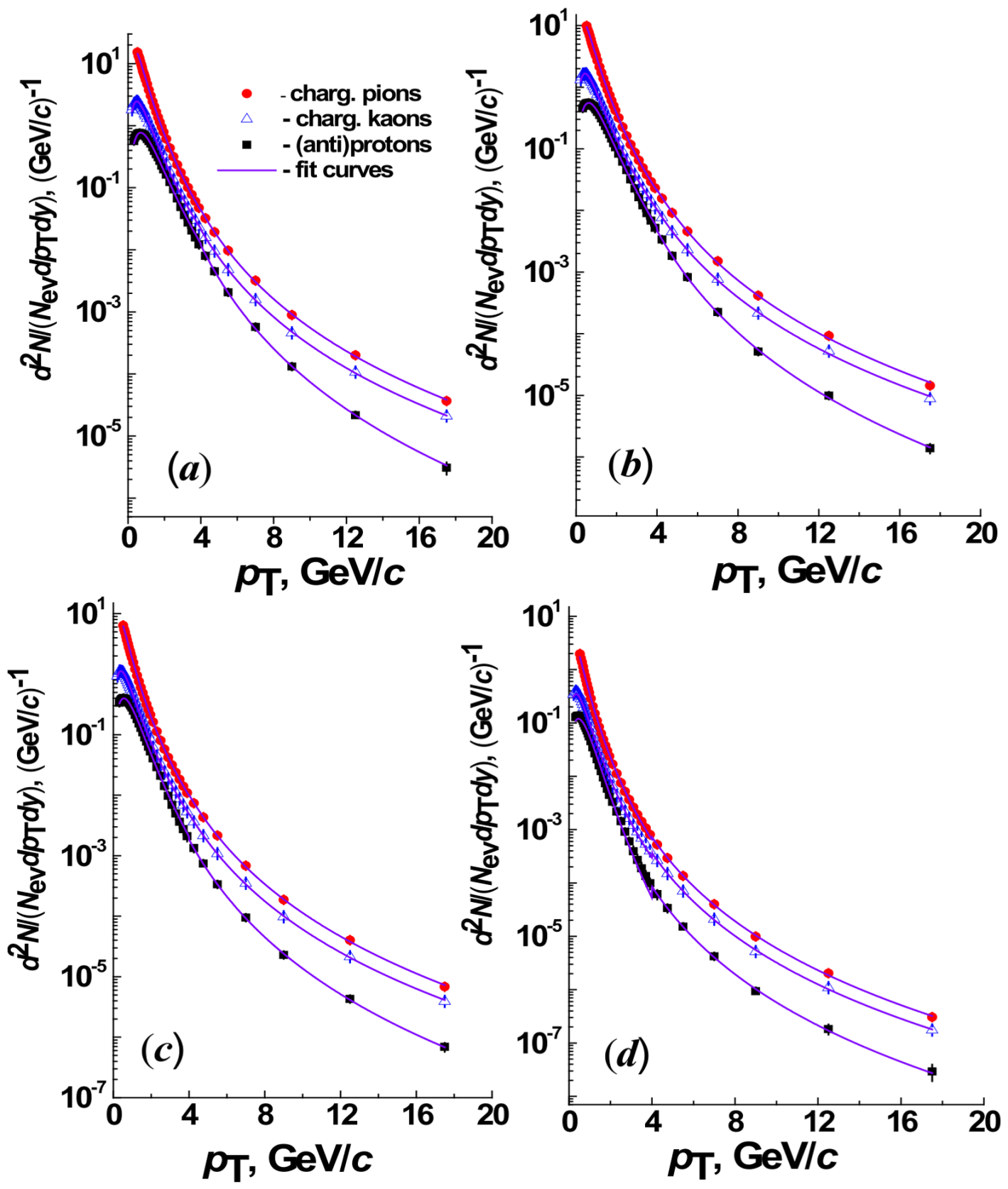
Figure 2.
The simultaneous minimum fits (solid curves) by the function in Eq. (6) of the experimental midrapidity pT spectra of the charged pions and kaons, protons and antiprotons in inelastic proton-proton collisions at = 13 TeV in different classes of charged-particle multiplicity density: = 26.02±0.35 (a), = 16.17±0.22 (b), = 10.02±0.14 (c), and = 2.55±0.04 (d). The vertical error bars are the sum of statistical and systematic uncertainties, dominated by the systematic ones.
Figure 2.
The simultaneous minimum fits (solid curves) by the function in Eq. (6) of the experimental midrapidity pT spectra of the charged pions and kaons, protons and antiprotons in inelastic proton-proton collisions at = 13 TeV in different classes of charged-particle multiplicity density: = 26.02±0.35 (a), = 16.17±0.22 (b), = 10.02±0.14 (c), and = 2.55±0.04 (d). The vertical error bars are the sum of statistical and systematic uncertainties, dominated by the systematic ones.
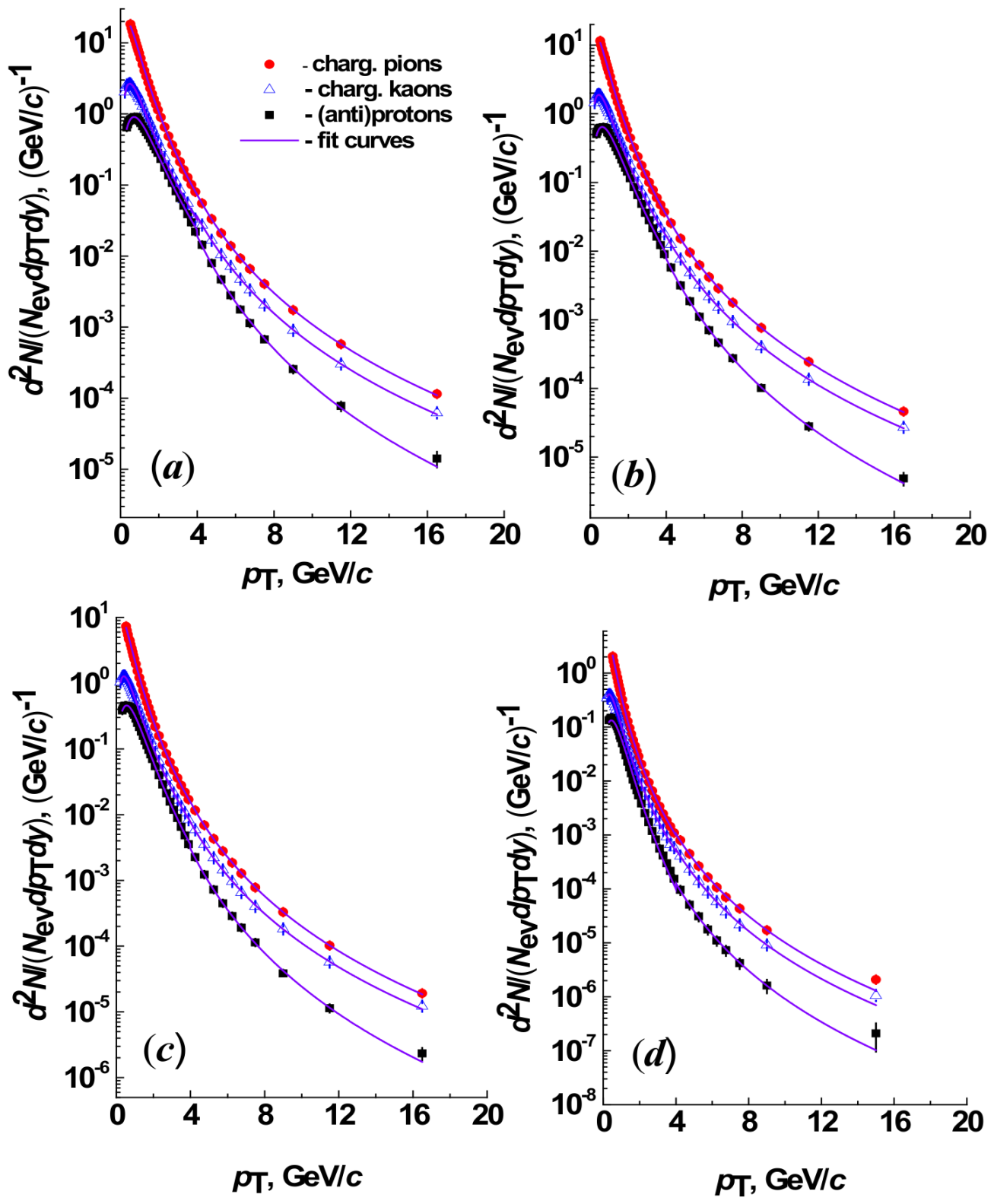
Figure 3.
The dependencies of the obtained parameters T0 (a), ⟩ (b), and q (c) of two-component model (THMTF) function (Eq. (6)), given in Table 2 and Table 3, on the average charged particle multiplicity density () in proton-proton collisions at = 7 and 13 TeV. The vertical lines at = 7.6±0.9 and = 9.0±1.0 show estimated border values of transition towards region of constant T0 and possible onset of deconfinement phase transition in proton-proton collisions at = 7 and 13 TeV, respectively.
Figure 3.
The dependencies of the obtained parameters T0 (a), ⟩ (b), and q (c) of two-component model (THMTF) function (Eq. (6)), given in Table 2 and Table 3, on the average charged particle multiplicity density () in proton-proton collisions at = 7 and 13 TeV. The vertical lines at = 7.6±0.9 and = 9.0±1.0 show estimated border values of transition towards region of constant T0 and possible onset of deconfinement phase transition in proton-proton collisions at = 7 and 13 TeV, respectively.
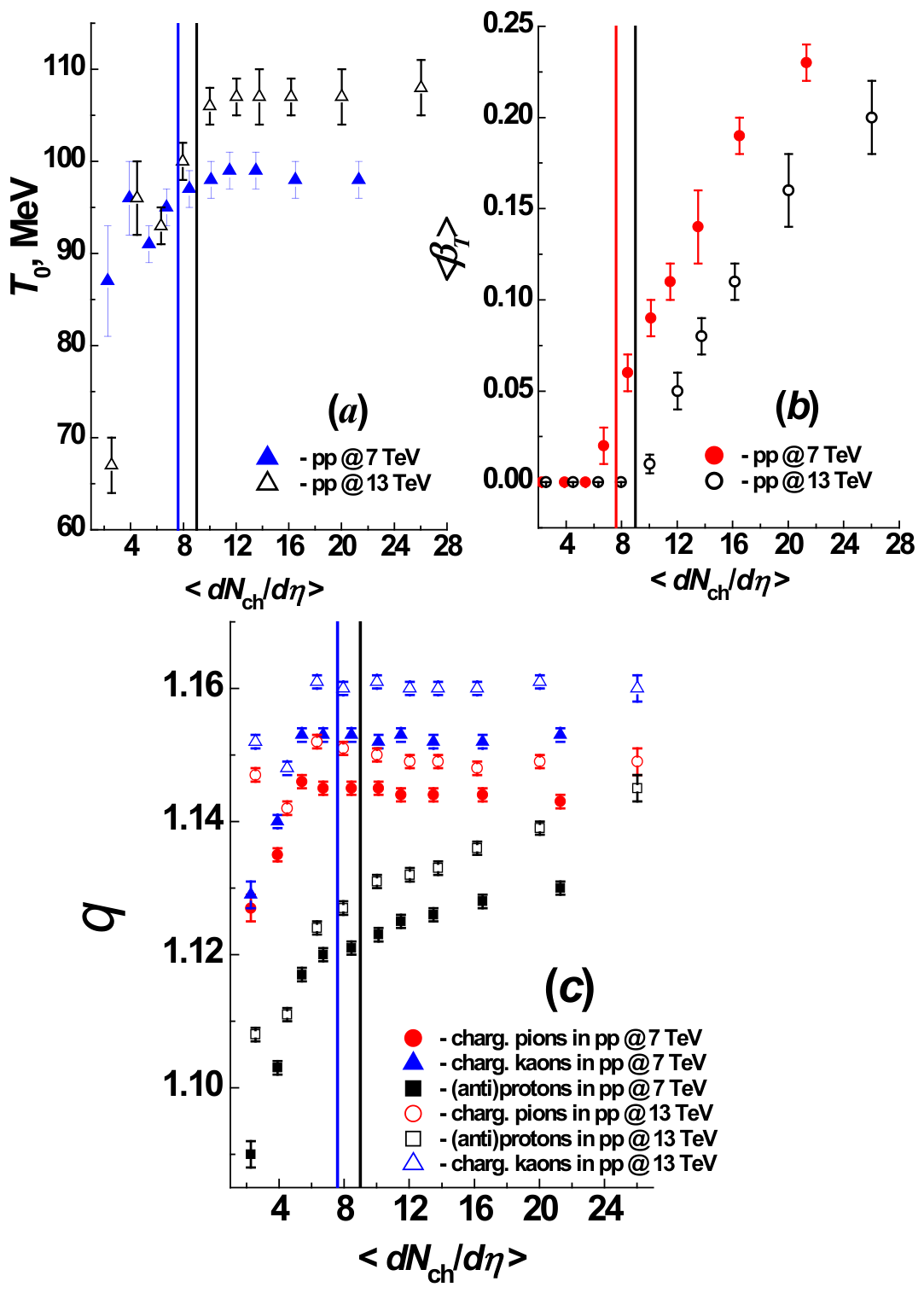
Figure 4.
The dependencies of the obtained parameters P0 (a) and n (b) of two-component model (THMTF) function (Eq. (6)), given in Table 2 and Table 3, on the average charged-particle multiplicity density () in proton-proton collisions at =7 and 13 TeV.
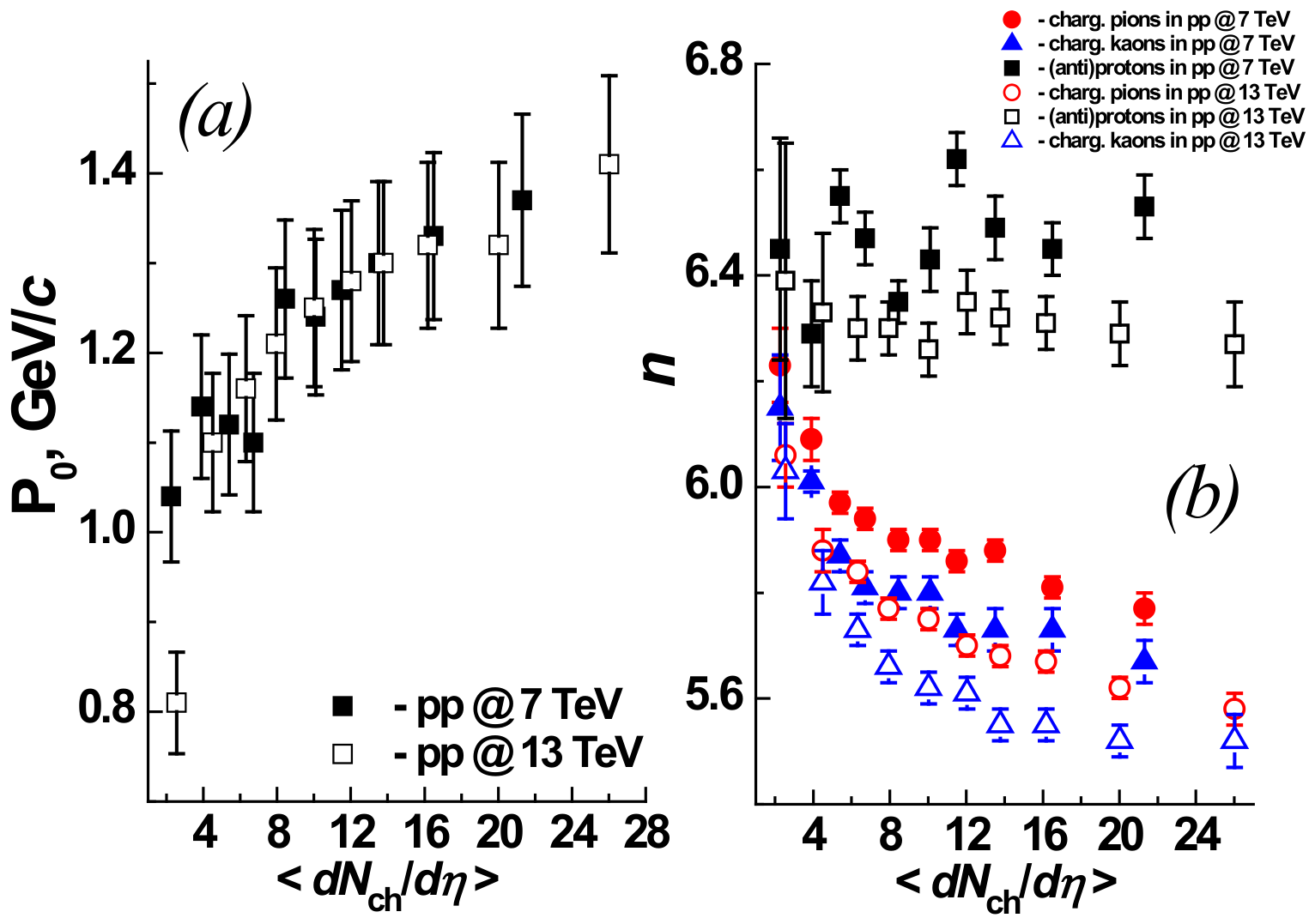

Table 1.
The mean charged-particle multiplicity density and fraction of inelastic cross-section in ten multiplicity groups in inelastic proton-proton collisions at =7 and 13 TeV.
Table 1.
The mean charged-particle multiplicity density and fraction of inelastic cross-section in ten multiplicity groups in inelastic proton-proton collisions at =7 and 13 TeV.
| p+p collisions at =7 TeV [13] | p+p collisions at =13 TeV [40] | ||||
|---|---|---|---|---|---|
| V0M mult. class | < dNch/dη > | σ/σINEL>0 (%) | V0M mult. class | < dNch/dη > | σ/σINEL>0 (%) |
| I | 21.3±0.6 | 0-0.95 | I | 26.02±0.35 | 0-0.92 |
| II | 16.5±0.5 | 0.95-4.7 | II | 20.02±0.27 | 0.92-4.6 |
| III | 13.5±0.4 | 4.7-9.5 | III | 16.17±0.22 | 4.6-9.2 |
| IV | 11.5±0.3 | 9.5-14 | IV | 13.77±0.19 | 9.2-13.8 |
| V | 10.1±0.3 | 14-19 | V | 12.04±0.17 | 13.8-18.4 |
| VI | 8.45±0.25 | 19-28 | VI | 10.02±0.14 | 18.4-27.6 |
| VII | 6.72±0.21 | 28-38 | VII | 7.95±0.11 | 27.6-36.8 |
| VIII | 5.40±0.17 | 38-48 | VIII | 6.32±0.09 | 36.8-46 |
| IX | 3.90±0.14 | 48-68 | IX | 4.50±0.07 | 46.0-64.5 |
| X | 2.26±0.12 | 68-100 | X | 2.55±0.04 | 64.5-100 |
Table 2.
The results obtained from minimum simultaneous fits with two-component model (THMTF) function (Eq. (6)) of experimental midrapidity spectra of the charged pions and kaons, protons and antiprotons in different multiplicity classes of proton-proton collisions at = 7 TeV.
Table 2.
The results obtained from minimum simultaneous fits with two-component model (THMTF) function (Eq. (6)) of experimental midrapidity spectra of the charged pions and kaons, protons and antiprotons in different multiplicity classes of proton-proton collisions at = 7 TeV.
| ⟩ | T0, (MeV) | P0, GeV/c | q(π±) | q(K±) | q(p,) | n(π±) | n(K±) | n(p,) |
/n.d.f. (n.d.f.) |
|
|---|---|---|---|---|---|---|---|---|---|---|
| 21.3±0.6 | 0.23±0.01 | 98±2 | 1.37 | 1.143±0.001 | 1.153±0.001 | 1.130±0.001 | 5.77±0.03 | 5.67±0.04 | 6.53±0.06 | 0.22 (106) |
| 16.5±0.5 | 0.19±0.01 | 98±2 | 1.33 | 1.144±0.001 | 1.152±0.001 | 1.128±0.001 | 5.81±0.02 | 5.73±0.04 | 6.45±0.05 | 0.24 (106) |
| 13.5±0.4 | 0.14±0.02 | 99±2 | 1.30 | 1.144±0.001 | 1.152±0.001 | 1.126±0.001 | 5.88±0.02 | 5.73±0.04 | 6.49±0.06 | 0.25 (106) |
| 11.5±0.3 | 0.11±0.01 | 99±2 | 1.27 | 1.144±0.001 | 1.153±0.001 | 1.125±0.001 | 5.86±0.02 | 5.73±0.03 | 6.62±0.05 | 0.17 (106) |
| 10.1±0.3 | 0.09±0.01 | 98±2 | 1.24 | 1.145±0.001 | 1.152±0.001 | 1.123±0.001 | 5.90±0.02 | 5.80±0.03 | 6.43±0.06 | 0.18 (106) |
| 8.45±0.25 | 0.06±0.01 | 97±2 | 1.26 | 1.145±0.001 | 1.153±0.001 | 1.121±0.001 | 5.90±0.02 | 5.80±0.03 | 6.35±0.04 | 0.13 (106) |
| 6.72±0.21 | 0.02±0.01 | 95±2 | 1.10 | 1.145±0.001 | 1.153±0.001 | 1.120±0.001 | 5.94±0.02 | 5.81±0.03 | 6.47±0.05 | 0.13 (106) |
| 5.40±0.17 | ≈10-5 | 91±2 | 1.12 | 1.146±0.001 | 1.153±0.001 | 1.117±0.001 | 5.97±0.02 | 5.87±0.03 | 6.55±0.05 | 0.12 (106) |
| 3.90±0.14 | ≈10-5 | 96±4 | 1.14 | 1.135±0.001 | 1.140±0.001 | 1.103±0.001 | 6.09±0.04 | 6.01±0.02 | 6.29±0.10 | 0.52 (106) |
| 2.26±0.12 | ≈10-5 | 87±6 | 1.04 | 1.127±0.002 | 1.129±0.002 | 1.090±0.002 | 6.23±0.07 | 6.15±0.10 | 6.45±0.21 | 1.16 (106) |
Table 3.
The results obtained from minimum simultaneous fits with two-component model (THMTF) function (Eq. (6)) of experimental midrapidity spectra of the charged pions and kaons, protons and antiprotons in different multiplicity classes of proton-proton collisions at = 13 TeV.
Table 3.
The results obtained from minimum simultaneous fits with two-component model (THMTF) function (Eq. (6)) of experimental midrapidity spectra of the charged pions and kaons, protons and antiprotons in different multiplicity classes of proton-proton collisions at = 13 TeV.
| ⟩ | T0, (MeV) | P0, GeV/c | q(π±) | q(K±) | q(p,) | n(π±) | n(K±) | n(p,) |
/n.d.f. (n.d.f.) |
|
|---|---|---|---|---|---|---|---|---|---|---|
| 26.02±0.35 | 0.20±0.02 | 108±3 | 1.41 | 1.149±0.002 | 1.160±0.002 | 1.145±0.002 | 5.58±0.03 | 5.52±0.05 | 6.27±0.08 | 0.32 (115) |
| 20.02±0.27 | 0.16±0.02 | 107±3 | 1.32 | 1.149±0.001 | 1.161±0.001 | 1.139±0.001 | 5.62±0.02 | 5.52±0.03 | 6.29±0.06 | 0.21 (115) |
| 16.17±0.22 | 0.11±0.01 | 107±2 | 1.32 | 1.148±0.001 | 1.160±0.001 | 1.136±0.001 | 5.67±0.02 | 5.55±0.03 | 6.31±0.05 | 0.16 (115) |
| 13.77±0.19 | 0.08±0.01 | 107±3 | 1.30 | 1.149±0.001 | 1.160±0.001 | 1.133±0.001 | 5.68±0.02 | 5.55±0.03 | 6.32±0.05 | 0.16 (115) |
| 12.04±0.17 | 0.05±0.01 | 107±2 | 1.28 | 1.149±0.001 | 1.160±0.001 | 1.132±0.001 | 5.70±0.02 | 5.61±0.03 | 6.35±0.06 | 0.14 (115) |
| 10.02±0.14 | 0.01±0.005 | 106±2 | 1.25 | 1.150±0.001 | 1.161±0.001 | 1.131±0.001 | 5.75±0.02 | 5.62±0.03 | 6.26±0.05 | 0.14 (115) |
| 7.95±0.11 | ≈10-5 | 100±2 | 1.21 | 1.151±0.001 | 1.160±0.001 | 1.127±0.001 | 5.77±0.02 | 5.66±0.03 | 6.30±0.05 | 0.11 (115) |
| 6.32±0.09 | ≈10-5 | 93±2 | 1.16 | 1.152±0.001 | 1.161±0.001 | 1.124±0.001 | 5.84±0.02 | 5.73±0.03 | 6.30±0.06 | 0.16 (115) |
| 4.50±0.07 | ≈10-5 | 96±4 | 1.10 | 1.142±0.001 | 1.148±0.001 | 1.111±0.001 | 5.88±0.04 | 5.82±0.06 | 6.33±0.15 | 0.45 (115) |
| 2.55±0.04 | ≈10-5 | 67±3 | 0.81 | 1.147±0.001 | 1.152±0.001 | 1.108±0.001 | 6.06±0.06 | 6.03±0.09 | 6.39±0.26 | 0.53 (112) |
Table 4.
Pearson correlation coefficient, , and its corresponding standard error between various parameters of two-component model function (Eq. (6)) extracted from simultaneous minimum χ2 fits of experimental midrapidity transverse momentum spectra of the charged pions and kaons, protons and antiprotons in proton-proton collisions at = 7 and 13 TeV and given in Table 2 and Table 3, respectively.
Table 4.
Pearson correlation coefficient, , and its corresponding standard error between various parameters of two-component model function (Eq. (6)) extracted from simultaneous minimum χ2 fits of experimental midrapidity transverse momentum spectra of the charged pions and kaons, protons and antiprotons in proton-proton collisions at = 7 and 13 TeV and given in Table 2 and Table 3, respectively.
| Collision type | pp @ 7 TeV | pp @ 13 TeV | Collision type | pp @ 7 TeV | pp @ 13 TeV |
| R(<βT>, T0) | +0.68±0.26 | +0.54±0.30 |
R(q, <βT>) (for pions) |
+0.39±0.32 | +0.08±0.35 |
| R(<βT>, P0) | +0.93±0.13 | +0.69±0.26 |
R(q, <βT>) (for kaons) |
+0.49±0.31 | +0.40±0.32 |
| R(P0, T0) | +0.83±0.19 | +0.97±0.09 |
R(q, <βT>) (for (anti)protons) |
+0.75±0.24 | +0.81±0.21 |
| R(P0,) | +0.93±0.13 | +0.83±0.20 |
R(q,) (for pions) |
+0.50±0.31 | +0.22±0.34 |
| R((<βT>,) | +0.99±0.06 | +0.97±0.09 |
R(q,) (for kaons) |
+0.59±0.29 | +0.56±0.29 |
| R(T0,) | +0.70±0.25 | +0.70±0.25 |
R(q,) (for (anti)protons) |
+0.81±0.21 | +0.92±0.14 |
|
R(<βT>, n) (for pions) |
–0.81±0.21 | –0.79±0.22 |
R(P0, n) (for pions) |
–0.89±0.17 | –0.98±0.07 |
|
R(<βT>, n) (for kaons) |
–0.78±0.22 | –0.69±0.25 |
R(P0, n) (for kaons) |
–0.85±0.19 | –0.98±0.06 |
|
R(<βT>, n) (for (anti)protons) |
+0.34±0.33 | –0.40±0.32 |
R(P0, n) (for (anti)protons) |
+0.21±0.35 | –0.73±0.24 |
|
R(q, T0) (for pions) |
+0.65±0.27 | +0.23±0.34 |
R(n, T0) (for pions) |
–0.82±0.20 | –0.93±0.13 |
|
R(q, T0) (for kaons) |
+0.71±0.25 | +0.61±0.28 |
R(n, T0) (for kaons) |
–0.83±0.20 | –0.95±0.11 |
|
R(q, T0) (for (anti)protons) |
+0.81±0.21 | +0.83±0.20 |
R(n, T0) (for (anti)protons) |
+0.05±0.35 | –0.70±0.25 |
|
R(q, P0) (for pions) |
+0.55±0.29 | +0.34±0.33 |
R(n,) (for pions) |
–0.87±0.17 | –0.90±0.15 |
|
R(q, P0) (for kaons) |
+0.63±0.27 | +0.70±0.25 |
R(n,) (for kaons) |
–0.84±0.19 | –0.83±0.20 |
|
R(q, P0) (for (anti)protons) |
+0.83±0.20 | +0.93±0.13 |
R(n,) (for (anti)protons) |
+0.38±0.33 | –0.56±0.29 |
Table 5.
Pearson correlation coefficient, , and its corresponding standard error between various parameters of two-component model function (Eq. (6)) obtained in Ref. [37] from minimum χ2 fits of experimental midrapidity transverse momentum spectra of primary charged particles in Xe+Xe collisions at =5.44 TeV and Pb+Pb collisions at =2.76 and 5.02 TeV.
Table 5.
Pearson correlation coefficient, , and its corresponding standard error between various parameters of two-component model function (Eq. (6)) obtained in Ref. [37] from minimum χ2 fits of experimental midrapidity transverse momentum spectra of primary charged particles in Xe+Xe collisions at =5.44 TeV and Pb+Pb collisions at =2.76 and 5.02 TeV.
| Collision type | Xe+Xe collisions at=5.44 TeV | Pb+Pb collisions at=2.76 TeV | Pb + Pb collisions at= 5.02 TeV |
| R(<βT>, T0) | −0.96±0.10 | −0.97±0.09 | −0.95±0.12 |
| R(<βT>, P0) | +0.98±0.08 | +0.99±0.06 | +0.97±0.10 |
| R(P0, T0) | −0.92±0.15 | −0.95±0.12 | −0.85±0.20 |
| R(<βT>, n) | −0.96±0.11 | −0.98±0.07 | −0.97±0.10 |
| R(q, T0) | +0.84±0.21 | +0.94±0.13 | +0.91±0.16 |
| R(q, P0) | −0.97±0.09 | −0.99±0.02 | −0.96±0.10 |
| R(q, <βT>) | −0.95±0.12 | −0.98±0.07 | −0.97±0.10 |
| R(q, n) | +0.90±0.17 | +0.97±0.09 | +0.90±0.17 |
| R(q, <dNch/dη>) | −0.92±0.15 | −0.91±0.15 | −0.85±0.20 |
| R(P0, n) | −0.93±0.14 | −0.97±0.09 | −0.89±0.17 |
| R(P0, <dNch/dη>) | +0.92±0.15 | +0.90±0.17 | +0.91±0.16 |
| R(n, T0) | +0.93±0.14 | +0.94±0.13 | +0.96±0.11 |
| R(n, <dNch/dη>) | −0.79±0.23 | −0.84±0.20 | −0.69±0.27 |
Disclaimer/Publisher’s Note: The statements, opinions and data contained in all publications are solely those of the individual author(s) and contributor(s) and not of MDPI and/or the editor(s). MDPI and/or the editor(s) disclaim responsibility for any injury to people or property resulting from any ideas, methods, instructions or products referred to in the content. |
© 2026 by the authors. Licensee MDPI, Basel, Switzerland. This article is an open access article distributed under the terms and conditions of the Creative Commons Attribution (CC BY) license (http://creativecommons.org/licenses/by/4.0/).
Copyright: This open access article is published under a Creative Commons CC BY 4.0 license, which permit the free download, distribution, and reuse, provided that the author and preprint are cited in any reuse.