

Submitted:
25 July 2026
Posted:
28 July 2026
You are already at the latest version
Abstract
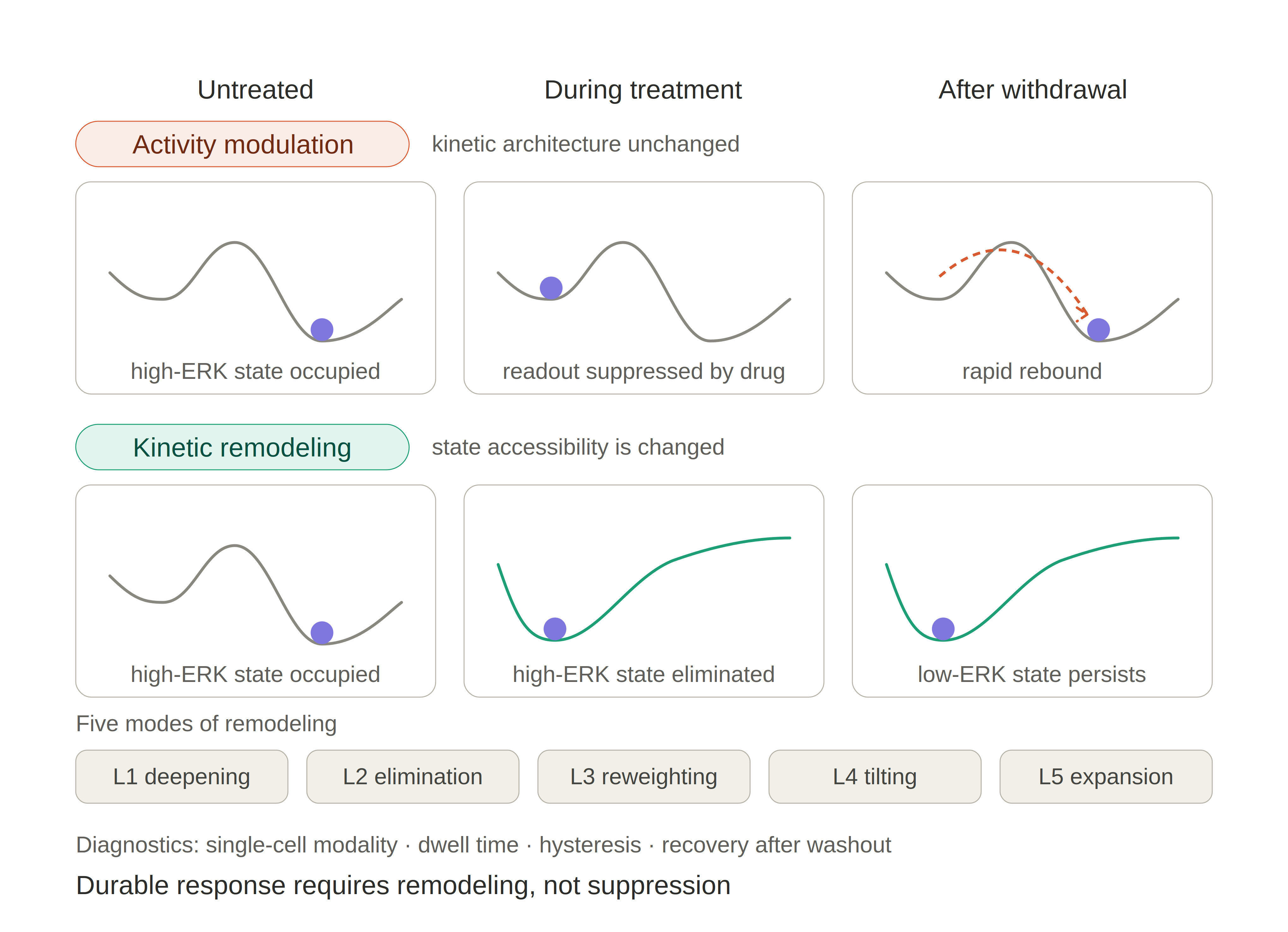
Durable therapeutic response depends not only on suppressing a disease-associated pathway, but also on changing the cellular dynamics that permit pathological or drug-tolerant states to persist and re-emerge. We distinguish transient activity modulation from kinetic remodeling, defined as a change in the drift, noise, flux, stability or transition structure governing cell-state accessibility. Using MAPK signaling as a model system, we organize remodeling into five idealized modes and link each to measurable signatures, including altered occupancy, switching, hysteresis and post-withdrawal recovery. This framework provides an experimental basis for identifying interventions that produce durable state control rather than temporary pathway inhibition.
Keywords:
MAPK/ERK signaling
; attractor landscapes
; stochastic dynamics
; cancer therapy resistance
; cell-fate transitions
; non-equilibrium thermodynamics
; single-cell dynamics
Copyright: This open access article is published under a Creative Commons CC BY 4.0 license, which permit the free download, distribution, and reuse, provided that the author and preprint are cited in any reuse.


