

Submitted:
25 July 2026
Posted:
27 July 2026
You are already at the latest version
Abstract
This article introduces the concept of Normative Phonetic Inclusiveness (NPI), defined as the degree to which a speech community recognizes multiple phonetic realizations of the same phonological category as equally legitimate within a shared linguistic norm. Using the Dutch rhotic (/r/) system as an exploratory case, the paper argues that the sociolinguistic significance of phonetic variation extends beyond its role as a marker of social identity to include the social organization of linguistic legitimacy. Contemporary Dutch accommodates a wide range of rhotic realizations without systematically privileging a single variant, providing an opportunity to examine how linguistic communities regulate diversity within a stable normative framework. Rather than proposing a causal relationship between pronunciation and broader cultural values, the article suggests that linguistic norms and other social norms emerge within the same historical and institutional ecology. Drawing on sociolinguistics and classical sociological theories of norms, the study conceptualizes NPI as a property of speech communities rather than individual speakers and distinguishes it from established concepts such as phonetic variation, linguistic prestige, and language ideology. The Dutch case serves as a theoretically motivated illustration for developing a broader framework of linguistic legitimacy, with the aim of stimulating future comparative research on how different speech communities organize the acceptance of phonetic diversity.
Keywords:
Normative Phonetic Inclusiveness
; Dutch rhotic (/r/)
; sociolinguistics
; linguistic legitimacy
; phonetic variation
; social meaning
; social norm
1. Introduction
Language is often described as a mirror of society. Beyond its communicative function, it reflects historical trajectories, social structures, cultural values, and collective identities. Linguistic forms are neither neutral nor randomly distributed; rather, they emerge through continuous interaction between speakers and the social environments in which they live. For decades, sociolinguistics has demonstrated that pronunciation, lexical choice, and grammatical variation frequently encode information about regional origin, social class, education, age, ethnicity, professional identity, and political affiliation. Language therefore constitutes one of the most powerful observable manifestations of social organization (Hartono et al, 2021; Bourdieu, 1991).
Among phonological phenomena, few consonants have attracted as much scholarly attention as the rhotic consonant (/r/). Across languages, rhotics display extraordinary articulatory variability while simultaneously carrying substantial sociolinguistic meaning. In English, the presence or absence of post-vocalic /r/ has historically functioned as a marker of prestige, social mobility, regional identity, and class distinction. Previous work has shown that rhoticity represents considerably more than a phonetic characteristic, reflecting instead broader historical processes of social stratification and cultural change (Costa & Serra, 2022). Similar observations have emerged in numerous linguistic traditions, where different realizations of /r/ frequently become associated with identity, prestige, regional belonging, or educational background (Tan, 2012; Becker, 2009).
The sociological significance of rhotics has therefore been investigated primarily from one perspective: what a particular pronunciation reveals about the speaker. Different pronunciations have generally been interpreted as social signals, allowing listeners to infer information regarding geographical origin, socioeconomic status, ethnicity, or membership within specific communities. In other words, sociolinguistic research has predominantly examined pronunciation as a marker of social differentiation (Costa & Serra, 2022).
This article proposes a complementary perspective. Rather than asking what a particular pronunciation communicates about an individual speaker, the present article examines what the collective acceptance of multiple pronunciations may reveal about a speech community itself. This shift in analytical perspective, from the speaker to the community, constitutes the central contribution of the present study.
The Netherlands offers an exceptional opportunity to explore this question. Contemporary Dutch exhibits one of the richest repertoires of rhotic realizations among European languages. Depending on regional background, age, phonological context, and individual preference, speakers may employ alveolar trills, alveolar taps, uvular fricatives, uvular trills, approximants, or reduced rhotic variants while remaining fully intelligible and socially accepted within the framework of Standard Dutch. Unlike many languages that largely converge on a single dominant realization of /r/, contemporary Dutch exhibits a remarkably broad rhotic repertoire. Depending on geographical region, age, social background, speech style, and phonetic context, speakers may employ several articulatory realizations of the same phonological category without compromising intelligibility or, in many contexts, normative acceptability. These realizations differ substantially in their articulatory mechanisms while fulfilling the same phonological function within the language (Van de Velde & Van Hout, 1999).
The alveolar trill [r] is the traditional "rolled R" familiar from languages such as Spanish and Italian. It is produced when the tongue tip vibrates rapidly against the alveolar ridge through aerodynamic airflow, generating a series of brief contacts. Historically widespread throughout the Netherlands and Flanders, this realization remains common in many northern and eastern regions and is often associated with more conservative or regional speech varieties (Wiemann, M. (2023; Verhoeven, 2002).
Closely related is the alveolar tap [ɾ], sometimes referred to as a "flapped R." Unlike the trill, the tongue makes only a single brief contact with the alveolar ridge rather than vibrating repeatedly. Because it requires less precise aerodynamic control than a trill, the tap frequently appears in rapid or casual speech and may alternate with the alveolar trill within the same speaker. Although phonetically distinct, both variants are generally interpreted by listeners as equivalent realizations of the Dutch rhotic phoneme (Anselme et al, 2023).
A second major group comprises uvular realizations, articulated at the back of the vocal tract. The uvular trill [ʀ] is produced through vibration of the uvula against the posterior part of the tongue. It resembles the traditional French or German "guttural R" and became increasingly common in several western Dutch-speaking regions during the twentieth century. Closely related is the uvular fricative [ʁ], in which airflow passes through a narrow constriction between the tongue dorsum and the uvula without producing repeated vibration. The resulting sound is smoother and less percussive than the uvular trill and represents one of the most frequent posterior realizations encountered in contemporary Dutch speech (Barry, 1997; Tabain, 2019; Van de Velde & Van Hout, 1999).
In addition to these more canonical rhotics, many speakers, particularly younger generations in the Randstad, produce an alveolar approximant [ɹ], often referred to as the Gooise R. In this realization, the tongue approaches the alveolar region without making sufficient contact to generate either a trill or a tap, producing a sound acoustically similar to the English rhotic. Although this pronunciation has sometimes attracted public attention and sociolinguistic commentary, it has become increasingly widespread and is no longer confined to a narrow social group (Van Bezooijen, 2005).
Dutch also exhibits reduced rhotic variants, particularly in syllable-final position or in casual speech. In these contexts, the rhotic gesture may be substantially weakened, vocalized, centralized, or only minimally articulated while continuing to fulfil its phonological role. Such reductions illustrate that rhotic variation concerns not only different places and manners of articulation but also varying degrees of articulatory prominence (Plug, 2003).
From a phonetic perspective, these realizations differ considerably in place of articulation, manner of articulation, and acoustic properties. From a phonological perspective, however, they represent alternative realizations of the same underlying category. It is precisely this coexistence of substantial phonetic diversity within a shared phonological and normative framework that makes the Dutch rhotic system particularly valuable for examining the concept of Normative Phonetic Inclusiveness (NPI). The theoretical interest of the Dutch /r/ therefore lies not simply in the number of available variants, but in the observation that several markedly different articulatory solutions may coexist without necessarily challenging their recognition as legitimate members of the same linguistic system (Table 1).
Importantly, these realizations are not confined to isolated dialects but coexist within a linguistic system characterized by considerable normative flexibility. Speakers using different rhotics participate in the same educational institutions, consume the same national media, and communicate without systematic correction or widespread perceptions of linguistic inadequacy (Van de Velde & Van Hout, 1999).
This observation raises an intriguing interdisciplinary question. Could the coexistence of multiple socially legitimate pronunciations represent more than a phonetic curiosity? Might it instead constitute one manifestation of broader cultural attitudes toward diversity, flexibility, and coexistence?
At first glance, such a proposition may appear speculative. Language does not determine culture, nor does culture determine language through simple causal mechanisms. Contemporary sociolinguistics has convincingly rejected deterministic explanations in favor of dynamic models emphasizing reciprocal interaction between linguistic practices and social structures. Consequently, this article does not argue that Dutch society is tolerant because Dutch speakers pronounce /r/ differently, nor that phonetic variability directly produces social inclusiveness. Such claims would be theoretically untenable and empirically unsubstantiated.
Instead, a more cautious proposition should be advanced. It can be suggested that the same historical, political, and cultural conditions that encouraged normative flexibility within Dutch society may also have fostered a linguistic environment in which multiple phonetic realizations of a single phoneme are widely accepted without systematic hierarchies of correctness or prestige. Under this interpretation, phonetic variability becomes neither a cause nor a consequence of social inclusiveness in isolation, but rather one possible manifestation of broader normative orientations toward diversity (Formanowicz & Suitner, 2020).
To conceptualize this phenomenon, the analytical construct of phonetic inclusiveness is introduced. Phonetic inclusiveness is defined as the extent to which a speech community accepts multiple phonetic realizations of the same phonological category without systematically attributing differential legitimacy, correctness, prestige, or communicative value to those variants. The concept deliberately shifts attention away from phonetic variation itself toward the social evaluation of variation. Two linguistic systems may display comparable degrees of phonetic diversity while differing profoundly in the extent to which that diversity is socially accepted, institutionally legitimized, or stigmatized (Rosa & Flores, 2023). Closely associated with phonetic inclusiveness is the concept of normative phonetic flexibility, defined as the capacity of a linguistic community to maintain multiple legitimate phonetic realizations within a shared linguistic norm rather than enforcing strict phonetic uniformity. Normative phonetic flexibility constitutes the social and institutional condition through which phonetic inclusiveness becomes possible. Together, these concepts offer a new analytical vocabulary for examining relationships between linguistic norms and broader cultural models of pluralism (Eckert & Labov, 2017).
The Dutch rhotic system represents an ideal exploratory case study for developing this conceptual framework. The remarkable variability of Dutch /r/ has been extensively documented by phonetic and sociolinguistic research, providing a robust empirical foundation upon which broader theoretical reflections may be constructed. Simultaneously, Dutch society has long been associated with concepts such as consensus-oriented governance, pragmatic accommodation, and institutional pluralism. Although these cultural characteristics have traditionally been examined within sociology, political science, and anthropology, they have rarely been considered alongside phonological variation. Bringing these domains into dialogue constitutes one of the principal innovations of the present article.
The objective of this paper is therefore not to demonstrate causality but to propose a new conceptual framework capable of generating future empirical research. Specifically, the article pursues four interconnected aims. First, it reviews existing sociolinguistic evidence concerning the Dutch rhotic system and its exceptional phonetic variability . Second, it examines Dutch traditions of normative flexibility and social pluralism (Hendriks, 2017) as possible cultural contexts within which phonetic inclusiveness may emerge. Third, it formally introduces the analytical construct of phonetic inclusiveness and distinguishes it from existing concepts such as phonetic variation, language ideology, and linguistic prestige. Finally, it proposes a broader interdisciplinary framework through which future comparative studies may investigate whether different linguistic communities exhibit differing degrees of phonetic inclusiveness and whether these patterns are associated with broader cultural orientations toward diversity.
Ultimately, the article invites scholars to reconsider an apparently simple linguistic observation. When a society allows many voices to pronounce the same letter in different ways without systematically privileging one over another, this phenomenon may represent more than phonetic diversity alone. It may offer a window into understanding how communities negotiate plurality, legitimacy, and coexistence. Whether this hypothesis withstands empirical investigation remains an open question. Nevertheless, it is argued that it represents a question worthy of systematic interdisciplinary inquiry.
To clarify the theoretical contribution of this article, it is important to distinguish between three analytically related but conceptually different dimensions of linguistic diversity: variation, meaning, and legitimacy. Linguistic variation refers to the existence of alternative forms within a speech community and constitutes the primary object of classical variationist sociolinguistics. Social meaning concerns the ways in which these forms become associated with identities, social groups, values, and contextual meanings. Linguistic legitimacy, by contrast, refers to the extent to which particular forms are recognized as acceptable and valid within the normative boundaries of a shared linguistic system. These dimensions are interconnected but should not be conflated. A linguistic variant may exist without achieving social recognition; it may acquire strong social meanings while remaining stigmatized; or it may become fully legitimate despite maintaining distinctive regional, stylistic, or identity-related associations. The central argument of this article is that sociolinguistic analysis should pay greater attention to the third dimension: the social organization of legitimacy among competing linguistic forms (Eckert, 2018; Reagan, 2019).
Within this framework, NPI refers not simply to the presence of phonetic variation, but to the extent to which multiple phonetic realizations of the same linguistic category are collectively recognized as legitimate within a shared normative system. NPI therefore represents a specific configuration of linguistic legitimacy in which diversity is accommodated without undermining the coherence of the linguistic community. The Dutch rhotic system provides an illustrative example of this configuration because different realizations of /r/ appear to coexist within a common linguistic framework (Van de Velde & Van Hout, 1999; Eckert, 2018; Reagan, 2019), suggesting that variation and normative stability may operate simultaneously rather than as opposing forces (Figure 1).
2. Rhoticity Beyond Phonetics: From Social Stratification to Social Meaning
The rhotic consonant has occupied a unique position within sociolinguistic research for more than half a century. Although phonetic variability characterizes many speech sounds, few have acquired such profound symbolic significance across different linguistic communities as the phoneme /r/. Its articulatory diversity has been extensively documented within descriptive linguistics, yet its sociological importance extends far beyond phonetics. Throughout history, different realizations of /r/ have repeatedly become associated with prestige, authority, regional belonging, education, social mobility, political identity, and cultural affiliation. Consequently, rhoticity represents one of the clearest examples of how seemingly minor phonetic phenomena may acquire major social meaning (Sebregts, 2023; Costa & Serra, 2022).
Variationist sociolinguistics fundamentally transformed the understanding of pronunciation by demonstrating that phonological variation rarely occurs randomly. Instead, linguistic variables systematically correlate with social structures, revealing patterns of stratification embedded within everyday speech. Among these variables, rhoticity rapidly emerged as one of the most informative. William Labov's pioneering studies of New York City department stores illustrated that the pronunciation of post-vocalic /r/ functioned as an indicator of socioeconomic status, occupational prestige, and speakers' aspirations toward upward social mobility. Individuals did not simply pronounce a consonant differently; rather, they positioned themselves within an existing social hierarchy through linguistic behaviour (Labov, 1964a; Labov, 1966).
Since Labov's seminal investigations, numerous studies have confirmed that rhotic variation frequently indexes social differentiation. In England, the historical decline of post-vocalic /r/ in southern varieties became closely associated with Received Pronunciation and institutional prestige, while rhotic accents continued to characterize Scotland, Ireland, and many southwestern regions. Similar dynamics have been documented in North America, Australia, New Zealand, and several Caribbean speech communities, where the presence or absence of rhoticity has reflected changing relationships between regional identity, educational attainment, and social prestige (Costa & Serra, 2022).
Importantly, these sociolinguistic interpretations shifted attention away from phonetic mechanisms themselves toward the meanings speakers and listeners attribute to linguistic forms. A pronunciation becomes socially significant not because of its articulatory properties but because communities collectively assign symbolic value to it. Phonetic variants therefore operate as social signs whose meanings evolve through historical processes, institutional practices, educational systems, and public attitudes (Costa & Serra, 2022).
Previous research has also demonstrated that rhoticity frequently functions as an identity marker. Speakers consciously or unconsciously manipulate rhotic variants to negotiate belonging within particular communities, express solidarity, distance themselves from social groups, or project professional authority. The same phonetic realization may consequently convey different meanings depending upon geographical location, historical period, or interactional context. Language therefore functions simultaneously as communication and as social performance (Costa & Serra, 2022).
A previous narrative review examining English rhoticity synthesized this extensive literature by demonstrating how changes in the pronunciation of /r/ reflected transformations in British and American social organization over several centuries. Rather than representing purely phonological developments, historical shifts between rhotic and non-rhotic varieties were shown to parallel changing conceptions of prestige, education, class distinction, and linguistic authority. Rhoticity thus emerged as a dynamic sociological phenomenon embedded within broader processes of cultural change (Costa & Serra, 2022).
Collectively, this body of research establishes an important principle. Pronunciation should not be understood merely as an articulatory event but as a socially meaningful practice. Linguistic communities continuously evaluate pronunciation according to implicit norms concerning correctness, appropriateness, prestige, authenticity, and legitimacy. Speakers internalize these evaluations throughout socialization, often adjusting their pronunciation according to audience, communicative setting, or desired social identity. Nevertheless, despite the richness of existing sociolinguistic scholarship, one characteristic feature deserves attention. Almost all previous investigations have concentrated on differences between speakers. Researchers have asked why one speaker produces a particular variant while another does not; why one pronunciation acquires prestige while another becomes stigmatized; why phonetic forms correlate with social class, ethnicity, age, gender, or regional identity. The principal analytical unit has therefore remained the individual speaker and the social meanings attached to particular linguistic behaviours (Costa & Serra, 2022).
Far less attention has been devoted to a different but equally important question: how does a speech community evaluate the coexistence of multiple phonetic variants themselves?
Although this distinction may appear subtle, it has important theoretical implications because it redirects the analytical focus of sociolinguistic inquiry. Traditional sociolinguistic research has primarily examined why speakers differ in their pronunciation and how such variation reflects or constructs social identities (Hay, 2007). The present article addresses a complementary question by investigating the conditions under which different pronunciations are collectively recognized as equally legitimate within the same linguistic system. Accordingly, the focus shifts from linguistic differentiation itself to the normative organization of variation, requiring a distinction between two analytically independent dimensions: the existence of linguistic variation and the social distribution of legitimacy among its competing forms. The first concerns phonetic differentiation, whereby alternative pronunciations function as markers of social distinction. In such systems, phonetic variants become associated with prestige, education, regional identity, or social hierarchy. Speakers' linguistic choices consequently communicate information about themselves. The second concerns the notion of phonetic inclusiveness, defined here as the coexistence of multiple phonetic realizations within a speech community without the emergence of rigid hierarchies of legitimacy or correctness. Under these conditions, the communicative system recognizes several phonetic pathways toward the same phonological objective while preserving mutual intelligibility and social legitimacy. These two dimensions should not be considered mutually exclusive. A linguistic community may simultaneously exhibit both processes to varying degrees. Some phonetic variables may strongly index prestige, whereas others remain largely free from social evaluation (Labov, 1964b; Brandberg & Amzel, 2017). The argument is therefore not that Dutch society lacks linguistic hierarchies or that rhotic variation carries no social information whatsoever. Rather, it is suggested that Dutch /r/ occupies an unusually inclusive position within the phonological system compared with many other well-documented linguistic variables. Recognizing this distinction opens an important conceptual space within sociolinguistic theory. If linguistic communities differ not only in the phonetic variants they produce but also in the degree to which they tolerate variation, then tolerance itself becomes a legitimate object of sociolinguistic inquiry. Instead of studying variation exclusively as an outcome of social differentiation, researchers may also investigate the social organization of acceptance (Drager, 2015). This perspective does not replace traditional variationist approaches but complements them by examining an additional dimension of linguistic life: the normative regulation of diversity within speech communities. It is precisely within this conceptual space that the Dutch rhotic system assumes particular significance. Rather than representing merely another example of phonetic variability, it offers an opportunity to explore whether the collective acceptance of multiple pronunciations may itself constitute a socially meaningful phenomenon. Before introducing the analytical construct of phonetic inclusiveness, however, it is first necessary to examine why Dutch rhotic variation occupies such a distinctive position within contemporary European linguistics.
3. The Dutch R: A Case of Normative Phonetic Flexibility
If rhoticity has traditionally been interpreted as a sociolinguistic marker of distinction, the Dutch language presents an intriguing exception. Rather than functioning primarily as a signal of social hierarchy or linguistic prestige, the Dutch rhotic system is characterized by the widespread coexistence of multiple phonetic realizations that remain broadly acceptable within the same linguistic community. This characteristic does not imply the absence of regional variation or sociophonetic preferences. Instead, it suggests the presence of an unusually flexible normative environment in which different articulatory solutions are recognized as legitimate realizations of the same phonological category. The Dutch rhotic inventory has long attracted the attention of phoneticians because of its remarkable diversity. Unlike languages in which one dominant realization of /r/ prevails across most speakers, contemporary Dutch accommodates a wide range of rhotic variants. Alveolar trills and taps coexist with uvular fricatives and trills, while approximant realizations have become increasingly frequent, particularly among younger speakers and in the western urban regions of the Netherlands. Importantly, these variants are not simply isolated dialectal features. They often occur within educated speech, national broadcasting, formal communication, and public institutions without provoking systematic correction or questioning the speaker's linguistic competence. This coexistence is unusual from a sociolinguistic perspective. In many languages, competing pronunciations tend to become associated with social hierarchies. One variant gradually acquires institutional prestige, educational legitimacy, or symbolic authority, while others become regionally restricted or socially stigmatized. Standardization processes frequently reinforce this dynamic by identifying one pronunciation as the normative model to be taught in schools and represented in public discourse. Dutch appears to have followed a different historical trajectory. Although certain rhotic variants exhibit regional concentrations and age-related distributions, contemporary Standard Dutch generally accepts several realizations as compatible with educated speech. The linguistic standard therefore functions less as a rigid phonetic prescription than as a framework within which articulatory diversity remains possible. In other words, the standard primarily regulates communicative intelligibility rather than phonetic uniformity (Barry, 1997; Tabain, 2019; Van de Velde & Van Hout, 1999).
This observation deserves careful consideration. Linguistic standards are not merely collections of grammatical rules; they are social institutions that define legitimacy within a speech community. Every standard language establishes boundaries between acceptable and unacceptable linguistic behaviour. These boundaries, however, differ considerably across linguistic domains. Some speech communities maintain strict grammatical norms while exhibiting relatively relaxed phonetic expectations. Others tolerate grammatical innovation but prescribe highly standardized pronunciation. Dutch appears to occupy a distinctive position in which phonetic diversity, particularly regarding rhotics, is accommodated to a degree that is comparatively uncommon among standardized European languages (Bonvillain, 2019).
Importantly, this flexibility should not be interpreted as linguistic permissiveness or absence of norms. Dutch possesses well-established orthographic conventions, grammatical standards, and lexical norms comparable to those of other national languages (Rutten, 2013). The flexibility observed concerns specifically the phonetic realization of certain phonological categories rather than the linguistic system as a whole. Consequently, the phenomenon is more accurately understood as selective normative flexibility than as generalized linguistic relativism (Delarue & De Caluwe, 2015).
Historical developments may partially explain this situation. The Netherlands has never been characterized by a single dominant prestige dialect comparable to the role historically played by Received Pronunciation in Britain or by the Académie Française in France. Instead, the linguistic standard emerged through prolonged interaction among regional varieties shaped by commerce, urbanization, religious pluralism, and political decentralization. The resulting standard language consequently retained greater tolerance toward certain phonetic differences than might be expected within more centralized linguistic traditions (Van der Plank, 1988).
The evolution of the so-called Gooise R illustrates this dynamic particularly well. During recent decades, approximant realizations of /r/, initially associated with younger speakers in the Randstad, have gradually entered mainstream spoken Dutch without provoking widespread institutional resistance. Rather than being categorically rejected as incorrect, these variants have increasingly become recognized as part of the evolving phonetic repertoire of contemporary Dutch. This gradual accommodation contrasts with situations in which emerging pronunciations are immediately framed as linguistic decline or deterioration (Van Bezooijen, 2005).
Equally significant is the fact that Dutch speakers themselves often display considerable flexibility in their own pronunciation. Individual speakers may alternate between rhotic variants according to phonological environment, speech style, communicative context, or even unconscious articulatory preference. Consequently, variation frequently occurs not only between speakers but also within individual speech production. Such intra-speaker variability further weakens the possibility of assigning fixed social identities to specific rhotic realizations (Van de Velde & Van Hout, 1999).
From a communicative perspective, this flexibility appears to generate remarkably few obstacles. Mutual intelligibility remains high despite articulatory diversity, suggesting that listeners prioritize phonological function over precise phonetic realization. In practical terms, communication succeeds because speakers recognize different rhotic variants as equivalent representations of the same underlying phoneme. The speech community therefore demonstrates a collective capacity to distinguish functional equivalence from articulatory uniformity (Cristia, 2012).
At this stage, however, an important methodological clarification is necessary. The observations presented here do not imply that Dutch society is uniquely tolerant, nor that all rhotic variants carry identical social meanings in every communicative context. Sociophonetic studies continue to identify regional preferences, generational tendencies, stylistic variation, and subtle prestige effects associated with particular realizations. The present analysis advances a considerably more limited claim. It proposes that, relative to many other well-documented linguistic systems, contemporary Dutch exhibits an unusually high degree of normative flexibility regarding the phonetic realization of /r/. This distinction is fundamental. The object of investigation is not phonetic diversity per se, since substantial phonetic variation is observed across many languages, but rather the social organization of such diversity. Specifically, attention is directed toward the extent to which a linguistic community allows multiple articulatory realizations to coexist without constructing rigid hierarchies of legitimacy among them. In this sense, the Dutch rhotic system offers an especially informative case because it allows us to separate two dimensions that are often conflated in sociolinguistic research: the existence of variation and the social acceptance of variation.
This distinction leads directly to the central conceptual question of the present article. Existing sociolinguistic terminology provides sophisticated frameworks for describing phonetic variation, language ideologies, prestige, accommodation, and standardization. Yet no widely established analytical construct explicitly captures the degree to which speech communities accept multiple phonetic realizations of the same phoneme as equally legitimate. Describing the Dutch /r/ therefore requires conceptual tools that extend beyond traditional phonetic description. For this reason, the following section introduces the concept of Phonetic Inclusiveness. Rather than describing variation itself, this analytical construct seeks to explain how speech communities organize the legitimacy of variation. The Dutch rhotic system serves not as proof of the concept, but as the empirical phenomenon that motivates its formulation.
4. Beyond Variation: Why Existing Sociolinguistic Concepts Are Not Enough
The study of linguistic variation has become one of the defining achievements of modern sociolinguistics. Since the pioneering work of Labov, (Labov, 1964a; Labov, 1964b; Labov, 1966), scholars have demonstrated that pronunciation varies systematically according to social class, age, gender, ethnicity, geographical origin, communicative setting, and interactional goals. Linguistic variation is now widely recognized not as noise within the linguistic system but as one of its fundamental organizing principles. Consequently, contemporary sociolinguistics possesses sophisticated theoretical tools for describing how and why speakers produce different linguistic forms.
Yet despite this remarkable progress, one aspect of linguistic variation has received comparatively little theoretical attention. Existing approaches primarily investigate the production of variation. Considerably less attention has been devoted to the normative organization of variation, namely the processes through which speech communities collectively establish which linguistic variants are recognized as legitimate within the boundaries of the same linguistic system. Although this distinction may appear subtle, it has important theoretical implications because it shifts the analytical focus from the existence of variation itself to the social mechanisms that regulate its acceptance and legitimacy. While variationist sociolinguistics has traditionally examined why speakers differ in their linguistic practices and how such differences acquire social meaning, the present article addresses a complementary but distinct question: why speech communities differ in the extent to which they accommodate and legitimize those differences. The first question concerns patterns of linguistic behavior and the emergence of variation; the second concerns the normative frameworks through which variation is evaluated, incorporated, or restricted. This distinction becomes clearer when considering the major conceptual traditions that have shaped sociolinguistic theory and their respective approaches to variation, social meaning, and linguistic legitimacy.
Variationist sociolinguistics successfully explains how phonetic variables correlate with social categories. Speakers select linguistic variants according to social identities, communicative contexts, stylistic objectives, and interactional strategies. However, the analytical focus remains the speaker. Variation itself constitutes the dependent variable. The theoretical framework does not explicitly address whether the speech community considers multiple variants equally legitimate or whether only one enjoys normative authority (Stratton & Beaman, 2024).
Similarly, research on language ideologies has demonstrated that communities develop shared beliefs regarding correctness, authenticity, purity, prestige, and appropriate language use. Language ideologies explain why certain pronunciations become valued while others become marginalized. Nevertheless, language ideology primarily investigates the cultural beliefs surrounding linguistic forms rather than the degree to which competing forms may simultaneously enjoy normative legitimacy (Kroskrity, 2022).
Comparable observations apply to Bourdieu's concept of linguistic capital. Bourdieu demonstrated that language functions as symbolic capital because certain linguistic forms acquire greater social value than others. Speakers possessing legitimate linguistic resources consequently enjoy greater opportunities for educational success, professional mobility, and symbolic authority. This framework brilliantly explains linguistic hierarchy. It says considerably less, however, about situations in which hierarchy appears comparatively weak or where several linguistic forms coexist without clear normative dominance (Bourdieu, 1991).
The concept of the speech community similarly emphasizes shared norms governing linguistic behaviour. Yet these norms are generally treated as relatively unified systems defining what constitutes appropriate language use. Less attention has been devoted to communities whose norms explicitly accommodate multiple equally legitimate realizations of the same linguistic category (Hesni, 2025).
Taken together, these observations reveal a conceptual gap. Current sociolinguistic theory provides powerful frameworks for understanding variation, prestige, identity, language ideology, and standardization. It provides fewer conceptual tools for describing how communities organize the legitimacy of variation itself. This gap becomes particularly evident in the Dutch rhotic system discussed in the previous section. Existing terminology accurately describes the coexistence of alveolar, uvular, and approximant realizations. It also explains their geographical distributions, phonetic characteristics, and historical development. What remains insufficiently conceptualized is the normative status of this coexistence. Why does one speech community accommodate several realizations within the same linguistic standard while another gradually elevates one variant above all others? Existing theories offer partial explanations but lack an analytical construct specifically addressing this question. To address this limitation, the concept of NPI is proposed. NPI is the degree to which a speech community recognizes multiple phonetic realizations of the same phonological category as equally legitimate within its normative linguistic system, without systematically assigning differences in correctness, legitimacy, or communicative validity to those realizations. This definition deliberately distinguishes NPI from phonetic variation itself. A linguistic community may exhibit considerable phonetic variation while simultaneously maintaining strong normative hierarchies that privilege one realization above all others. Conversely, another community may display relatively modest phonetic diversity yet treat all existing variants as equally legitimate. Variation and inclusiveness therefore represent different analytical dimensions. Accordingly, NPI should be understood as a property not of individual speakers but of linguistic communities. It describes the normative architecture through which speech communities regulate phonetic diversity. Under this perspective, pronunciation ceases to be merely an articulatory event or an identity marker; it also becomes an indicator of how communities negotiate plurality within shared linguistic norms. Rather than replacing existing sociolinguistic concepts, NPI complements them. Variationist sociolinguistics explains how speakers differ. Language ideology explains why variants acquire symbolic meanings. Linguistic capital explains how linguistic forms become socially valuable. Normative Phonetic Inclusiveness, in contrast, seeks to explain how linguistic communities distribute legitimacy across competing phonetic realizations. In this sense, the Dutch rhotic system should not be interpreted as proof of the concept but as its motivating case study. The broader ambition is comparative. Future research may investigate whether different speech communities exhibit systematically different degrees of NPI and whether such differences correlate with broader cultural orientations toward pluralism, institutional flexibility, or normative diversity.
5. Normative Phonetic Inclusiveness as a Social Norm
Language is among the most highly regulated forms of human behavior. Every speech community establishes explicit or implicit expectations regarding how its members should speak, write, pronounce words, and interact through language. These expectations extend beyond grammar and vocabulary, encompassing pronunciation, register, conversational etiquette, and communicative appropriateness. From this perspective, linguistic norms are not fundamentally different from legal, moral, or cultural norms. They constitute socially constructed systems that define what a community recognizes as legitimate behavior (Graham, 2022).
Classical sociology provides a particularly useful framework for understanding this process. Durkheim argued that social norms exist independently of individual preferences and exert normative force over members of society. Individuals experience these norms as external constraints, learning them through education, family life, and participation in collective institutions (Durkeim, 1982). Although norms are continually reproduced through social interaction, they acquire a degree of objectivity that transcends individual speakers. Language itself represents one of the clearest examples of such a social fact. No individual creates a language independently, nor can individual speakers unilaterally redefine its norms. Instead, linguistic legitimacy emerges through collective recognition.
This sociological perspective has important implications for the study of pronunciation. Standard pronunciations are often described as if they were natural linguistic properties. In reality, however, they are social constructions. A particular pronunciation becomes "correct" not because of inherent phonetic superiority but because speech communities collectively recognize it as legitimate. Educational institutions, dictionaries, broadcasting organizations, teachers, and everyday speakers continuously reproduce these judgments through explicit correction and implicit evaluation (Lubis, 2026).
From this perspective, the distinction between phonetic variation and normative legitimacy becomes particularly significant. Two communities may display comparable articulatory diversity while organizing that diversity according to profoundly different normative principles. In one community, multiple variants may coexist, yet one is consistently treated as the only acceptable realization in formal communication. In another, several variants may be recognized as equally legitimate despite their phonetic differences. The observable variation may appear similar, but the normative architecture governing that variation differs fundamentally (Nath, 2025).
The concept of NPI seeks to describe precisely this normative architecture. Rather than focusing on phonetic forms themselves, NPI concerns the social rules that regulate their legitimacy. Under this perspective, pronunciation is understood as a domain of normative organization comparable to other social institutions. Speech communities establish boundaries regarding which forms are accepted, tolerated, corrected, or rejected. These boundaries constitute social facts in the Durkheimian sense because they exist beyond individual speakers while simultaneously shaping individual linguistic behavior (Durkeim, 1982).
The social constructionist perspective developed by and Luckmann further strengthens this interpretation. According to their framework, institutional realities emerge through processes of externalization, objectivation, and internalization. Linguistic standards follow precisely this trajectory. Initially emerging through repeated communicative practices, they gradually become institutionalized within educational systems, dictionaries, public media, and collective expectations until speakers perceive them as natural properties of the language itself (Berger & Luckmann, 2023). Consequently, normative legitimacy should not be interpreted as an inherent linguistic characteristic but as the outcome of continuous processes of social construction.
This observation becomes particularly relevant when considering communities that recognize multiple legitimate pronunciations of the same phoneme. Such situations reveal that linguistic norms need not always operate through exclusivity. Social legitimacy may be distributed across several competing realizations rather than concentrated within a single prestigious form. In these contexts, standardization functions less as the elimination of diversity than as the regulation of diversity. This distinction represents the conceptual core of the present article. Traditional accounts often assume that linguistic standardization necessarily reduces variation by selecting one correct form among several alternatives. While this description accurately characterizes many historical processes of language planning, it should not be regarded as the only possible model of normative organization. Some speech communities appear capable of institutionalizing plurality itself. Their linguistic norms regulate variation without eliminating it. Normative Phonetic Inclusiveness therefore should not be interpreted as the absence of norms. On the contrary, it represents a particular type of norm, one that legitimizes multiple articulatory realizations within shared phonological boundaries. The community continues to distinguish between acceptable and unacceptable pronunciations, yet this distinction no longer requires reducing all legitimate speech to a single phonetic form. Inclusiveness thus emerges not through normative weakness but through normative flexibility.
Anthony Giddens' theory of structuration (Giddens, 1984) provides an additional theoretical perspective supporting this interpretation. Social norms simultaneously constrain and enable human action. Speakers reproduce linguistic structures through everyday communication while continuously reshaping those structures through repeated interaction. Normative Phonetic Inclusiveness may therefore be understood as a structural property that enables communicative diversity without threatening the stability of the linguistic system. Variation and stability become complementary rather than contradictory processes (Lawal 2023).
From this sociological perspective, the Dutch rhotic system acquires broader theoretical significance. Its importance lies not simply in exhibiting numerous phonetic variants but in illustrating how a linguistic community may institutionalize plurality without sacrificing communicative coherence. The case therefore provides an opportunity to observe normative flexibility operating within one of the most standardized human institutions: language itself. Importantly, this interpretation does not imply that Dutch society is uniquely inclusive, nor that pronunciation directly reflects political values. Rather, it suggests that linguistic norms, like all social norms, may differ in the degree to which they concentrate or distribute legitimacy. Normative Phonetic Inclusiveness represents one possible configuration within this broader continuum. Whether similar configurations exist in other linguistic communities remains an empirical question for future comparative research. Consequently, the analytical value of NPI extends beyond Dutch rhotics. The construct invites researchers to examine pronunciation not merely as an articulatory phenomenon or identity marker but as an institutional arrangement through which speech communities negotiate legitimacy, diversity, and normative order. In doing so, it opens a dialogue between sociolinguistics and classical sociological theories of norms that has remained surprisingly underdeveloped despite the inherently social nature of language.
6. From Gedogen to Normative Phonetic Inclusiveness: A Sociological Interpretation
The concepts developed in the previous sections raise an important question. If NPI represents a property of speech communities rather than individual speakers, where does such inclusiveness originate? Why do some linguistic communities converge toward a single normative pronunciation while others appear capable of maintaining multiple legitimate realizations of the same phonological category?
The present article does not attempt to provide a definitive answer to these questions. Instead, it proposes an interpretative hypothesis grounded in sociological theory. Linguistic norms should not be understood as isolated systems but as institutions embedded within broader cultural environments. Consequently, the degree of normative flexibility observed in language may reflect, at least in part, more general patterns through which societies organize diversity, legitimacy, and coexistence.
Among European societies, the Netherlands provides a particularly informative context for exploring this possibility. Dutch political culture has frequently been characterized by scholars as emphasizing negotiation, consensus-building, pragmatic compromise, and institutional pluralism. Although these concepts have been developed primarily within political science and sociology, they collectively describe a society in which social order is often maintained not through rigid uniformity but through negotiated accommodation among different actors. Perhaps the most internationally recognized expression of this tradition is the concept of gedogen. Frequently translated as "tolerance," the term encompasses a more nuanced institutional practice. Rather than simply permitting behaviors that deviate from formal rules, gedogen refers to situations in which authorities consciously choose pragmatic accommodation over strict enforcement. Importantly, gedogen does not eliminate norms; instead, it modifies the relationship between norms and their application. Rules continue to exist, but their implementation incorporates contextual judgment, proportionality, and practical coexistence (Juhász, 2026).
A similar logic characterizes the Dutch Polder Model, a decision-making tradition based on consultation among actors representing different interests. Historically emerging from the collective management of water resources, the model has become a broader metaphor for Dutch governance. Consensus is achieved not by eliminating differences but by integrating them into shared institutional arrangements. Diversity is therefore treated as a condition requiring coordination rather than as a problem demanding uniformity. These cultural traditions should not be romanticized. Dutch society, like every society, contains conflicts, inequalities, and processes of exclusion. Nor should concepts such as gedogen or the Polder Model be interpreted as timeless national characteristics. They have evolved historically and remain subjects of political debate. Nevertheless, they illustrate a recurring institutional preference for managing plurality through negotiated legitimacy rather than through categorical standardization (Knotter, 2023).
It is within this broader cultural landscape that the Dutch rhotic system acquires theoretical relevance. The argument proposed here is deliberately modest. It is not argued that Dutch speakers pronounce /r/ differently because of gedogen, nor that political institutions directly determine phonetic behavior. Such causal interpretations would extend well beyond the available evidence. Instead, the present analysis proposes that linguistic norms and other social norms emerge within the same cultural ecology. Communities that habitually organize diversity through flexible normative arrangements may also prove more capable of accommodating diversity within linguistic standards. From this perspective, the Dutch rhotic system can be interpreted as an example of institutionalized plurality. Multiple articulatory realizations coexist within a shared phonological framework without requiring a single phonetic form to monopolize legitimacy. Importantly, this coexistence does not weaken the linguistic system. Mutual intelligibility remains stable, educational institutions continue to function effectively, and communication proceeds without significant disruption. Diversity therefore exists alongside normative order rather than in opposition to it. This observation challenges a deeply rooted assumption underlying many accounts of linguistic standardization. Standard languages are often implicitly understood as systems that maximize uniformity. Variation is consequently viewed as residual, transitional, or problematic. The Dutch case suggests an alternative possibility. Standardization need not eliminate diversity; it may instead define the boundaries within which diversity becomes legitimate. Uniformity and legitimacy are therefore not synonymous concepts (Bode, 2024).
Seen from this perspective, NPI does not represent linguistic permissiveness. It represents a different strategy of normative organization. Rather than prescribing a single correct pronunciation, the speech community establishes a broader category of acceptable realizations united by their shared phonological function. The norm remains stable, yet the range of legitimate phonetic realizations expands. This distinction resonates with broader developments in contemporary sociology. Increasing attention has been devoted to understanding how modern societies govern diversity without dissolving collective order. Concepts such as pluralism, negotiated governance, institutional flexibility, and deliberative legitimacy all emphasize that social cohesion need not depend upon complete uniformity. Instead, stability may emerge precisely through the regulated coexistence of difference.
The present article suggests that similar dynamics may operate within language. Linguistic communities differ not only in the phonetic variants they produce but also in the ways they regulate those variants. Some concentrate legitimacy within a single prestigious realization, whereas others distribute legitimacy across several acceptable alternatives. Normative Phonetic Inclusiveness provides a conceptual vocabulary for describing this second possibility.
The Dutch rhotic system should therefore be interpreted not as evidence that language mirrors society in a deterministic sense but as an illustration of how linguistic institutions participate in broader normative cultures. Language neither passively reflects society nor exists independently from it. Rather, both language and society represent systems through which communities continuously negotiate legitimacy, order, and diversity.
Consequently, the significance of the Dutch /r/ extends beyond phonetics. Its importance lies in demonstrating that the organization of linguistic legitimacy itself deserves sociological attention. The case invites scholars to ask a broader comparative question: if speech communities differ systematically in their degrees of NPI, what social, historical, educational, or institutional conditions explain those differences?
Rather than concluding the discussion, the Dutch case therefore opens a new research agenda. It encourages future investigations comparing linguistic communities not only according to the sounds they produce but also according to the ways they define the legitimate boundaries of phonetic diversity. In doing so, it shifts the analytical focus from pronunciation alone to the social organization of linguistic legitimacy.
7. Toward a Sociology of Linguistic Legitimacy
The concept of NPI proposed in this article was initially developed to describe the organization of phonetic legitimacy within speech communities. However, its theoretical implications extend beyond pronunciation alone. Once linguistic legitimacy becomes the object of analysis, a broader question inevitably emerges: how do societies determine the boundaries of acceptable linguistic diversity?
This question has rarely occupied a central position in sociolinguistic theory. Traditional approaches have focused on variation, identity, prestige, language ideologies, and standardization, while generally treating legitimacy as an implicit consequence of these processes. Yet legitimacy itself deserves independent analytical attention. Before speakers can use linguistic forms to express identity or negotiate social position, speech communities must first establish which forms count as legitimate members of the linguistic system.
Legitimacy precedes social evaluation in the sense that a linguistic form cannot acquire prestige, stigma, or symbolic value unless it is first recognized as belonging to the sphere of socially meaningful linguistic behaviour. This observation shifts the analytical focus from the mere existence of linguistic variation to the social processes through which legitimacy is established and maintained. From this perspective, linguistic standards perform two complementary yet analytically distinct functions. On the one hand, they serve a communicative function by ensuring mutual intelligibility among speakers; on the other, they perform a normative function by defining which forms are recognized as belonging within the accepted boundaries of the language. Although these functions frequently overlap, they should not be regarded as equivalent. Many linguistic forms remain fully intelligible despite being judged socially inappropriate or non-standard, whereas others coexist as legitimate alternatives without compromising communicative efficiency. Such cases suggest that linguistic standards regulate not only intelligibility but, more fundamentally, the distribution of legitimacy (Simon et al, 2022; Uddin, 2025).
This distinction has broader sociological implications. Normative systems differ not only in the rules they establish but also in the degree of diversity those rules are capable of accommodating. Some institutions maintain stability by promoting standardization and minimizing variation, whereas others achieve stability through the structured recognition of multiple legitimate forms. Linguistic systems appear capable of operating according to either principle. Consequently, standard languages should be understood not merely as collections of grammatical and phonological prescriptions but as institutional arrangements that govern the relationship between uniformity and diversity. Every linguistic standard implicitly addresses a fundamental sociological question: how much difference can remain socially legitimate while still being recognized as part of the same linguistic community? This question extends well beyond the phonetic domain. Educational systems determine which lexical innovations become acceptable, language academies debate grammatical reforms, dictionaries confer institutional recognition on emerging words, broadcasting organizations influence pronunciation norms, and teachers continuously negotiate which linguistic forms require correction and which simply reflect legitimate regional or social diversity. In each of these contexts, linguistic institutions regulate not only language use but also the distribution of legitimacy across competing forms (Seidova, 2026; Coşkun & Arslan, 2024).
From this perspective, NPI represents one specific manifestation of a broader process that may be described as the management of linguistic legitimacy. Speech communities differ not only in the linguistic forms they produce but also in the institutional mechanisms through which legitimacy is allocated, concentrated, or distributed among those forms. These alternative normative configurations should not be interpreted hierarchically as inherently better or worse; rather, they represent historically contingent strategies for balancing diversity with institutional coherence. Importantly, this framework does not imply that linguistic norms mechanically reproduce broader cultural values. The relationship between language and society is reciprocal, dynamic, and historically contingent, and linguistic institutions possess their own historical trajectories, professional authorities, educational traditions, and internal logics that cannot be reduced to national political culture. Nevertheless, because linguistic norms are themselves social institutions, they inevitably participate in the wider processes through which societies negotiate order, plurality, authority, and collective identity. The Dutch rhotic system provides an illustrative example of this dynamic, demonstrating how multiple phonetic realizations may coexist within a shared normative framework while preserving both communicative coherence and institutional legitimacy. Its significance lies less in the number of phonetic variants than in the apparent willingness of the linguistic community to recognize several of those variants as compatible with a shared standard. The case therefore demonstrates how legitimacy may be distributed across multiple articulatory realizations without threatening institutional coherence. Future studies may investigate whether speech communities systematically differ in their degrees of NPI, whether these differences vary across phonological variables, and whether broader institutional cultures influence the ways linguistic legitimacy is organized. More broadly, future research might explore whether analogous forms of inclusiveness operate beyond phonetics. Lexical variation, grammatical alternatives, orthographic reforms, and multilingual practices all involve decisions concerning the distribution of linguistic legitimacy. The analytical perspective proposed here may therefore contribute to a broader sociology of language in which legitimacy itself becomes the principal object of investigation. Ultimately, the study of language may benefit from asking not only how people speak, but how communities decide that different ways of speaking may legitimately coexist within the same linguistic order.
8. A Framework for the Distribution of Linguistic Legitimacy
Language is commonly described as a system of rules. Less frequently, however, it is described as a system for distributing legitimacy. Every linguistic community distinguishes between forms that are considered acceptable, marginal, inappropriate, innovative, prestigious, colloquial, or incorrect. These distinctions are not intrinsic properties of linguistic forms themselves. Rather, they emerge through collective processes of social evaluation and institutional recognition. From this perspective, linguistic systems perform a function that extends beyond communication: they continuously regulate the boundaries of social and normative legitimacy. The present article argues that this regulatory dimension deserves explicit theoretical attention. Existing sociolinguistic frameworks have provided fundamental insights into how pronunciation indexes identity, prestige, social class, ethnicity, gender, and regional affiliation, demonstrating how linguistic forms acquire social meanings and become embedded within broader systems of evaluation. However, these approaches have devoted comparatively less attention to the processes through which communities determine whether multiple competing linguistic forms may simultaneously achieve equal normative legitimacy. This distinction is subtle but theoretically important: while meaning concerns the interpretation and social associations attached to linguistic forms, legitimacy concerns their recognition as acceptable members of a shared linguistic system. A pronunciation may therefore carry strong social meanings while remaining outside the boundaries of institutional or communal acceptance; conversely, several pronunciations may maintain full legitimacy despite being associated with different regional, stylistic, or social identities. The central analytical question is thus not merely why linguistic variation emerges or what meanings variants convey, but how legitimacy is socially distributed among competing forms. Accordingly, we propose that linguistic legitimacy should be conceptualized not as a binary condition of acceptance or rejection, but as a continuum reflecting different degrees of normative recognition. At one end of the continuum lie linguistic systems characterized by strong normative concentration. Such systems recognize relatively few acceptable realizations of particular linguistic categories and tend to assign high symbolic value to conformity with standardized forms (Shukla, 2026; Brunet, 2022).
At the opposite end lie systems characterized by greater normative distribution. Here, several realizations may coexist within the same linguistic standard without requiring speakers to abandon institutional legitimacy. Importantly, these different configurations should not be interpreted hierarchically as better or worse forms of linguistic organization. Rather, they represent alternative solutions to a fundamental sociological challenge: how communities maintain collective linguistic order while accommodating internal diversity. This perspective allows for an important analytical distinction between structural variation and normative distribution, two dimensions that are frequently related but should not be conflated. Structural variation refers to the extent and number of observable linguistic variants present within a speech community, whereas normative distribution refers to the degree to which legitimacy is shared among those variants. A language may therefore display considerable phonetic diversity while assigning institutional legitimacy to only a single preferred realization. Conversely, another linguistic community may exhibit relatively limited variation while recognizing all existing forms as equally acceptable within its normative framework. Normative Phonetic Inclusiveness should consequently be understood as one possible configuration within a broader analytical space defined by the relationship between variation and legitimacy. The Dutch rhotic system represents an illustrative case because it appears to combine relatively high structural variation with comparatively broad normative distribution, allowing multiple realizations of /r/ to coexist within a shared linguistic order. Its importance lies not in demonstrating an exceptional number of rhotic realizations but in suggesting that legitimacy itself may be distributed across several articulatory alternatives. Future comparative research could investigate this framework empirically. One possible direction would involve developing indicators capable of measuring normative distribution across speech communities. Potential variables might include institutional acceptance within educational systems, representation in national broadcasting, speakers' attitudes toward alternative pronunciations, patterns of linguistic correction, perceived prestige differences, and judgments concerning communicative appropriateness (Barry, 1997; Tabain, 2018; Van de Velde & Van Hout, 1999).
Together, these indicators could provide the basis for a comparative NPI Index, allowing researchers to investigate variation not only in pronunciation but also in the social organization of legitimacy.
Although the present article focuses on phonetics, the framework naturally extends beyond pronunciation. Lexical innovation, grammatical alternatives, orthographic reform, multilingual practices, and digital communication all require speech communities to negotiate the distribution of linguistic legitimacy. Future studies may therefore investigate whether comparable forms of normative inclusiveness operate across different linguistic domains. If confirmed, such findings would contribute to a broader sociology of linguistic legitimacy, within which phonetic inclusiveness represents only one specific manifestation. Ultimately, linguistic communities may differ not only in how they speak but also in how they decide that different ways of speaking remain equally legitimate.
9. Implications: From the Dutch R to a General Sociology of Linguistic Legitimacy
The Dutch rhotic system offers more than an example of phonetic diversity. It provides an opportunity to reconsider a broader sociological question: how do communities establish and distribute legitimacy within systems characterized by variation? While pronunciation represents the empirical domain examined in this article, the underlying theoretical issue concerns the relationship between diversity and normative order. Human societies continuously face the challenge of maintaining collective coherence while accommodating difference. This tension appears in political institutions, cultural practices, educational systems, and everyday social interactions. Norms provide stability by defining acceptable behaviors, yet excessive rigidity may restrict adaptation and exclude legitimate forms of diversity. Conversely, excessive flexibility may weaken shared expectations and reduce institutional coherence. Social systems therefore constantly negotiate the balance between standardization and accommodation (Ferdman, 2017).
Language represents one of the clearest examples of this process because linguistic norms operate simultaneously at individual, institutional, and collective levels. Speakers reproduce linguistic structures through everyday interaction, while educational systems, media organizations, and cultural institutions continuously define and reinforce standards of legitimacy. The organization of linguistic variation therefore reflects broader processes of social regulation (Woolard, 1985).
The concept of NPI contributes to this discussion by introducing a specific analytical perspective: communities differ not only in the amount of phonetic variation they contain, but also in the extent to which they recognize such variation as legitimate. This distinction allows researchers to examine linguistic diversity through a different lens. Instead of asking only why variants emerge or what social meanings they convey, scholars may investigate how communities determine which variants are allowed to coexist within a shared normative framework. This perspective has several theoretical implications. First, NP expands traditional approaches to linguistic variation by shifting attention from the existence of variants to the organization of legitimacy among variants. Variation is not socially neutral. Every speech community establishes implicit boundaries regarding acceptable pronunciation, and these boundaries influence speakers' experiences of belonging, identity, and recognition (Dalton & Seidlhofer, 1994 ). By focusing on legitimacy distribution, NPI highlights the institutional and social processes through which some forms become normalized while others remain marginalized. Second, the framework contributes to sociological theories of norms by demonstrating that norms should not be understood exclusively as mechanisms of restriction. Norms can also function as mechanisms of accommodation. The Dutch rhotic system illustrates a situation in which normative stability appears to be achieved not through the elimination of difference but through the recognition of multiple legitimate realizations. In this sense, inclusiveness does not represent the absence of regulation; rather, it represents a specific mode of regulation (Barry, 1997; Tabain, 2019; Van de Velde & Van Hout, 1999). Third, NPI may provide a useful bridge between sociolinguistics and broader theories of social inclusion. Contemporary sociology has increasingly examined how institutions manage diversity in contexts such as migration, multiculturalism, gender, disability, and social identity (Vertovec, 2010). These debates frequently revolve around a fundamental question: should difference be reduced in order to achieve equality, or can equality be achieved through the recognition of legitimate diversity? The linguistic domain offers a particularly clear setting in which to explore this question. A pronunciation difference does not necessarily prevent communication, yet it may acquire social consequences if institutions define one form as superior to others. Conversely, recognizing multiple legitimate forms may allow diversity to coexist without threatening collective understanding (Blommaert, 2009; Philips, 2004). The study of linguistic legitimacy therefore provides a microcosm through which broader processes of inclusion and exclusion can be examined. Fourth, the concept of NPI introduces the possibility that linguistic systems may be compared according to their normative architecture. Traditionally, languages are compared according to phonological complexity, grammatical structures, vocabulary, or historical development (Hock & Joseph, 2019; Joseph & Newmeyer, 2012). Future research may additionally consider how different linguistic communities organize legitimacy across forms of variation. Such comparisons should not produce simplistic rankings of "inclusive" and "non-inclusive" languages. Rather, they should investigate different strategies of normative organization. A community may prioritize phonetic uniformity while allowing extensive lexical innovation; another may tolerate accent variation while maintaining strict grammatical standards. Normative inclusiveness is therefore likely to be domain-specific and historically contingent. Fifth, the framework opens new perspectives for language education. Language teaching has traditionally emphasized the acquisition of standardized forms, often with the implicit assumption that deviation represents deficiency (Rosa & Flores, 2023). While standardization remains essential for communication and access to institutional resources, the concept of NPI suggests that educational approaches may distinguish between communicative competence and phonetic conformity. Learners may benefit from understanding that variation does not necessarily represent error but may reflect legitimate diversity within a linguistic system. This consideration is particularly relevant in increasingly multilingual societies. As mobility and migration reshape linguistic landscapes, educational institutions increasingly encounter diverse accents and pronunciation patterns (Blommaert, 2009). A theoretical framework capable of distinguishing variation from illegitimacy may contribute to more nuanced approaches to language learning and social integration.
Finally, NPI may contribute to a broader interdisciplinary dialogue concerning the relationship between diversity and order. The Dutch R represents a small linguistic phenomenon, yet it illustrates a fundamental sociological principle: systems can remain coherent while accommodating internal variation. The challenge is not the elimination of difference but the construction of frameworks through which difference can become socially legitimate.
From this perspective, the Dutch rhotic system becomes a theoretical entry point rather than a final object of analysis. The importance of the case lies not in the specific articulation of /r/, but in the broader question it raises: how do communities decide which forms of diversity belong within the boundaries of shared social and institutional life?
The concept of Normative Phonetic Inclusiveness provides one possible answer within the linguistic domain. More broadly, it invites a sociology of legitimacy capable of examining how societies organize acceptable difference across multiple domains of human interaction.
10. Limitations and Future Directions
The conceptual framework proposed in this article should be interpreted within its appropriate boundaries. Although the Dutch rhotic system provides a theoretically valuable case for exploring NPI, several limitations must be acknowledged. These limitations do not undermine the analytical value of the framework but rather define the conditions under which future empirical research may further examine and refine the concept.
First, this article does not propose a deterministic relationship between linguistic practices and cultural values. The coexistence of multiple accepted realizations of Dutch /r/ should not be interpreted as evidence that phonetic variation directly produces social inclusiveness, nor that broader cultural characteristics inevitably determine linguistic behaviour. Language and society influence one another through complex historical, institutional, and interactional processes. Any attempt to reduce one domain to the other would oversimplify the dynamic relationship between linguistic practices and social structures.
Rather, the argument developed here is based on a weaker and more theoretically cautious proposition: linguistic norms, like other social norms, emerge within particular historical and institutional environments. The ways in which communities organize linguistic legitimacy may therefore reflect broader patterns of norm formation, negotiation, and accommodation without being simple reflections of cultural identity. The relationship between linguistic legitimacy and social organization should consequently be understood as one of possible association and mutual shaping rather than direct causation.
Second, the Dutch case should not be interpreted through an essentialist understanding of national culture. The Netherlands is not a homogeneous society, and concepts such as gedogen or the Polder Model represent historical and institutional traditions rather than fixed characteristics shared equally by all individuals. Dutch society contains social inequalities, political conflicts, linguistic hierarchies, and processes of exclusion, as do all contemporary societies. The present article therefore does not argue that Dutch linguistic practices provide evidence of universal tolerance or social harmony.
Instead, the Dutch rhotic system is considered an illustrative case through which a broader theoretical question can be explored: how do speech communities distribute legitimacy among competing linguistic forms? The value of the Dutch example lies not in portraying a uniquely inclusive society but in identifying a linguistic configuration in which multiple phonetic realizations appear capable of coexisting within a shared normative framework.
Third, the concept of Normative Phonetic Inclusiveness requires further empirical validation. The present article introduces NPI as an analytical construct rather than as a fully operationalized measurement instrument. Future studies should investigate how NPI may be assessed empirically across different linguistic communities. Potential approaches could include sociophonetic experiments examining listener judgments, surveys exploring speaker attitudes, analyses of educational practices, studies of media representation, and investigations of correction behaviours within institutional settings. Such research would be particularly valuable because phonetic inclusiveness cannot be inferred solely from the existence of phonetic variation. A community may display numerous variants while maintaining strong hierarchies among them. Conversely, a community with relatively limited variation may still demonstrate high degrees of normative acceptance. Future empirical approaches should therefore distinguish between the presence of variants and the social legitimacy attributed to those variants.
Fourth, the present framework focuses specifically on phonetic variation, particularly the realization of rhotic consonants. However, the theoretical principles underlying NPI may extend to other linguistic domains. Future research could investigate whether comparable patterns exist in lexical variation, grammatical alternatives, orthographic change, multilingual practices, or emerging forms of digital communication. Such studies could determine whether phonetic inclusiveness represents a specific phenomenon limited to pronunciation or part of a broader tendency toward linguistic legitimacy distribution.
Fifth, comparative research will be essential to determine whether NPI varies systematically across linguistic communities. The Dutch /r/ represents only one case study. Other languages may reveal different relationships between variation and legitimacy. For example, some linguistic communities may strongly regulate pronunciation while accepting lexical diversity; others may tolerate multiple accents but maintain rigid grammatical standards. Comparative analyses could therefore examine NPI as a multidimensional phenomenon rather than as a simple continuum from inclusive to non-inclusive systems.
Such research would also benefit from examining historical change. Normative linguistic systems are not static. Pronunciations that were once stigmatized may gradually acquire legitimacy, while previously accepted variants may lose symbolic value through processes of social transformation. Understanding how communities expand or restrict linguistic legitimacy over time may provide important insights into the relationship between language change and social change.
Finally, future studies should explore the relationship between linguistic legitimacy and other forms of social legitimacy. The present article does not claim that societies with higher degrees of phonetic inclusiveness are necessarily more socially inclusive in political, economic, or ethical terms. Such an inference would represent an unjustified extension of the argument. However, the possibility that different domains of normative organization may share certain structural principles represents an intriguing area for future interdisciplinary investigation.
The broader contribution of this article is therefore not to establish a causal relationship between pronunciation and culture but to propose a new analytical question. Sociolinguistics has traditionally examined how social structures influence linguistic variation and how linguistic forms acquire social meaning. The concept of Normative Phonetic Inclusiveness invites researchers to additionally examine how communities determine the boundaries of legitimate variation itself.
In this sense, the Dutch R is not important because it proves that language mirrors society. It is important because it reveals a previously underexplored dimension of linguistic organization: the possibility that communities may maintain social and communicative coherence not by eliminating difference, but by regulating how difference can legitimately coexist.
11. Conclusion: One Letter, Many Voices, and the Social Organization of Difference
The pronunciation of a single consonant may appear to represent a minor linguistic detail. However, the Dutch rhotic system demonstrates that even small phonetic phenomena can reveal fundamental questions about how communities organize diversity and legitimacy. The coexistence of alveolar, uvular, and approximant realizations of /r/ within contemporary Dutch provides a unique opportunity to reconsider the relationship between linguistic variation and normative acceptance.
This article has proposed the concept of Normative Phonetic Inclusiveness (NPI) to describe the degree to which a speech community recognizes multiple phonetic realizations of the same phonological category as legitimate within a shared linguistic system. Unlike traditional approaches that primarily examine why speakers vary or how variants acquire social meanings, NPI focuses on a different analytical dimension: how legitimacy is distributed among existing forms of variation.
The Dutch R represents an illustrative case of this phenomenon. Its significance does not derive simply from the presence of multiple rhotic realizations, as phonetic diversity is a common feature of human languages. Rather, its theoretical importance lies in the apparent capacity of the Dutch linguistic community to accommodate different articulatory solutions without requiring a single realization to dominate as the exclusive legitimate form. The case therefore highlights a particular configuration of normative organization in which diversity and stability coexist.
Importantly, this article does not argue that linguistic practices directly mirror national character, nor that pronunciation can be used as a simple indicator of social inclusiveness. Such interpretations would ignore the complexity of linguistic and social systems. Instead, the argument advanced here is more specific: linguistic communities, like all social institutions, develop particular ways of managing difference. These ways of managing difference constitute part of the normative architecture through which collective life is organized.
From this perspective, language becomes more than a medium of communication. It becomes a social institution through which communities continuously negotiate the boundaries between conformity and diversity, standardization and flexibility, uniformity and recognition. Every linguistic norm implicitly answers a broader sociological question: how much difference can be accepted while maintaining a shared system of meaning?
The concept of Normative Phonetic Inclusiveness offers a framework for investigating this question within the domain of pronunciation. It suggests that languages should not only be studied according to the variants they contain but also according to the ways in which they distribute legitimacy among those variants. Some linguistic systems may preserve coherence through strong phonetic standardization; others may preserve coherence through the accommodation of multiple legitimate forms. These represent different normative strategies rather than simple measures of linguistic success or failure.
The broader implication extends beyond phonetics. The study of linguistic legitimacy may contribute to a wider sociology of norms by examining how institutions and communities construct acceptable forms of diversity. Whether considering pronunciation, vocabulary, grammar, or multilingual practices, societies continuously determine which differences remain compatible with collective belonging and which become markers of exclusion.
The Dutch R therefore serves as a conceptual doorway rather than a final destination. It demonstrates that variation itself is not the central sociological question. The deeper question concerns the social mechanisms through which variation becomes recognized as legitimate. A community is revealed not only by the differences that exist within it but also by the differences it allows to coexist.
Ultimately, the lesson of the Dutch R is not that one society possesses a uniquely inclusive language. Rather, it is that languages, like societies, have different ways of organizing plurality. A single letter may have many voices, and a shared linguistic system may remain coherent precisely because it allows those voices to be heard.
Author Contributions
Conceptualization, D.C., R.S.; methodology, D.C., R.S.; validation, D.C., N.I., R.S.; formal analysis, D.C., R.S.; investigation, R.S.; data curation, R.S.; writing—original draft preparation, D.C., N.I., R.S.; writing—review and editing, D.C., R.S.; visualization, D.C., N.I., R.S.; supervision, D.C., R.S.; The author has read and agreed to the published version of the manuscript.
Funding
This research received no external funding
Institutional Review Board Statement
Not applicable.
Data Availability Statement
no new data were created.
Conflicts of Interest
The authors declare no conflicts of interest.
References
- Anselme, R.; Pellegrino, F.; Dediu, D. What’s in the r? A review of the usage of the r symbol in the Illustrations of the IPA. J. Int. Phon. Assoc. 2023, 53(3), 1003–1032. [Google Scholar] [CrossRef]
- Barry, W. J. Another R-tickle. J. Int. Phon. Assoc. 1997, 27(1-2), 35–45. [Google Scholar] [CrossRef]
- Becker, K. /r/and the construction of place identity on New York City's Lower East Side 1. J. Socioling. 2009, 13(5), 634–658. [Google Scholar] [CrossRef]
- Luckmann; Berger, P.; Luckmann, T. The social construction of reality. In Social theory re-wired; Routledge, 2023; pp. 92–101. [Google Scholar]
- Blommaert, J. A market of accents. Lang. Policy 2009, 8(3), 243–259. [Google Scholar] [CrossRef]
- Bode, S. Uniformity and diversity of language in an evolutionary context. Biolinguistics 2024, 18, 1–25. [Google Scholar] [CrossRef]
- Bonvillain, N. Language, culture, and communication: The meaning of messages; Bloomsbury Publishing PLC, 2019. [Google Scholar]
- Bourdieu, P. Language and symbolic power; Harvard university press, 1991. [Google Scholar]
- Brandberg, A.; Amzel, I. A. Culture value on community life behavior of the phonetic and phonology. Linguist. Cult. Rev. 2017, 1(1), 13–25. [Google Scholar] [CrossRef]
- Brunet, M. P. “Diversity’s good unless you have a Southern accent, then you’re a hick”: Self-evaluation, linguistic insecurity and symbolic domination in Middle Tennessee. Anglophonia. French J. Engl. Linguist. 2022, 34. [Google Scholar] [CrossRef]
- Coşkun, R.; Arslan, S. The role of organizational language in gaining legitimacy from the perspective of new institutional theory. J. Manag. Organ. 2024, 30(6), 2003–2024. [Google Scholar]
- Costa, D.; Serra, R. Rhoticity in English, a Journey Over Time Through Social Class: A Narrative Review. Front. Sociol. 2022, 7, 902213. [Google Scholar] [CrossRef] [PubMed]
- Cristia, A.; Seidl, A.; Vaughn, C.; Schmale, R.; Bradlow, A.; Floccia, C. Linguistic processing of accented speech across the lifespan. Front. Psychol. 2012, 3, 479. [Google Scholar] [CrossRef] [PubMed]
- Dalton, C.; Seidlhofer, B. Pronunciation; Oxford University Press, 1994. [Google Scholar]
- Delarue, S.; De Caluwe, J. Eliminating social inequality by reinforcing standard language ideology? Language policy for Dutch in Flemish schools. Curr. Issues Lang. Plan. 2015, 16(1-2), 8–25. [Google Scholar]
- Drager, K.K. Linguistic variation, identity construction and cognition; Language Science Press, 2015. [Google Scholar]
- Durkheim, E. Rules of Sociological Method; Translation W. D. Hall, Free Press: NY, 1982. [Google Scholar]
- Eckert, P.; Labov, W. Phonetics, phonology and social meaning. J. Socioling. 2017, 21(4), 467–496. [Google Scholar] [CrossRef]
- Eckert, P. Meaning and linguistic variation: The third wave in socio-linguistics; Cambridge University Press, 2018. [Google Scholar]
- Ferdman, B. M. Paradoxes of inclusion: Understanding and managing the tensions of diversity and multiculturalism. J. Appl. Behav. Sci. 2017, 53(2), 235–263. [Google Scholar] [CrossRef]
- Formanowicz, M.; Suitner, C. Sounding strange (r): Origins, consequences, and boundary conditions of sociophonetic discrimination. J. Lang. Soc. Psychol. 2020, 39(1), 4–21. [Google Scholar]
- Giddens, A. The constitution of society: Outline of the theory of structuration; Univ of California Press, 1984. [Google Scholar]
- Graham, S. Self-efficacy and language learning–what it is and what it isn't. Lang. Learn. J. 2022, 50(2), 186–207. [Google Scholar] [CrossRef]
- Hartono, H.; Suparto, S.; Hassan, A.; et al. Language: a ‘mirror'of the culture and its application English language teaching. Linguist. Cult. Rev. 2021, 5(1), 93–103. [Google Scholar] [CrossRef]
- Hay, J.; Drager, K. Sociophonetics. Annu. Rev. Anthropol. 2007, 36(1), 89–103. [Google Scholar] [CrossRef]
- Hendriks, F. Polder politics: The re-invention of consensus democracy in the Netherlands; Routledge, 2017. [Google Scholar]
- Hesni, S. Philosophical intuitions about socially significant language. Hypatia 2025, 40(1), 82–106. [Google Scholar]
- Hock, H. H.; Joseph, B. D. Language history, language change, and language relationship: An introduction to historical and comparative linguistics; Walter de Gruyter GmbH & Co KG, 2019. [Google Scholar]
- Joseph, J. E.; Newmeyer, F. J. 'All Languages Are Equally Complex'. In Historiographia linguistica; 2012; p. 39. [Google Scholar]
- Juhász, Z. About Legal Culture: Main Theories and Their Consequences. ELTE Law. J. 2026, (1), 141–162. [Google Scholar] [CrossRef]
- Knotter, A. Undermining the ‘Polder Model’: Workers’ Militancy and Trade-Union Leadership in Four Dutch Wildcat Strikes, 1963–1970. Hist. Stud. Ind. Relat. 2023, 44(1), 43–61. [Google Scholar] [CrossRef]
- Kroskrity, P. V. Language ideologies and social identities. Ap-Proaches To Lang. Cult. 2022, 1, 101. [Google Scholar] [CrossRef]
- Labov, W. The social stratification of English in New York city; Columbia University, 1964a. [Google Scholar]
- Labov, W. Phonological correlates of social stratification. Am. Anthropol. 1964b, 66(6), 164–176. [Google Scholar] [CrossRef]
- Labov, W. The effect of social mobility on linguistic behavior. Sociol. Inq. 1966, 36, 186–203. [Google Scholar] [CrossRef]
- Lawal, S. A. Anthony Giddens structuration theory and modernity; Classical Theorists in the Social Sciences: From Western Ideas to African Realities; African books Collective ldt. Oxford. UK, 2023. [Google Scholar]
- Lubis, Y.; Gemilang, M. S.; Azzahra, A.; Munthe, R. S. Z. Pronounciation Variations: A Study on Accents and Dialects. J. Lit. Linguist. Res. 2026, 1(2), 51–61. [Google Scholar] [CrossRef]
- Nath, S. K. Contrast, context, and contact: Phonetic variation in the Assamese Mid front vowel space. Asia-Pac. Lang. Var. 2025, 11(1-2), 187–222. [Google Scholar]
- Philips, S. U. Language and social inequality. In A companion to linguistic anthropology; 2004; pp. 474–495. [Google Scholar]
- Plug, L. Zo spreek je de r dus niet uit Een fonetische kijk op'deletie'. Dutch Linguist. Taalkunde 2003, 8(1). [Google Scholar]
- Reagan, T. Linguistic legitimacy and social justice; Palgrave macmillan: London, 2019. [Google Scholar]
- Rosa, J.; Flores, N. Rethinking language barriers & social justice from a raciolinguistic perspective. Daedalus 2023, 152(3), 99–114. [Google Scholar] [CrossRef]
- Rutten, G.; van der Wal, M. Change, contact and conventions in the history of Dutch. Taal En. Tongval 2013, 65(1), 97–123. [Google Scholar] [CrossRef]
- Sebregts, K.; van Hout, R.; Van de Velde, H. Sociophonetics and rhotics. In The Routledge handbook of sociphonetics; Routledge, 2023; pp. 195–213. [Google Scholar]
- Seidova, E. Main Strategies of Enriching the Neologism Diction-aries. EuroGlobal J. Linguist. Lang. Educ. 2026, 3(1), 4–13. [Google Scholar] [CrossRef]
- Shukla, S. Sociolinguistics in Context; Educohack Press, 2026. [Google Scholar]
- Simon, E.; Lybaert, C.; Plevoets, K. Social attitudes, intelligibility and comprehensibility: The role of the listener in the perception of non-native speech. Vigo Int. J. Appl. Linguist. 2022, (19), 177–222. [Google Scholar] [CrossRef]
- Stratton, J. M.; Beaman, K. V. Variationist sociolinguistics: Theoretical and methodological foundations. In Expanding Variationist Sociolinguistic Research in Varieties of German; Routledge, 2024; pp. 1–32. [Google Scholar]
- Tabain, M. The phonetic properties of consonants. In The Routledge handbook of phonetics; Routledge, 2019; pp. 264–288. [Google Scholar]
- Tan, Y. Y. To r or not to r: Social correlates of/ɹ/in Singapore English. Int. J. Sociol. Lang. 2012, 2012(218), 1–24. [Google Scholar] [CrossRef]
- Uddin, M. A. Stigma and Prestige: Social Consequences of Standardising a Language. Can. J. Educ. Soc. Stud. 2025, 5(5), 147–160. [Google Scholar] [CrossRef]
- Van Bezooijen, R.; Kroezen, S.; van den Berg, R. Front approximant/r: A new and vigorous change in Dutch. Linguist. Neth. 2002, 19(1), 1–11. [Google Scholar]
- Van Bezooijen, R. Approximant/r/in Dutch: Routes and feelings. Speech Commun. 2005, 47(1-2), 15–31. [Google Scholar] [CrossRef]
- Van de Velde, H.; Van Hout, R. The pronunciation of (r) in Standard Dutch. Linguist. Neth. 1999, 16(1), 177–188. [Google Scholar] [CrossRef]
- Van der Plank, P. H. Growth and decline of the Dutch standard language across the state borders. Int. J. Sociol. Lang. 1988, 1988(73). [Google Scholar] [CrossRef]
- Verhoeven, J. The sound system of Dutch in a general phonetic perspective. Antwerp Pap. Linguist. 2002, 100, 165–176. [Google Scholar]
- Vertovec, S. Towards post-multiculturalism? Changing communities, conditions and contexts of diversity. Int. Soc. Sci. J. 2010, 61(199), 83–95. [Google Scholar] [CrossRef]
- Wiemann, M. Representations of phonological changes in GOAT and/r/in the Collection of Nineteenth-century Grammars (CNG). Engl. Lang. Linguist. 2023, 27(3), 591–616. [Google Scholar] [CrossRef]
- Woolard, K. A. Language variation and cultural hegemony: Toward an integration of sociolinguistic and social theory. Am. Ethnol. 1985, 12(4), 738–748. [Google Scholar] [CrossRef]
Figure 1.
From linguistic variation to normative legitimacy: the conceptual framework of Normative Phonetic Inclusiveness (NPI).
Figure 1.
From linguistic variation to normative legitimacy: the conceptual framework of Normative Phonetic Inclusiveness (NPI).
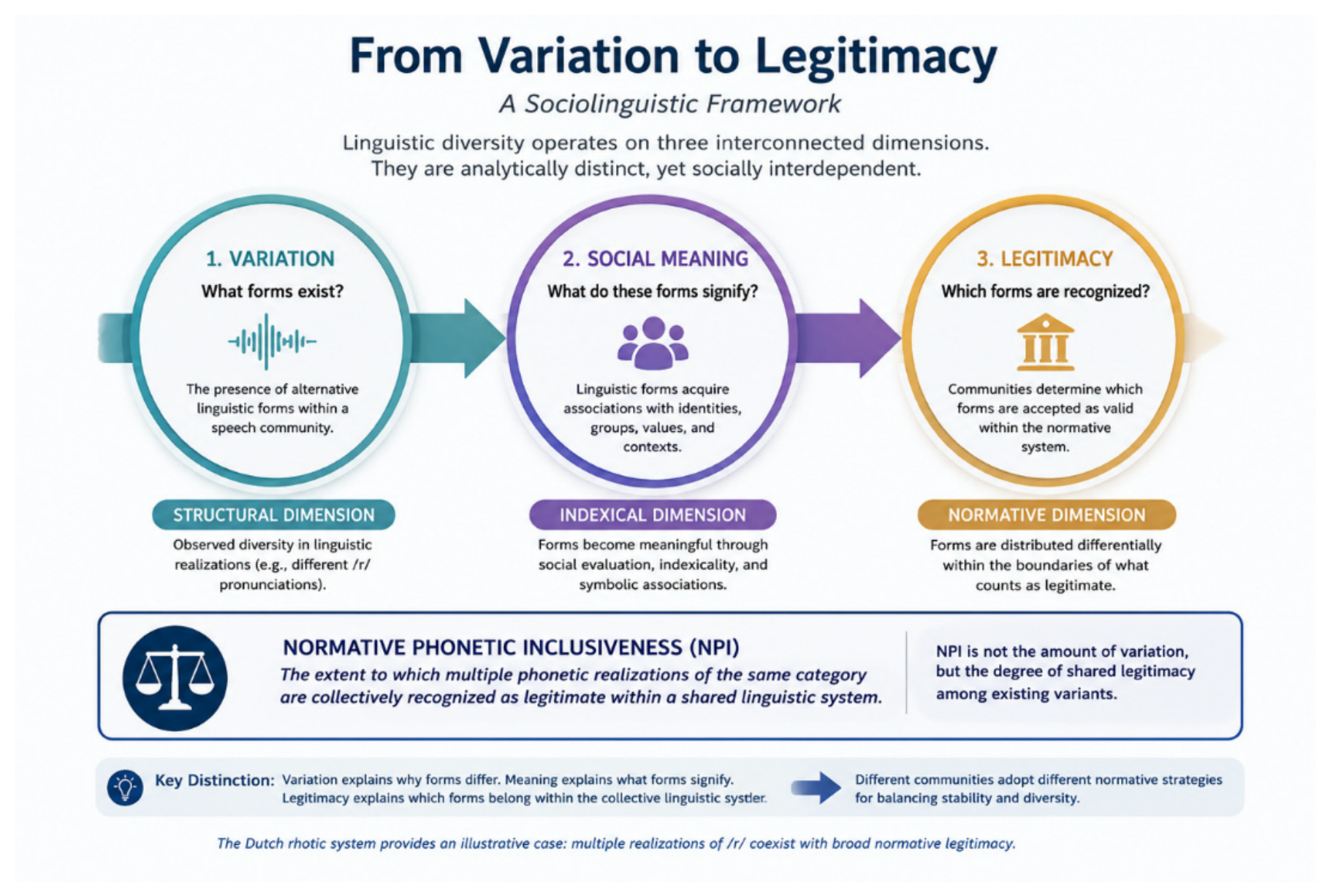

Table 1.
The Dutch Rhotic Repertoire.
| Variant | IPA symbol | Place of articulation | Manner of articulation | Typical occurrence |
|---|---|---|---|---|
| Alveolar trill | [r] | Alveolar ridge | Trill | Traditional Dutch, many regional varieties |
| Alveolar tap | [ɾ] | Alveolar ridge | Tap/Flap | Casual speech, alternates with [r] |
| Uvular trill | [ʀ] | Uvula | Trill | Western varieties, French/German influence |
| Uvular fricative | [ʁ] | Uvula | Fricative | Contemporary standard speech in many areas |
| Alveolar approximant (Gooise R) | [ɹ] | Alveolar/post-alveolar | Approximant | Younger speakers, Randstad |
| Reduced rhotic variants | Variable | Variable | Weakened/vocalized rhotic | Casual and syllable-final speech |
Disclaimer/Publisher’s Note: The statements, opinions and data contained in all publications are solely those of the individual author(s) and contributor(s) and not of MDPI and/or the editor(s). MDPI and/or the editor(s) disclaim responsibility for any injury to people or property resulting from any ideas, methods, instructions or products referred to in the content. |
© 2026 by the authors. Licensee MDPI, Basel, Switzerland. This article is an open access article distributed under the terms and conditions of the Creative Commons Attribution (CC BY) license.
Copyright: This open access article is published under a Creative Commons CC BY 4.0 license, which permit the free download, distribution, and reuse, provided that the author and preprint are cited in any reuse.