
Submitted:
25 July 2026
Posted:
27 July 2026
You are already at the latest version
Abstract
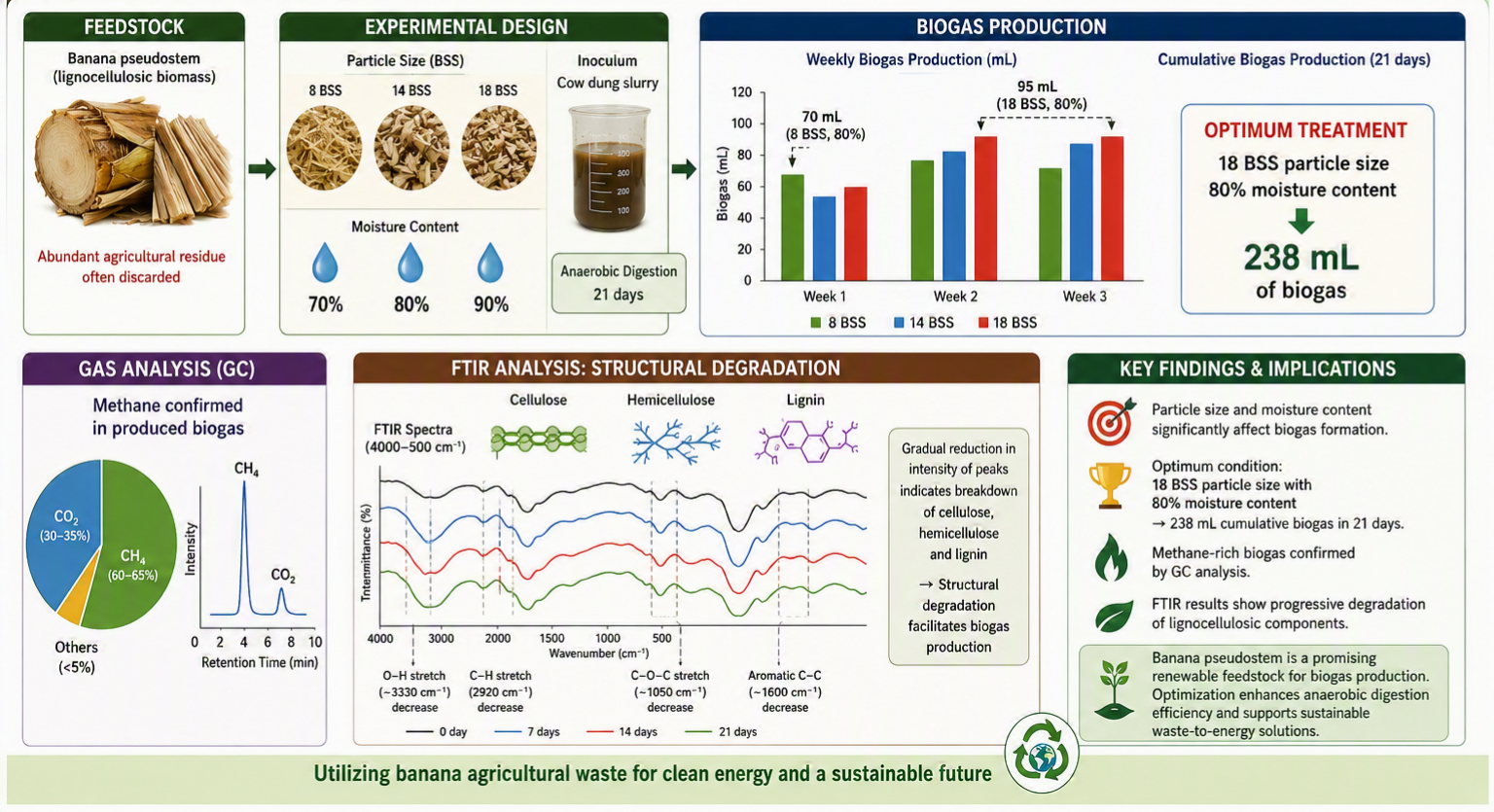
The banana pseudostem is a plentiful lignocellulosic biomass residue that results from banana cultivation and which is typically thrown away without proper usage. The effect of particle sizes and moisture content on biogas formation from banana pseudostem under anaerobic digestion conditions has been studied in this experiment with FTIR used to assess structural degradation of the lignocellulosic biomass. Three different sizes (8, 14, and 18 BSS) of banana pseudostems have been taken and their moisture contents varied into three percentages, namely 70%, 80%, and 90%. Anaerobic digestion studies have been performed for 21 days with cow dung slurry as the inoculum. It was clearly evident from the findings that both particle sizes and water contents had a profound effect on biogas formation. In week one, the maximum amount of biogas (70 mL) formed by any treatment was that of 8 BSS with 80% water content. However, in weeks two and three, the maximum amount of biogas (95 mL) was formed by the 18 BSS treatment having 80% water content. The cumulative analysis of biogas formations found the treatment combination of 18 BSS particle size with 80% water content to be the optimum treatment producing 238 mL of biogas. The gas analysis by gas chromatography confirmed the presence of methane gas in the produced biogas. Further, it was observed through FTIR analysis that there were gradual changes in the functional groups of cellulose, hemicellulose, and lignin components. This research demonstrates that banana pseduostem is a potential renewable feedstock for biogas production, and an optimized particle size and moisture content have significant effects on improving anaerobic digestion efficiency. These results contribute to the utilization of agricultural waste from bananas as renewable energy sources.
Keywords:
anaerobic digestion
; banana pseudostem
; biogas production
; FTIR
; lignocellulosic biomass
; moisture content
; particle size
; renewable energy
Copyright: This open access article is published under a Creative Commons CC BY 4.0 license, which permit the free download, distribution, and reuse, provided that the author and preprint are cited in any reuse.


