
Submitted:
27 July 2026
Posted:
27 July 2026
You are already at the latest version
Abstract
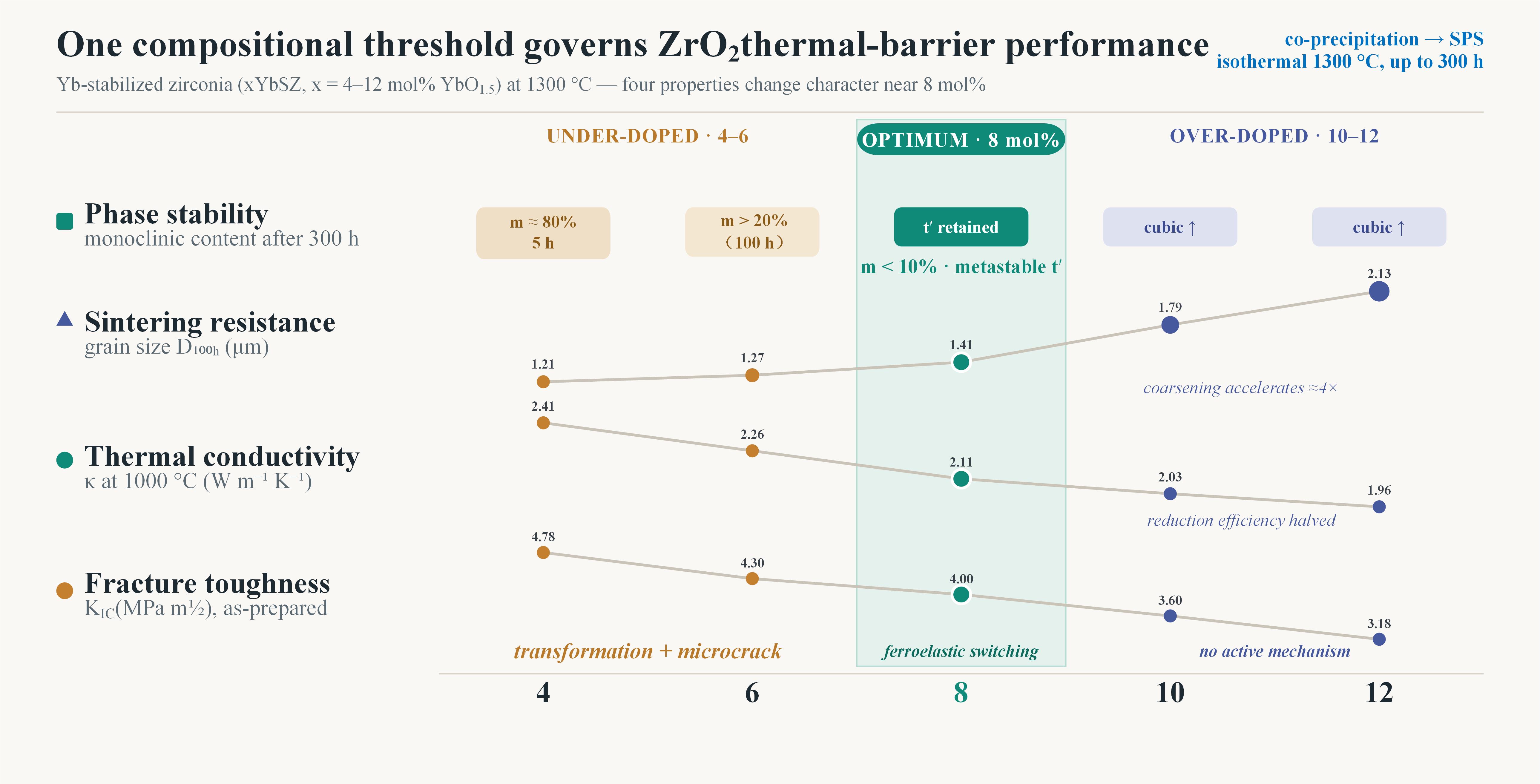
Yttria-stabilized zirconia (YSZ) thermal barrier coatings suffer from t′ phase destabilization and insufficient thermal insulation above 1200 ℃. In this work, YbO1.5-stabilized ZrO2 (xYbSZ, x = 4–12 mol%) powders were synthesized by chemical co-precipitation, consolidated by spark plasma sintering, and systematically evaluated at 1300 ℃ in terms of phase stability, sintering behavior, thermal conductivity, and fracture toughness. A common compositional boundary near 8 mol% YbO1.5 was identified across all four responses. 8YbSZ retained the metastable t′ phase with a monoclinic content below 10 mol% after 300 h at 1300 ℃, whereas the 4–6 mol% compositions destabilized rapidly and the 10–12 mol% compositions progressively developed the cubic phase. Grain coarsening accelerated markedly above 8 mol%, and the thermal-conductivity reduction efficiency per unit doping at 1000 ℃ was approximately halved beyond this composi-tion, with κ decreasing from 2.41 to 1.96 W·m-1·K-1 across the series, consistent with the saturation of point-defect phonon scattering. In the as-prepared state the fracture toughness decreased monotonically with doping, and the toughness gain produced by thermal treatment fell from 34% (4YbSZ) to about 10% (10–12YbSZ) as the dominant toughening mechanism shifted from transformation and microcrack toughening (4–6 mol%) to ferroelastic domain switching (8 mol%), both being lost in the cubic-dominated compositions. These results identify 8 mol% YbO1.5 as the optimal composition balancing phase stability, sintering resistance, thermal insulation, and mechanical integrity for TBC applications at 1300 ℃.
Keywords:
thermal barrier coating
; ytterbia-stabilized zirconia
; phase stability
; thermal conductivity
; fracture toughness
; compositional threshold
Copyright: This open access article is published under a Creative Commons CC BY 4.0 license, which permit the free download, distribution, and reuse, provided that the author and preprint are cited in any reuse.


