

Submitted:
24 July 2026
Posted:
27 July 2026
You are already at the latest version
Abstract
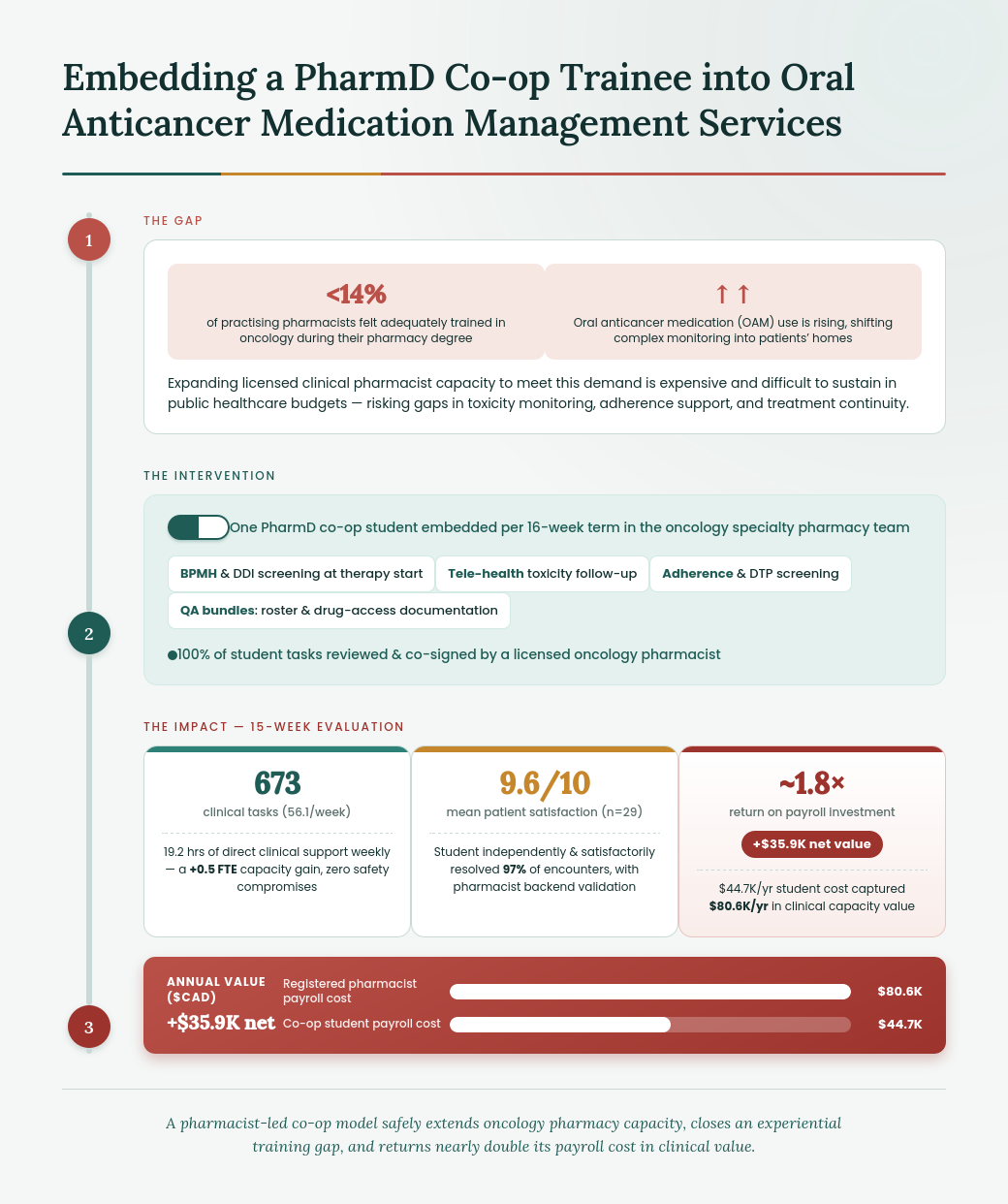
Background: The rapid emergence of oral anticancer medications (OAMs) has increased demand for specialized Clinical Pharmacy Services (OAM CPS). Concurrently, Canadian cross-sectional data highlights severe undergraduate gaps, with fewer than 14% of community pharmacists reporting adequate undergraduate OAM training. We designed, implemented, and evaluated a pharmacist-led Oral Anticancer Medication Clinical Co-op Program (OAMCCP) to bridge this experiential education gap while safely and cost-effectively expanding institutional capacity. Methods: Launched in Fall 2022, the OAMCCP integrated one PharmD student per 16-week term into a multidisciplinary oncology specialty pharmacy. Trainees executed core ambulatory oncology clinical pharmacy key performance indicators (AOcpKPIs), including Best Possible Medication Histories (BPMH), drug-drug interaction (DDI) screenings, and proactive toxicity follow-up. Crucially, 100% of student tasks were verified by a licensed oncology pharmacist to maintain absolute patient safety. Impact was quantified via task logging over 15 weeks, standardized 10-point patient satisfaction surveys, and payroll expenditure comparisons. Results: Trainees completed 673 clinical tasks (56.1 tasks/week), contributing 19.2 hours of direct clinical support weekly—effectively adding +0.5 Full-Time Equivalent (FTE) to service capacity with zero safety compromises. Mean patient satisfaction was 9.6/10 (n = 29), with students independently managing inquiries in 96.5% of encounters. Financially, a 1.0 FTE student (\(44,700/year cost) captured clinical capacity valued at \)80,600/year (0.5 FTE pharmacist equivalence). Conclusion: The OAMCCP resolves experiential training gaps while presenting a safe, scalable, and financially viable human resource framework that expands oncology pharmacy services.
Keywords:
oral anticancer medications
; clinical pharmacy services
; clinical key performance indicators
; pharmacy education
; experiential training
; health economics
; workforce optimization
1. Introduction
The landscape of oncology therapeutics has drastically evolved, marked by an exponential increase in the indications and utilization of oral anticancer medications (OAMs) [1]. This paradigm shift transitions complex monitoring requirements from traditional inpatient or ambulatory infusion suites directly into patients' homes, substantially increasing the operational burden on ambulatory oncology specialty pharmacies to provide robust clinical pharmacy services (OAM CPS) [1,2]. These services—critical to preventing treatment failures, managing toxicities, and avoiding unnecessary treatment interruptions—include proactive clinical charting, side-effect triage and management, drug-drug interaction (DDI) screening, and adherence evaluations [2].
Despite the clear imperative for specialized clinical oversight, systemic educational gaps persist across the Canadian pharmacy landscape (Figure 1). National cross-sectional surveys spearheaded by Canadian oncology pharmacy investigators reveal that fewer than 14% of practising pharmacists feel they received adequate oncology education during their undergraduate or professional degree programs [3]. While advanced experiential pharmacy students have been shown to successfully expand patient capacity and document high-volume interventions across general ambulatory care clinics [4], these frameworks are historically under-reported within high-acuity, specialized oncology environments.
Safety-focused student frameworks have seen historic success in standardizing multi-site outcomes and delivering quantified cost-avoidance across community and institutional care configurations [5,6]. However, an expanding cohort of OAM-naive pharmacy students continue to enter the healthcare system poorly equipped to manage complex oral oncology care independently [2]. Given the constraints on modern healthcare budgets and rising cancer incidence, expanding specialized clinical pharmacy human resources through traditional hiring models is difficult to execute sustainably [2].
To overcome this dual operational and educational bottleneck, the Sunnybrook Odette Cancer Centre Pharmacy (SOCCP) designed and implemented the Oral Anticancer Medication Clinical Co-op Program (OAMCCP). The primary goal of this pharmacist-led framework was to establish a unique, high-value, practice-based learning pathway for pharmacy students while strategically adding operational capacity to the specialty pharmacy workflow at a fraction of standard payroll costs, without compromising clinical quality or patient safety.
2. Materials and Methods
The institutional OAMCCP was formally launched in the fall semester of 2022. The operational design relied on onboarding one PharmD co-op student from the University of Waterloo School of Pharmacy per sequential 16-week academic term to work full-time alongside the core SOCCP OAM team.
A rigorous onboarding process prepared students to execute an array of clinical pharmacy duties under direct pharmacist supervision. To align our service evaluations with national benchmarking trends, student activities were structurally mapped to established Canadian ambulatory oncology clinical pharmacy key performance indicators (AOcpKPIs) [2]. To preserve clinical accuracy and patient safety, the institutional safety mandate was applied wherein 100% of student assessments, documentations, and clinical recommendations were reviewed, validated, and co-signed by a fully licensed ambulatory oncology specialty pharmacist prior to implementation. Under this framework, student duties included:
- • Initial Interventions (AOcpKPI-aligned): Conducting Best Possible Medication Histories (BPMH) and comprehensive DDI evaluations at baseline therapy initiation.
- • Patient Education & Support (AOcpKPI-aligned): Providing initial therapeutic and supportive care counseling, alongside reactive and proactive tele-health symptom monitoring and management.
- • Adherence & Clinical Assessment (AOcpKPI-aligned): Screening for drug-therapy problems (DTPs) linked to toxicity and treatment adherence.
- • Quality Assurance Operations: Facilitating clinical program tracking through predefined administrative bundles, including patient roster upkeep (QA Bundle #1) and administrative documentation for specialized exceptional drug access programs (QA Bundle #2).
Program impact was captured prospectively using a mixed-methods design across four performance indicators: quantitative workload data tracking over 15 weeks, direct institutional payroll expenditure analysis comparing student and pharmacist compensation, standardized post-consultation patient satisfaction surveys on a 1–10 point Likert scale, and qualitative trainee reflection portfolios
Generative artificial intelligence (Gemini 1.5 Pro, Google) to refine the language, improve readability, and assist with formatting the manuscript and references. The final text was fully reviewed, revised, and validated by the authors, who maintain complete accountability for the manuscript's intellectual content.
3. Results
3.1. Workload and Service Capacity Analysis
During a representative 15-week observational window, the clinical co-op student independently completed a cumulative total of 673 specialized tasks, averaging 56.1 individual interventions every week. A breakdown of specific tasks, hours invested, and estimated FTE equivalence is provided in Table 1. Proactive telephone follow-ups (214 completed interventions) and deep clinical chart reviews (279 completed interventions) consumed the largest portion of student time, accounting for an aggregate 8.7 hours and 3.9 hours per week respectively. Cumulatively, the trainee contributed an average of 19.2 hours of direct clinical support weekly, establishing a +0.5 FTE increase in real-time pharmacy department service capacity.
3.2. Patient Satisfaction Evaluation
A cross-sectional cohort of 29 outpatients undergoing clinical management for multiple oncological agents (including lenvatinib, darolutamide, olaparib, and lenalidomide) completed satisfaction evaluations (Table 2). The mean clinical pharmacy service satisfaction score across the cohort was 9.6 out of 10. Crucially, the embedded co-op student independently and satisfactorily managed all treatment-related questions for 28 out of the 29 survey participants (97%), with immediate backend validation by the supervising pharmacist, indicating that service quality matched institutional standards.During a representative 15-week observational window, the clinical co-op student independently completed a cumulative total of 673 specialized tasks, averaging 56.1 individual interventions every week. A breakdown of specific tasks, hours invested, and estimated FTE equivalence is provided in Table 1. Proactive telephone follow-ups (214 completed interventions) and deep clinical chart reviews (279 completed interventions) consumed the largest portion of student time, accounting for an aggregate 8.7 hours and 3.9 hours per week respectively. Cumulatively, the trainee contributed an average of 19.2 hours of direct clinical support weekly, establishing a +0.5 FTE increase in real-time pharmacy department service capacity.
3.3. Economic Utility Analysis
Financial comparison highlighted a highly favorable health-system economic outlook. Maintaining a full-time (1.0 FTE) clinical co-op student requires a fixed operational payroll cost of approximately $44,700 per annum. Given that the student absorbed workload equivalent to 0.5 FTE of a fully licensed ambulatory clinical oncology pharmacist—valued at an annual institutional baseline salary of $80,600 for a 0.5 FTE portion—the model allowed the specialty care center to capture essential clinical hours for a fraction of traditional expenditures ($44,700 for PharmD student 1.0 FTE / $80,600 for Pharmacist 0.5 FTE = 55%).
3.4. Educational Value and Trainee Feedback
Qualitative assessment of post-rotation portfolios reflected an accelerated acquisition of complex professional knowledge. Trainees consistently emphasized that the immersive framework successfully bridged gaps in didactic pharmacy education. Key longitudinal reflections are provided in Figure 2.
4. Discussion
This evaluation demonstrates that the integration of a structured, specialized clinical co-op student model into an ambulatory oncology specialty pharmacy effectively mitigates systemic capacity challenges without increasing operational costs or compromising patient care. Findings suggest the student successfully generated an additional 0.5 FTE of clinical capacity at a fraction of the cost. By taking on time-intensive processes like chart preparation, routine documentation, and tele-health follow-ups, the co-op student allowed the senior pharmacy staff to optimize their focus on advanced drug therapy problems and high-acuity interventions.
The substantial volume of student interventions captured in this pilot (56.1 tasks/week) strongly aligns with ambulatory experiential literature. Our findings expand upon the baseline work of Patel et al. (2016), who demonstrated that structured student integrations efficiently drive foundational ambulatory care indicators like medication reconciliation and therapeutic education [4]. In a foundational multi-year analysis, Shepler (2014) validated that pharmacy students on advanced rotations generate monumental interventions that correlate directly to quantified cost-savings, averaging $148 per documented intervention [5]. Similarly, Tualla et al. (2019) demonstrated that embedding senior trainees within ambulatory and community clinics yields major clinical and economic value through proactive toxicity screening and adverse event prevention [6]. Our model corroborates these findings within a highly specialized tertiary oncology environment, providing concrete financial metrics demonstrating that a 1.0 FTE student captures clinical hours valued at $80,600/year for a minimal payroll cost of $44,700 (~45% cost savings).
Importantly, the high patient satisfaction ratings show that introducing a learner into the care pathway did not disrupt the quality of the clinical services. Patients received timely, high-touch phone outreach that an otherwise resource-constrained staff might struggle to deliver consistently [2]. A paramount consideration of this program's operational viability is its adherence to stringent patient safety protocols. While the co-op trainee absorbed a significant operational burden, 100% of clinical data compilation, documentation, and patient outreach logs were scrutinized and verified by a licensed oncology pharmacist. This tiered supervision model guarantees that patient care standards are never minimized; rather, safety is augmented through an extra layer of active clinical screening.
Furthermore, this framework directly addresses the severe lack of undergraduate oncology education identified across the Canadian pharmacy landscape [3]. To elevate our tracking from basic task-counting to high-value care, student duties were aligned with established clinical pharmacy key performance indicators (cpKPIs). As emphasized by Lo et al. (2016), true institutional benchmarking must shift from pure workload metrics to discrete process measures explicitly linked to positive patient outcomes, such as formal BPMH, DDI screening, and collaborative care plans [7]. Global review data indicates that while 85.8% of current pharmacy KPIs remain process-based, there is a historical lack of published reference values within specialty ambulatory settings [8]. By utilizing and reporting these explicit reference values under an OAM-specific framework, our program establishes a highly transparent, safety-validated blueprint for workforce planning and institutional resource justification.
5. Conclusions
The Oral Anticancer Medication Clinical Co-op Program is an effective, pharmacist-led strategy that bridges experiential education gaps, expands clinical care capacity by 0.5 FTE, and maintains excellent patient satisfaction while optimizing institutional expenditures. Backed by strict pharmacist verification pathways and aligned with contemporary national quality metrics, this operational model serves as a safe and practical blueprint for specialty oncology pharmacies looking to scale their clinical services amidst rising demands and limited resource allocations.
Author Contributions
Conceptualization, C.P., C.D., S.S., and F.C.; methodology, C.P.; data curation, C.P.; formal analysis, C.P.; validation, C.P, C.D., and F.C.; writing—original draft preparation, C.P.; writing—review and editing, C.D., F.C., S.S.; supervision, C.P. All authors have read and agreed to the published version of the manuscript.
Funding
This research received no external funding.
Institutional Review Board Statement
The study was conducted as a program evaluation and practice-assessment initiative at Sunnybrook Health Sciences Centre. Research ethics review was not required because the project met criteria for exemption from such a review based on institutional process for confirming that the project was deemed improvement in quality and not human subject research (Quality Improvement Project #1480958452). All feedback regarding the OAM-CCP was collected in a de-identified manner.
Informed Consent Statement
Verbal consent was obtained from all clients involved in OAM-CCP service satisfaction evaluation. Verbal consent was obtained because it was not possible to obtain written consent during a telephone encounter.
Data Availability Statement
The datasets generated and analyzed during the current evaluation are available from the corresponding author upon reasonable request, subject to institutional patient privacy restrictions.
Acknowledgments
The authors thank Stephanie Lo, Geoffrey Ng, Ziyu He, Pariya Vegdani, and Valentina Pham for their essential clinical support, data collection, and contributions to the operational deployment of the pharmacy co-op program evaluated in this manuscript. During the preparation of this manuscript, the authors used Gemini (Gemini 1.5 Pro, Google) to refine the language, improve readability, and assist with formatting the manuscript and references. The graphical abstract accompanying this manuscript was designed and generated with the assistance of Claude (Anthropic), a generative artificial intelligence tool, which was used to synthesize key study data into a visual layout. Following the use of these tools, the authors reviewed and edited the content as needed and take full responsibility for the integrity and final layout of the published work.
Conflicts of Interest
C.P. has received consulting/advisory board fees from Roche, Sandoz, Organon, Pfizer, Astellas, AstraZeneca, and Taro; honoraria or speakers bureau fees from AstraZeneca, Novartis, Roche, Takeda, BeiGene, Pfizer, Seagen, Merck, Eisai, Apobiologix, Ipsen, and Eli Lilly; and research/grant support from Bayer. F.C. has received honoraria or speakers bureau fees Apobiologix. CD and SS declare no conflicts of interest.
Abbreviations
The following abbreviations are used in this manuscript:
| AOcpKPIs | Ambulatory oncology clinical pharmacy key performance indicators |
| BPMH | Best possible medication history |
| CPS | Clinical pharmacy services |
| DDI | Drug-drug interaction |
| FTE | Full time equivalent |
| EAP | Exceptional Access Program |
| OAM | Oral anticancer medication |
| OAMCCP | Oral Anticancer Medication Clinical Co-op Program |
| PharmD | Doctor of Pharmacy |
| QA | Quality assurance |
| SOCC | Sunnybrook Odette Cancer Centre |
References
- Cheema, P.K.; Shokoohi, A.; Shachar, S.S.; Blanchette, P.; Cheng, S.; Cohen, V.; Desbiens, C.; Florescu, M.; Ionescu, J.; Juergens, R.A.; et al. Implementation of a standardized oral EGFR-TKI toxicity management algorithm in advanced non-small cell lung cancer. Curr. Oncol. 2021, 28, 3122–3131. [Google Scholar] [CrossRef]
- Vu, K.; Edwards, S.; Altwairgi, A.K.; Beca, S.; Cameron, A.; Charbonneau, L.; Clarke, S.E.; Del Paggio, J.C.; DeAngelis, C.; Elewa, H.; et al. Development of Ambulatory Oncology Clinical Pharmacy Key Performance Indicators: A Modified Delphi Study. JCO Oncol. Pract. 2024, 20, 112–121. [Google Scholar] [CrossRef]
- Edwards, S.; Altwairgi, A.K.; Beca, S.; Cameron, A.; Charbonneau, L.; Clarke, S.E.; Del Paggio, J.C.; DeAngelis, C.; Elewa, H.; Kherani, F.; et al. Clinical Pharmacy Services in Ambulatory Oncology: An Environmental Scan of the Canadian Practice Landscape. Can. J. Hosp. Pharm. 2022, 75, 245–253. [Google Scholar] [CrossRef]
- Patel, H.; Goliak, K.L.; Shicker, L.; Shicker, M.; Williams, S. Impact of Pharmacy Student Interventions in an Ambulatory Care Clinic. Am. J. Pharm. Educ. 2016, 80, 43. [Google Scholar]
- Shepler, B.M. Cost Savings Associated With Pharmacy Student Interventions During APPEs. Am. J. Pharm. Educ. 2014, 78, 71. [Google Scholar] [CrossRef] [PubMed]
- Tualla, J.; Koh-Knox, C.; Shepler, B. Cost Savings and Clinical Interventions Made by PharmD Students During APPE Rotations at Federally Qualified Health Centers. Med. Sci. Educ. 2019, 29, 379–382. [Google Scholar] [CrossRef] [PubMed]
- Lo, E.; Rainkie, D.; Semchuk, W.M.; Fernandes, O.A.; Toombs, K.; Slack, M.G.; Bornstein, C.; Slayter, K.; Raymond, C.; Gorman, S.K.; et al. Measurement of Clinical Pharmacy Key Performance Indicators to Focus and Improve Your Hospital Pharmacy Practice. Can. J. Hosp. Pharm. 2016, 69, 149–153. [Google Scholar] [CrossRef] [PubMed]
- Magedanz, L.; Silva, H.L.; Galato, D.; Fernandez-Llimos, F. Clinical pharmacy key performance indicators for hospital inpatient setting: a systematic review. Int. J. Clin. Pharm. 2024, 46, 602–613. [Google Scholar] [CrossRef] [PubMed]
Figure 1.
Flow chart showing how rises in OAM use, increases in OAM CPS demand, & lack of OAM pharmacy education compromise the quality of OAM management and resulting treatment outcomes (OAM, oral anticancer medication; CPS, clinical pharmacy services; RPh, registered pharmacist; QOL, quality of life).
Figure 1.
Flow chart showing how rises in OAM use, increases in OAM CPS demand, & lack of OAM pharmacy education compromise the quality of OAM management and resulting treatment outcomes (OAM, oral anticancer medication; CPS, clinical pharmacy services; RPh, registered pharmacist; QOL, quality of life).
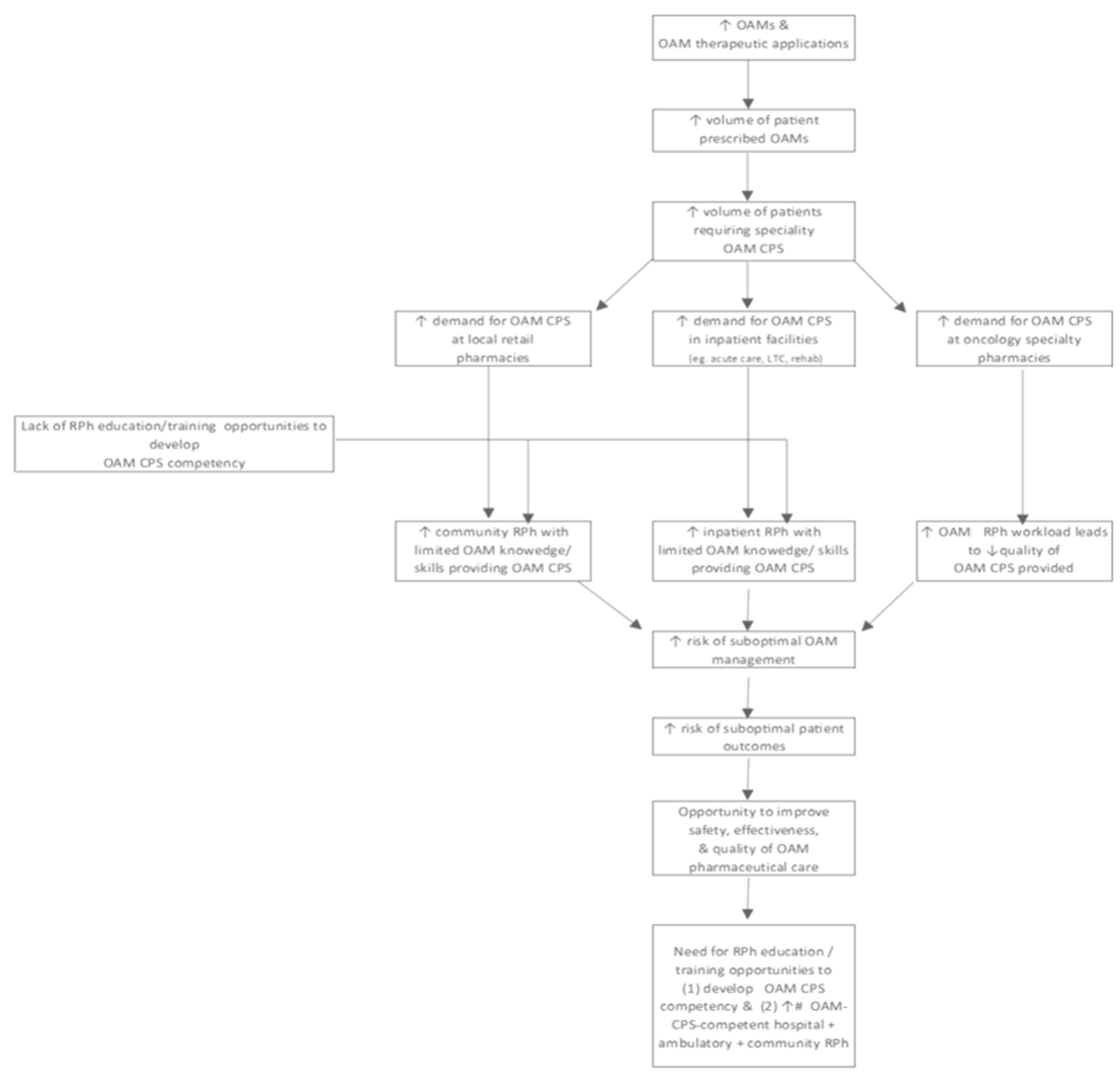
Figure 2.
Select quotes from Oral Anticancer Medication Clinical Co-op Program (OAMCCP) students endorsement letters demonstrating the value and impact of the innovative learning opportunity.
Figure 2.
Select quotes from Oral Anticancer Medication Clinical Co-op Program (OAMCCP) students endorsement letters demonstrating the value and impact of the innovative learning opportunity.
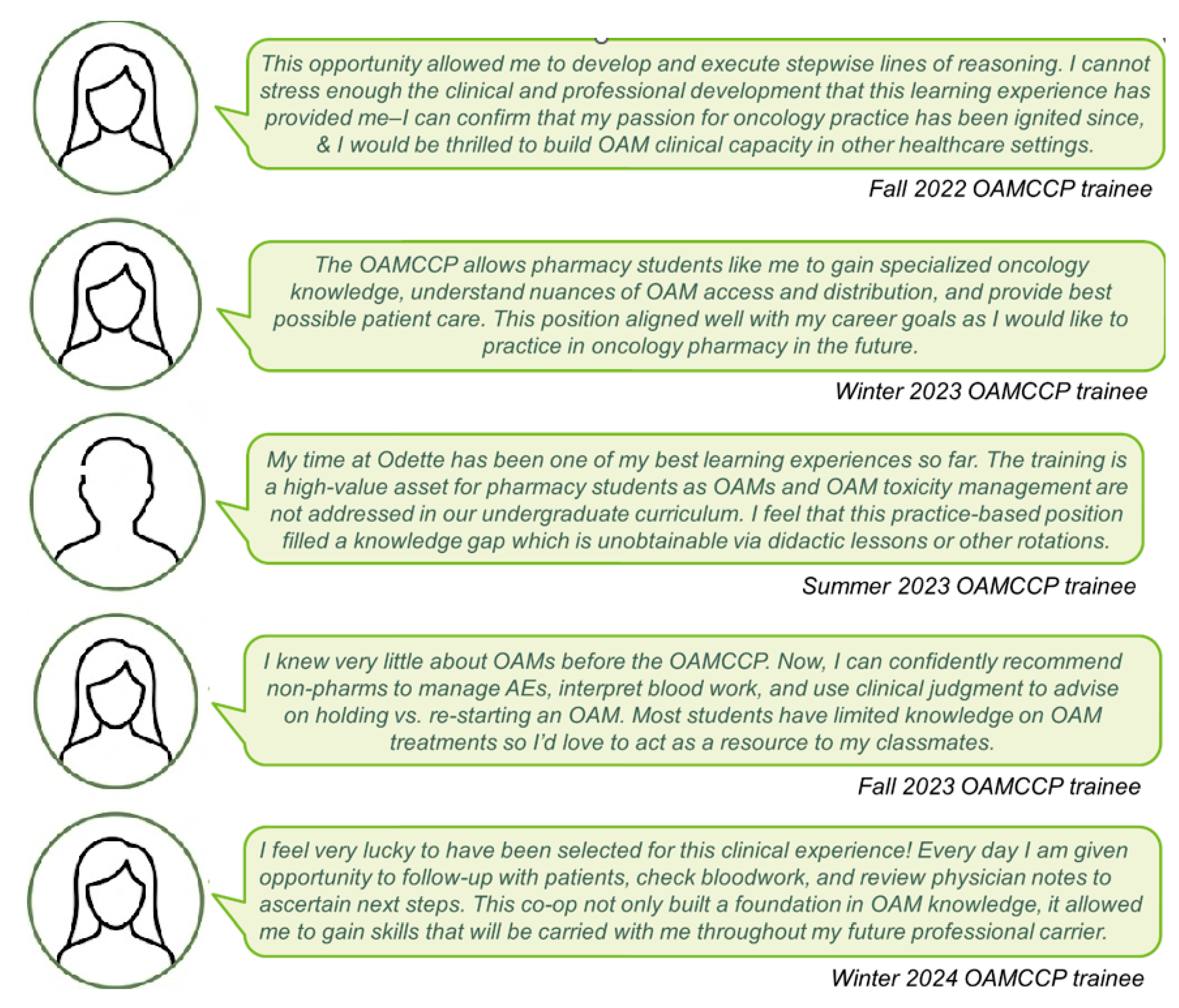

Table 1.
Co-op student workload performance over 15 weeks and system capacity projections.
| Clinical Service Metric |
Total Tasks (15-wks) |
Average Tasks / Week | Time / Task (Hours) | Total Invested Hours | Weekly Hours | Estimated FTE Equivalent |
| Best Possible Medication History (BPMH) | 26.0 | 2.2 | 0.3 | 8.7 | 0.7 | 0.0 |
| OAM & Supportive Care Counseling | 15.0 | 1.3 | 0.3 | 5.0 | 0.4 | 0.0 |
| Drug-Drug Interaction (DDI) Screening | 5.0 | 0.4 | 0.2 | 0.8 | 0.1 | 0.0 |
| Proactive Tele-health Follow-Up Calls | 214.0 | 17.8 | 0.4 | 89.2 | 7.4 | 0.2 |
| Clinical Electronic Chart Review | 279.0 | 23.3 | 0.2 | 46.5 | 3.9 | 0.1 |
| Physician Communication / Electronic Emails | 64.0 | 5.3 | 0.6 | 37.3 | 2.5 | 0.1 |
| Quality Assurance Bundle #1 (Roster Upkeep) | 31.0 | 2.6 | 1.0 | 31.0 | 2.6 | 0.1 |
| Quality Assurance Bundle #2 (Drug Access Docs) | 39.0 | 3.3 | 0.5 | 19.5 | 1.6 | 0.0 |
| Program Totals | 673.0 | 56.1 | -- | 238.0 | 19.2 | 0.5 |
BPMH, best possible medication history; DDI, drug-drug interaction; CPS, clinical pharmacy services; EAP, Exceptional Access Program; OAM, oral anticancer medication; QA bundle #1 , Quality Assurance bundle of tasks related to OAM patient roster maintenance; QA bundle #2 , Quality Assurance bundle related to Exertional Access Program tasks & activities.
Table 2.
Responses to the OAM CPS patient satisfaction survey. Patients rated their level of satisfaction with OAM telephone call-back services on a scale of 1-10. The co-op student independently answered all questions for 28/29 patient participants.
Table 2.
Responses to the OAM CPS patient satisfaction survey. Patients rated their level of satisfaction with OAM telephone call-back services on a scale of 1-10. The co-op student independently answered all questions for 28/29 patient participants.
| Patient | Medication | Counseling satisfaction |
| 1 | Lenvatinib | 10 |
| 2 | Darolutamide | 8 |
| 3 | Olaparib | 10 |
| 4 | Lenalidomide | 10 |
| 5 | Dab + Tram | 10 |
| 6 | Trametinib | 4.5 |
| 7 | Abiraterone | 9 |
| 8 | Osimertinib | 10 |
| 9 | Olaparib | 9 |
| 10 | Osimertinib | 10 |
| 11 | Capecitabine | 10 |
| 12 | Niraparib | 10 |
| 13 | Niraparib | 10 |
| 14 | Niraparib | 10 |
| 15 | Osimertinib | 10 |
| 16 | Olaparib | 10 |
| 17 | Niraparib | 10 |
| 18 | Niraparib | 10 |
| 19 | Niraparib | 9 |
| 20 | Lenalidomide | 11* |
| 21 | Regorafenib | 10 |
| 22 | Olaparib | 8 |
| 23 | Lenalidomide | 10 |
| 24 | Enzalutamide | 10 |
| 25 | Abiraterone | 10 |
| 26 | Niraparib | 10 |
| 27 | Enzalutamide | 9 |
| 28 | Alectinib | 10 |
| 29 | Enzalutamide | 10 |
*intentional score >10.
Disclaimer/Publisher’s Note: The statements, opinions and data contained in all publications are solely those of the individual author(s) and contributor(s) and not of MDPI and/or the editor(s). MDPI and/or the editor(s) disclaim responsibility for any injury to people or property resulting from any ideas, methods, instructions or products referred to in the content. |
© 2026 by the authors. Licensee MDPI, Basel, Switzerland. This article is an open access article distributed under the terms and conditions of the Creative Commons Attribution (CC BY) license (http://creativecommons.org/licenses/by/4.0/).
Copyright: This open access article is published under a Creative Commons CC BY 4.0 license, which permit the free download, distribution, and reuse, provided that the author and preprint are cited in any reuse.


