

Submitted:
23 July 2026
Posted:
27 July 2026
You are already at the latest version
Abstract
Decades of progress in global sexual and reproductive health programming and data availability are threatened as over 80% of donor funding for family planning (FP) comes from governments that have announced significant cuts to Official Development Assistance. This commentary examines how FP2030 is adapting its Measurement Framework and annual reporting given uncertainty around the future of household surveys, such as the Demographic and Health Survey, and the loss of technical resources. FP2030 will pivot from reporting on 22 indicators to a “minimum set” of 15 priority indicators. FP2030 arrived at these recommendations through consensus built during a series of working meetings with its Performance Monitoring and Evidence Working Group (PME WG), a group of FP measurement experts. The 15 indicators leverage existing mathematical models and health management information systems (HMIS). Moreover, this commentary provides a complementary set of indicators that should be prioritized if new data collection opportunities arise. Ultimately, while FP2030 and the PME WG believe that models and HMIS data will become more essential, these tools cannot fully replace household surveys. Continued investment in FP data availability remains critical to ensuring the community can review data that protects the rights and needs of individuals through current programming.
Keywords:
global family planning
; FP2030
; unmet need
; contraception
; access
; program monitoring
; measurement
; sexual and reproductive health and rights
Introduction
The termination of 80% of United States Agency for International Development (USAID) contracts, and subsequent dissolution by the Trump administration in 2025, has had devastating consequences on sexual and reproductive health (SRH) programs, services, and the populations they serve (Rubio, 2025) (Pamuk, 2025). Until January 2025, the United States had historically contributed 40% (around US$600 million annually) of the total donor government funding for family planning. Alongside USAID’s dismantling, Canada, Germany, Netherlands, Sweden, the United Kingdom have also announced significant planned cuts to their official development assistance (ODA) (White et al., 2025) (FP2030, 2025-a) (Robertson, 2025). In total, over 80% of donor government funding for family planning has come from countries that have announced significant cuts to their ODA (FP2030, 2025-a). As a result, decades of progress in SRH are threatened (Cavalcanti et al., 2025). Furthermore, critical programs (such as the Demographic and Health Surveys Program [DHS]) that provided support for broader population and health data collection, monitoring and evaluation, and research have also been defunded, hampering the family planning field’s ability to monitor progress toward program goals, set evidence-based policies, and track and address this backsliding (Khaki et al., 2025).
FP2030 is the only global partnership solely dedicated to family planning. A key aspect of the partnership’s work over the last decade has been to monitor progress towards the vision that all people should have the freedom and ability to make their own informed decisions regarding contraception and having children. Since 2012, FP2030 and its data partners have annually tracked a set of family planning indicators (FP2030, 2022). This process encourages countries to make commitments, annually review progress, prioritize evidence-based practices, and inform investment and policy decisions. The dissolution of USAID and other proposed cuts to ODA from European donors greatly impact critical data resources needed for this review process and may also inhibit countries from seeing the consequences of these terminations on health outcomes. These unprecedented shifts necessitated a review of which indicators FP2030 can continue to report and monitor in this new environment. In this commentary, we discuss the critical data dependencies of the FP2030 Measurement Framework, the disruptions to data systems, and the availability of key data sources. We also outline data and measurement priorities for FP2030 and its partners, proposing a minimum set of indicators for progress monitoring and data collection in the evolving data landscape.
FP2030’s Measurement Framework and Annual Data Process
FP2030 brings together different sectors to improve family planning programs worldwide. To date, FP2030 has garnered over 40 country government commitments and 200 non-governmental commitments – all pledging to expand access to family planning services (FP2030, 2025-a). To support monitoring of the commitments, FP2030 annually publishes a Measurement Report detailing progress on key family planning data for low and lower-middle income countries and other commitment-makers (FP2030, 2025-a). The report includes data on 22 key family planning indicators from the FP2030 Measurement Framework, which monitor various aspects from enabling environment and service delivery processes to outputs, expected outcomes, and the impact of modern contraceptive use (Figure 1) (FP2030, 2022).
FP2030 annual reporting is a “bottom-up” process, ensuring that the data review and validation start within countries (Figure 2). Track20, a project of Avenir Health leading in-country family planning monitoring efforts, conducts an annual workshop with technical leads from Ministries of Health in FP2030 commitment-making countries to produce estimates for FP2030 indicators. Country technical staff then lead in-country review and validation of the estimates. These estimates are reported back to Track20 for final review and combined with estimates from non-participating FP2030 countries into a single database covering 87 countries (Track20, n.d.-b) (Track20, n.d.-c). This country-driven process is critical to the work of FP2030 and highlights the importance of country-ownership, access to, and availability of family planning data.
Once FP2030 receives the final database, it works with Track20 and other partners to produce and publish a Measurement Report. The report is a critical resource for the global family planning community, including country governments and partners that rely on the annual estimates to review country progress and identify any backsliding. It allows for review of trends in key metrics such as modern contraceptive prevalence and unmet need for modern methods, shifts in modern method mix, insights into donor and domestic financing trends, and other key metrics about service delivery and health outcomes. It is the only global report with such comprehensive data on family planning. Since the start of FP2020 (now FP2030), tremendous gains have been made. As of July 2025, more than 394 million women of reproductive age across 87 countries were using a modern contraceptive method, and the increased availability and affordability of newer methods, such as implants, has contributed to shifts in modern method use towards longer-acting and more effective methods (FP2030, 2025-a). Countries have shown considerable progress in family planning over the last 13 years, but these achievements wouldn’t have been tracked, monitored, and understood without the FP2030 Measurement Framework and its critical data inputs.
In addition to supporting country progress monitoring, the Framework has also become a critical resource for the global family planning community, allowing new family planning measures and advancements to be incorporated, elevated globally, reviewed annually at the country level, and published in an annual Measurement Report.
Current Reliance on Data Systems for FP2030 and Challenges Ahead
The FP2030 Measurement Framework relies on the efforts and varied data sources of numerous partners, several of which are impacted by the USAID funding terminations (Figure 3). These sources include large household surveys (such as the DHS), routine data from health and logistics management information systems, and mathematical models. Seventeen indicators in the Measurement Framework rely on publicly accessible household surveys such as DHS, Multiple Cluster Indicator survey (MICS), and Performance Monitoring for Action (PMA) surveys. The other five indicators are calculated using other sources or routine data.
Surveys
Eight indicators in the Measurement Framework are directly calculated from household surveys, and nine indicators are calculated using models in which household surveys are a key input. While three indicators (adolescent birth rate [ABR], modern method mix, and percent of births unintended) can be calculated from MICS, the remaining five survey-based indicators are only available through DHS or PMA surveys. FP2030 also annually publishes data on 38 indicators on adolescent and youth demographics and SRH, all of which rely on household surveys (FP2030, 2022). With the closure of USAID, the DHS Program was disbanded; however, in July 2025 DHS was funded for three years in a limited capacity (Pamuk, 2025) (Khaki et al., 2025) (ICF, 2025). The PMA surveys will carry forward in a more limited scope, including not continuing in all 11 geographies in which they have had data collection (Siewe, 2024). Additionally, the MICS varies by implementing country, and several recently completed surveys (Afghanistan and Zimbabwe) omitted the family planning module from data collection altogether (United Nations Children’s Fund, 2022-2023) (Zimbabwe National Statistics Agency & UNICEF, 2019). Although the future will include household surveys, it will be in a more limited or uncertain capacity.
HMIS
In many countries, health management information systems (HMIS) are a vital source of country-produced routine health data. These systems allow countries to review data on contraceptive services or commodities delivered by facilities and geographies and estimate modern use (a proxy for modern contraceptive prevalence) (Track20, n.d.-d). In some countries, postpartum and post-abortion contraceptive use estimates can also be reviewed through HMIS data. These systems are limited in scope and cannot provide data on other components of a well-functioning family planning program, including quality of counseling of family planning services, decision-making, and fertility intentions, among others. Furthermore, in many cases any client-specific information, such as age, sex, marital-status, education, wealth, disability status, or experience with service delivery are not collected within HMIS. There is also heterogeneity in the data elements and quality of HMIS across different countries. Another limitation of HMIS data is the systems usually focus on public sector services, which results in limitations for capturing services delivered from private sector clinics, pharmacies, and drug shops, or the contraceptive needs and experiences of people not interacting with the health care system at all. There are innovations being developed to capture private sector data; however, in many countries this remains a key data challenge. While imperfect, these routine health data are critical; and they have been impacted by the termination of USAID projects, which has led to delays in data collection and analysis, as well as the loss of personnel essential to these systems (DHIS2, 2025).
Models
In addition to HMIS data, the family planning measurement community has made tremendous strides in innovative modeling techniques to estimate key indicators. The Family Planning Estimation Tool (FPET) estimates modern contraceptive use, unmet need, and demand satisfied for family planning (Track20, n.d.-a). It relies on survey data as key input but can continue generating estimates when new surveys are unavailable, albeit with increasing uncertainty, as their long-term accuracy depends on the availability of new high-quality data and projects that continue to update and maintain the models. Incorporating service statistics from HMIS can reduce uncertainty; however, many countries currently lack the HMIS data quality required for inclusion in FPET. In addition to FPET, the FP2030 Measurement Framework also relies on UN Population Division’s (UNPD) modeled population estimates (United Nations, Department of Economic and Social Affairs, Population Division, 2024). Besides FPET, other models that generate estimates also rely on household surveys. Nevertheless, modeled data face similar limitations to HMIS data. Current models do not estimate all the dynamics of contraceptive use or service delivery (such as client experience or quality of counseling), so both models and HMIS give us an incomplete view of progress related to family planning.
Priorities of the Family Planning Community
The loss of data sources and our ability to monitor programs and progress at this critical moment necessitates quick reorganization of our measurement work. In March 2025, the Future of Family Planning Convening brought together 200 diverse global and country leaders, researchers, and advocates from the family planning community to discuss ways forward for the field (William H. Gates Sr. Institute for Population and Reproductive Health, 2025). The measurement community in attendance coalesced around three priorities—1) Ensure data are maintained as a public good where data efforts are coordinated and collaborative with transparent methods and standard tools, and are publicly available; 2) Complete existing DHS surveys in the field, including finalizing and releasing reports and datasets; and 3) Identify a minimum set of priority indicators for the family planning field in the context of reduced data availability and reduced resources for collecting data in the future. The minimum set indicators could be collected through existing or future data collection efforts, could assist with monitoring of family planning programs, could be better centered in the needs and desires of individuals, and could show the impact of family planning use on different health outcomes (William H. Gates Sr. Institute for Population and Reproductive Health, 2025).
Work is underway to secure funding to preserve existing data resources and release the DHS surveys that were near completion (FP2030, 2025-b). In July 2025, the Gates Foundation provided a three-year grant to the DHS program to maintain the website, ensure access to tools and data, and support the completion and implementation of surveys in select countries (ICF, 2025). While the family planning community, including FP2030, continue to advocate for household surveys like the DHS – as no other source of information is as complete – this commentary aims to contribute near-term measurement priorities in a reality with more limited household surveys and funding, and identify a minimum set of indicators to prioritize.
Minimum Set of Priority Indicators
Over a series of working meetings from May to September 2025, a sub-group of the FP2030’s Performance Monitoring and Evidence Working Group (PME WG), a group of global family planning measurement experts, collaboratively reviewed and discussed the Measurement Framework in the context of the previously described data system disruptions and arrived at recommendations. A core function of the group is to guide and inform FP2030’s data and analytics efforts. Given the changes to the availability of data sources, the FP2030 PME WG proposes the following:
- A core set of priority indicators for FP2030 to continue publishing data on in the evolving data landscape, leveraging proxy indicators where necessary.
- A complementary set of indicators for prioritization in broader household survey data collection, and new methods of data collection, including both core FP2030 Framework indicators (that will be unavailable due to loss of data sources) and those from ongoing measurement advancement initiatives.
The PME WG set five guiding principles – essential indicator characteristics –to steer the discussion on creating a minimum set of priority indicators. These are: value, use at the country level, temporality, directionality, and data source.
Value, or the importance of knowledge gained through use of the indicator, was a central guiding principle. We prioritized indicators that reflected the stability of the system, individual’s access to care, or elements of person-centeredness (Rothschild et al., 2025). Some indicators were high in value because they were client-focused and had self-reported answers, like decision-making and Method Information Index (MII) Plus. Number of unintended pregnancies and method availability (having stock of three or five methods available on the day of assessment) were also determined to have inherent value through their utility in assessing system-level gaps in access to modern methods and negative health outcomes. Modern and traditional contraceptive prevalence were noted to be valuable for context setting around baseline contraceptive use.
We defined country-level use as alignment with national policies, plans, and FP2030 commitments, ensuring utility for country partners. Several indicators emerged as most relevant: unmet need for modern methods, modern contraceptive prevalence, modern method mix, total users of modern methods, stockouts, and CYPs. During these discussions, the PME WG urged FP2030 to consider reporting CYPs separately for long-acting methods versus short-acting methods for greater understandability by the data user. Another recommendation from the PME WG members was to collaborate with Track20 and RHSC to explore new stockout indicators sourced from HMIS, LMIS, or the Visibility & Analytics Network to increase the utility of this metric which would be available more frequently as a measure of point-in-time stock issues and trends.
Temporality, or the degree to which indicator estimates were sensitive to annual change, was also an important guiding principle. Many indicators were developed to facilitate annual monitoring of country family planning programs. The two finance indicators, domestic resource mobilization and donor financing for family planning, have clear temporality. Additionally, the modeled indicators (unmet need and demand satisfied for modern methods, total users of modern methods, and MCP) are currently annually produced and communicated in the context of trends over time. Some survey-based indicators are also reviewed for shifts or trends; for example, modern method mix and source of the most recent modern method. Indicators like MII Plus and method availability are traditionally communicated as point-in-time estimates and difficult to assess longitudinally and therefore considered to have low temporality.
Directionality, another guiding principle, was defined as a clear assignment of change in indicator estimates as “progress” vs “regression”, or “good” vs “bad.” Some indicators had clear inherent directionality; stockouts (currently assessed as point-in-time assessments), method availability, and domestic expenditure. Other indicators did not have a clear directionality, such as source of the most recent modern method (public versus private sector source).
Additionally, availability of different data sources was assessed in detail. Indicators such as source of the most recent method, MII Plus, and decision-making embodied multiple guiding principles, but they exclusively come from DHS or PMA surveys and thus are at best sporadically available for certain countries going forward. As such, they were removed from the minimum set of priority indicators. Discontinuation and switching and family planning information (from a health care provider), which are both only available from DHS or PMA surveys, along with percent of births and pregnancies that were unintended, were not rated highly under other guiding principles and removed from the minimum set of indicators. FP2030 will continue to report on the number of births that were unintended which is a close proxy to percent of pregnancies and births that were unintended because it is modeled and available annually. Indicators available through HMIS were also reviewed closely. This data source will play a role of increasing importance in an environment without consistent household surveys and if modeled estimates become less precise overtime. Proxy indicators from HMIS such as estimated modern method use or modern method mix can be obtained through HMIS (Track20, n.d.-d).
Moreover, the indicator for method availability aligned with multiple guiding principles. However, the PME WG members ultimately suggested excluding it from the minimum set of priority indicators until its data collection and source are refined. Key limitations noted included: (1) the low threshold of three or five modern methods is easy to meet, even if those methods are not the most popular or relevant in a given country; (2) the indicator does not account for the necessary components of a well-functioning health system (e.g., trained providers or equipment); and (3) because it relies on periodic point-in-time assessments (UNFPA supply surveys), the data lacks the real-time programmatic utility required for more regular monitoring (Barden-O’Fallon & Ijdi, 2023). Lastly, while FP2030 will continue to report on the unmet need for modern methods because of its utility at the country level and availability, the PME WG recommends different measures of “need” be explored for future monitoring efforts due to several limitations with the unmet need indicator—primarily that it does not capture self-identified need (Speizer et al., 2022). This leads to misinterpretation of the indicator and misuses of the estimates in monitoring frameworks.
In addition to the minimum set of priority indicators, the PME WG created a complementary set of indicators (which included some of the above-mentioned indicators) that remain priority indicators but necessitate new household survey data collection to be tracked (Table 2). These should be prioritized in surveys if new data collection opportunities arise.
The PME WG endorses the same methodology used by the DHS program for indicators two and three in Table 2. For the first indicator on contraceptive prevalence, the group recommends two modern contraceptive methods be disaggregated during data collection: injectables and intrauterine devices (IUDs). Injectables should be disaggregated to collect information on subcutaneous Depot Medroxyprogesterone Acetate (DMPA-SC) and intramuscular Depot Medroxyprogesterone Acetate (DMPA-IM) and IUDs should be disaggregated to collected data on hormonal IUDs and non-hormonal IUDs (ICF, 2019) (Rademacher et al., 2018) (Rademacher et al., 2022).
Regarding indicator four on “need,” the PME WG does not recommend unmet need for contraception (in its current form) be prioritized in new data collection efforts (ICF, n.d.). Following the 2022 publication of a PME WG commentary on the limitations to the unmet need measure, a special International Union for the Scientific Study of Population (IUSSP) panel on Rethinking Family Planning Measurement with a Reproductive Justice and Rights Lens was formed (Speizer et al., 2022) (Speizer et al., 2025). Two co-chairs of the IUSSP panel, along with a steering committee of family planning measurement experts, have been leading a global consultative process to reach consensus on which new measures of family planning “need” and use should be tested and/or adopted in global family planning monitoring. This process has identified key attributes and thematic focus for new measures of need. New measures of need should be person-centered, self-identified, and include both non-users and users of contraception; thematically, new indicators should focus on measuring contraceptive agency, alignment between actual use and desired use, and capturing women’s preferences and intentions (Speizer et al., 2025) (Rothschild et al., 2025). FP2030 endorses these early recommendations from the IUSSP panel. In addition, PME WG members encourage new measures to be less cumbersome to collect than the current measure of unmet need for family planning which relies on 15 different questions to construct (ICF, n.d.). The PME WG also advocates for new measures to be designed for simple socialization and easy communication, especially with country governments. Furthermore, regarding indicator five on “reproductive autonomy, agency, or empowerment”, the IUSSP panel recommendation to measure contraceptive agency is a welcome one. While decision-making on contraceptive use was removed from the minimum set of indicators, members of the PME WG urged FP2030 to underscore the importance of measuring and reporting on measures of contraceptive empowerment, autonomy, or agency.
Discussion
FP2030’s PME WG is recommending that the Measurement Framework be amended from annually publishing 22 indicators to a minimum set of 15 indicators, for which reliable data sources are expected to continue. This narrow set of minimum indicators reflects a pragmatic pivot for FP2030’s measurement work in this new data reality but also preserves the community’s ability to review at least one indicator critical to different aspects of family planning programs – from enabling environment to impact. However, with the continuation of DHS surveys in certain geographies for the next three years, there may be opportunities for FP2030 to report on indicators from the original framework for countries where data become available. Nevertheless, even with the continuation of the DHS program, new surveys may only be available for a limited set of countries, and the full scope of their future data collection remains unclear.
At the core of FP2030’s measurement work are the key global and country partners that utilize the data for decision-making, progress monitoring, and tracking challenges. The 15 indicators in the minimum set reflect many of the priorities of these partners. While the number of annually reported indicators has been reduced, their continued reporting is predicated on renewed country and donor investments in data systems and the data partners who add value to the data collected. Maintaining and updating models and strengthening HMIS will become critically important in a new reality of fewer household surveys. However, these sources remain a complement to, rather than a replacement for, household surveys. Detailed insights into an individual’s lived experience—ranging from sexual debut, family planning knowledge, level of education and household poverty status—fall outside of what’s available through models and HMIS. Furthermore, data on certain groups such as unmarried adolescents, people with disabilities, or LGBTI individuals will become even more sparse or only available through individual studies. In this past decade, various household surveys, including the DHS program, made great strides to include data on different communities, ensuring the data collection is reflective of diverse needs (Cardona et al., 2025) (Balian et al., 2024) (Farid & Wolfe, 2024). The family planning community has used these data to better understand the unique needs of diverse and marginalized groups.
A future with fewer household surveys not only jeopardizes our ability to monitor programs and progress but also compounds existing data limitations that the family planning community was already working to overcome. This measurement advancement effort involved developing and testing novel measures and improving existing ones to better align with person-centered and reproductive justice principles. Multiple working groups, convening series, and projects were supporting these efforts. Several promising innovations were working towards integration of measures within surveys such as the DHS. While our data sources are shrinking, these efforts remain crucial and new ways to test, validate, and integrate these measures in our data systems moving forward remain critical.
A rights-based approach to family planning requires that robust data on service provision be accompanied by data that reflects individual needs and preferences. This pivotal moment demands innovation and the exploration of diverse data collection and measurement approaches to ensure the family planning community transitions into the next decade with newer, affordable, and less intensive data collection options. Furthermore, all data collection efforts must prioritize the public accessibility of datasets, following the precedent set by surveys such as the DHS, MICS, and PMA. Without such transparency, data users are restricted to reports, precluding their ability to conduct independent secondary analyses.
Family planning data is essential for designing high quality family planning programs and holding donors and governments accountable. The ongoing global dialogue around evolving family planning data availability and measurement advancements are essential to drive progress on family planning globally. FP2030 remains committed to playing an active role in these efforts over the next decade by updating its Measurement Framework to provide the community with the most relevant and robust data necessary to drive equity, progress, and decision making within the reality of massive funding cuts.
References
- Balian, Sarah M., Blake Zachary, and Kerry L.D. MacQuarrie. 2024. Collecting Diverse Data on Gender and Sexuality in DHS Surveys: An Overview. DHS Occasional Papers No. 15. Rockville, Maryland, USA: ICF.
- Barden-O’Fallon, J., & Ijdi, R. E. (2023). Need for Standardized Measure of Modern Method Availability: Assessment of Indicators Using Health Facility Data from Three Country Contexts. Studies in family planning, 54(1), 251–263. [CrossRef]
- Cardona, C., Rusatira, J. C., Salmeron, C., Martinez-Baack, M., Rimon, J. G., Anglewicz, P., & Ahmed, S. (2025). Progress in reducing socioeconomic inequalities in the use of modern contraceptives in 48 focus countries as part of the FP2030 initiative between 1990 and 2020: a population-based analysis. The Lancet. Global health, 13(1), e38–e49. [CrossRef]
- Cavalcanti, D. M., de Oliveira Ferreira de Sales, L., da Silva, A. F., Basterra, E. L., Pena, D., Monti, C., Barreix, G., Silva, N. J., Vaz, P., Saute, F., Fanjul, G., Bassat, Q., Naniche, D., Macinko, J., & Rasella, D. (2025). Evaluating the impact of two decades of USAID interventions and projecting the effects of defunding on mortality up to 2030: a retrospective impact evaluation and forecasting analysis. Lancet (London, England), 406(10500), 283–294. [CrossRef]
- DHIS2. (2025). Now is the time to invest in locally-owned health data systems. https://dhis2.org/invest-in-routine-systems/.
- Farid, S., & Wolfe, A. (2024). Sexual and Reproductive Health Data on LGBTI Populations. https://www.fp2030.org/resources/brief-sexual-and-reproductive-health-data-on-lgbti-populations/.
- FP2030. (2022). FP2030 Measurement Framework. https://www.fp2030.org/app/uploads/2023/10/Framework-06-03-2022-EXTERNAL.pdf.
- FP2030. (2025-a). 2025 Impact Report. https://www.fp2030.org/impact-report-2025/.
- FP2030. (2025-b). Impacts of Funding Cuts on Family Planning: Resource Repository. https://www.fp2030.org/funding-cuts-impact/.
- ICF. (n.d.). Unmet Need for Family Planning. https://dhsprogram.com/topics/unmet-need.cfm.
- ICF. (2019). DHS-8 Questionnaires: Revision Process and New Content. https://www.dhsprogram.com/pubs/pdf/DHSM11/DHSM11.pdf.
- ICF. (2025). News about the DHS Program. https://dhsprogram.com/Who-we-are/News-about-the-DHS-Program.cfm.
- Khaki, J. J., Molenaar, J., Karki, S., Olal, E., Straneo, M., Mosuse, M. A., Fouogue, J. T., Hensen, B., Baguiya, A., Musau Nkola, A., Wong, K. L. M., Ba, O. A., Kikula, A., Grovogui, F. M., Semaan, A., Asefa, A., Macharia, P. M., Chikwari, C. D., Ouédraogo, M. O., Christou, A., … Beňová, L. (2025). When health data go dark: the importance of the DHS Program and imagining its future. BMC medicine, 23(1), 241. [CrossRef]
- Pamuk, H. (2025, July 1). As USAID stops foreign aid, Rubio says future US assistance will be limited. Reuters: https://www.reuters.com/legal/government/usaid-stops-foreign-aid-rubio-says-future-us-assistance-will-be-limited-2025-07-01/?utm_source=chatgpt.com.
- Rademacher, K. H., Sripipatana, T., Danna, K., Sitrin, D., Brunie, A., Williams, K. M., Afolabi, K., Rasoanirina, F., Ramarao, S., Pfitzer, A., Cain, D., Simon, M., Menotti, E., Hazelwood, A., Nwala, A. A., Saidu, Z., Chowdhury, R., Taiwo, A., Chidanyika, A., Ndirangu, G., … Dorflinger, L. J. (2022). What Have We Learned? Implementation of a Shared Learning Agenda and Access Strategy for the Hormonal Intrauterine Device. Global health, science and practice, 10(5), e2100789. [CrossRef]
- Rademacher, K. H., Sripipatana, T., Pfitzer, A., Mackay, A., Thurston, S., Jackson, A., Menotti, E., & Traeger, H. (2018). A Global Learning Agenda for the Levonorgestrel Intrauterine System (LNG IUS): Addressing Challenges and Opportunities to Increase Access. Global health, science and practice, 6(4), 635–643. [CrossRef]
- Robertson, D. (2025, November 4). Budget 2025: Ottawa to slash foreign aid spending to pre-pandemic levels. Global News Canada: https://globalnews.ca/news/11511224/federal-budget-2025-foreign-aid-cuts/.
- Rothschild, C. W., Holt, K., OlaOlorun, F. M., Njogu, J., Musau, A., & Dehlendorf, C. (2025). Person-Centered Measurement: Ensuring Prioritization of Individuals’ Values, Needs, and Preferences Within the Global Contraceptive Measurement Ecosystem. Studies in family planning, 56(3), 390–402. [CrossRef]
- Rubio, M. [@marcorubio]. (2025, March 10). After a 6 week review we are officially cancelling 83% of the programs at USAID. The 5200 contracts that are [Post]. X. https://x.com/marcorubio/status/1899021361797816325?ref_src=twsrc%5Egoogle%7Ctwcamp%5Eserp%7Ctwgr%5Etweet.
- Siewe, A., Byrne, M. E., Sarnak, D., Ahmed, S., Radloff, S., Brown, W., Zimmerman, L. A., Tsui, A., Choi, Y., Gummerson, E., Moreau, C., Cardona, C., Wood, S., Karp, C., Bell, S. O., Guiella, G., Mosso, R., Raïmi, F., Akilimali, P., Khanna, A., … Anglewicz, P. (2024). Cohort Profile: The Performance Monitoring for Action (PMA) panel surveys. International journal of epidemiology, 54(1), dyae180. [CrossRef]
- Speizer, I. S., Bremner, J., & Farid, S. (2022). Language and Measurement of Contraceptive Need and Making These Indicators More Meaningful for Measuring Fertility Intentions of Women and Girls. Global health, science and practice, 10(1), e2100450. [CrossRef]
- Speizer, I., Sedgh, G., Fabic, M. S., Sully, E., & Advisory Group and other members of the IUSSP Panel on Rethinking Family Planning Measurement with a Rights and Justice Lens. (2025, November 3-6). Rethinking Family Planning Measurement with a Reproductive Justice and Rights Lens: Results of a Stakeholder Survey {Conference presentation]. 2025 International Conference on Family Planning, Bogotá, Colombia. https://iussp.org/en/iussp-icfp-2025-bogota.
- Track20. (n.d.-a). FPET Training Module. https://www.track20.org/pages/track20-tools/FPET-Training-Module/1-welcome.html.
- Track20. (n.d.-b). Government data leadership & capacity. https://www.track20.org/pages/what-we-do/governments.html.
- Track20. (n.d.-c). Monitoring progress. https://www.track20.org/pages/what-we-do/monitoring.html.
- Track20. (n.d.-d). SS to EMU Tool. https://www.track20.org/pages/track20-tools/SS-to-EMU.html.
- United Nations Children’s Fund (UNICEF) Afghanistan Multiple Indicator Cluster Survey 2022-23, Survey Findings Report. Kabul, Afghanistan: United Nations Children’s Fund (UNICEF).
- United Nations, Department of Economic and Social Affairs, Population Division (2024). World Population Prospects: The 2024 Revision.
- White, J., Long, T., Weinberger, M., Bremner, J., Farid, S., Sully, E., Murphy, M., Wexler, A., Chidanyika, A., Zaidi, N. (2025). Setting a Roadmap for Quantifying the Impact of U.S. Government Policy Shifts on Family Planning: Analyses and Next Steps. Future of Family Planning Convening. [CrossRef]
- William H. Gates Sr. Institute for Population and Reproductive Health. (2025). Future of Family Planning Convening. https://gatesinstitute.org/ffpc/.
- Zimbabwe National Statistics Agency (ZIMSTAT) and UNICEF (2019). Zimbabwe Multiple Indicator Cluster Survey 2019, Survey Findings Report. Harare, Zimbabwe: ZIMSTAT and UNICEF.
Figure 1.
FP2030 Measurement Framework as of January 2025, before the dissolution of USAID.
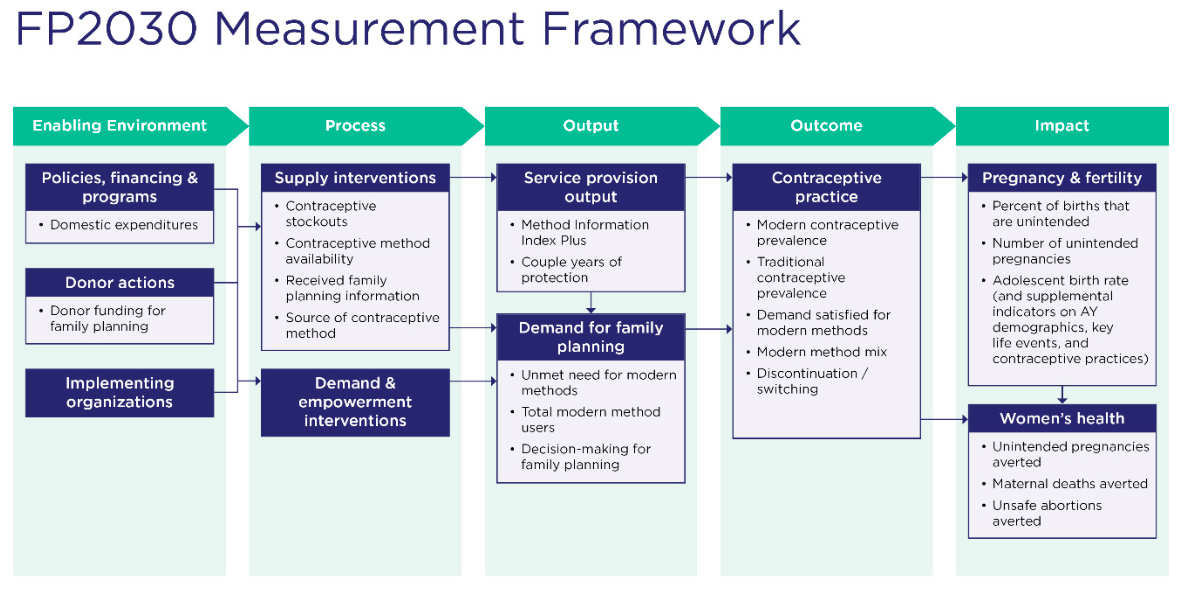
Figure 2.
FP2030 annual measurement and reporting process.
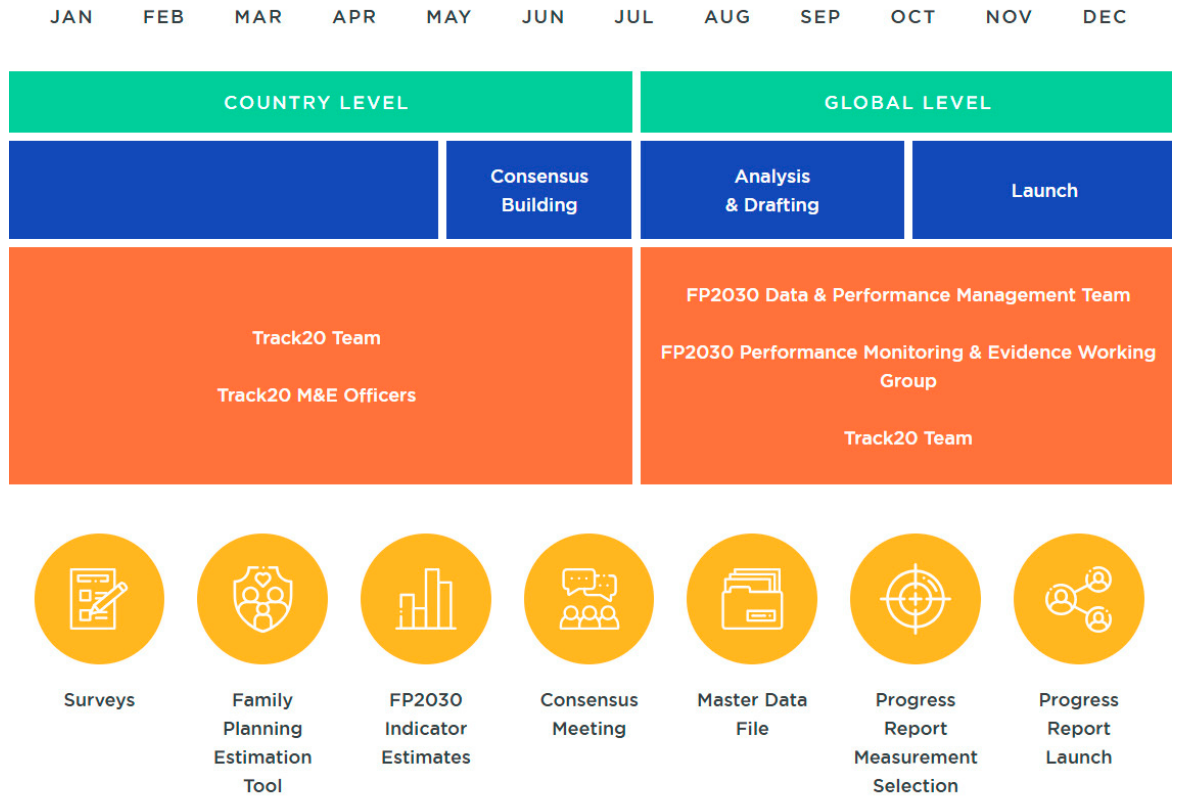
Figure 3.
FP2030 Measurement Framework broken down by data source availability.
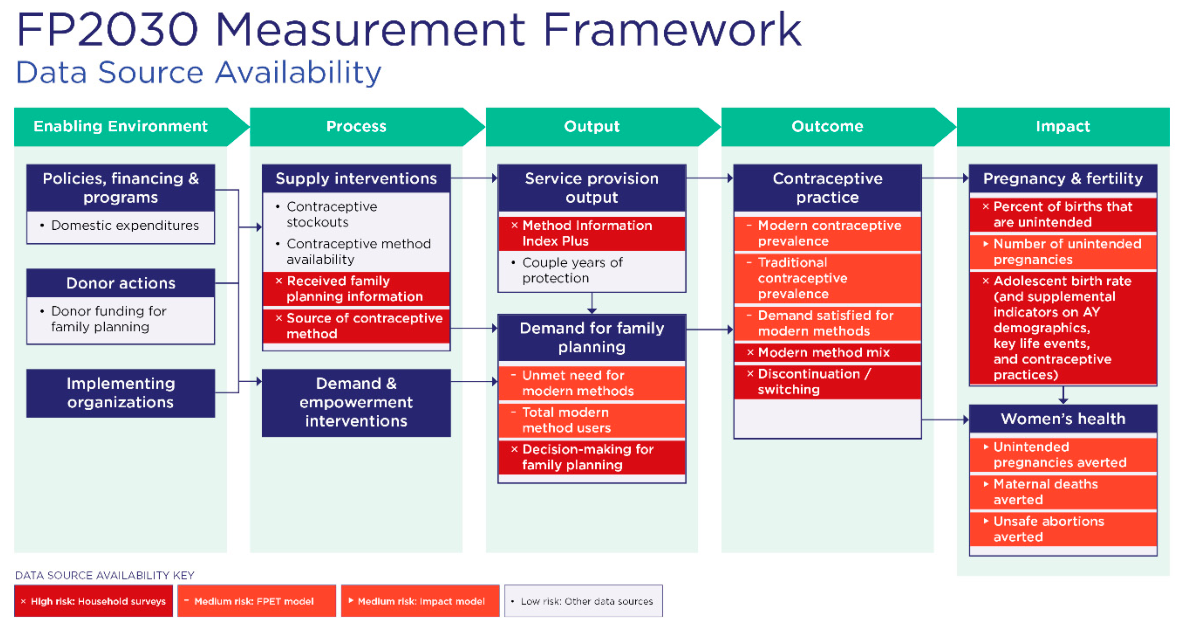
Figure 4.
FP2030 Measurement Framework minimum set of priority indicators.
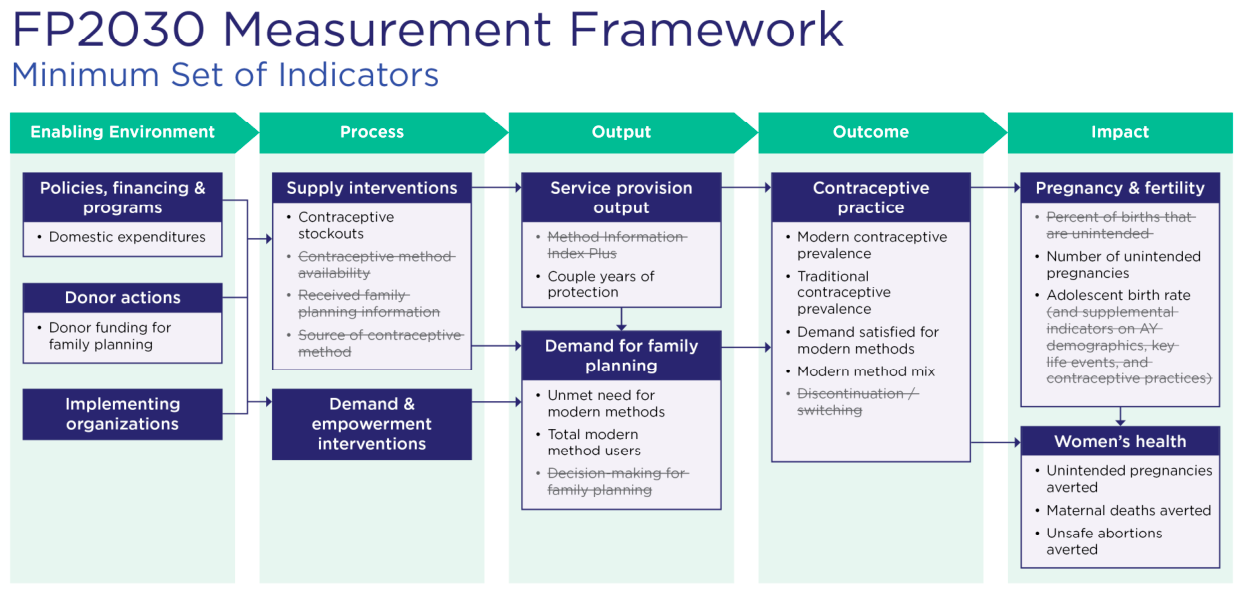

Table 1.
Minimum set of core priority indicators and their data sources.
| No. | Indicator | Data source for reporting |
| i. | Donor government financing for family planning | KFF |
| ii. | Domestic expenditure for family planning | Family Planning Spending Assessments |
| iii. | Modern contraceptive prevalence | FPET model (or proxy from HMIS) |
| iv. | Traditional contraceptive prevalence | FPET model |
| v. | Total number of users | FPET model + UNPD |
| vi. | Unmet need for modern methods | FPET model |
| vii. | Demand satisfied for modern methods | FPET model |
| viii. | Modern method mix | Surveys (or proxy from HMIS) |
| ix. | Number of unintended pregnancies | Impact model |
| x. | Number of unintended pregnancies averted | Impact model |
| xi. | Number of unsafe abortions averted | Impact model |
| xii. | Number of maternal deaths averted | Impact model |
| xiii. | Couple years of protection (CYPs) | HMIS |
| xiv. | Stockouts | UNFPA supplies surveys or HMIS |
| xv. | ABR | Surveys (or UNPD) |
Table 2.
Complementary set of indicators.
| No. | Indicator |
| i. | Contraceptive prevalence by method (with updated method categorization) |
| ii. | MII Plus |
| iii. | Source of method for the most recent modern method used |
| iv. | An indicator on “need” |
| v. | An indicator on reproductive autonomy, agency, or empowerment |
Disclaimer/Publisher’s Note: The statements, opinions and data contained in all publications are solely those of the individual author(s) and contributor(s) and not of MDPI and/or the editor(s). MDPI and/or the editor(s) disclaim responsibility for any injury to people or property resulting from any ideas, methods, instructions or products referred to in the content. |
© 2026 by the authors. Licensee MDPI, Basel, Switzerland. This article is an open access article distributed under the terms and conditions of the Creative Commons Attribution (CC BY) license (http://creativecommons.org/licenses/by/4.0/).
Copyright: This open access article is published under a Creative Commons CC BY 4.0 license, which permit the free download, distribution, and reuse, provided that the author and preprint are cited in any reuse.


