
Submitted:
23 July 2026
Posted:
24 July 2026
You are already at the latest version
Abstract
Paper mills pose a serious threat to the reliability of the scholarly record, and public critics have often identified cross-journal patterns that conventional editorial processes failed to detect. The legitimacy of this work, however, does not remove the need to calibrate public terminology. When a severe organisational label such as "paper mill" is combined with a national descriptor, the apparent scope of the claim can expand from a defined set of papers to authors, institutions, or an entire research community. This Perspective develops an evidence-and-scope framework for evaluating that expansion. It draws on research about paper mills, citation manipulation, image anomalies, stigma, and research assessment, and it uses the publicly available Science Integrity Digest post "The Iranian Plant Paper Mill" as an illustrative case. The analysis does not determine whether the papers discussed in that post originated from a paper mill and does not allege misconduct by the post's author, commenters, or any researcher mentioned there. Instead, it examines the relationship among the evidence described, the title's geographic referent, the procedural status of the allegations, the use of pseudonymous observations, and the expansion of claims through comments. The article argues that national descriptors are not inherently improper, but they require an explicit analytic purpose, a defined unit of attribution, proportional treatment of transnational participation, and visible uncertainty and update mechanisms. It proposes a staged evidence-to-label vocabulary and a disclosure standard covering dataset boundaries, geographic meaning, verification, right of reply, comment moderation, and post-publication revision. These safeguards are intended to strengthen, rather than restrain, public research-integrity criticism by making serious warnings more precise, auditable, and resistant to collective overgeneralisation.
Keywords:
paper mills
; national framing
; post-publication peer review
; citation manipulation
; collective attribution
; reputational harm
; procedural fairness
; research integrity
1. Introduction
Paper mills are not a rhetorical invention but a documented form of organised publication manipulation. The term is commonly used for commercial or coordinated services that produce, sell, or place fabricated, manipulated, plagiarised, or otherwise unreliable manuscripts, sometimes together with authorship positions, falsified peer review, or editorial access. Research and policy reports describe an expanding problem that consumes editorial resources, distorts the research record, and can overwhelm processes designed for isolated rather than industrial-scale cases [1,2,3,4,5]. The downstream consequences are not confined to the papers that first enter the literature, because retracted paper-mill articles continue to be cited and have been incorporated into systematic reviews, while recent calls for research emphasise that the enabling organisations, incentives, and publication infrastructures must be studied collectively [5,6,7].
Public post-publication criticism is indispensable within this environment because editors and institutions often see only one article, whereas independent analysts can compare images, wording, peer-review reports, coordinates, tables, and citation structures across journals. Text duplication has revealed repeated peer-review language associated with suspected review fraud, and large-scale image studies have shown both the prevalence of inappropriate duplication and the importance of distinguishing correctable preparation errors from patterns that may justify retraction [8,9,10]. Public scrutiny can therefore generate evidence that would otherwise remain fragmented, although the inferential distance between a visible anomaly and an organised production mechanism must remain explicit.
Citation analysis presents the same tension between valuable detection and premature attribution, because network methods can identify anomalous clusters and support investigation, while mutual citation may also arise from legitimate intellectual proximity, field size, language, collaboration, or shared methods. Scholarship on citation cartels and COPE's guidance on citation manipulation accordingly treats network concentration as evidence requiring contextual evaluation rather than as an automatic finding of collusion [11,12,13]. The broader principle is that a signal may justify scrutiny without, by itself, establishing the actor, mechanism, intention, or disciplinary conclusion that a strong public label appears to name.
That distinction becomes especially important when the label is coupled with a country. Stigma research explains how labels become linked to stereotypes, separation, status loss, and discrimination, while experimental work on stigma by association shows that discredit may spread beyond the person or object initially marked [14,15]. Within scholarly communication, retraction notices can themselves carry a stigmatising force whose allocation depends on wording and attributed responsibility [16]. Recent analysis of narratives about research misconduct in China further demonstrates that factually serious integrity problems can be discussed through national and civilizational frames that reproduce unequal transnational hierarchies, particularly when structural incentives are converted into claims about a research culture [17].
Country-level analysis is nevertheless legitimate when geography is analytically defined. Research has examined monetary publication rewards within China, and a recent cross-country study of retractions specified its data sources, period, denominators, and full-counting method for multi-country papers [18,19]. Those examples illustrate the difference between analysing a national policy or a transparently constructed country statistic and placing a country adjective beside an accusation whose unit of attribution remains ambiguous. An instructive analogy comes from World Health Organization naming guidance, which does not prohibit geographic epidemiology but recommends avoiding geographic disease names when they can create unnecessary negative effects for national, regional, cultural, or ethnic groups [20]. The analogy is not a rule for publication ethics, but it demonstrates why descriptive relevance and public naming require separate justification.
This Perspective argues that public critics should retain freedom to identify serious anomalies and suspected paper-mill patterns while accepting a corresponding responsibility to control the scope of attribution. COPE's ethical guidance requires peer reviewers, including those participating in public post-publication commentary, to remain unbiased by nationality, provide evidence for general statements, and avoid inflammatory language and unfounded accusations; the European Code of Conduct similarly places reliability, honesty, respect, and accountability at the centre of research integrity [21,22]. These principles support criticism that is exacting rather than timid, because claims become more credible when their evidentiary basis, geographic meaning, procedural status, and correction pathway are visible.
2. Scope and Analytical Approach
The article is a normative Perspective based on a purposive reading of peer-reviewed scholarship, official publication-ethics guidance, platform policies, and one publicly accessible case. It is not a systematic review, a content-analysis study, or an investigation of the underlying plant papers. The focal post was selected because its title explicitly joins a national adjective to the categorical term "paper mill", while its body describes a transnational paper set, technical anomalies, pseudonymous observations, and a public comment thread [23]. The post and related web materials were inspected on 23 July 2026.
The analysis asks five questions that can be applied to any country-labelled integrity claim: what the geographic term denotes; how the paper set was bounded; which observations are directly verifiable; where causal or intentional inference begins; and which mechanisms permit reply, correction, and revision. The method deliberately separates criticism of a public framing choice from adjudication of the scientific record. Consequently, the article neither endorses nor rejects the focal post's paper-mill hypothesis, and it does not infer motive, bias, bad faith, or misconduct on the part of the post's author, contributors, commenters, or the researchers whose papers are discussed.
3. Two Dimensions of Escalation: Claim Severity and Attributional Scope
Public integrity claims can escalate along two independent dimensions. The first is claim severity, which moves from a specific observation through replicated pattern evidence and a causal hypothesis to a categorical label or competent-body decision. The second is attributional scope, which moves from one figure or paper to a cluster, an inferred network, an institution, or a country-level community. A claim can be technically detailed yet still be overbroad if its attributed population exceeds the dataset, just as a geographically narrow claim can remain too categorical if it presents an untested mechanism as established.
Figure 1 presents these stages as an analytical pathway rather than a mandatory chronology, because public critics may begin with a cross-paper pattern and formal bodies may act without determining individual misconduct. The essential requirement is that each transition remain visible. Observations should be reproducible, cluster boundaries should be disclosed, causal language should identify alternatives, public labels should communicate their provisional or confirmed status, and the authority responsible for any record action or misconduct finding should be named.

Table 1.
Evidence-calibrated public terminology.
| Evidentiary and procedural position | Defensible public formulation | Scope and caveat |
| Specific anomaly in one paper | Apparent image overlap; coordinate outside the valid range; unexplained numerical inconsistency | Identify the exact paper, figure, table, or value; do not infer motive or production mechanism. |
| Replicated anomaly in a defined paper set | Repeated cross-paper pattern requiring investigation | Publish the inclusion rule and comparison method; distinguish observed similarity from shared origin. |
| Convergent indicators supporting a common-source hypothesis | Possible coordinated-production indicators or possible paper-mill involvement | Define the cluster and alternative explanations; state that the mechanism has not been formally established. |
| Publisher confirms systematic manipulation | Publisher-confirmed manipulation affecting the papers listed in the decision | Do not convert a record-status decision into an institutional misconduct finding unless the decision does so. |
| Institution, funder, or regulator issues a misconduct finding | Research-misconduct finding by the named competent body | Confine attribution to the people, conduct, works, period, and standard actually covered by the finding. |
4. Why National Framing Changes the Claim
A country word can denote several non-equivalent relationships, including sampling location, author affiliation, citizenship, institutional control, journal location, funding policy, commercial market, or the place where a service operates. When a title leaves that referent unspecified, readers may supply their own interpretation, and the most salient interpretation may be broader than the evidence. A phrase intended to describe where plants were sampled can therefore be received as a statement about the integrity of nationally affiliated researchers, even though the underlying papers may involve authors, institutions, and editorial systems distributed across several countries.
The relevant ethical problem is not the mere presence of geography but a mismatch among referent, evidence, and headline scope. Geographic specificity can improve an analysis when the location is part of the anomaly, when a documented policy creates an incentive, or when a country is the explicit unit of a comparative study [18,19]. Geographic wording becomes harder to justify when the country functions primarily as a memorable public label, when the dataset is transnational, or when a strong mechanism is attached to a national adjective without clarifying whether the adjective describes locations, affiliations, services, or responsibility.
Collective-attribution risk should not be described as proven audience harm in the absence of empirical reception data. In this article, the term identifies a foreseeable communication mechanism: a severe label is attached to a group marker, the marker becomes a retrieval and memory cue, and people outside the investigated set may inherit suspicion through category membership. Stigma theory and scholarship on nationalised misconduct narratives make that mechanism plausible, but the framework does not claim that every reader generalises or that every country-labelled title produces measurable discrimination [14,15,16,17].
5. Illustrative Case: “The Iranian Plant Paper Mill”
5.1. What the Public Page Documents
The Science Integrity Digest post dated 15 September 2022 describes what it calls a paper mill involving plants sampled in Iran. The page links to a spreadsheet identified as containing 70 papers as of September 2022 and reports several concrete anomaly types: repeated sampling coordinates across papers, latitude or longitude seconds above 59, mismatches between locations in tables and maps, shared networks or phylogenetic trees, apparently similar gel images, repeated rows of genetic-distance values, inconsistent corresponding-author email details, and concentrated citations to two authors [23]. The page attributes several image, graph, and tree comparisons to three pseudonymous PubPeer users and uses qualified terms such as "appear", "perhaps", and "might" in parts of the discussion [23].
These observations are not trivial, and a critic does not need to suppress them merely because the papers involve a country that may be exposed to stereotyping. Impossible coordinate notation is directly checkable, repeated values across ostensibly different studies can justify scrutiny, and cross-paper image similarities may support a broader inquiry when the comparison is reproducible. The central issue for this Perspective is not whether the observations should have been published, but whether the title, dataset description, causal label, and procedural status enable a reader to understand precisely what has and has not been established.
5.2. Geographic Referent and Transnational Structure
The post's body indicates that the relevant geography is heterogeneous. It describes plant sampling locations in Iran, co-authors from Iran, and first and corresponding authors who are primarily based in China and affiliated with different institutions [23]. The word "Iranian" in the title could therefore refer to the plants, the sampling sites, part of the authorship, the inferred production network, or a shorthand name previously used for the spreadsheet. Because these possibilities allocate responsibility differently, an explicit subtitle or method statement would materially improve the framing.
A narrower title could lead with the evidentiary feature, for example by referring to repeated coordinates and cross-paper anomalies in a defined set of plant studies using Iranian sampling locations. If the evidence instead supports a common production process crossing national boundaries, a formulation such as "possible coordinated-production indicators in a transnational plant-study cluster" would better match the described authorship. Neither alternative denies the geographic facts, but each prevents the country name from silently carrying an organisational or collective accusation.
5.3. Categorical Title, Provisional Body, and Dataset Transparency
The categorical phrase "paper mill" appears in the title, whereas several passages in the body retain uncertainty about how the papers are connected and whether the citation pattern forms part of the same mechanism [23]. A categorical title can be defensible when evidence is sufficiently strong, but readers should be shown why the public classification has crossed that threshold. At minimum, the page should state whether the label is an author's analytic conclusion, a shorthand for a screening set, a publisher-confirmed classification, or a finding adopted by another competent body.
The publicly visible page provides a search example and a link to the paper list, but it does not itself set out a reproducible inclusion and exclusion protocol, the number and rationale for removed cases, a structured assessment of alternative explanations, or a consolidated status table showing journal, publisher, or institutional outcomes for each paper [23]. Procedures or correspondence may exist elsewhere or privately, and their absence from the page should not be interpreted as proof that no verification occurred. The narrower point is that readers encountering the public label cannot evaluate those steps from the page alone, even though the page remains the durable object through which the case may be found and shared.
5.4. Pseudonymous Evidence and Amplification
Pseudonymity is not a reason to disregard a technically verifiable concern. COPE has long advised that anonymous concerns should be judged on their substance, while PubPeer protects pseudonymous participation and requires comments to rely on facts, logic, and publicly verifiable information [24,25]. PubPeer's current guidance also forbids allegations of misconduct, discourages speculation about motive, applies a higher moderation bar to comments implying misconduct, alerts authors, preserves a right of reply, and explicitly states that the platform does not scientifically verify comments or warrant their truth [24].
Amplification changes the communicative act because a blog author may combine multiple comments, add an explanatory narrative, select a title, and infer a production mechanism. The resulting page can carry more authority and wider search visibility than any single PubPeer comment, while the platform-level caveats may no longer accompany the evidence. A responsible amplification statement should therefore identify which comparisons were independently reproduced by the amplifying author, which remain attributed observations, which alternative explanations were tested, and whether authors, journals, or publishers were invited to respond before or after publication.
5.5. Comments as a Secondary Layer of Allegation
The public comment thread illustrates how the scope of a page can expand after publication. Visible comments introduce additional named researchers, speculate about connections, and describe an alleged operating method that includes paid authorship and citation enhancement, while other comments place further allegations about identifiable researchers beneath the original post [23]. The present analysis does not assess those statements and deliberately does not repeat the names, because their evidentiary status may differ from the top-level material.
Comment moderation should consequently be treated as part of research-integrity governance rather than as a purely stylistic function. A page-level disclaimer does not fully control the effect of a visible comment that asserts motive, payment, or misconduct against an identifiable person. Moderation can preserve useful leads while requiring sources, marking unverified extensions, preventing national or ethnic generalisation, and elevating author, journal, or institutional responses into a clearly visible update rather than leaving them buried chronologically.
6. Distinguishing Public Criticism, Record Action, and Misconduct Findings
Public critics, journals, publishers, and research institutions perform different functions. A critic can identify verifiable anomalies and propose a pattern; a journal or publisher can correct, express concern about, or retract a publication; and an institution, funder, or regulator may determine whether a person committed research misconduct under an applicable standard. COPE's flowchart on systematic manipulation addresses editorial investigation across papers, while its retraction guidance and the ICMJE Recommendations emphasise that a record action should explain why an article is unreliable and does not automatically amount to a disciplinary finding against every author [26,27,28].
This division of roles should be reflected in public wording. "Publisher-confirmed systematic manipulation" identifies both the decision and its source, whereas "misconduct" should be attributed to the competent body that made that finding. The phrase "paper mill" occupies an intermediate position because it can describe a research hypothesis, an editorial classification, or a confirmed commercial mechanism. Public critics should therefore state which of those meanings they intend, particularly when the phrase appears in a headline and is paired with a national descriptor.
7. A Scope-and-Calibration Standard for Public Integrity Criticism
The proposed standard combines evidentiary calibration with scope control. It does not require the procedures of a court or a formal misconduct tribunal, because public criticism often begins precisely when official systems are slow or fragmented. It requires enough disclosure for an informed reader to reproduce the observation, understand how the paper set was constructed, identify the status of the label, and locate later corrections or responses. Table 2 sets out eight dimensions that can be implemented by individual bloggers, collective watchdog projects, post-publication platforms, and news organisations without eliminating pseudonymity or imposing disproportionate administrative burdens.
8. Anticipated Objections and Responses
8.1. Qualification May Appear to Weaken Urgent Warnings
The strongest objection is that cautious terminology may blunt warnings about an industrial threat. That concern deserves weight because paper-mill outputs can remain in the literature, acquire citations, and enter evidence syntheses before editorial action [5,6]. Qualification, however, does not require vague or euphemistic prose. A critic can state that coordinates are impossible, figures appear duplicated, a cross-paper pattern is extensive, or the evidence is consistent with coordinated production, while still identifying which inference remains provisional. Precision can increase urgency because an editor can act on a reproducible claim more readily than on a sweeping label whose evidentiary components are unclear.
8.2. National Context Can Be Causally Relevant
Publication requirements, monetary rewards, research evaluation, and commercial authorship markets can be nationally or regionally structured, and eliminating geography would sometimes conceal an important cause [18,19]. The proposed standard therefore rejects a categorical ban on country analysis. It asks the author to identify the relevant mechanism and unit, use an appropriate denominator, acknowledge transnational infrastructures, and avoid translating a policy or incentive into a cultural essence. A documented national rule is evidence about a rule, whereas it is not evidence that all researchers governed by that rule share the same conduct or disposition.
8.3. Independent Critics Cannot Conduct Formal Investigations
Independent critics usually lack access to raw data, contracts, submission metadata, institutional interviews, and the power to compel evidence, which makes full adjudication unrealistic. The framework responds to that limitation by requiring status transparency rather than institutional equivalence. A critic may publish a serious, well-supported hypothesis, but should not allow the format, title, or subsequent commentary to obscure the difference between that hypothesis and a decision made after access to non-public evidence.
8.4. Pseudonymity Limits Conflict Disclosure
Pseudonymity can protect critics from retaliation and permit scrutiny across steep academic hierarchies, while the inability to assess expertise or conflicts remains a genuine limitation [24,25]. The solution is not compulsory identification but stronger evidence architecture: publicly verifiable claims, reproducible comparisons, transparent moderation, independent checking by the amplifier, and an accessible right of reply. These safeguards shift evaluation from the speaker's status to the quality and limits of the evidence without pretending that identity is always irrelevant.
9. Implications for Platforms, Critics, Journals, and Institutions
Platforms and independent critics should treat titles, tags, search snippets, images, comments, and later updates as one publication object. A cautious paragraph cannot fully neutralise a categorical title, and an accurate original post can become misleading if a correction is hidden below years of comments. Because online discussion and news attention to unreliable papers can persist after retraction, prominent versioning and status labels are part of scientific communication rather than optional reputation management [29].
Journals and publishers can support more proportionate public criticism by acknowledging receipt of documented concerns, publishing informative notices, linking related cases, and distinguishing unreliability from personal misconduct. Institutions should communicate whether an inquiry is pending, concluded, or outside their jurisdiction without demanding that critics surrender anonymity as a precondition for assessing verifiable evidence. Conversely, public critics should update the record when a journal corrects an error, an author supplies original data, a comparison proves mistaken, or an institutional finding changes the status of the allegation.
Research funders and assessment bodies should address incentives that create markets for authorship, citation, and rapid publication, because communication safeguards cannot replace structural prevention [1,7,18]. Country labels are particularly inadequate when the causal chain crosses national evaluation systems, commercial brokers, international journals, guest editors, paper authors, and global metrics providers. A transnational problem should not be made cognitively manageable by assigning one country the burden of representing the entire system.
10. Limitations
Four limitations bound the conclusions that can be drawn from this Perspective and should guide interpretation of its normative recommendations. First, it analyses one focal page and therefore does not estimate how common national framing is across research-integrity blogs, news coverage, PubPeer, or retraction notices. Second, it does not test reader responses, so collective-attribution risk remains a theoretically grounded communication concern rather than a measured effect in this case. It relies on the public page as displayed on the access date and cannot exclude private verification, correspondence, moderation, or investigative work that was not described there. Finally, it does not reanalyse the underlying plant papers and cannot determine whether the paper-mill or citation-ring hypotheses are correct.
These limitations define a future research agenda rather than negate the normative problem. Comparative studies could code the geographic referents, evidentiary language, response mechanisms, and update histories of public integrity reports, while experimental work could test whether country-labelled titles alter perceived credibility of unrelated researchers. Case studies could also examine whether more transparent dataset versioning accelerates publisher action or reduces conflict between critics and authors.
11. Conclusion
Paper mills, fabricated peer review, image manipulation, and citation engineering require determined public scrutiny, particularly when fragmented editorial systems cannot recognise cross-journal patterns. The credibility of that scrutiny depends on more than whether an anomaly is real, because titles and labels also determine who appears responsible, how far suspicion travels, and whether later evidence can repair the public record.
Country descriptors should therefore be used when they identify an analytically necessary feature and should be defined with the same care given to the technical evidence. Where a paper set is transnational, a sampling location should not silently become a national attribution; where a mechanism remains inferential, a categorical headline should not make it appear formally established; and where comments expand an allegation, moderation and updating should preserve the boundary of the original case.
My position is not that public critics should retreat from severe findings, but that severity and scope should be earned separately. Evidence-first wording, explicit geographic referents, reproducible dataset boundaries, clear procedural status, protected pseudonymity, visible reply, and durable correction mechanisms create a stronger form of accountability. Those safeguards allow research-integrity criticism to remain forceful while reducing the risk that a defined cluster becomes a lasting reputational judgement about an entire national research community.
Author Contributions
Edward Mason: Conceptualization; investigation; writing - original draft; writing - review and editing.
Funding
No external funding was received.
Competing interests
The author declares no financial, professional, or organisational relationship with the platforms, publications, individuals, or institutions discussed in this article.
Ethics approval
Not applicable. The article is a normative analysis of publicly accessible materials and published literature and does not involve human participants or non-public personal data.
Data availability
No new empirical dataset was generated. The focal public materials and all scholarly sources are identified in the reference list.
Generative-AI assistance
A generative-AI tool was used to support language editing. The author reviewed the manuscript, verified the cited sources, and accepts full responsibility for the final content.
References
- Committee on Publication Ethics (COPE); STM Association. Paper Mills - Research report from COPE & STM. Version 1. COPE. 2022. [Google Scholar] [CrossRef]
- Byrne, J.A.; Christopher, J. Digital magic, or the dark arts of the 21st century - how can journals and peer reviewers detect manuscripts and publications from paper mills? FEBS Lett. 2020, 594(4), 583–589. [Google Scholar] [CrossRef] [PubMed]
- Perez-Neri, I.; Pineda, C.; Sandoval, H. Threats to scholarly research integrity arising from paper mills: a rapid scoping review. Clin. Rheumatol. 2022, 41(7), 2241–2248. [Google Scholar] [CrossRef] [PubMed]
- Parker, L.; Boughton, S.; Bero, L.; Byrne, J.A. Paper mill challenges: past, present, and future. J. Clin. Epidemiol. 2024, 176, 111549. [Google Scholar] [CrossRef] [PubMed]
- Candal-Pedreira, C.; Ross, J.S.; Ruano-Ravina, A.; Egilman, D.S.; Fernandez, E.; Perez-Rios, M. Retracted papers originating from paper mills: cross sectional study. BMJ 2022, 379, e071517. [Google Scholar] [CrossRef] [PubMed]
- Tang, G.; Cai, H. Citation contamination by paper mill articles in systematic reviews of the life sciences. JAMA Netw. Open 2025, 8(6), e2515160. [Google Scholar] [CrossRef] [PubMed]
- Byrne, J.A.; Abalkina, A.; Akinduro-Aje, O.; Christopher, J.; Eaton, S.E.; Joshi, N.; et al. A call for research to address the threat of paper mills. PLoS Biol. 2024, 22(11), e3002931. [Google Scholar] [CrossRef] [PubMed]
- Day, A. Exploratory analysis of text duplication in peer-review reveals peer-review fraud and paper mills. Scientometrics 2022, 127(10), 5965–5987. [Google Scholar] [CrossRef]
- Bik, E.M.; Casadevall, A.; Fang, F.C. The prevalence of inappropriate image duplication in biomedical research publications. mBio 2016, 7(3), e00809-16. [Google Scholar] [CrossRef] [PubMed]
- Bik, E.M.; Fang, F.C.; Kullas, A.L.; Davis, R.J.; Casadevall, A. Analysis and correction of inappropriate image duplication: the Molecular and Cellular Biology experience. Mol. Cell Biol. 2018, 38(20), e00309-18. [Google Scholar] [CrossRef] [PubMed]
- Fister, I., Jr.; Fister, I.; Perc, M. Toward the discovery of citation cartels in citation networks. Front Phys. 2016, 4, 49. [Google Scholar] [CrossRef]
- Kojaku, S.; Livan, G.; Masuda, N. Detecting anomalous citation groups in journal networks. Sci. Rep. 2021, 11, 14524. [Google Scholar] [CrossRef] [PubMed]
- Committee on Publication Ethics. Citation manipulation. COPE discussion document. 2019. Available online: https://publicationethics.org/guidance/discussion-document/citation-manipulation (accessed on 23 July 2026).
- Link, B.G.; Phelan, J.C. Conceptualizing stigma. Annu Rev. Sociol. 2001, 27, 363–385. [Google Scholar] [CrossRef]
- Pryor, J.B.; Reeder, G.D.; Monroe, A.E. The infection of bad company: stigma by association. J. Pers. Soc. Psychol. 2012, 102(2), 224–241. [Google Scholar] [CrossRef] [PubMed]
- Xu, S.B.; Hu, G. Retraction stigma and its communication via retraction notices. Minerva 2022, 60(3), 349–374. [Google Scholar] [CrossRef]
- McLellan, T. Asian tricks and research misconduct: from Orientalism and Occidentalism to solidarity against audit cultures. East Asian Sci. Technol. Soc. 2025, 19(4), 493–513. [Google Scholar] [CrossRef]
- Quan, W.; Chen, B.; Shu, F. Publish or impoverish: an investigation of the monetary reward system of science in China (1999-2016). Aslib J. Inf. Manag. 2017, 69(5), 486–502. [Google Scholar] [CrossRef]
- Sebo, P.; Sebo, M. Geographical disparities in research misconduct: analyzing retraction patterns by country. J. Med. Internet Res. 2025, 27, e65775. [Google Scholar] [CrossRef] [PubMed]
- World Health Organization. World Health Organization best practices for the naming of new human infectious diseases. Geneva: WHO; 2015. Report No.: WHO/HSE/FOS/15.1. WHO: Geneva. Available online: https://www.who.int/publications/i/item/WHO-HSE-FOS-15.1 (accessed on 23 July 2026).
- COPE Council. COPE ethical guidelines for peer reviewers. Version 2. COPE 2017. [Google Scholar] [CrossRef]
- ALLEA. The European Code of Conduct for Research Integrity. Revised edition 2023; ALLEA: Berlin, 2023; Available online: https://allea.org/code-of-conduct/ (accessed on 23 July 2026).
- Bik, E. The Iranian Plant Paper Mill. Science Integrity Digest. 15 September 2022; updated 17 January 2023. Available online: https://scienceintegritydigest.com/2022/09/15/the-iranian-plants-paper-mill/ (accessed on 23 July 2026).
- PubPeer Foundation. Frequently asked questions. Available online: https://pubpeer.com/static/faq (accessed on 23 July 2026).
- Committee on Publication Ethics. Responding to anonymous concerns. COPE discussion document. 2013. Available online: https://publicationethics.org/guidance/discussion-document/responding-anonymous-concerns (accessed on 23 July 2026).
- Committee on Publication Ethics. Systematic manipulation of the publication process. COPE flowchart. 2024. Available online: https://publicationethics.org/guidance/flowchart/systematic-manipulation-publication-process (accessed on 23 July 2026).
- COPE Council. Retraction guidelines. COPE. 2025. Available online: https://publicationethics.org/guidance/guideline/retraction-guidelines (accessed on 23 July 2026).
- International Committee of Medical Journal Editors. Recommendations for the Conduct, Reporting, Editing, and Publication of Scholarly Work in Medical Journals. Updated January 2026. Available online: https://www.icmje.org/recommendations/ (accessed on 23 July 2026).
- Peng, H.; Romero, D.M.; Horvat, E.A. Dynamics of cross-platform attention to retracted papers. Proc. Natl. Acad. Sci. U S A 2022, 119(25), e2119086119. [Google Scholar] [CrossRef] [PubMed]
Figure 1.
Evidence-to-label pathway for public research-integrity criticism. The diagram distinguishes technical observation, pattern recognition, causal hypothesis, public classification, and decisions by bodies with formal responsibility. The safeguards apply at every transition and do not imply that each case must reach the final stage.
Figure 1.
Evidence-to-label pathway for public research-integrity criticism. The diagram distinguishes technical observation, pattern recognition, causal hypothesis, public classification, and decisions by bodies with formal responsibility. The safeguards apply at every transition and do not imply that each case must reach the final stage.
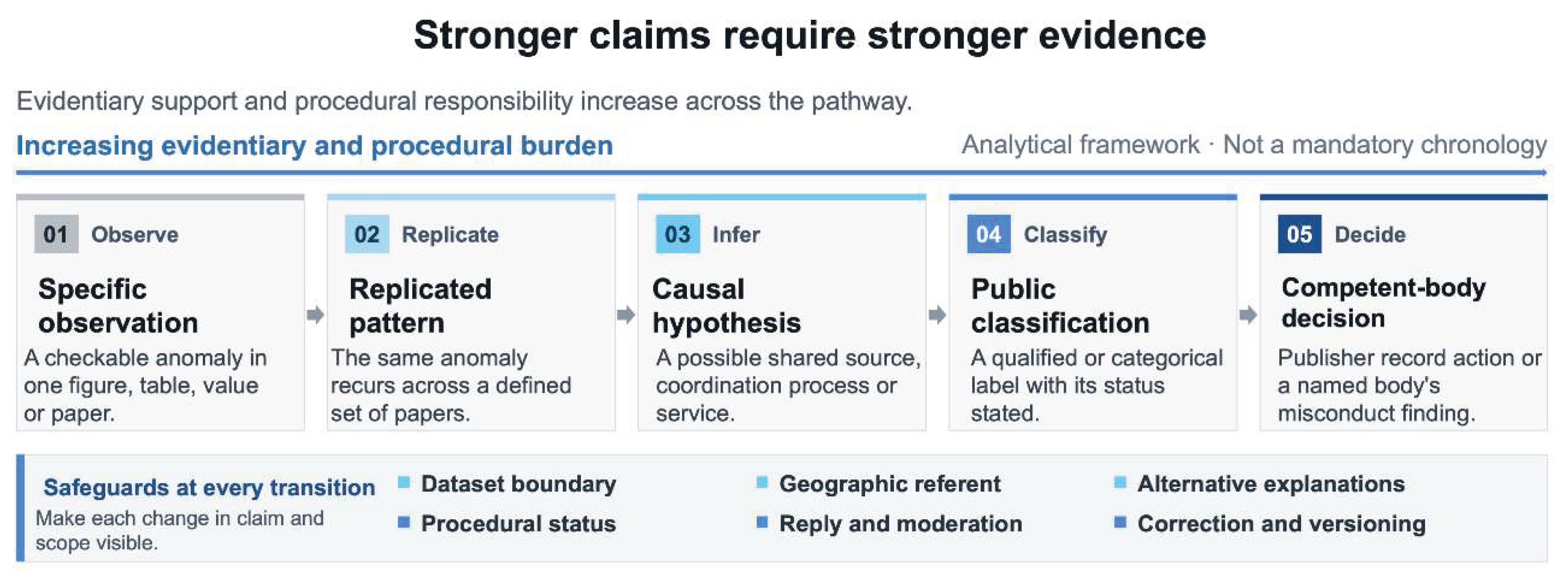
Table 2.
Minimum disclosure and repair standard for country-labelled integrity criticism.
| Dimension | Minimum public disclosure | Update or repair mechanism |
| Geographic referent | State whether the country denotes sampling location, affiliation, policy, journal, funding source, market, or service location. | Revise the title or subtitle if readers could reasonably infer a broader national accusation. |
| Dataset boundary | Provide the paper list, date range, search route, inclusion criteria, and treatment of borderline or removed cases. | Version the list and preserve a dated change note explaining additions and removals. |
| Observed evidence | Separate directly reproduced anomalies from observations attributed to third parties or automated tools. | Correct images, calculations, or comparisons visibly when replication fails or new files become available. |
| Causal label | Define whether 'paper mill' or 'citation ring' is a possibility, analytic conclusion, publisher classification, or formal finding. | Change categorical wording when the procedural status is weaker than the headline implies. |
| Transnational structure | Describe all materially relevant countries and roles rather than assigning symbolic responsibility to one location. | Add missing affiliations, service locations, editorial links, or cross-border relationships proportionately. |
| Right of reply | State whether authors, journals, publishers, or institutions were contacted and how responses can be submitted. | Display substantive responses near the original concern and identify unresolved disagreements. |
| Outcome and versioning | Distinguish no response, inquiry opened, correction, expression of concern, retraction, and misconduct finding. | Add a dated top-level update without silently rewriting the historical record. |
| Comment governance | Require sources for new allegations and mark comments that extend the original case beyond its evidence. | Remove or contextualise unsupported personal, national, ethnic, or motive-based accusations. |
Disclaimer/Publisher’s Note: The statements, opinions and data contained in all publications are solely those of the individual author(s) and contributor(s) and not of MDPI and/or the editor(s). MDPI and/or the editor(s) disclaim responsibility for any injury to people or property resulting from any ideas, methods, instructions or products referred to in the content. |
© 2026 by the authors. Licensee MDPI, Basel, Switzerland. This article is an open access article distributed under the terms and conditions of the Creative Commons Attribution (CC BY) license (http://creativecommons.org/licenses/by/4.0/).
Copyright: This open access article is published under a Creative Commons CC BY 4.0 license, which permit the free download, distribution, and reuse, provided that the author and preprint are cited in any reuse.