
Submitted:
24 July 2026
Posted:
24 July 2026
You are already at the latest version
Abstract
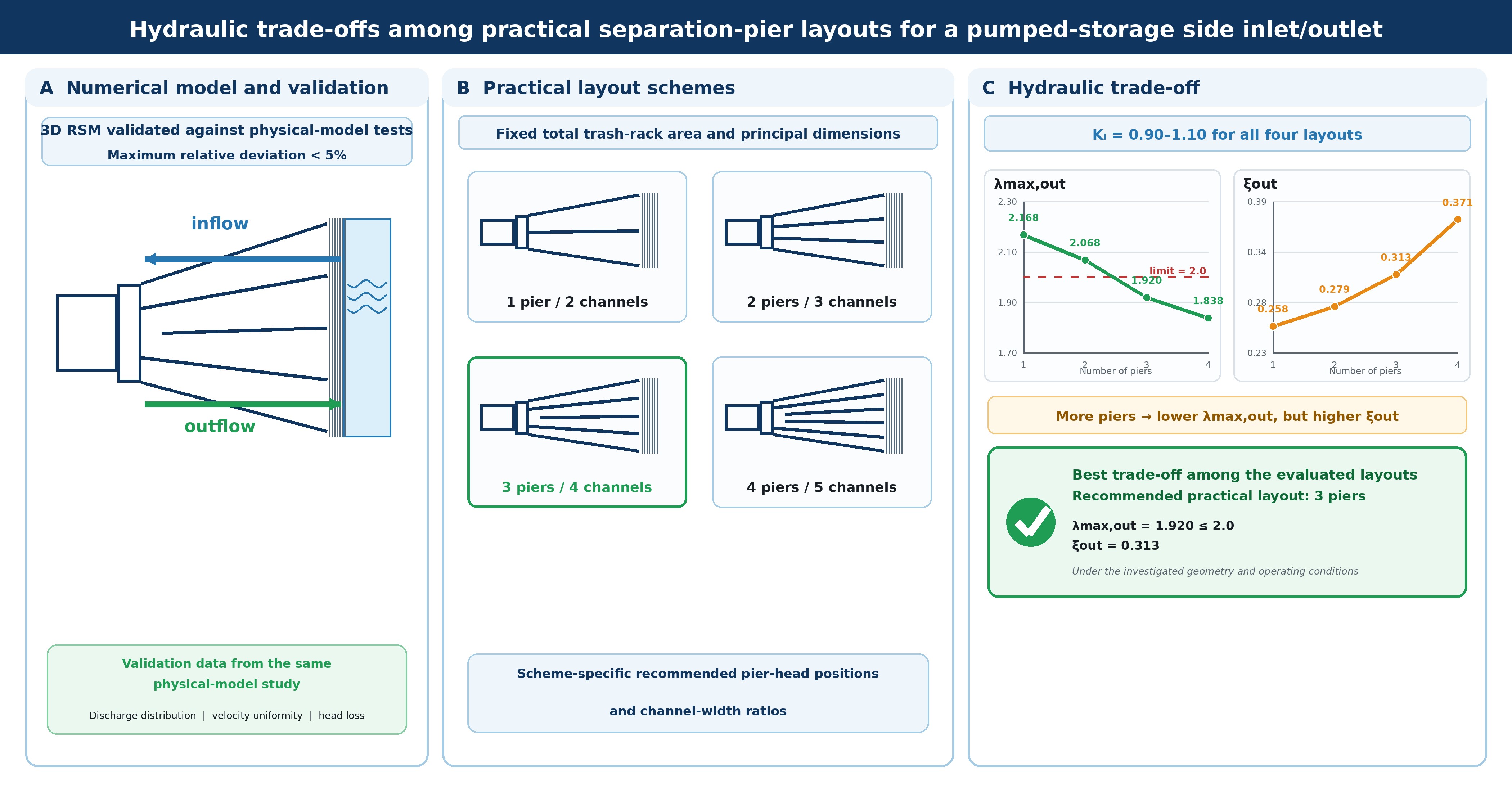
The selection of separation-pier layouts for side inlet/outlet structures in pumped-storage power stations is still largely experience-based, and direct hydraulic comparisons among practical layouts remain limited. This study compares one-, two-, three-, and four-pier layouts under inflow and outflow operation. A three-pier layout from a lower-reservoir side inlet/outlet was used as the reference, while the other layouts followed previously recommended pier-head positions and channel-width ratios. The total trash-rack flow area and the principal longitudinal and elevation dimensions were kept constant. A three-dimensional simulation based on the Reynolds stress model was validated against physical-model measurements; the maximum relative deviations of the evaluated hydraulic indices were below 5%. All four layouts met the prescribed discharge-distribution criterion in both flow directions. Under outflow, however, the maximum velocity non-uniformity coefficients for the one- and two-pier layouts were 2.168 and 2.068, exceeding the allowable value of 2.0, whereas the three- and four-pier layouts yielded 1.920 and 1.838. The head-loss coefficient increased monotonically with pier number in both directions. Consequently, the three-pier layout provided the most favorable engineering trade-off among the four evaluated configurations for the investigated geometry and operating conditions. These results represent a comparison of practical layouts rather than a strict single-factor test of pier number.
Keywords:
pumped storage
; side inlet/outlet
; separation-pier layout
; bidirectional flow
; Reynolds stress model
; hydraulic performance
Copyright: This open access article is published under a Creative Commons CC BY 4.0 license, which permit the free download, distribution, and reuse, provided that the author and preprint are cited in any reuse.


