
Submitted:
22 July 2026
Posted:
24 July 2026
You are already at the latest version
Abstract
The measurand considered in this work is the Planck length, \( \ell_{\mathrm P} \). The circularity objection surrounding the Planck units has a long history: Bridgman argued in 1922 that no physical significance should be attached to their particular magnitudes until an essential connection among gravitation, the velocity of light, and the quantum had been established; Cohen stated the circularity explicitly in 1987 by noting that a Planck mass calculated from G cannot then be used to determine G independently. Variants of this objection have persisted to the present day. This paper claims that the circle can now be broken. We develop a measurement model in which \( \ell_{\mathrm P} \) is inferred directly from the response of a torsion balance and from a non-gravitational determination of the inertial content of an isotopically enriched \( {}^{28}\mathrm{Si} \) source body. The source mass is represented by an aggregate reduced Compton wavelength constructed from measured photon wavelengths, cyclotron-frequency ratios, silicon lattice spacing, crystal volume, isotope composition, and material corrections. The resulting measurement equation contains neither G nor \( \hbar \) as independent input quantities. We specify the measurand, traceability routes, sensitivity coefficients, covariance terms, and principal systematic corrections. The proposed procedure is not intended to improve upon the numerical uncertainty of the CODATA value of \( \ell_{\mathrm P} \), conventionally inferred from G, \( \hbar \), and c; its significance is operational and methodological, because it provides an independent realization of the Planck length and thereby resolves the long-standing circularity objection.
Keywords:
Planck length
; measurement model
; metrological traceability
; measurement uncertainty
; torsion balance
; silicon-28
; atom counting
; compton wavelength
; gravitational constant
1. Introduction and Metrological Objective
The decisive issue should be stated at the outset. The familiar algebra
does not, by itself, establish that G is physically composed of a Planck length, a quantum of action, and the speed of light. If has first been calculated from
then Eq. (1) merely returns the information inserted into Eq. (2). The same problem arises for the Planck mass,
and the rearrangement
Cahill was among the first to argue explicitly that the gravitational constant could be interpreted through a dynamically generated Planck-mass scale rather than treated as irreducibly fundamental. In his tetrad formulation he wrote:
“The actual distribution of energy throughout space-time causes the tetrads to assume vacuum expected values of the order of the Planck mass, . Thus the gravitational constant, , may be viewed not as a fundamental constant, but as a mass scale that is dynamically determined by the large-scale structure of the Universe.” [7,12]
The proposal is physically suggestive, but the algebra alone does not determine either G or independently. Cohen made this limitation explicit in work presented in 1987 and published in the corresponding proceedings volume in 1988:
“Dimensional analysis let us write , where is the Planck mass, , but this is of no help in determining G since there is no independent determination of .” [8]
Hereafter is used for the Planck mass, although is also common in the literature. Cohen correctly identified the essential logical defect: unless a Planck unit can be determined independently of G, reconstructing G from that unit is circular. McCulloch later restated the same objection in a modern context [9].
The objection is correct against purely algebraic relabelling. It is not correct against an operational determination of a Planck unit. The circle is broken when the following conditions are simultaneously met:
- (i)
- the gravitational experiment is analysed without inserting a tabulated value of G;
- (ii)
- the inertial content of the source body is established without using a mass standard whose relevant calibration presupposes the same gravitational information;
- (iii)
- the final observable relation contains no hidden occurrence of G; and
- (iv)
- every remaining quantity belongs to an independently realizable measurement chain.
A Cavendish-type experiment combined with Compton-scale mass representation and atom counting satisfies these conditions in principle [10,11,12]. The result is stronger than an alternative notation for G. It is a measurement architecture in which is inferred first and G may subsequently be reconstructed through Eq. (1). Once this ordering is available, the traditional circularity objection has been answered.
2. Measurand and Operational Independence
The measurand is the Planck length associated with the specified torsion-balance and source-body measurement model. The conventional relation is not used as the evaluation equation with a tabulated value of G. Instead, the gravitational response of the balance and the independently characterized inertial content of the source body are combined directly.
Operational independence from G requires that:
- (i)
- no recommended or previously measured value of G is entered as an input quantity;
- (ii)
- the source-body inertial content is obtained from non-gravitational measurements;
- (iii)
- the final measurement function contains no explicit or hidden dependence on G; and
- (iv)
- every input quantity has a stated realization and traceability route.
This criterion does not claim statistical independence from all measurements historically used in the SI or in determinations of other constants. It is narrower and testable: G is not an input to the measurement model, and the source body’s inertial content is not supplied merely as a conventional kilogram value.
3. Historical Motivation for an Independent Realization
Planck introduced natural units in 1899 by combining constants he regarded as universal [1]. His construction produced characteristic units of length, time, mass, and temperature. In modern reduced-constant notation, the best-known length is Eq. (2). Planck’s original convention employed h, rather than ℏ, so numerical factors involving distinguish the historical and modern forms. That distinction does not alter the methodological point: dimensional analysis identifies a unique scale but does not by itself specify an experiment that realizes it.
Planck’s later treatment of thermal radiation placed these natural units within a broader physical framework [2]. Eddington went substantially further. After constructing the fundamental length from the velocity of light, the quantum of action, and the gravitational constant, he concluded:
“But it is evident that this length must be the key to some essential structure. It may not be an unattainable hope that some day a clearer knowledge of the processes of gravitation may be reached; and the extreme generality and detachment of the relativity theory may be illuminated by the particular study of a precise mechanism.” [3]
This is the complete passage rather than the frequently shortened form. Eddington’s expectation preceded quantum field theory and the modern quantum-gravity programme, yet it captured the central intuition that a length involving gravitation, relativity, and quantum action should not be dismissed as an accidental unit conversion. The historical wording and context are also reviewed in Ref. [12].
Bridgman supplied the necessary counterweight. His criticism was directed specifically at the physical interpretation of Planck’s natural units. After discussing the units constructed from the gravitational constant, the velocity of light, and the quantum of action, and after reproducing Eddington’s suggestion that the resulting extremely small length must reveal an essential structure, Bridgman concluded:
“Until some essential connection is discovered between the mechanisms which are accountable for the gravitational constant, the velocity of light, and the quantum, it would seem that no significance whatever should be attached to the particular size of the units defined in this way.”
This statement appears on pp. 101–102 of the 1922 edition of Dimensional Analysis [4]. It may be regarded as an early precursor to the later circularity objection. Bridgman’s concern was not merely that the Planck units arise from dimensional analysis, but that their physical significance remains unestablished so long as no independent connection exists between the mechanisms represented by G, c, and the quantum of action. In modern terms, if a Planck unit can only be calculated by inserting G, and is then used to reinterpret G, the construction has not supplied the “essential connection” Bridgman required. The operational measurement chain developed here is designed precisely to provide that missing connection by determining without using G as an input.
Bridgman’s warning therefore remains valid. Dimensional analysis identifies a possible scale, but it cannot by itself establish that the scale corresponds to an independently measurable physical quantity. The central question is consequently not whether can be written down, but whether it can be inferred from a measurement protocol that does not assume G in advance.
The operational construction reviewed below meets Bridgman’s requirement rather than bypassing it. It preserves the distinction between dimensional possibility and experimental realization, then supplies the missing realization.
4. Torsion-Balance Measurement Model
Let a torsion balance be characterized by an observed angular deflection , free oscillation period T, source-body inertial mass M, and an apparatus coefficient . The coefficient contains the complete geometrical and dynamical model of the balance, including lever arms, source–test separations, finite-body integration, density distributions, alignment, and multipole corrections. It has dimensions of volume. The gravitational measurement equation is
Equation (6) is a special case, not a universal torsion-balance identity. A practical realization must determine from the actual apparatus model and propagate all geometric uncertainties and covariances.
Figure 1 shows a modern Cavendish-type torsion-balance apparatus. The photograph is of a real instrument rather than a schematic rendering. In the illustrated setup the large source masses are lead spheres mounted on a rotating arm, while the suspended balance responds through the angular deflection and the free oscillation period T. For the specific measurement architecture proposed in this paper, isotopically enriched 28Si spheres would be preferable in principle because the number of atoms in them can be established much more precisely through atom-counting methodology. However, high-purity 28Si spheres are expensive, which is one practical reason why laboratory demonstrators and many existing Cavendish-style instruments instead employ more accessible materials such as lead. In all cases, the apparatus coefficient must be evaluated from the complete finite-body geometry and the actual mass distribution.
Modern Cavendish apparatuses are commonly combined with modern electronics, including optical angle readout, digital data acquisition, and precise timing systems. These permit very accurate measurement of both the angular deflection and the oscillation time period T, thereby strengthening the practical feasibility of the proposed measurement model even though they do not remove the need for careful control of systematic effects.
Combining Eq. (5) with the conventional dimensional relation for the Planck length gives
At this stage G is no longer an input. The remaining task is to replace M by a non-gravitationally realized microscopic mass representation.
5. Eliminating Both the Source Mass and ℏ
For any total inertial mass M, define the reduced Compton wavelength
The final expression contains neither G nor ℏ. It depends on the torsion-balance observables, the exact speed of light, and the aggregate reduced Compton wavelength of the source body.
The phrase “aggregate reduced Compton wavelength” must be interpreted correctly. A macroscopic source body is not asserted to possess a coherent free-particle Compton wave extending around the apparatus. In the present measurement model, is a composite bookkeeping quantity that represents the total inertial mass through an inverse-length scale:
If a body is idealized as a collection of constituents with additive rest masses , then
before binding-energy and material corrections are included. Equivalently,
Thus the composite wavelength becomes smaller as the total mass becomes larger. It is not introduced as a literal matter wave of the macroscopic sphere, but as mass accounting expressed in inverse Compton-length units. This interpretation and aggregation rule follow the composite treatment developed in Ref. [12]. Its metrological role is to replace a kilogram entry by a microscopic inventory whose constituents can be established through non-gravitational measurements.
6. Non-Gravitational Construction of the Particle Compton Scales
The electron Compton scale can be connected to Compton scattering. For an incident photon of wavelength , a scattered photon of wavelength , and scattering angle ,
where is the ordinary electron Compton wavelength [16]. Solving Eq. (14) for the electron Compton wavelength gives
The corresponding reduced electron Compton wavelength is therefore
This is an electromagnetic scattering measurement and does not require gravitational calibration. Most importantly for the present construction, Eqs. (15) and (16) contain neither h nor ℏ: the electron Compton scale is obtained from the measured incident photon wavelength , the measured scattered photon wavelength , and the measured scattering angle .
Cyclotron-frequency ratios provide a direct non-gravitational route to charged-particle mass ratios. In a uniform magnetic field, the free cyclotron angular frequency is
For a proton and an electron referred to the same magnetic field, and using , the field and charge cancel in the frequency ratio:
Since a reduced Compton wavelength is inversely proportional to mass, the same measurement gives
and therefore
This is not merely a formal possibility. Farnham, Van Dyck, and Schwinberg determined the electron’s relative atomic mass and the proton–electron mass ratio by Penning-trap mass spectroscopy, using cyclotron-frequency comparisons of particles alternately confined in the same highly uniform magnetic field [17]. Modern Penning-trap experiments continue to determine light-particle and light-ion masses from cyclotron-frequency ratios; for example, the LIONTRAP collaboration measured the proton’s atomic mass with a purpose-built multi-Penning-trap system [18,19]. In a practical realization, suitable reference ions and corrections for charge state and electronic binding energy may be required rather than a literal simultaneous comparison of a bare proton and electron. These corrections are electromagnetic and spectroscopic, not gravitational.
An interpretational qualification is essential. The electron Compton wavelength in Eq. (15) is connected directly to the measured Compton scattering shift. By contrast, the quantity denoted is used here as the inverse-mass scale associated with the proton mass determined from frequency ratios. The paper does not require, and does not claim, that the proton exhibits a directly observed free Compton wave in the same operational sense as the electron Compton wavelength obtained from scattering. The proton is itself a composite hadron, and functions in this construction as a compact mass-equivalent parameter. The essential point is that, once has been obtained from the measured Compton shift, the proton mass scale and hence can be fixed through measured cyclotron-frequency ratios without inserting either G or ℏ.
For a metrologically complete silicon-28 construction, the neutron contribution must also be included. It may be represented through an independently determined neutron-to-proton mass ratio, or through nuclear and atomic mass differences derived from non-gravitational spectroscopy and reaction-energy measurements. The specific laboratory chain may vary; circularity is avoided as long as it does not require G.
7. Silicon-28 as the Atom-Counting Realization
7.1. Why Silicon-28 Is the Natural Metrological Choice
Isotopically enriched 28Si is the natural material for a practical realization of the non-circular measurement chain. The Avogadro project established how the number of atoms in an almost perfect single-crystal silicon sphere can be inferred from interferometrically measured volume, x-ray determination of the lattice parameter, isotope analysis, and detailed corrections for surfaces, defects, and impurities [13,14,15]. This is not a speculative counting method. It is an experimentally mature route developed in the redefinition of the kilogram.
Silicon crystallizes in the diamond-cubic structure. The conventional cubic unit cell contains eight atoms. This can be counted directly: the eight corner atoms contribute one atom in total, the six face-centred atoms contribute three, and four atoms lie fully inside the conventional cell. Hence
If a is the lattice parameter, i.e. the edge length of the conventional cubic cell, and is the corrected volume of the crystalline core, the ideal atom count is
A real realization requires corrections for point defects, vacancies, interstitials, substitutional impurities, residual isotope fractions, oxide and chemisorbed surface layers, adsorbed water, metallic contamination, voids, strain, and departures from an ideal sphere. It is convenient to write
In a high-precision treatment, the number density, volume, isotope composition, and all correction terms must be propagated with their full covariance structure.
7.2. Microscopic Constitution of an Enriched 28Si Source
A neutral atom contains 14 protons, 14 neutrons, and 14 electrons. For an ideal isotopically pure source,
A first-order pedagogical approximation neglects electron masses, the neutron–proton mass difference, and all binding-energy defects. The source is then represented as proton-mass equivalents. This is not a claim that the silicon sphere possesses a physical proton-like Compton wave; it is the bookkeeping construction of Eqs. (12) and (13), applied to the total mass-equivalent inventory:
This approximation is sufficient to display the logical cancellation, but not for precision metrology.
A more complete constituent representation is
Here includes the nuclear mass defect and the electronic and condensed-matter binding contributions relative to the chosen free-particle decomposition. The material terms account for surface chemistry, impurities, vacancies, strain, and the thermodynamic state of the actual sphere.
An equivalent and often cleaner route is to use the experimentally determined neutral-atom mass of 28Si:
This remains non-gravitational provided the atomic mass ratio and reference scale are established through mass spectrometry, spectroscopy, and frequency measurements without inserting G.
8. The silicon-28 Planck-Length Equation
Combining the diamond-cubic atom count with the leading 28-nucleon approximation gives
because
Substitution into Eq. (10) yields
for an ideal isotopically enriched 28Si source.
Equation (29) is the central atom-counting result. It contains neither G, ℏ, nor a source mass entered in kilograms. Its inputs are the torsion-balance observables, the speed of light, a non-gravitationally established particle Compton scale, the silicon lattice parameter, and the corrected volume of the silicon crystal.
Replacing the first-order approximation by Eq. (26) gives the higher-order relation
with supplied by Eqs. (22)–(24). As before, the appearance of ℏ in an intermediate binding-energy notation does not require ℏ to be inserted as an independent input if the correction is realized directly as a frequency, mass ratio, or inverse Compton length.
9. Input Quantities and Traceability Chain
Table 1 summarizes the principal input quantities. The gravitational interaction enters through the observed torsion-balance response, not through a supplied value of G.
A practical sequence is:
- 1.
- determine from measured Compton-scattering wavelengths and angle;
- 2.
- determine proton and neutron mass ratios through frequency-ratio, spectroscopic, and nuclear measurements;
- 3.
- characterize an enriched single-crystal 28Si source body;
- 4.
- determine a, , isotope composition, defects, and surface corrections;
- 5.
- construct the aggregate reduced Compton wavelength ;
- 6.
- determine , T, and the full apparatus coefficient ;
- 7.
- evaluate from Eq. (10); and
- 8.
- report the result with a GUM-consistent uncertainty statement.
10. Suitability and Limitations of Silicon-28
Silicon-28 does more than provide a convenient example. It supplies the strongest presently available material basis for the argument because the relevant atom-counting technology already exists. The lattice parameter of silicon can be measured by x-ray interferometry, the volume of a nearly perfect sphere can be determined optically, and the isotope composition can be established by mass spectrometry. Surface layers and crystal defects can be modelled and corrected at a level developed for primary metrology [13,14,15].
This does not mean that the proposed Planck-length determination would automatically exceed the precision of the conventional value inferred from G, c, and ℏ. The torsion balance remains a demanding gravitational experiment, and the source-body characterization introduces its own uncertainty budget. The importance of 28Siis instead methodological: it removes the most obvious objection that the source mass must enter as a kilogram value. The source body’s inertial content is reconstructed from crystal geometry, atom counting, isotope composition, and non-gravitational microscopic mass relations.
11. Uncertainty Model
For the measurement function
the first-order sensitivity coefficients are
The law of propagation of uncertainty is
where and is the covariance [20]. If correlations are negligible,
The exact SI value of c contributes no uncertainty.
The uncertainty of must be evaluated from the actual geometry and finite-body gravitational integration. The uncertainty of must be propagated from the Compton-scattering data, frequency ratios, atom count, isotope composition, defect model, and binding-energy corrections. Important correlations include the common temperature dependence of the silicon lattice parameter and sphere volume, and common coordinate systems used in determining the torsion-balance geometry.
A realized experiment should report a complete input-quantity table, probability models, sensitivity coefficients, covariance matrix, effective degrees of freedom where applicable, combined standard uncertainty, and expanded uncertainty in accordance with the GUM. It must also document torsion-fibre anelasticity, damping, drift, electrostatic and magnetic backgrounds, seismic coupling, source positioning, and validation of the finite-body model used for .
The present work establishes the measurement model and traceability architecture; it does not claim a competitive numerical uncertainty. In an initial realization, the torsion-balance response and the determination of are expected to dominate over the silicon atom-counting contribution, but that expectation requires experimental verification.
12. Validation and Consistency Tests
The generalized model must reproduce the idealized result when . Independently characterized source bodies should also yield consistent values of within their stated uncertainties. A material-dependent discrepancy would indicate an error in the source-body representation, binding or surface corrections, or the gravitational geometry model.
As an output-level validation, the independently evaluated may be used to reconstruct
Agreement with conventional determinations of G would be a consistency test, not an input or calibration.
13. Metrological Interpretation
The circularity objection can now be separated into a valid restricted statement and an invalid unrestricted statement.
The valid statement is:
One cannot establish the physical primacy of a Planck unit by algebraically solving a Planck-unit definition for G when that Planck unit has itself been calculated from G.
The invalid unrestricted statement is:
A Planck unit can never be determined without first knowing G, and therefore every expression of G in Planck-scale variables is necessarily circular.
Equations (10), (29), and (30) provide explicit counterexamples to the unrestricted claim. A torsion balance supplies the gravitational interaction; atom counting and Compton-scale relations supply the source’s inertial content. Neither G nor ℏ remains as an independent input to the leading final equation.
This result does not prove that the Planck length is the smallest possible spatial interval. It does not prove spacetime discreteness, select a theory of quantum gravity, or guarantee competitive experimental precision. Those are separate questions. What it does prove at the level of operational construction is that the Planck length need not be confined to dimensional analysis. It can be attached to a concrete measurement procedure.
14. Relation to Conventional Determinations of G
Once has an independent operational route, Eq. (1) changes status. It is no longer forced to be a circular rewriting. It can be interpreted as a reconstruction of the gravitational constant from an independently determined gravitational length, the speed of light, and the quantum action scale:
Whether this should be regarded as an ontological decomposition of G is a further theoretical question. The operational result does not compel one metaphysical interpretation. It does, however, remove the standard logical veto against considering G a composite constant.
The stronger conclusion is therefore justified: the historical circle has been broken. Bridgman’s demand for an operation has been met, and Eddington’s expectation that the Planck length is connected to the structure of gravitation becomes experimentally meaningful. The silicon-28 construction reinforces that conclusion by grounding the method in an experimentally established atom-counting technology.
15. Conclusion
Planck’s natural units originated in dimensional analysis [1,2]. Eddington anticipated deeper gravitational content [3], while Bridgman correctly warned that dimensional combinations should not be mistaken for physical discoveries [4]. The later circularity criticism sharpened this warning: a Planck unit calculated from G cannot then be used to explain G without returning the same information [6,7,8,9].
That criticism has a definite boundary. It applies to algebraic inversion, not to an independent operational determination. A Cavendish-type torsion balance can be written directly as a Planck-length experiment. When the source mass is replaced by an aggregate reduced Compton wavelength constructed from atom counting and non-gravitational particle measurements, both G and ℏ disappear from the leading final relation [10,11,12].
For a diamond-cubic 28Si source, the ideal atom count is . Constituent-resolved or neutral-atom mass accounting then supplies the aggregate Compton scale. The resulting Planck-length equation is explicit, testable, and non-circular. Silicon-28 is particularly well suited to precision atom counting, and the established Avogadro-project methodology gives the measurement architecture a concrete metrological foundation.
The Planck length is therefore more than a number produced by combining dimensions. It is an indirectly measurable gravitational length. The traditional circularity objection does not survive the operational construction.
Ethics approval: Not applicable.
Consent to participate: Not applicable.
Consent for publication: Not applicable.
Author Contributions
The sole author conceived the study, developed the analysis, prepared the manuscript, and approved the submitted version.
Data Availability Statement
No new datasets were generated or analysed in this theoretical and methodological study.
References
- Planck, M. Natürliche Maßeinheiten. Sitzungsberichte Der Königlich Preuss. Akad. Der Wiss. Zu Berl. 1899, 479. [Google Scholar]
- Barth, Johann Ambrosius. M. Planck, Vorlesungen über die Theorie der Wärmestrahlung; Leipzig, 1906. [Google Scholar]
- Eddington, A. S. Report on the Relativity Theory of Gravitation, first ed. 1918; 2nd ed.; The Physical Society of London, Fleetway Press, London, 1920; p. 91. [Google Scholar]
- Bridgman, P. W. Dimensional Analysis; Yale University Press: New Haven, 1922; pp. 101–102. [Google Scholar]
- Unzicker, A. The Mathematical Reality: Why Space and Time Are an Illusion; Independently Published, Chicago; 2020. [Google Scholar]
- Cahill, K. The gravitational constant. Lett. Al Nuovo Cim. 1984, 39, 181–184. [Google Scholar] [CrossRef]
- Cahill, K. Tetrads, Broken Symmetries, and the Gravitational Constant. Z. Für Phys. C Part. Fields 1984, 23, 353–356. [Google Scholar] [CrossRef]
- Cohen, E. R. “Fundamental Physical Constants,” in Gravitational Measurements, Fundamental Metrology and Constants. In NATO ASI Series B; de Sabbata, V., Melnikov, V. N., Eds.; Kluwer Academic Publishers: Dordrecht, 1988; vol. 230, p. 74. [Google Scholar] [CrossRef]
- McCulloch, M. E. Quantised inertia from relativity and the uncertainty principle. Europhys. Lett. 2016, 115, 69001. [Google Scholar] [CrossRef]
- Haug, E. G. Can the Planck Length Be Found Independent of Big G? Appl. Phys. Res. 2017, 9(6), 58. [Google Scholar] [CrossRef]
- Haug, E. G. Finding the Planck Length Multiplied by the Speed of Light without Any Knowledge of G, c, or h, Using a Newton Force Spring. J. Phys. Commun. 2020, 4, 075001. [Google Scholar] [CrossRef]
- Haug, E. G. Progress in the Composite View of the Newton Gravitational Constant and Its Link to the Planck Scale. Universe 2022, 8(9), 454. [Google Scholar] [CrossRef]
- Becker, P.; Bettin, H. The Avogadro constant: determining the number of atoms in a single-crystal 28Si sphere. Philos. Trans. R. Soc. A 2011, 369, 3925–3935. [Google Scholar] [CrossRef] [PubMed]
- Becker, P. The new kilogram definition based on counting the atoms in a 28Si crystal. Contemp. Phys. 2012, 53, 461–479. [Google Scholar] [CrossRef]
- Bartl, G.; et al. A new 28Si single crystal: counting the atoms for the new kilogram definition. Metrologia 2017, 54, 693–715. [Google Scholar] [CrossRef]
- Compton, A. H. A Quantum Theory of the Scattering of X-Rays by Light Elements. Phys. Rev. 1923, 21, 483–502. [Google Scholar] [CrossRef]
- Farnham, D. L.; Van Dyck, R. S., Jr.; Schwinberg, P. B. Determination of the Electron’s Atomic Mass and the Proton/Electron Mass Ratio via Penning Trap Mass Spectroscopy. Phys. Rev. Lett. 1995, 75, 3598–3601. [Google Scholar] [CrossRef] [PubMed]
- Heiße, F.; Köhler-Langes, F.; Rau, S.; Hou, J.; Junck, S.; Kracke, A.; Mooser, A.; Quint, W.; Ulmer, S.; Werth, G.; Blaum, K.; Sturm, S. High-Precision Measurement of the Proton’s Atomic Mass. Phys. Rev. Lett. 2017, 119, 033001. [Google Scholar] [CrossRef] [PubMed]
- Heiße, F.; Rau, S.; Köhler-Langes, F.; Quint, W.; Werth, G.; Sturm, S.; Blaum, K. High-precision mass spectrometer for light ions. Phys. Rev. A 2019, 100, 022518. [Google Scholar] [CrossRef]
- Joint Committee for Guides in Metrology, Evaluation of Measurement Data—Guide to the Expression of Uncertainty in Measurement, JCGM 100:2008; BIPM: Sèvres, 2008.
- Joint Committee for Guides in Metrology, International Vocabulary of Metrology—Basic and General Concepts and Associated Terms. In JCGM 200:2012, 3rd ed.; BIPM: Sèvres, 2012.
Figure 1.
A modern Cavendish-type torsion-balance apparatus. The photograph shows a real instrument with large lead source spheres mounted on a rotating arm. In the measurement model proposed here, isotopically enriched 28Si source spheres would be preferable because their inertial content can, in principle, be characterized with much greater precision through atom counting; however, such 28Si spheres are expensive. Modern Cavendish apparatuses can be combined with optical angle sensing, digital electronics, and precise timing systems, enabling very accurate measurement of the angular deflection and the oscillation time period T.
Figure 1.
A modern Cavendish-type torsion-balance apparatus. The photograph shows a real instrument with large lead source spheres mounted on a rotating arm. In the measurement model proposed here, isotopically enriched 28Si source spheres would be preferable because their inertial content can, in principle, be characterized with much greater precision through atom counting; however, such 28Si spheres are expensive. Modern Cavendish apparatuses can be combined with optical angle sensing, digital electronics, and precise timing systems, enabling very accurate measurement of the angular deflection and the oscillation time period T.
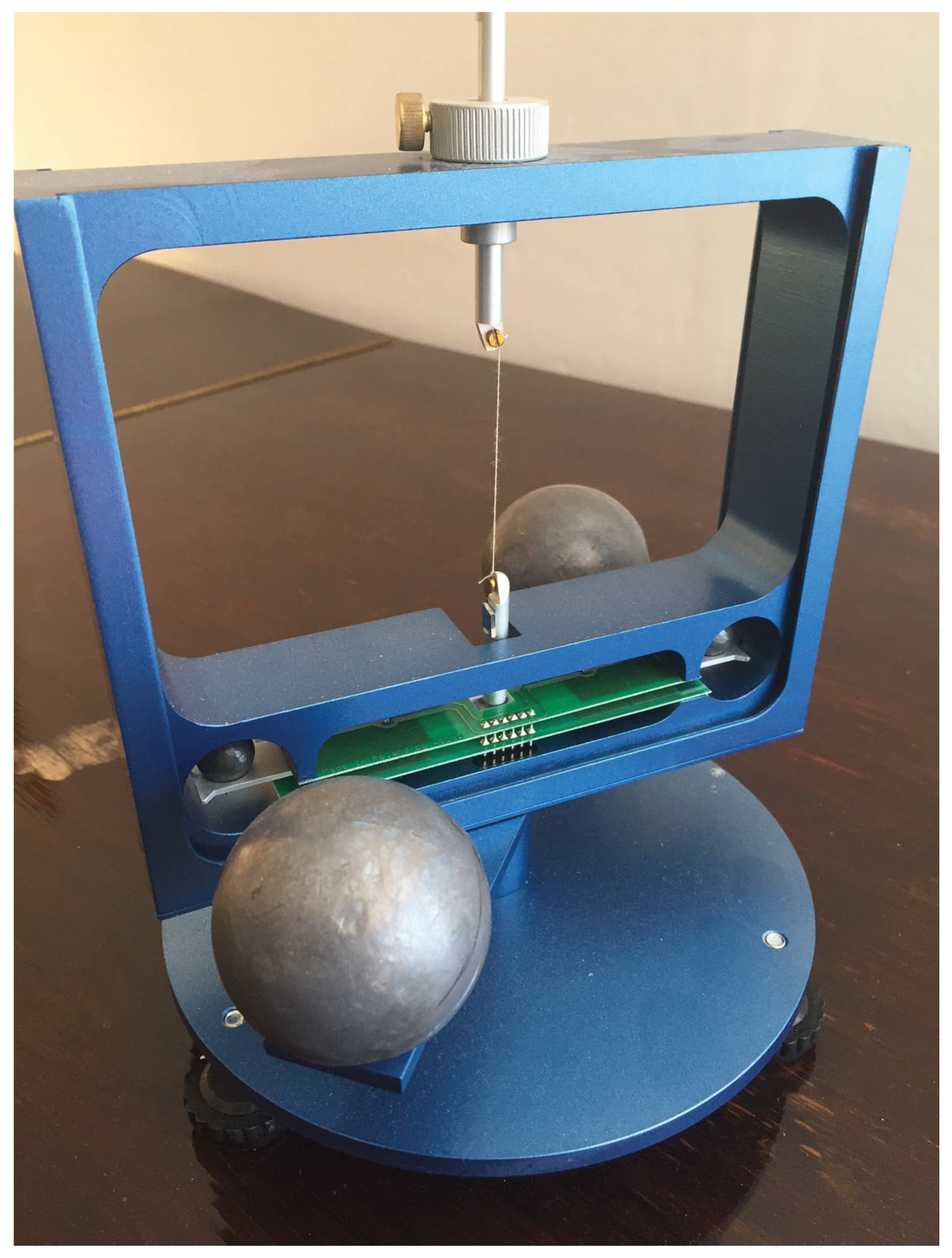

Table 1.
Principal input quantities and proposed realization routes.
| Input | Realization or determination | Principal corrections and correlations |
|---|---|---|
| Angular readout and free torsional oscillation | fibre anelasticity, damping, drift, readout nonlinearity, environmental coupling | |
| Dimensional metrology and gravitational modelling of the actual geometry | finite-body integration, alignment, density inhomogeneity, multipole terms, correlated coordinates | |
| Incident and scattered photon wavelengths and scattering angle | wavelength calibration, recoil geometry, angular alignment, detector response | |
| Penning-trap frequency ratios or an equivalent ion-reference chain | magnetic-field drift, image-charge shifts, trap imperfections, relativistic and binding corrections | |
| a | Combined x-ray and optical interferometry | temperature, strain, crystal defects, alignment |
| Optical interferometry with surface-layer subtraction | sphere topography, oxide and chemisorbed layers, adsorbed water, thermal expansion | |
| isotope fractions | Isotope-dilution mass spectrometry | calibration blends, mass bias, contamination |
| material corrections | Spectroscopy, defect characterization and surface analysis | vacancies, interstitials, impurities, nuclear and electronic binding energies |
| c | Exact SI value | no uncertainty contribution |
Disclaimer/Publisher’s Note: The statements, opinions and data contained in all publications are solely those of the individual author(s) and contributor(s) and not of MDPI and/or the editor(s). MDPI and/or the editor(s) disclaim responsibility for any injury to people or property resulting from any ideas, methods, instructions or products referred to in the content. |
© 2026 by the authors. Licensee MDPI, Basel, Switzerland. This article is an open access article distributed under the terms and conditions of the Creative Commons Attribution (CC BY) license (http://creativecommons.org/licenses/by/4.0/).
Copyright: This open access article is published under a Creative Commons CC BY 4.0 license, which permit the free download, distribution, and reuse, provided that the author and preprint are cited in any reuse.


