
Submitted:
23 July 2026
Posted:
24 July 2026
You are already at the latest version
Abstract
The growing demand for environmentally friendly energy storage materials has sparked interest in biomass-derived activated carbon for supercapacitor electrodes. The study looks at the physicochemical properties of chicken litter as a prelude to biochar manufacturing for supercapacitor applications. Poultry litter samples were characterised using proximal, ultimate and compositional analysis to determine their suitability for carbon material synthesis. The results revealed that poultry litter comprises 43.06% carbon, 6.13% hydro-gen, and 40.68% oxygen, as well as 70.26% volatile matter and 18.51% fixed carbon. The inorganic fraction contained large amounts of calcium (4.12%), potassium (3.42%), and silicon (0.89%), which could influence porosity growth during activation. The higher heating value (16.86 MJ kg⁻¹) implies moderate energy content. Based on these properties, poultry litter shows promise as a low-cost, abundant feedstock for producing porous car-bon materials suitable for supercapacitor electrodes, especially when combined with ap-propriate activation strategies to increase surface area and electrochemical performance.
Keywords:
poultry litter
; biochar
; biomass characterisation
; carbon-based supercapacitor
; activated carbon
; electrochemical energy storage
1. Introduction
The global shift to renewable energy has accelerated research into effective energy storage systems [1]. Supercapacitors have emerged as attractive electrochemical energy storage devices due to their high power density, fast charge-to-discharge rates, and outstanding cycling stability [2,3]. Supercapacitors, unlike batteries, store energy by reversible redox processes at electrode-electrolyte interfaces [4,5]. The performance of supercapacitors is significantly dependent on electrode material properties, particularly specific surface area, pore architecture and electrical conductivity [6,7]. They were examined because of their tuneable porosity and chemical stability [8,9].
However, typical carbon precursors obtained from fossil fuels present environmental problems and have high manufacturing costs [6].
Biomass waste has gained popularity as an alternative carbon source for electrode production [10]. Agricultural leftovers, forestry byproducts, and animal waste provide renewable, abundant, and cost-effective feedstocks for the synthesis of porous carbons [10]. The conversion of waste biomass into value-added carbon materials adheres to circular economy concepts, addressing waste management concerns while also developing sustainable energy storage options [11].
2. Background
The Poultry litter, which includes manure, bedding materials (sawdust, sunflower husks) and feed residues, is a major agricultural waste source, with global production surpassing millions of tonnes per year [9,12]. Improper management of this waste, particularly land application, often leads to excessive nutrient runoff, especially nitrogen and phosphorus, into water bodies [13,14]. This nutrient overload can trigger rapid eutrophication, resulting in harmful algal blooms that deplete oxygen, block sunlight, and cause fish kills. While such blooms are typically viewed as an environmental threat, some studies demonstrate that microalgae like “Dunaliella salina” can be cultivated under optimised nutrient conditions to produce high lipid yields for biodiesel [14]. This highlights a paradigm shift: instead of merely mitigating nutrient pollution, waste-derived nutrients could potentially support algal biofuel production[14]. Current disposal methods for poultry litter, including land application and direct combustion, are largely unsustainable due to their contributions to greenhouse gas emissions, air pollution, and nutrient runoff [13,14]. Therefore, converting chicken litter into carbonaceous materials for supercapacitor electrodes offers an environmentally benign alternative that aligns with circular economy principles.
Several studies have established the viability of employing animal waste-derived carbons for energy storage applications [15,16]. However, the physicochemical characteristics of poultry litter that govern its suitability for biochar production and subsequent activation into supercapacitor electrodes require systematic investigation. The study objects to comprehensively characterise poultry litter biomass by evaluating its proximate composition, elemental constituents, inorganic content and thermal properties to assess its potential as a precursor for porous carbon materials intended for supercapacitor applications [17].
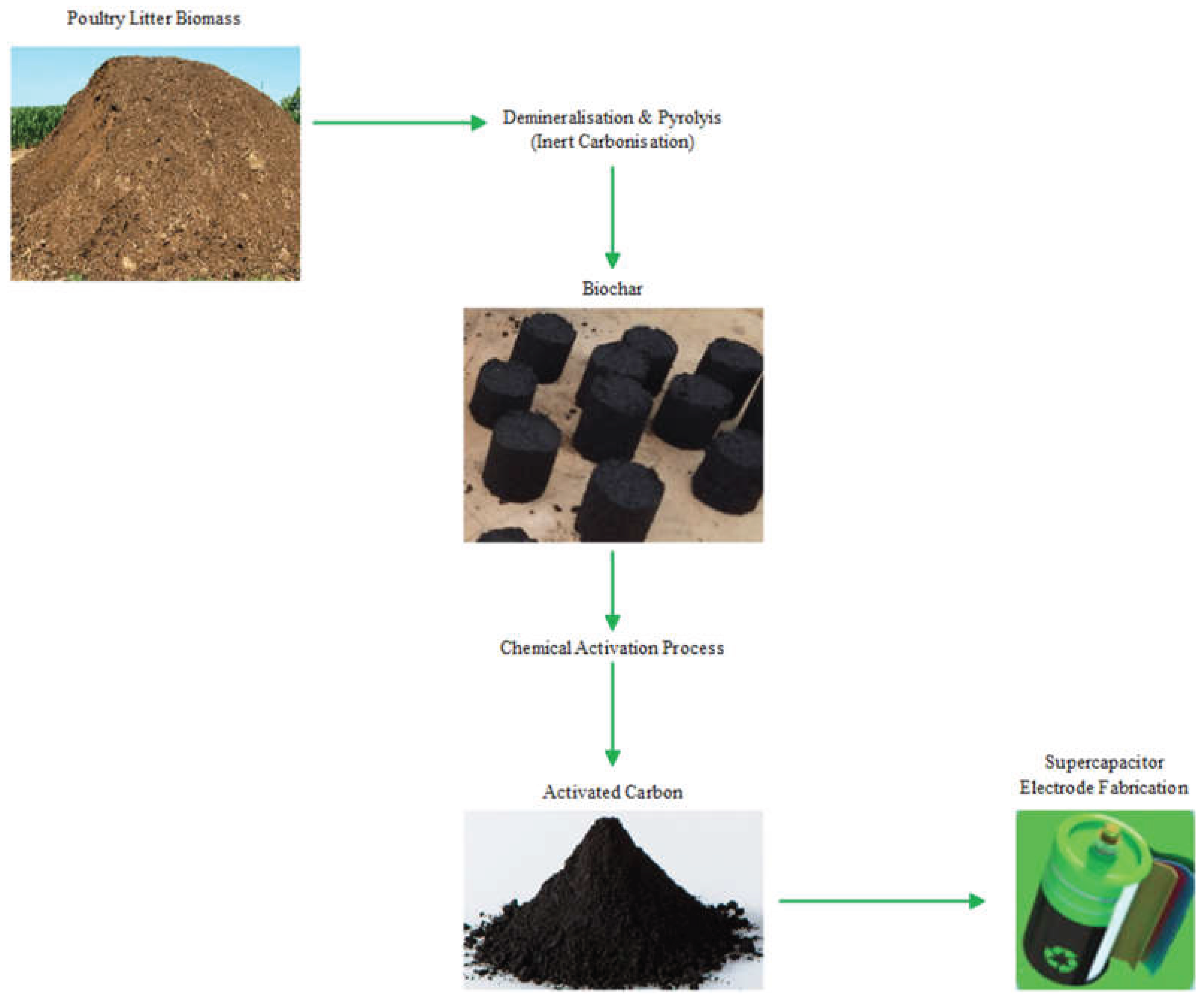
Figure 1.
PL Biomass to Supercapacitor Conversion Pathway.
3. Materials and Methods
3.1. Sample Collection and Preparation Procedure
Poultry litter samples consisting of sunflower husks, sawdust, feathers and manure were collected from Imbizo farm in Bulawayo, Zimbabwe. The feedstock was dried in an oven (Systronix Scientific) at 110°C for 24 hours to eliminate moisture [9]. The dried samples were ground using a ball mill (Pulveisette 6) for 15 minutes to achieve a uniform particle size [6,9].
Demineralisation was performed by washing the ground poultry litter with deionised water at a biomass-to-solvent ratio of 1:10 (w/v) at 30°C for 2 hours under continuous magnetic stirring [9,18]. This process removes water-soluble inorganic constituents that may interfere with subsequent carbonisation and activation processes. The samples were rinsed repeatedly with deionised water until pH 7 was achieved (Envtek, ENV49) and dried at 110°C for 24 hours, and stored in a desiccator prior to analysis [19,20].
3.2. Proximate Analysis
Proximate analysis was conducted using a thermogravimetric analyser (Leco TGA 701) according to ASTM D7582 MVA standard procedures [9]. Moisture content was determined by weight loss upon heating to 118°C. Volatile matter was measured by further heating to 970°C under an inert atmosphere. Ash content was determined by combustion in air at 600°C. Fixed carbon content was calculated by difference using Equation (1):
3.3. Ultimate Analysis
3.4. Calorific Value Determination
Higher heating value (HHV) was measured using an oxygen bomb calorimeter (IKA C6000; Supercal2) according to ASTM D5865-12 standards [21]. Lower heating value (LHV) was calculated considering the latent heat of vaporisation of water formed during combustion.
3.5. Inorganic Element Analysis
The inorganic elemental composition of demineralised poultry litter was analysed using a handheld X-ray fluorescence spectrometer (Olympus Delta-50 Premium) under the Geochem method [22]. Elements detected were quantified as weight percentages.
4. Results and Discussion
4.1. Proximate Composition
The proximate analysis results for demineralised poultry litter are presented in Table 1. The moisture content of 4.89% falls within the acceptable range for thermochemical conversion processes, as excessive moisture (>10%) reduces process efficiency and increases energy requirements [29]. The volatile matter content of 70.26% indicates substantial organic components that decompose during pyrolysis to generate porous carbon structures [23].
The ash content of 6.34% is moderate compared to other biomass feedstocks. Agricultural residues typically exhibit ash contents ranging from 2-20%, with higher values associated with soil contamination and inorganic nutrient accumulation [24]. The fixed carbon content of 18.51% represents the fraction available for conversion into carbonaceous structures during pyrolysis. This value is comparable to other lignocellulosic materials such as switchgrass (15.02%) and red cedar (15.62%)[6,25].
4.2. Elemental Composition
Ultimate analysis results (Table 2) reveal carbon content of 43.06%, which serves as the primary building block for porous carbon networks. This value is lower than woody biomass (typically 45-50%) but comparable to herbaceous agricultural residues [26][6]. The hydrogen content of 6.13% and oxygen content of 40.68% indicate substantial oxygen-containing functional groups that may contribute to pseudocapacitance through faradaic reactions when incorporated into electrode materials [27].
The nitrogen content of 2.11% is noteworthy, as nitrogen doping in carbon materials enhances electrochemical performance by introducing electron-donor properties and improving wettability [9,28]. Heteroatom-doped carbons derived from nitrogen-rich precursors exhibit improved specific capacitance through additional pseudocapacitive contributions [29]. The sulfur content of 1.68% may similarly contribute to enhanced electrochemical activity [30][6,9].
The atomic ratios of H/C and O/C provide insights into the carbonisation behaviour and aromaticity development during pyrolysis [9]. The calculated H/C ratio of 1.71 (atomic basis) and O/C ratio of 0.71 suggest moderate aromatic condensation potential, though these values will evolve significantly during thermal treatment[31,32].
4.3. Calorific Value
The higher heating value of 16.86 MJ kg⁻¹ (Table 3) is lower than conventional woody biomass (18-22 MJ kg⁻¹) but consistent with values reported for animal manures and agricultural residues [33]. The energy content reflects the combined contributions of organic components and influences the thermal behaviour during carbonisation [34,35].
4.4. Inorganic Element Composition
X-ray fluorescence analysis revealed the presence of multiple inorganic elements in the demineralised poultry litter (Table 4). Calcium (4.12%) and potassium (3.42%) were the most abundant, reflecting the mineral composition of poultry feed and bedding materials [36]. Silicon (0.89%), aluminium (1.06%), and iron (1.23%) originate from soil contamination and bedding materials.
The existence of alkali (water soluble basis) and alkaline (pH neutralising) earth metals (K, Ca, Mg) significantly influences pyrolysis behaviour and subsequent activation processes [37]. During thermal treatment, these elements can catalyse carbon gasification reactions, affecting pore development and surface area evolution [38]. Potassium, in particular, is known to enhance the reactivity of carbonaceous materials during activation, promoting the formation of microporous structures [39].
Transition metals such as iron, copper, and zinc may contribute to graphitisation during high-temperature treatment and thus potentially improving electrical conductivity of the resulting carbon materials [40]. However, excessive inorganic content present may necessitate additional washing steps to prevent pore blockage and ensure consistent electrochemical performance [41].
4.5. Implications for Supercapacitor Electrode Fabrication
The characterisation results provide several insights regarding the suitability of poultry litter for supercapacitor electrode production (Table 5).
4.6. Comparative Assessment with Other Biomass Feedstocks
Table 6 compares the characteristics of poultry litter to other biomass sources studied for supercapacitor device applications. The carbon content is significantly lower than wood-derived biomass (red cedar: 47.51%), but equivalent to herbaceous materials (switchgrass: 43.19%, sorghum: 40.68%) [43]. The ash content is higher than woody biomass, but lower than some agricultural leftovers like rice husk (15-20%) [44].
Poultry litter has a higher nitrogen content (2.11%) than other feedstocks (<0.6%), providing a distinct advantage in producing heteroatom-enriched carbons. Studies have showed that nitrogen-containing functional groups enhance specific capacitance through faradaic reactions and improve electrolyte wettability [45,46].
Similarly, the elevated sulphur content may contribute to enhanced electrochemical performance, as sulphur-doping has been shown to increase pseudocapacitance and rate capability [47,48].
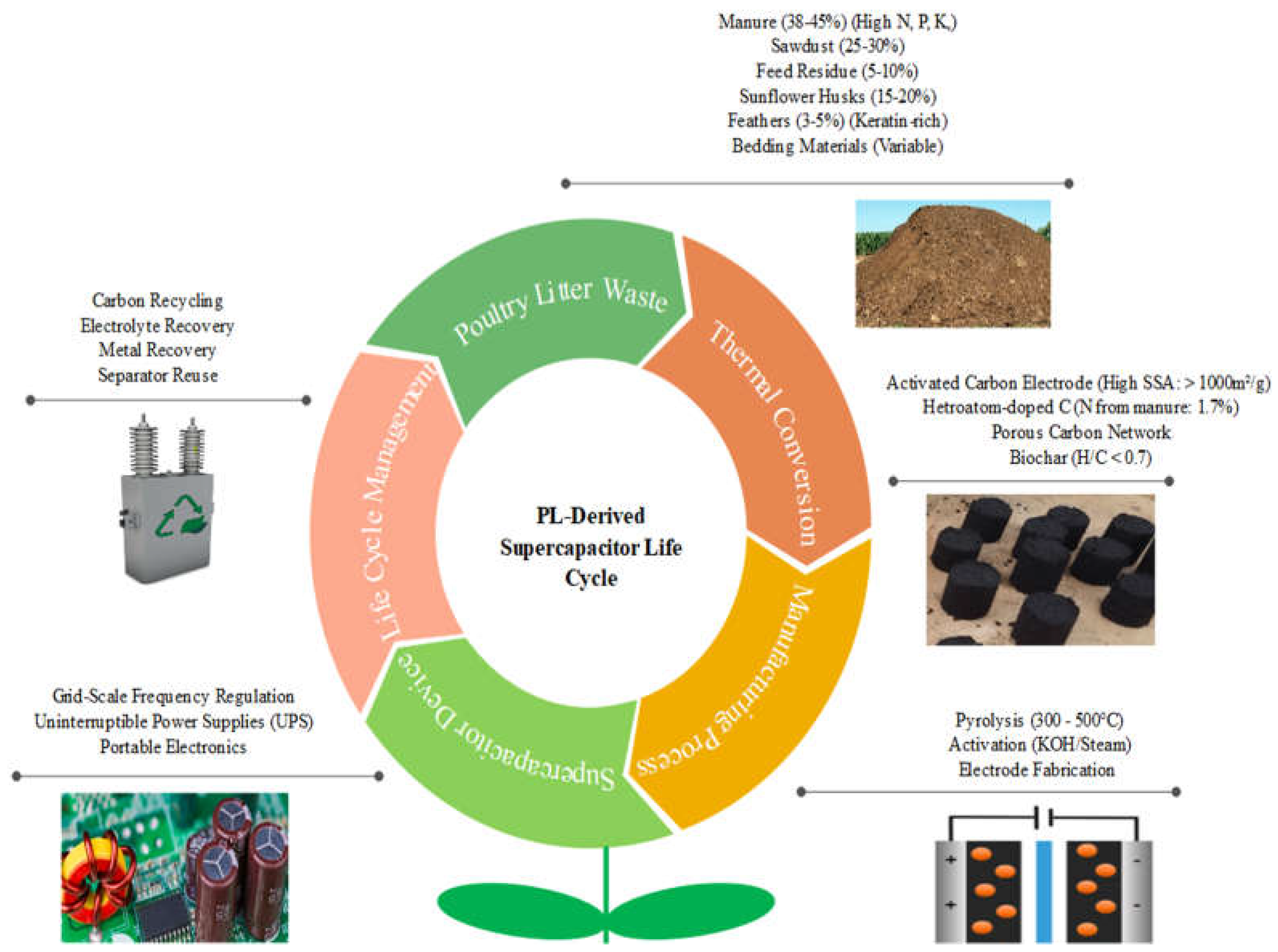
Figure 2.
Circular Economy Framework of PL-Derived Supercapacitor.
4.7. Optimisation Considerations for Biochar Production
Based on the characterisation results, several parameters require optimisation for producing biochar suitable for supercapacitor applications (Table 7).
5. Conclusions
The study characterised poultry litter biomass to evaluate its suitability for biochar production intended for supercapacitor electrode applications. The substance contains 43.06% carbon, 70.26% volatile matter and 18.51% fixed carbon, making it an ideal precursor for porous carbon synthesis. The intrinsic nitrogen (2.11%) and sulphur (1.68%) concentration allows for self-doping during carbonisation, which can improve electrochemical performance via pseudocapacitive contributions. The presence of potassium (3.42%) and other inorganic elements may aid in the creation of pores during chemical activation, thus reducing the need for activating agents. The moderate ash concentration (6.34%) demands adequate demineralisation procedures to avoid pore obstruction and provide constant electrode performance.
Poultry litter has specific advantages over typical biomass feedstocks, such as heteroatom enrichment and waste valorisation potential. The conversion of poultry litter into porous carbon materials adheres to circular economy concepts, addressing agricultural waste management issues while also developing sustainable energy storage solutions. Further research should focus on optimising pyrolysis and activation parameters to maximise surface area while preserving beneficial heteroatom functionalities, and evaluating the electrochemical performance of resulting carbon materials in supercapacitor configurations.
Author Contributions
Conceptualisation, K.N.C. and A.U.U.; methodology, C.M.; formal analysis, D.Z.; investigation, K.N.C., S.T.N. and M.M.; writing -original draft, K.N.C; writing -review and editing, S.T.N and C.M.; supervision, A.U., N.G. and C.M. All authors have read and agreed to the published version of the manuscript.
Funding
The authors are grateful to the Botswana International University of Science and Technology (BIUST) and the Government of Botswana, particularly for financial support through the Research Grant initiative. One of the authors ( Charles Mbohwa) is thankful to the University of South Africa (UNISA) for providing financial assistance towards the research. K.N.C is grateful for his PhD studentship funded by the Botswana International University of Science and Technology (BIUST).
Data Availability Statement
The original contributions presented in the study are included in the article; further inquiries can be directed to the corresponding author.
Acknowledgments
Materials characterisation (pyrolysis, TGA, and XRF) were carried out at the Botswana International University of Science and Technology (BIUST).
Conflicts of Interest
The authors declare no conflicts of interest.
Abbreviations
The following abbreviations are used in this manuscript:
| BC | Biochar |
| C | Carbon |
| EDLC | Electrochemical Double Layer Capacitor |
| FC | Fixed Carbon |
| H | Hydrogen |
| N | Nitrogen |
| O | Oxygen |
| PL | Poultry Litter |
| S | Sulphur |
| VM | Volatile Matter |
References
- Siegfried, K.; Günther, S.; Mengato, S.; Riedel, F.; Thrän, D. Boosting Biowaste Valorisation—Do We Need an Accelerated Regional Implementation of the European Law for End-of-Waste? Sustainability 2023, vol. 15(no. 17). [Google Scholar] [CrossRef]
- Krishnan, V.; Pazhamalai, P.; Chennakrishnan, J.; Swaminathan, R.; Kim, S. J. From Biomass to High-Performance Electrodes: Hierarchical Porous Oxy-Carbon for Redox-Mediated Supercapacitors. Adv. Sustain. Syst. 2026, vol. 10(no. 2). [Google Scholar] [CrossRef]
- Mangisetti, S. R.; Kamaraj, M.; Sundara, R. Green Approach for Synthesizing Three Different Carbon Microstructures from a Single Biowaste Bombax malabaricum for Fully Biocompatible Flexible Supercapacitors and Their Performance in Various Electrolytes. ACS Omega 2019, vol. 4(no. 4), 6399–6410. [Google Scholar] [CrossRef]
- Li; Xu, J.; Cheng, J. Recent Progress of Biomass-Derived Carbon for Supercapacitors: A Review. Batteries 2026, vol. 12(no. 1), 18. [Google Scholar] [CrossRef]
- Yıldırım, D.; Bakhtiari, B.; Güngör, A.; Erdem, E. Supercapacitor electrodes based on biowaste. Discov. Electrochem. 2025, vol. 2(no. 1). [Google Scholar] [CrossRef]
- K. Qian et al., Effects of biomass feedstocks and gasification conditions on the physiochemical properties of char. Energies . 2013, vol. 6(no. 8), 3972–3986. [CrossRef]
- Hamidah, et al. Biomass-Based Supercapacitors Electrodes for Electrical Energy Storage Systems Activated Using Chemical Activation Method: A Literature Review and Bibliometric Analysis. Indones. J. Sci. Technol. 2023, vol. 8(no. 3), 439–468. [Google Scholar] [CrossRef]
- Wu, F.; et al. Novel application of biochar from biomass pyrolysis for low temperature selective catalytic reduction. J. Energy Inst. 2012, vol. 85(no. 4), 236–239. [Google Scholar] [CrossRef]
- Nyoni; Kelebopile, L. MULTIVARIATE OPTIMIZATION OF PYROLYSIS PROCESS PARAMETERS FOR BI-OCHAR PRODUCTION DERIVED FROM DEMINERALIZED POULTRY LITTER USING RESPONSE SURFACE METHODOLOGY. Paliva 2023, vol. 15(no. 3), 101–115. [Google Scholar] [CrossRef]
- Abdul Aziz, M.; et al. Biomass-Based Supercapacitors: Design, Fabrication and Sustainability, First Edition; 2023. [Google Scholar]
- Abdul Aziz, M.; et al. Biomass Utilization in Supercapacitors for the Circular Economy 3.1 Introduction; 2023. [Google Scholar]
- Zhang, Z.; Tian, S.; Liu, J.; Guo, P. Y.; Shen, J. Influence of Animal/Plant Activated Biochar Properties on Methane Production from Corn Stalk by Anaerobic Fermentation. Fermentation 2022, vol. 8(no. 8). [Google Scholar] [CrossRef]
- Aziz, M. A.; et al. A High-Energy Asymmetric Supercapacitor Based on Tomato-Leaf-Derived Hierarchical Porous Activated Carbon and Electrochemically Deposited Polyaniline Electrodes for Battery-Free Heart-Pulse-Rate Monitoring. Small 2023, vol. 19(no. 33). [Google Scholar] [CrossRef] [PubMed]
- Nyoni; Kelebopile, L.; Lebogang, L. Microalgal lipid production for fatty acid methyl esters conversion: A response surface methodology optimisation of media nutrient in batch reactors. Results Chem. 2024, vol. 9. [Google Scholar] [CrossRef]
- Buaki-Sogó; Zubizarreta, L.; García-Pellicer, M.; Quijano-López, A. Sustainable carbon as efficient support for metal-based nanocatalyst: Applications in energy harvesting and storage. In MDPI AG; 01 Jul 2020. [Google Scholar] [CrossRef] [PubMed]
- Politehnika 2025.
- Buljac; Vukojević Medvidović, N.; Perinović Jozić, S.; Ključarić, P.; Miloloža, E.; Radić, J. Evaluating the Effectiveness of the C-EcoForHome Composter for Indoor Biowaste Processing in Educational Institutions. Kem. U Ind. 2026, no. 3–4. [Google Scholar] [CrossRef]
- Zhang, S.; et al. Biomass-Derived Carbon Decorated With NiSe2 as Cathode Materials for Enhanced Supercapacitors Application. ChemistrySelect 2026, vol. 11(no. 1). [Google Scholar] [CrossRef]
- Hamidah, et al. Biomass-Based Supercapacitors Electrodes for Electrical Energy Storage Systems Activated Using Chemical Activation Method: A Literature Review and Bibliometric Analysis. Indones. J. Sci. Technol. 2023, vol. 8(no. 3), 439–468. [Google Scholar] [CrossRef]
- Taer, E.; Apriwandi; Taslim, R. Heteroatom-Doped Biomass-Derived Porous Carbon for Supercapacitor Applications: A Review. In Walailak University; 01 Aug 2025. [Google Scholar] [CrossRef]
- Roy; Barai, H. R. Steam-activated carbon for supercapacitors. In Biomass-Based Supercapacitors: Design, Fabrication and Sustainability; wiley, 2023; pp. 213–236. [Google Scholar] [CrossRef]
- Jia, H.; et al. Heteroatoms co-doped carbon from biowaste for capacitive energy storage: Dependence of physicochemical properties and electrochemical performances on precursor grain sizes. J. Energy Storage 2023, vol. 60. [Google Scholar] [CrossRef]
- Titani, F. Retyo; Kusuma, F. Dhatul Prima. SAINSTEK: JURNAL SAINS DAN TEKNOLOGI Utilization of Biomass as a Source of Activated Carbon for Supercapacitor Applications: A Review Article History. 2025. [Google Scholar] [CrossRef]
- Wang, Z. Research progress on nitrogen doping modification of biomass activated carbon materials for supercapacitors. 2025. [Google Scholar] [CrossRef] [PubMed]
- Bezuszko, et al. Slow Pyrolysis as a Method of Treating Household Biowaste for Biochar Production. Appl. Sci. 2025, vol. 15(no. 14). [Google Scholar] [CrossRef]
- Nadeem, S. S.; Sanjaya, A. R.; Khalil, M.; Ivandini, T. A. Biomass-Derived Supercapacitors Supercharged with MXene Integration. In Gadjah Mada University; 2025. [Google Scholar] [CrossRef]
- Gura, V.; Sambulov, A.; Vaschenko, O.; Ponomarenko, Y. Strategic Development of Social Entrepreneurship Mechanisms and Regulation in Biomass Waste Management. Econ. Ecol. Socium 2025, vol. 9(no. 4), 31–43. [Google Scholar] [CrossRef]
- Garg, V.; Deng, T.; Bradley, M. Overcoming flow characterisation challenges and enhancing handling equipment selection for biomass and biowaste materials. EPJ Web of Conferences, EDP Sciences, Dec. 2025. [Google Scholar] [CrossRef]
- Czubaszek, R.; Wysocka-Czubaszek, A. Anaerobic Co-Digestion of Common Reed and Plant-Based Biowaste from Households. Energies . 2025, vol. 18(no. 9). [Google Scholar] [CrossRef]
- Koroglu, D.; Bingol, H.; Uralcan, B. Flexible solid-state supercapacitors based on biowaste-derived activated carbon and nanomaterials for enhanced performance. Nanotechnology 2025, vol. 36(no. 10). [Google Scholar] [CrossRef] [PubMed]
- Ali, W.; Shabir, T.; Iqbal, S.; Adil Sardar, S.; Akhtar, F.; Kim, W. Y. “A Comprehensive Review on Sustainable Triboelectric Energy Harvesting Using Biowaste-Derived Materials,” Feb. 01, 2026. In Multidisciplinary Digital Publishing Institute (MDPI). [CrossRef] [PubMed]
- Alemu, M. A.; Assegie, A. A. Recent advancements in biomass-origin carbon structures for next-generation supercapacitors. In Elsevier Inc.; 20 Mar 2026. [Google Scholar] [CrossRef] [PubMed]
- Vyas, M.; Jain, M.; Pareek, K.; Garg, A. Multivariate optimization for maximum capacity of lead acid battery through Taguchi method. Measurement (Lond) . 2019, vol. 148. [Google Scholar] [CrossRef]
- François; MANDIN Philippe, P.; Gérémy, B. Étude expérimentale des batteries au plomb et de leur régénération Modélisation de l’évolution temporelle des performances; SFGP. [CrossRef]
- Mirghni, A.; Shah, S. S.; Hardianto, Y. P.; Manickavasakam, K.; Aziz, Md. A. Sustainable production of nanostructured activated carbon from biowaste for next generation supercapacitors. In Discover Energy; Mar 2026. [Google Scholar] [CrossRef]
- Li, Y.; et al. Sustainable Conversion of Biowaste to Energy to Tackle the Emerging Pollutants: A Review. In Springer Science and Business Media Deutschland GmbH; 01 Dec 2023. [Google Scholar] [CrossRef]
- Hasan, M. A.; Rahman, M. A.; Islam, M. M. Non-activated carbon for supercapacitor electrodes. In Biomass-Based Supercapacitors: Design, Fabrication and Sustainability; wiley, 2023; pp. 107–120. [Google Scholar] [CrossRef]
- Zhu, X.; Zeng, Y.; Zhao, X.; Liu, D.; Lei, W.; Lu, S. Biomass-Derived Carbon and Their Composites for Supercapacitor Applications: Sources, Functions, and Mechanisms. In John Wiley and Sons Inc; 01 Sep 2025. [Google Scholar] [CrossRef]
- Ersoy, S.; Aleinawi, M. H.; Erdem, E.; Kaya, F.; Kaya, C.; Koc, B. Green synthesized of zinc oxide nanoparticles and calcined biowaste for sustainable electrodes to asymmetric supercapacitors. Sci. Rep. 2025, vol. 15(no. 1). [Google Scholar] [CrossRef] [PubMed]
- Li, Y.; et al. Fabrication of manganese dioxide nanoplates anchoring on biomass-derived cross-linked carbon nanosheets for high-performance asymmetric supercapacitors. J. Power Sources 2015, vol. 300, 309–317. [Google Scholar] [CrossRef]
- Brandão, T. S. C.; et al. Renewable Carbon Materials as Electrodes for High-Performance Supercapacitors: From Marine Biowaste to High Specific Surface Area Porous Biocarbons. ACS Omega 2023, vol. 8(no. 21), 18782–18798. [Google Scholar] [CrossRef] [PubMed]
- Ampong, D. N.; et al. Facile Synthesis of Colocasia esculenta Peels-Derived Activated Carbon for High-Performance Supercapacitor. Energy Storage 2024, vol. 6(no. 7). [Google Scholar] [CrossRef]
- Nakka; Naradala, J.; Pani, J.; Rajagiri, P.; Borkar, H.; Tumu, V. R. Cost-effective synthesis of nitrogen self-doped activated carbon with 3D porous honeycomb structure for enhanced supercapacitor electrode performance. J. Porous Mater. 2024, vol. 31(no. 5), 1933–1944. [Google Scholar] [CrossRef]
- Xiu, S.; Shahbazi, A.; Li, R. Trends in Renewable Energy Characterization, Modification and Application of Biochar for Energy Storage and Catalysis: A Review. 2017, vol. 3(no. 1), 86–101. [Google Scholar] [CrossRef]
- Fan; Lei, X.; Zhang, J.; Yu, T.; Chen, H.; Liu, J. Preparation of Carbon Electrode Material with a Large Specific Surface Area and Multiscale Pore Structure from Biowaste Kochia for Symmetrical Supercapacitor. Energy Technol. 2023, vol. 11(no. 4). [Google Scholar] [CrossRef]
- Mensah-Darkwa; Zequine, C.; Kahol, P. K.; Gupta, R. K. Supercapacitor energy storage device using biowastes: A sustainable approach to green energy. In MDPI; 15 Jan 2019. [Google Scholar] [CrossRef]
- L. K. C. de Souza et al., Hierarchical porous carbon derived from acai seed biowaste for supercapacitor electrode materials. J. Mater. Sci. Mater. Electron. 2020, vol. 31(no. 15), 12148–12157. [CrossRef]
- Reddy, M.; Kambhala, N. Green Carbon Quantum Dots: State-of-the-Art Strategies on Performance Enhancement of Supercapacitor Applications—A Review. In John Wiley and Sons Inc; 15 Dec 2025. [Google Scholar] [CrossRef]
- Callegari; Capodaglio, A. G. Properties and beneficial uses of (bio)chars, with special attention to products from sewage sludge pyrolysis. In MDPI AG; 01 Mar 2018. [Google Scholar] [CrossRef]
- Srivastava, R. K.; et al. Valorization of biowastes for clean energy production, environmental depollution and soil fertility. In Academic Press; 15 Apr 2023. [Google Scholar] [CrossRef] [PubMed]
- Aziz, Abdul; et al. Biomass Utilization in Supercapacitors for the Circular Economy 3.1 Introduction. 2023. [Google Scholar] [CrossRef] [PubMed]
- Xu; Yang, M.; Sun, H.; Gao, M.; Wang, Q.; Wu, C. Bioconversion of biowaste into renewable energy and resources: A sustainable strategy. Environ. Res. 2022, vol. 214. [Google Scholar] [CrossRef] [PubMed]
- Shaba, E. Y.; et al. “Biomass Valorisation: A Sustainable Approach Towards Carbon Neutrality and Circular Economy,” in Biomass Valorization: A Sustainable Approach Towards Carbon Neutrality and Circular Economy; Springer Nature, 2025; pp. 99–122. [Google Scholar] [CrossRef]
- Chen, W.; et al. Biowaste valorisation in a circular economy. In Recent Trends in Solid Waste Management; Elsevier, 2023; pp. 245–258. [Google Scholar] [CrossRef]

Table 1.
Proximate Analysis of Demineralised Poultry Litter.
| Parameter | Content (weight %, dry basis) |
|---|---|
| Moisture Content | 4.89 |
| Volatile Matter | 70.26 |
| Ash Content | 6.34 |
| Fixed Carbon | 18.51 |
Table 2.
Ultimate Analysis of Demineralised Poultry Litter.
| Element | Content (weight %, dry ash-free basis) |
|---|---|
| Nitrogen | 2.11 |
| Carbon | 43.06 |
| Hydrogen | 6.13 |
| Sulphur | 1.68 |
| Oxygen | 40.68 |
Table 3.
Calorific Values Of Demineralised Poultry Litter.
| Parameter | Value (MJ kg⁻¹) |
|---|---|
| Higher heating value | 16.86 |
| Lower Heating Value | 15.32 |
Table 4.
Ultimate Analysis of Demineralised Poultry Litter.
| Element | Content (%) | Element | Content (%) |
|---|---|---|---|
| Silicon | 0.89 | Calcium | 4.12 |
| Phosphorus | 0.72 | Aluminium | 1.06 |
| Sulphur | 0.41 | Iron | 1.23 |
| Chlorine | 0.82 | Chromium | 0.09 |
| Potassium | 3.42 | Manganese | 0.24 |
| Copper | 0.11 | Zinc | 0.04 |
Table 5.
Implications Of Poultry Litter Characteristics For Supercapacitor Electrode Fabrication.
| Characteristic | Measured Value (%) | Implications for Electrodes | References |
|---|---|---|---|
| Carbon Content & Volatile Matter | C: 43.06 VM: 70.26 |
Provides sufficient precursor for porous carbon. High VM is released during pyrolysis and thus creates initial porosity that can be further developed by activation. | [44] |
| Fixed Carbon | 18.51 | Suggests a need for optimised activation (KOH, steam) to achieve the high surface areas (>1000 m²/g) required for high performance EDLCs. | [9] |
| Heteroatom Content (N, S) | N: 2.11 S: 1.68 |
Offers potential for self-doping. N- and S-containing functional groups can introduce pseudocapacitance, enhance conductivity, and improve electrode wettability, thereby boosting overall capacitance. | [6] |
| Inorganic Content (K, Ca) | K: 3.42 Ca: 4.12 |
Inherent K can act as a natural activation catalyst, thus potentially reducing the amount of external chemical activators needed. This can lower costs and simplify processing time. | [7] |
| Ash Content | 6.34 | Requires management. High ash can block micropores and increase electrode resistance. Demineralisation (acid washing) is likely necessary as a pre- or post-treatment step to curb the blockage occurrences. | [20] |
Table 6.
Comparison of poultry Litter With other Biomass Feedstocks.
| Parameter | PL(%) | Switchgrass(%) [6] |
Sorghum(%) [6] |
Red Cedar(%) [6] |
|---|---|---|---|---|
| Nitrogen | 2.11 | 0.57 | 0.51 | 0.37 |
| Sulphur | 1.68 | 0.30 | 0.20 | 1.07 |
| VM | 70.26 | 70.36 | 68.10 | 71.79 |
| Ash | 6.34 | 4.62 | 5.05 | 4.09 |
| FC | 18.51 | 15.02 | 17.46 | 15.62 |
Table 7.
Key Optimisation Parameters For Converting Poultry Litter To Supercapacitor-Grade Biochar.
| Process Parameter | Optimisation Goal | Justification | References |
|---|---|---|---|
| Pyrolysis Temperature |
Moderate (400-600°C): For heteroatom retention. High (700-900°C): For high conductivity and graphitisation. |
Lower temperatures preserve beneficial N/S functional groups (pseudocapacitance), while higher temperatures improve electrical conductivity and carbon ordering but can eliminate heteroatoms. | [50] |
| Activation Strategy |
Chemical (KOH/NaOH): For ultra-high surface area. Physical (Steam/ CO₂): For a greener, simpler process. |
High surface area is paramount for EDLCs. KOH activation is highly effective but corrosive. The inherent K in the ash may allow for a reduced chemical-to-precursor ratio. | [51,52] |
| Demineralisation | Effective (Acid Washing): Target ash < 2-3% | Essential to prevent pore blockage by residual inorganics, which would otherwise reduce the active surface area and increase the internal resistance (IR drop) of the final electrode. | [19,53] |
| Heteroatom Retention |
Controlled atmosphere and Ramp rate: Maximise N/S functionality. Post-treatment: NH₃ or H₂S atmospheres. |
To fully exploit the self-doping advantage, pyrolysis conditions must be mild enough to retain heteroatoms. Post-treatment can further enrich surface chemistry. | [54] |
Disclaimer/Publisher’s Note: The statements, opinions and data contained in all publications are solely those of the individual author(s) and contributor(s) and not of MDPI and/or the editor(s). MDPI and/or the editor(s) disclaim responsibility for any injury to people or property resulting from any ideas, methods, instructions or products referred to in the content. |
© 2026 by the authors. Licensee MDPI, Basel, Switzerland. This article is an open access article distributed under the terms and conditions of the Creative Commons Attribution (CC BY) license (http://creativecommons.org/licenses/by/4.0/).
Copyright: This open access article is published under a Creative Commons CC BY 4.0 license, which permit the free download, distribution, and reuse, provided that the author and preprint are cited in any reuse.


