
Submitted:
23 July 2026
Posted:
24 July 2026
You are already at the latest version
Abstract
Wildfire smoke (WFS) is an expanding source of fine particulate matter (PM2.5) with well-documented cardiopulmonary risks, yet its impact on organismal aging and functional decline remains incompletely understood. Here we use Caenorhabditis elegans to characterize the dose-dependent impacts of simulated WFS PM2.5 exposure (0.095-1000 µg/mL) on survival and age-associated functional outcomes. Locomotion and morphology were assessed at defined time points in adulthood, after which unexposed progeny of WFS-exposed nematodes were evaluated for identical tests to detect gross intergenerational effects. Parental (P0) worms subjected to a single 24-hour WFS exposure exhibited dose-dependent reductions in lifespan at high concentrations and significant impairments in neuromuscular function at lower concentrations. A single P0 WFS exposure was also sufficient to induce deficits in multiple measures of locomotion and morphology, but these readouts were almost entirely resolved in F1 progeny. Additionally, RNA-sequencing on P0 nematodes was used to provide insight into biological processes underlying our in vivo observations, revealing WFS-associated aging-like transcriptomic signatures. Taken together, these results suggest that acute WFS exposure is sufficient to induce age-associated functional decline and establish C. elegans as a scalable, low-cost in vivo platform for quantifying WFS-driven toxicity.
Keywords:
wildfire
; smoke
; particulate matter (PM2.5)
; aging
; healthspan
; RNA-seq
1. Introduction
Wildfire events are increasing in frequency and duration due to climate change, making rising levels of wildfire smoke (WFS) a significant contributor to air pollution in the United States and abroad [1,2]. These events have contributed to increasing mean summertime fine particulate matter (PM2.5, diameter < 2.5 μm) levels [3,4], and despite a degree of inherent uncertainty in forecasts [5], major increases in wildfire incidence are expected to occur in the coming decades [2]. The WFS that results from these fires contains a mixture of hazardous air pollutants that have been repeatedly associated with respiratory disease and premature mortality in the general population [6,7]. Among them, the most frequent hospitalizations occur from chronic obstructive pulmonary disease [7,8], asthma [7,9], and cardiopulmonary-related events [3,10,11,12]. Indeed, analyses of cardiopulmonary hospitalizations in California have shown that even light-to-moderate smoke exposure is associated with increased risk of hospitalization [10], and recent reports have identified WFS exposure as a significant risk factor for dementia [13]. Globally, WFS is estimated to be associated with 339,000 deaths annually, but this number is expected to rise substantially as the frequency of wildfires increases [14]. In the United States, climate-driven increases in wildfire smoke PM2.5 are projected to contribute to approximately 23,800-27,800 deaths annually by 2050 [15], making the need to better understand the biological consequences of WFS exposure an important research priority. Recent work has suggested that WFS may negatively interact with the biological hallmarks of aging and potentially accelerate the aging process [16], which could in part explain its association with mortality and chronic disease risk. Furthermore, a comparison of nine PM exposure sources across the U.S. over a 10-year period reported that WFS had one of the strongest correlations with dementia incidence [13], underscoring WFS’ potential for age-related neurological impacts. However, the functional consequences underlying WFS-induced aging toxicity remain largely uncharacterized.
Caenorhabditis elegans (C. elegans) is a well-characterized in vivo model organism that enables efficient screening of distinct airborne particulate samples collected in the lab or from nature. C. elegans has become popular in many fields of biological science (including aging research) for its ease of use in the laboratory, short lifecycle (~3 days), short lifespan (~25 days), large brood size, optical transparency, and well-annotated genome and connectome [17]. Importantly, although C. elegans lack a respiratory system, it has numerous conserved stress-response and detoxification pathways that help predict toxicity in mammals [18]. As such, C. elegans have been shown to be a useful toxicological model when studying PM2.5 from a variety of sources such as diesel, urban, coal, and dust extracts [19,20,21,22,23,24]. Particulate exposures from these sources impact C. elegans lifespan, reproduction, locomotion, induction of reactive oxygen species (ROS) [20], and the unfolded protein response (UPR) [23]. Additionally, the adverse effects of common inhalable pollutants (e.g., tobacco and e-cigarette smoke) have been well-characterized using C. elegans as a model organism [25,26]. Importantly, a recent study has found ambient PM2.5 exposure can reduce nematode lifespan and healthspan, with evidence implicating disruption of conserved longevity-associated pathways such as insulin/IGF-1 signaling and downstream daf-16 regulation [27]. However, whether WFS-derived PM2.5 induces aging-relevant functional decline or produces persistent intergenerational effects remains poorly characterized.
Therefore, in the present study, we hypothesized acute WFS exposure would accelerate age-associated health and functional decline in C. elegans. We show that a single exposure is sufficient to reduce lifespan and impair locomotion, and that these effects are largely resolved in the unexposed progeny. RNA-seq analyses also suggest that acute WFS PM2.5 exposure induces aging-like transcriptomic signatures, consistent with previous literature reports [16] demonstrating that WFS exposure is a risk factor for multiple age-associated diseases and the idea that WFS may affect age-related mechanisms of functional decline. Together, our findings establish C. elegans as a valuable in vivo platform for elucidating the biological effects of WFS PM2.5 exposure at the intersection of toxicology and aging.
2. Methods
2.1. Generation of Wildfire Smoke Solution
Simulated wildfire smoke was generated in a custom-designed quartz-tube furnace system housed at Colorado State University and inspired by DIN 53436 [28,29]. Douglas Fir branches were sourced from Livermore, CO as a regionally representative fuel prevalent in fire-prone ecosystems. Douglas Fir needles were dried at 75 °C for 72 hours and then combusted at smoldering temperatures (450 °C) where the resulting smoke was collected onto quartz fiber filters. Particulate matter from a nearly identical system – designed by the same consultant – and from the same source averaged 100 nm in size [28]. Quartz fiber filters laden with whole particulate matter were placed into pre-weighed 15 mL Eppendorf tubes with 100% methanol and sonicated for 30 minutes. Methanol was then evaporated under a direct nitrogen stream after which the filter was removed and the tube was reweighed. The pre- and post-weights were compared against each other to determine total particulate matter collected, and dried particulate was resuspended in M9 worm buffer and kept at -20 °C until experimentation.
2.2. Worm Culture and Exposure
Wild-type N2 strain hermaphrodites used in this study were obtained from the Caenorhabditis Genetics Center (CGC), University of Minnesota, Minneapolis, USA. Worms were cultured on 10 cm petri dishes containing standard nematode growth medium (NGM) [30] with a bacterial food Escherichia coli OP50 20 °C. Standard 5% hypochlorite treatment procedure was used on N2 hermaphrodites for age-synchronized egg populations. Synchronized eggs were incubated on NGM plates without OP50 food to obtain age-synchronized L1 worms. Synchronized worms were then placed on NGM plates containing OP50 and incubated at 20 °C for 48 hours to obtain age-synchronized L4 stage larvae for experiments. L4-stage nematodes were then transferred to 6 cm NGM plates containing experimental concentrations of WFS solution that had been allowed to dry into a film, while control groups were exposed to M9 for 24 hours prior to data collection. For range-finding lifespan experiments, nematodes were exposed to WFS PM2.5 concentrations of 10, 100, 500, and 1000 µg/mL. Based on these results, subsequent lifespan and neuromuscular function studies used lower concentrations of 0.095, 0.95, 3, 9.49, and 30 µg/mL. Intergenerational locomotion and morphology experiments used 10, 50, and 100 µg/mL WFS PM2.5, and RNA-seq experiments used 0 or 30 µg/mL WFS PM2.5. Following 24-hour exposure beginning at the L4 stage, nematodes were assessed at various defined timepoints. Lifespan tracking began with day 1 adults while neuromuscular function of the same animals was assessed at day 10 of adulthood. Intergenerational assessments used P0 & F1 worms after development to adulthood (approximately 72 hours). For RNA-seq experiments, exposed and control nematodes were aged to day 5 or day 10 of adulthood prior to collection. All experimental plates contained OP50 food lawns.
2.3. Survival Assay – Range Finding
L4-stage nematodes were placed on NGM plates with 5-fluoro-2′-deoxyuridine (FUdR) to prevent progeny production and subsequently exposed to WFS for 24 hours. Animals were then transferred to 96-well plates (10 worms/well), incubated at 20 °C, and assessed for mortality every 24 hours. FUdR concentrations were kept at 60 uM in exposure plates and lifespan assay wells. OP50 solutions were added to each well as a food source. Death was determined by assessing mobility and response to prodding with a worm pick. 17-67 worms were used per condition.
2.4. Survival Assay – Lifespan & Neuromuscular Function
Lifespan experiments were performed using a NemaLife Infinity apparatus (NemaLife Inc.) as previously reported [31,32]. Briefly, NemaLife microfluidic chips were cleaned with ethanol, incubated with 50 mg/mL pluronic F-127 (Sigma-Aldrich) at room temperature for one hour to prevent fluid aggregation, and then washed with M9 buffer prior to the addition of 50–75 treated or untreated day 1 adult C. elegans. All chips were maintained at 20 °C while being washed, fed (20 mg OP50/mL NGM solution), and video recorded daily. Each day, 90-second videos of the NemaLife microfluidic arena were used to quantify living nematodes (washing/feeding stimulates nematodes, which were classified as “alive” if they moved during the video duration).
Pharyngeal pumping was assessed at the approximate median lifespan (day 10) untreated N2 according to standard NemaLife procedures [31]. Individual C. elegans pharynges were observed in NemaLife chips placed under a stereo microscope (Tritech Research) at 50x magnification. Contractions were manually recorded over a 60-second interval for 6 nematodes per condition.
Velocity data were generated in WormLab (MBF Bioscience LLC) software using videos taken on the NemaLife apparatus during lifespan assays. Briefly, all videos were trimmed to 30 seconds and cropped to include only the microfluidic arena, which was measured to calculate pixel size of the resized video, and the threshold level was adjusted for optimal contrast between the worms and their background (light on dark). Tracking was analyzed using default parameters except for the following changes; ‘detection parameters’ – area min: 0, length min: 1, width min: 0.5, width/length ratio min: 0.05, max: 0.3, detection fit min: 0.25, registration fit: 0.05, detection frequency: 15 frames, predominant direction: forward, fitting iterations: 130; ‘tracking parameters’ – max tracked hypothesis: 3, minimum track duration: 3. After WormLab’s automated tracking, individual tracks were manually repaired using the “remove” and “join” track functions. Average speeds were exported to Excel for calculation of average velocities, and only velocity data for worms tracked for more than half of the video duration were included in the final calculations.
2.5. Intergenerational Locomotion Assessment
Treated L4-stage nematodes were cultured on 6 cm NGM agar plates as described above prior to video collection with a ZEISS Stemi 305 dissection microscope (ZEISS Microscopy). After video collection, nematodes in the P0 exposure group were transferred to untreated NGM agar plates to lay eggs in the presence of food for 1–2 hours. The exposed P0 nematodes were then removed, and the eggs were incubated at 20 °C until they progressed past the L4 stage, approximately 72 hours later. Videos of the F1 nematodes were collected and assessed alongside P0 videos via Wormlab. Three technical replicates were used to control for batch effects. Similar parameters to those described in the Nemalife assessment were used for the assessment of intergenerational locomotion. Briefly, videos were collected for 60 seconds, and the threshold level was adjusted to 100 to maintain optimal contrast between the worms and their background. Tracking was collected according to default parameters, with certain modifications as listed above. The track summary data was exported to Excel for subsequent analysis, and only worms tracked for at least half the video duration were included in the final data set. In P0 worms the final sample sizes were: Control, n = 94; 10 µg/mL, n = 89; 50 µg/mL, n = 127; and 100 µg/mL, n = 62 animals.
2.6. RNA Extraction & Bioinformatics
Wild-type C. elegans with or without 24-hour L4 WFS exposure were aged to day 5 or 10 (to reflect younger and middle life). Triplicates of roughly 100 nematodes for each condition were collected in standard M9 buffer (50 μL). TriZol Reagent (200 μL, Zymo Research) was mixed into samples, which were subsequently frozen in liquid nitrogen, thawed at room temperature, and vortexed repeatedly before centrifugation to disrupt worm cuticles. Supernatant was carefully transferred to a new microfuge tube, and RNA was recovered and purified using an RNA-specific spin column kit (Direct-zol RNA Microprep, Zymo Research) which included DNaseI treatment to remove genomic DNA. Purified RNA was analyzed on a NanoDrop Spectrophotometer (ThermoFisher Scientific) and on a Qubit instrument with an RNA IQ Assay Kit (Thermo Fisher Scientific Inc) for concentration and quality. All samples had an absorbance 260/280 ratio >2.0, and an RNA integrity number >7.0. PolyA libraries were prepared from isolated RNA using random hexamer primers and sequenced on an Illumina NovaSeq instrument with 151bp reads (Novagene).
Transcriptome data analyses were performed on raw sequencing data as recently reported [32,33,34,35]. Reads were trimmed and filtered with the fastp program [36] and then mapped to the C. elegans (ce11) genome with the STAR aligner [37]. Gene counts were analyzed for differential expression in R using DESeq2 software [38], and significant differences were determined using the default Wald test and adjusted p-values. Normalized counts extracted from DESeq2 were used for all statistical analyses, and gene ontology was performed using g:Profiler [39].
2.7. Statistical Analysis
Statistical analysis for lifespan assays were performed using a Log-rank (Mantel-Cox) test. Prior to statistical testing, normality was assessed using Shapiro-Wilk, and Brown-Forsythe’s test was used to check for the homogeneity of variance. For comparison between groups, one-way ANOVA as used when assumptions of normality and homogeneity of variance were met, followed by Tukey’s post-hoc test. In instances of nonparametric data, such as in the case of non-normal distributions of results, a Kruskal-Wallis test was performed with Dunn’s post-hoc test for multiple comparisons. Neuromuscular readouts from microfluidic lifespan experiments (pharyngeal pumping and average velocity) were determined using a one-way ANOVA. All statistical analyses were performed using GraphPad Prism (version 10.6.0 software), except for differential expression (described above under Bioinformatics) and gene ontology analyses, in which significance was determined using the R package’s g:Profiler p-value outputs. The variety of sample sizes across treatments can be attributed to practical constraints in the tests used and populations left after post-hoc analysis.
3. Results
3.1. WFS Exposure Reduces Lifespan and Healthspan in Nematodes
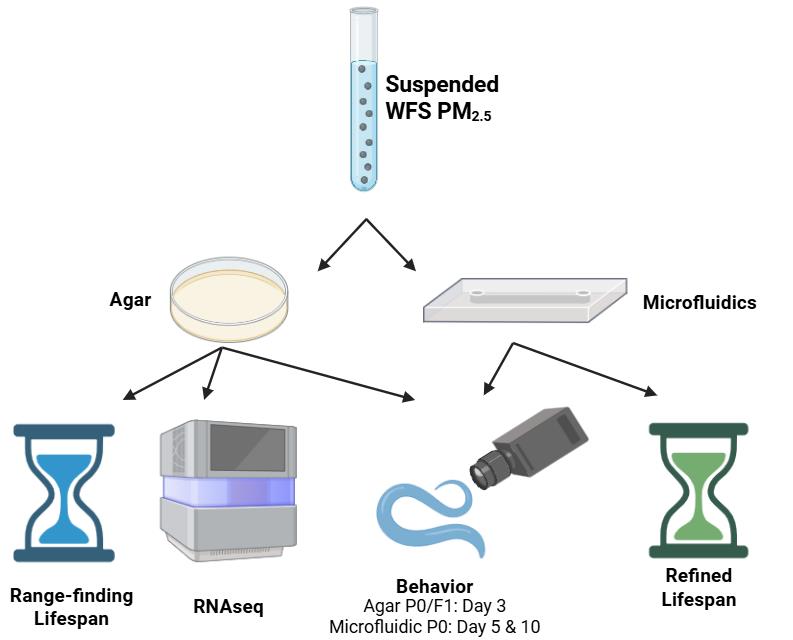
To understand the effects of WFS-derived PM2.5 on the longevity of C. elegans, an initial range-finding lifespan assay was conducted in 96-well plates after a 24-hour exposure to WFS doses spanning 10 µg/mL–1000 µg/mL, as described in Figure 1. We found that high doses (500–1000 µg/mL) resulted in complete population mortality within 6 days, and that intermediate doses (10–100 µg/mL) were associated with reduced population survival rate compared to controls (Figure 2).
Based on these results, we used a refined half-log dosing regimen (0.95, 3, 9.49, 30 µg/mL) for further investigation. Subsequent lifespan studies in microfluidic chips following a 24-hour exposure showed that a single 30 µg/mL dose of WFS was sufficient to decrease maximum lifespan (by ~16%) but not median lifespan (Figure 3A). All other treatment groups had similar lifespan profiles compared to controls (Supplementary Figure S1). However, lower WFS concentrations still affect healthspan and physiological function. For example, analysis of day 10 pharyngeal pumping rates (an indicator of overall animal health that declines with age [40]) showed dose-dependent reductions in WFS-exposed nematodes housed in microfluidic chips, in which the highest dose (30 µg/mL) reduced pumping rate by ~75% compared to untreated controls (Figure 3B). WFS exposure in day 10 nematodes was also associated with decreases in normalized average velocity, although these effects were only significant at the highest doses (~20% reduction vs. controls, Figure 3C).
3.2. WFS Exposure Produces Dose-Dependent Changes in P0 Locomotion and Morphology with Limited Intergenerational Inheritance
In P0 nematodes, we found that the highest dose, 100 µg/mL, was associated with significant increases in body length (Figure 4A), area (Figure 4B), and straight-line distance (Figure 4C), which approximately doubled compared to controls. Additionally, despite no change in peristaltic track length (Figure 4D), the peristaltic speed in nematodes exposed to 50 µg/mL was significantly decreased (by ~25%) compared to controls (Figure 4E). Similarly, the number of reversals in P0 C. elegans exposed to 100 µg/mL WFS was significantly decreased (by ~25%) compared to controls (Figure 4F), despite no change in distance traveled (Figure 4G,H). Notably, the doubling in straight-line distance was the only locomotion readout from WFS-exposed P0 nematodes that showed significant intergenerational persistence into the unexposed offspring (Supplementary Figure S2).
3.3. WFS Exposure Activates Oxidative/Phase I Metabolism and Suppresses Muscular Gene Expression
To determine which biological processes may underly the WFS-induced functional declines observed in vivo, we analyzed mRNA levels from treated and untreated nematodes at 5 and 10 days post-exposure. Among all conditions, biological aging (Figure 5A) had stronger effects on the overall transcriptome than a single WFS exposure alone (Figure 5B-D). However, we also found that the topmost increased and decreased genes/transcripts associated with aging (i.e., in day 10 vs day 5 controls) were also largely increased and decreased in day 5 WFS vs day 5 control nematodes (Figure 5E, leftmost and rightmost columns in heatmap). Among the top 1000 most upregulated genes with aging, 74% were also increased in day 5 WFS-exposed nematodes, and among the top 1000 most downregulated genes with aging, 82% were also decreased in day 5 WFS-exposed C. elegans. This similarity in transcriptome patterns suggested that WFS PM2.5 exposure may induce “aging-like” transcriptional events. To further evaluate this possibility, we performed gene ontology analyses on the differentially expressed genes/transcripts that were similarly increased or decreased with both WFS exposure (WFS day 5 vs control day 5 nematodes) and aging (day 10 control vs day 5 control nematodes). We found that the increased genes/transcripts associated with aging-like transcriptional changes were enriched for pathways related to oxidation and phase I metabolism (Figure 6A), consistent with previous reports showing that oxidative phase I metabolism is involved in the detoxification of harmful environmental compounds [41]. The topmost decreased genes/transcripts associated with aging-like effects of WFS exposure were overwhelmingly related to muscle function and organization (Figure 6B), consistent with our in vivo neuromuscular function data showing declines in pharyngeal pumping and locomotion. Importantly, many of these upregulated genes/transcripts were also members of canonical aging pathways in C. elegans (e.g., insulin/IGF-1 signaling) [42,43,44,45]. Together, these data provide evidence that WFS associated with PM2.5 may accelerate tissue aging at the transcriptional level.
4. Discussion
The incidence of wildfires is increasing worldwide, due to climate change enhancing the likelihood while simultaneously challenging suppression efforts [1,46]. The resulting smoke from these wildfires contains potentially harmful PM2.5 with a composition that varies depending on the surrounding ecosystem involved [47]. PM2.5 from various sources has been associated with multiple age-related diseases [48,49,50], suggesting it may be interacting with biological mechanisms of aging. However, exactly how PM2.5 intersects with aging, and how regional WFS exposures influence functional outcomes has not been thoroughly investigated. C. elegans is a popular model organism in biological aging research and has also been widely used to study toxicity associated with pollution and cigarette smoke, yet to our knowledge, no studies to date have examined the effects of WFS on their healthspan and lifespan [26,51,52,53]. In the present study, we show that a single acute exposure to simulated WFS PM2.5 is sufficient to reduce lifespan, impair neuromuscular function, alter locomotion and morphology, and induce aging-like transcriptomic signatures in C. elegans. These findings provide new evidence that WFS-derived PM2.5 can influence conserved biological processes associated with functional decline.
The reported concentrations reflect nominal PM2.5 mass suspended in buffer and applied to agar plates, rather than an inhaled dose. Therefore, these values should not be interpreted as direct equivalents to ambient human PM2.5 concentrations. Instead, this exposure paradigm provides a controlled mass-based approach for evaluating biological responses to WFS-derived particles across a defined dose range. Similar paradigms based on nominal mass exposures are widely used in C. elegans particulate matter toxicology studies [22,54,55] and are useful for identifying dose-dependent toxicity patterns and prioritizing mechanistic follow-up studies. We found that a single 24-hour exposure to simulated WFS PM2.5 is sufficient to accelerate functional decline (i.e., decrease healthspan) and reduce lifespan, consistent with research showing that PM from multiple sources can shorten nematode lifespan and locomotion, often through oxidative stress and phase I metabolism pathways [22,54,55]. Even at sub-lethal doses, WFS exposure caused dose-dependent neuromuscular declines by day 10 of lifespan, reflected by decreases in pharyngeal pumping and average crawling velocity. These WFS-associated effects on neuromuscular decline appeared to be age-dependent, as day 10 worms displayed significant decreases in average velocity following exposures to concentrations as low as 3 µg/mL, while worms observed at day 3 displayed mixed peristaltic speed results beginning at concentrations of 50 µg/mL and higher. Interestingly, this is consistent with reports on diesel exhaust particles showing altered neuron function and behavior in C. elegans, indicating that airborne particle suspensions may disrupt the nematode’s nervous system [56].
The F1 generation’s resilience in terms of locomotion and gross morphological effects may be the result of efficient intergenerational repair mechanisms, i.e., intergenerational germline erasure of chromatin/epigenetic marks, and small-RNA inheritance that is dose and duration limited unless repeatedly reinforced. The germline can regulate itself via histone-modifying enzymes and embryonic reprogramming pathways (e.g., LSD-1/SPR-5–linked demethylation and related germline chromatin resets) to purge parental phenotypes during gametogenesis and early embryogenesis [57,58]. Additionally, inherited small-RNA responses can act as a tunable generational memory which can persist for generations before fading without continued stressors [59]. However, strong initiating stimuli (e.g., piRNA-induced silencing) [60] or repeated activations [61] can extend the duration of inheritance. Given these mechanisms, it is possible that a single, sub-lethal WFS exposure in the parental generation may fall below the threshold needed for stable inheritance into the F1 generation via germline remodeling. Therefore, future studies should examine how either multiple exposures and/or chronic exposure to WFS PM2.5 could overcome germline reprogramming to drive functional decline in F1 nematodes.
To better understand the biological processes underlying the in vivo functional declines we observed, we analyzed RNA from treated and untreated day 5 and day 10 nematodes. In our initial bioinformatics analysis, the effects of aging alone (day 10 vs. day 5 controls) drove stronger transcriptional changes than WFS exposure. However, further analysis revealed that these age-associated modulations were largely mirrored in day 5 WFS-exposed worms, suggesting that their transcriptome resembled that of day 10 controls. This pattern is consistent with a recent report suggesting that WFS-derived PM2.5 may be associated with accelerated aging in humans [62]. Additionally, when performing gene ontology analyses on the topmost increased genes associated with this accelerated aging-like pattern, we found that the most upregulated transcriptional signatures were centered around phase I metabolism, consistent with multiple reports linking PM to oxidative-stress and antioxidant pathways in C. elegans [22,27]. Conversely, when analyzing the topmost decreased genes associated with accelerated aging, GO terms were overwhelmingly enriched for the downregulation of muscle function. These findings were consistent with our in vivo observations of significant declines in multiple readouts of neuromuscular function, and with previous reports suggesting that muscle function is negatively impacted in wildland firefighters [63,64,65]. Our findings also support the results of broader C. elegans studies in which oxidative and mitochondrial stressors, such as rotenone [66] and paraquat [67], reduce lifespan and healthspan-related outcomes like locomotion and pharyngeal pumping. However, these results are purely correlational and future studies examining WFS on age related functional decline should interrogate how oxidative-stress related pathways might influence lifespan and healthspan related outcomes. By linking aging-like transcriptomic signatures with measurements of functional decline, these data suggest WFS PM2.5 exposure may have healthspan effects that extend beyond immediate toxicity.
Several limitations should be considered when interpreting these findings. First, because C. elegans lack a respiratory system, the exposure paradigm used here does not replicate inhalation exposure in mammals, despite conserved stress response and signaling pathways. Second, although the WFS particles were generated under controlled combustion conditions, detailed chemical characterization of the extracted PM2.5 was not performed, limiting our ability to attribute the observed effects to specific smoke constituents. Third, it’s possible that the aging-like transcriptomic signatures and functional decline we observe could have some root in unresolved injury following WFS exposure, and future time-course studies may be needed to determine the role of persistent damage versus true accelerated aging. Finally, the transcriptomic analyses are correlative and should be followed by mechanistic studies targeting candidate pathways. Despite these limitations, the suitability of C. elegans as a model provides an opportunity to compare different WFS sources and test interventions targeting aging through well-studied,lifespan-modifying strains such as daf-2 & daf-16 mutants in the context of healthspan decline in future work.
Taken together, our findings indicate that even a single, acute WFS exposure can exacerbate functional decline and steepen an organism’s aging trajectory. In humans, wildfire-derived PM2.5 is strongly linked to excess respiratory morbidity and mortality [7,10,68,69] and these health burdens are projected to increase as wildfire incidence continues to rise [1,2]. Although C. elegans do not model human respiratory disease directly, the observed decline in locomotion and pharyngeal pumping provide functional evidence that WFS-derived PM2.5 can disrupt conserved neuromuscular and aging-associated processes. This is relevant to human epidemiological studies linking WFS exposure with age-associated outcomes because oxidative stress, altered proteostasis, mitochondrial dysfunction, and chronic inflammatory signaling are shared biological features implicated in both PM toxicity and aging-related disease. Thus, the current findings should be interpreted as evidence that WFS-derived PM2.5 can engage conserved aging-relevant toxicity pathways and serve as a foundation for follow-up studies in more complex models.
Supplementary Materials
The following supporting information can be downloaded at the website of this paper posted on Preprints.org.
Author Contributions
Conceptualization, J.S., R.A.G., T.J.L., J.A.M. and L.M.; Methodology, J.S., R.A.G. and A.A.; Validation, T.J.L., J.A.M. and L.M.; Formal Analysis, J.S., R.A.G. and T.J.L.; Investigation, J.S., R.A.G., A.A. and T.J.L.; Resources, T.J.L., J.A.M. and L.M.; Data Curation, J.S., R.A.G. and T.J.L.; Writing – Original Draft Preparation, J.S. and R.A.G.; Writing – Review & Editing, J.S., R.A.G., A.A., T.J.L., J.A.M. and L.M.; Supervision, T.J.L., J.A.M. and L.M.; Funding Acquisition, T.J.L., J.A.M. and L.M. All authors have read and agreed to the published version of the manuscript.
Funding
This work was supported by NIH awards AG078859, AG085456, and by NIOSH award T42OH009229. The content is solely the responsibility of the authors and does not necessarily represent the official views of the NIH & NIOSH.
Acknowledgments
The authors would like to thank Rose Reiter for assistance in nematode husbandry and video collection.
Conflicts of Interest
The authors declare no conflicts of interest.
References
- Pausas JG, Keeley JE. Wildfires and global change. Front Ecol Environ. Sep 2021;19(7):387-395. [CrossRef]
- Yue X, Mickley LJ, Logan JA, Kaplan JO. Ensemble projections of wildfire activity and carbonaceous aerosol concentrations over the western United States in the mid-21st century. Atmos Environ (1994). Oct 1 2013;77:767-780. [CrossRef]
- Magzamen S, Gan RW, Liu J, et al. Differential Cardiopulmonary Health Impacts of Local and Long-Range Transport of Wildfire Smoke. Geohealth. Mar 2021;5(3):e2020GH000330. [CrossRef]
- O’Dell K, Ford B, Fischer EV, Pierce JR. Contribution of Wildland-Fire Smoke to US PM(2.5) and Its Influence on Recent Trends. Environ Sci Technol. Feb 19 2019;53(4):1797-1804. [CrossRef]
- Brey SJ, Barnes EA, Pierce JR, Swann ALS, Fischer EV. Past Variance and Future Projections of the Environmental Conditions Driving Western U.S. Summertime Wildfire Burn Area. Earths Future. Feb 2020;9(2):e2020EF001645. [CrossRef]
- Ma Y, Zang E, Liu Y, et al. Long-term exposure to wildland fire smoke PM(2.5) and mortality in the contiguous United States. medRxiv. Jun 11 2024;doi:10.1101/2023.01.31.23285059.
- Reid CE, Brauer M, Johnston FH, Jerrett M, Balmes JR, Elliott CT. Critical Review of Health Impacts of Wildfire Smoke Exposure. Environ Health Perspect. Sep 2016;124(9):1334-43. [CrossRef]
- Liu JC, Wilson A, Mickley LJ, et al. Wildfire-specific Fine Particulate Matter and Risk of Hospital Admissions in Urban and Rural Counties. Epidemiology. Jan 2017;28(1):77-85. [CrossRef]
- Wilgus ML, Merchant M. Clearing the Air: Understanding the Impact of Wildfire Smoke on Asthma and COPD. Healthcare (Basel). Jan 25 2024;12(3)doi:10.3390/healthcare12030307.
- Wettstein ZS, Hoshiko S, Fahimi J, Harrison RJ, Cascio WE, Rappold AG. Cardiovascular and Cerebrovascular Emergency Department Visits Associated With Wildfire Smoke Exposure in California in 2015. J Am Heart Assoc. Apr 11 2018;7(8)doi:10.1161/JAHA.117.007492.
- Brook RD, Rajagopalan S, Pope CA, 3rd, et al. Particulate matter air pollution and cardiovascular disease: An update to the scientific statement from the American Heart Association. Circulation. Jun 1 2010;121(21):2331-78. [CrossRef]
- Pope CA, 3rd, Burnett RT, Thurston GD, et al. Cardiovascular mortality and long-term exposure to particulate air pollution: epidemiological evidence of general pathophysiological pathways of disease. Circulation. Jan 6 2004;109(1):71-7. [CrossRef]
- Zhang B, Weuve J, Langa KM, et al. Comparison of Particulate Air Pollution From Different Emission Sources and Incident Dementia in the US. JAMA Intern Med. Oct 1 2023;183(10):1080-1089. [CrossRef]
- Cascio WE. Wildland fire smoke and human health. Sci Total Environ. May 15 2018;624:586-595. [CrossRef]
- Qiu M, Li J, Gould CF, et al. Wildfire smoke exposure and mortality burden in the USA under climate change. Nature. Nov 2025;647(8091):935-943. [CrossRef]
- Scieszka D, Bolt AM, McCormick MA, Brigman JL, Campen MJ. Aging, longevity, and the role of environmental stressors: a focus on wildfire smoke and air quality. Front Toxicol. 2023;5:1267667. [CrossRef]
- Smoot J, Padilla S, Farraj AK. The utility of alternative models in particulate matter air pollution toxicology. Curr Res Toxicol. 2022;3:100077. [CrossRef]
- Harlow PH, Perry SJ, Widdison S, et al. The nematode Caenorhabditis elegans as a tool to predict chemical activity on mammalian development and identify mechanisms influencing toxicological outcome. Sci Rep. Mar 18 2016;6:22965. [CrossRef]
- Yang R, Rui Q, Kong L, et al. Metallothioneins act downstream of insulin signaling to regulate toxicity of outdoor fine particulate matter (PM(2.5)) during Spring Festival in Beijing in nematode Caenorhabditis elegans. Toxicol Res (Camb). Jul 1 2016;5(4):1097-1105. [CrossRef]
- Sun L, Lin Z, Liao K, Xi Z, Wang D. Adverse effects of coal combustion related fine particulate matter (PM2.5) on nematode Caenorhabditis elegans. Sci Total Environ. Apr 15 2015;512-513:251-260. [CrossRef]
- Wu Q, Han X, Wang D, Zhao F, Wang D. Coal combustion related fine particulate matter (PM(2.5)) induces toxicity in Caenorhabditis elegans by dysregulating microRNA expression. Toxicol Res (Camb). Jul 1 2017;6(4):432-441. [CrossRef]
- Haghani A, Dalton HM, Safi N, et al. Air Pollution Alters Caenorhabditis elegans Development and Lifespan: Responses to Traffic-Related Nanoparticulate Matter. J Gerontol A Biol Sci Med Sci. Jul 12 2019;74(8):1189-1197. [CrossRef]
- Zhao Y, Jin L, Chi Y, Yang J, Zhen Q, Wu H. Fine Particulate Matter Leads to Unfolded Protein Response and Shortened Lifespan by Inducing Oxidative Stress in C. elegans. Oxid Med Cell Longev. 2019;2019:2492368. [CrossRef]
- Wang M, Nie Y, Liu Y, et al. Transgenerational effects of diesel particulate matter on Caenorhabditis elegans through maternal and multigenerational exposure. Ecotoxicol Environ Saf. Apr 15 2019;170:635-643. [CrossRef]
- Melnikov K, Kaiglova A, Kucharikova S. The use of the model organism Caenorhabditis elegans in the investigation of the adverse effects of electronic cigarettes. Ecotoxicol Environ Saf. Feb 2025;291:117853. [CrossRef]
- Green RM, Gally F, Keeney JG, et al. Impact of cigarette smoke exposure on innate immunity: a Caenorhabditis elegans model. PLoS One. Aug 31 2009;4(8):e6860. [CrossRef]
- Zhang W, Li Z, Li G, et al. PM(2.5) induce lifespan reduction, insulin/IGF-1 signaling pathway disruption and lipid metabolism disorder in Caenorhabditis elegans. Front Public Health. 2023;11:1055175. [CrossRef]
- Einbrodt HJ, Hupfeld J, Prager FH, Sand H. The Suitability of the Din 53436 Test Apparatus for the Simulation of a Fire Risk Situation With Flaming Combustion. Journal of Fire Sciences. 1984;2(6):427-438. [CrossRef]
- Prager FH. Assessment of Fire Model DIN 53436. Journal of Fire Sciences. 1988;6(1):3-24. [CrossRef]
- Corsi AK, Wightman B, Chalfie M. A Transparent window into biology: A primer on Caenorhabditis elegans. WormBook. Jun 18 2015:1-31. [CrossRef]
- Rahman M, Edwards H, Birze N, et al. NemaLife chip: a micropillar-based microfluidic culture device optimized for aging studies in crawling C. elegans. Sci Rep. Oct 1 2020;10(1):16190. [CrossRef]
- Wahl D, Smith ME, McEntee CM, et al. The reverse transcriptase inhibitor 3TC protects against age-related cognitive dysfunction. Aging Cell. May 2023;22(5):e13798. [CrossRef]
- LaRocca TJ, Cavalier AN, Wahl D. Repetitive elements as a transcriptomic marker of aging: Evidence in multiple datasets and models. Aging Cell. Jul 2020;19(7):e13167. [CrossRef]
- Smith ME, Wahl D, Cavalier AN, et al. Repetitive element transcript accumulation is associated with inflammaging in humans. Geroscience. Dec 2024;46(6):5663-5679. [CrossRef]
- Wahl D, Cavalier AN, Smith M, Seals DR, LaRocca TJ. Healthy Aging Interventions Reduce Repetitive Element Transcripts. J Gerontol A Biol Sci Med Sci. Apr 30 2021;76(5):805-810. [CrossRef]
- Chen S, Zhou Y, Chen Y, Gu J. fastp: an ultra-fast all-in-one FASTQ preprocessor. Bioinformatics. Sep 1 2018;34(17):i884-i890. [CrossRef]
- Dobin A, Davis CA, Schlesinger F, et al. STAR: ultrafast universal RNA-seq aligner. Bioinformatics. Jan 1 2013;29(1):15-21. [CrossRef]
- Love MI, Huber W, Anders S. Moderated estimation of fold change and dispersion for RNA-seq data with DESeq2. Genome Biol. 2014;15(12):550. [CrossRef]
- Raudvere U, Kolberg L, Kuzmin I, et al. g:Profiler: a web server for functional enrichment analysis and conversions of gene lists (2019 update). Nucleic Acids Res. Jul 2 2019;47(W1):W191-W198. [CrossRef]
- Cho J, Lu J, Kim D, Park Y. Determination of health status during aging using bending and pumping rates at various survival rates in Caenorhabditis elegans. Sci Rep. Mar 17 2025;15(1):9057. [CrossRef]
- Hartman JH, Widmayer SJ, Bergemann CM, et al. Xenobiotic metabolism and transport in Caenorhabditis elegans. J Toxicol Environ Health B Crit Rev. Feb 17 2021;24(2):51-94. [CrossRef]
- Kenyon C. The first long-lived mutants: discovery of the insulin/IGF-1 pathway for ageing. Philos Trans R Soc Lond B Biol Sci. Jan 12 2011;366(1561):9-16. [CrossRef]
- Lapierre LR, Hansen M. Lessons from C. elegans: signaling pathways for longevity. Trends Endocrinol Metab. Dec 2012;23(12):637-44. [CrossRef]
- Lee H, Lee SV. Recent Progress in Regulation of Aging by Insulin/IGF-1 Signaling in Caenorhabditis elegans. Mol Cells. Nov 30 2022;45(11):763-770. [CrossRef]
- Uno M, Nishida E. Lifespan-regulating genes in C. elegans. NPJ Aging Mech Dis. 2016;2:16010. [CrossRef]
- Jones MW, Smith AJP, Betts R, Canadell JG, Prentice IC, Quéré CL. Climate Change Increases the Risk of Wildfires: January 2020. ScienceBrief Tyndall Centre for Climate Change Research. 1 2020;
- Liu JC, Peng RD. The impact of wildfire smoke on compositions of fine particulate matter by ecoregion in the Western US. J Expo Sci Environ Epidemiol. Oct 2019;29(6):765-776. [CrossRef]
- Garcia A, Santa-Helena E, De Falco A, de Paula Ribeiro J, Gioda A, Gioda CR. Toxicological Effects of Fine Particulate Matter (PM(2.5)): Health Risks and Associated Systemic Injuries-Systematic Review. Water Air Soil Pollut. 2023;234(6):346. [CrossRef]
- Cristaldi A, Fiore M, Oliveri Conti G, et al. Possible association between PM(2.5) and neurodegenerative diseases: A systematic review. Environ Res. May 15 2022;208:112581. [CrossRef]
- Krittanawong C, Qadeer YK, Hayes RB, et al. PM2.5 and Cardiovascular Health Risks. Curr Probl Cardiol. Jun 2023;48(6):101670. [CrossRef]
- Chen H, Wang C, Li H, et al. A review of toxicity induced by persistent organic pollutants (POPs) and endocrine-disrupting chemicals (EDCs) in the nematode Caenorhabditis elegans. J Environ Manage. May 1 2019;237:519-525. [CrossRef]
- Long NP, Kang JS, Kim HM. Caenorhabditis elegans: a model organism in the toxicity assessment of environmental pollutants. Environ Sci Pollut Res Int. Mar 2023;30(14):39273-39287. [CrossRef]
- Cai H, Xu Y, Tang S, et al. Systemic toxicity evaluation of novel tobacco products in Caenorhabditis elegans. Toxicol In Vitro. Feb 2020;62:104671. [CrossRef]
- Liu X, Ge P, Lu Z, et al. Reproductive toxicity and underlying mechanisms of fine particulate matter (PM(2.5)) on Caenorhabditis elegans in different seasons. Ecotoxicol Environ Saf. Dec 15 2022;248:114281. [CrossRef]
- Zhang F, You X, Zhu T, et al. Silica nanoparticles enhance germ cell apoptosis by inducing reactive oxygen species (ROS) formation in Caenorhabditis elegans. J Toxicol Sci. 2020;45(3):117-129. [CrossRef]
- Chatterjee N, Gonzalez-Durruthy M, Costa MD, et al. Differential impact of diesel exhaust particles on glutamatergic and dopaminergic neurons in Caenorhabditis elegans: A neurodegenerative perspective. Environ Int. Apr 2024;186:108597. [CrossRef]
- Katz DJ, Edwards TM, Reinke V, Kelly WG. A C. elegans LSD1 demethylase contributes to germline immortality by reprogramming epigenetic memory. Cell. Apr 17 2009;137(2):308-20. [CrossRef]
- Kelly WG. Transgenerational epigenetics in the germline cycle of Caenorhabditis elegans. Epigenetics Chromatin. Mar 29 2014;7(1):6. [CrossRef]
- Houri-Ze’evi L, Korem Y, Sheftel H, et al. A Tunable Mechanism Determines the Duration of the Transgenerational Small RNA Inheritance in C. elegans. Cell. Mar 24 2016;165(1):88-99. [CrossRef]
- Ashe A, Sapetschnig A, Weick EM, et al. piRNAs can trigger a multigenerational epigenetic memory in the germline of C. elegans. Cell. Jul 6 2012;150(1):88-99. [CrossRef]
- Houri-Zeevi L, Teichman G, Gingold H, Rechavi O. Stress resets ancestral heritable small RNA responses. Elife. Mar 17 2021;10doi:10.7554/eLife.65797.
- Wu Y, Xu R, Li S, et al. Association between wildfire-related PM(2.5) and epigenetic aging: A twin and family study in Australia. J Hazard Mater. Jan 5 2025;481:136486. [CrossRef]
- Christison KS. Muscle soreness and damage during wildland firefighter critical training. 2020;
- West M, Domitrovich J, Symonds J. Rhabdomyolysis in wildland fire. Missoula, MT; 2015.
- Christison KS, Sol JA, Gurney SC, Dumke CL. Twenty-Four Percent of Wildland Firefighters Reach Critical Levels of Serum Creatine Kinase During 80-Hour Critical Training. Wilderness Environ Med. Sep 2023;34(3):334-340. [CrossRef]
- Romero-Sanz S, Caldero-Escudero E, Alvarez-Illera P, et al. Rescue of a Rotenone Model of Parkinson’s Disease in C. elegans by the Mitochondrial Na(+)/Ca(2+) Exchanger Inhibitor CGP37157. Int J Mol Sci. Apr 4 2025;26(7)doi:10.3390/ijms26073371.
- Zhou L, Liu J, Bu LL, Liao DF, Cheng SW, Zheng XL. Curcumin Acetylsalicylate Extends the Lifespan of Caenorhabditis elegans. Molecules. Oct 31 2021;26(21)doi:10.3390/molecules26216609.
- Gould CF, Heft-Neal S, Johnson M, Aguilera J, Burke M, Nadeau K. Health Effects of Wildfire Smoke Exposure. Annu Rev Med. Jan 29 2024;75:277-292. [CrossRef]
- Youssouf H, Liousse C, Roblou L, et al. Non-accidental health impacts of wildfire smoke. Int J Environ Res Public Health. Nov 14 2014;11(11):11772-804. [CrossRef]
Figure 1.
Graphical abstract showing order of experiments. L4 nematodes were exposed to simulated wildfire smoke (WFS) for 24 hours, then assessed for lifespan, behavior, and transcriptomic effects.
Figure 1.
Graphical abstract showing order of experiments. L4 nematodes were exposed to simulated wildfire smoke (WFS) for 24 hours, then assessed for lifespan, behavior, and transcriptomic effects.
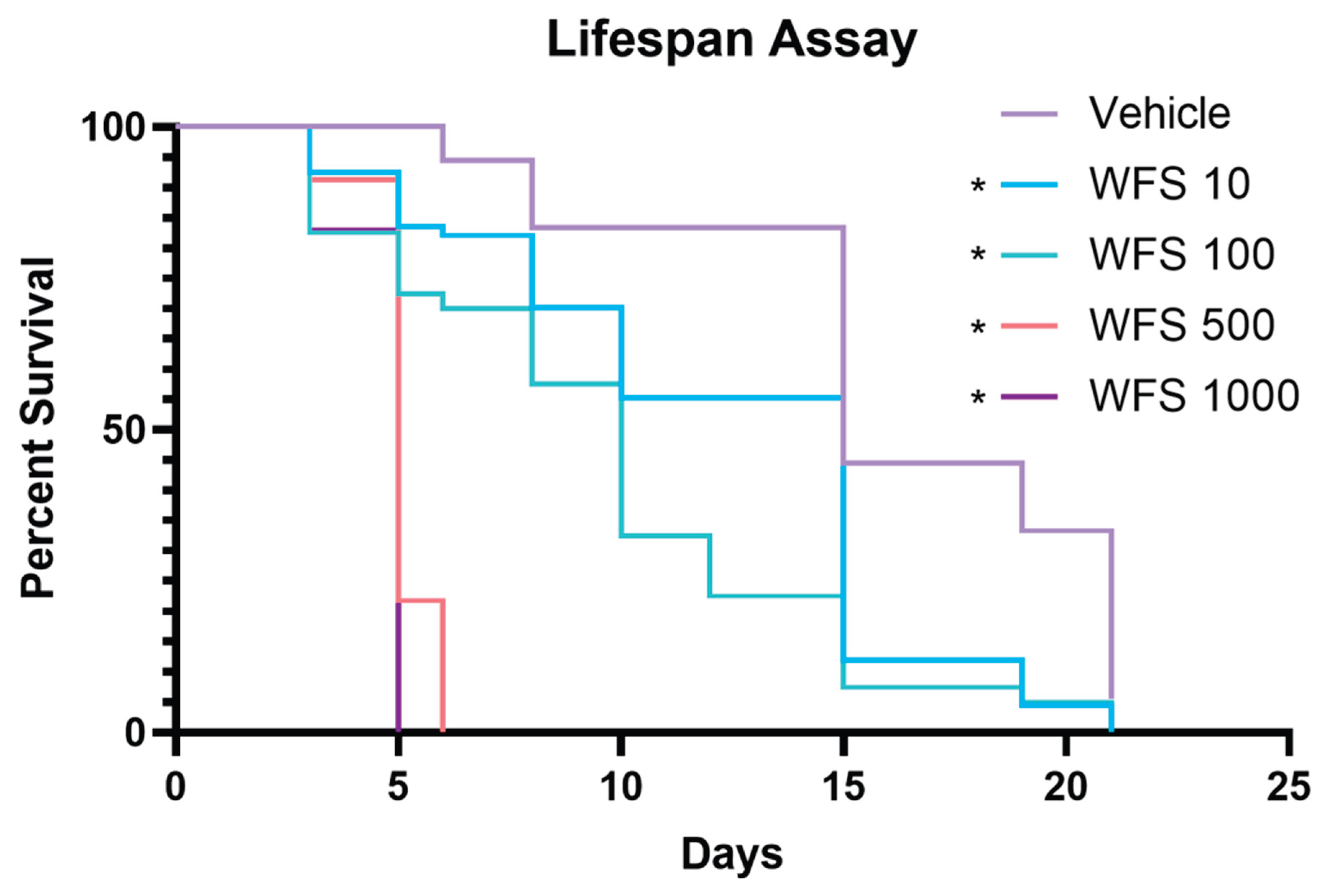
Figure 2.
High WFS exposure doses are associated with dose-dependent decreases in lifespan. A 24-hour WFS exposure to L4 nematodes results in decreased maximum and median lifespan compared to controls. Survival assay data significance was determined via Log-rank (Mantel-Cox) test. Sample size: Control (n = 17), 10 µg/mL (n = 67), 100 µg/mL (n = 40), 500 µg/mL (n = 46), 1000 µg/mL (n = 47). * P < 0.05.
Figure 2.
High WFS exposure doses are associated with dose-dependent decreases in lifespan. A 24-hour WFS exposure to L4 nematodes results in decreased maximum and median lifespan compared to controls. Survival assay data significance was determined via Log-rank (Mantel-Cox) test. Sample size: Control (n = 17), 10 µg/mL (n = 67), 100 µg/mL (n = 40), 500 µg/mL (n = 46), 1000 µg/mL (n = 47). * P < 0.05.
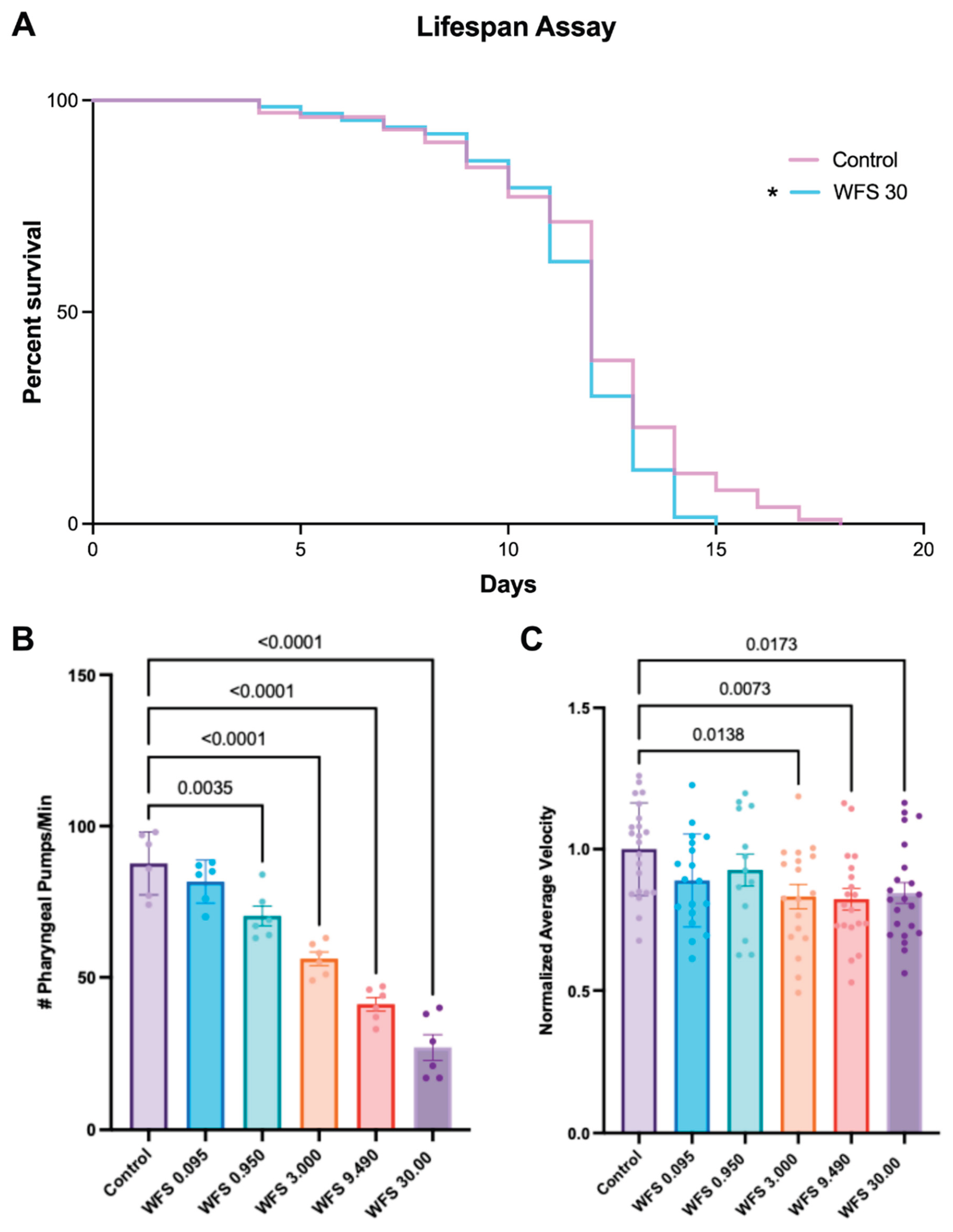
Figure 3.
Low WFS exposure doses are associated with decreased neuromuscular function. A) Nemalife lifespan assay showing decreased maximum lifespan, but not median lifespan with WFS exposure. Sample size: Control (n = 101), 30 µg/mL WFS (n = 63). WFS exposure decreased neuromuscular function as reflected by B) decreased pharyngeal pump rate; and C) declines in average velocity at day 10 of adulthood. Data are presented as a survival curve for lifespan and as a bar plot with mean ± standard deviation with individual animals represented as points. Survival assay data significance was determined via Log-rank (Mantel-Cox) test. Intergenerational locomotion data significance was determined via ordinary one-way ANOVA with Tukey’s post-hoc test with a single pooled variance. In instances of nonparametric data, a Kruskal-Wallis test was used with Dunn’s post-hoc test for multiple comparisons was used. * P < 0.05.
Figure 3.
Low WFS exposure doses are associated with decreased neuromuscular function. A) Nemalife lifespan assay showing decreased maximum lifespan, but not median lifespan with WFS exposure. Sample size: Control (n = 101), 30 µg/mL WFS (n = 63). WFS exposure decreased neuromuscular function as reflected by B) decreased pharyngeal pump rate; and C) declines in average velocity at day 10 of adulthood. Data are presented as a survival curve for lifespan and as a bar plot with mean ± standard deviation with individual animals represented as points. Survival assay data significance was determined via Log-rank (Mantel-Cox) test. Intergenerational locomotion data significance was determined via ordinary one-way ANOVA with Tukey’s post-hoc test with a single pooled variance. In instances of nonparametric data, a Kruskal-Wallis test was used with Dunn’s post-hoc test for multiple comparisons was used. * P < 0.05.
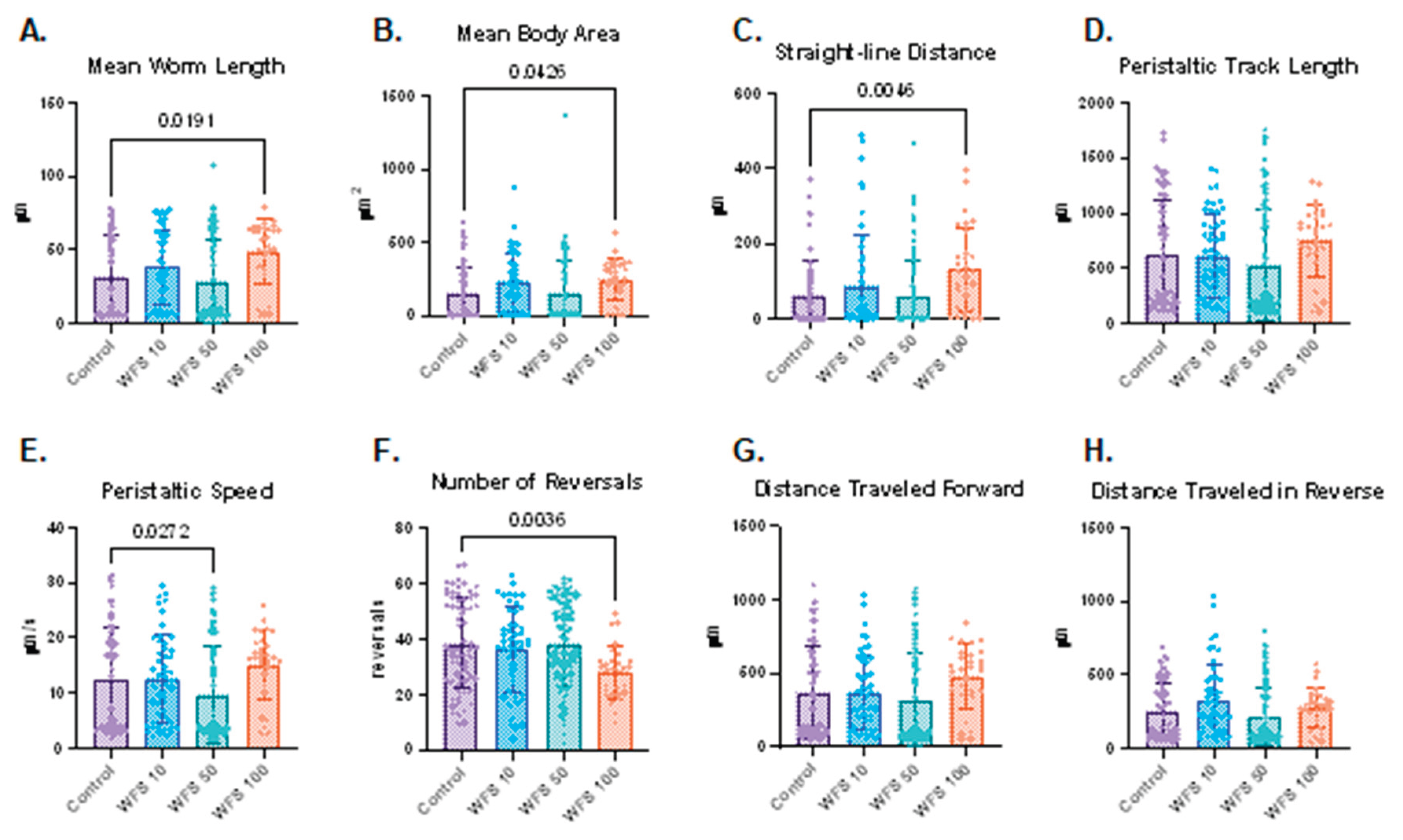
Figure 4.
WFS exposure impacts locomotion and morphology in day 3 adult P0 worms. P0 nematodes were assessed for A) length; B) area; and C) straight-line distance which were all increased at the highest dose. D) Track length was unchanged by WFS exposure; but E) speed; and F) reversal number decreased in nematodes treated with the second highest and highest WFS concentration, respectively. Both G) distance traveled forward; and H) distance traveled reverse showed no change with WFS exposure. Data are presented as a bar plot with mean ± standard deviation with individual animals represented as points. Significance was determined via a Kruskal-Wallis test with Dunn’s post-hoc test for multiple comparisons. Sample size: Control (n = 94), 10 µg/mL (n = 89), 50 µg/mL (n = 127), 100 µg/mL (n = 62). * P < 0.05.
Figure 4.
WFS exposure impacts locomotion and morphology in day 3 adult P0 worms. P0 nematodes were assessed for A) length; B) area; and C) straight-line distance which were all increased at the highest dose. D) Track length was unchanged by WFS exposure; but E) speed; and F) reversal number decreased in nematodes treated with the second highest and highest WFS concentration, respectively. Both G) distance traveled forward; and H) distance traveled reverse showed no change with WFS exposure. Data are presented as a bar plot with mean ± standard deviation with individual animals represented as points. Significance was determined via a Kruskal-Wallis test with Dunn’s post-hoc test for multiple comparisons. Sample size: Control (n = 94), 10 µg/mL (n = 89), 50 µg/mL (n = 127), 100 µg/mL (n = 62). * P < 0.05.
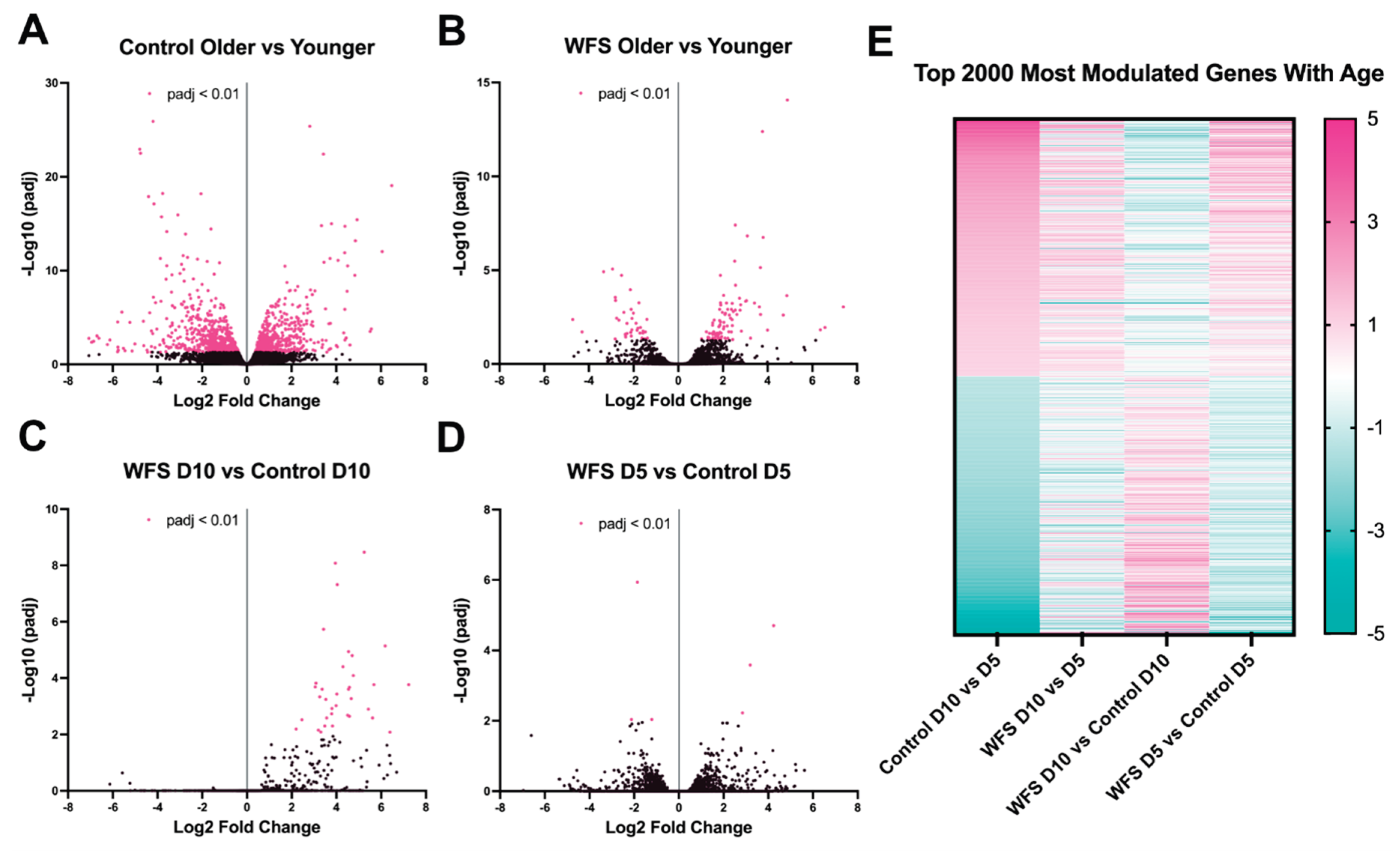
Figure 5.
WFS exposure displays aging-like transcriptional signatures. A-D) Volcano plots showing differential expression of all transcripts in multiple comparisons. E) Heatmap showing the top 1000 most increased and top 1000 most decreased genes with aging, and their expression patterns across identical comparisons (far left and far right panels in conjunction suggest a possible aging-like phenotype).
Figure 5.
WFS exposure displays aging-like transcriptional signatures. A-D) Volcano plots showing differential expression of all transcripts in multiple comparisons. E) Heatmap showing the top 1000 most increased and top 1000 most decreased genes with aging, and their expression patterns across identical comparisons (far left and far right panels in conjunction suggest a possible aging-like phenotype).
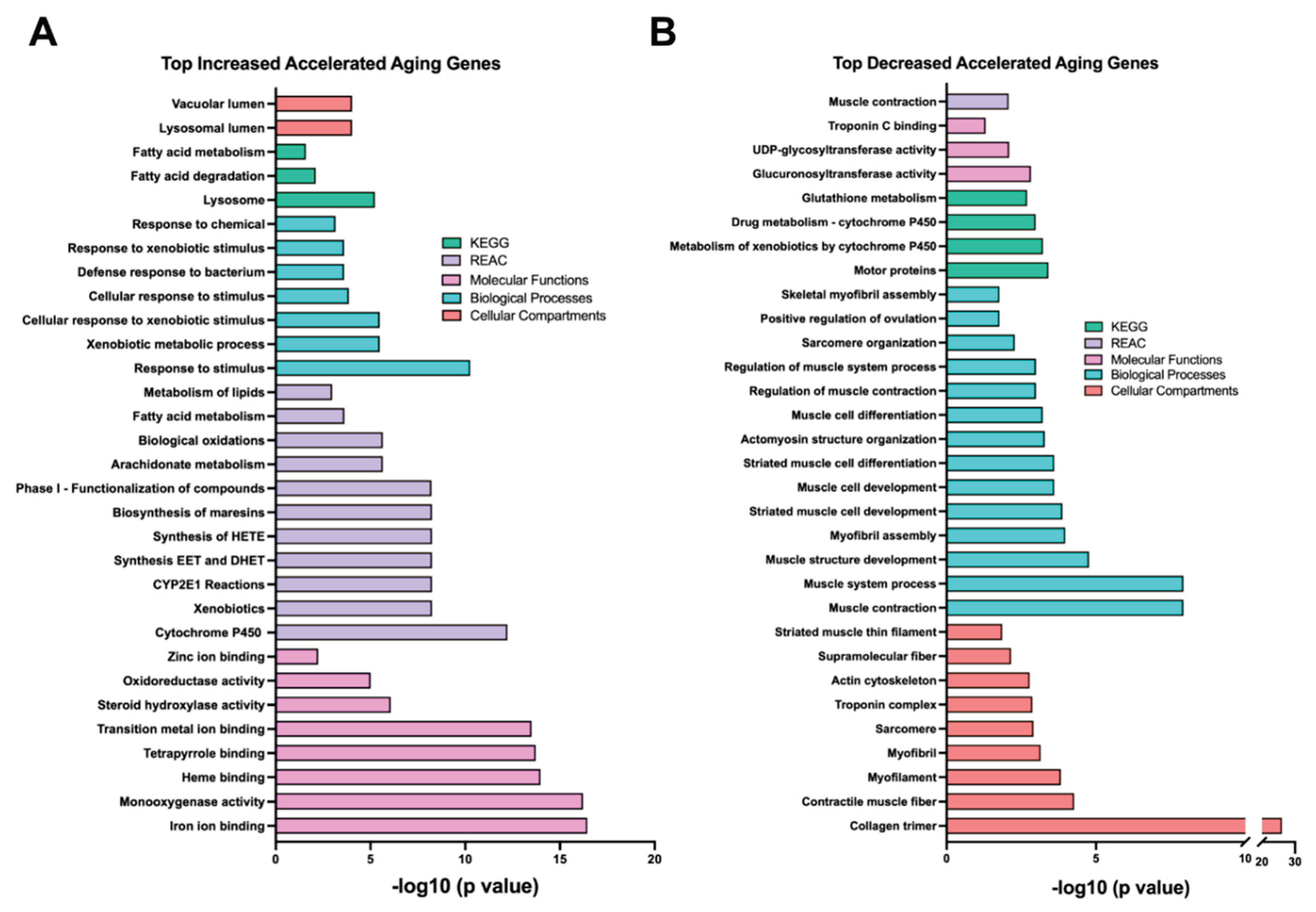
Figure 6.
Gene ontology terms from genes in WFS D5 vs Control D5 that follow the same trend seen in the aging (Control D10 v D5) comparison. A) Topmost increased genes associated with accelerated aging are linked to phase I metabolism. B) Topmost decreased genes associated with accelerated aging are linked to muscle function.
Disclaimer/Publisher’s Note: The statements, opinions and data contained in all publications are solely those of the individual author(s) and contributor(s) and not of MDPI and/or the editor(s). MDPI and/or the editor(s) disclaim responsibility for any injury to people or property resulting from any ideas, methods, instructions or products referred to in the content. |
© 2026 by the authors. Licensee MDPI, Basel, Switzerland. This article is an open access article distributed under the terms and conditions of the Creative Commons Attribution (CC BY) license (http://creativecommons.org/licenses/by/4.0/).
Copyright: This open access article is published under a Creative Commons CC BY 4.0 license, which permit the free download, distribution, and reuse, provided that the author and preprint are cited in any reuse.