

Submitted:
23 July 2026
Posted:
24 July 2026
You are already at the latest version
Abstract
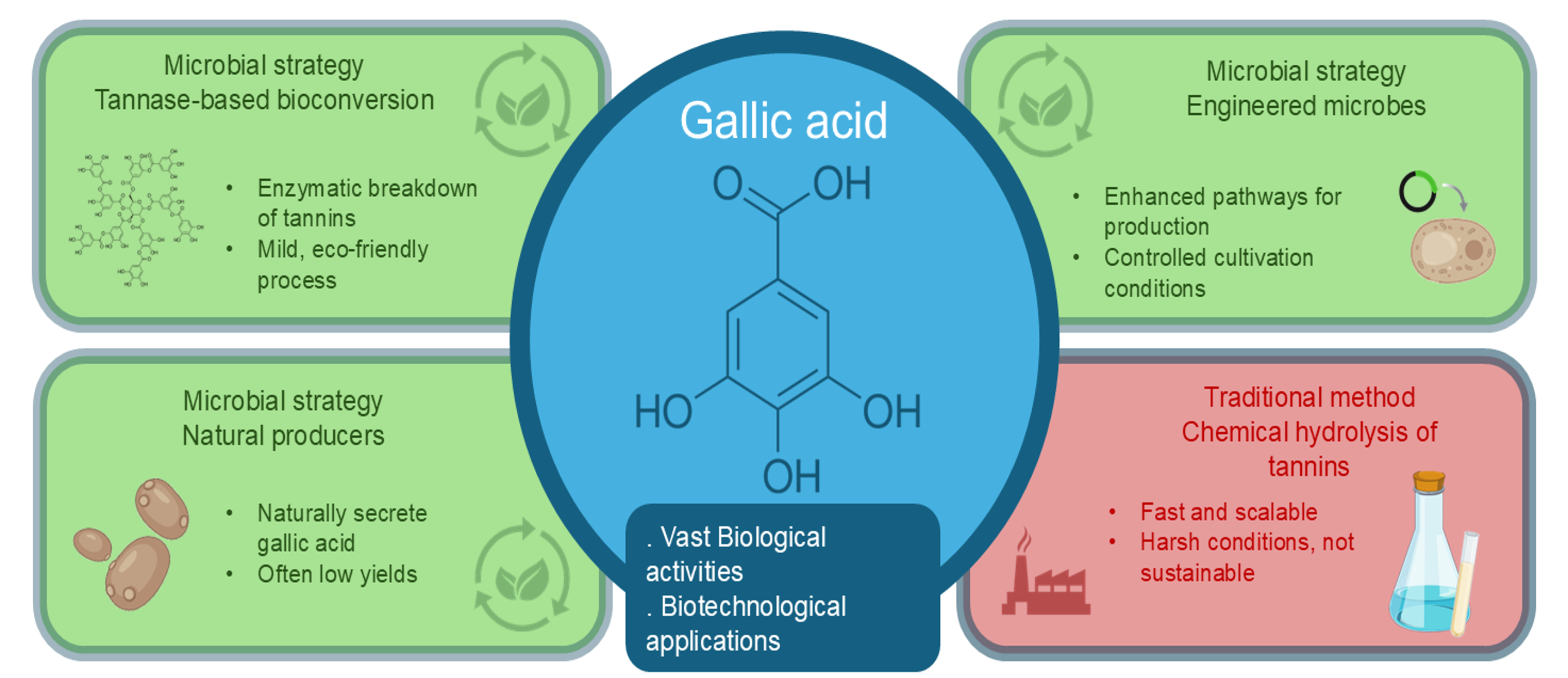
Gallic acid (GA) is a value-added phenolic compound widely applied in the food, pharmaceutical, and cosmetic industries. Traditionally obtained through chemical hydrolysis of tannins, its production faces limitations related to environmental impact, substrate dependency, and process sustainability. In recent years, microbial platforms have emerged as promising bioproduction alternatives, driven by advances in metabolic engineering and synthetic biology. This review discusses the transition from conventional enzymatic tannin hydrolysis to the engineering of microbial cell factories to enable de novo GA biosynthesis via shikimate pathway reprogramming. This work summarizes reported strategies, including tannase-mediated bioconversion, exploration of native GA-producing microorganisms, and rational pathway reconstruction in model chassis such as Escherichia coli, Corynebacterium glutamicum, and Pseudomonas putida. Emphasis is given to recent approaches involving carbon flux redirection, deletion of competing catabolic routes, enzyme engineering, dynamic regulatory circuits, and tolerance improvement. Current challenges related to metabolic bottlenecks, product toxicity, and industrial scalability are critically analyzed. By integrating enzymatic, metabolic, and systems-level strategies, this review highlights the progress achieved in microbial GA production and outlines perspectives for the development of robust and sustainable biotechnological platforms.
Keywords:
gallic acid
; microbial cell factories
; shikimate pathway
; metabolic engineering
; synthetic biology
; fermentation
1. Introduction
The shikimate pathway represents a central metabolic hub responsible for the biosynthesis of aromatic amino acids and a wide range of high-value phenolic compounds in microorganisms and plants [1,2]. Recent advances in systems and synthetic biology have enabled the reprogramming of this pathway toward the sustainable production of industrially relevant aromatics, including phenolic acids and their derivatives [3]. Among these compounds, gallic acid has attracted increasing attention due to its multifunctional applications and growing market demand.
Gallic acid (GA), or 3,4,5-trihydroxybenzoic acid, is a polyphenolic compound widely found in nature. Structurally, GA consists of an aromatic ring with three hydroxyl groups and one carboxyl group, conferring high chemical reactivity to the molecule (Figure 1) [4].
GA exhibits diverse biological activities and is an attractive candidate for biotechnological applications. Several industrial processes use GA, including leather, photography, dye, pharmaceutical, cosmetic, and food industries, reflecting its economic and scientific importance. Properties of GA widely reported include antioxidant, anti-inflammatory, antimicrobial, antifungal, antiviral, antithrombotic, anti-apoptotic, anticancer, antiulcerogenic, antidepressant, anxiolytic, antidiabetic, antimelanogenic, antiallergic, cardioprotective, neuroprotective, nephroprotective, and hepatoprotective [4,5,6,7,8,9,10,11,12,13].
In nature, GA is mainly found in its free form or as part of hydrolyzable tannins present in a wide range of plants [13]. It is produced by plants as a defense mechanism against environmental stress and microbial infections, being isolated from fruits, nuts, leaves, and tree bark [4].
Gallotannins are a type of hydrolyzable tannin composed of polymers formed through the esterification of GA monomers, with the hydroxyl groups of a polyol, typically glucose [14]. Its general structure is illustrated in Figure 2.
GA is marketed in different purity grades, including industrial, pharmaceutical, and food grades, catering to various applications ranging from food antioxidants to cosmetics and pharmaceutical ingredients. China leads the GA global production and market, accounting for approximately 86% of worldwide production, followed by India with about 9%. Major Chinese suppliers include Jiurui Biology, Bei Yuan Chemical, Hunan Linong, and Tianxin Biotech, with the first three controlling around 55% of the global market [15]. To the best of the authors’ knowledge, as of May 2025, Kao Global Chemicals (Japan) is the only company commercially producing GA via a de novo microbial fermentation process using engineered bacteria, commercialized under the product GA-100 BIO (https://chemical.kao.com/global/bio/ga100_bio/) [16]. The disparity between commercial demands and the limited availability of microbial-derived alternatives indicates that the GA industry remains highly dependent on conventional plant-derived tannins.
GA is traditionally produced by direct extraction from plant materials or through chemical hydrolysis of tannins, with the latter remaining the predominant industrial production route [17]. Plant-based extraction employs solvents like methanol, ethanol, or water and has been applied to a range of raw materials, such as leaves, bark, and fruits. The process begins with the selection and preparation of plant biomass, followed by solvent extraction to isolate the target compounds. The resulting extract is then concentrated and refined to remove impurities. Subsequent spray drying converts the refined extract into a powdered product, which is mixed and screened to ensure uniformity. The product is then packaged and subjected to quality control testing prior to storage and commercial distribution [7].
The hydrolysis of tannic acid and other hydrolysable tannins, performed under acidic or alkaline conditions, has been explored as a route for GA production [18]. Despite its simplicity, this strategy results in low purity, generates toxic effluents, and poses environmental and equipment-related risks [19,20]. These drawbacks reinforce the interest in safer and more sustainable alternatives. Commercial production of GA using microorganisms traditionally relies on enzymatic hydrolysis of tannins through tannase production by bacteria or fungi. This approach is advantageous compared to extraction or acid/alkaline hydrolysis of gallotannins due to its higher yield, lower impurity generation, environmental safety, and process reproducibility. However, industrial-scale biotransformation of tannins still faces challenges, such as microbial sensitivity to high concentrations of tannic acid and the need for a deeper understanding of tannin metabolism and tannase properties [7,21].
GA global demand is reported to exceed 103 tons per year [22,23], with the global market valued at USD 91.3 million in 2025, and projected to reach USD 131.1 million by 2030 [15]. Growing demands across multiple industrial sectors have intensified interest in biotechnological alternatives for GA production. GA is widely valued as a natural antioxidant in foods and beverages, and its bioactive properties support its growing use in pharmaceutical formulations, such as cosmetics and dyes [15].
This has driven the development of innovative biotechnological strategies. De novo production by metabolically engineered microbial strains has emerged as a promising solution to overcome limitations related to dependence on plant-derived substrates. This approach seeks to optimize microorganisms to produce GA directly from simple and renewable agro-industrial residues as carbon sources, such as glucose or glycerol, increasing sustainability and reducing production costs. In addition to addressing supply chain disruptions and the limited availability of natural resources, de novo microbial production offers better control over product consistency and purity, which is often a challenge in plant-based extraction methods.
This article reviews the advances in GA production, with emphasis on the transition from tannin hydrolysis-based production to de novo bioproduction by metabolically engineered microbial strains. Traditional methods, industrial applications, and challenges related to industrial scale-up are also discussed, aiming to highlight both opportunities and barriers in the transition to sustainable technologies.
2. Enzymatic Production of GA
The use of tannase, an enzyme that catalyzes the hydrolysis of hydrolysable tannins into GA and glucose, represents a well-established approach for GA production. Since the first reports in the literature involving fungi such as Aspergillus niger and Penicillium glaucum, tannase has proven to be a valuable tool for the bioconversion of plant tannins into GA [24].
Dhiman and collaborators reviewed microorganisms capable of producing this enzyme, listing the reported production yields [21]. They emphasized its safety and efficiency compared to traditional chemical technologies, especially regarding yield, purity, environmental safety, and process reproducibility. Studies highlight that tannase production can be optimized through submerged cultivations, using tannin-rich sources as inducers. This approach has been explored to meet industrial demands in applications such as food preservatives, antioxidants in cosmetics, and chemical intermediates [25].
Tannase can also be used to degrade tannins found in different industrial wastes, representing an economically viable and environmentally sustainable alternative for GA production. The leather industry, for example, generates polluted effluents due to the intensive use of tannins, affecting water quality and ecosystems. Bioremediation using microbial tannase offers a promising approach to degrade the tannins present in this waste, enabling GA recovery as a by-product [21].
The literature review by Babu and collaborators listed GA production by microorganisms through enzymatic tannase synthesis [25]. This compilation was updated to include new references found in the years preceding its publication, as well as studies published afterward (Table S1).
Tannase activity was determined by estimating the GA released during the hydrolysis of methyl gallate. One unit of enzyme activity (U) is defined as the amount of enzyme that liberates one micromole of GA from tannic acid per minute under the assay conditions. In this review, tannase activity values are reported either as volumetric activity (U/mL in the culture supernatant) or as specific activity (U/mg of protein), both representing GA production, since one unit corresponds to the release of one micromole of GA per minute. Whenever available, values for purified tannase were prioritized. For studies that assessed multiple organisms, only the strain with the highest activity was included in the table. The values were kept in the original units reported by each author, as they reflect different approaches to expressing enzyme activity or production. Because a complete normalization across studies was not possible, the data should be interpreted qualitatively rather than quantitatively.
Although the biotransformation of tannins into GA using tannase is a widely studied strategy, its industrial-scale applications still face significant limitations. Factors such as microbial sensitivity to tannic acid – which can inhibit the growth and metabolism of tannase-producing microorganisms at higher substrate concentrations –, incomplete understanding of tannin metabolism, and enzymatic properties limit the efficiency of this process [7,21]. Relevant enzymatic factors include low affinity of some tannases for polymeric tannins, the need for synergistic activity of multiple isoenzymes for efficient hydrolysis, and sensitivity of the enzyme to extreme pH or temperature conditions [26,27].
3. Microbial Production
In addition to enzymatic production through the release of GA molecules from tannin- or gallotannin-rich sources, this phenolic compound can also be obtained via metabolic synthesis by microorganisms.
Direct production of GA via the shikimate pathway (Figure 3) in microorganisms has emerged as a promising alternative to tannin-based production.
This biotechnological approach bypasses dependence on tannin-rich substrates by harnessing natural or optimized metabolic pathways to convert simple carbon sources, such as glucose, into GA. Thus, either by using naturally producing organisms or the development of more robust and metabolically adapted microorganisms, coupled with engineered biosynthetic pathways, can overcome challenges related to scalability and economic feasibility, enabling more efficient and environmentally sustainable production processes to meet industrial and commercial demands.
section may be divided by subheadings. It should provide a concise and precise description of the experimental results, their interpretation, and the experimental conclusions that can be drawn.
3.1. Exploration of Natural GA-Producing Microorganisms
Exploration of natural GA-producing microorganisms
Endogenous GA production by microorganisms occurs primarily via the shikimate pathway (SP), a highly conserved metabolic route present in plants, fungi, bacteria, and some protozoa. SP is partially conserved and often non-canonical in Archaea, and absent in animals [2,28]. SP is involved in the synthesis of essential aromatic compounds such as phenylalanine, tyrosine, and tryptophan, as well as secondary metabolites like lignins, flavonoids, and phenolic acids [1,29]. The SP (Figure 3) comprises seven major steps catalyzed by enzymes that convert central metabolism precursors – phosphoenolpyruvate (PEP) and erythrose-4-phosphate (E4P) – into shikimate and subsequently to chorismate, the key intermediate that feeds several biosynthetic routes responsible for producing bioactive and structural compounds [2,3].
Interest in studying this pathway has continuously grown, as its intermediates and derivatives participate in the biosynthesis of a wide variety of molecules of industrial, nutritional, and pharmaceutical interest [30,31].
The main steps and enzymes involved in the pathway are as follows. First, phosphoenolpyruvate (PEP) and erythrose-4-phosphate (E4P) are condensed to form 3-deoxy-D-arabino-heptulosonate-7-phosphate (DAHP), catalyzed by DHAP synthase. DHAP is then converted to 3-dehydroquinate (DHQ) by 3-dehydroquinate synthase (AroB). DHQ is dehydrated to 3-dehydroshikimate by 3-dehydroshikimate dehydratase (AroD), which is subsequently reduced to shikimate by shikimate dehydrogenase (AroE). Shikimate is phosphorylated by shikimate kinase (AroK) to form shikimate-3-phosphate, which is converted to 5-enolpyruvylshikimate-3-phosphate (EPSP) by EPSP synthase (AroA). Finally, chorismate synthase (AroC) catalyzes the conversion of EPSP to chorismate. Chorismate can be further transformed into GA through downstream reactions catalyzed by specific enzymes, such as decarboxylases and oxygenases, depending on the organism and whether a native or heterologous pathway is employed [32]. Table 1 lists literature reporting the synthesis of GA by wild-type strains.
Early studies conducted in the mid-20th century onward demonstrated that several wild-type microorganisms are capable of producing GA under laboratory conditions (Table 1). Among the organisms listed, there is a marked predominance of filamentous fungi, especially Phycomyces blakesleeanus, a species of the Zygomycota phylum, known for its ability to produce aromatic secondary metabolites. This strain appears in independent reports spanning five decades (1947-1997). Reported yield varied widely (from 17 µg/mL to 2 g), depending on carbon source concentration, nitrogen supplementation, and cultivation duration.
Later studies expanded the list of producers to include filamentous fungi such as Aspergillus terreus and Penicillium flavigenum. Notably, P. flavigenum achieved a titer 11.9 g/L GA after seven days of submerged cultivation in potato dextrose broth, representing the highest concentration reported by a native producer, i.e. non-genetically engineered strain. Despite this promising value, the process relied on complex culture media and long cultivation time, limiting the feasibility of industrial production. Overall, these reports demonstrate that natural GA biosynthesis is restricted to filamentous fungi known to produce phenolic (secondary) metabolites. Although wild-type GA producers provide valuable biological information about biosynthetic routes and related enzymes, they are generally poor candidates for industrial applications due to low volumetric productivities (g/L.h), and difficulties in bioprocess control and genetic engineering [42,43].
More recently, co-culture strategies combining fungi and bacteria have been explored to enhance phenolic acid biosynthesis. The rationale is that complementary metabolic pathways can increase substrate degradation and precursor availability, thereby boosting yields. Exploratory reports indicate that such approaches may provide higher titers and broader metabolite profiles compared to monocultures, although results are still variable depending on the strains and cultivation conditions employed [44].
Taken together, the literature on natural GA producers reveals that most of the reports date back to the pre-metabolic engineering era, and that even the most promising native producers exhibited limited production. These constraints motivated the transition to the construction of engineered strains, which is discussed in the next section.
3.2. Engineering Microbial Cell Factories for de Novo GA Biosynthesis
The transition from tannin-based biotransformation to fully engineered microbial cell factories represents a paradigm shift in GA production. De novo biosynthesis through shikimate pathway reprogramming enables the conversion of simple carbon sources into GA, decoupling production from plant-derived intermediates and allowing systematic metabolic optimization.
GA production by microorganisms through the de novo strategy has been enabled by the rational engineering of heterologous metabolic pathways. Unlike native production, this approach relies on the introduction of biosynthetic pathways to a microbial chassis, enabling the synthesis of intermediates and compounds directly related to GA, redirecting metabolic fluxes, and optimizing production efficiency.
Efficient GA production requires the expression and regulation of key genes in the SP and accessory pathways (Figure 1). Essential genes include aroA, aroB, aroC, aroD, aroE, aroK, and aroG, which are involved in the central steps of the shikimate pathway; ubiC, which encodes chorismate-pyruvate lyase that converts chorismate into 4-hydroxybenzoate, a precursor of other aromatic compounds; and galE, which encodes enzymes that facilitate the conversion of intermediates into GA.
Analysis of the data presented in Table 2 reveals how these pathways have been implemented in different genetic configurations, ranging from point replacements of endogenous promoters to the construction of complex regulatory circuits integrated into the genome.
Most of the cited studies use Escherichia coli as a host organism due to its well-documented ability to accept and express heterologous DNA, tolerate extensive metabolic modifications, and molecular toolbox, in addition to its rapid growth and the availability of standardized protocols. The reconstruction of the shikimate pathway combined with accessory genes is the common basis of these approaches, which have become increasingly sophisticated over the years. Early studies, such as that of [45], modified E. coli by replacing the aroF promoter with a constitutive promoter (Ptac), and by inserting the feedback inhibition-resistant version aroF^FBR. Subsequent studies enhanced gene expression control, as demonstrated by [46], where the combination of a mutated aroE with aroF^FBR and pobA genes resulted in 20 g/L of GA in 48 hours, in a 2 L fed-batch reactor.
A striking trend in more recent studies is the use of mutant enzymes, such as PobA Y385F/T294A. In this variant, the replacement of Tyr385 by Phe reduced steric hindrance in the active site, while the substitution of Thr294 by Ala improved hydrogen-bonding interactions and overall structural stability. As a result, the enzyme displayed higher substrate affinity and enhanced robustness, achieving 1.27 g/L of GA in 48 hours [48].
In parallel, strategies combining multiple genetic modifications with catabolic gene deletions and central metabolism reengineering have been explored. A notable example is the study by Guo et al. [51], which employed a highly optimized metabolic architecture comprising optimization of the shikimate pathway with high-efficiency enzymes (such as QuiC from Pseudomonas putida and PobA from Pseudomonas aeruginosa, gene expression tuning with specific promoters, and elimination of plasmid use to reduce metabolic burden. This approach resulted the production of 51.57 g/L of GA in a bioreactor. Additionally, the platform was extended to biosynthesize the GA derivative β-glucogallin (92.42 mg/L) via the expression of a GA 1-O-glucosyltransferase. It should be noted that β-glucogallin is a glycosylated derivative formed from GA, serving as an intermediate for the biosynthesis of gallotannins or as a compound with distinct functional applications. The GA biosynthetic pathway is highly versatile, providing opportunities for the co-production of related polyphenolic compounds.
The study by Liu et al. [53] investigated the adaptive response E. coli W3110 (ATCC 82057) to stress caused by GA. The research revealed that E. coli enhances its tolerance through three main strategies: reducing compound uptake, increasing its excretion, and maintaining intracellular environmental stability. These mechanisms involve negative regulation of outer membrane proteins (such as OmpF and OmpC), activation of efflux systems like MdtEF and AaeAB, and induction of acid resistance island (AFI) genes that promote survival in acidic environments. Despite these adaptations, bacterial growth was significantly inhibited, highlighting the impact of GA on biomass and cell morphology. The findings reveal possibilities for genetic enhancement of E. coli to improve its tolerance to GA, enabling advances in microbial production of phenolic compounds.
Another example of such co-production beyond GA is reported by Jung et al. [52], who engineered Corynebacterium glutamicum to produce GA along with its reduced derivatives, gallic aldehyde and gallic alcohol, via an extended shikimate pathway. A mutant 4-hydroxybenzoate hydroxylase (Y385F/L200V) was introduced to enable efficient protocatechuate hydroxylation, achieving 4.03 g/L in flask cultures. Carboxylic acid reductases (CARs), particularly MpCAR, were employed to convert GA into gallic aldehyde, while the endogenous aromatic aldehyde reductase NCgl0324 facilitated production of gallic alcohol. Overexpression of qsuB enhanced carbon flux toward protocatechuate, further improving yields. Using this integrated pathway design and metabolic engineering approach, 5-L fed-batch fermentation reached 12.0 g/L GA and 1.14 g/L gallic aldehyde, demonstrating the efficiency and robustness of C. glutamicum as a microbial platform for polyphenol biosynthesis.
Another modification in the production method involves co-culture systems, as exemplified by Wang et al. [54], who developed a syntrophic co-culture of E. coli to maximize GA production. Their strategy involved splitting the biosynthetic pathway between two strains: one engineered to overexpress shikimate pathway genes, including aroB, for efficient conversion of glucose to GA, and the other modified to optimize NADPH balance and precursor supply, reducing accumulation of intermediates such as protocatechuate. This division of labor allows metabolic fluxes to be more efficiently distributed, minimizes by-product formation, and results in high productivity, achieving a remarkable GA titer of 57.66 g/L.
Another significant outcome involved Pseudomonas putida, a chassis naturally more resistant to phenolic compounds [49]. Genes involved in GA production (aroG4, quiC, and pobA) were expressed from a plasmid, and gene sequences related to the degradation of metabolic intermediates (pcaHG, galTAPR) were deleted. This combined strategy enhanced GA production to 346.7 mg/L. Although the absolute value is lower than that obtained with E. coli, the higher tolerance of P. putida to aromatic and phenolic compounds makes this chassis promising for more robust industrial applications, as already observed in studies on catechol, protocatechuic acid, and derivative production [32,55]. This study also introduces a critical aspect of metabolic engineering that has gained prominence: the deletion of endogenous genes responsible for the degradation of intermediates or GA itself. In microorganisms such as E. coli and P. putida, natural pathways for phenolic acid degradation compete with the productive route and reduce GA accumulation. Genes such as pcaH and pcaG encode enzymes of the β-ketoadipate pathway, responsible for converting GA and other phenolic acids into central metabolites of the tricarboxylic acid (TCA) cycle, such as succinyl-CoA and acetyl-CoA. The galTAPR operon is associated with the modification and degradation of galacturonates and phenolic derivatives, which can directly affect GA yield. The deletion of these genes, as demonstrated in the study with P. putida, prevents carbon flux to competing catabolic routes, promoting intracellular or extracellular GA accumulation. This strategy, when combined with biosynthetic pathway optimization and cellular tolerance strengthening, represents one of the most promising paths for the industrial feasibility of GA production via microbial fermentation.
In addition to these approaches, other studies have also investigated the use of synthetic circuits that dynamically activate or repress genes in response to GA levels in the system [56,57,58]. These advanced synthetic biology strategies signal a new era of fine regulatory control, enabling the microorganism to adaptively modulate its metabolism, reduce toxicity, and maximize production efficiency. Other approaches that can be used to optimize GA production and enable large-scale production include: (i) Precursor pool enrichment: Manipulation of central metabolic pathways, such as the Embden-Meyerhof-Parnas (EMP) and the tricarboxylic acid (TCA) cycle, is essential to ensure the availability of PEP and E4P. Regulatory genes such as ppsA and tktA can be overexpressed to maximize these precursors; (ii) Optimization of metabolic fluxes: The use of biosensors and synthetic regulatory circuits helps redirect metabolic flux towards GA production; (iii) Integration of diverse heterologous pathways: Introduction of genes from plants or fungi, such as those encoding specific decarboxylases and oxygenases, can expand the capacity of model bacteria for GA and other aromatic derivative production [59,60,61].
In summary, the success of the de novo GA production strategies depends not only on the effective introduction of the correct biosynthetic pathways but also on the elimination of endogenous degradative routes that compete for the same precursor pool or convert the final product into central metabolic compounds. The synergy between gene insertions and deletions, combined with the use of suitable chassis and the development of sophisticated regulatory tools, has enabled the significant advances observed in microbial production of this important phenolic metabolite in recent decades.
4. Toward Industrial-Scale Microbial Production of GA: Challenges and Perspectives
Microbial synthesis of GA represents a more sustainable alternative to traditional chemical extraction processes, offering reduced environmental impact and lower pollution. Continued research in microbial bioproduction can further reduce the ecological footprint of GA production [62]. However, despite considerable progress, several scientific and technological challenges must still be addressed before large-scale industrial implementation can be fully realized.
The gap between current bench-scale performance and real-world industrial setups can be rationally evaluated using Fermi-style estimates [63]. At present, the highest GA titers reported in the literature reach ~50 g/L after 60h of cultivation [51]. Averaged over the full cultivation time, this corresponds to a volumetric productivity of roughly 0.8 g/L.h, or about 20 kg/m3.day. In practice, however, these values are rarely sustained at large-scale cultivations, which inevitably include non-productive phases and scale-inherent physiological stress on the platform microbial strain (e.g., oxygen transfer, heat transfer, and stirring efficiency limitations). Taking these factors into account places the practical productivity around 5-10 kg/m³.day, which lies closer to the lower limit of economic viability for fine-chemical bioproduction [64].
These simple estimates suggest that further progress in GA microbial production is unlikely to be driven by marginal increases in the final titer alone. Instead, meaningful advances will require sustained improvements in volumetric productivity and strain robustness under conditions that better reflect industrial operation.
A central challenge lies in improving bioprocess parameters, namely titer, rates, and yields (TRY). Optimization of the shikimate pathway and associated metabolic pathways remains critical, as these routes often impose bottlenecks on GA biosynthesis. A deeper understanding of carbon flux distribution and metabolic regulation will be essential for overcoming such limitations [48,51].
Enzyme efficiency within the biosynthetic pathway is an additional major player in GA productivity. Recent studies that targeted enzyme engineering can substantially improve pathway performance and relieve metabolic bottlenecks. For instance, the low catalytic efficiency of p-hydroxybenzoate hydroxylase (PobA), a key enzyme in protocatechuate → GA conversion, was significantly improved with specific mutations (Y385F/T294A), leading to enhanced conversion efficiency and reduced intermediate accumulation [48]. In this sense, future research should focus on Synthetic Biology-empowered metabolic engineering strategies, such as (continuous) directed evolution [65] and rational enzyme design to further enhance catalytic efficiency (kcat/KM) and process selectivity [66].
Beyond enzyme engineering, maintaining a proper balance between metabolic flux toward GA and cellular growth presents a significant challenge. Unbalanced redirection of intermediates can impair biomass production and compromise chain robustness, especially in large-volume cultivations. Fine-tuning the expression of key pathway enzymes and redirecting carbon flux from central catabolic routes, such as the EMP pathway and the TCA cycle, may help maximize precursor availability while preserving cellular fitness.
Strain robustness and genetic stability under industrial conditions (>10,000 L cultivations) are equally important factors. Most of the analyzed studies relied on plasmid-based expression systems, which typically require the addition of antibiotics for plasmid maintenance and can suffer from instability over extended cultivation periods. The integration of GA biosynthetic pathways into the microbe chromosome, as demonstrated by Guo et al. [51], offers a promising alternative by reducing metabolic burden and enhancing long-term production stability. The construction of recombinant strains without antibiotic dependence should be a major focus of future metabolic engineering efforts.
The economic viability of the bioprocess also plays a decisive role in establishing large-scale microbial GA production. Most of the studies analyzed in this review (Table 1 and Table 2) made use of glucose as the main carbon source or employed complex, nutrient-rich culture media. Therefore, engineering strains to utilize low-cost, abundant, and renewable feedstocks of high-interest, such as agro-industrial residues rich in lignocellulosic carbohydrates, molasses, whey permeate, or crude glycerol, has the potential to significantly improve economic competitiveness [67,68,69]. The use of crude glycerol, a byproduct from the biodiesel industry, was already demonstrated as a viable and sustainable carbon source for GA biosynthesis [49]. This example highlights the broader importance of metabolic adaptation to non-conventional substrates, which is a key advantage for integrating GA production into biorefinery setups [70].
In addition to GA, the microbial production of GA derivatives, such as β-glucogallin, opens new possibilities for applications in the pharmaceutical and cosmetic industries. However, the enzymatic mechanisms underlying GA glycosylation are yet to be fully elucidated [51]. Developing a multifunctional microbial chassis capable of producing GA, its derivatives, and other bioactive molecules could substantially increase the value of bioproduction systems and expand their commercial potential.
In this scenario, although microbial GA bioproduction has made rapid and encouraging progress, its industrial deployment remains dependent on improvements in enzyme and metabolic efficiency, genetic stability, and feedstock flexibility. The use of SynBio-empowered metabolic and enzyme engineering, combined with genome editing tools such as CRISPR/Cas9, will aid the construction of more efficient and robust microbial strains critical for achieving a sustainable and economically viable production of value-added molecules.
5. Conclusion
Microbial synthesis represents a promising path toward GA sustainable bioproduction. Conventional conversion strategies, especially tannase-mediated processes, have industrial relevance, particularly for the valorization of tannin-rich waste streams. However, these approaches are limited by substrate availability, enzyme sensitivity and stability. Advances in metabolic engineering have opened new avenues for de novo GA biosynthesis from renewable carbon sources such as glucose and glycerol, circumventing the dependence on plant-derived tannins and chemical extraction. Although current engineered strains are still limited by modest volumetric productivities and incomplete pathway regulation, they represent a scalable and eco-friendly alternative with significant industrial potential. Continued efforts to optimize biosynthetic pathways, including enzyme performance, regulatory network control, and precursor supply, combined with bioprocess engineering strategies, are essential to unlock the full potential of microbial platforms and surpass the conventional strategies of GA production industrial setups. The convergence of genome editing, metabolic flux control, and chassis optimization is progressively transforming GA biomanufacturing from a biotransformation-based strategy into a fully engineered microbial platform. As industry-ready strains are developed and validated, microbial cell factories are expected to reshape the future industrial landscape of GA production.
Supplementary Materials
The following supporting information can be downloaded at Preprints.org, Table S1: Microorganisms and raw materials used for gallic acid production by tannase enzyme.
Author Contributions
R.K.P., L.F.S., and J.G.C.G. conceived the study. R.K.P. wrote the first draft, with contributions from M.M.T., A.S.S., and E.R.O.F. L.F.S. and J.G.C.G. acquired funding. L.F.S. supervised the study and will serve as the corresponding author. All authors read, edited, and approved the final manuscript.
Funding
This study was financed in part by the Coordenação de Aperfeiçoamento de Pessoal de Nível Superior – Brasil (CAPES) – Finance Code 001 (Ph.D. fellowship to R.K.P., grant number 88887.705434/2022-00). The authors also gratefully acknowledge productivity fellowships from the National Council for Scientific and Technological Development (CNPq – Brazil) awarded to L.F.S. (grant number 302821/2022-8) and J.G.C.G. (grant number 311932/2022-3).
Conflicts of Interest
The authors declare no conflicts of interest. The funders had no role in the design of the study; in the collection, analyses, or interpretation of data; in the writing of the manuscript; or in the decision to publish the results.
References
- Maeda, H.; Dudareva, N. The shikimate pathway and aromatic amino Acid biosynthesis in plants. Annu. Rev. Plant Biol. 2012, 63, 73–105. [Google Scholar] [CrossRef] [PubMed]
- Shende, V.V.; Bauman, K.D.; Moore, B.S. The shikimate pathway: gateway to metabolic diversity. Nat. Prod. Rep. 2024, 41, 604–648. [Google Scholar] [CrossRef] [PubMed]
- Sheng, Q.; Yi, L.; Zhong, B.; Wu, X.; Liu, L.; Zhang, B. Shikimic acid biosynthesis in microorganisms: Current status and future direction. Biotechnol. Adv. 2023, 62, 108073. [Google Scholar] [CrossRef] [PubMed]
- Badhani, B.; Sharma, N.; Kakkar, R. Gallic acid: a versatile antioxidant with promising therapeutic and industrial applications. RSC Adv. 2015, 5, 27540–27557. [Google Scholar] [CrossRef]
- Bai, J.; Zhang, Y.; Tang, C.; Hou, Y.; Ai, X.; Chen, X.; Zhang, Y.; Wang, X.; Meng, X. Gallic acid: Pharmacological activities and molecular mechanisms involved in inflammation-related diseases. Biomed. Pharmacother. 2021, 133, 110985. [Google Scholar] [CrossRef] [PubMed]
- Choubey, S.; Varughese, L.R.; Kumar, V.; Beniwal, V. Medicinal importance of gallic acid and its ester derivatives: a patent review. Pharm. Pat. Anal. 2015, 4, 305–315. [Google Scholar] [CrossRef] [PubMed]
- Dhiman, S.; Mukherjee, G. Gallic acid (GA): A multifaceted biomolecule transmuting the biotechnology era. In Recent developments in microbial technologies; Environmental and microbial biotechnology; Prasad, R., Kumar, V., Singh, J., Upadhyaya, C. P., Eds.; Springer Nature Singapore: Singapore, 2021; pp. 163–202. ISBN 978-981-15-4438-5. [Google Scholar]
- Gangadharan, G.; Gupta, S.; Kudipady, M.L.; Puttaiahgowda, Y.M. Gallic acid based polymers for food preservation: A review. ACS Omega 2024, 9, 37530–37547. [Google Scholar] [CrossRef] [PubMed]
- Kahkeshani, N.; Farzaei, F.; Fotouhi, M.; Alavi, S.S.; Bahramsoltani, R.; Naseri, R.; Momtaz, S.; Abbasabadi, Z.; Rahimi, R.; Farzaei, M.H.; Bishayee, A. Pharmacological effects of gallic acid in health and diseases: A mechanistic review. Iran. J. Basic Med. Sci. 2019, 22, 225–237. [Google Scholar] [CrossRef] [PubMed]
- Park, W.H. The expanding frontiers of gallic acid: From dual chemistry and pharmacology to innovative technological applications. Chem. Biol. Interact. 2026, 425, 111899. [Google Scholar] [CrossRef] [PubMed]
- Satapathy, T.; Verma, M.; Sahu, P.; Minj, A. Therapeutic potential of gallic acid and diosgenin in metabolic dysfunction-associated steatotic liver disease (MASLD) and non-alcoholic fatty liver disease (NAFLD): A comprehensive review. Pharmacol. Res.-Nat. Prod. 2026, 10, 100525. [Google Scholar] [CrossRef]
- Verma, S.; Singh, A.; Mishra, A. Gallic acid: molecular rival of cancer. Environ. Toxicol. Pharmacol. 2013, 35, 473–485. [Google Scholar] [CrossRef] [PubMed]
- Wianowska, D.; Olszowy-Tomczyk, M. A Concise Profile of Gallic Acid-From Its Natural Sources through Biological Properties and Chemical Methods of Determination. Molecules 2023, 28. [Google Scholar] [CrossRef] [PubMed]
- Cammann, J.; Denzel, K.; Schilling, G.; Gross, G.G. Biosynthesis of gallotannins: beta-glucogallin-dependent formation of 1,2,3,4,6-pentagalloylglucose by enzymatic galloylation of 1,2,3,6-tetragalloylglucose. Arch. Biochem. Biophys. 1989, 273, 58–63. [Google Scholar] [CrossRef] [PubMed]
- Intelmarket Research Gallic Acid Market Growth Analysis, Dynamics, Key Players and Innovations, Outlook and Forecast 2025-2032. Available online: https://www.intelmarketresearch.com/gallic-acid-market-10926 (accessed on 16 May 2026).
- Obunai, R.; Irie, Y.; Miyake, S. Method for producing composition containing gallic acid 2022. [CrossRef] [PubMed]
- Luo, Q.; Zeng, S.; Shu, Y.; Fu, Z.; Zhao, H.; Su, S. A novel green process for tannic acid hydrolysis using an internally sulfonated hollow polystyrene sphere as catalyst. RSC Adv. 2018, 8, 17151–17158. [Google Scholar] [CrossRef] [PubMed]
- Mukherjee, G.; Banerjee, R. Production of gallic acid. Biotechnological routes (Part 1). Chimica Oggi 2003.
- Bajpai, B.; Patil, S. A new approach to microbial production of gallic acid. Braz. J. Microbiol. 2008, 39, 708–711. [Google Scholar] [CrossRef] [PubMed]
- Banerjee, D.; Mondal, K.C.; Pati, B.R. Production and characterization of extracellular and intracellular tannase from newly isolated Aspergillus aculeatus DBF 9. J. Basic Microbiol. 2001, 41, 313–318. [Google Scholar] [CrossRef]
- Dhiman, S.; Mukherjee, G.; Singh, A.K. Recent trends and advancements in microbial tannase-catalyzed biotransformation of tannins: a review. Int. Microbiol. 2018, 21, 1–21. [Google Scholar] [CrossRef] [PubMed]
- Lekshmi, R.; Arif Nisha, S.; Thirumalai Vasan, P.; Kaleeswaran, B. A comprehensive review on tannase: Microbes associated production of tannase exploiting tannin rich agro-industrial wastes with special reference to its potential environmental and industrial applications. Environ. Res. 2021, 201, 111625. [Google Scholar] [CrossRef] [PubMed]
- Singh, S. Gallic Acid Market Size, Share, and Growth Forecast, 2026 – 2033. Available online: https://www.persistencemarketresearch.com/market-research/gallic-acid-market.asp (accessed on 17 May 2026).
- Lekha, P.K.; Lonsane, B.K. Comparative titres, location and properties of tannin acyl hydrolase produced by Aspergillus niger PKL 104 in solid-state, liquid surface an submerged fermentations. Process Biochem. 1994, 29, 497–503. [Google Scholar] [CrossRef]
- Babu, R.; Sowjanya, N.; Sarvamangala, D. Production of Gallic acid-A Short Review. International Journal of Science & Research Methodology 2016.
- Jana, A.; Halder, S.K.; Banerjee, A.; Paul, T.; Pati, B.R.; Mondal, K.C.; Das Mohapatra, P.K. Biosynthesis, structural architecture and biotechnological potential of bacterial tannase: a molecular advancement. Bioresour. Technol. 2014, 157, 327–340. [Google Scholar] [CrossRef] [PubMed]
- Rodríguez-Durán, L.V.; Valdivia-Urdiales, B.; Contreras-Esquivel, J.C.; Rodríguez-Herrera, R.; Aguilar, C.N. Novel strategies for upstream and downstream processing of tannin acyl hydrolase. Enzym. Res. 2011, 2011, 823619. [Google Scholar] [CrossRef] [PubMed]
- Zucko, J.; Dunlap, W.C.; Shick, J.M.; Cullum, J.; Cercelet, F.; Amin, B.; Hammen, L.; Lau, T.; Williams, J.; Hranueli, D.; Long, P.F. Global genome analysis of the shikimic acid pathway reveals greater gene loss in host-associated than in free-living bacteria. BMC Genom. 2010, 11, 628. [Google Scholar] [CrossRef] [PubMed]
- Tzin, V.; Galili, G.; Aharoni, A. Shikimate pathway and aromatic amino acid biosynthesis. In eLS; John Wiley & Sons, Ltd: Chichester, UK, 2012; ISSN ISBN 047001590X. [Google Scholar]
- Muir, R.M.; Ibáñez, A.M.; Uratsu, S.L.; Ingham, E.S.; Leslie, C.A.; McGranahan, G.H.; Batra, N.; Goyal, S.; Joseph, J.; Jemmis, E.D.; Dandekar, A.M. Mechanism of gallic acid biosynthesis in bacteria (Escherichia coli) and walnut (Juglans regia). Plant Mol. Biol. 2011, 75, 555–565. [Google Scholar] [CrossRef] [PubMed]
- Moriwaki, Y.; Yato, M.; Terada, T.; Saito, S.; Nukui, N.; Iwasaki, T.; Nishi, T.; Kawaguchi, Y.; Okamoto, K.; Arakawa, T.; Yamada, C.; Fushinobu, S.; Shimizu, K. Understanding the Molecular Mechanism Underlying the High Catalytic Activity of p-Hydroxybenzoate Hydroxylase Mutants for Producing Gallic Acid. Biochemistry 2019, 58, 4543–4558. [Google Scholar] [CrossRef] [PubMed]
- Li, J.; Fu, J.; Yue, C.; Shang, Y.; Ye, B.-C. Highly Efficient Biosynthesis of Protocatechuic Acid via Recombinant Pseudomonas putida KT2440. J. Agric. Food Chem. 2023, 71, 10375–10382. [Google Scholar] [CrossRef] [PubMed]
- Bernhard, K.; Albrecht, H. Metabolic products of the microorganism Phycomyces blakesleeanus in glucose-containing nutrient solution and studies on the growth of this mold with various nitrogen sources. Helv. Chim. Acta 1947, 30, 627–632. [Google Scholar] [CrossRef] [PubMed]
- Sasaki, Y.; Takao, S. Studies on the gallic acid fermentation from sugar. (Part 1). In Memoirs of the Research Faculty of Agriculture, Hokkaido University; 1953. [Google Scholar]
- Brucker, W. Zur Biogenese der Gallus- und Protocatechusäure Durch Phycomyces blakesleeanus. Planta 1957, 48, 627–630. [Google Scholar] [CrossRef]
- Dennison, D.S. Gallic acid in Phycomyces Sporangiophores. Nature 1959, 184, 2036–2036. [Google Scholar] [CrossRef]
- Haslam, E.; Haworth, R.D.; Knowles, P.F. 361. Gallotannins. Part IV. The biosynthesis of gallic acid. J. Chem. Soc. 1961, 1854. [Google Scholar] [CrossRef]
- Kawakubo, J.; Nishira, H.; Aoki, K.; Shinke, R. Screening for Gallic Acid-producing Microorganisms and Their Culture Conditions. Agric. Biol. Chem. 1991, 55, 875–877. [Google Scholar] [CrossRef]
- Kawakubo, J.; Nishira, H.; Aoki, K.; Shinke, R. Isolation of a Gallic Acid-producing Microorganism with Sake Cake Medium and Production of Gallic Acid. Biosci. Biotechnol. Biochem. 1993, 57, 1360–1361. [Google Scholar] [CrossRef]
- Werner, I.; Bacher, A.; Eisenreich, W. Retrobiosynthetic NMR studies with 13C-labeled glucose. Formation of gallic acid in plants and fungi. J. Biol. Chem. 1997, 272, 25474–25482. [Google Scholar] [CrossRef] [PubMed]
- Gonçalves Tavares, D.; Viana Lessa Barbosa, B.; Lopes Ferreira, R.; Ferreira Duarte, W.; Gomes Cardoso, P. Antioxidant activity and phenolic compounds of the extract from pigment-producing fungi isolated from Brazilian caves. Biocatal. Agric. Biotechnol. 2018, 16, 148–154. [Google Scholar] [CrossRef]
- El Enshasy, H.A. Fungal morphology: a challenge in bioprocess engineering industries for product development. Curr. Opin. Chem. Eng. 2022, 35, 100729. [Google Scholar] [CrossRef]
- Hill, R.A. Filamentous fungal synthetic biology: Current applications and ongoing developments. Biotechnol. Adv. 2026, 90, 108912. [Google Scholar] [CrossRef] [PubMed]
- Guo, X.; Wang, X.; Chen, T.; Lu, Y.; Zhang, H. Comparing E. coli mono-cultures and co-cultures for biosynthesis of protocatechuic acid and hydroquinone. Biochem. Eng. J. 2020, 156, 107518. [Google Scholar] [CrossRef]
- Li, K.; Frost, J.W. Microbial synthesis of 3-dehydroshikimic acid: a comparative analysis of D-xylose, L-arabinose, and D-glucose carbon sources. Biotechnol. Prog. 1999, 15, 876–883. [Google Scholar] [CrossRef] [PubMed]
- Kambourakis, S.; Draths, K.M.; Frost, J.W. Synthesis of Gallic Acid and Pyrogallol from Glucose: Replacing Natural Product Isolation with Microbial Catalysis. J. Am. Chem. Soc. 2000, 122, 9042–9043. [Google Scholar] [CrossRef]
- Escalante, A.; Calderón, R.; Valdivia, A.; de Anda, R.; Hernández, G.; Ramírez, O.T.; Gosset, G.; Bolívar, F. Metabolic engineering for the production of shikimic acid in an evolved Escherichia coli strain lacking the phosphoenolpyruvate: carbohydrate phosphotransferase system. Microb. Cell Fact. 2010, 9, 21. [Google Scholar] [CrossRef] [PubMed]
- Chen, Z.; Shen, X.; Wang, J.; Wang, J.; Yuan, Q.; Yan, Y. Rational engineering of p-hydroxybenzoate hydroxylase to enable efficient gallic acid synthesis via a novel artificial biosynthetic pathway. Biotechnol. Bioeng. 2017, 114, 2571–2580. [Google Scholar] [CrossRef] [PubMed]
- Dias, F.M.S.; Pantoja, R.K.; Gomez, J.G.C.; Silva, L.F. From degrader to producer: reversing the gallic acid metabolism of Pseudomonas putida KT2440. Int. Microbiol. 2023, 26, 243–255. [Google Scholar] [CrossRef] [PubMed]
- Katsuki, N.; Masuo, S.; Nukui, N.; Minakawa, H.; Takaya, N. Gallic acid fermentation by metabolically engineered Escherichia coli producing p-hydroxybenzoate hydroxylase from Hylemonella gracilis NS1. J. Gen. Appl. Microbiol. 2024, 69, 301–308. [Google Scholar] [CrossRef] [PubMed]
- Guo, J.; Ren, X.; Lu, L.; An, N.; Li, S.; Geng, M.; Li, G.; Shen, X.; Sun, X.; Wang, J.; Yuan, Q. Microbial synthesis of gallic acid and its glucoside β-glucogallin. Biotechnol. Bioeng. 2024, 121, 3527–3536. [Google Scholar] [CrossRef] [PubMed]
- Jung, M.-H.; Choi, J.-M.; Mariyes, T.C.; Ju, E.-J.; Lee, J.-H. Metabolic Engineering of Corynebacterium glutamicum for the Fermentative Production of Gallic Compounds by Extending the Shikimate Pathway. J. Microbiol. Biotechnol. 2025, 35, e2504009. [Google Scholar] [CrossRef] [PubMed]
- Liu, L.; Tang, S.; Liu, T.; Zhang, Z.; Wang, X.; Bilal, M.; Liu, S.; Luo, H.; Zhao, Y.; Duan, X. Transcriptomic analysis approach towards an improved tolerance of Escherichia coli to gallic acid stress. Arch. Microbiol. 2023, 205, 372. [Google Scholar] [CrossRef] [PubMed]
- Wang, S.; Kong, Z.; Xu, X.; Zhang, J.; Lin, L.; Wu, F.; Wang, Q. Efficient biosynthesis of gallic acid by a syntrophic Escherichia coli co-culture system. Metab. Eng. 2025, 91, 313–321. [Google Scholar] [CrossRef] [PubMed]
- Li, J.; Yue, C.; Wei, W.; Shang, Y.; Zhang, P.; Ye, B.-C. Construction of a p-coumaric and ferulic acid auto-regulatory system in Pseudomonas putida KT2440 for protocatechuate production from lignin-derived aromatics. Bioresour. Technol. 2022, 344, 126221. [Google Scholar] [CrossRef] [PubMed]
- Kutraite, I.; Malys, N. Development and Application of Whole-Cell Biosensors for the Detection of Gallic Acid. ACS Synth. Biol. 2023, 12, 533–543. [Google Scholar] [CrossRef] [PubMed]
- Ding, N.; Zhou, S.; Deng, Y. Transcription-Factor-based Biosensor Engineering for Applications in Synthetic Biology. ACS Synth. Biol. 2021, 10, 911–922. [Google Scholar] [CrossRef] [PubMed]
- Liang, C.; Zhang, X.; Wu, J.; Mu, S.; Wu, Z.; Jin, J.-M.; Tang, S.-Y. Dynamic control of toxic natural product biosynthesis by an artificial regulatory circuit. Metab. Eng. 2020, 57, 239–246. [Google Scholar] [CrossRef] [PubMed]
- Yin, L.; Zhou, Y.; Ding, N.; Fang, Y. Recent Advances in Metabolic Engineering for the Biosynthesis of Phosphoenol Pyruvate-Oxaloacetate-Pyruvate-Derived Amino Acids. Molecules 2024, 29. [Google Scholar] [CrossRef] [PubMed]
- Zhu, Y.; Li, Y.; Xu, Y.; Zhang, J.; Ma, L.; Qi, Q.; Wang, Q. Development of bifunctional biosensors for sensing and dynamic control of glycolysis flux in metabolic engineering. Metab. Eng. 2021, 68, 142–151. [Google Scholar] [CrossRef] [PubMed]
- Bontpart, T.; Marlin, T.; Vialet, S.; Guiraud, J.-L.; Pinasseau, L.; Meudec, E.; Sommerer, N.; Cheynier, V.; Terrier, N. Two shikimate dehydrogenases, VvSDH3 and VvSDH4, are involved in gallic acid biosynthesis in grapevine. J. Exp. Bot. 2016, 67, 3537–3550. [Google Scholar] [CrossRef] [PubMed]
- Sharma, K.P.; John, P.J.; Goswami, P.; Soni, M. Enzymatic synthesis of gallic acid from tannic acid with an inducible hydrolase of Enterobacter spp. Biocatal. Biotransformation 2017, 35, 177–184. [Google Scholar] [CrossRef]
- Oliveira-Filho, E.R.; Campos-Silva, R.; Hanson, A.D. Running Fermi calculations as a superpower to gauge reality. Plant Physiol. 2025, 198, kiae347. [Google Scholar] [CrossRef] [PubMed]
- Konzock, O.; Nielsen, J. TRYing to evaluate production costs in microbial biotechnology. Trends Biotechnol. 2024, 42, 1339–1347. [Google Scholar] [CrossRef] [PubMed]
- Molina, R.S.; Rix, G.; Mengiste, A.A.; Álvarez, B.; Seo, D.; Chen, H.; Hurtado, J.E.; Zhang, Q.; García-García, J.D.; Heins, Z.J.; Almhjell, P.J.; Arnold, F.H.; Khalil, A.S.; Hanson, A.D.; Dueber, J.E.; Schaffer, D.V.; Chen, F.; Kim, S.; Fernández, L.Á.; Shoulders, M.D.; Liu, C.C. In vivo hypermutation and continuous evolution. Nat. Rev. Methods Prim. 2022, 2, 36. [Google Scholar] [CrossRef]
- Zhou, L.; Tao, C.; Shen, X.; Sun, X.; Wang, J.; Yuan, Q. Unlocking the potential of enzyme engineering via rational computational design strategies. Biotechnol. Adv. 2024, 73, 108376. [Google Scholar] [CrossRef] [PubMed]
- Delgado-Macuil, R.J.; Perez-Armendariz, B.; Cardoso-Ugarte, G.A.; Tolibia, S.E.M.; Benítez-Rojas, A.C. Recent biotechnological applications of whey: review and perspectives. Fermentation 2025, 11, 217. [Google Scholar] [CrossRef]
- Dogbe, E.S.; Mandegari, M.; Görgens, J.F. Revitalizing the sugarcane industry by adding value to A-molasses in biorefineries. Biofuels Bioprod. Bioref. 2020, 14, 1089–1104. [Google Scholar] [CrossRef]
- Francois, J.M.; Alkim, C.; Morin, N. Engineering microbial pathways for production of bio-based chemicals from lignocellulosic sugars: current status and perspectives. Biotechnol. Biofuels 2020, 13, 118. [Google Scholar] [CrossRef] [PubMed]
- Dias, F.M.S.; Gomez, J.G.C.; Silva, L.F. Exploring the Microbial Production of Aromatic Fine Chemicals to Overcome the Barriers of Traditional Methods. Advances in Applied Science Research 2017.
Figure 1.
Chemical structure of gallic acid.
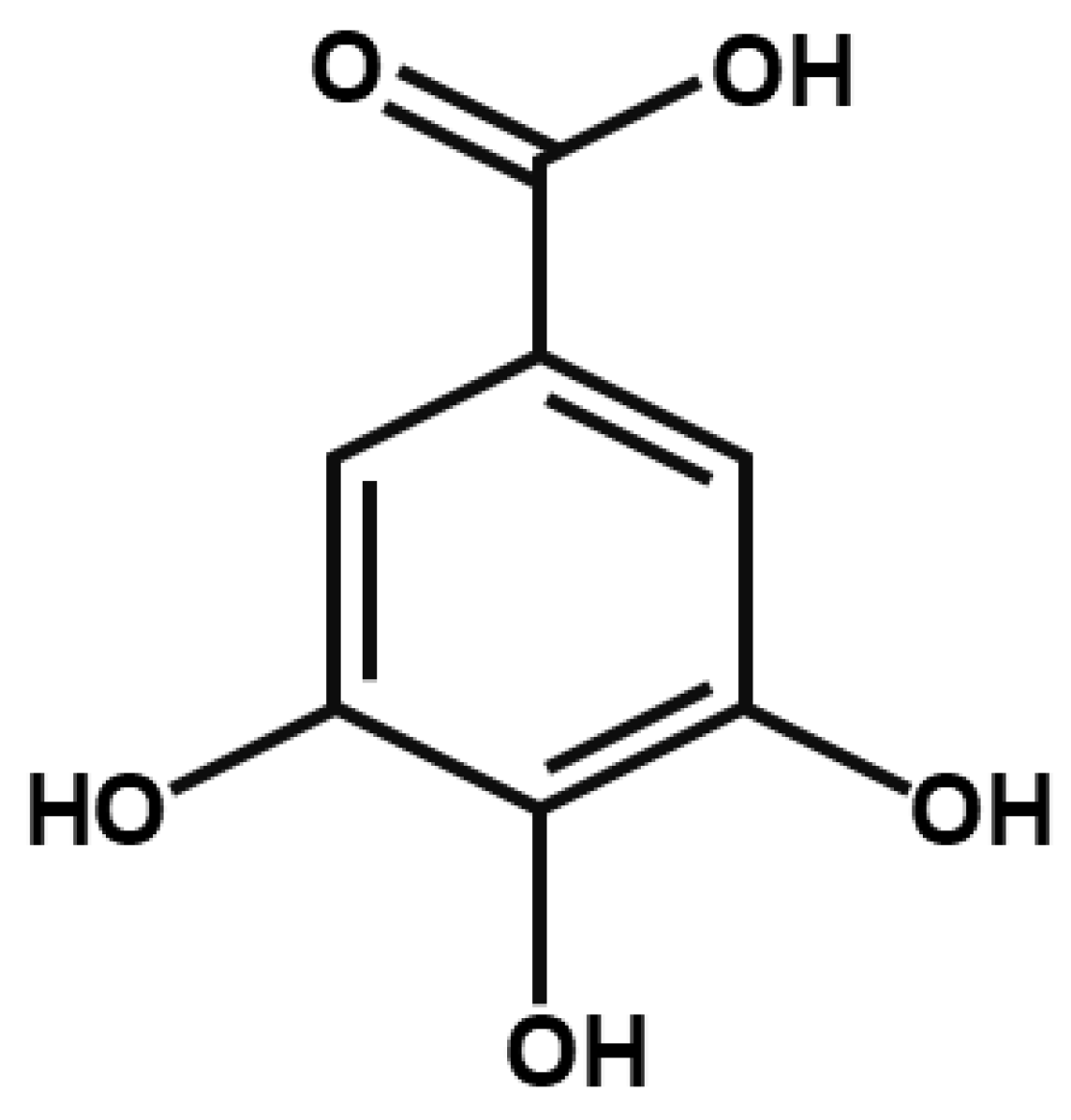
Figure 2.
Chemical structure of a hydrolysable tannin, gallotannin, composed of esters of gallic acid linked to a sugar core.
Figure 2.
Chemical structure of a hydrolysable tannin, gallotannin, composed of esters of gallic acid linked to a sugar core.
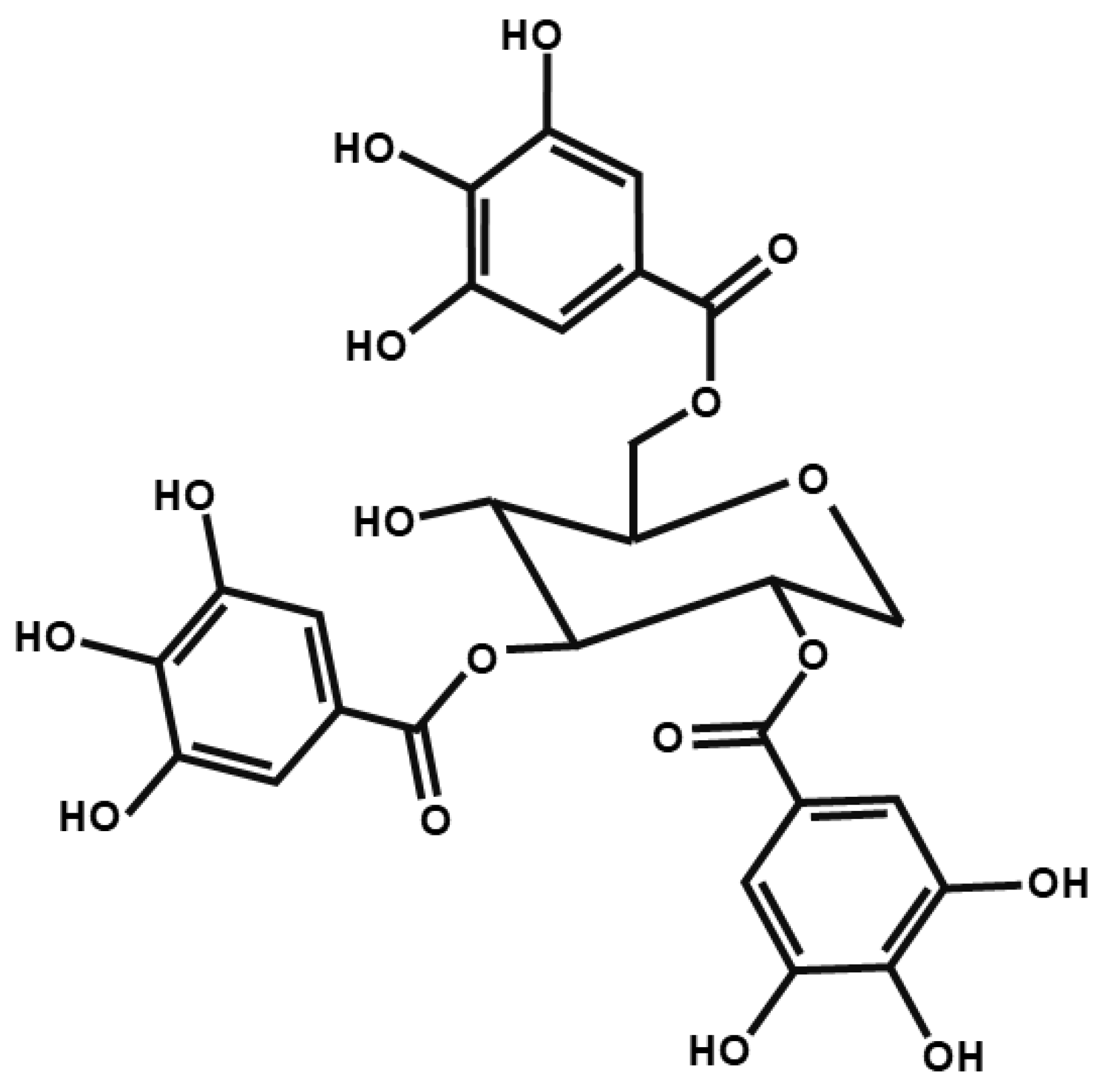
Figure 3.
The shikimate pathway (SP) and biosynthesis of Gallic acid (GA). PEP, phosphoenolpyruvate; E4P, erythrose-4-phosphate; DAHP, 3-deoxy-D-arabino-heptulosonate-7-phosphate; DHQ, 3-dehydroquinate; DHS, 3-dehydroshikimate; SA, shikimic acid; S3P, shikimate-3-phosphate; EPSP, 5-enolpyruvoylshikimate 3-phosphate; CHA, chorismic acid; 4HB, 4-Hydroxybenzoate; 3HB, 3-Hydroxybenzoate; PCA, protocatechuic acid.
Figure 3.
The shikimate pathway (SP) and biosynthesis of Gallic acid (GA). PEP, phosphoenolpyruvate; E4P, erythrose-4-phosphate; DAHP, 3-deoxy-D-arabino-heptulosonate-7-phosphate; DHQ, 3-dehydroquinate; DHS, 3-dehydroshikimate; SA, shikimic acid; S3P, shikimate-3-phosphate; EPSP, 5-enolpyruvoylshikimate 3-phosphate; CHA, chorismic acid; 4HB, 4-Hydroxybenzoate; 3HB, 3-Hydroxybenzoate; PCA, protocatechuic acid.
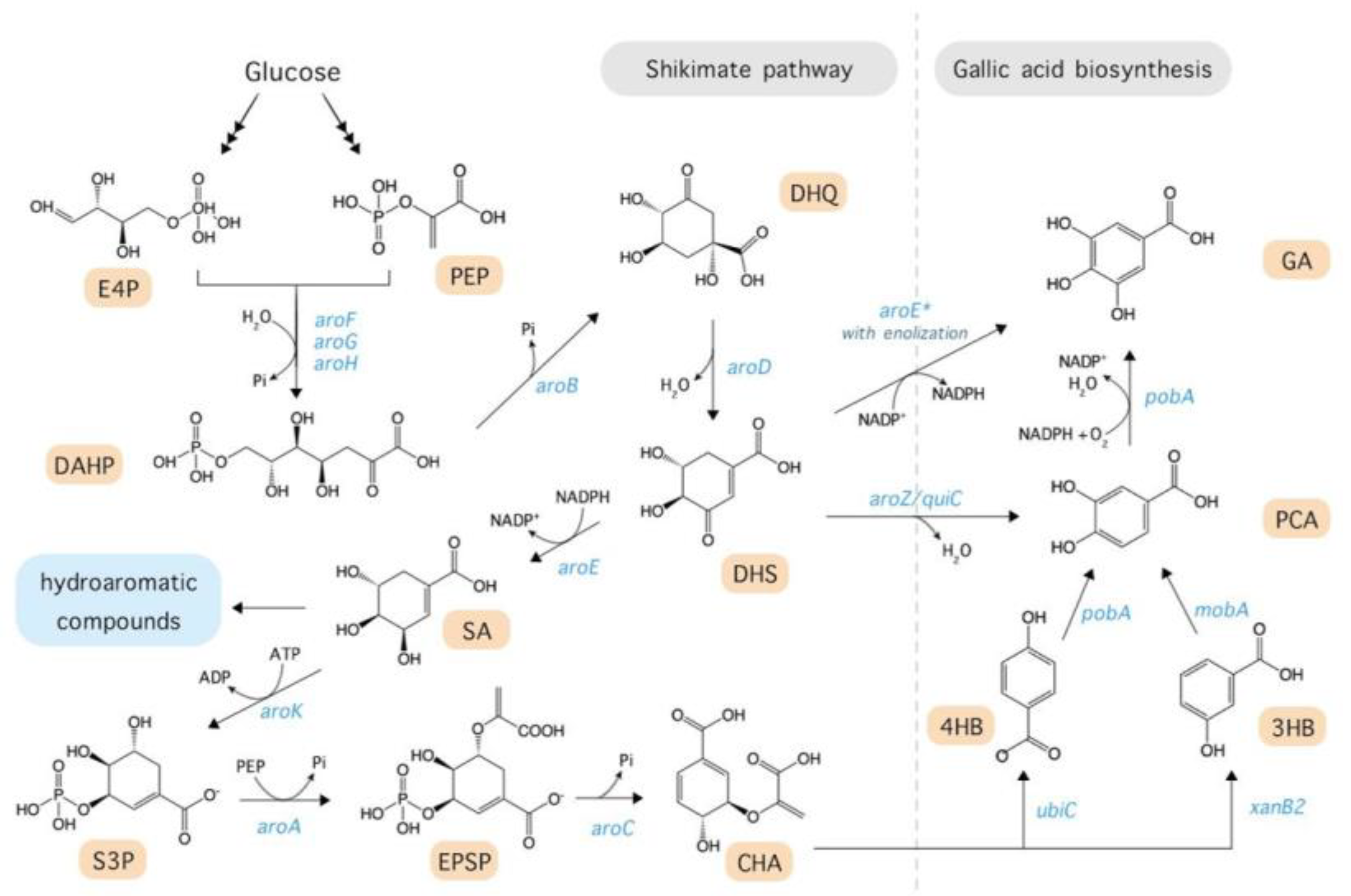

Table 1.
Microorganisms and culture media used for gallic acid production via innate microbial metabolism.
Table 1.
Microorganisms and culture media used for gallic acid production via innate microbial metabolism.
| Organism | Media | Duration | Yield | Reference |
| Phycomyces blakesleeanus | 50 g glucose in media | 6 days | 2 g | [33] |
| Aspergilllls spp. and Penicillium spp. | 5% glucose in media | 7-13 days | NR | [34] |
| Phycomyces blakesleeanus | 30 g glucose in media | 12 days | 11.4 mg | [35] |
| Phycomyces blakesleeanus | Potato dextrose agar | 4 days | 10 mg/mL | [36] |
| Phyconzyces blakesleeanus | 10% glucose in media | 8 days | 17 μg/mL | [37] |
| Penicillium spp. | 5% glucose in media | 7 days | NR | [38] |
| Aspergillus terreus | Sake Cake Medium | 7 days | 8.7 μg/mL | [39] |
| Phycomyces blakesleeanus | 2.0 g of asparagine + glucose | 6 days | 5 mg | [40] |
| Penicillium flavigenum | Potato dextrose agar | 7 days | 11.9 g/L | [41] |
NR: not reported.
Table 2.
Microorganisms genetically modified for the production of gallic acid by their innate metabolism.
Table 2.
Microorganisms genetically modified for the production of gallic acid by their innate metabolism.
| Organism | Genetic modification | Media | Cultivation conditions | GA production |
Yield |
Reference |
| Escherichia coli |
aroB, aroFFBR native ParoF promoter of aroF replaced with a Ptac promoter. Focused on 3-dehydroshikimic acid production. |
M9 medium + L-arabinose (23 g/L) + aromatic supplements and vitamins | 48 h, fed-batch, 2 L | 4.7 g/L | 0.06 - 0.20 g/g gGA/g arabinose: estimated range (total volume of L-arabinose not reported). |
[45] |
| Escherichia coli KL7/pSK6.161 | Mutated aroE, Plasmid pSK6.161 contained pobA* and aroFFBR | Complex, glucose-rich (30 g/L) + nitrogen-rich | 48 h, fed-batch, 1 L | 20 g/L | 0.12 gGA/g estimated, no final sugar concentration provided | [46] |
| Escherichia coli PB12.SA31 | inactivating aroK, aroL, pykF or pykA and the expression of plasmid-coded genes aroGfbr, tktA, aroB and aroE. Focused on 3-shikimic acid production. |
25 g/L of glucose, 15 g/L of yeast extract | 50 h, batch, __ mL | 0.3 g/L | 0.009 gGA/g estimated on glucose (disregarding yeast extract) | [47] |
| Escherichia coli BW25113 | mutant PobA Y385F/T294A, UbiC over-expressed |
Semi-defined, modified M9 medium 10 g/L glycerol, 2.5 g/L glucose, 5 g/L yeast extract |
48 h, shake flasks, 20 mL |
1.27 g/L | 0.101 gGA/g estimated on glycose and glucose (disregarding yeast extract) | [48] |
| Pseudomonas putida KT2440 | aroG4, quiC and pobA*, deletions pcaHG and galTAPR | Mineral Medium + 10 g/L glycerol | 72 h, shake flasks, no volume provided | 0.35 g/L | 0.12 gGA/g as reported | [49] |
| Escherichia coli | ycjR and mutant pobA | LB + 1% glucose | 60 h, shake flasks with glucose pulse feeding, 100 mL | 0.56 g/L | 0.019 gGA/g estimated on glucose (disregarding yeast extract) | [50] |
| Escherichia coli BW25113 | Gene deletions (ptsG, pykA/F) overexpression of endogenous genes (glf, glk, talB, tktA, aroGfbr, aroD, aroB) and overexpression of exogenous genes (quiC, pobA*, RiGT2) | modified M9 medium glucose (15 g/L) yeast extract (10 g/L) | 60 h, fed-batch, 1 L culture | 51.57 g/L | 0.45_gGA/g on glucose as reported (disregarding yeast extract) |
[51] |
| Corynebacterium glutamicum | Expression of mutant pobA (Y385F/L200V), Carboxylic acid reductases (CARs), and Overexpression of qsuB | Modified M9 Medium glucose (80g/L) |
45h, fed-batch, 5 L |
12.0 g/l | 0.0825 gGA/g estimated | [52] |
Disclaimer/Publisher’s Note: The statements, opinions and data contained in all publications are solely those of the individual author(s) and contributor(s) and not of MDPI and/or the editor(s). MDPI and/or the editor(s) disclaim responsibility for any injury to people or property resulting from any ideas, methods, instructions or products referred to in the content. |
© 2026 by the authors. Licensee MDPI, Basel, Switzerland. This article is an open access article distributed under the terms and conditions of the Creative Commons Attribution (CC BY) license (http://creativecommons.org/licenses/by/4.0/).
Copyright: This open access article is published under a Creative Commons CC BY 4.0 license, which permit the free download, distribution, and reuse, provided that the author and preprint are cited in any reuse.


