

Submitted:
23 July 2026
Posted:
24 July 2026
You are already at the latest version
Abstract
Background. Therapeutic inertia — conventionally defined as the failure to initiate or intensify pharmacotherapy when clinical treatment targets are unmet and used in that under-titration sense throughout this review — is a pervasive and underappreciated source of preventable harm in ambulatory medicine. Despite decades of evidence-based guidelines and increasingly efficacious pharmacological agents, most patients with common chronic diseases remain on suboptimal medication doses, accruing avoidable morbidity, irreversible end-organ damage, and premature mortality. Objective. To characterize, in a unified cross-disease framework, the prevalence, clinical consequences, and economic burden of therapeutic inertia in pharmacologic dose titration across sixteen chronic conditions, and to summarize the case for new categories of intervention. Methods. Narrative review of peer-reviewed literature, clinical guidelines, and published health economic analyses. Searches were performed in PubMed and MEDLINE through April 2026 using condition-specific terms combined with “therapeutic inertia,” “clinical inertia,” “treatment intensification,” and “dose optimization.” Priority was given to systematic reviews, meta-analyses, prospective cohort studies, and large registry and database analyses since 2015, supplemented by seminal earlier studies and current guideline documents. U.S.-based sources were prioritized for epidemiologic and economic estimates. Results. Across sixteen conditions spanning cardiovascular, endocrine, obstructive airway, gastrointestinal, musculoskeletal, urologic, neurodegenerative, movement, sleep, and tobacco-dependence disorders, dose-optimization inertia or suboptimal pharmacotherapy maintenance is highly prevalent, ranging from approximately 55% (type 2 diabetes) to 99% (heart failure with reduced ejection fraction) across eligible patients or clinical encounters, among the nine conditions with a verifiable single-study point estimate (see Figure 1). Ten conditions produce life-threatening sequelae; six produce irreversibly debilitating functional and quality-of-life impairment without immediate life-threatening sequelae (osteoarthritis, benign prostatic hyperplasia, lower urinary tract symptoms/overactive bladder, essential tremor, restless leg syndrome, and Parkinson’s disease). Suboptimal titration is consistently associated with accelerated disease progression, irreversible end-organ damage inadequate symptom control, and preventable healthcare utilization. Aggregate annual U.S. direct and indirect costs for these conditions exceed $2.4 trillion, across the fifteen of sixteen conditions for which a comparable dollar-denominated estimate exists (essential tremor is excluded because the literature reports only relative cost multipliers). Existing technologies including provider education, EHR alerts, telehealth, standard remote patient monitoring, and digital therapeutics each operate within, rather than outside of, the structural constraints that produce inertia. Conclusions. Therapeutic inertia in pharmacologic dose titration is a systemic, cross-disease failure with shared structural determinants and no currently deployed solution capable of addressing it at population scale. The sixteen conditions reviewed collectively affect more than half of the adult U.S. population and account for majority of preventable mortality and disability in ambulatory care. The disparity between what evidence-based pharmacotherapy can achieve and what clinical systems reliably deliver represents one of the most consequential unmet needs in modern ambulatory medicine, and the populations bearing the greatest burden are those least served by current programs.
Keywords:
therapeutic inertia
; dose optimization
; pharmacotherapy
; clinical decision support
; health equity
1. Introduction
The contemporary pharmacotherapeutic armamentarium represents one of the most consequential achievements in modern medicine. High-intensity statins reduce major cardiovascular events by approximately 21% per 1 mmol/L reduction in low-density lipoprotein cholesterol in a dose-dependent relationship established across 170,000 participants.1 GLP-1 receptor agonists confer clinically meaningful reductions in cardiovascular mortality and end-organ events extending well beyond glycemic control.2–3 Triple bronchodilator-corticosteroid inhalation therapy substantially reduces moderate-to-severe exacerbation rates in symptomatic chronic obstructive pulmonary disease (COPD).4 Fully optimized guideline-directed medical therapy (GDMT) for heart failure with reduced ejection fraction (HFrEF) provides a gain of 2.7 to 8.3 additional years free of cardiovascular death or first HF hospitalization — 2.7 years for a patient aged 80 and 8.3 years for a patient aged 55 — when all four GDMT pillars are optimized to target dose.5 Across virtually every major chronic condition, the pharmacological tools to meaningfully alter disease trajectory are well established. Yet this progress is systematically undermined by a pervasive and underappreciated failure: the persistent inability of clinical practice to deliver these therapies at guideline-recommended doses, to the patients who require them, for as long as the clinical course demands.
Phillips and colleagues formally characterized this failure in a landmark 2001 analysis, defining clinical inertia as “recognition of the problem but failure to act”, the failure of providers to initiate or intensify therapy when treatment goals are unmet.6 The concept has since been extended under the broader term therapeutic inertia, encompassing not only failures to initiate but failures to escalate and titrate pharmacotherapy as disease trajectories evolve.7
The definition has since been extended in some literature to encompass other forms of prescribing failure, most notably failure to discontinue medications that are no longer indicated or that produce net harm at continued doses, a construct sometimes termed deprescribing inertia.8 That application of the concept falls outside the scope of this review. The sixteen conditions examined here share a specific and distinct problem: patients whose prescribed doses fall short of evidence-based targets. Under-titration is the mechanism by which the preventable morbidity, mortality, and economic burden documented in the sections below accumulate.
Therapeutic inertia manifests across virtually every chronic condition for which dose titration is fundamental to outcome, and the downstream harms are neither abstract nor reversible. Suboptimally treated dyslipidemia is associated with increased risk of myocardial infarction and ischemic stroke;1 undertitrated levodopa leaves patients with Parkinson’s disease in motor “off” states that accelerate functional decline and hasten institutionalization; and persistently uncontrolled blood pressure inflicts clinically silent, progressive damage on the kidney, heart, and cerebrovascular circulation years before manifesting as stroke or end-stage renal disease. These are real, frequently irreversible harms occurring at population scale.
People with chronic disease account for approximately 90% of the United States’ $4.1 trillion in annual healthcare expenditures.9 Therapeutic inertia amplifies this burden by converting manageable disease into costly complications: hospitalizations for acute coronary syndromes preventable by statin uptitration; nursing home placements driven by avoidable cognitive decline; emergency department visits for asthma attributable to persistent underuse of inhaled controller therapy.
This review examines clinician-directed dose-optimization inertia specifically — defined as the failure to adjust medication regimens toward evidence-based therapeutic targets in response to documented clinical need — and does not address patient-directed variables, including medication non-adherence, which independently contribute to suboptimal outcomes and are treated extensively elsewhere in the literature.
The review has three aims: (1) to characterize the prevalence of dose-optimization inertia across sixteen chronic conditions for which titration is the cornerstone of management; (2) to document the clinical consequences, including the specific irreversible harms that accrue during periods of suboptimal titration, and quantify the resulting economic burden; and (3) to summarize why existing technological approaches have failed to close the gap at population scale.
2. Methods
We conducted a narrative review of peer-reviewed literature, clinical guidelines, epidemiologic databases, and published health economic analyses through April 2026. Searches were performed in PubMed and MEDLINE using condition-specific terms combined with “therapeutic inertia,” “clinical inertia,” “undertreatment,” “treatment intensification,” and “dose optimization.” Priority was given to systematic reviews, meta-analyses, prospective cohort studies, and large retrospective database analyses published since 2015, with seminal earlier studies included where they constitute foundational contributions to the field. U.S.-based sources were prioritized for prevalence and economic estimates; international data were incorporated to contextualize findings where U.S. data were unavailable. Economic burden estimates were derived from published cost analyses, national registry data, and disease-specific government and foundation reports.
Conditions were selected based on three criteria: (1) dose titration is central to achieving clinical treatment goals such that suboptimal dosing directly compromises outcomes; (2) therapeutic inertia has been documented through published research as prevalent in that domain; and (3) the magnitude of harm attributable to suboptimal titration is substantial and, in important respects, irreversible or progressive.
This work was conducted as a narrative cross-disease synthesis rather than a systematic review with formal protocol registration. Inertia prevalence estimates for each condition reflect point estimates from key single studies (registries, prospective cohorts, or large database analyses cited in §3.2 and Table 1); they are not meta-analytic pooled values, given heterogeneity of inertia definitions and study populations. Figure 1 displays these single-study point estimates in cross-disease context; per-condition citations are annotated on the figure, and study designs are summarized in Supplementary Table S1.
3. Results
3.1. Defining Therapeutic Inertia in Dose Optimization
This review focuses specifically on dose-optimization inertia, the failure to titrate medications to effective doses once treatment has been initiated. This distinction carries important clinical weight: a patient who has been prescribed a low-intensity statin and remains on that dose indefinitely despite persistent above-goal low-density lipoprotein cholesterol (LDL-C) is nominally treated but functionally undertreated and bears a cardiovascular risk burden substantially higher than optimally managed peers. Analogously, a patient with COPD managed on short-acting bronchodilator monotherapy despite GOLD Group B symptom burden is, by established guideline standards, systematically undertreated because of underescalation.
The term therapeutic inertia has been applied in some literature to prescribing failures of other kinds, including continuation of medications that are no longer indicated and failure to reduce doses that carry adverse-effect burden at current levels; this latter application is sometimes termed deprescribing inertia.8,10–11 Those constructs are not examined here. This review is concerned exclusively with failure to intensify: the gap between current and target doses in patients with inadequately controlled disease.
Multiple interacting factors sustain dose-optimization inertia. Physician-level factors include anchoring to the initial prescription and accepting partial response,6,12 excessive concern about dose-related adverse effects, and the time constraints of ambulatory encounters (15–18 minutes) insufficient for structured medication review across competing demands of a multimorbid panel.13 System-level factors include fragmented care delivery, infrequent follow-up, and the near-universal absence of automated titration decision support. Patient-level factors include medication fatigue, cost-related barriers, and the insidious, often asymptomatic nature of early deterioration.
Dose-optimization inertia is conceptually distinct from patient non-adherence. Both contribute to poor outcomes, but inertia operates at the prescriber and system level and requires different remediation strategies.14–15 In many of the conditions reviewed, therapeutic inertia is substantially more prevalent than non-adherence and represents the more actionable target for quality improvement.7,14–15
The consequences of dose-optimization inertia are not symmetric across the patient population. Patients in lower-income, rural, and historically marginalized communities, who have the highest chronic-disease burden and the least access to specialty titration programs, bear disproportionate exposure.16–17 Closing the inertia gap is therefore also a health-equity imperative.
As illustrated in Figure 1, across all sixteen conditions, the majority of eligible patients receive suboptimal pharmacotherapy, with inertia prevalence ranging from approximately 55% in type 2 diabetes to 99% in heart failure with reduced ejection fraction (among the nine conditions with a verifiable single-study point estimate), a cross-disease pattern that reflects shared structural determinants rather than condition-specific knowledge deficits.
3.2. Condition-Specific Evidence
Of the sixteen conditions characterized below, ten produce life-threatening sequelae when suboptimally treated, and six produce primarily functional and quality-of-life impairment without immediate life-threatening sequelae (osteoarthritis, benign prostatic hyperplasia, lower urinary tract symptoms / overactive bladder, essential tremor, restless leg syndrome, and Parkinson’s disease). In every condition, the harms accumulating during periods of suboptimal titration include endpoints that subsequent therapy escalation cannot retrieve (see Supplementary Figure 1 for representative examples).
3.2.1. Heart Failure with Reduced Ejection Fraction (HFrEF)
Heart failure affects approximately 6 million Americans, with HFrEF accounting for approximately half of that burden.18 Vaduganathan et al. estimated that comprehensive GDMT titration provides a gain of up to 8.3 years free of cardiovascular death or first HF hospitalization when all four pillars (angiotensin receptor-neprilysin inhibitor (ARNi) or ACEi/ARB therapy, evidence-based beta-blocker, mineralocorticoid receptor antagonist, and sodium-glucose cotransporter 2 inhibitor) are optimized to target dose.5 Against this benchmark, the CHAMP-HF registry, a prospective multicenter study of 3,518 U.S. specialist outpatients, found that only 1% of patients were receiving target doses of all cornerstone medication classes simultaneously; 67% of MRA-eligible patients were not prescribed a mineralocorticoid receptor antagonist; and only 13% of ARNi-eligible patients had been prescribed sacubitril-valsartan; and among those already receiving ARNI therapy, only 14% had been titrated to target dose, despite the PARADIGM-HF demonstration of a 20% reduction in cardiovascular death or HF hospitalization.19–20 The 2022 AHA/ACC/HFSA guideline assigns Class I, Level A evidence to all four GDMT pillars, with corresponding evidence from DAPA-HF and EMPEROR-Reduced for the SGLT2 inhibitor pillar.21–23
GDMT under-titration is potentially life-threatening at every dose shortfall: each increment of subtherapeutic dosing translates to preventable adverse ventricular remodeling, and avoidable HF hospitalizations, each of which independently increases post-discharge mortality risk, and premature cardiovascular death in a population whose 5-year all-cause mortality exceeds 50%.21 The annual U.S. economic burden of heart failure was estimated at $31 billion in 2012, with total costs (including indirect costs) projected to reach $70 billion by 2030.24
3.2.2. Hypertension
Hypertension is the single most prevalent modifiable cardiovascular risk factor in the United States, affecting approximately 116 million adults (46% of the adult population)25 Yet fewer than half of hypertensive adults achieved guideline-defined blood pressure control as of 2017–2018 (43.7%), a rate that has declined from 53.8% in 2013–2014 despite four decades of increasingly effective antihypertensive agents.26 Berlowitz et al. first quantified this failure in a landmark analysis, documenting that treatment was intensified in only 6.7% of all hypertension-related visits (regardless of blood pressure level at that visit).27 More recent analyses confirm the pattern is durable: antihypertensive therapy is intensified in approximately 17% of encounters with documented above-goal blood pressure.28
The consequences of hypertension dose-optimization inertia span multiple organ systems, each with largely irreversible endpoints: hemorrhagic and ischemic stroke causing permanent neurological disability, hypertensive nephropathy progressing to end-stage renal disease, left ventricular hypertrophy advancing to heart failure with preserved ejection fraction, and accelerated coronary and peripheral atherosclerosis. The annual U.S. economic burden attributable to hypertension and its sequelae approximates $52.4 billion.18
3.2.3. Dyslipidemia
Elevated LDL-C is the most modifiable determinant of atherosclerotic cardiovascular disease, the leading cause of death in the United States, with a dose-response relationship between LDL-C reduction and cardiovascular event reduction established across more than 170,000 patients.1 Guideline concordance falls substantially short of what the evidence demands: the EUROASPIRE V registry of European patients with established coronary heart disease found that only 29% of very-high-risk patients achieved the guideline-recommended LDL-C target of <70 mg/dL despite contemporary lipid-lowering therapy.29
Every preventable failure to intensify lipid-lowering therapy could potentially translate to preventable cardiovascular mortality and irreversible end-organ damage. The annual U.S. economic burden of total cardiovascular disease (a broader category than dyslipidemia-attributable ASCVD alone) exceeds $363 billion in direct and indirect costs.18
3.2.4. Type 2 Diabetes
Type 2 diabetes (T2DM) affects approximately 40 million Americans and is the leading cause of acquired blindness, end-stage renal disease, and non-traumatic lower limb amputation in the United States.31 Across clinical populations, systematic reviews document a median time from first above-target HbA1c to treatment intensification ranging from 0.3 to more than 7.2 years, representing a period of unmitigated hyperglycemic exposure whose microvascular and macrovascular consequences accumulate irreversibly.7 Systematic review of therapeutic inertia in T2DM confirms that, in most clinical populations, fewer than half of patients with above-target HbA1c received treatment intensification within 12 months of the qualifying measurement.7 Within the GLP-1 receptor agonist class, which confers cardiovascular mortality benefits demonstrated in LEADER (13% reduction in 3-point MACE with liraglutide), SUSTAIN-6 (26% reduction with semaglutide), and REWIND (12% reduction in a primary-prevention–enriched population with dulaglutide)2–3,30, therapeutic inertia is compounded by titration-sensitive tolerability profiles that lead to premature discontinuation before therapeutic doses are reached.
Dose-optimization failure in T2DM is associated with life-threatening and largely irreversible end-organ injury: diabetic nephropathy progressing to end-stage renal disease, retinopathy causing permanent visual loss, peripheral neuropathy, lower limb amputation, and cardiovascular death, each representing irreversible organ damage that accrues silently during years of suboptimal glycemic titration. The total direct and indirect economic cost of diabetes in the United States was estimated at $412 billion in 2022.31
3.2.5. Chronic Obstructive Pulmonary Disease
COPD affects approximately 16 million diagnosed U.S. adults, with an estimated 12 million additional individuals harboring undiagnosed airflow limitation.32 The GOLD 2024 framework provides a well-validated escalation algorithm progressing from short-acting bronchodilator for GOLD Group A patients, through long-acting bronchodilator monotherapy and combination bronchodilation for Group B/E patients, to ICS/LABA/LAMA triple therapy for those with eosinophilic inflammation or frequent exacerbations, a recommendation reinforced by the IMPACT trial.4,33 Despite these clear guidelines, real-world adherence to this escalation algorithm is inconsistent, and maintenance therapy is frequently not stepped up promptly following a moderate-to-severe exacerbation.
Dose-optimization inertia in COPD is associated with a uniquely irreversible form of physiological harm: lung function permanently lost with each preventable exacerbation. Every moderate-to-severe exacerbation accelerates forced expiratory volume in 1 second (FEV1) decline at a rate approximately 8 mL/year greater than in patients with infrequent exacerbations, and this excess loss is not recovered after the exacerbation resolves.34 The total U.S. economic burden of COPD was estimated at $36 billion in 2010, with direct medical costs projected to reach $49 billion by 2020.35
3.2.6. Asthma
Asthma affects approximately 25 million Americans across all age groups.36 Guideline-directed management requires systematic step-up therapy from short-acting beta-agonist monotherapy, through inhaled corticosteroid (ICS) controller therapy, ICS/LABA combination, and ultimately add-on biologic therapy for severe, eosinophilic, or exacerbation-prone disease. Adherence to this escalation framework is poor: in a nationally representative U.S. analysis, only about one-third of children and adults with asthma were using long-term controller medication such as inhaled corticosteroids at the time of the survey.37
Failure to escalate asthma pharmacotherapy carries both immediate life-threatening risk and long-term irreversible structural consequences. Repeated bronchospasm and uncontrolled airway inflammation drive irreversible structural remodeling (subepithelial fibrosis, smooth muscle hypertrophy, goblet cell hyperplasia) producing fixed airflow limitation and a COPD overlap phenotype that cannot be reversed with subsequent treatment.38 The total annual economic cost of asthma in the United States (direct and indirect) was estimated at $81.9 billion.39
3.2.7. Gastroesophageal Reflux Disease
Gastroesophageal reflux disease (GERD) affects approximately 20% of the U.S. population with weekly symptom frequency.40 Its most clinically serious consequence, Barrett’s esophagus, confers a markedly elevated lifetime risk of esophageal adenocarcinoma,41 a malignancy carrying a 5-year survival of approximately 20%.42 Therapeutic inertia in GERD management manifests primarily as failure to implement structured proton pump inhibitor (PPI) step-up therapy and, critically, failure to refer for endoscopic Barrett’s surveillance in patients meeting established risk criteria — a failure that converts a surveyable, manageable condition into an undetected and frequently fatal malignancy. Dose-optimization failure in GERD has been associated with the most preventable form of gastrointestinal cancer: the Barrett’s-to-adenocarcinoma transition is modifiable by adequate acid suppression and surveillance compliance.
Therapeutic inertia in GERD management also operates in the reverse direction, through failure to de-escalate. Studies supporting PPI use for most common indications — including nonerosive reflux disease and mild-to-moderate esophagitis — endorse treatment durations of two to twelve weeks, yet PPIs are routinely continued for prolonged periods or indefinitely without reassessment of ongoing indication 43–44. Estimates of inappropriate long-term PPI prescribing range from 25% to 70% across clinical settings, and population-level data confirm that the majority of long-term users are never systematically reassessed for step-down candidacy 44–45. Failure to de-escalate carries meaningful clinical consequences: chronic PPI exposure has been associated with increased risk of Clostridioides difficile infection, hypomagnesemia, bone fracture, chronic kidney disease, and pneumonia 45. Clinician inertia — manifest here as the failure to respond to symptom resolution or the absence of a high-risk indication by reducing or discontinuing PPI therapy — converts a time-limited treatment into a source of cumulative, avoidable harm.
GERD carried the highest disease-specific direct costs of seventeen digestive and liver diseases assessed in a national cost-of-illness analysis, at $9.3 billion in 1998 dollars46; a more current, comprehensive direct-and-indirect aggregate specific to GERD was not identified for this review.
3.2.8. Osteoarthritis
Osteoarthritis affects approximately 30.8 million U.S. adults, representing the leading cause of chronic pain and disability in older populations, and is characterized by progressive, largely irreversible cartilage loss and periarticular structural remodeling.47 A clinically paradoxical pattern defines osteoarthritis pharmacotherapy: evidence-based non-opioid agents recommended in current ACR/Arthritis Foundation guidelines (topical NSAIDs, intraarticular corticosteroids, duloxetine) are substantially underutilized relative to clinical need, while opioid prescribing rates substantially exceed what evidence-based management warrants, reflecting failure of the analgesic escalation ladder.48–49 The consequence is progressive, irreversible functional disability compounded by a substantial and iatrogenic risk of opioid dependence. Uncontrolled pain is associated with sedentary behavior, accelerating functional decline, cardiovascular risk, obesity, and depression.
This pattern of therapeutic inertia operates bidirectionally. Failure to titrate guideline-recommended non-opioid agents is not only a driver of initial opioid initiation but also forecloses the pathway to opioid de-escalation in patients who are already opioid-dependent. The SPACE randomized clinical trial — a 12-month pragmatic trial in patients with chronic back pain or hip and knee osteoarthritis pain — demonstrated that non-opioid pharmacotherapy achieved equivalent pain-related functional outcomes and superior pain intensity scores compared with opioid therapy, with significantly fewer medication-related adverse effects, supporting non-opioid agents as a viable substitute rather than merely a supplement to opioid therapy.50 Adequate titration of non-opioid analgesics thus represents both the primary intervention to prevent opioid initiation and the pharmacologic foundation for opioid tapering — a dual opportunity that is forfeited when clinician inertia leaves guideline-concordant analgesics undertitrated.
The annual U.S. economic burden of osteoarthritis encompasses more than $303 billion annually in direct and indirect costs, representing the combined burden of osteoarthritis and related musculoskeletal conditions.48,51
3.2.9. Hypothyroidism
Primary hypothyroidism (overt and subclinical combined) affects approximately 4.6% of the U.S. population (overt and subclinical combined) per NHANES III data, with some regional surveys, such as the Colorado Thyroid Disease Prevalence Study, reporting combined prevalence approaching 9%.52 Levothyroxine titration to a therapeutic serum thyroid-stimulating hormone (TSH) level within the reference range is the standard of care, and clinical practice guidelines specify structured monitoring following dose adjustment.52 Real-world adherence to these titration and monitoring recommendations has not been quantified in a verifiable published source identified for this review.
Undertitrated hypothyroidism carries both cardiovascular and irreversible reproductive consequences. Persistent hypothyroidism elevates LDL-C and compounds atherosclerotic risk in a relationship that reverses with adequate thyroid hormone replacement, making dose-optimization inertia a contributor to atherosclerotic cardiovascular disease risk. In women of reproductive age, inadequately treated hypothyroidism is independently associated with infertility, recurrent miscarriage, and adverse fetal neurodevelopmental outcomes that are not reversible with subsequent maternal dose optimization.53
Per-patient direct and indirect costs associated with hypothyroidism have been estimated at $460 to $2,555 annually, substantially exceeding those of euthyroid comparators across medical utilization, absenteeism, and short- and long-term disability.54
3.2.10. Benign Prostatic Hyperplasia
Benign prostatic hyperplasia (BPH), the anatomic enlargement of the prostate that produces bladder outlet obstruction, affects approximately 14 million American men with clinically significant disease, with prevalence rising sharply with each decade of life.55 Combination pharmacotherapy, an alpha-adrenergic blocker combined with a 5-alpha reductase inhibitor, reduces the risk of overall clinical BPH progression by 66% compared with placebo in the landmark MTOPS trial.56 Despite this evidence, combination pharmacotherapy remains substantially underutilized. Real-world prescribing analyses demonstrate that most eligible men with moderate-to-severe BPH remain on monotherapy despite available combination regimens, with escalation to combination therapy occurring in a minority of indicated patients.57
Failure to adequately escalate BPH pharmacotherapy is associated with both acute urological emergencies and progressive, partially irreversible structural injury. Acute urinary retention requiring emergency catheterization disproportionately affects men with inadequately controlled disease, and bladder wall changes secondary to chronic outflow obstruction (detrusor hypertrophy, trabeculation, diverticulum formation) may be only incompletely reversible after prolonged delay. Direct and indirect BPH-related costs to the private sector, among privately insured, working-age men, approach $3.9 billion annually; this estimate excludes the Medicare-age population in which BPH is most prevalent, and a total U.S. aggregate inclusive of older men was not identified for this review.57
3.2.11. Lower Urinary Tract Symptoms / Overactive Bladder
Lower urinary tract symptoms (LUTS), encompassing urgency, frequency, nocturia, and urge incontinence, encompass a broad symptom complex, of which overactive bladder syndrome (OAB) — the subset most amenable to pharmacotherapy — affects an estimated 29.8 million U.S. adults aged 40 and older with bothersome symptoms.58 The condition is mechanistically distinct from BPH-associated outlet obstruction and is treated through different agent classes: first-line therapy includes antimuscarinic agents (oxybutynin, tolterodine, solifenacin, fesoterodine, darifenacin, trospium), with beta-3 adrenergic agonists (mirabegron, vibegron) as alternative or add-on options for refractory disease.59
Therapeutic inertia in LUTS is dominated by antimuscarinic intolerance without therapeutic substitution. Published cohort studies consistently document high rates of early treatment abandonment: in a study of patients who received antimuscarinic therapy at no cost, 35.1% never refilled their initial prescription, and among those who did refill, only 25.6% later switched to a different agent, most discontinuations attributable to dry mouth, constipation, or cognitive side effects. Yet real-world medication persistence is poor: in a regional managed-care cohort, only 13.2% of patients remained on any antimuscarinic agent at 12 months (representing an 86.8% non-persistence rate by complement), and in separate national claims analyses, a large proportion of patients switched or discontinued therapy shortly after initiation.60–62 The result is a large population silently abandoning therapy for an undertreated condition with documented quality-of-life and safety consequences.
The clinical consequences of undertreated LUTS are durably and irreversibly debilitating: nighttime urgency is associated with falls and hip fractures that carry a one-year mortality of approximately 20–25% in older adults63; chronic urinary incontinence is associated with social withdrawal, depression, and skin breakdown that may require long-term catheterization or institutional care; and persistent antimuscarinic exposure in older patients, where alternative therapeutic substitution would mitigate risk, compounds cumulative anticholinergic burden and dementia risk per Beers-criteria framing. The annual U.S. direct and indirect economic burden of LUTS and OAB exceeds $66 billion.64
3.2.12. Parkinson’s Disease
Parkinson’s disease affects approximately 1 million Americans, making it the second most common neurodegenerative disorder in North America, with prevalence projected to increase substantially over the coming decades.65 Pharmacologic management, principally dopaminergic replacement with levodopa-carbidopa, supplemented by dopamine agonists, MAO-B inhibitors, and COMT inhibitors, does not halt neurodegeneration but is essential for preserving motor function and minimizing “off” time. Critically, the neuronal substrate on which dopaminergic therapy acts is progressively and irreversibly diminishing; function preserved by timely dose optimization cannot be recovered by later escalation.
The clinical sequelae of dose-optimization inertia in Parkinson’s disease are directly and irreversibly debilitating: motor “off” episodes, falls with hip fractures carrying disproportionate morbidity and mortality, progressive loss of independent ambulation, and premature nursing home placement. The annual U.S. economic burden of Parkinson’s disease was estimated at $51.9 billion in 2017, with projected growth to more than $79 billion by 2037.66
3.2.13. Dementia
Approximately 7.2 million Americans currently live with Alzheimer’s disease or related dementias (ADRD), a figure projected to reach 13.8 million by 2060.67 Acetylcholinesterase inhibitors (for mild-to-severe disease) and memantine (for moderate-to-severe disease) modestly attenuate cognitive decline and functional impairment do not halt neurodegeneration but provide modest, time-limited slowing of cognitive and functional decline and may reduce certain behavioral symptoms, and defer institutionalization when initiated early and titrated to recommended doses. The timing imperative is unambiguous: the neuronal substrate on which these agents act is progressively diminishing, making the early disease window the period of maximum treatment value. Despite this, initiation of cholinesterase inhibitors among eligible patients is frequently delayed or foregone, and consistent maintenance at recommended doses remains substantially below guideline expectations in real-world practice.67–68
Each month of suboptimal pharmacotherapy during the early disease window represents neuronal loss and functional decline that later dose escalation cannot retrieve. Rountree et al. demonstrated that greater cumulative cholinesterase inhibitor exposure — quantified as a persistency index reflecting the ratio of treatment years to disease-duration years — was associated with significantly slower cognitive decline, underscoring the compounding clinical cost of treatment gaps and dose reductions.68 The annual U.S. economic burden of ADRD was estimated at $360 billion in 2024.67
3.2.14. Essential Tremor
affecting an estimated 4–10 million Americans (depending on diagnostic criteria), with prevalence rising to 4.6% among those aged 65 and older.69 First-line pharmacotherapy (propranolol and primidone) reduces tremor amplitude in 50–70% of patients when titrated to demonstrably effective doses, representing a substantial functional benefit in a condition whose direct impact is the inability to perform basic activities requiring fine motor precision: writing, self-feeding, drinking from open vessels, and skilled occupational tasks.70
Claims-based comparisons document that patients with essential tremor incur substantially higher all-cause healthcare costs than matched non-ET patients — in one analysis, mean two-year total costs were numerically approximately 2.6-fold higher among commercially insured ET patients and 1.8-fold higher among Medicare-covered ET patients (Pahwa et al. 2024) (differences were descriptive and not formally statistically tested), with costs and comorbidity burden rising further among patients requiring multiple ET medications.71 The consequence of dose-optimization inertia in essential tremor is irreversible occupational disability and progressive social isolation.
3.2.15. Restless Leg Syndrome
Restless leg syndrome affects an estimated 5–10% of U.S. population, representing 16 to 32 million individuals, thus making it one of the most prevalent neurological conditions and, simultaneously, one of the most profoundly underrecognized.72 The REST Primary Care Study, a landmark multi-national primary care survey, found that only 12.9% of those who consulted a physician about their RLS symptoms received an RLS diagnosis; most patients who were prescribed treatment received pharmacotherapy not known to be guideline-appropriate for RLS, and 88.4% of RLS sufferers reported sleep-related symptoms (inability to fall or stay asleep, or disturbed sleep).73
The downstream consequences of undertitrated restless leg syndrome extend well beyond symptomatic discomfort. Severe, chronic sleep deprivation, the direct product of inadequate pharmacologic control, is associated with increased risk of cardiovascular disease and premature mortality,74 rendering restless leg syndrome a significant accelerant of multimorbidity when left unaddressed. A back-calculation using per-patient cost estimates and published prevalence data suggests an aggregate U.S. economic burden of approximately $15 billion annually, although no single published source reports this aggregate directly.75
3.2.16. Smoking Cessation Pharmacotherapy
Cigarette smoking causes approximately 480,000 U.S. deaths annually — a toll spanning cancer, cardiovascular disease, respiratory disease, and perinatal complications.76 Nicotine replacement therapy, varenicline, and bupropion SR substantially and durably improve cessation rates in a dose- and duration-dependent fashion, with evidence-based protocols specifying minimum effective doses and treatment durations of 8–12 weeks or longer to achieve sustained abstinence. Yet fewer than one-third of smokers making a quit attempt use evidence-based cessation counseling and/or medication; among those who use pharmacotherapy, prescribed doses and treatment durations commonly fall short of guideline-recommended standards.77
The clinical stakes of undertreated smoking cessation are uniquely severe: every additional day of continued tobacco exposure is irreversibly cumulative. Lung cancer, COPD, peripheral arterial disease, and cardiovascular disease attributable to prolonged smoking are not conditions from which patients recover. The annual U.S. economic burden attributable to cigarette smoking exceeds $600 billion, including more than $240 billion in direct healthcare spending and approximately $372 billion in lost productivity (2018 data).78
3.3. Cross-Cutting Analysis: Structural Drivers of Dose-Optimization Inertia
The cross-disease consistency of therapeutic inertia observed across conditions as pathophysiologically heterogeneous as COPD, HFrEF, Parkinson’s disease, GERD, and restless leg syndrome is not incidental. It reflects shared structural determinants that transcend individual disease domains, specialist communities, and therapeutic classes (Figure 2).
Time-constrained ambulatory encounters. The average U.S. primary care visit lasts 15–18 minutes, and patients with chronic conditions present with multiple competing concerns.13 Medication titration, encompassing reviewing response to current therapy, calculating adjusted doses, anticipating adverse effects at new doses, and scheduling appropriate monitoring follow-up, requires a structured and unhurried clinical evaluation that consistently loses priority to acute concerns.
Absence of between-visit titration infrastructure. In none of the sixteen conditions reviewed is there a systematic, widely implemented protocol for between-visit monitoring of titration-relevant parameters and automated escalation triggers. Titration decisions are deferred to the next available appointment rather than prompted by objective clinical data, and the typical 3-to-6-month interval between visits represents an extended period of suboptimal therapy without clinical oversight.
Anchoring and satisficing. A well-characterized cognitive tendency to anchor on initial impressions and accept partial improvement as sufficient manifests as reluctance to escalate a regimen that “seems to be working,” even when objective targets remain unmet.79
Asymmetric risk perception. Providers systematically overweight the risks of dose escalation including adverse effects and monitoring burden, relative to the risks of sustained under-treatment.12,79–80 For the majority of conditions reviewed, published evidence clearly establishes that the clinical risks of guideline-directed uptitration are substantially lower than the long-term risks of inaction.
Fragmented monitoring and data flow. Opportunities to detect suboptimal control between visits (elevated LDL-C on interval laboratory work, above-goal hemoglobin A1c, persistently uncontrolled blood pressure, declining FEV1, above-range TSH) are systematically missed in the absence of integrated real-time clinical decision support that can surface these signals and prompt escalation before deterioration advances to irreversible harm.
These drivers share a fundamental characteristic: the absence of systematic processes to translate pharmacologic evidence into timely dose optimization at the point of care and between visits.
4. Discussion
4.1. Why Existing Solutions Have Failed to Close the Gap
That therapeutic inertia persists at the prevalence levels documented above, despite three decades of explicit recognition as a quality problem, is not for lack of attempted remedies. Multiple categories of intervention have been deployed at scale; the persistence of inertia after each attests to the fact that the gap has not been closed.
Provider education and decision-support detailing. Continuing medical education, academic detailing, and guideline dissemination have measurable effects on knowledge but consistently fail to produce sustained changes in prescribing behavior.81 Systematic reviews of audit-and-feedback show median absolute behavior change of approximately 4% (interquartile range 0.5–16%), attenuated 12 months post-intervention. The structural cause: provider education addresses knowledge deficits, but inertia is not a knowledge problem. Providers know what to do; they cannot operationalize it inside a 15-to-18-minute encounter that must already accommodate acute concerns, preventive care, social determinants screening, and documentation.
Electronic health record clinical decision support. EHR-based decision support including pop-up alerts, best-practice advisories, and order-set suggestions has been the dominant in-visit intervention for the past decade. Empirical performance is disappointing. Alert override rates of 49–96% are widely reported, with alert fatigue producing systematic desensitization to even high-priority advisories.82–83 Critically, EHR decision support operates only when the provider is at the keyboard during a visit — precisely the constrained context in which titration decisions are routinely deferred. It does not, by design, address the absence of action between visits.
Population health dashboards. Care-gap dashboards and patient-registry tools surface lists of patients needing intensification. These have improved population-level measurement but rarely translate into individualized titration actions. The barrier is not visibility but rather the time and workflow required to act. A dashboard reporting 1,000 patients with above-goal blood pressure is operationally identical to no intervention if no team member has dedicated time and authority to contact and titrate each patient.
Telehealth. Post-pandemic expansion of synchronous telehealth has improved access but has not altered the time-constrained-encounter problem. A 15-minute video visit faces the same competing-priorities pressure as a 15-minute office visit. Telehealth removes geographic friction but does not redesign the unit of work, the discrete clinical encounter, that originally produced inertia.
Remote patient monitoring. RPM expansion under CMS Chronic Care Management reimbursement has produced widespread deployment of connected cuffs, scales, glucose monitors, and wearables. It reliably collects data; what it consistently does not do is convert that data into closed-loop titration action.84 A patient transmitting daily blood-pressure readings does not, in most implementations, trigger any automatic clinical response unless a clinician is actively reviewing the flowsheet. RPM has become a parallel data stream rather than a decision-and-action infrastructure.
Standalone digital therapeutics for chronic disease. Commercial digital health platforms for hypertension, diabetes, and weight management have produced modest improvements in disease control. A 2024 Peterson Health Technology Institute review concluded that behavior-change-oriented platforms produced “little to no effect on systolic blood pressure compared with usual care,” while medication-management-oriented platforms showed modest benefit only when paired with prescriber action.85 The underlying limitation is that these platforms operate adjacent to, rather than inside, the prescriber’s workflow; they cannot themselves titrate medication.
Pharmacist-led and nurse-led titration clinics. The most clinically successful category is structured non-physician titration under collaborative practice agreements. Pharmacist-managed warfarin clinics have operated for decades with documented superiority to physician-managed care, and pharmacist-led hypertension and heart-failure clinics consistently improve disease control.86–88 However, these programs exist for only a small number of conditions, rely on a specially trained clinical pharmacist and nurse workforce that numbers only in the tens of thousands nationally, far smaller than the >180 million U.S. adults with at least one of the sixteen conditions reviewed, and are geographically concentrated in academic medical centers and large integrated systems.89 Titration delegation works clinically; what does not exist is a delegation target that scales.
The aggregate picture. Each intervention addresses a different facet of inertia and is bounded by a different structural constraint. Provider education addresses knowledge but not workflow; clinical decision support addresses workflow but only during visits; telehealth addresses access but not the time-constrained encounter; remote patient monitoring addresses data but not action; digital therapeutics address engagement but not prescribing; pharmacist- and nurse-led clinics address all of the above but cannot scale to the affected population. No currently deployed system simultaneously operates between visits, executes structured protocol-based titration with clinician oversight, integrates closed-loop with the electronic health record, and scales without proportional workforce expansion.
4.2. Toward a System-Level Solution
The persistence of therapeutic inertia across sixteen pathophysiologically distinct conditions despite three decades of disease-specific interventions implies that the next consequential advance will not be a new drug or a new education program but new execution infrastructure. Such infrastructure would need to integrate, in a single coordinated system: continuous between-visit engagement; deterministic, protocol-driven decision support tied to evidence-based titration algorithms; clinician-in-the-loop workflows; closed-loop integration with the electronic health record; real-time safety guardrails; and the capacity to scale through automation rather than proportional workforce expansion, including reach to populations underserved by specialty programs. Rigorous prospective evaluation of approaches that combine these elements, with pre-specified clinical endpoints capturing time-to-goal, intensification rates, and downstream patient outcomes, represents a research and public-health priority commensurate with the magnitude of preventable harm documented here.
4.3. Cross-Disease Implications
This review documents therapeutic inertia in pharmacologic dose titration as a systemic, cross-disease failure with severe and measurable consequences across sixteen conditions collectively affecting more than half of the adult U.S. population. Examined in aggregate, these conditions reveal a single recurring pattern: the persistent, often decades-long gap between what evidence-based pharmacotherapy can achieve and what clinical systems reliably deliver — a gap whose downstream consequences manifest as preventable deaths, irreversible organ damage, and avoidable functional disability at scale.
The cross-condition universality of this finding carries important implications for how the problem should be framed and addressed. GLP-1 receptor agonist titration in T2DM, levothyroxine titration in hypothyroidism, dopaminergic titration in Parkinson’s disease, and GDMT titration in HFrEF are managed by different specialists using different drugs for different mechanisms, yet in each case, a substantial majority of patients remain at subtherapeutic doses for extended periods. This consistency does not reflect a lack of clinical knowledge; the guideline recommendations are unambiguous, and the evidence base is mature. Rather, it reflects the uniform inadequacy of the execution infrastructure through which pharmacologic knowledge is meant to be translated into individualized, timely clinical decisions. Disease-specific educational campaigns address only a fraction of this problem; the shared structural drivers identified here require shared structural solutions.
Equally consequential is the systematic invisibility of harm from dose-optimization inertia within existing quality and safety frameworks. Clinical medicine is exquisitely attuned to harms of commission (adverse drug reactions, prescribing errors, drug interactions), each of which generates documentation, mandatory reporting, and institutional quality review. The harms of undertreatment leave a different paper trail. A patient who sustains a myocardial infarction after years of suboptimally titrated statins will have atherosclerotic cardiovascular disease documented as the cause of hospitalization; therapeutic inertia will not appear in any reporting system. A patient whose COPD is associated with progressive, irreversible FEV1 loss over a decade of under-escalated maintenance therapy will be described as having “advanced disease.” This invisibility allows dose-optimization inertia to persist at population scale without triggering the accountability mechanisms activated by equivalent harms from prescribing error.
The equity dimension warrants emphasis. Patients in rural, low-income, and historically marginalized communities are simultaneously the populations with the highest chronic-disease burden and the populations with the least access to the pharmacist- and nurse-led titration programs that have demonstrated clinical effectiveness.16–17,89 Inertia is therefore also a health-equity problem in which the populations most exposed to preventable harm are those least able to access the only interventions presently shown to address it. Any system-level remedy must, by design, reach these populations rather than reproduce the geographic and socioeconomic concentration of existing programs.
Prior observational analyses of prescribing behavior and care quality across individual disease domains support the generalizability of these observations.14,90 The present review extends this literature by documenting dose-optimization inertia systematically across neurological movement disorders, obstructive airway diseases, lower urinary tract symptoms, and gastrointestinal malignancy risk (domains largely absent from prior cross-disease syntheses), and by pairing condition-specific inertia prevalence with quantified economic burden in a cross-disease framework (Figure 3 and Figure 4).
Several actionable priorities emerge. Standardized measurement of dose-optimization inertia, analogous to how medication adherence is currently captured, should be incorporated into chronic-disease quality reporting. Reimbursement frameworks that compensate healthcare teams for systematic medication optimization activities deserve broader implementation. Most fundamentally, development and rigorous prospective evaluation of integrated titration support systems that extend the reach of clinical judgment beyond the episodic encounter, including to populations historically underserved by existing programs, represents a research and public-health priority commensurate with the magnitude of preventable harm documented here.
4.4. Limitations
This narrative review carries several limitations. First, evidence synthesis reflects expert judgment in study selection and may be subject to publication bias. Second, therapeutic inertia is operationalized heterogeneously across studies (some applying any failure-to-escalate criterion, others requiring above-target objective measures), precluding formal meta-analytic pooling. Third, a subset of prevalence estimates are derived from or contextualized with international data, and generalizability to diverse U.S. populations may be limited. Fourth, economic burden estimates reflect different publication years (2013–2024) and heterogeneous costing methodologies; all figures should be interpreted as order-of-magnitude approximations. Fifth, conditions were selected by clinical judgment rather than a formal systematic process. Sixth, the evidence base is thinner for essential tremor, restless leg syndrome, BPH, and LUTS than for cardiovascular domains. Seventh, the existing-solutions landscape in §4.1 may not capture niche or emerging interventions. Eighth, the primary quantitative anchor for treatment intensification timing in type 2 diabetes is a 2004 analysis; more contemporaneous U.S. utilization data, where available, would provide a more current foundation for this estimate. Ninth, the rapidly evolving therapeutic landscape in obesity medicine, heart failure, and dementia pharmacotherapy means some figures may understate current inertia scope as novel agents are adopted into practice. Finally, this review focuses on clinician-directed therapeutic inertia and does not systematically address patient-directed barriers to optimal pharmacotherapy, including non-adherence, cost-related non-persistence, and health literacy. These factors operate in parallel with prescriber inertia and may independently drive the harms described herein. In conditions where real-world prescription-fill or medication-persistence data were used as proxy measures for dose-optimization inertia — most notably in the dementia analysis — the estimated inertia prevalence may reflect a combination of clinician and patient contributions that cannot be fully disaggregated from claims-based or administrative data sources.
5. Conclusions
Therapeutic inertia in pharmacologic dose titration is a pervasive, cross-disease failure with serious, measurable, and largely preventable consequences. Across sixteen chronic conditions affecting more than half of the adult U.S. population, large proportions of patients remain on suboptimal medication doses for extended periods — accruing avoidable morbidity, irreversible end-organ damage, and premature mortality. The aggregate annual U.S. economic burden of the fifteen of sixteen conditions with a comparable dollar-denominated estimate (essential tremor excluded; see Figure 3) exceeds $2.4 trillion. This figure represents total condition-level disease burden — not the fraction directly attributable to therapeutic inertia, and not a strictly additive sum given the high prevalence of co-occurring conditions — but it defines the economic scale within which inertia-attributable costs operate. Of the sixteen conditions reviewed, ten produce life-threatening sequelae and the remaining six produce irreversibly debilitating disability when suboptimally treated. Shared structural determinants require solutions that operate at the systems level rather than the disease level. Existing approaches, including provider education, EHR-based decision support, telehealth, remote patient monitoring, digital therapeutics, and pharmacist-led titration clinics, each address a subset of the structural drivers, and none has, on its own, closed the gap at population scale. The disparity between what evidence-based pharmacotherapy can achieve and what clinical systems reliably deliver represents one of the most consequential unmet needs in modern ambulatory medicine, and the populations bearing the greatest burden are those least served by current programs.
Espaillat/Hepp et al. (2021) report per-patient direct-medical costs attributable to hypothyroidism of $460 (conservative) to $2,555 (broad) annually and estimate, from the same analysis, a U.S. aggregate economic burden of $384 million to $2.1 billion annually. No larger published U.S. aggregate was identified for this review.
Using the published U.S. RLS prevalence range of 16-32 million U.S. population and Durgin et al.’s (2015) reported annualized per-patient costs (RLS-specific direct healthcare cost of $350.54 per patient; in a separate managed-care comparison within the same study, RLS-attributable costs averaged $774 per patient, representing 6.7% of total all-cause healthcare spending), the aggregate U.S. economic burden of RLS is estimated at approximately $15 billion at midpoint, annually. No single published source reports this aggregate directly.
Funding
None.
Data availability statement
All data underlying figures and tables are reproduced from published, peer-reviewed sources cited in the manuscript.
Acknowledgments
None.
Conflicts of Interest
All authors except J.A. are employees of Hippocratic AI, Inc. J.A. received compensation from Hippocratic AI, Inc. for his contribution to this manuscript.
References
- Cholesterol Treatment Trialists’ (CTT) Collaboration. Efficacy and safety of more intensive lowering of LDL cholesterol: a meta-analysis of data from 170,000 participants in 26 randomised trials. Lancet 2010, 376(9753), 1670–1681. [CrossRef] [PubMed]
- Marso, S.P.; Daniels, G.H.; Brown-Frandsen, K.; et al. Liraglutide and cardiovascular outcomes in type 2 diabetes (LEADER). N Engl. J. Med. 2016, 375(4), 311–322. [Google Scholar] [CrossRef] [PubMed]
- Marso, S.P.; Bain, S.C.; Consoli, A.; et al. Semaglutide and cardiovascular outcomes in patients with type 2 diabetes (SUSTAIN-6). N Engl. J. Med. 2016, 375(19), 1834–1844. [Google Scholar] [CrossRef] [PubMed]
- Lipson, D.A.; Barnhart, F.; Brealey, N.; et al. Once-daily single-inhaler triple versus dual bronchodilator therapy in patients with COPD (IMPACT). N Engl. J. Med. 2018, 378(18), 1671–1680. [Google Scholar] [CrossRef] [PubMed]
- Vaduganathan, M.; Claggett, B.L.; Jhund, P.S.; et al. Estimating lifetime benefits of comprehensive disease-modifying pharmacological therapies in patients with heart failure with reduced ejection fraction. Lancet 2020, 396(10244), 121–128. [Google Scholar] [CrossRef] [PubMed]
- Phillips, L.S.; Branch, W.T.; Cook, C.B.; et al. Clinical inertia. Ann. Intern Med. 2001, 135(9), 825–834. [Google Scholar] [CrossRef] [PubMed]
- Khunti, K.; Gomes, M.B.; Pocock, S.; et al. Therapeutic inertia in the treatment of hyperglycaemia in patients with type 2 diabetes: a systematic review. Diabetes Obes. Metab. 2018, 20(2), 427–437. [Google Scholar] [CrossRef] [PubMed]
- Steinman, M.A.; Landefeld, C.S. Overcoming inertia to improve medication use and deprescribing. JAMA 2018, 320(18), 1867–1869. [Google Scholar] [CrossRef] [PubMed]
- Centers for Disease Control and Prevention. About chronic disease. 2024. Available online: https://www.cdc.gov/chronicdisease/about/index.htm (accessed on 15 April 2026).
- Anderson, K.; Stowasser, D.; Freeman, C.; Scott, I. Prescriber barriers and enablers to minimising potentially inappropriate medications in adults: a systematic review and thematic synthesis. BMJ Open 2014, 4(12), e006544. [Google Scholar] [CrossRef] [PubMed]
- Moretti, B.; Livecchi, R.; Taylor, S.R.; et al. Physician-reported barriers and facilitators to thyroid hormone deprescribing in older adults. J. Am. Geriatr. Soc. 2024, 73(2), 566–573. [Google Scholar] [CrossRef] [PubMed]
- Okonofua, E.C.; Simpson, K.N.; Jesri, A.; Rehman, S.U.; Durkalski, V.L.; Egan, B.M. Therapeutic inertia is an impediment to achieving the Healthy People 2010 blood pressure control goals. Hypertension 2006, 47(3), 345–351. [Google Scholar] [CrossRef]
- Tai-Seale, M.; McGuire, T.G.; Zhang, W. Time allocation in primary care office visits. Health Serv. Res. 2007, 42(5), 1871–1894. [Google Scholar] [CrossRef] [PubMed]
- Schmittdiel, J.A.; Uratsu, C.S.; Karter, A.J.; et al. Why don’t diabetes patients achieve recommended risk factor targets? Poor adherence versus lack of treatment intensification. J. Gen. Intern Med. 2008, 23(5), 588–594. [Google Scholar] [CrossRef] [PubMed]
- Lebeau, J.P.; Cadwallader, J.S.; Aubin-Auger, I.; et al. The concept and definition of therapeutic inertia in hypertension in primary care: a qualitative systematic review. BMC Fam. Pract. 2014, 15, 130. [Google Scholar] [CrossRef] [PubMed]
- Ratanawongsa, N.; Karter, A.J.; Parker, M.M.; et al. Communication and medication refill adherence: the Diabetes Study of Northern California. JAMA Intern Med. 2013, 173(3), 210–218. [Google Scholar] [CrossRef] [PubMed]
- Lewey, J.; Choudhry, N.K. The current state of ethnic and racial disparities in cardiovascular care: lessons from the past and opportunities for the future. Curr. Cardiol. Rep. 2014, 16(10), 530. [Google Scholar] [CrossRef] [PubMed]
- Virani, S.S.; Alonso, A.; Aparicio, H.J.; et al. Heart disease and stroke statistics — 2021 update. Circulation 2021, 143(8), e254–e743. [Google Scholar] [CrossRef] [PubMed]
- Greene, S.J.; Butler, J.; Albert, N.M.; et al. Medical therapy for heart failure with reduced ejection fraction: the CHAMP-HF registry. J. Am. Coll. Cardiol. 2018, 72(4), 351–366. [Google Scholar] [CrossRef] [PubMed]
- McMurray, J.J.V.; Packer, M.; Desai, A.S.; et al. Angiotensin-neprilysin inhibition versus enalapril in heart failure (PARADIGM-HF). N Engl. J. Med. 2014, 371(11), 993–1004. [Google Scholar] [CrossRef] [PubMed]
- Heidenreich, P.A.; Bozkurt, B.; Aguilar, D.; et al. 2022 AHA/ACC/HFSA guideline for the management of heart failure. J. Am. Coll. Cardiol. 2022, 79(17), e263–e421. [Google Scholar] [CrossRef] [PubMed]
- McMurray, J.J.V.; Solomon, S.D.; Inzucchi, S.E.; et al. Dapagliflozin in patients with heart failure and reduced ejection fraction (DAPA-HF). N Engl. J. Med. 2019, 381(21), 1995–2008. [Google Scholar] [CrossRef] [PubMed]
- Packer, M.; Anker, S.D.; Butler, J.; et al. Cardiovascular and renal outcomes with empagliflozin in heart failure (EMPEROR-Reduced). N Engl. J. Med. 2020, 383(15), 1413–1424. [Google Scholar] [CrossRef] [PubMed]
- Heidenreich, P.A.; Albert, N.M.; Allen, L.A.; et al. Forecasting the impact of heart failure in the United States: a policy statement from the American Heart Association. Circ. Heart Fail. 2013, 6(3), 606–619. [Google Scholar] [CrossRef] [PubMed]
- Whelton, P.K.; Carey, R.M.; Aronow, W.S.; et al. 2017 ACC/AHA guideline for the prevention, detection, evaluation, and management of high blood pressure in adults. J. Am. Coll. Cardiol. 2018, 71(19), e127–e248. [Google Scholar] [CrossRef] [PubMed]
- Muntner, P.; Hardy, S.T.; Fine, L.J.; et al. Trends in blood pressure control among U.S. adults, 1999–2000 to 2017–2018. JAMA 2020, 324(12), 1190–1200. [Google Scholar] [CrossRef] [PubMed]
- Berlowitz, D.R.; Ash, A.S.; Hickey, E.C.; et al. Inadequate management of blood pressure in a hypertensive population. N Engl. J. Med. 1998, 339(27), 1957–1963. [Google Scholar] [CrossRef] [PubMed]
- Mu, L.; Mukamal, K.J. Treatment intensification for hypertension in US ambulatory medical care. J. Am. Heart Assoc. 2016, 5(10), e004188. [Google Scholar] [CrossRef] [PubMed]
- Catapano, A.L.; Graham, I.; De Backer, G.; et al. Adherence to lipid-lowering therapy and the EUROASPIRE V survey. Eur. J. Prev. Cardiol. 2019, 26(6), 607–614. [Google Scholar] [CrossRef]
- Gerstein, H.C.; Colhoun, H.M.; Dagenais, G.R.; et al. Dulaglutide and cardiovascular outcomes in type 2 diabetes (REWIND). Lancet 2019, 394(10193), 121–130. [Google Scholar] [CrossRef] [PubMed]
- Centers for Disease Control and Prevention. National Diabetes Statistics Report. Published 2026. Available online: https://www.cdc.gov/diabetes/php/data-research/index.html (accessed on 12 Jul 2026).
- Kanchustambham, V.; Brown, B.D. Chronic Obstructive Pulmonary Disease (COPD) [Updated 2026 Apr 15]. In StatPearls [Internet]; StatPearls Publishing: Treasure Island (FL), Jan 2026; Available online: https://www.ncbi.nlm.nih.gov/books/NBK559281/.
- Global Initiative for Chronic Obstructive Lung Disease. Global Strategy for Prevention, Diagnosis and Management of COPD: 2024 Report; GOLD, 2024. [Google Scholar]
- Donaldson, G.C.; Seemungal, T.A.R.; Bhowmik, A.; Wedzicha, J.A. Relationship between exacerbation frequency and lung function decline in COPD. Thorax 2002, 57(10), 847–852. [Google Scholar] [CrossRef] [PubMed]
- Ford, E.S.; Murphy, L.B.; Khavjou, O.; et al. Total and state-specific medical and absenteeism costs of COPD among adults in the United States. Chest 2015, 147(1), 31–45. [Google Scholar] [CrossRef] [PubMed]
- Asthma and Allergy Foundation of America. Asthma facts and figures. April 2026. Available online: https://aafa.org/asthma/asthma-facts/ (accessed on 12 Jul 2026).
- Centers for Disease Control and Prevention. Vital Signs: asthma in the US. MMWR Morb. Mortal. Wkly. Rep. 2011, 60(17), 547–552. [Google Scholar] [PubMed]
- Lambrecht, B.N.; Hammad, H.; Fahy, J.V. The cytokines of asthma. Immunity 2019, 50(4), 975–991. [Google Scholar] [CrossRef] [PubMed]
- Nurmagambetov, T.; Kuwahara, R.; Garbe, P. The economic burden of asthma in the United States, 2008–2013. Ann. Am. Thorac. Soc. 2018, 15(3), 348–356. [Google Scholar] [CrossRef] [PubMed]
- Shaheen, N.J.; Hansen, R.A.; Morgan, D.R.; et al. The burden of gastrointestinal and liver diseases. Am. J. Gastroenterol. 2006, 101(9), 2128–2138. [Google Scholar] [CrossRef] [PubMed]
- Hvid-Jensen, F.; Pedersen, L.; Drewes, A.M.; Sørensen, H.T.; Funch-Jensen, P. Incidence of adenocarcinoma among patients with Barrett’s esophagus. N Engl. J. Med. 2011, 365(15), 1375–1383. [Google Scholar] [CrossRef] [PubMed]
- National Cancer Institute. Cancer stat facts: esophageal cancer. SEER Program. 2024. Available online: https://seer.cancer.gov/statfacts/html/esoph.html (accessed on 15 April 2026).
- Katz, P.O.; Dunbar, K.B.; Schnoll-Sussman, F.H.; Greer, K.B.; Yadlapati, R.; Spechler, S.J. ACG clinical guideline for the diagnosis and management of gastroesophageal reflux disease. Am. J. Gastroenterol. 2022, 117(1), 27–56. [Google Scholar] [CrossRef] [PubMed]
- Farrell, B.; Pottie, K.; Thompson, W.; et al. Deprescribing proton pump inhibitors: evidence-based clinical practice guideline. Can. Fam. Physician 2017, 63(5), 354–364. [Google Scholar] [PubMed]
- Ben-Eltriki, M.; Chhabra, M.; Cassels, A.; Wright, J.M. Inappropriate use of proton pump inhibitor among elderly patients in British Columbia: what are the long-term adverse events? Curr. Drug Saf. 2024, 19(2), 244–247. [Google Scholar] [CrossRef] [PubMed]
- Sandler, R.S.; Everhart, J.E.; Donowitz, M.; Adams, E.; Cronin, K.; Goodman, C.; Gemmen, E.; Shah, S.; Avdic, A.; Rubin, R. The burden of selected digestive diseases in the United States. Gastroenterology 2002, 122(5), 1500–11. [Google Scholar] [CrossRef] [PubMed]
- Cisternas, M.G.; Murphy, L.; Sacks, J.J.; Solomon, D.H.; Pasta, D.J.; Helmick, C.G. Alternative methods for defining osteoarthritis and the impact on estimating prevalence. Arthritis Care Res. 2016, 68(5), 574–580. [Google Scholar] [CrossRef] [PubMed]
- Murphy, L.; Helmick, C.G. The impact of osteoarthritis in the United States: a population-health perspective. Am. J. Nurs. 2012, 112((3) Suppl 1, S13–S19. [Google Scholar] [CrossRef]
- Kolasinski, S.L.; Neogi, T.; Hochberg, M.C.; et al. 2019 American College of Rheumatology/Arthritis Foundation guideline for the management of osteoarthritis of the hand, hip, and knee. Arthritis Rheumatol. 2020, 72(2), 220–233. [Google Scholar] [CrossRef] [PubMed]
- Krebs, E.E.; Gravely, A.; Nugent, S.; et al. Effect of opioid vs nonopioid medications on pain-related function in patients with chronic back pain or hip or knee osteoarthritis pain: the SPACE randomized clinical trial. JAMA 2018, 319(9), 872–882. [Google Scholar] [CrossRef] [PubMed]
- Murphy, L.B.; Cisternas, M.G.; Pasta, D.J.; Helmick, C.G.; Yelin, E.H. Medical expenditures and earnings losses among US adults with arthritis in 2013. Arthritis Care Res. 2018, 70(6), 869–876. [Google Scholar] [CrossRef] [PubMed]
- Garber, J.R.; Cobin, R.H.; Gharib, H.; et al. Clinical practice guidelines for hypothyroidism in adults: cosponsored by the American Association of Clinical Endocrinologists and the American Thyroid Association. Endocr. Pract. 2012, 18(6), 988–1028. [Google Scholar] [CrossRef] [PubMed]
- Abalovich, M.; Amino, N.; Barbour, L.A.; et al. Management of thyroid dysfunction during pregnancy and postpartum: an Endocrine Society Clinical Practice Guideline. J. Clin. Endocrinol. Metab. 2007, 92((8) Suppl, S1–S47. [Google Scholar] [CrossRef] [PubMed]
- Espaillat, R.; Hepp, Z.; Lage, M.J. The direct and indirect economic burden of hypothyroidism in the United States: a retrospective claims database study. J. Med. Econ. 2021, 24(1), 374–382. [Google Scholar] [CrossRef] [PubMed]
- Lokeshwar, S.D.; Harper, B.T.; Webb, E.; et al. Epidemiology and treatment modalities for the management of benign prostatic hyperplasia. Transl. Androl. Urol. 2019, 8(5), 529–539. [Google Scholar] [CrossRef] [PubMed]
- McConnell, J.D.; Roehrborn, C.G.; Bautista, O.M.; et al. The long-term effect of doxazosin, finasteride, and combination therapy on the clinical progression of benign prostatic hyperplasia (MTOPS). N Engl. J. Med. 2003, 349(25), 2387–2398. [Google Scholar] [CrossRef] [PubMed]
- Saigal, C.S.; Joyce, G. Economic costs of benign prostatic hyperplasia in the private sector. J. Urol. 2005, 173(4), 1309–1313. [Google Scholar] [CrossRef] [PubMed]
- Coyne, K.S.; Sexton, C.C.; Vats, V.; Thompson, C.; Kopp, Z.S.; Milsom, I. National community prevalence of overactive bladder in the United States stratified by sex and age. Urology 2011, 77(5), 1081–1087. [Google Scholar] [CrossRef] [PubMed]
- Lightner, D.J.; Gomelsky, A.; Souter, L.; Vasavada, S.P. Diagnosis and treatment of overactive bladder (non-neurogenic) in adults: AUA/SUFU guideline amendment 2019. J. Urol. 2019, 202(3), 558–563. [Google Scholar] [CrossRef] [PubMed]
- Sears, C.L.G.; Lewis, C.; Noel, K.; Albright, T.S.; Fischer, J.R. Overactive bladder medication adherence when medication is free to patients. J. Urol. 2010, 183(3), 1077–1081. [Google Scholar] [CrossRef] [PubMed]
- D’Souza, A.O.; Smith, M.J.; Miller, L.A.; Doyle, J.; Ariely, R. Persistence, adherence, and switch rates among extended-release and immediate-release overactive bladder medications in a regional managed care plan. J. Manag Care Pharm. 2008, 14(3), 291–301. [Google Scholar] [CrossRef] [PubMed]
- Ivanova, J.I.; Hayes-Larson, E.; Sorg, R.A.; Birnbaum, H.G.; Berner, T. Healthcare resource use and costs of privately insured patients who switch, discontinue, or persist on anti-muscarinic therapy for overactive bladder. J. Med. Econ. 2014, 17(10), 741–750. [Google Scholar] [CrossRef] [PubMed]
- Downey, C.; Kelly, M.; Quinlan, J.F. Changing trends in the mortality rate at 1-year post hip fracture: a systematic review. World J. Orthop. 2019, 10(3), 166–175. [Google Scholar] [CrossRef] [PubMed]
- Coyne, K.S.; Wein, A.; Nicholson, S.; Kvasz, M.; Chen, C.I.; Milsom, I. Economic burden of urgency urinary incontinence in the United States: a systematic review. J. Manag Care Pharm. 2014, 20(2), 130–140. [Google Scholar] [CrossRef] [PubMed]
- Marras, C.; Beck, J.C.; Bower, J.H.; et al. Prevalence of Parkinson’s disease across North America. npj Park. Dis. 2018, 4, 21. [Google Scholar] [CrossRef] [PubMed]
- Yang, W.; Hamilton, J.L.; Kopil, C.; Beck, J.C.; Tanner, C.M.; Albin, R.L.; Ross, E.J.; Lehmann, S.; Marras, C. Current and projected future economic burden of Parkinson’s disease in the U.S. npj Park. Dis. 2020, 6, 15. [Google Scholar] [CrossRef] [PubMed]
- Alzheimer’s Association. Alzheimer’s disease facts and figures. Alzheimers Dement. 2024, 20, 3708–3821. [Google Scholar] [CrossRef] [PubMed]
- Rountree, S.D.; Chan, W.; Pavlik, V.N.; Darby, E.J.; Siddiqui, S.; Doody, R.S. Persistent treatment with cholinesterase inhibitors and/or memantine slows clinical progression of Alzheimer disease. Alzheimers Res. Ther. 2009, 1(2), 7. [Google Scholar] [CrossRef] [PubMed]
- Louis, E.D.; Ferreira, J.J. How common is the most common adult movement disorder? Update on the worldwide prevalence of essential tremor. Mov. Disord. 2010, 25(5), 534–541. [Google Scholar] [CrossRef] [PubMed]
- Zesiewicz, T.A.; Elble, R.J.; Louis, E.D.; et al. Evidence-based guideline update: treatment of essential tremor. Neurology 2011, 77(19), 1752–1755. [Google Scholar] [CrossRef] [PubMed]
- Pahwa, R.; Colletta, K.; Higgins, D.; et al. Clinical and Economic Correlates of Pharmacotherapy in Patients with Essential Tremor. Tremor Other Hyperkinet Mov. (N Y) 2024, 14, 60. [Google Scholar] [CrossRef] [PubMed]
- Allen, R.P.; Walters, A.S.; Montplaisir, J.; et al. Restless legs syndrome prevalence and impact. Arch. Intern Med. 2005, 165(11), 1286–1292. [Google Scholar] [CrossRef] [PubMed]
- Hening, W.; Walters, A.S.; Allen, R.P.; Earley, C.J.; Kushida, C.A.; Trenkwalder, C. Impact, diagnosis and treatment of restless legs syndrome in a primary care population: the REST primary care study. Sleep Med. 2004, 5(3), 237–246. [Google Scholar] [CrossRef] [PubMed]
- Cappuccio, F.P.; D’Elia, L.; Strazzullo, P.; Miller, M.A. Sleep duration and all-cause mortality: a systematic review and meta-analysis of prospective studies. Sleep 2010, 33(5), 585–592. [Google Scholar] [CrossRef] [PubMed]
- Durgin, T.; Witt, E.A.; Fishman, J. The humanistic and economic burden of restless legs syndrome. PLoS ONE 2015, 10(10), e0140632. [Google Scholar] [CrossRef] [PubMed]
- Centers for Disease Control and Prevention. Smoking and tobacco use: fast facts and fact sheets. Published 2024. Available online: https://www.cdc.gov/tobacco/data_statistics/fact_sheets/fast_facts/index.htm (accessed on 15 April 2026).
- Babb, S.; Malarcher, A.; Schauer, G.; Asman, K.; Jamal, A. Quitting smoking among adults — United States, 2000–2015. MMWR Morb. Mortal. Wkly. Rep. 2017, 65(52), 1457–1464. [Google Scholar] [CrossRef] [PubMed]
- Centers for Disease Control and Prevention. Economic trends in tobacco. Published 2024. Available online: https://www.cdc.gov/tobacco/php/data-statistics/economic-trends/index.html (accessed on 1 July 2026).
- Reach, G. Clinical inertia, uncertainty and individualized guidelines. Diabetes Metab. 2014, 40(4), 241–245. [Google Scholar] [CrossRef] [PubMed]
- Aujoulat, I.; Jacquemin, P.; Rietzschel, E.; et al. Factors associated with clinical inertia: an integrative review. Adv. Med. Educ. Pract. 2014, 5, 141–147. [Google Scholar] [CrossRef] [PubMed]
- Ivers, N.; Jamtvedt, G.; Flottorp, S.; et al. Audit and feedback: effects on professional practice and healthcare outcomes. Cochrane Database Syst. Rev. 2012, (6), CD000259. [Google Scholar] [CrossRef] [PubMed]
- Ancker, J.S.; Edwards, A.; Nosal, S.; Hauser, D.; Mauer, E.; Kaushal, R. Effects of workflow on physicians’ use of EHR clinical decision support alerts. BMC Med. Inf. Decis. Mak. 2017, 17(1), 36. [Google Scholar] [CrossRef] [PubMed]
- Olakotan, O.O.; Mohd Yusof, M. Evaluating the alert appropriateness of clinical decision support systems in supporting clinical workflow. J. BioMed Inform. 2020, 106, 103453. [Google Scholar] [CrossRef] [PubMed]
- Tang, M.; Mehrotra, A.; Stern, A.D. Rapid growth of remote patient monitoring is driven by a small number of primary care providers. Health Aff. (Millwood) 2024, 43(3), 425–432. [Google Scholar] [CrossRef]
- Peterson Health Technology Institute. Digital hypertension management solutions: an assessment of clinical effectiveness, economic impact, and health equity. In PHTI; 2024. [Google Scholar]
- Carter, B.L.; Rogers, M.; Daly, J.; Zheng, S.; James, P.A. The potency of team-based care interventions for hypertension. Arch. Intern Med. 2009, 169(19), 1748–1755. [Google Scholar] [CrossRef] [PubMed]
- Kario, K.; Nomura, A.; Harada, N.; et al. A multicenter clinical trial to assess the efficacy of the digital hypertension management system. Hypertension 2020, 76(5), 1368–1374. [Google Scholar] [CrossRef]
- Wiggins, B.S.; Rodgers, J.E.; DiDomenico, R.J.; Cook, A.M.; Page, R.L. Discharge education in heart failure: pharmacist-led interventions to reduce readmissions. J. Am. Pharm. Assoc. (2003) 2013, 53(6), e294–e305. [Google Scholar] [CrossRef]
- American Association of Colleges of Pharmacy. Pharmacy workforce projections, 2024. Published 2024. Available online: https://www.aacp.org/ (accessed on 15 April 2026).
- Turgeon, R.D.; Barry, A.R.; Hawkins, N.M.; Ellis, U. Pharmacotherapy for heart failure with reduced ejection fraction and health-related quality of life: a systematic review and meta-analysis. Eur. J. Heart Fail. 2021, 23(4), 578–589. [Google Scholar] [CrossRef] [PubMed]
- Brown, J.B.; Nichols, G.A.; Perry, A. The burden of treatment failure in type 2 diabetes. Diabetes Care 2004, 27(7), 1535–1540. [Google Scholar] [CrossRef] [PubMed]
- Tsao, C.W.; Aday, A.W.; Almarzooq, Z.I.; Beaton, A.Z.; Bittencourt, M.S.; Boehme, A.K.; et al. Heart Disease and Stroke Statistics—2023 Update: A Report From the American Heart Association. Circulation 2023, 147, e93–e621. [Google Scholar] [CrossRef] [PubMed]
Figure 1.
Therapeutic inertia prevalence (% of eligible patients with suboptimal dose titration) across nine chronic conditions with a verifiable single-study point estimate, sorted in descending order. Each bar represents a point estimate from a single key study (registry, prospective cohort, or large database analysis); per-condition reference numbers are annotated on the bars (citations 17, 60, 86, 24, 26, 42, 64, 35, 8). Seven conditions — GERD/Barrett’s esophagus, hypothyroidism, Parkinson’s disease, dementia, essential tremor, chronic obstructive pulmonary disease, and benign prostatic hyperplasia — are not shown because no single-study point estimate for inertia prevalence could be verified against its cited source in the current manuscript text or in the peer-reviewed literature searched for this review. Values are not meta-analytic pooled estimates, and per-condition study designs differ — see Supplementary Table S1. Bar color indicates downstream consequence severity: life-threatening (red) or irreversibly debilitating (orange).
Figure 1.
Therapeutic inertia prevalence (% of eligible patients with suboptimal dose titration) across nine chronic conditions with a verifiable single-study point estimate, sorted in descending order. Each bar represents a point estimate from a single key study (registry, prospective cohort, or large database analysis); per-condition reference numbers are annotated on the bars (citations 17, 60, 86, 24, 26, 42, 64, 35, 8). Seven conditions — GERD/Barrett’s esophagus, hypothyroidism, Parkinson’s disease, dementia, essential tremor, chronic obstructive pulmonary disease, and benign prostatic hyperplasia — are not shown because no single-study point estimate for inertia prevalence could be verified against its cited source in the current manuscript text or in the peer-reviewed literature searched for this review. Values are not meta-analytic pooled estimates, and per-condition study designs differ — see Supplementary Table S1. Bar color indicates downstream consequence severity: life-threatening (red) or irreversibly debilitating (orange).
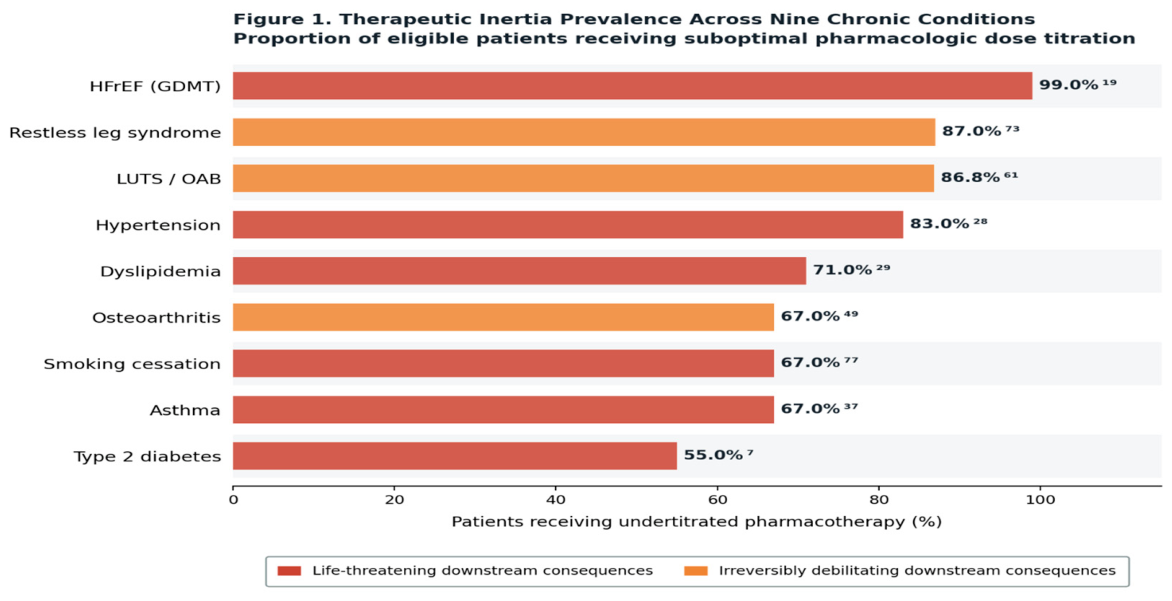
Figure 2.
The therapeutic inertia cycle. Provider-level drivers (anchoring, time pressure, asymmetric risk perception) and system-level drivers (absent between-visit monitoring, fragmented data flow) converge on a failure of dose optimization, producing a downstream cascade of disease progression, avoidable acute events, and excess economic burden. Conceptual framework adapted from Phillips et al.6 and Okonofua et al.12.
Figure 2.
The therapeutic inertia cycle. Provider-level drivers (anchoring, time pressure, asymmetric risk perception) and system-level drivers (absent between-visit monitoring, fragmented data flow) converge on a failure of dose optimization, producing a downstream cascade of disease progression, avoidable acute events, and excess economic burden. Conceptual framework adapted from Phillips et al.6 and Okonofua et al.12.
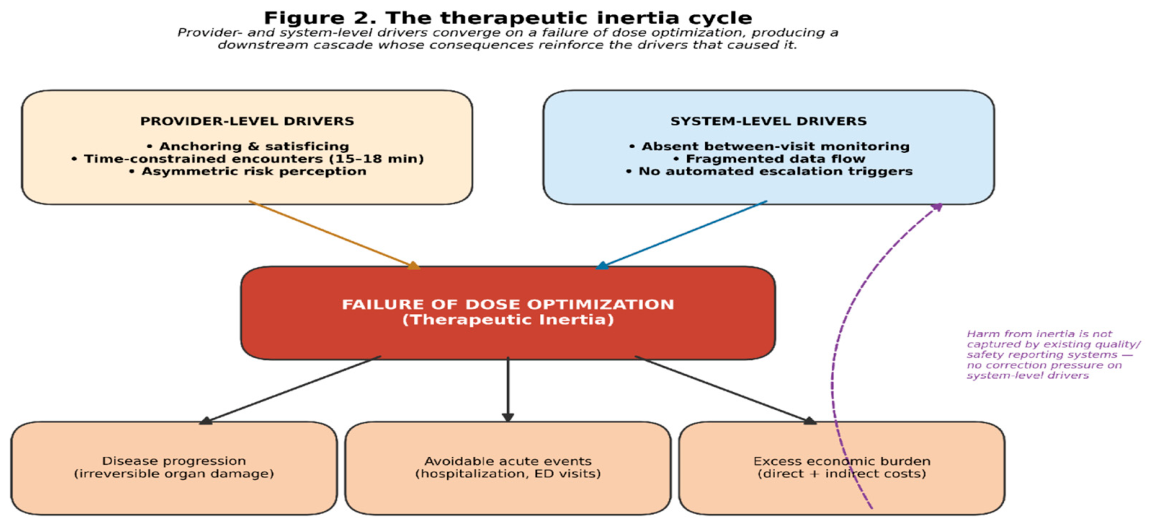
Figure 3.
Annual U.S. economic burden (direct and indirect costs, billions USD) across fifteen of the sixteen conditions reviewed, sorted in descending order. Color indicates severity category (Parkinson’s disease is classified here as irreversibly debilitating; see §3.2.12). Aggregate burden across the fifteen conditions shown exceeds $2.4 trillion. Essential tremor is not shown because the literature reports only relative cost multipliers, not a dollar figure comparable to the other conditions. Data sources: condition-specific economic analyses cited in §3.2.
Figure 3.
Annual U.S. economic burden (direct and indirect costs, billions USD) across fifteen of the sixteen conditions reviewed, sorted in descending order. Color indicates severity category (Parkinson’s disease is classified here as irreversibly debilitating; see §3.2.12). Aggregate burden across the fifteen conditions shown exceeds $2.4 trillion. Essential tremor is not shown because the literature reports only relative cost multipliers, not a dollar figure comparable to the other conditions. Data sources: condition-specific economic analyses cited in §3.2.
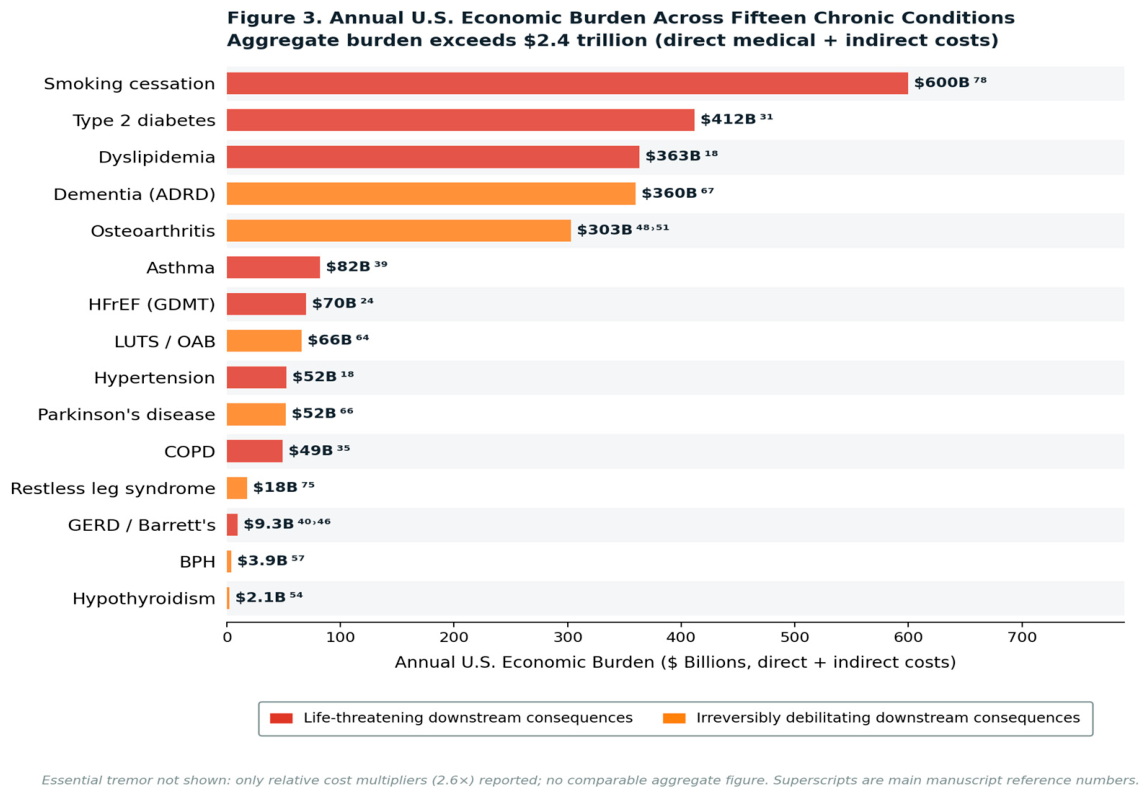
Figure 4.
Therapeutic inertia prevalence plotted against annual U.S. economic burden for the nine conditions with a verifiable point estimate for both axes. Bubble size is proportional to U.S. patient population (millions). Color indicates severity category. Dashed lines represent median values across these nine conditions. Conditions in the upper-right quadrant combine high inertia prevalence with high economic burden, representing the most urgent targets for systematic dose-optimization intervention. The seven conditions excluded here are the same as in Figure 1; see the Figure 1 caption for detail.
Figure 4.
Therapeutic inertia prevalence plotted against annual U.S. economic burden for the nine conditions with a verifiable point estimate for both axes. Bubble size is proportional to U.S. patient population (millions). Color indicates severity category. Dashed lines represent median values across these nine conditions. Conditions in the upper-right quadrant combine high inertia prevalence with high economic burden, representing the most urgent targets for systematic dose-optimization intervention. The seven conditions excluded here are the same as in Figure 1; see the Figure 1 caption for detail.
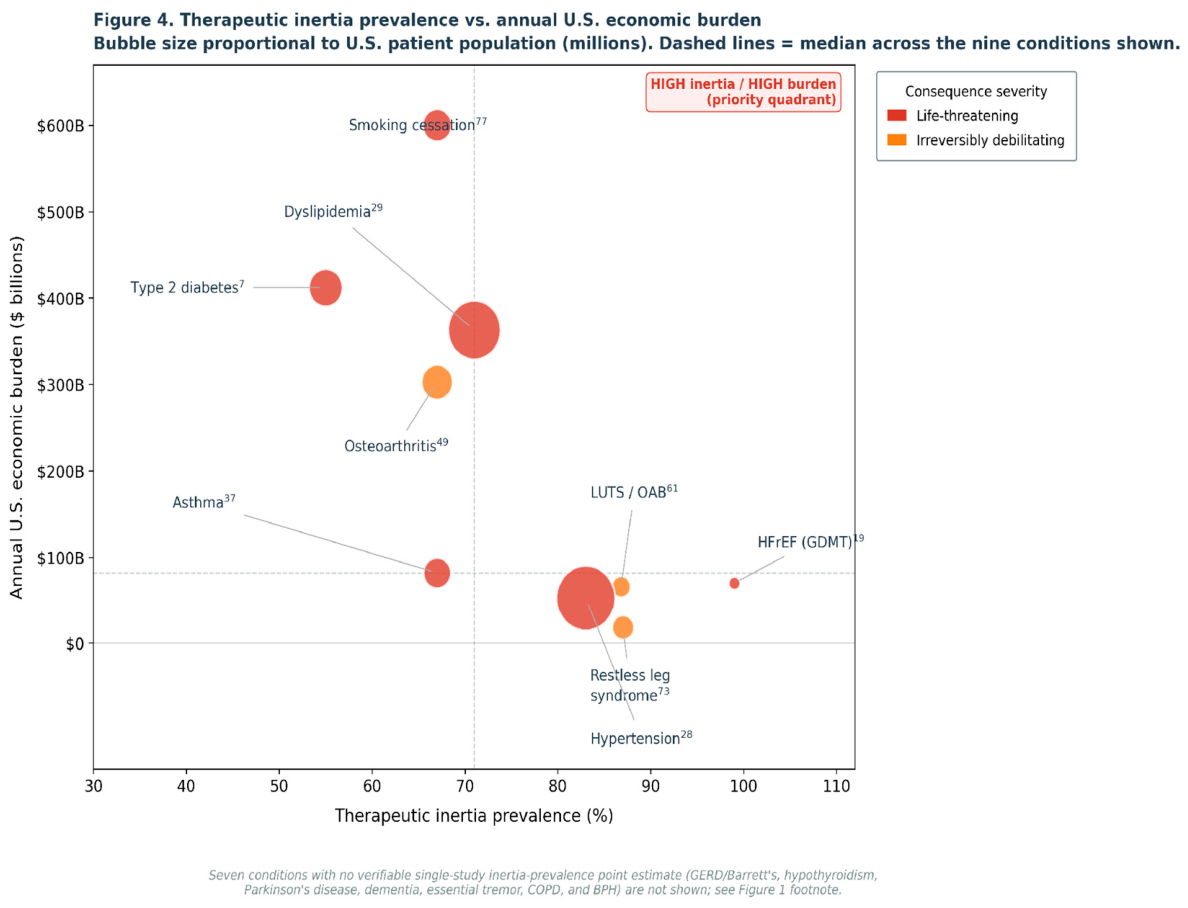

Table 1.
Therapeutic Inertia in Pharmacologic Dose Titration: Cross-Disease Summary.
| # | Condition | U.S. Prevalence | Inertia Prevalence | Clinical Consequence of Suboptimal Titration | Annual U.S. Economic Burden | Primary Source(s) |
|---|---|---|---|---|---|---|
| 1 | HFrEF (GDMT) | ~3.1M | 1% receiving target doses of ACE/ARB/ARNI, beta-blocker, and MRA (CHAMP-HF) | HF hospitalizations, ventricular remodeling, CV death (5-yr mortality >50%) | ~$31B (2012); ~$70B projected by 2030 | 5,19,20,24 |
| 2 | Hypertension | ~116M | ~17% of encounters with above-goal BP result in therapy intensification | Stroke, MI, HFpEF, CKD → ESRD | ~$52.4B | 18,25,26,27,28 |
| 3 | Dyslipidemia | ~86M | Only 29% of very-high-risk patients at LDL-C target (EUROASPIRE V) | MI, ischemic stroke, CV death | ~$363B (total CVD) | 18,29, |
| 4 | Type 2 diabetes | ~38M | Median time to intensification varies widely across populations (range 0.3 to >7.2 yr); <50% intensified within 12 mo (Khunti et al. systematic review) | Retinopathy, ESRD, neuropathy, amputation, CV death | ~$412B | 2,3,7,30,31,91 |
| 5 | COPD | ~16M | No verifiable single-study point estimate for escalation rate; real-world guideline concordance is inconsistent | Irreversible FEV1 loss per exacerbation, cor pulmonale, respiratory failure | ~$36B (2010); ~$49B (2020 projected) | 4,32,33,34,35 |
| 6 | Asthma | ~25M | ~33% of children and adults with asthma used long-term controller medication such as inhaled corticosteroids | Fatal asthma, irreversible airway remodeling | ~$82B | 36,37,38,39 |
| 7 | GERD / Barrett’s | ~65M | Majority without guideline-recommended escalation or surveillance | Esophageal adenocarcinoma (5-yr survival ~20%) | ~$9.3B (1998, direct costs only) | 40,41,46 |
| 8 | Osteoarthritis | ~30.8M | Guideline-recommended non-opioid pharmacotherapy is substantially underutilized relative to clinical need | Disability, falls, opioid dependence | ~$303B | 47,48,49,51 |
| 9 | Hypothyroidism | ~15M | Levothyroxine dose adjustment following above-range TSH is not systematically tracked in verifiable published U.S. data | CVD risk, infertility, adverse fetal outcomes | $0.4–$2.1B | 52,53,54 |
| 10 | BPH | ~14M | No verifiable single-study point estimate; escalation to combination therapy occurs in a minority of eligible patients | Acute urinary retention, bladder decompensation, renal insufficiency | ~$3.9B (working-age, private-sector only) | 56,57 |
| 11 | LUTS / OAB | ~29.8M | 86.8% not persisting on antimuscarinic therapy at 12 months (D’Souza et al.); 35.1% never refill the initial prescription (Sears et al.) | Falls/fracture, incontinence-related institutional care, anticholinergic-cognitive risk | ~$66B | 58,59,60,61,64 |
| 12 | Parkinson’s disease | ~1M | Motor fluctuations are common with chronic dopaminergic therapy; timely dose adjustment is time-critical to preserving function | Falls with fracture, loss of ambulation, institutionalization | ~$52B | 65,66 |
| 13 | Dementia (ADRD) | ~6.9M | Real-world AChEI persistence at 12 months is substantially below guideline expectations; greater cumulative AChEI exposure is independently associated with slower cognitive decline (Rountree et al., 2009; N=641) | Accelerated cognitive decline, behavioral symptoms, early institutionalization | ~$360B | 67,68 |
| 14 | Essential tremor | ~7M | 30–50% of patients fail to respond to first-line pharmacotherapy (propranolol or primidone); inadequate titration to demonstrably effective doses is common | Occupational disability, social isolation | 1.8–2.6× higher all-cause costs vs. non-ET patients | 69,70,71 |
| 15 | Restless leg syndrome | 16–32M | Markedly underdiagnosed: only 12.9% of those consulting a physician received an RLS diagnosis (REST study); most patients who were treated received pharmacotherapy not known to be guideline-appropriate | Sleep deprivation → CVD, T2DM, cognitive impairment | ~$15B | 72,73,74,75 |
| 16 | Smoking cessation | ~28M smokers | <31% of quit attempts use evidence-based counseling and/or medication | Lung cancer, COPD, CVD, premature death | ~$600B | 76,77,78 |
Abbreviations. AChEI, acetylcholinesterase inhibitor; ADRD, Alzheimer’s disease and related dementias; ARNi, angiotensin receptor-neprilysin inhibitor; BPH, benign prostatic hyperplasia; CKD, chronic kidney disease; COPD, chronic obstructive pulmonary disease; CV, cardiovascular; CVD, cardiovascular disease; ESRD, end-stage renal disease; FEV1, forced expiratory volume in 1 second; GDMT, guideline-directed medical therapy; GERD, gastroesophageal reflux disease; HF, heart failure; HFpEF, heart failure with preserved ejection fraction; HFrEF, heart failure with reduced ejection fraction; ICS, inhaled corticosteroid; LDL-C, low-density lipoprotein cholesterol; LUTS, lower urinary tract symptoms; MI, myocardial infarction; OAB, overactive bladder; T2DM, type 2 diabetes mellitus; TSH, thyroid-stimulating hormone.
Disclaimer/Publisher’s Note: The statements, opinions and data contained in all publications are solely those of the individual author(s) and contributor(s) and not of MDPI and/or the editor(s). MDPI and/or the editor(s) disclaim responsibility for any injury to people or property resulting from any ideas, methods, instructions or products referred to in the content. |
© 2026 by the authors. Licensee MDPI, Basel, Switzerland. This article is an open access article distributed under the terms and conditions of the Creative Commons Attribution (CC BY) license (http://creativecommons.org/licenses/by/4.0/).
Copyright: This open access article is published under a Creative Commons CC BY 4.0 license, which permit the free download, distribution, and reuse, provided that the author and preprint are cited in any reuse.


