

Submitted:
22 July 2026
Posted:
24 July 2026
You are already at the latest version
Abstract
This study aimed to evaluate the applicability of gelatin (GEL)-based edible coatings as a complementary preservation approach for vacuum-packaged sliced cooked cured pork loin (CCPL) during refrigerated storage (4 °C, 21 days), focusing on the effect of GEL concentration (5% vs. 10%) in coating-forming solutions on the properties of the resulting films and, subsequently, on coating performance. GEL films were character-ized and compared with a commercial polyamide/polyethylene (PA/PE) vacu-um-packaging film at 40–90% relative humidity (RH). Despite the more compact cryo-SEM microstructure of the 10%-GEL coating-forming solution, GEL films showed no significant differences in microstructure, crystallinity, or most physicochemical properties. Compared with the PA/PE film, GEL films exhibited a more compact and homogeneous structure, higher transparency and stronger UVB/UVC-blocking capaci-ty, lower oxygen permeability up to 60% RH (127.75–1231.25 vs. 4234.06–5056.72 cm³ μm m⁻² day⁻¹), and higher puncture strength up to 70% RH (9.12–15.24 vs. ~6.6 MPa). As RH increased, oxygen permeability increased in all films, while GEL films also ex-hibited increased moisture uptake and reduced mechanical strength. The 10%-GEL coating caused more pronounced color changes in CCPL. Both GEL coatings similarly impaired oxidative stability and microbial quality compared with the uncoated CCPL.
Keywords:
gelatin films and coatings
; gelatin concentration
; relative humidity
; microstructure
; oxygen permeability
; meat products
; lipid oxidation
; total viable count
1. Introduction
Given the resource-intensive nature of meat production and the high levels of meat waste [1,2], reducing product losses and extending shelf life are of considerable ecological and economic importance. This is particularly relevant for portioned ready-to-eat meat products, such as sliced meat, which are highly susceptible to oxidative and microbial spoilage due to their large exposed surface area. In response to these challenges, edible coatings have emerged as a promising alternative strategy for the preservation of meat products [3,4,5,6,7,8,9]. Edible coatings are not intended to replace plastic packaging, which remains essential for ensuring hygiene, preventing contamination, and maintaining product safety. Instead, they may serve as a complementary preservation strategy to improve product stability, particularly after package opening. If sufficiently effective, edible coatings may improve the environmental sustainability of food packaging [9] by enabling the use of thinner or less resource-intensive plastic materials and reducing the need for difficult-to-recycle multilayer packaging, such as polyamide/polyethylene (PA/PE) films [10].
The selection of edible coating materials is often guided by intuitive rather than systematic approaches. In the meat sector, animal-derived by-products are particularly attractive because they support circular economy principles within conventional meat processing systems. Among these, animal gastrointestinal tracts, composed primarily of collagen-rich submucosal tissue, have long been used as edible sausage casings. Their unique structural protein matrix has subsequently inspired the development of more practical collagen-based alternatives [11]. Collagen, the principal structural protein of connective tissues, exhibits remarkable mechanical strength due to its unique triple-helix structure, formed by a repetitive amino acid sequence rich in glycine, proline, and hydroxyproline. Its partially hydrolyzed form, gelatin (GEL), offers greater water solubility and processability, making it a widely used biopolymer for food protection against oxygen and light [12,13]. Glazing meat with GEL is a traditional technique commonly used in the preparation of aspics, galantines, and other jellied meat products, where it provides an attractive glossy appearance, reduces moisture loss, and enables the formation of firm, decorative structures. Beyond its culinary applications, GEL has been investigated as an edible coating material for extending the shelf life of various meat products since the 1950s [14]. For example, spray application of a 20% bovine GEL solution to fresh meat stored under modified atmosphere packaging at 4 °C reduced purge loss and partially slowed colour deterioration, while having no significant effect on lipid oxidation or flavour; however, the coating negatively affected product colour because of its inherent pigmentation [15]. In processed meat products, GEL-based coatings have been shown to enhance the moisture-barrier and antioxidative properties of vacuum-packaged sliced sausages [16]. Moreover, GEL coatings enriched with green tea extract effectively delayed lipid oxidation in sausages [17], whereas GEL coatings containing probiotics reduced lipid oxidation and weight loss in cooked chicken breast [18]. In addition, GEL coatings improved the oxidative and color stability of cooked ham and bacon packaged in both oxygen-permeable and vacuum films during frozen storage [19]. Importantly, it should be noted that, although vacuum packaging substantially limits oxygen availability, residual oxygen within the package and oxygen permeation through the packaging material may still promote lipid oxidation. Furthermore, exposure of meat to oxygen after cooking inevitably initiates oxidative changes [20]. Taken together, cited studies demonstrate the potential of GEL-based coatings to enhance the stability of meat products, with their effectiveness varying according to the product matrix and coating composition.
Edible coatings are formed directly on food surfaces, whereas edible films are pre-formed structures used as wrapping materials or as model systems for evaluating coating properties. Previous studies have shown that GEL plasticized with polyhydric alcohols, such as glycerol or sorbitol, forms mechanically strong, stiff, highly transparent, and UV-blocking films compared with other biopolymers [21,22,23,24]. However, these properties are typically determined under standard conditions (25 °C and 50% relative humidity (RH)), which do not reflect the high-humidity environments in which meat coatings are intended to function. GEL films are typically prepared by solvent casting from 5–10% solutions [22,23,24,25], although a broader range of concentrations (1–20%) has been reported [26]. However, the influence of GEL concentration on film properties and coating performance remains insufficiently understood, despite the established role of concentration in determining GEL gelation and network formation [27].
Considering the aforementioned research gaps and the need for alternative approaches for extending the shelf life of meat products, this study aimed to evaluate the applicability of GEL-based coatings as a complementary preservation approach for vacuum-packaged sliced cooked cured pork loin (CCPL). Specifically, the objectives were to: (i) compare the properties of film/coating-forming solutions (CFSs) containing 5% and 10% (w/w) GEL; (ii) characterize the structural, physicochemical, and antioxidant properties of 5%- and 10%-GEL films as model systems under different RH conditions (40–90%) and compare them with PA/PE film; and (iii) assess the effect of 5%- and 10%-GEL coatings on quality changes in vacuum-packaged sliced CCPL stored at 4 °C for 21 days.
2. Results and Discussion
2.1. Comparison of the Properties of 5%-GEL and 10%-GEL CFSs
Cryogenic scanning electron microscopy (cryo-SEM) showed that increasing GEL concentration resulted in a more compact CFS network with smaller pores (Figure 1A), suggesting that more water was immobilized within the GEL network in the 10%-GEL formulation, thereby limiting ice crystal growth during freezing. Small, but statistically significant difference (p<0.05) was observed between the pH (5.03 vs. 5.09) and lightness (27.06 vs. 26.16) of the 5%- and 10%-GEL CFSs (Table 1). As expected, doubling the GEL concentration resulted in CFS that was more intensely colored (higher chroma value), thicker (9.10 vs. 22.97 mPa·s), faster gelling (~25 vs. 55 min) (Table 1), and less permeable to UV/VIS light (Figure 2A). Both formulations equally and completely blocked UVC light (≤280 nm). Furthermore, doubling the GEL concentration resulted in more than a fourfold increase in gel strength (GS, 34.28 vs. 147.40 g, Table 1), reflecting stronger intermolecular interactions between GEL chains, consistent with the more compact network observed by cryo-SEM (Figure 1A).
2.2. Comparative Characterization of 5%-GEL, 10%-GEL, and PA/PE Films
Because the same amount of CFS solids was applied per unit area, the resulting GEL films had similar thicknesses (~90 μm; Table 2), matching that of the PA/PE film (Table 2). Nevertheless, it should be noted that GEL films are expected to swell with increasing RH, resulting in significant increase in thickness, as reported previously [28].
2.2.1. Structural Properties
The GEL films exhibited no noticeable differences in microstructure, apart from minor variations in fracture surface roughness caused by the fracture process. Although both the GEL and PA/PE films exhibited smooth and homogeneous surfaces (Figure 1B), SEM revealed marked differences in their cross-sectional morphologies (Figure 1C). Consistent with previous reports, the GEL films exhibited dense and compact fracture surfaces [22,28], whereas the PA/PE film displayed the distinct layered structure typical of multilayer materials. Differential interference contrast (DIC) microscopy confirmed the homogeneous morphology of the GEL films and the heterogeneous morphology of the PA/PE film (Figure 1D), corroborating the SEM cross-sectional observations (Figure 1C) and previous findings [22,25,29]. The film microstructure remained essentially unchanged across the tested RH range (data not shown).
The Wide-angle X-ray diffraction (WAXD) patterns of the 5%- and 10%-GEL films (Figure 3) were essentially similar, exhibiting a diffraction peak at 2θ ≈ 7.2°, attributed to triple-helix crystalline structures, together with a broad amorphous halo centered at 2θ ≈ 20.5° [30]. These results indicate that the approximately twofold higher initial hydration level of the GEL (18.8 vs. 8.8 g H₂O/g for the 5%- and 10%-GEL CFSs, respectively), and the associated differences in CFS drying time, had no significant effect on the final degree of renaturation, which was primarily governed by the identical GEL/glycerol ratio (5:1) and the processing conditions. The PA/PE film exhibited a sharp and intense diffraction peak at 2θ ≈ 21.5° together with a weaker reflection at 23.7°, consistent with the diffractogram characteristic of the low-density polyethylene (LDPE) phase (Figure 3, [31]) constituting the outer layer of the material [32,33]. Since WAXD probes the entire film thickness, the superimposed diffraction signals indicate a low PA content, which is typical of PA-containing multilayer films [33], and a minor contribution of the PA layer to the overall crystallinity. In summary, the well-defined sharp reflections suggest a higher degree of molecular ordering and crystallinity in the PA/PE film compared with the predominantly amorphous GEL films.
2.2.2. Optical Properties
The concentration of GEL had no effect on the color parameters of the films (Table 2). Both GEL-based films exhibited higher lightness than the PA/PE film but also showed a more yellowish-red coloration, as indicated by their higher a* and b* values. Consequently, the GEL-based films would likely be more visually noticeable than the PA/PE film on light-colored product surfaces (ΔE = 0.96 vs. 0.69; Table 2).
As for the color parameters, no significant differences in light barrier properties were found between the 5%- and 10%-GEL films (Figure 2B). The heterogeneous multilayer structure of the PA/PE film (Figure 1C,D) provided multiple light-scattering centers, resulting in lower transmittance in the visible (400–700 nm) region and, consequently, higher opacity (Opa; Table 2) and superior protection against UVA radiation (315–400 nm) (59–71% vs. 76–88%; Figure 2B) compared with the homogeneous GEL films (Figure 1C,D). The enhanced light attenuation may also have been influenced by the presence of impurities and structural defects within the PA component, as previously reported in the literature [34]. UVA-blocking property is advantageous for food packaging applications, as UVA radiation accounts for ~95% of the UV radiation reaching the Earth’s surface [35] and can induce the formation of free radicals that promote the oxidation of food components [36]. Nevertheless, UVA has a lower photodestructive potential than UVB (which constitutes the remaining ~5% of terrestrial UV radiation) and UVC (100–280 nm) [35]. In this context, the GEL films, with their superior blocking of short-wavelength UV radiation, possessed more favorable UV-protective properties than the PA/PE film (Figure 2B). This behavior can be attributed to the presence of intrinsic UV-absorbing chromophores in GEL, such as tyrosine, phenylalanine, and disulfide bonds, with absorption maxima at approximately 275, 258, and 260 nm, respectively [37,38]. Consistent with the literature [22], an absorption peak at ~278 nm was observed in the GEL films (Figure S1), arising from overlapping contributions of the previously mentioned chromophores. For clarity, the absence of the corresponding peaks in the spectra of the CFSs (Figure 2A) was attributed to stronger UV absorption resulting from the substantially longer optical path length (1 cm) than that of the films (~90 μm thickness), leading to near-zero transmittance. Complete blocking of deep-UV radiation by the GEL films can be attributed to strong absorption by peptide bonds, with a major absorption band centered at approximately 190 nm and a weaker band in the 210–220 nm region [38]. The same effect in the PA/PE film was most likely attributable to the presence of amide groups in the PA component [34]. RH had no significant effect on the optical properties of the films (data not shown).
2.2.3. Moisture Content (MC) and Water Vapor Permeability (WVP)
The GEL-based films exhibited similar MC values, increasing steadily with RH from ~10% at 40% RH to ~32% at 90% RH (Figure 4A), consistent with previous report [28]. A particularly sharp increase occurred between 80% and 90% RH, reflecting the high swelling capacity of GEL under high-humidity conditions. Because the hydrophobic outer PE layers [39] effectively shielded the hydrophilic PA layer [40] from moisture, the MC of the PA/PE film remained low (~1–1.5%) throughout the entire RH range.
Given that 100% RH was maintained inside the cups, the WVP of the GEL-based films exhibited a clear decreasing trend with increasing external RH as a result of the reduction in the water vapor pressure gradient across the film (Figure 4B). Specifically, increasing the RH from 40% to 90% reduced the WVP from 52.91 to 4.88 g mm m⁻² day⁻¹ kPa⁻¹ (≈11-fold) for the 5%-GEL film and from 45.25 to 5.73 g mm m⁻² day⁻¹ kPa⁻¹ (≈8-fold) for the 10%-GEL film. The WVP values measured under the Δ50 condition were within the range previously reported for GEL-based films [23,25,41]. Interestingly, at external RH ≤60% (i.e., at higher RH gradients, Δ40–Δ60), the 10%-GEL film exhibited lower WVP values than the 5%-GEL film. As no significant differences in the structural properties of the GEL films were detected by SEM and WAXD (Figure 1B–D and 2), the improved water vapor barrier performance (5.0–14.5%) under high driving forces is likely attributable to subtle molecular-level variations in the network architectures formed during drying, including enhanced intermolecular interactions or reduced free volume that remained beyond the resolution of the applied characterization techniques. In the 10%-GEL films (obtained by shorter drying), a denser and more highly entangled polymer matrix (Figure 1A) was presumably partially maintained due to the faster water removal, originating from the close proximity of GEL molecules in the more concentrated CFS. When exposed to a high moisture gradient, this congested structure offered greater resistance to water vapor transport by creating a more tortuous diffusion path for water molecules, thereby restricting their migration across the film compared to the more relaxed, open network of the 5%-GEL counterpart. At RH ≥ 70%, extensive water sorption likely disrupted polymer–polymer cohesivnes, increasing chain spacing and free volume [42], so that water vapor transport became dominated by water-induced plasticization, thereby masking the effect of GEL concentration on WVP. As expected, the PA/PE film, owing to the hydrophobic nature of its polyolefin component [43], exhibited no detectable WVP regardless of the RH gradient (Figure 4B).
2.2.4. Oxygen Permeability (OP)
Under moderate moisture conditions (40–60% RH), the GEL-based films exhibited statistically similar OP values, which were approximately 4- to 30-fold lower than those of the PA/PE film, depending on the RH level (Table 3). This finding is consistent with the well-established fact that biopolymer-based films, including GEL-based films, generally exhibit superior oxygen barrier properties compared with conventional petroleum-based packaging polymers, although this advantage is mainly maintained under low to intermediate RH conditions [44]. The superior oxygen barrier properties of dry GEL films stem from their compact, polar matrix, which limits oxygen diffusion due to the low affinity between the hydrophilic GEL network and non-polar oxygen molecules [45], in contrast to the apolar and highly gas-permeable PE matrix [46]. As shown in Figure 1C, unlike the more heterogeneous layered structure of the PA/PE film, the GEL films displayed a compact and homogeneous cross-sectional morphology, thereby hindered oxygen diffusion. Although a clear increasing trend in OP values with increasing RH was observed for the GEL films (Table 3), the differences were not statistically significant due to the considerable variability within the dataset. When the RH exceeded 60%, absorbed water molecules plasticized the GEL films by disrupting interchain hydrogen bonds, increasing polymer chain mobility and free volume, and consequently enhancing oxygen diffusion through the film, leading to a pronounced deterioration in oxygen barrier performance [26]. At 70% and 80% RH, the films exhibited unstable behavior, leading to sinusoidal instrument readings, while measurements could not be completed at 90% RH, due to moisture-induced deformation of the films. In contrast, due to its hydrophobic nature and limited moisture uptake (Figure 4A), the PA/PE film maintained measurable OP values across the entire RH range, with OP generally showing a gradual increase as RH increased.
It is worth noting that the OP values of the GEL films were lower than those reported previously [22]. This difference may be attributed to the lower plasticizer content (20% vs. 40% based on GEL), which caused less disruption of protein–protein interactions and promoted the formation of a denser protein network, consequently limiting oxygen diffusion [47,48].
2.2.5. Mechanical Properties
Although the 5%-GEL and 10%-GEL CFSs differed significantly in terms of GS (Table 1), the puncture strength (PS) of the resulting films remained comparable across the entire range of RH (Figure 4C). Consistent with the literature [44], increasing RH reduced the mechanical strength of the GEL films because absorbed water (Figure 4A) acted as a plasticizer, weakening intermolecular hydrogen bonding and reducing film matrix cohesion. Up to 70% RH, the GEL films exhibited PS values up to 2.3-fold higher than those of the PA/PE film (9.12–15.24 MPa vs. ~6.6 MPa; Figure 4C). At higher RH, however, extensive moisture uptake (Figure 4A) markedly reduced film cohesion, lowering the PS to approximately 2.5 MPa at 90% RH. Nevertheless, this value remained comparable to those reported for glycerol-plasticized pea protein isolate, gum Arabic, corn starch, and sorbitol-plasticized soy protein isolate films conditioned at standard 50% RH (PS = ~3.00, 2.61, 2.14, and 2.20 MPa respectively) [21,24,49,50] and exceeded that of chitosan lactate films (PS = 1.45 MPa) [51]. Because all of the aforementioned values were determined using the same puncture test methodology, these comparisons indicate the inherently strong and cohesive protein network formed by GEL, even in the wet state.
The PD of the GEL-based films increased markedly with increasing RH, from approximately 4.6 mm at 40% RH to 16–18 mm at 90% RH (Figure 3D), indicating a pronounced plasticizing effect of water. Although both films exhibited the same PS (Figure 3C), they reached failure through different deformation behavior. At low-to-medium RH, both films exhibited similar rigidity due to strong interchain hydrogen bonding. At RH ≥ 60%, however, the 10%-GEL films consistently exhibited higher PD values than the 5%-GEL films, reflecting a more ductile mechanical response. As the GEL films did not differ in microstructure (Figure 1B–D), crystalline order (Figure 2), or MC (Figure 3A), their differing deformability/flexibility, likely reflects subtle variations in chain entanglement density and free volume that remain undetectable by standard characterization methods but become significantly amplified upon water-induced plasticization at elevated RH levels. Possibly, due to the prolonged water evaporation time, 5%-GEL films could form a more ordered, rigid molecular network that restricted chain slippage, resulting in lower PD. Conversely, the 10% GEL films (obtained by shorter drying) presumably featured a less organized network structure that, upon plasticization, allowed for greater macromolecular displacement and higher deformability. The hydrophobic nature of the PA/PE film and its negligible moisture uptake (Figure 4A) resulted in no RH-dependent changes in the mechanical properties (Figure 4C).
2.2.6. Antioxidant Properties
The GEL films exhibited the same the 2,2′-azino-bis(3-ethylbenzothiazoline-6-sulfonic acid) radical cation (ABTS*+) scavenging activity (Figure S2, Table 2), which was not affected by RH (data not shown). Consistent with previous findings, the observed antioxidant capacity is attributed to the electron-donating ability of amino acid residues in GEL [25,41,52]. Interestingly, the PA/PE film also exhibited radical-scavenging activity, although its contribution was negligible relative to the GEL films (~2.5% vs. ~92%; Figure S2). This minor activity may result from chemical stabilizers, including antioxidants, incorporated during film manufacture [53,54].
2.3. Comparison of the Effects of 5%-GEL and 10%-GEL Coatings on the Quality of Vacuum-Packaged Sliced CCPL
2.3.1. Effect of Coatings on Color
The color parameters of sliced CCPL were influenced by both the GEL coating concentration and storage time (Table 4). While the uncoated and 5%-GEL-coated samples darkened over time, the 10%-GEL coating maintained stable L* values, resulting in significantly higher lightness at the end of storage. Generally, the 10%-GEL-coated CCPL exhibited lower redness (a*) than the uncoated samples, likely reflecting the greater visual masking effect of the coating formed from the more concentrated GEL solution rather than changes in meat pigment stability. Despite minor fluctuations during storage, b* values remained comparable among treatments, suggesting that the coatings had little effect on yellowness. Based on the established total color difference (ΔE*) thresholds [55], the color differences between the 5%-GEL-coated and uncoated CCPL samples were generally below the perceptibility threshold for an untrained observer (1 < ΔE* < 2). The only exception was one sample with a ΔE* of 2.73 (Table 4), for which the color difference was considered noticeable (2 < ΔE* < 3.5). In contrast, the 10%-GEL coating resulted in clearly distinguishable (3.5 < ΔE* < 5) color differences at some storage times (Table 4).
2.3.2. Effect of Coatings on Water Aactivity (aw), pH, Thiobarbituric Acid Reactive Substances (TBARS) Content, and Total Viable Count (TVC)
aw remained high throughout storage, ranging from 0.968 to 0.984 (Table 5), which is typical of cooked meat products due to their high MC [56,57]. During the first week of storage, both GEL coatings resulted in similarly higher aw values than the uncoated control (p < 0.05), suggesting that the coating process introduced additional free water, most likely at the product surface. After 14 and 21 days of storage, no significant differences were observed among treatments, indicating that the free water associated with the coatings had likely redistributed within the product and reached equilibrium.
The pH values of CCPL ranged from 6.08 to 6.35 (Table 5), showing good agreement with previously reported values for CCPL products [56,58]. Likely due to the slightly acidic nature of the CFSs (pH ≈ 5; Table 1), the coated CCPL generally exhibited slightly lower pH values than the uncoated samples (6.08–6.29 vs. 6.17–6.35), irrespective of GEL concentration, as the CFSs had similar pH values (Table 1).
TBARS content ranged from 0.015 to 0.180 mg malondialdehyde (MDA)/kg (Table 5). On day 1, both GEL-coated CCPL samples exhibited lower TBARS values than the uncoated control, with the lowest value observed for the 5%-GEL treatment (0.023 mg
MDA/kg). The uncoated control maintained consistently low TBARS values throughout storage (0.015–0.080 mg MDA/kg). In contrast, TBARS levels in the GEL-coated samples increased markedly during storage, reaching 0.119 and 0.180 mg MDA/kg at the end of storage in the 5%- and 10%-GEL treatments, respectively. These results indicate that the GEL coatings not only failed to retard lipid oxidation during storage but also reduced the oxidative stability of the product. This unexpected result, particularly considering the antioxidant properties of the GEL films (Table 2, Figure S2), contrasts with previous reports showing that GEL-based coatings generally reduce [19,59] or at least do not affect TBARS [15,60] in fresh or thermally processed meat. One possible explanation is that the coating procedure itself increased the exposure of the CCPL to oxygen before vacuum packaging, thereby facilitating oxidative changes. Alternatively, interference of GEL degradation products with the TBARS assay cannot be excluded, potentially leading to an overestimation of lipid oxidation [61].
During refrigerated storage, progressive microbial growth was observed in all treatments; however, GEL-coated CCPL samples reached higher TVCs than the control (Table 5). This may be attributed to several factors, including microbial introduction with the non-sterile CFSs, prolonged sample handling outside refrigerated conditions during coating before vacuum packaging, and the presence of GEL as an additional nutrient source supporting microbial growth. Moreover, the additional water introduced with the CFSs may have locally increased surface moisture, thereby creating more favorable conditions for microbial proliferation. However, since all samples exhibited high aw values (>0.96), the slightly higher initial aw of the GEL-coated samples (Table 5) was unlikely to account for the observed differences in TVC. Except for day 1, no significant differences in TVCs were found between the 5%-GEL and 10%-GEL coatings. The investigated foodborne pathogens, Listeria monocytogenes and Salmonella, were not detected in any CCPL sample throughout refrigerated storage; L. monocytogenes remained below the detection limit (<10 CFU/g), while Salmonella was not detected in 25 g of product (data not shown).
3. Materials and Methods
3.1. Materials
The CFSs were made from a pork GEL (type A, Bloom strength of 240, Kamis; McCormick Polska, Poland) and glycerol (Sigma-Aldrich, USA). Musculus longissimus lumborum (pork loin) was collected from commercial crossbred pigs slaughtered at approximately 6 months of age, with a live body weight of 110–120 kg. The muscle was excised 24 h postmortem. Commercial PA/PE bags (20 × 40 cm) were used for packaging.
3.2. Preparation and Analysis of CFSs
Aqueous solutions containing 5% or 10% (w/w) GEL and glycerol (20%, w/w, based on the GEL mass) were heated at 90 °C for 30 min and then cooled. Cryo-SEM observations were performed using an Ultra Plus scanning electron microscope (Carl Zeiss, Oberkochen, Germany). The pH of the CFSs was measured at ~40 °C using a glass ERH-11S electrode connected to a CPC-401 pH meter (Elmetron, Zabrze, Poland). The color parameters (L*, a*, and b*) were measured using an NH310 colorimeter equipped with a 5 × 5 × 5 cm liquid sample accessory (3nh, Guangzhou, China). The opacity (Op, A600/mm) was determined using a Lambda 40 spectrophotometer (PerkinElmer, Shelton, CT, USA) as the absorbance at 600 nm divided by the optical path length (10 mm), with distilled water used as the blank. Dynamic viscosity (η, mPa·s) was determined using a rotational viscometer ROTAVISC lo-vi (IKA, Staufen, Germany) at following operating parameters: SP-1 spindle, 200 rpm, 40oC, 400 ml of the sample, with the reading taken after 3 min. Gelation time (tgel) of the CFSs was determined using ball-drop method [62] with slight modifications. Briefly, the CFS (30 g, 35 oC) in a glass beaker (50 ml) was left at room temperature (~25oC) to cool down. A 3 mm (~0.11 g) metal ball was dropped into the CFS betweenwhiles (every minute as the solution began to lose fluidity) until it got stuck in the gel. Additionally, a gelation temperature (Tgel) was recorded. The resultant gels were tightly closed and keep at 25 °C for 24h. Then the gel strength (GS), corresponding to maximum force (g) required for the 5 mm diameter ball probe (P/5S) to penetrate 10 mm into the gel at a speed of 1 mm/s, was measured with a texture analyser TA.XTplus (Stable Micro Systems, Goldamig, UK). The analyses of the CFSs were performed at least in triplicate.
3.3. Preparation and Characterization of GEL Films
The degassed CFSs were cast on polycarbonate trays (144 cm2) and dried on a leveled heating table (~30 oC, 50% RH, ~16 h). A constant mass of non-water components (0.0125 g/cm2) was placed onto the trays in order to maintain ≈90 μm film thickness (namely, 30 g of the 5%-GEL and 15 g of the 10%-GEL CFSs were cast onto trays). The films were peeled off and cut into samples of various shapes dependent on the test.
Thickness of the samples was determined using a Mitotuyo 547-401 digital thickness gauge (Mitotuyo, Tokyo, Japan). Before testing, the film samples were maintained in an MLR-350 climatic test chamber (Sanyo Electric Biomedical Co. Ltd., Osaka, Japan) for 48 h at 25 °C and 40-90% RH.
The air-side surface and cryofractured cross-section of the films (prepared after immersion in liquid nitrogen) were analyzed using an Ultra Plus scanning electron microscope (Carl Zeiss, Oberkochen, Germany). Prior to SEM observation, the film samples were sputter-coated with gold. SEM images were acquired at 3–5 kV with a working distance of approximately 12 mm using a secondary electron detector. Additionally, the morphology was visualized using a Leica DM5500 B microscope (Leica Microsystems GmbH, Wetzlar, Germany) equipped with a DIC optical system. WAXD patterns of the films and reference materials, including commercial LDPE and two polymorphic forms of PA6 (α and β), were obtained on a URD 6 Seifert X-ray diffractometer (FPM-Seifert, Freiberg, Germany) with a Cu Kα radiation source at following operating parameters: 30 mA, 40 kV, scanning speed of 0.1° per 15s, step size 0.1°, ~25oC. The analyses of the color values (L*a*b*), total color difference (ΔE*) calculated with respect to the white reference background (L* = 93.75, a* = 0.25, b* = −10.38), light transmission, Opa, MC, WVP, OP, and PS were performed as described previously [30,63]. PD (mm) was determined as the probe displacement at the moment of film puncture and used as a measure of film extensibility. The antioxidant activity was estimated using the ABTS*+-based assay [64] with slight modifications. Namely, film samples (2 × 2 cm) were immersed in 10 mL of ABTS*+ solution (absorbance ≈ 0.70 at 734 nm, 25 °C) under continuous stirring (500 rpm) for 45 min. The antirarical activity was expressed as the percentage of ABTS*⁺ radicals scavenged and as the time required to reduce the ABTS*+ concentration by 50% (tABTS50%).
A commercial PA/PE film (thickness ≈ 90 μm) was used as the reference material. Depending on the analysis, the number of replicates was three for WVP, OP, and antiradical activity, five for optical properties and MC, and eight for mechanical properties.
3.4. Preparation of Sliced CCPL, Coating Procedure, Packaging and Storage
Pork loins were divided into ~1 kg portions and cured with a curing mixture (99.5% sodium chloride, 0.5% sodium nitrite) added at 2.2% of the meat weight. The loins were stored at 4 °C for 24 h, cooked to an internal temperature of 70 °C, cooled in cold water to 20–25 °C, and sliced into 3-mm-thick slices. The slices were immersed in the CFSs for 10 min, suspended to dry for 30 min, while uncoated slices served as the control. Subsequently, the slices were vacuum-packaged in sterile PA/PE bags in groups of 15 (~200 g), with individual slices separated to prevent direct contact, and stored at 4 °C for 21 days. Analyses were performed on days 1, 7, 14, and 21 of storage.
3.5. Analysis of Sliced CCPL
Color parameters (L*, a*, and b*) were determined using an 8200 spectrophotometer (X-RITE Inc., Grand Rapids, MI, USA) with a 13-mm aperture, D65 illuminant, and 10° standard observer. The ΔE* was calculated using Equation (1):
where Δ represents the difference between the color parameters of the uncoated and coated sample.
The aw was measured at 20 °C using a LabMaster-aw water activity analyzer (NOVASINA AG, Lachen, Switzerland). The pH was determined at 20 °C using a CPC-501 pH meter (Elmetron, Zabrze, Poland) equipped with an ERH-111 electrode (Hydromet, Gliwice, Poland) after homogenizing 10 g of sample with 100 mL of distilled water. TBARS content was determined spectrophotometrically according to the method described by Pikul et al. [65] and expressed as mg MDA per kg of sample. TVCs were determined according to ISO 4833-1:2013-12 [66]. Listeria monocytogenes and Salmonella were analyzed according to ISO 11290-2:2017-07 [67] and ISO 6579-1:2017-04/A1:2020-09 [68], respectively. Samples for microbiological analyses were collected from the center of the cross-section of a CCPL slices.
3.6. Statistical Analysis
All data are presented as mean ± standard deviation (n ≥ 3). Differences among mean values were assessed by one-way ANOVA (CFS and film properties) or two-way ANOVA (coating experiment), followed by Fisher’s test, with statistical significance set at p < 0.05 (Statistica 13.3, TIBCO Software Inc., Palo Alto, CA, USA).
4. Conclusions
Despite distinct differences in the properties of the 5%- and 10%-GEL CFSs, the resulting films exhibited no significant structural differences and shared most physicochemical properties. Compared with the 5%-GEL film, however, the 10%-GEL film showed improved water vapor barrier properties under ΔRH 40–60% conditions and lower deformability at RH ≥60%. These differences may be attributed to subtle molecular-scale variations in the polymer network, such as chain entanglement and free volume, which remained beyond the resolution of the applied characterization techniques but became evident under specific humidity conditions. The GEL coatings similarly adversely affected the CCPL oxidative stability, likely due to greater oxygen exposure during their application compared to the uncoated control. Although GEL-based coatings are widely reported to limit oxidation in meat products, our findings suggest that the effectiveness of this mechanism is limited under high-moisture conditions typically encountered in meat products. While GEL films outperformed PA/PE at 40–60% RH, their oxygen barrier performance deteriorated markedly with increasing humidity, and their oxygen permeability exceeded that of PA/PE at RH 80%. Finally, although GEL exhibits inherent antioxidant activity, its effectiveness was insufficient to prevent oxidation under the conditions of this study, indicating that additional active antioxidants are required in such coating formulations. The higher TVCs observed in GEL-coated CCPL were likely associated with microbial introduction from the CFSs, increased surface moisture, additional nutrient availability, and temporary cold chain disruption during coating application.
In summary, GEL alone is unlikely to provide sufficient protection against oxidative and microbiological deterioration in vacuum-packaged sliced CCPL. If further studies are pursued, they should focus on incorporating active antioxidant and antimicrobial compounds and developing coating procedures that minimize microbial contamination. Given the comparable performance of the 5% and 10% GEL coatings, the CFS with the higher GEL concentration may be preferred as a carrier for active compounds, with the aim of minimizing the amount of water introduced during coating application.
Supplementary Materials
The following supporting information can be downloaded at the website of this paper posted on Preprints.org, Figure S1: Light absorbance of 5%-gelatin (GEL), 10%-GEL, and polyamide/polyethylene (PA/PE) films; Figure S2: Kinetics od ABTS*+ scavenging by 5%-gelatin (GEL), 10%-GEL, and polyamide/polyethylene (PA/PE) films.
Author Contributions
Conceptualization, D.K.; methodology, D.K., K.W., M.B.-C., and T.S.; validation, D.K., formal analysis, D.K. and P.K.; investigation, D.K., K.W., P.K. M.B.-C., and T.S.; data curation, D.K.; writing—original draft preparation, D.K. and K.W.; writing—review and editing, D.K. and P.K.; visualization, D.K., P.K., M.B.-C., and T.S.; supervision, D.K.; project administration, D.K. and K.W.; funding acquisition, D.K. and K.W. All authors have read and agreed to the published version of the manuscript.
Funding
This research was funded by the program of the Minister of Science and Higher Education “Regional Initiative of Excellence” in 2019–2023; project number 029/RID/2018/19; funding amount 11,927,330.00 PLN.
Institutional Review Board Statement
Not applicable.
Informed Consent Statement
Not applicable.
Data Availability Statement
The raw data supporting the conclusions of this article will be made available by the authors upon request.
Acknowledgments
During the preparation of this manuscript, the author(s) used ChatGPT for language editing. The authors have reviewed and edited the output and take full responsibility for the content of this publication.
Conflicts of Interest
The authors declare no conflicts of interest.
Abbreviations
| η | Dynamic viscosity |
| ΔE* | Total color difference |
| ABTS | 2,2′-azino-bis(3-ethylbenzothiazoline-6-sulfonic acid) |
| ABTS*+ | 2,2′-azino-bis(3-ethylbenzothiazoline-6-sulfonic acid) radical cation |
| ANOVA | Analysis of variance |
| aw | Water activity |
| CCPL | Cooked cured pork loin |
| CFS | Film/coating-forming solution |
| DIC | Differential interference contrast |
| CFU | Colony-forming unit |
| GS | Gel strength |
| GEL | Gelatin |
| LDPE | Low-density polyethylene |
| MC | Moisture content |
| Opa | Opacity |
| OP | Oxygen permeability |
| PA/PE | Polyamide/polyethylene |
| PS | Puncture strength |
| PD | Puncture deformation |
| RH | Relative humidity |
| SEM | Scanning electron microscopy |
| tABTS50% | Iime required for 50% ABTS*+ |
| TBARS | Thiobarbituric acid reactive substances |
| Tgel | Gelation temperature |
| tgel | Gelation time |
| TVC | Total viable count |
| WAXD | Wide-angle X-ray diffraction |
| WVP | Water vapor permeability |
References
- Xu, X.; Sharma, P.; Shu, S.; Lin, T.-S.; Ciais, P.; Tubiello, F.N.; Smith, P.; Campbell, N.; Jain, A.K. Global Greenhouse Gas Emissions from Animal-Based Foods Are Twice Those of Plant-Based Foods. Nat. Food 2021, 2, 724–732. [Google Scholar] [CrossRef] [PubMed]
- Karwowska, M.; Łaba, S.; Szczepański, K. Food Loss and Waste in Meat Sector—Why the Consumption Stage Generates the Most Losses? Sustainability 2021, 13, 6227. [Google Scholar] [CrossRef]
- Moura-Alves, M.; Esteves, A.; Ciríaco, M.; Silva, J.A.; Saraiva, C. Antimicrobial and Antioxidant Edible Films and Coatings in the Shelf-Life Improvement of Chicken Meat. Foods 2023, 12, 2308. [Google Scholar] [CrossRef] [PubMed]
- Ustunol, Z. Edible Films and Coatings for Meat and Poultry. In Edible Films and Coatings for Food Applications; Springer New York: New York, NY, 2009; pp. 245–268. [Google Scholar]
- Shu, D.; Yuan, Y.; Ma, M.; Xu, J. Next-Generation Edible Coatings and Films for Intelligent and Sustainable Meat Preservation: Natural Actives, Smart Design, and Integrated Technologies. J. Future Foods 2026. [Google Scholar] [CrossRef]
- Sánchez-Ortega, I.; García-Almendárez, B.E.; Santos-López, E.M.; Amaro-Reyes, A.; Barboza-Corona, J.E.; Regalado, C. Antimicrobial Edible Films and Coatings for Meat and Meat Products Preservation. Sci. World J. 2014, 2014, 1–18. [Google Scholar] [CrossRef] [PubMed]
- Hashemi, S.M.B.; Kaveh, S.; Abedi, E.; Phimolsiripol, Y. Polysaccharide-Based Edible Films/Coatings for the Preservation of Meat and Fish Products: Emphasis on Incorporation of Lipid-Based Nanosystems Loaded with Bioactive Compounds. Foods 2023, 12, 3268. [Google Scholar] [CrossRef] [PubMed]
- Song, D.-H.; Hoa, V.B.; Kim, H.W.; Khang, S.M.; Cho, S.-H.; Ham, J.-S.; Seol, K.-H. Edible Films on Meat and Meat Products. Coatings 2021, 11, 1344. [Google Scholar] [CrossRef]
- Gil, M.; Rudy, M. Innovations in the Packaging of Meat and Meat Products—A Review. Coatings 2023, 13, 333. [Google Scholar] [CrossRef]
- Tartakowski, Z. Recycling of Packaging Multilayer Films: New Materials for Technical Products. Resour. Conserv. Recycl. 2010, 55, 167–170. [Google Scholar] [CrossRef]
- Savic, Z. Advances in the Manufacture of Sausage Casings. In Advances in Meat, Poultry and Seafood Packaging; Elsevier, 2012; pp. 377–405. [Google Scholar]
- Rather, J.A.; Akhter, N.; Ashraf, Q.S.; Mir, S.A.; Makroo, H.A.; Majid, D.; Barba, F.J.; Khaneghah, A.M.; Dar, B.N. A Comprehensive Review on Gelatin: Understanding Impact of the Sources, Extraction Methods, and Modifications on Potential Packaging Applications. Food Packag. Shelf Life 2022, 34, 100945. [Google Scholar] [CrossRef]
- Said, N.S.; Sarbon, N.M. Physical and Mechanical Characteristics of Gelatin-Based Films as a Potential Food Packaging Material: A Review. Membranes . 2022, 12, 442. [Google Scholar] [CrossRef] [PubMed]
- Antoniewski, M.N.; Barringer, S.A. Meat Shelf-Life and Extension Using Collagen/Gelatin Coatings: A Review. Crit. Rev. Food Sci. Nutr. 2010, 50, 644–653. [Google Scholar] [CrossRef] [PubMed]
- Antoniewski, M.N.; Barringer, S.A.; Knipe, C.L.; Zerby, H.N. Effect of a Gelatin Coating on the Shelf Life of Fresh Meat. J. Food Sci. 2007, 72. [Google Scholar] [CrossRef] [PubMed]
- Shon, J.-H.; Eo, J.-H.; Choi, Y.-H. Gelatin Coating on Quality Attributes of Sausage during Refrigerated Storage. Korean J. Food Sci. Anim. Resour. 2011, 31, 834–842. [Google Scholar] [CrossRef]
- Hamann, D.; Puton, B.M.S.; Comin, T.; Colet, R.; Valduga, E.; Zeni, J.; Steffens, J.; Junges, A.; Backes, G.T.; Cansian, R.L. Active Edible Films Based on Green Tea Extract and Gelatin for Coating of Fresh Sausage. Meat Sci. 2022, 194, 108966. [Google Scholar] [CrossRef] [PubMed]
- Mehrabi, A.; Morasa, H.K.; Ghajarbeygi, P.; Sadighbathi, S.; Alizadeh, A.; Mahmoudi, R.; Raheem, D. Effects of Gelatin Coating on the Preservative and Sensory Qualities of Cooked Chicken Breast. J. Food Sci. Technol. 2025, 62, 864–875. [Google Scholar] [CrossRef] [PubMed]
- Villegas, R.; O’Connor, T.P.; Kerry, J.P.; Buckley, D.J. Effect of Gelatin Dip on the Oxidative and Colour Stability of Cooked Ham and Bacon Pieces during Frozen Storage. Int. J. Food Sci. Technol. 1999, 34, 385–389. [Google Scholar] [CrossRef]
- Huang, X.; Ahn, D.U. Lipid Oxidation and Its Implications to Meat Quality and Human Health. Food Sci. Biotechnol. 2019, 28, 1275–1285. [Google Scholar] [CrossRef] [PubMed]
- Łupina, K.; Kowalczyk, D.; Zięba, E.; Kazimierczak, W.; Mężyńska, M.; Basiura-Cembala, M.; Wiącek, A.E. Edible Films Made from Blends of Gelatin and Polysaccharide-Based Emulsifiers - A Comparative Study. Food Hydrocoll. 2019, 96. [Google Scholar] [CrossRef]
- Kowalczyk, D.; Karaś, M.; Kazimierczak, W.; Skrzypek, T.; Wiater, A.; Bartkowiak, A.; Basiura-Cembala, M. A Comparative Study on the Structural, Physicochemical, Release, and Antioxidant Properties of Sodium Casein and Gelatin Films Containing Sea Buckthorn Oil. Polymers . 2025, 17, 320. [Google Scholar] [CrossRef] [PubMed]
- Kowalczyk, D.; Skrzypek, T.; Basiura-Cembala, M.; Łupina, K.; Mężyńska, M. The Effect of Potassium Sorbate on the Physicochemical Properties of Edible Films Based on Pullulan, Gelatin and Their Blends. Food Hydrocoll. 2020, 105, 105837. [Google Scholar] [CrossRef]
- Kowalczyk, D.; Baraniak, B. Effect of Candelilla Wax on Functional Properties of Biopolymer Emulsion Films – A Comparative Study. Food Hydrocoll. 2014, 41, 195–209. [Google Scholar] [CrossRef]
- Kowalczyk, D.; Szymanowska, U.; Skrzypek, T.; Basiura-Cembala, M.; Bartkowiak, A.; Łupina, K. A Comprehensive Study on Gelatin- and Whey Protein Isolate-Based Edible Films as Carriers of Fireweed (Epilobium Angustifolium L.) Extract. Food Bioproc. Tech. 2022, 15, 2547–2561. [Google Scholar] [CrossRef]
- Tyuftin, A.A.; Kerry, J.P. Gelatin Films: Study Review of Barrier Properties and Implications for Future Studies Employing Biopolymer Films. Food Packag. Shelf Life 2021, 29, 100688. [Google Scholar] [CrossRef]
- Dalabasmaz, S.; Melayim, M.E.; Konar, N. Effects of Gelatin Concentration, Adding Temperature and Mixing Rate on Texture and Quality Characteristics of Model Gels. J. Texture Stud. 2024, 55. [Google Scholar] [CrossRef] [PubMed]
- Tessaro, L.; Benoso, P.; Siracusa, V.; Lourenço, R.V.; Dalla Rosa, M.; Sobral, P.J. do A. The Conditioning Relative Humidity Influences the Gas Permeability of Active Films and Nanocomposites Based on Gelatin. Polym. Eng. Sci. 2025, 65, 3595–3606. [Google Scholar] [CrossRef]
- Czarnecka-Komorowska, D.; Nowak-Grzebyta, J.; Gawdzińska, K.; Mysiukiewicz, O.; Tomasik, M. Polyethylene/Polyamide Blends Made of Waste with Compatibilizer: Processing, Morphology, Rheological and Thermo-Mechanical Behavior. Polymers . 2021, 13, 2385. [Google Scholar] [CrossRef] [PubMed]
- Łupina, K.; Kowalczyk, D.; Lis, M.; Basiura-Cembala, M. Antioxidant Polysaccharide/Gelatin Blend Films Loaded with Curcumin — A Comparative Study. Int. J. Biol. Macromol. 2023, 236, 123945. [Google Scholar] [CrossRef] [PubMed]
- Cho, H.-K.; Hong, S.M.; Baek, K.-Y.; Koo, C.M.; Lee, H.-S.; Lee, Y.-W. Physical and Rheological Properties of Thermoplasticized Crosslinked-Polyethylene Foam in Supercritical Methanol. Macromol. Res. 2009, 17, 950–955. [Google Scholar] [CrossRef]
- Barbosa, F.D.; Staffa, L.H.; Costa, L.C. Recycling of PE / PA / EVOH Multilayer Flexible Packaging Films via Reactive Compatibilization. J. Appl. Polym. Sci. 2025, 142. [Google Scholar] [CrossRef]
- Huang, C.-H.; Wu, J.-S.; Huang, C.-C. Predicting the Permeability and Tensile Properties of Multilayer Films from the Properties of the Individual Component Layers. Polym. J. 2004, 36, 386–393. [Google Scholar] [CrossRef]
- Hu, X. Wavelength Sensitivity of Photo-Oxidation of Polyamide 6. Polym. Degrad. Stab. 1998, 62, 599–601. [Google Scholar] [CrossRef]
- IARC Working Group on the Evaluation of Carcinogenic Risks to Humans Radiation; (IARC Monographs on the Evaluation of Carcinogenic Risks to Humans, No. 100D.); International Agency for Research on Cancer: Lyon (FR), 2012.
- Lei, Y.-T.; Meng, F.-B.; Jiao, X.-L.; Tang, Y.-M.; Wu, Q.-J.; Li, Y.-C. Effects of UV-A Irradiation and Microbial Fermentation on the Physicochemical, Microstructure and Functional Properties of Okara. Food Res. Int. 2025, 200, 115445. [Google Scholar] [CrossRef] [PubMed]
- Biter, A.B.; Pollet, J.; Chen, W.-H.; Strych, U.; Hotez, P.J.; Bottazzi, M.E. A Method to Probe Protein Structure from UV Absorbance Spectra. Anal. Biochem. 2019, 587, 113450. [Google Scholar] [CrossRef] [PubMed]
- Prasad, S.; Mandal, I.; Singh, S.; Paul, A.; Mandal, B.; Venkatramani, R.; Swaminathan, R. Near UV-Visible Electronic Absorption Originating from Charged Amino Acids in a Monomeric Protein. Chem. Sci. 2017, 8, 5416–5433. [Google Scholar] [CrossRef] [PubMed]
- Raj, B.; Raj, A.E.; Kumar, K.R. Siddarramaiah Moisture-sorption Characteristics of Starch/Low-density Polyethylene Films. J. Appl. Polym. Sci. 2002, 84, 1193–1202. [Google Scholar] [CrossRef]
- Broudin, M.; Le Saux, V.; Le Gac, P.Y.; Champy, C.; Robert, G.; Charrier, P.; Marco, Y. Moisture Sorption in Polyamide 6.6: Experimental Investigation and Comparison to Four Physical-Based Models. Polym. Test. 2015, 43, 10–20. [Google Scholar] [CrossRef]
- Kowalczyk, D.; Szymanowska, U.; Skrzypek, T.; Basiura-Cembala, M.; Łupina, K.; Biendl, M. Edible Films Based on Gelatin, Carboxymethyl Cellulose, and Their Blends as Carriers of Potassium Salts of Iso-α-Acids: Structural, Physicochemical and Antioxidant Properties. Food Hydrocoll. 2021, 115, 106574. [Google Scholar] [CrossRef]
- Liu, R.; Qiao, C.; Liu, Q.; Yao, J.; Xu, J. Water State, Thermal Transition Behavior and Structure of Hydrated Gelatin Films. Soft Matter 2024, 20, 1603–1610. [Google Scholar] [CrossRef] [PubMed]
- Lazić, V.L.; Budinski-Simendić, J.; Gvozdenović, J.J.; Simendić, B. Barrier Properties of Coated and Laminated Polyolefin Films for Food Packaging. Acta Phys. Pol. A 2010, 117, 855–858. [Google Scholar] [CrossRef]
- Avena-Bustillos, R.J.; Chiou, B.; Olsen, C.W.; Bechtel, P.J.; Olson, D.A.; McHugh, T.H. Gelation, Oxygen Permeability, and Mechanical Properties of Mammalian and Fish Gelatin Films. J. Food Sci. 2011, 76. [Google Scholar] [CrossRef] [PubMed]
- Choi, J.; Lee, J.-S.; Han, J.; Chang, Y. Development of Gelatin–Sodium Caseinate High-Oxygen-Barrier Film Containing Elderberry (Sambucus Nigra L.) Extract and Its Antioxidant Capacity on Pork. Food Biosci. 2023, 53, 102617. [Google Scholar] [CrossRef]
- Kim, K.; Zervoudakis, A.J.; LaNasa, J.A.; Haugstad, G.; Zhou, F.; Lee, B.; Lhost, O.; Trolez, Y.; Bates, F.S.; Macosko, C.W. Polyethylene Blends for Improved Oxygen Barrier: Processing-Dependent Microstructure and Gas Permeability. ACS Appl. Polym. Mater. 2024, 6, 524–533. [Google Scholar] [CrossRef]
- Lim, L. -T.; Mine, Y.; Tung, M.A. Barrier and Tensile Properties of Transglutaminase Cross-linked Gelatin Films as Affected by Relative Humidity, Temperature, and Glycerol Content. J. Food Sci. 1999, 64, 616–622. [Google Scholar] [CrossRef]
- Hom, F.S.; Veresh, S.A.; Ebert, W.R. Soft Gelatin Capsules II: Oxygen Permeability Study of Capsule Shells. J. Pharm. Sci. 1975, 64, 851–857. [Google Scholar] [CrossRef] [PubMed]
- Kowalczyk, D.; Gustaw, W.; Świeca, M.; Baraniak, B. A Study on the Mechanical Properties of Pea Protein Isolate Films. J. Food Process. Preserv. 2014, 38, 1726–1736. [Google Scholar] [CrossRef]
- Kowalczyk, D.; Szymanowska, U.; Skrzypek, T.; Basiura-Cembala, M.; Materska, M.; Łupina, K. Corn Starch and Methylcellulose Edible Films Incorporated with Fireweed (Chamaenerion Angustifolium L.) Extract: Comparison of Physicochemical and Antioxidant Properties. Int. J. Biol. Macromol. 2021, 190, 969–977. [Google Scholar] [CrossRef] [PubMed]
- Kowalczyk, D.; Kordowska-Wiater, M.; Nowak, J.; Baraniak, B. Characterization of Films Based on Chitosan Lactate and Its Blends with Oxidized Starch and Gelatin. Int. J. Biol. Macromol. 2015, 77. [Google Scholar] [CrossRef] [PubMed]
- Kowalczyk, D.; Biendl, M. Physicochemical and Antioxidant Properties of Biopolymer/Candelilla Wax Emulsion Films Containing Hop Extract – A Comparative Study. Food Hydrocoll. 2016, 60, 384–392. [Google Scholar] [CrossRef]
- Tolinski, M. Antioxidants and Heat Stabilization. In Additives for Polyolefins; Elsevier, 2009; pp. 23–43. [Google Scholar]
- Lou, J.; He, M.; Liu, Y.; Zhang, K.; He, L.; Qin, S.; Yu, J. The Antioxidant Mechanism of Hindered Phenolic Antioxidants Bonded with Para Bridge Groups in PA6. Polymer (Guildf) . 2024, 290, 126553. [Google Scholar] [CrossRef]
- Mokrzycki, W.; Tatol, M. Color Difference Delta E-A Survey Colour Difference ∆E-A Survey; 2014. [Google Scholar]
- Nielsen, H.-J.S.; Zeuthen, P. Influence of Sodium Substitution with Potassium on Microbial and Organoleptic Spoilage Patterns in Sliced Vacuum-Packed Pasteurized Pork Loin. J. Food Prot. 1986, 49, 999–1002. [Google Scholar] [CrossRef] [PubMed]
- Kurp, L.; Danowska-Oziewicz, M.; Kłębukowska, L. Sous Vide Cooking Effects on Physicochemical, Microbiological and Sensory Characteristics of Pork Loin. Appl. Sci. 2022, 12, 2365. [Google Scholar] [CrossRef]
- Knox, B.L.; Van Laack, R.L.J.M.; Davidson, P.M. Relationships between Ultimate PH and Microbial, Chemical, and Physical Characteristics of Vacuum-Packaged Pork Loins. J. Food Sci. 2008, 73. [Google Scholar] [CrossRef] [PubMed]
- Kim, Y.-J.; Jung, T.-J.; Kim, T.-K.; Lee, J.H.; Shin, D.-M.; Yu, H.H.; Choi, Y.-S. The Effect of Gelatin Coating and Sonication on the Quality Properties of Wet-Aging Pork Loins. Food Sci. Anim. Resour. 2023, 43, 269–281. [Google Scholar] [CrossRef] [PubMed]
- OU, C.; TSAY, S.; LAI, C.; WENG, Y. USING GELATIN-BASED ANTIMICROBIAL EDIBLE COATING TO PROLONG SHELF-LIFE OF TILAPIA FILLETS. J. Food Qual. 2002, 25, 213–222. [Google Scholar] [CrossRef]
- Díaz, P.; Linares, M.B.; Egea, M.; Auqui, S.M.; Garrido, M.D. TBARs Distillation Method: Revision to Minimize the Interference from Yellow Pigments in Meat Products. Meat Sci. 2014, 98, 569–573. [Google Scholar] [CrossRef] [PubMed]
- Prokopová, A.; Gál, R.; Mokrejš, P.; Pavlačková, J. Preparation of Gelatin from Broiler Chicken Stomach Collagen. Foods 2022, 12, 127. [Google Scholar] [CrossRef] [PubMed]
- Łupina, K.; Kowalczyk, D.; Lis, M.; Raszkowska-Kaczor, A.; Drozłowska, E. Controlled Release of Water-Soluble Astaxanthin from Carboxymethyl Cellulose/Gelatin and Octenyl Succinic Anhydride Starch/Gelatin Blend Films. Food Hydrocoll. 2022, 123, 107179. [Google Scholar] [CrossRef]
- Kowalczyk, D.; Szymanowska, U.; Skrzypek, T.; Bartkowiak, A.; Materska, M.; Łupina, K. Release of Fireweed Extract (Epilobium Angustifolium L.) from Corn Starch- and Methylcellulose-Based Films - A Comparative Study. Food Hydrocoll. 2021, 120, 106887. [Google Scholar] [CrossRef]
- Pikul, J.; Leszczynski, D.E.; Kummerow, F.A. Evaluation of Three Modified TBA Methods for Measuring Lipid Oxidation in Chicken Meat. J. Agric. Food Chem. 1989, 37, 1309–1313. [Google Scholar] [CrossRef]
- International Organization for Standardization (ISO). ISO 4833-1:2013; Microbiology of the Food Chain—Horizontal Method for the Enumeration of Microorganisms—Part 1: Colony Count at 30 °C by the Pour Plate Technique 2013.
- International Organization for Standardization (ISO) ISO 11290-2:2017; Microbiology of the Food Chain—Horizontal Method for the Detection and Enumeration of Listeria Monocytogenes and of Listeria Spp.—Part 2: Enumeration Method 2017.
- International Organization for Standardization (ISO) ISO 6579-1:2017/Amd 1:2020; Microbiology of the Food Chain—Horizontal Method for the Detection, Enumeration and Serotyping of Salmonella—Part 1: Detection of Salmonella Spp.; Amendment 1: Broader Range of Incubation Temperatures, Amendment to the Status of Annex D, and Correction of the Composition of MSRV and SC 2020.
Figure 1.
Cryogenic scanning electron microscopy (cryo-SEM) images of 5%- and 10%-gelatin (GEL) film/coating-forming solutions at 5000x magnification (A). Scanning electron microscopy (SEM) surface (500x, B), SEM cross-sectional morphology (2500x, C), and differential interference contrast microscopy images (100x, D) of 5%-GEL, 10%-GEL, and polyamide/polyethylene (PA/PE) films.
Figure 1.
Cryogenic scanning electron microscopy (cryo-SEM) images of 5%- and 10%-gelatin (GEL) film/coating-forming solutions at 5000x magnification (A). Scanning electron microscopy (SEM) surface (500x, B), SEM cross-sectional morphology (2500x, C), and differential interference contrast microscopy images (100x, D) of 5%-GEL, 10%-GEL, and polyamide/polyethylene (PA/PE) films.
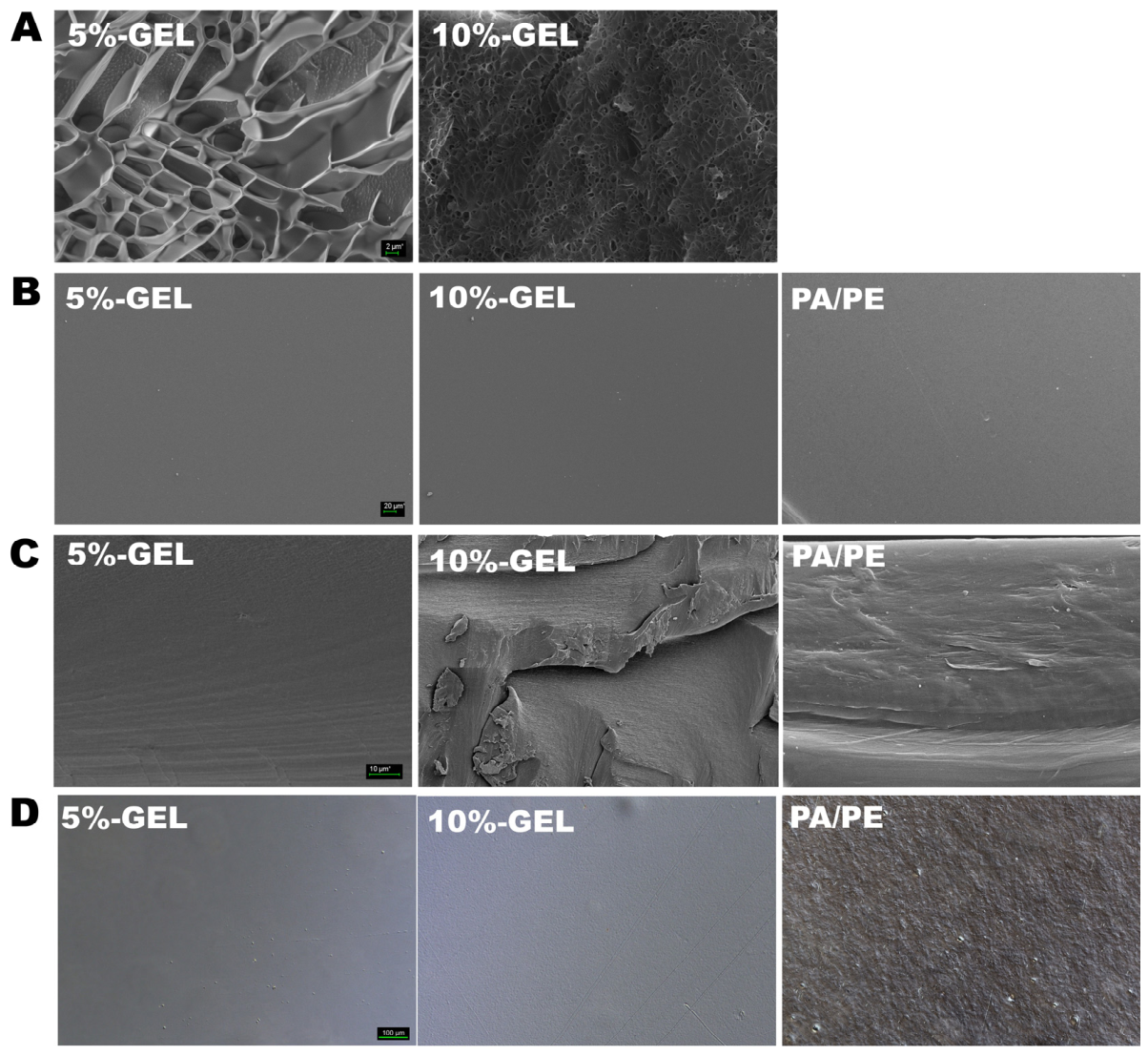
Figure 2.
Light transmittance of 5%- and 10%-gelatin (GEL) film/coating-forming solutions (A), and of 5%-GEL, 10%-GEL, and polyamide/polyethylene (PA/PE) films (B).
Figure 2.
Light transmittance of 5%- and 10%-gelatin (GEL) film/coating-forming solutions (A), and of 5%-GEL, 10%-GEL, and polyamide/polyethylene (PA/PE) films (B).
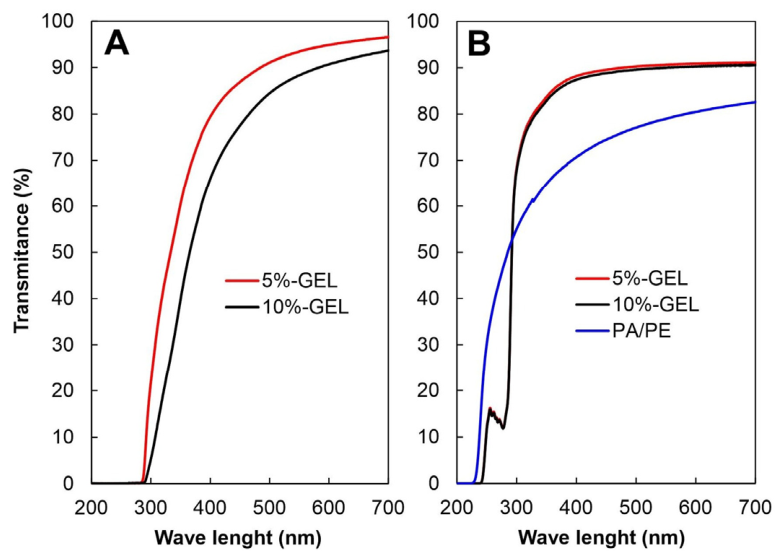
Figure 3.
Wide-angle X-ray diffraction patterns of 5%-gelatin (GEL), 10%-GEL, and polyamide/polyethylene (PA/PE) along with the reference materials: low-density polyethylene (LDPE), α-PA6, and β-PA6 conditioned at 50% relative humidity.
Figure 3.
Wide-angle X-ray diffraction patterns of 5%-gelatin (GEL), 10%-GEL, and polyamide/polyethylene (PA/PE) along with the reference materials: low-density polyethylene (LDPE), α-PA6, and β-PA6 conditioned at 50% relative humidity.
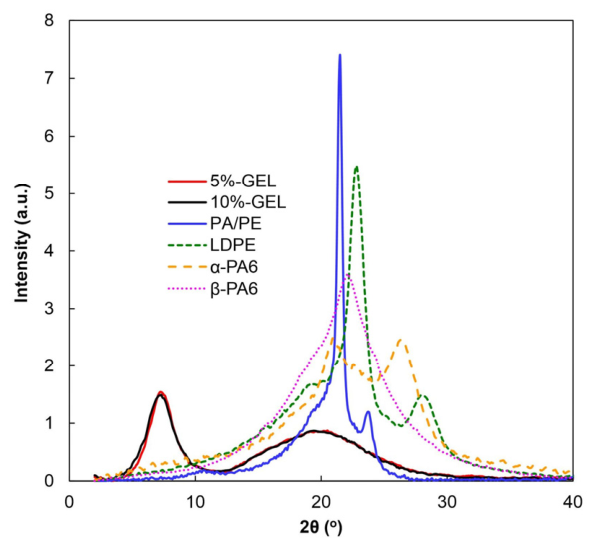
Figure 4.
Effect of relative humidity (RH) on moisture content (MC) (A), water vapor permeability (WVP) (B), puncture strength (PS) (C), and puncture deformation (PD) of 5%- gelatin (GEL), 10%-GEL, and polyamide/polyethylene (PA/PE) films. Values from Δ10 to Δ60 denote the RH gradient across the film.
Figure 4.
Effect of relative humidity (RH) on moisture content (MC) (A), water vapor permeability (WVP) (B), puncture strength (PS) (C), and puncture deformation (PD) of 5%- gelatin (GEL), 10%-GEL, and polyamide/polyethylene (PA/PE) films. Values from Δ10 to Δ60 denote the RH gradient across the film.
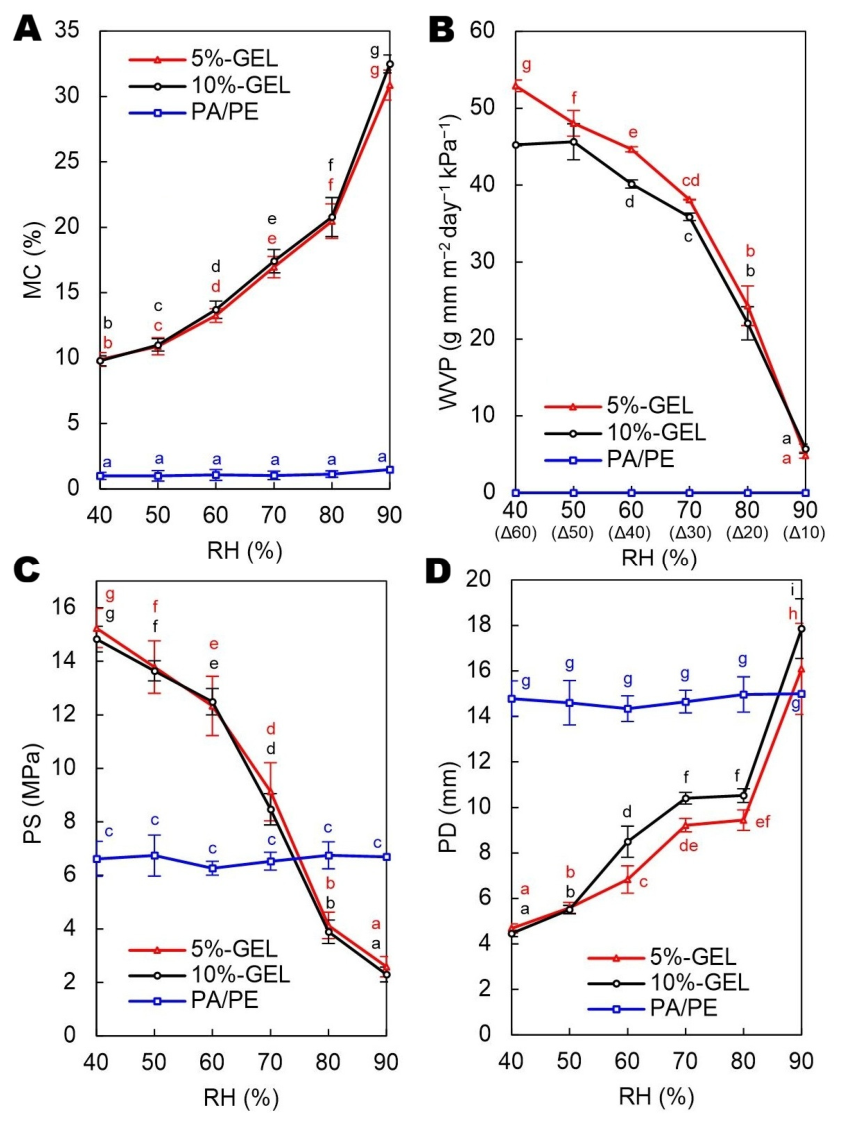

Table 1.
Effect of gelatin (GEL) concentration on the pH, color parameters (lightness, L*; chroma, C; and hue angle, h), opacity (Opa), dynamic viscosity (η), gelation time (tgel), gelation temperature (Tgel), and gel strength (GS) of film/coating-forming solutions.
Table 1.
Effect of gelatin (GEL) concentration on the pH, color parameters (lightness, L*; chroma, C; and hue angle, h), opacity (Opa), dynamic viscosity (η), gelation time (tgel), gelation temperature (Tgel), and gel strength (GS) of film/coating-forming solutions.
| Parameter | 5%-GEL | 10%-GEL |
|---|---|---|
| pH | 5.03 ± 0.02a | 5.09 ± 0.01b |
| L* | 27.06 ± 0.02b | 26.16 ± 0.07a |
| C | 1.61 ± 0.11a | 2.53 ± 0.08b |
| h (o) | 58.97 ± 2.55b | 51.02 ± 1.71a |
| Opa (A600/mm) | 0.0023 ± 0.0003a | 0.0042 ± 0.0005b |
| η (mPa·s) | 9.10 ± 0.20a | 22.97 ± 0.38b |
| tgel (min) | 55.00 ± 1.00b | 24.57 ± 0.58a |
| Tgel (oC) | 25.37± 0.35a | 27.43 ± 0.40b |
| GS (g) | 34.28 ± 3.00a | 147.40 ± 9.54b |
a-b Values with the same superscript letters within a row are not significantly different (p < 0.05).
Table 2.
Thickness, color parameters (lightness, L*; redness, a*; yellowness, b*; and total color difference, ΔE*), opacity (Opa), and antioxidant activity (tABTS50%, time required for 50% ABTS*+ reduction) of 5%-gelatin (GEL), 10%-GEL, and polyamide/polyethylene (PA/PE) films conditioned at 50% relative humidity.
Table 2.
Thickness, color parameters (lightness, L*; redness, a*; yellowness, b*; and total color difference, ΔE*), opacity (Opa), and antioxidant activity (tABTS50%, time required for 50% ABTS*+ reduction) of 5%-gelatin (GEL), 10%-GEL, and polyamide/polyethylene (PA/PE) films conditioned at 50% relative humidity.
| Parameter | 5%-GEL | 10%-GEL | PA/PE |
|---|---|---|---|
| Thickness (μm) | 87.20 ± 1.48a | 91.25± 6.19a | 89.20 ± 0.84a |
| L* | 93.93±0.19b | 93.74 ± 0.16b | 93.22 ± 0.07a |
| a* | 0.21±0.18b | 0.05 ± 0.14b | -0.28 ± 0.07a |
| b* | -9.02±0.11b | -8.96 ± 0.18b | -9.48 ± 0.08a |
| ΔE* | 0.96±0.13b | 0.96 ± 0.15b | 0.69 ± 0.15a |
| Opa (A600/mm) | 0.48±0.02a | 0.48±0.03a | 1.06 ± 0.05b |
| tABTS50% (min) | 8.3±0.3a | 7.8±0.5a | n.e. |
a-b Values with the same superscript letters within a row are not significantly different (p < 0.05). n.e. - not estimable.
Table 3.
Oxygen permeability (cm³ µm m⁻² day⁻¹) of 5%-gelatin (GEL), 10%-GEL, and polyamide/polyethylene (PA/PE) films measured at different relative humidity (RH) levels.
Table 3.
Oxygen permeability (cm³ µm m⁻² day⁻¹) of 5%-gelatin (GEL), 10%-GEL, and polyamide/polyethylene (PA/PE) films measured at different relative humidity (RH) levels.
| RH (%) | 5%-GEL | 10%-GEL | PA/PE |
|---|---|---|---|
| 40 | 157.97 ± 10.76a | 127.75 ± 62.93a | 4234.06 ± 573.64b |
| 50 | 347.06 ± 20.64a | 372.95 ± 37.15a | 4513.78 ± 709.83b |
| 60 | 1195.09 ± 46.32a | 1231.25 ± 224.01a | 5056.72 ± 939.82bc |
| 70 | 2853.33 ÷ 6350.00~ | 3010.67 ÷ 7726.67~ | 6126.23 ± 1317.19c |
| 80 | 9908.33 ÷ 19454.17~ | 10778.33 ÷ 22281.67~ | 7986.08 ± 2049.15d |
| 90 | n.m. | n.m. | 15333.02 ± 1699.42e |
a-e Values with the different superscript are significantly different (p<0.05), ~ - unstable instrument readings, n.m. - not measurable.
Table 4.
Effect of 5%- and 10%-gelatin (GEL) coatings on the lightness (L*), redness (a*), yellowness (b*), and total color difference (ΔE*) of sliced cooked cured pork loin vacuum-packaged in polyamide/polyethylene bags during refrigerated storage.
Table 4.
Effect of 5%- and 10%-gelatin (GEL) coatings on the lightness (L*), redness (a*), yellowness (b*), and total color difference (ΔE*) of sliced cooked cured pork loin vacuum-packaged in polyamide/polyethylene bags during refrigerated storage.
| Parameter | Coating | Storage time (days) | |||
|---|---|---|---|---|---|
| 1 | 7 | 14 | 21 | ||
| L* | Uncoated | 74.92 ± 2.49b | 76.1 ± 2.26b | 75.59 ± 2.79b | 73.3 ± 3.01a |
| 5%-GEL | 76.31 ± 1.6b | 75.22 ± 2.86b | 73.27 ± 1.28a | 72.31 ± 3.17a | |
| 10%-GEL | 76.45 ± 1.14b | 78.16 ± 1.34b | 75.30 ± 1.07b | 77.13 ± 2.12b | |
| a* | Uncoated | 6.79 ± 0.88a | 6.90 ± 0.49a | 7.06 ± 0.76a | 7.57 ± 1.07a |
| 5%-GEL | 5.49 ± 0.81b | 6.01 ± 1.16a | 6.50 ± 1.18a | 7.40 ± 1.63ab | |
| 10%-GEL | 5.41 ± 0.83b | 4.17 ± 1.10b | 6.13 ± 0.83a | 6.31 ± 0.70b | |
| b* | Uncoated | 10.26 ± 0.47a | 9.74 ± 0.43b | 9.34 ± 0.34b | 9.05 ± 0.55ab |
| 5%-GEL | 10.58 ± 1.00a | 9.87 ± 0.71b | 10.66 ± 1.11a | 10.00 ± 1.22a | |
| 10%-GEL | 10.71 ± 0.55a | 11.13 ± 1.16a | 10.75 ± 0.66a | 8.64 ± 0.73b | |
| ΔE* | Uncoated | 1.93 ± 0.48b | 1.26 ± 0.31a | 2.73 ± 0.61bc | 1.38 ± 0.45a |
| 10%-GEL | 2.12 ± 0.74b | 3.69 ± 0.74c | 1.57 ± 0.43ab | 4.06 ± 0.76c | |
a-c Values with the same superscript letters within the same parameter are not significantly different (p < 0.05).
Table 5.
Effect of 5%- and 10%-gelatin (GEL) coatings on water activity (aw), pH, thiobarbituric acid reactive substances (TBARS) content, and total viable count (TVC) of sliced cooked cured pork loin vacuum-packaged in polyamide/polyethylene bags during refrigerated storage.
Table 5.
Effect of 5%- and 10%-gelatin (GEL) coatings on water activity (aw), pH, thiobarbituric acid reactive substances (TBARS) content, and total viable count (TVC) of sliced cooked cured pork loin vacuum-packaged in polyamide/polyethylene bags during refrigerated storage.
| Parameter | Coating | Storage time (days) | |||
|---|---|---|---|---|---|
| 1 | 7 | 14 | 21 | ||
| aw | Uncoated | 0.974 ± 0.008a | 0.975 ± 0.004a | 0.968 ± 0.001a | 0.972 ±0.001a |
| 5%-GEL | 0.984 ± 0.004b | 0.980 ± 0.001b | 0.976 ± 0.001a | 0.976 ± 0.002a | |
| 10%-GEL | 0.983 ± 0.007b | 0.979 ± 0.002b | 0.976 ± 0.001a | 0.976 ± 0.001a | |
| pH | Uncoated | 6.17 ± 0.099a | 6.35 ±0.008c | 6.31 ± 0.022c | 6.22 ± 0.039b |
| 5%-GEL | 6.24 ± 0.010a | 6.23 ± 0.016a | 6.11 ± 0.005a | 6.08 ± 0.010a | |
| 10%-GEL | 6.12 ± 0.013a | 6.29 ± 0.015b | 6.18 ± 0.026b | 6.12 ± 0.006a | |
| TBARS (mg MDA/kg) |
Uncoated | 0.080 ± 0.013c | 0.015 ± 0.002a | 0.022 ± 0.002a | 0.042 ± 0.003b |
| 5%-GEL | 0.023 ± 0.003a | 0.155 ± 0.032e | 0.160 ± 0.007e | 0.119 ± 0.001d | |
| 10%-GEL | 0.051 ± 0.003b | 0.162 ± 0.047e | 0.120 ± 0.005d | 0.180 ± 0.009f | |
| TVC (log CFU/g) |
Uncoated | 4.40 ± 0.02a | 6.15 ± 0.04c | 7.04 ± 0.03d | 7.32 ± 0.04e |
| 5%-GEL | 4.41 ± 0.03a | 7.08 ± 0.05d | 8.00 ± 0.04f | 7.92 ± 0.05f | |
| 10%-GEL | 5.43 ± 0.03b | 6.92 ± 0.06d | 7.95 ± 0.05f | 7.80 ± 0.04f | |
a–f Values with the same superscript letters within the same parameter are not significantly different (p < 0.05). MDA- malondialdehyde, CFU - colony forming unit (were converted to their logarithmic values before statistical analysis).
Disclaimer/Publisher’s Note: The statements, opinions and data contained in all publications are solely those of the individual author(s) and contributor(s) and not of MDPI and/or the editor(s). MDPI and/or the editor(s) disclaim responsibility for any injury to people or property resulting from any ideas, methods, instructions or products referred to in the content. |
© 2026 by the authors. Licensee MDPI, Basel, Switzerland. This article is an open access article distributed under the terms and conditions of the Creative Commons Attribution (CC BY) license (http://creativecommons.org/licenses/by/4.0/).
Copyright: This open access article is published under a Creative Commons CC BY 4.0 license, which permit the free download, distribution, and reuse, provided that the author and preprint are cited in any reuse.


