

Submitted:
22 July 2026
Posted:
23 July 2026
You are already at the latest version
Abstract
Regardless of whether consciousness is viewed as integrated information, a sensory input, a quantum process involving “brain microtubules”, a generative mental model, or else, its origins unavoidably lie in genetic coding, transcriptional variations, and protein synthesis. If the deepest mystery in biology, the genetic code, is solvable through basic biochemistry and evolution, consciousness, as its byproduct, must be governed by the same natural laws. Just as the genetic code, consciousness required specific evolutionary pressures to emerge, develop, and sustain its primary function. It is therefore only logical to suggest that the nature of consciousness is defined by the same molecular mechanisms that control all essential life processes in multicellular organisms – the code, its expression and its translation. Accordingly, this view posits that consciousness originates from the unique genomic signatures within neurons and the brain’s electrochemical circuity is a secondary result rather than the primary cause.
Keywords:
consciousness
; evolution
; genetic code
; gene expression
1. Introduction
There are two mainstream theories of the origin of consciousness: integrated information theory, or IIT, which argues that consciousness arises from the capacity to integrate information [1] and global neuronal workspace theory, or GNWT [2], that assumes consciousness is a result of long-distance neural connectivity, which provides a global network for sharing information between multiple specialized brain areas.
Despite their prominence, it is quite obvious to a biologist outside this highly specialized field that both theories are more abstract and metaphysical than they are empirical and evolutionarily viable models. It is likely because the nature of consciousness was and is often associated with philosophical, mathematical, psychological and spiritual nuances rather than with purely biological inquiries.
What was the “light bulb” that suddenly illuminated the darkness of small brains of Australopithecus anamensis or Australopithecus afarensis making them to eventually transform into larger “cognitive devices”? What was the starting point of this breathtaking evolution that initiated the origin of consciousness in an “evolutionary correct”, Darwinian, way? Natural selection is the main driver of evolution. At the molecular level, natural selection relies on genetic variations created by random changes in DNA sequences. It is thus theoretically possible that consciousness may have emerged when the genetic code bearing a handful of beneficial mutations yielded novel, functionally advantageous protein(s) critical to neural processing and brain development.
This process sequentially paved the way to rudimentary neural frameworks intended for a particular cognitive experience, for instance, a more sophisticated stress response. Put simply, the basic mechanisms of molecular biology that govern all essential processes of life in multicellular organisms - genetic coding, transcription, and translation - determined how consciousness originated, how it evolved, and what it actually is. Driven by the unique genomic signatures within neurons, consciousness makes electrochemical wiring a mere tool for its expansion rather than the cause of cognitive experience.
2. Main Text
The DNA molecule is composed of billions of carbon, oxygen, nitrogen, phosphorus and hydrogen atoms structured into monomers, then polymers and then inexplicably into ordered sequence that carries information and constitutes the genetic code of life. Similarly, the roughly 86 billion neurons of the human brain assemble into dynamic and sequential neural circuits working in unison to generate consciousness as an ultimate result. If basic biochemistry and natural selection can largely explain the origin of the genetic code - arguably biology’s most complex problem - then consciousness, as a product of the genetic code, must be explainable by the same fundamental mechanisms or at least follow a parallel pattern.
Previous proposals argued that the evolution of the genetic code was driven by the need to secure early RNA molecules within protective shells, a process that sequentially fostered specific amino acid-RNA interactions and enabled primitive coding instructions to produce multiple copies of a single protein [3]. Much like the emergence of the genetic code, the origin of consciousness should have required a similar evolutionary force that would offer specific advantages to ensure survival of early hominids in harsh environments.
The initial adaptations must have originated from underlying genetic mutations favored by natural selection due to their contribution to survival and fitness. Just as O, H, N, C , and P atoms during the Early Earth and RNA World [4] organized into RNA rather than other chemical compounds, primitive consciousness likely began when the genetic code bearing these specific mutation(s) led to a rudimentary neural network intended for a particular cognitive experience, for instance, a more sophisticated stress response.
Analogous to the code triplets, individual neurons within this minimum neural assemble would coordinate and rearrange their synaptic plasticity to produce and transmit a unique message to neighboring networks, eventually building a goal-oriented circuit architecture indirectly comparable with translation of the genetic code into functional proteins. Gradually, multiple purpose-built organized patterns of synaptic connectivity would allow brain to multitask, simultaneously processing different information and achieving survival-driven goals by integrating primitive reflexes into learned, pre-cognitive actions. These behaviors will be refined by scrutinizing pressure of natural selection evolving into rudimentary forms of mental processes and proto-cognition, in the end maturing into primitive thinking and full cognitive ability (Figure 1).
This mechanism closely resembles the formation of protein-protein interaction networks essential to organ development and function. Indeed, as Nature frequently repurposes universal ‘machinery’ to perform diverse functions, it is plausible that the origin, evolution, and the very essence of consciousness might be rooted in the same foremost principles as the genetic coding and translation.
What novel perspective does this assumption offer on the extensively researched problem of consciousness, a field already saturated with theories? While the evolutionary origin of consciousness as a mechanism for survival and social coordination is evident, the nature of this brain activity is unknown. Comparing consciousness with the origin and significance of the genetic code from which it unequivocally emerged, provides a clear answer to this fundamental question: the nature of consciousness is determined by the same molecular mechanisms that govern all essential life processes in multicellular organisms –the genetic code, gene expression, transcriptional regulation, epigenetic remodeling, post-transcriptional controls, and protein translation.
In other words, whether consciousness is a product of information sharing [2]; an integrated information itself [5]; a result of sensory input [6]; a process rooted in quantum mechanics and “brain microtubules” [7]; a generative model constantly updating a mental status of the world [8]; or else [9,10], it ultimately stems from the genetic coding, transcriptional variations, and production of distinct proteins.
This is why the mechanisms of consciousness should be studied at the levels of molecular biology, genetics and functional genomics rather than through philosophy, mathematics, physics, or psychology. Regrettably, this approach remains largely, if not entirely, unexplored as none of the current theories focuses on these aspects of consciousness’s nature and origin, arguing instead about “excitable membranes”, “consciousness in single cell”, “biocivilisations”, or importance of vague “molecular perspectives” [11,12,13,14,15].
Evolution is powered by natural selection. At the molecular scale, it relies on random changes in DNA sequences. Accordingly, the genesis of consciousness can undoubtedly be linked to advantageous mutations responsible for unique proteins facilitating critical neural processes. It is theoretically possible that the evolution of consciousness in primates began with just one genetic mutation that radically transformed their behavior and physiology.
For instance, a single C-to-G point mutation that happened between 1.5 and 0.5 mya in the duplicated ARHGAP11B gene, encoding Rho GTPase-activating protein 11B and present in modern humans, Neanderthals, and Denisovans, but not in chimpanzees (Florio et a. 2015), triggered a 55-nucleotide deletion, altering the protein’s C-terminal sequence. These changes enabled the protein to move from the nucleus to the mitochondria, allowing it to drive increased basal progenitor proliferation crucial for neocortex expansion and a larger brain [16,17,18,19]. High expression of this gene in radial glial cells caused evolutionary expansion of human neocortex, the primary site for consciousness [20].
If basic processes of molecular biology originating in the RNA World, a predecessor of the “Central Dogma” [4], catalyzed the emergence of consciousness, what mechanisms, beyond physically shaping brain’s structure, enabled them to facilitate information processing? Key processes responsible for conscious sensations - the synaptic neurotransmission and high-frequency action potentials – depend entirely on the gene expression, although in obviously different ways. Differential gene expression leads to structural and functional changes in neurons and resulting neural activity translates through a series of signals into coordinated pattern that brain interprets as a cognitive event.
In other words, consciousness arises from the unique genomic/transcriptomic signatures within neurons and electrochemical “wiring” is the subsequent process rather than a starting point. Unlikely being associated with an elusive state of “DNA consciousness” or a sci-fi-like condition of “cellular consciousness” [13,21], it is most probably a sustained product of selective activation or repression of specific genes to perform distinct tasks, although doubtfully related to “meditation techniques” [22]. It is no wonder, then, that a control hub of three miRNAs and three protein-coding genes was recently discovered to orchestrate a network of over 4,000 genes linked to human personality and self-awareness, solidifying the role of gene expression in these core experiences of consciousness [23].
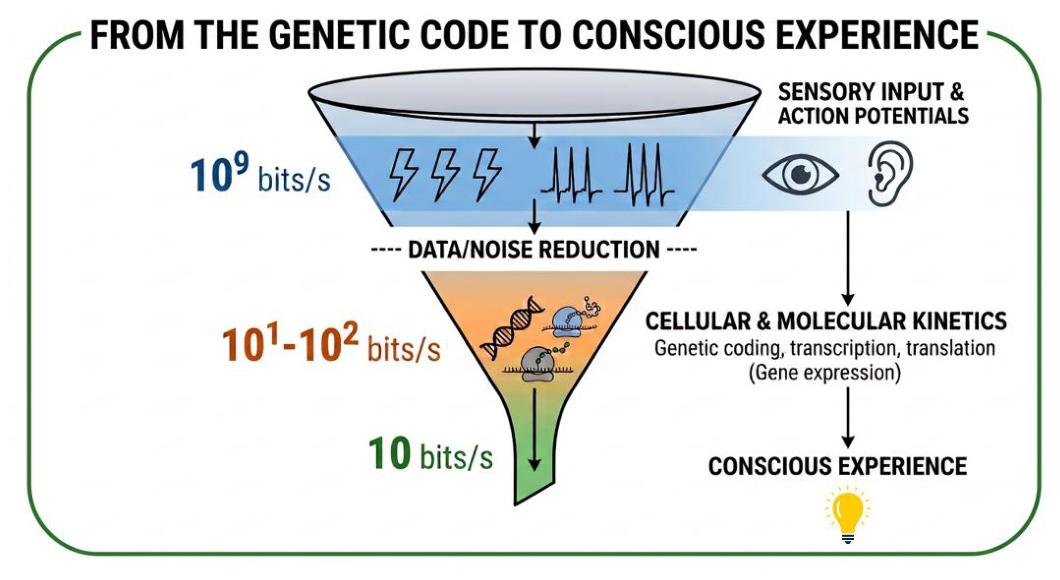
Recent data suggested that conscious processing speed is ~ 10 bits per second, much slower than that of sensory data ~ 109 bits/s [24]. The speed of eukaryotic genetic processing such as transcription and translation on individual and molecular scale is approximately 36–84 bits/s and ~12–120 bits/s, respectively [25,26], and the dynamic speed of the whole cell, or global, genetic processing is likely much faster since a human cell doesn’t just run one gene at a time and is a parallel processor.
Therefore, the conscious experience (~ 10 bits/s) aligns more closely with the slower timescale of cellular and molecular kinetics (~ 101-102 bits/s) rather than with the rapid neuronal spikes (~103 bits/s) or a massive human sensory input (~ 109 bits/s [24], (Figure 2).
That is to say, the aggregate genetic activity of the cell not merely builds biological machinery required for information to be integrated, but also actively generates thoughts as the direct output of millions of synchronized molecular events. Afterall, if universal transcriptomic signatures can modulate aging, lifespan, health and mortality [27], why would not they also control our cognitive processes and intellectual functions? Perhaps this is a path that future consciousness research can look into more closely.
3. Conclusions
In summary, both the “hard” and the “easy” problems of consciousness [28] are comparable with the enigma of the genetic code. If laws of chemistry and evolution can explain the origin of the genetic code, then consciousness, as a byproduct of the code, likely operates under the same biological principles or follows a parallel logical pattern.
Is this perspective strictly mechanistic and dismissing all philosophico-spiritual attempts to explain consciousness as a pure expression of mind detached from any biological processes? Yet the whole human organism operates as a finely tuned biological entity, a complex infrastructure and a continuum sustained by billions of interconnected cellular and molecular events - from the genetic coding, transcription and translation to protein networks and cell signaling. Mental processes cannot possibly be excluded from this rule. Therefore, the “easy” problems of consciousness explainable by science may actually unlock the answer to the “hard” problem—the true origin of conscious experience [28]. Within this concept, neural nets and their dynamic communication systems is a “hardware”, or a physical scaffold of the conscious brain, while the genetic code, genomic architecture, gene expression and protein interaction networks is the software that brings the process of consciousness to life.
Author Contributions
The author confirms sole responsibility for the conception, design, analysis, interpretation, drafting, and final approval of the manuscript.
Funding
This study was supported by the United States Department of Agriculture, the Agricultural Research Service, CRIS number 8042-21500-003-000D.
Data Availability Statement
No data were generated as a result of this study.
Conflicts of Interest
The author declares that he has no competing interests.
Declaration on the use of artificial intelligence
Generative AI has not been used for writing this manuscript. During the preparation of this work the author used Google Gemini and Google search tools to search and review available literature on the subject, to analyze data as part of the research process, and to improve language and readability. After using the tools, the author thoroughly reviewed and evaluated the content as needed and takes full responsibility for the content of the publication.
References
- Tononi, G. An information integration theory of consciousness. BMC Neurosci. 2004, 5, 42. [Google Scholar] [CrossRef] [PubMed]
- Dehaene, S.; Kerszberg, M.; Changeux, J.P. A neuronal model of a global workspace in effortful cognitive tasks. Proc. Natl. Acad. Sci. USA 1998, 95, 14529–14534. [Google Scholar] [CrossRef] [PubMed]
- Nemchinov, L.G. The genetic code as a hypothetical product of primordial viral evolution. Npj Viruses 2026. Online ahead of print. [Google Scholar] [CrossRef]
- Gilbert, W. Origin of life: The RNA world. Nature 1986, 319, 618–619. [Google Scholar] [CrossRef]
- Tononi, G. Consciousness as integrated information: A provisional manifesto. Biol. Bull. 2008, 215, 216–242. [Google Scholar] [CrossRef] [PubMed]
- Lamme, V.A. Towards a true neural stance on consciousness. Trends Cogn. Sci. 2006, 10, 494–501. [Google Scholar] [CrossRef] [PubMed]
- Penrose, R. Shadows of the Mind: A Search for the Missing Science of Consciousness; Oxford University Press: Oxford, UK, 1994. [Google Scholar]
- Hohwy, J.; Seth, A. Predictive processing as a systematic basis for identifying the neural correlates of consciousness. Philos. Mind Sci. 2020, 1, 3. [Google Scholar] [CrossRef]
- Brown, R.; Lau, H.; LeDoux, J.E. Understanding the higher-order approach to consciousness. Trends Cogn. Sci. 2019, 23, 754–768. [Google Scholar] [CrossRef] [PubMed]
- He, B.J. On the role of theories in consciousness science. Commun. Psychol. 2025, 3, 173. [Google Scholar] [CrossRef] [PubMed]
- Prentner, R. Consciousness: A molecular perspective. Philosophies 2017, 2, 26. [Google Scholar] [CrossRef]
- Reber, A.S.; Baluška, F. Cognition in some surprising places. Biochem. Biophys. Res. Commun. 2021, 564, 150–157. [Google Scholar] [CrossRef] [PubMed]
- Reber, A.S.; Miller, W.B.; Slijepcevic, P.; Baluska, F. The CBC theory and its entailments. EMBO Rep. 2023, 24, e58140. [Google Scholar]
- Edelman, G.M.; Gally, J.A.; Baars, B.J. Biology of consciousness. Front. Psychol. 2011, 2, 4. [Google Scholar] [CrossRef] [PubMed]
- Slijepcevic, P. Biocivilisations: A New Look at the Science of Life; Chelsea Green Publishing: White River Junction, VT, 2023. [Google Scholar]
- Florio, M.; Albert, M.; Taverna, E.; Namba, T.; Brandl, H.; Lewitus, E.; Haffner, C.; Sykes, A.; Wong, F.K.; Peters, J.; et al. Human-specific gene ARHGAP11B promotes basal progenitor amplification and neocortex expansion. Science 2015, 347, 1465–1470. [Google Scholar] [CrossRef] [PubMed]
- Florio, M.; Namba, T.; Pääbo, S.; Hiller, M.; Huttner, W.B. A single splice site mutation in human-specific ARHGAP11B causes basal progenitor amplification. Sci. Adv. 2016, 2, e1601941. [Google Scholar] [CrossRef] [PubMed]
- Namba, T.; Dóczi, J.; Pinson, A.; Xing, L.; Kalebic, N.; Wilsch-Bräuninger, M.; Long, K.R.; Vaid, S.; Lujan-Metelmann, I.; Kondati, A.K.; et al. Human-specific ARHGAP11B acts in mitochondria to expand neocortical progenitors by glutaminolysis. Neuron 2020, 105, 867–881.e9. [Google Scholar] [CrossRef] [PubMed]
- Kalebic, N.; Gilardi, C.; Albert, M.; Namba, T.; Long, K.R.; Kostic, M.; Langen, B.; Huttner, W.B. Human-specific ARHGAP11B induces hallmarks of neocortical expansion in developing ferret neocortex. eLife 2018, 7, e41241. [Google Scholar] [CrossRef] [PubMed]
- Crick, F.; Koch, C. Towards a neurobiological theory of consciousness. Semin. Neurosci. 1990, 2, 263–275. [Google Scholar]
- Grandy, J.K. The three dynamic levels of DNA consciousness. Int. J. Arts Sci. 2013, 6, 313–327. [Google Scholar]
- Ravnik-Glavač, M.; Hrašovec, S.; Bon, J.; Dreo, J.; Glavač, D. Genome-wide expression changes in a higher state of consciousness. Conscious. Cogn. 2012, 21, 1322–1344. [Google Scholar] [CrossRef] [PubMed]
- del Val, C.; Díaz de la Guardia-Bolívar, E.; Zwir, I.; Mishra, P.P.; Mesa, A.; Salas, R.; Poblete, G.F.; de Erausquin, G.; Raitoharju, E.; Kähönen, M.; et al. Gene expression networks regulated by human personality. Mol. Psychiatry 2024, 29, 2241–2260. [Google Scholar] [CrossRef] [PubMed]
- Zheng, J.; Meister, M. The unbearable slowness of being: Why do we live at 10 bits/s? Neuron 2025, 113, 192–204. [Google Scholar] [CrossRef] [PubMed]
- Pérez-Ortín, J.E.; Alepuz, P.M.; Moreno, J. Genomics and gene transcription kinetics in yeast. Trends Genet. 2007, 23, 250–257. [Google Scholar] [CrossRef] [PubMed]
- Prabhakar, A.; Choi, J.; Wang, J.; Petrov, A.; Puglisi, J.D. Dynamic basis of fidelity and speed in translation: Coordinated multistep mechanisms of elongation and termination. Protein Sci. 2017, 26, 1352–1362. [Google Scholar] [CrossRef] [PubMed]
- Tyshkovskiy, A.; Kholdina, D.; Davitadze, M.; et al. Universal transcriptomic hallmarks of mammalian ageing and mortality. Nature 2026, 654, 173–188. [Google Scholar] [CrossRef] [PubMed]
- Chalmers, D.J. Facing up to the problem of consciousness. J. Conscious. Stud. 1995, 2, 200–219. [Google Scholar]
Figure 1.
A simplistic view of the gradual emergence of consciousness relative to the fundamental biological processes of life. Oxygen (O), Carbon (C), Hydrogen (H), Nitrogen (N), and Phosphorus (P) atoms as building blocks of biological life; DE, differential gene expression.
Figure 1.
A simplistic view of the gradual emergence of consciousness relative to the fundamental biological processes of life. Oxygen (O), Carbon (C), Hydrogen (H), Nitrogen (N), and Phosphorus (P) atoms as building blocks of biological life; DE, differential gene expression.
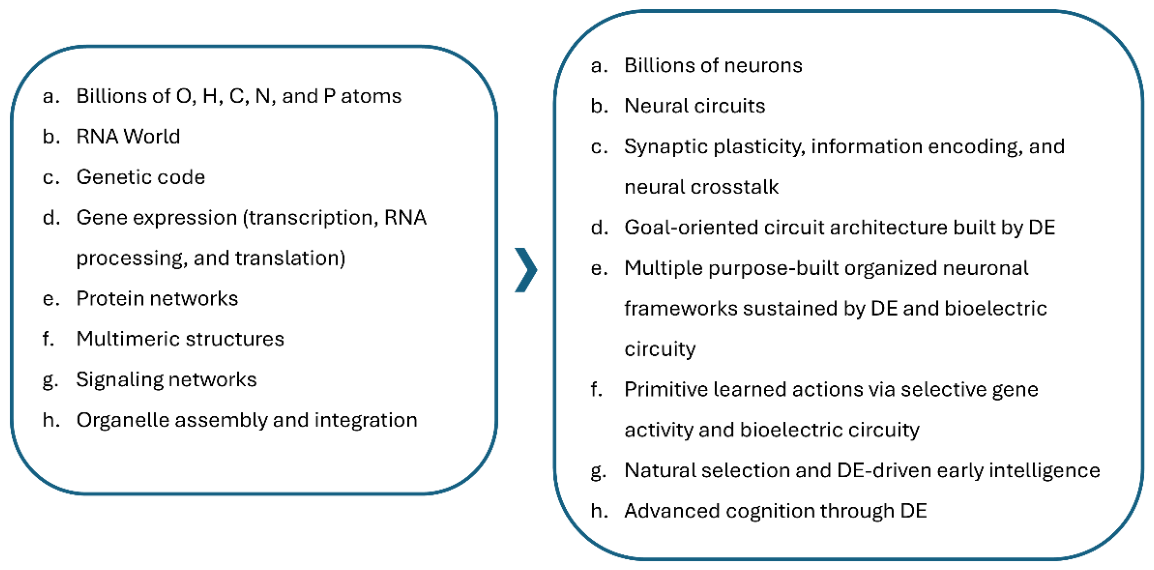
Figure 2.
An oversimplified diagram of conscious throughput via cellular and molecular pathways. High-volume sensory input enters the brain too quickly to match a much slower stream of consciousness, while cellular and molecular processes governing gene coding and expression operate on a timescale that aligns with conscious experience. Image created using Gemini tool (Google, 2026) based on the directions provided by the author to illustrate the concept. The final image was curated and verified for technical accuracy by the author.
Figure 2.
An oversimplified diagram of conscious throughput via cellular and molecular pathways. High-volume sensory input enters the brain too quickly to match a much slower stream of consciousness, while cellular and molecular processes governing gene coding and expression operate on a timescale that aligns with conscious experience. Image created using Gemini tool (Google, 2026) based on the directions provided by the author to illustrate the concept. The final image was curated and verified for technical accuracy by the author.
Disclaimer/Publisher’s Note: The statements, opinions and data contained in all publications are solely those of the individual author(s) and contributor(s) and not of MDPI and/or the editor(s). MDPI and/or the editor(s) disclaim responsibility for any injury to people or property resulting from any ideas, methods, instructions or products referred to in the content. |
© 2026 by the authors. Licensee MDPI, Basel, Switzerland. This article is an open access article distributed under the terms and conditions of the Creative Commons Attribution (CC BY) license (http://creativecommons.org/licenses/by/4.0/).
Copyright: This open access article is published under a Creative Commons CC BY 4.0 license, which permit the free download, distribution, and reuse, provided that the author and preprint are cited in any reuse.


