

Submitted:
19 July 2026
Posted:
23 July 2026
You are already at the latest version
Abstract
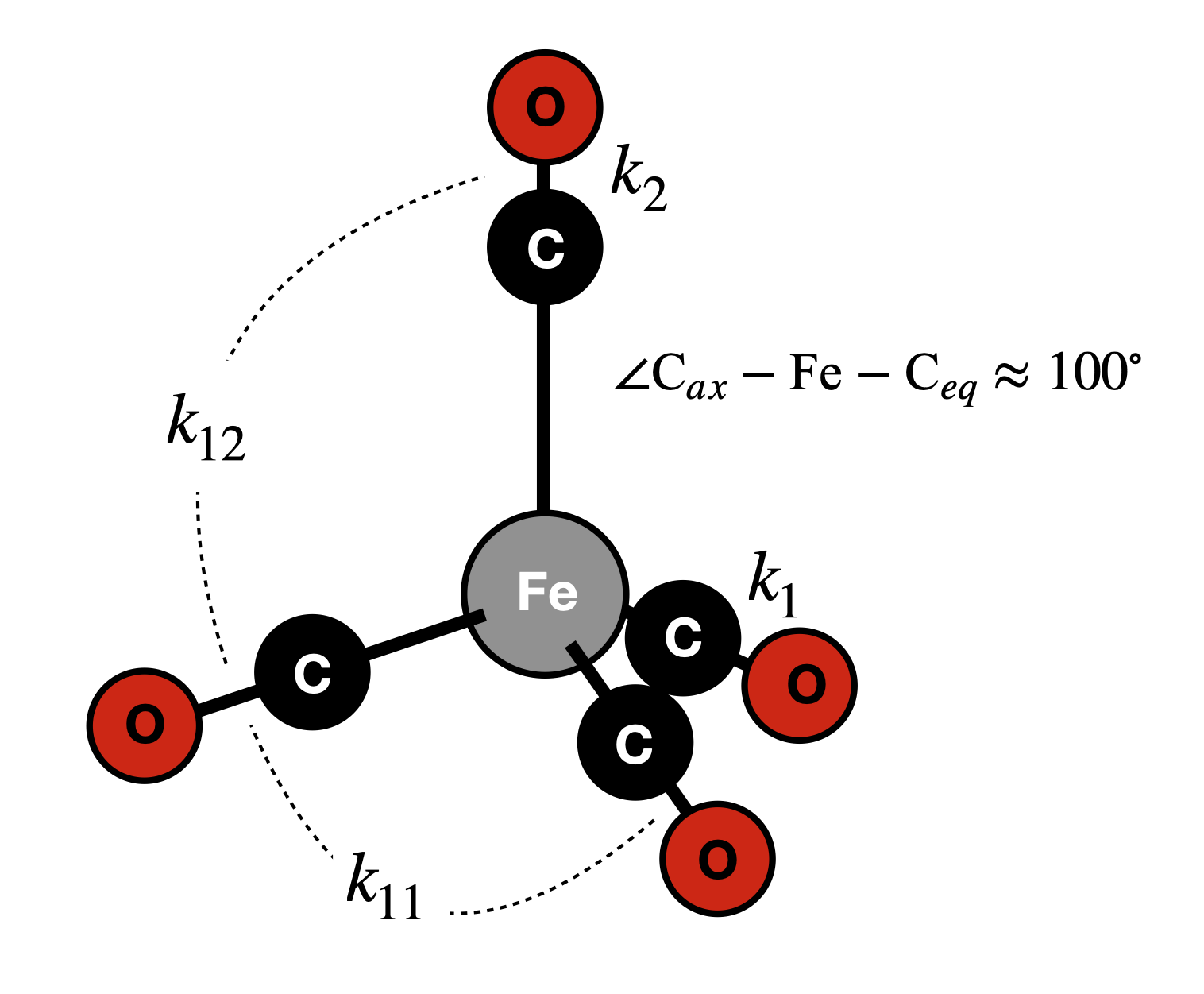
The 17-e anion, [Fe(CO)4]- , was first characterised in 1981 by Breeze et al. We subsequently challenged their interpretation, suggesting that they had produced [Fe(CO)3]-. In the light of new calculations here, we withdraw that view. We confirm that [Fe(CO)4]- has the C3v structure (as previously reported) and we have calculated the following, new, energy-factored force constants: k1 = 1437.2 k2 = 1456.2 k11 = 48.6 k12 = 47.7 where k1 refers to the three chemically identical equatorial CO groups and k2 refers to the sole axial CO group ( k11 and k12 are the CO,CO interaction constants). This force field is significantly different from that originally proposed.
Keywords:
transition metal carbonyl
; radical ion
; matrix isolation
; Wilson-FG force constants
Introduction
Breeze et al [1] claimed that the 17-e anion [Fe(CO)4]- is produced when matrix-isolated Fe(CO)5 is irradiated with vacuum-UV. The IR spectrum [1] of [Fe(CO)4]- in a cryogenic matrix (argon at 10K) shows two well resolved bands at 1864.2 and 1854.1 cm-1. There is no observed high-frequency band that might be attributed to the symmetric breathing mode of the CO groups but this would, in all probability, be of very low intensity. Calculations by us many years ago [2] suggested that the molecule posited as [Fe(CO)4]- was, in fact, [Fe(CO)3]- but we now recognise that this view is certainly incorrect and the observed molecule is, as first described, the C3v tetracarbonyl anion, [Fe(CO)4]-.
However, the published energy-factored force field calculated for [Fe(CO)4]- is, with equal certainty, erroneous, and worth further investigation to give a more accurate picture of the bonding in [Fe(CO)4]-.
In metal carbonyl molecules and their fragments, isoelectronic molecules are also, invariably, isostructural [1] and we can utilise this fact. For [Fe(CO)4]- there is a well-characterised isoelectronic 17-e molecule that we can use: Co(CO)4. This was produced [3] by photolysis of Co(CO)3(NO) in a CO matrix at 20K and, using 13CO substitution, the molecule was shown to have a C3v structure with an axial-equatorial bond angle of around 100° (based on the relative band intensities of the various 12CO/13CO molecules). We would confidently expect that [Fe(CO)4]- has very nearly the same structure as Co(CO)4 and, indeed, a C3v structure is expected [1] on theoretical grounds.
Other experiments [4] confirmed the existence of one of the observed bands (at 1854 cm-1) of [Fe(CO)4]- although the weaker band (1864 cm-1) was missing. For [Ru(CO)4]- and [Os(CO)4]-, where one might have hoped for some extra insight, Andrews and Zhou maintain that two structural isomers co-exist in a neon matrix. One form exhibits the C3v geometry like [Fe(CO)4]-, and the other form purportedly has a D2d structure [5]. Their evidence is, however, inconclusive and gives no additional clues as to the force field of [Fe(CO)4]-.
Before offering an alternative force field, it is useful to demonstrate why we believe that the original force field is incorrect. Comparing the published force fields (see Table 1) of [Fe(CO)4]- and Co(CO)4 is instructive.
We made the point previously [2] that the force constants calculated by Breeze et al were suspect in two respects: the CO-stretching force constants were approximately 50 Nm-1 too low (the difference in CO-stretching force constants is usually around 200 Nm-1 between isoelectronic pairs [6]) and, even more obvious, the CO,CO interaction constants are much too low (by around 12 Nm-1 or 35%) in the calculated [Fe(CO)4]- force field. It is well-established [7] that when CO-stretching force constants fall, the associated CO,CO force constants rise. The published force field of [Fe(CO)4]-has CO,CO-interaction constants that are smaller than and this is certainly incorrect. In fairness, the behaviour of CO,CO-interaction constants in an energy-factored force field was still poorly understood at the time Breeze et al carried out this work. We show below that there is an alternative force field that is much more in tune with what we now know about CO energy-factored force fields.
Results
Although the results have been available for 50+ years, it has not been hitherto noticed that an excellent straight line results when the mean CO force constant (energy-factored force constants are used throughout) of a tetracarbonyl, M(CO)4, is plotted against the number of d-electrons (see Appendix 1 for details). All of the uncharged molecules Cr(CO)4, Fe(CO)4, Co(CO)4 and Ni(CO)4 are on this line (as are Mo(CO)4 and W(CO)4 which are very close to Cr(CO)4). We might intuitively expect that the tetracarbonyl anions might be on a corresponding line. We might also hope that the shift in the CO force constant from Ni(CO)4 to the isoelectronic [Co(CO)4]- might be mirrored in the shift from Co(CO)4 to the isoelectronic [Fe(CO)4]-. The relevant CO force constants and prediction for [Fe(CO)4]- are in Table 2.
So, if the shift from Ni(CO)4 to [Co(CO)4]-is 237 Nm-1 we can surmise that the corresponding shift from Co(CO)4 to [Fe(CO)4]- would be similar and this gives us a mean CO force constant of 1444 Nm-1 for [Fe(CO)4]-.
We might, alternatively, approach this differently. The change in the mean CO-stretching force constant shift from Co(CO)4] to [Co(CO)4]- is 196 Nm-1. If we apply this shift to Fe(CO)4 (which has a mean kCO of 1635 Nm-1 in an Ar matrix [7]) to give [Fe(CO)4]- we would have an average CO force constant of 1439 Nm-1 - very close to the calculation above.
Using both calculations, we arrive at a mean kCO value of 1442 Nm-1 which is significantly higher than the 1427 Nm-1 reported as a mean value of kCO in ref. 1.
Assuming that [Fe(CO)4]- has a C3v geometry similar to Co(CO)4, it should have three infrared CO-stretching vibrations (2a1+e). The lower a1 stretch may be higher or lower than the e mode - there is no a priori way of predetermining this. The higher a1 stretch (essentially a breathing mode of the three “equatorial” CO groups) will be at a higher frequency than the other two frequencies [8]. We would expect this stretch to be very weak in the IR and mixed with the low frequency a1 stretch. The e mode is expected to be the strongest as it is the doubly degenerate asymmetric stretch of the three equatorial CO groups with the greatest dipole change.
The secular equations linking these force constants and the symmetry force constants for the three vibrations are:
This is a typical case of an underdetermined energy-factored force field; there are three possible observable CO stretching frequencies but four force constants. This is exacerbated by the fact that one of the frequencies is not observed. So we have four force constants but only two observed frequencies.
Without recourse to isotopic substitution with good data about the weak, high frequency CO-stretches, there exists an infinite range of solutions for the force field of [Fe(CO)4]- and we can only hope to offer a valid and reliable solution.
An obvious starting point is to make:
and find a solution to this by assuming that k2 > k1 by 19 Nm-1 (as is found in Co(CO)4).
This provides a workable solution to the force field (all in Nm-1):
| k1 = 1437.2 | k2 = 1456.2 | k11 = 48.6 | k12 = 47.7 |
This also provides a frequency for the higher a1 stretch at 1982 cm-1 (much higher than predicted in Ref.1 where the estimated frequency was 1945.8 cm-1). Note that k11 > k12 as would be expected in a near-tetrahedral [Fe(CO)4]- where k1 < k2.
If this force field is accurate, it would be able to predict the frequencies of the isotopically labelled species [Fe(12CO)4-x(13CO)x]- . There are 12 observed 12CO/13CO bands in Ref 1. These are all “low frequency” CO-stretching modes. No high frequency stretches were observed - a great pity since it would have stabilised the iterative process used to determine the force constants. However, even with this caveat, the predicted, unrefined frequencies are very close to those observed. The RMS error (in observed - calculated) is 1.24 cm-1 with a maximum error of 3.9 cm-1 on a partially resolved band. Full details are in given in Appendix 2.
Comparing the force field from Ref. 1 and that calculated here we can see the differences:

Table 3.
Contrasting Force Fields for [Fe(CO)4]- (in Nm-1).
| Force Constant | [Fe(CO)4]- (this work) | [Fe(CO)4]- (Ref. 1) |
|---|---|---|
| k1 | 1437 | 1425 |
| k2 | 1456 | 1431 |
| k11 | 49 | 38 |
| k12 | 48 | 30 |
Conclusion
This short analysis strongly suggests that it was [Fe(CO)4]- that was the molecule observed by Breeze et al. It is equally certain that the force field for [Fe(CO)4]- that resulted from the analysis of the 12CO/13CO data was incorrect. The unrefined force constants here replicate the observed isotopic spectra very closely. All of the force constants make chemical sense: the stretching force constants are where one might expect them to be, the CO,CO interaction constants are the right magnitude.
It would be interesting to examine the original spectra to see whether any CO bands are visible around 1980 cm-1 although it is more than likely that these bands are obscured by Fe(CO)5, Fe(CO)4 and Fe(CO)3 species also present in the matrix. Mischievously, we wonder will [Fe(CO)3]- ever be discovered?
Acknowledgments
The author wishes to thank Prof. J. J. Turner for useful discussions over several decades.
Conflicts of Interest
The author declares no conflicts of interest.
Appendix A
Matrix isolation experiments in the 1970’s produced a substantial number of well-characterised carbonyl fragments. We focus here on the tetracarbonyls produced as follows: Cr(CO)4 produced by UV Photolysis of Cr(CO)6 in inert matrices (Ar, CH4 etc.) by Turner and Perutz9; Fe(CO)4 produced by UV Photolysis of Fe(CO)5 in inert matrices (Ar, SF6, CH4 etc.) by Turner and Poliakoff [10], [11] and Co(CO)4 produced by UV Photolysis of in a CO matrix by Turner et al [4]; Ni(CO)4 (room temperature alkane solution) has had a force field determined by Bor [12].
The photolytic fragments Mo(CO)4 and W(CO)4 were also characterised by Perutz and Turner [10]. These six tetracarbonyls and their mean CO force constants (in Nm-1) are listed in Table A1.1
Table A1.
| Molecule | Mean kCO | n (d-electrons) |
|---|---|---|
| Cr(CO)4 | 1539 | 6 |
| Mo(CO)4 | 1544 | 6 |
| W(CO)4 | 1535 | 6 |
| Fe(CO)4 | 1630 | 8 |
| Co(CO)4 | 1681 | 9 |
| Ni(CO)4 | 1725 | 10 |
The line produced when is plotted against the number of d-electrons (d) is:
Appendix B
Calculation of CO-stretching frequencies for [Fe(12CO)4-x(13CO)x]- molecules based on:
| k1 = 1437.2 | k2 = 1456.2 | k11 = 48.6 | k12 = 47.7 |
| Molecule | Mode | Calc. (cm-1) | Obsd. (cm-1) | Error (O-C) |
| [Fe(12CO)4]- | a1 | 1981.9 | a | |
| a1 | 1864.2 | 1864.2 | 0.0 | |
| e | 1854.1 | 1854.1 | 0.0 | |
| eq-[Fe(12CO)3(13CO)]- | a’ | 1973.6 | a | |
| a’ | 1863.2 | 1863.1 | -0.1 | |
| a’ | 1821.4 | 1821.0 | -0.4 | |
| a” | 1854.1 | 1854.1 | 0.0 | |
| ax-[Fe(12CO)3(13CO)]- | a1 | 1972.0 | a | |
| a1 | 1831.8 | 1828.8 | -3.0 | |
| e | 1854.1 | 1854.1 | 0.0 | |
| eq,eq-[Fe(12CO)2(13CO)2]- | a’ | 1973.6 | a | |
| a’ | 1864.7 | 1864.2 | -0.5 | |
| a’ | 1832.2 | 1831.7 | -0.5 | |
| a” | 1812.0 | 1811.6 | -0.4 | |
| ax,eq-[Fe(12CO)2(13CO)2]- | a’ | 1967.1 | a | |
| a’ | 1849.7 | 1850.0 | 0.3 | |
| a’ | 1820.2 | 1816.3 | -3.9 | |
| a” | 1854.1 | 1854.1 | 0.0 | |
| eq,eq, eq-[Fe(12CO)(13CO)3]- | a1 | 1954.8 | a | |
| a1 | 1849.3 | 1850.0 | 0.7 | |
| e | 1812.0 | 1811.6 | -0.4 | |
| ax,eq,eq-[Fe(12CO)(13CO)3]- | a’ | 1952.2 | a | |
| a’ | 1843.4 | 1840.5 | -2.9 | |
| a’ | 1820.3 | 1819.8 | -0.5 | |
| a” | 1812.0 | 1811.6 | -0.4 | |
| ax,eq,eq,eq-[Fe(13CO)4]- | a1 | 1939.8 | a | |
| a1 | 1822.0 | 1821.0 | -1.0 | |
| e | 1812.0 | 1811.6 | -0.4 | |
| a not observed |
References
- P. A. Breeze, J. K. Burdett and J. J. Turner, Inorg. Chem., 1981, 20, 3369-3378.
- J. A. Timney, J. Mol. Struct., 1991, 263, 229-234.
- Crichton, M. Poliakoff, A. J. Rest and J. J. Turner, J. Chem. Soc., Dalton Trans., 1973, 1321-1324.
- M. Zhou, L. Andrews and C. W. Bauschlicher, Chem. Rev., 2001, 101, 1931-1961 and references therein.
- L. Andrews and M. Zhou, J. Phys. Chem. A, 1999, 103, 6956-6968.
- M. Bigorgne, J. Organomet. Chem., 1975, 94, 161-180.
- M. Poliakoff and J. J. Turner J. Chem. Soc., Dalton Trans., 1974, 2276-2285.
- P. S. Braterman, Metal Carbonyl Spectra, 1975, Academic Press, London.
- R. N. Perutz and J. J. Turner, J. Am. Chem. Soc., 1975, 97, 4800-4804.
- M. Poliakoff and J. J. Turner, J. Chem. Soc., Dalton Trans., 1973, 1351-1357.
- M. Poliakoff and J. J. Turner, J. Chem. Soc., Dalton Trans., 1974, 2276-2285.
- G. Bor, J. Organomet. Chem., 1967, 10, 343-359.
Table 1.
Energy-Factored Force Fields of Co(CO)4 and [Fe(CO)4]- (all in Nm-1).
| Force Constant | Co(CO)4 (Ref 4) | [Fe(CO)4]- (Ref 1) | Difference (Co-Fe) |
|---|---|---|---|
| k1 | 1676 | 1425 | 251 |
| k2 | 1695 | 1431 | 264 |
| k11 | 43 | 38 | 5 |
| k12 | 33 | 30 | 3 |
| k1 refers to the three equatorial CO groups and k2 refers to the sole axial CO group | |||
Table 2.
Relevant Stretching Force Constants for Fe, Co and Ni tetracarbonyls.
| Uncharged Molecule | Mean CO Force Constant (Nm-1) | Isoelectronic Negatively Charged Molecule | Mean CO Force Constant (Nm-1) |
|---|---|---|---|
| Ni(CO)4 | 1722 | [Co(CO)4]- | 1485 |
| Co(CO)4 | 1681 | [Fe(CO)4]- | 1444 |
Disclaimer/Publisher’s Note: The statements, opinions and data contained in all publications are solely those of the individual author(s) and contributor(s) and not of MDPI and/or the editor(s). MDPI and/or the editor(s) disclaim responsibility for any injury to people or property resulting from any ideas, methods, instructions or products referred to in the content. |
© 2026 by the author. Licensee MDPI, Basel, Switzerland. This article is an open access article distributed under the terms and conditions of the Creative Commons Attribution (CC BY) license.
Copyright: This open access article is published under a Creative Commons CC BY 4.0 license, which permit the free download, distribution, and reuse, provided that the author and preprint are cited in any reuse.


