

Submitted:
22 July 2026
Posted:
23 July 2026
You are already at the latest version
Abstract
EPR measurements on Fe- and Mn-doped SiCN samples, annealed at various temperatures, revealed that they were superparamagnetic. As well, their EPR spectra depended significantly on the sizes of the nanoparticles. The magnetism of SiCN/Fe is due mainly to the presence of Fe5Si3 and α-Fe superparamagnetic nanoparticles, distributed within the SiCN matrix. On the other hand, the main source of magnetism in SiCN/Mn ceramics is the presence of Mn5Si3Cx and α-Mn nanoparticles. The magnetization measurements on SiCN/Fe reveal that the difference between the ZFC (zero-field cooling) and FC (field cooling) magnetizations decreased with increasing annealing temperatures of the samples, implying that the homogeneity in the distribution of the sizes of nanoparticles increased with increasing annealing temperature. This result can be exploited for practical applications of Fe-doped SiCN nanoceramics as functional materials by annealing these samples at temperatures even higher than 1400 °C. The magnetization and EPR studies of Mn-doped SiCN ceramic indicate the presence of a variety of Mn-containing nanocrystallites, mainly ferromagnetic Mn5Si3Cx nanoparticles. There is also the possibility of presence of ferromagnetic Mn5Si3 nanoparticles with a rather high Curie temperature. The EPR spectra reveal that both Fe- and Mn-doped SiCN nanoparticles exhibit superparamagnetism, or single domain ferromagnetism, depending on their average sizes. They are thus potentially useful in being developed as high-temperature magnetic sensor devices due to SiCN being very stable to temperature variations, and being suitable functional materials for applications to electronics, spintronics and tunable soft magnetics for MEMS/NEMS (micro/nanoelectromechanical systems) devices, requiring homogeneous and uniform material.
Keywords:
SiCN
; Fe-doped
; Mn-doped
; EPR studies
; magnetization studies
; MEMS
; NEMS
; nano particles
; annealing
1. Introduction
Polymer derived SiCN (silicone carbonitride), has been exploited for MEMS/NEMS (micro/nanoelectromechanical systems) applications [1]. SiCN ceramics, derived from liquid polysilazane precursor, possess many outstanding physical properties, such as hardness, fracture strength, creep resistance and high functional temperature.
SiCN ceramic is a wide-band semiconductor with an energy gap ~3.8 eV [2]. Its conductivity varies widely depending on annealing temperature and the impurities [3,4]. Different kinds of defects, which can serve as donors or acceptors, influence electrical conductivity. EPR investigations of the defects can help to understand the mechanism of conductivity in such compounds. Excellent electrical properties of SiCN ceramics have been reported [5,6]. SiCN ceramics can be successfully used in building high-temperature pressure sensors [7]
Electron paramagnetic resonance (EPR), a very sensitive technique to probe environments around a paramagnetic center. It enables one to distinguish between different sources of magnetism in Fe-containing crystallites. It has been successfully exploited to investigate pure SiCN ceramic samples [8,9,10,11,12,13]. Li et al. [14] reported EPR spectra of sp2- and sp3 -dangling bonds in SiCN ceramics. In particular, they carried out a detailed investigation of dangling bonds in these ceramics by EPR at several frequencies from 9.5 GHz to as high as 170 GHz at various temperatures from 4 K to 300 K [8]. They observed an intense EPR line due to carbon related sp2-dangling bonds, located on the surface of free-carbon phases with g = 2.0027. In the synthesis of SiCN, dangling bonds are first formed during the ceramization stage. Then C-H bonds are broken, leading to the formation of free-carbon phase [15]. Confirmation of the origin of EPR signal due to dangling bonds was obtained by Tomasella et al. [16,17]. Kobayashi et al. [18] observed an EPR signal in UV-irradiated SiCN films, associated with nitrogen-related dangling bonds. Savchenko et al. [19] investigated SiCN films, finding three EPR signals: the first one at g = 2.0033 was due to sp2 -carbon-related dangling bonds, the second ne at g = 2.009 was assigned to the interface defect representing threefold-coordinated Si dangling bond, and the third one at g = 2.05 was assigned to the trapped holes on Si atoms.
The magnetic properties of polymer derived SiCN ceramics, which are doped with transition metal ions, in particular, Fe ions, have attracted a great attention [20,21,22,23,24,25,26,27,28,29,30,31,32,33,34,35,36,37,38,39,40,41,42,43,44,45,46,47,48,49,50,51,52,53,54,55]. Fe-doped SiCN ceramics, referred to hereafter as SiCN/Fe, have been easily produced by addition of various iron-containing compounds to the polymer precursor [20,21,22,23]. Reviews of synthesis and characterization of polymer-derived SiCN/Fe ceramics were presented by Zaheer et al. [20], Hojamberdiev et al. [21], and Mera et al. [22]. SiCN ceramics annealed (pyrolyzed) above 1000 °C have excellent thermal/mechanical and magnetic properties for high-temperature and high-pressure applications; in particular, for magnetic and pressure sensors [8,20,21,22,23]. These studies revealed that the magnetic properties of SiCNFe composite are determined by magnetic nanoparticles, dispersed in diamagnetic SiCN nanoceramics. Chemical composition of these magnetic nanoparticles depends on synthesis method, annealing temperature, and initial organic Si-containing and Fe-containing precursors. Numerous investigations show that Fe-containing nanoparticles in SiCN/Fe are mainly α-Fe (TC = 1043 K), Fe3Si (TC = 390 K) and Fe5Si3 (TC = 800 K), as reported in a review [20,21,22,46,47]. However, Fe2SiO4 [28], Fe3C (TC = 480 K) [30,31], and Fe3N (TC = 573 K), Fe4N (TC = 668 K) [29] were also observed. (Here TC stands for Curie temperature.) Investigation of SiCN ceramic and its conductive and magnetic derivatives, e.g., those obtained by doping with Fe and Mn ions, is currently of great interest in their use for development for high-temperature termistor and sensor applications [7,24]. Furthermore, SiCN/Fe ceramics exhibit excellent microwave absorption perfomance [25,26].
There are two important conditions for rendering the SiCN ceramics doped with transition metal ions as tunable functional ceramic materials. First, it is their predictable magnetic behavior over a wide temperature range. It requires an exact knowledge of the chemical composition of transition-metal containing compounds and their synthesis conditions. As well, it requires that the number of such magnetic compounds be minimum, ideally only one compound with well-known properties. Second, it is very important to produce a homogeneous material, wherein the nanoparticles of transition-metal containing compounds are uniformly distributed in the ceramic matrix. The EPR method can eminently help monitor the optimization of both chemical compositions and synthesis conditions for the homogeneity of ceramics.
2. EPR Study of SiCN/Fe Ceramics
SiCN/Fe ceramic samples (0.2% Fe), synthesized at different annealing (pyrolysis) temperatures in the range 600° - 1580 °C have been investigated by EPR [23]. The EPR spectra of these particles were influenced significantly by their being in the nano state. This is further supported by the data obtained by X-ray diffraction, Raman and FTIR techniques [23]. EPR measurements were used to determine the chemical composition of ferromagnetic particles, distributed in the SiCN ceramic matrix. There occurs transformation from the paramagnetic state for the samples annealed in the temperature range of 600° – 800 °C to superparamagnetic state for the samples synthesized at temperature in the range of 950° – 1150 °C. Three different states of Fe3+ ions were found in these samples: (i) Fe3+ ions, characterized by superparamagnetic behavior exhibiting enhanced magnetic moments. Their EPR line is further split into two lines, due to α-Fe nanoparticles with two different average sizes. (ii) Fe5Si3 particles characterized by ferromagnetic behavior. The EPR signal corresponding to this phase appears in the samples annealed at 950 °C. But it is absent in the samples annealed at 1280° -1400 °C. (iii) The third group of Fe3+ ions, with rather low concentration, exhibits a narrow EPR line near g = 2.0, exhibited only by the samples annealed above 1200 °C. These ions are most likely incorporated into the Si-C-N nano-crystallites. This EPR signal is absent in the samples annealed above 1530 °C.
The EPR investigations on polymer-derived SiCN/Fe ceramics [20,21,22,23,24,25,26,27,28,29,30,31,32,33,34,35,36,37,38,39,40,41,42,43,44,45,46,47,48,49,50,51,52,53,54,55], doped with Fe ions, reveal the kinds of magnetic nanoparticles that are dispersed in diamagnetic SiCN nanoceramic matrices. Depending on Fe-containing precursors, these nanoparticles consist of α-Fe, Fe3Si, Fe5Si3, Fe3C, Fe4N, Fe3N, Fe2SiO4. SiCN/Fe composites. So fabricated, they are superparamagnetic, characterized by the blocking temperatures (TB) being anywhere from 20 K [27] to 100 K [32]. The coercive fields and remanent magnetization vanish above TB. The result of the EPR study reported in [23] was that the magnetization was predominatly due to the nanograins of Fe5Si3, and α-Fe nanoparticles, in accordance with that reported in [21,37,41] for SiCN/Fe ceramics. Below are given the details of EPR studies only for the sample annealed at 1100 °C, as being a representative for the various studiedSiCN/Fe samples annealed at different temperatures.
2.1. X-Band (9.5 GHz) EPR Study of the SiCN Ceramic, Annealed at 1100 °C
The g-value, double-integrated intensity of the first-derivative EPR signal, and the peak-to-peak linewidth of the EPR signal of the SiCN ceramic sample, prepared at the annealing temperature of 1100 °C were investigated in the temperature range 77 -400 K. The following results were obtained [23]:
(i) The EPR line at g ~ 10. For the SiCN ceramic sample, prepared by annealing at 1100 °C, the peak-to-peak linewidth of the EPR signal in the temperature range 77 - 400 K are shown in Figure 1. The temperature dependence indicated that the Curie temperature (Tc) is 400 K due to the presence of the ferromagnetic Fe5Si3 particles. The Curie temperature was found by fitting to the following expression, describing the temperature (T) dependence of the EPR linewidth of impurity centers in ferromagnetic sample [57]:
| ΔB = ΔB0 + A|Tc-T|-γ | (1) |
The values, γ = 1, ΔB0 = (254 ± 8) G, A = (19.6 ± 2.0)× 103 K/G, and TC = (409 ± 5) K were found by fitting to Eq. (1). This Curie temperature is very close to TC = 393 K reported for Fe5Si3 [58]. The linewidth expression described by Eq. (1) is explained as follows. Fluctuations of the magnetization M near the Curie temperature provide a major contribution to FMR linewidth in ferromagnetic samples. It shifts the position of the resonance and produces broadening of the resonance line. As the mean-square fluctuations of the magnetization is expressed as:
where χ is magnetic susceptibility, and V is volume. and γ is the critical exponent. The fluctuation of M is inversely proportional to the square root of the temperature deviation from the Curie point (Tc) [59]. Considering that the EPR linewidth, ΔB, is proportional to the mean square of magnetization fluctuations of M, one can derive Eq. (1).
| 〈(ΔM)2〉 = ∝ |Tc – T|- γ; | (2) |
(ii) More intense EPR line at g ~ 2.065. This line does not exhibit significant temperature dependence. When fitted to the linear expression: ΔB(T) = ΔB0 + A⋅T, one finds ΔB0 = (890 ±20) G and A = (-0.56±0.08) G/deg. It is concluded here that the Fe ions are in the superparamagnetic state, which is justified as follows. (i) The particular g-value is 2.065. (ii) The temperature dependence of the double-integrated intensity follows Curie law within experimental error. This line is assigned to α-Fe nanoparticles, as seen below, in Sec. 3.
2.2. High- Frequency (94 GHz) EPR Investigations of SiCN/Fe
The high-frequency W-band EPR spectrum of the SiCN/Fe sample annealed at 1100 °C, shown in Figure 2, clearly indicate that that the unsplit central broad EPR line observed at X-band splits into two lines [44] at W-band. This is due to the presence of two different superparamagnetic Fe-containing crystalline phases, with anisotropic magnetic moments, characterized by gz = 3.00, gx,y = 2.045 and gz = 2.28, gx,y = 1.99, as deduced from the EPR lines. In addition, the two observed EPR lines at g = 2.0011 and 2.0033, well resolved at the high-frequency W-band (94 GHz), are due to carbon-related dangling bonds: (a) the aromatic rings of graphene layers with the g-value 2.0011 (sp2); and (b) the bulk of “free” carbon phase with g = 2.0033 (sp3).

Table 1.
The spin-Hamiltonian parameters, used for simulation of W-band EPR spectra for the SiCN/Fe ceramic sample annealed at 1100 °C.
Table 1.
The spin-Hamiltonian parameters, used for simulation of W-band EPR spectra for the SiCN/Fe ceramic sample annealed at 1100 °C.
| EPR signal (lineshape) | gx = gy | gz | ΔBppx = ΔBppy (Gauss) | ΔBppz (Gauss) | Relative intensity |
|---|---|---|---|---|---|
| S1 (Gauss) | 2.045 | 3.10 | 900 | 1600 | 0.5 |
| S2 (Lorentz) | 1.990 | 2.29 | 460 | 800 | 0.5 |
3. Magnetization Studies on SiCN/Fe Ceramics
The zero-field cooling (ZFC) and field-cooling (FC) magnetization measurements of the SiCN/Fe ceramic samples, annealed at 800°, 1000°, 1100°, 1285° and 1400 °C [43,44] are shown in Figure 3.
The details of the magnetization studies on the various anneled SiCN/Fe ceramics are discussed as follows.
3.1. SiCN/Fe Sample Annealed at 800 °C
This sample behaves quite differently from all other samples, due to the presence of many phases in it that have not blended well with each other at its low annealing temperature. It is noted that the saturation magnetization of this sample is much smaller, as compared to those of the other samples, annealed at higher temperatures, due to the fact that sufficient ferromagnetic Fe-containing crystallites had not been formed at 800 °C. Nevertheless, the coercive fields and remanent magnetization for this sample are still appreciable at all temperature up to 400 K, due to the formation of some Fe-containing nanocrystallites. As measured from the linear part of the magnetization at low magnetic field, the susceptibility of this sample fits well to with С = 8· 10-5 ±0.1·10-5 emu/g/Oe, in the 5-50 K temperature range. It is noted that for this sample there is observed a rather large difference between the ZFC and FC magnetizations up to 400 K, which confirms its inhomogenious magnetic structure.
3.2. SiCN/Fe Sample Annealed at 1000 °C
This sample also exhibits complex magnetic behavior, similar to that of the SiCN/Fe sample annealed at 800 °C due to the localized Fe3+ moments at lower temperatures with almost the same Curie constant C = 7 ·10-5 emu/g/Oe, when fitted to the susceptibility expression. Moreover, as deduced from the EPR spectrum, characterized by a wide EPR signal at low magnetic field (g = 12) due to nanocrystallites of Fe5Si3 [23] in the samples annealed at or above 1000 °C, the nanocrystallites of Fe5Si3, contribute to the magnetic behavior of this sample. The saturation magnetization for this sample is larger than that for the SiCN/Fe sample annealed at 800 °C, implying that at 1000 °C Fe-containing crystallites start to form rather easily and their contribution to the magnetization is therefore rather significant. The coercive fields and remanent magnetizations for this sample are also appreciable at all temperatures up to 400 K, which confirms the superparamagnetic nature of the sample. This is further confirmed by the rather large difference between the ZFC and FC magnetizations for this sample.
3.3. SiCN/Fe Samples Annealed at 1100°, 1285° and 1400 °C
Because there is observed a significant difference between the zero field cooling (ZFC) and field cooling (FC) magnetizations below the so-called blocking temperature for these samples, it is concluded that these samples are superaramagnetic. Moreover, their nanoparticle sizes are more uniform and homogeneous due to their higher annealing temperatures, as found from the analysis of the maxima of the ZFC plots.
3.4. Blocking Temperature
In the blocked state, observed at temperatures below the blocking temperature (T < TB), the magnetic moments are unable to reorient because they are constrained by the anisotropy energy barrier. At temperatures above the blocking temperature (T > TB), the particles exhibit superparamagnetic behaviour, characterized by the absence of hysteresis, due to their hysteresis loops have zero widths. The blocking temperature can be determined using two commonly employed methods. First, it may be identified as the temperature (TB) corresponding to the maximum in the zero-field-cooled (ZFC) magnetization curve [60,61]; other related approaches to determine TB, based on the inflection-point criterion have also been reported [62,63,64,65,66,67]. Second, the average blocking temperature (〈TB〉) can be estimated from the temperature dependence of the coercive field. 〈TB〉 corresponds to the point at which both the coercive field and remanent magnetization disappear, indicating the complete collapse of the hysteresis loop [68,69]. According to Stoner–Wohlfarth model [68,69], an assembly of non-interacting single-domain particles possessing uniaxial magnetic anisotropy, exhibits a coercive field, , that varies with temperature over the range from 0 K to TB, where all particles remain in the blocked state, according to the following relationship:
In Eq. (3), MS denotes the saturation magnetization, while α is a factor that depends on the orientation of the particles’ easy axes. Specifically, α = 1 for particles with perfectly aligned easy axes and α = 0.48 for randomly oriented particles. The parameter (K) represents the magnetic anisotropy constant, and (T) is the absolute temperature. Figure 4 illustrates the temperature dependence of the coercive field for the different SiCN/Fe samples. The experimental HC(T) data for each sample were fitted to Eq. (3), using and the average blocking temperature〈TB〉, as fitting parameters. The fitting yielded average blocking temperatures of 22.3 K, 58.1 K, 126 K, and 448 K for the SiCN/Fe samples annealed at 1400 °C, 1285 °C, 1100 °C, and 1000 °C, respectively. These values are consistently lower than the blocking temperatures obtained from the maxima of the zero-field-cooled (ZFC) magnetization curves. Such differences are generally expected because the two methods estimate the blocking temperature using different physical criteria and underlying assumptions.
4. SiCN/Mn Ceramic
4.1. Synthesis
Mn(II) acetylacetonate powder was added to the liquid CERASET™ polymer. Despite dissolution and subsequent filtration, a small fraction of the precursor remained undissolved. These residual particles likely serve as nucleation centres for the formation of magnetic clusters, leading to the development of Mn₅Si₃Cₓ or other Mn-containing ferromagnetic nanoparticles during annealing. If the resulting particles are smaller than 5 nm, they are expected to exhibit superparamagnetic behaviour. However, the temperature dependence of the double-integrated EPRR intensity, which is proportional to the sample magnetization, does not follow the Curie law expected for a system dominated by isolated paramagnetic moments. This observation indicates that the contribution from paramagnetic α-Mn clusters is negligible. Instead, the magnetic response is primarily attributed to ferromagnetic Mn5Si3 nanoparticles (TC = 590 K) [70]. Their formation is most likely a consequence of the limited solubility of Mn(II) acetylacetonate in the CERASET™ precursor, which promotes the formation of relatively large particles that retain ferromagnetic ordering because of their size. During synthesis, in the initial stage of sample preparation, clusters of paramagnetic α-Mn ions are also formed, Both the EPR and magnetization measurements [56] indicate that the observed ferromagnetic behaviour of the samples originates from ferromagnetic nanoparticles rather than isolated Mn ions, even though the SiCN/Mn samples contain a relatively low concentration of Mn (approximately 0.2 at.%),
4.2. EPR Results on SiCN/Mn
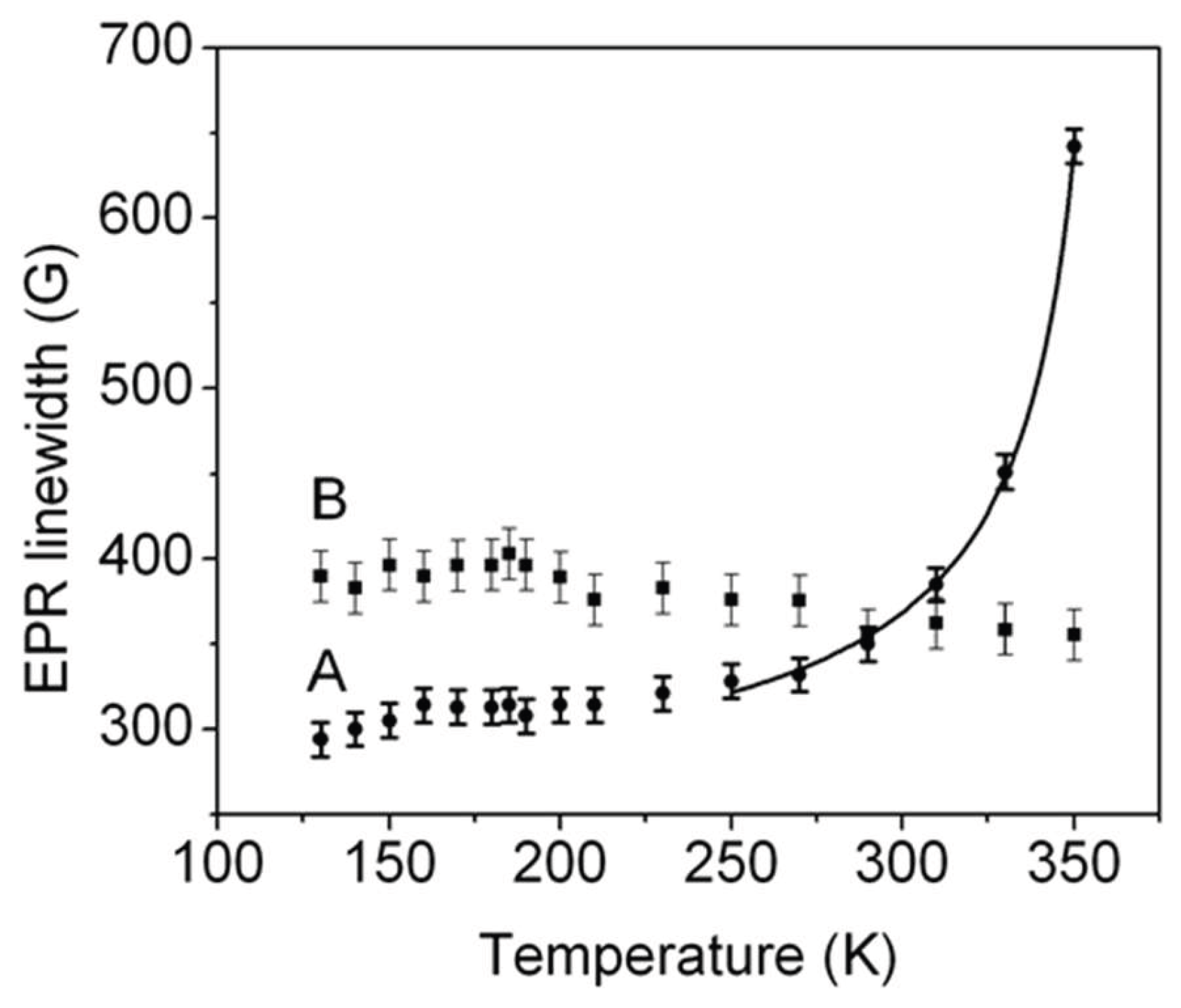
Two distinct EPR lines were observed in SiCN/Mn ceramics annealed at 1100 °C [56], as shown in Figure 5. The first resonance (Line A) appears at very low magnetic fields and is characterized by an effective g-factor of approximately 10, whereas the second resonance (line B) is located near g = 2.0. The temperature dependence of the peak-to-peak linewidth of the first-derivative EPR signal over the range of 77–350 K, for both lines A and B, is shown in Figure 5.
(i) Line A. As the temperature increased from 290 K to 350 K, the area under Line A, determined by double integration of the first-derivative EPR absorption spectrum, decreased progressively and approached zero at approximately 350 K. Since the double-integrated intensity is directly proportional to the magnetization, this behaviour indicates a gradual reduction in the magnetization of the ferromagnetic Mn₅Si₃Cₓ nanoparticles present in the sample with increasing annealing temperature. Line A, which occurs at very low magnetic field, is due to Mn5Si3Cx nanoparticles [56], which exhibit single-domain structure with a distinct ferromagnetic behavior. Mn-containing nanoparticles produced during the formation of the SiCN network (Mn–Si–N–C) are attributed primarily to Mn₅Si₃Cₓ nanoparticles, as inferred from the temperature dependence of the EPR Line. These nanoparticles undergo a ferromagnetic-to-paramagnetic phase transition at a Curie temperature of approximately 363 K. The pronounced temperature dependence of both the EPR linewidth and line positions provide strong evidence for assigning Line A to the Mn₅Si₃Cₓ phase.
Critical-temperature determination from the EPR line A of the SiCN/Mn sample. The temperature dependence of the linewidth of Line A was analyzed by fitting the experimental data to the expression given in Eq. (1) [57]. The fitting procedure yielded the following parameters: γ = 0.7, ΔB₀ = (230 ± 10) G, A = (2.6 ± 0.3) × 10³ K⁰·⁷·G, and TC = 363 ± 2 K. The EPR linewidth, ΔB, is proportional to the square root of the mean-square fluctuation of the magnetization, ⟨(ΔM)²⟩, in the vicinity of the magnetic phase transition, as described by Eq. (2). Based on the theory of second-order phase transitions [59] and the scaling theory [71], the critical exponent γ was found to have the value of 0.7 by the fitting procedure. The deduced Curie temperature is in good agreement with that obtained from the temperature dependence of the magnetization of ferromagnetic Mn₅Si₃Cₓ (x < 1) nanoparticles. The fitted value of TC ≈ 363 K is consistent with the Curie temperature of ~ 360 K, predicted from the Mn–Si–C phase diagram [72,73], thereby supporting the assignment of Line A to the ferromagnetic Mn₅Si₃Cₓ phase.
(ii) Line B. The line at g = 2.0, is ascribed to either clusters of paramagnetic α-Mn nanoparticles incorporated into the Si–C–N tetrahedral network [56,69]., or Mn5Si3 nanoparticles. Since pure α-Mn is paramagnetic above Neel temperature, TN = 95 K, [74], only α-Mn clusters with strong dipole-dipole interactions can exhibit such very broad EPR line. On the other hand, Mn5Si3 nanoparticles with average size of 9 nm exhibit ferromagnetic properties at room temperature. The Curie temperature of Mn5Si3 nanoparticles is TC = 590 K [70]. Therefore, such nanoparticles can also be considered as a source of the resonance line at g = 2.
5. Use of SiCN/Fe and SiCN/Mn Ceramics as Functional Materials
The principal results obtained from the EPR, and magnetization measurements of SiCN/Fe ceramic samples annealed at 800 °C, 1000 °C, 1100 °C, 1285 °C, and 1400 °C, showing that they are suitable for fabrication as MEMS/NEMS devices, are summarized as follows [43,44,45,46,47].
(i) Magnetic behaviour of the samples. All investigated SiCN/Fe ceramics exhibit superparamagnetic behaviour over the temperature range of 5–400 K, with the exception of the sample annealed at 800 °C, which deviates slightly from the ideal superparamagnetic behaviour. Analysis of the EPR spectra indicates that the observed superparamagnetism primarily originates from Fe₅Si₃ nanoparticles (TC = 390 K), α-Fe nanoparticles (TC = 1043 K), and Fe₃Si nanoparticles (TC = 800 K). In addition, Fe₇₀SiₓC₃₀₋ₓ nanoparticles (TC = 620 K [53]) contribute to the magnetic behavior of samples annealed at higher temperatures.
(ii) Effect of annealing temperature on particle-size distribution. The pronounced separation between the zero-field-cooled (ZFC) and field-cooled (FC) magnetization curves for the samples annealed at 800 °C and 1000 °C indicates a broad distribution of nanoparticle sizes. As the annealing temperature increases, the particle-size distribution becomes progressively narrower. This is reflected in the ZFC magnetization curves, which exhibit well-defined maxima at the blocking temperatures for the samples annealed at 1100 °C, 1285 °C, and 1400 °C. Correspondingly, the overlap between the ZFC and FC magnetization curves above the blocking temperature becomes increasingly pronounced for these samples, indicating improved uniformity in their particle size.
(iii) Blocking temperature and coercive field analysis. The temperature dependence of the coercive field follows the predictions of the Stoner–Wohlfarth model only for the samples annealed at 1100 °C, 1285 °C, and 1400 °C. Fitting the experimental data to this model yields average blocking temperatures of 〈TB〉 = 448 K, 126 K, 58.1 K, and 22.3 K for the samples annealed at 1000 °C, 1100 °C, 1285 °C, and 1400 °C, respectively. These values are lower than the blocking temperatures determined from the maxima of the ZFC magnetization curves, namely 203.8 K, 103.5 K, and 38.6 K for the samples annealed at 1100 °C, 1285 °C, and 1400 °C, respectively. This discrepancy is expected because the two approaches define and estimate the blocking temperature using different physical criteria.
(iv) Structural homogeneity of the annealed ceramics. Among all the investigated samples, the SiCN/Fe ceramic annealed at 1400 °C exhibits the highest degree of structural homogeneity. Analysis of the ZFC magnetization peak reveals a very narrow size distribution of Fe-containing nanoparticles, attributed to the enhanced structural ordering of the SiCN/Fe matrix at annealing temperatures above 1200 °C. This observation is further supported by the narrow simulated central EPR lines associated with Fe70SiₓC30₋ₓ nanocrystallites, which are observed only in the samples annealed at 1285 °C and 1400 °C. These samples possess the most uniform nanoparticle-size distributions among all those investigated. The results suggest that annealing at temperatures exceeding 1400 °C may further improve the structural homogeneity of SiCN/Fe ceramics, thereby enhancing their suitability for high-performance magnetic sensor applications.
(v) High-frequency (94 GHz) EPR characterization. W-band EPR measurements reveal that the broad central resonance observed at X-band splits into two distinct resonance lines. This splitting is attributed to the presence of two different α-Fe crystalline phases possessing anisotropic magnetic moments. The two phases differ in their particle sizes: the smaller nanoparticles exhibit superparamagnetic behaviour and produce Gaussian-shaped EPR lines, whereas the larger single-domain particles display ferromagnetic resonance (FMR) characterized by Lorentzian line shapes.
(vi) Mössbauer studies of SiCN/Fe sample annealed at 1100 °C. Recent Mössbauer spectroscopy investigations of SiCN/Fe ceramics annealed at 1100 °C were carried out to verify the identification of the Fe-containing nanoparticles previously inferred from EPR studies [45]. The SiCN/Fe ceramic annealed at 1100 °C with a low Fe concentration (0.1 at.%) displayed a single, very broad singlet assigned to an FeₓSiᵧC𝓏 phase, although its exact composition could not be determined. For samples with a higher Fe concentration, the Mössbauer spectra consisted of two components: a singlet attributed to α-Fe and a sextet assigned to an FeₓSiᵧ phase, again without further phase identification. The principal findings of this Mössbauer investigation of SiCN/Fe ceramics annealed at 1100 °C are summarized as follows. The presence α-Fe and Fe₅Si₃ nanoparticles are present, probably together with Fe₃Si nanoparticles. In addition, trace amounts of iron nitrides (Fe₃N and Fe₄N) and Fe³⁺ ions in an octahedral oxygen coordination environment are present. The presence of iron nitride phase together with residual paramagnetic Fe³⁺ ions suggests that the annealing process was not fully completed in these samples. Overall, the Mössbauer results are in good agreement with the conclusions drawn from the EPR investigations of SiCN/Fe ceramics annealed at 1100 °C, thereby providing independent confirmation of the phase composition and magnetic characteristics of the Fe-containing nanoparticles.
6. Concluding Remarks
The EPR and magnetization investigations on Fe- and Mn-doped SiCN nanoparticles reveal the following features, validating their suitability as functional devices.
- (i)
- The magnetism and EPR spectra of Fe-doped SiCN ceramic is due to the presence of a variety of Fe-containing nanocrystallites, distributed in the diamagnetic SiCN matrix, mainly Fe5Si3 and α-Fe nanoparticles.
- (ii)
- There are two kinds of α-Fe nanoparticles present in SiCN/Fe, which differ in their sizes. The particles with smaller dimensions are superparamagnetic, whereas larger single-domain particles are ferromagnetic.
- (iii)
- Fe5Si3 nanoparticles disappear significantly in SiCN/Fe samples annealed above 1280°.
- (iv)
- The magnetization measurements reveal that the homogeneity in the size of nanoparticles of Fe-doped SiCN ceramics increases with increasing annealing temperature. The optimal annealing temperature for developing them as functional material was estimated to be1400 °C.
- (v)
- The magnetization and EPR studies of Mn-doped SiCN ceramic indicate the presence of a variety of Mn-containing nanocrystallites, mainly ferromagnetic Mn5Si3Cx nanoparticles. There is also the possibility of presence of ferromagnetic Mn5Si3 nanoparticles with a rather high Curie temperature.
- (vi)
- The EPR spectra reveal that both Fe- and Mn-doped SiCN nanoparticles exhibit superparamagnetism, or single domain ferromagnetism, depending on their average sizes. They are thus potentially useful in being developed as high-temperature magnetic sensor devices due to SiCN being very stable to temperature variations.
Funding
This research received no external funding.
Data Availability Statement
The original contributions presented in this study are included in the article. Further inquiries can be directed to the corresponding author.
Conflicts of Interest
The authors declare no conflict of interest.
References
- Liew, L.-A.; Zhang, W.; Bright, V. M.; An, L.; Dunn, M. L.; Raj, R. Fabrication of SiCN ceramics MEMS using injectable polymer-precursor technique. Sens. Actuators A Phys. 2001, 89, 64–70. [Google Scholar] [CrossRef]
- Lin, D.Y.; Li, C.F.; Huang, Y.S.; Jong, Y.C.; Chen, Y.F.; Chen, L.C.; Chen, C.K.; Chen, K.H.; Bhusari, D. M. Temperature dependence of the direct band gap of Si-containing carbon nitride crystalline films. Phys. Rev. B 1997, 56, 6498–6501. [Google Scholar] [CrossRef]
- 3.; Hermann, A.M.; Wang, Y.T.; Ramakrishnan, P.A.; Balzar, D.; An, L.; Haluschka, C.; Riedel, R. Structure and electronic properties of Si-(B)-C-N ceramics. J. Am. Ceram. Soc. 2001, 84, 2260–2264. [Google Scholar] [CrossRef]
- Trassl, S.; Puchinger, M.; Rössler, E.; Ziegler, G. Electrical properties of amorphous SiCxNyHz -ceramics derived from polyvinylsilazane. J. Eur. Ceram. Soc. 2003, 23, 781–789. [Google Scholar] [CrossRef]
- Wang, K.; Zhuang, S.; Xie, C.; He, H.; Chen, S.; Ma, B.; Huang, J.; Zhu, Y.; Song, X. Flash sintering of SiCN ceramics: Effects of current density on structure and electrical conductivity. Ceram. Int. 2026, 52, 5186–5195. [Google Scholar] [CrossRef]
- Liu, H.; Xiao, X.; Liu, Y.; Bian, C.; Chu, P.; Xie, W.; Cao, W.; Li, M.; Yang, K.; Zhang, Y.; Chen, F. Preparation of Co/Ni/SiCN ceramic fibers and analysis of their absorption properties under high-temperature conditions. Colloids Surf. A Physicochem. Eng. Asp. 2026, 738, 139977. [Google Scholar] [CrossRef]
- Leo, Alfin; Andronenko, S.; Stiharu, I.; Bhat, R. B. Thick and thin film SiCN for pressure sensor at high temperature and influence of temperature on mechanical properties. Sensors 2010, 10, 1338–1354. [Google Scholar] [CrossRef] [PubMed]
- Andronenko, S.I.; Stiharu, I.; Misra, S.K. Synthesis and characterization of polyureasilazane- derived SiCN ceramics. J. Appl. Phys. 2006, 99, 113907. [Google Scholar] [CrossRef]
- Trassl, S.; Motz, G.; Rossler, E.; Ziegler, G. Characterization of the Free-Carbon Phase in Precursor-Derived Si-C-N Ceramics, J. Non-Cryst. Sol. 2001, 293-295, 261–267. [Google Scholar] [CrossRef]
- Trassl, S.; Motz, G.; Rossler, E.; Ziegler, G. Characterization of the Free-Carbon Phase in Precursor-Derived Si-C-N Ceramics: I, Spectroscopic Methods. J. Am. Ceram. Soc. 2002, 85, 239–244. [Google Scholar] [CrossRef]
- Trassl, S.; Kleebe, H.-J.; Stormer, H.; Motz, G.; Rossler, E.; Ziegler, G. Characterization of the Free Carbon Phase in Precursor-Derived SiCN Ceramics Part II: Comparison of Different Precursors. J. Am. Ceram. Soc. 2002, 85, 1268–1274. [Google Scholar] [CrossRef]
- Erdem, E.; Mass, V.; Gembus, A.; Schulz, A.; Liebau-Kunzmann, V.; Fasel, G.; Riedel, R.; Eichel, R.-A. Defect structure in lithium-doped polymer-derived SiCN ceramics characterized by Raman and electron paramagnetic resonance spectroscopy. Phys. Chem. Chem. Phys. 2009, 11, 5628–5633. [Google Scholar] [CrossRef]
- Berger, F.; Muller, A.; Albinger, F.; Muller, K. Solid state NMR investigation on boron-modified poly(allylmethylsilazane, Z. Anorg. Allg. Chem. 2005, 631, 355–363. [Google Scholar] [CrossRef]
- Li, Y.; Yu, Y.; San, H.; Han, Q.; An, L. Effect of Pyrolysis Temperature on the Electrical Behavior of Polymer-Derived SiOCN Ceramics. J. Mater. Sci. Chem. Eng. 2015, 3, 9–16. [Google Scholar] [CrossRef]
- Li, Y.-L.; Kroke, E.; Riedel, R.; Fasel, C.; Gervais, C.; Babonneau, F. Thermal cross-linking and pyrolytic conversion of poly(ureamethylvinil)silazanes to silicon-based ceramics. Appl. Organometal. Chem. 2001, 15, 820–832. [Google Scholar] [CrossRef]
- Tomasella, E.; Spinelle, L.; Bousquet, A.; Rebib, F.; Dubois, M.; Eypert, C.; Gaston, J. P.; Cellier, J. Structural and Optical Investigations of Silicon Carbon Nitride Thin Films Deposited by Magnetron, Plasma process. Polym. 2009, 6(S21), S11–S16. [Google Scholar] [CrossRef]
- Tomasella, E.; Rebib, F.; Dubois, M.; Cellier, J.; Jacquet, M. Structural and optical properties studies of sputtered a-SiCN thin films. J. Phys. Conf. Ser. 2008, 100, 082045. [Google Scholar] [CrossRef]
- Kobayashi, K.; Yokoyama, H.; Endoh, M. Leakage current and paramagnetic defects in SiCN dielectrics for copper diffusion barriers. Appl. Surf. Sci. 2008, 254, 6222–6225. [Google Scholar] [CrossRef]
- Savchenko, D.; Kulikovsky, V.; Vorliček, V.; Lanček, J.; Kiselov, V.; Kalabukhova, E. Optical and magnetic resonance study of a-SiCxNy films obtained by magnetron sputtering. Phys. Stat. Sol. B 2014, 251, 1178–1185. [Google Scholar] [CrossRef]
- Zaheer, M.; Schmalz, T.; Motz, G.; Kempe, R. Polymer derived non-oxide ceramics modified with late transition metals. Chem. Soc. Rev. 2012, 41, 5102–5116. [Google Scholar] [CrossRef] [PubMed]
- Hojamberdiev, M.; Prasad, R. M.; Fasel, C.; Riedel, R.; Ionescu, E. Single-source-precursor synthesis of soft magnetic Fe3Si- and Fe5Si3-containing SiOC ceramic nanocomposites. Eur. J. Ceram. Soc. 2013, 33, 2465–2472. [Google Scholar] [CrossRef]
- Mera, G.; Gallei, M.; Bernard, S.; Ionescu, E. Ceramic nanocomposites from tailor-made preceramics polymers. Nanomaterials 2015, 5, 468–540. [Google Scholar] [CrossRef] [PubMed]
- Andronenko, S.I.; Stiharu, I.; Misra, S.K.; Lacroix, C.; Menard, D. EPR/FMR, FTIR, X-ray, and Raman investigations of Fe-doped SiCN ceramics. Appl. Magn. Reson. 2010, 38, 385–402. [Google Scholar] [CrossRef]
- Ma, B.; Cao, Y.; Gao, Y.; Wang, Y. Fabrication of a thin double-layer thermistor based on DVB-modified polymer-derived SiCN ceramics. J. Alloy Compd. 2018, 732, 491–497. [Google Scholar] [CrossRef]
- Wang, Y.; Guo, X.; Feng, Y.; Lin, X.; Gong, H. Wave absorbing performance of polymer-derived SiCN(Fe) ceramics. Ceram. Int. 2017, 43, 15551–15555. [Google Scholar] [CrossRef]
- Guo, X.; Feng, Y.; Lin, X.; Liu, Y.; Gong, H.; Zhang, Y. The dielectric and microwave absorption properties of polymer-derived SiCN ceramics. J. Eur. Ceram. Soc. 2018, 38, 1327–1333. [Google Scholar] [CrossRef]
- MacLachlan, M. J.; Ginzburg, M.; Coombs, N.; Coyle, T. W.; Raju, N. P.; Greedan, J. E.; Ozin, G. A.; Manners, I. Shaped Ceramics with Tunable Magnetic Properties from Metal-Containing Polymers. Science 2000, 287, 1460–1463. [Google Scholar] [CrossRef] [PubMed]
- Saha, A.; Shah, S.R.; Raj, R.; Russek, S.E. Polymer derived SiCN composite with magnetic properties. J. Mater. Res. 2003, 18, 2549–2551. [Google Scholar] [CrossRef]
- Li, Y.; Zheng, Z.; Reng, C.; Zhang, Z.; Gao, W.; Yang, S.; Xie, Z. Preparation of Si-C-N-Fe magnetic ceramics from iron-containing polysilazane. Appl. Organometal. Chem. 2003, 17, 120–126. [Google Scholar] [CrossRef]
- Dumitru, A.; Ciupina, V.; Stamatin, I.; Prodan, G.; Morozan, A.; Mirea, C. Plasma polymerization of ferrocene with silane and silazane monomers for design of nanostructured magnetic ceramics, J. Optoelectron. Adv. Mater. 2006, 8, 50–54. [Google Scholar]
- Dumitru, A.; Stamatin, I.; Morozan, A.; Mirea, C.; Ciupina, V. Si–C–N–Fe nanostuctured ceramics from inorganic polymer precursors obtained by plasma polymerization. Mater. Sci. Eng. C 2007, 27, 1331–1337. [Google Scholar] [CrossRef]
- Li, J.; Zhang, Z.; Zheng, Z.; Guo, L.; Xu, G.; Xie, Z. Preparation and Magnetic Properties of Fe/Si/C/N Ceramics Derived from a Polymer Precursor. J. Appl. Polym. Sci. 2007, 105, 1786–1792. [Google Scholar] [CrossRef]
- Park, J. H.; Park, K.H.; Kim, D.P. Superparamagnetic Si3N4-Fe-Containing Ceramics Prepared from a Polymer-metal Complex. J. Ind. Eng. Chem. 2007, 13, 27–32. [Google Scholar]
- Yan, X.; Cheng, X. N.; Li, C. S.; Hauser, R.; Riedel, R. Synthesis and Low Temperature Magnetic Properties of Metal Elements Filled Polymer-Derived SiCN Ceramic Composites. Mater. Sci. Forum 2007, 546-549, 2269–2272. [Google Scholar] [CrossRef]
- Hauser, R.; Francis, A.; Theismann, R.; Riedel, R. Processing and magnetic properties of metal-containing SiCN ceramic micro- and nano-composites. J. Mater. Sci. 2008, 43, 4042–4049. [Google Scholar] [CrossRef]
- Singh, G.; Priya, S.; Hossu, M.R.; Shah, S.R.; Grover, S.; Koymen, A.R.; Mahajan, R.L. Synthesis, electrical and magnetic characterization of core–shell silicon carbo-nitride coated carbon nanotubes. Mater. Lett. 2009, 63, 2435–2438. [Google Scholar] [CrossRef]
- Francis, A.; Ionescu, E.; Fasel, C.; Riedel, R. Crystallization Behavior and Controlling Mechanism of Iron-Containing Si−C−N Ceramics. Inorg. Chem. 2009, 48, 10078–10083. [Google Scholar] [CrossRef] [PubMed]
- Ionescu, E.; Terzioglu, C.; Linck, C.; Kaspar, J.; Navrotsky, A.; Riedel, R. Thermodynamic control of phase composition and crystallization of metal-modified silicon oxycarbides. J. Amer. Ceram. Soc. 2013, 96, 1899–1913. [Google Scholar] [CrossRef]
- Mishra, R.; Tiwari, R. K.; Saxena, A. K. Synthesis of Fe-SiC nanowires via precursor route. J. Inorg. Organomet. Polym. 2009, 19, 223–227. [Google Scholar] [CrossRef]
- Zhou, C.; Yang, L.; Geng, H.; Zheng, Q.; Min, H.; Yu, Zh.; Xia, H. Preparation of Si–C–N–Fe magnetic ceramic derived from iron-modified polysilazane. Ceram. Int. 2012, 38, 6815–6822. [Google Scholar] [CrossRef]
- Vakifahmetoglu, C.; Pippel, E.; Woltersdorf, J.; Colombo, P. Growth of One-Dimensional Nanostructures in Porous Polymer-Derived Ceramics by Catalyst-Assisted Pyrolysis. Part I: Iron Catalyst. J. Am. Ceram. Soc. 2010, 93, 959–968. [Google Scholar] [CrossRef]
- Yan, X.; Cheng, X.; Han, G.; Hauser, R.; Riedel, R. Synthesis and Magnetic Properties of Polymer Derived Metal/SiCN Ceramic Composites. Key Eng. Mater. 2007, 353-358, 1485–1488. [Google Scholar] [CrossRef]
- Misra, S. K.; Andronenko, S.; Gilmutdinov, I.; Yusupov, R. EPR and magnetization studies of polymer-derived Fe-doped SiCN nanoceramics annealed at various temperatures: blocking temperatures, superparamagnetism and size distribution. Appl. Magn. Reson 2018, 49, 1397–1415. [Google Scholar] [CrossRef]
- Andronenko, S.I.; Rodionov, A.A.; Misra, S.K. A variable temperature X- and W-band EPR study of Fe-doped SiCN ceramics annealed at 1000 °C, 1100 °C, and 1285 °C: dangling bonds, ferromagnetism and superparamagnetism. Appl. Magn. Reson 2018, 49, 335–344. [Google Scholar] [CrossRef]
- Stiharu, I.; Andronenko, S.; Zinnatullin, A.; Vagizov, F. SiCNFe ceramics as soft magnetic material for MEMS magnetic devices: A Mossbauer study. Micromachines 2023, 14, 925(13). [Google Scholar] [CrossRef]
- Misra, S.K.; Andronenko, S.I. Chapter 10, “EPR and FMR of SiCN ceramics and SiCN magnetic derivatives” in eBook: “EPR in modern carbon-based materials”, 2018. In eBook series: “Frontiers in Magnetic Resonance”; Savchenko, D., Kassiba, A.H., Eds.; Bentham Science STM-publisher, 2018; Volume v. 1, pp. 197–224. [Google Scholar]
- Misra, S.K.; Andronenko, S.I. A review of EPR and magnetization investigations of doped nanoparticles of transition metal oxides and SiCN: functional materials and spintronic devices. Appl. Magn. Reson. 2025, 56, 1293–1315. [Google Scholar] [CrossRef]
- Pushkarev, R.V.; Fainer, N.I.; Maurya, K.K. Structural and magnetic properties of nanocomposite iron containing SiCxNy films. Superlattices Microstruct. 2017, 102, 119–126. [Google Scholar] [CrossRef]
- Pushkarev, R.; Fainer, N.; Kirienko, V.; Matsynin, A.; Nadolinnyy, V.; Merenkov, I.; Trubina, S.; Ehrenburg, S.; Kvashnina, K. SiCxNy:Fe films as a tunable ferromagnetic material with tailored conductivity. J. Mater. Chem. C 2019, 7, 4250–4258. [Google Scholar] [CrossRef]
- Stepina, N. P.; Pushkarev, R.V.; Zinovieva, A.F.; Kirienko, V.V.; Bogomyakov, A.S.; Gutakovskii, A.K.; Fainer, N.I.; Dvurechenskii, A.V. Magnetic properties of granulated SiCxNy:Fe films with different structure of α-Fe nanoclusters. J. Magn. Magn. Mater. 2020, 499, 166242. [Google Scholar]
- Fainer, N. I.; Plekhanov, A. G.; Pushkarev, R. V.; Shayapov, V. R.; Maksimovskiy, E. A.; Nadolinny, V. A.; Korotaev, E. V.; Kaichev, V. V. Synthesis of magnetic nanocomposite films SiCxNyFez by plazma-enhanced chemical decomposition of a gaseous mixture of 1,1,1,3,3,3-hexamethyldisilazane, ferrocene, and helium. J. Struct. Chem. 2020, 61, 1865–1875. [Google Scholar]
- Lomayeva, S.F.; Maratkanova, A.N. Structure, phase composition and magnetic properties of Fe–Si–C system due to mechanical activation of Fe–Si alloy in organic liquids. Intermetallics 2009, 17, 714–721. [Google Scholar] [CrossRef]
- Yelsukov, E.P.; Maratkanova, A.N.; Lomayeva, S.F.; Konyagin, G.N.; Nemtsova, O.M.; Ul’yanov, A.I.; Chulkina, A.A. Structure, phase composition and magnetic properties of mechanically alloyed and annealing quasibinary Fe(70)Si(x)C(30-x) alloys. J. Alloys Compd. 2006, 407, 98–105. [Google Scholar] [CrossRef]
- Fainer, N. I.; Pushkarev, R. V.; Golubenko, A. N.; Rumyantsev, Yu. M.; Maksimovskii, E. A.; Kaichev, V. V. Synthesis of Si–C–N–Fe Layers from Volatile Organosilicon Precursors and Ferrocene. Part I. Synthesis, Chemical and Phase Composition of Iron Containing Layers Prepared by Thermal Decomposition of Ferrocene. Glass Phys. Chem. 2015, 41, 630–636. [Google Scholar] [CrossRef]
- Viard, A.; Kurz, H.; Lale, A.; Heymann, L.; Weber, B.; Bernard, S.; Knauer, M.; Motz, G. Superparamagnetic Silicon Carbonitride Ceramic Fibers Through In Situ Generation of Iron Silicide Nanoparticles During Pyrolysis of an Iron-Modified Polysilazane. ACS Appl. Mater. Interfaces 2021, 13, 8745−8753. [Google Scholar] [CrossRef]
- Andronenko, S.I.; Leo, Alfin; Stiharu, I.; Misra, S.K. EPR/FMR investigation of Mn doped SiCN ceramics. Appl. Magn. Reson. 2010, 39, 347–356. [Google Scholar] [CrossRef]
- Altshuler, T.S.; Bresler, M.S.; Goryunov, Yu. V. Ferromagnetic Ordering of Iron Impurities in the Kondo Semiconductor SmB6. JETP Lett. 2005, 81, 475–478. [Google Scholar] [CrossRef]
- Sawatzky, E. Magnetic and magnetooptical properties of sputtered Fe5Si3 films. IEEE trans. magn. 1971, 7, 374–376. [Google Scholar] [CrossRef]
- Landay, L.D.; Lifshitz, E. M. Course of Theoretical Physics, v.5.: Statistical Physics, 4th ed.; Nauka, Moscow; Butterworth, London, 1995; p. 528. [Google Scholar]
- de la Presa, P.; Luengo, Y.; Velasco, V.; Morales, M. P.; Iglesias, M.; Veintemillas-Verdaguer, S.; Crespo, P.; Hernando, A. Interactions in Liquid Magnetic Colloids by Zero Field Cooled Measurements: Effects on Heating Efficiency. J. Phys. Chem. C 2015, 119, 11022–11030. [Google Scholar] [CrossRef]
- Sankar, S.; Berkowitz, A. E.; Dender, D.; Borchers, J. A.; Erwin, R. W.; Kline, S. R.; Smith, D. J. Magnetic correlations in non-percolated Co–SiO2 granular films. J. Mag. Magn. Mater. 2000, 221, 1–9. [Google Scholar] [CrossRef]
- Knobel, M.; Nunes, W. C.; Socolovsky, L.M.; De Biasi, E.; Vargas, J. M.; Denardin, J. C. Superparamagnetism and Other Magnetic Features in Granular Materials: A Review on Ideal and Real Systems. J. Nanosci. Nanotech. 2008, 8, 2836–2857. [Google Scholar] [CrossRef]
- Schmitz-Antoniak, C. X-ray absorption spectroscopy on magnetic nanoscale systems for modern applications. Rep. Prog. Phys. 2015, 78, 062501. [Google Scholar] [CrossRef] [PubMed]
- Tournus, F.; Tamion, A. Magnetic susceptibility curves of a nanoparticle assembly II. Simulation and analysis of ZFC/FC curves in the case of a magnetic anisotropy energy distribution. J. Magn. Magn. Mater. 2011, 323, 1118–1127. [Google Scholar] [CrossRef]
- Mamiya, H.; Nakatani, I.; Furubayashi, T.; Ohnuma, M. Analyses of superparamagnetism - Magnetic properties of isolated iron – nitride nanoparticles. Trans. Magn. Soc. Jap. 2002, 2, 36–48. [Google Scholar] [CrossRef]
- Hansen, M. F.; Mørup, S. Estimation of blocking temperatures from ZFC/FC curves. J. Magn. Magn. Mater. 1999, 203, 214–216. [Google Scholar] [CrossRef]
- Bruvera, I. J.; Zélis, P. M.; Calatayud, M. P.; Goya, G. F.; Sánchez, F. H. Determination of the blocking temperature of magnetic nanoparticles: The good, the bad, and the ugly. J. Appl. Phys. 2015, 118, 184304. [Google Scholar] [CrossRef]
- Stoner, E. S.; Wohlfarth, E.P. A Mechanism of Magnetic Hysteresis in Heterogeneous Alloys. Philos. Trans. R. Soc. A 1949, 240, 599–642. [Google Scholar]
- Nunes, W. C.; Folly, W. S. D.; Sinnecker, J. P.; Novak, M.A. Temperature dependence of the coercive field in single-domain particle systems. Phys. Rev. B 2004, 70, 014419. [Google Scholar] [CrossRef]
- Das, B.; Balasubramanian, B.; Manchanda, P.; Mukherjee, P.; Skomski, R.; Hadjipanayis, G.C.; Sellmyer, D.J. Mn5Si3 Nanoparticles: Synthesis and Size-Induced Ferromagnetism. Nano Lett. 2016, 16, 1132–1137. [Google Scholar] [CrossRef] [PubMed]
- Patashinskii, A. Z.; Pokrovskii, V.L. Fluctuation Theory of phase transitions; Pergamon Press: Oxford, 1979; p. 321. [Google Scholar]
- Sürgers, C.; Potzger, K.; Fischer, G. Magnetism of carbon doped Mn5Si3 and Mn5Ge3, J. Chem. Sci. 2009, 121, 173–176. [Google Scholar] [CrossRef]
- Gopalakrishnan, B.; Sürgers, C.; Montbrun, R.; Singh, A.; Uhlarz, M.; v. Löhneysen, H. Electronic transport in magnetically ordered Mn5Si3Cx films. Phys. Rev. B 2008, 77, 104414. [Google Scholar] [CrossRef]
- Bondi, J.F.; Oyler, K.D.; Ke, X.; Schiffer, P.; Schaak, R.E. Chemical Synthesis of Air-Stable Manganese Nanoparticles. J. Am. Chem. Soc. 2009, 131, 9144–9145. [Google Scholar] [CrossRef] [PubMed]
Figure 1.
SiCN/Fe EPR linewidth dependence on temperature [23] for the sample annealed at 1100 °C: a) for the line at g ~ 10, b) for the line at g ~ 2.0. Continuous lines represent simulations with the parameters, listed in the text after Eq. (1).
Figure 1.
SiCN/Fe EPR linewidth dependence on temperature [23] for the sample annealed at 1100 °C: a) for the line at g ~ 10, b) for the line at g ~ 2.0. Continuous lines represent simulations with the parameters, listed in the text after Eq. (1).
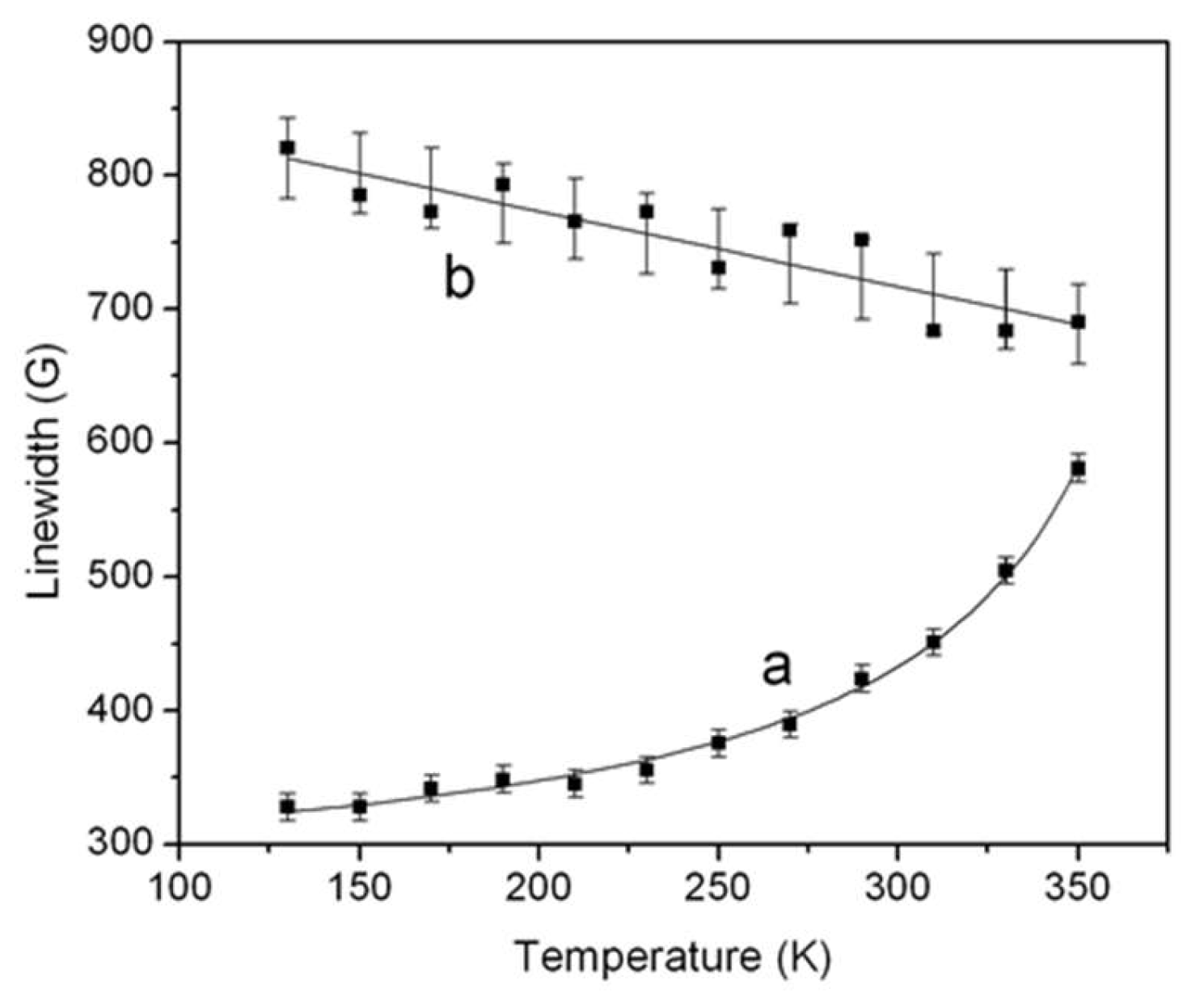
Figure 2.
The experimental and simulated spectra for the SiCN/Fe sample annealed at 1100̴ °C are shown by black and red lines, respectively. The EPR lines with arrows are due to dangling bonds [44]. The simulation of the EPR spectrum (red) at 94 GHz at 300 K is made for the SiCN/Fe sample annealed at 1100 °C. It is an overlap of the simulated spectra S1 and S2, with corresponding spin-Hamiltonian parameters listed in Table 1.
Figure 2.
The experimental and simulated spectra for the SiCN/Fe sample annealed at 1100̴ °C are shown by black and red lines, respectively. The EPR lines with arrows are due to dangling bonds [44]. The simulation of the EPR spectrum (red) at 94 GHz at 300 K is made for the SiCN/Fe sample annealed at 1100 °C. It is an overlap of the simulated spectra S1 and S2, with corresponding spin-Hamiltonian parameters listed in Table 1.
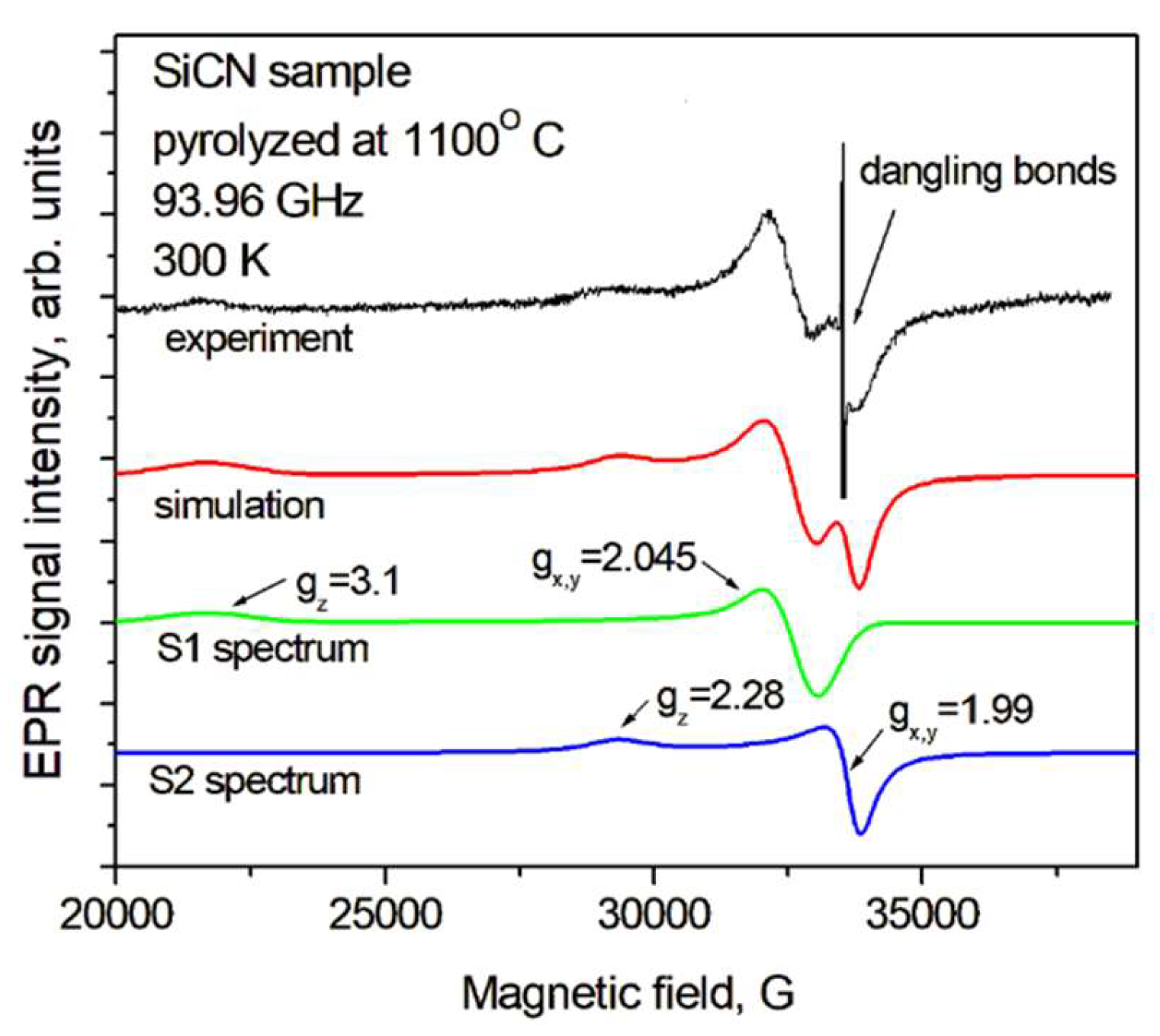
Figure 3.
Temperature dependences of the ZFC and FC magnetizations from 5 to 400 K for the SiCN/Fe nanoceramics, annealed at 800 °C, 1000 °C, 1100 °C, 1285 °C, and 1400 °C [43].
Figure 3.
Temperature dependences of the ZFC and FC magnetizations from 5 to 400 K for the SiCN/Fe nanoceramics, annealed at 800 °C, 1000 °C, 1100 °C, 1285 °C, and 1400 °C [43].
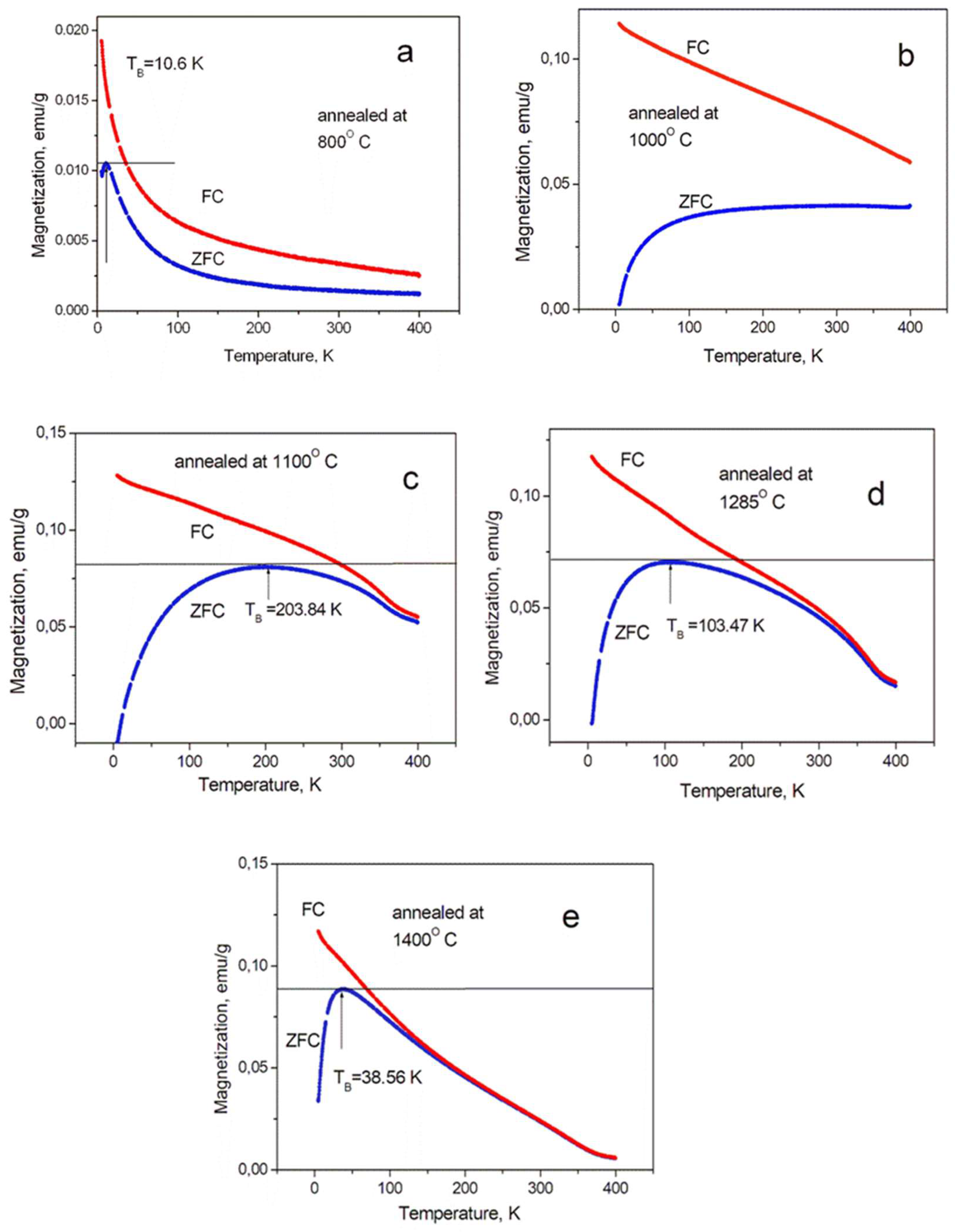
Figure 4.
Temperature dependences of coercive fields for the various SiCN/Fe nanoceramics, annealed at 800 °C, 1000 °C, 1100 °C, 1285 °C, 1400 °C [43].
Figure 4.
Temperature dependences of coercive fields for the various SiCN/Fe nanoceramics, annealed at 800 °C, 1000 °C, 1100 °C, 1285 °C, 1400 °C [43].
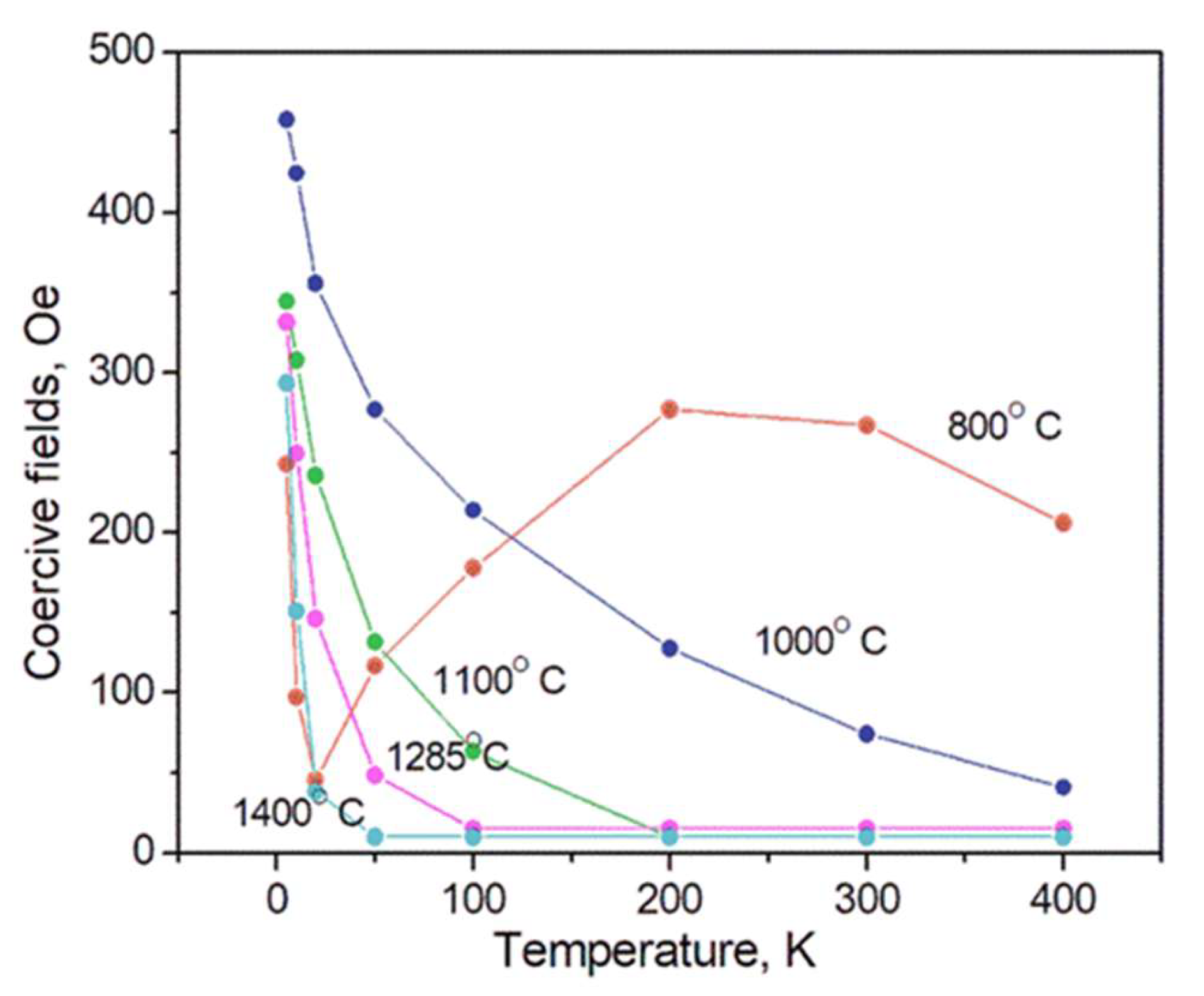
Figure 5.
Temperature variation of the peak-to-peak first-derivative EPR linewidth with temperature for lines A and B observed in SiCN/Mn ceramics annealed at 1100 °C [56].
Figure 5.
Temperature variation of the peak-to-peak first-derivative EPR linewidth with temperature for lines A and B observed in SiCN/Mn ceramics annealed at 1100 °C [56].
Disclaimer/Publisher’s Note: The statements, opinions and data contained in all publications are solely those of the individual author(s) and contributor(s) and not of MDPI and/or the editor(s). MDPI and/or the editor(s) disclaim responsibility for any injury to people or property resulting from any ideas, methods, instructions or products referred to in the content. |
© 2026 by the authors. Licensee MDPI, Basel, Switzerland. This article is an open access article distributed under the terms and conditions of the Creative Commons Attribution (CC BY) license (http://creativecommons.org/licenses/by/4.0/).
Copyright: This open access article is published under a Creative Commons CC BY 4.0 license, which permit the free download, distribution, and reuse, provided that the author and preprint are cited in any reuse.


