

Submitted:
22 July 2026
Posted:
23 July 2026
You are already at the latest version
Abstract
The intersection of climate change and international security has emerged as one of the most consequential analytical frontiers in twenty-first-century international relations. This paper develops a multidimensional framework for analyzing how environmental stress shapes interstate conflict and cooperation, advancing beyond existing scholarship that treats climate as a background variable. Drawing on securitization theory, environmental peacebuilding literature, and the most recent empirical syntheses of climate–conflict linkages, the paper articulates seven interconnected dimensions of climate security—resource competition, migration pressures, territorial change, food security, cooperation opportunities, securitization dynamics, and infrastructure vulnerability—situated within a multilevel structure spanning local, national, regional, and global scales. Through comparative analysis of transboundary water governance, climate-induced migration, Arctic geopolitics, food-system disruption, and environmental peacemaking initiatives, the paper identifies both pathways to conflict and opportunities for cooperation. The findings indicate that climate security outcomes are contingent rather than deterministic, mediated by political institutions, economic conditions, and social structures; that institutional density determines how much climate stress a domain can absorb; and that conflictual and cooperative trajectories frequently co-occur within the same regions and dyads. The paper contributes to international relations theory by bridging materialist and constructivist perspectives on climate security, offering policy-relevant insights for diplomatic practice, international law, and multilateral governance. It concludes by identifying priority areas for future research, including the climatization of security institutions, the legal implications of disappearing states, the security externalities of mitigation policy, and the potential for climate cooperation to serve as a confidence-building measure in contested geopolitical environments.
Keywords:
climate security
; interstate conflict
; environmental peace building
; securitization
; transboundary resources
; climate migration
; Arctic geopolitics
; and climatization
1. Introduction
The recognition that climate change constitutes a fundamental security challenge has transformed contemporary international relations scholarship and policy discourse. What began as a peripheral concern of environmental studies has become a central preoccupation of defense establishments, intelligence agencies, and diplomatic institutions worldwide (Busby, 2022). The United Nations Security Council has debated climate security on multiple occasions since 2007, the European Union has integrated climate considerations into its Common Security and Defence Policy, and national security strategies from Washington to Beijing now explicitly address climate-related risks (Conca, 2019; Scott, 2015). Indeed, an identifiable professional field of climate security has emerged, spanning military, intelligence services, and international organizations (Busby, 2021). Yet despite this institutional recognition, international relations scholarship has struggled to develop robust theoretical frameworks that adequately capture the multiple, overlapping, and often contradictory pathways through which environmental changes shape state behavior, alliance formation, and the emergence of new security challenges.
Climate security, as an analytical category, examines how shifts in environmental conditions—including extreme weather events, resource scarcity, sea-level rise, and climate-induced migration—can escalate tensions and contribute to interstate conflict, while simultaneously creating unprecedented opportunities for cooperation (Mach et al., 2019). The field sits at the intersection of multiple subdisciplines, drawing on peace and conflict studies, political ecology, international law, and security studies. This interdisciplinary character has produced both intellectual vitality and persistent conceptual confusion, with scholars employing divergent definitions, methodologies, and normative orientations (Scartozzi, 2021; von Lucke et al., 2014). Recent authoritative syntheses have consolidated a hard-won consensus—climate change influences conflict risk indirectly and conditionally, as one driver among many—while underscoring how much of the causal terrain remains unmapped (Hendrix et al., 2023).
The central problem addressed in this paper is the absence of an integrated framework capable of analyzing the direct and indirect pathways by which climate factors influence interstate relations. Existing scholarship, while substantial, remains fragmented across thematic silos—water conflicts, migration, territorial disputes, food security—with insufficient attention to how these dimensions interact to produce systemic outcomes. Moreover, the literature has focused predominantly on intrastate conflict, leaving interstate dynamics comparatively underexplored (Koubi, 2019; von Uexkull & Buhaug, 2021). This gap is particularly troubling given that many of the most significant climate-security phenomena—transboundary water competition, Arctic geopolitics, climate-induced displacement across borders, and the potential disappearance of small island states—are inherently international in character.
This paper advances a multidimensional framework for analyzing the climate–security nexus, organized around seven interconnected dimensions and four analytical levels. The argument proceeds in several parts. Following this introduction, Section 2 reviews the theoretical foundations of climate security research and identifies key research gaps. Section 3 presents the multidimensional framework, articulating its conceptual architecture and analytical commitments. Section 4 applies the framework through comparative analysis of contemporary climate-security phenomena. Section 5 examines the implications for international relations theory and policy practice, Section 6 offers an integrative analytical discussion, and Section 7 concludes before Section 8 sets out priorities for future research. The paper's central argument is that climate security outcomes are neither deterministic nor random but contingent on the interaction between environmental stressors and the political, economic, and social structures through which they are mediated. This contingency means that climate change can produce both conflict and cooperation—sometimes simultaneously, and that the choice between these trajectories depends significantly on the analytical frameworks and policy responses deployed by states and international institutions.
2. Theoretical Foundations and Research Gap Identification
This section establishes the theoretical foundations for analyzing the climate–security relationship and identifies the specific gaps this study addresses. It first traces the evolution of environment–conflict scholarship from early neo-Malthusian and scarcity-based accounts to constructivist securitization theory, showing how each tradition illuminates part of the picture while leaving climate's causal role undertheorized (Section 2.1). It then surveys the empirical climate–conflict literature, whose contested findings underscore the need for frameworks that specify mechanisms and scope conditions rather than asserting direct causation (Section 2.2). Building on this foundation, the section turns to two underexplored dimensions with particular relevance for interstate relations: the potential for climate cooperation to function as a confidence-building measure (Section 2.3), and the implications of climate change for sovereignty, territory, and the state system itself (Section 2.4). Together, these gaps motivate the multidimensional framework developed in Section 3.
2.1. Foundational Scholarship on Environment and Conflict
The scholarly investigation of environmental factors in security and conflict has deep roots, though its systematic development is relatively recent. Thomas Homer-Dixon's foundational work established important theoretical groundwork by articulating how environmental scarcity—conceptualized as the interaction of supply-induced, demand-induced, and structural scarcities—could contribute to violent conflict through mechanisms including economic decline, migration, and institutional weakening (Homer-Dixon, 1999). His research program, conducted through the Toronto Project on Environment, Population, and Security, generated case studies from South Asia, the Middle East, and Latin America demonstrating how resource pressures interacted with political institutions to shape conflict outcomes.
Yet most existing studies continue to treat climate as a background variable rather than analyzing its direct causal mechanisms in shaping international outcomes. This tendency reflects both the methodological difficulty of isolating climate effects from other causal factors and the conceptual challenge of theorizing environmental change within frameworks developed primarily for material, institutional, and ideational variables (Barnett, 2003). The gap is most pronounced in understanding climate's role in alliance formation, resource competition, and the emergence of new forms of cooperation and conflict that transcend traditional analytical categories. The securitization framework developed by Buzan et al. (1998) offers valuable tools for analyzing how climate becomes constructed as a security issue through discursive practices that designate referent objects requiring extraordinary protective measures. Copenhagen School theorists have demonstrated how environmental securitization can legitimize resource allocation, institutional innovation, and policy intervention, but the framework does not adequately address the material pathways through which environmental change produces security outcomes. A complete analysis requires integrating constructivist attention to discourse with materialist analysis of physical impacts (Oels, 2012; Trombetta, 2008).
2.2. Contested Findings and Recent Advances in Climate–Conflict Research
The empirical literature on climate and conflict has produced notably contested findings. Some studies identify significant correlations between temperature anomalies, rainfall variability, and conflict incidence (Burke et al., 2015; Hsiang et al., 2013), while others emphasize the mediating role of political institutions, economic conditions, and social factors. A major expert assessment published in Nature concluded that climate has influenced organized armed conflict within countries but that other drivers, including low socioeconomic development, limited state capability, and intergroup inequality—are substantially more influential (Mach et al., 2019). Gleditsch (2012) cautioned against simplistic claims linking climate directly to conflict, arguing for attention to the complex interplay of environmental, political, and economic factors, and these debates reflect persistent methodological challenges of scale, measurement, and causal identification (Buhaug, 2015; Selby, 2014). Meta-analytic evidence reinforces this conditional reading: synthesizing sixty-nine econometric studies, Vesco et al. (2020) find that neither resource scarcity nor resource abundance exerts uniform effects on conflict, with outcomes depending on resource type, governance quality, and the interaction of scarcity with distributional inequities.
The most recent stocktaking exercises confirm both progress and persistent limits. Reviewing a decade of research, von Uexkull and Buhaug (2021) conclude that climate affects the risk and dynamics of conflict primarily indirectly—through livelihoods, food prices, and migration—under context-specific conditions such as weak institutions, agricultural dependence, and preexisting cleavages. A systematic review of 124 studies similarly finds that scholarship has moved from asking whether climate causes conflict to specifying how and under what conditions, while remaining heavily quantitative and intrastate in focus (Scartozzi, 2021). Complementing these syntheses, Daoudy (2021) proposes a human–environmental–climate security approach that integrates critical and empirical traditions, and an emerging research agenda warns that climate mitigation policies themselves—critical-mineral extraction, land-use change, carbon pricing—may generate new conflict pathways requiring analytical attention (Gilmore & Buhaug, 2021).
A newest wave of scholarships, published since 2020, has sharpened this conditional consensus in three respects. First, state-of-the-art syntheses now specify the causal architecture with greater precision: Hendrix et al. (2023) distill the field's accumulated evidence into an integrated account in which climate change shapes conflict risk through agricultural livelihoods, food prices, economic shocks, and mobility, with effects concentrated in settings already marked by political exclusion and low development. Second, the relationship is increasingly understood as bidirectional. Buhaug and von Uexkull (2021) demonstrate that violence and vulnerability form "vicious circles": armed conflict erodes precisely the adaptive capacities—institutions, infrastructure, livelihoods—that societies need to withstand climate stress, so that conflict-affected populations become progressively more climate-vulnerable, feeding back into renewed instability. Third, disaggregated research designs have replaced monolithic claims. Examining climate-related disasters within ongoing armed conflicts, Ide (2023) shows that disasters can both escalate and de-escalate fighting depending on whether they weaken rebel logistics or state capacity, while geolocated micro-level evidence links localized food and water insecurity to social unrest through mechanisms observable in near-real time (Koren et al., 2021). Parallel work has extended the field regionally and conceptually, interrogating how "climate security" itself is framed by governments and international organizations in climate-exposed regions such as the Middle East and North Africa (Daoudy et al., 2022). Figure 1 situates these developments within the field's broader intellectual trajectory (Figure 1).
This trajectory—from deterministic scarcity narratives, through constructivist critique and econometric contestation, to today's integrative and conditional syntheses—clarifies what an adequate framework must accomplish. It must specify mechanisms rather than assert correlations, accommodate feedback between conflict and vulnerability, incorporate both material impacts and discursive framing, and remain attentive to the interstate domain that quantitative scholarship has largely bypassed. As summarized in Table 1, the major theoretical approaches offer distinct entry points with characteristic strengths and limitations that the framework developed in Section 3 seeks to integrate.
2.3. The Cooperation Gap
A particularly significant gap concerns the potential for climate cooperation to serve as a confidence-building measure and contribute to broader patterns of peace and stability. While environmental peacemaking has received growing scholarly attention, the specific mechanisms through which climate cooperation might contribute to security remain underexplored (Ide et al., 2021). Environmental peacebuilding scholarship, pioneered by Conca and Dabelko (2002), has demonstrated that shared environmental challenges can create opportunities for dialogue, trust-building, and institutional cooperation even among adversaries: cases including the Indus Waters Treaty, Nile Basin cooperation, and transboundary conservation areas in southern Africa illustrate how environmental issues can serve as entry points for broader diplomatic engagement (Dinar, 2011; Ide, 2018). Recent theoretical work has begun to specify the causal mechanisms involved—Krampe et al. (2021) identify three: environmental cooperation builds intergroup contact and trust, strengthens state legitimacy through service provision, and deepens interdependence—while the field's leading scholars have jointly mapped an agenda for its next generation of research (Ide et al., 2023). At the policy level, the Stockholm International Peace Research Institute's landmark Environment of Peace report argues that the intertwined environmental and security crises must be governed together, positioning environmental cooperation as a core instrument of twenty-first-century risk reduction rather than a peripheral concern (Black et al., 2022). However, critical scholars caution that environmental cooperation does not automatically translate into broader peace and may sometimes reinforce power asymmetries or enable "greenwashing" of problematic political relationships (Ide, 2020).
2.4. Sovereignty, Territory, and the State System
Additionally, the literature has not adequately addressed the implications of climate change for sovereignty and territorial integrity—issues that strike at the foundations of the modern state system. Rising sea levels threaten the existence of small island states, raising profound questions about statehood, citizenship, and maritime entitlements (McAdam, 2012). The opening of Arctic shipping routes creates new geopolitical competition, with implications for concepts of sovereignty, territory, and international law that remain underexplored (Barnett & Adger, 2007; Young, 2011). These territorial dimensions are especially significant because they challenge fundamental assumptions about the relationship between states and their physical geography: international law presupposes defined territories with permanent populations, yet climate change threatens both conditions for vulnerable states, and the analytical tools developed for conventional territorial disputes may prove inadequate when the territorial substrate of statehood itself is at risk (Wong, 2013). Beyond territory, recent scholarship shows that decarbonization itself reshapes international politics by revaluing assets and coalitions—what Colgan et al. (2021) term the "existential politics" of climate change—suggesting that the climate–security nexus extends to the foundations of the global political economy.
3. A Multidimensional Framework for Climate Security Analysis
Building on the theoretical foundations and gaps identified above, this section develops an integrated framework for analyzing the climate–security nexus. It first sets out the framework's conceptual architecture, identifying seven analytically distinct but empirically interconnected dimensions of climate security and mapping each onto its principal climate drivers, potential outcomes, and relevant analytical traditions (Section 3.1). It then situates these dimensions within a multilevel structure spanning local, national, regional, and global analysis, showing how dynamics at one level shape and are shaped by dynamics at others (Section 3.2). Finally, it examines the climatization of security—the process through which climate change is increasingly integrated into security discourse and institutions—and considers the opportunities and risks this entails (Section 3.3). Together, these elements furnish the analytical scaffolding applied to the comparative cases examined in Section 4.
3.1. Conceptual Architecture
Research on climate security should examine multiple causal pathways linking environmental stress to international outcomes, employing frameworks that capture both the material and social dimensions of climate-security linkages. The framework proposed here identifies seven dimensions of climate security operating across four analytical levels (local, national, regional, and global). These dimensions are analytically distinct but empirically interconnected, with impacts in one domain frequently cascading into others. As depicted in Figure 2, the seven dimensions comprise: (1) resource competition, particularly over water and agricultural resources; (2) migration pressures arising from environmental displacement; (3) territorial change, including the sovereignty implications of sea-level rise and Arctic opening; (4) food security and its political implications; (5) cooperation opportunities created by shared environmental challenges; (6) securitization dynamics through which climate becomes constructed as a security issue; and (7) infrastructure vulnerability to climate-driven disasters (Figure 2).
Each dimension draws on an established analytical tradition while contributing to an integrated account. Table 2 maps the seven dimensions onto their principal climate drivers, potential international outcomes, and the analytical frameworks best suited to their study, providing the conceptual scaffolding for the comparative analysis in Section 4.
3.2. Multilevel Analysis
The framework adopts a multilevel analytical orientation examining climate security at local, national, regional, and global levels. Climate impacts operate differently at each level, and interactions between levels create dynamics that single-level analysis cannot capture: local resource conflicts may escalate to national and regional levels, while global governance frameworks shape local and national responses (Detges, 2017). At the local level, climate impacts manifest through resource scarcity, livelihood disruption, and community displacement, generating grievances that can drive political mobilization, migration, and sometimes violence. At the national level, governments must manage domestic impacts while navigating international pressures; national capacity—institutional quality, fiscal resources, social cohesion—shapes both vulnerability and response effectiveness (Busby, 2022). At the regional level, shared geographies and transboundary resources create interdependencies that can generate either cooperation or conflict, managed through river basin authorities, regional organizations, and conservation regimes. At the global level, multilateral frameworks including the UN Framework Convention on Climate Change (UNFCCC), the Paris Agreement, and Security Council deliberations shape the context within which national and regional responses operate. Table 3 summarizes the actors, dynamics, and institutional mechanisms of each level.
3.3. The Climatization of Security
The framework also examines the emerging concept of the "climatization of security"—the process by which climate change becomes integrated into security discourse and institutions (Oels, 2012). Climatization operates through multiple pathways. Security institutions increasingly incorporate climate analysis into strategic planning, as evidenced by assessments from the U.S. Department of Defense, NATO, and the European External Action Service, and an identifiable community of climate security practice now links defense ministries, international organizations, and think tanks (Busby, 2021, 2022). Climate issues are increasingly framed in security terms within political discourse, mobilizing urgency and justifying resource allocation (von Lucke et al., 2014). And security logics are increasingly applied to climate governance itself, with implications for the character of climate policy and its relationship to human rights, development, and environmental objectives (Methmann & Rothe, 2012). The climatization process carries both opportunities and risks: it can generate political attention and institutional resources for climate action, while potentially militarizing responses, marginalizing civilian expertise, and framing adaptation in ways that neglect underlying development challenges (Hardt, 2018).
4. Applying the Framework: Comparative Analysis of Climate Security Dimensions
Having developed the multidimensional framework in Section 3, this section applies it to substantive empirical terrain, examining how each dimension manifests across concrete cases of interstate and intrastate climate security dynamics. The analysis proceeds dimension by dimension, beginning with resource competition and transboundary water governance (Section 4.1) and climate-induced migration and regional instability (Section 4.2), before turning to territorial change in small island states and the Arctic (Section 4.3). It then examines food security and political stability (Section 4.4), cooperation opportunities and environmental peacebuilding (Section 4.5), securitization dynamics and the climatization of security (Section 4.6), and infrastructure vulnerability and cascading risks (Section 4.7). Read together, these cases illustrate both the explanatory reach of the framework and the ways its seven dimensions interact in practice, setting up the theoretical and policy implications developed in Section 5.
4.1. Resource Competition and Transboundary Water Governance
Water scarcity and agricultural stress represent perhaps the most extensively studied dimensions of climate security. Approximately 40% of the world's population lives in river basins shared by two or more countries, and climate change is altering hydrological patterns in ways that affect water availability, quality, and timing (UN-Water, 2018). Contrary to popular predictions of "water wars," historical analysis reveals that states have generally managed transboundary water disputes through cooperation rather than violent conflict. Wolf's research program documented more than 3,600 treaties governing international waters since 1820, with only a handful of militarized disputes directly attributable to water (Wolf, 2007). The Indus Waters Treaty between India and Pakistan, signed in 1960 and brokered by the World Bank, has survived three wars and persistent hostility between the signatories, demonstrating the resilience of institutionalized water cooperation (Zawahri, 2009). This cooperative record is consistent with meta-analytic findings that resource scarcity translates into conflict only under specific configurations of governance failure and distributional inequity rather than as a general rule (Vesco et al., 2020).
Yet this cooperative pattern faces significant pressure from intensifying climate impacts. Changes in glacial melt, monsoon behavior, and precipitation variability are altering the hydrological assumptions on which existing agreements were built (Zeitoun et al., 2013). The Nile Basin illustrates these tensions, with the Grand Ethiopian Renaissance Dam creating friction among Ethiopia, Sudan, and Egypt over allocation in a basin already stressed by population growth and climate variability (Tawfik, 2016). The Mekong Basin faces similar pressures, as upstream dam construction and climate-induced changes in flow affect downstream fisheries and agriculture (Matthews & Motta, 2015). How governments frame these pressures matters as well: in the Middle East and North Africa, official climate-security discourses often emphasize water and food risks to regime stability while sidelining the livelihood and rights dimensions that shape long-term resilience (Daoudy et al., 2022). Table 4 profiles selected transboundary agreements and their capacity to accommodate climate adaptation.
The analytical lesson from transboundary water governance is that institutional arrangements matter decisively in determining whether resource pressures generate conflict or cooperation. Well-designed agreements with flexible allocation mechanisms, monitoring systems, and dispute-resolution procedures can absorb significant climate stress, while brittle arrangements or absent institutions leave states vulnerable to escalation (Dinar, 2011). Water governance also illustrates the peacebuilding mechanisms specified by Krampe et al. (2021): basin institutions create sustained intergroup contact, enhance state legitimacy through service delivery, and deepen interdependence in ways that raise the cost of conflict. This suggests that climate adaptation in transboundary basins requires not merely technical infrastructure but institutional innovation capable of managing uncertainty and distributing adaptation burdens equitably.
4.2. Climate-Induced Migration and Regional Instability
Climate migration has become one of the most prominent and politically charged dimensions of the climate–security nexus, generating alarming projections and intense policy debate (McLeman, 2014). The World Bank's Groundswell modeling projects that, absent effective climate action, up to 216 million people could be displaced within their own countries by 2050 across six regions (Clement et al., 2021). The demographic stakes are underscored by research on the human climate niche, which estimates that each additional degree of warming above present levels could leave hundreds of millions of people outside the climatic conditions that have historically sustained dense human settlement (Lenton et al., 2023). Most climate-related movement is expected to be internal rather than cross-border, challenging common assumptions in security discourse; even internal displacement, however, can generate international implications through spillover effects, humanitarian pressures, and political destabilization. As shown in Figure 3, projected displacement is heavily concentrated in Sub-Saharan Africa, East Asia and the Pacific, and South Asia—regions where adaptive capacity is most constrained (Figure 3).
The relationship between climate migration and interstate conflict is complex and contested. Some scholars argue that climate migration can exacerbate tensions in receiving areas, particularly where resource competition, ethnic divisions, or political fragility already exist (Reuveny, 2007). Others emphasize that migration often functions as an adaptive response that reduces pressure in origin areas, with security implications depending heavily on political management (Black et al., 2011). Meta-analytic evidence clarifies this heterogeneity: across 30 country-level studies, environmental change increases migration primarily at middle income levels and through livelihood channels, whereas the poorest populations are frequently trapped rather than mobile (Hoffmann et al., 2020)—a finding that complicates alarmist projections and underscores the mediated character of migration outcomes. Crucially, the climate–migration–conflict chain appears to operate only under restrictive conditions: analyzing global asylum flows, Abel et al. (2019) find that climatic conditions influenced cross-border displacement only during specific periods and in countries undergoing political transformation, with drought severity raising the likelihood of armed conflict that in turn drove refugee movements. The Syrian conflict has been invoked as a putative case of climate-induced instability, with the 2006–2010 drought contributing to rural–urban migration before the 2011 uprising, though causal claims remain sharply contested (Kelley et al., 2015; Selby et al., 2017). Table 5 details the regional projections and their principal drivers.
International legal frameworks remain poorly adapted to climate-induced displacement. The 1951 Refugee Convention does not recognize environmental factors as grounds for refugee status, creating a protection gap for those displaced by climate impacts (McAdam, 2012). The Nansen Initiative and its successor, the Platform on Disaster Displacement, have advanced soft-law frameworks for cross-border climate displacement, but binding international instruments remain elusive (Kälin, 2015). This legal ambiguity itself generates security tensions as states navigate competing obligations and political pressures in managing climate-related population movements.
4.3. Territorial Change: Small Island States and Arctic Geopolitics
Climate change poses existential challenges to territorial integrity that international law and international relations theory are ill-equipped to address. Rising sea levels threaten the physical existence of small island states, while the opening of Arctic shipping routes creates new theaters of geopolitical competition. Both phenomena raise fundamental questions about sovereignty, territory, and international order.
4.3.1. Disappearing States
Small island developing states including Tuvalu, Kiribati, the Maldives, and the Marshall Islands face potential loss of territory from sea-level rise (McAdam, 2012). Projected rise of 0.28–1.01 meters by 2100 under different emissions scenarios would render portions of these states uninhabitable well before complete submergence, through salinization of freshwater aquifers, destruction of agricultural land, and increased storm-surge vulnerability (IPCC, 2021). The implications for statehood are profound and largely unresolved. Under the Montevideo Convention (1933), statehood requires a permanent population, defined territory, government, and capacity for international relations; potential loss of territory and population raises questions about whether affected states would continue to exist under international law (Wong, 2013). Emerging proposals include "deterritorialized states" retaining sovereign status despite territorial loss, ex-situ governments maintaining institutional continuity from territory provided by other states, and novel sovereign arrangements adapted to climate realities (Burkett, 2011). Maritime entitlements under the UN Convention on the Law of the Sea present additional complications, since exclusive economic zones are measured from baselines that could retreat with coastlines; the Pacific Islands Forum declared in 2021 that member states would maintain existing maritime zones regardless of climate-induced sea-level change, challenging conventional interpretations of maritime law (Pacific Islands Forum, 2021).
4.3.2. Arctic Geopolitics
The Arctic represents perhaps the most dramatic case of climate-induced geopolitical change. Sea-ice extent has declined markedly since 1979—with reductions across all seasons—opening shipping routes and creating access to previously inaccessible resources (Stroeve & Notz, 2018). The Northern Sea Route and Northwest Passage can substantially cut shipping distances between Europe and Asia, and the region is estimated to hold about 13% of undiscovered global oil and 30% of undiscovered gas (USGS, 2008). These changes have intensified competition among the eight Arctic states and attracted non-Arctic powers, including China, which has declared itself a "near-Arctic state." Russian military modernization—including the reopening of Soviet-era bases—has heightened concern about the region's strategic trajectory, and Russia's 2022 invasion of Ukraine disrupted Arctic governance, with the Arctic Council suspending cooperation involving Russia (Conley et al., 2020). Assessing this rupture, Koivurova and Shibata (2023) conclude that while functional cooperation on science, search and rescue, and fisheries may be partially sustainable, the invasion has damaged the institutional trust on which three decades of "Arctic exceptionalism" retain instructive demonstration that climate-driven cooperation remains hostage to broader geopolitical shocks. Table 6 summarizes the principal sovereignty claims and disputes.
Despite increased tension, Arctic governance has historically demonstrated substantial cooperation through the Arctic Council and related institutions. The Ilulissat Declaration (2008) affirmed commitment to the law of the sea as the framework for resolving Arctic disputes, and the region has produced binding agreements on search and rescue, oil-spill response, and scientific cooperation (Byers, 2013). Whether this cooperative pattern survives intensifying great-power competition remains a critical question for Arctic security—and a revealing test of the contingency thesis advanced in this paper.
4.4. Food Security and Political Stability
Climate change is transforming global food systems in ways that carry significant implications for political stability and interstate relations. Agricultural productivity in many regions is projected to decline due to heat stress, water scarcity, and changing precipitation, while extreme weather increasingly disrupts production and distribution; the IPCC concludes with high confidence that climate change has already affected food security in the most vulnerable regions (IPCC, 2022). Food price volatility represents a particularly potent political risk. The 2007–2008 and 2010–2011 price spikes, partly attributable to climate-related production shortfalls, contributed to unrest in numerous countries, including those affected by the Arab Spring uprisings (Bellemare, 2015; Werrell & Femia, 2013). Micro-level evidence corroborates this pathway: analyzing millions of geolocated social media messages, Koren et al. (2021) show that localized experiences of food and water insecurity significantly raise the probability of protest and unrest, providing granular support for the aggregate price–instability relationship. The relationship between food prices and instability is mediated by government response capacity, import dependence, and social safety nets, but the potential for climate-induced food shocks to trigger crises with international reverberations is well documented.
Trade conflicts over agricultural resources constitute another pathway through which food security affects interstate relations. Export restrictions imposed during supply crises amplify global price volatility and generate diplomatic tension, as when major exporters restricted grain exports during the 2007–2008 crisis (Headey & Fan, 2010). More recently, the Russia–Ukraine war's disruption of grain and fertilizer exports illustrated how conflicts in major agricultural regions generate global food-security crises with cascading political effects: because Russia and Ukraine jointly supplied roughly one-tenth of globally traded calories, import-dependent states across the Middle East and Africa faced acute exposure to a shock originating far beyond their borders (Hellegers, 2022). Longer term, warming may reconfigure global agricultural geography, shifting production toward higher latitudes as tropical and subtropical productivity declines—a restructuring that could generate new patterns of strategic dependence for food-importing regions in the Middle East, North Africa, and parts of Asia (Wheeler & von Braun, 2013).
4.5. Cooperation Opportunities and Environmental Peacebuilding
Analysis of climate cooperation as a confidence-building measure contributes to understanding environmental peacemaking—how shared environmental challenges create opportunities for diplomatic engagement even among adversaries. The environmental peacebuilding literature identifies multiple pathways through which environmental cooperation can contribute to broader peace: building trust through technical cooperation, creating institutional frameworks for communication, addressing underlying grievances, and generating shared benefits that strengthen cooperative constituencies (Conca & Dabelko, 2002; Ide, 2019; Krampe et al., 2021). Empirically, Ide (2018) finds that cooperative environmental agreements have measurably contributed to reconciliation in several international rivalries, though effects are conditional on political context. Table 7 summarizes the principal mechanisms with illustrative cases and effectiveness conditions.
Climate cooperation offers particularly promising avenues for peacebuilding because climate change is a genuinely shared global challenge that cannot be addressed unilaterally. The Paris Agreement's framework of nationally determined contributions, collective stocktaking, and enhanced transparency creates structured opportunities for engagement among states with otherwise divergent interests (Falkner, 2016), while climate finance, technology transfer, and adaptation cooperation create material stakes in cooperative relationships that can buffer political tension. The Environment of Peace assessment reaches a parallel conclusion at the level of grand strategy: because environmental degradation and insecurity now compound one another, investments in cooperative environmental governance function simultaneously as instruments of peace and of risk reduction (Black et al., 2022). However, environmental peacebuilding faces significant limitations. Selection bias may overstate success, as failed cooperation receives less scholarly attention than visible successes; cooperation can reinforce power asymmetries when inattentive to equity; and technical cooperation may substitute for, rather than enable, political engagement on harder issues (Ide, 2020). Climate cooperation specifically confronts the collective-action problems of global public goods, distributional conflict over emission reductions, and the vulnerability of multilateral frameworks to great-power competition (Colgan et al., 2021).
4.6. Securitization Dynamics and the Climatization of Security
The securitization of climate change has proceeded unevenly across states, institutions, and issue areas, with significant implications for both security and climate governance. The Copenhagen School analyzes securitization as a speech act through which issues are constructed as existential threats requiring extraordinary measures (Buzan et al., 1998). Climate change presents an ambiguous case, combining features of successful securitization—widespread acknowledgment as a major threat, institutional response—with clear limits, notably the absence of emergency measures commensurate with the identified threat (Oels, 2012; Trombetta, 2008). Three modes of climate securitization can be distinguished analytically: risk-based securitization, which connects climate to established risk-management practices; humanitarian securitization, which centers vulnerable populations as referent objects; and militarized securitization, which emphasizes traditional security implications with corresponding defense and intelligence responses (Methmann & Rothe, 2012; von Lucke et al., 2014). A fourth, ecological mode—centered on Earth systems and planetary boundaries—has gained prominence in recent discourse. Comparative research demonstrates that these framings are not merely rhetorical: which mode prevails shapes whose security is prioritized and which policy instruments become thinkable, as studies of climate-security discourse in the Middle East and North Africa illustrate (Daoudy et al., 2022). Table 8 compares these modes and their policy implications.
Critical scholars identify several risks in climate securitization. Militarization may displace civilian expertise and development-oriented approaches (Hardt, 2018); security framing may construct climate-vulnerable populations as threats rather than victims, legitimizing restrictive rather than supportive policies (Bettini, 2013); and the emergency logic of security may be incompatible with the long-term structural transformation effective climate response requires (Methmann & Rothe, 2012). Balancing the mobilizational power of security framings against these risks remains an ongoing analytical and political challenge.
4.7. Infrastructure Vulnerability and Cascading Risks
The final dimension addresses infrastructure vulnerability to climate-driven disasters, which creates cascading risks with significant international implications. Critical infrastructure—energy systems, transportation networks, water supplies, communications—faces increasing exposure to extreme weather and sea-level rise, with damage in Europe alone projected to increase tenfold by century's end under high-emissions scenarios (Forzieri et al., 2018). Infrastructure failures generate cascade effects across interconnected systems and international boundaries, ranging from economic disruption to humanitarian crisis and political destabilization. Globalization has intensified these interdependencies: supply chains spanning multiple jurisdictions can be disrupted by localized disasters with global consequences, as the 2011 Thailand floods demonstrated when a national disaster disrupted global hard-drive and automotive manufacturing (Haraguchi & Lall, 2015). Such compounding, transboundary dynamics exemplify the systemic risks that increasingly characterize a densely interconnected world (Renn et al., 2019). Climate adaptation of critical infrastructure requires substantial investment—the OECD estimates USD 6.9 trillion annually in infrastructure investment through 2030 to meet climate and development objectives (OECD, 2018)—and international cooperation on standards, financing, and emergency response remains an underdeveloped dimension of climate security governance.
5. Theoretical Implications and Policy Relevance
The comparative cases examined in Section 4 carry implications that extend beyond their individual empirical findings. This section draws out those broader stakes, first assessing what the climate–security nexus contributes to international relations theory more generally—including its bearing on debates over sovereignty, securitization, and the sources of interstate conflict and cooperation (Section 5.1)—and then turning to the practical implications for policymakers, institutions, and governance arrangements tasked with managing climate-related security risks (Section 5.2).
5.1. Contributions to International Relations Theory
The multidimensional framework developed in this paper contributes to international relations theory in four principal ways. First, it bridges materialist and constructivist perspectives on climate security by demonstrating how physical environmental changes and their social construction jointly produce security outcomes; the framework rejects both crude environmental determinism and purely discursive analysis, insisting instead on the interaction between material impacts and meaning-making processes (Barnett, 2003; Daoudy, 2021). Second, it advances understanding of how climate change interacts with existing political, economic, and social structures: rather than treating climate as an external shock, the framework analyzes how impacts are mediated by institutions, capabilities, and political relationships, in line with scholarship emphasizing the co-production of environmental and political phenomena (Conca, 2019; von Uexkull & Buhaug, 2021)—and, following the vicious-circles insight, how conflict itself degrades the adaptive capacities on which climate resilience depends (Buhaug & von Uexkull, 2021). Third, by explicitly incorporating cooperation dimensions alongside conflict pathways, the framework corrects the conflict-centric bias of much climate security literature, demonstrating that climate change produces both conflict and cooperation, often simultaneously (Ide et al., 2021). Fourth, the framework's multilevel structure addresses the limitations of the single-level analyses that dominate existing literature, tracing how local, national, regional, and global dynamics interact (Detges, 2017). Table 9 summarizes these contributions against the limitations of prior scholarship.
5.2. Policy Implications
The framework's policy implications span multiple governance levels. For diplomatic practice, the analysis suggests integrating climate considerations across foreign policy institutions rather than confining them to environmental ministries: climate affects trade policy, development assistance, security cooperation, and multilateral engagement in ways requiring whole-of-government coordination (Dellmuth et al., 2018). For international law, it highlights the need for legal innovation to address the status of disappearing states, protection of climate-displaced persons, and governance of newly accessible Arctic spaces; frameworks developed under stable environmental conditions may require reinterpretation or new instruments (Wong, 2013). For multilateral governance, the framework suggests complementing formal climate negotiations with attention to security dimensions: the Paris Agreement focuses on emissions and adaptation finance without explicitly addressing security implications, and parallel processes—Security Council deliberations, regional security dialogues, expert networks—create complementary opportunities (Scott, 2015). For security institutions, the framework recommends balanced approaches that harness the mobilizational potential of security framing while avoiding militarization risks: effective climate security responses typically require civilian-led approaches drawing on development, humanitarian, and environmental expertise, with security institutions in supporting roles (Busby, 2022). Table 10 organizes these priorities by governance level.
6. Discussion
Read across the seven dimensions, the comparative analysis yields an integrated account of when climate stress escalates interstate tension and when it catalyzes cooperation. The central analytical result is the contingency thesis visualized in Figure 4: climate stressors do not translate directly into security outcomes but are refracted through mediating structures—political institutions, economic conditions, social cleavages, and international frameworks—whose quality and design determine which pathway prevails (Figure 4). This thesis is consistent with the strongest quantitative evidence, which finds climate to be a real but comparatively modest and heavily conditioned risk factor for conflict (Hendrix et al., 2023; Mach et al., 2019; von Uexkull & Buhaug, 2021), and it explains the otherwise puzzling coexistence of cooperation-dominant domains (transboundary water) with escalation-prone domains (Arctic geopolitics) within a single climate-security field.
Three cross-dimensional patterns deserve emphasis. First, institutions absorb stress unevenly. The water domain shows that flexible, well-designed institutions can metabolize substantial hydrological change (Wolf, 2007; Zeitoun et al., 2013), whereas domains lacking comparable institutional density—Arctic seabed claims, cross-border displacement, food-export discipline—transmit climate stress to interstate relations with little buffering. This pattern extends the environmental peacebuilding mechanisms identified by Krampe et al. (2021) into a general proposition: the security effect of a climate stressor varies inversely with the institutionalization of the domain it strikes. The post-2022 rupture in Arctic governance offers a sobering corollary: even dense institutions remain vulnerable to exogenous geopolitical shocks that suspend the trust on which they depend (Koivurova & Shibata, 2023). Second, the conflict and cooperation literature describe one phenomenon, not two. The same interdependencies that generate friction—shared rivers, shared seas, shared food markets—constitute the material basis for cooperation, which is why environmental peacemaking and resource rivalry recur in the same basins and regions (Dinar, 2011; Ide, 2018). Analyses that sample only on conflict, or only on cooperation, therefore systematically misestimate climate-security dynamics (Ide, 2020). Third, securitization is an intervening variable, not merely a discourse. How climate is framed—risk, humanitarian, militarized, or ecological—shapes which institutions respond, which resources mobilize, and which populations are constructed as threats or victims (Bettini, 2013; Daoudy et al., 2022; von Lucke et al., 2014). Climatization of security institutions can thus tilt outcomes along Figure 4's pathways independently of material stress, for better or worse (Hardt, 2018; Oels, 2012).
The recent empirical literature adds two dynamics that deepen the contingency thesis. The first is feedback: because armed conflict destroys the institutions, infrastructure, and livelihoods that underpin adaptive capacity, violence and climate vulnerability can lock societies into mutually reinforcing "vicious circles" in which each round of instability magnifies exposure to the next climate shock (Buhaug & von Uexkull, 2021). The framework's mediating structures are therefore endogenous to the very outcomes they mediate—a property that static, one-directional models of climate–conflict causation cannot capture. The second is bidirectionality of shock effects: climate-related disasters occurring within ongoing conflicts sometimes intensify fighting but sometimes suppress it, depending on how the disaster redistributes capabilities between belligerents (Ide, 2023). Likewise, the climate–migration–conflict chain operates only under restrictive political conditions rather than as a general mechanism (Abel et al., 2019). Both findings counsel against extrapolating single-case narratives—Syrian drought, Arctic rivalry—into universal laws, and both reinforce the framework's insistence on specifying scope conditions.
The analysis also connects the climate–security nexus to the broader transformation of international order. Decarbonization redistributes wealth and power by revaluing assets—fossil reserves, industrial capacity, critical minerals—thereby generating what Colgan et al. (2021) call existential politics among winners and losers of the transition; mitigation itself may open new conflict pathways through mineral extraction and land competition (Gilmore & Buhaug, 2021). Meanwhile, climate stress increasingly interacts with pandemics, financial instability, and technological disruption in entangled, mutually amplifying crises—the "polycrisis" dynamic (Lawrence et al., 2024)—for which the systemic-risk perspective offers essential analytical tools (Renn et al., 2019). These interactions imply that the framework's seven dimensions should be read not as a closed list but as extensible architecture.
Several limitations qualify these conclusions. The framework is illustrated through purposively selected contemporary cases rather than tested against a systematic sample, so its propositions—particularly the institutional-absorption claim—remain hypotheses for comparative and quantitative evaluation. The analysis relies substantially on English-language scholarship and on projections (e.g., Groundswell migration scenarios) whose assumptions embed deep uncertainty (Clement et al., 2021; Hoffmann et al., 2020). And because the field's empirical base remains dominated by intrastate evidence, extrapolations to interstate behavior warrant caution (Scartozzi, 2021; von Uexkull & Buhaug, 2021). These limitations define the research program elaborated in Section 8.
7. Conclusion
This paper has developed a multidimensional framework for analyzing the climate–security nexus, advancing beyond scholarship that treats climate as a background variable or focuses narrowly on specific conflict types. The framework identifies seven interconnected dimensions of climate security—resource competition, migration pressures, territorial change, food security, cooperation opportunities, securitization dynamics, and infrastructure vulnerability—operating across four analytical levels from local to global. Through comparative analysis of contemporary climate-security phenomena, the paper has demonstrated how this framework illuminates both pathways to conflict and opportunities for cooperation.
Four key findings emerge. First, climate security outcomes are contingent rather than deterministic, mediated by political institutions, economic conditions, and social structures: the same climate stressor can produce very different political outcomes depending on institutional context and policy response. Second, cooperation represents a plausible and frequent response to climate challenges rather than a theoretical aspiration: transboundary water governance, environmental peacebuilding initiatives, and multilateral climate frameworks all demonstrate substantial cooperative capacity. Third, the securitization of climate change carries both opportunities and risks, mobilizing resources and attention while potentially militarizing responses and marginalizing civilian expertise. Fourth, climate change challenges fundamental concepts of sovereignty, territory, and international order in ways that existing legal and theoretical frameworks inadequately address. The paper's theoretical contributions—bridging materialist and constructivist approaches, specifying structural mediation and its feedback dynamics, balancing conflict and cooperation, and integrating analysis across governance levels—respond to significant gaps in existing scholarship and provide tools for more rigorous analysis of climate-security phenomena.
The stakes of getting climate security right are profound. Climate change will shape the international relations of the coming century through the pathways this paper has analyzed and through others yet unforeseen. Whether the international community navigates these challenges in ways that minimize conflict, maximize cooperation, and protect vulnerable populations depends significantly on the analytical frameworks and policy responses deployed by states, international institutions, and civil society. The multidimensional framework advanced here represents one contribution to that broader intellectual enterprise whose importance will only grow as climate impacts intensify in the decades ahead.
8. Recommendations for Further Research
Building on the framework and the limitations identified in the Discussion, six priorities warrant sustained scholarly attention. First, the intersection of climate security with great-power competition requires systematic investigation, particularly between the United States and China: whether climate cooperation can survive deepening strategic rivalry—and whether shared climate imperatives might create openings for confidence-building—should be examined through comparative analysis of how great powers integrate climate into grand strategy, informed by the existential politics of decarbonization (Colgan et al., 2021) and by the Arctic's demonstration that institutionalized cooperation can be abruptly suspended by geopolitical shocks (Koivurova & Shibata, 2023).
Second, the legal and political implications of disappearing states demand urgent interdisciplinary work bridging international law, political theory, and security studies: deterritorialized statehood, maritime entitlements under the law of the sea, and the rights of climate-displaced populations remain unresolved (Burkett, 2011; McAdam, 2012; Wong, 2013). Third, comparative empirical studies of transboundary resource governance under climate stress should test the institutional-absorption hypothesis advanced here—analyzing systematically why some basin institutions absorb climate pressure while others fail—to generate actionable design principles for vulnerable basins such as the Nile, Mekong, and Indus (Krampe et al., 2021; Zeitoun et al., 2013). Such work should also incorporate the feedback dynamics documented in recent scholarship, examining how conflict-driven erosion of adaptive capacity reshapes basin politics over time (Buhaug & von Uexkull, 2021).
Fourth, research should examine the governance consequences of climate securitization: whether security framings accelerate or undermine effective climate action, and how the climatization of security institutions reshapes civil–military relations, development assistance, and humanitarian response (Busby, 2021; Hardt, 2018; Oels, 2012). Comparative discourse research across regions—extending analyses of the kind pioneered for the Middle East and North Africa (Daoudy et al., 2022)—would clarify how framing choices condition policy outcomes. Fifth, the security implications of climate mitigation and intervention deserve expanded attention: both the conflict pathways potentially opened by mitigation policy itself (Gilmore & Buhaug, 2021) and the governance gaps surrounding solar radiation management and large-scale carbon removal, including unilateral deployment risks (Horton, 2015). Sixth, future work should develop integrated frameworks for compound and entangled risks arising from the interaction of climate change with pandemics, financial instability, artificial intelligence, and other transformative processes, drawing on systemic-risk and polycrisis research (Lawrence et al., 2024; Renn et al., 2019) and on food-system evidence showing how conflict shocks in one region propagate through trade dependence to distant states (Hellegers, 2022). Advancing this agenda will require methodological pluralism, interdisciplinary collaboration, and sustained engagement between scholars and practitioners; the quality of the analytical frameworks available to decision-makers will significantly shape whether intensifying climate impacts are navigated through pathways of cooperation or conflict.
Transparency
The author confirms that the manuscript is an honest, accurate and transparent account of the study that no vital features of the study have been omitted and that any discrepancies from the study as planned have been explained. This study followed all ethical practices during writing.
Funding
This work was supported and funded by the Deanship of Scientific Research at Imam Mohammad ibn Saud Islamic University (IMSIU) (grant number IMSIU-DDRSP2602).
Conflicts of Interest
The authors declare no conflicts of interest.
References
- Abel, G. J.; Brottrager, M.; Crespo Cuaresma, J.; Muttarak, R. Climate, conflict and forced migration. Glob. Environ. Change 54 2019, 239–249. [Google Scholar] [CrossRef]
- Barnett, J. Security and climate change. Glob. Environ. Change 2003, 13(1), 7–17. [Google Scholar] [CrossRef]
- Barnett, J.; Adger, W. N. Climate change, human security and violent conflict. Political Geogr. 2007, 26(6), 639–655. [Google Scholar] [CrossRef]
- Bellemare, M. F. Rising food prices, food price volatility, and social unrest. Am. J. Agric. Econ. 2015, 97(1), 1–21. [Google Scholar] [CrossRef]
- Bettini, G. Climate barbarians at the gate? A critique of apocalyptic narratives on 'climate refugees. Geoforum 45 2013, 63–72. [Google Scholar] [CrossRef]
- Black, R.; Adger, W. N.; Arnell, N. W.; Dercon, S.; Geddes, A.; Thomas, D. The effect of environmental change on human migration. Glob. Environ. Change 21 2011, S3–S11. [Google Scholar] [CrossRef]
- Black, R.; Busby, J.; Dabelko, G. D.; de Coning, C.; Maalim, H.; McAllister, C.; Ndiloseh, M.; Smith, D. Environment of peace: Security in a new era of risk; Stockholm International Peace Research Institute, 2022; Available online: https://www.sipri.org/publications/2022/policy-reports/environment-peace-security-new-era-risk.
- Buhaug, H. Climate–conflict research: Some reflections on the way forward. WIREs Clim. Change 2015, 6(3), 269–275. [Google Scholar] [CrossRef]
- Buhaug, H.; von Uexkull, N. Vicious circles: Violence, vulnerability, and climate change. Annu. Rev. Environ. Resour. 46 2021, 545–568. [Google Scholar] [CrossRef]
- Burke, M.; Hsiang, S. M.; Miguel, E. Climate and conflict. Annu. Rev. Econ. 2015, 7(1), 577–617. [Google Scholar] [CrossRef]
- Burkett, M. The nation ex-situ: On climate change, deterritorialized nationhood and the post-climate era. Clim. Law. 2011, 2(3), 345–374. [Google Scholar] [CrossRef]
- Busby, J. Beyond internal conflict: The emergent practice of climate security. J. Peace Res. 2021, 58(1), 186–194. [Google Scholar] [CrossRef]
- Busby, J. States and nature: The effects of climate change on security; Cambridge University Press, 2022. [Google Scholar] [CrossRef]
- Buzan, B.; Wæver, O.; de Wilde, J. Security: A new framework for analysis; Lynne Rienner, 1998; ISBN 9781555877842. [Google Scholar]
- Byers, M. International law and the Arctic; Cambridge University Press, 2013. [Google Scholar] [CrossRef]
- Clement, V.; Rigaud, K. K.; de Sherbinin, A.; Jones, B.; Adamo, S.; Schewe, J.; Sadiq, N.; Shabahat, E. Groundswell Part 2: Acting on internal climate migration; World Bank, 2021; Available online: https://openknowledge.worldbank.org/handle/10986/36248.
- Colgan, J. D.; Green, J. F.; Hale, T. N. Asset revaluation and the existential politics of climate change. Int. Organ. 2021, 75(2), 586–610. [Google Scholar] [CrossRef]
- Conca, K. Is there a role for the UN Security Council on climate change? Environ. Sci. Policy Sustain. Dev. 2019, 61(1), 4–15. [Google Scholar] [CrossRef]
- Conca, K.; Dabelko, G. D. (Eds.) Environmental peacemaking; Woodrow Wilson Center Press, 2002; ISBN 9780801871931. [Google Scholar]
- Conley, H. A.; Melino, M.; Tsafos, N.; Williams, I. America's Arctic moment: Great-power competition in the Arctic to 2050. In Center for Strategic and International Studies; 2020; Available online: https://www.csis.org/analysis/americas-arctic-moment.
- Daoudy, M. Rethinking the climate–conflict nexus: A human–environmental–climate security approach. Glob. Environ. Politics 2021, 21(3), 4–25. [Google Scholar] [CrossRef]
- Daoudy, M.; Sowers, J.; Weinthal, E. What is climate security? Framing risks around water, food, and migration in the Middle East and North Africa. WIREs Water 2022, 9(3), e1582. [Google Scholar] [CrossRef]
- Dellmuth, L. M.; Gustafsson, M. T.; Bremberg, N.; Mobjörk, M. Intergovernmental organizations and climate security: Advancing the research agenda. WIREs Clim. Change 2018, 9(1), e496. [Google Scholar] [CrossRef]
- Detges, A. Climate and conflict: Reviewing the statistical evidence. adelphi. 2017. Available online: https://www.adelphi.de/en/publications/climate-and-conflict-reviewing-statistical-evidence.
- Dinar, S. (Ed.) Beyond resource wars: Scarcity, environmental degradation, and international cooperation; MIT Press, 2011. [Google Scholar] [CrossRef]
- Falkner, R. The Paris Agreement and the new logic of international climate politics. Int. Aff. 2016, 92(5), 1107–1125. [Google Scholar] [CrossRef]
- Forzieri, G.; Bianchi, A.; Silva, F. B.; Marin Herrera, M. A.; Leblois, A.; Lavalle, C.; Aerts, J. C. J. H.; Feyen, L. Escalating impacts of climate extremes on critical infrastructures in Europe. Glob. Environ. Change 48 2018, 97–107. [Google Scholar] [CrossRef] [PubMed]
- Gilmore, E. A.; Buhaug, H. Climate mitigation policies and the potential pathways to conflict: Outlining a research agenda. WIREs Clim. Change 2021, 12(5), e722. [Google Scholar] [CrossRef] [PubMed]
- Gleditsch, N. P. Whither the weather? Climate change and conflict. J. Peace Res. 2012, 49(1), 3–9. [Google Scholar] [CrossRef]
- Haraguchi, M.; Lall, U. Flood risks and impacts: A case study of Thailand's floods in 2011 and research questions for supply chain decision making. Int. J. Disaster Risk Reduct. 14 2015, 256–272. [Google Scholar] [CrossRef]
- Hardt, J. N. Environmental security in the Anthropocene: Assessing theory and practice; Routledge, 2018. [Google Scholar] [CrossRef]
- Headey, D.; Fan, S. Reflections on the global food crisis: How did it happen? How has it hurt? And how can we prevent the next one? In International Food Policy Research Institute; 2010. [Google Scholar]
- Hellegers, P. Food security vulnerability due to trade dependencies on Russia and Ukraine. Food Secur. 2022, 14(6), 1503–1510. [Google Scholar] [CrossRef] [PubMed]
- Hendrix, C. S.; Koubi, V.; Selby, J.; Siddiqi, A.; von Uexkull, N. Climate change and conflict. Nat. Rev. Earth Environ. 2023, 4(3), 144–148. [Google Scholar] [CrossRef]
- Hoffmann, R.; Dimitrova, A.; Muttarak, R.; Crespo Cuaresma, J.; Peisker, J. A meta-analysis of country-level studies on environmental change and migration. Nat. Clim. Change 2020, 10(10), 904–912. [Google Scholar] [CrossRef]
- Homer-Dixon, T. F. Environment, scarcity, and violence; Princeton University Press, 1999; ISBN 9780691089782. [Google Scholar]
- Horton, J. B. The emergency framing of solar geoengineering: Time for a different approach. Anthr. Rev. 2015, 2(2), 147–151. [Google Scholar] [CrossRef]
- Hsiang, S. M.; Burke, M.; Miguel, E. Quantifying the influence of climate on human conflict. Science 2013, 341(6151), 1235367. [Google Scholar] [CrossRef] [PubMed]
- Ide, T. Does environmental peacemaking between states work? Insights on cooperative environmental agreements and reconciliation in international rivalries. J. Peace Res. 2018, 55(3), 351–365. [Google Scholar] [CrossRef]
- Ide, T. The impact of environmental cooperation on peacemaking: Definitions, mechanisms, and empirical evidence. Int. Stud. Rev. 2019, 21(3), 327–346. [Google Scholar] [CrossRef]
- Ide, T. The dark side of environmental peacebuilding. World Dev. 127 2020, 104777. [Google Scholar] [CrossRef]
- Ide, T. Rise or recede? How climate disasters affect armed conflict intensity. Int. Secur. 2023, 47(4), 50–78. [Google Scholar] [CrossRef]
- Ide, T.; Bruch, C.; Carius, A.; Conca, K.; Dabelko, G. D.; Matthew, R.; Weinthal, E. The past and future(s) of environmental peacebuilding. Int. Aff. 2021, 97(1), 1–16. [Google Scholar] [CrossRef]
- Ide, T.; Johnson, M. F.; Barnett, J.; Krampe, F.; Le Billon, P.; Maertens, L.; von Uexkull, N.; Vélez-Torres, I. The future of environmental peace and conflict research. Environ. Politics 2023, 32(6), 1077–1103. [Google Scholar] [CrossRef]
- Intergovernmental Panel on Climate Change. Climate change 2021: The physical science basis (Working Group I contribution to the Sixth Assessment Report); Cambridge University Press, 2021. [Google Scholar] [CrossRef]
- Intergovernmental Panel on Climate Change. Climate change 2022: Impacts, adaptation and vulnerability (Working Group II contribution to the Sixth Assessment Report); Cambridge University Press, 2022. [Google Scholar] [CrossRef]
- Kälin, W. The Nansen Initiative: Building consensus on displacement in disaster contexts. Forced Migr. Rev. 49 2015, 5–7. Available online: https://www.fmreview.org/climatechange-disasters/kalin.
- Kelley, C. P.; Mohtadi, S.; Cane, M. A.; Seager, R.; Kushnir, Y. Climate change in the Fertile Crescent and implications of the recent Syrian drought. Proc. Natl. Acad. Sci. 2015, 112(11), 3241–3246. [Google Scholar] [CrossRef] [PubMed]
- Koivurova, T.; Shibata, A. After Russia's invasion of Ukraine in 2022: Can we still cooperate with Russia in the Arctic? Polar Rec. 59 2023, e12. [Google Scholar] [CrossRef]
- Koren, O.; Bagozzi, B. E.; Benson, T. S. Food and water insecurity as causes of social unrest: Evidence from geolocated Twitter data. J. Peace Res. 2021, 58(1), 67–82. [Google Scholar] [CrossRef]
- Koubi, V. Climate change and conflict. Annu. Rev. Political Sci. 2019, 22(1), 343–360. [Google Scholar] [CrossRef]
- Krampe, F.; Hegazi, F.; VanDeveer, S. D. Sustaining peace through better resource governance: Three potential mechanisms for environmental peacebuilding. World Dev. 144 2021, 105508. [Google Scholar] [CrossRef]
- Lawrence, M.; Homer-Dixon, T.; Janzwood, S.; Rockström, J.; Renn, O.; Donges, J. F. Global polycrisis: The causal mechanisms of crisis entanglement. Glob. Sustain. 7 2024, e6. [Google Scholar] [CrossRef]
- Lenton, T. M.; Xu, C.; Abrams, J. F.; Ghadiali, A.; Loriani, S.; Sakschewski, B.; Zimm, C.; Ebi, K. L.; Dunn, R. R.; Svenning, J.-C.; Scheffer, M. Quantifying the human cost of global warming. Nat. Sustain. 2023, 6(10), 1237–1247. [Google Scholar] [CrossRef]
- Mach, K. J.; Kraan, C. M.; Adger, W. N.; Buhaug, H.; Burke, M.; Fearon, J. D.; Field, C. B.; Hendrix, C. S.; Maystadt, J.-F.; O'Loughlin, J.; Roessler, P.; Scheffran, J.; Schultz, K. A.; von Uexkull, N. Climate as a risk factor for armed conflict. Nature 2019, 571(7764), 193–197. [Google Scholar] [CrossRef] [PubMed]
- Matthews, N.; Motta, S. Chinese state-owned enterprise investment in Mekong hydropower: Political and economic drivers and their implications across the water, energy, food nexus. Water 2015, 7(11), 6269–6284. [Google Scholar] [CrossRef]
- McAdam, J. Climate change, forced migration, and international law; Oxford University Press, 2012. [Google Scholar] [CrossRef]
- McLeman, R. A. Climate and human migration: Past experiences, future challenges; Cambridge University Press, 2014. [Google Scholar] [CrossRef]
- Methmann, C.; Rothe, D. Politics for the day after tomorrow: The logic of apocalypse in global climate politics. Secur. Dialogue 2012, 43(4), 323–344. [Google Scholar] [CrossRef]
- OECD. Financing climate futures: Rethinking infrastructure; OECD Publishing, 2018. [Google Scholar] [CrossRef]
- Oels, A. From 'securitization' of climate change to 'climatization' of the security field. In Climate change, human security and violent conflict; Scheffran, J., Brzoska, M., Brauch, H. G., Link, P. M., Schilling, J., Eds.; Springer, 2012; pp. 185–205. [Google Scholar] [CrossRef]
- Pacific Islands Forum. Declaration on preserving maritime zones in the face of climate change-related sea-level rise. 2021. Available online: https://www.forumsec.org/2021/08/11/declaration-on-preserving-maritime-zones-in-the-face-of-climate-change-related-sea-level-rise/.
- Peluso, N. L.; Watts, M. (Eds.) Violent environments; Cornell University Press., 2001; ISBN 9780801487118. [Google Scholar]
- Renn, O.; Lucas, K.; Haas, A.; Jaeger, C. Things are different today: The challenge of global systemic risks. J. Risk Res. 2019, 22(4), 401–415. [Google Scholar] [CrossRef]
- Reuveny, R. Climate change-induced migration and violent conflict. Political Geogr. 2007, 26(6), 656–673. [Google Scholar] [CrossRef]
- Scartozzi, C. M. Reframing climate-induced socio-environmental conflicts: A systematic review. Int. Stud. Rev. 2021, 23(3), 696–725. [Google Scholar] [CrossRef]
- Scott, S. V. Implications of climate change for the UN Security Council: Mapping the range of potential policy responses. Int. Aff. 2015, 91(6), 1317–1333. [Google Scholar] [CrossRef]
- Selby, J. Positivist climate conflict research: A critique. Geopolitics 2014, 19(4), 829–856. [Google Scholar] [CrossRef]
- Selby, J.; Dahi, O. S.; Fröhlich, C.; Hulme, M. Climate change and the Syrian civil war revisited. Political Geogr. 60 2017, 232–244. [Google Scholar] [CrossRef]
- Stroeve, J.; Notz, D. Changing state of Arctic sea ice across all seasons. Environ. Res. Lett. 2018, 13(10), 103001. [Google Scholar] [CrossRef]
- Tawfik, R. The Grand Ethiopian Renaissance Dam: A benefit-sharing project in the Eastern Nile? Water Int. 2016, 41(4), 574–592. [Google Scholar] [CrossRef]
- Trombetta, M. J. Environmental security and climate change: Analysing the discourse. Camb. Rev. Int. Aff. 2008, 21(4), 585–602. [Google Scholar] [CrossRef]
- UNDP. Human development report 1994: New dimensions of human security; Oxford University Press, 1994; Available online: https://hdr.undp.org/content/human-development-report-1994.
- UN-Water. Sustainable Development Goal 6 synthesis report 2018 on water and sanitation; United Nations, 2018; Available online: https://www.unwater.org/publications/sdg-6-synthesis-report-2018-water-and-sanitation.
- USGS. Circum-Arctic resource appraisal: Estimates of undiscovered oil and gas north of the Arctic Circle (Fact Sheet 2008-3049). U.S. Geological Survey. 2008. Available online: https://pubs.usgs.gov/fs/2008/3049/.
- Vesco, P.; Dasgupta, S.; De Cian, E.; Carraro, C. Natural resources and conflict: A meta-analysis of the empirical literature. Ecol. Econ. 172 2020, 106633. [Google Scholar] [CrossRef]
- von Lucke, F.; Wellmann, Z.; Diez, T. What's at stake in securitising climate change? Towards a differentiated approach. Geopolitics 2014, 19(4), 857–884. [Google Scholar] [CrossRef]
- von Uexkull, N.; Buhaug, H. Security implications of climate change: A decade of scientific progress. J. Peace Res. 2021, 58(1), 3–17. [Google Scholar] [CrossRef]
- Wæver, O. Securitization and desecuritization. In On security; Lipschutz, R. D., Ed.; Columbia University Press., 1995; pp. 46–86. ISBN 9780231102711. [Google Scholar]
- Werrell, C. E.; Femia, F. (Eds.) The Arab Spring and climate change. In Center for American Progress, Stimson Center, and Center for Climate and Security; 2013; Available online: https://climateandsecurity.org/resources/arab-spring-climate-change/.
- Wheeler, T.; von Braun, J. Climate change impacts on global food security. Science 2013, 341(6145), 508–513. [Google Scholar] [CrossRef] [PubMed]
- Wolf, A. T. Shared waters: Conflict and cooperation. Annu. Rev. Environ. Resour. 2007, 32(1), 241–269. [Google Scholar] [CrossRef]
- Wong, D. Sovereignty sunk? The position of 'sinking states' at international law. Melb. J. Int. Law. 2013, 14(2), 346–391. Available online: https://law.unimelb.edu.au/mjil/issues/archive/2013(2).
- Young, O. R. The future of the Arctic: Cauldron of conflict or zone of peace? Int. Aff. 2011, 87(1), 185–193. [Google Scholar] [CrossRef]
- Zawahri, N. A. India, Pakistan and cooperation along the Indus River system. Water Policy 2009, 11(1), 1–20. [Google Scholar] [CrossRef]
- Zeitoun, M.; Goulden, M.; Tickner, D. Current and future challenges facing transboundary river basin management. WIREs Clim. Change 2013, 4(5), 331–349. [Google Scholar] [CrossRef]
Figure 1.
The Evolution of Climate-Security Scholarship, 1990s–2020s. Note. Author's elaboration based on Barnett (2003), Hendrix et al. (2023), Scartozzi (2021), and von Uexkull and Buhaug (2021). Each phase incorporates, rather than replaces, the insights of its predecessors.
Figure 1.
The Evolution of Climate-Security Scholarship, 1990s–2020s. Note. Author's elaboration based on Barnett (2003), Hendrix et al. (2023), Scartozzi (2021), and von Uexkull and Buhaug (2021). Each phase incorporates, rather than replaces, the insights of its predecessors.
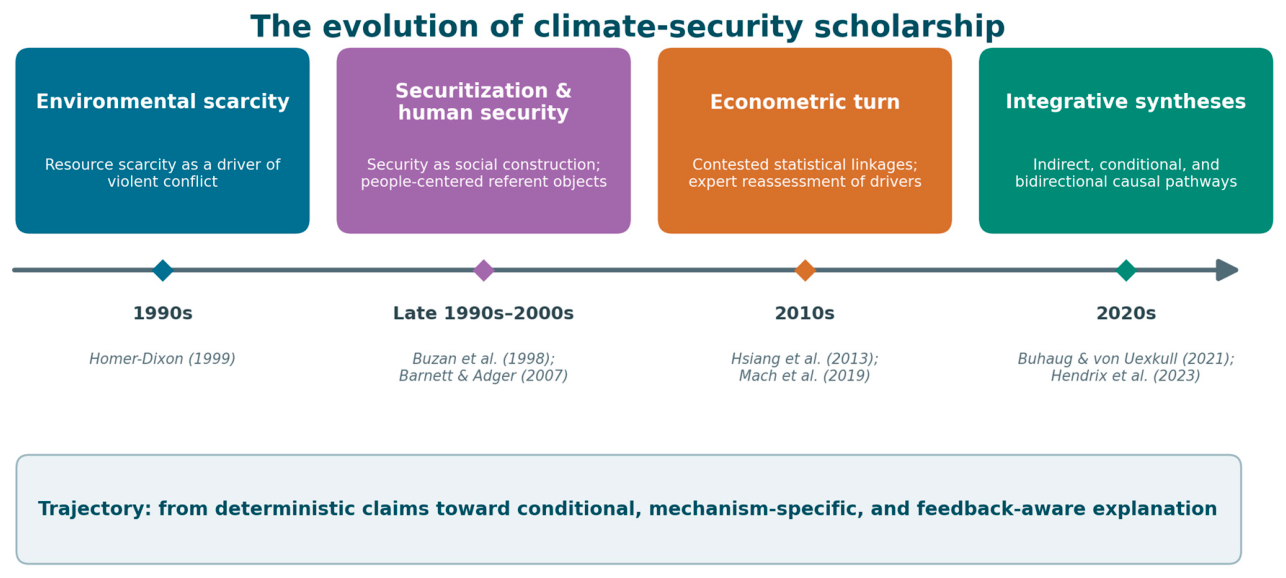
Figure 2.
The Multidimensional Climate-Security Framework: Seven Dimensions Across Four Analytical Levels. Note. Author's elaboration. Bidirectional connectors indicate that each dimension both shapes and is shaped by overall nexus outcomes, which remain contingent on mediating political, economic, and social structures.
Figure 2.
The Multidimensional Climate-Security Framework: Seven Dimensions Across Four Analytical Levels. Note. Author's elaboration. Bidirectional connectors indicate that each dimension both shapes and is shaped by overall nexus outcomes, which remain contingent on mediating political, economic, and social structures.
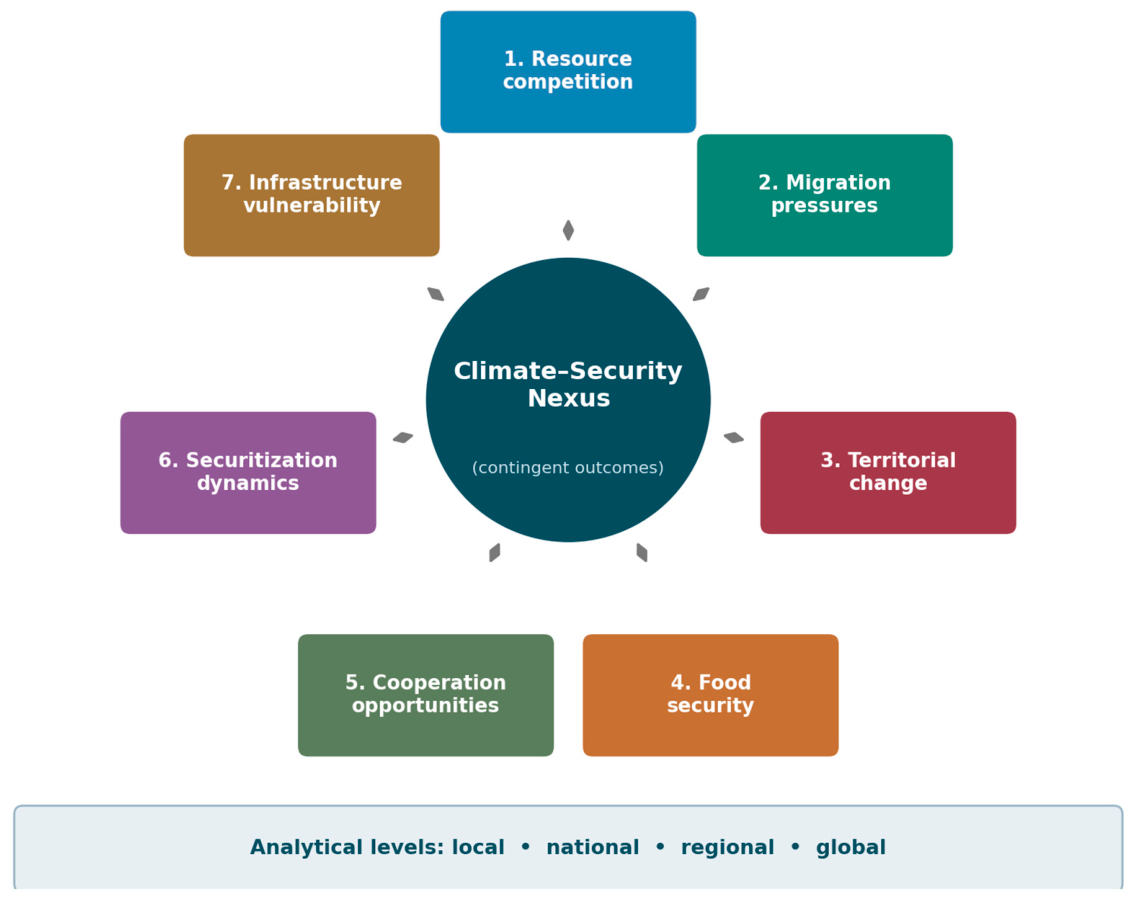
Figure 3.
Projected Internal Climate Migration by Region Under a Pessimistic Scenario, 2050. Note. Data from the World Bank Groundswell Part 2 report (Clement et al., 2021). Values denote projected internal climate migrants by 2050 under the pessimistic (high-emissions, unequal development) scenario.
Figure 3.
Projected Internal Climate Migration by Region Under a Pessimistic Scenario, 2050. Note. Data from the World Bank Groundswell Part 2 report (Clement et al., 2021). Values denote projected internal climate migrants by 2050 under the pessimistic (high-emissions, unequal development) scenario.
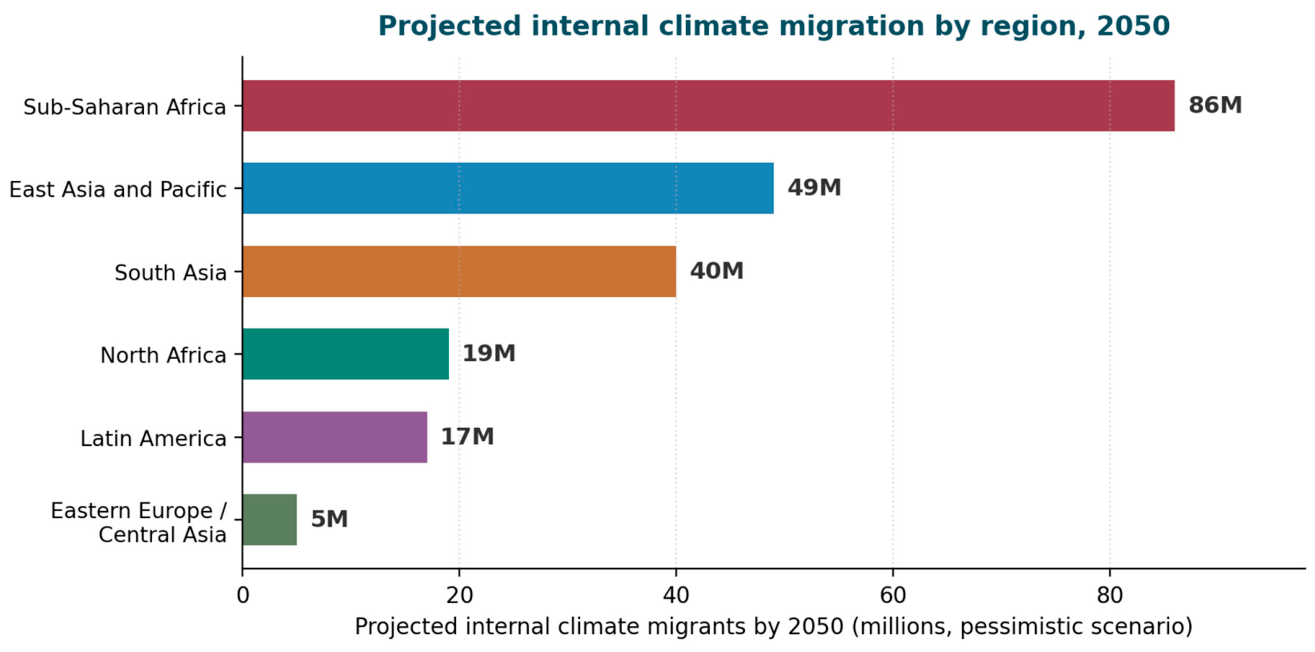
Figure 4.
Contingent Pathways from Climate Stress to Conflict and Cooperation. Note. Author's elaboration synthesizing the comparative analysis in Section 4 with the mediation findings of Mach et al. (2019) and von Uexkull and Buhaug (2021). The dashed connector indicates that conflictual and cooperative outcomes frequently co-occur within the same dyad or region.
Figure 4.
Contingent Pathways from Climate Stress to Conflict and Cooperation. Note. Author's elaboration synthesizing the comparative analysis in Section 4 with the mediation findings of Mach et al. (2019) and von Uexkull and Buhaug (2021). The dashed connector indicates that conflictual and cooperative outcomes frequently co-occur within the same dyad or region.
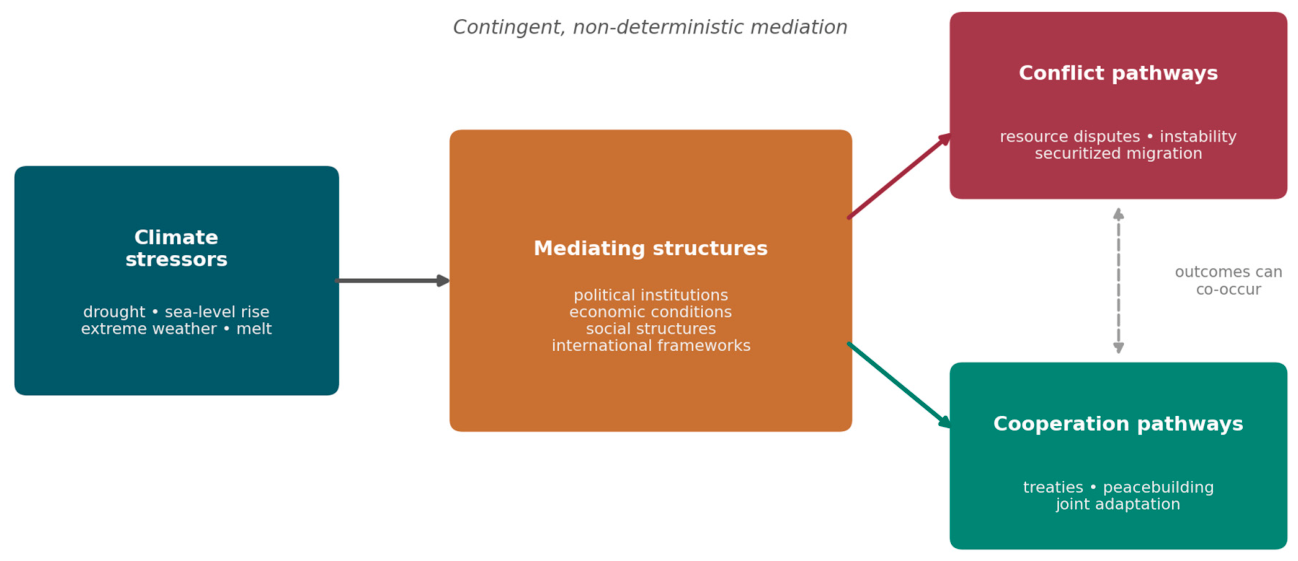

Table 1.
Major Theoretical Approaches to Climate Security.
| Theoretical Approach | Key Contributors | Core Claims | Limitations |
|---|---|---|---|
| Environmental scarcity theory | Homer-Dixon (1999) | Resource scarcity drives conflict through economic, migration, and institutional pathways | Deterministic tendencies; limited interstate focus |
| Copenhagen School securitization | Buzan et al. (1998); Wæver (1995) | Security issues are socially constructed through speech acts | Weak attention to material impacts |
| Human security | UNDP (1994); Barnett & Adger (2007) | Security should center on individuals and vulnerable communities | Conceptual breadth limits analytical precision |
| Environmental peacebuilding | Conca & Dabelko (2002); Ide (2018); Krampe et al. (2021) | Shared environmental challenges can foster cooperation | Selection bias; limited scope of documented cases |
| Climate–conflict econometrics | Hsiang et al. (2013); Burke et al. (2015); Vesco et al. (2020) | Statistical linkages between climate variables and conflict | Contested findings; methodological disputes |
| Political ecology | Peluso & Watts (2001); Selby (2014) | Environmental conflicts reflect broader political-economic structures | Variable engagement with security studies |
| Integrative human–environmental approaches | Daoudy (2021); von Uexkull & Buhaug (2021); Hendrix et al. (2023) | Climate affects security indirectly, conditionally, and across scales | Framework consolidation still in progress |
Note. Author's compilation is based on Barnett (2003), Buhaug (2015), Conca (2019), Hendrix et al. (2023), Koubi (2019), Scartozzi (2021), and von Uexkull and Buhaug (2021).
Table 2.
Climate Security Dimensions and Their Impacts on International Relations.
| Security Dimension | Climate Factor | Potential Outcomes | Analytical Framework |
|---|---|---|---|
| Resource competition | Water scarcity, agricultural stress | Conflict or cooperation over shared resources | Transboundary resource governance theory |
| Migration pressures | Sea-level rise, extreme weather | Cross-border movement, regional instability | Migration–security nexus analysis |
| Territorial change | Rising sea levels, Arctic opening | Sovereignty disputes, new shipping routes | Sovereignty and territorial integrity law |
| Food security | Agricultural disruption, yield decline | Price volatility, civil unrest, trade conflicts | Food systems and political stability |
| Cooperation opportunities | Shared environmental challenges | Environmental peacemaking, institutional development | Environmental peacebuilding theory |
| Securitization dynamics | Climate as constructed threat | Policy change, institutional adaptation | Copenhagen School securitization framework |
| Infrastructure vulnerability | Extreme weather, flooding | Critical infrastructure failure, cascade effects | Resilience and adaptation governance |
Note. Author's compilation based on Barnett (2003), Barnett and Adger (2007), Buzan et al. (1998), Homer-Dixon (1999), and Mach et al. (2019).
Table 3.
Multilevel Climate Security Analysis.
| Level | Key Actors | Primary Dynamics | Institutional Mechanisms |
|---|---|---|---|
| Local | Communities, local governments, civil society | Resource conflicts, displacement, livelihood disruption | Customary institutions, local adaptation planning |
| National | States, national security agencies, ministries | Policy formation, capacity deployment, domestic legitimation | National adaptation plans, defense strategies |
| Regional | Regional organizations, neighboring states | Transboundary cooperation or rivalry, migration management | River basin commissions, regional climate agreements |
| Global | International organizations, great powers, NGOs | Norm-setting, resource mobilization, agenda-setting | UNFCCC, UN Security Council, Paris Agreement, IPCC |
Note. Author's compilation based on Conca (2019), Detges (2017), and Scott (2015).
Table 4.
Selected Transboundary Water Agreements and Climate Adaptation.
| Agreement/Basin | Parties | Year | Climate Adaptation Provisions | Status |
|---|---|---|---|---|
| Indus Waters Treaty | India, Pakistan | 1960 | Limited; under stress from glacial change | Operational, contested |
| Nile Basin Initiative | 10 Nile states | 1999 | Cooperative framework; GERD disputes | Partial functionality |
| Mekong Agreement | Cambodia, Laos, Thailand, Vietnam | 1995 | Flow monitoring; climate adaptation dialogue | Operational, strained |
| Columbia River Treaty | Canada, United States | 1964 | Under renegotiation for climate adaptation | Renegotiation ongoing |
| Senegal River (OMVS) | Guinea, Mali, Mauritania, Senegal | 1972 | Integrated adaptation planning | Operational |
| Lake Chad Basin Commission | Six basin states | 1964 | Restoration initiatives amid climate-driven shrinkage | Limited effectiveness |
Note. Author's compilation based on Wolf (2007), Zawahri (2009), Tawfik (2016), and Zeitoun et al. (2013).
Table 5.
Climate Migration Projections and Regional Variations.
| Region | Projected Climate Migrants by 2050 (Pessimistic Scenario) | Primary Drivers | Key Host Areas |
|---|---|---|---|
| Sub-Saharan Africa | 86 million | Drought, agricultural decline, coastal flooding | Urban centers, regional neighbors |
| East Asia and Pacific | 49 million | Sea-level rise, typhoons, water stress | Urban centers, inland areas |
| South Asia | 40 million | Monsoon variability, coastal flooding, glacial melt | Urban centers, inland states |
| North Africa | 19 million | Water scarcity, agricultural decline | Coastal cities, Europe (secondary) |
| Latin America | 17 million | Drought, hurricanes, water stress | Urban centers, North America (secondary) |
| Eastern Europe/Central Asia | 5 million | Water scarcity, agricultural decline | Urban centers |
Note. Adapted from Clement et al. (2021), World Bank Groundswell Part 2 report.
Table 6.
Arctic Sovereignty Claims and Disputes.
| Issue | States Involved | Nature of Dispute | Current Status |
|---|---|---|---|
| Lomonosov Ridge | Russia, Canada, Denmark | Competing continental-shelf claims | CLCS review ongoing |
| Northwest Passage | Canada, United States | Internal waters vs. international strait | Unresolved; managed through practice |
| Northern Sea Route | Russia, multiple states | Transit rules and sovereignty | Russian regulatory framework contested |
| Hans Island | Canada, Denmark | Territorial sovereignty | Resolved 2022 (divided) |
| Beaufort Sea | Canada, United States | Maritime boundary | Unresolved |
| Svalbard fisheries | Norway, Russia, EU | Treaty interpretation | Ongoing disputes |
Note. Author's compilation based on Young (2011), Conley et al. (2020), Byers (2013), and Koivurova and Shibata (2023).
Table 7.
Environmental Peacebuilding Mechanisms and Examples.
| Mechanism | Logic | Example Cases | Effectiveness Factors |
|---|---|---|---|
| Technical cooperation | Scientific exchange builds trust | Red Sea Marine Peace Park; IAEA exchanges | Political space; sustained engagement |
| Institutional development | Shared institutions manage disputes | Mekong River Commission; Nile Basin Initiative | Institutional design; resource allocation |
| Livelihood creation | Shared benefits create peace constituencies | Transboundary conservation areas | Benefit distribution; community engagement |
| Conflict transformation | Environmental issues reframe disputes | Ecuador–Peru peace process | High-level commitment; creative diplomacy |
| Track II diplomacy | Unofficial channels build dialogue | Middle East water working groups | Political support; civil-society engagement |
Note. Author's compilation based on Conca and Dabelko (2002), Dinar (2011), Ide (2019), and Krampe et al. (2021).
Table 8.
Modes of Climate Securitization and Their Implications.
| Mode | Referent Object | Logic | Policy Implications | Critiques |
|---|---|---|---|---|
| Risk-based | Societal functioning, economic systems | Probability and preparedness | Risk assessment, adaptation planning | Depoliticizing effects |
| Humanitarian | Vulnerable populations | Protection and assistance | Human-security programming | Limited capacity to mobilize resources |
| Militarized | State security, critical infrastructure | Threat and defense | Defense planning, border security | Militarization risks |
| Ecological | Earth systems, planetary boundaries | Existential planetary risk | Transformative policy change | Political feasibility questions |
Note. Author's compilation based on Oels (2012), Methmann and Rothe (2012), and von Lucke et al. (2014).
Table 9.
Contributions to Climate Security Theory.
| Theoretical Contribution | Prior Limitation | Framework's Advance |
|---|---|---|
| Material–discursive integration | Disciplinary silos between constructivist and materialist approaches | Joint analysis of physical impacts and securitization dynamics |
| Structural mediation | Treatment of climate as external shock | Analysis of interaction with political, economic, and social structures, including conflict–vulnerability feedbacks |
| Cooperation–conflict balance | Conflict-centric bias | Explicit incorporation of cooperation pathways |
| Multilevel analysis | Single-level analytical focus | Integration across local, national, regional, and global levels |
| Interstate focus | Predominant focus on intrastate conflict | Explicit attention to international dynamics |
Note. Author's compilation.
Table 10.
Policy Recommendations Across Governance Levels.
| Governance Level | Priority Actions | Key Institutions |
|---|---|---|
| Local | Community-based adaptation; conflict-sensitive programming | Local governments, civil society |
| National | Cross-sectoral coordination; climate-proofing security institutions | National governments, interagency structures |
| Regional | Transboundary cooperation; regional adaptation planning | Regional organizations, river basin commissions |
| Global | Climate-security mainstreaming; legal innovation | UN system, Paris Agreement institutions |
Note. Author's compilation.
Disclaimer/Publisher’s Note: The statements, opinions and data contained in all publications are solely those of the individual author(s) and contributor(s) and not of MDPI and/or the editor(s). MDPI and/or the editor(s) disclaim responsibility for any injury to people or property resulting from any ideas, methods, instructions or products referred to in the content. |
© 2026 by the authors. Licensee MDPI, Basel, Switzerland. This article is an open access article distributed under the terms and conditions of the Creative Commons Attribution (CC BY) license (http://creativecommons.org/licenses/by/4.0/).
Copyright: This open access article is published under a Creative Commons CC BY 4.0 license, which permit the free download, distribution, and reuse, provided that the author and preprint are cited in any reuse.