

Submitted:
22 July 2026
Posted:
23 July 2026
You are already at the latest version
Abstract
Indoor air quality (IAQ) directly impacts occupant health, comfort, and accessibility, particularly for individuals with asthma, migraines, or multiple chemical sensitivity (MCS). While technical IAQ testing protocols in office buildings, such as the United States Environmental Protection Agency (EPA), Health Canada, and ASHRAE Standards, provide guidance for sampling, they do not address technician-related sources of contamination. Personal products, laundering practices, smoking, dry-cleaning residues, and fragrances are known sources of volatile organic compounds (VOCs) that can persist on clothing and skin, potentially contributing to confounding sampling results. Studies have shown that fragranced personal care and laundry products emit numerous VOCs, generate secondary byproducts, and remain a source of exposure through clothing off gassing. While switching to fragrance-free alternatives has been demonstrated to reduce emissions, these efforts are not always documented in testing. Rather, the lack of formalized decontamination protocols for technicians may undermine the accuracy of IAQ testing. This paper examines IAQ testing protocols used in Canadian office buildings, synthesizing evidence on human pollutant sources, susceptibility of vulnerable populations, and the role of greenwashing in product labeling, while proposing a formalized decontamination protocol for technicians. The protocol may improve accuracy of IAQ sampling, thereby supporting more reliable assessments for public health decision-making.
Keywords:
indoor air quality (IAQ)
; multiple chemical sensitivity (MCS)
; volatile organic compounds (VOCs)
; indoor air quality testing
; fragrances
; indoor accessibility
; disability inclusion
1. Introduction
Scent/fragrance-free policies are increasingly adopted across disciplines to restrict the use of fragranced consumer products such as perfumes, lotions, and antiperspirants [1]. These policies are designed to accommodate individuals affected by fragrances, including those with Multiple Chemical Sensitivity (MCS) [1,2]. MCS, a condition with rising prevalence in Canada [3], is characterized by debilitating symptoms such as headaches, nausea, respiratory distress and cognitive impairment, often triggered by exposure to fragranced products or to low concentrations of chemicals commonly tolerated by the general population [4,5,6]. Other vulnerable groups, including individuals with asthma, chronic obstructive pulmonary disease (COPD), migraine disorders, and dermatological conditions, are also adversely affected by fragrances, highlighting the broader public health importance of scent/fragrance-free policies [7,8,9,10].
For the purposes of this paper, we will refer to the term ‘fragrance-free policy’ to describe scent/fragrance-free and lowest-emission, least-toxic product use, ecological solutions for daily use, and a smoke-free policy. Fragrance-free policies also include omitting all products that contain the terms “fragrance”, “perfume” or “parfum” on labels, to foster inclusivity and enhance indoor air accessibility for susceptible populations impacted by fragrances. The term ‘fragrance’ refers to perfumes, scents, fragrances, colognes, essential oils, and incense.
For individuals with MCS and other related conditions, fragrance-free spaces are essential for accessibility, particularly in workplaces [11]. Fragrances were found to create significant environmental barriers and create a lack of accessibility to indoor environments in a companion paper, currently under peer-review [12]. A nationally distributed online survey in the United States (n= 1136) found that 34.7% of respondents experienced at least one adverse health effect from exposure to fragranced products, including migraines, respiratory and skin problems, asthma attacks, cognitive impairment, and cardiovascular symptoms [13]. As a result, 15.2% of the general population reported lost workdays, while individuals with autism, 59.4% reported losing workdays or employment [13,14]. This evidence highlights the substantial socio-economic impacts and the reduced participation in society from fragrance exposures.
Fragranced products emit volatile organic compounds (VOCs), which are carbon-based chemicals that readily vaporize under normal conditions and contribute to indoor air pollution [10,15]. Commonly released terpenes such as D-limonene and alpha-pinene can cause irritation, while other compounds including acetaldehyde, ethanol, acetone, and formaldehyde may also be emitted, many of which are undisclosed on ingredient labels [16]. The limited ingredient transparency of product ingredients and insufficient policy monitoring highlight how fragranced products can contribute to poor indoor air quality (IAQ).
With a growing body of research on IAQ, the monitoring and testing of indoor air pollutants, including VOCs, has become increasingly sophisticated. Accurate measurement of IAQ, especially in fragrance-free environments, requires minimizing additional sources of VOCs. While existing protocols such as Health Canada and U.S Environmental Protection Agency (EPA) often control for building materials and occupant activities, VOCs introduced by technicians remain largely undocumented and uncontrolled. Emerging research shows that humans produce measurable VOCs through breath, skin, clothing, and fragranced personal care products [17,18]. Given the sensitivity of modern IAQ testing equipment [19,20], technician emissions may interfere with the detection of low-concentration compounds in fragrance-free environments. For example, human metabolism and activities, such as skin care products, are major contributors to poor air quality [19], highlighting that human-related VOC emissions can impact IAQ.
This commentary was developed in response to a gap identified during the Accessible Air in the Built Environment research, funded by Accessibility Standards Canada/The Government of Canada, led by the Environmental Health Association of Quebec (ASEQ-EHAQ). Drawing on a targeted review of the scientific literature and existing IAQ guidance, it proposes a precautionary technician decontamination protocol to help reduce technician-related contamination during IAQ assessments. It also explores the implications of these methodological gaps for accessibility and the health of vulnerable populations, including individuals with MCS, in fragranced environments. Drawing on empirical evidence, the review proposes a formalized decontamination protocol to address systematic technician off gassing prior to IAQ testing, developed by ASEQ-EHAQ. Decontamination, for the purpose of this paper, includes practical guidance to minimize personal VOC emissions from off gassing into testing environments, thereby supporting more accurate, reliable, and inclusive IAQ assessments. The protocol may help improve accuracy and reliability of IAQ measurements, thereby supporting more reliable exposure assessments for public health decision-making, and is encouraged to be used in future validation studies.
2. Existing Indoor Air Quality Protocols and Gaps
This commentary includes a targeted review of IAQ guidance documents to identify recommendations related to sampling procedures and decontamination protocols for technicians. Guidance documents were obtained from the websites of the U.S. Environmental Protection Agency (EPA), Health Canada, the American Society of Heating, Refrigerating and Air-Conditioning Engineers (ASHRAE), and other relevant organizations. Given the Canadian context of the work, the targeted review prioritized IAQ guidance documents commonly applied or referenced in Canada, including Health Canada guidance, ASHRAE standards referenced by Health Canada, and U.S. EPA protocols, which are widely used in IAQ investigations. Documents were reviewed for guidance on quality assurance, sampling preparation, and technician-related sources of contamination. Sources were eligible if they addressed IAQ sampling procedures, quality assurance, contamination control, technician practices, or chemical sources that could influence indoor air measurements. Documents focusing exclusively on analytical laboratory methods or unrelated environmental monitoring applications were excluded. Findings were synthesized to identify gaps in current practices and inform the development of a precautionary technician decontamination protocol.
IAQ assessments in office buildings typically follow recognized technical protocols such as the U.S. Environmental Protection Agency (EPA) IAQ protocols for large office buildings [21] and Health Canada’s Indoor Air Quality in Office Buildings: A Technical Guide [22]. Health Canada also references ASHRAE standards, which are widely applied to IAQ parameters in commercial office settings [22,23,24]. These frameworks provide comprehensive protocols covering sampling strategies for different IAQ parameters, measurement techniques, quality assurance, technician practices, and interpretation of results. A summary of these protocols in relation to key IAQ parameters, target settings, and technician guidance is presented in Table 1.
While these protocols emphasize sampling accuracy, calibration, equipment handling, and the identification of pollutant sources related to occupant complaints, they do not account for confounding emissions from technicians, who are present throughout the sampling process. Specifically, current protocols lack instructions regarding fragranced personal care products and formal decontamination protocols prior to IAQ testing.

Table 1.
Comparison of Different IAQ Testing Protocols.
| Standard / Protocol | Settings | Key IAQ Parameters | Technician Guidance |
|---|---|---|---|
| Health Canada Indoor Air Quality in Office Buildings: A Technical Guide |
Office buildings |
|
|
| U.S. Environmental Protection Agency EPA A Standardized EPA Protocol for Characterizing Indoor Air Quality in Large Office Buildings |
Office buildings |
|
|
| ASHRAE Standard 55-2017 Thermal Environmental Conditions for Human Occupancy |
Residential, commercial and office buildings |
|
|
| ASHRAE Standard 62.1-2013 Ventilation for Acceptable Indoor Air Quality |
Non-residential buildings, including office buildings |
|
|
For buildings operating under fragrance-free policies, existing IAQ assessment protocols such as Health Canada, U.S. EPA, and ASHRAE, do not provide procedural guidance to prevent technicians from introducing VOCs from personal products during sampling activities. This omission underscores a significant gap in formal requirements to ensure that field personnel refrain from wearing fragranced or non-fragranced, high emission personal care products, laundry detergents, or perfumes/colognes, and that no formalized decontamination protocols were implemented prior to testing. Similarly, previous research on IAQ testing in office environments has not documented whether technicians use effective protocols to eliminate VOCs from personal use in internal or external spaces prior to sampling, highlighting a potential limitation in methodological transparency regarding decontamination protocols [e.g., 25,26,27]. One notable example is a companion study, currently in pre-print, that compared IAQ in office spaces with and without fragrance-free policies, in which technicians followed decontamination procedures to remove personal fragrances and other chemicals prior to IAQ sampling, as described in Section 3 of this paper [28]. Given that modern analytical instruments are capable of detecting VOCs at sub-parts-per-billion concentrations [20], measurements may be highly susceptible to contamination from human emissions through product choices, particularly those released from skin or clothing exposed to fragranced products [17,29,30,31]. This may not only compromise measurement accuracy, but also disproportionately affect IAQ assessments in environments that aim to be fragrance-free, affecting occupants who depend on these accommodations for accessibility.
2.1. Decontamination Gaps in IAQ Testing
When technicians enter environments that require a fragrance-free policy, such as certain hospitals where visitors are prohibited from wearing fragrances, using fragranced products, or carrying tobacco residues due to patient and staff vulnerability [32,33,34,35], they often do so without fragrance-free preparation unless explicitly instructed by clients. In the absence of clear protocols and instructions, technicians may fail to decontaminate or remove residual fragrances from personal care and other products, including laundry products (i.e., detergents, scent boosters, dryer sheets), or air fresheners used in homes and vehicles for a period of time prior to IAQ testing [22,23,24]. Additionally, current infection control guidelines in healthcare settings do not address fragrances in relation to patient care [36], despite its growing recognition of fragrance-free spaces as a critical accessibility measure for vulnerable populations [37,38].
The absence of formalized decontamination protocols can produce confounding VOC emissions during IAQ sampling. For example, controlled chamber studies have shown that lotion-on-skin exposure produces high VOC emission rates, with compounds such as phenoxyethanol accounting for two-thirds of the emissions [31]. Fragranced products, including air fresheners and laundry detergents, have been documented to emit hazardous VOCs such as toluene, benzene, acetone, ethylbenzene, and xylenes [39,40], which can react with ozone to form additional harmful byproducts, including nonanal, hexanal, and acetaldehyde [31,41].
Other studies have linked fragranced laundry products to the emission of numerous VOCs, including D-limonene [40,42], with evidence showing that VOCs can persist on clothing for days after contact to fragranced items such as perfumes and lotions [41]. Personal care products such as lotions, deodorants, and shampoos have been shown to produce hundreds of different VOCs behind terms such as “fragrances” or “parfum”, with one single product emitting 1-8 toxic or hazardous chemicals [25]. Despite claims of being environmentally friendly, many products labelled as “green” or “natural” can emit VOCs that can be harmful to health [43]. Additionally, some “green” products contain masking agents designed to cover up odors, which can still cause irritation and may not be truly eco-friendly, highlighting the importance of scrutinizing product labels and being aware of potential greenwashing tactics [44]. Importantly, switching to verified eco-friendly, fragrance-free products can substantially reduce VOC emissions by as much as 99.7% in some cases [42,45]. Incorporating such measures into technician preparation is therefore essential to minimize personal VOC contributions and ensure the integrity of IAQ testing results.
2.2. Equality Implications of Decontamination Gaps in IAQ Testing on Persons with Disabilities
Domestic and International human rights laws aim to protect persons with disabilities from discrimination, which includes protecting persons who have disabilities that are impacted by chemical exposures. The United Nations Convention on the Rights of Persons with Disabilities (UNCRPD), also includes in its ambit rights-based protections to persons with disabilities that are impacted by environmental barriers, including chemical and fragrance exposures. From a disability rights framing, these issues are examined within an accessibility and duty to accommodate framework. Thus, within this framing, fragrance-free policies are considered to be an important accessibility measure, and may be an appropriate form of accommodation, for individuals and groups impacted by fragrance exposures, including those with MCS [11]. These are legal obligations that the government, employers, service providers, and others that are legally obligated under human rights legislation and accessibility legislation, must comply with.
Fragrance-free policies are an important tool in the realization of human rights, accessibility, and full inclusion. In fact, fragrance-free policies have been shown to improve IAQ, by reducing total volatile organic compounds (TVOCs), and specific hazardous VOCs, known to exacerbate MCS symptoms, such as toluene, xylenes, ethylbenzene, acetaldehyde, and acetone [28]. Thus, the accuracy of testing becomes imperative as fragrance-free policies are critical to help increase accessibility for groups impacted by fragrances and poor IAQ.
Addressing this procedural gap underscores the need to control technician-related VOC sources during IAQ testing, whether it is in fragrance-free or non-fragrance-free environments. The use of verified fragrance-free products as a decontamination protocol prior to sampling may minimize measurement bias and ensure that IAQ data accurately reflects building conditions. This practice also protects occupants who require fragrance-free spaces from exposure. Establishing such procedures not only strengthens scientific rigor but also aligns with principles of equity, equality, and accessibility, by ensuring that testing does not inadvertently create barriers for vulnerable groups. Including technician decontamination as part of standardized IAQ protocols, consistent with best practice guidance (e.g., EPA, WHO), further enhances the credibility and reproducibility of results. The next section outlines a step-by-step decontamination protocol for IAQ technicians developed by ASEQ-EHAQ.
3. A Path Forward in IAQ Protocols: Suggested Steps to Implement Decontamination Protocols
To minimize confounding VOC emissions from technicians during IAQ testing, ASEQ-EHAQ recommends a structured set of decontamination protocols. This targeted review focused on identifying peer-reviewed evidence relevant to human-related VOC emissions and IAQ testing protocols. To our knowledge, there were no protocols that addressed this. Thus, this study extracted literature pertaining to VOC emissions from human and environmental sources.
Literature was synthesized using a search strategy across PubMed, Scopus, and Google Scholar. Peer-reviewed literature was identified through PubMed, Scopus, and Google Scholar using combinations of search terms including indoor air quality, IAQ testing, environmental sampling, technician contamination, occupant behaviour, volatile organic compounds (VOCs), fragrances, personal care products, third-hand smoke, dry-cleaning emissions, and decontamination protocols. Articles were included if they addressed VOC emissions from human sources (e.g., skin, clothing, personal care or fragranced products), laundering sources, environment, or examined adsorption and re-emission processes of VOCs. Only technical guidance documents applicable to the built environment, including office or institutional building environments were considered, consistent with the testing settings in the Accessible Air in the Built Environment research project carried out by ASEQ-EHAQ [28]. Grey literature (e.g., government reports) was reviewed only when it provided context on existing IAQ protocols. Extracted studies were analyzed thematically to identify evidence gaps in current IAQ technician protocols, specifically regarding fragrance contamination and the need for decontamination protocols. This review resulted in 15 relevant articles [16,17,25,31,40,41,46,47,48,49,50,51,52,53,54].
The following proposed decontamination protocols balance scientific rigor with practical feasibility for technicians, while drawing on the lived experiences of individuals with MCS and other individuals who are intolerant to fragrances [5,14,37,55]. The proposed technician decontamination protocol should be interpreted as a precautionary protocol. Recommendations are based on available evidence regarding indoor VOC sources, emissions from personal care and household products, fragrance residues, laundering products, tobacco-related residues, and other human sources of VOCs. Where exact preparation periods or procedures are specified, these represent precautionary operational recommendations developed from the available literature and ASEQ-EHAQ’s field experience, rather than experimentally validated thresholds. Future studies should evaluate the optimal duration and effectiveness of these measures. The proposed protocol was also informed by ASEQ-EHAQ’s experience working with individuals affected by VOC exposures and multiple chemical sensitivity, whose reported approaches for reducing residual odours and exposures helped identify practical considerations for protocol development. The protocol was implemented during IAQ assessments conducted as part of the Accessible Air in the Built Environment research. However, no formal participant data were collected specifically for this commentary, and the effectiveness of the proposed protocol has not been formally evaluated and requires future validation.
Refer to S1 for a formal checklist of the proposed protocol.
3.1. Proposed Technician Decontamination Protocol and Components
Table 2.
Proposed Technician Decontamination Protocol Recommendations and Evidence Basis.
| Protocol category | Recommendation | Evidence Basis |
|---|---|---|
| Smoking prohibition | Technicians should not smoke or vape prior to IAQ testing to minimize tobacco-related VOC contamination off-gassing into sampling sites, as tobacco emits numerous VOCs [51]. | Literature-informed |
| Clothing selection | Clothing should be purchased from non-fragranced, non or lowest-emission clothing merchandise whenever possible (eg. organic clothing); if this is not feasible, refer to laundering practices below for used textiles [53]. | Literature-informed and organizational practice-based |
| New textiles, that are non-organic, will emit formaldehyde and other VOCs; pre-washing and adequate airing (see details below) are required [53]. | Literature-informed and organizational practice-based | |
| Laundering practices | Dry-cleaned garments should not be worn during IAQ testing, as they can introduce unwanted elements into the testing process [52]. | Literature-informed |
| Clothing, new or used, should be laundered well in advance of IAQ testing. A minimum preparation period of 14 days is recommended prior to testing to allow residual VOCs to dissipate, because literature has shown that VOCs persist on clothing for several days [41]. | Literature-informed and organizational practice-based | |
| If clothes are scented, before washing them, hang them outside for a few days to off-gas the scents as much as possible. Then proceed to wash them to remove the scents and other chemicals (presented below) [52]. | Literature-informed and organizational practice-based | |
| Before using your washing machine, if conventional fragranced products are usually used, run the washing machine twice (more if necessary) with hot water, fragrance-free laundry products, vinegar, and baking soda [48,49]. When fragrance emissions from the washing machine have been eliminated, proceed with laundering clothes. This process of cleaning out the washing machine is done to remove residual fragrances or VOCs from previously used laundry products; if this is not done, chemicals present in fragrances will be picked up by your clothes that are used during IAQ testing. Note: If you have bought non-fragranced clothes, and your washing machine is fragranced, it is preferable to wash them by hand using only fragrance-free soap (Refer to Figure 1), baking soda and vinegar. Hang textiles to dry outside or in a well-ventilated fragrance-free area [46,48,49,52]. | Literature-informed and organizational practice-based | |
| When laundering, fragranced articles should be washed for at least four cycles using fragrance-free, lowest-emission laundry products as this can reduce VOCs emitted from fragranced laundry products [40]; adding 1 cup of baking soda and 1 cup of vinegar per cycle can help absorb odours and neutralize VOC residuals [48,49]. | Literature-informed and organizational practice-based | |
| After laundering, clothes should be air-dried either indoors or outdoors until dry as dryers will be contaminated with chemicals from regular laundry products, including softeners [46]. | Literature-informed and organizational practice-based | |
| Clothes can be hung outside to dry, which helps increase the off-gassing process. Areas preferred indoors to dry clothes could be any room that is non-perfumed to avoid fragrance contamination [46]. | Literature-informed and organizational practice-based | |
| If in highly urbanized areas, clothes should be dried indoors, in a non-perfumed area, with adequate ventilation [46]. | Literature-informed and organizational practice-based | |
| Store in a sealed fragrance-free plastic bag in a fragrance-free space, until the testing date to prevent the transfer of neighboring sources of VOCs. Do not store the sealed plastic bag in a drawer with clothes that have been laundered in regular fragranced detergents [41]. |
Literature-informed and organizational practice-based | |
| Fragrance elimination at home, in vehicles, and en route to testing site | Technicians should refrain from using perfumes, and fragrances, and scented products such as lotions, hair products, incense, candles, air fresheners, and any other high emission or toxic products – this includes such usage by others within their living space for at least 14 days prior to testing to reduce the transmission of VOCs and the resulting off-gassing into the air [16,17,25,31,41]. | Literature-informed and organizational practice-based |
| Technicians should refrain from undergoing any home renovations until after IAQ testing has been completed as this may produce numerous VOCs [54]. | Literature-informed | |
| To maintain optimal air quality, it is preferable to open windows for ventilation and remove garbage regularly to avoid unwanted odours [50]. | Literature-informed | |
| Vehicles used for transport to testing sites should also be free from air fresheners and fragranced products for four weeks prior to testing. | Literature-informed | |
| Avoid any vehicle detailing, as this may emit many VOCs [47]. | Literature-informed | |
| A new Tyvek suit (see below for details) should be worn in the vehicle from the technician’s home to testing sites to prevent VOC exposure from the vehicle. | Literature-informed | |
| Technicians should avoid entering any areas of high emission on route to testing sites such as pharmacies, stores, shopping malls, garages or gas stations, as VOCs may attach to skin, hair and clothes [56]. | Literature-informed and organizational practice-based | |
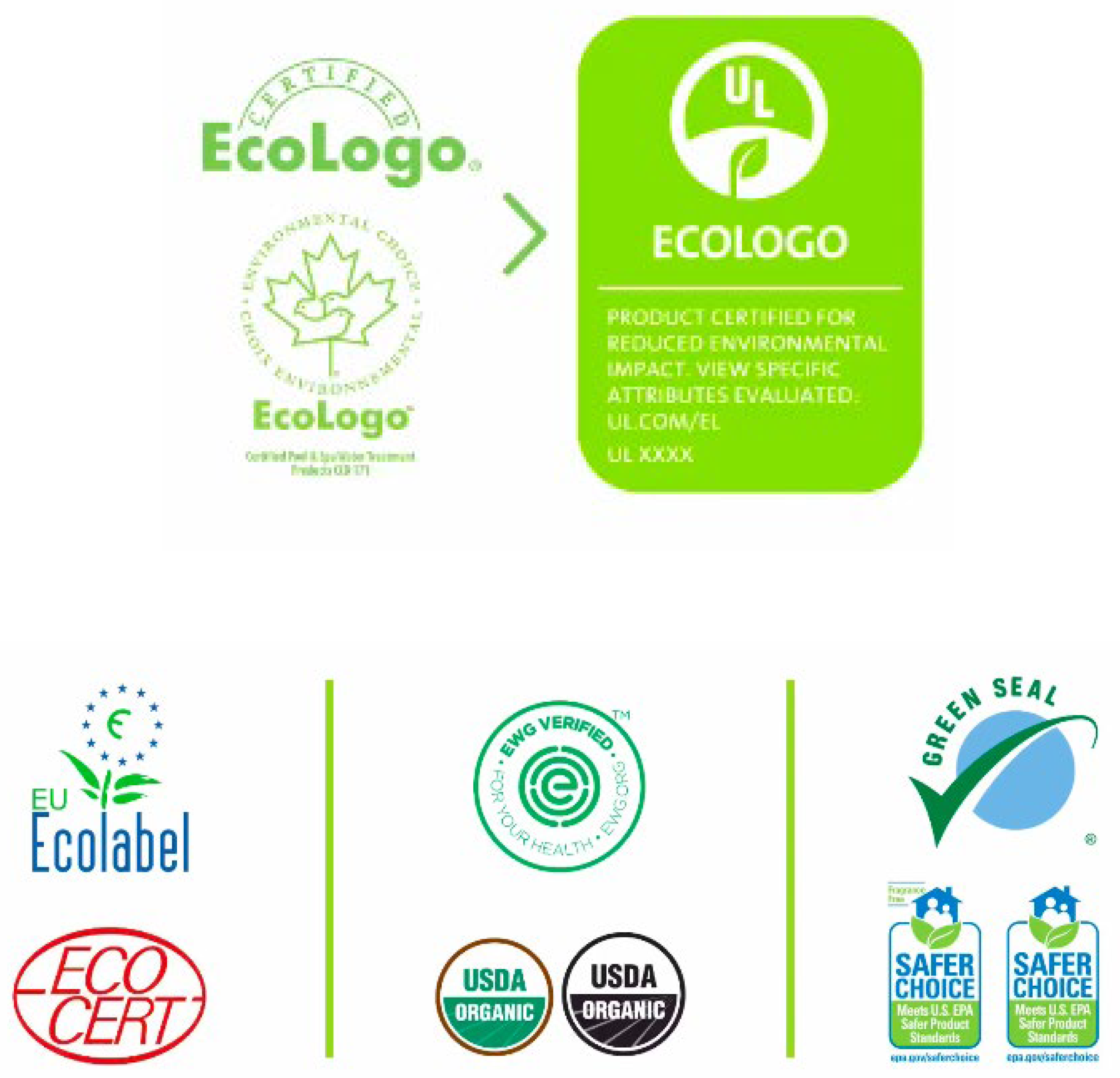
| Awareness of greenwashing and product selection | Many products labeled “unscented,” “eco-friendly,” or “green” still contain fragrance masking agents or VOCs [57]. Only use products with clear ingredient disclosure or third-party fragrance-free certification to ensure validity (refer to Figure 1). | Literature-informed and organizational practice-based |
| Avoid products with terms on the label such as “perfume”, “parfum”, “fragrance” or “essential oils” [57]. | Literature-informed and organizational practice-based |
Source classification: Literature-informed recommendations are supported directly by published evidence. Literature-informed and organizational practice-based recommendations combine published evidence with ASEQ-EHAQ’s field experience accumulated over more than 20 years of work in environmental health and accessibility. These recommendations are precautionary in nature and require future validation.
Figure 1.
Examples of Recognized Eco-Logo.
3.2. Tyvek Suits
A Tyvek suit is a disposable one-piece coverall made from DuPont’s Tyvek® fabric, a tough, non-woven material that provides protection against particulates [58]. In some environments, particularly those with elevated ozone levels, such as certain office buildings [59], clothing can react with ozone to produce aldehydes, including nonanal and formaldehyde, which can alter the indoor air composition and affect IAQ measurements [29]. While clothing may reduce emissions from skin-ozone reactions, it can contribute to VOCs originating from the textiles themselves [29]. To address this challenge, Tyvek suits are recommended during IAQ testing to reduce VOC emissions from skin, hair, and clothing, thereby preventing contamination from technician-related sources.
- Before entering the testing site, the Tyvek suit worn during transport should be discarded outside of the testing area, to prevent contamination from vehicles into sampling areas.
- To standardize results and prevent fragrances and other contaminants from affecting sampling devices, all technicians must wear a new Tyvek suit before entering the testing area and prior to setting up sampling equipment.
- Once the sampling equipment is set up and operational, technicians should exit the testing area, remove the Tyvek suit, and package it in a sealed non-fragranced bag while they wait for the sampling to be completed.
- The Tyvek suit must be worn again any time before re-entering the testing area for periodic checks on the sampling equipment and for takedown of the equipment. Anytime the suit is removed between checks, it should be placed in the sealed non-fragranced bag to avoid contamination from outside sources.
- A new Tyvek suit is to be used for each sampling site and not reused. Once sampling is completed for the day, discard the suit, and repeat the above steps for the next site.
4. Conclusions
This paper advances the field of IAQ assessment by introducing a formalized decontamination protocol for technicians that addresses a methodological gap in current IAQ testing protocols in buildings. Through a targeted review of peer-reviewed evidence on VOC emissions from human sources, including skin, clothing, and fragranced products, and lived experiences of populations impacted by fragrance exposures, to our knowledge, this study proposes the first published formalized technician decontamination protocol to reduce technician-related contamination and off gassing of personal VOCs. Beyond its methodological contribution, the paper links IAQ testing to accessibility and equity principles under the United Nations Convention on the Rights of Persons with Disabilities (UNCRPD), emphasizing that fragrance and certain chemical exposures can create barriers to accessibility and inclusion in indoor and outdoor environments. The proposed framework aligns scientific evidence with inclusive practice, offering a foundation for future IAQ standards, technician training curriculums, and IAQ assessments in a variety of different environments. We therefore propose a technician decontamination protocol as a precautionary approach to strengthen sampling reliability and consistency. Future research should evaluate the effectiveness, feasibility, and reproducibility of the proposed protocol across diverse indoor environments and establish evidence-based standards for technician preparation in IAQ investigations. Collectively, these contributions strengthen both the validity of IAQ results for public health decision-making, and the protection of vulnerable populations in diverse indoor settings.
Supplementary Materials
The following supporting information can be downloaded at the website of this paper posted on Preprints.org.
Author Contributions
Conceptualization, R.P.; methodology, R.P., A.T., and N.A.D.; validation, R.P., J.M., M.G., A.T., and N.A.D.; formal analysis, A.T.; investigation, R.P., J.M., A.T., and R.B.; data curation, A.T.; writing—original draft preparation, A.T.; review and editing, R.P., J.M., M.G., R.B., R.L., N.A.D., and A.T.; visualization, A.T.; supervision, R.P.; project administration, R.P.; funding acquisition, R.P. All authors have read and agreed to the published version of the manuscript. All authors have read and agreed to the published version of the manuscript.
Funding
This research was part of a broader research project that was funded in part by Accessibility Standards Canada and the Association pour la santé environnementale du Québec-Environmental Health Association of Québec (ASEQ-EHAQ).
Institutional Review Board Statement
The study was conducted in accordance with the Declaration of Helsinki, and approved by the Ethics Committee of the Women’s College Hospital [REB# 2023-0030-E] on October 27th, 2023.
Informed Consent Statement
Informed consent was obtained from all subjects involved in the Accessible Air in the Built Environment study.
Data Availability Statement
The original contributions presented in this study are included in the article/supplementary material. Further inquiries can be directed to the corresponding author(s).
Acknowledgments
The authors sincerely thank the Steering Committee, project partners, participants who contributed their time, experiences, and perspectives to this work.
Conflicts of Interest
Some authors received remuneration from (ASEQ-EHAQ) for conducting data analysis and manuscript preparation. However, this did not influence the study design, analysis, or interpretation of results.
References
- Canadian Human Rights Commission. Environmental sensitivities and scent-free policies: A guide for federally regulated employers and service providers . Government of Canada, 2026. Available online: https://www.chrc-ccdp.gc.ca/resources/publications/environmental-sensitivities-and-scent-free-policies.
- Steinemann, A. Ten questions concerning fragrance-free policies and indoor environments. Build. Environ. 2019, 159, 106054. [Google Scholar] [CrossRef]
- Robins, S.; Molot, J.; Peris, R. Prevalence of multiple chemical sensitivity in Canada between 2000 and 2020. Int. J. Environ. Res. Public Health 2026, 23(2), 236. [Google Scholar] [CrossRef] [PubMed]
- L’Association pour la santé environnementale du Québec / Environmental Health Association of Quebec. Health Impacts . ASEQ-EHAQ, n.d. Available online: https://aseq-ehaq.ca/en/health-impacts/ (accessed on 12 November 2025).
- Molot, J.; Sears, M.; Anisman, H. Multiple chemical sensitivity: It’s time to catch up to the science. Neurosci. Biobehav. Rev. 2023, 151, 105227. [Google Scholar] [CrossRef] [PubMed]
- Diallo, N. A.; Molot, J.; Bray, R.; Trifunovski, A.; Peris, R. Chemical Exposures, Sensitization, Provocation and Symptom Profiles in Adults with Multiple Chemical Sensitivity: A Cross-Sectional Survey. Association pour la santé environnementale du Québec – Environmental Health Association of Québec: Québec, Ontario, Canada, 2026a; (Manuscript in preparation; under review). [Google Scholar]
- Steinemann, A. Health and societal effects from exposure to fragranced consumer products. Prev. Med. Rep. 2017, 5, 45–47. [Google Scholar] [CrossRef] [PubMed]
- Rádis-Baptista, G. Do synthetic fragrances in personal care and household products impact indoor air quality and pose health risks? J. Xenobiotics 2023, 13(1), 121–131. [Google Scholar] [CrossRef] [PubMed]
- Salonen, H.; Salthammer, T.; Castagnoli, E.; Täubel, M.; Morawska, L. Cleaning products: Their chemistry, effects on indoor air quality, and implications for human health. Environ. Int. 2024, 190, 108836. [Google Scholar] [CrossRef] [PubMed]
- Bhoonah, R.; Mendez, M.; Maury-Micolier, A. Human health impacts and indoor chemical reactions of vocs from cleaning products and occupants. Atmos. Environ. 2024, 338, 120846. [Google Scholar] [CrossRef]
- Canadian Human Rights Commission. Environmental sensitivities and scent-free policies. 2024. Available online: https://www.chrc-ccdp.gc.ca/resources/publications/environmental-sensitivities-and-scent-free-policies.
- Diallo, N. A.; Molot, J.; Bray, R.; Trifunovski, A.; Peris, R. When Disability Recognition Fails: Accommodation Denial and Socioeconomic Exclusion Among Canadians with Multiple Chemical Sensitivity. Association pour la santé environnementale du Québec – Environmental Health Association of Québec: Québec, Ontario, Canada, 2026b; (Manuscript in preparation; under review). [Google Scholar]
- Steinemann, A. Fragranced consumer products: Exposures and effects from emissions. Air Qual. Atmos. Health 2016, 9(8), 861–866. [Google Scholar] [CrossRef] [PubMed]
- Steinemann, A. National prevalence and effects of multiple chemical sensitivities. J. Occup. Environ. Med. 2018, 60(3), e152–e156. [Google Scholar] [CrossRef] [PubMed]
- Wolkoff, P. Indoor air chemistry: Terpene reaction products and airway effects. Int. J. Hyg. Environ. Health 2020, 225, 113439. [Google Scholar] [CrossRef] [PubMed]
- Steinemann, A.; MacGregor, I. C.; Gordon, S. M.; Gallagher, L. G.; Davis, A. L.; Ribeiro, D. S.; Wallace, L. A. Fragranced consumer products: Chemicals emitted, ingredients unlisted. Environ. Impact Assess. Rev. 2011, 31(3), 328–333. [Google Scholar] [CrossRef]
- Steinemann, A. Volatile emissions from common consumer products. Air Qual. Atmos. Health 2015, 8, 273–281. [Google Scholar] [CrossRef]
- Tang, X.; Misztal, P. K.; Nazaroff, W. W.; Goldstein, A. H. Volatile organic compound emissions from humans indoors. Environ. Sci. Technol. 2016, 50(23), 12686–12694. [Google Scholar] [CrossRef] [PubMed]
- You, Bo; Zhou, Wei; Li, Junyao; Li, Zhijie; Sun, Yele. A review of indoor Gaseous organic compounds and human chemical Exposure: Insights from Real-time measurements. Environ. Int. Vol. 170 2022, 2022, 107611. [Google Scholar] [CrossRef] [PubMed]
- Papapostolou, V.; Kuang, M.; Mui, W.; Low, J. C.; Polidori, A. Laboratory Evaluation of VOC Sensors: Laboratory Testing Protocol . [Technical report]. South Coast Air Quality Management District, 2023. Available online: https://www.aqmd.gov/docs/default-source/aq-spec/protocols/voc-sensors-laboratory-testing-protocol.pdf.
- U.S. Environmental Protection Agency. A standardized EPA protocol for characterizing indoor air quality in large office buildings . (Report No. EPA/600/R-03/060). 2003. Available online: https://www.epa.gov/sites/default/files/2016-04/documents/standardized_iaq_base_protocol_for_characterizing_iaq_in_large_buildings-pdf.pdf (accessed on 5 September 2025).
- Health Canada. Indoor air quality in office buildings: A technical guide (Cat. H46-2/93-166Erev). 1995. Available online: https://publications.gc.ca/collections/collection/h46-2-93-166e-rev.pdf (accessed on 5 August 2025).
- American Society of Heating, Refrigerating and Air-Conditioning Engineers (ASHRAE). Addendum d to ANSI/ASHRAE Standard 55-2017: Thermal Environmental Conditions for Human Occupancy [PDF]. 2020. Available online: https://www.ashrae.org/file%20library/technical%20resources/standards%20and%20guidelines/standards%20addenda/55_2017_d_20200731.pdf (accessed on 8 July 2025).
- American Society of Heating, Refrigerating and Air-Conditioning Engineers (ASHRAE). Addendum p to ANSI/ASHRAE Standard 62.1-2013: Ventilation for acceptable indoor air quality [PDF]. 2015. Available online: https://www.ashrae.org/file%20library/technical%20resources/standards%20and%20guidelines/standards%20addenda/62_1_2013_p_20150707.pdf (accessed on 8 July 2025).
- Potera, C. Indoor air quality: Scented products emit a bouquet of vocs. Environ. Health Perspect. 2011, 119(1). [Google Scholar] [CrossRef] [PubMed]
- Jung, C.; El Samanoudy, G.; Alqassimi, N. Indoor air quality in educational institutions: A comparative study of vocs and bacterial contaminants in Dubai schools. Front. Built Environ. 2024, 10. [Google Scholar] [CrossRef]
- Mansor, A.; Abdullah, S.; Ahmad, A.; Ahmed, A.; Zulkifli, M.; Jusoh, S.; Ismail, M. Indoor air quality and sick building syndrome symptoms in administrative office at public university. Dialogues Health 2024, 4, 100178. [Google Scholar] [CrossRef] [PubMed]
- Trifunovski, A.; Lattanzio, R.; Molot, J.; Bray, R.; Barakat, C.; Chan, A. W.; Diallo, N. A.; Peris*, R. Scent-Free Policies: An Effective and Low-Cost Source-Control Strategy to Improving Indoor Air Quality. 2026. [Google Scholar] [CrossRef]
- Wang, N.; Ernle, L.; Bekö, G.; Wargocki, P.; Williams, J. Emission rates of volatile organic compounds from humans. Environ. Sci. Technol. 2022, 56(8), 4838–4848. [Google Scholar] [CrossRef] [PubMed]
- Wu, T.; Müller, T.; Wang, N.; Byron, J.; Langer, S.; Williams, J.; Licina, D. Indoor emission, oxidation, and new particle formation of personal care product related volatile organic compounds. Environ. Sci. Technol. Lett. 2024, 11(10), 1053–1061. [Google Scholar] [CrossRef] [PubMed]
- Wang, N.; Müller, T.; Ernle, L.; Bekö, G.; Wargocki, P.; Williams, J. How does personal hygiene influence indoor air quality? Environ. Sci. Technol. 2024, 58(22), 9750–9759. [Google Scholar] [CrossRef] [PubMed]
- Women’s College Hospital. Fragrance/scent-free workplace environment. 2023. Retrieved September 5, 2025, from Women’s College Hospital website: https://www.womenscollegehospital.ca/fragrance-scent-free-workplace-environment/.
- University Health Network. Smoke-Free & Scent-Free. n.d. Available online: https://www.uhn.ca/OurHospitals/Pages/smoke_scent_free_UHN.aspx (accessed on 5 September 2025).
- American Medical Association (AMA). A-25 Handbook: Informational Reports and Reference Committee Reports [PDF]. 2025a. Available online: https://www.ama-assn.org/system/files/a25-handbook-combined.pdf (accessed on 11 October 2025).
- American Medical Association (AMA). Fragrance Regulation (Policy H-135.902). In Report of the Council on Science and Public Health (Resolution 501-A-24). 2025b. Available online: https://policysearch.ama-assn.org/policyfinder/detail/%22Fragrance%20Regulation%20H-135.902%22?uri=%2FAMADoc%2FHOD.xml-H-135.902.xml (accessed on 5 September 2025).
- Health Canada. Hand washing, cleaning, disinfection and sterilization in health care (Canada Communicable Disease Report, Vol. 24, Suppl. 8). 1998. Available online: https://publications.gc.ca/collections/collection_2016/aspc-phac/HP3-1-24-S8-eng.pdf (accessed on 5 September 2025).
- Yousufzai, S. J.; Psaradellis, E.; Peris, R.; Barakat, C. A qualitative exploration of policy, institutional, and social misconceptions faced by individuals with multiple chemical sensitivity. Int. J. Environ. Res. Public Health 2025, 22(9), 1383. [Google Scholar] [CrossRef] [PubMed]
- Flegel, K.; Martin, J. G. Artificial scents have no place in our hospitals. Can. Med. Assoc. J. 2015, 187(16), 1187–1187. [Google Scholar] [CrossRef] [PubMed]
- Lin, K.-H.; Tsai, J.-H.; Cheng, C.-C.; Chiang, H.-L. Emission of volatile organic compounds from consumer products. Aerosol Air Qual. Res. 2022, 22(9), 220250. [Google Scholar] [CrossRef]
- Steinemann, A.; Gallagher, L.G.; Davis, A.L.; et al. Chemical emissions from residential dryer vents during use of fragranced laundry products. Air Qual. Atmos. Health 2013, 6, 151–156. [Google Scholar] [CrossRef]
- Gherghel, S.; Morgan, R. M.; Arrebola-Liébanas, J. F.; Blackman, C. S.; Garrido-Frenich, A.; Parkin, I. P. Persistence of transferred fragrance on fabrics for forensic reconstruction applications. Sci. Justice 2020, 60(1), 53–62. [Google Scholar] [CrossRef] [PubMed]
- Goodman, N. B.; Wheeler, A. J.; Paevere, P. J.; Agosti, G.; Nematollahi, N.; Steinemann, A. Emissions from dryer vents during use of fragranced and fragrance-free laundry products. Air Qual. Atmos. Health 2018, 12(3), 289–295. [Google Scholar] [CrossRef]
- Harding-Smith, E.; Shaw, D. R.; Shaw, M.; Dillon, T. J.; Carslaw, N. Does green mean clean? volatile organic emissions from regular versus green cleaning products. Environ. Sci. Process. Impacts 2024, 26(2), 436–450. [Google Scholar] [CrossRef] [PubMed]
- Fella, S.; Bausa, E. Green or greenwashed? examining consumers’ ability to identify greenwashing. J. Environ. Psychol. 2024, 95, 102281. [Google Scholar] [CrossRef]
- Temkin, A. M.; Geller, S. L.; Swanson, S. A.; Leiba, N. S.; Naidenko, O. V.; Andrews, D. Q. Volatile organic compounds emitted by conventional and “green” cleaning products in the u.s. market. Chemosphere 2023, 341, 139570. [Google Scholar] [CrossRef] [PubMed]
- Anderson, Rosalind C.; And, Julius H. Respiratory toxicity of fabric softener emissions. J. Toxicol. Environ. Health Part A 2000, 60(2), 121–136. [Google Scholar] [CrossRef] [PubMed]
- Wilson, M. P.; Hammond, S.; Nicas, M.; Hubbard, A. E. Worker exposure to volatile organic compounds in the vehicle repair industry. J. Occup. Environ. Hyg. 2007, 4(5), 301–310. [Google Scholar] [CrossRef] [PubMed]
- Srinivas, C.; Mathew, A.; Chakravarthi, A. Activated charcoal and baking soda to reduce odor associated with extensive blistering disorders. Indian J. Dermatol. Venereol. Leprol. 2008, 74(2), 122. [Google Scholar] [CrossRef] [PubMed]
- Qamaruz-Zaman, N.; Kun, Y.; Rosli, R. Preliminary observation on the effect of baking soda volume on controlling odour from discarded organic waste. Waste Manag. 2015, 35, 187–190. [Google Scholar] [CrossRef] [PubMed]
- Agapiou, A.; Vamvakari, J. P.; Andrianopoulos, A.; Pappa, A. Volatile emissions during storing of green food waste under different aeration conditions. Environ. Sci. Pollut. Res. 2016, 23(9), 8890–8901. [Google Scholar] [CrossRef] [PubMed]
- Jacob, P.; Benowitz, N. L.; Destaillats, H.; Gundel, L.; Hang, B.; Martins-Green, M.; Matt, G. E.; Quintana, P. E.; Samet, J. M.; Schick, S. F.; Talbot, P.; Aquilina, N. J.; Hovell, M. F.; Mao, J.-H.; Whitehead, T. P. Thirdhand smoke: New evidence, challenges, and future directions. Chem. Res. Toxicol. 2016, 30(1), 270–294. [Google Scholar] [CrossRef] [PubMed]
- Ceballos, D. M.; Fellows, K. M.; Evans, A. E.; Janulewicz, P. A.; Lee, E.; Whittaker, S. G. Perchloroethylene and dry cleaning: It’s time to move the industry to safer alternatives. Front. Public Health 2021, 9. [Google Scholar] [CrossRef] [PubMed]
- Herrero, M.; González, N.; Rovira, J.; Marquès, M.; Domingo, J.; Nadal, M. Early-life exposure to formaldehyde through clothing. Toxics 2022, 10(7), 361. [Google Scholar] [CrossRef] [PubMed]
- Mai, J.-L.; Yang, W.-W.; Zeng, Y.; Guan, Y.-F.; Chen, S.-J. Volatile organic compounds (vocs) in residential indoor air during interior finish period: Sources, variations, and health risks. Hyg. Environ. Health Adv. 2024, 9, 100087. [Google Scholar] [CrossRef]
- Diallo, N.A.; Molot, J.; Bray, R.; Trifunovski, A.; Peris, R. Chemical exposures, sensitization, provocation and symptom profiles in adults with multiple chemical sensitivity: A cross-sectional survey, 2026; (Manuscript submitted).
- Salthammer, Tunga; Uhde, Erik; Omelan, Alexander; Morrison, Glenn C. Sorption of semi-volatile organic compounds to clothing textiles. Science of The Total Environment 2025, 981, 179578. [Google Scholar] [CrossRef] [PubMed]
- Competition Bureau Canada. Environmental claims and greenwashing. 2025. Retrieved September 5, 2025, from Competition Bureau Canada website: https://competition-bureau.canada.ca/en/how-we-foster-competition/education-and-outreach/environmental-claims-and-greenwashing.
- DuPont. Tyvek® for PPE [Web page]. DuPont. n.d. Available online: https://www.dupont.com/personal-protection/tyvek-for-ppe.html (accessed on 8 October 2025).
- Salonen, H.; Salthammer, T.; Morawska, L. Human exposure to ozone in school and office indoor environments. Environ. Int. 2018, 119, 503–514. [Google Scholar] [CrossRef] [PubMed]
Disclaimer/Publisher’s Note: The statements, opinions and data contained in all publications are solely those of the individual author(s) and contributor(s) and not of MDPI and/or the editor(s). MDPI and/or the editor(s) disclaim responsibility for any injury to people or property resulting from any ideas, methods, instructions or products referred to in the content. |
© 2026 by the authors. Licensee MDPI, Basel, Switzerland. This article is an open access article distributed under the terms and conditions of the Creative Commons Attribution (CC BY) license (http://creativecommons.org/licenses/by/4.0/).
Copyright: This open access article is published under a Creative Commons CC BY 4.0 license, which permit the free download, distribution, and reuse, provided that the author and preprint are cited in any reuse.


