

Submitted:
22 July 2026
Posted:
23 July 2026
You are already at the latest version
Abstract
The upcoming COMET and Mu2e experiments aim to search for charged-lepton flavor violation with unprecedented sensitivity, requiring an exact characterization of the muon decay-in-orbit (DIO) spectrum near its kinematic endpoint. Here, we present a testable prediction derived from rest mass dynamics and special relativistic energy conservation. In contrast to standard Quantum Electrodynamics —where the bound muon retains its invariant rest mass— our approach predicts that atomic binding intrinsically rescales the bound particle's internal dynamics. For muonic aluminum (Z=13), this yields two correlated, parameter-free signatures at the DIO endpoint: i) a downward endpoint displacement of approximately 0.95 MeV, and ii) a 0.9% horizontal compression of the spectrum corresponding to an equivalent retardation of the integrated decay rate. The simultaneous observation of these signatures would provide direct empirical evidence for the proposition that atomic binding modifies a bound particle's intrinsic rest mass.
Keywords:
muon decay-in-orbit
; rest mass dynamics
; COMET experiment
; Mu2e experiment
; universal matter architecture
; bound-state QED
; atomic binding
; lepton flavor violation
1. Introduction
The forthcoming COMET and Mu2e experiments[1,2,3,4,5,6,7,8] will determine the high-energy tail of a muon’s decay in orbit (DIO) spectrum with unprecedented precision.
Because the flavor-violating conversion signal of charged leptons lies at the kinematic endpoint, even small distortions of the DIO spectrum, as referred to what one expects from the Standard Model (SM), become experimentally relevant. In the conventional description, the muon bound to an atomic nucleus retains its invariant rest mass, while the static binding energy B=Ze2/Rμ, along with the familiar notation, is represented as an external electromagnetic potential well that the outgoing decay electron must climb out of.[9,10]
More precisely, SM includes a) bound-state wavefunctions, b) recoil, c) radiative corrections, while retaining an invariant muon rest mass. The endpoint spectrum is therefore determined entirely by the available phase space within the geometric picture in question.
Yarman’s Approach (YA) applies energy conservation together with the mass–energy equivalence of the Special Theory of Relativity (STR), to bound systems. According to YA, the rest mass or the same rest energy (should the speed of light be taken as unity) of a non-radiating test particle decreases by an amount equal to its static binding energy B.
When this rest-mass reduction is incorporated into the Universal Matter Architecture (UMA) theorem (see Appendix A), the internal dynamics of the bound particle such as a muon replacing an electron around the given atomic nucleus —including its decay rate— are rescaled by the fractional amount coming into play. [11,12] Proofs of this theorem are reproduced in the Appendix B
YA is, in effect, nothing else but the law of energy conservation, expressed in special relativistic terms:
- The rest mass (or, should the velocity of light c be taken as unity, the rest energy), of a test object, gets decreased in the presence of an attractive force field by an amount equal to Δm=B/c2, where B is its static binding energy at the given location in the field.
When this result is plugged into the UMA, as said, the decay rate of the bound muon is expected to be retarded. Therefore, in the present approach, already static binding modifies the internal dynamics of the particle itself rather than acting solely through an external potential.
One can grasp all this further as follows:
-The reduction of the bound particle's rest energy weakens its internal quantum dynamics. The particle's intrinsic clock therefore operates more slowly, while its characteristic energies decrease in the same proportion. Within the UMA theorem, this reduced internal activity is naturally accompanied by a reduced internal dynamical binding and, consequently, by a corresponding stretching of the bound object —that is, an increase of its characteristic spatial scale— so that the entire bound-state dynamics is governed by a common scaling factor.
A concise statement of the UMA theorem is given in Appendix A, while complete derivations have been presented previously. The reader can check easily, for a recent derivation of it, the Supplementary Material of this article.[13]
Here we derive experimentally distinguishable predictions for the DIO endpoint spectrum. Once the muon binding energy is specified, the predicted effects contain no adjustable parameter and may be accessible to the forthcoming measurements. COMET and Mu2e may therefore test the proposition that atomic binding modifies the intrinsic rest mass, i.e. the internal dynamics, of the decaying particle.
2. The UMA Mechanism and Spectral Compression
The relevant Universal Matter Architecture (UMA) theorem provides the physical basis for the present prediction. It states that, when a non-radiating particle becomes bound, conservation of energy, in special relativistic terms, requires the discharge of a minimal part of the test object’s rest energy corresponding to its binding energy.
Consequently, every characteristic energy associated with the bound particle —including its decay endpoint and its rate of internal dynamics— scales accordingly.
For a negative muon to be bound to an atomic nucleus, its rest energy mμc2 must get decreased by B to become
The difference ΔEmax=mμc2 – m′μc2 clearly represents the difference in maximum energies emitted by the muon. Therefore, we can write,
m′μc2= mμc2 – B.
ΔEmax=B.
Therefore, in the absence of neutrino kinetic energy, the DIO electron endpoint is shifted downward by B.
In effect, according to the mentioned quantum mechanical UMA theorem, the decrease of the bound particle’s rest mass is accompanied by a proportional quantal rescaling of its internal dynamics. Consequently, the decay process itself proceeds on the weakened internal dynamics of the bound muon, which naturally leads to the predicted decay rate retardation.
The resulting fractional reduction of the decay rate is thus,
 |
Note that, since the decay rate is the transition probability per unit intrinsic time, the UMA rescaling —through the weakening of the bound muon’s internal energy and the corresponding stretching of its decay lifetime— implies a proportional reduction of the decay rate , provided that the dimensionless decay probability per internal cycle remains invariant (see Appendix A). The predicted linear scaling therefore follows from the common rescaling of the complete internal clock, rather than from a separate phase-space substitution in the free-muon decay formula.
The static binding energy B of the muon is given, along with the familiar notation, by
 |
Z is the proton number of the host nucleus; e is the charge intensity of either the proton or the electron; Rμ is the orbital radius of the bound muon.
Within Bohr model, normally, the orbital radius Re is delivered for the ground level of the hydrogen-like atom of concern, made of a nuclear charge Ze, and the electron orbiting it, by (h being the Planck constant) the relationship
4π2Ze2Reme=h2.
For the hydrogen atom this (aH being the Bohr atom radius) would be written as
4π2e2aHme=h2.
This implies that in an atom where the proton number is Z, the Bohr electron radius becomes,
Re=aH/Z.
If furthermore a muon is bound to the same nucleus, instead of the electron, the radius Rμ of the ground state of the new atom, will be given by
4π2Ze2Rμmμ=h2.
So that,
Rμ=Re me/mμ.
With this, we rewrite Eq. (3b):
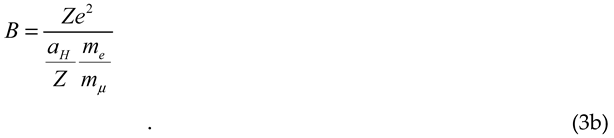 |
For Aluminum, Z=13; the muon mass is 207 times heavier than that of the electron. The static binding energy of the electron e2/aH in the hydrogen atom is 27.2 eV. Hence,
 |
In short, the static binding energy B of the muon in the Aluminum atom, is equal to 0.95 MeV.
The rest energy mμ c2 being 105.66 MeV, we obtain,
 |
The present prediction is intended as an additional intrinsic scaling of the bound muon's internal dynamics. It should therefore be compared with the complete bound-state QED prediction, including recoil, radiative, and nuclear corrections, rather than with the free-muon spectrum. Although numerically small, this effect produces a characteristic distortion of the DIO spectrum near the endpoint that accompanies the predicted endpoint displacement.
3. Experimental Discrimination Between Competing Descriptions
The conventional QED description and the YA/UMA framework predict different properties for the said endpoint spectrum. Within the standard description, the bound muon retains its invariant rest mass, while the binding energy enters through the external electromagnetic potential.
Consequently, no intrinsic rescaling of the muon’s internal dynamics is expected beyond the conventional phase-space, recoil, binding, and radiative effects.
In contrast, YA/UMA predicts that the parent’s rest mass itself is reduced by the binding energy. This produces two simultaneous experimental consequences (cf. Appendix A):
(i) a small downward displacement of the endpoint energy,
(ii) an intrinsic compression of the endpoint spectrum.
These two observables are not independent occurrences. They originate from the same UMA scaling law and must therefore appear simultaneously. Observed together, they would constitute a substantially stronger test of the underlying physical mechanism than either occurrence being considered separately. Table 1 summarizes the expected scaling behaviors.
The correlation between the two signatures is essential. It is that both arise from the same UMA scaling law; observing one without the other would be inconsistent with the framework.
The Fermi scaling[14] is included because it provides an instructive limiting comparison. If the decay rate depended on the fifth power of the parent mass, the anticipated suppression would be approximately 4.5%. YA/UMA instead predicts a substantially smaller reduction because the internal clock dynamics scale linearly according to the aforementioned UMA theorem.
Consequently, COMET can discriminate not only between the QED expectation and our approach, but also between two distinct mechanisms relating bound-state mass to decay dynamics. It should be emphasized that the present prediction cannot be absorbed into conventional QED corrections. Standard radiative, recoil, and binding corrections modify the decay spectrum while preserving the invariant rest mass of the parent muon. In contrast, the YA/UMA prediction originates from a reduction of the bound muon’s intrinsic rest mass and the corresponding rescaling of its internal dynamics.
The correlated endpoint displacement and spectral compression therefore constitute a qualitatively distinct experimental signature rather than justifying higher-order corrections to the conventional description.
4. Relation to Previous Bound Muon Decay Rate Measurements
The current approach does not emerge in isolation; it extends an earlier investigation of bound muon decay, in which the total decay rate was shown to be reduced by a factor proportional to 1-Z2α2, insofar as bringing the UMA/PBFT (Pure Bound Field Theory) framework’s prediction into agreement with the measurements of Yovanovitch[10,15] (see Figure 1).
That result concerned the integrated decay probability over the entire electron spectrum. The present work, in comparison, addresses a different observable. It is that, rather than the total decay rate, we predict a differential distortion of the DIO spectrum itself localized near the kinematic endpoint.
While the two results are complementary, our earlier work solely established the global retardation of the decay process, whereas the present analysis predicts the detailed spectral structure that should accompany it.
At any rate, both arise from the same physical principle embodied in the UMA theorem (cf. Appendix A), i.e. that the binding energy is commensurate with the intrinsic reduction of the bound particle’s rest mass.
Consequently, COMET and Mu2e provide an opportunity to revisit not merely the integrated decay rate measurements, but to test the underlying physical mechanism through a substantially more sensitive differential observable.
Note that, the Standard QED accepts the conventional relativistic retardation associated with the motion of the bound muon (the same physical origin as rotational-relativity time dilation), while the intrinsic rest mass remains invariant. Whereas, YA/UMA accepts the same conventional relativistic effect and, in addition, predicts an intrinsic rest-mass reduction due to the static binding energy. This common scaling by ξ compresses the entire electron-energy spectrum and shifts the endpoint.
Before discussing the experimental implications of the present prediction, it is instructive to relate it to earlier observations of bound-muon decay, which probed the same underlying dynamical principle through a different observable.
5. Predicted Experimental Signature
Figure 2 summarizes the principal prediction of this work, where we plot the integrated decay rate per unit energy of decay electron. In the conventional description, the DIO spectrum approaches the kinematic endpoint with the familiar phase-space dependence determined by the invariant parent rest mass.
Within the YA/UMA framework, the intrinsic reduction of the bound muon rest mass produces two correlated signatures:
i) a slight downward displacement of the endpoint energy, and
ii) a simultaneous compression of the endpoint curvature.
Figure 2 is schematic and is intended only to illustrate the qualitative difference between the competing predictions YA versus QED.[16,17,18,19] A complete quantitative comparison requires the full DIO spectrum including recoil, radiative, and detector effects, which will be presented elsewhere.
For a muon decaying in orbit around an aluminium nucleus, the DIO electron endpoint lies at approximately 104.97 MeV, after inclusion of the muonic binding energy and nuclear recoil [16]. This is the endpoint relevant to COMET and Mu2e.
Now, applying our proposed 0.9% reduction factor (cf. Table 1), this energy should be shifted by an amount equal to B=0.949 MeV, or 949 keV.
Likewise, the integrated decay rate is reduced by approximately 0.9%. Since the electron-energy scale is reduced by the same factor, the differential quantity dΓ/dEe remains unchanged at corresponding scaled energies, while the full spectrum is compressed horizontally.
Because both observables originate from the same UMA scaling law, their simultaneous observation would constitute a direct experimental signature of rest mass dynamics in bound quantum systems.
The predicted endpoint displacement of approximately 0.95 MeV is large compared with the energy scale over which the conversion-electron signal and the terminal DIO spectrum are experimentally analyzed.
Consequently, the YA/UMA prediction should not appear merely as a small normalization correction, but as a visibly displaced termination of the spectrum.
Given that, the predicted spectral modification is a simple scaling transformation rather than a deformation of the spectrum, its experimental verification requires only a sufficiently precise determination of the endpoint region.
6. Conclusion
In this work, we have examined the consequences of Rest Mass Dynamics (RMD), together with the Universal Matter Architecture (UMA) theorem, introduced by Yarman’s Approach (strictly based on the law of conservation of energy that is embodied in the mass - energy equivalence of the Special Theory of Relativity), for the decay-in-orbit (DIO) spectrum of muonic atoms.
Unlike conventional bound-state QED, which treats the muon rest mass as invariant while incorporating binding through wavefunctions and radiative corrections, the present framework predicts that atomic binding intrinsically reduces the bound muon's rest mass by the binding energy. This leads to a common scaling factor governing the bound particle's internal dynamics.
The resulting predictions are direct and parameter-free. For muonic Aluminum, the theory yields a displacement of the DIO endpoint by approximately 0.95 MeV, together with a corresponding horizontal compression of the endpoint spectrum and an integrated decay-rate retardation of approximately 0.9%.
These signatures arise from the same underlying scaling law and therefore constitute correlated experimental observables.
Because forthcoming high-precision muon experiments are expected to measure the DIO spectrum with unprecedented accuracy, the predicted endpoint shift and spectral scaling provide a direct opportunity to test whether atomic binding affects only the external dynamics of a bound particle, as in conventional bound-state QED, or also modifies its intrinsic rest mass, as proposed within the present framework. Such measurements would therefore provide a clear experimental distinction between the two descriptions.
The predictions presented here are unambiguous and parameter-free. Whether they correspond to physical reality will ultimately be decided by the COMET and Mu2e experiments.
Funding
The authors declare that no funding was received for this study.
Data Availability Statement
All data generated or analysed during this study are included in this published article, and its supplementary information file.
Acknowledgments
We extend our gratitude to Savronik for their support, and continuous encouragement.
Appendix A. The UMA (Universal Matter Architecture) Theorem Pertinent to Muon Decay
Consider a relativistic or a non-relativistic quantum mechanical description of a given object, depending on whichever may be appropriate, for the case at hand. This description points, in any event, to an internal dynamics, which consists of a clock motion, carried by a clock mass, and achieved in a clock space, along with a clock unit period of time, driven by a clock energy. The description excludes synthetic potential energies which may otherwise lead to incompatibilities with the STR. The quantum mechanical description in question is supposed to be based on K particles altogether.
If different masses mk0, k = 1, …, K involved in the said description of the object that remain at rest on the whole are all multiplied by the same arbitrary number ξ, then the following two general results are conjointly obtained:
i) The eigenvalue E0 of the quantum mechanical description —i.e., the total energy associated with the given clock’s motion for the object— is increased as much, or the same, the unit period of time T0 of the motion associated with this energy is decreased as much.
ii) The characteristic length, or the clock space size R0 to be associated with the given clock’s motion, contracts as much. In mathematical words this is:
[(mk0, k = 1, …, K) → (ξmk0, k = 1, …, K)] ⇒ [ (E0 → ξ E0 ) or (T0 → T0 / ξ),
and (R0→ R0/ ξ)]. (A1)
The theorem has been derived for general Schrödinger and Dirac descriptions, including complex atomic and molecular systems. We therefore propose that it also applies to the internal dynamics governing muon decay.
Appendix B. Proof of UMA Theorem on the basis of the Schrödinger Equation
For conciseness, only the essential derivation is provided here; detailed developments can be found in prior publications.20
One can, in fact, achieve this without solving the related quantum mechanical equation. It thus delineates an intrinsic property connected to a change in the mass values of the terms within the given equation.
For simplicity, consider the Schrödinger equation written for a hydrogen-like atom using the standard notation:
 |
where μ0 is the reduced mass of the proton and the electron at rest, Z the number of protons in the nucleus, h the Planck Constant, e the elementary charge, ψ(r0) the wave function at the location pointed to by the vector r0, and E0 the energy eigenvalue.
Next, we multiply (A1) (re-written in polar coordinates r0, θ, φ) by an arbitrary number ξ2:
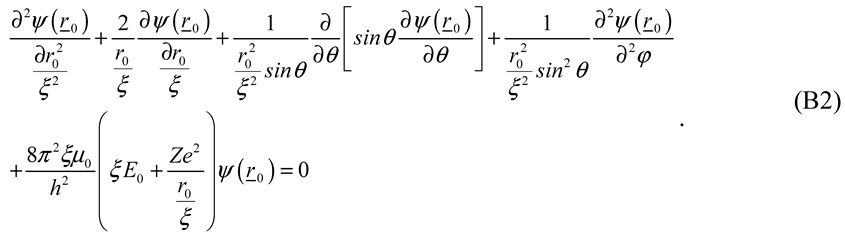 |
Eq. (B2) clearly exhibits the re-scalings framed by our Theorem 1; i.e., when the mass μ0 is multiplied by ξ, all r0’s are conjointly reduced by ξ and the energy eigenvalue E0 is increased by the same factor.
A full-scale mathematical demonstration of the said theorem is provided after one multiplies in Eq. (B1) just the mass μ0 by ξ and seeks how the eigenvalue is altered accordingly.
Theorem 1 thus well holds regardless of the complexity of the quantum mechanical description, provided that the scalar potentials are proportional to the inverse of the distance.
Note further that, in gravity, Eq. (B1) represents the Schrödinger equation for the local observer, whereas Eq. (B2) represents the same equation in gravity, but as referred to the remote observer.
We would like to recall that, already the way it appears in Eq. (B2), Theorem 1 yields systematizations of i) diatomic molecules as well as polyatomic molecules [20], ii) α-disintegrating nuclei,[21] iii) β−-decaying nuclei,[22] iv) β+-decaying nuclei,[23] v) the quantization of the second law of thermodynamics,[24] etc.
The derivation of the UMA theorem in the relativistic Dirac case, is offered in here.25
References
- Ueno, K., et al. (COMET Collaboration). (2025). Search for muon to electron conversion with COMET experiment at J-PARC. Proceedings of the 9th International Symposium on Symmetries in Subatomic Physics (SSP2025).
- COMET Collaboration. (2026). The COMET Experiment to Search for μ-e Conversion at J-PARC. JPS Conference Proceedings, 45, 011081.
- Moritsu, M., Li, H.-B., Xing, T., Yuan, Y., & Zhang, Y. (2025). A study to suppress a sneaking cosmic muon background in the COMET experiment. arXiv preprint arXiv:2508.15344.
- Adamov, G. (COMET Collaboration). (2026). The COMET Experiment at J-PARC. Proceedings of the 24th Conference on Flavor Physics and CP Violation (FPCP 2026). CERN.
- Bernstein, R., Kiburg, B., Miscetti, S., et al. (Mu2e Collaboration). (2026). Mu2e Experiment at Fermilab. Fermi National Accelerator Laboratory.
- Miscetti, S., et al. (Mu2e Collaboration). (2025). A major milestone for the Mu2e experiment at Fermilab – The calorimeter has been completed and installed. INFN-LNF.
- Mu2e Collaboration. (2024). Computing Concepts. Mu2e Wiki (https://mu2ewiki.fnal.gov/wiki/Computing_Concepts).
- Mu2e Collaboration. (2026). HPC (High Performance Computing). Mu2e Wiki (https://mu2ewiki.fnal.gov/wiki/HPC).
- Huff, R. W. (1961). Decay of bound muons. Physical Review, 122(2), 608–621.
- Yovanovitch, D. D. (1960). Decay Rates of Bound Negative Muons. Phys. Rev. 117, p. 1580. [CrossRef]
- Yarman, T. (2006). The end results of General Relativity theory via just energy conservation and quantum mechanics. Foundations of Physics Letters, 19(6), 675–693. [CrossRef]
- Marchal, C. B. (2023). Quantal theory of gravity: Essential points and implications. Annals of Physics, 454, 169342. [CrossRef]
- Yarman, T., Kholmetskii, A. L., Yarman, O., & Marchal, C. B. (2026). Quantal theory of gravity: A two-entity formalism yielding wave–particle coexistence, validated by recent atom-interferometry. Frontiers in Quantum Science and Technologies, 5, Article 1780610.
- Burgess, C., & Moore, G. (2007). The Standard Model: A primer. Cambridge University Press. (p. 158). ISBN: 978-0-511-80351-2.
- Yarman, T., Kholmetskii, A. L., & Missevitch, O. V. (2011). Pure bound field theory and the decay of Muon in meso-atoms. International Journal of Theoretical Physics, 50(5), 1407–1416.
- Czarnecki, X. Garcia i Tormo, W. J. Marciano, Muon decay in orbit: Spectrum of high-energy electrons, Phys. Rev. D 84, 013006 (2011).
- R. Szafron and A. Czarnecki. High-energy electrons from the muon decay in orbit: radiative corrections, Phys. Lett. B 753, 61 (2016). [CrossRef]
- R. Szafron and A. Czarnecki Bound muon decay spectrum in the leading logarithmic accuracy, Phys. Rev. D 94, 051301(R) (2016).
- D. Fontes and R. Szafron, EFT approach to the endpoint of muon decay-in-orbit,JHEP 11 (2025) 166. [CrossRef]
- T. Yarman, Revealing the Mystery of the Galilean Principle of Relativity. Part I: Basic Assertions, Int. J. Theor. Phys. 48, 2235–2245 (2009). [CrossRef]
- T. Yarman et al., Int. J. Mod. Phys. E 26 (2017) 1750068.
- T. Yarman et al., Front. Phys. 1743540 (January 2026: in press).
- T. Yarman et al., Int. J. Mod. Phys. E, 34, 6 (2025) 2550023.
- T. Yarman et al., Results Phys. 10 (2018) 3, p. 818.
- T. Yarman, The Quantum Mechanical Framework Behind the End Results of the General Theory of Relativity: Matter Is Built on a Universal Matter Architecture (Nova Science Publishers, New York, 2010). ISBN 978-1617613180.
Figure 1.
Plot of normalized decay rate versus proton number as adapted from Ref. [15]. Bound muon decay rate is given on the y-axis versus the atomic number Z on the x-axis. The solid line represents Huff’s standard QED calculation, while the open circles are Huff’s corrected datapoints [9]. The thick triangles delineate the UMA/PBFT (Pure Bound Field Theory) prediction, is reported in Ref. [16] to improve agreement with Yovanovitch’s experimental data (solid dots with experimental uncertainty bars) [10]. .
Figure 1.
Plot of normalized decay rate versus proton number as adapted from Ref. [15]. Bound muon decay rate is given on the y-axis versus the atomic number Z on the x-axis. The solid line represents Huff’s standard QED calculation, while the open circles are Huff’s corrected datapoints [9]. The thick triangles delineate the UMA/PBFT (Pure Bound Field Theory) prediction, is reported in Ref. [16] to improve agreement with Yovanovitch’s experimental data (solid dots with experimental uncertainty bars) [10]. .
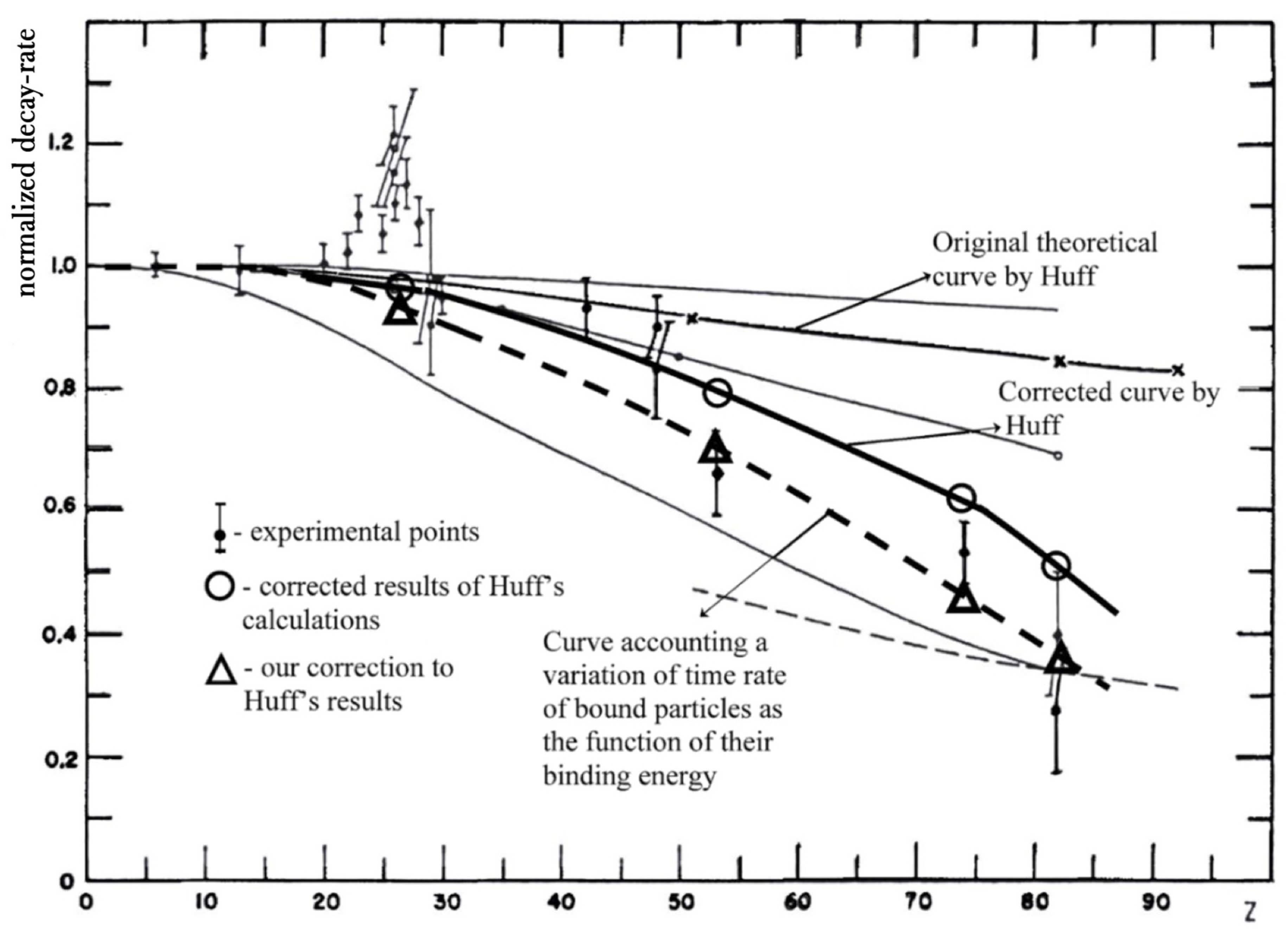
Figure 2.
Schematic (not to scale) comparison of the normalized differential decay rate of the muon per unit electron energy, dΓ/dEe, for decay-in-orbit (DIO) electrons near the kinematic endpoint in Aluminium (Z=13). The solid black curve represents the standard QED prediction, while the blue dashed curve illustrates the YA/UMA prediction. Within the YA/UMA framework, the bound muon's rest mass and all characteristic electron energies are reduced by the common factor ξ=(1-B/mμc2) ≈ 0.991, so that the ordinate dΓ/dEe remains unchanged at corresponding scaled energies, whereas the entire spectrum is compressed horizontally by the factor ξ. Consequently, the endpoint is shifted from 104.97 MeV for QED to 104.02 MeV for YA, corresponding to a shift of 0.95 MeV which is potentially resolvable in forthcoming high-precision endpoint measurements. The corresponding reduction in the area under the spectrum represents the accompanying approximately 0.9% retardation of the integrated decay rate. A detailed detector-level sensitivity analysis, including resolution, recoil, radiative effects, and event statistics, lies beyond the scope of the present conceptual study.
Figure 2.
Schematic (not to scale) comparison of the normalized differential decay rate of the muon per unit electron energy, dΓ/dEe, for decay-in-orbit (DIO) electrons near the kinematic endpoint in Aluminium (Z=13). The solid black curve represents the standard QED prediction, while the blue dashed curve illustrates the YA/UMA prediction. Within the YA/UMA framework, the bound muon's rest mass and all characteristic electron energies are reduced by the common factor ξ=(1-B/mμc2) ≈ 0.991, so that the ordinate dΓ/dEe remains unchanged at corresponding scaled energies, whereas the entire spectrum is compressed horizontally by the factor ξ. Consequently, the endpoint is shifted from 104.97 MeV for QED to 104.02 MeV for YA, corresponding to a shift of 0.95 MeV which is potentially resolvable in forthcoming high-precision endpoint measurements. The corresponding reduction in the area under the spectrum represents the accompanying approximately 0.9% retardation of the integrated decay rate. A detailed detector-level sensitivity analysis, including resolution, recoil, radiative effects, and event statistics, lies beyond the scope of the present conceptual study.
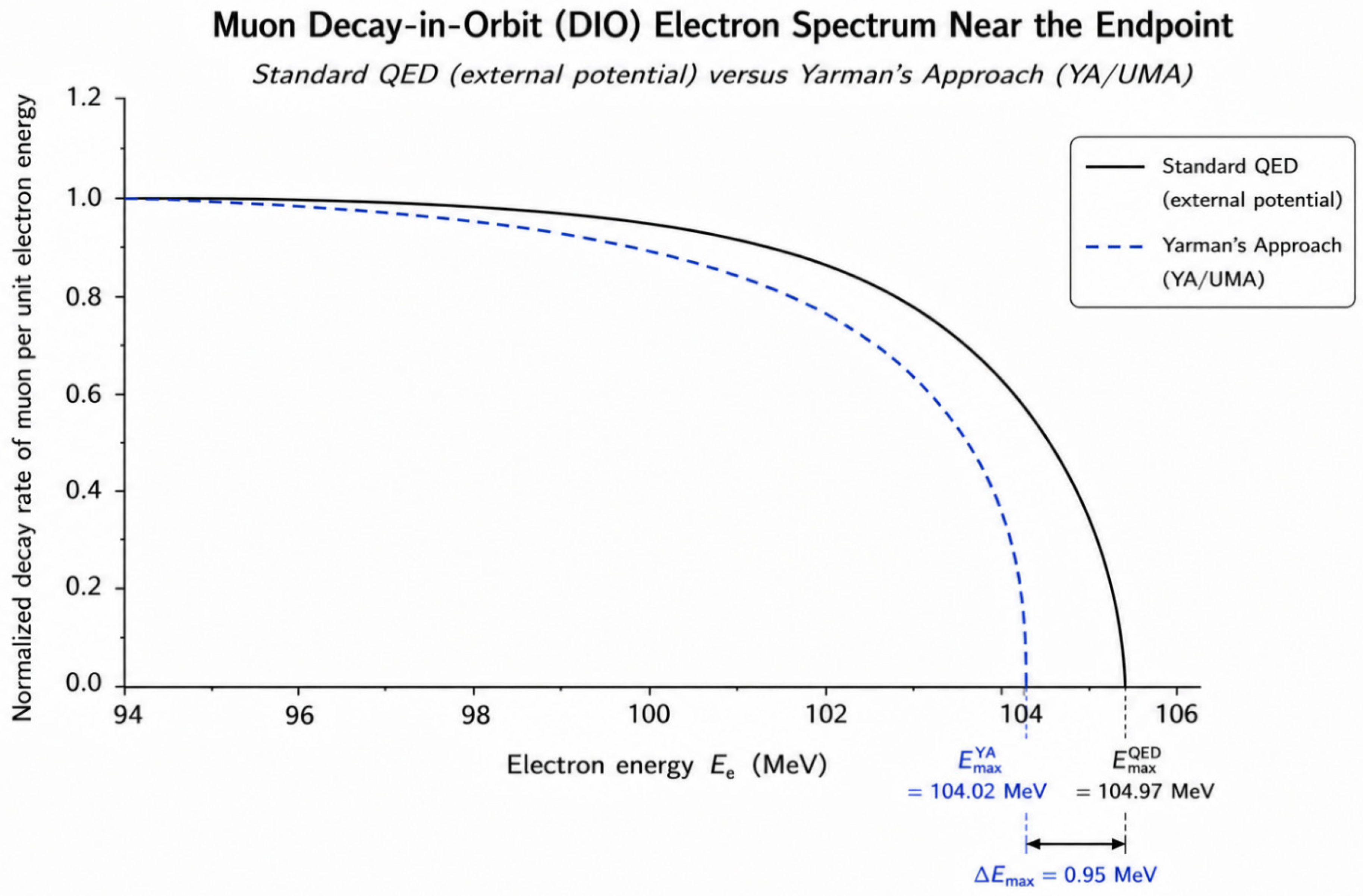

Table 1.
Comparison of decay rate and endpoint energy compression in YA/UMA.
| Description | Assumed bound-mass treatment |
Decay rate scaling |
Compression(%) |
| QED | mμ invariant | No intrinsic mass rescaling | 0 |
| Phase-space only | m′μc2=mμc2-B, | Γ~mμ5 | ~4.5 |
| YA/UMA | m′μc2=mμc2-B, | Γ~mμ | ~0.9 |
Disclaimer/Publisher’s Note: The statements, opinions and data contained in all publications are solely those of the individual author(s) and contributor(s) and not of MDPI and/or the editor(s). MDPI and/or the editor(s) disclaim responsibility for any injury to people or property resulting from any ideas, methods, instructions or products referred to in the content. |
© 2026 by the authors. Licensee MDPI, Basel, Switzerland. This article is an open access article distributed under the terms and conditions of the Creative Commons Attribution (CC BY) license (http://creativecommons.org/licenses/by/4.0/).
Copyright: This open access article is published under a Creative Commons CC BY 4.0 license, which permit the free download, distribution, and reuse, provided that the author and preprint are cited in any reuse.