
Submitted:
21 July 2026
Posted:
22 July 2026
You are already at the latest version
Abstract
Background: International catheter guidance focuses on indication, infection prevention, and removal timing, but largely overlooks the mechanical details of Foley balloon deflation and withdrawal. After complete aspiration, collapsed balloon folds may increase friction and cause urethral trauma. This systematic review evaluated whether small-volume reinjection after aspiration reduces pain and removal-related complications compared with conventional removal. Methods: This systematic review and meta-analysis was conducted and reported in accordance with the PRISMA 2020 statement, with the protocol registered in PROSPERO (CRD420261451421). Eight English- and Chinese-language databases were searched from inception to 9 July 2026. Eligible studies were randomized or quasi-randomized controlled trials enrolling adults undergoing routine urethral catheter removal, comparing post-aspiration balloon reinjection with conventional complete aspiration. Pain intensity was pooled as Hedges’ g standardized mean difference, with a harmonized 0–10 mean difference as a clinically interpretable sensitivity analysis. Dichotomous outcomes (urinary retention, hematuria, catheter reinsertion, and successful spontaneous voiding) were pooled as risk ratios, all using random-effects models. Risk of bias was assessed using the Cochrane Risk of Bias 2 tool, and overall evidence certainty was evaluated using the Grading of Recommendations Assessment, Development and Evaluation (GRADE) framework. Results: Forty-six Chinese trials involving 6,365 participants were included; no eligible English-language randomized trial was found. Reinjection reduced pain (26 trials; standardized mean difference -1.14, 95% confidence interval -1.35 to -0.92; I-squared=89.8%). The harmonized 0-10 mean difference was -1.73 points (95% confidence interval -2.11 to -1.35). Reinjection was also associated with less urinary retention (risk ratio 0.22), any hematuria (risk ratio 0.21), and catheter reinsertion (risk ratio 0.44), and with more successful spontaneous voiding (risk ratio 1.29). Certainty was low or very low because of risk of bias, inconsistency, single-country evidence, and suspected small-study effects. Conclusions: Balloon reinjection may reduce pain and urethral-trauma-related events, but the evidence is methodologically limited and geographically narrow. It is not sufficient for a strong international recommendation. Prospectively registered multicentre trials outside China are needed.
Keywords:
balloon cuffing
; balloon reinjection
; device removal
; hematuria
; meta-analysis
; pain
; urethral catheters
1. Introduction
Indwelling urethral catheterization is common in hospitals, perioperative care, rehabilitation, and long-term care. Removal may be followed by pain, visible or microscopic hematuria, urinary retention, failed first voiding, and the need for catheter reinsertion. International guidance from the Centers for Disease Control and Prevention, the European Association of Urology, infection-control societies, and nursing reviews focuses on appropriate indication, aseptic insertion, maintenance, infection prevention, duration, clamping, antibiotic prophylaxis, and timely removal [1,2,3,4,5,6,7,8,9,10,11,12,13,14,15,16,17,18,19,20,21,22,23,24,25,26,27]. These sources do not provide evidence-based recommendations on the final mechanical details of balloon deflation and withdrawal. Thus, the questions of when to remove a catheter and how to remove it remain distinct.
The physical act of removal can itself be traumatic. After aspiration, the balloon may not collapse into a smooth cylinder; folds and ridges can form a cuff around the distal catheter. In vitro work and clinical reports indicate that this cuff can increase the effective diameter of the balloon region by approximately 1-5 mm, depending on catheter material and deflation mechanics [28,29,30,31,32]. Passage of an irregular cuff may scrape urethral epithelium, cause bleeding, and stimulate pain-sensitive afferents. Reports of difficult removal provide clinical support for this mechanical pathway, although they do not establish the effect of routine reinjection.
For more than two decades, Chinese nursing teams have used a simple modification: after complete balloon aspiration, 0.2-1.5 mL of sterile water, saline, residual aspirated fluid, or air is reinjected immediately before withdrawal [33,34,35,36,37,38,39,40,41,42,43,44,45,46,47,48,49,50,51,52,53,54,55,56,57,58,59,60,61,62,63,64,65,66,67,68,69,70,71,72,73,74,75,76,77,78]. The intended effect is to smooth the cuff and reduce friction. Evidence has remained dispersed across small Chinese studies, with no eligible English-language randomized trial and no previous bilingual synthesis. This regional evidence gap may reflect a nurse-led innovation that developed outside internationally standardized removal protocols and was seldom prospectively registered or reported in English.
This review therefore had three objectives: to quantify effects on pain and removal-related complications; to explore whether reinjection medium, volume, study design, sample size, and clinical population could explain heterogeneity; and to judge whether current certainty is sufficient for clinical or guideline recommendations. The review question was framed by population, intervention, comparator, outcomes, and study design.
This meta-analysis synthesizes scattered domestic clinical evidence of a nurse-led catheter removal intervention, filling the global evidence gap and providing quantitative evidence to support the translation of this low-cost, safe nursing technique into standardized clinical care protocols.
2. Materials and Methods
2.1. Design and Reporting
2.2. Search Strategy
Searches covered PubMed and MEDLINE, Embase, the Cochrane Library, Google Scholar, China National Knowledge Infrastructure, Wanfang Data, the VIP Chinese Science and Technology Journals Database, and the Chinese Biomedical Literature Database from database inception through 9 July 2026. English concepts included indwelling urinary catheter, Foley catheter, urethral catheter, removal, withdrawal, balloon deflation, cuffing, reinjection, reinflation, pain, hematuria, urinary retention, urethral trauma, and randomized trial; equivalent Chinese subject headings and free-text terms were combined. Controlled vocabulary and free-text terms were linked within four modules covering catheter, reinjection, outcomes, and controlled study design. Reference lists of included reports and relevant systematic reviews were hand-searched. Full line-by-line strategies are specified in Supplementary File S1. The archived materials did not support a reproducible audit of conference abstracts or trial registries; grey-literature coverage was therefore judged uncertain and treated as a potential source of publication bias rather than represented as complete.
2.3. Inclusion and Exclusion Criteria
2.3.1. Population
Adults aged 18 years or older undergoing removal of an ordinary indwelling transurethral balloon catheter. Children, pregnant patients, patients with suprapubic catheters, urethral reconstruction or stricture, traumatic catheterization, or other high-risk difficult-removal conditions were excluded.
2.3.2. Intervention
Complete aspiration of the original balloon contents followed by reinjection of 0.2-1.5 mL sterile water, normal saline, residual aspirated fluid, or air immediately before withdrawal, with no simultaneous pharmacological or mechanical co-intervention.
Comparator: Conventional withdrawal immediately after complete balloon aspiration, without reinjection or reinflation.
2.3.3. Outcomes
The primary outcome was pain during removal. Secondary outcomes were any hematuria, macroscopic hematuria, microscopic hematuria, urinary retention, successful spontaneous voiding, and catheter reinsertion.
2.3.4. Study Design
Randomized or quasi-randomized controlled trials with a concurrent conventional-removal group.Exclude non-comparative designs, unavailable full text, duplicate reports without additional data, insufficient extractable data, partial aspiration without reinjection, unclear reinjection technique, suprapubic catheter removal, and combined interventions such as lidocaine gel, analgesics, antibiotics, or bladder clamping.
2.4. Intervention Definition and Planned Effect Modifiers
Post-aspiration balloon reinjection was defined as complete withdrawal of the original balloon contents until no further fluid could be aspirated, followed immediately by a small, measured reinjection before gentle catheter withdrawal. Medium (liquid versus air), volume (0.3-0.5 mL versus more than 0.5 mL), sample size, allocation method (randomized versus quasi-randomized), and clinical specialty were prespecified as potential effect modifiers.
Experimental procedure: After complete aspiration, the specified liquid or air volume was reinjected aseptically and the catheter was withdrawn without force. Reported volumes ranged from 0.2 to 1.5 mL; most liquid protocols used 0.3-0.5 mL and most air protocols used 0.4-0.6 mL.
Control procedure: The balloon was aspirated until no further fluid could be withdrawn, after which the catheter was removed without reinjection. No additional procedural difference was eligible.
Timing and safety: Reinjection was performed immediately before withdrawal using a sterile syringe. Resistance, severe pain, suspected encrustation, urethral reconstruction or stricture, traumatic catheterization, and a history of difficult removal were not regarded as indications for reinjection and require appropriate clinical assessment.
2.5. Outcomes
The primary outcome was pain intensity during catheter removal. Because studies used visual analogue, numeric rating, facial, verbal, ordinal, and locally adapted scales, the primary continuous synthesis used the Hedges g standardized mean difference. Where an outcome was reported as ordered categories, category scores and frequencies were converted to an approximate continuous mean and standard deviation using the prespecified extraction rule; these converted data were examined in sensitivity analysis. A mean difference on a harmonized 0-10 scale was retained for clinical interpretation. Secondary outcomes were urinary retention, successful spontaneous voiding, any hematuria, macroscopic hematuria, microscopic hematuria, and catheter reinsertion.
2.6. Study Selection and Data Extraction
Two reviewers independently screened titles and abstracts, assessed full texts, and extracted data into a piloted form; disagreements were resolved by discussion and, when necessary, a third reviewer. The independent screening decisions were not retained in a form that permitted a defensible retrospective calculation of Cohen kappa and its 95% confidence interval; no agreement coefficient was therefore invented. Extracted items included setting, participants, catheter context and material when reported, dwell time, reinjection medium and volume, allocation method, pain instrument, outcome definitions, group sizes, and numeric results. When a standard deviation was absent, it was derived from a reported standard error, confidence interval, or other algebraically recoverable statistic. No outcome value was imputed without recoverable source data; studies with irretrievable data were excluded from the relevant synthesis. No additional author-supplied dataset was available.
2.7. Risk-of-Bias Assessment
Two reviewers independently applied the Cochrane Risk of Bias 2 framework across randomization, deviations from intended interventions, missing outcome data, outcome measurement, and selection of the reported result. Each domain and the overall judgment were rated low risk, some concerns, or high risk; disagreement was resolved by discussion and third-reviewer arbitration. Quasi-random allocation by admission order, ward, treatment route, or a comparable predictable method was judged high risk in the randomization domain. Operator blinding was infeasible, but blinded outcome assessment was considered possible and was judged from the report.
2.8. Certainty of Evidence
Two reviewers independently assessed certainty for each outcome using the Grading of Recommendations Assessment, Development and Evaluation domains of risk of bias, inconsistency, indirectness, imprecision, and publication bias. Downgrading was prespecified for serious methodological limitations, substantial unexplained heterogeneity, evidence restricted to one country or incompletely applicable populations, confidence intervals compatible with materially different effects, and funnel-plot or regression evidence of small-study effects. Disagreements were resolved by consensus or third-reviewer arbitration.
2.9. Statistical Analysis
Continuous outcomes were pooled with inverse-variance methods as Hedges g standardized mean differences when instruments differed and as mean differences when they could be placed on the same 0-10 scale. Binary outcomes were pooled as risk ratios because the relative probability of an event was clinically interpretable across different baseline risks. A 0.5 continuity correction was applied to a zero cell. A random-effects model was prespecified because differences in population, catheter material and size, reinjection medium and volume, clinical specialty, and pain measurement were expected; fixed-effect results were sensitivity analyses. Heterogeneity was assessed with Cochran Q, tau-squared, and I-squared, with I-squared below 50% interpreted as low, 50-75% as moderate, and above 75% as high. Prespecified subgroup hypotheses concerned medium, reinjection volume, sample size, allocation method, and specialty. Leave-one-out analyses, exclusion of high-risk studies when possible, and fixed-effect reanalysis assessed robustness. Funnel plots and Egger regression were restricted to outcomes with at least 10 studies. For multi-arm trials, eligible reinjection arms were combined when they shared one control group so that the control participants were not counted twice.
3. Results
3.1. Study Selection
Database and manual searching identified 4,774 records (4,767 from databases and 7 from reference lists or manual searching). After 4,580 duplicates and 61 other documented pre-screening removals, 133 records underwent title and abstract screening; 47 were excluded. Eighty-six full-text reports were assessed and 40 were excluded: 7 were not randomized or quasi-randomized, 14 used an ineligible reinjection intervention, 15 included analgesic co-intervention during removal, and 4 had insufficient data or duplicated another report. Forty-six Chinese trials involving 6,365 participants entered qualitative and quantitative synthesis (Figure 1).
3.2. Study Characteristics
The 46 studies were published from 2003 to 2025. Sample sizes ranged from 60 to 418 participants, with a median of 115 (interquartile range 89-186). Settings included urology, neurosurgery, orthopedics and trauma, gynecology, abdominal surgery, thoracic surgery, and mixed adult populations. Thirty-six studies used a liquid, nine used air, and one did not clearly specify the medium. Most used 0.3-0.5 mL, although some used 0.6-1.5 mL or adjusted volume by catheter size or dwell time. Ten studies used a visual analogue scale, four used a numeric rating scale, four used facial scales, nineteen used verbal or ordinal scales, and sixteen used another or unclear pain measure; some studies reported more than one pain representation. Age, sex distribution, catheter material, and catheter dwell time were inconsistently reported, so pooled baseline means, sex proportions, and a median dwell time could not be calculated without inventing data. Abbreviated characteristics of included studies(Part) as Table 1. Study-level reporting is listed in Supplementary File S2.
3.3. Risk of Bias
Using the Cochrane Risk of Bias 2 framework, eight studies (17%) were judged low risk in the randomization process, twenty-seven (59%) raised some concerns, and eleven (24%) were high risk because allocation was predictable or otherwise inadequate. Because operator blinding was infeasible and blinded outcome assessment was usually unreported, all studies raised at least some concern for deviations from intended intervention or outcome measurement. Outcome data were complete in the extracted reports and selective outcome reporting was not evident, although protocols were unavailable. Overall, thirty-five studies (76%) raised some concerns and eleven (24%) were high risk; none met low-risk criteria across all domains (Figure 2).
3.4. Primary Outcome: Pain During Catheter Removal
Twenty-six trials involving 3,900 participants reported pain. Reinjection reduced pain compared with conventional removal (standardized mean difference -1.14, 95% confidence interval -1.35 to -0.92; I-squared=89.8%; Figure 3). On the harmonized 0-10 scale, the mean difference was -1.73 points (95% confidence interval -2.11 to -1.35; I-squared=96.2%), a magnitude likely to be clinically noticeable although interpretation depends on the pain instrument and context. Leave-one-out analyses preserved the direction of effect. Funnel-plot asymmetry and Egger regression (p<0.001) indicated small-study effects, publication bias, or heterogeneity.
3.5. Secondary Outcomes
Reinjection was associated with improvement across secondary outcomes (Table 2). Urinary retention fell by approximately 78% (risk ratio 0.22, 95% confidence interval 0.14-0.32; I-squared=0.0%). Successful spontaneous voiding increased by 29% in relative terms (risk ratio 1.29, 95% confidence interval 1.21-1.39; I-squared=65.8%). Any hematuria fell by approximately 79% (risk ratio 0.21, 95% confidence interval 0.14-0.32; I-squared=52.5%); macroscopic hematuria fell by approximately 72% (risk ratio 0.28, 95% confidence interval 0.19-0.41; I-squared=21.8%); and microscopic hematuria fell by approximately 66% (risk ratio 0.34, 95% confidence interval 0.22-0.52; I-squared=78.8%). Catheter reinsertion fell by approximately 56% (risk ratio 0.44, 95% confidence interval 0.28-0.69; I-squared=0.0%). Additional forest plots are identified for Supplementary File S3.
3.6. Subgroup, Sensitivity, and Small-Study-Effect Analyses
Subgroup hypotheses for liquid versus air, 0.3-0.5 mL versus larger volumes, allocation method, sample size, and specialty were prespecified. The direction of effect favored reinjection in the available medium strata, but inconsistent arm-level reporting of dose, catheter material, dwell time, allocation method, and specialty prevented reliable estimation of each factor's independent contribution to heterogeneity. These analyses were therefore treated as exploratory rather than causal. Leave-one-out analyses did not reverse any pooled effect, and fixed-effect models produced more precise estimates without resolving clinical heterogeneity; random-effects estimates remained the primary results. Funnel plots were examined only for outcomes with at least 10 studies (Additional funnel plot are identified for Supplementary File S4.). The pain funnel plot was asymmetric and Egger regression was significant (p<0.001), supporting downgrading for suspected publication bias and caution against effect-size overestimation.
4. Discussion
4.1. Principal Findings
This review found a consistent direction of benefit across pain, urinary retention, spontaneous voiding, hematuria, and catheter reinsertion. Relative effects were strongest and heterogeneity lowest for several objective outcomes: any hematuria fell by 79%, urinary retention by 78%, and catheter reinsertion by 56%, whereas the large pain effect showed high heterogeneity. This pattern is compatible with a more consistent effect on mechanical mucosal trauma than on subjective pain, which is also shaped by expectation, sex, anxiety, pain instrument, clinical setting, and operator technique. Nevertheless, low or very low certainty prevents firm causal or guideline-level conclusions.
4.2. Relationship to Existing Evidence
The most recent Cochrane review of short-term catheter removal addressed timing, clamping, and antibiotic prophylaxis but did not identify trials of balloon-deflation and reinjection technique [1]. Infection-prevention and catheter-management guidance similarly emphasizes indication, maintenance, and prompt removal [2,3,4,5,6,7,8,9,10,11,12,13,14,15,16,17]. This review therefore addresses a separate mechanical question: how the final withdrawal step is performed. The absence of eligible English-language randomized trials may reflect the local, nurse-led evolution of the technique, limited prospective registration, inconsistent terminology, and the low visibility of small Chinese nursing trials in international evidence systems. These circumstances explain both the novelty of the synthesis and why its regional evidence base cannot be assumed to transfer unchanged to other countries. This review supplements missing evidence to advance evidence-based urinary nursing and facilitate cross-regional knowledge translation of nursing innovation.
4.3. Mechanistic Insights from Effect-Size Patterns
The findings are compatible with an injury-pain dual-pathway hypothesis. In vitro and clinical reports show that incomplete balloon collapse can create a circumferential cuff and increase the effective withdrawal diameter [28,29,30,31,32] First, an irregular ridge may scrape urethral epithelium and produce visible or microscopic bleeding. Second, tissue stretch and friction may activate urethral pain afferents and trigger guarding or reflex difficulty voiding even without visible injury. A measured small reinjection may redistribute balloon material and blunt the ridge. This mechanism explains why hematuria could respond more consistently than pain, but it remains a hypothesis because the included trials did not directly measure balloon geometry, mucosal force, or neural activation.
4.4. Clinical Implications
Current evidence supports only cautious, conditional consideration in selected adults undergoing routine short-term transurethral catheter removal, particularly when removal pain is anticipated. A provisional protocol based on the most common studies is complete aspiration, aseptic reinjection of 0.3-0.5 mL sterile water, saline, or air, and gentle withdrawal without force, with the volume, medium, catheter type, and adverse events documented. Reinjection should not be used to overcome resistance or in suspected encrustation, urethral reconstruction, known stricture, traumatic catheterization, embedded balloons, or a history of difficult removal; these situations require clinical or urological assessment. Any local use should be standardized, audited, and accompanied by adverse-event monitoring.
For nursing practice, the review highlights that prevention of catheter-related harm should address not only whether and when a catheter is removed but also the mechanics of removal. Domestic clinical pathways may evaluate a standardized, volume-controlled technique under governance and monitoring. International guideline incorporation is premature until multicentre trials outside China reproduce benefit and establish the safest medium and dose.
This synthesized quantitative evidence supports the knowledge translation of balloon reinjection technique in routine urinary catheter care. Hospitals can integrate this standardized low-cost procedure into evidence-based nursing pathways to reduce catheter-related pain and urethral injury risks. Current regional evidence limitation highlights the necessity of international multi-center trials to realize global clinical implementation of this nursing intervention.
4.5. Limitations
Several limitations are important. First, all trials were conducted in China and no eligible English-language randomized trial was found; differences in catheter materials, sizes, balloon designs, nursing workflows, analgesic practice, and patient characteristics limit transferability. Second, most studies were small, single-centre, and not prospectively registered; allocation concealment was unreported, predictable allocation was common, operator blinding was infeasible, and assessor blinding was unclear. Third, pain instruments and converted outcome formats varied, producing high heterogeneity and possible measurement bias. Fourth, catheter material, dwell time, sex-specific anatomy, age, and baseline characteristics were reported too inconsistently for reliable effect-modifier analyses. Fifth, long-term outcomes such as urethral stricture and recurrent urinary infection were not assessed. Sixth, grey-literature, conference-abstract, and non-Chinese/non-English coverage could not be audited from the archived search materials, and screening decisions were not retained for retrospective calculation of inter-reviewer agreement with a 95% confidence interval. Seventh, funnel-plot asymmetry and significant regression suggest that small positive studies may overestimate benefit. These limitations underpin the low or very low certainty ratings.
4.6. Future Research
Priority questions are the optimal reinjection volume and medium, effect modification by catheter material, size, dwell time and sex, objective urethral-injury measurement, long-term safety, and implementation outside China. Future trials should be international, multicentre, prospectively registered, adequately concealed, and reported according to the Consolidated Standards of Reporting Trials. They should use blinded outcome assessment where feasible and monitor difficult removal, catheter reinsertion, urinary infection, and longer-term urethral symptoms.
From a knowledge-translation perspective, this synthesis provides the quantitative evidence base needed to update local nursing protocols for catheter removal. The key translational steps are: 1) incorporating the reinjection technique into nursing skill training; 2) developing a standardized, volume-controlled clinical pathway; 3) monitoring adverse events and patient-reported outcomes during early implementation; and 4) participating in international collaborative research to test its effectiveness in diverse healthcare systems.
5. Conclusions
Small-volume post-aspiration balloon reinjection was associated with less pain, hematuria, urinary retention, and catheter reinsertion and with more successful spontaneous voiding across 46 Chinese trials. The intervention is mechanically plausible, but all evidence came from a single country and was affected by methodological limitations, high heterogeneity for important outcomes, and suspected publication bias; certainty was low or very low and does not support a strong international guideline recommendation.
Under a standardized protocol and adverse-event monitoring, selected domestic centres may evaluate the technique cautiously in routine low-risk catheter removal. International multicentre, adequately concealed, prospectively registered trials are required before wider adoption. Catheter research should address not only when a catheter is removed but also how the mechanical withdrawal step is performed.
This pooled evidence provides actionable evidence for translating improved catheter removal nursing practice into routine ward care, and reminds global nursing researchers to pay more attention to understudied mechanical details of catheter management in evidence-based practice construction.
Supplementary Materials
The following supporting information can be downloaded at the website of this paper posted on Preprints.org, File S1: Complete database-specific English and Chinese search strategies. File S2: Full characteristics of all 46 included studies, including available baseline, catheter, intervention, and outcome data. File S3: Forest plots for all secondary outcomes, reporting I-squared, tau-squared, and Cochran Q. File S4: Funnel plot for pain and other outcomes with at least 10 studies.
Author Contributions
Conceptualization, J.Z. and C.D.; methodology, J.H. and Q.L.; data curation, J.H. and T.G.; writing—original draft preparation, J.H.; writing—review and editing, Q.L. and H.J.; supervision, H.J.; project administration, J.H. and H.J.; funding acquisition, H.J. All authors have read and agreed to the published version of the manuscript.
Funding
This research received no specific grant from any funding agency in the public, commercial, or not-for-profit sectors.
Institutional Review Board Statement
Not applicable.
Informed Consent Statement
Not applicable.
Data Availability Statement
The study-level extraction dataset, analytic code, and additional review materials are available from the corresponding author on reasonable request, subject to confirmation that no third-party restrictions apply.
Acknowledgments
We would like to thank all participants and contributors for their hard work and support.
Conflicts of Interest
The authors declare no conflicts of interest.
References
- Ellahi, A.; Stewart, F.; Kidd, E.A.; Griffiths, R.; Fernandez, R.; Omar, M.I. Strategies for the removal of short-term indwelling urethral catheters in adults. Cochrane Database Syst. Rev. 2021, 6(6), CD004011. [Google Scholar] [CrossRef] [PubMed]
- Centers for Disease Control and Prevention. Guideline for Prevention of Catheter-Associated Urinary Tract Infections (2009): summary of recommendations. CDC Infection Control. 2024. Available online: https://www.cdc.gov/infection-control/hcp/cauti/summary-of-recommendations.html.
- Patel, P.K.; Advani, S.D.; Kofman, A.D.; Lo, E.; Maragakis, L.L.; Pegues, D.A.; et al. Strategies to prevent catheter-associated urinary tract infections in acute-care hospitals: 2022 Update. Infect. Control Hosp. Epidemiol. 2023, 44(8), 1209–1231. [Google Scholar] [CrossRef] [PubMed]
- European Association of Urology. EAU Guidelines on Urological Infections; EAU Guidelines Office, 2026. [Google Scholar]
- Rosenthal, V.D.; Memish, Z.A.; Nicastri, E.; Leone, S.; Bearman, G. Preventing catheter-associated urinary tract infections: A position paper of the International Society for Infectious Diseases, 2024 update. International journal of infectious diseases: IJID: official publication of the International Society for Infectious Diseases 2025, 151, 107304. [Google Scholar] [CrossRef] [PubMed]
- Li, N.; Shi, R.; Sun, Y.; Chen, Q. Effective interventions to prevent catheter-associated urinary tract infections: a systematic review. Rev. Do Inst. De Med. Trop. De Sao Paulo 2025, 67, e61. [Google Scholar] [CrossRef] [PubMed]
- Su, L. Effectiveness of Nurse-Driven Protocols in Reducing Catheter-Associated Urinary Tract Infections: A Systematic Review and Meta-Analysis. J. Nurs. Care Qual. 2025, 40(1), 39–45. [Google Scholar] [CrossRef] [PubMed]
- Ling, M.L.; Ching, P.; Apisarnthanarak, A.; Jaggi, N.; Harrington, G.; Fong, S.M. APSIC guide for prevention of catheter associated urinary tract infections (CAUTIs). Antimicrob. Resist. Infect. Control 2023, 12(1), 52. [Google Scholar] [CrossRef] [PubMed]
- Scruggs-Wodkowski, E.; Kidder, I.; Meddings, J.; Patel, P.K. Urinary Catheter-Associated Infections. Infect. Dis. Clin. N. Am. 2024, 38(4), 713–729. [Google Scholar] [CrossRef] [PubMed]
- Cameron, A.P.; Werneburg, G.T. Foley Catheter Management: A Review. JAMA Surg. 2025, 160(6), 701–707. [Google Scholar] [CrossRef] [PubMed]
- Fletke, K.J.; Jeong, D.H.; Herrera, A.V. Urinary Catheter Management. Am. Fam. Physician 2024, 110(3), 251–258. [Google Scholar] [PubMed]
- Werneburg, G.T. Catheter-Associated Urinary Tract Infections: Current Challenges and Future Prospects. Res. Rep. Urol. 2022, 14, 109–133. [Google Scholar] [CrossRef] [PubMed]
- Venkataraman, R.; Yadav, U. Catheter-associated urinary tract infection: an overview. J. Basic Clin. Physiol. Pharmacol. 2023, 34(1), 5–10. [Google Scholar] [CrossRef] [PubMed]
- Yuan, F.; Huang, Z.; Yang, T.; Wang, G.; Li, P.; Yang, B.; et al. Pathogenesis of Proteus mirabilis in Catheter-Associated Urinary Tract Infections. Urol. Int. 2021, 105(5-6), 354–361. [Google Scholar] [CrossRef] [PubMed]
- Mangal, S.; Pho, A.; Arcia, A.; Carter, E. Patient and Family Engagement in Catheter-Associated Urinary Tract Infection (CAUTI) Prevention: A Systematic Review. Jt. Comm. J. Qual. Patient Saf. 2021, 47(9), 591–603. [Google Scholar] [CrossRef] [PubMed]
- Bagley, K.; Severud, L. Preventing Catheter-Associated Urinary Tract Infections with Incontinence Management Alternatives: PureWick and Condom Catheter. Nurs. Clin. N. Am. 2021, 56(3), 413–425. [Google Scholar] [CrossRef] [PubMed]
- Ostaszkiewicz, J.; Clarke, J.; Watt, E.; Tay, C.; Dj Peters, M. Characteristics and outcome measures of indwelling urinary catheter care bundles in adult populations: a scoping review protocol. JBI Evid. Synth. 2026, 24(5), 972–980. [Google Scholar] [CrossRef] [PubMed]
- Ma, S.; Gu, J.; Fan, X. Need to clamp indwelling urinary catheters before removal after different durations: a systematic review and meta-analysis. BMJ Open 2023, 13(2), e064075. [Google Scholar] [CrossRef] [PubMed]
- Nollen, J.M.; Pijnappel, L.; Schoones, J.W.; Peul, W.C.; Van Furth, W.R.; Brunsveld-Reinders, A.H. Impact of early postoperative indwelling urinary catheter removal: A systematic review. J. Clin. Nurs. 2023, 32(9-10), 2155–2177. [Google Scholar] [CrossRef] [PubMed]
- Castelo, M.; Sue-Chue-Lam, C.; Kishibe, T.; Acuna, S.A.; Baxter, N.N. Early urinary catheter removal after rectal surgery: systematic review and meta-analysis. BJS Open 2020, 4(4), 545–553. [Google Scholar] [CrossRef] [PubMed]
- Rimmer, M.P.; Henderson, I.; Keay, S.D.; Khan, K.S.; Al Wattar, B.H. Early versus delayed urinary catheter removal after hysterectomy: A systematic review and meta-analysis. Eur. J. Obstet. Gynecol. Reprod. Biol. 2020, 247, 55–60. [Google Scholar] [CrossRef] [PubMed]
- Huang, H.; Dong, L.; Gu, L. The timing of urinary catheter removal after gynecologic surgery: A meta-analysis of randomized controlled trials. Medicine 2020, 99(2), e18710. [Google Scholar] [CrossRef] [PubMed]
- Fang, Y.Y.; Mu, P.F.; Chow, L.H. Effect of early removal of urinary catheter on recovery after vaginal surgery: A systematic review and meta-analysis. Taiwan. J. Obstet. Gynecol. 2024, 63(4), 451–458. [Google Scholar] [CrossRef] [PubMed]
- Wei, C.; Wang, G.; Wang, H.F.; Pan, H.F.; Jiang, Z.W.; Qu, M.W. Immediate versus early urinary catheter removal after gastrectomy under enhanced recovery after surgery protocols: randomized clinical trial. BJS Open 2025, 9(4). [Google Scholar] [CrossRef] [PubMed]
- McCormack, L.; Song, S.; Budden, A.; Ma, C.; Nguyen, K.; Li, F.G.; et al. Immediate versus delayed urinary catheter removal following non-hysterectomy benign gynaecological laparoscopy: a randomised trial. BJOG An. Int. J. Obstet. Gynaecol. 2023, 130(9), 1112–1119. [Google Scholar] [CrossRef] [PubMed]
- Askew, A.L.; Margulies, S.L.; Agu, I.; LeCroy, K.M.; Geller, E.; Wu, J.M. Patient Removal of Urinary Catheters After Urogynecologic Surgery: A Randomized Controlled Trial. Obstet. Gynecol. 2024, 143(2), 165–172. [Google Scholar] [CrossRef] [PubMed]
- Markopoulos, G.; Kitridis, D.; Tsikopoulos, K.; Georgiannos, D.; Bisbinas, I. Bladder training prior to urinary catheter removal in total joint arthroplasty. A randomized controlled trial. Int. J. Nurs. Stud. 2019, 89, 14–17. [Google Scholar] [CrossRef] [PubMed]
- Chung, E.; So, K. In vitro analysis of balloon cuffing phenomenon: inherent biophysical properties of catheter material or mechanics of catheter balloon deflation? Surg. Innov. 2012, 19(2), 175–80. [Google Scholar] [CrossRef] [PubMed]
- Gonzalgo, M.L.; Walsh, P.C. Balloon cuffing and management of the entrapped Foley catheter. Urology 2003, 61(4), 825–7. [Google Scholar] [CrossRef] [PubMed]
- Robinson, J. Suprapubic catheter removal: the cuffing effect of deflated catheter balloons. Br. J. Community Nurs. 2003, 8(5), 205–8. [Google Scholar] [CrossRef] [PubMed]
- Jannings, W.; Kelly, M. Difficulty in removing suprapubic urinary catheters in home based patients: a comparative descriptive study. The Australian journal of advanced nursing: a quarterly publication of the Royal Australian Nursing Federation 2001, 19(2), 20–5. [Google Scholar] [PubMed]
- Ghaffary, C.; Yohannes, A.; Villanueva, C.; Leslie, S.W. A practical approach to difficult urinary catheterizations. Curr. Urol. Rep. 2013, 14(6), 565–79. [Google Scholar] [CrossRef] [PubMed]
- Chen, J.Q. Modified urinary catheter removal after bone trauma surgery and its effects on first-void waiting time and catheter-removal-related problems [in Chinese]. 2021. Chinese. [Google Scholar] [CrossRef]
- Chen, L. Application of balloon injection in removing balloon urinary catheter after flexible ureteroscopy [in Chinese]. In Journal of Practical Hospital Clinical; 2020; Volume 17, 4, pp. 73–74, Chinese. [Google Scholar]
- Chen, S. Application of different balloon reinjection volumes during catheter removal after short-term catheterization following interventional treatment for cerebral infarction [in Chinese]. Heilongjiang J. Tradit. Chin. Med.;Chinese 2025. [Google Scholar]
- Cao, H. Effect analysis of an improved method for removing indwelling balloon urinary catheters [in Chinese]; 2013; Chinese. [Google Scholar] [CrossRef]
- Chen, H.L. Exploration of a removal method for balloon urinary catheters in male patients [in Chinese]; 2010; Chinese. [Google Scholar] [CrossRef]
- Dong, Y.R. Analysis of automatic voiding catheter expulsion versus traditional catheter removal on comfort and pain in patients with indwelling urinary catheters [in Chinese]. In World Latest Medicine Information; 2017; 1, p. 17, Chinese. [Google Scholar] [CrossRef]
- Fan, Y.Y. Application of different urinary catheter removal methods in male patients after thoracic surgery [in Chinese]. J. Nurses Train. 2010, 25(10), 935–936. [Google Scholar] [CrossRef]
- Gao, Y.X. Application of a modified technique for extubation of indwelling balloon catheter [in Chinese]; 2013; Chinese. [Google Scholar] [CrossRef]
- Guan, W.L. Application effect of modified urinary catheter removal in patients with indwelling balloon catheters [in Chinese]. 2013, (5), 120–121, Chinese. [Google Scholar]
- Huang, J.M. Effect of an improved urinary catheter removal method on reducing patient pain [in Chinese]; 2013; Chinese. [Google Scholar] [CrossRef]
- Li, F.D. The effect of different methods of removing catheter with inflation bag towards comfort of male patients [in Chinese]; 2013; Chinese. [Google Scholar]
- Li, Y. Application effect of three urinary catheter removal methods after craniocerebral tumor resection [in Chinese]. In Guangxi Medical Journal; 2015; Volume (7), pp. 1031–1033, Chinese. [Google Scholar] [CrossRef]
- Li, F.J. Application of a modified indwelling urinary catheter removal method in neurosurgical inpatients [in Chinese]; 2015; Chinese. [Google Scholar]
- Li, YanHong. Effect of modified urinary catheter removal on reducing discomfort after catheter removal [in Chinese]. 2015. Chinese. [Google Scholar] [CrossRef]
- Li, YiHong. Application effect of modified urinary catheter removal after orthopedic surgery [in Chinese]. 2014. Chinese. [Google Scholar] [CrossRef]
- Li, X.Y. Observation of the practice effect of the improved pull-out method for indwelling urinary catheter [in Chinese]. 2010, 7(8). Chinese. [Google Scholar]
- Li, Y.H. Effect of two different catheter removal methods on urethral injury in male patients with indwelling urinary catheters [in Chinese]; 2011; Chinese. [Google Scholar] [CrossRef]
- Liang, J.Y. Effect of modified urinary catheter removal on reducing discomfort symptoms in catheterized patients [in Chinese]. 2012, (6), 139–140, Chinese. [Google Scholar]
- Liang, Y.Q. Reinjecting 0.4-1 mL air after aspirating balloon fluid to reduce pain during urinary catheter removal [in Chinese]; 2016; Chinese. [Google Scholar]
- Lin, S.H. Application and evaluation of an improved balloon catheter removal method [in Chinese]; 2012; Chinese. [Google Scholar]
- Liu, X.X. Application of a modified urinary catheter removal method after transurethral endoscopic surgery [in Chinese]; 2016; Chinese. [Google Scholar]
- Liu, H.X. Application effect of a modified urinary catheter removal method in surgical patients [in Chinese]; 2013; Chinese. [Google Scholar] [CrossRef]
- Liu, Y.X. Effect of modified urinary catheter removal on post-removal complications in neurosurgical patients with indwelling double-lumen balloon catheters [in Chinese]. J. Clin. Nursing's Pract.;Chinese 2018, 3(24). [Google Scholar]
- Liu, J.X. Clinical observation of two balloon urinary catheter removal methods after laparoscopic surgery [in Chinese]. In Journal of Practical Medical Techniques; 2012; Volume (12), pp. 1902–1903, Chinese. [Google Scholar] [CrossRef]
- Mei, X. Application of modified urinary catheter removal in elective surgery patients [in Chinese]; 2014; Chinese. [Google Scholar]
- Ning, F.Q. Study of different catheter removal methods on urethral injury [in Chinese]. In Journal of Practical Medical Techniques; 2011; Volume (5), pp. 795–796, Chinese. [Google Scholar] [CrossRef]
- Qin, H.G. Effect of retaining a small amount of gas in the balloon on pain during removal of indwelling balloon urinary catheters in male patients [in Chinese]. 2013, (1), 135–136, Chinese. [Google Scholar]
- Ruan, Q. Probe into the extubation method for patients with indwelling balloon catheter [in Chinese]. In Chinese Nursing Research; 2010; 3, p. 24, Chinese. [Google Scholar] [CrossRef]
- Song, S.K. Effect of modified urinary catheter removal on first voiding after craniocerebral surgery [in Chinese]. J. Xuzhou Med. Coll.;Chinese 2013. [Google Scholar] [CrossRef]
- Sun, W.L. Evaluation of methods for removing three-way urinary catheters after transurethral resection of the prostate [in Chinese]. In Chinese Journal of Andrology; 2017; Chinese. [Google Scholar] [CrossRef]
- Sun, H.X. Effect of modified urinary catheter removal on urinary retention and urinary tract irritation symptoms after catheter removal [in Chinese]. J. Clin. Nursing's Pract.;Chinese 2018, 3(30). [Google Scholar]
- Tan, X.S. Clinical effect observation of modified urinary catheter removal [in Chinese]. Nurs. Pract. Res.;Chinese 2010, 7(2). [Google Scholar]
- Wang, Q.H. Effect of air injection on urethral injury during removal of indwelling urinary catheters [in Chinese]. 2017, (12), 76–77, Chinese. [Google Scholar]
- Wang, S.Y. Application of a small-volume air injection method in removal of double-lumen urinary catheters [in Chinese]; 2012; Chinese. [Google Scholar]
- Wei, H.Q. Application of modified urinary catheter removal after transurethral resection of the prostate [in Chinese]. 2012, (4), 424–425, Chinese. [Google Scholar]
- Wu, G.Y. Application of modified urinary catheter removal in urological patients [in Chinese]. 2010, (2), 180–181, Chinese. [Google Scholar] [CrossRef]
- Wu, Q. Effect of modified urinary catheter removal in neurosurgical patients with indwelling urinary catheters [in Chinese]. In Chinese Medical Journal of Metallurgical Industry; 2022; 18, p. 16, Chinese. [Google Scholar] [CrossRef]
- Wu, X.Y. Painless urinary catheter removal in patients with short-term catheterization after spinal surgery [in Chinese]; 2017; Chinese. [Google Scholar]
- Xue, L. Comparative study of two methods for removing indwelling urinary catheters [in Chinese]; 2016; Chinese. [Google Scholar]
- Xia, M. Modified urinary catheter removal technology to reduce catheter-removal-related complications in elderly patients undergoing neurointerventional surgery [in Chinese]. 2022. Chinese. [Google Scholar] [CrossRef]
- Yang, T.H. Clinical observation of painless removal of balloon urinary catheters [in Chinese]; 2012; Chinese. [Google Scholar]
- Zeng, C.L. Application of different urinary catheter removal methods in elderly male patients after abdominal surgery [in Chinese]; 2018; Chinese. [Google Scholar]
- Zhang, T. Application of modified urinary catheter removal combined with magnetic nursing in orthopedic patients with indwelling urinary catheters [in Chinese]; 2020; Chinese. [Google Scholar]
- Zhang, J.F. Clinical observation of two urinary catheter removal methods on urethral injury [in Chinese]; 2003; Chinese. [Google Scholar] [CrossRef]
- Zhao, W.F. Comparative research on two ways of extubation of indwelling catheter after gynaecological surgery [in Chinese]. J. Clin. Med. Pract. 2014, 18(4), 56–58. [Google Scholar] [CrossRef]
- Zhao, Y.Y. Experience with removal of double-lumen urinary catheters in a semi-inflated balloon state to prevent urinary tract injury [in Chinese]. J. Nurses Train. 2008, 23(19), 1809–1809. [Google Scholar] [CrossRef]
- Page, M.J.; McKenzie, J.E.; Bossuyt, P.M.; Boutron, I.; Hoffmann, T.C.; Mulrow, C.D.; et al. The PRISMA 2020 statement: an updated guideline for reporting systematic reviews. BMJ (Clinical research ed.) . 2021, 372, n71. [Google Scholar] [CrossRef] [PubMed]
- Page, M.J.; Moher, D.; Bossuyt, P.M.; Boutron, I.; Hoffmann, T.C.; Mulrow, C.D.; et al. PRISMA 2020 explanation and elaboration: updated guidance and exemplars for reporting systematic reviews. BMJ (Clinical research ed.) . 2021, 372, n160. [Google Scholar] [CrossRef] [PubMed]
Figure 1.
PRISMA 2020 flow diagram of study selection.
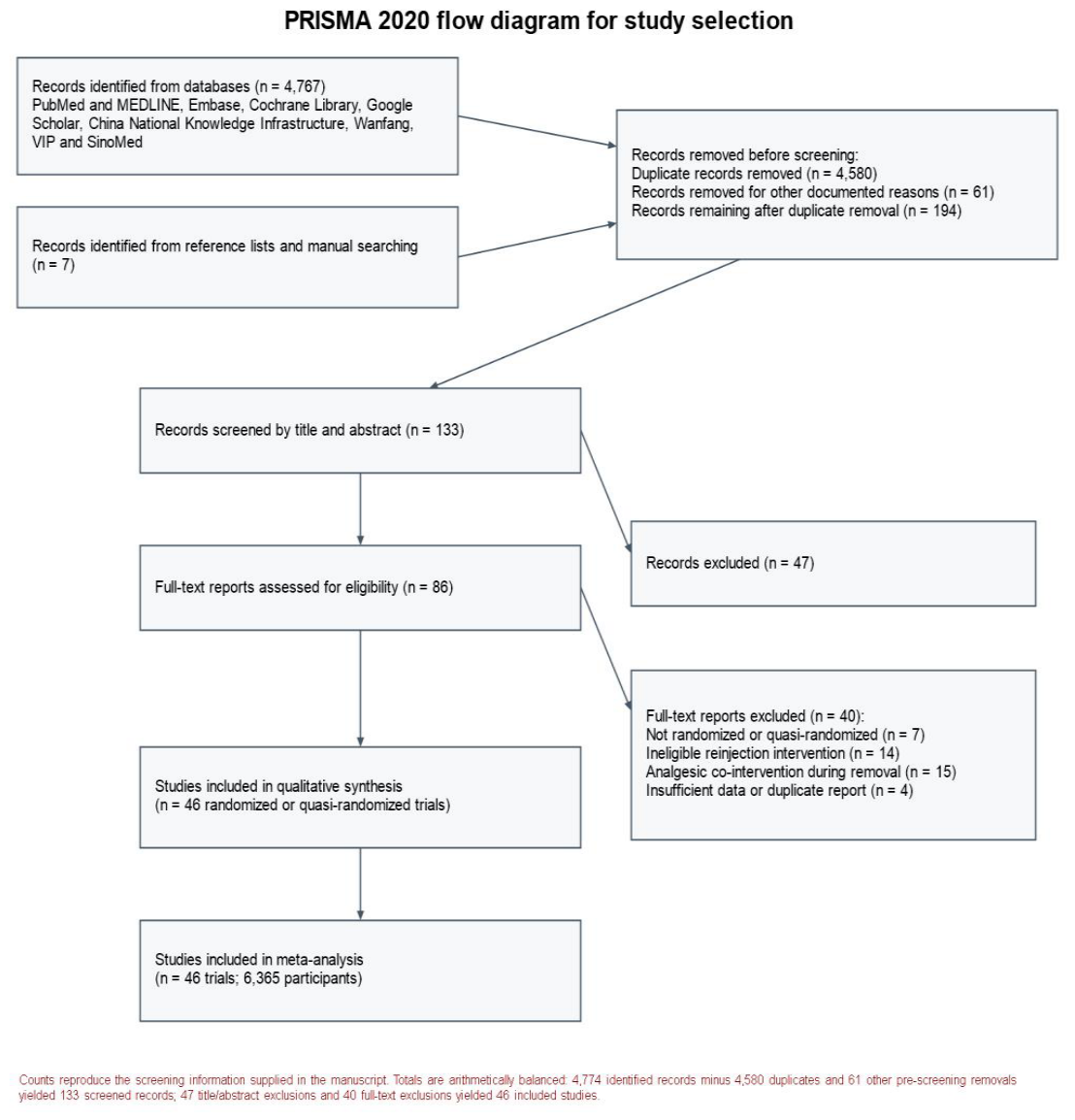
Figure 2.
Risk of bias assessment results.
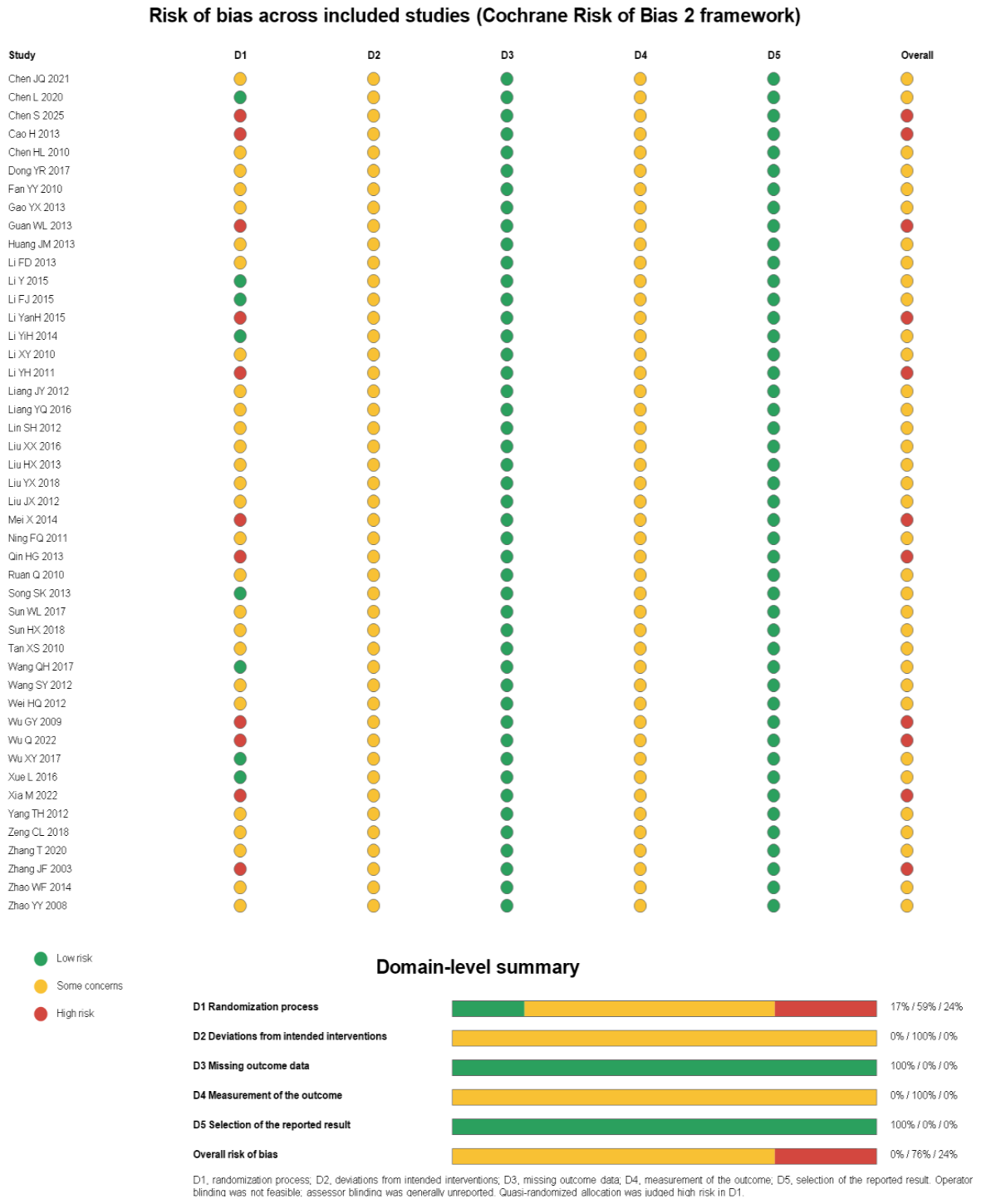
Figure 3.
Forest plot of the effect of reinjection on pain intensity. Blue squares denote the SMD of individual studies, with horizontal lines representing 95% confidence intervals. The green diamond indicates the pooled overall SMD and its 95% CI.
Figure 3.
Forest plot of the effect of reinjection on pain intensity. Blue squares denote the SMD of individual studies, with horizontal lines representing 95% confidence intervals. The green diamond indicates the pooled overall SMD and its 95% CI.
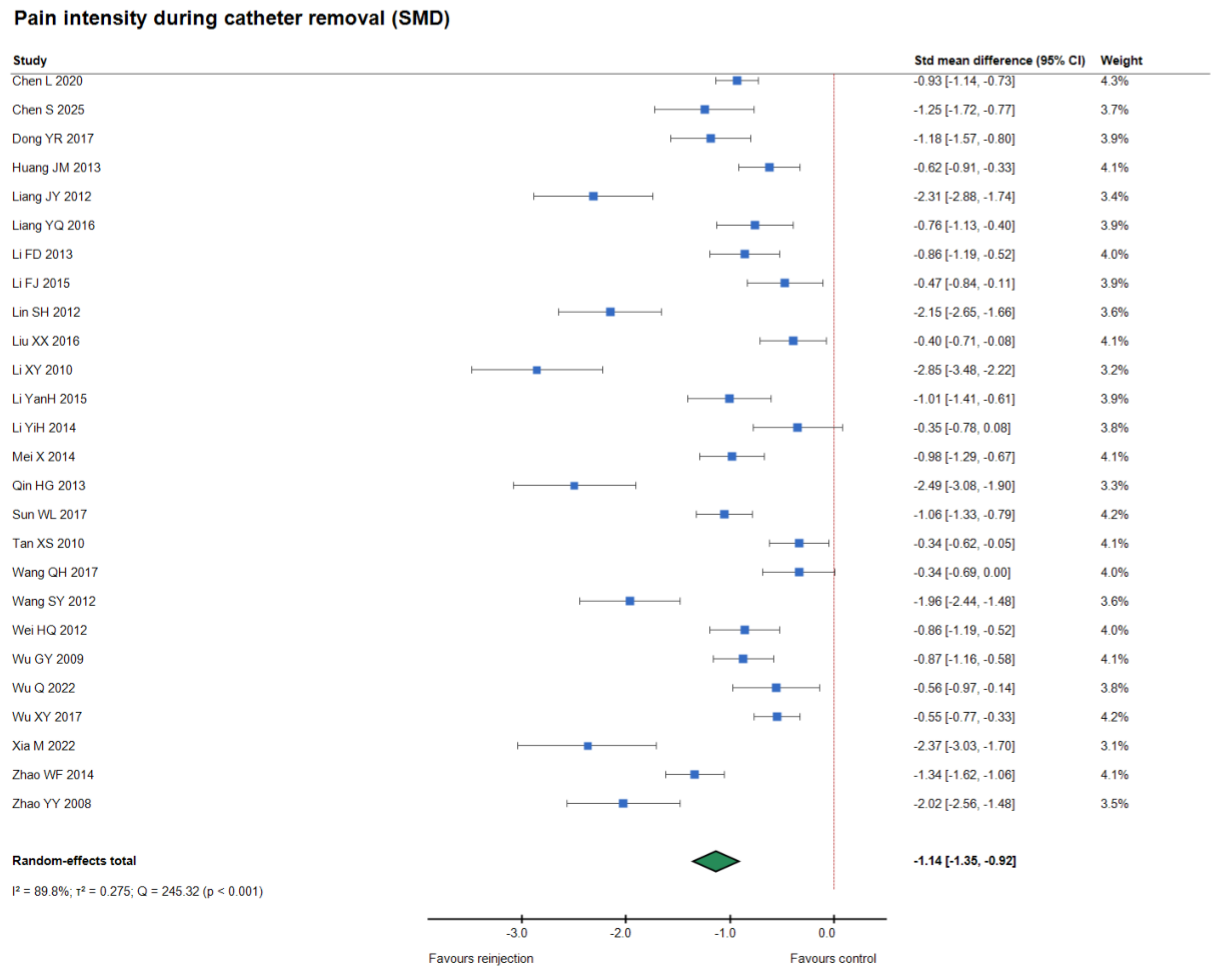

Table 1.
Abbreviated characteristics of included studies(Part).
| Study1 | Sample control/intervention | Population | Post-aspiration reinjection | Medium | Pain assessment | Outcomes |
|---|---|---|---|---|---|---|
| Chen JQ 2021 |
98/98 | Trauma orthopedics patients with preoperative catheterization | 0.3-0.5 mL air reinjection | air | Other/unclear | urinary retention; catheter reinsertion |
| Chen L 2020 |
192/226 | Male patients after flexible ureteroscopy | 0.5 mL sterile water reinjection | liquid | numeric rating scale; facial pain scale | pain |
| Chen S 2025 |
30/30 in characteristics; pain dataset combines two reinjection arms (60/30) | Patients with short-term catheterization after cerebral-infarction intervention | 0.5 mL sterile water reinjection; raw trial also includes a 0.3 mL arm | liquid | visual analogue scale | pain; hematuria |
| Cao H 2013 |
60/60 | Orthopedic surgery patients with indwelling catheters | 0.5-1.0 mL saline retained/reinjected | liquid | numeric rating scale; verbal rating or ordinal scale | hematuria; urinary retention |
| Chen HL 2010 |
30/30 | Male patients with balloon urinary catheters | 0.5-1.0 mL saline reinjection | liquid | Not reported | hematuria |
| Dong YR 2017 |
62/62 | Surgical patients with indwelling urinary catheters | Small-volume fluid reinjection | liquid | visual analogue scale; verbal rating or ordinal scale | pain; successful spontaneous voiding |
| Fan YY 2010 |
50/50 | Male patients after thoracic surgery | 0.5 mL saline reinjection | liquid | Other/unclear | successful spontaneous voiding |
| Gao YX 2013 |
50/50 | Patients with indwelling balloon catheters | 1.0 mL fluid reinjection | liquid | verbal rating or ordinal scale | hematuria; successful spontaneous voiding |
| Guan WL 2013 |
43/43 | Patients with postoperative urinary retention and balloon catheters | 0.5 mL air reinjection | air | Not reported | hematuria; urinary retention |
| Huang JM 2013 |
94/94 | Urological endoscopic surgery patients | 0.3-0.4 mL saline reinjection | liquid | numeric rating scale; verbal rating or ordinal scale | pain |
| Li FD 2013 |
100/100 | Male catheterized patients | 0.2-0.8 mL sterile saline, adjusted by catheter size and dwell time | liquid | Other/unclear | pain; hematuria; urinary retention; catheter reinsertion |
| Li Y 2015 |
50/50 | Patients after craniocerebral tumor resection | 0.5 mL saline reinjection | liquid | Not reported | successful spontaneous voiding; catheter reinsertion |
1 The full 46-study version of Table 1 is provided in Supplementary File S2; the abbreviated in-text table shows the first 12 studies in chronological extraction order to comply with journal table limits.
Table 2.
Summary of findings and certainty of evidence1.
| Outcome | Studies | Participants | Effect estimate | Heterogeneity | Certainty of evidence | Main reasons for downgrading | Clinical interpretation |
|---|---|---|---|---|---|---|---|
| Pain intensity during catheter removal | 26 | 3900 | SMD -1.14 (-1.35 to -0.92) | I²=89.8% | Very low | Serious risk of bias; very serious inconsistency (I²=89.8%); suspected small-study effects | Pain may be meaningfully lower on a 0-10 scale, but heterogeneity and small-study effects make the magnitude uncertain. |
| Urinary retention | 16 | 2206 | RR 0.22 (0.14 to 0.32) | I²=0.0% | Low | Serious risk of bias; single-country evidence | About 78% relative reduction; absolute benefit depends on baseline risk. |
| Successful spontaneous voiding | 19 | 2460 | RR 1.29 (1.21 to 1.39) | I²=65.8% | Very low | Serious risk of bias; inconsistency (I²=65.8%); suspected small-study effects | About 29% relative increase in successful voiding; definitions varied. |
| Any hematuria | 20 | 2511 | RR 0.21 (0.14 to 0.32) | I²=52.5% | Very low | Serious risk of bias; inconsistency (I²=52.5%); suspected small-study effects | About 79% relative reduction; objective injury signal, but moderate heterogeneity remains. |
| Macroscopic hematuria | 14 | 1863 | RR 0.28 (0.19 to 0.41) | I²=21.8% | Low | Serious risk of bias; suspected small-study effects despite lower heterogeneity | About 72% relative reduction with comparatively low heterogeneity. |
| Microscopic hematuria | 9 | 1055 | RR 0.34 (0.22 to 0.52) | I²=78.8% | Very low | Serious risk of bias; inconsistency (I²=78.8%); suspected small-study effects | About 66% relative reduction, but high heterogeneity limits confidence. |
| Catheter reinsertion | 11 | 1620 | RR 0.44 (0.28 to 0.69) | I²=0.0% | Low | Serious risk of bias; single-country evidence | About 56% relative reduction; absolute benefit depends on baseline risk. |
1 SMD, standardized mean difference; RR, risk ratio; I-squared, proportion of variability attributable to heterogeneity. Certainty judgments follow the Grading of Recommendations Assessment, Development and Evaluation framework.
Disclaimer/Publisher’s Note: The statements, opinions and data contained in all publications are solely those of the individual author(s) and contributor(s) and not of MDPI and/or the editor(s). MDPI and/or the editor(s) disclaim responsibility for any injury to people or property resulting from any ideas, methods, instructions or products referred to in the content. |
© 2026 by the authors. Licensee MDPI, Basel, Switzerland. This article is an open access article distributed under the terms and conditions of the Creative Commons Attribution (CC BY) license.
Copyright: This open access article is published under a Creative Commons CC BY 4.0 license, which permit the free download, distribution, and reuse, provided that the author and preprint are cited in any reuse.


