

Submitted:
21 July 2026
Posted:
22 July 2026
You are already at the latest version
Abstract
Microbiological bioproducts constitute a rapidly growing group of preparations used in modern agriculture and play a significant role in achieving the goals of sustainable crop production. Because they contain live microorganisms or their metabolites, they promote plant growth and development, increase nutrient availability, improve soil properties, and suppress pathogen development, thereby representing a promising alternative to conventional fertilizers and chemical plant protection products. The aim of this study was to analyze the current state of knowledge on the application of microorganisms in agriculture, with a particular focus on their mechanisms of action, bioproduct formulation principles, and the legal requirements for their registration and marketing in Poland and the European Union. The paper presents a classification of microbiological bioproducts and compares their properties with those of chemical products. The stages of product formulation, including strain selection and identification, mass production, the choice of appropriate carriers, and stabilization methods, are discussed. Furthermore, the primary mechanisms of microbial action on plants are characterized, including biological nitrogen fixation, phosphate solubilization, the production of phytohormones and siderophores, and pathogen biocontrol mechanisms. In addition, the current legal regulations governing the classification, registration, and quality and safety requirements of agricultural microbiological products are outlined. The analysis indicates that microbiological bioproducts have significant potential to support sustainable crop production and mitigate the negative environmental impacts of agriculture. However, their widespread adoption requires further advancements in formulation technologies, quality standardization, and the improvement and harmonization of existing legal framework.
Keywords:
sustainable crop production
; microbiological bioproducts
; legal regulations
1. Introduction
Microbiological bioproducts constitute a rapidly evolving group of biological agents used in agriculture and horticulture [1]. Generally speaking, these are solutions containing live microorganisms or their metabolites that, upon application, exert specific biological effects, including stimulating plant growth and development, protecting against pathogens, improving soil properties, and enhancing crop quality and yield [2].
Based on their intended use, microbiological bioproducts include biopesticides, biofertilizers, biostimulants, and microbial fertilizer products. They most frequently consist of bacteria, microscopic fungi, or consortia of various microorganisms whose activity improves plant growth, nutrition, and health [3].
According to Meher et al. [4], 41% of commercially available bioproducts contain microorganisms, of which 74% are bacteria and 10% are fungi. Tarigana et al. [5] analyzed the market for microbiological biostimulants in Hungary, Switzerland, Spain, France, Indonesia, and Canada. According to 2020 data, a total of 483 biostimulants containing 245 species of microorganisms were registered. The dominant group consisted of preparations containing bacteria, which were present in 82% of the biostimulants analyzed, while preparations containing fungi were present in 63%. An analysis of their composition revealed that these solutions were based on both single microbial strains and consortia. Furthermore, 48% of the products contained more than one type of microorganism, indicating the growing importance of multi-component biological formulations. The most frequently utilized species included Bacillus subtilis, B. amyloliquefaciens, B. licheniformis, B. pumilus, B. megaterium, Penicillium bilaiae, Bradyrhizobium japonicum, Rhizobium leguminosarum, Rhizophagus irregularis, Trichoderma asperellum, T. harzianum, T. viride, and representatives of the genus Azotobacter. On the other hand, Sulatnova et al. [6] demonstrated that the microorganisms forming the basis of most commercially available biopreparations include B. subtilis, B. amyloliquefaciens, B. thuringiensis, Beauveria bassiana, Pseudomonas aureofaciens, P. fluorescens, and representatives of the genera Lactobacillus, Lecanicillium (e.g., L. lecanii), Metarhizium (e.g., M. anisopliae), Streptomyces, and Trichoderma. In turn, analyses conducted by Tyśkiewicz et al. [7] show that approximately 77 biopesticides are currently available on the global market, produced from single or multiple strains of Trichoderma, which eliminate over 100 different fungal plant pathogens [8]. Current statistical data from the European Commission show that 27 strains of microorganisms can be used to produce biological products, among which bacteria of the genus Bacillus constitute the dominant group [9]. The register of plant protection products authorized for marketing by the Minister of Agriculture and Rural Development indicates that 2,984 preparations are registered in Poland, of which 58 are biological products. A significantly higher degree of commercialization has been achieved in the fertilization segment, where, according to data from the State Research Institute - Institute of Soil Science and Plant Cultivation in Puławy (Poland), 414 microbial products are available [10].
The growing importance of biological solutions is also reflected in economic analyses. In 2025, the global market value of microbial agricultural inputs was estimated at USD 5.64 billion, and forecasts indicate it will reach USD 13.88 billion by 2034, representing a Compound Annual Growth Rate (CAGR) of approximately 10.5%. Such high growth dynamics demonstrate the systematically increasing importance of biological technologies in modern agriculture. Currently, Europe holds the largest market share, while the fastest growth is recorded in the Asia-Pacific region [11,12].
The growing interest in microbiological bioproducts necessitates ensuring their quality, safety, and compliance with current regulations [13]. The development of this group of solutions is supported by the assumptions of the European Green Deal, in particular the “Farm to Fork” strategy, which aims to reduce the use of mineral fertilizers and chemical plant protection products in favor of more sustainable agricultural production methods. [14,15,16,17,18] However, placing microbiological bioproducts on the market within the European Union requires meeting appropriate legal requirements, the scope of which depends on their intended use. Furthermore, the registration process itself is complex and multi-stage, involving the assessment of chemical composition, quality, safety, and efficacy, in accordance with the requirements specified in EU and national legislation [19].
The dynamic growth of the microbial bioproduct market, together with the evolving legal framework governing their marketing in the European Union, has highlighted the need for a comprehensive approach to the development and implementation of these products. For many years, harmonized regulations concerning, among other things, microbial biostimulants were lacking. This contributed to the presence on the European market, including in Poland, of products that were not subject to mandatory registration assessment or uniform requirements regarding quality and efficacy. Despite the introduction of legal regulations, problems related to the classification of individual product categories and the interpretation of the relevant provisions still persist.
At the same time, available review studies focus mainly on selected biological, technological, or legislative aspects, while comprehensive analyses covering the entire development process of microbial preparations are still lacking. Such a process includes the isolation, selection, and characterization of strains; formulation design; quality and efficacy assessment; registration procedures; and, finally, the implementation of the product in agricultural practice, with consideration of the legal framework applicable in Poland and the European Union. This study addresses this gap by comprehensively presenting the successive stages of microbial preparation development and their interrelationships, from isolate acquisition to product commercialization (Figure 1).
Accordingly, the aim of this study is to analyze the current state of knowledge on the use of microbial bioproducts in crop production and to identify the benefits, limitations, and technological and legal challenges associated with their development, registration, and implementation in agricultural practice. Based on the premises presented above, the following hypothesis was formulated: microbial bioproducts constitute an innovative and effective alternative to conventional fertilizers and chemical plant protection products; however, their widespread implementation may be limited primarily by technological barriers, quality-control requirements, and the applicable legal regulations.
2. Microbiological and Chemical Products Used in Crop Production – A Comparative Analysis
The fundamental characteristic of microbiological products used in plant protection and growth promotion is the presence of live microorganisms or their metabolites, which are responsible for the preparation’s biological effect. Unlike chemical preparations, whose action stems from specific chemical compounds, microbiological products often exhibit multidirectional activity that depends on environmental conditions, such as temperature, substrate pH, and nutrient availability [20,21,22].
A significant difference between microbiological and chemical preparations lies in their safety and shelf life. Chemical preparations are typically characterized by greater stability and easier standardization of their composition [23,24], whereas microbiological products require strict quality control, including the monitoring of viable cell counts and compliance with current legal standards [25]. On the other hand, microbial preparations exhibit lower environmental toxicity [26,27] and can be more selective in their action [28], unlike synthetic preparations, which can be toxic to humans, animals, and plants [29,30].
Additionally, microbiological agents are most often derived from microbial strains isolated from natural environments [31], such as soil, the rhizosphere, and plant tissues. Due to their natural origin, they are considered environmentally safe solutions that align with the principles of sustainable agriculture. A major advantage of microbiological bioproducts over conventional chemical agents is also the lower risk of resistance development among target organisms. Long-term use of chemical preparations can lead to the selection of resistant strains under strong selective pressure [32]. In contrast, microbiological products exhibit multidirectional mechanisms of action, including, among others, competition for nutrients, the production of secondary metabolites, and the induction of natural plant defense mechanisms [33].
3. Classification of Microbiological Bioproducts for Agricultural Purposes
Microbiological preparations can be classified based on various criteria, among which their function and method of application are most frequently considered (Figure 2).
3.1. Classification of Microbiological Bioproducts Based on Function
Based on their function, microbiological preparations can be divided into biofertilizers, biostimulants, biopesticides, and microbial fertilizer products. However, it should be emphasized that this classification has evolved alongside the development of national and European Union regulations about agricultural products.
Under the current legal framework, both biofertilizers and biostimulants containing microorganisms are classified as microbial fertilizer products, with their classification determined primarily by their declared biological function rather than by the product’s trade name [34].
Biological fertilizer products are products containing exclusively microorganisms (including live, dead, or inactive cells) and their metabolites, as well as substances that serve as a growth medium for the microorganisms present in the preparation, and harmless residual substances from the culture media, which improve the biological activity of the soil or stimulate plant nutrition processes. These products are applied to improve the plant availability of nutrients from poorly accessible forms in the substrate, enhance plant quality traits, increase nutrient use efficiency, and boost plant resistance to abiotic stresses [35].
According to the Act of 10 July 2007 on Fertilizers and Fertilizing (Poland) [36] and the Regulation of the Minister of Agriculture and Rural Development of 18 June 2008 on the implementation of certain provisions of the Act on Fertilizers and Fertilizing (Poland) [37], biofertilizers are products that stimulate plant growth and development, supply plants with nutrients, and improve soil properties and fertility.
In turn, according to Regulation (EU) No 2019/1009 of the European Parliament [38], a plant biostimulant is a preparation that stimulates plant nutrition processes independently of the product’s nutrient content, and whose sole aim is to improve at least one of the following characteristics of the plant or the rhizosphere: nutrient use efficiency, tolerance to abiotic stress, quality traits, or availability of confined nutrients in the soil or rhizosphere.
On the other hand, biopesticides are agents based on microorganisms, plants, or other biological substances, whose role is to control pests (including weeds, pathogens, and animal pests) by disrupting their metabolic processes and inhibiting their vital functions [39].
3.2. Classification of Microbiological Bioproducts Based on the Method of Application
Based on the method of application, microbiological products can be divided into those used for seed treatment, soil application, fertigation, foliar spraying, and root system inoculation. The choice of the appropriate application method depends on the crop species and cultivation technology, the formulation properties of the preparation, the characteristics of the utilized microorganisms, and the intended biological effect. The selection of the application method is vital to the efficacy of microbial colonization of plants, their survival in the environment, and the efficiency of their effects on plant growth, development, and health [40].
Seed treatment involves coating the seed surface with a suspension containing microorganisms, most frequently bacteria or fungi. This method is among the simplest and most economical ways to apply bioinoculants. The presence of microorganisms on the seed surface helps protect young seedlings against pathogens and can also improve germination capacity and stimulate the initial stages of plant growth and development [41]. An additional advantage of seed treatment is its low environmental impact compared to conventional plant protection methods [42].
Soil application involves introducing microbiological preparations directly into the soil environment in either liquid or solid form. The applied bioinoculants contain live or dormant microbial strains capable of colonizing the rhizosphere and interacting with the host plant [43]. This method reduces the use of plant protection products, particularly pesticides, while eliminating the risk of mechanical seed damage during seed treatment [44].
Fertigation is a method that combines plant fertilization and irrigation. It involves dissolving fertilizers in irrigation water, enabling the efficient delivery of nutrients directly to the root zone [44]. Integrating microbiological products into fertigation systems can further enhance nutrient use efficiency by plants. It has been demonstrated that the application of liquid products containing microorganisms can reduce mineral fertilizer consumption by up to 25% while increasing crop yields. However, the efficacy of this method depended on the proper selection of plant varieties and appropriate nutrient proportions within the fertigation solution [45].
Another method of bioproduct application is foliar spraying, which involves applying liquid microbiological preparations directly to the leaf surface. Microorganisms applied in this manner can influence not only plant health but also the course of metabolic processes occurring within their tissues [46].
Root inoculation involves dipping the plant’s root system into a suspension of microorganisms prior to planting at the cultivation site. Direct contact between the inoculant and the roots promotes effective rhizosphere colonization and increases the probability of permanent establishment of beneficial microorganisms within the plant. This method is particularly applicable to plant growth-promoting rhizobacteria (PGPR), especially in vegetatively propagated crops. Due to their ability to stimulate growth, enhance nutrient availability, and suppress pathogen development, these microorganisms help improve plant condition and productivity [47].
4. Legal Aspects Regarding the Use of Microbiological Bioproducts for Agricultural Purposes
With the growing popularity of microbiological products [48,49], regulatory issues and quality standardization have become increasingly important. In many countries, including Poland, efforts are underway to develop uniform procedures for evaluating the safety, efficacy, and identification of strains used in microbiological preparations.
On December 11, 2019, the European Commission presented the assumptions of the European Green Deal [14,15], which constitutes a long-term strategy for transforming the European Union’s economy towards climate neutrality and sustainable development. As part of implementing this program, the Farm to Fork Strategy [18] was published on May 20, 2020, to enhance the sustainability of food systems. The strategy assumes that by 2030, nutrient losses will be reduced by 50%, which is intended to allow for a reduction in the use of mineral fertilizers by at least 20% while maintaining soil fertility. Furthermore, a 50% reduction in the use of chemical plant protection products is anticipated, including a 50% reduction in pesticide use. Another objective is to increase the share of organic farming to at least 25% of agricultural land in the European Union and to allocate at least 10% of agricultural land to landscape features that promote biodiversity [16,50,51]. The achievement of these goals involves the progressive tightening of regulations concerning the use of fertilizers and plant protection products, which stimulates the development and implementation of innovative, more environmentally friendly agricultural production technologies, including biological and microbiological preparations.
4.1. Procedures for the Registration of Microbiological Bioproducts Used in Agriculture Within the European Union
The introduction of a microbiological bioproduct to the European Union market requires compliance with a number of stringent legal requirements. A key stage in the registration process is the proper qualification of the product, as microbial preparations are subject to two distinct regulatory regimes, namely as fertilizing products or as plant protection products. According to Regulation (EU) 2019/1009 of the European Parliament and of the Council of 5 June 2019 [38], a product qualifies as a fertilizer or a crop support agent if its primary function is to support plant nutrition, increase the availability of nutrients in the soil, improve nutrient use efficiency, or enhance plant tolerance to abiotic stresses.
Once the requirements set out in Regulation (EU) 2019/1009 are met, EU fertilizing products can be marked with the CE mark, thereby enabling their free movement throughout the European Union’s internal market. The CE marking applies exclusively to EU fertilizing products that meet the requirements set out in this Regulation and does not cover products placed on the market solely under national regulations. Microbial fertilizing products can be classified as plant biostimulants (Product Function Category, PFC 6) if they meet the requirements specified in Regulation (EU) 2019/1009. The components of the product must belong to the relevant component material categories (Component Material Categories, CMC) specified in Annex II to the Regulation and meet the requirements specific to a given category. The manufacturer is obliged to demonstrate that the microorganism strains used do not pose a threat to human, animal, or plant health, and to conduct a full conformity assessment procedure to confirm the product’s safety and efficacy [52].
For microbiological products not covered by harmonized regulations applicable at the European Union level, the national registration procedure applies. In Poland, it is specified in the Act of 10 July 2007 on Fertilizers and Fertilization (consolidated text: Journal of Laws of 2024, item 105) [36]. Pursuant to Article 4, paragraphs 3 and 4 of this Act, placing a fertilizer on the market in Poland requires obtaining a permit from the Minister of Agriculture and Rural Development [37]. Detailed procedural requirements are specified in the Regulation of the Minister of Agriculture and Rural Development of 18 June 2008 on the implementation of certain provisions of the Act on Fertilizers and Fertilization (consolidated text) [53]. These regulations require the applicant to conduct tests in authorized research units to confirm the product’s fertilizing efficacy and safety.
A different procedure applies to bioproducts intended for controlling harmful organisms, such as pathogenic fungi, disease-causing bacteria, or other pests. Products of this type are qualified as plant protection products and are subject to the provisions of Regulation (EC) No 1107/2009 of the European Parliament and of the Council of 21 October 2009 [54,55,56] concerning the placing of plant protection products on the market. These regulations require the approval of the microorganism as an active substance at the European Union level. This process is significantly more complex, time-consuming, and costly than the procedure applicable to fertilizing products, and it comprises two main stages. The first stage is the evaluation and approval of the active substance at the European Union level with the participation of the European Food Safety Authority (EFSA), while the second is obtaining authorization to place a specific plant protection product on the market in individual Member States.
In Poland, procedures related to authorizing plant protection products for the market are regulated by the Act of 8 March 2013 on Plant Protection Products (consolidated text: Journal of Laws of 2024, as amended), which implements and harmonizes national law with the requirements of Regulation No 1107/2009 [56]. This Act specifies requirements for the registration, use, labeling, and control of these products. The consistency and safety of the surveillance system are ensured by Regulation (EU) 2017/625 of the European Parliament and of the Council of 15 March 2017 [57], which establishes a framework for official controls throughout the agri-food chain. In Poland, control tasks in this area are carried out by specialized institutions, in particular the State Plant Health and Seed Inspection Service, responsible for the supervision of plant protection products, and the Agricultural and Food Quality Inspection, which supervises fertilizers and fertilizing products, which are authorized to verify the compliance of products with the conditions specified in the registration documentation [58].
Pursuant to Regulation (EC) No 1107/2009 [56], a plant protection product may only be authorized for the market after complying with uniform evaluation principles and requirements regarding approved active substances. The specification of these substances must not deviate significantly from the parameters determined during the approval process, nor may it increase the risk to human, animal, or environmental health. The product must not contain unacceptable substances, and its composition and formulation must ensure efficacy while minimizing hazards. The safety assessment is based on the current state of scientific and technical knowledge and requires an unambiguous determination of the composition using appropriate analytical methods. It is also necessary to determine residues of substances of toxicological, ecotoxicological, and environmental relevance, and to ensure physicochemical properties that guarantee the safe use, transport, and storage of the preparation, which constitutes a prerequisite for obtaining a marketing authorization in the European Union.
The proper qualification of a microbiological bioproduct is crucial to ensuring food safety, protecting human health, and preserving the natural environment. Consequently, misclassification of a product or attempts to circumvent applicable registration procedures may result in administrative sanctions, including the withdrawal of the product from the market. At the same time, compliance with applicable legal standards is an essential element in building trust among users, particularly professional agricultural producers, for whom the efficacy, safety, and compliance of the preparations used with current regulations and declared properties are of particular importance [56].
4.2. Identification Requirements for Microbial Strains Used in Microbiological Bioproducts
In the process of registering microbiological bioproducts on the European Union market, one of the fundamental requirements is the unambiguous identification of the microbial strains used in the product. This requirement is crucial for assessing the safety, efficacy, and quality of agricultural preparations. The scope and specificity of the required identification depend on the product’s intended use and the applicable regulatory framework [59].
In the case of EU fertilizing products, including microbial plant biostimulants covered by Regulation (EU) 2019/1009 of the European Parliament and of the Council of 5 June 2019 [38], the manufacturer is obliged to present a comprehensive taxonomic characterization of the microorganisms used. The identification must enable unambiguous assignment of a given strain to the groups of microorganisms authorized for use in accordance with the requirements specified in the regulation’s annexes. The documentation should confirm the identity of the microorganism, its safety for humans, animals, and the environment, and the stability of its biological properties.
Significantly more detailed requirements apply to microorganisms used as active substances in plant protection products, which are subject to the provisions of Regulation (EC) No 1107/2009 of the European Parliament and of the Council of 21 October 2009 [56]. In such cases, the microorganism undergoes a comprehensive scientific assessment including species and strain identification, genetic characterization, evaluation of the stability of biological traits, and an analysis of potential risks to human, animal, and environmental health. Molecular biology methods are widely used in the identification process, such as the sequencing of genetic regions characteristic of specific groups of microorganisms, including the 16S rRNA gene for bacteria and the ITS region for fungi [60,61].
An essential element of the assessment is also demonstrating the distinctness of the tested strain from pathogenic microorganisms or those producing hazardous metabolites. The manufacturer is required to present data confirming the strain’s genetic stability and consistency during preparation and storage. These requirements aim to ensure that the microorganism used in the product retains its declared biological properties and does not pose a risk to users or the environment [62].
The importance of proper strain identification is further emphasized by the regulations concerning official controls on food, feed, and agricultural inputs, as set out in Regulation (EU) 2017/625 of the European Parliament and of the Council [57]. These regulations enable the competent authorities of the Member States to verify the compliance of products on the market with their registration documentation. Consequently, unambiguous and scientifically validated strain identification represents not only a formal requirement of the registration process but also a fundamental component in ensuring the quality, safety, and reliability of microbiological bioproducts used in agriculture within the European Union.
4.3. Legal Standards Regulating the Chemical and Sanitary Composition of Microbiological Bioproducts Used for Agricultural Purposes
In accordance with the requirements set out in Regulation (EU) 2019/1009 of the European Parliament and of the Council [38], EU fertilizing products, including plant biostimulants, must meet strict chemical and microbiological safety criteria. One of the fundamental conditions for placing a product on the market is limiting the content of substances that are potentially hazardous to human and animal health, as well as to the natural environment.
With regard to chemical safety, maximum permissible levels have been established for selected contaminants [63,64]. The cadmium content must not exceed 1.5 mg Cd · kg−1 of dry matter, hexavalent chromium must not exceed 2 mg Cr(VI) · kg−1 of dry matter, lead must not exceed 120 mg Pb · kg−1 of dry matter, mercury must not exceed 1 mg Hg · kg−1 of dry matter, nickel must not exceed 50 mg Ni · kg−1 of dry matter, and inorganic arsenic must not exceed 40 mg As · kg−1 of dry matter of the product. All values relate to the dry matter of the preparation, which necessitates appropriate sample preparation and the conversion of laboratory analysis results to the dry matter of the tested material.
In addition to the requirements concerning chemical composition, microbiological products used in agriculture are subject to a detailed microbiological safety assessment [69]. The purpose of these requirements is to eliminate the risk of transmitting pathogenic microorganisms and other organisms that could threaten human and animal health. In accordance with current regulations, Salmonella must be absent from a 25 g or 25 ml sample of the product. Furthermore, the count of Escherichia coli and representatives of the Enterobacteriaceae family must not exceed 1 · 103 colony-forming units (CFU) per gram or milliliter of the product [38,52].
For products containing materials of organic origin, it is also required to confirm the absence of viable intestinal parasite eggs (helminth eggs), particularly those from the genera Ascaris, Trichuris, and Toxocara. This requirement is of significant importance from a sanitary safety perspective, as the eggs of these parasites are highly resistant to adverse environmental conditions and can be a source of infection for humans and animals [38].
Compliance with all chemical and microbiological safety requirements must be confirmed by appropriate laboratory testing conducted in accordance with recognized analytical methods. For products with a complex composition or an elevated risk level, the conformity assessment procedure may require the involvement of a notified body, which performs independent verification of the product’s compliance with the requirements set out in European Union legislation [38].
The requirements regarding the quality, safety, and control of microbiological products used in agriculture derive primarily from Regulation (EU) 2019/1009 of the European Parliament and of the Council [38]. Compliance with them is subject to official controls conducted in accordance with Regulation (EU) 2017/625 of the European Parliament and of the Council [57], which aims to ensure a high level of protection for human, animal, and plant health, as well as the natural environment within the European Union. Consequently, fulfilling the chemical and microbiological safety requirements constitutes one of the key elements of the process for authorizing biostimulants and other microbiological products for placing on the market and their safe use in agricultural production.
5. Development of Microbiological Bioproducts
5.1. Criteria for the Selection of Microbial Strains Intended for the Development of Microbiological Bioproducts
The selection of appropriate microbial strains constitutes the first stage of designing a microbiological preparation and significantly determines the efficacy and functionality of the final product. Microorganisms used as active substances in biological preparations applied in agriculture most frequently belong to the group of plant growth - promoting microorganisms (PGPM) [65].
The initial stage in obtaining strains is screening, which includes isolating microorganisms from the natural environment, selecting them on appropriate culture media, obtaining pure cultures, and subsequently performing taxonomic identification, evaluating biological properties, and verifying technological suitability for product formulation [65].
The most common source of microorganisms used to produce microbiological bioproducts is the rhizosphere, i.e., the soil zone directly surrounding the plant root system. This environment is characterized by high biological activity and significant microbial diversity, resulting from the presence of root exudates that contain, among other compounds, sugars, amino acids, and organic acids. Microorganisms isolated from the rhizosphere exhibit a high capacity to colonize the root system and to establish effective interactions with the host plant, owing to their adaptation to the specific conditions prevailing in this zone. For this reason, the rhizosphere is the primary and most valuable source of strains for developing bioinoculants that can support plant growth and development [66]. In addition to the rhizosphere, microorganisms are obtained from the rhizoplane (i.e., the root surface), plant tissues colonized by endophytic microorganisms, and composts and soils associated with specific cropping systems, which are valuable sources of strains with specific functional properties [65].
After obtaining the isolates, their identification is carried out to determine the taxonomic affiliation of the microorganisms. Initial characterization includes evaluating colony morphology, biochemical properties, and genetic identification of the strains, assessed by sequencing the 16S rRNA gene in bacteria and the internal transcribed spacer (ITS) region in fungi [67]. Whole Genome Sequencing (WGS) is also gaining importance, enabling a comprehensive assessment of the strain’s functional potential, the identification of genes associated with beneficial traits, and the detection of genes underlying undesirable properties, such as pathogenicity or antibiotic resistance [65].
Following taxonomic identification, functional screening is conducted to evaluate the properties that determine the microorganism’s suitability for agricultural applications. The primary parameters analyzed include the capacity for biological nitrogen fixation, solubilization of poorly accessible forms of phosphorus, siderophore production, synthesis of phytohormones such as indole-3-acetic acid, enzymatic activity, and the ability to suppress plant pathogen growth. Strains exhibiting multiple mechanisms of action simultaneously are considered particularly valuable from a technological standpoint, as they can concurrently increase nutrient availability, stimulate root system development, and enhance plant resistance to biotic and abiotic stresses [68].
In addition to functional properties, the strain’s ability to survive and effectively colonize soil or plant environments, as well as the stability of its biological traits, is evaluated. Indeed, the efficacy of a microorganism under laboratory conditions does not guarantee corresponding effectiveness under field conditions, where its activity depends on numerous environmental factors, such as the physicochemical properties of the soil, humidity, temperature, competition with the native microbiome, and the crop species. These factors significantly influence the survival, metabolic activity, and root-colonization capacity of microorganisms [69].
A key element in designing a microbiological preparation is the choice between using a single strain and a microbial consortium. Single-strain preparations are characterized by greater predictability of action and facilitate the control of both the production process and the quality of the finished product. On the other hand, multi-strain preparations containing carefully selected and compatible microorganisms can exhibit a synergistic effect resulting from the complementarity of their functions. Individual strains may be responsible for different mechanisms that support plant growth. However, developing an effective consortium requires prior evaluation of the interactions among its components, as some microorganisms may exhibit antagonistic effects, inhibiting the growth of the remaining strains through competition for nutrients or the production of inhibitory metabolites [70].
The final stage of selection involves evaluating the biosafety and technological suitability of the chosen strain. Microorganisms intended for agricultural applications should be characterized by genetic stability, a lack of pathogenic properties toward humans, animals, and plants, and the capacity for efficient mass production under industrial conditions. Equally important is the ability to maintain viability and biological activity after integration with a carrier and during preparation and storage, as these parameters directly determine the shelf-life, quality, and biological efficacy of the final product [71].
5.2. Multiplication of Selected Microorganisms
The multiplication of microorganisms is a stage aimed at maximizing the active biomass of the selected isolate (the strain obtained during the screening process). The microorganisms must remain viable, maintain high metabolic activity, and retain their biological properties [66,72]. A starter culture must be prepared and then used to initiate cultivation and multiplication in a bioreactor. Initially, this process should be carried out on a laboratory scale and subsequently scaled up to an industrial level. During the cultivation scale-up, it is necessary to consider the risk of culture contamination by undesirable microorganisms and the need to preserve the biological and genetic stability of the multiplied strain. Maintaining optimal cultivation conditions is of paramount importance, as certain microorganisms are highly sensitive to variations in environmental parameters, which can lead to reduced viability, decreased metabolic activity, and the loss of desired functional properties [65,71,72,73].
The selection of an appropriate growth medium is also a critical phase of the process, as its primary function is to provide microorganisms with conditions that mimic their natural environment. The elements to consider when designing such a medium include carbon and nitrogen sources, the content of micro- and macroelements, and the potential presence of fungicides [66,74,75]. Upon completion of cultivation, the resulting biomass must be evaluated for viable cell count (CFU) and microbiological purity, and the analyzed microorganism must be verified to have retained its biological properties and compatibility with other microbial strains [65,76].
5.3. Selection of an Appropriate Carrier
The selection of an appropriate carrier is a key stage in designing a microbiological preparation, as it influences the survival of microorganisms and protects them from environmental stresses such as temperature, drought, and UV radiation. A proper carrier should ensure that the microorganisms maintain biological activity, both during storage and after their application under greenhouse and field conditions [71,76]. An ideal carrier substrate should not be toxic to the tested microorganisms and should provide conditions for long-term cell viability and stability during the storage of the finished product. Furthermore, it should be readily available, easy and simple to produce, and exhibit compatibility with the specific strain [65,66].
Organic, mineral, and polymer carriers are primarily used in microbiological products. Organic carriers include peat, compost, lignite, and plant-derived materials such as biochar. Biochar is a porous carbonaceous material that protects selected microorganisms from desiccation and the effects of pathogenic species, thereby enabling beneficial microorganisms to effectively colonize the substrate [72,74]. The second group consists of mineral carriers, most commonly occurring in granular form, such as talc, kaolin, vermiculite, and clays. These materials are highly resistant to physical and mechanical damage and are used for seed treatment, allowing for an even distribution of microorganisms on the seed. A significant disadvantage of this group of carriers is their limited capacity to supply nutrients; consequently, they often require enrichment with additional substances that support the growth and survival of the microorganisms [74,76].
Another group of carriers comprises polymer materials and encapsulation systems, which involve the immobilization of microbial cells within semi-permeable polymer matrices. Among the most frequently utilized materials are alginate, chitosan, and natural polymers with high biocompatibility. The application of encapsulation technology protects cells against adverse environmental factors, limits damage during storage and application, and enhances the viability and stability of the microbiological preparation. Furthermore, the semi-permeable structure of the capsules ensures the exchange of nutrients and metabolites while protecting cells against environmental stress [65,71,75].
The choice of an appropriate carrier is also conditioned by the type of microorganism. Spore-forming bacteria, such as the genus Bacillus, are more resistant to adverse environmental conditions and can remain stable in simpler formulations, whereas more sensitive bacteria, e.g., certain strains of Pseudomonas spp. or Rhizobium spp., require more effective protection against desiccation and loss of activity. For this reason, there is no single universal carrier applicable to all microorganisms; the selection of such a carrier must be based on the biochemical characterization of the chosen strain and is also determined by the environmental conditions under which the biopreparation will be applied [65,66,71,76].
5.4. Stabilization and Shelf-Life of Microbiological Bioproducts
The stabilization and shelf-life assessment of a microbiological preparation constitutes the final stage of its design, determining the maintenance of cell viability and biological activity during product storage and after application to the substrate. Fungi and bacteria used in agricultural production are susceptible to a range of factors that limit their survival, including low water and nutrient availability, temperature fluctuations, oxidative stress, UV radiation, and competition from the native microbiome. For this reason, stabilization is a necessary process to protect cells from adverse environmental conditions [65,71,76].
Among the most important indicators of whether a preparation has been adequately formulated are the determination of the viable microbial cell count (CFU) and the assessment of their capacity for plant colonization, metabolite production, and antagonistic properties against pathogenic organisms [69,71,77]. A method for increasing the shelf life of microorganisms in biopreparations is to subject them to a drying process, which thereby restricts their metabolic activity and reduces the concentration of metabolites that inhibit the development of the desired microorganisms. To protect microorganisms in the preparations, various stabilizing substances (stabilizers) are used, including trehalose, sucrose, glycerol, and protective proteins, which mitigate the negative effects of drying and enhance microbial survival during storage of the finished product [72,75].
Encapsulation is a flagship example of a modern method for stabilizing and protecting microorganisms in the design of microbiological preparations. This process involves entrapping the cell inoculum within a polymer matrix, such as alginate, chitosan, or other natural polymers. In this manner, microorganisms are less susceptible to environmental stresses and the adverse impact of the autochthonous (native) microbiome. A key advantage of the encapsulation method is the ability to control the quantity of substances released into the environment [65,66,71,72,75].
In the formulation of biopreparations, it is also essential to maintain stability when combining all elements of the product (the carrier and the selected microorganism), as the absence of key components or the addition of new ones can alter the microorganisms’ physiological properties. Consequently, the final preparation should be evaluated not only in terms of microbial count but also in terms of its actual biological efficacy under conditions that closely resemble field environments [65,66,76].
6. Mechanisms of Plant Growth Stimulation by Microorganisms
6.1. Direct Mechanisms of Plant Growth and Development Promotion
The group of direct mechanisms for stimulating plant growth and development includes the biosynthesis of phytohormones, biological nitrogen fixation, the mobilization (solubilization) of micro- and macronutrients from forms unavailable to plants (particularly phosphorus) [78].
Rhizosphere microorganisms play a crucial role in regulating plant ontogeny by synthesizing major classes of phytoregulators: auxins, cytokinins, and gibberellins. These compounds exogenously modify root system architecture, which directly translates to an increased efficiency of water and mineral nutrient uptake from the soil profile [79]. Phytohormones are low-molecular-weight organic compounds responsible for plant phenotypic plasticity and their response to variable environmental factors [80]. Despite acting in trace concentrations, they control key biochemical and physiological processes, including stomatal movements, flowering induction, fruit ripening, and plant aging [81]. The ability of microorganisms to synthesize these compounds has broad applications in mitigating the negative effects of abiotic and biotic stresses and in optimizing nutrient management [82].
A classic example of plant hormones modified by the microbiome is auxin, which regulates cell division, primary root elongation, and the differentiation of lateral and adventitious roots. Furthermore, auxins enhance plant tolerance to abiotic stresses, for example, by immobilizing heavy metals and limiting their phytotoxicity in the environment [83]. The capacity to synthesize auxins is characteristic of, among others, fungi of the genus Trichoderma, bacteria of the genera Pseudomonas and Bacillus, as well as selected cyanobacteria [82]. These microorganisms produce auxins primarily as indole-3-acetic acid (IAA), which can also stimulate the conversion of unavailable forms of phosphorus into forms accessible to plants [84].
Cytokinins are a group of plant hormones that stimulate cell division and shoot differentiation and delay leaf aging. Maintaining cytokinin homeostasis is essential for proper stomatal activity. A reduction in the level of these compounds induces stomatal closure, which consequently limits transpiration, gas exchange, and the intensity of carbon dioxide assimilation [83]. Many plant growth-promoting microorganisms (PGPM) possess the potential for cytokinin biosynthesis, including strains of P. fluorescens and P. citrinum [85].
Gibberellins also perform an important regulatory function in plant growth dynamics. These hormones help stimulate shoot elongation, generative organ development, seed dormancy breaking, and germination initiation. Under salinity-induced osmotic stress, the biosynthesis of gibberellic acid (GA) helps maintain growth homeostasis and increases seed germination energy. The gibberellin synthesis pathway remains in strict correlative dependence with other phytoregulators, especially auxins, which can stimulate their expression and biological activity. The ability to produce gibberellins is exhibited by numerous rhizosphere microorganisms, including bacteria belonging to the genera Azotobacter, Azospirillum, and Pseudomonas, as well as the filamentous fungus Gliomastix murorum, whose presence contributes to the intensification of plant growth and the improvement of quantitative and qualitative yield parameters [86,87].
Abscisic acid (ABA), in turn, serves as a master regulator of plant responses to abiotic stress factors. Unlike cytokinins and gibberellins, this sesquiterpenoid is primarily responsible for adaptive processes and growth inhibition under critical conditions. ABA helps maintain water homeostasis by inducing stomatal closure, thereby limiting transpiration under drought or salinity conditions. The capacity for ABA biosynthesis is also exhibited by certain rhizosphere microorganisms, including A. brasilense and selected isolates of the genus Phoma. Microbial synthesis of ABA modifies the host’s hormonal balance, increasing its stress tolerance and the efficiency of adaptation to adverse environmental conditions [83,88].
Since the physical reach of roots into the soil profile is strictly limited by architectural barriers, plants’ direct access to the nutrient pool can be constrained. This limitation is compensated for by arbuscular mycorrhizal fungi (AMF), whose extensive extraradical mycelium forms a common mycorrhizal network (CMN) with the host. This network enables exploration of rhizosphere regions inaccessible to root hairs alone. The CMN structure efficiently captures and transports key macronutrients, such as nitrogen and phosphorus, optimizing their mineral assimilation. This bidirectional symbiosis is based on strict metabolic exchange: the fungus supplies the plant with mineral nutrients, receiving in return photosynthetic products (primarily carbohydrates) that it cannot synthesize independently as a heterotrophic organism [89].
An important mechanism increasing the pool of nutrients available to plants is biological phosphorus solubilization. Studies described by Garcia-Sanchez et al. [86] demonstrated that bacteria of the genera Bacillus and Paenibacillus release phosphorus from insoluble mineral phosphates through the secretion of organic acids, such as gluconic, lactic, glycolic, acetic, formic, and pyruvic acids. Similarly, Bononi et al. [90] indicated a high potential of Trichoderma sp. isolates to solubilize phosphorus via acidogenesis. This mechanism relies on two processes: acidification of the rhizosphere due to the release of protons (H+) and the chelation of cations to form insoluble phosphate complexes. Consequently, orthophosphates available to plants (HPO42− and H2PO4−) are released [91].
The efficiency of phosphorus solubilization depends on the nitrogen source available to the microorganisms. In alkaline soils rich in calcium carbonate (CaCO3), the assimilation of nitrate ions (NO3−) intensifies organic acid production more effectively than the assimilation of ammonium ions (NH4+). Statistical analysis conducted by Boudou et al. [92] revealed a positive correlation between a high content of CaCO3 and nitrates and the metabolic potential of microorganisms responsible for phosphate chelation. As a result, bacteria and fungi not only increase phosphorus availability but also limit its secondary precipitation in the soil, which is of key importance when designing biopreparations for alkaline soils [93].
Molecular nitrogen (N2), despite its high abundance in the atmosphere (~78%), is not directly available to eukaryotes due to the presence of a strong covalent triple bond between the nitrogen atoms [94]. Diazotrophic bacteria possess the unique ability to reduce N2 to ammonia (NH3) with the participation of the nitrogenase enzyme complex. This process is highly energy-demanding and requires the presence of reductants such as ferredoxin [95]. In agroecosystems, the efficiency of biological nitrogen fixation (BNF) depends on the synergistic cooperation of different groups of rhizosphere microorganisms. Interactions between symbiotic bacteria and endophytes can intensify root colonization and stimulate nitrogenase activity, thereby optimizing the plant’s nitrogen economy and supporting its biomass [96].
Soil microorganisms furthermore coordinate the processes of mineralization and immobilization of organic matter. Mineralization transforms complex organic structures into simple mineral forms available to plants, while immobilization temporarily incorporates elements into microbial biomass. These processes are accompanied by the activity of extracellular soil enzymes, such as phosphatases, urease, and dehydrogenases. These enzymes are stabilized by soil organic colloids, which significantly extend their catalytic activity in the environment [97].
Microorganisms also help stabilize soil aggregate structure by synthesizing extracellular polymeric substances (EPS) and decomposing plant residues. The products of these transformations promote the formation of stable soil aggregates that combine mineral particles with organic matter. The aggregate structure beneficially modifies soil water capacity, aeration, and ecological niches of the microbiome. In turn, the decomposition of crop residues constitutes a constant source of carbon, and the release of nitrogen, phosphorus, and sulfur locked within them directly supplies subsequent crops in the rotation [98].
6.2. Direct Mechanisms of Plant Growth and Development Promotion
Direct mechanisms of promoting plant growth and development are oriented toward mitigating biotic pressure. They include the biological control (biocontrol) of phytopathogens, induced systemic resistance (ISR) of plants, and competitive exclusion of pathogenic microorganisms from ecological niches and nutrient pools, including the production of siderophores. [78].
One of the most important defense mechanisms activated by beneficial microbiota is Induced Systemic Resistance (ISR). Non-pathogenic bacteria and fungi, upon recognizing pathogen-associated molecular patterns (PAMPs) or in response to chemical signals, induce the expression of genes encoding defense metabolites and pathogenesis-related (PR) proteins in the plant. In this process, signaling pathways dependent on salicylic acid, jasmonic acid, and ethylene play a key role as mediators. Activated phenolic compounds, phytoalexins, and lytic enzymes directly inhibit pathogen growth, damage their cellular structures, or induce programmed cell death (apoptosis) at the site of infection [99].
Special importance in biocontrol is attributed to bacteria of the genera Bacillus and Pseudomonas. Bacillus strains synthesize, among others, bacillomycin—a lipopeptide with potent antifungal properties, which effectively limits the development of the fungus F. graminearum, the main etiological agent of cereal fusariosis, through the lysis and degradation of hyphae and spores [100]. In turn, P. aeruginosa is characterized by the ability to produce pyocyanin. This green-blue phenazine pigment generates reactive oxygen species (ROS), exhibiting strong antibacterial and antifungal properties with high therapeutic potential in eliminating plant infections [101]. Similarly, fungi of the genus Trichoderma produce a wide spectrum of secondary metabolites (e.g., trichodermin, peptaibols) and lytic enzymes (chitinases, β -glucanases) that degrade the cell wall of phytopathogens, disrupt their metabolic homeostasis, and lead to cell lysis [102].
The mechanisms of action of antibiotics and lipopeptides synthesized by PGPM are diverse. Some of them inhibit the biosynthesis of the cell wall of pathogenic bacteria and fungi. Examples include β -lactam antibiotics, which block the activity of transpeptidases (penicillin-binding proteins – PBPs) responsible for cross-linking peptidoglycan containing D-alanyl-D-alanine. Certain metabolites can also directly bind to the D-alanyl-D-alanine domain, preventing polymerization and further stages of bacterial cell wall formation [103]. Another mechanism is the direct destabilization of the continuity of pathogens’ cytoplasmic membranes through interactions with their lipid components (e.g., ergosterol in fungi), which induces uncontrolled electrolyte leakage and cell death [104].
Selected antibiotics exhibit activity against pathogens’ genetic apparatus, disrupting replication and transcription. Quinolone antibiotics inhibit the activity of topoisomerase II (DNA gyrase) and topoisomerase IV, leading to DNA strand fragmentation and bacterial cell death. In turn, sulfonamides and diaminopyrimidines act as antimetabolites, blocking the folic acid synthesis pathway necessary for the biosynthesis of purine and pyrimidine nucleotides [103].
An important element of indirect protection is competition for space (ecological niche). Beneficial microorganisms exhibit high affinity for receptors on the root surface, occupying available adhesion sites (so-called competitive exclusion). This prevents the permanent attachment and colonization of tissues by pathogenic microorganisms. The maintenance of a stable, dense biofilm by symbiotic and endophytic microorganisms creates a physical and biological barrier, hindering spatial expansion and the biosynthesis of virulence factors regulated by quorum-sensing mechanisms in pathogens [105,106].
Beneficial microbiota also exhibit high metabolic plasticity, utilizing a wide spectrum of carbon, nitrogen, and micronutrient sources, which drastically limits their availability to slower-growing pathogenic species. Under conditions of microbial homeostasis, the depletion of easily assimilable nutrient pools in the rhizosphere effectively suppresses pathogen growth. Conversely, dysbiosis (disruption of the microbiome biodiversity structure) releases free nutrient resources, favoring the rapid proliferation and niche colonization by opportunistic and phytopathogenic species [107].
Rhizobacteria and filamentous fungi, such as A. niger or A. flavus [108], exhibit the ability to secrete siderophores—low-molecular-weight compounds with a high affinity for iron ions. Siderophores chelate Fe3+ ions, thereby enabling their reduction to the Fe2+ form, which is characterized by significantly greater availability to plants and microbiota. Iron serves an obligatory function as a cofactor in oxidoreductases, for example, in the NADH-coenzyme Q10 oxidoreductase complex involved in mitochondrial ATP synthesis [109]. Over 500 siderophores have been characterized and structurally classified into catecholate, hydroxamate, and carboxylate groups. An example of a catecholate siderophore with extremely high complexation stability is enterobactin, produced by both Gram-negative and Gram-positive bacteria [110]. The biosynthesis of these compounds can proceed via the NRPS (non-ribosomal peptide synthetase) pathway or through a mechanism independent of NRPS, involving specific ATP-dependent enzymes [109].
7. Bacteria and Fungi as the Primary Elements of Agricultural Bioproducts
The biological agricultural products available on the market most frequently include bacteria isolated from the plant rhizosphere and phyllosphere, belonging to the genera Bacillus, Rhizobium, Pseudomonas, Azotobacter, Azospirillum, and Paenibacillus [111,112]. These microorganisms exhibit high metabolic activity and the capacity to colonize root surfaces and the aboveground parts of plants, thereby playing an essential role in improving crop development and health. Rhizospheric and phyllospheric bacteria are widely used in agricultural bioproducts due to their plant growth-promoting properties [113], ability to suppress pathogen development, and participation in processes that increase nutrient availability in the soil [114,115] (Table 1).
Bacteria of the genus Pseudomonas are microorganisms that, through their mechanisms of action, enable the improvement of plant growth, stress tolerance, and the inhibition of disease development. In addition to their positive impact on plants, they are also involved in the decomposition of organic matter [116]. However, bacteria of the genus Bacillus represent the most thoroughly studied group of microorganisms in the field of biological plant protection. They utilize mechanisms of action such as the production of antibiotics and secondary metabolites, support of systemic resistance, and biological nitrogen fixation. Consequently, they can be utilized as biofertilizers or biostimulants. A major advantage of the genus Bacillus is its ability to form endospores, which enable it to survive harsh environmental conditions [117]. They can also prevent the development of soil-borne pathogens through antagonistic interactions and competition for nutrients and ecological niches [118].
Alongside bacteria, filamentous fungi constitute an important group of microorganisms utilized in agricultural bioproducts. Their significance derives primarily from their ability to suppress pathogen development, stimulate plant growth and development, and improve soil biological properties. In agricultural applications, species belonging to the genera Trichoderma, Metarhizium, Beauveria, Purpureocillium, and Clonostachys are most frequently used, as are mycorrhizal fungi from the genera Glomus and Rhizophagus. These microorganisms exhibit antagonistic, symbiotic, and entomopathogenic properties, which underlie their broad applications in biological plant protection and the improvement of agroecosystem productivity (Table 1).
Fungi exhibit antagonistic activity against pathogenic microorganisms by producing antibiotics, lytic enzymes, and secondary metabolites that inhibit the growth and development of pathogenic bacteria and fungi [119].
Members of the genus Trichoderma play a particularly significant role in biological plant protection, being characterized by rapid growth and a high capacity to adapt to soil environmental conditions. As a result, they effectively compete with pathogens for available resources and colonization space [120]. Additionally, they produce numerous hydrolytic enzymes and secondary metabolites, including trichomycin and gelatomycin, which degrade the pathogen’s cell wall, disrupt its metabolic processes, and ultimately lead to cell death. An essential mechanism of action of fungi in this genus is necrotrophic mycoparasitism, which involves recognizing, attacking, and degrading the hyphae of pathogenic fungi, and subsequently utilizing their cellular components as a source of nutrients [121]. Furthermore, Trichoderma sp. stimulates plant growth and development by inducing induced systemic resistance (ISR). These fungi induce the synthesis of proteins involved in the plant defense response, increasing plant resistance to infections and biotic stress, and can also produce phytohormones that influence the development of the root system and aboveground parts of plants [119,120,121].
A special place among agricultural bioproducts is also held by mycorrhizal fungi, which form symbiotic relationships with the plant root system. Owing to an extensive hyphal network, they increase the effective absorptive surface area of the roots, leading to more intensive uptake of water and minerals, particularly phosphorus and nitrogen. The multidirectional nature of mycorrhizal fungi’s impact allows them to both improve nutrient uptake efficiency and strengthen plants’ natural defense mechanisms. In mycorrhizal preparations, arbuscular mycorrhizal fungi of the genus Glomus are most commonly used; in addition to improving plant nutrition, they suppress soil-borne pathogens and increase plant tolerance to adverse environmental conditions. In studies by Miransari et al. [122], it was demonstrated that G. mosseae can effectively limit the development of P. syringae in soybean cultivation and support plant protection against soil nematodes [123,124]. Fungi of the genus Glomus also convert insoluble phosphorus compounds into soluble forms through hyphal activity, thereby enabling better absorption of the element. In the event of drought, the symbiosis between the plant and fungi mitigates stress by supporting gas and water exchange in the leaves and transpiration intensity [125].
8. Advantages and Disadvantages of Microbiological Bioproducts
8.1. Advantages of Microbiological Bioproducts
One of the primary advantages of utilizing microbiological products is their beneficial effect on soil functioning and the biological processes occurring within it. Soil microorganisms play a crucial role in organic matter decomposition, mineral nutrient transformations, and shaping conditions conducive to plant growth and development. Introducing them into the soil supports the activity of the soil microbiome, which is one of the fundamental elements that determine soil fertility and proper functioning [65,69,139]. As indicated by Sadia et al. [140], the diversity of soil microorganisms in sustainable agricultural systems significantly influences processes related to carbon and nutrient cycling, thereby maintaining the stability and productivity of agroecosystems.
Another significant benefit of using microbiological products is the increased availability of mineral nutrients to plants. Microorganisms participate in biological nitrogen fixation, the solubilization of poorly available forms of phosphorus, and the production of enzymes that catalyze nutrient transformations, thereby improving nutrient availability and uptake by plants [68,69,77].
Backer et al. [69], analyzing the properties of plant growth - promoting rhizobacteria (PGPR), demonstrated that rhizosphere-colonizing microorganisms increase the efficiency of mineral nutrient uptake and improve the utilization of mineral fertilizers. The authors also emphasize that the use of PGPR can reduce the necessity for intensive mineral fertilization, aligning with the principles of sustainable agriculture.
Similar results were reported by Santos et al. [65], who evaluated the efficacy of bacterial bioinoculants primarily used in agriculture. Their research showed that appropriately selected microorganisms exert a beneficial effect on plant growth and improve the biological properties of the rhizosphere. At the same time, the authors point out that the efficiency of bioinoculation depends on the proper selection of microbial strains tailored to the plant species, environmental conditions, and cultivation system.
Microorganisms used in microbiological products can also directly stimulate plant growth by synthesizing phytohormones, such as auxins, gibberellins, and cytokinins. These compounds promote the intensification of aboveground part growth and root system development, enhancing plants’ capacity to absorb water and mineral nutrients from the soil [67,69,77]. Studies on the application of microorganisms as bioinoculants, including Bradyrhizobium, Rhizobium spp., Bacillus spp., Pseudomonas spp., and Azospirillum spp., have demonstrated improvements in plant growth parameters; however, the effectiveness of this solution depended on the proper selection of microbial strains for the specific agricultural production system [65,75].
Another benefit of applying microbiological products is enhanced plant resistance to biotic and abiotic stresses. Microorganisms exhibit antagonistic activity against numerous soil-borne pathogens and stimulate the natural defense mechanisms of plants [69,140]. Research by Saberi Riseh et al. [141] and Ahmed et al. [142] demonstrated that the use of microbiological products can increase plant tolerance to unfavorable environmental conditions, including periodic water deficits and limited nutrient availability. This effect is primarily associated with improved root system development, increased soil biological activity, and intensified processes within the rhizosphere, which translate into better plant condition and higher productivity [141,143,144].
An additional advantage of using microbiological products is their high environmental safety. The microorganisms used in these products produce metabolites that, unlike many synthetic chemicals, do not exert toxic effects on the natural environment and undergo natural biodegradation [76,144]. Furthermore, many microbiological products are based on autochthonous (native) microbial strains naturally occurring in a given soil environment. Consequently, they are characterized by an enhanced capacity for adaptation and soil colonization, as well as a lower risk of disrupting the ecosystem’s microbial balance [65,139]. The use of native microorganisms helps maintain soil biodiversity and aligns with the principles of sustainable, environmentally friendly agriculture [65,71,140].
8.2. Disadvantages of Microbiological Bioproducts
Despite numerous benefits of using microbiological products, their application in agricultural and horticultural practice is also associated with certain limitations and disadvantages. Their efficacy depends on a multitude of biological and environmental factors; therefore, their action is less stable and more difficult to predict than that of traditional mineral fertilizers or chemical plant protection products [69,70,71,139].
One of the primary disadvantages of microbiological preparations is their slower rate of action compared to chemical substances. Mineral fertilizers provide nutrients in forms that are rapidly available to plants, whereas microorganisms require time to colonize the soil environment, proliferate, and initiate biological activity. In the case of biofertilizers, the effects of their action often become apparent only after prolonged application, as they depend on the activity of the microorganisms and the underlying biological processes. Microbiological solutions can be effective in the long-term improvement of soil functioning, but they do not always provide an immediate effect directly visible after application [69,73,74].
Another disadvantage of using microbiological products is their high dependence on environmental conditions for efficacy. To function properly, microorganisms require appropriate conditions, such as optimal temperature, water availability, soil pH, and nutrient availability. Research by Wani et al. [144] indicates that variable environmental conditions can significantly affect the survival and activity of microorganisms, thereby directly influencing the efficacy of bioproducts used in agriculture. According to the authors mentioned above, even well-selected strains may exhibit limited activity if environmental conditions are not conducive to their development.
In contrast to many chemical products, microbiological preparations contain live microorganisms; hence, their quality depends on maintaining appropriate storage conditions. Improper temperature or humidity, or excessively long storage periods, can reduce the number of viable microbial cells in the product, resulting in limited activity and efficacy. In studies on biopreparations, it is often noted that the biological stability of the product is one of the greatest technological challenges, as microorganisms can lose viability and activity during storage [72,76,145]. Developing an appropriate formulation and protecting the microorganisms is crucial for preserving their biological properties and metabolic activity.
Furthermore, the effects of their action tend to be less predictable than those of chemical agents. This is because microbial activity depends on multiple simultaneous factors, such as the composition of the native soil microbiome, antagonistic interactions among microorganisms, and crop cultivation conditions. Studies on the application of biological plant protection products indicate that differences between results obtained under laboratory, greenhouse, and field conditions can be significant [69,71]. The efficacy of microorganisms observed under controlled conditions does not always translate into their actual performance under field conditions [142].
9. Conclusions and Summary
Microbial bioproducts are among the most promising biological inputs for agricultural production, aligning with the principles of sustainable agriculture and the European Green Deal. The use of microorganisms can reduce reliance on mineral fertilizers and chemical plant protection products while improving soil fertility, increasing nutrient availability, and enhancing plant health and productivity. The dynamic development of the market and the growing number of available products indicate that the importance of this product group will continue to increase.
The analysis confirmed that the successful development and implementation of microbial bioproducts depend not only on the appropriate selection of strains and their biological activity but also on suitable formulation technologies, quality control, and regulatory compliance. Thus, the adopted research hypothesis was confirmed, namely that the widespread use of microbial bioproducts in agricultural practice is primarily limited by technological barriers, quality-control requirements, and applicable legal regulations.
At the same time, it was demonstrated that the available review studies focus mainly on selected biological, technological, or legislative aspects, whereas comprehensive analyses covering the entire process of developing microbial preparations—from strain isolation and characterization, through formulation design, quality and efficacy assessment, and registration procedures, to the implementation of the product in agricultural practice—remain scarce. This review addresses that gap by integrating all these stages into a single study and presenting their interrelationships and importance for the effective development and commercialization of microbial bioproducts.
This study may serve as a source of current and systematically organized knowledge for the scientific community, manufacturers, and institutions responsible for the assessment, registration, and quality control of microbial bioproducts. It also identifies directions for further research on improving formulation technologies, methods for identifying and quality-controlling microorganisms, and the development of coherent legal frameworks to enable the safe and effective implementation of innovative bioproducts in agricultural practice.
Supplementary Materials
Not applicable.
Author Contributions
Conceptualization, A.W.-M., A.D., E.P., M.P.; methodology, A.W.-M., A.D., E.P., M.P., A.K.; software, A.W.-M., A.D., E.P., M.P., A.K.; validation, A.W.-M., A.K., A.N., formal analysis, A.W.-M., A.D., E.P., M.P., A.K.; investigation, A.W.-M., A.D., E.P., M.P., A.K.; resources, A.W.-M., A.D., E.P., M.P., A.K; data curation, A.W.-M., A.K., A.N.; writing—original draft preparation, A.W.-M., A.D., E.P., M.P., A.K.; writing—review and editing, A.W.-M., A.D., E.P., M.P., A.K.; visualization, A.W.-M., A.D., E.P., M.P., A.K.; supervision, A.W.-M., A.N.; project administration, A.W.-M., A.N., A.K.; funding acquisition, A.W.-M., A.N., A.K. All authors have read and agreed to the published version of the manuscript.
Funding
Not applicable.
Data Availability Statement
No new data were created or analyzed in this study. Data sharing is not applicable to this article.
Acknowledgments
The authors used OpenAI’s GPT-5.5 solely for text formatting during the preparation of this manuscript. The authors reviewed and edited the manuscript and are fully responsible for the content of this publication.
Conflicts of Interest
The authors declare no conflicts of interest.
References
- Nazranov, K.M.; Didanova, E.N.; Khalishkhova, L.Z. Formation and Development of the Biopreparations Market. IOP Conf. Ser. Earth Environ. Sci. 2021, 699, 012037. [Google Scholar] [CrossRef]
- Kumar, A.; Verma, J.P. The Role of Microbes to Improve Crop Productivity and Soil Health. In Ecological Wisdom Inspired Restoration Engineering; Achal, V., Mukherjee, A., Eds.; Springer: Singapore, 2018; pp. 249–265. [Google Scholar] [CrossRef]
- Rojas-Sánchez, B.; Guzmán-Guzmán, P.; Morales-Cedeño, L.R.; Orozco-Mosqueda, M.d.C.; Saucedo-Martínez, B.C.; Sánchez-Yáñez, J.M.; Fadiji, A.E.; Babalola, O.O.; Glick, B.R.; Santoyo, G. Bioencapsulation of Microbial Inoculants: Mechanisms, Formulation Types and Application Techniques. Appl. Biosci. 2022, 1, 198–220. [Google Scholar] [CrossRef]
- Meher, J.; Rajput, R.S.; Bajpai, R.; Teli, B.; Sarma, B.K. Trichoderma: A Globally Dominant Commercial Biofungicide. In Trichoderma: Agricultural Applications and Beyond; Manoharachary, C., Ed.; Springer: Cham, Switzerland, 2020; Volume 61, pp. 195–208. [Google Scholar] [CrossRef]
- Tarigan, S.I.; Toth, S.; Szalai, M.; Kiss, J.; Turoczi, G.; Toepfer, S. Biological Control Properties of Microbial Plant Biostimulants. A Review. Biocontrol Sci. Technol. 2022, 32, 1351–1371. [Google Scholar] [CrossRef]
- Sultanova, L.; Pronovich, N.; Galieva, G.; Kuryntseva, P.; Selivanovskaya, S. Biopreparations: Types, Main Agents, and Promising Methods. BIO Web Conf. 2025, 181, 01017. [Google Scholar] [CrossRef]
- Tyśkiewicz, R.; Nowak, A.; Ozimek, E.; Jaroszuk-Ściseł, J. Trichoderma: The Current Status of Its Application in Agriculture for the Biocontrol of Fungal Phytopathogens and Stimulation of Plant Growth. Int. J. Mol. Sci. 2022, 23, 2329. [Google Scholar] [CrossRef] [PubMed]
- Thambugala, K.M.; Daranagama, D.A.; Phillips, A.J.L.; Kannangara, S.D.; Promputtha, I. Fungi vs. fungi in biocontrol: An overview of fungal antagonists applied against fungal plant pathogens. Front. Cell. Infect. Microbiol. 2020, 10, 604923. [Google Scholar] [CrossRef] [PubMed]
- European Commission. Micro-organisms Used in Plant Protection Products. Directorate-General for Health and Food Safety, European Commission, Brussels, Belgium, 2024. Available online: https://food.ec.europa.eu/plants/pesticides/micro-organisms_en (accessed on 7 July 2026).
- Institute of Soil Science and Plant Cultivation in Puławy - National Research Institute. List of microbiological fertilizing products. Available online: https://www.iung.pl (accessed on 5 July 2026).
- Market Data Forecast. Europe Biostimulants Market Size, Share, Trends & Growth Forecast Report (2026–2034). Available online: https://www.marketdataforecast.com/market-reports/europe-biostimulants-market (accessed on 27 June 2026).
- Custom Market Insights. Microbial Biostimulants Market Size, Trends and Insights (2025–2034). Available online: https://www.custommarketinsights.com/report/microbial-biostimulants-market/ (accessed on 27 June 2026).
- Bharti, N.; Suryavanshi, M. Quality Control and Regulations of Biofertilizers: Current Scenario and Future Prospects. In Biofertilizers; Rakshit, A., Meena, V.S., Parihar, M., Singh, H.B., Singh, A.K., Eds.; Woodhead Publishing: Cambridge, UK, 2021; pp. 133–141. [Google Scholar] [CrossRef]
- Karamaouna, F.; Economou, L.P.; Lykogianni, M.; Mantzoukas, S.; Eliopoulos, P.A. Βiopesticides in the EU: State of Play and Perspectives after the Green Deal for Agriculture. In Development and Commercialization of Biopesticides: Costs and Benefits; Koul, O., Ed.; Academic Press: London, UK, 2023; pp. 213–239. [Google Scholar] [CrossRef]
- European Commission. Communication from the Commission to the European Parliament, the European Council, the Council, the European Economic and Social Committee and the Committee of the Regions, the European Green Deal; COM(2019) 640 final; European Commission: Brussels, Belgium, 2019; Available online: https://eur-lex.europa.eu/legal-content/EN/TXT/?uri=COM%3A2019%3A640%3AFIN (accessed on 7 July 2026).
- Popp, J.; Oláh, J.; Neményi, M.; Nyéki, A.E. Global Challenges and the ‘Farm to Fork’ Strategies of the European Green Deal: Blessing or Curse. Prog. Agric. Eng. Sci. 2024, 20, 101–111. [Google Scholar] [CrossRef]
- Cortignani, R.; Buttinelli, R.; Dono, G. Farm to Fork Strategy and Restrictions on the Use of Chemical Inputs: Impacts on the Various Types of Farming and Territories of Italy. Sci. Total Environ. 2022, 810, 152259. [Google Scholar] [CrossRef] [PubMed]
- European Commission. A Farm to Fork Strategy for a fair, healthy and environmentally-friendly food system. COM(2020) 381 final.; European Commission: Brussels, Belgium, 2020; Available online: https://eur-lex.europa.eu/legal-content/EN/TXT/?uri=CELEX:52020DC0381 (accessed on 7 July 2026).
- Czaja, K.; Góralczyk, K.; Struciński, P.; Hernik, A.; Korcz, W.; Minorczyk, M.; Łyczewska, M.; Ludwicki, J.K. Biopesticides-Towards Increased Consumer Safety in the European Union. Pest Manag. Sci. 2015, 71, 3–6. [Google Scholar] [CrossRef] [PubMed]
- Rodrigues, A.M.d.S.; Lima, A.Y.V.; Silva, D.F.; Menillo, R.B.; Cipriani, H.N.; Cherubin, M.R. Soil Health Multifunctionality of Biological Products in Agriculture: Overview and Research Perspectives. Exp. Agric. 2025, 61, e27. [Google Scholar] [CrossRef]
- Hannusch, D.J.; Boland, G.J. Interactions of Air Temperature, Relative Humidity and Biological Control Agents on Grey Mold of Bean. Eur. J. Plant Pathol. 1996, 102, 133–142. [Google Scholar] [CrossRef]
- Bielza, P.; Balanza, V.; Cifuentes, D.; Mendoza, J.E. Challenges Facing Arthropod Biological Control: Identifying Traits for Genetic Improvement of Predators in Protected Crops. Pest Manag. Sci. 2020, 76, 3517–3526. [Google Scholar] [CrossRef] [PubMed]
- De la Cruz-Quiroz, R.; Cruz-Maldonado, J.J.; Rostro-Alanis, M.d.J.; Torres, J.A.; Parra-Saldívar, R. Fungi-Based Biopesticides: Shelf-Life Preservation Technologies Used in Commercial Products. J. Pest Sci. 2019, 92, 1003–1015. [Google Scholar] [CrossRef]
- Lanier-Christensen, C. From Agricultural Chemistry to Toxicology: The AOAC and the Politics of Validation. BJHS Themes 2026, 1–18. [Google Scholar] [CrossRef]
- Zayed, M.S. Advances in Formulation Development Technologies. In Microbial Inoculants in Sustainable Agricultural Productivity; Singh, D.P., Singh, H.B., Prabha, R., Eds.; Springer: New Delhi, India, 2016; Vol. 2, pp. 219–237. [Google Scholar] [CrossRef]
- Cai, P.; Dimopoulos, G. Microbial Biopesticides: A One Health Perspective on Benefits and Risks. One Health 2025, 20, 100962. [Google Scholar] [CrossRef] [PubMed]
- Ojuederie, O.B.; et al. Contribution of Microbial Inoculants in Sustainable Maintenance of Human Health, Including Test Methods and Evaluation of Safety of Microbial Pesticide Microorganisms. In Biopesticides: Botanicals and Microorganisms for Improving Agriculture and Human Health; Springer, 2021; pp. 207–240. [Google Scholar]
- Bakr, R.; Abdelmoteleb, A.; Mendez-Trujillo, V.; Gonzalez-Mendoza, D.; Hewedy, O. The Potential of Beneficial Microbes for Sustainable Alternative Approaches to Control Phytopathogenic Diseases. Microbiol. Res. 2025, 16, 105. [Google Scholar] [CrossRef]
- Chowdhury, S.; Banerjee, M.; Basnett, D.; Mazumdar, T. Natural Pesticides for Pest Control in Agricultural Crops: An Alternative and Eco-Friendly Method. Plant Sci. 2023, 10, 2547. [Google Scholar] [CrossRef]
- Ayilara, M.S.; Adeleke, B.S.; Akinola, S.A.; Fayose, C.A.; Adeyemi, U.T.; Gbadegesin, L.A.; Omole, R.K.; Johnson, R.M.; Uthman, Q.O.; Babalola, O.O. Biopesticides as a Promising Alternative to Synthetic Pesticides: A Case for Microbial Pesticides, Phytopesticides, and Nanobiopesticides. Front. Microbiol. 2023, 14, 1040901. [Google Scholar] [CrossRef] [PubMed]
- Mulas, D.; Díaz-Alcántara, C.A.; Marcano, I.; Barquero, M.; González-López, J. Inoculants Based on Autochthonous Microorganisms: A Strategy to Optimize Agronomic Performance of Biofertilizers. In Beneficial Plant–Microbial Interactions: Ecology and Applications; CRC Press: Boca Raton, FL, USA, 2013; pp. 301–328. [Google Scholar] [CrossRef]
- Rangasamy, K.; Athiappan, M.; Devarajan, N.; Samykannu, G.; Parray, J.A.; Aruljothi, K.N.; Shameem, N.; Alqarawi, A.A.; Hashem, A.; Abd_Allah, E.F. Pesticide Degrading Natural Multidrug Resistance Bacterial Flora. Microb. Pathog. 2018, 114, 304–310. [Google Scholar] [CrossRef] [PubMed]
- El-Saadony, M.T.; Saad, A.M.; Soliman, S.M.; Salem, H.M.; Ahmed, A.I.; Mahmood, M.; El-Tahan, A.M.; Ebrahim, A.A.M.; Abd El-Mageed, T.A.; Negm, S.H.; Selim, S.; Babalghith, A.O.; Elrys, A.S.; El-Tarabily, K.A.; AbuQamar, S.F. Plant Growth-Promoting Microorganisms as Biocontrol Agents of Plant Diseases: Mechanisms, Challenges and Future Perspectives. Front. Plant Sci. 2022, 13, 923880. [Google Scholar] [CrossRef] [PubMed]
- Hassen, A.I.; Bopape, F.L.; Sanger, L.K. Microbial Inoculants as Agents of Growth Promotion and Abiotic Stress Tolerance in Plants. In Microbial Inoculants in Sustainable Agricultural Productivity: Research Perspectives; Springer India: New Delhi, India, 2016; pp. 23–36. [Google Scholar] [CrossRef]
- O’Callaghan, M.; Ballard, R.A.; Wright, D. Soil Microbial Inoculants for Sustainable Agriculture: Limitations and Opportunities. Soil Use Manag. 2022, 38, 1340–1369. [Google Scholar] [CrossRef]
- Republic of Poland. Act of 10 July 2007 on Fertilizers and Fertilization; Journal of Laws of the Republic of Poland 2007, No. 147, item 1033, as amended. Available online: https://eli.gov.pl/eli/DU/2007/1033/ogl (accessed on 7 July 2026).
- Republic of Poland. Regulation of the Minister of Agriculture and Rural Development of 18 June 2008 on the Implementation of Certain Provisions of the Act on Fertilizers and Fertilization. Journal of Laws of the Republic of Poland 2008, No. 119, item 765, as amended. Available online: https://dziennikustaw.gov.pl/DU/2008/s/119/765 (accessed on 7 July 2026).
- European Parliament; Council of the European Union. Regulation (EU) 2019/1009 of the European Parliament and of the Council of 5 June 2019 laying down rules on the making available on the market of EU fertilising products. Off. J. Eur. Union 2019, L 170, 1–114. Available online: https://eur-lex.europa.eu/eli/reg/2019/1009/oj (accessed on 7 July 2026).
- Daraban, G.M.; Hlihor, R.-M.; Suteu, D. Pesticides vs. Biopesticides: From Pest Management to Toxicity and Impacts on the Environment and Human Health. Toxics 2023, 11, 983. [Google Scholar] [CrossRef] [PubMed]
- Sadanov, A.K.; Baimakhanova, G.; Baimakhanova, B.B.; Orazymbet, S.; Ratnikova, I.A.; Smirnova, I.; Aitkaliyeva, G.S.; Belkozhayev, A.M.; Kossalbayev, B.D. Microorganism-Based Biological Products for Agriculture: From Strain Selection to Production Organization. Microorganisms 2026, 14, 775. [Google Scholar] [CrossRef] [PubMed]
- Rocha, I.; Ma, Y.; Souza-Alonso, P.; Vosátka, M.; Freitas, H.; Oliveira, R.S. Seed Coating: A Tool for Delivering Beneficial Microbes to Agricultural Crops. Front. Plant Sci. 2019, 10, 1357. [Google Scholar] [CrossRef] [PubMed]
- Sarkar, D.; Singh, S.; Parihar, M.; Rakshit, A. Seed bio-priming with microbial inoculants: A tailored approach towards improved crop performance, nutritional security, and agricultural sustainability for smallholder farmers. Curr. Res. Environ. Sustain. 2021, 3, 100093. [Google Scholar] [CrossRef]
- Chaudhary, T.; Dixit, M.; Gera, R.; Shukla, A.K.; Prakash, A.; Gupta, G.; Shukla, P. Techniques for improving formulations of bioinoculants. 3 Biotech. 2020, 10, 199. [Google Scholar] [CrossRef] [PubMed]
- Kumar, R.; Devi, S.; Kumawat, S.N. Fertigation in Fruit Crops: Advances, Challenges and Future Prospects. In Nanotechnology: Role in Agriculture with Reference to Crop Improvement; Elsevier: Amsterdam, The Netherlands, 2025; pp. 65–68. [Google Scholar]
- Zheng, X.; Wang, M.; Che, J.; Chen, Y.; Lan, J.; Wang, J.; Liu, B. A novel microbial fertilizer derived from Pennisetum giganteum juice for drip-fertigation of solanaceous fruit vegetables. Ind. Crops Prod. 2025, 235, 121668. [Google Scholar] [CrossRef]
- Huang, X.; Tang, Q.; Li, Q.; Lin, H.; Li, J.; Zhu, M.; Liu, Z.; Wang, K. Integrative analysis of transcriptome and metabolome reveals the mechanism of foliar application of Bacillus amyloliquefaciens to improve summer tea quality (Camellia sinensis). Plant Physiol. Biochem. 2022, 185, 302–313. [Google Scholar] [CrossRef] [PubMed]
- Lopes, M.J.S.; Dias-Filho, M.B.; Gurgel, E.S.C. Successful Plant Growth-Promoting Microbes: Inoculation Methods and Abiotic Factors. Front. Sustain. Food Syst. 2021, 5, 606454. [Google Scholar] [CrossRef]
- Reddy, A.A.; Mouzam, S.M.; Praveen, K.V.; Mohan, G. Biopesticide Market and Regulatory Landscape with Determinants of Farm-Level Use in India. Discov. Sustain. 2026, 7, 45. [Google Scholar] [CrossRef]
- Miranda, A.M.; Hernández-Tenorio, F.; Villalta, F.; Vargas, G.J.; Sáez, A.A. Advances in the Development of Biofertilizers and Biostimulants from Microalgae. Biology 2024, 13, 199. [Google Scholar] [CrossRef] [PubMed]
- Cuadros-Casanova, I.; Cristiano, A.; Biancolini, D.; Cimatti, M.; Sessa, A.A.; Mendez Angarita, V.Y.; Dragonetti, C.; Pacifici, M.; Rondinini, C.; Di Marco, M. Opportunities and Challenges for Common Agricultural Policy Reform to Support the European Green Deal. Conserv. Biol. 2023, 37, e14052. [Google Scholar] [CrossRef] [PubMed]
- Weber, M.; Liscio, M.C.; Bregoli, D.; Sospiro, P. From Agriculture to Agroindustry: The European Union Farm to Fork Policy. J. Ind. Bus. Econ. 2026, 53, 359–381. [Google Scholar] [CrossRef]
- Carrazco, A.M.; Díaz-Rodríguez, A.M.; Cota, F.I.P.; de los Santos Villalobos, S. Legal Framework for the Development of Microbial Inoculants. In New Insights, Trends, and Challenges in the Development and Applications of Microbial Inoculants in Agriculture; Academic Press: Cambridge, MA, USA, 2024; pp. 143–151. [Google Scholar] [CrossRef]
- Slunge, D.; Miguel, M.; Lindahl, L.; Backhaus, T. The implementation of the substitution principle in European chemical legislation: A comparative analysis. Environ. Sci. Eur. 2023, 35, 107. [Google Scholar] [CrossRef]
- Robin, D.C.; Marchand, P.A. Expansion of the Low-Risk Substances in the Framework of the European Pesticide Regulation (EC) No 1107/2009. Eur. J. Risk Reg. 2022, 13, 514–531. [Google Scholar] [CrossRef]
- Paege, N.; Feustel, S.; Marx-Stoelting, P. Toxicological Evaluation of Microbial Secondary Metabolites in the Context of European Active Substance Approval for Plant Protection Products. Environ. Health 2024, 23, 52. [Google Scholar] [CrossRef] [PubMed]
- European Parliament; Council of the European Union. Regulation (EC) No 1107/2009 of the European Parliament and of the Council of 21 October 2009 concerning the placing of plant protection products on the market and repealing Council Directives 79/117/EEC and 91/414/EEC. Off. J. Eur. Union 2009, L 309, 1–50. Available online: https://eur-lex.europa.eu/eli/reg/2009/1107/oj (accessed on 7 July 2026).
- European Parliament; Council of the European Union. Regulation (EU) 2017/625 of the European Parliament and of the Council of 15 March 2017 on official controls and other official activities performed to ensure the application of food and feed law, rules on animal health and welfare, plant health and plant protection products. Off. J. Eur. Union 2017, L 95, 1–142. Available online: https://eur-lex.europa.eu/eli/reg/2017/625/oj (accessed on 7 July 2026).
- Mickiewicz, A.; Mickiewicz, B.; Jurczak, R.; Lisiak, S. Process of Shaping of Institutional Support for Agricultural Sector in Poland. In Economic Science for Rural Development; Proceedings of the International Scientific Conference, Jelgava, Latvia, 27–28 April 2017; No. 44, pp. 116–125. [Google Scholar]
- European Commission. Commission Regulation (EU) No 546/2011 of 10 June 2011 implementing Regulation (EC) No 1107/2009 of the European Parliament and of the Council as regards uniform principles for evaluation and authorisation of plant protection products. Off. J. Eur. Union 2011, L 155, 127–175. Available online: https://eur-lex.europa.eu/legal-content/EN/TXT/?uri=CELEX:32011R0546 (accessed on 8 July 2026).
- Hadi, S.N.; Widiyawati, I.; Fauzi, A.; Dewi, P.S.; Ahadiyat, Y.R. Identification of Potential Biofertilizer and Bioremediator Bacteria from Upland Soil Based on 16S rDNA Sequence Analysis. Planta Trop. 2023, 11, 133–140. [Google Scholar] [CrossRef]
- Oliveira, M.; Azevedo, L. Molecular markers: An overview of data published for fungi over the last ten years. J. Fungi 2022, 8, 803. [Google Scholar] [CrossRef] [PubMed]
- EFSA FEEDAP Panel; Rychen, G.; Aquilina, G.; Azimonti, G.; Bampidis, V.; Bastos, M.L.; Bories, G.; Chesson, A.; Cocconcelli, P.S.; Flachowsky, G.; et al. Guidance on the characterisation of microorganisms used as feed additives or as production organisms. EFSA J. 2018, 16, e05206. [Google Scholar] [CrossRef] [PubMed]
- Nagajyoti, P.C.; Lee, K.D.; Sreekanth, T.V.M. Heavy Metals, Occurrence and Toxicity for Plants: A Review. Environ. Chem. Lett. 2010, 8, 199–216. [Google Scholar] [CrossRef]
- Vassileva, M.; Mocali, S.; Canfora, L.; Malusá, E.; García del Moral, L.F.; Martos, V.; Flor-Peregrin, E.; Vassilev, N. Safety Level of Microorganism-Bearing Products Applied in Soil - Plant Systems. Front. Plant Sci. 2022, 13, 862875. [Google Scholar] [CrossRef] [PubMed]
- Santos, M.S.; Nogueira, M.A.; Hungria, M. Microbial inoculants: Reviewing the past, discussing the present and previewing an outstanding future for the use of beneficial bacteria in agriculture. AMB Express 2019, 9, 205. [Google Scholar] [CrossRef] [PubMed]
- Malusá, E.; Sas-Paszt, L.; Ciesielska, J. Technologies for beneficial microorganisms inocula used as biofertilizers. Sci. World J. 2012, 2012, 491206. [Google Scholar] [CrossRef] [PubMed]
- Raimi, A.; Adeleke, R. 16S rRNA gene-based identification and plant growth-promoting potential of cultivable endophytic bacteria. Agron. J. 2023, 115, 1447–1462. [Google Scholar] [CrossRef]
- Timofeeva, A.M.; Galyamova, M.R.; Sedykh, S.E. Plant Growth-Promoting Soil Bacteria: Nitrogen Fixation, Phosphate Solubilization, Siderophore Production, and Other Biological Activities. Plants 2023, 12, 4074. [Google Scholar] [CrossRef] [PubMed]
- Backer, R.; Rokem, J.S.; Ilangumaran, G.; Lamont, J.; Praslickova, D.; Ricci, E.; Subramanian, S.; Smith, D.L. Plant growth-promoting rhizobacteria: Context, mechanisms of action, and roadmap to commercialization of biostimulants for sustainable agriculture. Front. Plant Sci. 2018, 9, 1473. [Google Scholar] [CrossRef] [PubMed]
- Timmusk, S.; Behers, L.; Muthoni, J.; Muraya, A.; Aronsson, A.-C. Perspectives and challenges of microbial application for crop improvement. Front. Plant Sci. 2017, 8, 49. [Google Scholar] [CrossRef] [PubMed]
- Díaz-Rodríguez, A.M.; Parra Cota, F.I.; Cira Chávez, L.A.; García Ortega, L.F.; Estrada Alvarado, M.I.; Santoyo, G.; de los Santos-Villalobos, S. Microbial Inoculants in Sustainable Agriculture: Advancements, Challenges, and Future Directions. Plants 2025, 14, 191. [Google Scholar] [CrossRef] [PubMed]
- Vassileva, M.; Malusà, E.; Sas-Paszt, L.; Trzcinski, P.; Galvez, A.; Flor-Peregrin, E.; Shilev, S.; Canfora, L.; Mocali, S.; Vassilev, N. Fermentation Strategies to Improve Soil Bio-Inoculant Production and Quality. Microorganisms 2021, 9, 1254. [Google Scholar] [CrossRef] [PubMed]
- O’Callaghan, M. Microbial inoculation of seed for improved crop performance: issues and opportunities. Appl. Microbiol. Biotechnol. 2016, 100, 5729–5746. [Google Scholar] [CrossRef] [PubMed]
- Bashan, Y.; de-Bashan, L.E.; Prabhu, S.R.; Hernandez, J.-P. Advances in plant growth-promoting bacterial inoculant technology: Formulations and practical perspectives (1998–2013). Plant Soil 2014, 378, 1–33. [Google Scholar] [CrossRef]
- Naik, K.; Mishra, S.; Srichandan, H.; Singh, P.K.; Choudhary, A. Microbial Formulation and Growth of Cereals, Pulses, Oilseeds and Vegetable Crops. Sustain. Environ. Res. 2020, 30, 10. [Google Scholar] [CrossRef]
- Herrmann, L.; Lesueur, D. Challenges of Formulation and Quality of Biofertilizers for Successful Inoculation. Appl. Microbiol. Biotechnol. 2013, 97, 8859–8873. [Google Scholar] [CrossRef] [PubMed]
- Glick, B.R. Plant Growth-Promoting Bacteria: Mechanisms and Applications. Scientifica 2012, 2012, 963401. [Google Scholar] [CrossRef] [PubMed]
- Ajinde, A.O.; Dayo-Olagbende, O.G.; Akpor, O.B. Direct and Indirect Mechanisms of Growth Promotion by Plant Growth Promoting Rhizobacteria. In Proceedings of the 2024 International Conference on Science, Engineering and Business for Driving Sustainable Development Goals (SEB4SDG), Omu-Aran, Nigeria; IEEE: Piscataway, NJ, USA, 4–6 April 2024; Volume 2024, pp. 1–16. [Google Scholar] [CrossRef]
- Sławczyk, D.; Baor, E.; Grobelak, A. Bakterie ryzosferowe jako biostymulatory wzrostu roślin – znaczenie w rolnictwie i ochronie środowiska. In Współczesne wyzwania inżynierii produkcji i zrównoważonego rozwoju; Staniewska, E., Wyleciał, T., Eds.; Wydawnictwo Politechniki Częstochowskiej: Częstochowa, Poland, 2024; pp. 208–219. [Google Scholar]
- Fanai, A.; Bohia, B.; Lalremruati, F.; Lalhriatpuii, N.; Lalrokimi; Lalmuanpuii, R.; Singh, P.K.; Zothanpuia. Plant Growth Promoting Bacteria (PGPB) - Induced Plant Adaptations to Stresses: An Updated Review. PeerJ 2024, 12, e17882. [Google Scholar] [CrossRef] [PubMed]
- Vejan, P.; Abdullah, R.; Khadiran, T.; Ismail, S.; Nasrulhaq Boyce, A. Role of Plant Growth Promoting Rhizobacteria in Agricultural Sustainability—A Review. Molecules 2016, 21, 573. [Google Scholar] [CrossRef] [PubMed]
- Tripathi, K.; Rai, A.; Rai, P.K.; Singh, A.; Sharma, N.K. Harnessing Plant Growth Promoting Microorganisms for Sustainable Agriculture. Discov. Appl. Sci. 2026, 8, 351. [Google Scholar] [CrossRef]
- Egamberdieva, D.; Wirth, S.J.; Alqarawi, A.A.; Abd_Allah, E.F.; Hashem, A. Phytohormones and Beneficial Microbes: Essential Components for Plants to Balance Stress and Fitness. Front. Microbiol. 2017, 8, 2104. [Google Scholar] [CrossRef] [PubMed]
- Grady, E.N.; MacDonald, J.; Liu, L.; Richman, A.; Yuan, Z.-C. Current Knowledge and Perspectives of Paenibacillus: A Review. Microb. Cell Fact. 2016, 15, 203. [Google Scholar] [CrossRef] [PubMed]
- Gu, K.; Chen, C.-Y.; Selvaraj, P.; Pavagadhi, S.; Yeap, Y.T.; Swarup, S.; Zheng, W.; Naqvi, N.I. Penicillium citrinum Provides Transkingdom Growth Benefits in Choy Sum (Brassica rapa var. parachinensis). J. Fungi 2023, 9, 420. [Google Scholar] [CrossRef] [PubMed]
- Garcia-Sanchez, M.; Bertrand, I.; Barakat, A.; Zeroual, Y.; Oukarroum, A.; Plassard, C. Improved rock phosphate dissolution from organic acids is driven by nitrate assimilation of bacteria isolated from nitrate and CaCO3-rich soil. PLoS ONE 2023, 18, e0283437. [Google Scholar] [CrossRef] [PubMed]
- Khan, S.A.; Hamayun, M.; Kim, H.Y.; Yoon, H.J.; Lee, I.J.; Kim, J.G. Gibberellin Production and Plant Growth Promotion by a Newly Isolated Strain of Gliomastix murorum. World J. Microbiol. Biotechnol. 2009, 25, 829–833. [Google Scholar] [CrossRef]
- Murali, M.; Naziya, B.; Ansari, M.A.; Alomary, M.N.; Al Yahya, S.; Asiri, A.M.; Gowtham, H.G.; Kalgi, M.S.; Singh, S.B.; Lakshmeesha, T.R. Bioprospecting of Rhizosphere-Resident Fungi: Their Role and Importance in Sustainable Agriculture. J. Fungi 2021, 7, 314. [Google Scholar] [CrossRef] [PubMed]
- Kummerová, M.; Zezulka, Š.; Váňová, L.; Fišerová, H. Effect of Organic Pollutant Treatment on the Growth of Pea and Maize Seedlings. Cent. Eur. J. Biol. 2012, 7, 159–166. [Google Scholar] [CrossRef]
- Bononi, L.; Chiaramonte, J.B.; Pansa, C.C.; Moitinho, M.A.; Melo, I.S. Phosphorus-Solubilizing Trichoderma spp. from Amazon Soils Improve Soybean Plant Growth. Sci. Rep. 2020, 10, 2858. [Google Scholar] [CrossRef] [PubMed]
- Alori, E.T.; Glick, B.R.; Babalola, O.O. Microbial Phosphorus Solubilization and Its Potential for Use in Sustainable Agriculture. Front. Microbiol. 2017, 8, 971. [Google Scholar] [CrossRef] [PubMed]
- Boudou, M.; Brígido, C.; Glick, B.R.; et al. Improved Rock Phosphate Dissolution from Organic Acids Is Driven by Nitrate Assimilation of Bacteria Isolated from Nitrate- and CaCO3-Rich Soil. Front. Microbiol. 2023, 14, 1129636. [Google Scholar] [CrossRef]
- Sharma, S.B.; Sayyed, R.Z.; Trivedi, M.H.; Gobi, T.A. Phosphate Solubilizing Microbes: Sustainable Approach for Managing Phosphorus Deficiency in Agricultural Soils. SpringerPlus 2013, 2, 587. [Google Scholar] [CrossRef] [PubMed]
- Kumari, R.; Bhatnagar, S.; Kalra, C. Nitrogen Assimilation in Plants. In Advances in Plant Nitrogen Metabolism; Singh, R.P., Singh, P., Eds.; CRC Press: Boca Raton, FL, USA, 2022; pp. 38–54. [Google Scholar] [CrossRef]
- Addison, H.G.; Glatter, T.; Hochberg, G.K.A.; Rebelein, J.G. Two Distinct Ferredoxins Are Essential for Nitrogen Fixation by the Iron Nitrogenase in Rhodobacter capsulatus. MBio 2024, 15, e03314-23. [Google Scholar] [CrossRef] [PubMed]
- Htwe, A.Z.; Moh, S.M.; Soe, K.M.; Moe, K.; Yamakawa, T. Effects of Biofertilizer Produced from Bradyrhizobium and Streptomyces griseoflavus on Plant Growth, Nodulation, Nitrogen Fixation, Nutrient Uptake, and Seed Yield of Mung Bean, Cowpea, and Soybean. Agronomy 2019, 9, 77. [Google Scholar] [CrossRef]
- Negi, M.; Kumar, P.; Chauhan, A.; Sharma, S.; Sharma, H.D.; Sharma, K. Linking soil enzymes and microbial community dynamics with organic carbon fluctuations for sustaining the soil health. Sci. Rep. 2026, 16, 13146. [Google Scholar] [CrossRef] [PubMed]
- Singh, S.; Sharma, P.K.; Singh, S.; Kumar, A. Addition of crop residues with different C:N ratios on the release pattern of available nitrogen and sulfur in different soils. Commun. Soil Sci. Plant Anal. 2021, 52, 2912–2920. [Google Scholar] [CrossRef]
- Pacheco-Trejo, J.; Aquino-Torres, E.; Reyes-Santamaría, M.I.; Islas-Pelcastre, M.; Pérez-Ríos, S.R.; Madariaga-Navarrete, A.; Saucedo-García, M. Plant Defensive Responses Triggered by Trichoderma spp. as Tools to Face Stressful Conditions. Horticulturae 2022, 8, 1181. [Google Scholar] [CrossRef]
- Qin, G.; Yang, Y.; Qiming, Y.; Sheng, G.; Liming, W.; Zhiying, L.; Rong, H.; Huijin, W.; Buchenauer, H.; Gao, X. Bacillomycin D Produced by Bacillus amyloliquefaciens Is Involved in the Antagonistic Interaction with the Plant-Pathogenic Fungus Fusarium graminearum. Appl. Environ. Microbiol. 2017, 83, e01075-17. [Google Scholar] [CrossRef] [PubMed]
- Mudaliar, S.B.; Bharath Prasad, A.S. A Biomedical Perspective of Pyocyanin from Pseudomonas aeruginosa: Its Applications and Challenges. World J. Microbiol. Biotechnol. 2024, 40, 90. [Google Scholar] [CrossRef] [PubMed]
- Khan, R.A.A.; Najeeb, S.; Hussain, S.; Xie, B.; Li, Y. Bioactive Secondary Metabolites from Trichoderma spp. against Phytopathogenic Fungi. Microorganisms 2020, 8, 817. [Google Scholar] [CrossRef] [PubMed]
- Kozińska, A.; Sitkiewicz, I. „Nowe” i „stare” antybiotyki – mechanizmy działania i strategie poszukiwania leków przeciwbakteryjnych. Kosmos 2017, 66, 109–124. [Google Scholar]
- Ledger, E.V.K.; Sabnis, A.; Edwards, A.M. Polymyxin and Lipopeptide Antibiotics: Membrane-Targeting Drugs of Last Resort. Microbiology 2022, 168, 001136. [Google Scholar] [CrossRef] [PubMed]
- Wang, S.; Wang, Y.; Shi, X.; Herrera-Balandrano, D.D.; Chen, X.; Liu, F.; Laborda, P. Application and Antagonistic Mechanisms of Atoxigenic Aspergillus Strains for the Management of Fungal Plant Diseases. Appl. Environ. Microbiol. 2024, 90, e01085–24. [Google Scholar] [CrossRef] [PubMed]
- Manathunga, K.K.; Gunasekara, N.W.; Meegahakumbura, M.K.; Ratnaweera, P.B.; Faraj, T.K.; Wanasinghe, D.N. Exploring Endophytic Fungi as Natural Antagonists against Fungal Pathogens of Food Crops. J. Fungi 2024, 10, 606. [Google Scholar] [CrossRef] [PubMed]
- de Faria, M.R.; Costa, L.S.A.S.; Chiaramonte, J.B.; et al. The rhizosphere microbiome: functions, dynamics, and role in plant protection. Trop. Plant pathol. 2021, 46, 13–25. [Google Scholar] [CrossRef]
- Machuca, A.; Milagres, A.M.F. Use of CAS-Agar Plate Modified to Study the Effect of Different Variables on the Siderophore Production by Aspergillus. Lett. Appl. Microbiol. 2003, 36, 177–181. [Google Scholar] [CrossRef] [PubMed]
- Krawczyk, B.; Rosińska, A. Siderofory bakteryjne – rola w patogenezie i potencjał wykorzystania w diagnostyce. In Mikrobiologia i toksykologia – przegląd wybranych zagadnień; Wydawnictwo Naukowe TYGIEL Sp. z o.o.: Lublin, Poland, 2021; pp. 28–38. [Google Scholar]
- Nodwell, M.B.; Britton, R. Enterobactin on a Bead: Parallel, Solid Phase Siderophore Synthesis Reveals Structure–Activity Relationships for Iron Uptake in Bacteria. ACS Infect. Dis. 2021, 7, 153–161. [Google Scholar] [CrossRef] [PubMed]
- Kaushal, M.; Devi, S. Microbial Consortium: A Boon for a Sustainable Agriculture. In Climate Change and Microbiome Dynamics: Carbon Cycle Feedbacks; Springer International Publishing: Cham, Switzerland, 2023; pp. 15–31. [Google Scholar] [CrossRef]
- Menéndez, E.; Paço, A. Is the Application of Plant Probiotic Bacterial Consortia Always Beneficial for Plants? Exploring Synergies between Rhizobial and Non-Rhizobial Bacteria and Their Effects on Agro-Economically Valuable Crops. Life 2020, 10, 24. [Google Scholar] [CrossRef] [PubMed]
- Khoso, M.A.; Wagan, S.; Alam, I.; Hussain, A.; Ali, Q.; Saha, S.; Poudel, T.R.; Manghwar, H.; Liu, F. Impact of Plant Growth-Promoting Rhizobacteria (PGPR) on Plant Nutrition and Root Characteristics: Current Perspective. Plant Stress 2024, 11, 100341. [Google Scholar] [CrossRef]
- Legein, M.; Smets, W.; Vandenheuvel, D.; Eilers, T.; Muyshondt, B.; Prinsen, E.; Samson, R.; Lebeer, S. Modes of Action of Microbial Biocontrol in the Phyllosphere. Front. Microbiol. 2020, 11, 1619. [Google Scholar] [CrossRef] [PubMed]
- Thepbandit, W.; Athinuwat, D. Rhizosphere Microorganisms Supply Availability of Soil Nutrients and Induce Plant Defense. Microorganisms 2024, 12, 558. [Google Scholar] [CrossRef] [PubMed]
- Satognon, F.; Akuku, V. Mechanisms of Pseudomonas spp. as plant growth promoting rhizobacteria: plant nutrition and biocontrol. Antonie Van. Leeuwenhoek 2026, 119, 141. [Google Scholar] [CrossRef] [PubMed]
- Miljaković, D.; Marinković, J.; Balešević-Tubić, S. The Significance of Bacillus spp. in Disease Suppression and Growth Promotion of Field and Vegetable Crops. Microorganisms 2020, 8, 1037. [Google Scholar] [CrossRef] [PubMed]
- Shen, Y.; Yang, H.; Lin, Z.; Chu, L.; Pan, X.; Wang, Y.; Liu, W.; Jin, P.; Miao, W. Screening of compound-formulated Bacillus and its effect on plant growth promotion. Front. Plant Sci. 2023, 14, 1174583. [Google Scholar] [CrossRef] [PubMed]
- Yao, X.; Guo, H.; Zhang, K.; Zhao, M.; Ruan, J.; Chen, J. Trichoderma and its role in biological control of plant fungal and nematode disease. Front. Microbiol. 2023, 14, 1160551. [Google Scholar] [CrossRef] [PubMed]
- Shaili, S.J.; Kabiraj, U.K.; Mahedi, Md. Fungal Biocontrol in Agriculture: A Sustainable Alternative to Chemical Pesticides – A Comprehensive Review. World J. Adv. Res. Rev. 2025, 26, 2305–2316. [Google Scholar] [CrossRef]
- Kubiak, A.; Wolna-Maruwka, A.; Pilarska, A.A.; Niewiadomska, A.; Piotrowska-Cyplik, A. Fungi of the Trichoderma Genus: Future Perspectives of Benefits in Sustainable Agriculture. Appl. Sci. 2023, 13, 6434. [Google Scholar] [CrossRef]
- Miransari, M. Interactions between arbuscular mycorrhizal fungi and soil bacteria. Appl. Microbiol. Biotechnol. 2011, 89, 917–930. [Google Scholar] [CrossRef] [PubMed]
- Mucha, J.; Behnke-Borowczyk, J. Relacje roślin z grzybami mykoryzowymi. Acad. Mag. Pol. Akad. Nauk 2023, 1, 36–39. [Google Scholar] [CrossRef]
- Weng, W.; Yan, J.; Zhou, M.; Yao, X.; Gao, A.; Ma, C.; Cheng, J.; Ruan, J. Roles of Arbuscular mycorrhizal Fungi as a Biocontrol Agent in the Control of Plant Diseases. Microorganisms 2022, 10, 1266. Available online: microorganisms10071266. [CrossRef] [PubMed]
- Ouhaddou, R.; Anli, M.; Ben-Laouane, R.; Boutasknit, A.; Baslam, M.; Meddich, A. The Importance of the Glomus Genus as a Potential Candidate for Sustainable Agriculture Under Arid Environments: A Review. Int. J. Plant Biol. 2025, 16, 32. [Google Scholar] [CrossRef]
- Petkova, M.; Marcheva, M.; Petrova, A.-L.; Slavova, V.; Shilev, S. Plant Growth-Promoting and Biocontrol Characteristics of Four Bacillus Strains and Evaluation of Their Effects on Wheat (Tr. aestivum L.). Int. J. Plant Biol. 2025, 16, 1. [Google Scholar] [CrossRef]
- Mengistie, G.Y.; Awlachew, Z.T. Evaluation of the Plant Growth Promotion Effect of Bacillus Species on Different Varieties of Tomato (Solanum lycopersicum L.) Seedlings. Adv. Agric. 2022, 2022, 1771147. [Google Scholar] [CrossRef]
- Booth, J.; Schenk, P.M.; Mirzaee, H. Microbial Biopesticides against Bacterial, Fungal and Oomycete Pathogens of Tomato, Cabbage and Chickpea. Appl. Microbiol. 2022, 2, 288–301. [Google Scholar] [CrossRef]
- Suleman, M.; Yasmin, S.; Rasul, M.; Yahya, M.; Atta, B.M.; Mirza, M.S. Phosphate Solubilizing Bacteria with Glucose Dehydrogenase Gene for Phosphorus Uptake and Beneficial Effects on Wheat. PLoS ONE 2018, 13, e0204408. [Google Scholar] [CrossRef] [PubMed]
- Xu, W.; Xu, L.; Deng, X.; Goodwin, P.H.; Xia, M.; Zhang, J.; Wang, Q.; Sun, R.; Pan, Y.; Wu, C.; et al. Biological Control of Take-All and Growth Promotion in Wheat by Pseudomonas chlororaphis YB-10. Pathogens 2021, 10, 903. [Google Scholar] [CrossRef] [PubMed]
- Ghadamgahi, F.; Tarighi, S.; Taheri, P.; Saripella, G.V.; Anzalone, A.; Kalyandurg, P.B.; Catara, V.; Ortiz, R.; Vetukuri, R.R. Plant Growth-Promoting Activity of Pseudomonas aeruginosa FG106 and Its Ability to Act as a Biocontrol Agent against Potato, Tomato and Taro Pathogens. Biology 2022, 11, 140. [Google Scholar] [CrossRef] [PubMed]
- Grabka, R.; d’Entremont, T.W.; Adams, S.J.; Walker, A.K.; Tanney, J.B.; Abbasi, P.A.; Ali, S. Fungal Endophytes and Their Role in Agricultural Plant Protection against Pests and Pathogens. Plants 2022, 11, 384. [Google Scholar] [CrossRef] [PubMed]
- Mundim, G.d.S.M.; Maciel, G.M.; Mendes, G.d.O. Aspergillus niger as a Biological Input for Improving Vegetable Seedling Production. Microorganisms 2022, 10, 674. [Google Scholar] [CrossRef] [PubMed]
- Attia, M.S.; Salem, M.S.; Abdelaziz, A.M. Endophytic fungi Aspergillus spp. reduce fusarial wilt disease severity, enhance growth, metabolism and stimulate the plant defense system in pepper plants. Biomass Conv. Bioref. 2024, 14, 16603–16613. [Google Scholar] [CrossRef]
- Pereyra, M.M.; Romero-Contreras, Y.J.; Maza, D.; et al. Characterization of novel Trichoderma spp. isolates: phytostimulant and biocontrol properties in the model plant Arabidopsis thaliana. Planta 2026, 263, 123. [Google Scholar] [CrossRef] [PubMed]
- Awad-Allah, E.F.A.; Shams, A.H.M.; Helaly, A.A.; Ragheb, E.I.M. Effective Applications of Trichoderma spp. as Biofertilizers and Biocontrol Agents Mitigate Tomato Fusarium Wilt Disease. Agriculture 2022, 12, 1950. [Google Scholar] [CrossRef]
- Saderi, S.Z.; Abrishamchi, P.; Ganjeali, A.; Radjabian, T. Glomus mosseae symbiosis improves disease resistance of Melissa officinalis to Fusarium culmorum through inducing antioxidant responses and plant hormones levels. Sci. Hortic. 2024, 338, 113607. [Google Scholar] [CrossRef]
- Barra-Bucarei, L.; González, M.G.; Iglesias, A.F.; Aguayo, G.S.; Peñalosa, M.G.; Vera, P.V. Beauveria bassiana Multifunction as an Endophyte: Growth Promotion and Biologic Control of Trialeurodes vaporariorum, (Westwood) (Hemiptera: Aleyrodidae) in Tomato. Insects 2020, 11, 591. [Google Scholar] [CrossRef] [PubMed]
- Nadarajah, K.; Abdul Rahman, N.S.N. The Microbial Connection to Sustainable Agriculture. Plants 2023, 12, 2307. [Google Scholar] [CrossRef] [PubMed]
- Sadia, A.; Munshi, A.R.; Kataoka, R. Harnessing endophytic fungi for sustainable agriculture: Interactions with soil microbiome and soil health in arable ecosystems. Sustainability 2026, 18, 872. [Google Scholar] [CrossRef]
- Saberi Riseh, R.; Ebrahimi-Zarandi, M.; Tamanadar, E.; Moradi Pour, M.; Thakur, V.K. Salinity stress: Toward sustainable plant strategies and using plant growth-promoting rhizobacteria encapsulation for reducing it. Sustainability 2021, 13, 12758. [Google Scholar] [CrossRef]
- Ahmed, T.; Noman, M.; Qi, Y.; Shahid, M.; Hussain, S.; Masood, H.A.; Xu, L.; Ali, H.M.; Negm, S.; El-Kott, A.F.; et al. Fertilization of microbial composts: A technology for improving stress resilience in plants. Plants 2023, 12, 3550. [Google Scholar] [CrossRef] [PubMed]
- Köhl, J.; Kolnaar, R.; Ravensberg, W.J. Mode of action of microbial biological control agents against plant diseases: Relevance beyond efficacy. Front. Plant Sci. 2019, 10, 845. [Google Scholar] [CrossRef] [PubMed]
- Wani, A.K.; Akhtar, N.; Sher, F.; et al. Microbial adaptation to different environmental conditions: Molecular perspective of evolved genetic and cellular systems. Arch. Microbiol. 2022, 204, 144. [Google Scholar] [CrossRef] [PubMed]
- Fadiji, A.E.; Xiong, C.; Egidi, E.; Singh, B.K. Formulation challenges associated with microbial biofertilizers in sustainable agriculture and paths forward. J. Sustain. Agric. Environ. 2024, 3, e70006. [Google Scholar] [CrossRef]
Figure 1.
Stages in the development of microbial preparations, from isolate acquisition to product commercialization.
Figure 1.
Stages in the development of microbial preparations, from isolate acquisition to product commercialization.
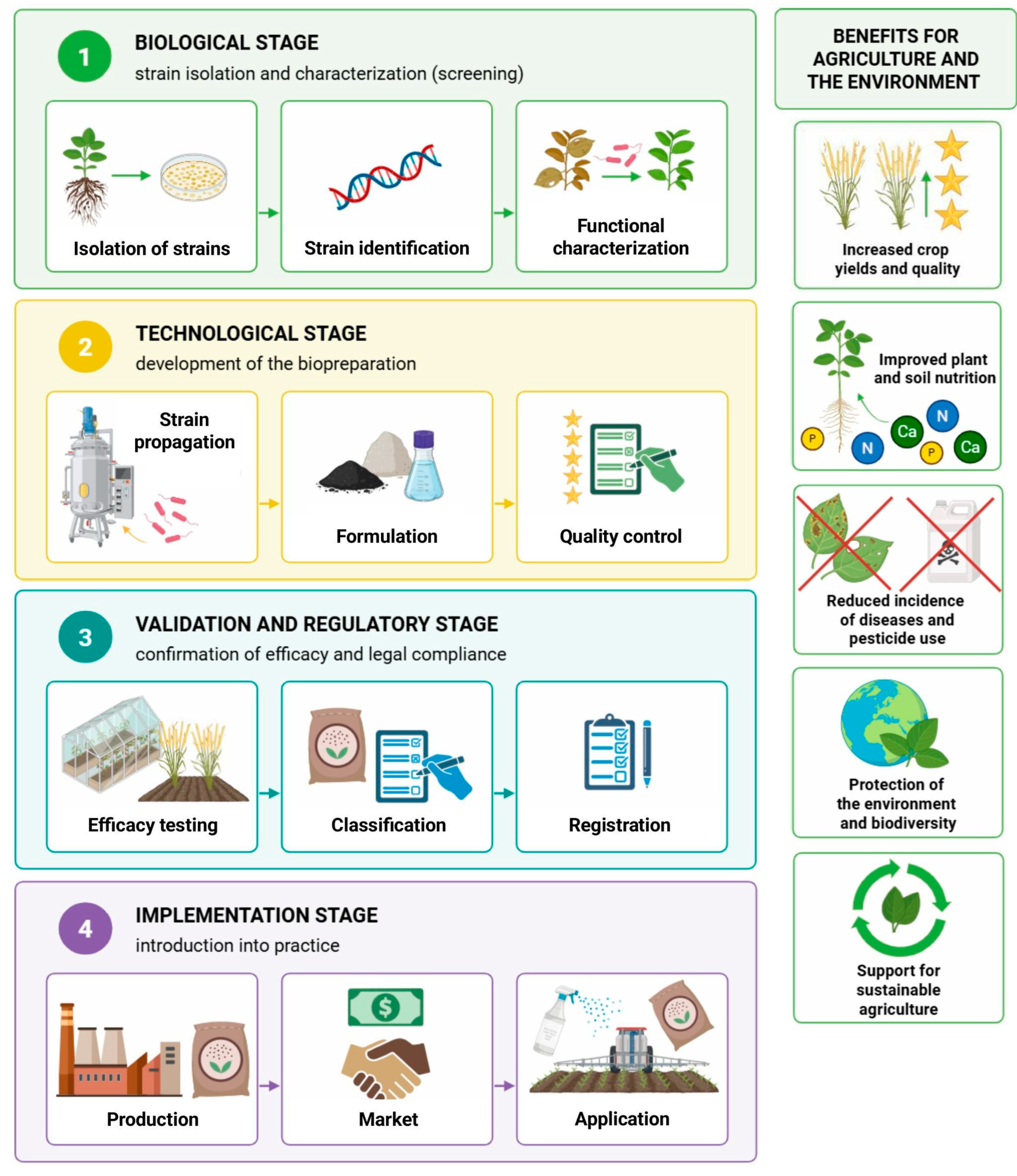
Figure 2.
Classification of microbiological bioproducts based on agent, function, and method of application.
Figure 2.
Classification of microbiological bioproducts based on agent, function, and method of application.
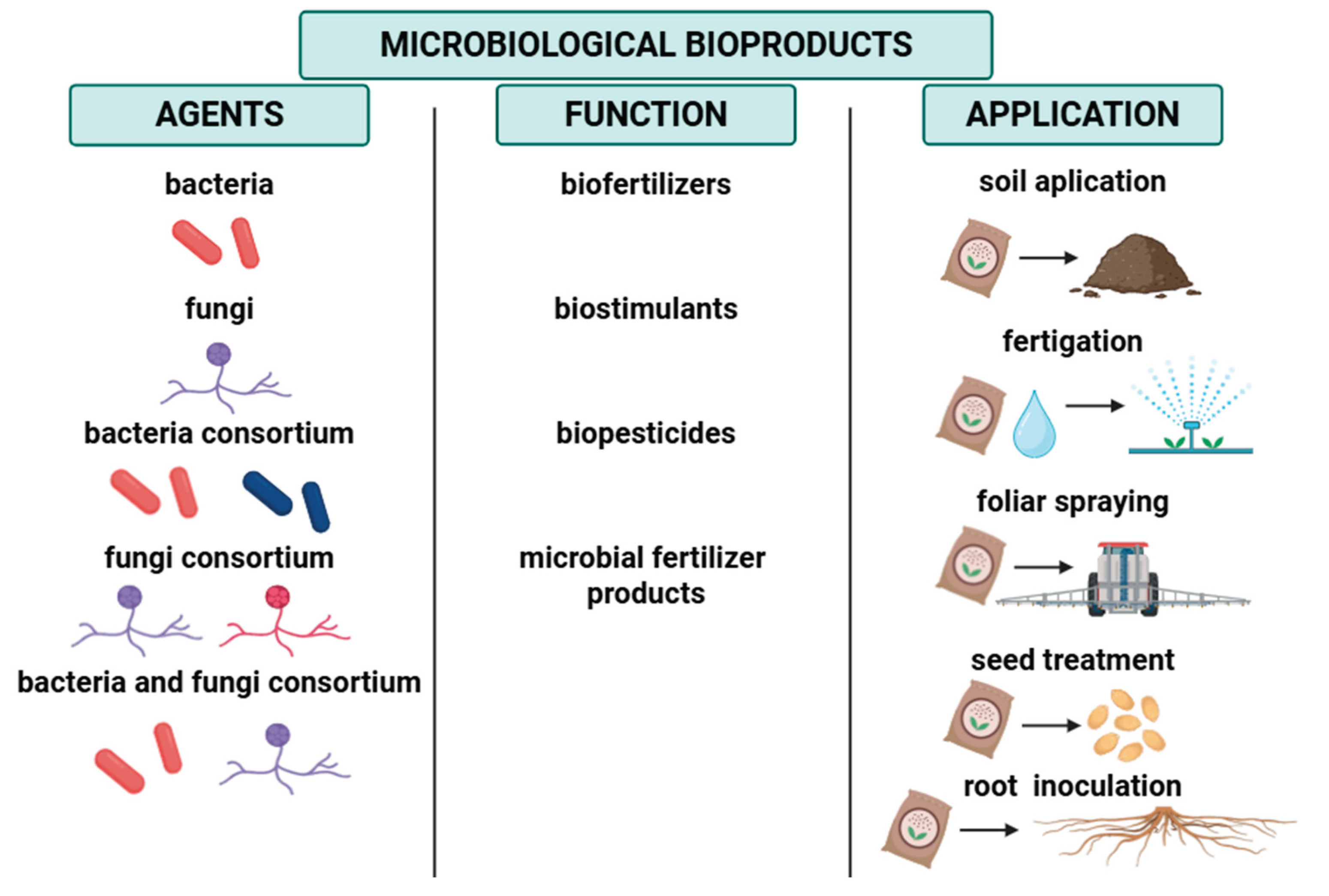

Table 1.
Overview of microorganisms interacting with plants, their mechanisms of action, and their effects.
Table 1.
Overview of microorganisms interacting with plants, their mechanisms of action, and their effects.
| Microorganism | Plant | Mechanism of action | Final effect | Literature |
|---|---|---|---|---|
| Bacillus spp. | wheat | production of secondary metabolites |
reduction in the growth of the pathogen F. graminearum growth by approximately 50%, compared to the control increase in wheat yield from 112% to 142% compared to the national standard (Bulgaria) |
[126] |
| Bacillus spp. | tomato (Maya, Kochero, Melkesalsa varieties) |
production of secondary metabolites | increase in plant growth by 62% (Melkesalsa), 65% (Kochero), and 85% (Maya), compared to the control |
[127] |
|
Paenibacillus peoriae Comamonas jiangduensis Bacillus amyloliquefaciens Bacillus methylotrophicus, |
tomato cabbage chickpea |
antagonism | reduction in the impact of the pathogens F. oxysporum, A. solani, and A. brassicicola compared to controls |
[128] |
| Pseudomonas spp. | wheat | phosphorus solubilization |
increase in root lenght by 9.61 cm, compared to the control supporting wheat seedling growth doubling the vigour index |
[129] |
| Pseudomonas chlororaphis | wheat | production of IAA andsiderophores |
increase in the fresh root mass by 0.6 g, fresh shoot mass by 0.54 g, and shoot length by 4.22 cm, compared to the control |
[130] |
| Pseudomonas aeruginosa | tomato | antagonism | reduction in the growth of the pathogen P. infestans by 83.4%, compared to the control increase in shoot and root length by 2.14 cm and 3.31 cm, respectively, compared to the control |
[131] |
| Aspergillus neoniger | fig tree | production of secondary metabolites |
reduction in the growth of the pathogens P. avelaneum, P. notatum, and A. terreus by 80%, compared to the control |
[132] |
| Aspergillus niger | lettuce watermelon melon tomato kale bell pepper |
production of IAA and phytohormones |
increase in the fresh mass of shoot by 38%(watermelon), 16% (melon), 92% (bell pepper), 42% (tomato), 61% (lettuce), 40% (kale), compared to the control |
[133] |
| Aspergillus spp. | bell pepper | antagonism | reduction in plant infection by the pathogen F. oxysporum by 58-83%, compared to the control |
[134] |
| Trichoderma spp. | arabidopsis | antagonism | reduction in the growth of the pathogen B. cinerea by 96%-98%, P. digitatum by 76%, and A. alternata by 51%-96%, compared to the control |
[135] |
|
Trichoderma viride Trichoderma harzianum |
tomato | mycoparasitism | reduction in the growth of the pathogen F. solani by 78% (inoculated with T. harzianum) and 61.2% (inoculated with T. viride), compared to the control |
[136] |
|
Trichoderma longibrachiatum Trichoderma asperellum Trichoderma atroviridei |
soybean | production of hydrolytic enzymes, siderophores, and IAA |
reduction in seed infection by the pathogen R. solani by 64% (inoculated with T. asperellum), 60% (inoculated with T. atroviridei), and 55% (inoculated with T. longibrachiatum), compared to the control |
[132] |
| Penicillium citrinum | choy sum | phosphorus solubilization |
increase in the fresh and dry mass of shoot by 35% and root by 71.4%, compared to the control |
[85] |
| Glomus mosseae | melisa | antagonism strengthening the antioxidant system |
increase in shoot and root length by 58% and 53%, respectively, compared to the control reduction in plant infection by the pathogen F. culmorum in the root system and leaves by 46%, compared to the control |
[137] |
| Beauveria bassiana | tomato | production of siderophores phosphorus solubilization |
increase in the growth of plant by 21%, compared to the control |
[138] |
Disclaimer/Publisher’s Note: The statements, opinions and data contained in all publications are solely those of the individual author(s) and contributor(s) and not of MDPI and/or the editor(s). MDPI and/or the editor(s) disclaim responsibility for any injury to people or property resulting from any ideas, methods, instructions or products referred to in the content. |
© 2026 by the authors. Licensee MDPI, Basel, Switzerland. This article is an open access article distributed under the terms and conditions of the Creative Commons Attribution (CC BY) license (http://creativecommons.org/licenses/by/4.0/).
Copyright: This open access article is published under a Creative Commons CC BY 4.0 license, which permit the free download, distribution, and reuse, provided that the author and preprint are cited in any reuse.