

Submitted:
20 July 2026
Posted:
22 July 2026
You are already at the latest version
Abstract
The origin of creation and the emergence of subjective experience remain among the deepest unsolved questions in science. We propose a unified hypothesis in which 'creation' is any entity or process with a beginning and an end in space and time. This premise implies the existence of a universal ground state as the source which is all-pervading, eternal, uniform and memoryless. All observable phenomena arise as cyclical fluctuations within this ground state, which simultaneously serves as a stable universal reference (ground zero) enabling the detection of change. We redefine consciousness as a measurement problem enabled by this universal ground zero reference, with subjective experience originating from the resonance and energy redistribution between perceived signals and stored memory cycles. This re-frames the hard problem of consciousness by grounding perception in a universal substrate present at every point in the universe. The apparent differences in awareness between different points in space is arising from their state of evolution with variation in memory capacity and responsiveness.
Keywords:
consciousness as a measurement problem
; theory of consciousness
; creation
; universal ground state
1. Introduction
Explaining how physical matter gives rise to subjective experience is widely regarded as one of science’s hardest problems[1]. Modern physics offers precise descriptions across atomic to cosmic scales, yet the question of why certain neurobiological processes are accompanied by phenomenal awareness remains unresolved. The dominant view in neuroscience holds that consciousness emerges from the complex integration of neural activity, without any individual component itself being conscious.
Here we propose an alternative perspective. We suggest that neurobiological processes primarily support memory formation and context-appropriate responses, while the capacity to perceive change, which we designate as the core of consciousness, requires a universal reference state whose existence is tied to the nature of creation itself. By combining a minimal assumption about creation with a perception-centric definition of consciousness, we develop a parsimonious model of the mind that bridges cosmology, physics and cognitive science. This hypothesis does not replace existing neuroscientific frameworks but offers a complementary foundation that may help address explanatory gaps.
2. Creation: Stable Fluctuations in a Universal Ground State
We begin with one foundational assumption: creation refers to any entity or process that possesses a definite beginning and end in space and time. From this, several properties of both creation and its source follow logically. If creation is bounded, its source must lie beyond such boundaries and therefore cannot itself have a beginning or end; it must be all-pervading and everlasting. Any fluctuation or variation already belongs to creation, implying that the source is perfectly uniform and constant. Such a source would lack intrinsic distinctions of space or time, rendering scale irrelevant, and would be memoryless. We term this source the universal ground state.
For illustration, the universal ground state can be depicted as an empty domain (Figure 1a). The appearance of any ‘speck’ constitutes creation (Figure 1b) and must be a fluctuation in the fabric of the ground state (Figure 1c). For fluctuations to persist, they must be cyclical. We can call the source of these cyclical fluctuations to be energy. This way, each fluctuation becomes a store house of energy. Thus, matter and waves can be described as cyclical fluctuations embedded in the universal ground state. These fluctuations break the uniformity of the ground state and hence creates an impression of space, while their periodicity gives rise to time. Because even a minimal fluctuation encodes information, the entirety of creation can be viewed as a vast, dynamic memory of the universe’s state, imprinted upon the universal ground state.
3. Consciousness: Perception Enabled by a Universal Reference
A central puzzle in physics and neuroscience is how matter becomes self-aware. Consciousness is commonly linked to wakefulness and responsiveness and is widely attributed to complex neural dynamics. Recent advances in artificial neural networks have reinforced this association, yet the precise basis of subjective experience remains elusive.
The essential prerequisite for all phenomena attributed to consciousness is the ability to perceive. What is perceived can then be encoded as memory, enabling adaptive responses. Memory and response mechanisms can, in principle, be engineered independently. Therefore, we propose to redefine consciousness as the capacity to perceive which simplifies modeling and re-frames the question from why are we conscious to why do we perceive.
Perception is fundamentally a measurement: the quantification of fluctuation relative to a reference (zero) point. Consistent measurement across isolated systems or distant regions of the universe requires a stable, universal common ground (Figure 2). From our previous description of creation, the universal ground state provides exactly this reference. A shifting or non-universal reference would prevent communication, cognition, and the formation of stable structures from molecules to galaxies. We therefore suggest that the universal ground state is the fundamental enabler of perception, making consciousness an intrinsic characteristic of the ground state itself.
Consequently, every point in the universe is potentially capable of perception. Differences between systems (for example, between cells and brains) arise not from the presence or absence of consciousness, but from variations in evolved memory capacity and responsiveness. This view is compatible with emerging evidence of distributed cognitive capacities in non-neural biological systems[2,3].
Now, how does perception lead to subjective experience? Every perception is associated with a transfer of energy from the object (or event) to the observer(Figure 2). It is this energy redistribution that gives rise to subjective experience. While the cyclical fluctuations at the atomic scale are very stable, this energy redistribution is often captured by higher-order physiological cycles. In the case of human beings, when an energy redistribution find correlation with past experiences stored in memory, they can trigger additional sequences of energy-redistribution cycles, leading to complex emotions and rich subjective experiences. Thus every energy-driven fluctuation is, at the most elementary level, both perception and the formation of memory.
4. Model for the Mind
Everything in the existence according to our hypothesis can be represented as a combination of universal ground state (consciousness) and memory. Hence, we should be able to create a model for the mind using the same basic components. Below we describe a hypothetical model for the mind as a dynamic interaction between memory and consciousness.
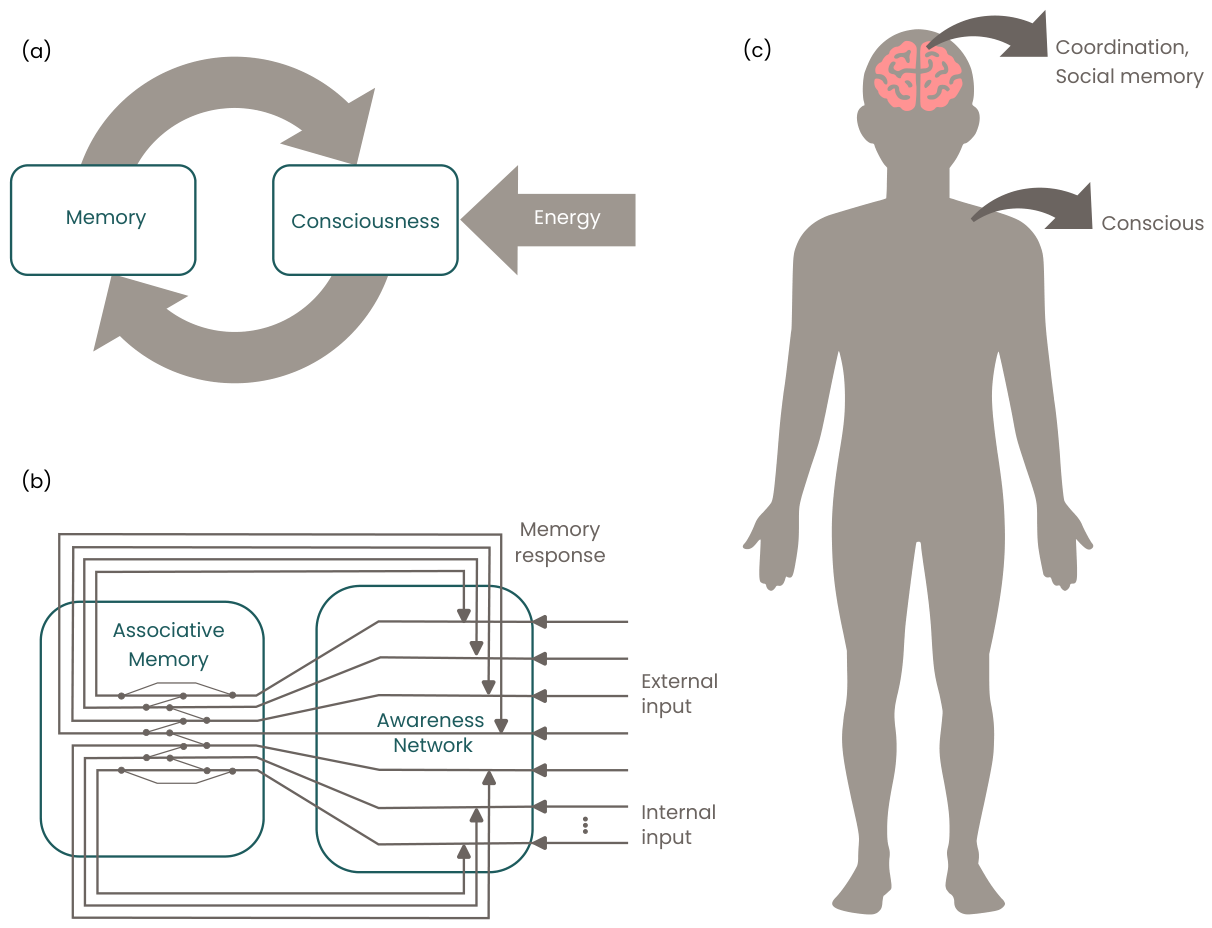
The mind enables perception, retention and response. These operations can be captured using a simple architecture involving consciousness and memory in mutual feedback (Figure 3a). Consciousness registers current input as energy patterns. Resonant or matching memory traces are activated, along with correlated associations, generating a sense of recognition. Iterative feedback between consciousness and memory refines successive patterns, progressively aligning internal representations with external reality. Subjective thought corresponds to the sequential activation and modulation of memory patterns within this loop.
The memory-consciousness cycle is not a single isolated loop confined to the brain. At a higher functional level, it comprises an interconnected ensemble of numerous loops (Figure 3b), some processing external and others internal signals via an awareness network. These loops operate across multiple scales: some may function at the atomic or molecular level, while others operate at the level of cells, tissues, or entire organ systems. The loops interact through correlations, yielding an inherently associative memory. A substantial portion of this memory is genetically encoded and executes fixed cyclical patterns supporting basic physiology. Another portion has evolved high plasticity, manifesting as the brain and central nervous system.
According to this framework, every point in the body is capable of perception and is therefore conscious. The strong association of consciousness with brain activity likely stems from the high programmability of neural memory, which supports flexible coordination and social behaviour. Most bodily processes rely on more automatic, pre-programmed memory. Each cell perceives and responds to its local environment, indicating distributed consciousness with varying capacities for recording and flexible response. Clinical assessments, which emphasise observable behaviour coordinated by the brain, may thus capture only the most salient expressions of a broader phenomenon (Figure 3c).
5. Discussion
This hypothesis offers a unified conceptual scaffold linking the nature of creation to the basis of perception and mind. By anchoring perception in a universal ground state that serves as a stable reference, the model reframes the problem of consciousness: subjective experience is no longer an inexplicable emergent feature of certain neural processes but arises because the same ground state that underlies all creation enables the detection of change at every point in the universe. Differences in apparent consciousness then reduce to variations in memory and responsiveness shaped by evolution.
The feedback model of the mind is broadly compatible with leading neuroscientific accounts. It shares features with the global neuronal workspace hypothesis (iterative integration and broadcasting of information that leads to a coherent, globally available representation)[4] and integrated information theory (dynamic interactions among multiple loops that generate a unified, coherent experience)[5], while locating the enabling reference beyond purely neural mechanisms. It also aligns with observations of basal cognition and bioelectric signalling in non-neural systems, where cells exhibit perception-like and decision-making capacities[6,7].
Recent theoretical work exploring zero-point field (ZPF) fluctuations or vacuum states as substrates for conscious processes provides an intriguing point of contact[8], although our formulation remains classical at its foundation and open to quantum elaboration. The model accounts for the uniformity of physical laws across the cosmos through a shared reference and suggests that clinical and behavioural measures of consciousness capture only the most flexible, socially relevant expressions of a more distributed phenomenon.
Limitations and open questions remain. The framework rests on the assumption that creation is bounded; alternative cosmologies (such as eternal inflation or cyclic models) may necessitate refinement. The biophysical mechanisms linking ground-state fluctuations to stable biological memory, and the scaling from genetic cycles to programmable neural architectures, require detailed theoretical and experimental development. The hypothesis does not yet yield specific quantitative predictions that resolve the quantum measurement problem.
In summary, this perspective proposes that consciousness, understood as perception, is not a late-emerging byproduct of complex matter but an intrinsic feature enabled by the universal ground state that underlies creation itself. Presented as a hypothesis intended to stimulate interdisciplinary dialogue, the framework bridges cosmology, physics, neuroscience and philosophy of mind while remaining open to empirical refinement.
References
- D. J. Chalmers, “Facing up to the problem of consciousness,” Journal of Consciousness Studies, vol. 2, no. 3, pp. 200–19, 1995.
- F. Baluška and M. Levin, “On having no head: Cognition throughout biological systems,” Frontiers in Psychology, vol. Volume 7 - 2016, 2016. [Online]. Available: https://www.frontiersin.org/journals/psychology/articles/10.3389/fpsyg.2016.00902.
- P. Lyon and K. Cheng, “Basal cognition: shifting the center of gravity (again),” Animal Cognition, pp. 1743–1750, 2023.
- G. A. Mashour, P. Roelfsema, J.-P. Changeux, and S. Dehaene, “Conscious processing and the global neuronal workspace hypothesis,” Neuron, vol. 105, p. 776–798, 2020. [Online]. Available: . [CrossRef]
- G. Tononi and C. Koch, “Consciousness: here, there and everywhere?” Philosophical Transactions of the Royal Society B: Biological Sciences, vol. 370, no. 1668, p. 20140167, 05 2015. [Online]. Available: . [CrossRef]
- G. Seifert, A. Sealander, S. Marzen, and M. Levin, “From reinforcement learning to agency: Frameworks for understanding basal cognition,” Biosystems, Jan 2024.
- M. Levin, “Bioelectric networks: the cognitive glue enabling evolutionary scaling from physiology to mind,” Animal Cognition, vol. 26, 2023. [Online]. Available: . [CrossRef]
- J. Keppler, “Macroscopic quantum effects in the brain: new insights into the fundamental principle underlying conscious processes,” Frontiers in Human Neuroscience, vol. Volume 19 - 2025, 2025. [Online]. Available: https://www.frontiersin.org/journals/human-neuroscience/articles/10.3389/fnhum.2025.1676585.
Figure 1.
(a) An empty box to represent the state prior to creation, universal ground state, which is devoid of anything. (b) A speck in the box to indicate the presence of something, a creation. (c) Since the speck could not have come from anywhere else, it should be a fluctuation in the underlying ground state.
Figure 1.
(a) An empty box to represent the state prior to creation, universal ground state, which is devoid of anything. (b) A speck in the box to indicate the presence of something, a creation. (c) Since the speck could not have come from anywhere else, it should be a fluctuation in the underlying ground state.
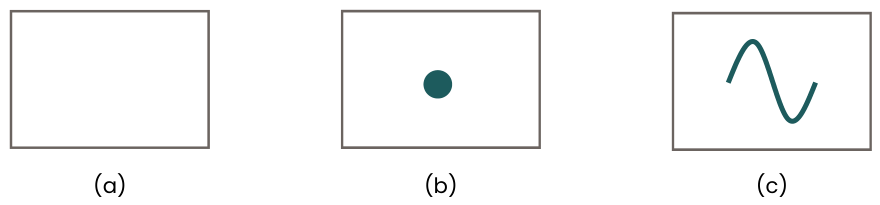
Figure 2.
An abstract illustration of universal ground state serving as a reference level (gray line) across an object, observer and the intermediate energy transmission. Presence of a common reference enables reliable detection of deviations and hence perception becomes possible.
Figure 2.
An abstract illustration of universal ground state serving as a reference level (gray line) across an object, observer and the intermediate energy transmission. Presence of a common reference enables reliable detection of deviations and hence perception becomes possible.
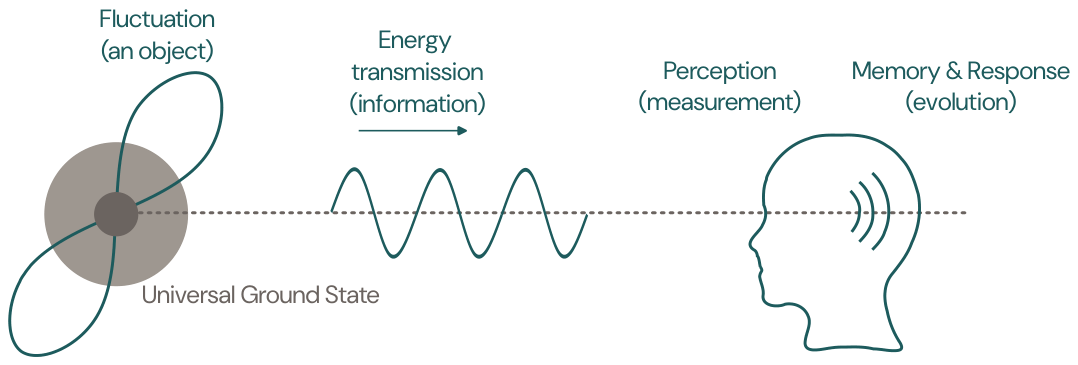
Figure 3.
(a) Mind modeled as a feedback loop between memory and consciousness (b) A slightly more detailed picture of the model of mind. Each memory awareness loop supports a physical or cognitive function. (c) An illustration of the whole body being capable of consciousness, but the coordination and social memory primarily residing in the brain. This causes the consciousness to be often associated with brain activity.
Figure 3.
(a) Mind modeled as a feedback loop between memory and consciousness (b) A slightly more detailed picture of the model of mind. Each memory awareness loop supports a physical or cognitive function. (c) An illustration of the whole body being capable of consciousness, but the coordination and social memory primarily residing in the brain. This causes the consciousness to be often associated with brain activity.
Disclaimer/Publisher’s Note: The statements, opinions and data contained in all publications are solely those of the individual author(s) and contributor(s) and not of MDPI and/or the editor(s). MDPI and/or the editor(s) disclaim responsibility for any injury to people or property resulting from any ideas, methods, instructions or products referred to in the content. |
© 2026 by the authors. Licensee MDPI, Basel, Switzerland. This article is an open access article distributed under the terms and conditions of the Creative Commons Attribution (CC BY) license (http://creativecommons.org/licenses/by/4.0/).
Copyright: This open access article is published under a Creative Commons CC BY 4.0 license, which permit the free download, distribution, and reuse, provided that the author and preprint are cited in any reuse.