
Submitted:
21 July 2026
Posted:
22 July 2026
You are already at the latest version
Abstract
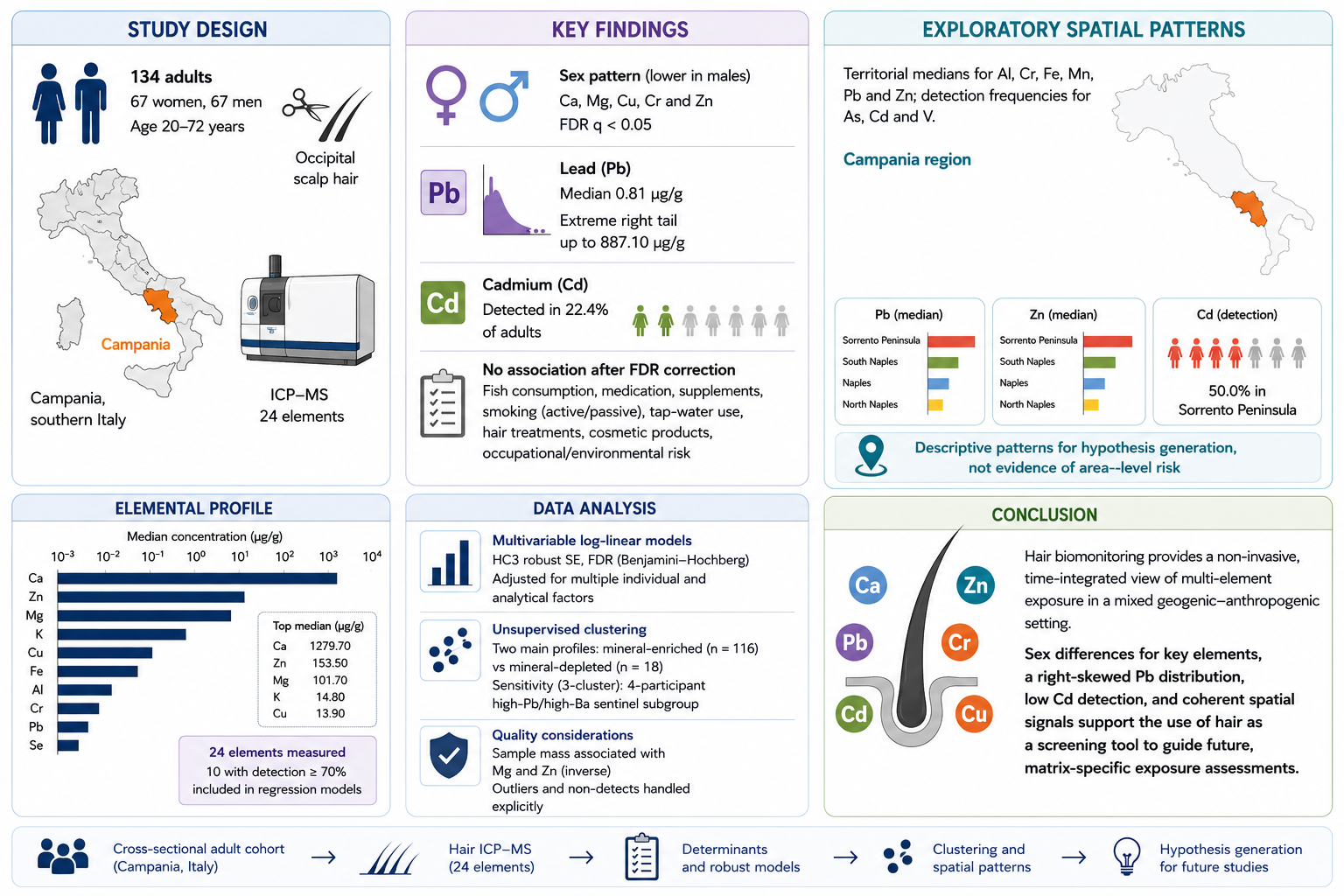
Inductively coupled plasma mass spectrometry (ICP–MS) was used to measure 24 elements in occipital scalp hair from 134 adults living in Campania, southern Italy (67 women, 67 men; age range 20–72 yr). Continuous models were restricted to the ten elements detected in at least 70% of adults: Al, Ba, Ca, Cr, Cu, K, Mg, Pb, Se and Zn. Multivariable log-linear models with HC3-robust standard errors adjusted for sex, age, fish consumption, medication and supplement use, current and passive smoking, hair treatments, cosmetic product use, tap-water use, occupational/environmental risk and sample mass, with multiple testing controlled by Benjamini–Hochberg false discovery rate (FDR) correction. Ca (median 1279.7g/g), Zn ( 153.5g/g), Mg ( 101.7g/g), K ( 14.8g/g) and Cu ( 13.9g/g) dominated the elemental profile. Pb had a median of 0.81g/g but an extreme right tail reaching 887.1g/g; Cd was detected in only 22.4% of adults, with a population median of zero. The most reproducible pattern was lower hair concentrations in males for Ca (Δ=−61.6%, q<0.001), Mg (Δ=−52.2%, q<0.001), Cu (Δ=−37.7%, q=0.003), Cr (Δ=−33.0%, q=0.011) and Zn (Δ=−23.9%, q=0.011). Sample mass remained inversely associated with Mg and Zn, indicating a potential analytical or censoring-related effect requiring quality-control attention. No fish, medication, supplement, smoking, tap-water or environmental-risk predictor survived FDR correction. An exploratory territorial display used medians for Al, Cr, Fe, Mn, Pb and Zn, and detection frequencies for the low-detection elements As, Cd and V, to visualize potential sentinel patterns. Exploratory unsupervised clustering separated a large mineral-enriched profile from a smaller mineral-depleted profile and, in a three-cluster sensitivity analysis, isolated a four-participant high-Pb/high-Ba sentinel subgroup; however, residual clustering after adjustment for sex, age, hair-care variables and sample mass was weak. These findings support hair biomonitoring as a screening tool in mixed-exposure regions and align with recent European calls for harmonised human biomonitoring, provided that sex, robust territorial aggregation, sample mass, non-detects, outliers and external contamination are handled explicitly.
Keywords:
hair biomonitoring
; trace elements
; ICP-MS
; lead
; cadmium
; chromium
; Campania
; human biomonitoring
; scalp hair
; toxic metals
; environmental exposure
1. Introduction
Metals and metalloids remain among the most persistent environmental stressors because they can be redistributed across air, soil, water and food chains, and may exert toxicity at low chronic doses depending on chemical form, target organ and life stage. Evidence linking Pb, Cd, As and other elements to neurodevelopmental, renal, cardiovascular and carcinogenic outcomes is well established [1,2,3,4]. At the same time, several elements measured in multi-element panels, including Cu, Zn, Se, Mg and Ca, are essential nutrients whose interpretation differs fundamentally from that of non-essential toxicants. This dual toxicological and nutritional character is one reason why multi-element biomonitoring studies should avoid a simple “high equals harmful” reading and should instead focus on distributions, determinants, analytical robustness and follow-up hypotheses.
Contemporary human biomonitoring has moved from single-substance surveillance toward harmonised, multi-chemical frameworks that integrate exposure assessment, quality assurance and policy interpretation. The European Human Biomonitoring Initiative (HBM4EU) explicitly aimed to harmonise sampling, analytical performance and interpretation across countries, and derived guidance values for selected substances where robust toxicological and epidemiological evidence exists [5,6,7,8]. These developments are important for the present work for two reasons. First, they highlight the need for transparent pre-analytical and analytical procedures when comparing biomonitoring results across studies. Second, they show that not every biological matrix or every element has an accepted health-based interpretation. For many metals, blood or urine remain the preferred matrices for quantitative exposure assessment, whereas hair is better viewed as a complementary, time-integrated and hypothesis-generating biospecimen [4,9].
Campania (see Figure 1) is a useful setting for human biomonitoring because geogenic and anthropogenic drivers coexist. Volcanic bedrock, dense traffic, industrial activities and historical illegal dumping in parts of Naples and Caserta create a mixed-exposure landscape where environmental measurements alone do not necessarily reflect internal burden [10,11,12,13]. The “Land of Fires” debate has also shown how difficult it is to translate environmental contamination into individual exposure without well-designed biomonitoring and exposure reconstruction [14]. In this context, hair analysis can complement soil geochemistry, atmospheric dispersion modelling and air-quality post-processing by integrating multiple exposure pathways at the individual level [15,16,17,18].
Scalp hair is attractive because collection is non-invasive, storage is simple, and many elements occur at higher concentrations than in blood or urine [9,19,20,21]. The proximal segment can provide a short retrospective window, which is useful when repeated blood or urine collection is not feasible. However, interpretation is difficult. External contamination from dust, traffic particles, water and cosmetic products can persist despite washing; incorporation into the follicle varies with sex, melanin, nutritional status and metabolic factors; and published reference intervals differ widely across washing protocols, digestion procedures, instrumentation and cohort composition [20,22,23,24]. Recent work using spatially resolved laser-ablation ICP–MS reinforces that external contamination is one of the central unresolved challenges for elemental hair analysis, while studies of washing procedures show that pre-cleaning can alter results without fully solving the contamination problem [21,24,25,26]. For these reasons, hair concentrations should be treated as biomarkers of elemental burden and potential contamination, not as direct dose estimates.
The present analysis uses the verified source dataset but restricts all reporting to adults aged 20 yr or older. Participants younger than 20 yr were excluded because the study was not designed as a paediatric biomonitoring protocol and because adult-only reporting provides a cleaner biological and ethical frame. The objectives were to: (i) describe detection frequencies and distributions for 24 hair elements in Campanian adults; (ii) test whether questionnaire variables—sex, age, fish consumption, medication, supplements, smoking, passive smoke, hair treatments, cosmetic products, tap-water use and occupational/environmental risk—are associated with concentrations after multivariable adjustment; (iii) evaluate the influence of outliers and sample mass; (iv) provide an exploratory territorial visualization for selected toxicologically relevant and sentinel elements using robust spatial summaries; and (v) contextualise the adult Campanian medians against published Italian studies [27,28,29]. Reporting follows STROBE recommendations for cross-sectional observational studies [30].
2. Materials and Methods
2.1. Study Design and Population
We conducted a cross-sectional biomonitoring study in residents of Campania. The original dataset included 148 participants; 14 individuals younger than 20 yr were excluded before analysis. The final analytic cohort therefore comprised 134 adults aged 20–72 yr, balanced by sex (67 women and 67 men). All participants provided written informed consent before sample collection.

Table 1.
Participant characteristics in the adult analytic cohort (). Percentages use 134 as denominator unless otherwise indicated.
Table 1.
Participant characteristics in the adult analytic cohort (). Percentages use 134 as denominator unless otherwise indicated.
| Characteristic | n / value | % |
|---|---|---|
| Participants, n | 134 | 100.0 |
| Female sex | 67 | 50.0 |
| Male sex | 67 | 50.0 |
| Age, mean (range), yr | 35.2 (20–72) | |
| Current smoker | 40 | 29.9 |
| Passive smoke exposure | 54 | 40.3 |
| Hair treatments | 31 | 23.1 |
| Cosmetic product use | 27 | 20.1 |
| Tap-water use | 65 | 48.5 |
| Medication use | 37 | 27.6 |
| Supplement use | 57 | 42.5 |
| Occupational/environmental risk | 53 | 39.6 |
| Fish consumption: /week | 34 | 25.4 |
| Fish consumption: 1–3/week | 84 | 62.7 |
| Fish consumption: /week | 13 | 9.7 |
2.2. Hair Sampling and Preparation
Occipital scalp hair was collected with stainless-steel scissors by cutting the proximal 3–4 cm segment at the root end. The samples were washed with 20 ml of solvent according to the sequence acetone → water → water → acetone under ultrasonic agitation for 20 min each, then dried at 40 °C for 24 h before weighing. After drying, approximately 150 mg of hair was weighed from each sample. The mineralization process involved the addition of 3 ml of nitric acid for a 24 hour, followed by the addition of 0.5 ml of hydrogen peroxide for an additional 24 hours. The final solutions were diluted with ultrapure water to a volume of 25 ml and further filtred with 0.2 filter to eliminate any solid residues formed during the chemical extraction that could interfere with the analytical instrument. This protocol was intended to reduce external contamination while preserving comparability with prior hair-biomonitoring studies [19,20,31].
2.3. Analytical Determination and Quality Assurance
Concentrations of Ag, Al, As, B, Ba, Be, Bi, Ca, Cd, Co, Cr, Cu, Fe, K, Mg, Mn, Mo, Ni, Pb, Se, Tl, U, V and Zn were quantified by ICP–MS using multi-element internal standards to correct instrumental drift and matrix effects. Concentrations were expressed as dry weight. Quality assurance included procedural blanks and replicate digestion of a subset of samples, together with post-analytical screening of the most extreme observations. The dataset used for statistical analysis contains final hair concentrations and questionnaire variables; batch-level instrumental settings, element-specific calibration parameters, LOD/LOQ estimates, recovery values and replicate relative standard deviations should be retained with the laboratory record and made available during peer review if requested. Extreme values for Pb, Cd, Se and Ag were flagged for confirmatory audit of sample identity, batch records, blanks, recovery and possible exogenous contamination. Because matrix-matched hair reference materials and standardized hair methods remain active analytical challenges [32,33], the interpretation below emphasizes distributional patterns, sensitivity analyses and follow-up needs rather than direct risk quantification.
2.4. Statistical Analysis
Values below the detection limit were set to zero for data management and analysed using an offset-based approach as described below. This pragmatic approach was chosen given the sample size and the primary focus on elements with detection; for larger studies, formal censored-data methods would be preferable (see Section 4.1). Descriptive statistics include detection frequency, median, interquartile range, maximum and geometric mean of positive observations (GM+). Arithmetic means are reported in the Supplementary Material only, because right-skewed distributions make means poor summaries for several elements.
Inferential models were restricted to elements detected in at least 70% of adults. In the adult-only cohort, these were Al, Ba, Ca, Cr, Cu, K, Mg, Pb, Se and Zn. Fe was marginally below the threshold (69.4%) and was not modelled continuously. For each primary element, the outcome was log-transformed after adding an element-specific offset equal to half the minimum positive adult value. Expanded multivariable ordinary least-squares models were fitted with HC3 heteroskedasticity-consistent standard errors. Predictors were male sex, fish consumption (1–3/week and /week, reference /week), current smoking, passive smoke exposure, hair treatments, cosmetic product use, tap-water use, medication use, supplement use, occupational/environmental risk, age and sample mass. The occupational/environmental-risk variable was coded from the questionnaire item asking whether participants perceived their living or working environment as being at risk; it should therefore be interpreted as a broad self-reported screening indicator rather than a measured exposure variable. Effect sizes are reported as percentage changes, . FDR correction used the Benjamini–Hochberg method within each predictor family across the ten primary elements. Global FDR values across all regression coefficients are provided in the Supplementary Material.
Median quantile regression using the same covariate set was performed as a sensitivity analysis. Low-detection elements were analysed using Fisher’s exact tests on detection status for binary predictors. Spearman correlations among primary elements were computed on log-transformed shifted concentrations, with FDR correction across element pairs.
2.4.1. Exploratory Spatial Aggregation
The spatial analysis was designed as a descriptive bridge between individual-level hair biomonitoring and the geography of the study area. Municipalities of residence were grouped into four contiguous macro-areas with broadly comparable territorial features: Naples, North Naples, South Naples and the Sorrento Peninsula. This aggregation reduced visual fragmentation in the maps and allowed the main spatial patterns to be inspected without presenting municipality-level identifiers. Administrative boundaries were obtained from the Italian National Institute of Statistics (ISTAT), and the cartographic workflow was prepared in QGIS version 3.40.14.
The territorial display focused on nine elements selected a priori for interpretability. Pb, Cr, As and Cd were mapped because of their toxicological relevance; Al, Fe, Mn and V were included as possible crustal, particulate or industrial sentinel elements; and Zn was included because it was abundant in hair and belonged to the main mineral profile. Adults living outside the four predefined mapping groups were excluded from this visualization, leaving 109 participants (Naples, n = 32; North Naples, n = 38; South Naples, n = 30; Sorrento Peninsula, n = 9). To limit the influence of extreme observations, zone-level medians were used for Al, Cr, Fe, Mn, Pb and Zn. For As, Cd and V, for which detection was sparse or borderline, the mapped summary was the detection frequency rather than the arithmetic mean.
2.4.2. Exploratory Clustering
Unsupervised clustering was added as an exploratory, phenotype-oriented analysis rather than as source apportionment. The input matrix included the same ten primary elements used for continuous modelling. Concentrations were transformed as , where was half the minimum positive adult value for element e, winsorized at the 1st and 99th percentiles, and robust-standardized by median and interquartile range. Ward hierarchical clustering was selected as the primary method because it is transparent and minimizes within-cluster dispersion in Euclidean space [34]. Candidate solutions with to were compared using average silhouette width [35], minimum cluster size and bootstrap stability based on adjusted Rand indices. Gaussian mixture models with diagonal and full covariance matrices were fitted as a sensitivity analysis and compared using the Bayesian information criterion [36]. To evaluate whether clustering mainly reflected known covariates, a residualized analysis was also performed after regressing each transformed element on sex, age, hair treatments, cosmetic product use and sample mass. Element-level clustering was performed on a distance matrix defined as , where is the Spearman correlation coefficient.
3. Results
3.1. Detection Frequencies and Descriptive Statistics
Table 2 summarises detection frequencies and distributions. Ten elements met the 70% detection criterion: Al, Ba, Ca, Cr, Cu, K, Mg, Pb, Se and Zn. Fe was close to the threshold but remained below it. Ca, Zn, Mg, K and Cu dominated the concentration profile by mass. Pb was characterised by a moderate median but a very long right tail, and Cd was detected in only 22.4% of adults.
3.2. Exploratory Spatial Distribution of Sentinel Elements
Figure 2 summarizes nine selected elements across the four territorial groups. The figure is intended to help readers place the biomonitoring results in a geographic frame, while preserving the main limitation of the analysis: the mapped values are descriptive summaries from a convenience adult cohort and should not be read as estimates of territorial risk.
The most visible pattern concerned the Sorrento Peninsula, where the median Pb concentration was highest (7.88 ), followed by South Naples (1.05 ), Naples (0.86 ) and North Naples (0.77 ). Cr showed a similar but less extreme pattern, with the highest median in the Sorrento Peninsula (1.12 ) and a second-highest value in South Naples (0.86 ). Zn, which represents an abundant mineral element rather than a toxicant, was also highest in the Sorrento Peninsula (204.10 ). For As, Cd and V, the informative signal was detection rather than central concentration: As was rarely detected overall but reached approximately 50% detection in the Sorrento Peninsula; Cd detection also reached 50.0% in that area; and V detection was highest in South Naples (70.8%). These patterns are useful for prioritizing confirmatory sampling, but they do not establish statistically significant area-level differences.
3.3. Expanded Multivariable Regression Models
The strongest and most reproducible adjusted association was sex. Males had lower Ca, Mg, Cu, Cr and Zn after FDR correction (Table 3). These effects remained directionally coherent in median quantile regression (Supplementary Table S3). No fish, medication, supplement, smoking, passive-smoke, tap-water or occupational/environmental-risk predictor survived FDR correction. Sample mass was inversely associated with Mg and Zn in the HC3 models and with several elements in quantile regression; in our opinion, this should be interpreted primarily as a quality-control or censoring-related signal rather than a biological effect.
3.4. Detection-Probability Patterns Among Low-Detection Elements
For elements below the 70% detection threshold, Fisher’s exact tests indicated sex-related differences in detection for Ag, Co, Mn, Ni and V, with higher detection generally among women. Hair treatments were associated with detection of Co, Mn, Ni and V. These results are plausible but should be interpreted cautiously because they may reflect surface contamination from cosmetic products or differential washing efficiency rather than endogenous incorporation.
3.5. Inter-Element Correlations
Spearman correlations among the ten primary elements showed a coherent mineral cluster involving Ca, Mg, Cu and Zn, together with positive associations involving Cr. Pb correlated positively with Ba and several other elements, a pattern compatible with mixed environmental or surface-contamination sources but insufficient for source attribution without isotope or environmental co-sampling data. The full correlation matrix is shown in Table 4.
3.6. Exploratory Clustering
Hierarchical clustering of the ten primary elements supported a simple two-profile description more clearly than a high-dimensional exposure classification. In the raw concentration space, the solution had an average silhouette width of 0.377 and separated 105 adults with generally higher mineral concentrations from 29 adults with lower concentrations across Ca, Mg, Cu, Zn and several trace elements (Supplementary Tables S6 and S7; Supplementary Figure S2). The larger cluster had higher median Ca (1410.0 versus 640.3 ), Mg (117.5 versus 41.5 ), Cu (16.5 versus 8.8 ) and Zn (161.3 versus 99.4 ). The smaller cluster had a higher proportion of men (65.5% versus 45.7%) and lower median sample mass, but the demographic and questionnaire associations were weak and should be regarded as descriptive.
A three-cluster sensitivity analysis produced a similar silhouette width (0.378) but included a very small four-participant subgroup. This subgroup had low sample mass, high occupational/environmental-risk reporting and markedly higher median Pb and Ba than the other clusters (Supplementary Table S8). Because the subgroup is small and overlaps with the extreme right tail of Pb, it is best interpreted as a sentinel pattern that requires QA and follow-up rather than as an independently validated exposure class. Residual clustering after adjustment for sex, age, hair treatments, cosmetic products and sample mass was less structured: the residual solution had a silhouette width of 0.183 and no strong association with the recorded covariates (Supplementary Table S9). Gaussian mixture models were also unstable across preprocessing choices: BIC preferred a four-component full-covariance model for raw profiles but a one-component full-covariance model for residual profiles (Supplementary Table S10). Overall, clustering confirmed the mineral-rich/mineral-poor structure already suggested by regression and correlation analyses but did not provide robust evidence for discrete environmental source classes.
3.7. Contextual Comparison with Italian Populations
Compared with Palermo schoolchildren and adults from the Domizio Flegreo–Agro Aversano district, Campanian adults in this study showed broadly comparable Pb medians but a notable Cr median ( /) relative to published Italian comparators [27,29]. The comparison with Palermo is useful because it provides a southern Italian, urban, hair-based reference, but it is not a strict benchmark: the cohort was paediatric, the physiological and behavioural determinants of hair composition differ, and analytical protocols were not identical. The Domizio comparator is geographically closer and adult-based, but it represents a specific sub-area with documented soil, groundwater, crop and hair geochemical characterisation, including Pb isotopic information [29]. Because cohorts differ in age, geography, washing protocol and instrumentation, these comparisons are descriptive only. Cd cannot be meaningfully compared by median because most adult values were below detection.
3.8. Element-Specific Interpretation
The essential-element pattern is dominated by Ca, Mg, Zn and Cu. In hair studies these elements often reflect a mixture of nutritional status, hair biology, sex-linked physiology and cosmetic history rather than environmental exposure alone [37,38,39]. The strong Ca–Mg correlation and the consistent male deficit for Ca, Mg, Cu and Zn therefore probably indicate a biological or behavioural structure in the cohort. Possible explanations include sex differences in hair morphology, hair-care practices, diet, endocrine regulation of mineral metabolism and binding affinity to hair proteins or melanin. The present dataset cannot discriminate among these mechanisms, but it shows that sex must be treated as a design variable rather than a nuisance covariate in future Campanian biomonitoring.
For toxic or potentially toxic elements, interpretation is more conservative. Pb is a priority because of its well-established neurotoxicity and cardiovascular relevance, yet hair Pb is not equivalent to blood Pb and cannot be translated into a health-based risk estimate without confirmatory matrices [4,40]. In the present data, the median Pb concentration is moderate whereas the maximum is extreme, suggesting a sentinel pattern more than a population-wide shift. Cd is even clearer: its low detection frequency means that the data do not support a population-level Cd signal, despite one high maximum requiring audit. Cr is analytically and toxicologically more ambiguous because total Cr in hair does not distinguish trivalent and hexavalent species. The elevated Cr median relative to Italian comparators is therefore best presented as a reproducible screening signal that merits targeted source-oriented follow-up, not as evidence of toxic Cr(VI) exposure.
4. Discussion
This adult-only analysis positions the Campanian dataset within three overlapping literatures: environmental health studies of metals, European human biomonitoring harmonisation and methodological work on hair as a biospecimen. The principal scientific conclusion is that sex is the dominant adjusted predictor of several hair elements, particularly Ca, Mg, Cu, Cr and Zn. This pattern is consistent with prior literature reporting sex differences in hair elemental composition and with the known influence of hormonal, nutritional, morphological and cosmetic factors on hair mineral profiles [37,38,39]. Importantly, the finding is not limited to a single element but appears as a coordinated shift in a correlated mineral cluster. This makes random false positivity less likely, although residual confounding by hair care, diet and unmeasured biological factors remains possible.
The absence of robust associations for fish consumption, medication, supplement use, smoking, passive smoke, tap-water use and occupational/environmental risk should be interpreted carefully. It does not prove that these pathways are irrelevant in Campania. Rather, it suggests that the questionnaire variables available here were too broad, too imbalanced or too weakly measured to explain inter-individual variation after FDR correction. For example, fish consumption was collected by frequency category but not by species, source, portion size or local origin; tap-water use did not capture plumbing material or household water chemistry; and occupational/environmental risk was necessarily self-reported. A future source-oriented protocol should therefore replace broad indicators with exposure-specific modules and environmental co-samples.
The Pb distribution warrants special attention. The adult median was modest, but the maximum value exceeded 887 /, making the arithmetic mean misleading. Such an extreme value should not be used to infer population-level Pb burden without confirmatory QA. It may represent a true high-exposure case, a surface-contamination event, an occupational/residential source or an analytical/transcription problem. A targeted audit and, if possible, follow-up in blood, household dust, tap water and residential/occupational history would be appropriate. Because blood Pb is a better-established biomarker of recent internal exposure than hair Pb, any public-health interpretation of the outlier should be based on confirmatory sampling rather than on hair alone [4,40].
Cd was detected in only 22.4% of adults; therefore, the dataset does not support a claim of elevated population-level Cd exposure. This is an important negative result because Cd is a priority substance in European biomonitoring and HBM4EU guidance-value work, especially for renal effects [7,8]. However, urine Cd, not hair Cd, is generally more appropriate for long-term Cd body burden. The current hair data should therefore be used to motivate confirmatory urine-based assessment only if there are independent reasons to suspect Cd exposure.
Cr was detected in most adults and had a median higher than contextual Italian comparators. This signal is potentially important but requires caution because total hair Cr cannot distinguish essential trivalent Cr from other species, and source attribution requires environmental sampling, speciation or source-specific evidence. The result should be framed as a geographically interesting screening signal in a mixed-exposure region rather than as evidence of health risk. If the Cr pattern is prioritised for follow-up, the next step should combine repeated hair analysis with urine or blood biomarkers where appropriate, local environmental sampling, occupational history and analytical checks for ICP–MS interferences.
The inverse sample-mass association for Mg and Zn deserves explicit quality-control discussion. Because concentration is already normalised by hair mass, a residual association with mass may reflect LOD propagation, weighing uncertainty, heterogeneous contamination, batch effects or model instability at low sample weights. It may also indicate that smaller samples have greater relative surface area, poorer homogenisation or greater susceptibility to localized contamination. Future analyses should report element-specific LOD/LOQ, batch effects, replicate RSDs, recovery by element and, ideally, a hair-matrix certified reference material. This point strengthens rather than weakens the manuscript if presented transparently, because it shows that the analysis identified a concrete analytical feature requiring control.
The territorial display adds a practical geographic layer to the individual-level analysis. Its role is not to demonstrate spatial risk gradients, but to show where confirmatory sampling could be most informative. Using medians for concentration summaries and detection frequencies for sparse elements keeps the visualization consistent with the distributional structure of the data and avoids giving undue weight to isolated extreme values.
The clustering analysis adds nuance but does not change the main interpretation. Its strongest signal was a broad mineral-rich versus mineral-poor contrast, which is consistent with the regression finding that sex is a major determinant of Ca, Mg, Cu and Zn. The small high-Pb/high-Ba subgroup identified only in the three-cluster raw solution is potentially useful for targeted QA and source follow-up, but the weak residual clustering argues against presenting the clusters as stable exposure categories. This distinction is important: clustering can help prioritize samples and generate hypotheses, but it cannot separate endogenous incorporation, external deposition, hair-care effects and analytical features without independent environmental or biological validation.
From a public-health perspective, the most defensible message is not that Campanian adults have a demonstrably elevated toxic-metal burden, but that adult hair biomonitoring can identify interpretable population patterns and sentinel individuals in a region where environmental sources are complex. The findings justify targeted follow-up for Pb outliers and Cr, stronger analytical harmonisation, and integration with environmental matrices. They do not justify hazard quotients, lifetime cancer-risk calculations or causal source attribution from hair data alone.
4.1. Limitations
Hair is vulnerable to external contamination and cosmetic effects even after washing. Non-detects were encoded as zero and modelled using an offset approach; censored-data methods such as Tobit regression, regression on order statistics or Kaplan–Meier estimation would be preferable for larger studies near the detection boundary [41]. No blood, urine, toenail, environmental co-samples, Pb isotopes or Cr speciation data were available. The clustering analysis was exploratory, sensitive to preprocessing and outliers, and intentionally interpreted as descriptive profiling rather than causal source apportionment. The questionnaire contained useful screening variables but lacked detailed exposure reconstruction for diet, occupation, residential history, indoor dust, drinking-water plumbing and product use. Finally, because this is a convenience adult cohort rather than a probability sample, it should not be used to derive regional reference intervals.
4.2. Future Directions
A follow-up study should recruit an adult cohort with pre-specified strata by sex, age, municipality and the territorial zones highlighted by the robust exploratory summaries; use a matrix-matched hair reference material; confirm extreme Pb/Cd/Se/Ag values; and pair hair analysis with indoor dust, tap water, diet and environmental samples. Pb follow-up should include blood Pb and isotope/source information where feasible; Cd follow-up should prioritise urine Cd; and Cr follow-up should address analytical interferences and, if possible, speciation or complementary biomarkers. If minors are to be studied, they should be handled in a separate paediatric protocol with guardian consent and formal ethical review or documented exemption.
5. Conclusions
This adult-only cross-sectional study documents 24 hair elements in 134 Campanian residents aged 20–72 yr. The most robust finding is lower Ca, Mg, Cu, Cr and Zn in men after multivariable adjustment and FDR correction. Pb shows a strongly right-skewed distribution requiring individual-level QA and possible follow-up, whereas Cd is mostly non-detected and does not support a population-level elevation claim. No questionnaire predictor related to fish, medication, supplements, smoking, tap-water use or environmental risk survived FDR correction. The territorial visualization highlighted possible follow-up priorities for Pb, Cr, As, Cd and V, particularly where high medians or higher detection frequencies were concentrated, but it did not provide inferential evidence of area-level risk. Exploratory clustering identified broad mineral-profile differences and a small potential Pb/Ba sentinel subgroup, but residual clustering was weak and did not support discrete source classes. Hair biomonitoring is useful as a screening and hypothesis-generating tool in Campania, but source attribution and risk assessment require confirmatory biomarkers and environmental co-sampling. The study is strongest when presented as an adult distributional and determinant analysis rather than as a direct health-risk assessment.
Supplementary Materials
The following supporting information can be downloaded at the website of this paper posted on Preprints.org. Supplementary Tables S1–S10, the territorial-summary table generated for Figure 2, and Supplementary Figures S1–S3.
Author Contributions
Conceptualization, E.C.; methodology, E.C. and R.F.; software, A.R. and S.D.P.; validation, E.C., R.F., S.D.P. and A.R.; formal analysis, A.R.; investigation, E.C., R.F., J.R. and A.R.; resources, A.R.; data curation, R.F., S.D.P., J.R. and E.C.; writing—original draft preparation, A.R.; writing—review and editing, E.C., R.F. and A.R.; visualization, A.R.; supervision, E.C. and A.R. All authors have read and agreed to the published version of the manuscript.
Funding
This research received no external funding.
Institutional Review Board Statement
The study used non-invasive scalp-hair collection, and analysed de-identified adult participant data. According to institutional procedures applicable at the time of sampling, formal ethics committee approval was not required for this type of anonymous, non-invasive environmental biomonitoring activity. All procedures complied with institutional and national requirements applicable at the time of sampling.
Informed Consent Statement
Written informed consent was obtained from all adult subjects involved in the study before hair sample collection and questionnaire completion.
Data Availability Statement
De-identified data supporting the reported results are available from the corresponding author upon reasonable request, subject to privacy restrictions related to age, residence and questionnaire variables. Municipality-level identifiers are not publicly released to reduce re-identification risk in small territorial strata.
Conflicts of Interest
The authors declare no conflict of interest.
References
- International Agency for Research on Cancer. Arsenic, Metals, Fibres and Dusts. In IARC Monographs on the Evaluation of Carcinogenic Risks to Humans; International Agency for Research on Cancer: Lyon, France, 2012; Volume 100. [Google Scholar]
- Tchounwou, P.B.; Yedjou, C.G.; Patlolla, A.K.; Sutton, D.J. Heavy Metal Toxicity and the Environment. In Molecular, Clinical and Environmental Toxicology; Springer: Basel, 2012; Vol. 101, EXS, pp. 133–164. [Google Scholar] [CrossRef] [PubMed]
- Landrigan, P.J.; Fuller, R.; Acosta, N.J.R.; Adeyi, O.; Arnold, R.; Basu, N.; Balde, A.B.; Bertollini, R.; Bose-O’Reilly, S.; Boufford, J.I.; et al. The Lancet Commission on Pollution and Health. The Lancet 2018, 391, 462–512. [Google Scholar] [CrossRef] [PubMed]
- Martinez-Morata, I.; Sobel, M.; Tellez-Plaza, M.; Navas-Acien, A.; Howe, C.G.; Sanchez, T.R. A State-of-the-Science Review on Metal Biomarkers. Curr. Environ. Health Rep. 2023, 10, 215–249. [Google Scholar] [CrossRef] [PubMed]
- Lobo Vicente, J.; Ganzleben, C.; Gasol, R.; Marnane, I.; Gilles, L.; Buekers, J.; Bessems, J.; Colles, A.; Gerofke, A.; David, M.; et al. HBM4EU Results Support the Chemicals’ Strategy for Sustainability and the Zero-Pollution Action Plan. Int. J. Hyg. Environ. Health 2023, 248, 114111. [Google Scholar] [CrossRef] [PubMed]
- Vorkamp, K.; Esteban López, M.; Gilles, L.; Göen, T.; Govarts, E.; Hajeb, P.; Katsonouri, A.; Knudsen, L.E.; Kolossa-Gehring, M.; Lindh, C.; et al. Coordination of Chemical Analyses under the European Human Biomonitoring Initiative (HBM4EU): Concepts, Procedures and Lessons Learnt. Int. J. Hyg. Environ. Health 2023, 251, 114183. [Google Scholar] [CrossRef] [PubMed]
- Apel, P.; Lamkarkach, F.; Lange, R.; Sissoko, F.; David, M.; Rousselle, C.; Schoeters, G.; Kolossa-Gehring, M. Human Biomonitoring Guidance Values (HBM-GVs) for Priority Substances under the HBM4EU Initiative: New Values Derivation for Deltamethrin and Cyfluthrin and Overall Results. Int. J. Hyg. Environ. Health 2023, 248, 114097. [Google Scholar] [CrossRef] [PubMed]
- HBM4EU. Human Biomonitoring Guidance Values: HBM4EU Indicator 2.2. European Human Biomonitoring Initiative. 2022. Available online: https://www.hbm4eu.eu/wp-content/uploads/2022/07/HBM4EU-Indicator-2.2_HBM_guidance_values_def.pdf.
- Esteban, M.; Castano, A. Non-invasive Matrices in Human Biomonitoring: A Review. Environ. Int. 2009, 35, 438–449. [Google Scholar] [CrossRef] [PubMed]
- Senior, K.; Mazza, A. Italian “Triangle of Death” Linked to Waste Crisis. Lancet Oncol. 2004, 5, 525–527. [Google Scholar] [CrossRef] [PubMed]
- Cicchella, D.; De Vivo, B.; Lima, A.; Albanese, S.; Fedele, L. Urban Geochemical Mapping in the Campania Region (Italy). Geochem. Explor. Environ. Anal. 2008, 8, 19–29. [Google Scholar] [CrossRef] [PubMed]
- Cicchella, D.; Giaccio, L.; Lima, A.; Albanese, S.; Cosenza, A.; Civitillo, D.; De Vivo, B. Assessment of the Topsoil Heavy Metals Pollution in the Sarno River Basin, South Italy. Environ. Earth Sci. 2013, 71, 5129–5143. [Google Scholar] [CrossRef]
- Maresca, V.; Postiglione, A.; Siciliano, A.; Dentato, M.; Cianciullo, P.; Forte, I.M.; Iannuzzi, C.A.; Fedeli, R.; Loppi, S.; Sorbo, S.; et al. Biomonitoring of Potentially Toxic Elements at Two Differentially Anthropized Areas of the “Land of Fires” (S Italy). Sci. Total Environ. 2025, 977, 179399. [Google Scholar] [CrossRef] [PubMed]
- Alberti, P. The `Land of Fires’: Epidemiological Research and Public Health Policy during the Waste Crisis in Campania, Italy. Heliyon 2022, 8, e12331. [Google Scholar] [CrossRef] [PubMed]
- Riccio, A.; Barone, G.; Chianese, E.; Giunta, G. A Hierarchical Bayesian Approach to the Spatio-temporal Modeling of Air Quality Data. Atmos. Environ. 2006, 40, 554–566. [Google Scholar] [CrossRef]
- Solazzo, E.; Riccio, A.; Kioutsioukis, I.; Galmarini, S. Pauci ex Tanto Numero: Reduce Redundancy in Multi-model Ensembles. Atmos. Chem. Phys. 2013, 13, 8315–8333. [Google Scholar] [CrossRef]
- Riccio, A.; Ciaramella, A.; Giunta, G.; Galmarini, S.; Solazzo, E.; Potempski, S. On the systematic reduction of data complexity in multimodel atmospheric dispersion ensemble modeling. J. Geophys. Res. Atmos. 2012, 117. [Google Scholar] [CrossRef]
- Chianese, E.; Camastra, F.; Ciaramella, A.; Landi, T.C.; Staiano, A.; Riccio, A. Spatio-temporal Learning in Predicting Ambient Particulate Matter Concentration by Multi-layer Perceptron. Ecol. Inform. 2019, 49, 54–61. [Google Scholar] [CrossRef]
- World Health Organization. Environmental Health Criteria 89: Human Exposure Assessment; World Health Organization: Geneva, Switzerland, 1994; Available online: https://iris.who.int/server/api/core/bitstreams/31fb0c1f-3142-4884-9232-a399203641bc/content.
- Kempson, I.M.; Lombi, E. Hair Analysis as a Biomonitor for Toxicology, Disease and Health Status. Chem. Soc. Rev. 2011, 40, 3915–3940. [Google Scholar] [CrossRef] [PubMed]
- Pozebon, D.; Scheffler, G.L.; Dressler, V.L. Elemental Hair Analysis: A Review of Procedures and Applications. Anal. Chim. Acta 2017, 992, 1–23. [Google Scholar] [CrossRef] [PubMed]
- Bencko, V. Use of Human Hair as a Biomarker in the Assessment of Exposure to Pollutants in Occupational and Environmental Settings. Toxicology 1995, 101, 29–39. [Google Scholar] [CrossRef] [PubMed]
- Goullé, J.P.; Mahieu, L.; Castermant, J.; Neveu, N.; Bonneau, L.; Lainé, G.; Bouige, D.; Lacroix, C. Metal and metalloid multi-elementary ICP-MS validation in whole blood, plasma, urine and hair: Reference values. Forensic Sci. Int. 2005, 153, 39–44. [Google Scholar] [CrossRef]
- Verrey, D.; Durand, S.; Thomas, O.; Lelévrier, V.; Bénech, P.; Le Bizec, B. A New Washing Procedure for Inorganic Element Analysis of Hair. J. Expo. Sci. Environ. Epidemiol. 2019, 29, 706–717. [Google Scholar] [CrossRef] [PubMed]
- David, G.K.; Hunter, A.H.; Moromizato, K.H.; Allen, C.M.; Wheatley, R.; von Hippel, F.A.; Niehaus, A.C.; Wilson, R.S. Pre-cleaning of Hair Is Not Beneficial in LA-ICP-MS Studies of Chronic Metal Exposure. PLoS ONE 2023, 18, e0289635. [Google Scholar] [CrossRef] [PubMed]
- Christensen, J.R.; LaBine, G.O. Microchemistry of Single Hair Strands Below and Above the Scalp: Impacts of External Contamination on Cuticle and Cortex Layers. Biol. Trace Elem. Res. 2024, 202, 3910–3922. [Google Scholar] [CrossRef] [PubMed]
- Dongarrà, G.; Lombardo, M.; Tamburo, E.; Varrica, D.; Cibella, F.; Cuttitta, G. Concentration and Reference Interval of Trace Elements in Human Hair from Students Living in Palermo, Sicily (Italy). Environ. Toxicol. Pharmacol. 2011, 32, 27–34. [Google Scholar] [CrossRef] [PubMed]
- Buononato, E.V.; De Luca, D.; Galeandro, I.C.; Congedo, M.L.; Cavone, D.; Intranuovo, G.; Guastadisegno, C.M.; Corrado, V.; Ferri, G.M. Assessment of Environmental and Occupational Exposure to Heavy Metals in Taranto and Other Provinces of Southern Italy by Means of Scalp Hair Analysis. Environ. Monit. Assess. 2016, 188, 337. [Google Scholar] [CrossRef] [PubMed]
- Rezza, C.; Albanese, S.; Ayuso, R.A.; Lima, A.; Sorvari, J.; De Vivo, B. Geochemical and Pb Isotopic Characterization of Soil, Groundwater, Human Hair, and Corn Samples from the Domizio Flegreo and Agro Aversano Area (Campania Region, Italy). J. Geochem. Explor. 2018, 184, 318–332. [Google Scholar] [CrossRef]
- von Elm, E.; Altman, D.G.; Egger, M.; Pocock, S.J.; Gotzsche, P.C.; Vandenbroucke, J.P. The Strengthening the Reporting of Observational Studies in Epidemiology (STROBE) Statement: Guidelines for Reporting Observational Studies. The Lancet 2007, 370, 1453–1457. [Google Scholar] [CrossRef] [PubMed]
- Ryabukin, Y.S. Activation Analysis of Hair as an Indicator of Contamination of Man by Environmental Trace Element Pollutants; Technical report; International Atomic Energy Agency: Vienna, Austria, 1978. [Google Scholar]
- Bonilla, K.; Fox, A.; Phillips, C.; Baudelet, M. Development of a Matrix-Matched Standard for the Elemental Analysis of Human Hair by LA-ICP-MS. J. Anal. At. Spectrom. 2025, 40, 2745–2752. [Google Scholar] [CrossRef]
- Runkel, A.A.; Jagodic Hudobivnik, M.; Zivkovic, I.; Klemencic, P.; Mazej, D.; Horvat, M. Optimisation of A Sample Preparation Method for the Determination of Multi-Elemental Compositions in Human Hair By Triple Quadrupole ICP-MS Analysis. Biol. Trace Elem. Res. 2026, 204, 4348–4362. [Google Scholar] [CrossRef] [PubMed]
- Ward, J.H. Hierarchical Grouping to Optimize an Objective Function. J. Am. Stat. Assoc. 1963, 58, 236–244. [Google Scholar] [CrossRef]
- Rousseeuw, P.J. Silhouettes: A Graphical Aid to the Interpretation and Validation of Cluster Analysis. J. Comput. Appl. Math. 1987, 20, 53–65. [Google Scholar] [CrossRef]
- Fraley, C.; Raftery, A.E. Model-Based Clustering, Discriminant Analysis, and Density Estimation. J. Am. Stat. Assoc. 2002, 97, 611–631. [Google Scholar] [CrossRef]
- Chojnacka, K.; Gorecka, H.; Gorecki, H. The Effect of Age, Sex, Smoking Habit and Hair Color on the Composition of Hair. Environ. Toxicol. Pharmacol. 2006, 22, 52–57. [Google Scholar] [CrossRef] [PubMed]
- Vahter, M.; Akesson, A.; Liden, C.; Ceccatelli, S.; Berglund, M. Gender Differences in the Disposition and Toxicity of Metals. Environ. Res. 2007, 104, 85–95. [Google Scholar] [CrossRef] [PubMed]
- Massadeh, A.; El-Rjoob, A.W.; Smadi, H. Lead, Cadmium, Copper, Zinc, Iron, and Calcium in Human Hair as a Function of Gender, Age, Smoking, and Hair Dyeing. Toxicol. Environ. Chem. 2011, 93, 494–503. [Google Scholar] [CrossRef]
- Barbosa, F.J.; Tanus-Santos, J.E.; Gerlach, R.F.; Parsons, P.J. A Critical Review of Biomarkers Used for Monitoring Human Exposure to Lead: Advantages, Limitations, and Future Needs. Environ. Health Perspect. 2005, 113, 1669–1674. [Google Scholar] [CrossRef] [PubMed]
- Helsel, D.R. Statistics for censored environmental data using Minitab and R; John Wiley & Sons, 2011; Vol. 77. [Google Scholar]
Figure 1.
Map of Italy highlighting the Campania region, located in southern Italy, used as the study area in this work.
Figure 1.
Map of Italy highlighting the Campania region, located in southern Italy, used as the study area in this work.
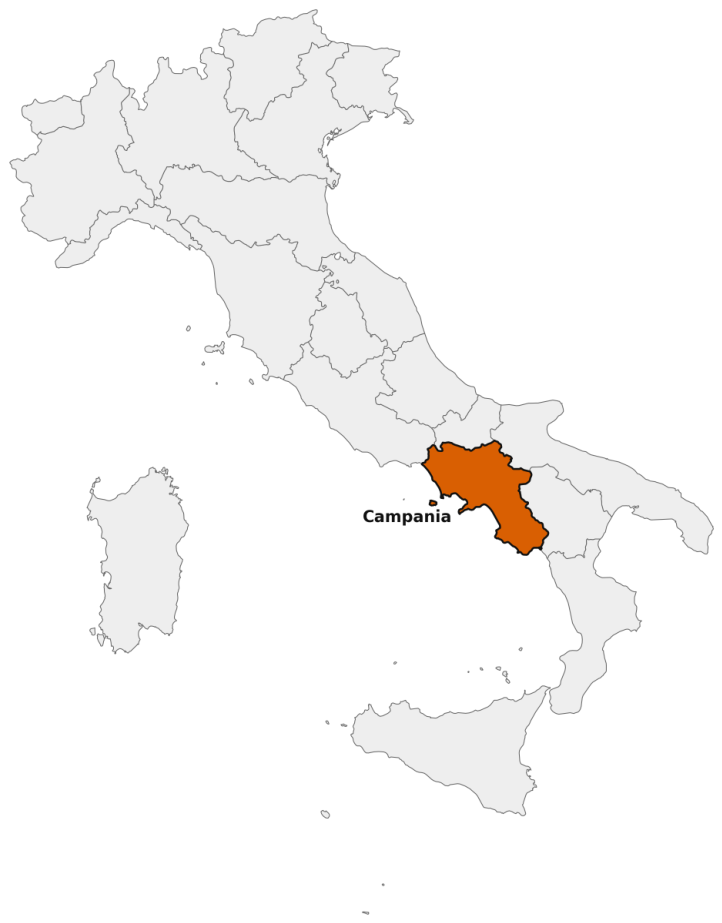
Figure 2.
Exploratory territorial summaries of selected sentinel hair elements in Campania. Values are medians for Al, Cr, Fe, Mn, Pb and Zn, and detection frequencies for As, Cd and V. Adults were assigned by municipality of residence to Naples (n = 32), North Naples (n = 38), South Naples (n = 30) and the Sorrento Peninsula (n = 9); participants outside these predefined mapping groups were excluded from this visualization. The selected elements were chosen for toxicological relevance (As, Cd, Cr and Pb), environmental or particulate sentinel value (Al, Fe, Mn and V), or high abundance and nutritional relevance (Zn). The figure is descriptive and hypothesis-generating only.
Figure 2.
Exploratory territorial summaries of selected sentinel hair elements in Campania. Values are medians for Al, Cr, Fe, Mn, Pb and Zn, and detection frequencies for As, Cd and V. Adults were assigned by municipality of residence to Naples (n = 32), North Naples (n = 38), South Naples (n = 30) and the Sorrento Peninsula (n = 9); participants outside these predefined mapping groups were excluded from this visualization. The selected elements were chosen for toxicological relevance (As, Cd, Cr and Pb), environmental or particulate sentinel value (Al, Fe, Mn and V), or high abundance and nutritional relevance (Zn). The figure is descriptive and hypothesis-generating only.
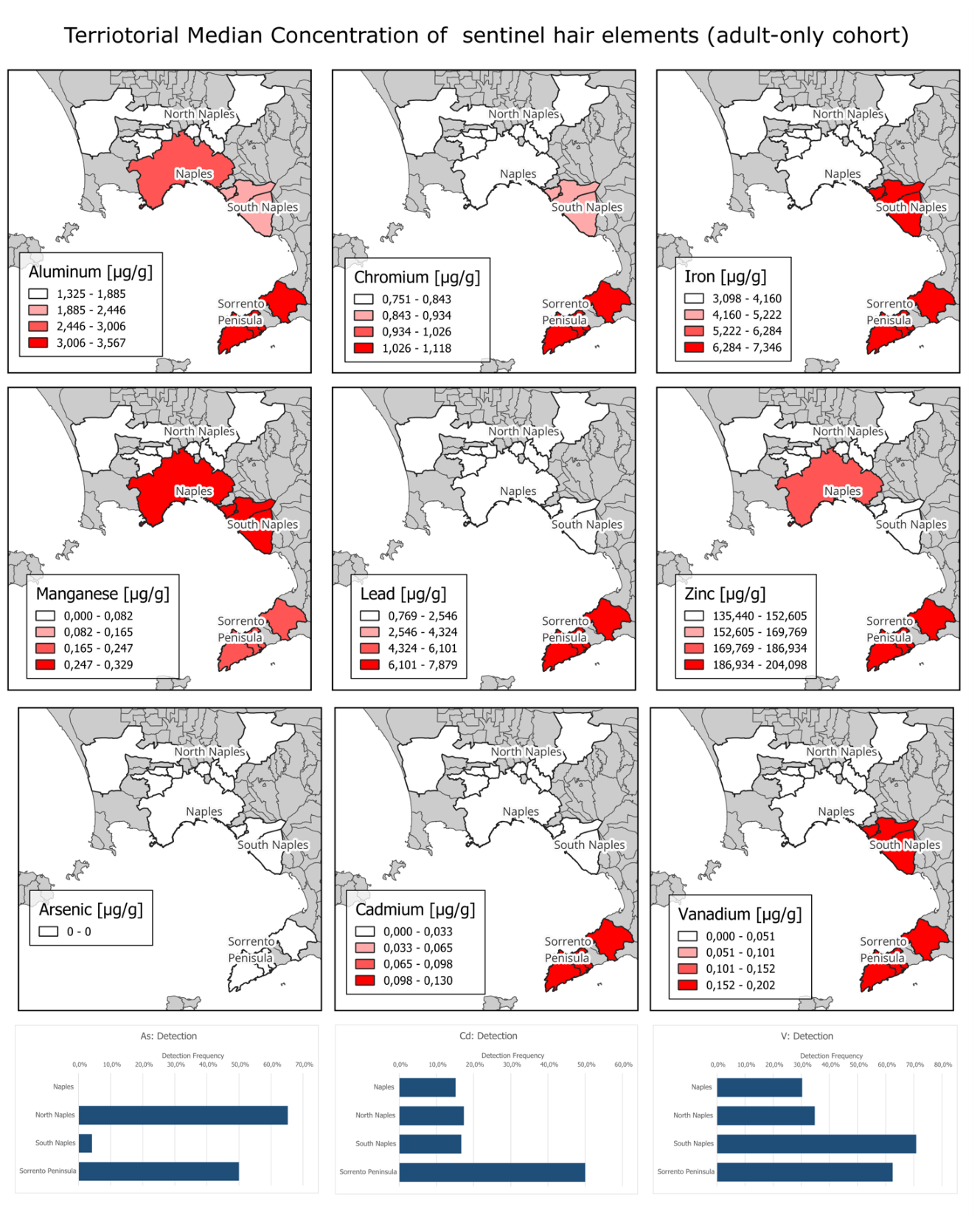
Table 2.
Detection frequencies and descriptive statistics for hair element concentrations in Campanian adults (). Units: dry weight. GM+ = geometric mean of positive observations only. Elements with detection are marked * and excluded from primary continuous regression models.
Table 2.
Detection frequencies and descriptive statistics for hair element concentrations in Campanian adults (). Units: dry weight. GM+ = geometric mean of positive observations only. Elements with detection are marked * and excluded from primary continuous regression models.
| Element | Detect (%) | Median | P25 | P75 | Max | GM+ |
|---|---|---|---|---|---|---|
| Ag* | 55.2 | 0.164 | 0.000 | 0.608 | 75.89 | 0.671 |
| Al | 85.1 | 1.56 | 0.455 | 3.80 | 37.65 | 1.99 |
| As* | 3.7 | 0.000 | 0.000 | 0.000 | 1.56 | 0.325 |
| B* | 36.6 | 0.000 | 0.000 | 0.720 | 74.30 | 1.20 |
| Ba | 70.1 | 0.663 | 0.000 | 1.45 | 11.77 | 1.12 |
| Be* | 1.5 | 0.000 | 0.000 | 0.000 | 1.12 | 0.304 |
| Bi* | 3.0 | 0.000 | 0.000 | 0.000 | 0.893 | 0.322 |
| Ca | 99.3 | 1279.7 | 627.0 | 2667.2 | 9614.6 | 1258.8 |
| Cd* | 22.4 | 0.000 | 0.000 | 0.000 | 311.2 | 1.68 |
| Co* | 17.2 | 0.000 | 0.000 | 0.000 | 0.893 | 0.199 |
| Cr | 96.3 | 0.804 | 0.599 | 1.06 | 10.49 | 0.791 |
| Cu | 99.3 | 13.94 | 10.96 | 20.46 | 81.75 | 15.07 |
| Fe* | 69.4 | 3.07 | 0.000 | 6.98 | 92.96 | 5.10 |
| K | 97.0 | 14.79 | 4.95 | 33.90 | 311.4 | 14.16 |
| Mg | 99.3 | 101.7 | 41.57 | 191.6 | 763.5 | 90.41 |
| Mn* | 65.7 | 0.192 | 0.000 | 0.443 | 4.71 | 0.385 |
| Mo* | 23.1 | 0.000 | 0.000 | 0.000 | 18.36 | 0.340 |
| Ni* | 36.6 | 0.000 | 0.000 | 0.171 | 3.91 | 0.299 |
| Pb | 93.3 | 0.808 | 0.335 | 2.27 | 887.1 | 1.27 |
| Se | 85.1 | 0.562 | 0.282 | 0.835 | 106.3 | 0.630 |
| Tl* | 0.0 | 0.000 | 0.000 | 0.000 | 0.000 | – |
| U* | 9.0 | 0.000 | 0.000 | 0.000 | 0.530 | 0.220 |
| V* | 39.6 | 0.000 | 0.000 | 0.166 | 0.503 | 0.193 |
| Zn | 99.3 | 153.5 | 123.8 | 194.7 | 1008.1 | 147.7 |
Table 3.
Adjusted associations surviving predictor-wise FDR in adult-only HC3-robust log-linear models. Full model output is reported in Supplementary Table S2.
Table 3.
Adjusted associations surviving predictor-wise FDR in adult-only HC3-robust log-linear models. Full model output is reported in Supplementary Table S2.
| Predictor | Element | 95% CI (log) | % | 95% CI (%) | p | q | |
|---|---|---|---|---|---|---|---|
| Male sex | Ca | -0.957 | [-1.313, -0.601] | -61.6 | [-73.1, -45.2] | 1.35e-07 | 1.35e-06 |
| Male sex | Cr | -0.401 | [-0.684, -0.118] | -33.0 | [-49.5, -11.2] | 0.00544 | 0.0115 |
| Male sex | Cu | -0.473 | [-0.753, -0.192] | -37.7 | [-52.9, -17.5] | 0.000956 | 0.00319 |
| Male sex | Mg | -0.738 | [-1.121, -0.356] | -52.2 | [-67.4, -29.9] | 0.000154 | 0.000769 |
| Male sex | Zn | -0.274 | [-0.468, -0.080] | -23.9 | [-37.4, -7.6] | 0.00573 | 0.0115 |
| Sample mass, per g | Mg | -3.035 | [-4.547, -1.524] | -95.2 | [-98.9, -78.2] | 8.3e-05 | 0.000415 |
| Sample mass, per g | Zn | -2.638 | [-3.441, -1.836] | -92.9 | [-96.8, -84.1] | 1.15e-10 | 1.15e-09 |
Table 4.
Spearman correlation matrix for log-transformed shifted concentrations of the ten primary elements (). Asterisks indicate pairwise FDR .
Table 4.
Spearman correlation matrix for log-transformed shifted concentrations of the ten primary elements (). Asterisks indicate pairwise FDR .
| Al | Ba | Ca | Cr | Cu | K | Mg | Pb | Se | Zn | |
|---|---|---|---|---|---|---|---|---|---|---|
| Al | 1.00 | 0.37* | 0.32* | 0.53* | 0.42* | 0.35* | 0.38* | 0.46* | 0.35* | 0.35* |
| Ba | 0.37* | 1.00 | 0.31* | 0.16 | 0.30* | 0.68* | 0.46* | 0.55* | 0.34* | 0.40* |
| Ca | 0.32* | 0.31* | 1.00 | 0.32* | 0.61* | 0.12 | 0.76* | 0.25* | 0.07 | 0.41* |
| Cr | 0.53* | 0.16 | 0.32* | 1.00 | 0.45* | 0.33* | 0.35* | 0.34* | 0.50* | 0.49* |
| Cu | 0.42* | 0.30* | 0.61* | 0.45* | 1.00 | 0.22* | 0.50* | 0.36* | 0.34* | 0.48* |
| K | 0.35* | 0.68* | 0.12 | 0.33* | 0.22* | 1.00 | 0.45* | 0.50* | 0.41* | 0.48* |
| Mg | 0.38* | 0.46* | 0.76* | 0.35* | 0.50* | 0.45* | 1.00 | 0.39* | 0.21* | 0.56* |
| Pb | 0.46* | 0.55* | 0.25* | 0.34* | 0.36* | 0.50* | 0.39* | 1.00 | 0.31* | 0.37* |
| Se | 0.35* | 0.34* | 0.07 | 0.50* | 0.34* | 0.41* | 0.21* | 0.31* | 1.00 | 0.51* |
| Zn | 0.35* | 0.40* | 0.41* | 0.49* | 0.48* | 0.48* | 0.56* | 0.37* | 0.51* | 1.00 |
Disclaimer/Publisher’s Note: The statements, opinions and data contained in all publications are solely those of the individual author(s) and contributor(s) and not of MDPI and/or the editor(s). MDPI and/or the editor(s) disclaim responsibility for any injury to people or property resulting from any ideas, methods, instructions or products referred to in the content. |
© 2026 by the authors. Licensee MDPI, Basel, Switzerland. This article is an open access article distributed under the terms and conditions of the Creative Commons Attribution (CC BY) license (http://creativecommons.org/licenses/by/4.0/).
Copyright: This open access article is published under a Creative Commons CC BY 4.0 license, which permit the free download, distribution, and reuse, provided that the author and preprint are cited in any reuse.


