
Submitted:
21 July 2026
Posted:
22 July 2026
You are already at the latest version
Abstract
AlSb film has attracted the attention for its excellent properties, and many preparation methods have been explored. Herein, AlSb thin films were prepared by DC magnetron co-sputtering method and the interfacial behavior between the films and air molecules were investigated by X-ray diffraction(XRD), Auger electron spectroscopy (AES) testing and density functional theory (DFT) calculations to elucidated the deliquescence process of AlSb thin films and its underlying mechanism. The results revealed that AlSb thin film exhibited Sb2O4 and Sb2O5 phases while the thin films doped Cu no longer showed any Sb oxide phases after the film exposed to air for one day. The chemical state of aluminum in the film remained stable along the depth direction, whereas antimony exhibited a pronounced gradient in chemical state from the surface to the interior. The oxidation state of Sb ions varied from -3 in the interior to +5 at the surface. The interaction between the (111) crystal plane of the AlSb film and air molecules is an exothermic process, with water molecules exhibiting the highest adsorption energy on the film surface, followed by oxygen molecules. The adsorption energies for nitrogen and carbon dioxide molecules were the lowest. Consequently, AlSb molecules readily combine with H2O molecules. Furthermore, doping the AlSb film with copper or zinc atoms effectively reduced the adsorption energy for water and oxygen molecules, offering a new approach to suppress the deliquescence and oxidation of AlSb thin films. This study provides an important theoretical foundation for subsequent research on this material system.
Keywords:
AlSb thin film
; deliquescence
; interface
; molecular dynamics
1. Introduction
The direct band gap of AlSb is 1.6 eV and the indirect band gap is 2.6 eV, which is very suitable for the broad spectrum of visible light[1], the theoretical conversion rate is high, up to 27% [2,3,4]. AlSb films show a high electron mobility of 200 cm2 ·V−1 ·s−1 and hole mobility of 400 cm2 ·V−1 ·s−1 [5]. It is widely used in field spintronics, in electro-optic and electronic device [6], also in high-energy solar cells, P–N junction diodes and transistors [7,8], and other fields. This compound is used such as high temperature semiconducting materials [9], as an anode candidate for sodium/lithium-ion batteries [10,11] and is also promising as a photon detector [12]. The important thing is that Al and Sb elements are abundant in the earth's crust, and will not produce additional harmful substances during use, which is an environmentally friendly material[13]. Therefore, AlSb thin film will receive a lot of attention in the current situation of being unable to cope with traditional fossil energy, and it also determines that it will have huge development potential.
AlSb thin films have been prepared by magnetron sputtering Alloy target or Geometric target or Al、Sb target [2,4], co- evaporation [14],pulsed laser deposition [15], Electrodeposition [16,17], Respectively. Meanwhile, the structure, Electrical properties, and Optical properties have been researched. Compared with GaAs films, the faster hydrolysis rate of AlSb film in aqueous medium affects its performance in solar cells, especially under short-circuit current[16,18]. Sattar, Farhan deposited AlSb: Zn thin films by chemical bath method and their results show that these electrodeposited films show unique development potential when applied to photonics, photocatalysis, and energy industry and other fields[19]. Therefore, we need to solve the deliquescent problem of AlSb films and find ways to improve the stability of AlSb films. Mingqiang Li proposed a sandwich structure of Ni/AlSb/acrylic resin/Ni multilayer films to prevent AlSb film from contacting with the atmosphere and thus prevent AlSb film from deliquescence[20]. Yixuan Pei used AlSb/AlSb: Cu composite films to study the properties and the inhibition of deliquescence of AlSb films[21]. Jianxiong He measured the deliquescence process of AlSb thin films by experimental observation[22]. However, the deliquescent mechanism and theoretical verification of AlSb films have not been reported in detail.
In this paper, AlSb thin films were prepared by co-sputtering of Al and Sb in a magnetron sputtering system, the interfacial properties of AlSb films with air molecules were investigated by AES and Density functional analysis (DFT) and Molecular dynamics.
2. Experiment
2.1. Preparation Process and Testing Conditions
AlSb films were deposited on quartz glass at room temperature via direct-current (DC) magnetron sputtering in a vacuum chamber with a base pressure of 5 × 10⁻³ Pa and annealed at 400 °C with holding time of 60 min in vacuum conditions. The AlSb films were prepared at 0.75 A/430 V power, 0.35 Pa pressure for 30 min.
The X-ray diffraction (XRD) measurement was performed with a RigukuDMAD-RCDX-1000 diffractometer by Cu Ka radiation by Rigaku Corporation of Japan.The Auger electron spectroscopy (AES) of AlSb thin films was conducted at the State Key Laboratory of the Institute of Engineering Physics, Chinese Academy of Sciences, using a PHI-600 Auger electron spectrometer.
2.2. Results and Discussion
Figure 1.
XRD pattern of AlSb thin film placed in air for 1day.
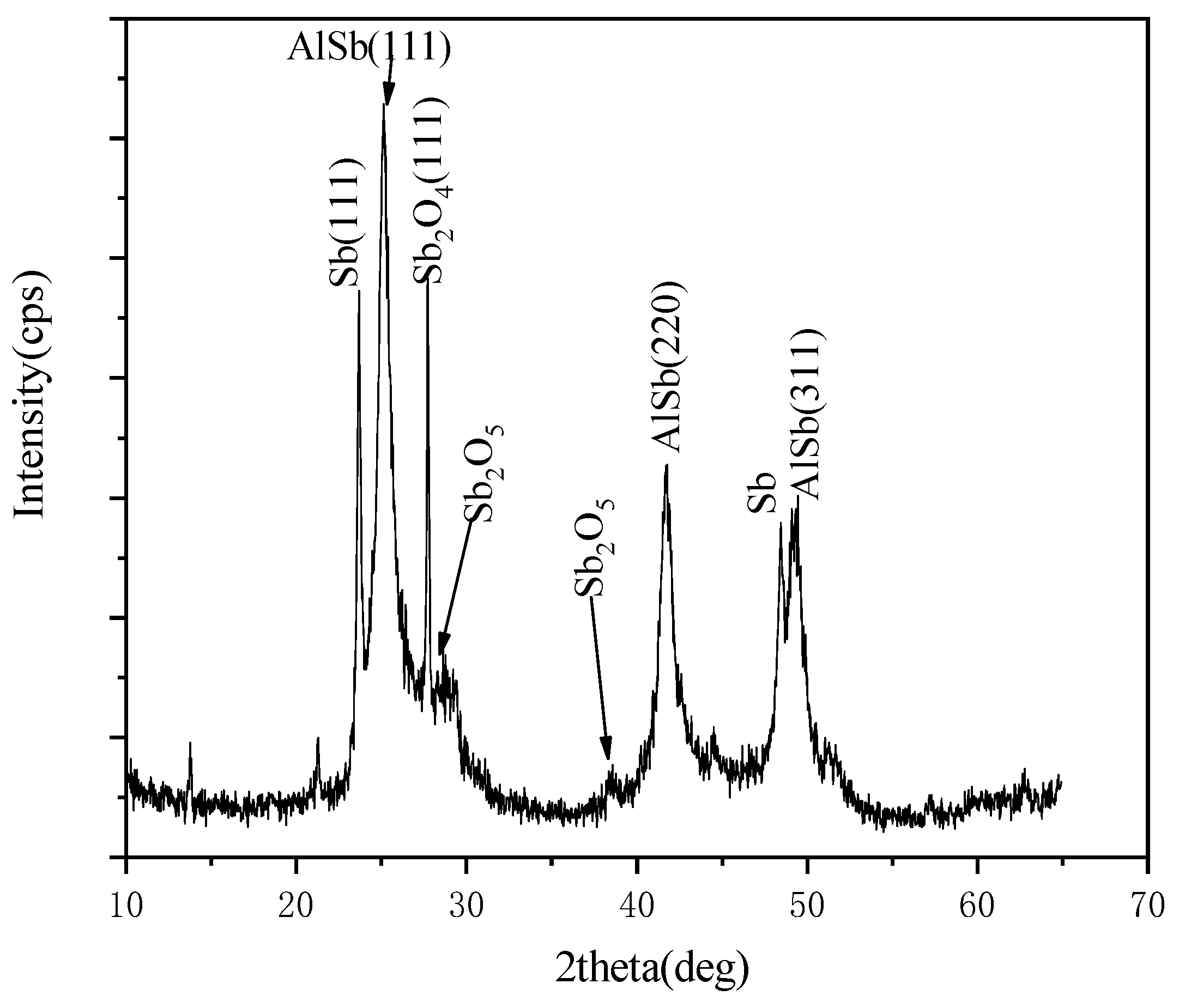
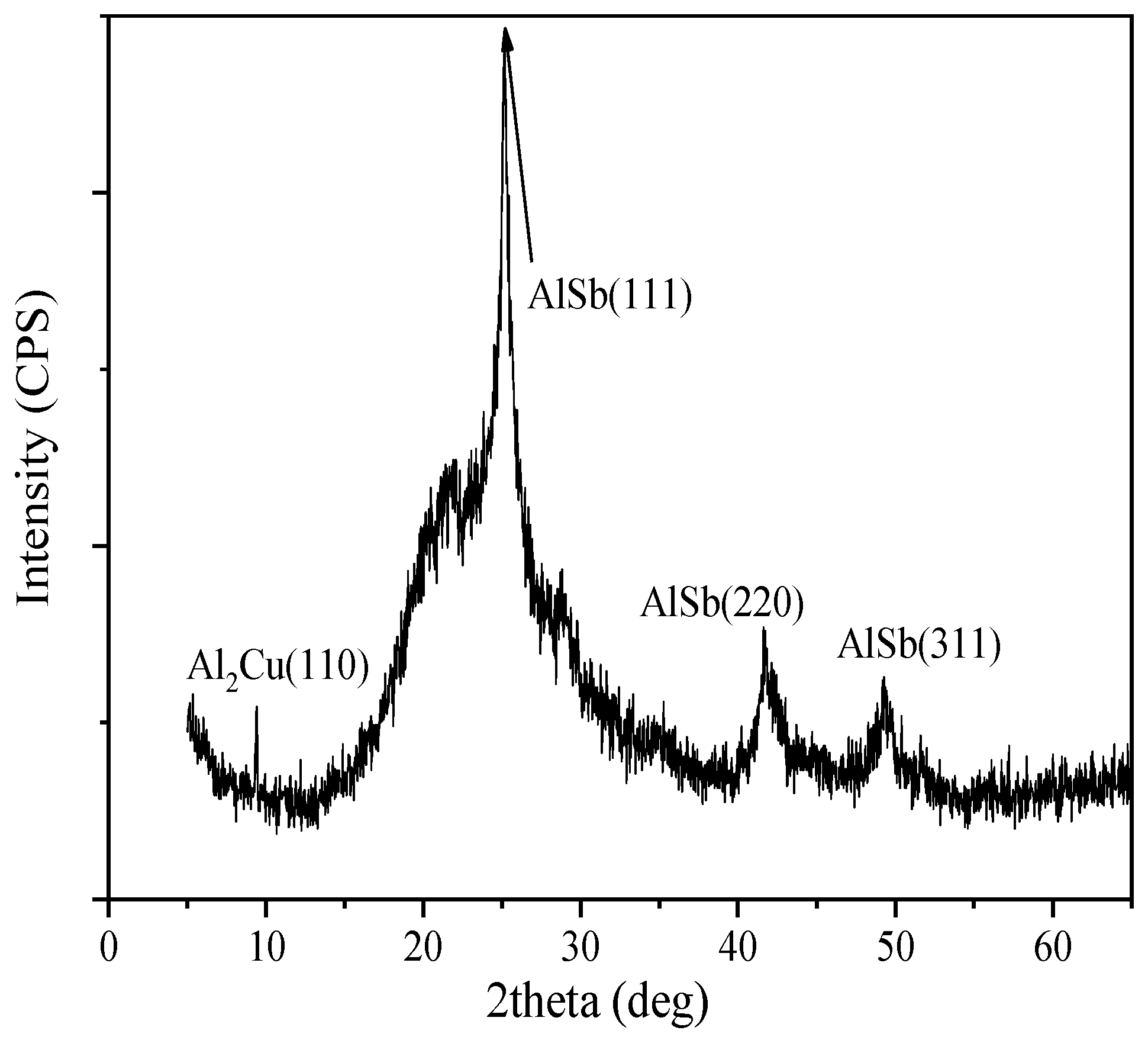
To understand the deliquesce mechanism of AlSb thin films, it was tested the XRD of AlSb films after placed for 1 day shown in Fig.1. As can be seen from the Fig.1, in addition to AlSb and Sb, Sb2O4 and Sb2O5 also appear in the thin film, and they preferentially orient along the Sb2O4 (111) crystal direction, indicating that there is a certain component in the atmosphere that greatly affects the stability of the AlSb film[20]. The XRD pattern of an AlSb:Cu thin film with a Cu doping concentration of 6.25 atm% was shown in Fig.2 after being annealed at 400℃ for 1 hour and then left to stand for 1 day. As evident from the Fig.2, the curve exhibits peaks corresponding to AlSb(111), AlSb(220), and AlSb(311) crystal orientations, with preferential growth occurring in the AlSb(111) crystal orientation. The thin film structure is cubic. In addition, an Al2Cu (110) crystal orientation peak has appeared, which may be formed by the diffusion of the Cu protective film sputtered on the surface into the AlSb film layer after annealing, replacing the Sb atoms that exist in elemental form. The replaced Sb atoms are solid-solved into the AlSb lattice or Al2Cu lattice and exist in the form of a solid solution.
Figure 2.
XRD pattern of AlSb:Cu thin film placed in air for 1 day.
In order to research the process of AlSb thin films to ambient air, elements Chemical states of the AlSb interface was analyzed.
AlSb films surface were stripped by Ar sputtering using sputtering power of 4000 W and the elements Chemical states of the interface were measured every 30 s using AES technology, until AlSb films were completely stripped. Figure 3 was a typical AES full spectrum of AlSb films which was clearly observed that samples contained elements of Al, Sb, C and O. The C element may come from CO and CO2 within the vacuum diffusion pump system during the deposition process. In addition to the residual gas in the vacuum chamber during the deposition process, element O may be due to the oxidation of AlSb films due to their contact with the atmospheric.
The AES spectra of AlSb films was shown in Figure 4. As can be seen from the Figure 4, there were two characteristic peaks of Al, located at 52 eV and 65 eV. With the increasing of stripping depth, the two characteristic peaks of Al did not shift, which indicated that Al did not reacted to other elements. The kinetic energy of Sb was shifted to the right. The first peak was shifted from 454.6 eV to 455.2 eV (the shift of 0.6 eV), and the second peak was shifted from 462.5 eV to 463 eV (the shift of 0.5 eV). This may be caused by the continuous diffusion of O2, H2O, or CO2 molecules from the surface into the interior of AlSb, leading to the reconstruction of the electron cloud around the Sb atoms and resulting in minor fluctuations in their inner electron energy levels. Based on the XRD pattern analysis in previous studies, the valence of Sb element gradually changes from -3 to +5 from the interior to the surface [22]. Therefore, the antimony element in the interior of the film still exists in the form of AlSb compound, while the electronic energy levels of antimony element in the near-surface region undergo changes, leading to internal charge transfer of Sb atoms and resulting in valence changes [23].
From the above analysis, we could see O element from H2O would gradually make Sb element from the polycrystalline AlSb film in the atmosphere into Sb oxide, and finally formed Sb2O5(black powder solid). AlSb thin films were easy to deliquesce and cannot be preserved for a long time, which was the main reason that restricted its large-scale production. Our preliminary research has found that when water vapor comes into contact with AlSb thin films, sand holes will appear after the films are fully immersed in an atmospheric environment. Subsequently, water vapor reversely penetrates into the interior of the films, ultimately leading to structural spalling [22]. In order to study the mechanism of deliquesce, the adsorption energy of undoped AlSb thin films, as well as AlSb:Cu and AlSb:Zn films was simulated by using the first-principles method from the Molecular dynamics point of view using MS (Material Studio) software. The deliquesce mechanism of AlSb film was revealed and the change of interface properties was investigated.
3. Calculation and Theory Analysis
3.1 Crystal cell model of AlSb thin film and doped thin film
The MS software was used to select the crystal cells of the basic AlSb polycrystalline thin film in its data, and model it, as shown in Figure 5(a). Cu and Zn atoms are mixed in AlSb polycrystal thin film, as shown in Fig.5(b) and Fig.5(c).
The most densely grown crystal planes of AlSb were selected by MS software: (1 1 1), (2 0 0) and (2 2 0), and the three crystal planes were sliced and expanded, and a vacuum layer was added to them to facilitate the subsequent addition of oxidizing molecules in the air, as shown in Figure 6.
The oxidizing molecules (O2, CO2, N2, H2O) in the air were modeled separately, and the molecular models containing each oxidation were combined with the cross-sectional models of AlSb polycrystalline films, AlSb films doped with Cu atoms and Zn atoms, as shown in Figure 7.This combined model will be used in subsequent studies to investigate the interaction mechanism between the thin film surface and air molecules under different doping conditions.
3.2. Theoretical Foundations of Computing
The formula for the adsorption energy of AlSb film after binding to oxidizing molecules is as follows equation (1).
——Adsorption energy
——The total energy of the AlSb film after binding to air molecules
——The energy of the system containing only the corresponding section of the AlSb film
——The system energy of air molecules
——The number of molecules bound to each system
The calculation of the individual energy of each part is done by the calculation module included in the Dmol3 module, and the calculation formula is shown in equation (2).
——System energy
——Wave function
——Kinetic energy term
——External potential energy term
——Interaction terms
All calculations were based on the DMol³ module in Materials Studio, utilizing density functional theory and numerical atomic orbital basis sets; the exchange-correlation functional was vdW-DF; gradient optimization algorithm was employed for structural optimization to find the lowest energy. The total energy of the adsorption system, clean surface, and adsorbate was calculated through self-consistent field iteration, with a maximum iteration step of 500 steps. The energy convergence threshold was set at 0.002 Ha; the maximum force on atoms was converged to 0.002 Ha/Å. The SCF convergence precision was set at 1.0×10-⁶ Ha. The periodic system employed a surface slab model, with the k-point grid set as follows: supercell was 5×5×1, and vacuum layer was 5×5×10.
3.3. Data analysis
3.3.1. Energy analysis of oxidizing molecules
After the geometry optimization of the density functional (DFT) quantum mechanical program Dmol3 module of MS software, the energy changes of the main growth crystal planes of each molecule and each thin film in the air were calculated, as shown in Fig.8.
The absolute value of the energy of the O2 molecule was not significantly reduced relative to the (1 1 1) crystal of each film in Figure 8(a). Compared with the (2 0 0) crystal planes of each film, the absolute energy reduction of O2 was greater than that of the films doped Zn. For the crystal planes of each thin film (2 2 0), doping the Cu film can increase the absolute value of O2 energy, and doping Zn atoms can significantly reduce the absolute value of O2 energy. But none of the doped films significantly reduced the absolute energy value of N2 molecules for each film (1 1 1) crystal plane from Figure 8(b). For the crystal planes of each thin film (2 0 0), the absolute value of N2 energy reduction was greater for the doped Cu film, while the absolute value of N2 molecular energy reduction was not obvious for the doped Zn film. For the crystal planes of each thin film (2 2 0), the doped film increased the absolute value of N2 molecular energy, and the doped Cu film increases the absolute value of N2 molecular energy more.
The absolute value of H2O molecular energy cannot be significantly reduced for each thin film (1 1 1) crystal plane from Figure 8(c). For the crystal planes of each film (2 0 0), the absolute value of H2O molecular energy was only slightly reduced by Cu-doped films, while the absolute value of H2O molecular energy was increased by doped Zn films. For the crystal planes of each thin film (2 2 0), the absolute value of H2O molecular energy increased by doping Cu film, while the absolute value of H2O molecular energy decreased by doping Zn thin film. However, from Figure 8(d), for each film (1 1 1) crystal plane, the doped film can only slightly reduce the absolute value of CO2 molecular energy. For the crystal planes of each thin film (2 0 0), the doped Cu film significantly reduces the absolute value of CO2 molecular energy, while the doped Zn film was not useful to reduce the CO2 molecular energy. For the crystal planes of each thin film (2 2 0), the doped Zn film can reduce the absolute value of CO2 molecular energy, while the doped Cu film can increase the absolute value of CO2 molecular energy.
From the above analysis, it can be seen that the absolute reduction of the energy of various oxidizing molecules in the crystal face of the (2 0 0) AlSb film doped Cu atoms was much better than that of the AlSb film doped Zn atoms. The doped film had no effect on the absolute value of the energy of each molecule on the (1 1 1) crystal plane. The AlSb film doped Cu atoms often had a counter-effect on the decrease of the absolute energy value of each molecule on the (2 2 0) crystal surface, while the AlSb film doped Zn atom only played a small disturbance effect on the absolute energy value of each molecule, and no obvious energy change occurs.
3.3.2. Calculation of the energy and adsorption energy of each part
To further investigate the energy changes of various crystal faces in AlSb thin films and the mechanism of deliquescence of AlSb thin films, the adsorption energies of AlSb thin films with various molecules in the air were calculated, as shown in Table 1, Table 2 and Table 3.
As can be seen from Table 1, Table 2 and Table 3, whether it is the (111), (200), or (220) crystal plane of AlSb thin films, the adsorption energy of AlSb molecules towards H2O molecules in the air is the highest, releasing more energy and being in the most stable state. This explains the observation in previous experiments that the deliquesce process of AlSb is first combined with water vapor in the air, gradually penetrating from the film surface to the interior of the film, gradually forming sand holes on the substrate, and finally detaching from the substrate.
Therefore, to address the deliquescence issue of AlSb thin films and ensure their photoelectric performance in optoelectronic technology applications, doping of AlSb is necessary. Preliminary research has shown that doping AlSb thin films with Cu and Zn elements can maintain and enhance their photoelectric performance to some extent [8,22]. Therefore, the adsorption energies of various preferred crystal faces of AlSb:Cu and AlSb:Zn thin films towards various molecules in the air were calculated and analyzed. The results are presented in Table 4, Table 5, Table 6, Table 7, Table 8, Table 9 and Table 10.
From Table 1, Table 2, Table 3, Table 4, Table 5, Table 6, Table 7, Table 8, Table 9 and Table 10, it can be seen the absolute value of the adsorption energy of H2O molecules after combining with the crystal plane was largest and most stable after combination among the same kind of AlSb films, resulting in the crystal plane being the easiest to combine with H2O molecules. The absolute value of adsorption energy was obviously higher before doping than after doping, indicating that the absolute value of adsorption energy was reduced after doping, and the binding state between the doped crystal plane and water molecules was more unstable than that before doping, and it was not easy to combine with water molecules. Among the same type of AlSb films, the crystal plane with the lowest adsorption energy and the easiest adsorption energy between the AlSb film doped with Cu atoms and H2O molecules was (2 0 0), the crystal plane with the lowest adsorption energy and the easiest adsorption plane between the AlSb film doped with Zn atoms and water molecules was (2 0 0), and the crystal plane with the lowest adsorption energy and the easiest adsorption between AlSb film and water molecules was (1 1 1).
4. Conclusion
The AlSb films were successfully prepared by direct-current (DC) magnetron co-sputtering technology. And the results suggested AlSb films were deliquescent oxidized to oxides such as Sb2O4 and Sb2O5 after one day contacted with air. The chemical states of Al remained unchanged and Sb in the films changed gradually from the surface to the interior. The crystal plane (111) of AlSb film was an exothermic reaction with the molecules in the air, and the adsorption energy of H2O on AlSb film was the most, followed by that of O2 and the adsorption energy with N2 and CO2 was the lowest. After the AlSb films doped with Cu and Zn atoms, the adsorption energy of the films with H2O and O2 molecules decreased, which could reduce the deliquescence oxidation of AlSb films and provide a theoretical basis for the application of AlSb films.
Statements and Declarations
Author Introduction: Song Huijin, born in 1978. She received her Ph.D and M.S. degrees in Materials Science Department of Sichuan University in 2009and 2006 respectively. Her research interests include thin films materials and device, the hard coatings.
Funding
The authors receive support from National Natural Science Foundation of China Youth Fund (No.52402225)for the submitted work.
References
- Åberg, D.; Erhart, P.; Williamson, Andrew J W; Lordi, V. Intrinsic point defects in aluminum antimonide. Phys. Rev. B 2008, 77(16), 165206. [Google Scholar] [CrossRef]
- He, J. X.; Wu, L. L.; Xia, G. P.; Zhang, J. G.; Feng, L. H.; Lei, Z.; Li, W. Preparation and properties of AlSb polycrystalline films. J. Funct. Mater. Devices 2010, 16(1), 11–16. [Google Scholar] [CrossRef]
- He, J. X.; Wu, L. L.; Zhang, J. G.; Xia, G. P.; Feng, L. H.; Zhang, J. Q.; Wei, L.I.; Bing, L.I. Prepare and deliquescence for AlSb polycrystalline films. J. Funct. Mater. 2010, 41(1), 173–176. [Google Scholar] [CrossRef]
- Yang, K.; Xu, F.; Wu, L. L.; Zhang, J. Q.; Feng, L. H.; Li, W.; Cai, Y. P.; Li, B. Preparation of AlSb polycrystalline thin films by magnetron supttering. Acta Energy Solaris Sin. 2009, 30.11, 1461–1464. [Google Scholar]
- Song, H. J.; He, J. X.; Wu, L. L. Properties of AlSb polycrystalline thin film materials. J. Inorg. Mater. (in Chinese). 2009, 24, 1655–1661. [Google Scholar] [CrossRef]
- Rahman, G.; Cho, S.; Hong, S. C. Half metallic ferromagnetism of Mn doped AlSb: A first principles study. Phys. Status Solidi (b) 2007, 244(12), 4435–4438. [Google Scholar] [CrossRef]
- Djuri?I?, A. B.; Chan, Y.; Li, E. H. Novel model for the optical function of GaN. Appl. Phys. A 2002, 74(5), 669–674. [Google Scholar] [CrossRef]
- Tang, P.; Wang, W. M.; Li, B.; Feng, L. H.; Zeng, G. G. Coatings 2019, 9, 136. [CrossRef]
- Qiu, P.; Yang, J.; Huang, X.; Chen, X.; Chen, L. Effect of antisite defects on band structure and thermoelectric performance of ZrNiSn half-Heusler alloys. Appl. Phys. Lett. 2010, 96(15), 152105-152105-3. [Google Scholar] [CrossRef]
- Stjerndahl, M.; Bryngelsson, H.; Gustafsson, T.; Vaughey, J. T. Surface chemistry of intermetallic AlSb-anodes for Li-ion batteries. Electrochimica Acta 2007, 52(15), 4947–4955. [Google Scholar] [CrossRef]
- Baggetto, L.; Marszewski, M.; Górka, J.; Jaroniec, M.; Veith, G. M. AlSb thin films as negative electrodes for Li-ion and Na-ion batteries. J. Power Sources 2013, 243(6), 699–705. [Google Scholar] [CrossRef]
- Pino, R.; Ko, Y.; Dutta, P. S. Adhesion-free growth of AlSb bulk crystals in silica crucibles. J. Cryst. Growth 2005, 290(1), 29–34. [Google Scholar] [CrossRef]
- Baufay, L.; Andrew, R.; Pigeolet, A.; Laude, L. D. Preparation of AlSb films by laser annealing. Thin Solid Films 1982, 90, 69–74. [Google Scholar] [CrossRef]
- Song, H. J.; Wu, L. L.; Zheng, J. G.; Feng, L. H.; Lei, Z.; Zhang, J. Q. Study on AlSb polycrystalline thin films prepared by vacuum co-evaporation. Int. J. Mod. Phys. B 2011, 25(13), 1747–1755. [Google Scholar] [CrossRef]
- Liu, X. L.; Liu, J. Y.; Yang, K. Study on the deliquescence of AlSb/Sb stacks deposited by pulsed laser deposition. Mater. Sci. Semicond. Process. 2018, 81, 102–107. [Google Scholar] [CrossRef]
- Singh, J.; Rajaram, P. Single Step Electrode position of AlSb Thin Films. Mater. Today Proc. 2019, 16, 636–639. [Google Scholar] [CrossRef]
- Chandra, S.; Khare, N.; Upadhyaya, H. M. Photoelectrochemical solar cells using electrodeposited GaAs and AlSb semiconductor films. Bull. Mater. Sci. 1988, 10(4), 323–332. [Google Scholar] [CrossRef]
- Nakata, J.; Shibata, T.; Nanishi, Y.; Fujimoto, M. Suppression of AlSb oxidation with hydrocarbon passivation layer induced by MeV-He+ irradiation. J. Appl. Phys. 1994, 76(4), 2078–2085. [Google Scholar] [CrossRef]
- Sattar, F.; Shahid, W.; Anwar, W. A.; Iqbal, M. A.; Malik, M.; Anwar, N.; Idrees, F.; Din, S. Z. U.; Kanwal, Q. Synthesis and characterization of Zn doped AlSb thin films for photovoltaic and energy applications. Z. Für Naturforschung A 2022, vol. 77(no. 5), 507–513. [Google Scholar] [CrossRef]
- Song, H. J.; Gu, P.; Zhu, X. H.; Yan, Q.; Yang, D. Y. Preparation of AlSb thin films by magnetron sputtering technology and its deliquescence mechanism. Mater. Sci. Semicond. Process. 2019, 89, 126–130. [Google Scholar] [CrossRef]
- Li, M. Q.; Li, B.; Zeng, G. G.; Song, H. J.; Yang, K.; Xiao, R. Preparation of AlSb thin films using aluminum–antimony alloying target by magnetron sputtering and its deliquescence prevention approach. J. Mater. Sci. Mater. Electron. 2019, 31(3), 1846–1852. [Google Scholar] [CrossRef]
- Pei, Y. X.; Yan, H. B.; Xiao, R.; Li, B.; Yang, K.; Song, H. J. Structural, optical, electrical and deliquescent properties of AlSb:Cu thin films prepared by magnetron sputtering. Vacuum 2020, 177, 109341. [Google Scholar] [CrossRef]
Figure 3.
AES full spectrum of ALSB film.
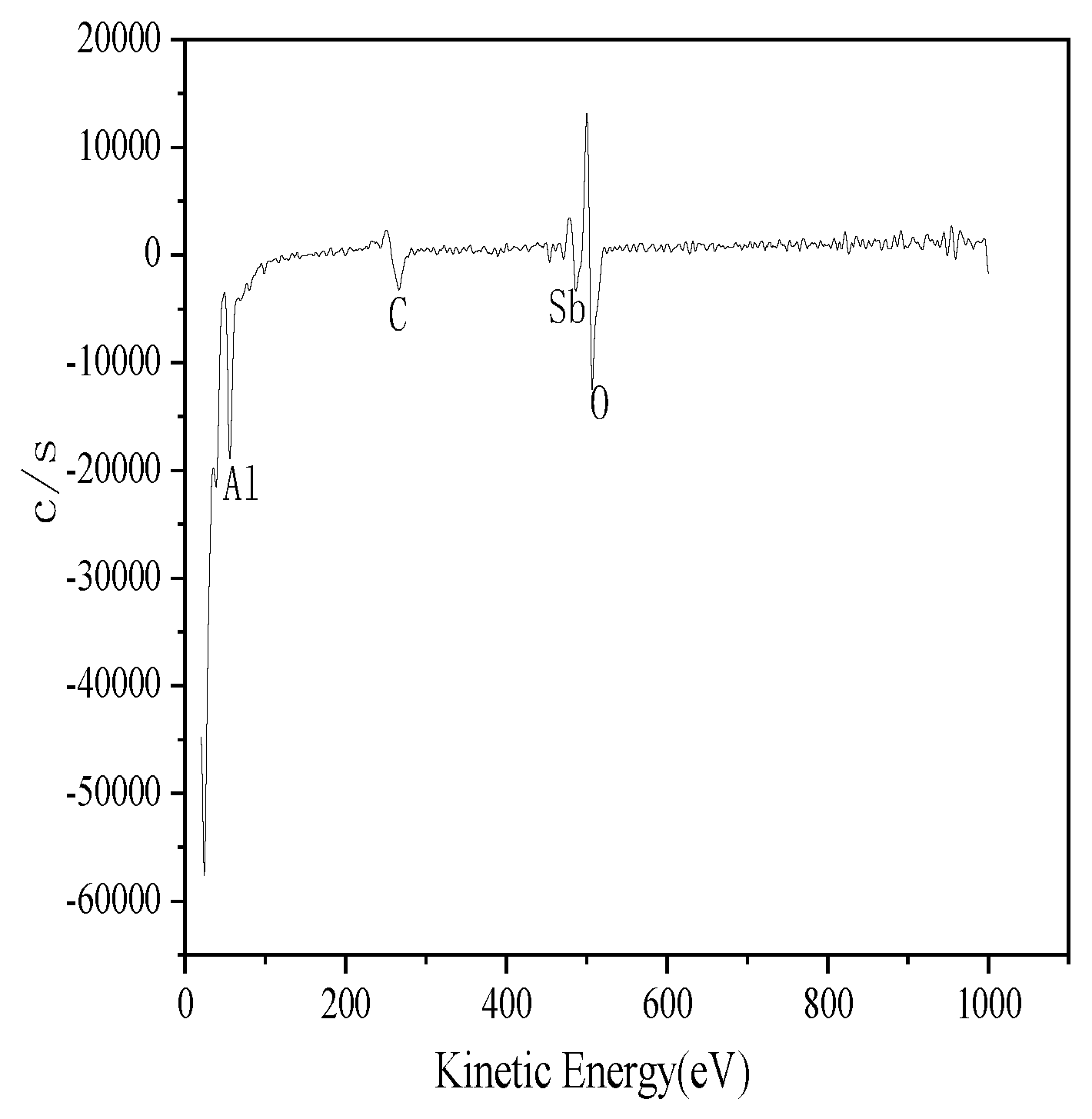
Figure 4.
AES single spectrum diagram of Al and Sb elements in AlSb film.
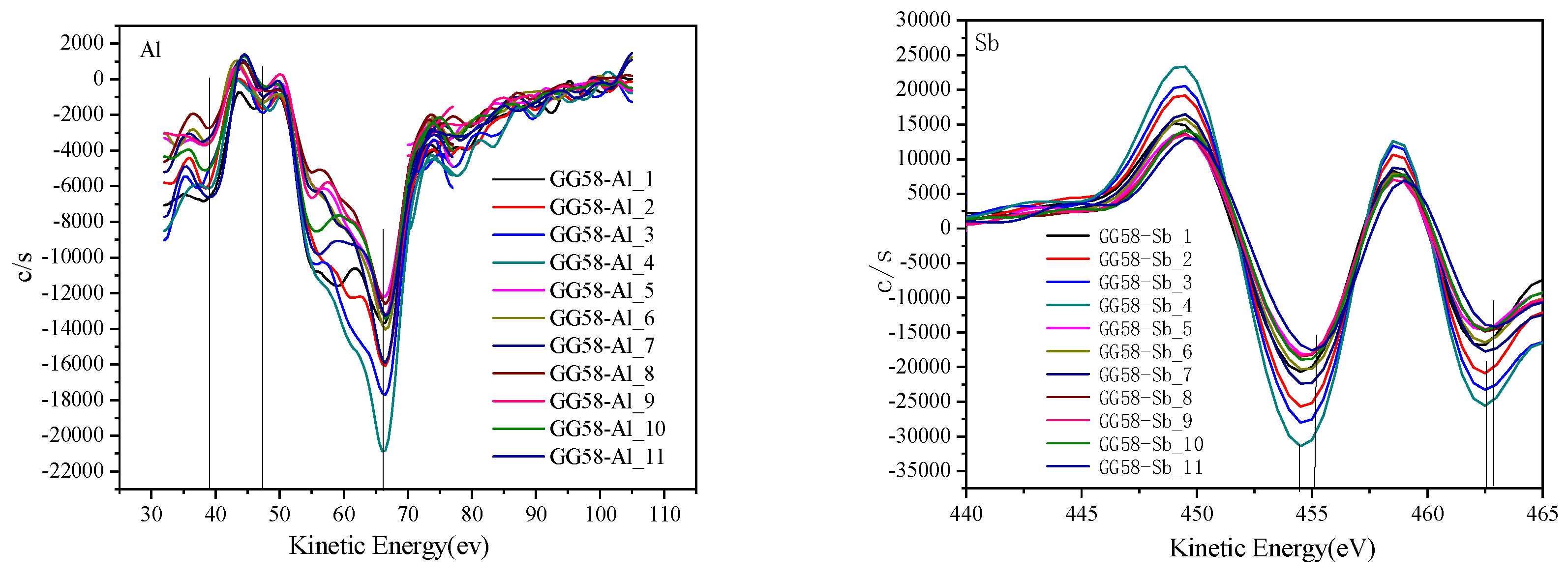
Figure 5.
the structure diagram. (a )AlSb film (b) AlSb·Cu film (c) AlSb·Zn film.
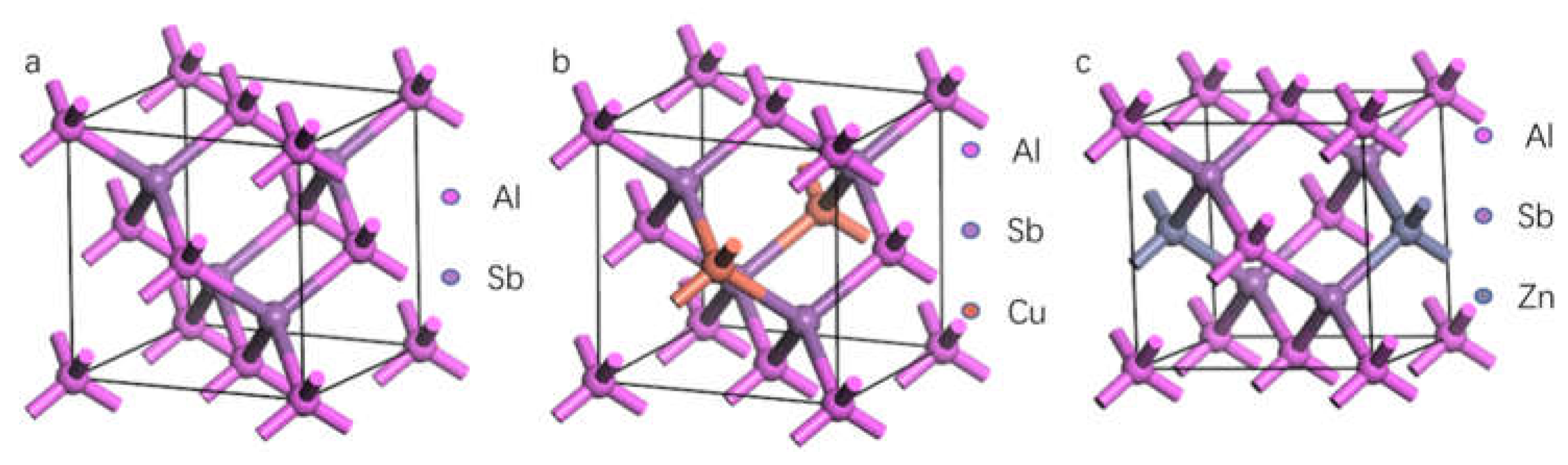
Figure 6.
AlSb film flip each crystal plane combined with each molecule
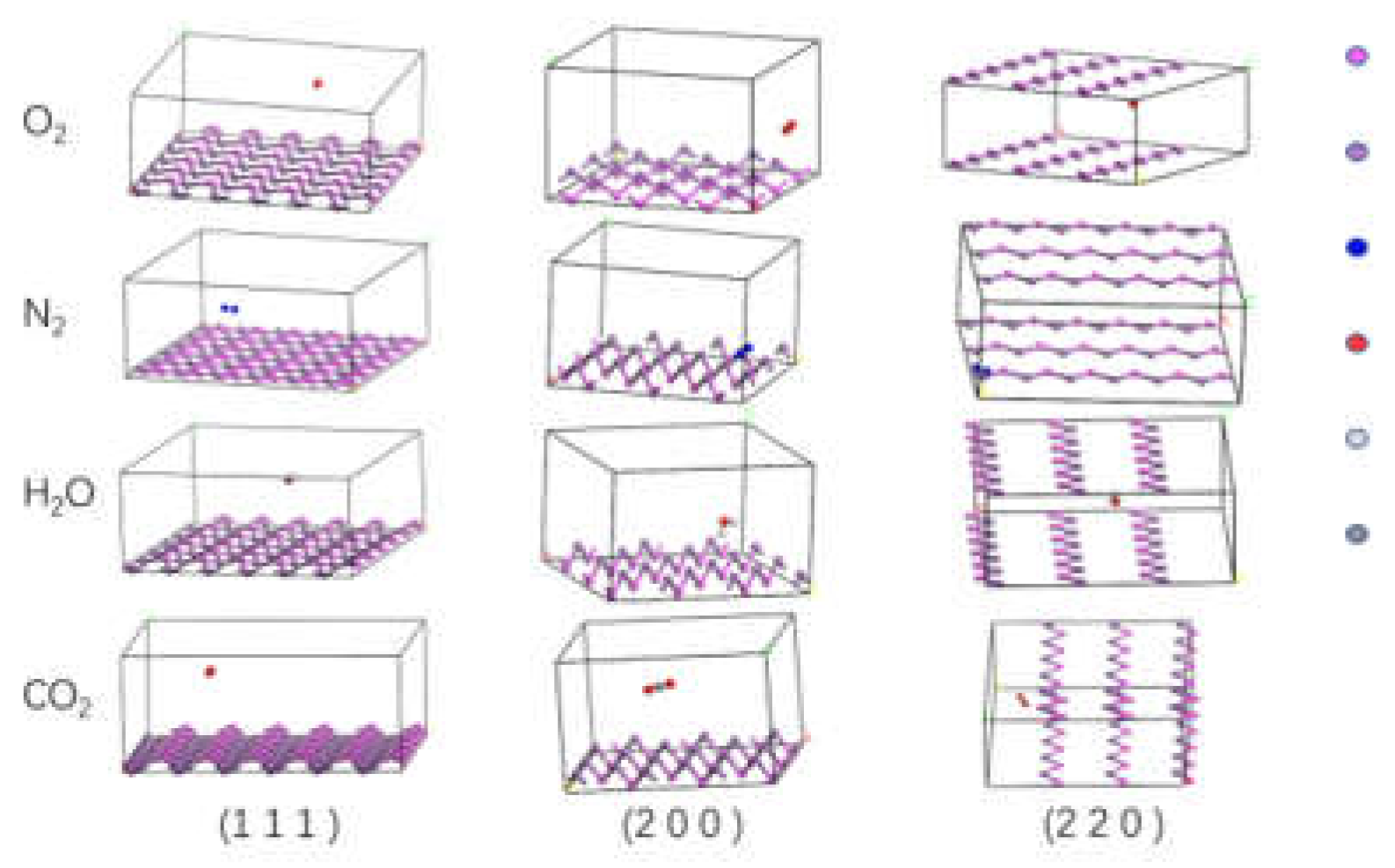
Figure 7.
Schematic diagram of AlSb:Cu(a), AlSb:Zn(b) thin film combined with various molecules
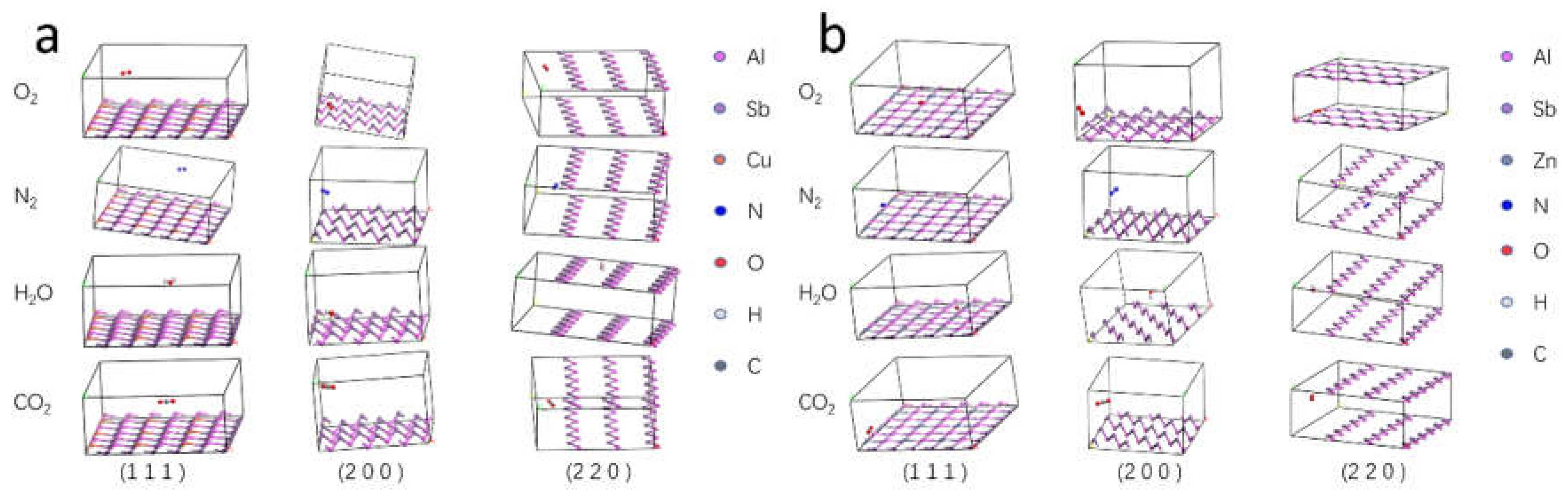
Figure 6.
the change in energy of each molecule after binding to the model.
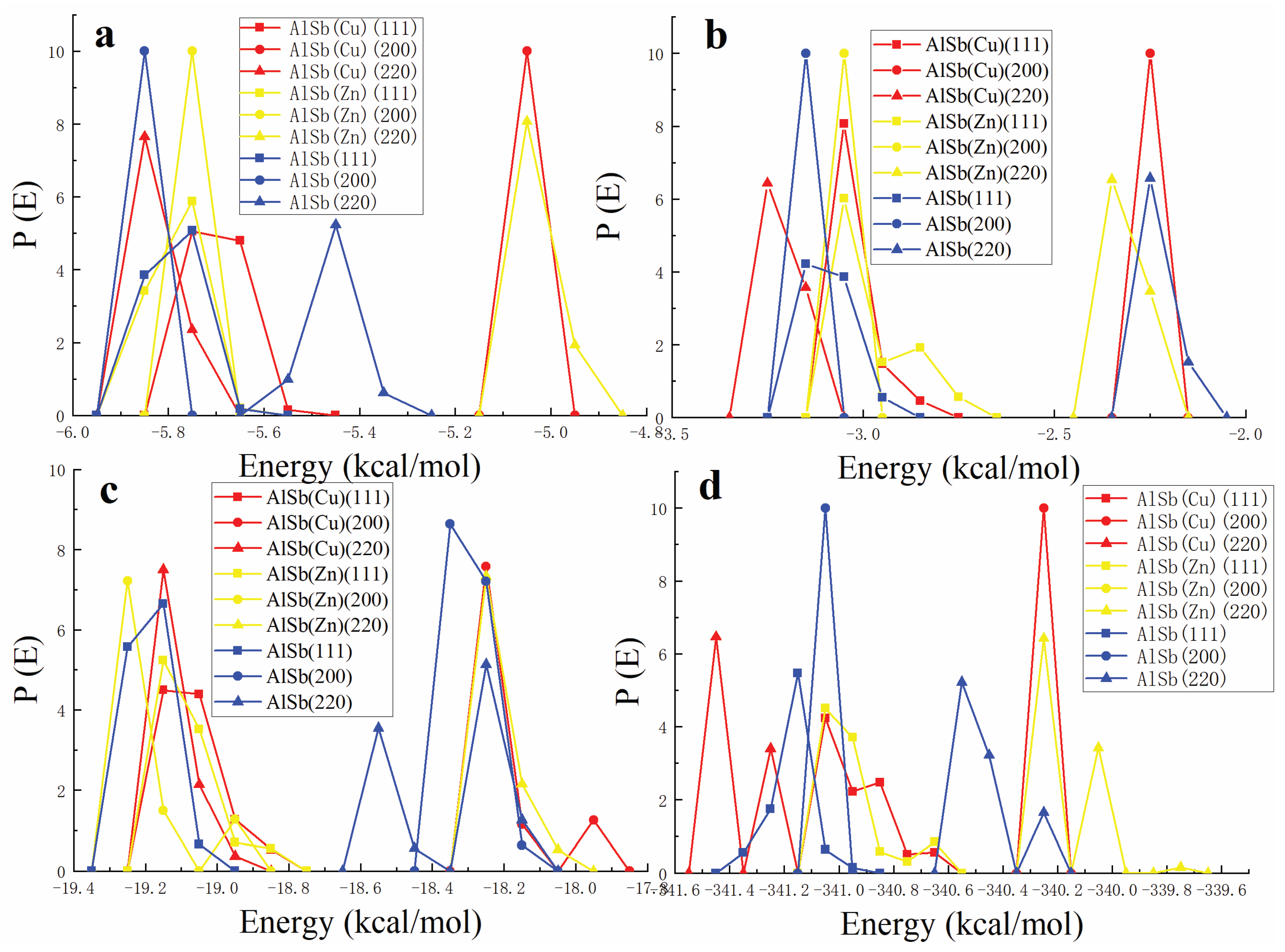

Table 1.
Adsorption energy of (1 1 1) crystal planes and molecules in AlSb films.
| Model type | The energy of the system after binding (kcal/mol· A-2) | AlSb substrate system energy (kcal/mol·A-2) | The energy of a single oxidizing molecular system(kcal/mol·A-2) | Adsorption energy(kcal/mol·A-2) |
| O2 | -3.1715642 | -2.5956461 | -5.7615462 | -5.1856281 |
| N2 | -0.7651653 | -2.4154845 | -3.1431565 | -4.7934757 |
| H2O | -16.4981536 | -2.8515463 | -19.1715654 | -5.5249581 |
| CO2 | -338.6511218 | -2.5154613 | -341.1215463 | -4.9858858 |
Table 2.
Adsorption energy of (2 0 0) crystal planes and molecules in AlSb films.
| Model type | The energy of the system after binding (kcal/mol· A-2) | AlSb substrate system energy (kcal/mol·A-2) | The energy of a single oxidizing molecular system(kcal/mol·A-2) | Adsorption energy(kcal/mol·A-2) | |
| O2 | -3.6516471 | -2.6623164 | -5.8531614 | -4.8638307 | |
| N2 | -0.7816841 | -2.5655434 | -3.1131651 | -4.8970244 | |
| H2O | -15.9231584 | -2.9416546 | -18.4341687 | -5.4526649 | |
| CO2 | -338.3134463 | -2.4164194 | -341.0615436 | -5.1645167 | |
Table 3.
Adsorption energy of (2 2 0) crystal planes and molecules in AlSb films.
| Model type | The energy of the system after binding (kcal/mol· A-2) | AlSb substrate system energy (kcal/mol·A-2) | The energy of a single oxidizing molecular system(kcal/mol·A-2) | Adsorption energy(kcal/mol·A-2) |
| O2 | -3.7664184 | -1.4949153 | -5.4531463 | -3.1816432 |
| N2 | -0.7926464 | -1.6919455 | -2.3648866 | -3.2641857 |
| H2O | -16.3343193 | -1.7241531 | -18.2141654 | -3.6039992 |
| CO2 | -338.9261643 | -1.5464597 | -340.5314649 | -3.1517603 |
Table 4.
Adsorption energy of (1 1 1) crystal planes and molecules in AlSb:Cu films.
| Model type | The energy of the system after binding (kcal/mol· A-2) | AlSb substrate system energy (kcal/mol·A-2) | The energy of a single oxidizing molecular system(kcal/mol·A-2) | Adsorption energy(kcal/mol·A-2) |
| O2 | -3.67382744 | -2.09825468 | -5.77208212 | -4.196509 |
| N2 | -0.76108285 | -2.31175774 | -3.07284059 | -4.623515 |
| H2O | -16.49867295 | -2.59598658 | -19.09465953 | -5.191973 |
| CO2 | -338.8666416 | -2.43736128 | -341.3040028 | -4.874723 |
Table 5.
Adsorption energy of (2 0 0) crystal planes and molecules in AlSb:Cu films.
| Model type | The energy of the system after binding (kcal/mol· A-2) | AlSb substrate system energy (kcal/mol·A-2) | The energy of a single oxidizing molecular system(kcal/mol·A-2) | Adsorption energy(kcal/mol·A-2) |
| O2 | -3.67382252 | -2.06595709 | -5.73977961 | -4.131914 |
| N2 | -0.76107491 | -2.27581406 | -3.03688896 | -4.551628 |
| H2O | -16.49855928 | -2.70401231 | -19.20257159 | -5.408025 |
| CO2 | -338.8665405 | -2.23180147 | -341.098342 | -4.463603 |
Table 6.
Adsorption energy of (2 2 0) crystal planes and molecules in AlSb:Cu films.
| Model type | The energy of the system after binding (kcal/mol· A-2) | AlSb substrate system energy (kcal/mol·A-2) | The energy of a single oxidizing molecular system(kcal/mol·A-2) | Adsorption energy(kcal/mol·A-2) |
| O2 | -3.67383316 | -1.40611701 | -5.07995018 | -2.812234 |
| N2 | -0.76108382 | -1.5588861 | -2.31996992 | -3.117772 |
| H2O | -16.49866751 | -1.76478469 | -18.26345219 | -3.529569 |
| CO2 | -338.86663 | -1.35357342 | -340.2202034 | -2.707147 |
Table 7.
Adsorption energy of (1 1 1) crystal planes and molecules in AlSb:Zn films.
| Model type | The energy of the system after binding (kcal/mol· A-2) | AlSb substrate system energy (kcal/mol·A-2) | The energy of a single oxidizing molecular system(kcal/mol·A-2) | Adsorption energy(kcal/mol·A-2) |
| O2 | -3.67383093 | -2.20703315 | -5.88086408 | -4.414066 |
| N2 | -0.76108168 | -2.46412623 | -3.2252079 | -4.928252 |
| H2O | -16.49866929 | -2.65565753 | -19.15432682 | -5.311315 |
| CO2 | -338.8666329 | -2.61448857 | -341.4811215 | -5.228977 |
Table 8.
Adsorption energy of (2 0 0) crystal planes and molecules in AlSb:Zn films.
| Model type | The energy of the system after binding (kcal/mol· A-2) | AlSb substrate system energy (kcal/mol·A-2) | The energy of a single oxidizing molecular system(kcal/mol·A-2) | Adsorption energy(kcal/mol·A-2) | ||
| O2 | -3.67382296 | -2.06101266 | -5.73483563 | -4.122025 | ||
| N2 | -0.76107454 | -2.28054426 | -3.04161879 | -4.561089 | ||
| H2O | -16.49855915 | -2.70401244 | -19.20257159 | -5.408025 | ||
| CO2 | -338.8665405 | -2.23180148 | -341.098342 | -4.463603 | ||
Table 9.
Adsorption energy of (2 2 0) crystal planes and molecules in AlSb:Zn films.
| Model type | The energy of the system after binding (kcal/mol· A-2) | AlSb substrate system energy (kcal/mol·A-2) | The energy of a single oxidizing molecular system(kcal/mol·A-2) | Adsorption energy(kcal/mol·A-2) |
| O2 | -3.67383316 | -1.40611701 | -5.07995018 | -2.812234 |
| N2 | -0.76108382 | -1.5588861 | -2.31996992 | -3.117772 |
| H2O | -16.49866746 | -1.76478473 | -18.26345219 | -3.529569 |
| CO2 | -338.8666195 | -1.35358332 | -340.2202028 | -2.707167 |
Table 10.
Comparison of adsorption energies of various AlSb films.
| Type of film | (1 1 1) Adsorption energy after binding(kcal/mol·A-2) | (2 0 0) Adsorption energy after binding (kcal/mol·A-2) | (2 2 0) Adsorption energy after binding (kcal/mol·A-2) | Combine the most stable crystal planes |
| AlSb:Cu | -5.191973 | -5.408025 | -3.529569 | (2 0 0) |
| AlSb:Zn | -5.311315 | -5.408025 | -3.529569 | (2 0 0) |
| AlSb | -5.524958 | -5.452664 | -3.603999 | (1 1 1) |
Disclaimer/Publisher’s Note: The statements, opinions and data contained in all publications are solely those of the individual author(s) and contributor(s) and not of MDPI and/or the editor(s). MDPI and/or the editor(s) disclaim responsibility for any injury to people or property resulting from any ideas, methods, instructions or products referred to in the content. |
© 2026 by the authors. Licensee MDPI, Basel, Switzerland. This article is an open access article distributed under the terms and conditions of the Creative Commons Attribution (CC BY) license.
Copyright: This open access article is published under a Creative Commons CC BY 4.0 license, which permit the free download, distribution, and reuse, provided that the author and preprint are cited in any reuse.


