

Submitted:
20 July 2026
Posted:
22 July 2026
You are already at the latest version
Abstract
The loss of a companion animal can provoke grief whose intensity rivals human bereavement, yet its biological basis remains largely uncharted. This structured narrative review synthesizes neurobiological, endocrinological, immunological, and psychosocial evidence into a mechanistic framework offered not as established fact but as a source of testable hypotheses. We trace the substrates of the human-animal bond across six interacting systems and propose how disruption of each upon an animal's death may drive grief. Three carry comparatively robust analogical support (oxytocinergic signaling, hypothalamic-pituitary-adrenal [HPA] axis regulation, and neuroinflammatory activation) and three are more exploratory (dopaminergic, serotonergic, and endocannabinoid pathways). Integrating extracted study-level data into transparent prioritization heuristics, we identify the HPA axis, assessed with its coupled oxytocinergic partner, as the most defensible first target for a direct biomarker study, a conclusion robust across three methodologically independent analyses. No direct pet-loss evidence yet supports any proposal, and this gap is the review's central motivation. As applied context, we address euthanasia-related guilt, disenfranchised grief under East Asian norms (a tentative "double disenfranchisement" hypothesis we want tested), assessment instruments, evidence-graded therapies, a Korean tool-development roadmap, and One Health research priorities.
Keywords:
pet loss grief
; companion animal bereavement
; human–animal bond
; disenfranchised grief
; oxytocin
; HPA axis
; neuroinflammation
; prolonged grief disorder
; One Health
; cultural adaptation
1. Introduction
When a companion animal dies, the owner's world can come apart in ways that are often unexpected, including to the owner. Months of sadness, intrusive memories, broken sleep. These reactions are neither rare nor confined to a sentimental minority. They are well documented and clinically relevant [1,2,3]. The literature on pet loss grief, though growing, is scattered across disciplines that have seldom looked at one another's work, and it has almost nothing to say about bereaved owners in East Asian societies. We set out to bridge that gap.
The scale of companion animal ownership alone demands attention. In South Korea, the Animal and Plant Quarantine Agency under the Ministry of Agriculture, Food and Rural Affairs recorded roughly 3.29 million registered dogs and cats as of 2023, a figure that has risen each year [4]. Survey-based estimates of the total companion animal population run higher, but the registration data give the firmest floor. Worldwide, an estimated 57 percent of consumers reported owning a pet in the mid-2010s [5]. These animals are now commonly treated as family. The language of fur baby and pet parent is not mere affectation. It reflects a genuine psychological reorganization whose clinical implications medicine has been slow to absorb [6,7,8]. When such animals die, the grief response can mirror human bereavement in symptom profile and sometimes exceed it in severity [1,3]. A meaningful proportion of bereaved owners may satisfy DSM-5 criteria for persistent complex bereavement disorder [2], and bereavement following pet loss has been linked to measurable physical deterioration, including raised inflammatory markers and compromised immune function [9]. In a large UK study using quota-based sampling, 7.5 percent of pet-bereaved individuals met ICD-11 criteria for prolonged grief disorder, with the symptom structure showing full measurement invariance relative to human loss [10]. These are not negligible figures.
Yet this grief routinely goes unrecognized. Doka's [11] concept of disenfranchised grief, bereavement that society neither acknowledges nor sanctions, fits pet loss almost perfectly. In Korean clinical and social settings, the problem may run deeper. Cultural norms favoring emotional restraint create what we later describe as a potential double burden, in which owners grieve intensely but feel doubly prohibited from showing it [12,13]. Few healthcare professionals receive any training to recognize or respond to this particular form of loss [14].
A substantial neurobiological gap sits at the center of all this. We have extensive data on oxytocinergic and HPA-axis correlates of human social bonding. We know almost nothing about what happens biologically when someone loses an animal with whom they have shared daily oxytocin-mediated interactions for a decade or more. Closing this gap requires the kind of cross-disciplinary thinking that the One Health paradigm was designed to support (Figure 1) [15,16]. Veterinary medicine, psychology, neuroscience, and public health all need to be at the same table.
This review examines the neurobiological architecture of the human-animal bond and proposes how each system may become disrupted when that bond is severed by death. We also consider clinical phenomenology, epidemiology, and psychosocial context. We review assessment instruments and therapeutic approaches graded by evidence quality, outline a phased roadmap for culturally adapted tool development in Korea, and discuss educational implications and future research directions.
Several prior reviews have addressed adjacent terrain. Cleary and colleagues offered a systematic review focused on the clinical phenomenology of pet bereavement [17], and Packman and colleagues advanced the disenfranchised grief framework as it applies to animal loss [18]. Our contribution differs in scope and integration. We synthesize neurobiological mechanisms across six interacting systems, extend the analysis to East Asian cultural contexts, and lay out a phased translational roadmap for culturally adapted instrument development. To our knowledge, no prior review has combined these three elements, mechanistic framework, cultural extension, and translational roadmap, within a single One Health framing. It also differs in orientation from social-neuroscience reviews of human grief, which characterize bereavement-related brain circuitry in people but do not engage the companion-animal bond or the cross-species neurobiology that a One Health account requires. We regard this neurobiological framework and its data-driven prioritization as the primary contribution of the present review. The assessment instruments, therapeutic grading, cultural analysis, and educational recommendations that follow are developed as the applied context for which this framework is intended, rather than as independent aims.
2. Review Methodology
This structured narrative review follows the Scale for the Assessment of Narrative Review Articles (SANRA) quality criteria [19]. It is not a PRISMA-compliant systematic review, though we applied independent dual screening of titles and abstracts to reduce selection bias, as noted in the Limitations. A narrative synthesis is the appropriate design for this review because it aims to integrate mechanistically heterogeneous evidence, namely animal models, human bereavement studies, and human–animal-bond research, into a single hypothesis-generating framework, an objective that a PRISMA-style systematic review, which presumes a homogeneous body of studies with poolable outcomes, is not designed to serve.
Search strategy. We searched PubMed/MEDLINE, PsycINFO, Web of Science, Scopus, and Google Scholar from January 1980 to April 2026, without language restrictions. Search strings combined three conceptual blocks: (i) bereavement ("pet loss," "companion animal bereavement," "disenfranchised grief," "complicated grief"); (ii) human–animal relationship ("human–animal bond," "attachment to pet"); and (iii) neurobiology ("oxytocin," "HPA axis," "cortisol," "dopamine," "neuroinflammation," "endocannabinoid"). For cultural-context searches, we added "Korea," "Japan," "China," "Confucian," and "East Asia" to the bereavement block.
Inclusion criteria. Original research, systematic reviews, meta-analyses, and narrative reviews addressing neurobiological, psychological, or cultural dimensions of pet loss grief or human–animal bonding were eligible. Book chapters were included where they represent seminal conceptualizations, for example, Doka's disenfranchised grief framework [11].
Exclusion criteria. Conference abstracts without full text, editorial commentaries lacking original data, and articles dealing exclusively with animal welfare without reference to human bereavement were excluded.
Limitations of methodology. Titles and abstracts from database searches were independently screened by two reviewers (J.O. and H.J.K) against the inclusion and exclusion criteria. Disagreements were resolved through discussion. Unresolved cases were adjudicated by the corresponding author (W.L.). Full-text articles passing screening were assessed for relevance by all authors. Because this is a structured narrative review rather than a systematic one, selection bias cannot be fully ruled out. We attempted to mitigate this by conducting comprehensive multi-database searches. All neurobiological propositions in Section 3 are explicitly framed as hypotheses that require prospective empirical validation.
3. The Human–Animal Bond: Neurobiological Foundations and What Happens When It Breaks
Most reviews treat the neuroscience of bonding and the neuroscience of grief as separate topics. We regard this separation as a conceptual shortcoming. The very systems that sustain the bond are the ones whose disruption drives the grief. In the subsections that follow, we therefore pair each neurobiological substrate with the hypothesized consequences of its loss.
One point governs everything in this section. With the single exception of explicitly labeled predictions, all evidence cited below comes from human social bonding, human bereavement after human loss, or animal models. None of it comes from bereaved pet owners. The human and animal findings serve as scaffolding for hypotheses, not as confirmation of them. We organize the six systems into two tiers. Three carry comparatively strong analogical support and are ready for first-generation biomarker testing, namely the oxytocinergic system, the HPA axis with its autonomic partners, and the neuroinflammatory response. Three are more exploratory and rest on thinner evidence, namely dopaminergic reward circuitry and the serotonergic and endocannabinoid pathways. (Figure 2)
3.1. The Oxytocinergic System (Primary)
Of all the neurobiological substrates of the human-animal bond, oxytocin has attracted the most sustained research attention. This nine-amino-acid neuropeptide is synthesized in the paraventricular and supraoptic nuclei, released from the posterior pituitary, and sits at the intersection of maternal behavior, pair bonding, social recognition, trust, and stress regulation [20]. Its deep evolutionary conservation across mammals makes a point worth stating plainly. Social attachment is a biological necessity, not a sentimental luxury [21]. The broader psychosocial and psychophysiological effects of human-animal interaction, with oxytocin as a probable mediator, have been reviewed in detail [22].
The signature finding in this literature is bidirectional oxytocinergic activation. Early work showed that a dog's gaze at its owner raises the owner's urinary oxytocin [23]. Nagasawa and colleagues [24] went further, demonstrating in 2015 that mutual gaze between dogs and owners elevates urinary oxytocin in both species, an interspecific positive feedback loop without clear precedent. Oxytocin concentrations correlated with gaze duration and self-reported attachment, consistent with a dose-response relationship. Later studies confirmed that exogenous oxytocin enhances canine bonding behavior [25] and that tactile contact with a companion dog raises salivary oxytocin while lowering cortisol, blood pressure, and heart rate [26]. Oxytocin also modulates stress reactivity through direct inhibitory projections to the HPA axis, attenuating corticotropin-releasing hormone secretion from the paraventricular nucleus and suppressing adrenocorticotropic hormone release [27], and it facilitates fear extinction through actions on the amygdala [28].
A methodological caveat is warranted. Studies of human-dog oxytocin relationships have used heterogeneous biological matrices, namely urine, saliva, and plasma, and the correlations between matrices are weak [29]. The claim that companion-animal interaction sustains tonic oxytocin signaling therefore rests on convergent rather than directly comparable evidence. Future prospective studies should standardize the measurement modality and, where feasible, favor central over peripheral indices.
OXTR gene polymorphisms, particularly rs53576, have been proposed as moderators of social bonding and affiliative behavior [30]. A word of caution is in order. The candidate gene literature for rs53576 suffers from inconsistent replication, small effect sizes, and what appears to be substantial publication bias [31]. Treating these associations as straightforwardly applicable to pet loss grief without genome-wide approaches would be premature. The OXTR locus remains a biologically plausible exploratory target, but candidate-gene-era findings alone cannot support strong claims.
What grief may do to this system. During an active relationship, daily touch, eye contact, and olfactory exposure likely sustain elevated baseline oxytocin tone, which, in turn, inhibits HPA activity and supports autonomic homeostasis [26,32]. When the animal dies, the sudden and permanent removal of these oxytocin-stimulating interactions may precipitate an acute drop in oxytocinergic signaling, a collapse analogous to what happens when a rodent pair bond is experimentally disrupted. In prairie voles, breaking established bonds reduces oxytocin receptor binding in limbic structures and produces anxiety-like behavior and HPA hyperactivity [33]. Bereaved individuals show dysregulated diurnal cortisol patterns, flattened slopes, and altered awakening responses that persist for weeks to months [34]. From this, we derive a specific prediction. Bereaved pet owners should show reduced oxytocin concentrations in acute bereavement, and these reductions should track grief severity and pre-loss attachment strength. The prediction has not been tested.
3.2. The HPA Axis and Autonomic Nervous System (Primary)
Interaction with companion animals consistently down-regulates the stress axis. Pet owners show lower cortisol responses to psychosocial stressors than non-owners [35], and a systematic review encompassing 129 human-dog interaction studies confirmed cortisol reduction as one of the most robust findings in the field [36]. In certain experimental paradigms, the animal buffered stress more effectively than a spouse [37], a result that invites reflection on why the non-evaluative, unconditional character of the human-animal relationship may offer stress-regulatory benefits that even close human relationships cannot fully replicate.
Heart rate variability, a reliable index of parasympathetic tone, increases during and after human-dog interaction [36,38]. Polyvagal theory [39] offers a complementary view, in which a trusted attachment figure activates the ventral vagal complex and promotes calm engagement. At the population level, pet ownership is associated with lower cardiovascular morbidity and mortality [40], likely reflecting sustained autonomic adaptation.
What grief may do to this system. With the stress buffer removed, the HPA axis loses its principal brake. We would predict glucocorticoid hyperexposure. The supporting evidence again comes from human loss rather than pet loss. Chronic grief after human bereavement is associated with sustained HPA activation and a dysregulated cortisol diurnal rhythm [41]. Elevated glucocorticoids suppress lymphocyte proliferation and natural killer cell cytotoxicity, impair hippocampal neurogenesis through reduced brain-derived neurotrophic factor, fragment sleep architecture, and promote systemic inflammation through NF-kB pathway interactions [42]. McEwen's concept of allostatic overload [43] is useful here. Owners who have relied chronically on the bond's stress-buffering effects may accumulate allostatic burden quickly when that resource disappears overnight. Whether any of this holds for pet loss specifically is unknown, and serial cortisol sampling in bereaved owners is the obvious first test.
3.3. Dopaminergic Reward Circuitry (Exploratory)
Social bonds engage the mesolimbic dopamine system, the circuitry responsible for reward prediction, motivational salience, and incentive learning. Bond dissolution lowers dopamine signaling in reward-related regions [44]. Neuroimaging of grieving humans shows decreased activation in the caudate nucleus and nucleus accumbens [45], alongside simultaneous activation of reward and pain systems that captures the mixed quality of acute grief, the yearning, the searching, and the distress when the search fails [46]. Oxytocin and dopamine interact in the nucleus accumbens during bond formation [47], creating self-reinforcing loops that may heighten grief vulnerability when the bonded partner dies. Whether analogous dopaminergic changes occur in pet-loss grief is unknown, and this gap is addressable.
What grief may do to this system. By analogy with human neuroimaging, pet loss may involve disruption of dopaminergic reward circuitry. Grief regulation engages prefrontal and limbic circuits [48], and the deceased animal may continue to act as a conditioned reward stimulus that drives the yearning and searching of acute grief. When these reward-seeking behaviors persistently go unreinforced, the plausible outcome is reward-system hypoactivity, expressed as anhedonia and social withdrawal [49]. Direct neuroimaging is needed before any of this can be asserted.
3.4. Serotonergic and Endocannabinoid Systems (Exploratory)
Serotonin contributes to affiliative behavior and social reward processing [50]. Endogenous opioids modulate social bonding as well. Panksepp and colleagues [51] showed that endorphins mediate the rewarding aspects of social contact and that disrupting opioidergic signaling produces separation distress in animal models. Central serotonergic activity falls in bereaved individuals with complicated grief and major depression [52].
The endocannabinoid system modulates social bonding, fear extinction, and stress resilience [53]. Anandamide and 2-arachidonoylglycerol act on CB1 and CB2 receptors to attenuate HPA responses, reduce amygdala-mediated fear, and support hedonic tone. In animal models, social separation lowers anandamide in the prefrontal cortex and amygdala and produces anxiety-like and depressive-like behaviors that pharmacological enhancement of the system can reverse [54].
What grief may do to these systems. Neither serotonergic nor endocannabinoid changes have been investigated in pet loss grief, and the indirect evidence is thinner than for the primary systems. Serotonergic deficits are well established in complicated human grief and concurrent depression [52], and it would be surprising if pet loss grief of comparable severity did not involve similar disruption. The endocannabinoid data are thinner still. If social separation lowers prefrontal and amygdalar anandamide in rodents [54], prolonged absence of a bonded companion could plausibly produce analogous effects in humans, but this is conjecture. We place both systems in the exploratory tier and recommend that serotonergic and endocannabinoid assays be included as secondary measures in the biomarker panels of Section 8, valuable for hypothesis generation rather than confirmation.
3.5. Neuroinflammatory Cascades (Primary)
Social loss activates microglia and upregulates pro-inflammatory cytokines, including interleukin-1β, interleukin-6, and tumor necrosis factor-α, in limbic and prefrontal regions in animal models [55]. In humans, bereavement raises circulating inflammatory markers that predict grief severity and subsequent depression [56]. Some of this response may reflect withdrawal of the anti-inflammatory signaling normally provided by oxytocin [57].
What grief may do to this system. Neuroinflammation may drive depressive symptoms indirectly through tryptophan catabolism along the kynurenine pathway [58]. The logic runs as follows. Bereavement triggers a peripheral and central inflammatory response. Pro-inflammatory cytokines activate indoleamine 2,3-dioxygenase, which shunts tryptophan away from serotonin synthesis and toward neurotoxic kynurenine metabolites (Figure 3). The resulting serotonergic deficit and accumulation of quinolinic acid could sustain depressive and anxiety symptoms beyond what the psychological loss alone would predict. None of these pathways has been examined in bereaved pet owners. Given the robust association between human bereavement and inflammatory markers [56], and the plausible withdrawal of oxytocin-mediated anti-inflammatory protection upon pet death [57], inflammatory profiling of bereaved owners is a tractable and high-priority target. On the readiness dimension, the neuroinflammatory system ranks in the primary tier, but the data-driven robustness analyses in Section 3.7 identify it as the most fragile of the primary mechanisms. Its high readiness should therefore be read together with that qualification.
3.6. Summary of Evidence and Critical Research Gaps
Table 1 maps each proposed mechanism against its evidence base and the studies needed to test it. The pattern is consistent across all six systems. Indirect or analogical evidence is available, but direct pet-loss-specific evidence is absent.
3.7. A Data-Driven Prioritization of Mechanisms
The six systems reviewed above differ not only in their proposed relevance to pet loss but also in the maturity, reliability, and structure of the evidence supporting them. To move beyond a descriptive account and offer an actionable research agenda, we integrated the quantitative evidence assembled for this review (79 studies with extractable design, sample size, and citation data) into a small set of transparent prioritization metrics. The full evidence base is reproduced in Appendix A, Table A1. These metrics are proposed heuristics rather than established psychometrics, and we report them together with their limitations. Full definitions, scoring rules, weighting, and sensitivity analyses for these metrics are provided in Supplementary Methods S1. We aim to identify, based on current evidence, which mechanism is the most defensible first target for a direct biomarker study of pet loss grief.
We first defined a First-Study Priority Index (FSPI) that combines three independent dimensions of evidential strength. The first is analogical readiness, reflecting how well a mechanism is supported by human bereavement and human-animal bond research that can be extended to pet loss. The second is citation consensus, computed for each mechanism as the ratio of supporting to supporting-plus-contrasting Smart Citations aggregated across its key papers. The third is sample adequacy, indexed by the median empirical sample size of the primary studies underlying the mechanism. Because these three dimensions are drawn from methodologically distinct sources, namely literature synthesis, a citation-classification database, and per-study sample extraction, their combination is informative rather than redundant. The composite is a product of these three inputs, and the readiness index itself weights its evidence dimensions according to the review’s priorities, namely human-bereavement support, human-animal-bond support, and quantified effect size. Because these choices are analytic rather than empirically derived, the resulting order should be read as a directional guide to which mechanism to test first, not as a precise or validated ranking, and its robustness to alternative weightings and to expansion of the evidence base is examined in Supplementary Methods S1.
The resulting ranking placed the hypothalamic-pituitary-adrenal (HPA) axis first, followed by the neuroinflammatory, oxytocinergic, dopaminergic, serotonergic, and endocannabinoid systems. This ordering is notable because it differs from what analogical readiness alone would suggest. On readiness alone, the neuroinflammatory system ranks highest, but when reliability and statistical power are incorporated, the HPA axis overtakes it. As a worked illustration, the HPA axis scores 85 × 1.00 × 1.00 = 85.0, whereas the neuroinflammatory system scores 92 × 0.71 × 1.00 = 65.1, so the stronger raw readiness of the neuroinflammatory system is outweighed once its lower citation consensus enters the product. The reordering proved stable across four sequential expansions of the evidence base (from 33 to 46 to 58 to 79 studies), and the HPA advantage widened rather than narrowed as evidence accumulated, because the neuroinflammatory literature acquired additional contrasting citations while the HPA literature did not. The HPA axis was ranked first in four of five alternative weighting schemes, indicating the result is not an artifact of a particular weighting choice (Figure 4).
Two further analyses, each methodologically independent of the FSPI and of the other, converged on the same conclusion. An evidence-triangulation analysis counted the number of distinct study designs supporting each mechanism (causal animal-loss model, human longitudinal, human experimental, cross-sectional, and synthesis review). The HPA axis was the only mechanism spanning four independent designs (Figure S1, Supplementary Materials), uniquely combining a causal animal-loss model (early maternal loss in wild chimpanzees) with human longitudinal and experimental evidence. By contrast, the neuroinflammatory and dopaminergic systems lacked a causal animal-loss anchor, resting solely on human observational and review evidence, which limits direct causal testing. A concentration analysis then quantified how much of each mechanism's citation weight rested on a single dominant paper. The neuroinflammatory system was the most concentrated, with roughly three-quarters of its citation weight attributable to one general review of relationships and inflammation that is not specific to bereavement. In contrast, the HPA and oxytocinergic systems drew on a more evenly distributed base of primary loss studies and therefore present no single point of failure.
The agreement of three independent analyses is the central result (Figure 5). The FSPI, the triangulation-breadth analysis, and the concentration analysis use different inputs yet all favor the HPA axis and all identify the neuroinflammatory system as comparatively fragile, since it is contested in its citation record, lacks a causal loss model, and is heavily dependent on a single non-specific review. The robustness of the HPA-first conclusion across these lenses gives us more confidence in it than any single metric would justify.
A complementary network analysis of how the six systems interconnect refines this recommendation. Mapping the mechanistic links reported across the extracted studies, the oxytocinergic and HPA systems emerged as the most integrative hubs (Figure S2, Supplementary Materials), while the neuroinflammatory system was the most peripheral, connected to the wider network only through the kynurenine pathway to serotonin. The single strongest link in the network was the coupling between oxytocin and cortisol. This suggests that an optimal first study should not measure the HPA axis in isolation but should assess the coupled HPA-oxytocin axis, since these two primary-tier systems are both individually robust and, mechanistically, most tightly linked.
Three boundary conditions must be stated plainly. First, a study-level analysis found that how contested a finding is could not be predicted from either its frequency of citation or its sample size, with both relationships statistically indistinguishable from zero. Citation consensus is therefore orthogonal to citation volume and statistical power, meaning popularity and sample size cannot substitute for direct evidence of agreement. Consensus is derived from automated Smart Citation classifications, which carry a nonzero misclassification rate, so we treat it as an approximate signal and rely on the agreement of independent analyses rather than on any single value. Second, and most importantly, every metric above is built on human bereavement and human-animal bond data, because direct biomarker studies of pet loss do not yet exist. These indices are intended as a practical aid for priority-setting (allocating scarce research resources and designing the first direct biomarker study) by indicating where such a study should begin. They do not establish that any mechanism has been demonstrated in pet loss itself. Third, the dimension weights are the authors’ analytic choice rather than empirically derived. Although the ranking held across five alternative weighting schemes and successive expansions of the evidence base, the index should be interpreted as a directional priority rather than a precise ordinal scale. The prioritization is thus a hypothesis-generating tool, and the gap it addresses remains the central justification for the empirical program proposed in Section 8.
5. Assessment Instruments
5.1. Existing Validated Instruments
Systematic assessment of pet loss grief requires validated, standardized instruments. Table 2 summarizes the principal measures currently available. One limitation applies across the board. None has been formally validated in Korean-speaking populations. This is more than a methodological inconvenience. It is a substantial barrier to research in the region. A Chinese-language adaptation of the Pet Bereavement Questionnaire was validated in a Hong Kong Chinese sample in 2024 [76], but no Korean-language version exists.
5.2. Roadmap for Culturally Adapted Tool Development in Korea
Building Korean-language instruments is not optional; without them, the research agenda outlined in this review cannot move forward. Table 3 presents a phased roadmap.
6. Therapeutic Approaches
6.1. Evidence Classification Framework
A basic limitation of the therapeutic literature must be stated at the outset. No randomized controlled trial (RCT) has specifically targeted companion animal bereavement. Every psychotherapeutic recommendation, therefore, rests on evidence extrapolated from human bereavement research. Table 4 grades available approaches using a modified classification adapted from the Oxford Centre for Evidence-Based Medicine (CEBM) Levels of Evidence, with asterisked levels (e.g., Level II*) denoting extrapolated evidence, derived from studies in analogous populations (e.g., human bereavement) rather than the target population (pet loss bereavement).
One entry in Table 4 warrants an added note. Intranasal oxytocin is rated Level V for its mechanistic plausibility from animal models and early human social-cognition studies. Yet, recent meta-analyses and methodological reviews have raised serious concerns about the reproducibility of intranasal oxytocin effects on human social and emotional outcomes [90,91]. The current evidence does not support clinical use. We include it only as a target for hypothesis-driven research, contingent on resolution of these methodological concerns.
6.2. The Role of Veterinarians
Veterinarians are often the first professionals a bereaved owner encounters after an animal's death, and how that encounter goes matters a great deal. Best-practice guidance stresses structured, empathic communication throughout end-of-life decision-making [92]. Empathic communication and collaborative decision-making reduce grief severity, lower decisional regret, and increase client satisfaction [65,93]. Communication failures predict worse grief outcomes, whether through rushed consultations, failure to acknowledge distress, or euphemistic language that obscures the reality of euthanasia [94].
This places veterinarians in an untenable position when they are not supported. Repeated exposure to animal death and owner grief drives compassion fatigue, and the profession faces elevated suicide risk [95]. Institutional support remains inadequate in most health systems, Korea included. From a One Health perspective, veterinary well-being is not a separate issue from owner bereavement. They are two faces of the same problem.
6.3. Interdisciplinary One Health Approaches
Full-scale integration across veterinary and mental health systems is logistically complex and unlikely to materialize as a single coordinated reform. Achievable near-term steps include standardized pet loss screening questions in primary care intake assessments; referral cards linking bereaved owners to grief support resources in veterinary clinic waiting rooms; shared continuing education that brings veterinary and mental health professionals into structured dialogue; and, where feasible, co-located or tele-linked counseling services accessible through veterinary clinics. A One Health framework does not require that every discipline solve every problem. It requires that each discipline recognize where its boundaries intersect with those of another and act accordingly.
7. Educational Implications for Healthcare Professionals
Pet loss grief is currently absent from veterinary, medical, and nursing curricula. This reflects an assumption, largely unexamined, that human–animal relationships are emotional rather than clinical concerns. We propose a tiered interprofessional educational framework.
Veterinarians need to recognize signs of grief, practice empathetic end-of-life communication, know how to use grief assessment tools, maintain current referral lists, and learn strategies to manage their own compassion fatigue. Veterinary schools should integrate these competencies into clinical rotations rather than relegating them to elective seminars.
Physicians and psychiatrists should be aware of DSM-5 diagnostic correlates, competent in screening for pet loss-related depression and anxiety, and familiar with evidence-based therapeutic options. A patient who presents with depression after a pet's death deserves the same diagnostic rigor as one who presents after any other significant loss.
Nurses are well-positioned to integrate companion animal ownership and pet loss history into routine assessments. An empathic, validating response from a nurse can be the first signal a bereaved patient receives that their grief is legitimate.
In Korea specifically, educational content must address the cultural norms around emotional restraint and the "double disenfranchisement" dynamic described in Section 4.3. Standardized patient simulations portraying bereaved Korean owners, with culturally authentic emotional restraint rather than open Western-style expressions of grief, would offer a powerful pedagogical tool for training Korean healthcare professionals. The goal is not to impose a Western grief model but to equip clinicians to recognize culturally encoded grief that manifests in indirect, somatized, or restrained forms.
8. Future Research Directions
The most pressing need is direct empirical testing of the neurobiological mechanisms proposed in Section 3. We organize the agenda below by methodological domain, in rough order of feasibility.
Biomarker studies. The first-generation studies should be prospective and longitudinal. Ideally, participants would be enrolled while their companion animal is still alive (e.g., during a terminal illness diagnosis at a veterinary oncology clinic), allowing pre-loss baseline measurements of salivary OT, diurnal cortisol (with cortisol awakening response), HRV via wearable devices, and a peripheral inflammatory panel (IL-6, CRP, TNF-α). Post-loss follow-up at 2 weeks, 3 months, and 12 months would capture both acute disruption and chronic trajectories. Plasma endocannabinoid concentrations (AEA, 2-AG) and tryptophan/kynurenine ratios should be included as core, not ancillary, biomarkers. Pre-loss attachment strength (CABS), grief severity (PBQ or ICG), and disenfranchisement measures should be collected at each time point to permit mediation and moderation analyses. In line with the prioritization developed in Section 3.7, this first-generation cohort should treat the coupled HPA-oxytocin axis, operationalized as concurrent diurnal cortisol and salivary oxytocin sampling, as the primary endpoint, with the remaining assays retained as secondary measures.
Genetic moderators. Candidate gene approaches to OXTR rs53576 and 5-HTTLPR should be interpreted with extreme caution given the replication crisis in this literature [31]. Any genotyping study should be adequately powered, with more than 500 participants, and, where resources permit, should be paired with genome-wide analysis. Epigenetic analyses, including OXTR and NR3C1 methylation, offer a complementary and potentially more informative window into how bond disruption alters gene regulation.
Cross-cultural and qualitative research. The "double disenfranchisement" hypothesis requires a mixed-methods program. Phase 1 should consist of Korean-language qualitative interviews with bereaved pet owners. Phase 2 should deploy the validated Korean instruments in a quantitative comparison with a demographically matched Western sample. Phase 3 should extend to Japan, China, and Taiwan to determine whether "double disenfranchisement" is uniquely Korean or a broader East Asian phenomenon.
Intervention trials. No intervention for pet loss grief has been evaluated in a randomized controlled trial. This is the single most consequential gap in the field. We recommend that the first RCT target complicated grief treatment (CGT) adapted for pet loss, with euthanasia-related guilt modules. A wait-list-controlled design with 12-week follow-up and recruitment from veterinary clinic referral networks is feasible within the existing Korean clinical infrastructure.
Pet loss grief research in East Asian populations is virtually non-existent. Korean researchers, with both the clinical need and the methodological infrastructure, are well positioned to fill this void. The instrument development roadmap in Section 5.2, the biomarker protocol outlined above, and the first pet-loss-specific RCT could realistically emerge from a single coordinated program of work.
9. Conclusions
Pet loss grief deserves greater recognition from the biomedical and psychological research communities than it has received to date. The neurobiological framework we have proposed pulls together oxytocinergic disruption, HPA dysregulation, dopaminergic reward-system hypoactivity, and neuroinflammation, but each piece is offered as a testable hypothesis rather than an established mechanism. The framework becomes actionable in its prioritization. Integrating analogical readiness, citation consensus, and sample adequacy, the HPA axis, assessed together with its coupled oxytocinergic partner, emerges as the most defensible first target for a direct biomarker study. This ranking remained first across five alternative weighting schemes as the evidence base expanded from 33 to 79 studies. This ordering is a directional research priority, not a validated metric, and no mechanism has yet been measured directly in bereaved pet owners. We have been deliberate about a few caveats throughout. Direct pet-loss-specific neurobiological evidence does not yet exist. The therapeutic recommendations rest on extrapolation from human bereavement research. And culturally adapted assessment instruments for East Asian populations still need to be built.
With its rapidly growing companion animal population, established biomedical research infrastructure, and distinctive cultural context, South Korea is well positioned to advance this agenda, from culturally adapted instrument development to neurobiological investigation to the first pet-loss-specific clinical trials.
What we need most now is data. Section 3's neurobiological proposals should be testable through prospective biomarker cohorts that measure oxytocin, diurnal cortisol, inflammatory markers, and endocannabinoids, sampled while the companion animal is still alive and tracked through bereavement. Logistically demanding, yes, but not infeasible. Korean veterinary oncology referral networks could supply suitable cohorts, and establishing such a cohort by enrolling owners of terminally ill companion animals for pre- and post-bereavement biomarker sampling is the priority next step this framework is intended to lead to. The largest evidence gap, however, sits elsewhere. No randomized controlled trial of any therapy has been conducted specifically for pet loss grief. Even one well-powered CGT trial with a euthanasia-guilt module would substantially shift the field. Our "double disenfranchisement" idea is the third item on this list and not the least important, but its proper testing depends on the prior availability of validated Korean assessment tools, so it belongs in the latter half of the decade-long program outlined in Section 5 and Section 8. None of these projects is individually unaffordable. The harder question is whether the field will treat them as a coordinated program or leave them as scattered single efforts.
Supplementary Materials
The following supporting information can be downloaded at the website of this paper posted on Preprints.org. Supplementary Methods S1, index definitions, scoring rules, weighting, and sensitivity and robustness analyses for the Translational Readiness Index and the First-Study Priority Index, together with the figure-value provenance index (Tables S1a, S1b, and S1c) and a supplementary reference list; Figure S1, evidence triangulation architecture across the six mechanisms; Figure S2, mechanism co-occurrence network and centrality.
Author Contributions
Conceptualization, W.L.; methodology, W.L.; literature screening, J.O., H.J.K., and T.H.P.N.; data extraction and table verification, T.H.P.N.; writing of the original draft, W.L. and T.H.P.N.; writing, review, and editing, all authors; supervision, W.L. All authors have read and agreed to the published version of the manuscript.
Funding
This research received no external funding.
Institutional Review Board Statement
Not applicable.
Informed Consent Statement
Not applicable.
Data Availability Statement
The data supporting the findings of this review are contained within the article, including the complete quantitative evidence base presented in Appendix A (Table A1). The full evidence database, comprising the extracted studies and the derived analytic sheets, is available from the corresponding author upon reasonable request.
Conflicts of Interest
The authors declare no conflicts of interest.
Use of Generative AI Tools
The authors used generative artificial intelligence tools (Claude) to assist with limited language editing and initial literature and reference searches. All scientific content, interpretations, and conclusions were developed and validated by the authors, who take full responsibility for the contents of this publication.
Abbreviations
The following abbreviations are used in this manuscript:
| 2-AG | 2-arachidonoylglycerol |
| 5-HT | 5-hydroxytryptamine (serotonin) |
| 5-HTTLPR | serotonin-transporter-linked polymorphic region |
| AEA | anandamide (N-arachidonoylethanolamine) |
| CABS | Companion Animal Bonding Scale |
| CBT | cognitive behavioral therapy |
| CEBM | Centre for Evidence-Based Medicine |
| CGT | complicated grief treatment |
| CRP | C-reactive protein |
| DSM-5 | Diagnostic and Statistical Manual of Mental Disorders, 5th Edition |
| ECS | endocannabinoid system |
| FSPI | First-Study Priority Index |
| GAD-7 | Generalized Anxiety Disorder 7-item scale |
| HHI | Herfindahl-Hirschman Index |
| HPA | hypothalamic-pituitary-adrenal (axis) |
| HRV | heart rate variability |
| ICD-11 | International Classification of Diseases, 11th Revision |
| ICG | Inventory of Complicated Grief |
| ICG-K | Inventory of Complicated Grief, Korean version |
| IDO | indoleamine 2,3-dioxygenase |
| IL-6 | interleukin-6 |
| OT | oxytocin |
| OXTR | oxytocin receptor gene |
| PAS | Pet Attitude Scale |
| PBQ | Pet Bereavement Questionnaire |
| PGD | prolonged grief disorder |
| PHQ-9 | Patient Health Questionnaire-9 |
| PRISMA | Preferred Reporting Items for Systematic Reviews and Meta-Analyses |
| RCT | randomized controlled trial |
| SANRA | Scale for the Assessment of Narrative Review Articles |
| TNF | tumor necrosis factor |
| TRI | Translational Readiness Index |
Appendix A

Table A1.
Quantitative evidence base: the 79 studies extracted for the mechanism-prioritization analysis. N denotes sample size ("review" or "—" where not applicable); S/C/M denotes Scite Smart Citation tallies (Supporting / Contrasting / Mentioning), with "—" where not tallied.
Table A1.
Quantitative evidence base: the 79 studies extracted for the mechanism-prioritization analysis. N denotes sample size ("review" or "—" where not applicable); S/C/M denotes Scite Smart Citation tallies (Supporting / Contrasting / Mentioning), with "—" where not tallied.
| # | Study | Journal | N | Design | Key quantitative finding | S/C/M | DOI |
|---|---|---|---|---|---|---|---|
| 1 | Hyland 2026 | PLoS ONE | 975 | cross-sectional survey | Pet-loss PGD 7.5%; RR 1.27; pet loss = 8.1% of all PGD; full measurement invariance | — | 10.1371/journal.pone.0339213 |
| 2 | Lee 2020 | Psychiatry Research | 438 | survey | 9.4% met DSM-5 PCBD criteria after pet loss | — | 10.1016/j.psychres.2020.112800 |
| 3 | Yiu et al. 2024 | Animals | 246 | psychometric validation | PBQ-C 3-factor (grief/anger/guilt); correlates with ICG & DASS-21 depression | 0/0/0 | 10.3390/ani14192845 |
| 4 | Park & Royal 2020 | Veterinary Sciences | 340 | national survey | Euthanasia coping: 74.7% mourned privately, 58.2% social support, 32.1% new pet, 0.9% support group | 0/0/8 | 10.3390/vetsci7030089 |
| 5 | Testoni et al. 2017 | Anthrozoos | 1249 | survey | Pet loss linked to death representation, attachment, depression, euthanasia attitudes | 7/0/41 | 10.1080/08927936.2017.1270599 |
| 6 | Field et al. 2009 | Death Studies | — | survey | Attachment style predicts pet-loss grief severity | 4/1/102 | 10.1080/07481180802705783 |
| 7 | Packman et al. 2011 | J Loss & Trauma | — | survey | Continuing bonds associated with psychosocial adjustment in pet loss | 6/0/76 | 10.1080/15325024.2011.572046 |
| 8 | Ogi et al. 2020 | Animals | 8 | experimental pilot | Salivary OT rose after positive interaction (p=0.036); no HPA change | 4/0/49 | 10.3390/ani10040708 |
| 9 | Handlin et al. 2011 | Anthrozoos | — | experimental | Owner-dog interaction alters OT, cortisol, insulin, HR (OT-cortisol inverse contested) | 12/6/260 | 10.2752/175303711x13045914865385 |
| 10 | Nagasawa et al. 2017 | Front Psychology | — | experimental | Intranasal OT increased dog-owner gaze; owner urinary OT rose; HRV changes | 2/1/28 | 10.3389/fpsyg.2017.01624 |
| 11 | Simpson et al. 2014 | PNAS | 28 | RCT (macaque) | Inhaled OT decreased salivary cortisol (d=0.99, p=0.018) | 5/2/60 | 10.1073/pnas.1402471111 |
| 12 | Miller et al. 2022 | Front Vet Science | — | review | Therapy-dog HAI raised salivary OT (p=0.02; vs baseline p<0.01) | 1/0/4 | 10.3389/fvets.2022.844252 |
| 13 | Marano et al. 2025 | Int J Mol Sci | 12 studies | systematic review | Altered cortisol rhythm, elevated OT, raised cytokines across pathological grief (12 of 2140 screened) | — | 10.3390/ijms262411835 |
| 14 | Fagundes et al. 2019 | Psychological Science | 111 | experimental | High grief: +45%/h IL-6 vs +26%/h low grief (19% relative), independent of depression | — | 10.1177/... (Fagundes 2019) |
| 15 | Hopf et al. 2020 | J Neuroendocrinology | review | systematic review | Cortisol dominant biomarker; limited OT data; timing of assessment inconsistent | — | 10.1111/jne.12887 |
| 16 | Wagner et al. 2021 | JMIR | 1349 | meta-analysis (9 RCT) | Internet grief therapy: grief g=0.54, depression g=0.44, PTS g=0.82 | — | PMC8701663 |
| 17 | Lundorff et al. 2017 | J Affective Disorders | meta | meta-analysis | Prolonged grief 9.8% of bereaved adults | — | 10.1016/j.jad.2017.01.030 |
| 18 | Ong et al. 2011 | Health Psychology | 44 | prospective (bereaved vs control) | Spousal loss: lower wake cortisol + flatter diurnal slope; positive emotion mediates 29% of slope effect | 1/0/48 | 10.1037/a0022262 |
| 19 | Hopf et al. 2020 | J Neuroendocrinology | 20 studies | systematic review (460 screened) | Elevated mean cortisol, flattened diurnal slopes, higher morning cortisol in bereaved | 0/0/21 | 10.1111/jne.12887 |
| 20 | Seiler et al. 2020 | Front Psychiatry | review | conceptual review | Within 6 mo of spousal loss: HPA dysregulation + heightened inflammation + reduced NK activity | 1/0/54 | 10.3389/fpsyt.2020.565239 |
| 21 | Girard-Buttoz et al. 2021 | eLife | 78 | wild chimpanzee (animal loss model) | Maternal loss raised HPA activation (diurnal slope) short-term in immatures; recovered in adults | 1/0/33 | 10.7554/elife.64134 |
| 22 | Kakarala et al. 2020 | Psychiatry Res Neuroimaging | 24 studies | systematic review (reward system) | PGD shows differential NAc/amygdala/OFC/ACC activity; 15 of 18 fMRI studies had N<30 | 3/1/44 | 10.1016/j.pscychresns.2020.111135 |
| 23 | O'Connor et al. 2008 | NeuroImage | 23 | fMRI (PGD vs normative) | Higher nucleus accumbens activation to deceased cue in PGD (N=11) vs normative grief (N=12) | — | 10.1016/j.neuroimage.2008.04.256 |
| 24 | Bryant et al. 2020 | Psychological Medicine | 117 | fMRI (PGD/PTSD/MDD/control) | PGD had distinct medial OFC + reward-region activation vs PTSD and MDD | 0/0/26 | 10.1017/s0033291719003507 |
| 25 | McConnell et al. 2018 | Heliyon | 25 | fMRI | Yearning predicted subgenual ACC activation across bereaved (reward/rumination) | 0/0/12 | 10.1016/j.heliyon.2018.e00852 |
| 26 | Bui et al. 2019 | Eur J Psychotraumatol | — | case-control | Circulating oxytocin higher in PGD than non-PGD (peripheral; caution re central) | — | 10.1080/20008198.2019.1646603 |
| 27 | Fagundes et al. 2019 | Psychosomatic Med / Brain Behav Immun | 99 | experimental | MDD predicted IL-6, TNF-a, INF-g, IL-17A after spousal loss | — | (Fagundes 2019) |
| 28 | Dantzer et al. 2011 | Psychoneuroendocrinology | review | mechanistic review | Inflammation shifts tryptophan from serotonin to kynurenine via IDO; neurotoxic 3-HK/quinolinic acid drive depression | 16/5/519 | 10.1016/j.psyneuen.2010.09.012 |
| 29 | Correia & Vale 2022 | Int J Mol Sci | review | narrative review | ~95% of free tryptophan enters kynurenine pathway; IDO/TDO overactivated in depression; 5-HT reduced | 1/0/169 | 10.3390/ijms23158493 |
| 30 | Cervenka et al. 2017 | Science | review | mechanistic review | Peripheral inflammation raises brain kynurenine (depression); exercise clears it via skeletal muscle | 17/1/1137 | 10.1126/science.aaf9794 |
| 31 | Don et al. 2015/2016 | PNAS / Cannabis Cannabinoid Res | animal | experimental (mouse) | Oxytocin drives anandamide-mediated CB1 signaling in NAc to control social reward; FAAH block reverses social deficit | 6/0/120 | 10.1089/can.2015.0008 |
| 32 | Chen et al. 2011 | PNAS | 194 | experimental (G x E) | OXTR rs53576 G-allele carriers show lower cortisol to stress after social support; AA genotype no buffering | 19/0/213 | 10.1073/pnas.1113079108 |
| 33 | Onaka & Takayanagi 2021 | J Neuroendocrinology | review | review | Maternal separation alters OXTR binding (lateral septum down, VMH up); early stress reshapes oxytocin system | 0/0/60 | 10.1111/jne.13049 |
| 34 | Romero et al. 2014 | PNAS | behavioral | experimental (dog) | Exogenous OT raised affiliation/social orientation to owners & dog partners; contested (4 contrasting) | 5/4/197 | 10.1073/pnas.1322868111 |
| 35 | Wirobski et al. 2021 | Scientific Reports | dogs+wolves | experimental | Pet-dog OT correlated with owner physical contact; life experience not domestication drives OT release | 1/0/21 | 10.1038/s41598-021-93922-1 |
| 36 | Payne et al. 2015 | Psych Res Behav Manag | review | review | Affiliative dog-human interaction produces mutual physiological change (OT up, cortisol down) | 6/0/176 | 10.2147/prbm.s74972 |
| 37 | Thielke & Udell 2015 | Biological Reviews | review | review | Intranasal OT proposed for canine separation anxiety; role of OT in dog-human bond | 0/0/23 | 10.1111/brv.12235 |
| 38 | Oliva et al. 2016 | Pet Behaviour Science | 75 | experimental (crossover) | Intranasal OT altered dog object-choice performance; owner attachment predicted saline not OT trials | 0/0/13 | 10.21071/pbs.v0i1.3991 |
| 39 | Hattori et al. 2024 | Scientific Reports | 30 | experimental (cat) | Intranasal OT increased gaze to humans in male cats (sex-specific); interspecies OT effect | 0/0/2 | 10.1038/s41598-024-59161-w |
| 40 | D'Aniello et al. 2021 | Animal Cognition | behavioral | experimental (SST) | Sex differences in dog-owner attachment parallel adult human romantic bonds | 1/0/5 | 10.1007/s10071-021-01545-w |
| 41 | O'Connor et al. 2012 | Psychoneuroendocrinology | 24 | case-control | Complicated grief (n=12) had flatter diurnal cortisol slope than non-complicated (n=12) | 1/0/38 | 10.1016/j.psyneuen.2011.08.009 |
| 42 | Mason & Duffy 2018 | J Am Psychiatr Nurses Assoc | review | integrative review | Complicated grief associated with altered cortisol response; HPA dysregulation | 0/0/18 | 10.1177/1078390318807966 |
| 43 | Guldin et al. 2011 | BMC Palliative Care | 276 | cohort | BDI + single item at 8 wk screens CG risk (AUC 0.83); stratified 7% / 23% / 64% propensity | 2/2/32 | 10.1186/1472-684x-10-9 |
| 44 | Breen et al. 2019 | Palliative Medicine | 70 | prospective longitudinal | Caregiver grief/QoL/health took 9-10 mo post-death to match non-caregiver comparison | 4/0/42 | 10.1177/0269216319880766 |
| 45 | Mah et al. 2021 | Support Care Cancer | 157 | cohort | Death preparation predicted less complicated grief (beta=-.37, p=.001) and depression (beta=-.35, p=.005) | 2/0/20 | 10.1007/s00520-021-06536-8 |
| 46 | Peak et al. 2024 | OMEGA | 304 | cross-sectional | Maladaptive personality + coping predicted complicated-grief symptoms; coping partially mediated | 0/0/0 | 10.1177/00302228241275195 |
| 47 | Fagundes et al. (INF) 2019 | Psychoneuroendocrinology | 99 | case-control | Bereaved showed higher stimulated proinflammatory cytokines (IL-6, TNF-a, IFN-g, IL-17A); depression predicts | 2/0/60 | 10.1016/j.psyneuen.2018.10.006 |
| 48 | Schultze-Florey et al. 2012 | Brain Behav Immun | — | case-control (GxE) | Bereaved vs married: inflammatory response varies by IL-6 genotype; genetic moderation of grief inflammation | 3/1/51 | 10.1016/j.bbi.2012.06.009 |
| 49 | LeRoy et al. 2020 | Psychoneuroendocrinology | — | case-control | Attachment orientation moderates bereavement inflammation (IL-6, fibrinogen, CRP) | 2/1/15 | 10.1016/j.psyneuen.2019.104401 |
| 50 | Kiecolt-Glaser et al. 2010 | Neurosci Biobehav Rev | review | review | Close relationships modulate inflammation and health; relationship disruption raises inflammatory risk | 10/5/362 | 10.1016/j.neubiorev.2009.09.003 |
| 51 | Mann et al. 2013 | Phil Trans R Soc B | review | review | Serotonergic dysfunction central to mood disorders and suicidal behavior; 5-HT deficit + receptor changes | 6/1/136 | 10.1098/rstb.2012.0537 |
| 52 | Mann & Currier 2010 | Eur Psychiatry | review | review | Stress-diathesis: serotonergic and HPA alterations plus epigenetics underlie suicide neurobiology | 2/0/101 | 10.1016/j.eurpsy.2010.01.009 |
| 53 | Gibson 2018 | Proc Nutr Soc | review | review | Tryptophan supplementation raises serotonin function; effects moderated by genetic variation | 2/0/55 | 10.1017/s0029665117004451 |
| 54 | Lamontagne et al. 2022 | Neurobiol Stress | review | cross-species review | Stress-induced endophenotypes of suicide conserved across species (serotonergic/reward) | 0/0/3 | 10.1016/j.ynstr.2022.100450 |
| 55 | Fitzgerald et al. 2021 | Neurobiol Stress | — | prospective | Circulating endocannabinoids (AEA/2-AG) prospectively predicted depression risk after trauma | 2/0/18 | 10.1016/j.ynstr.2021.100304 |
| 56 | Karhson et al. 2016 | Translational Psychiatry | review | RDoC review | Endocannabinoid signaling regulates social functioning; anandamide-oxytocin interplay in social reward | 1/0/47 | 10.1038/tp.2016.169 |
| 57 | Bassir Nia et al. 2019 | Chronic Stress | review | review | Endocannabinoid system altered in PTSD; AEA/2-AG dysregulation with trauma and stress | 2/0/32 | 10.1177/2470547019864096 |
| 58 | Maldonado et al. 2020 | Dialogues Clin Neurosci | review | review | Endocannabinoid system modulates fear, anxiety, stress-coping; CB1 central to emotional homeostasis | 1/0/49 | 10.31887/dcns.2020.22.3/rmaldonado |
| 59 | Sun et al. 2014 | Behav Brain Res | animal | experimental (prairie vole) | Partner-loss in male prairie voles caused long-term emotional/neurochemical changes (OT/reward) | 10/3/125 | 10.1016/j.bbr.2014.02.016 |
| 60 | Love 2014 | Pharmacol Biochem Behav | review | review | Oxytocin interacts with dopamine to drive motivation and social reward | 11/0/249 | 10.1016/j.pbb.2013.06.011 |
| 61 | Vitale & Smith 2022 | Front Behav Neurosci | review | integrative review | Loneliness, isolation and loss share neurobiology of social-reward and stress systems | 5/0/63 | 10.3389/fnbeh.2022.846315 |
| 62 | Luyten et al. 2018 | Clin Psychol Rev | review | model review | Stress-reward-mentalizing model links depression to reward dysfunction and attachment | 3/0/60 | 10.1016/j.cpr.2017.09.008 |
| 63 | Pedersen 2004 | Ann N Y Acad Sci | review | review | Oxytocin/vasopressin underpin social bonding and its disruption; roots of mother-infant attachment | 3/0/73 | 10.1196/annals.1330.006 |
| 64 | Kaplow et al. 2013 | J Trauma Stress | — | cohort | Bereavement-related HPA axis dysregulation correlates with environmental and psychological factors | 3/0/18 | 10.1002/jts.21788 |
| 65 | Kamp et al. 2018 | Death Studies | — | survey | Bereavement hallucinations common after spousal loss; linked to attachment and grief intensity | 8/1/39 | 10.1080/07481187.2018.1458759 |
| 66 | Shear & Shair 2008 | Psychiatr Ann | review | review | Complicated grief tied to attachment system and separation distress neurobiology | 3/0/90 | 10.3928/00485713-20081001-10 |
| 67 | Debbane et al. 2016 | Front Hum Neurosci | review | review | Attachment neurobiology and mentalizing across the psychosis continuum (OT, mesolimbic) | 4/0/117 | 10.3389/fnhum.2016.00406 |
| 68 | Bonanno et al. 2004 | Psychology and Aging | — | prospective longitudinal | 5 bereavement trajectories (resilience most common); chronic grief vs chronic depression distinct | 32/5/356 | 10.1037/0882-7974.19.2.260 |
| 69 | Vable et al. 2015 | Am J Geriatr Psychiatry | 8106 | cohort (HRS) | Widowhood effect precedes loss; recent widows worse depression (beta=0.71, 95%CI 0.57-0.85) | 7/1/65 | 10.1016/j.jagp.2014.05.004 |
| 70 | Ong et al. (pos-emotion) 2010 | Psychology and Aging | — | prospective | Widowed showed decline in positive emotion vs married; preloss resilience buffered | 5/1/46 | 10.1037/a0018870 |
| 71 | Stroebe & Schut 2001 | APA (Handbook) | review | methodological review | Risk factors for poor bereavement outcome; dual-process model; early risk identification | 6/2/99 | 10.1037/10436-015 |
| 72 | Palitsky et al. 2023 | Psychosomatic Medicine | 59 | experimental (grief recall) | Grief recall raised SBP +21.1 mmHg; PGD severity predicted SBP response (cardiovascular grief link) | 3/1/35 | 10.1097/psy.0000000000001223 |
| 73 | Jadhav & Weir 2017 | J Gerontol B | . | cross-national cohort | Widowhood-depression link across US/Europe/Korea/China; gender-specific symptom patterns | 4/1/58 | 10.1093/geronb/gbx021 |
| 74 | Szabo et al. 2019 | J Gerontol B | 686 | longitudinal (LCGA) | Emotional loneliness the most common post-bereavement change; 31% clinically relevant depression | 6/0/41 | 10.1093/geronb/gbz039 |
| 75 | Kamp et al. 2018 | Death Studies | 175 | cross-sectional | Bereavement hallucinations linked to prolonged grief/PTSD/depression; avoidant coping predicts | 8/1/39 | 10.1080/07481187.2018.1458759 |
| 76 | Guiaux et al. 2007 | Personal Relationships | 635 | prospective | Support rose after widowhood then declined ~2.5 yr later; network instability in late life | 10/4/104 | 10.1111/j.1475-6811.2007.00165.x |
| 77 | Cohen-Mansfield et al. 2013 | Psychol Trauma | 1239 | cohort (20-yr) | Parental bereavement predicted mortality at 20 yr; stronger for mothers | 4/0/24 | 10.1037/a0029011 |
| 78 | Shear & Mulhare 2008 | Psychiatric Annals | review | review | Attachment-based model of acute/integrated/complicated grief; CG clinical syndrome + treatment | 3/0/90 | 10.3928/00485713-20081001-10 |
| 79 | Zhang et al. 2019 | SSM Popul Health | — | cohort (CHARLS) | Continued widowhood 2+ yr predicts episodic memory decline in Chinese older adults | 3/1/36 | 10.1016/j.ssmph.2018.100329 |
References
- Archer, J.; Winchester, G. Bereavement following death of a pet. Br. J. Psychol. 1994, 85, 259–269. [Google Scholar] [CrossRef] [PubMed]
- Lee, S.A. Does the DSM-5 grief disorder apply to owners of deceased pets? A psychometric study of impairment during pet loss. Psychiatry Res. 2020, 285, 112800. [Google Scholar] [CrossRef] [PubMed]
- Wrobel, T.A.; Dye, A.L. Grieving pet death: Normative, gender, and attachment issues. OMEGA-J. Death Dying 2003, 47, 385–393. [Google Scholar] [CrossRef]
- Ministry of Agriculture Food and Rural Affairs (MAFRA). Survey on the Current Status of Animal Protection; MAFRA: Sejong, Republic of Korea, 2023. [Google Scholar]
- Growth from Knowledge (GfK). GfK Global Pet Ownership Survey; GfK: London, UK, 2016.
- Cohen, S.P. Can pets function as family members? West. J. Nurs. Res. 2002, 24, 621–638. [Google Scholar] [CrossRef] [PubMed]
- Blouin, D.D. Understanding relations between people and their pets. Sociol. Compass 2012, 6, 856–869. [Google Scholar] [CrossRef]
- Irvine, L. If You Tame Me: Understanding Our Connection with Animals; Temple University Press: Philadelphia, PA, USA, 2004. [Google Scholar]
- Fagundes, C.P.; Glaser, R.; Hwang, B.S.; Malarkey, W.B.; Kiecolt-Glaser, J.K. Depressive symptoms enhance stress-induced inflammatory responses. Brain Behav. Immun. 2013, 31, 172–176. [Google Scholar] [CrossRef] [PubMed]
- Hyland, P. No pets allowed: Evidence that prolonged grief disorder can occur following the death of a pet. PLoS ONE 2026, 21, e0339213. [Google Scholar] [CrossRef] [PubMed]
- Doka, K.J. Disenfranchised Grief: Recognizing Hidden Sorrow; Lexington Books: Lexington, MA, USA, 1989. [Google Scholar]
- Bonanno, G.A.; Papa, A.; Lalande, K.; Zhang, N.; Noll, J.G. Grief processing and deliberate grief avoidance: A prospective comparison of bereaved spouses and parents in the United States and the People's Republic of China. J. Consult. Clin. Psychol. 2005, 73, 86–98. [Google Scholar] [CrossRef] [PubMed]
- Chentsova-Dutton, Y.E.; Tsai, J.L. Self-focused attention and emotional reactivity: The role of culture. J. Personal. Soc. Psychol. 2010, 98, 507–519. [Google Scholar] [CrossRef] [PubMed]
- Chur-Hansen, A. Grief and bereavement issues and the loss of a companion animal: People living with a companion animal, owners of livestock, and animal support workers. Clin. Psychol. 2010, 14, 14–21. [Google Scholar] [CrossRef]
- One Health Commission. What Is One Health? Available online: https://www.onehealthcommission.org.
- Gibbs, E.P.J. The evolution of One Health: A decade of progress and challenges for the future. Vet. Rec. 2014, 174, 85–91. [Google Scholar] [CrossRef] [PubMed]
- Cleary, M.; West, S.; Thapa, D.K.; Westman, M.; Vesk, K.; Kornhaber, R. Grieving the loss of a pet: A qualitative systematic review. Death Stud. 2022, 46, 2167–2178. [Google Scholar] [CrossRef] [PubMed]
- Packman, W.; Carmack, B.J.; Katz, R.; Carlos, F.; Field, N.P.; Landers, C. Online survey as empathic bridging for the disenfranchised grief of pet loss. Omega 2014, 69, 333–356. [Google Scholar] [CrossRef] [PubMed]
- Baethge, C.; Goldbeck-Wood, S.; Mertens, S. SANRA — a scale for the quality assessment of narrative review articles. Res. Integr. Peer Rev. 2019, 4, 5. [Google Scholar] [CrossRef] [PubMed]
- Lee, H.J.; Macbeth, A.H.; Pagani, J.H.; Young, W.S. Oxytocin: The great facilitator of life. Prog. Neurobiol. 2009, 88, 127–151. [Google Scholar] [CrossRef] [PubMed]
- Donaldson, Z.R.; Young, L.J. Oxytocin, vasopressin, and the neurogenetics of sociality. Science 2008, 322, 900–904. [Google Scholar] [CrossRef] [PubMed]
- Beetz, A.; Uvnäs-Moberg, K.; Julius, H.; Kotrschal, K. Psychosocial and psychophysiological effects of human-animal interactions: The possible role of oxytocin. Front. Psychol. 2012, 3, 234. [Google Scholar] [CrossRef] [PubMed]
- Nagasawa, M.; Kikusui, T.; Onaka, T.; Ohta, M. Dog's gaze at its owner increases owner's urinary oxytocin during social interaction. Horm. Behav. 2009, 55, 434–441. [Google Scholar] [CrossRef] [PubMed]
- Nagasawa, M.; Mitsui, S.; En, S.; Ohtani, N.; Ohta, M.; Sakuma, Y.; Onaka, T.; Mogi, K.; Kikusui, T. Oxytocin-gaze positive loop and the coevolution of human-dog bonds. Science 2015, 348, 333–336. [Google Scholar] [CrossRef] [PubMed]
- Romero, T.; Nagasawa, M.; Mogi, K.; Hasegawa, T.; Kikusui, T. Oxytocin promotes social bonding in dogs. Proc. Natl. Acad. Sci. USA 2014, 111, 9085–9090. [Google Scholar] [CrossRef] [PubMed]
- Handlin, L.; Hydbring-Sandberg, E.; Nilsson, A.; Ejdebäck, M.; Jansson, A.; Uvnäs-Moberg, K. Short-term interaction between dogs and their owners: Effects on oxytocin, cortisol, insulin and heart rate. Anthrozoös 2011, 24, 301–315. [Google Scholar] [CrossRef]
- Neumann, I.D. Brain oxytocin: A key regulator of emotional and social behaviours in both females and males. J. Neuroendocrinol. 2008, 20, 858–865. [Google Scholar] [CrossRef] [PubMed]
- Viviani, D.; Charlet, A.; van den Burg, E.; Robinet, C.; Hurni, N.; Abatis, M.; Magara, F.; Stoop, R. Oxytocin selectively gates fear responses through distinct outputs from the central amygdala. Science 2011, 333, 104–107. [Google Scholar] [CrossRef] [PubMed]
- McCullough, M.E.; Churchland, P.S.; Mendez, A.J. Problems with measuring peripheral oxytocin: can the data on oxytocin and human behavior be trusted? Neurosci. Biobehav Rev. 2013, 37, 1485–1492. [Google Scholar] [CrossRef] [PubMed]
- Feldman, R.; Monakhov, M.; Pratt, M.; Ebstein, R.P. Oxytocin pathway genes: Evolutionary ancient system impacting on human affiliation, sociality, and psychopathology. Biol. Psychiatry 2016, 79, 174–184. [Google Scholar] [CrossRef] [PubMed]
- Border, R.; Johnson, E.C.; Evans, L.M.; Smolen, A.; Berley, N.; Sullivan, P.F.; Keller, M.C. No support for historical candidate gene or candidate gene-by-interaction hypotheses for major depression across multiple large samples. Am. J. Psychiatry 2019, 176, 376–387. [Google Scholar] [CrossRef] [PubMed]
- Beetz, A.; Julius, H.; Turner, D.; Kotrschal, K. Effects of social support by a dog on stress modulation in male children with insecure attachment. Front. Psychol. 2012, 3, 352. [Google Scholar] [CrossRef] [PubMed]
- Young, L.J.; Wang, Z. The neurobiology of pair bonding. Nat. Neurosci. 2004, 7, 1048–1054. [Google Scholar] [CrossRef] [PubMed]
- Ong, A.D.; Fuller-Rowell, T.E.; Bonanno, G.A.; Almeida, D.M. Spousal loss predicts alterations in diurnal cortisol activity through prospective changes in positive emotion. Health Psychol. 2011, 30, 220–227. [Google Scholar] [CrossRef] [PubMed]
- Allen, K.; Blascovich, J.; Mendes, W.B. Cardiovascular reactivity and the presence of pets, friends, and spouses: The truth about cats and dogs. Psychosom. Med. 2002, 64, 727–739. [Google Scholar] [CrossRef] [PubMed]
- Teo, J.T.; Johnstone, S.J.; Römer, S.S.; Thomas, S.J. Psychophysiological mechanisms underlying the potential health benefits of human-dog interactions: A systematic literature review. Int. J. Psychophysiol. 2022, 180, 27–48. [Google Scholar] [CrossRef] [PubMed]
- Allen, K.M.; Blascovich, J.; Tomaka, J.; Kelsey, R.M. Presence of human friends and pet dogs as moderators of autonomic responses to stress in women. J. Personal. Soc. Psychol. 1991, 61, 582–589. [Google Scholar] [CrossRef] [PubMed]
- Friedmann, E.; Son, H. The human-companion animal bond: How humans benefit. Vet. Clin. N. Am. Small Anim. Pract. 2009, 39, 293–326. [Google Scholar] [CrossRef] [PubMed]
- Porges, S.W. The Polyvagal Theory: Neurophysiological Foundations of Emotions, Attachment, Communication, and Self-regulation; W.W. Norton: New York, NY, USA, 2011. [Google Scholar]
- Mubanga, M.; Byberg, L.; Nowak, C.; Egenvall, A.; Magnusson, P.K.; Ingelsson, E.; Fall, T. Dog ownership and the risk of cardiovascular disease and death — a nationwide cohort study. Sci. Rep. 2017, 7, 15821. [Google Scholar] [CrossRef] [PubMed]
- Buckley, T.; McKinley, S.; Tofler, G.; Bartrop, R. Cardiovascular risk in early bereavement: A literature review and proposed mechanisms. Int. J. Nurs. Stud. 2010, 47, 229–238. [Google Scholar] [CrossRef]
- Miller, G.E.; Cohen, S.; Ritchey, A.K. Chronic psychological stress and the regulation of pro-inflammatory cytokines: A glucocorticoid-resistance model. Health Psychol. 2002, 21, 531–541. [Google Scholar] [CrossRef] [PubMed]
- McEwen, B.S. Stressed or stressed out: What is the difference? J. Psychiatry Neurosci. 2005, 30, 315–318. [Google Scholar] [CrossRef] [PubMed]
- Berridge, K.C.; Robinson, T.E. What is the role of dopamine in reward: Hedonic impact, reward learning, or incentive salience? Brain Res. Rev. 1998, 28, 309–369. [Google Scholar] [CrossRef] [PubMed]
- O'Connor, M.F.; Wellisch, D.K.; Stanton, A.L.; Eisenberger, N.I.; Irwin, M.R.; Lieberman, M.D. Craving love? Enduring grief activates brain's reward centre. NeuroImage 2008, 42, 969–972. [Google Scholar] [CrossRef] [PubMed]
- Gündel, H.; O'Connor, M.F.; Littrell, L.; Fort, C.; Lane, R.D. Functional neuroanatomy of grief: An fMRI study. Am. J. Psychiatry 2003, 160, 1946–1953. [Google Scholar] [CrossRef] [PubMed]
- Feldman, R. The neurobiology of human attachments. Trends Cogn. Sci. 2017, 21, 80–99. [Google Scholar] [CrossRef] [PubMed]
- Freed, P.J.; Yanagihara, T.K.; Hirsch, J.; Mann, J.J. Neural mechanisms of grief regulation. Biol. Psychiatry 2009, 66, 33–40. [Google Scholar] [CrossRef] [PubMed]
- Shear, M.K. Complicated grief. N. Engl. J. Med. 2015, 372, 153–160. [Google Scholar] [CrossRef] [PubMed]
- Tops, M.; Russo, S.; Boksem, M.A.; Tucker, D.M. Serotonin: Modulator of a drive to withdraw. Brain Cogn. 2009, 71, 427–436. [Google Scholar] [CrossRef] [PubMed]
- Panksepp, J.; Herman, B.; Conner, R.; Bishop, P.; Scott, J.P. The biology of social attachments: Opiates alleviate the distress of social loss. Biol. Psychiatry 1978, 13, 607–618. [Google Scholar] [PubMed]
- Zisook, S.; Shear, K. Grief and bereavement: What psychiatrists need to know. World Psychiatry 2009, 8, 67–74. [Google Scholar] [CrossRef] [PubMed]
- Hill, M.N.; McLaughlin, R.J.; Bingham, B.; Shrestha, L.; Lee, T.T.Y.; Gray, J.M.; Hillard, C.J.; Gorzalka, B.B.; Viau, V. Endogenous cannabinoid signaling is essential for stress adaptation. Proc. Natl. Acad. Sci. USA 2010, 107, 9406–9411. [Google Scholar] [CrossRef] [PubMed]
- Bluett, R.J.; Gamble-George, J.C.; Hermanson, D.J.; Hartley, N.D.; Marnett, L.J.; Patel, S. Central anandamide deficiency predicts stress-induced anxiety: Behavioral reversal through endocannabinoid augmentation. Transl. Psychiatry 2014, 4, e408. [Google Scholar] [CrossRef] [PubMed]
- Frank, M.G.; Watkins, L.R.; Maier, S.F. Stress-induced neuroinflammatory priming: A liability factor in the etiology of psychiatric disorders. Neurobiol. Stress 2015, 4, 62–70. [Google Scholar] [CrossRef] [PubMed]
- Kiecolt-Glaser, J.K.; Derry, H.M.; Fagundes, C.P. Inflammation: Depression fans the flames and feasts on the heat. Am. J. Psychiatry 2015, 172, 1075–1091. [Google Scholar] [CrossRef] [PubMed]
- Szeto, A.; Nation, D.A.; Mendez, A.J.; Dominguez-Bendala, J.; Brooks, L.G.; Schneiderman, N.; McCabe, P.M. Oxytocin attenuates NADPH-dependent superoxide activity and IL-6 secretion in macrophages and vascular cells. Am. J. Physiol.-Endocrinol. Metab. 2008, 295, E1495–E1501. [Google Scholar] [CrossRef] [PubMed]
- Myint, A.M.; Kim, Y.K. Network beyond IDO in psychiatric disorders: Revisiting neurodegeneration hypothesis. Prog. Neuro-Psychopharmacol. Biol. Psychiatry 2014, 48, 304–313. [Google Scholar] [CrossRef] [PubMed]
- Field, N.P.; Orsini, L.; Gavish, R.; Packman, W. Role of attachment in response to pet loss. Death Stud. 2009, 33, 334–355. [Google Scholar] [CrossRef] [PubMed]
- Cordaro, M. Pet loss and disenfranchised grief: Implications for mental health counseling practice. J. Ment. Health Couns. 2012, 34, 283–294. [Google Scholar] [CrossRef]
- Park, R.M.; Royal, K.D.; Gruen, M.E. A literature review: Pet bereavement and coping mechanisms. Hum.-Anim. Interact. Bull. 2023, 26, 285–299. [Google Scholar] [CrossRef]
- Lundorff, M.; Holmgren, H.; Zachariae, R.; Farver-Vestergaard, I.; O'Connor, M. Prevalence of prolonged grief disorder in adult bereavement: A systematic review and meta-analysis. J. Affect. Disord. 2017, 212, 138–149. [Google Scholar] [CrossRef] [PubMed]
- Brown, B.H.; Richards, H.C.; Wilson, C.A. Pet bonding and pet bereavement among adolescents. J. Couns. Dev. 1996, 74, 505–509. [Google Scholar] [CrossRef]
- Tzivian, L.; Friger, M.; Kushnir, T. Associations between stress and quality of life: Differences between owners keeping a living dog or losing a dog by euthanasia. J. Vet. Behav. 2015, 10, 146–152. [Google Scholar] [CrossRef]
- Adams, C.L.; Bonnett, B.N.; Meek, A.H. Predictors of owner response to companion animal death in 177 clients from 14 practices in Ontario. J. Am. Vet. Med. Assoc. 2000, 217, 1303–1309. [Google Scholar] [CrossRef] [PubMed]
- Sharkin, B.S.; Knox, D. Pet loss: Issues and implications for the psychologist. Prof. Psychol. Res. Pract. 2003, 34, 414–421. [Google Scholar] [CrossRef]
- Doka, K.J. Disenfranchised Grief: New Directions, Challenges, and Strategies for Practice; Research Press: Champaign, IL, USA, 2002. [Google Scholar]
- Gross, J.J.; Levenson, R.W. Hiding feelings: The acute effects of inhibiting negative and positive emotion. J. Abnorm. Psychol. 1997, 106, 95–103. [Google Scholar] [CrossRef] [PubMed]
- Wu, Y.; Song, J. The relationship between pet attachment and pet loss grief in Chinese undergraduates. Behav. Sci. 2025, 15, 431. [Google Scholar] [CrossRef] [PubMed]
- Doka, K.J.; Martin, T.L. Grieving Beyond Gender: Understanding the Ways Men and Women Mourn; Routledge: New York, NY, USA, 2010. [Google Scholar]
- Stroebe, M.; Schut, H. The Dual Process Model of coping with bereavement: Rationale and description. Death Stud. 1999, 23, 197–224. [Google Scholar] [CrossRef] [PubMed]
- Neimeyer, R.A. Meaning Reconstruction and the Experience of Loss; American Psychological Association: Washington, DC, USA, 2001. [Google Scholar]
- Worden, J.W. Grief Counseling and Grief Therapy: A Handbook for the Mental Health Practitioner; Springer: New York, NY, USA, 2009. [Google Scholar]
- Kübler-Ross, E. On Death and Dying; Macmillan: New York, NY, USA, 1969. [Google Scholar]
- Packman, W.; Field, N.P.; Carmack, B.J.; Ronen, R. Continuing Bonds and Psychosocial Adjustment in Pet Loss. J. Loss Trauma 2011, 16, 341–357. [Google Scholar] [CrossRef]
- Yiu, W.W.Y.; Cheung, H.N.; Wong, P.W.C. Adaptation and Validation of the Pet Bereavement Questionnaire (PBQ) for Chinese Population. Animals 2024, 14, 2845. [Google Scholar] [CrossRef] [PubMed]
- Hunt, M.; Padilla, Y. Development of the Pet Bereavement Questionnaire. Anthrozoös 2006, 19, 308–324. [Google Scholar] [CrossRef]
- Poresky, R.H.; Hendrix, C.; Mosier, J.E.; Samuelson, M.L. The Companion Animal Bonding Scale: Internal Reliability and Construct Validity. Psychol. Rep. 1987, 60, 743–746. [Google Scholar] [CrossRef]
- Templer, D.I.; Salter, C.A.; Dickey, S.; Baldwin, R.T.; Veleber, D.M. The Construction of a Pet Attitude Scale. Psychol. Rec. 1981, 31, 343–348. [Google Scholar] [CrossRef]
- Prigerson, H.G.; Maciejewski, P.K.; Reynolds, C.F., 3rd; Bierhals, A.J.; Newsom, J.T.; Fasiczka, A.; Frank, E.; Doman, J.; Miller, M. Inventory of Complicated Grief: a scale to measure maladaptive symptoms of loss. Psychiatry Res. 1995, 59, 65–79. [Google Scholar] [CrossRef] [PubMed]
- Kroenke, K.; Spitzer, R.L.; Williams, J.B. The PHQ-9: validity of a brief depression severity measure. J. Gen. Intern Med. 2001, 16, 606–613. [Google Scholar] [CrossRef] [PubMed]
- Spitzer, R.L.; Kroenke, K.; Williams, J.B.; Löwe, B. A brief measure for assessing generalized anxiety disorder: the GAD-7. Arch. Intern Med. 2006, 166, 1092–1097. [Google Scholar] [CrossRef] [PubMed]
- Shiozaki, M.; Hirai, K.; Dohke, R.; Morita, T.; Miyashita, M.; Sato, K.; Tsuneto, S.; Shima, Y.; Uchitomi, Y. Measuring the regret of bereaved family members regarding the decision to admit cancer patients to palliative care units. Psychooncology 2008, 17, 926–931. [Google Scholar] [CrossRef]
- Mercer, S.W.; Maxwell, M.; Heaney, D.; Watt, G.C. The consultation and relational empathy (CARE) measure: development and preliminary validation and reliability of an empathy-based consultation process measure. Fam. Pract. 2004, 21, 699–705. [Google Scholar] [CrossRef] [PubMed]
- Han, D.H.; Lee, J.J.; Moon, D.-S.; Cha, M.-J.; Kim, M.A.; Min, S.; Yang, J.H.; Lee, E.J.; Yoo, S.K.; Chung, U.-S. Korean Version of Inventory of Complicated Grief Scale: Psychometric Properties in Korean Adolescents. J. Korean Med. Sci. 2016, 31, 114–119. [Google Scholar] [CrossRef] [PubMed]
- Shear, M.K.; Frank, E.; Houck, P.R.; Reynolds, C.F. Treatment of complicated grief: A randomised controlled trial. JAMA 2005, 293, 2601–2608. [Google Scholar] [CrossRef] [PubMed]
- Wagner, B.; Knaevelsrud, C.; Maercker, A. Internet-based cognitive-behavioural therapy for complicated grief: A randomised controlled trial. Death Stud. 2006, 30, 429–453. [Google Scholar] [CrossRef] [PubMed]
- Frankl, V.E. Man's Search for Meaning; Beacon Press: Boston, MA, USA, 1959. [Google Scholar]
- MacDonald, K.; MacDonald, T.M. The peptide that binds: A systematic review of oxytocin and its prosocial effects in humans. Harv. Rev. Psychiatry 2010, 18, 1–21. [Google Scholar] [CrossRef] [PubMed]
- Mierop, A.; Mikolajczak, M.; Stahl, C.; Béna, J.; Luminet, O.; Lane, A.; Corneille, O. How Can Intranasal Oxytocin Research Be Trusted? A Systematic Review of the Interactive Effects of Intranasal Oxytocin on Psychosocial Outcomes. Perspect. Psychol. Sci. 2020, 15, 1228–1242. [Google Scholar] [CrossRef] [PubMed]
- Quintana, D.S.; Lischke, A.; Grace, S.; Scheele, D.; Ma, Y.; Becker, B. Advances in the field of intranasal oxytocin research: lessons learned and future directions for clinical research. Mol. Psychiatry 2021, 26, 80–91. [Google Scholar] [CrossRef] [PubMed]
- Shaw, J.R.; Lagoni, L. End-of-life communication in veterinary medicine: Delivering bad news and euthanasia decision making. Vet. Clin. N. Am. Small Anim. Pract. 2007, 37, 95–108. [Google Scholar] [CrossRef] [PubMed]
- Lagoni, L.; Butler, C.; Hetts, S. The Human-Animal Bond and Grief; W.B. Saunders: Philadelphia, PA, USA, 1994. [Google Scholar]
- Stoewen, D.L.; Coe, J.B.; MacMartin, C.; Stone, E.A.; Dewey, C.E. Qualitative study of the communication expectations of clients accessing oncology care at a tertiary referral centre for dogs with life-limiting cancer. J. Vet. Intern. Med. 2014, 28, 907–913. [Google Scholar] [CrossRef] [PubMed]
- Nett, R.J.; Witte, T.K.; Holzbauer, S.M.; Elchos, B.L.; Campagnolo, E.R.; Musgrave, K.J.; Carter, K.K.; Kurkjian, K.M.; Vanicek, C.F.; O'Leary, D.R.; et al. Risk factors for suicide, attitudes toward mental illness, and practice-related stressors among US veterinarians. J. Am. Vet. Med. Assoc. 2015, 247, 945–955. [Google Scholar] [CrossRef] [PubMed]
Figure 1.
The One Health framework of companion-animal bereavement. Human caregivers and companion animals are joined through shared neurobiological substrates, oxytocinergic signaling, hypothalamic–pituitary–adrenal (HPA)-axis regulation, endocannabinoid tone, dopaminergic reward, and inflammatory balance, and are coupled through a shared oxytocinergic loop and mutual stress buffering, so that rupture of the attachment bond by death carries bidirectional consequences, prolonged grief with cardiovascular and immune dysregulation in humans, disenfranchised social recognition of the loss, and stress behaviors in surviving animals. Epidemiological anchors come from a UK quota sample (Hyland et al. 2026, N = 975), in which 32.6% had experienced the death of a pet, 7.5% met criteria for prolonged grief disorder, the relative risk of prolonged grief after pet loss was 1.27 versus non-bereaved, and pet loss accounted for 8.1% of all prolonged-grief cases. Colors identify the six neurobiological systems consistently across Figure 1, Figure 2 and Figure 4. OT = oxytocin; HPA = hypothalamic–pituitary–adrenal axis.
Figure 1.
The One Health framework of companion-animal bereavement. Human caregivers and companion animals are joined through shared neurobiological substrates, oxytocinergic signaling, hypothalamic–pituitary–adrenal (HPA)-axis regulation, endocannabinoid tone, dopaminergic reward, and inflammatory balance, and are coupled through a shared oxytocinergic loop and mutual stress buffering, so that rupture of the attachment bond by death carries bidirectional consequences, prolonged grief with cardiovascular and immune dysregulation in humans, disenfranchised social recognition of the loss, and stress behaviors in surviving animals. Epidemiological anchors come from a UK quota sample (Hyland et al. 2026, N = 975), in which 32.6% had experienced the death of a pet, 7.5% met criteria for prolonged grief disorder, the relative risk of prolonged grief after pet loss was 1.27 versus non-bereaved, and pet loss accounted for 8.1% of all prolonged-grief cases. Colors identify the six neurobiological systems consistently across Figure 1, Figure 2 and Figure 4. OT = oxytocin; HPA = hypothalamic–pituitary–adrenal axis.
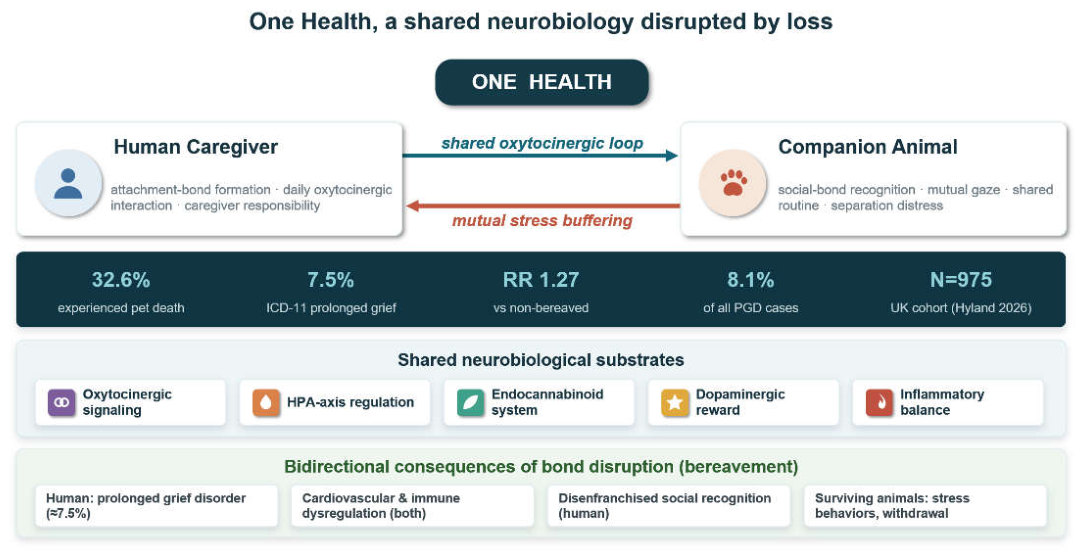
Figure 2.
Mechanism map of the six candidate neurobiological systems whose disruption is hypothesized to drive pet-loss grief, ranked by the First-Study Priority Index (FSPI). Systems are organized into a primary tier (oxytocinergic system, HPA axis, neuroinflammatory response), ready for first-generation biomarker testing, and an exploratory tier (dopaminergic, serotonergic, and endocannabinoid pathways), with the tier marked on each row. Each row summarizes the system's role during the bond and its predicted change upon loss, and reports the analogical readiness index (TRI, 0–100), the citation-consensus ratio (0–1, from Scite Smart Citations), the median empirical sample size of the primary studies (N, shown as a dash where review-only), and the composite FSPI (= TRI × consensus × sample-adequacy). Colors identify each system consistently across Figure 1, Figure 2 and Figure 4. TRI and FSPI are proposed heuristics; their definitions, weights, and sensitivity analyses are provided in Supplementary Methods S1. No direct pet-loss biomarker data yet exists, so all values derive from analogical human and animal evidence.
Figure 2.
Mechanism map of the six candidate neurobiological systems whose disruption is hypothesized to drive pet-loss grief, ranked by the First-Study Priority Index (FSPI). Systems are organized into a primary tier (oxytocinergic system, HPA axis, neuroinflammatory response), ready for first-generation biomarker testing, and an exploratory tier (dopaminergic, serotonergic, and endocannabinoid pathways), with the tier marked on each row. Each row summarizes the system's role during the bond and its predicted change upon loss, and reports the analogical readiness index (TRI, 0–100), the citation-consensus ratio (0–1, from Scite Smart Citations), the median empirical sample size of the primary studies (N, shown as a dash where review-only), and the composite FSPI (= TRI × consensus × sample-adequacy). Colors identify each system consistently across Figure 1, Figure 2 and Figure 4. TRI and FSPI are proposed heuristics; their definitions, weights, and sensitivity analyses are provided in Supplementary Methods S1. No direct pet-loss biomarker data yet exists, so all values derive from analogical human and animal evidence.
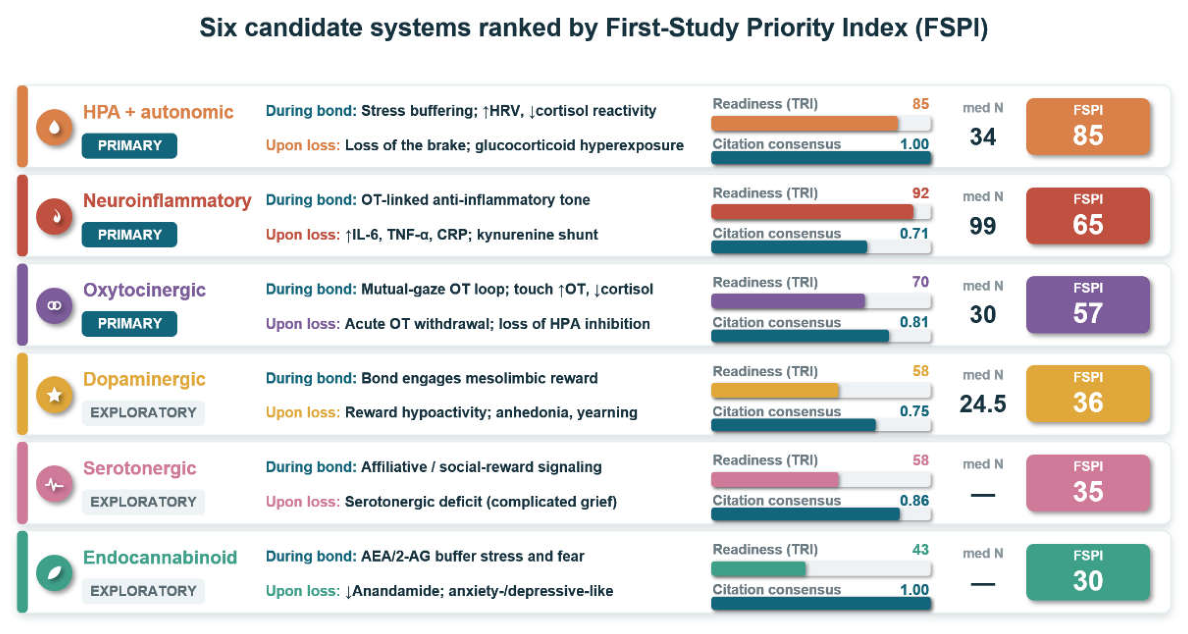
Figure 3.
Putative kynurenine-pathway bridge linking peripheral inflammation to serotonergic deficit. Pro-inflammatory signaling induces indoleamine 2,3-dioxygenase (IDO), which shunts tryptophan away from serotonin synthesis and toward kynurenine and its neuroactive metabolite quinolinic acid. Link-level citation-consensus ratios (inflammation → kynurenine, 0.76, Dantzer et al. 2011; kynurenine → serotonin, 0.94, Cervenka et al. 2017) yield a serial-chain confidence of 0.72 (0.76 × 0.94). Each step is established in the general stress-immunology literature but has not been measured in bereaved pet owners.
Figure 3.
Putative kynurenine-pathway bridge linking peripheral inflammation to serotonergic deficit. Pro-inflammatory signaling induces indoleamine 2,3-dioxygenase (IDO), which shunts tryptophan away from serotonin synthesis and toward kynurenine and its neuroactive metabolite quinolinic acid. Link-level citation-consensus ratios (inflammation → kynurenine, 0.76, Dantzer et al. 2011; kynurenine → serotonin, 0.94, Cervenka et al. 2017) yield a serial-chain confidence of 0.72 (0.76 × 0.94). Each step is established in the general stress-immunology literature but has not been measured in bereaved pet owners.
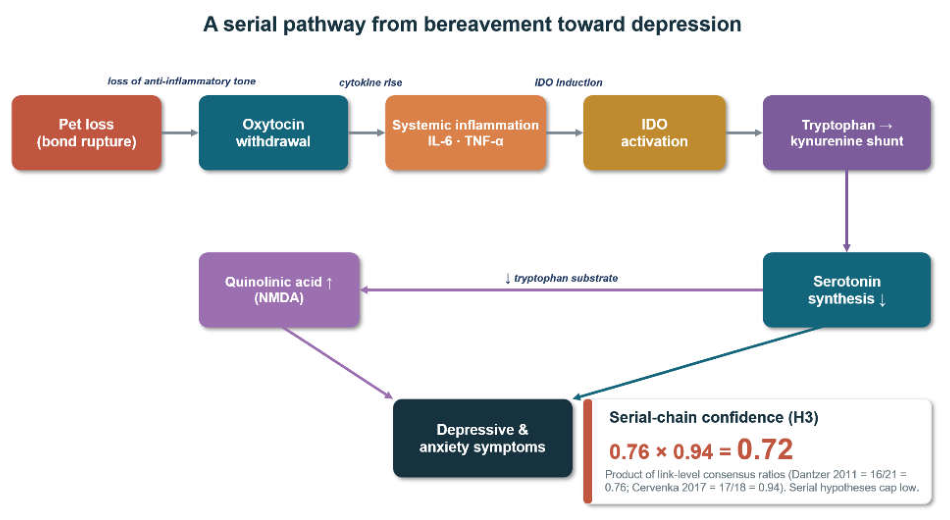
Figure 4.
Data-driven prioritization of the six mechanisms by the First-Study Priority Index (FSPI). Bubble position encodes analogical readiness (x-axis, TRI) and citation consensus (y-axis). Bubble area encodes sample adequacy. Bars show the composite FSPI (HPA axis 85, neuroinflammatory 65, oxytocinergic 57, dopaminergic 36, serotonergic 35, endocannabinoid 30), each computed as TRI × consensus × sample-adequacy. The HPA axis is prioritized even though the neuroinflammatory system leads in terms of readiness alone, because reliability and statistical power reweight the ranking. Colors identify each system consistently across Figure 1, Figure 2 and Figure 4. Derivations are fully specified and reproducible in Supplementary Methods S1.
Figure 4.
Data-driven prioritization of the six mechanisms by the First-Study Priority Index (FSPI). Bubble position encodes analogical readiness (x-axis, TRI) and citation consensus (y-axis). Bubble area encodes sample adequacy. Bars show the composite FSPI (HPA axis 85, neuroinflammatory 65, oxytocinergic 57, dopaminergic 36, serotonergic 35, endocannabinoid 30), each computed as TRI × consensus × sample-adequacy. The HPA axis is prioritized even though the neuroinflammatory system leads in terms of readiness alone, because reliability and statistical power reweight the ranking. Colors identify each system consistently across Figure 1, Figure 2 and Figure 4. Derivations are fully specified and reproducible in Supplementary Methods S1.
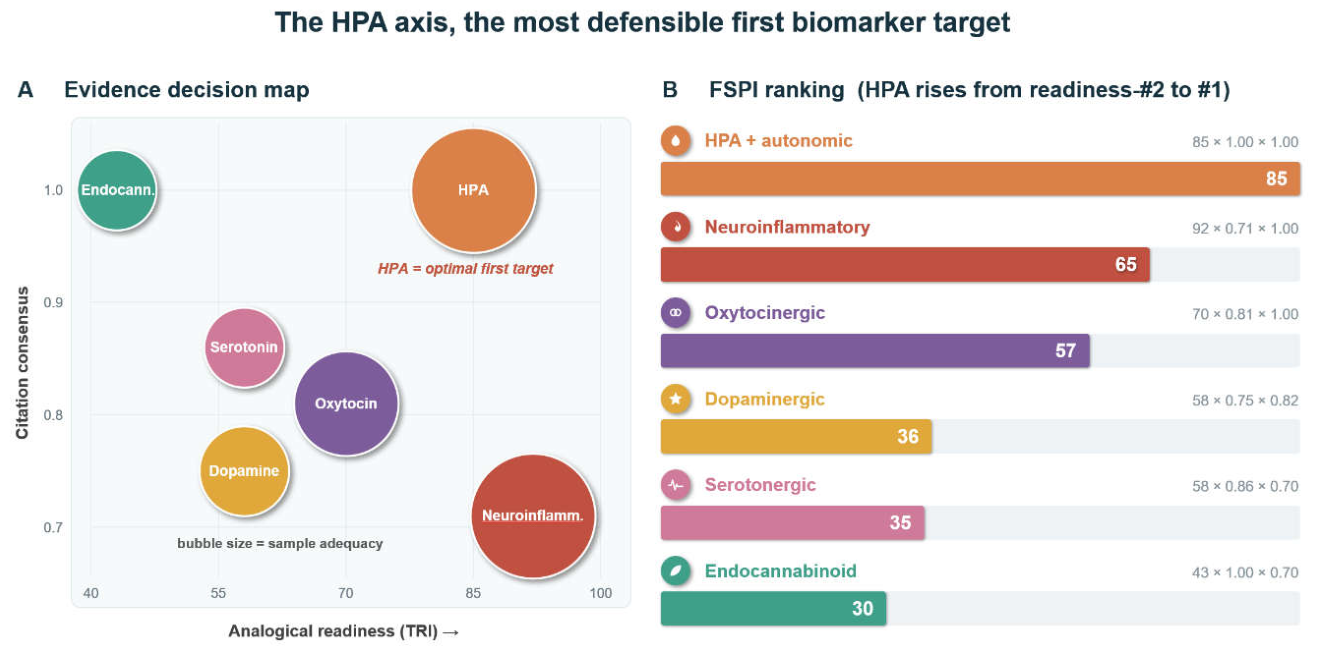
Figure 5.
Robustness of the HPA-first ranking across independent lenses. (Left) Citation-concentration analysis, using top-paper share and the Herfindahl index (HHI), identifies the neuroinflammatory system as the most single-source dependent (top-paper share ≈ 74%, HHI 0.57), whereas the HPA and oxytocinergic systems rest on a more evenly distributed base of primary loss studies. (Right) A rank matrix across three methodologically independent analyses (FSPI, evidence triangulation, and citation concentration; 1 = best) shows convergence on the HPA axis as the highest-priority first target. See Supplementary Methods S1 for all derivations.
Figure 5.
Robustness of the HPA-first ranking across independent lenses. (Left) Citation-concentration analysis, using top-paper share and the Herfindahl index (HHI), identifies the neuroinflammatory system as the most single-source dependent (top-paper share ≈ 74%, HHI 0.57), whereas the HPA and oxytocinergic systems rest on a more evenly distributed base of primary loss studies. (Right) A rank matrix across three methodologically independent analyses (FSPI, evidence triangulation, and citation concentration; 1 = best) shows convergence on the HPA axis as the highest-priority first target. See Supplementary Methods S1 for all derivations.
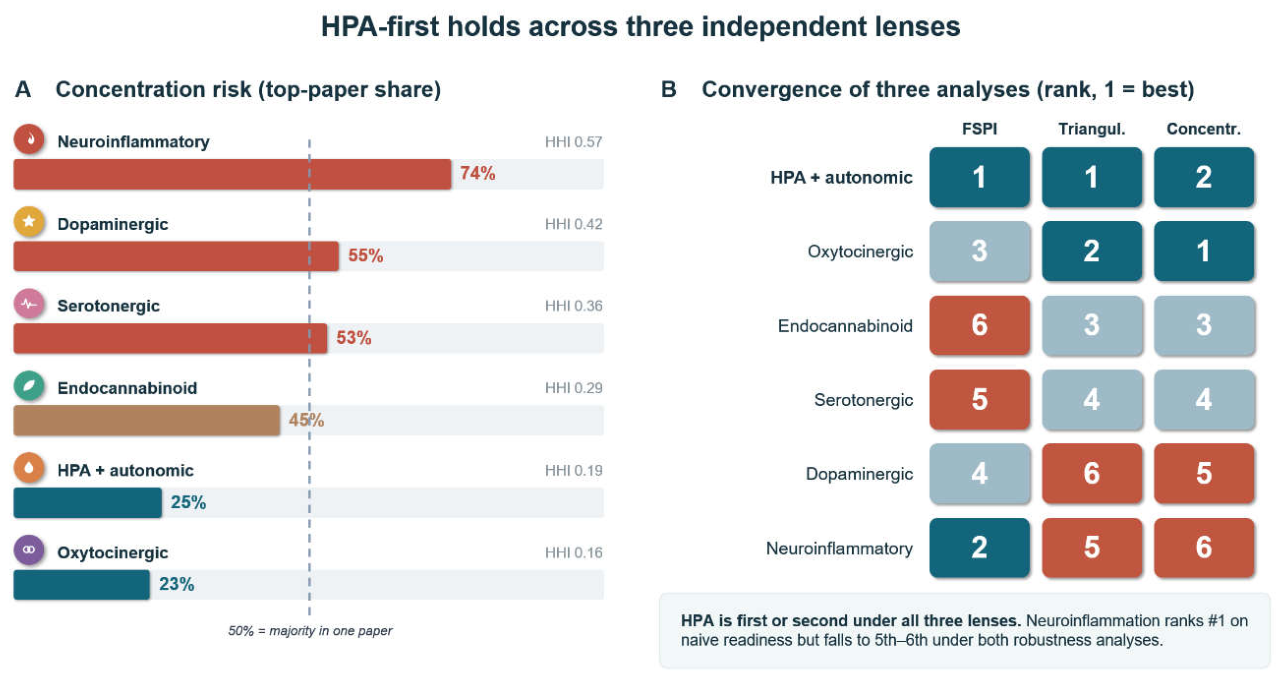
Figure 6.
Prevalence of prolonged or complicated grief across bereavement contexts. Point estimates with reported intervals: pet loss 7.5% (95% CI 5.9–9.4; Hyland et al. 2026, N = 975) and 9.4% (Lee 2020, N = 438); human complicated grief 9.8% (Lundorff et al. 2017, meta-analytic); a DSM-5 persistent complex bereavement reference midpoint of 3.6% (2.4–4.8% reference range); and COVID-19 bereavement 29.3% (Tang & Xiang 2021, N = 422). The DSM-5 value is the midpoint of a reference range rather than a study estimate, and the human benchmark intervals are reported ranges rather than uniformly re-derived 95% confidence intervals.
Figure 6.
Prevalence of prolonged or complicated grief across bereavement contexts. Point estimates with reported intervals: pet loss 7.5% (95% CI 5.9–9.4; Hyland et al. 2026, N = 975) and 9.4% (Lee 2020, N = 438); human complicated grief 9.8% (Lundorff et al. 2017, meta-analytic); a DSM-5 persistent complex bereavement reference midpoint of 3.6% (2.4–4.8% reference range); and COVID-19 bereavement 29.3% (Tang & Xiang 2021, N = 422). The DSM-5 value is the midpoint of a reference range rather than a study estimate, and the human benchmark intervals are reported ranges rather than uniformly re-derived 95% confidence intervals.
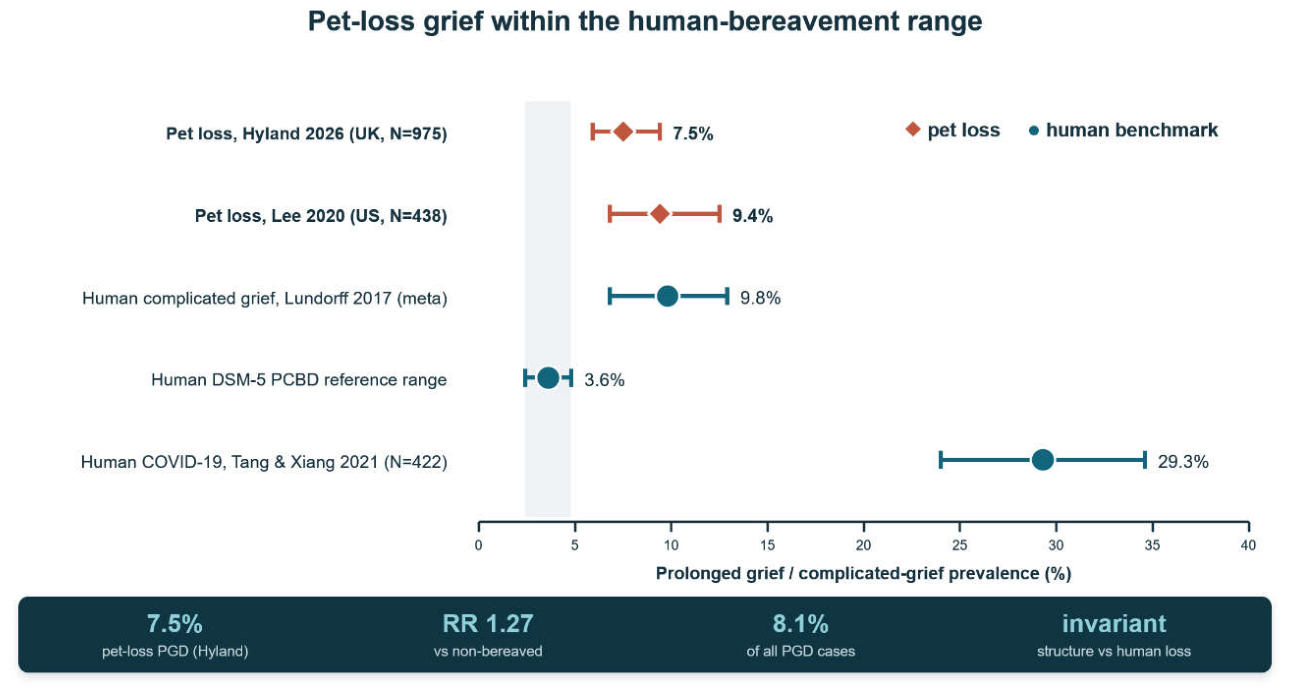
Table 1.
Evidence base, tier, and required empirical studies. None of the six neurobiological mechanisms has yet been examined directly in pet-bereaved populations. Every entry rests on analogical evidence and requires prospective validation, the gap this review addresses. The tier of each mechanism is also marked, so the strength of the underlying analogical case is visible at a glance.
Table 1.
Evidence base, tier, and required empirical studies. None of the six neurobiological mechanisms has yet been examined directly in pet-bereaved populations. Every entry rests on analogical evidence and requires prospective validation, the gap this review addresses. The tier of each mechanism is also marked, so the strength of the underlying analogical case is visible at a glance.
| Mechanism | Tier | Analogical Evidence | Required Studies |
|---|---|---|---|
| OT system disruption | Primary | Human–dog OT mutual gaze [24]; rodent pair bond disruption [33] | Prospective OT biomarker studies (saliva/urine); correlation with grief severity and pre-loss attachment |
| HPA dysregulation | Primary | Human bereavement cortisol elevation [34]; pet interaction cortisol reduction [36] | Serial cortisol (saliva, awakening response) in bereaved owners; wearable HRV monitoring |
| Dopaminergic disruption | Exploratory | Human grief fMRI: nucleus accumbens hypoactivation [45,46] | fMRI or PET of pet-loss-specific yearning; longitudinal neuroimaging |
| Neuroinflammation | Primary | Human bereavement: elevated IL-6, TNF-α [56]; animal models [55] | Inflammatory biomarker panels (IL-6, CRP, TNF-α); correlation with grief severity |
| Serotonergic disruption | Exploratory | Human complicated grief: reduced 5-HT [52] | Tryptophan/kynurenine pathway assays; 5-HTTLPR genotyping as moderator |
| ECS dysregulation | Exploratory | Animal social separation: reduced AEA [54] | Plasma endocannabinoid assays (AEA, 2-AG); CB1/CB2 receptor imaging |
Table 2.
Principal instruments for pet loss grief assessment with East Asian validation status.
| Instrument | Subscales/Items | Format | Clinical Application | East Asia Validation |
|---|---|---|---|---|
| Pet Bereavement Questionnaire (PBQ) [77] | Anger, Grief, Guilt (16 items) | 4-pt Likert | Identify high-risk individuals; evaluate interventions | Not validated |
| Companion Animal Bonding Scale (CABS) [78] | Attachment strength (8 items) | 5-pt Likert | Pre-loss risk stratification | Not validated |
| Pet Attitude Scale (PAS) [79] | Humanization, emotional closeness (13 items) | 7-pt Likert | Characterize attachment style | Not validated |
| Inventory of Complicated Grief (ICG) [80] | Yearning, bitterness, shock (19 items) | 5-pt Likert | Complicated grief screening | Korean version validated (ICG-K; see Note) |
| PHQ-9 / GAD-7 [81,82] | Depression/Anxiety severity | 4-pt Likert | Comorbid psychopathology screening | PHQ-9 validated in Korean |
| RBFM [83] | Decisional regret (5 items) | 5-pt Likert | End-of-life care regret; euthanasia contexts | Not validated |
| CARE Measure [84] | Veterinarian empathy (10 items) | 5-pt Likert | Veterinarian–client communication quality | Not validated |
Note. The Korean version of the Inventory of Complicated Grief has been validated among Korean adolescents [85], and it is the only grief-specific tool listed here with formal Korean validation. Adult validation in pet bereavement contexts has not been established.
Table 3.
Proposed phased roadmap for culturally adapted pet loss grief assessment in Korean and East Asian populations.
Table 3.
Proposed phased roadmap for culturally adapted pet loss grief assessment in Korean and East Asian populations.
| Phase | Timeline | Activities and Outputs |
|---|---|---|
| 1 | Year 1 | Qualitative exploration: focus groups and interviews with bereaved Korean pet owners; identification of emic grief expressions and cultural barriers → Conceptual model; preliminary item pool |
| 2 | Year 1–2 | Forward–backward translation and cultural adaptation of PBQ, CABS, ICG; cognitive interviewing with bilingual panels → K-PBQ, K-CABS, K-ICG |
| 3 | Year 2–3 | Psychometric validation: pilot study (n≥200); CFA; reliability (Cronbach α, test–retest); convergent/discriminant validity → Validated Korean instruments |
| 4 | Year 3–4 | Normative data collection: large-scale survey (n≥1000); Korean norms and cut-off scores → Korean normative database |
| 5 | Year 4–5 | Regional expansion with Japanese, Chinese, and Taiwanese collaborators; cross-cultural equivalence testing → East Asian assessment suite |
Table 4.
Therapeutic approaches for pet loss grief graded by evidence level.
| Intervention | Evidence Level | Supporting Evidence | Pet Loss RCT? | Recommended Use |
|---|---|---|---|---|
| Complicated Grief Treatment (CGT) | Level II* | RCT in human complicated grief [86] | No, extrapolated | First-line for complicated grief; pet-specific trial urgently needed |
| Cognitive-Behavioral Therapy (CBT) | Level II* | RCTs in human bereavement-related depression [87] | No, extrapolated | First-line for comorbid depression/anxiety; adapt for euthanasia guilt |
| Meaning-centered therapy | Level III* | Theoretical framework [72]; case series | No, extrapolated | Adjunctive: useful for existential dimensions of loss |
| Peer support / online groups | Level III* | Observational studies in pet loss [17,18] | No, observational only | Accessible; counteracts disenfranchisement; not standalone |
| SSRIs / SNRIs | Level II* | RCTs as augmentation in human complicated grief [86] | No, extrapolated | Consider for comorbid depression; not first-line for uncomplicated grief |
| Logotherapy | Level IV | Theoretical basis [88]; no controlled trials | No | Experimental; may benefit individuals with existential orientation |
| Intranasal oxytocin | Level V (speculative) | Animal models; human social bonding studies [89] | No, highly speculative | Research only; no clinical use at present |
Evidence grading note: Level II* = evidence extrapolated from RCTs in analogous human bereavement populations; Level III* = observational evidence or expert consensus extrapolated to pet loss; Level IV = theoretical basis only; Level V = speculative/experimental. No Level I evidence (pet-loss-specific RCTs) currently exists.
Disclaimer/Publisher’s Note: The statements, opinions and data contained in all publications are solely those of the individual author(s) and contributor(s) and not of MDPI and/or the editor(s). MDPI and/or the editor(s) disclaim responsibility for any injury to people or property resulting from any ideas, methods, instructions or products referred to in the content. |
© 2026 by the authors. Licensee MDPI, Basel, Switzerland. This article is an open access article distributed under the terms and conditions of the Creative Commons Attribution (CC BY) license (http://creativecommons.org/licenses/by/4.0/).
Copyright: This open access article is published under a Creative Commons CC BY 4.0 license, which permit the free download, distribution, and reuse, provided that the author and preprint are cited in any reuse.